EP2065738A1 - Optisches Gerät - Google Patents
Optisches Gerät Download PDFInfo
- Publication number
- EP2065738A1 EP2065738A1 EP08020721A EP08020721A EP2065738A1 EP 2065738 A1 EP2065738 A1 EP 2065738A1 EP 08020721 A EP08020721 A EP 08020721A EP 08020721 A EP08020721 A EP 08020721A EP 2065738 A1 EP2065738 A1 EP 2065738A1
- Authority
- EP
- European Patent Office
- Prior art keywords
- radiation
- optical
- fibre
- termination
- retroreflector
- Prior art date
- Legal status (The legal status is an assumption and is not a legal conclusion. Google has not performed a legal analysis and makes no representation as to the accuracy of the status listed.)
- Withdrawn
Links
- 0 **1CCCC1 Chemical compound **1CCCC1 0.000 description 2
Images



Classifications
-
- G—PHYSICS
- G01—MEASURING; TESTING
- G01N—INVESTIGATING OR ANALYSING MATERIALS BY DETERMINING THEIR CHEMICAL OR PHYSICAL PROPERTIES
- G01N21/00—Investigating or analysing materials by the use of optical means, i.e. using sub-millimetre waves, infrared, visible or ultraviolet light
- G01N21/01—Arrangements or apparatus for facilitating the optical investigation
- G01N21/03—Cuvette constructions
- G01N21/031—Multipass arrangements
-
- G—PHYSICS
- G01—MEASURING; TESTING
- G01N—INVESTIGATING OR ANALYSING MATERIALS BY DETERMINING THEIR CHEMICAL OR PHYSICAL PROPERTIES
- G01N21/00—Investigating or analysing materials by the use of optical means, i.e. using sub-millimetre waves, infrared, visible or ultraviolet light
- G01N21/01—Arrangements or apparatus for facilitating the optical investigation
- G01N21/03—Cuvette constructions
- G01N21/05—Flow-through cuvettes
-
- G—PHYSICS
- G01—MEASURING; TESTING
- G01N—INVESTIGATING OR ANALYSING MATERIALS BY DETERMINING THEIR CHEMICAL OR PHYSICAL PROPERTIES
- G01N21/00—Investigating or analysing materials by the use of optical means, i.e. using sub-millimetre waves, infrared, visible or ultraviolet light
- G01N21/01—Arrangements or apparatus for facilitating the optical investigation
- G01N21/03—Cuvette constructions
- G01N21/031—Multipass arrangements
- G01N2021/0314—Double pass, autocollimated path
-
- G—PHYSICS
- G02—OPTICS
- G02B—OPTICAL ELEMENTS, SYSTEMS OR APPARATUS
- G02B5/00—Optical elements other than lenses
- G02B5/12—Reflex reflectors
- G02B5/122—Reflex reflectors cube corner, trihedral or triple reflector type
-
- G—PHYSICS
- G02—OPTICS
- G02B—OPTICAL ELEMENTS, SYSTEMS OR APPARATUS
- G02B6/00—Light guides; Structural details of arrangements comprising light guides and other optical elements, e.g. couplings
- G02B6/24—Coupling light guides
- G02B6/26—Optical coupling means
- G02B6/262—Optical details of coupling light into, or out of, or between fibre ends, e.g. special fibre end shapes or associated optical elements
Definitions
- This invention relates to optical apparatus.
- the invention is more particularly concerned with optical apparatus of the kind employing an optical fibre to transmit an optical signal to detection apparatus.
- the apparatus may include a process cell to which a fluid, such as a gas, vapour, liquid or other flowable substance is supplied, such as in line in a processing system.
- a fluid such as a gas, vapour, liquid or other flowable substance
- Optical radiation such as infra-red radiation
- the termination of the cable is arranged to direct radiation across a part of the cell so that it passes through the fluid.
- a second optical fibre cable is arranged with its termination in line with the first termination so that radiation from the first cable is directed onto the second cable.
- the second cable typically extends to a remote spectrometer by which the radiation is analysed and information obtained about the fluid in the cell.
- Some process cells are arranged with the inlet and outlet optical fibre terminations side-by-side and have a mirror mounted in the cell opposite the terminations so that the incoming radiation passes through the fluid and is reflected by the mirror back through the fluid onto the outlet fibre termination, making two passes through the fluid.
- the optical fibre cables typically used in such apparatus include multimode fibres with a relatively large diameter of between about 200-600 ⁇ m.
- These multimode fibres have various disadvantages. They are relatively expensive, which is a particular problem because two cables are needed and they often extend for considerable distances, such as in chemical plants or other hazardous environments where the monitoring cannot readily be carried out close to the process cell.
- Another problem is that they are not suited to use with coherent radiation sources because of interference effects caused by the multiple, different path lengths along the cable for the different propagation modes supported by the fibre. They cannot, therefore, be used with tunable diode lasers without significant deterioration in signal-to-noise ratio. These sources would otherwise be advantageous in such applications.
- Single-mode fibre cables would be preferable because they can be used with coherent sources and are of lower cost.
- the considerably smaller core diameter of single-mode fibres typically around 9 ⁇ m for telecommunications grade fibre at 1550nm
- optical apparatus including an optical fibre capable of supporting upto 10 propagation modes, said optical fibre having a radiation inlet/outlet at one end and a termination by which optical radiation is transmitted from the fibre at the other end, a retroreflector spaced from the termination and aligned with the path of radiation from the termination such that the radiation is reflected back along the same path onto the termination and the reflected radiation passes back along the same fibre to the radiation inlet.
- the optical fibre is preferably a single-mode fibre over the wavelengths of radiation used and could be of polarisation maintaining type.
- the apparatus preferably includes a circulator by which radiation is supplied to and from the optical fibre.
- an optical detection cell including a housing having a cavity therein for receiving a substance, an optical aperture in the housing, an optical fibre which is secured relative to the optical aperture to direct radiation into the cavity, retroreflector means mounted opposite the aperture such that radiation from the optical fibre passes through the substance in the cavity onto the retroreflector means and is reflected by the retroreflector means back to the optical fibre.
- the optical fibre is preferably a single-mode fibre.
- the optical detection cell may be a process cell including an inlet and an outlet by which fluid can be supplied to flow through the cavity.
- a spectrometer system including a source of optical radiation, an optical detector, a detection cell, an optical fibre cable arrangement extending between the source of optical radiation, the detector and the detection cell, the detection cell having a cavity for containing a substance for spectrometer analysis and being arranged such that radiation from the optical fibre cable arrangement is directed through the substance onto a retroreflector to be reflected back along the same path to the optical fibre arrangement such that the detector receives radiation after two passes through the substance along the same path.
- the optical fibre cable arrangement preferably includes a single-mode fibre.
- the optical fibre cable arrangement also includes an optical circulator by which radiation is supplied from the source to the detection cell and from the detection cell to the detector.
- the optical detection cell may be a process cell including an inlet and an outlet by which fluid can be supplied to flow through the cavity.
- the system includes a source of radiation such as of a tunable diode laser 1, or other source of similar coherent radiation, connected to provide an output to a one arm 2 of an optical fibre arrangement 3.
- a second arm 4 of the optical fibre arrangement 3 is connected to provide an output to a detector 5.
- a third arm 6 of the optical fibre arrangement 3 provides an input to and receives an output from a detection cell in the form of a process cell 7, which receives a flow of fluid through it via an inlet 8 and an outlet 9.
- the tunable diode laser 1 may be of a conventional form arranged to provide a radiation output at near infra-red wavelengths, typically between about 0.6 ⁇ m and 25 ⁇ m.
- the radiation is coherent with a very narrow bandwidth.
- Other forms of radiation source are possible.
- the source could be a broadband source of radiation in which case the detector would be replaced by a spectrometer.
- the optical fibre arrangement 3 comprises a length of single-mode optical fibre cable 30 providing the third arm 6.
- the fibre 130 ( Fig 3 ) in the cable 30 is typically of silica or other material transparent to the wavelength being transmitted.
- the fibre is typically around 125 ⁇ m in diameter with a core of around 9 ⁇ diameter, for a 1550nm operating wavelength so that it transmits radiation along a single path through the fibre, that is, in a single mode.
- the cable 30 may have an outer protective jacket of any conventional kind suitable for the environment in which the cable is being used.
- the small diameter of the fibre 130 means that the overall diameter of the cable 30 can be relatively small and that it can be highly flexible.
- the cable 30 may be many tens or hundreds of metres long according to where the detector 5 and source 1 are to be located relative to the process cell 7.
- One end of the cable 30 is terminated by a termination or connector 31, which is secured to a first end 76 of the process cell 7.
- the opposite end 32 of the cable 30 connects with, or is formed as a part of, an optical fibre circulator 33 of known kind.
- the circulator 33 also connects with the first and second arms 2 and 4 of the optical fibre arrangement 3, which are likewise provided by single-mode optical fibre cables 34 and 35 respectively.
- the circulator 33 is arranged to supply radiation from the source 1 via the cable 34 to only the process cell cable 30, and to supply return radiation from the process cell cable 30 to only the detector cable 35.
- Circulators also have an advantage when being used with laser sources because they substantially isolate the source from returned radiation, which could otherwise make the laser unstable.
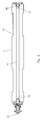
- the process cell 7 can be of many different kinds but, in the present embodiment comprises a housing 70 of substantially tubular form machined of a metal and having a straight, axial bore extending along its length providing a cavity 71 within the housing 70.
- the inlet 8 opens into the cavity 71 via an opening 72.
- the outlet 9 opens from the cavity 71 via an opening 73.
- the cavity 71 at end 76 of process cell 7, is closed by an end fitting 75 screwed to the end face of the housing 70.
- the end fitting 75 comprises a metal plate 77 with a central, cylindrical collar 78 having a bore 83, which receives within it as an accurate sliding fit a cylindrical sleeve 79.
- An inner end of the sleeve 79 bears on one end of a helical spring 80 in the bore 83, the other end of spring 80 engaging a ledge 180 formed adjacent the inner end of the bore 83.
- the sleeve 79 supports three radially-extending pins 181, which project through longitudinally-extending slots (not visible) in the collar 78.
- An outer ring 182 has an internal screw thread 183 engaged with an external screw thread 184 on the collar 78.
- a reduced diameter end portion of the ring 182 bears on the pins 181 and is resiliently retained in engagement therewith by spring 80, so that the sleeve 79 can be moved axially forwards or backwards along the bore 83, to effect focusing by screwing the ring 182 along the collar 78.
- An end plate 81 is screwed to the outer end of the sleeve 79 and this supports an externally-threaded fitting 82.
- the end fitting 75 supports two optical components that serve both an optical and sealing function.
- a meniscus type focusing lens 84 is mounted in the bore of sleeve 79 so that its axial position can be altered with that of the sleeve 79.
- the lens 84 has an outer concave surface and an inner convex surface.
- the lenses 84 and 85 are made of materials that are capable of surviving the environmental conditions to which they are exposed.
- the material of the lens 85 in particular, is chosen to resist damage from contact with the fluid in the cavity 71 to which it is exposed.
- Sapphire is a particularly suitable material that is resistant to many chemicals and to large temperature variations, it is also transparent to infra-red wavelengths.
- the termination 31 at the end of the cable 30 is screwed onto the fitting 82 with the end of the single-mode fibre 130 in the cable located at the focus of the lens system provided by the lenses 84 and 85, so that radiation emerging from the cable 30 is formed into a parallel beam directed axially along the length of the cavity 71.
- the opposite end of the bore of cavity 71 in the process cell 7 is closed by an end plate 90 screwed to the end face of the housing 70 at end 91.
- the inner surface of the end plate 90 is formed with a retaining ring 92, which supports a retroreflector 93.
- the retroreflector 93 is provided by a block 100 of an optically-transparent material suited to the environmental conditions to which it is exposed, such as sapphire.
- the surface 95 of the block 100 adjacent endplate 90 is formed with three planar facets 96, 97 and 98 inclined mutually at 90° to one another.
- the surface 102 on the block 100 remote from end plate 90 is plane and orthogonal to the axis of the cavity 71.
- Radiation incident on the transparent block 100 passes through it to be incident on one of the three inclined facets 96, 97, 98 and is reflected within the block 100 from said one facet to a second facet and then to a third facet from which it is reflected back parallel to the initial incident direction as indicated by the ray line 104, as shown in figure 4a .
- Radiation incident on the retroreflector 93 over a range of angles is reflected back along the same path.
- Radiation from the fibre 130 is directed axially along the cavity 71 of the cell 7 through fluid present in the cavity 71.
- the radiation is incident on the retroreflector 93 and is then reflected back through the cavity 71 at the same angle so that the radiation makes a double pass through the fluid and the reflected radiation is incident on the termination 31 of the fibre 130.
- the reflected radiation is reflected back along the same path as the incident radiation, irrespective of any slight misalignment of the optical fibre cable termination 31 or other defect causing a slight deviation of the radiation from a true axial path and will not have any effect on the radiation received back by the termination even where fibres with a very small diameter are used, such as in single-mode optical fibre cables.
- a pair of windows 200, 202 are secured in the cavity 71 one adjacent each of the ends of the cavity, to seal the cavity.
- the windows 200, 202 and made of materials, for example sapphire, that are capable of surviving the environmental conditions to which they are exposed and are transparent to infra-red wavelengths or the wavelengths of the light produced by the source 1.
- the faces of the windows 200, 202 are inclined to the axis of the cavity 71 so that any light reflected from the windows will be reflected none axially and will not be returned along the same path as the incident and reflected beams, thereby avoiding interference with the incident and reflected beams.
- the end plate 90 locates a retroreflector 193 in the form of a mirror block 200, coaxially of the cavity 71, the mirror block 200 being retained in place by retaining bolt 204.
- the mirror block 193 defines three mirror surfaces 196 to 198, inclined mutually at 90° to one another, the mirror surfaces facing the incident beam emitted from the termination of the fibre optic cable 30.
- the mirror block 193 reflects the incident beam from one mirror surface 196 to 198, a second mirror surface and then to a third mirror surface from which it is reflected back parallel to the path of the initial beam, to the termination 31 of the fibre optic cable 30.
- the retroreflector 93, 193 may be in the form of an array of mini retroreflectors 293, each mini retroreflector 293 defining three facets or mirror surfaces 296, 297, 298, inclined mutually at 90° to one another, as illustrated in figure 8 .
- the fluid used is a gas or vapour, which requires a relatively long path length to produce a measurable effect on the transmitted radiation. If a liquid were used the cavity 71 could be much shorter.
- the fibre optic end termination 31 and focusing assembly is mounted at one end of a process cell 7 and the retroreflector 93, 193, 293 is mounted at the other end, the end termination and focusing assembly and retroreflector 93,193,293 may be separate components which may, for example be mounted in aligned relationship on opposite sides of a vessel or conduit to detect fluid in or flowing through the vessel or conduit, for example gasses flowing through a flue.
- the arrangement of the present invention enables a single-mode fibre cable to be used with a process cell or other optical detection device. It also enables a single cable to be used to supply radiation both to and from an optical device. These factors enable considerable expense, bulk and weight to be saved especially where the optical device is located at a considerable distance from the source and detector.
- the invention also avoids the modal noise produced when using multi-mode fibre cables.
- the cable terminations and the process cell are relatively easy to set up because no special care has to be taken to ensure accurate alignment. There is also less risk of loss of output signal as misalignment increases over time caused by vibration, shock, temperature changes and the like.
- the invention is not confined to use with process cells but could be used with other optical devices such as for detecting the presence of objects or for detection employing fluorescence techniques.
- the invention may be used with any optical radiation from infra-red to ultra-violet.
Landscapes
- Physics & Mathematics (AREA)
- Health & Medical Sciences (AREA)
- Life Sciences & Earth Sciences (AREA)
- Chemical & Material Sciences (AREA)
- Analytical Chemistry (AREA)
- Biochemistry (AREA)
- General Health & Medical Sciences (AREA)
- General Physics & Mathematics (AREA)
- Immunology (AREA)
- Pathology (AREA)
- Investigating Or Analysing Materials By Optical Means (AREA)
Applications Claiming Priority (1)
| Application Number | Priority Date | Filing Date | Title |
|---|---|---|---|
| GBGB0723561.7A GB0723561D0 (en) | 2007-12-01 | 2007-12-01 | Optical apparatus |
Publications (1)
| Publication Number | Publication Date |
|---|---|
| EP2065738A1 true EP2065738A1 (de) | 2009-06-03 |
Family
ID=38962474
Family Applications (1)
| Application Number | Title | Priority Date | Filing Date |
|---|---|---|---|
| EP08020721A Withdrawn EP2065738A1 (de) | 2007-12-01 | 2008-11-28 | Optisches Gerät |
Country Status (3)
| Country | Link |
|---|---|
| US (1) | US20090141273A1 (de) |
| EP (1) | EP2065738A1 (de) |
| GB (1) | GB0723561D0 (de) |
Cited By (5)
| Publication number | Priority date | Publication date | Assignee | Title |
|---|---|---|---|---|
| CN102645277A (zh) * | 2012-04-10 | 2012-08-22 | 上海美析仪器有限公司 | 一种微孔光谱仪 |
| EP2604999A1 (de) * | 2011-12-15 | 2013-06-19 | Mettler-Toledo AG | Gasmessgerät |
| CN105258823A (zh) * | 2015-11-03 | 2016-01-20 | 中国原子能科学研究院 | 一种瞬态冲击波温度测量系统及方法 |
| EP3647769A1 (de) * | 2018-10-29 | 2020-05-06 | ETH Zurich | Durchflusszelle |
| EP4198494A1 (de) * | 2021-12-20 | 2023-06-21 | M & C TechGroup Germany GmbH | Verwendung von spinell, polykristallinem aluminiumoxid oder aluminiumoxynitrid als reflexionselement in einem messgerät zur absorptions-spektroskopischen gasmessung, dieses messgerät und verfahren zur absorptions-spektroskopischen gasmessung damit |
Families Citing this family (4)
| Publication number | Priority date | Publication date | Assignee | Title |
|---|---|---|---|---|
| CA2780068A1 (en) * | 2009-11-06 | 2011-05-12 | Schlumberger Canada Limited | Light based communication port for use on downhole tools |
| US9714562B2 (en) | 2009-11-06 | 2017-07-25 | Schlumberger Technology Corporation | Downhole logging communication module |
| DE102010062027A1 (de) * | 2010-11-26 | 2012-05-31 | Siemens Aktiengesellschaft | Messaufbau für die optische Absorptions-Spektroskopie |
| FR3030783B1 (fr) * | 2014-12-17 | 2017-01-20 | Commissariat Energie Atomique | Retroreflecteur assurant les fonctions de retroreflexion et de captation d'un parametre de l'environnement |
Citations (5)
| Publication number | Priority date | Publication date | Assignee | Title |
|---|---|---|---|---|
| GB2219656A (en) * | 1988-06-10 | 1989-12-13 | Plessey Co Plc | Sensor for sensing the light absorption of a gas |
| US5185834A (en) * | 1991-03-04 | 1993-02-09 | Specac Ltd. | Optical fiber probes for remote analysis |
| US5572031A (en) * | 1994-11-23 | 1996-11-05 | Sri International | Pressure- and temperature-compensating oxygen sensor |
| US20060091303A1 (en) * | 2004-10-29 | 2006-05-04 | Evans Alan F | Optical sensors |
| WO2007060523A1 (en) * | 2005-11-22 | 2007-05-31 | Mycrolab P/L | Microfluidic structures |
Family Cites Families (2)
| Publication number | Priority date | Publication date | Assignee | Title |
|---|---|---|---|---|
| US5347475A (en) * | 1991-09-20 | 1994-09-13 | Amoco Corporation | Method for transferring spectral information among spectrometers |
| JP4048729B2 (ja) * | 2001-04-24 | 2008-02-20 | 横河電機株式会社 | 光ファイバ特性測定装置 |
-
2007
- 2007-12-01 GB GBGB0723561.7A patent/GB0723561D0/en not_active Ceased
-
2008
- 2008-11-28 EP EP08020721A patent/EP2065738A1/de not_active Withdrawn
- 2008-12-01 US US12/325,497 patent/US20090141273A1/en not_active Abandoned
Patent Citations (5)
| Publication number | Priority date | Publication date | Assignee | Title |
|---|---|---|---|---|
| GB2219656A (en) * | 1988-06-10 | 1989-12-13 | Plessey Co Plc | Sensor for sensing the light absorption of a gas |
| US5185834A (en) * | 1991-03-04 | 1993-02-09 | Specac Ltd. | Optical fiber probes for remote analysis |
| US5572031A (en) * | 1994-11-23 | 1996-11-05 | Sri International | Pressure- and temperature-compensating oxygen sensor |
| US20060091303A1 (en) * | 2004-10-29 | 2006-05-04 | Evans Alan F | Optical sensors |
| WO2007060523A1 (en) * | 2005-11-22 | 2007-05-31 | Mycrolab P/L | Microfluidic structures |
Cited By (9)
| Publication number | Priority date | Publication date | Assignee | Title |
|---|---|---|---|---|
| EP2604999A1 (de) * | 2011-12-15 | 2013-06-19 | Mettler-Toledo AG | Gasmessgerät |
| WO2013087753A1 (de) * | 2011-12-15 | 2013-06-20 | Mettler-Toledo Ag | Gasmessgerät |
| US9304079B2 (en) | 2011-12-15 | 2016-04-05 | Mettler-Toledo Gmbh | Gas analyser |
| CN102645277A (zh) * | 2012-04-10 | 2012-08-22 | 上海美析仪器有限公司 | 一种微孔光谱仪 |
| CN105258823A (zh) * | 2015-11-03 | 2016-01-20 | 中国原子能科学研究院 | 一种瞬态冲击波温度测量系统及方法 |
| CN105258823B (zh) * | 2015-11-03 | 2017-11-21 | 中国原子能科学研究院 | 一种瞬态冲击波温度测量系统及方法 |
| EP3647769A1 (de) * | 2018-10-29 | 2020-05-06 | ETH Zurich | Durchflusszelle |
| EP4198494A1 (de) * | 2021-12-20 | 2023-06-21 | M & C TechGroup Germany GmbH | Verwendung von spinell, polykristallinem aluminiumoxid oder aluminiumoxynitrid als reflexionselement in einem messgerät zur absorptions-spektroskopischen gasmessung, dieses messgerät und verfahren zur absorptions-spektroskopischen gasmessung damit |
| WO2023118171A1 (de) * | 2021-12-20 | 2023-06-29 | M&C Techgroup Germany Gmbh | Spinell, polykristallines aluminiumoxid oder aluminiumoxynitrid als reflexionselement in messgerät zur absorptions-spektroskopischen gasmessung und verfahren der absorptions-spektroskopie |
Also Published As
| Publication number | Publication date |
|---|---|
| GB0723561D0 (en) | 2008-01-09 |
| US20090141273A1 (en) | 2009-06-04 |
Similar Documents
| Publication | Publication Date | Title |
|---|---|---|
| EP2065738A1 (de) | Optisches Gerät | |
| US10185096B2 (en) | Ferrule-core concentricity measurement systems and methods | |
| US6963062B2 (en) | Method for multiplexed optical detection including a multimode optical fiber in which propagation modes are coupled | |
| US10551303B2 (en) | Flow cell optical detection system | |
| EP0080887A2 (de) | Faseroptische Datenübertragungsmodule | |
| US8358882B2 (en) | Modalmetric fibre sensor | |
| CN105531612A (zh) | 光学耦合器 | |
| EP3887792B1 (de) | Grosse kernvorrichtung zur messung der optischen leistung in mehrfaserkabeln | |
| GB2217834A (en) | Evanescent sensor | |
| CA2424820A1 (en) | Prismatic reflection optical waveguide device | |
| EP0298091A1 (de) | Optische sensoren und optisches fasernetz für diese sensoren | |
| US6690459B2 (en) | Method and apparatus for fiber alignment using light leaked from cladding | |
| CA2411638A1 (en) | Fiber optic sensing system | |
| EP0842413B1 (de) | Wellenleitersensor für die anwendung in einem probenmedium und verfahren zur einkopplung elektromagnetischer strahlung | |
| US5334850A (en) | Method and device for optically detecting an interface between two fluids and method of setting the parameters for such detection | |
| US9958615B2 (en) | Monolithic element and system for collimating or focusing laser light from or to an optical fiber | |
| Mignani et al. | Radially gradient-index lenses: applications to fiber optic sensors | |
| US20240310193A1 (en) | Off-axis fiber optic sensor | |
| US20250297901A1 (en) | Optical Signal Transfer Mechanism For A Vacuum Compatible Spring Loaded Thermometry Probe | |
| KR100719488B1 (ko) | 베벨컷된 광섬유팁을 이용한 콜리메이터 | |
| GB2423816A (en) | High Temperature ATR Probe | |
| Mignani et al. | Micro-optic probes for gas absorption measurements: design study and demonstrators | |
| Insou et al. | Expanded beam connectors for single mode optical fiber sensor applications in harsh environment | |
| Boudreau et al. | Single-mode fiber coupling to laser diode arrays | |
| Conde Portilla et al. | New optical cell design for pollutant detection |
Legal Events
| Date | Code | Title | Description |
|---|---|---|---|
| PUAI | Public reference made under article 153(3) epc to a published international application that has entered the european phase |
Free format text: ORIGINAL CODE: 0009012 |
|
| AK | Designated contracting states |
Kind code of ref document: A1 Designated state(s): AT BE BG CH CY CZ DE DK EE ES FI FR GB GR HR HU IE IS IT LI LT LU LV MC MT NL NO PL PT RO SE SI SK TR |
|
| AX | Request for extension of the european patent |
Extension state: AL BA MK RS |
|
| 17P | Request for examination filed |
Effective date: 20091130 |
|
| 17Q | First examination report despatched |
Effective date: 20100104 |
|
| AKX | Designation fees paid |
Designated state(s): AT BE BG CH CY CZ DE DK EE ES FI FR GB GR HR HU IE IS IT LI LT LU LV MC MT NL NO PL PT RO SE SI SK TR |
|
| STAA | Information on the status of an ep patent application or granted ep patent |
Free format text: STATUS: THE APPLICATION IS DEEMED TO BE WITHDRAWN |
|
| 18D | Application deemed to be withdrawn |
Effective date: 20101130 |