EP2065859A2 - Mikroprozessorkarte, eine solche Karte enthaltendes Telefon und Verarbeitungsverfahren in einer solchen Karte - Google Patents
Mikroprozessorkarte, eine solche Karte enthaltendes Telefon und Verarbeitungsverfahren in einer solchen Karte Download PDFInfo
- Publication number
- EP2065859A2 EP2065859A2 EP08291030A EP08291030A EP2065859A2 EP 2065859 A2 EP2065859 A2 EP 2065859A2 EP 08291030 A EP08291030 A EP 08291030A EP 08291030 A EP08291030 A EP 08291030A EP 2065859 A2 EP2065859 A2 EP 2065859A2
- Authority
- EP
- European Patent Office
- Prior art keywords
- application
- card
- command
- response
- microprocessor
- Prior art date
- Legal status (The legal status is an assumption and is not a legal conclusion. Google has not performed a legal analysis and makes no representation as to the accuracy of the status listed.)
- Ceased
Links
Images


Classifications
-
- G—PHYSICS
- G06—COMPUTING OR CALCULATING; COUNTING
- G06K—GRAPHICAL DATA READING; PRESENTATION OF DATA; RECORD CARRIERS; HANDLING RECORD CARRIERS
- G06K19/00—Record carriers for use with machines and with at least a part designed to carry digital markings
- G06K19/06—Record carriers for use with machines and with at least a part designed to carry digital markings characterised by the kind of the digital marking, e.g. shape, nature, code
- G06K19/067—Record carriers with conductive marks, printed circuits or semiconductor circuit elements, e.g. credit or identity cards also with resonating or responding marks without active components
- G06K19/07—Record carriers with conductive marks, printed circuits or semiconductor circuit elements, e.g. credit or identity cards also with resonating or responding marks without active components with integrated circuit chips
-
- G—PHYSICS
- G07—CHECKING-DEVICES
- G07F—COIN-FREED OR LIKE APPARATUS
- G07F7/00—Mechanisms actuated by objects other than coins to free or to actuate vending, hiring, coin or paper currency dispensing or refunding apparatus
- G07F7/08—Mechanisms actuated by objects other than coins to free or to actuate vending, hiring, coin or paper currency dispensing or refunding apparatus by coded identity card or credit card or other personal identification means
- G07F7/10—Mechanisms actuated by objects other than coins to free or to actuate vending, hiring, coin or paper currency dispensing or refunding apparatus by coded identity card or credit card or other personal identification means together with a coded signal, e.g. in the form of personal identification information, like personal identification number [PIN] or biometric data
- G07F7/1008—Active credit-cards provided with means to personalise their use, e.g. with PIN-introduction/comparison system
-
- G—PHYSICS
- G06—COMPUTING OR CALCULATING; COUNTING
- G06F—ELECTRIC DIGITAL DATA PROCESSING
- G06F1/00—Details not covered by groups G06F3/00 - G06F13/00 and G06F21/00
-
- G—PHYSICS
- G06—COMPUTING OR CALCULATING; COUNTING
- G06Q—INFORMATION AND COMMUNICATION TECHNOLOGY [ICT] SPECIALLY ADAPTED FOR ADMINISTRATIVE, COMMERCIAL, FINANCIAL, MANAGERIAL OR SUPERVISORY PURPOSES; SYSTEMS OR METHODS SPECIALLY ADAPTED FOR ADMINISTRATIVE, COMMERCIAL, FINANCIAL, MANAGERIAL OR SUPERVISORY PURPOSES, NOT OTHERWISE PROVIDED FOR
- G06Q20/00—Payment architectures, schemes or protocols
- G06Q20/30—Payment architectures, schemes or protocols characterised by the use of specific devices or networks
- G06Q20/34—Payment architectures, schemes or protocols characterised by the use of specific devices or networks using cards, e.g. integrated circuit [IC] cards or magnetic cards
- G06Q20/341—Active cards, i.e. cards including their own processing means, e.g. including an IC or chip
-
- G—PHYSICS
- G06—COMPUTING OR CALCULATING; COUNTING
- G06Q—INFORMATION AND COMMUNICATION TECHNOLOGY [ICT] SPECIALLY ADAPTED FOR ADMINISTRATIVE, COMMERCIAL, FINANCIAL, MANAGERIAL OR SUPERVISORY PURPOSES; SYSTEMS OR METHODS SPECIALLY ADAPTED FOR ADMINISTRATIVE, COMMERCIAL, FINANCIAL, MANAGERIAL OR SUPERVISORY PURPOSES, NOT OTHERWISE PROVIDED FOR
- G06Q20/00—Payment architectures, schemes or protocols
- G06Q20/30—Payment architectures, schemes or protocols characterised by the use of specific devices or networks
- G06Q20/34—Payment architectures, schemes or protocols characterised by the use of specific devices or networks using cards, e.g. integrated circuit [IC] cards or magnetic cards
- G06Q20/356—Aspects of software for card payments
- G06Q20/3563—Software being resident on card
-
- G—PHYSICS
- G06—COMPUTING OR CALCULATING; COUNTING
- G06Q—INFORMATION AND COMMUNICATION TECHNOLOGY [ICT] SPECIALLY ADAPTED FOR ADMINISTRATIVE, COMMERCIAL, FINANCIAL, MANAGERIAL OR SUPERVISORY PURPOSES; SYSTEMS OR METHODS SPECIALLY ADAPTED FOR ADMINISTRATIVE, COMMERCIAL, FINANCIAL, MANAGERIAL OR SUPERVISORY PURPOSES, NOT OTHERWISE PROVIDED FOR
- G06Q20/00—Payment architectures, schemes or protocols
- G06Q20/30—Payment architectures, schemes or protocols characterised by the use of specific devices or networks
- G06Q20/34—Payment architectures, schemes or protocols characterised by the use of specific devices or networks using cards, e.g. integrated circuit [IC] cards or magnetic cards
- G06Q20/357—Cards having a plurality of specified features
-
- H—ELECTRICITY
- H04—ELECTRIC COMMUNICATION TECHNIQUE
- H04B—TRANSMISSION
- H04B1/00—Details of transmission systems, not covered by a single one of groups H04B3/00 - H04B13/00; Details of transmission systems not characterised by the medium used for transmission
- H04B1/38—Transceivers, i.e. devices in which transmitter and receiver form a structural unit and in which at least one part is used for functions of transmitting and receiving
- H04B1/40—Circuits
Definitions
- the present invention relates to a microprocessor card. It applies more particularly to microprocessor cards compliant with the ISO 7816 standard and microprocessor cards that comply with the MMC (acronym for "MultiMedia Card” multimedia card) standard.
- the invention also relates to a mobile phone comprising such a card and a processing method on such a card.
- microprocessor cards may have several applications, stored in non-volatile memory, for example in ROM or EEPROM memory, ie the internal microprocessor (s) have, in memory, executable (or interpretable) codes of several computer applications and are suitable to run them to ensure a particular task or function.
- a first default application may be a mobile phone application, if it is a mobile phone card, intended for a mobile phone, and a second application is a banking application used. occasionally for example to make a payment using the phone.
- a mobile phone standard for example, a GSM standard [acronym for "Global System for Mobile Communications "] or ETSI [acronym for "European Telecommunications Standards Institute "]
- a banking standard eg EMV [acronym for" Europay Mastercard Visa "]
- An example of a first application is a smart card web server (SCWS), adapted to communicate with a browser of the mobile phone and / or with the Internet network via the network of smartphones (" Smart Card Web Serve " in English terminology).
- SCWS smart card web server
- mobile telephony for example through the WAP protocol (acronym for " Wireless Application Protocol ").
- the microprocessor cards include both a security-intensive application and an application with a moderate security requirement.
- applications with a high security requirement are, for example, the payment or identification applications of the holder (passport, identity card).
- customers require a high level of security that requires particularly long and costly evaluations, for example according to common criteria, performed by an independent, certified body.
- Some evaluations can last more than a year and cost tens of thousands of euros for a microprocessor card model.
- an evaluation, possibly lightened, must be carried out again when the application evolves.
- Applications with a moderate security requirement are, for example, mobile telephony applications (for example subscriber identification to a mobile telephone network) or transport applications (for example, access to a public transport network). These applications do not generally require certification or require much less expensive and time-consuming certification than the previous ones.
- the first application constitutes a safety relay for the second application by controlling the incoming command, for example by a conversion, and combining the response provided with complementary data.
- the first application is preponderant in that it receives and processes all orders received for possible retransmit to another application, if any.
- the use of two separate microcircuits makes inaccessible, from the communication interface, the microcircuit of the high security application level, here the second microcircuit. This increases the transaction security of this second application with an application or external equipment.
- the configuration of the invention with a first relay microcircuit for the second allows a microprocessor card reader to send commands to the two microprocessors without it being necessary to implement additional contacts with respect to the second microprocessor. case where only one microprocessor would be ordered.
- said first application is a smart card web server and said at least one data item comprises HTTP data, in particular HTML pages.
- the card communicates with the outside through mainly the HTTP protocol, especially with the Internet network via a mobile phone network or with a web browser provided by the equipment hosting the card, typically a mobile phone.
- the commands received are contained in HTTP requests.
- said HTTP request indicates, in association with said command, a path of the second application.
- said first application is an application implementing the SIM application toolkit (" SIM Application ToolKit " according to the English terminology).
- the first application comprises means for converting said received command into a control format compatible with said second application, for example a command received according to the SWP protocol by a short-range wireless communication interface connected to the card into an APDU command for the second application.
- the first application includes means for determining whether the received command is implemented by the first application. Thus, it determines if the command received concerns it and can transmit the command received to the second application if necessary (negative determination).
- the means for determining include means for comparing the command received with a table stored in memory and comprising a list of the first commands implemented by the first application.
- the means for determining may comprise at least one conditional instruction within the execution code of said first application so as to transmit said received command to the second application when this command is not implemented by the first application.
- the first application is arranged to transmit, on the outside of the card, the aggregation of the response with the at least one datum, ie the global response, in the form of HTTP response, for example including an HTML page.
- the response and the at least one data item may be included in the body of a page (for example HTML) of the HTTP response so that an external browser executing the global response, for example a mobile phone provided with a display screen, displays the answer and the at least one data.
- the response of the second application and the at least one aggregated data are display data for external equipment to the card.
- the HTTP response may include a redirection instruction and a target address of a remote device so as to control an intermediate browser to retransmit at least a portion, including all, of said response from the second application to said remote device.
- the first application is arranged to transmit, outside the card, the aggregation of the response with the at least one piece of data (that is to say the global response) in the form of a command in accordance with FIG. the SIM application toolkit (" SIM Application Toolkit " according to the English terminology).
- the data memorized by the first microcircuit can be a menu item (which is displayed in a conventional manner on a telephone) and the response of the second application can be one or more display sub-menu items relating to the service that this second application implements (eg management of an electronic wallet, social security rights, a subscription).
- the communication means are exclusively connected to the first microcircuit. This renders accessibility of the second microcircuit (at the high security level) from the communication interface difficult, which guarantees a higher level of security.
- the second microcircuit is then connected to the first circuit, it is possible to use, at a lower cost, conventional chips compliant with the ISO 7816 standard to form this second microcircuit.
- the communication means comprise electrical contacts, for example flush with the card.
- said electrical contacts are provided on one face of a module printed circuit (for example a microprocessor module, also called a chip) and at least the first microcircuit is mounted on the other side of said printed circuit board. module.
- a module printed circuit for example a microprocessor module, also called a chip
- the communication means are arranged to connect to a wireless communication interface of a card reader.
- This wireless communication interface may be provided by the equipment receiving the card object of the invention, for example a mobile phone.
- said communication means comply with the NFC (acronym for "Near Field Communication") standard.
- NFC near Field Communication
- a mobile phone provided with such means of communication, it is possible to make a payment with an existing payment microprocessor already certified according to the common criteria.
- said communication means implement an SWP communication protocol (acronym for "Single Wire Protocol") with the card, in particular with the first circuit or the first application.
- the card comprises at least one input / output line, preferably in accordance with the ISO 7816 standard, which connects the two microcircuits and is used to transmit said command received between the two microcircuits.
- a clock link which connects the two microcircuits so that said first microcircuit provides a clock signal to the second microcircuit, in particular according to ISO 7816. It is recalled that the clock signal according to ISO 7816 corresponds to the c3 contact of the standard.
- the two microcircuits can operate with different clocks, for example clocked at different frequencies.
- the first microcircuit comprises means for inhibiting said clock signal supplied to the second microcircuit.
- the second microcircuit comprises means for standby in the absence of a clock signal, in particular to save the current supplied by the reader, which can be particularly critical when the reader is in a portable object powered by a battery, such as a mobile phone
- the first microcircuit can command the standby of all or part of the second microcircuit.
- said two microcircuits are mounted on the same printed circuit module (or chip). This results in a simplification of the independent certification of the two microprocessors, in particular to obtain a highly secure microprocessor.
- the card comprises a card body and a module printed circuit hosted by the body, said first and second microcircuits being respectively provided on said module printed circuit and in said body, and interconnected by conductive tracks provided in the card body.
- the first microcircuit implements a lower level of security than the second microcircuit.
- a microprocessor card reader implementing only the security level of the first microcircuit can operate the second microcircuit.
- the second microcircuit can to have a security increased by the fact that its orders reach him only of the first microcircuit.
- the communications between the microcircuits and their respective applications can be performed using APDU commands (acronym for " application protocol data unit " for application protocol data unit ).
- said response from the second application to the transmitted command includes authentication data.
- said second microcircuit implements a payment application, in particular in accordance with the EMV standard (acronym for "Europay Mastercard Visa”).
- microprocessor card complies with ISO 7816 and / or MMC (acronym for " MultiMedia Card ”)
- the microprocessor card is of SIM card type (acronym for " Subscriber ldentity Module ”) or USIM (acronym for " Universal Subscriber ldentity Module ").
- the card conforms to the ID-000 format according to the ISO 7816 standard.
- the invention also relates to a device comprising a microprocessor card as presented above.
- this device can be a terminal, a host station or a reader; for example a mobile phone or a personal computer.
- said device comprises an application arranged to communicate with said microprocessor card so as to transmit said command (received by the card) and to receive said response and the at least one piece of data (global response), by example in the form of an HTTP response according to the http protocol (the application is a web browser for example) or the STK SIM Application ToolKit command (the application is then STK compatible).
- said application arranged to communicate with said microprocessor card so as to transmit said command (received by the card) and to receive said response and the at least one piece of data (global response), by example in the form of an HTTP response according to the http protocol (the application is a web browser for example) or the STK SIM Application ToolKit command (the application is then STK compatible).
- said device for example a mobile phone, comprises display means, in particular an onboard screen, for display said response and the at least one data contained in the global response received by said browser from the microprocessor card.
- said browser is arranged to execute a redirection instruction included in an HTTP response so as to retransmit at least part, including all, of said response of the second application to a remote device.
- the method may implement means relating to the microprocessor card characteristics discussed above.
- the transmission to the second circuit may be preceded by a step (for example performed by the first application, which is in this case preponderant) of determining whether the command received from the outside is intended for said first application, said transmission being carried out in the event of a negative determination.
- this determination may comprise the comparison of the command received from the outside with a list of commands implemented by the first application, the list being stored by the first microcircuit.
- this determination may comprise the execution of conditional instructions contained in the execution code of said first application.
- the command transmitted to the second application comprises a datum and the method comprises a step of encrypting, by the second application, this datum using a cryptographic key stored in memory of the second microcircuit.
- the second microcircuit comprises cryptographic means.
- the response of the second application comprises data stored in memory of the second microcircuit. It is thus possible, remotely, to recover data stored securely in the second microcircuit, by the use of simple commands.
- the aggregation comprises integrating data from the response of the second application into HTTP data stored in memory of the first microcircuit.
- HTTP response including for example HTML pages, enriched data calculated or determined by the secure application of the second microcircuit.
- said HTTP data comprises a redirection instruction and a target address of a remote device so as to control an intermediate browser to retransmit at least part, including the entirety, of the response of the second application to said remote device.
- the aggregation combines in the same SIM Application ToolKit STK command the response of the second microcircuit with a data item stored by the first microcircuit.
- the method includes a step of displaying data included in the overall response.
- this display is conducted by an application, here a browser or an application STK ad hoc, receiving said global response and connected to a display screen.
- This browser can include equip a mobile phone hosting said microprocessor card.
- the method comprises, prior to said transmission step, a step of converting said received command into a control format compatible with said second microprocessor.
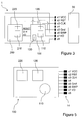
- a smart card 1 comprising a plastic substrate 5 forming a card body and an electronic module 10 integrated in the card body.
- the electronic module 10 is formed of a printed circuit 12, electrical contacts 14 provided on the outer face of the circuit 12 and intended to be connected to a reader 30, including eight flush contacts c1 to c8 according to ISO 7816, and a first microcircuit 100 and a second microcircuit 200 integrated on the inner face of the circuit 12 so as to provide a mechanical protection thereof.
- the two microcircuits 100 and 200 are connected through the printed circuit 12, thanks in particular to conductive tracks provided on this circuit and connections between these tracks and the integrated circuit (microcircuit) 100 and 200.
- the electrical contacts 14 are connected only to the first microcircuit 100.
- the first microcircuit 100 includes a first microprocessor 110 associated with a first memory holding executable (or interpretable) code instructions of a first application 120.
- the second microcircuit 200 comprises a second microprocessor 210 associated with a second memory holding code instructions executable (or interpretable) of a second application 220.
- each of the microcircuits 100 and 200 is a microcontroller comprising a microprocessor and a memory.
- the first microprocessor 110 implements a lower level of security than the second microprocessor 210.
- the first application is a subscriber identification application to a mobile telephone network, called SIM (acronym for "subscriber identification module") and the second application is a bank payment application, for example in accordance with EMV (acronym for "europay mastercard visa").
- the microprocessor 110 is more secure than the microprocessor 210.
- microprocessors and banking applications are generally certified according to the common criteria method (corresponding to ISO 15408) at or above EAL4 level. (Acronym for "Evaluation Assurance Level 4" for Assessment Assurance Level 4), typically at EAL4 + level.
- microprocessors and mobile phone applications are generally not certified according to common criteria. This is explained by the fact that, in the field of mobile telephony, there are lower requirements in terms of security and higher in terms of card response time, than in the field of payment.
- the card reader 30 is a mobile phone in the case where the first application is a mobile phone application.
- the information exchanges being done on the internal link are in accordance with the ISO 7816 standard. It can be provided, if necessary, that the first microprocessor 110 connected to the contacts 14 performs a format conversion of the data received on the contacts. an ISO 7816 format for the other microprocessor 210 (vice versa in the other direction of communication).
- a second internal link, clock carries a clock signal from the first microprocessor 110 to the second microprocessor 210, allowing the first to clock or to inhibit the operation of the second.
- a third internal reset link (in English "reset"), carries a reset signal, from the first microprocessor 110 to the second microprocessor 210, allowing the first to control the zeroing of the second.
- the first microprocessor 110 comprises receiving means according to a communication protocol with a wireless communication interface compliant with the communication protocol "SWP" ("Single Wire Protocol").
- SWP Single Wire Protocol
- FIG. 2 a map 1 presenting elements common with the map of the figure 1 .
- the electronic module 10 only accepts the first microcircuit 100.
- the second microcircuit 200 is integrated in the card body 5 at an intermediate layer 50 according to a flip-chip process.
- the two microcircuits 100 and 200 are connected by a conductive track 52 deposited on the layer 50 during the manufacturing process.
- a metallized hole 54 at the first microcircuit 100 makes it possible to electrically connect the latter to the conductive track 52.
- the reader 30 consists of a mobile telephone provided with an antenna 310 and an interface circuit 320.
- the interface circuit 320 is of the very short-range type, for example in accordance with FIG. to the NFC standard, and is provided with an interface antenna 330 and is connected to a contact 340 for communication with one of the contacts 14 of the card 1, for example the contact c4.
- An external reader (not shown) provided with a very short-range communication interface, for example compliant with the NFC standard, communicates with the mobile telephone 30, via the interface 320.
- the contact c4 used for the wireless communication is distinct from the other contacts used for a contact communication, in particular to facilitate the differentiation of the data arrival channels.
- very short reach means a range of less than 1 meter, preferably less than 50 cm, typically less than 20 cm.
- These may be communication means, for example, in accordance with the NFC (Near Field Communication) standard, or the ISO (International Standardization Organization) standard for international standardization organization.
- 14443 concerning radio frequency identification (in English radio frequency identification, or RFID), without the invention being limited to these protocols.
- An advantage of the very short range is in particular to allow a user to voluntarily or consciously engage in wireless communications by approaching a portable device to a fixed reader, typically at a distance of a few centimeters.
- a non-payment contact microcircuit card for example with a dimension conforming to the ISO 7816 standard, such a range limits the risks that the bearer's account a card is debited, without the holder has meant that he wishes by approaching his card a few inches from a suitable reader, and thus engaging a payment transaction between the reader and his card.
- the external reader issues commands to the second microprocessor 210 and receives the responses. These commands are adapted to be recognized by the first microprocessor 110 as intended for the second microprocessor 210, as set forth below.
- Such a mobile phone 30 can also be used with the card 1 of the figure 1 .
- the first contact noted “c1” in the ISO 7816 standard is connected by a first link, on the one hand, to the first microprocessor 110 and secondly to the second microprocessor 210.
- This first contact c1 and this first link carry a DC voltage, generally denoted “Vcc” power microprocessors 110 and 210 by the reader 30.
- Vcc DC voltage
- the card 1 is devoid of autonomous power supply.
- the contact c1 (combined with c5 below) thus allows the supply of the card 1 and its internal components.
- the second contact noted “c2” in the ISO 7816 standard is connected, by a second link, to the first microprocessor 110.
- This second contact c2 and this second link carry a reset signal, generally denoted "RST", bet zero of the microprocessor 110.
- the third contact noted “c3" in ISO 7816, is connected by a third link to the first microprocessor 110 and carries a signal clock, generally denoted "CLK", so that the reader 30 can clock the operation of the first microprocessor 110.
- CLK signal clock
- the fourth contact noted “c4" in the ISO 7816 standard, is not connected to one or other of the microprocessors 110 and 210.
- the fifth contact noted “c5" in the ISO 7816 standard is connected by a fifth link, on the one hand, to the first microprocessor 110 and on the other hand, to the second microprocessor 210.
- This fifth contact c5 and this fifth link are connected to the ground, generally denoted "GND”, for the supply of the microprocessors 110 and 210 by the reader 30.
- the sixth contact noted “c6” in the ISO 7816 standard is connected, by a sixth link, to the first microprocessor 110 and carries a data signal, here noted “SWP", implementing the SWP protocol, or "single wire protocol" For a single-link protocol for the communication of the first microprocessor 110 with the reader 30. It is noted that the reader 30 sends commands to the card 100 using, for example, this contact c6.
- SWP data signal
- the reader 30 sends commands to the card 100 using, for example, this contact c6.
- the seventh contact noted “c7” in the ISO 7816 standard is connected by a seventh link to the first microprocessor 110 and carries data, generally denoted "I / O", so that the reader 30 and the first microprocessor 110 can exchange Datas. Note that the reader 30 sends commands to the card 10 using, for example, this contact c7.
- the eighth contact noted “c8" in the ISO 7816 standard, is not connected to one or the other of the microprocessors 110 and 210.
- the input / output I / O, clock CLK and RESET reset lines are also observed between the two microcircuits 100 and 200. figure 2 These lines are carried by the conductor tracks 52.
- a table 130 stored in memory is provided.
- This table 130 lists all the commands used by the application 120, here command 1, command 2 and command 3. It also associates with each of these commands the execution address of the command. This is, for example, a pointer to the instruction or the binary code to execute for this command. So, when one realizes, as illustrated below, a search in this table, it does not penalize the first application if the desired order is already in the list, then the execution of this command can be performed immediately with this address.
- This table 130 may especially be generated during the compilation of the application 120 at the stage of its design, and provided to the card 1 at the same time as this application.
- step 402 power is brought map 1 (and therefore the microcircuits 100 and 200) by the reader 30. Then, during a step 404, the communication between the card 1 and the reader 30 is initialized in accordance with the ISO 7816 standard.
- the first microprocessor 110 sends a zero signal to the second microprocessor 210 and a clock signal for timing the operation of the second microprocessor 210.
- the first microprocessor 110 provides a reset signal in a manner consistent with ISO 7816 in the second microprocessor 210, this signal corresponding to the contact c2 of the ISO 7816 standard.
- the microprocessors 110 and 210 initialize the communication between them. In the embodiment described and shown, this communication is carried out according to the ISO 7816 protocol. In this communication, the first microprocessor 110 behaves as a reader of the second microprocessor 210, with the exception of the supply of the power supply, which is provided directly by contacts c1 and c5.
- the first microprocessor 110 receives at least one command from the reader 30. This command is part of a more general process which is described below with reference to Figures 6 and 7 .
- this command is received by the card 1 on the contact 14 (c7) and conforms to the ISO7816 standard (it is an APDU command) or it is received by the contact 14 (c4 or c6) and is in accordance with the protocol SWP.
- the first microprocessor 110 determines whether it has received a command from the reader 30 to the second microprocessor 210 for a predetermined duration, for example the last five seconds.
- the first microprocessor 110 determines whether the received command is intended for it before eventually concluding that it is a command to the second application 220.
- the first microprocessor 110 determines whether a command is intended for it.
- all the commands arriving on the same contact 14, for example the contact c4 which is connected to the very short-range communication interface 320-330 ( figure 2 ), are intended for the second application 220 (or alternatively to the first application 120).
- the microprocessor 110 or the application 120 detects the contact terminal 14 on which the command arrives and directly determines whether this command is intended for it or not.
- the first predominant application 120 in the card 1 incorporates the communication means capable of receiving data from the interfaces 14.
- these means allow the first application 120 to know on which contact the command is received.
- communication means receiving the data on the contacts 14 may be distinct from the first application 120.
- information of the contact number of reception of the command may be added to allow this application to determine this contact number by simply reading the information.
- the first application may detect the protocol or standard used to transmit the commands to determine the communication channel.
- the first application detects an APDU command, it deduces that the contact c7 received this command and therefore it is for example the first communication channel.
- the first application deduces that it was received on the contact c4 and therefore by, for example, the second channel.
- the ⁇ contact, protocol or standard ⁇ association can be performed and stored during an initialization phase of the card 1.
- the first microprocessor 110 retrieves the received command.
- the comparison can be stopped as soon as a comparison is positive, in which case the first microprocessor 110 concludes that the command is intended for it: the determination is positive.
- the first application 120 then executes the received command.
- the first microprocessor 110 concludes that the command is not intended for it, and that it is therefore intended for the other application 220: the determination is negative.
- the command is then transmitted to the second application 220, as seen below, for possible execution.
- the received command is transmitted application in application to the destination application that executes it without retransmission to its lower level application.
- a table 130 is not used.
- the executable code of the first application 120 includes conditional instructions.
- the command is executed in the case of equality verified without one of the conditions, or the command is transmitted to the second application 220 through the branch if not the last loop if, which then comprises a transmission instruction of the command to this application 220.
- the use of the table 130 is combined with the use of the conditional instructions.
- the determination is first made from the table 130 and then using the conditional instructions.
- conditional instructions only confirm that the received command is intended for the first application 220. On the other hand, if the table 130 is corrupted, the conditional instructions provide additional protection for the first application 220 against an execution malfunction (bug).
- the detection of the contact 14 receiving the command can be combined to transmit it to the second application 220 with a check, for example if the contact does not make it possible to take immediate decision (for example contact 14 used for two applications) using the table 130 and / or using conditional instructions implemented in the executable code of the first application 120.
- the first microprocessor 110 If the first microprocessor 110 has not received a command from the reader 300 to the second microprocessor 210 (thus no negative determination) for the predetermined duration, the first microprocessor 110 interrupts the clock signal destined for the second microprocessor. microprocessor 210 and the latter goes to sleep, during a step 412.
- This step 412 can easily be implemented by the first microprocessor 110 using a "timer" (timer in the English terminology) which counts the clock signals to a predetermined value and then initiating an interrupt interrupting transmission of the clock signal to the second microprocessor 210.
- the inhibition of the clock signal transmitted by the first microprocessor 110 to the second microprocessor 210 makes it possible, in the case where the second microprocessor 210 comprises means of standby in the absence of a clock signal, of save the power supplied by the reader, which can be particularly critical when the reader is in a portable object powered by a battery, such as a mobile phone.
- the first microprocessor 110 can control the sleep of part of the second microprocessor 210.
- the first microprocessor 110 then operates in a manner known to those skilled in the art, for example as a SIM card in the context of a mobile phone application, during a step 414 and regularly returns to step 410.
- the first microprocessor executes each command that is intended for it and returns at least one response to the reader 30.
- the first microprocessor 110 determines that it has received at least one command from the reader 30 to the second microprocessor 210 (thus negative determination)
- the first microprocessor 110 sends the signal of clock to the second microprocessor 210 and the latter goes into operation, during a step 416. It is noted that, for certain types of microprocessors and of savers, during step 416, the first microprocessor microprocessor 110 commands a zeroing of the second microprocessor 210.
- the first microprocessor 110 transmits, to the second microprocessor 210, each command intended for the second microprocessor 210.
- the first microprocessor 110 generates commands for the second microprocessor 210, as a function of several commands received from the reader 30. In a variant, the first microprocessor 110 generates commands for the second microprocessor 210 as a function of at least a command received from the reader 30 and information stored in the associated memory 120.
- the second microprocessor 210 then processes this command, for example of the APDU type compliant with the ISO 7816 standard, and returns a response to the first microprocessor 110, to the reader 300, during a step 418.
- the processing can take part in a challenge response (challenge / response) authentication process for which the second microprocessor 210 computes an encrypted data, from random data received with the command and from a symmetric key stored in memory.
- An ad hoc cryptographic means for example software, is then provided at the level of the second microcircuit 200 and a key stored in a memory of the microcircuit 200.
- the first microprocessor 110 sends the response received from the second microprocessor 210 to the reader 30 and returns to step 410.
- This response is in particular relayed by the first microprocessor 110 to the contacts of This step is in particular more detailed below with reference to Figures 6 and 7 .
- the present invention thus makes it possible, in particular, to make the two types of applications co-exist on the same card and to easily update the applications with moderate requirements in security, without having to redo certify the applications with a high security requirement and without modifying them.
- the microcircuit 100 (supported by a not shown card body) has a single microprocessor 110 multitasking for the execution of the two applications 120 and 220.
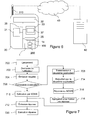
- the mobile phone 30 is provided with operating components, in particular a central CPU 31, a display screen 32, one or more memories 33, for example a read-only memory and a random access memory, communication means 34 with the mobile telephone network 40 and an interface 35 with a SIM card 1 at the level of the electrical contacts 14.
- operating components in particular a central CPU 31, a display screen 32, one or more memories 33, for example a read-only memory and a random access memory, communication means 34 with the mobile telephone network 40 and an interface 35 with a SIM card 1 at the level of the electrical contacts 14.
- the central unit 31 is capable of executing applications contained in memory 33, in particular an onboard operating system (not shown) enabling the conventional operation of a mobile telephone.
- the memory 33 also includes a known Web browser application 37, executable by the central processing unit 31, to allow the user to access the remote Internet network, for example via the previously mentioned WAP protocol.
- a keyboard or input device (not shown) provided on the mobile phone 30 allows the user to interact with the web browser 37 when it is executed by the central unit 31.
- the rendering provided by the web browser 37 is displayed on the screen 32 of the phone 30.
- OMA Open Mobile Alliance
- the first application 120 is a smart card server, for example a web server (" Smart Card Web Server ”) and the microcircuit 100 stores in memory web pages.
- a web server Smart Card Web Server
- the second application 220 is an electronic purse application.
- step 700 the user launches the web browser 37 which then initiates a clean execution context and displays a homepage managing the wallet.
- the user selects an action from the displayed page, for example he clicks on a "check his balance” link.
- step 704 the browser 37 sends an HTTP request to the SCWS server 120 as requested by the user.
- This HTTP request can include a function "consultation_solde" which is implemented by the application 220 of the wallet.
- step 706 the SCWS server 120 receives the request and determines whether the received command "consultation_solde" is intended for it, according to one of the mechanisms mentioned previously in connection with the figure 4 .
- step 708 the server 120 has determined that the command must be transmitted, and therefore transmits it to the application 220.
- the server 120 converts the command "consultation_solde" into an APDU command for the second application 220
- the purse 220 application executes the command.
- the application determines the value of the monetary balance remaining on the account based on historical transaction data (credits and debits) recorded in memory of the microcircuit 200.
- step 716 the second application 220 returns the calculated balance to the web server 120.
- the web server 120 integrates the balance obtained into an HTML page whose model is in memory of the first microcircuit.
- This model may for example contain additional data related to the telephony operator of the SIM card 1, including a logo or information of the user such as his phone number.
- the web server 120 thus forms an HTTP response that it transmits to the browser 37 at step 712.
- step 720 the browser 37 executes the HTTP response, in this case it displays the HTML page containing the balance and the logo on the screen 32 of the phone.
- the user wants to recharge his wallet 220 online, using the remote banking server 42.
- An HTTP request for reloading is sent to the SCWS server 120 as in step 704.
- the user then enters his personal code in the form displayed by the browser 37 and validates the form, which transmits an HTTP request to the server SCWS 120 (step 704).
- the server 120 determines in step 706 that it is a "verifyCode" function that is implemented by the purse application 220.
- the identifier 123 and the code entered and encrypted 85F6EE9 are transmitted as parameters.
- the browser sends an HTTP request to the address specified above, here the bank server 42 and its main page.
Landscapes
- Engineering & Computer Science (AREA)
- Business, Economics & Management (AREA)
- General Physics & Mathematics (AREA)
- Physics & Mathematics (AREA)
- Theoretical Computer Science (AREA)
- Microelectronics & Electronic Packaging (AREA)
- Computer Networks & Wireless Communication (AREA)
- Accounting & Taxation (AREA)
- General Business, Economics & Management (AREA)
- Strategic Management (AREA)
- Signal Processing (AREA)
- Computer Hardware Design (AREA)
- General Engineering & Computer Science (AREA)
- Telephone Function (AREA)
- Telephonic Communication Services (AREA)
- Credit Cards Or The Like (AREA)
Applications Claiming Priority (1)
| Application Number | Priority Date | Filing Date | Title |
|---|---|---|---|
| FR0759008A FR2923632B1 (fr) | 2007-11-13 | 2007-11-13 | Carte a microprocesseur, telephone comprenant une telle carte et procede de traitement dans une telle carte. |
Publications (2)
| Publication Number | Publication Date |
|---|---|
| EP2065859A2 true EP2065859A2 (de) | 2009-06-03 |
| EP2065859A3 EP2065859A3 (de) | 2009-12-02 |
Family
ID=39471807
Family Applications (1)
| Application Number | Title | Priority Date | Filing Date |
|---|---|---|---|
| EP08291030A Ceased EP2065859A3 (de) | 2007-11-13 | 2008-11-05 | Mikroprozessorkarte, eine solche Karte enthaltendes Telefon und Verarbeitungsverfahren in einer solchen Karte |
Country Status (4)
| Country | Link |
|---|---|
| US (1) | US8066193B2 (de) |
| EP (1) | EP2065859A3 (de) |
| KR (1) | KR101165495B1 (de) |
| FR (1) | FR2923632B1 (de) |
Cited By (1)
| Publication number | Priority date | Publication date | Assignee | Title |
|---|---|---|---|---|
| WO2011144875A1 (fr) * | 2010-05-20 | 2011-11-24 | Natural Security | Equipement portable de communication, systeme et procede de communication entre un terminal local et une pluralite d'equipements portables |
Families Citing this family (7)
| Publication number | Priority date | Publication date | Assignee | Title |
|---|---|---|---|---|
| US20100240413A1 (en) * | 2009-03-21 | 2010-09-23 | Microsoft Corporation | Smart Card File System |
| KR101166797B1 (ko) * | 2009-09-22 | 2012-07-26 | 에스케이플래닛 주식회사 | 스마트카드 기반 브라우징 시스템 및 그 방법, 그리고 이에 적용되는 스마트카드 |
| US10454693B2 (en) * | 2009-09-30 | 2019-10-22 | Visa International Service Association | Mobile payment application architecture |
| EP2715617A4 (de) | 2011-05-23 | 2014-11-26 | Mastercard International Inc | Combicard-transaktionsverfahren und -system mit einem mechanismus zur aktualisierung von anwendungsparametern |
| CN103460712B (zh) * | 2012-02-15 | 2018-03-06 | 松下电器(美国)知识产权公司 | 终端设备、其通信方法以及通信模块 |
| FR3023951B1 (fr) * | 2014-07-15 | 2016-08-05 | Oberthur Technologies | Procede d'etablissement d'une session de communication via une interface swp |
| CN110381472A (zh) * | 2019-07-02 | 2019-10-25 | 深圳市有方科技股份有限公司 | 基于stk协议的通信方法及终端 |
Citations (1)
| Publication number | Priority date | Publication date | Assignee | Title |
|---|---|---|---|---|
| EP1603088A1 (de) | 2004-06-03 | 2005-12-07 | Nagracard S.A. | Bauteil für ein Sicherheitsmodul |
Family Cites Families (11)
| Publication number | Priority date | Publication date | Assignee | Title |
|---|---|---|---|---|
| US5049728A (en) * | 1990-04-04 | 1991-09-17 | Rovin George H | IC card system with removable IC modules |
| AU678135B2 (en) * | 1991-02-25 | 1997-05-22 | Broadcom Corporation | Hand-held data capture system with interchangeable modules and interactive control circuits |
| DE4406704C1 (de) * | 1994-03-02 | 1995-07-20 | Angewandte Digital Elektronik | Chipkarte |
| JP3492057B2 (ja) * | 1995-12-14 | 2004-02-03 | 株式会社日立製作所 | マルチチップicカード及びそれを用いたicカードシステム |
| DE19618103C2 (de) * | 1996-05-06 | 1998-05-14 | Siemens Ag | Chipkartenmodul mit Beschichtung aus leitfähigem Kunststoff und Verfahren zu dessen Herstellung |
| FR2782435B1 (fr) * | 1998-08-13 | 2000-09-15 | Bull Cp8 | Procede de communication entre une station d'utilisateur et un reseau, notamment de type internet, et architecture de mise en oeuvre |
| US8511558B2 (en) * | 2005-04-12 | 2013-08-20 | Sandisk Il Ltd. | Smartcard power management |
| US20060287004A1 (en) * | 2005-06-17 | 2006-12-21 | Fuqua Walter B | SIM card cash transactions |
| FR2893803A1 (fr) * | 2005-11-21 | 2007-05-25 | Nec Technologies Uk Ltd | Methode de communication entre une cartre (u)sim en mode serveur et un client |
| US8190206B2 (en) * | 2006-07-04 | 2012-05-29 | Sandisk Il Ltd. | Dual channel smart card data storage |
| US20080257952A1 (en) * | 2007-04-18 | 2008-10-23 | Andre Luis Zandonadi | System and Method for Conducting Commercial Transactions |
-
2007
- 2007-11-13 FR FR0759008A patent/FR2923632B1/fr active Active
-
2008
- 2008-11-05 EP EP08291030A patent/EP2065859A3/de not_active Ceased
- 2008-11-13 KR KR1020080113003A patent/KR101165495B1/ko active Active
- 2008-11-13 US US12/270,202 patent/US8066193B2/en active Active
Patent Citations (1)
| Publication number | Priority date | Publication date | Assignee | Title |
|---|---|---|---|---|
| EP1603088A1 (de) | 2004-06-03 | 2005-12-07 | Nagracard S.A. | Bauteil für ein Sicherheitsmodul |
Cited By (4)
| Publication number | Priority date | Publication date | Assignee | Title |
|---|---|---|---|---|
| WO2011144875A1 (fr) * | 2010-05-20 | 2011-11-24 | Natural Security | Equipement portable de communication, systeme et procede de communication entre un terminal local et une pluralite d'equipements portables |
| FR2960322A1 (fr) * | 2010-05-20 | 2011-11-25 | P1G | Equipement portable de communication, systeme et procede de communication entre un terminal local et une pluralite d'equipements portables |
| AU2011254438B2 (en) * | 2010-05-20 | 2015-04-23 | Natural Security | Portable communication equipment, system and method for communicating between a local terminal and a plurality of portable equipment |
| EA025025B1 (ru) * | 2010-05-20 | 2016-11-30 | Нэчерал Секьюрити | Портативное устройство связи, система и способ связи между локальным терминалом и множеством портативных устройств |
Also Published As
| Publication number | Publication date |
|---|---|
| FR2923632A1 (fr) | 2009-05-15 |
| US20090127333A1 (en) | 2009-05-21 |
| FR2923632B1 (fr) | 2010-01-08 |
| KR101165495B1 (ko) | 2012-07-13 |
| KR20090049560A (ko) | 2009-05-18 |
| US8066193B2 (en) | 2011-11-29 |
| EP2065859A3 (de) | 2009-12-02 |
Similar Documents
| Publication | Publication Date | Title |
|---|---|---|
| EP2065857A2 (de) | Mikroprozessorkarte, eine solche Karte enthaltendes Telefon und Ausführungsverfahren eines Befehls in einer solchen Karte | |
| EP0565469B1 (de) | System zum kontaktlosen Austausch von Daten zwischen einem Endgerät und einer modularen, tragbaren Einheit | |
| EP1857953B1 (de) | Verfahren und System zur Authentifizierung und zum sicheren Austausch von Daten zwischen einem personalisierten Chip und einem dedizierten Server | |
| EP2065858A2 (de) | Mikroprozessorkarte, eine solche Karte enthaltendes Telefon und Ausführungsverfahren eines Befehls in einer solchen Karte | |
| EP2065859A2 (de) | Mikroprozessorkarte, eine solche Karte enthaltendes Telefon und Verarbeitungsverfahren in einer solchen Karte | |
| EP2463833B1 (de) | Verfahren und Vorrichtung zur Ausführungskontrolle für interne Funktionen und Funktionen von geschützten Anwendungen auf Mikrochipkarten von mobilen Endgeräten | |
| EP2002376B1 (de) | Verfahren zur dynamischen Zuweisung von Kontakten einer Teilnehmer-Chipkarte in einem mobilen Endgerät sowie entsprechendes Programm und mobiles Endgerät | |
| EP2003556A1 (de) | Verfahren zur Verarbeitung von Anwendungsbefehlen, die von physischen Kanälen ausgegeben wurden, mittels einer tragbaren elektronischen Vorrichtung sowie entsprechende Vorrichtung und entsprechendes System | |
| FR2914459A1 (fr) | Carte a microprocesseurs | |
| WO2003056510A1 (fr) | Objet portable sans contact comportant au moins un dispositif peripherique connecte a la meme antenne que la puce | |
| EP3110190B1 (de) | Verfahren und vorrichtung zur verwaltung von kontaktlosen anwendungen | |
| FR2868647A1 (fr) | Interface de transmission | |
| EP2936379B1 (de) | Erkennung einer transaktionsvorrichtung | |
| EP3108424A1 (de) | Elektronisches transaktionsverfahren und system über ein tragbares zubehör | |
| EP3163487A1 (de) | Verfahren, computerterminal und computerprogramm zur sicherung der verarbeitung transaktioneller daten | |
| EP2087417A1 (de) | Tragbare elektronische einheit und verfahren zur anpassung der elektronischen einheit | |
| EP2177922A1 (de) | Prüfverfahren eines elektronischen Identitätsdokuments und entsprechende Vorrichtung | |
| EP2254077A1 (de) | Vorrichtung für konventionelle Chipkarte, die eine elektronische Transaktion über ein Netz erlaubt | |
| EP3273398B1 (de) | Datenverarbeitungsverfahren mithilfe einer elektronischen vorrichtung zur datenerfassung, vorrichtung und entsprechendes programm | |
| WO2019016470A1 (fr) | Procédé et système de gestion d'un paiement par porte-monnaie électronique | |
| EP2867837B1 (de) | System zum sicheren übertragen von digitalen daten | |
| EP2306414A1 (de) | Kommunikationsverfahren zwischen einem Kartenleser und zwei Chipkarten | |
| EP1214686A1 (de) | Tragbares elektronisches gerät mit einer anzeigevorrichtung und mittel zum laden von nachrichten dafür | |
| FR2805065A1 (fr) | Lecteur de carte a puce de type visionneuse comprenant des moyens d'emission-reception de donnees sans contact | |
| FR3099272A1 (fr) | Procédé de sécurisation, et dispositif électronique associé |
Legal Events
| Date | Code | Title | Description |
|---|---|---|---|
| PUAI | Public reference made under article 153(3) epc to a published international application that has entered the european phase |
Free format text: ORIGINAL CODE: 0009012 |
|
| 17P | Request for examination filed |
Effective date: 20081119 |
|
| AK | Designated contracting states |
Kind code of ref document: A2 Designated state(s): AT BE BG CH CY CZ DE DK EE ES FI FR GB GR HR HU IE IS IT LI LT LU LV MC MT NL NO PL PT RO SE SI SK TR |
|
| AX | Request for extension of the european patent |
Extension state: AL BA MK RS |
|
| PUAL | Search report despatched |
Free format text: ORIGINAL CODE: 0009013 |
|
| AK | Designated contracting states |
Kind code of ref document: A3 Designated state(s): AT BE BG CH CY CZ DE DK EE ES FI FR GB GR HR HU IE IS IT LI LT LU LV MC MT NL NO PL PT RO SE SI SK TR |
|
| AX | Request for extension of the european patent |
Extension state: AL BA MK RS |
|
| 17Q | First examination report despatched |
Effective date: 20100113 |
|
| AKX | Designation fees paid |
Designated state(s): AT BE BG CH CY CZ DE DK EE ES FI FR GB GR HR HU IE IS IT LI LT LU LV MC MT NL NO PL PT RO SE SI SK TR |
|
| STAA | Information on the status of an ep patent application or granted ep patent |
Free format text: STATUS: THE APPLICATION HAS BEEN REFUSED |
|
| 18R | Application refused |
Effective date: 20121012 |
|
| REG | Reference to a national code |
Ref country code: FR Ref legal event code: GC Effective date: 20140115 |