EP2065948A2 - Dispositif électroluminescent à semi-conducteurs et dispositif d'éclairage - Google Patents
Dispositif électroluminescent à semi-conducteurs et dispositif d'éclairage Download PDFInfo
- Publication number
- EP2065948A2 EP2065948A2 EP08020468A EP08020468A EP2065948A2 EP 2065948 A2 EP2065948 A2 EP 2065948A2 EP 08020468 A EP08020468 A EP 08020468A EP 08020468 A EP08020468 A EP 08020468A EP 2065948 A2 EP2065948 A2 EP 2065948A2
- Authority
- EP
- European Patent Office
- Prior art keywords
- light emitting
- resin layer
- emitting device
- semiconductor light
- front luminance
- Prior art date
- Legal status (The legal status is an assumption and is not a legal conclusion. Google has not performed a legal analysis and makes no representation as to the accuracy of the status listed.)
- Withdrawn
Links
Images







Classifications
-
- H—ELECTRICITY
- H10—SEMICONDUCTOR DEVICES; ELECTRIC SOLID-STATE DEVICES NOT OTHERWISE PROVIDED FOR
- H10H—INORGANIC LIGHT-EMITTING SEMICONDUCTOR DEVICES HAVING POTENTIAL BARRIERS
- H10H20/00—Individual inorganic light-emitting semiconductor devices having potential barriers, e.g. light-emitting diodes [LED]
- H10H20/80—Constructional details
- H10H20/85—Packages
- H10H20/851—Wavelength conversion means
- H10H20/8511—Wavelength conversion means characterised by their material, e.g. binder
- H10H20/8512—Wavelength conversion materials
- H10H20/8513—Wavelength conversion materials having two or more wavelength conversion materials
-
- H—ELECTRICITY
- H10—SEMICONDUCTOR DEVICES; ELECTRIC SOLID-STATE DEVICES NOT OTHERWISE PROVIDED FOR
- H10H—INORGANIC LIGHT-EMITTING SEMICONDUCTOR DEVICES HAVING POTENTIAL BARRIERS
- H10H20/00—Individual inorganic light-emitting semiconductor devices having potential barriers, e.g. light-emitting diodes [LED]
- H10H20/80—Constructional details
- H10H20/85—Packages
- H10H20/852—Encapsulations
- H10H20/853—Encapsulations characterised by their shape
-
- H—ELECTRICITY
- H10—SEMICONDUCTOR DEVICES; ELECTRIC SOLID-STATE DEVICES NOT OTHERWISE PROVIDED FOR
- H10H—INORGANIC LIGHT-EMITTING SEMICONDUCTOR DEVICES HAVING POTENTIAL BARRIERS
- H10H20/00—Individual inorganic light-emitting semiconductor devices having potential barriers, e.g. light-emitting diodes [LED]
- H10H20/80—Constructional details
- H10H20/85—Packages
- H10H20/852—Encapsulations
- H10H20/854—Encapsulations characterised by their material, e.g. epoxy or silicone resins
-
- H—ELECTRICITY
- H10—SEMICONDUCTOR DEVICES; ELECTRIC SOLID-STATE DEVICES NOT OTHERWISE PROVIDED FOR
- H10H—INORGANIC LIGHT-EMITTING SEMICONDUCTOR DEVICES HAVING POTENTIAL BARRIERS
- H10H20/00—Individual inorganic light-emitting semiconductor devices having potential barriers, e.g. light-emitting diodes [LED]
- H10H20/80—Constructional details
- H10H20/882—Scattering means
Definitions
- the presently disclosed subject matter relates to a semiconductor light emitting device, which in particular is provided with a resin layer containing light-scattering materials and/or fluorescent substances, and lighting devices incorporating the same.
- white light emitting devices in which a part of light emitted from a blue light emitting element is wavelength-converted by fluorescent substance (e.g., fluorescent particles), have come to be used in lighting equipment such as general lighting fixtures, street lights, vehicle headlamps and so forth.
- fluorescent substance e.g., fluorescent particles
- a semiconductor light emitting device having a resin layer, which contains fluorescent substances, provided on the light emitting element (see for example, Japanese Patent Application Laid-Open No. 2002-185048 and Japanese Patent Application Laid-Open No. 2001-244507 ).
- a difference in front luminance between a light emitting portion and a light non-emitting portion of the light source is large depending on the intended use, the desired light distribution characteristic, and the kind of lens design adopted.
- the resin layer containing the fluorescent substance covers the light emitting element and has a uniform thickness, light will be emitted from side surfaces of the resin layer in a horizontal direction and in directions lower than the horizontal direction, whereby the front luminance of an end portion of the semiconductor light emitting device will deteriorate. Accordingly, the front luminance distribution of the semiconductor light emitting device will have a broad form, and thus there might be cases in which such semiconductor light emitting device is not qualified for use as a light source depending on the desired optical light distribution.
- a high-power semiconductor light emitting device with a high-power density for instance, over 2 (W/mm 2 ) will sometimes have problems regarding not only increased temperature of the light emitting element, but also increased heat generated by the fluorescent substance itself contained in the resin layer. Due to the heat generated by the fluorescent substance, conversion efficiency of the fluorescent substance at the time of wavelength conversion of light from the light emitting element will deteriorate to a considerable extent. In addition, there might be cases in which a part of a transparent resin composing the resin layer will volatilize to cause a decrease in the volume of the transparent resin and/or blackening of the transparent resin, whereby performance of the semiconductor light emitting device may deteriorate to a considerable extent.
- the presently disclosed subject matter is provided in view of such circumstances, and can include a semiconductor light emitting device having a resin layer containing light-scattering materials and/or fluorescent substance, which exhibits a front luminance distribution where there is a large difference in front luminance between a light emitting portion and a light non-emitting portion at an end portion of the semiconductor light emitting device.
- a semiconductor light emitting device can include a resin layer containing fluorescent substance, and the light emitting device can be configured to be capable of efficiently diffusing heat generated by the fluorescent substance contained in the resin layer.
- a semiconductor light emitting device can include a light emitting element including a semiconductor epitaxial layer which has a light emitting portion, and an element substrate which supports the semiconductor epitaxial layer and does not transmit light from the light emitting portion.
- a resin layer can be provided on the element substrate in a way covering side surfaces and an upper surface of the semiconductor epitaxial layer and containing scattering materials and/or fluorescent substance configured to wavelength-convert the light from the light emitting portion, the resin layer being inclined inwardly toward the top at one cross section.
- the element substrate which does not transmit light from the light emitting portion by using the element substrate which does not transmit light from the light emitting portion, the light from the light emitting portion is prevented from leaking through the element substrate to a side of a substrate where the light emitting element is mounted on, whereby possible reflected light from the substrate can be prevented.
- the resin layer is inclined inwardly toward the top at one cross section, it is possible to prevent a front luminance of an end portion of the semiconductor light emitting device from deteriorating because the light from side surfaces of the resin layer does not emit in a horizontal direction and in directions lower than the horizontal direction.
- the resin layer can be formed in an inclined manner and in the form of an approximate arc at one cross section.
- the semiconductor light emitting device can achieve a light distribution pattern having few extreme highs and lows in luminance.
- the resin layer can be formed in a way such that an angle formed between a tangent line of the resin layer, drawn on a starting point of inclination of the resin layer, and a surface of the element substrate is 20 degrees or over but not exceeding 90 degrees, at one cross section.
- the angle formed between the tangent line of the resin layer and the surface of the element substrate is 20 degrees or over but not exceeding 90 degrees, it is possible to obtain a desired front luminance distribution.
- the resin layer can also be formed to include scattering materials and/or a fluorescent substance delivered by drops to harden thereafter.
- the resin By forming the resin to include scattering materials and/or a fluorescent substance delivered by drops to harden thereafter, a resin layer inclined in an approximate arc form can be easily realized.
- the resin layer can also be arranged such that it contains scattering materials and fluorescent substance while the resin layer has a laminated structure composed of a layer containing scattering materials and a layer containing a fluorescent substance.
- the resin layer has the laminated structure composed of the layer containing scattering materials and the layer containing fluorescent substance, it is possible to obtain a desired light emitting profile and emission color by adjusting the thickness and the content rate of each layer.
- the element substrate that does not transmit light can be configured, for example, as an opaque substrate which absorbs light from the light emitting portion, a substrate which reflects the light from the light emitting portion, and/or a semiconductor substrate having a reflective layer laminated thereon.
- the front luminance distribution can exhibit a maximum value of front luminance at the end portion where the surface of the resin layer starts to incline.
- the condition where the maximum value of front luminance is obtained at the end portion includes a state in which the front luminance of a center portion is the same as the front luminance of the end portion in the front luminance distribution. This means that it is appropriate as along as the front luminance of the center portion is not higher than the front luminance of the end portion.
- a front luminance distribution where a luminance ratio of a maximum value of front luminance to a value of front luminance with respect to a part other than the light emitting surface is at least 150:1.
- the luminance ratio of the maximum value of front luminance to the value of front luminance with respect to the part other than the light emitting surface is at least 150:1 in the front luminance distribution, when the semiconductor light emitting device is used as a lighting device, and as a vehicle front light in particular, it is possible to have a sharp boundary line between the light emitting portion and the light non-emitting portion.
- the resin layer can also be arranged such that it contains fluorescent substance deposited on the light emitting element.
- the fluorescent substance in the resin layer can include a plurality of particles deposited on the light emitting element, the heat generated by the fluorescent substance will be transmitted to the light emitting element without being passed on to the transparent resin with low thermal conductivity, whereby the heat can be efficiently diffused.
- the fluorescent substance within the resin layer can be deposited on the light emitting element by sedimentation, the fluorescent substance can be deposited evenly on the light emitting element. Thereby, the heat generated by the fluorescent substance can be efficiently transmitted to the side of the light emitting element.
- the resin layer can be arranged such that it contains fluorescent substance particles having a smaller particle size than that of the fluorescent substance deposited on the light emitting element, the fluorescent substance with the smaller particle size being dispersed within the resin layer.
- the fluorescent substance particles having the smaller particle size are dispersed within the resin layer, it is possible to reduce unevenness of color at the time when light is to be emitted by the semiconductor light emitting device.
- the resin layer can be arranged such that it contains scattering materials which are dispersed within the resin layer.
- the scattering materials are dispersed within the resin layer, it is further possible to reduce unevenness of color at the time when light is to be emitted by the semiconductor light emitting device.
- a lighting device can include: the semiconductor light emitting device as described above; and a projection device which emits an output light from the semiconductor light emitting device in a predetermined direction.
- the semiconductor light emitting device having a front luminance distribution showing a large difference in front luminance between the light emitting portion and the light non-emitting portion at the end portion of the semiconductor light emitting device is used as a light source, a light distribution pattern with a sharp light-dark boundary can be obtained.
- the horizontal line in the light distribution pattern and the boundary with the precipitous front luminance distribution with respect to the above-described semiconductor light emitting device can coincide. Accordingly, in this case, it is possible to have a horizontal line with a sharp light-dark boundary under a low beam condition.
- a semiconductor light emitting device provided with a resin layer containing scattering materials and/or fluorescent substance, which has a front luminance distribution exhibiting a large difference in front luminance between a light emitting portion and a light non-emitting portion at an end portion of the semiconductor light emitting device.
- a semiconductor light emitting device provided with a resin layer containing fluorescent substance, which is capable of efficiently diffusing heat generated by the fluorescent substance contained in the resin layer.
- Fig. 1 is a perspective view illustrating a semiconductor light emitting device 100.
- the semiconductor light emitting device 100 is provided with an element substrate 1, a semiconductor epitaxial layer 2 formed on the element substrate 1, and a resin layer 4 containing a fluorescent substance 5 which can include particles that are configured to wavelength-convert light from the semiconductor epitaxial layer 2.
- the resin layer 4 can be arranged on the element substrate 1 in a manner such that the side surfaces and an upper surface of the semiconductor epitaxial layer 2 are covered by the resin layer 4.
- a light emitting element 3 can be composed of the element substrate 1 and the semiconductor epitaxial layer 2 formed on the element substrate 1 and can define a light emitting portion.
- the semiconductor epitaxial layer 2 is smaller in area than the element substrate 1, and it is formed to fit in the element substrate 1.
- the resin layer 4 arranged on the element substrate 1 can cover not only the upper surface but also the side surfaces of the semiconductor epitaxial layer 2.
- the resin layer 4 can also be arranged on an upper surface of the element substrate 1 while not covering side surfaces of the element substrate 1.
- the element substrate 1 can be composed of an opaque substrate that absorbs light from the light emitting portion of the semiconductor epitaxial layer 2 or, can be composed of a base substrate and a reflective film formed on the base substrate. Accordingly, the light from the light emitting portion of the semiconductor epitaxial layer 2 will not be transmitted through the element substrate 1.
- the fluorescent substance 5 which wavelength-converts part of the light (e.g. visible light and/or ultraviolet light) emitted from the semiconductor epitaxial layer 2 is dispersed in a highly heat-resistant transparent resin 6.
- the resin layer 4 arranged on the element substrate 1 can be shaped with a circular top.
- the resin layer 4 is formed by having a resin containing fluorescent substance 5 delivered into the light emitting element 3 by drops to harden thereafter, and the resin layer 4 formed in such way has a protuberant shape on the light emitting element 3.
- the resin layer 4 has a dome shape with a circular top of an approximately hemispherical shape, and a surface of the resin layer 4 is a curved surface connecting the top portion positioned at the upper center of the light emitting element 3 and respective sides of a rectangular upper surface of the element substrate 1.
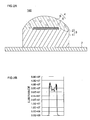
- Fig. 2A is a sectional view of the semiconductor light emitting device 100 taken along line 2A-2A in Fig. 1 .
- the resin layer 4 has an inclined surface formed into an approximate arc inclining inwardly from the element substrate 1 toward the top.
- An apex of the resin layer 4 is positioned above a center point of the semiconductor epitaxial layer 2.
- the semiconductor light emitting device 100 can be mounted on a mounting substrate 7 or the like to be used as a semiconductor light emitting apparatus.
- Fig. 2B shows a front luminance distribution of the semiconductor light emitting apparatus where the semiconductor light emitting device 100 is mounted on the mounting substrate 7.
- This exemplary semiconductor light emitting device 100 is provided with a resin layer 4, which is formed on a blue color light emitting element 3 including the semiconductor epitaxial layer 2 having an area of 950 ⁇ m by 950 ⁇ m formed on the element substrate 1 which has an area of 980 ⁇ m by 980 ⁇ m and a height of 0.1 mm, for example.
- the resin layer 4 can be formed by having a resin containing a fluorescent substance delivered into the light emitting element 3 by drops which are hardened thereafter.
- the external atmosphere surrounding the semiconductor light emitting device can be air.
- a maximum thickness of the resin layer 4 is 0.3 mm, in a sectional view shown in Fig. 2A , while a tangent line of the resin layer 4 drawn from a contact point of the element substrate 1, the resin layer 4 and the external atmosphere makes an angle of about 68 degree with the surface of the element substrate 1.
- a difference in front luminance at a boundary between a light emitting portion of the semiconductor light emitting device 100 and a light non-emitting portion of an exterior of the semiconductor light emitting device 100 can be relatively large.
- a difference in front luminance between the light emitting portion and the light non-emitting portion at an end portion of the semiconductor light emitting device 100 is large.
- the front luminance ratio of the light emitting portion to the light non-emitting portion could be brought to about 190:1.
- the end portion of the semiconductor light emitting device 100 which is to be the light emitting portion is defined as an outer edge of the light emitting element, an outer edge of the element substrate or an outer edge of the resin layer, when viewed from above.
- FIG. 3A illustrates one example of a conventional semiconductor light emitting device.
- a semiconductor light emitting device 200 is provided with a light emitting element 230, which is composed of a semiconductor epitaxial layer 220 being formed on a transparent element substrate 210 made of sapphire, etc., and a resin layer 240 containing fluorescent substance 250 which wavelength-convert light from the semiconductor epitaxial layer 220.
- the resin layer 240 is configured to cover side surfaces and an upper surface of the light emitting element 230.
- the semiconductor light emitting device 200 is mounted on a mounting substrate 270.
- the semiconductor light emitting device 200 By driving the semiconductor light emitting device 200, light is emitted from the semiconductor epitaxial layer 220. A part of the light will be transmitted through the resin layer 240, while another part of the light will be wavelength-converted by the fluorescent substances 250 and then transmitted through the resin layer 240. As shown in Fig. 3A , in the semiconductor light emitting device 200, the light is emitted from an upper surface and side surfaces of the semiconductor epitaxial layer 220. The light from the semiconductor epitaxial layer 220 will be transmitted through the transparent element substrate 210, and similarly, a part of the light will be transmitted through the resin layer 240, while other parts of the light will be wavelength-converted by the fluorescent substance 250 and then transmitted through the resin layer 240.
- the light will be emitted from side surfaces of the semiconductor light emitting device 200, and light will thus not only be emitted in upper directions but also in a horizontal direction and lower directions from the semiconductor light emitting device 200.
- the light emitted in the lower direction will be reflected by the mounting substrate 270 towards an upper direction.
- the front luminance distribution of the semiconductor light emitting device 200 when the front luminance distribution of the semiconductor light emitting device 200 is measured, the light from the semiconductor light emitting device 200 and the reflected light from the mounting substrate 270 will be included in the measurement.
- the front luminance distribution in this case will have a broad form at an end portion of the semiconductor light emitting device 200.
- FIG. 3B illustrates another example of a conventional semiconductor light emitting device.
- a semiconductor light emitting device 300 is provided with a light emitting element 330, which is composed of a semiconductor epitaxial layer 320 formed on an opaque element substrate 310, and a resin layer 340 containing fluorescent substance 350 which wavelength-converts light from the semiconductor epitaxial layer 320.
- the semiconductor epitaxial layer 320 is smaller in area than the opaque element substrate 310, and it is formed to fit in the element substrate 310.
- the resin layer 340 covers side surfaces and an upper surface of the semiconductor epitaxial layer 320.
- the semiconductor light emitting device 300 is mounted on a mounting substrate 370.
- the semiconductor light emitting device 300 By driving the semiconductor light emitting device 300, light is emitted from the semiconductor epitaxial layer 320. A part of the light will be transmitted through the resin layer 340, while other parts of the light will be wavelength-converted by the fluorescent substance 350 and will then be transmitted through the resin layer 340. The light from the semiconductor epitaxial layer 320 will be emitted in the upper surface and side surface directions. On the other hand, since light from the semiconductor epitaxial layer 320 will not be transmitted through the opaque element substrate 310, no light will be emitted from side surfaces of the opaque element substrate 310.
- the light that is emitted from side surfaces of the semiconductor epitaxial layer 320 will be emitted from side surfaces of the resin layer 340, and will be emitted in horizontal and lower directions. In this case, the light emitted in the lower direction will be reflected by the mounting substrate 370 towards an upper direction.
- the front luminance distribution of the semiconductor light emitting device 300 when the front luminance distribution of the semiconductor light emitting device 300 is measured, the light from the semiconductor light emitting device 300 and the reflected light from the mounting substrate 370 will be measured at an end portion of the semiconductor light emitting device 300.
- the front luminance distribution in this case will have a broad form at an end portion of the semiconductor light emitting device 300.
- Fig. 3C is a sectional view of the semiconductor light emitting device 100 according to the presently disclosed subject matter. Same reference numerals will be used for components similar to those in the semiconductor light emitting device 100 shown in Fig. 1 or Fig. 2A , and there might be cases where descriptions on such redundant components will be omitted for brevity.
- the semiconductor light emitting device 100 By driving the semiconductor light emitting device 100, light will be emitted from the semiconductor epitaxial layer 2. A part of the light will be transmitted through the resin layer 4, while other parts of the light will be wavelength-converted by the fluorescent substance 5 and then transmitted through the resin layer 4. The light from the semiconductor epitaxial layer 2 will be emitted in upper surface and side surface directions. On the other hand, since the light from the semiconductor epitaxial layer 2 will not be transmitted through the opaque element substrate 1, no light will be emitted from side surfaces of the element substrate 1.
- the light emitted from side surfaces of the semiconductor epitaxial layer 2 will be led in an upper direction when passing through the resin layer 4. Therefore, light rays emitted in directions lower than a horizontal direction will be reduced to a considerable extent as compared to the conventional cases shown in Figs. 3A and 3B , whereby light reflected by the mounting substrate 7 will also be reduced.
- Fig. 4A is a diagram representing simulation results of front luminance distributions between the semiconductor light emitting device 100 and the conventional semiconductor light emitting device 300 used as a comparison example.
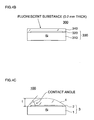
- Figs. 4B and 4C are schematic diagrams showing the conditions present when the simulation shown in Fig. 4A is performed.
- the semiconductor light emitting device 100 is provided with a light emitting element 3 which is composed of an element substrate 1 having a silicon substrate and a reflective layer arranged on the silicon substrate, and a semiconductor epitaxial layer 2 formed on the element substrate 1.
- a resin layer 4 containing fluorescent substance (not shown) is arranged on the light emitting element 3 and has a circular top.
- an angle (hereinafter referred to as a contact angle) on the side of the resin layer 4 formed between a tangent line of the resin layer 4, drawn from a contact point of the element substrate 1, the resin layer 4 and the external atmosphere, and the surface of the element substrate 1 is provided with the following values: 20 degrees; 45 degrees; and 90 degrees.
- a height "t" of the resin layer 4 up to its apex is provided with the following values; 0.09 mm (20 degrees); 0.21 mm (45 degrees); and 0.50 mm (90 degrees).
- the semiconductor light emitting device 300 is provided with a light emitting element 330 which is composed of an element substrate 310 composed of the same kind of silicon substrate as that of the semiconductor light emitting device 100, and a reflective layer arranged on the silicon substrate, and a semiconductor epitaxial layer 320.
- a resin layer 340 contains fluorescent substance (not shown) and is formed as a sheet with a predetermined thickness (0.2 mm).
- reference character A designates a front luminance distribution in the comparison example
- reference characters B to D designate front luminance distributions for the above described embodiments of the disclosed subject matter having various contact angles and heights "t”.
- Reference character A represents a front luminance distribution of the semiconductor light emitting device 300.
- the front luminance exhibits a maximum value at a center portion.
- the front luminance decreases gradually from the maximum value at the center portion toward both ends of the semiconductor light emitting device 300. At points passing both end portions, the front luminance decreases almost perpendicularly.
- Reference character B represents a front luminance distribution of a semiconductor light emitting device 100 according to the presently disclosed subject matter where the resin layer 4 has a contact angle of 20 degrees and a height of 0.09 mm.
- the front luminance exhibits a minimum value at a center portion, and the front luminance increases from the center portion toward both ends of the semiconductor light emitting device 100. At points passing both end portions, the front luminance decreases almost perpendicularly.
- Reference character C represents a front luminance distribution of a semiconductor light emitting device 100 according to the presently disclosed subject matter where the resin layer 4 has a contact angle of 45 degrees and a height of 0.21 mm.
- the front luminance exhibits a minimum value at a center portion, and the front luminance is increasing drastically from the center portion toward both ends of the semiconductor light emitting device 100. At points passing both end portions, the front luminance decreases almost perpendicularly.
- Reference character D represents a front luminance distribution of a semiconductor light emitting device 100 according to the presently disclosed subject matter where the resin layer 4 has a contact angle of 90 degrees and a height of 0.50 mm.
- the front luminance exhibits a minimum value at a center portion, and the front luminance is increasing gradually from the center portion toward both ends of the semiconductor light emitting device 100. At points passing both end portions, the front luminance decreases almost perpendicularly.
- the front luminance distribution exhibits the minimum value of front luminance at the center portion, whereas it exhibits the maximum value of front luminance at the end portion. Therefore, the front luminance distribution exhibits a precipitous form at the end portions, which is different from the case of luminance characteristics for the comparison example.
- the front luminance distribution C where the contact angle is 45 degrees exhibits the largest maximum value of front luminance at the end portion. Moreover, the front luminance distribution C exhibits the largest difference in front luminance between the end portion and the center portion. Comparing the front luminance distribution B and the front luminance distribution D, the front luminance distribution B exhibits a larger value of front luminance at the end portion than does the front luminance distribution D. With respect to a difference in front luminance between the end portion and the center portion, there is not much difference between the front luminance distributions B and D.
- the semiconductor light emitting device typically has a front luminance distribution exhibiting a maximum value of front luminance at an end portion.
- a difference in front luminance at a boundary between a light emitting portion and a light non-emitting portion becomes small, whereby a precipitous front luminance distribution cannot be achieved.
- a clear cutoff line for the light distribution is not achieved.
- an optical device such as a lens, etc. can be arranged on an upper side of the semiconductor light emitting device. By using the optical device, it is possible to change the front luminance distribution of the semiconductor light emitting device.
- the front luminance distribution exhibits a maximum value of front luminance at the end portion. Accordingly, it is possible to achieve a desired front luminance distribution by using an optical device.
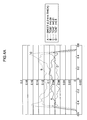
- Fig. 5A is a diagram representing simulation results of front luminance distributions between the semiconductor light emitting device 100 and the conventional semiconductor light emitting device 300.
- Figs. 5B and 5C are schematic diagrams showing the conditions when the simulation shown in Fig. 5A was performed. Structures of the semiconductor light emitting device 100 and the conventional semiconductor light emitting device 300 are the same as the ones described above with respect to Fig. 4A-C .
- a contact angle on the side of the resin layer 4 formed between a tangent line of the resin layer 4, drawn from a contact point of the element substrate 1, the resin layer 4 and the external atmosphere, and the surface of the element substrate 1 is to be 90 degrees, while a height "t" of the resin layer 4 is to be changed to 0.2 mm, 0.5 mm and 1.0 mm.
- reference character A designates a front luminance distribution for the comparison example
- reference characters B to D designate front luminance distributions for various embodiments of the presently disclosed subject matter.
- Reference character A represents a front luminance distribution of the semiconductor light emitting device 300.
- the front luminance exhibits a maximum value at a center portion.
- the front luminance decreases gradually from the maximum value at the center portion toward both ends of the semiconductor light emitting device 300. At points passing both end portions, the front luminance decreases almost perpendicularly.
- Reference character B represents a front luminance distribution of the semiconductor light emitting device 100 in which the resin layer 4 has a height of 0.2 mm.
- the front luminance exhibits a minimum value at a center portion, and the front luminance increases from the center portion toward both ends of the semiconductor light emitting device 100. At points passing both end portions, the front luminance decreases almost perpendicularly.
- Reference character C represents a front luminance distribution of a semiconductor light emitting device 100 where the resin layer 4 has a height of 0.5 mm.
- the front luminance exhibits a minimum value at a center portion, and the front luminance increases drastically from the center portion toward both ends of the semiconductor light emitting device 100. At points passing both end portions, the front luminance decreases almost perpendicularly.
- Reference character D represents a front luminance distribution of the semiconductor light emitting device 100 where the resin layer 4 has a height of 1.0 mm.
- the front luminance exhibits a minimum value at a center portion, and the front luminance increases gradually from the center portion toward both ends of the semiconductor light emitting device 100. At points passing both end portions, the front luminance decreases almost perpendicularly.
- the front luminance distribution exhibits the minimum value of front luminance at the center portion, whereas it exhibits the maximum value of front luminance at the end portion.
- the front luminance distribution exhibits a precipitous form at the end portion, which is different from the case of the comparison example.
- the front luminance distribution B where the height of the resin layer is 0.2 mm exhibits the largest maximum value of front luminance at the end portion. Moreover, the front luminance distribution B exhibits the largest difference in front luminance between the end portion and the center portion. Comparing the front luminance distribution C and the front luminance distribution D, the front luminance distribution C exhibits a slightly larger value of front luminance at the end portion than does the front luminance distribution D. With respect to a difference in front luminance between the end portion and the center portion, the front luminance distribution D shows a larger value than the front luminance distribution C.
- Fig. 6A is a diagram representing a simulation result of a front luminance distribution of a semiconductor light emitting device 100.
- Fig. 6B is a schematic diagram showing conditions when the simulation shown in Fig. 6A is performed.
- the semiconductor light emitting device 100 includes a light emitting element 3 composed of an element substrate 1 made of silicon and a semiconductor epitaxial layer 2 formed on the element substrate 1.
- a sheet-like resin layer 4a is formed on the light emitting element 3 with a predetermined thickness (0.2 mm).
- a dome-shaped resin layer 4b is formed on the sheet-like resin layer 4a. Both of the sheet-like resin layer 4a and the dome-shaped resin layer 4b include fluorescent substance.
- an angle (a contact angle) on the side of the resin layer 4b formed between a tangent line of the resin layer 4b, drawn from a contact point of the sheet-like resin layer 4a and the dome-shaped resin layer 4b, and the surface of the element substrate 1 is 45 degrees.
- the front luminance distribution of the semiconductor light emitting device 100 provided with the sheet-like resin layer 4a and the dome-shaped resin layer 4b exhibits maximum values of front luminance at both end portions and a minimum value of front luminance at a center portion. Meanwhile, a difference between the maximum value and the minimum value is small, and the front luminance distribution shows a generally flat form. At points passing both end portions, the front luminance decreases almost perpendicularly.
- the front luminance distribution can be improved by arranging the dome-shaped resin layer 4b on the sheet-like resin layer 4a.
- a resin layer with slopes in the uppermost layer can tolerate the arrangement of a sheet-like resin layer as a part of the resin layer.
- the resin layer has side surfaces perpendicular to the surface of the element substrate, it may be acceptable as long as the part of the resin layer having such side surfaces has a thickness within a predetermined range.
- the semiconductor light emitting device 100 can include an element substrate composed of a transparent semiconductor substrate and a reflective layer formed on the transparent semiconductor substrate.
- the reflective layer can be a metal, or a so-called DBR can be used.
- a reflectance ratio of the reflective layer should be 90% or over.
- the resin layer 4 should be adequate as long as it is inclined to the inward side of the semiconductor light emitting device 100 toward the top. By forming the resin layer 4 in an inclined manner and in a form of an approximate arc, it is possible to achieve a semiconductor light emitting device 100 that has few extreme highs and lows in luminance within its light distribution pattern. On the other hand, if the resin layer 4 has an angular cross section, the semiconductor light emitting device 100 may have distinct highs and lows in luminance within its light distribution pattern.
- the resin layer 4 is not limited to having a dome shape with a circular top or being inclined as a whole. By contrast, it could also have an approximately flat portion at its apex, for example. With respect to the present description, such a form will be referred to as a dome shape.
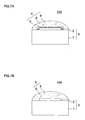
- the semiconductor light emitting device 100 shown in Fig. 7A is provided with a light emitting element 3 composed of an opaque element substrate 1 and a semiconductor epitaxial layer 2 formed on the element substrate 1.
- a resin layer 4 is composed of a fluorescent body containing layer containing fluorescent substance 5 and a scattering material containing layer containing scattering material 9. Since the resin layer 4 is a laminated body including the scattering material containing layer and the fluorescent body containing layer, it is possible to obtain a desired light emitting characteristic and emission color by adjusting thickness and content rate with respect to each layer.
- the semiconductor light emitting device 100 shown in Fig. 7B includes a light emitting element 3 composed of an opaque element substrate 1 and a semiconductor epitaxial layer 2 formed on the element substrate 1.
- a resin layer 4 is composed of a transparent resin 6 and scattering material 9. Since the resin layer 4 has a shape with a circuit top, it is possible to obtain a front luminance distribution exhibiting precipitous rise in front luminance at the end portion, as described above.
- the semiconductor epitaxial layer in this present embodiment is composed of a GaN-based compound semiconductor, for instance, and will emit light in bandwidth ranging from ultraviolet to green.
- the fluorescent substance can include a YAG-based fluorescent substance or other suitable wavelength conversion material which is configured to wave-length convert blue light into yellow colored light when the wavelength conversion material is excited by the blue colored light.
- the scattering material can include barium oxide or barium titanate or other suitable material.
- the semiconductor light emitting device according to the presently disclosed subject matter is not limited to those examples.
- the light emitting element and the resin layer can be paired in various manners and used in the semiconductor light emitting device according to the presently disclosed subject matter.
- FIG. 8A to 8E Exemplary forms of a resin layer which could be used in the semiconductor light emitting device according to the presently disclosed subject matter will be described with reference to Figs. 8A to 8E .
- Figs. 8A to 8E only the resin layer 4 and the light emitting element are shown while the element substrate, the semiconductor epitaxial layer, the fluorescent substances, etc., are omitted from view.
- the semiconductor light emitting device 100 in Fig. 8A has a resin layer 4 of an approximately hemispherical shape provided on light emitting element 3.
- the shape of the resin layer 4 is obtained by applying a resin that includes dispersed scattering material and/or fluorescent substance by potting, and letting the resin harden thereafter.
- the resin layer 4 is formed with an arc shape in the upper surface at a central cross section.
- the shape of the resin layer 4 can be changed by controlling viscosity and thixotropy of the resin that is to be applied by the potting process. For instance, a curvature, a distance from an end portion of the element substrate to the resin layer, a contact angle of the resin layer, a height of the resin layer, etc., can be changed.
- the resin layer 4 By forming the resin layer 4 into a dome shape, it is possible to obtain a front luminance distribution that is precipitous at end portions of all four sides of the light emitting element 3.
- the resin layer 4 is formed by applying a resin by potting, the resin layer 4 can be easily formed into a dome shape.
- the semiconductor light emitting device 100 in Fig. 8B has a resin layer 4 of an approximately semi-cylindrical shape provided on a light emitting element 3.
- Fig. 8C is a sectional view of the semiconductor light emitting device shown in Fig. 8B taken along line 8C-8C of Fig. 8B .
- the shape of the resin layer 4 is obtained by molding a resin including dispersed scattering material and/or fluorescent substance into a desired shape.
- a cross section taken along line 8C-8C has a semicircular shape (as shown in Fig. 8C ).
- the semiconductor light emitting device 100 can have a front luminance distribution in which there is a large difference in front luminance between a light emitting portion and a light non-emitting portion at both end portions of the semiconductor light emitting device 100.
- a cross section of the device 100 that is taken perpendicular to the line 8C-8C will be an approximately rectangular shape. With respect to this cross sectional shape, a front luminance distribution will exhibit a maximum value of front luminance at a center portion, as in the case of the conventional semiconductor light emitting device. Accordingly, the semiconductor light emitting device 100 in Fig. 8B will have a front luminance distribution that is precipitous at end portions of the two longest facing sides of the light emitting element 3.
- the semiconductor light emitting device 100 in Fig. 8D has a resin layer 4 provided on a light emitting element 3.
- Fig. 8E is a sectional view of the semiconductor light emitting device shown in Fig. 8D taken along line 8E-8E of Fig. 8D .
- a shape of the resin layer 4 is obtained by molding a resin including dispersed scattering material and/or fluorescent substance into a desired shape.
- a cross section taken along line 8E-8E has a shape of an arc extending from one end to the other end (shown in Fig. 8E ).
- the resin layer 4 is inclined inwardly toward the top so that its apex will be positioned at the edge of the other end.
- the semiconductor light emitting device 100 exhibits a front luminance distribution which is precipitous at one end only.
- the semiconductor light emitting device 100 shown in Fig. 9A includes a light emitting element 3 and a resin layer 4 composed of a transparent resin 6 containing fluorescent substance 5 and scattering material 9.
- the light emitting element 3 is mounted on a mounting board (not shown).
- the resin layer 4 is surrounded by air.
- the light emitting element 3 and the resin layer 4 might be surrounded by gas such as nitrogen or the like.
- All or almost all of the fluorescent substance 5 in the resin layer 4 is deposited on the light emitting element 3, or those particles of the fluorescent substance 5 which are not deposited directly on the light emitting element 3 can settle such that they are nearly contacting the fluorescent substance 5 deposited on the light emitting element 3 or nearly contacting the fluorescent substance 5 contacting the light emitting element 3. This means that most of the fluorescent substance 5 in the resin layer 4 is thermally connected with the light emitting element 3 either directly or indirectly.
- the heat generated by the fluorescent substance 5 will be transmitted to the light emitting element 3 without being passed on to the transparent resin 6 which has a low thermal conductivity (for instance, if the transparent resin is silicon, the thermal conductivity will be about 0.2 W/mK).
- the thickness of the layer formed by the deposited fluorescent substance 5 can be changed arbitrarily by changing the kind and the amount of the fluorescent substance 5.
- YAG: Ce is used as the fluorescent substance
- desired white light can be obtained while the heat from the fluorescent substance 5 can be transmitted to the light emitting element 3.
- the scattering material 9 contained in the resin layer 4 it is possible to reduce unevenness of color.
- a resin layer 4 in the semiconductor light emitting device 100 shown in Fig. 9B does not include scattering material.
- all or almost all of the fluorescent substance 5 in the resin layer 4 is deposited on the light emitting element 3, and that fluorescent substance 5 which is not deposited directly on the light emitting element 3 settles such that it nearly contacts the fluorescent substance 5 deposited on the light emitting element 3 or nearly contacts the fluorescent substance 5 contacting the light emitting element 3.
- This means that most of the fluorescent substance 5 in the resin layer 4 is thermally connected with the light emitting element 3 either directly or indirectly.
- the semiconductor light emitting device 100 in Fig. 9B is not provided with scattering material, scattering material is not an indispensable constituent feature in terms of improving heat dissipation of the fluorescent substance 5.
- Fig. 9C shows the semiconductor light emitting device 100 as having a resin layer 4 containing fluorescent substance 5a and fluorescent substance 5b, and fluorescent substance 5b includes particles having a smaller particle size than a particle size of particles that make up the fluorescent substance 5a.
- the smaller particle size fluorescent substance 5b is hard to deposit as compared to the relatively large particle size fluorescent substance 5a. For instance, in a case of forming the resin layer 4 by applying a resin containing the fluorescent substance 5a and the smaller particle size fluorescent substance 5b by potting on the light emitting element 3 and letting the resin thermally harden, the smaller particle size fluorescent substance 5b can be easily dispersed within the resin layer 4.
- the smaller particle size fluorescent substance 5b has less conversion efficiency than the large particle size fluorescent substance 5a. However, the smaller particle size fluorescent substance 5b makes it possible to reduce unevenness of color.
- the resin layer can further contain scattering materials.
- the amount of the fluorescent substance 5b should be less than the amount of the deposited fluorescent substance 5 a.
- the semiconductor light emitting device in each of Figs. 9A to 9C has a resin layer 4 with a circular top, the semiconductor light emitting device can have a front luminance distribution that is precipitous at the end portion, regardless of the state of distribution of the fluorescent substance 5.
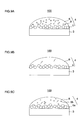
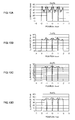
- Figs. 10A to 10D illustrate front luminance distributions of the semiconductor device where the fluorescent substance is deposited within the resin layer and thermally connected with the light emitting element.
- the front luminance distribution is measured under the condition that four of the semiconductor light emitting devices are arranged in a line, while each of the semiconductor light emitting devices has a dome-shaped resin layer with a circular top, as described with reference to the device shown in Figs. 1 , 2A and 2B .
- Fig. 10A shows a front luminance distribution of the semiconductor light emitting device where the resin layer contains no scattering material (0 wt%) in the resin layer.
- FIG. 10B shows a front luminance distribution of the semiconductor light emitting device where the resin layer contains scattering materials at a ratio of 1 wt%.
- Fig. 10C shows a front luminance distribution of the semiconductor light emitting device where the resin layer contains scattering materials at a ratio of 2 wt%.
- Fig. 10D shows a front luminance distribution of the semiconductor light emitting device where the resin layer contains scattering materials at a ratio of 3 wt%.
- the semiconductor light emitting device can have a front luminance distribution that is precipitous at end portions thereof.
- the front luminance distribution of the semiconductor light emitting device can be turned into a desired pattern in compliance with the optical characteristic that is required in a lighting device.
- Fig. 11 is a graphic representation comparing measurement results on resin surface maximum temperatures and Tj calculation values between a case in which the fluorescent substance 5 is dispersed within the resin layer and a case in which the fluorescent substance 5 is deposited within the resin layer. Surface temperatures of the layers of fluorescent substance are measured by an infrared (IR) camera.
- IR infrared
- Reference character A represents measurement results with respect to the semiconductor light emitting device having the resin layer formed only on the light emitting element while YAG fluorescent substance is dispersed evenly within the resin layer.
- Reference character B represents measurement results with respect to the semiconductor light emitting device having the resin layer formed only on the light emitting element while YAG fluorescent substance is deposited within the resin layer.
- the X axis shows Tj calculation values (°C) at the time when the light emitting element is driven.
- the Tj calculation value indicates a temperature of the light emitting element.
- Rth designates thermal resistance of the semiconductor light emitting device and a heat sink.
- If and “Vf” designate a current and a voltage at the time when the light emitting element is driven, respectively.
- Ta designates an atmosphere temperature.
- the Y axis shows temperatures of the resin layer surface measured by the IR camera.
- the light emitting element is driven at a power density of approximately 2.5 (W/mm 2 ).
- a Tj value is varied according to changes in the atmosphere temperature.
- a resin layer surface temperature measured by the IR camera is considerably high with respect to a light emitting element temperature Tj.
- a difference between the two is over 50°C.
- Tj 120°C
- the surface temperature of the layer of fluorescent substances is measured as about 175°C. This indicates that the amount of transparent resin is small with respect to the amount of fluorescent substance, and thus the transparent resin in the resin layer is raised to a high temperature due to the heat generated by the fluorescent substance.
- a vehicle lamp adopting the semiconductor light emitting device as described above will be described with reference to Figs. 12A to 12C .
- a semiconductor light emitting apparatus having four of the semiconductor light emitting devices 100, each of which being provided with the resin layer 4 of an approximately semi-cylindrical shape on the light emitting elements 3, and arranged in a line, is used as a light source.
- Each of the light emitting elements 3 in the present embodiment has a rectangular shape in top planar view, and they are arranged such that their long sides will make a straight line.
- Fig. 12B shows an example of a state in which the semiconductor light emitting devices 100 are set in a head light 20 which includes a reflector 21 of a paraboloid of revolution form.
- the plurality of semiconductor light emitting devices 100 are arranged linearly in a direction perpendicular to a center line Ho (i.e. an optical axis of the head light 20) in a horizontal direction with respect to reflector 21.
- Ho i.e. an optical axis of the head light 20
- the plurality of semiconductor light emitting devices 100 should be positioned in the vicinity of a focal point of the paraboloid of revolution including the position of the focal point (for example, at a position arbitrarily a head of the focal point).
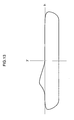
- a light distribution pattern as shown in Fig. 13 , which is suitable for a low beam light distribution for irradiating an area below a horizontal line H can be obtained depending on a shape of a light emitting portion of the semiconductor light emitting device.
- the semiconductor light emitting apparatus using the semiconductor light emitting devices as a light source for a vehicle head light, it is possible to have a light distribution pattern where a horizontal line with a sharp light-dark boundary can be formed, and thus the optical design can be made simple. Furthermore, since the lighting intensity of an edge area forming the horizontal line can be raised, it is possible to have improved distance visibility.
- the semiconductor light emitting apparatus serving as the light source for the vehicle head light when a plurality of light emitting devices are to be arranged as shown in Fig.
- each resin layer 4 will have a portion that inclines inwardly toward the top at a cross section perpendicular to a longitudinal direction of the elements arrangement (and perpendicular to each longitudinal axis of each light emitting device). Then as shown in Fig. 12B , the resin layer will have a portion that inclines inwardly toward the top at a cross section along a lighting direction of the vehicle head light.
- the semiconductor light emitting apparatus to be used as a light source for a vehicle lamp, it is possible to adopt the semiconductor light emitting device provided with the resin layer 4 of a dome shape as shown in Fig. 8A , or with the resin layer 4 having its apex at the edge portion as shown in Figs. 8D and 8E . Furthermore, as shown in Fig. 12C , it is also possible to form such a semiconductor light emitting device where a resin layer 4 with an approximately semi-cylindrical shape at cross section is formed integrally over an arrangement of a plurality of light emitting elements.
Landscapes
- Led Device Packages (AREA)
- Non-Portable Lighting Devices Or Systems Thereof (AREA)
Applications Claiming Priority (1)
| Application Number | Priority Date | Filing Date | Title |
|---|---|---|---|
| JP2007307675A JP5212777B2 (ja) | 2007-11-28 | 2007-11-28 | 半導体発光装置及び照明装置 |
Publications (2)
| Publication Number | Publication Date |
|---|---|
| EP2065948A2 true EP2065948A2 (fr) | 2009-06-03 |
| EP2065948A3 EP2065948A3 (fr) | 2010-02-03 |
Family
ID=40351669
Family Applications (1)
| Application Number | Title | Priority Date | Filing Date |
|---|---|---|---|
| EP08020468A Withdrawn EP2065948A3 (fr) | 2007-11-28 | 2008-11-25 | Dispositif électroluminescent à semi-conducteurs et dispositif d'éclairage |
Country Status (3)
| Country | Link |
|---|---|
| US (1) | US20090134417A1 (fr) |
| EP (1) | EP2065948A3 (fr) |
| JP (1) | JP5212777B2 (fr) |
Cited By (7)
| Publication number | Priority date | Publication date | Assignee | Title |
|---|---|---|---|---|
| EP2233828A1 (fr) | 2009-03-24 | 2010-09-29 | Stanley Electric Co., Ltd. | Phare de véhicule et dispositif d'éclairage des routes |
| WO2011138712A1 (fr) * | 2010-05-07 | 2011-11-10 | Koninklijke Philips Electronics N.V. | Boîtier de diode électroluminescente à lentille en carré arrondi |
| EP2393133A1 (fr) * | 2010-06-04 | 2011-12-07 | Kabushiki Kaisha Toshiba | Dispositif électroluminescent semi-conducteur |
| US8342720B2 (en) | 2008-10-10 | 2013-01-01 | Stanley Electric Co., Ltd. | Vehicle light and road illumination device |
| WO2013127985A1 (fr) * | 2012-03-01 | 2013-09-06 | Osram Opto Semiconductors Gmbh | Élément optoélectronique et procédé de fabrication d'un élément optoélectronique |
| EP2667423A1 (fr) * | 2012-05-25 | 2013-11-27 | Kabushiki Kaisha Toshiba | Dispositif électroluminescent à semi-conducteur et unité de source de lumière |
| EP2360749A3 (fr) * | 2010-02-12 | 2014-11-19 | LG Innotek Co., Ltd. | Diode électroluminescente, boîtier DEL et système d'éclairage l'incorporant |
Families Citing this family (24)
| Publication number | Priority date | Publication date | Assignee | Title |
|---|---|---|---|---|
| KR101574286B1 (ko) * | 2009-01-21 | 2015-12-04 | 삼성전자 주식회사 | 발광 장치 |
| JP5572013B2 (ja) | 2010-06-16 | 2014-08-13 | スタンレー電気株式会社 | 発光装置およびその製造方法 |
| US8455907B2 (en) | 2010-06-16 | 2013-06-04 | Stanley Electric Co., Ltd. | Semiconductor light emitting device having an optical plate including a meniscus control structure and method of manufacturing |
| JP2012033823A (ja) | 2010-08-02 | 2012-02-16 | Stanley Electric Co Ltd | 発光装置およびその製造方法 |
| JP5622494B2 (ja) | 2010-09-09 | 2014-11-12 | スタンレー電気株式会社 | 発光装置およびその製造方法 |
| JP5588368B2 (ja) * | 2011-01-24 | 2014-09-10 | スタンレー電気株式会社 | 発光装置およびその製造方法 |
| US8581287B2 (en) | 2011-01-24 | 2013-11-12 | Stanley Electric Co., Ltd. | Semiconductor light emitting device having a reflective material, wavelength converting layer and optical plate with rough and plane surface regions, and method of manufacturing |
| JP5899734B2 (ja) * | 2011-09-16 | 2016-04-06 | 日亜化学工業株式会社 | 発光装置 |
| KR101335921B1 (ko) * | 2011-10-06 | 2013-12-03 | 삼성전자주식회사 | 발광 다이오드 패키지 및 그의 제조방법 |
| JP6038443B2 (ja) * | 2011-11-21 | 2016-12-07 | スタンレー電気株式会社 | 半導体発光装置および半導体発光装置の製造方法 |
| JP6025138B2 (ja) * | 2012-02-14 | 2016-11-16 | スタンレー電気株式会社 | 発光装置及びその製造方法 |
| CN103367614A (zh) * | 2012-03-26 | 2013-10-23 | 台达电子工业股份有限公司 | 发光二极管的封装结构与其制法 |
| JP6006525B2 (ja) * | 2012-05-15 | 2016-10-12 | スタンレー電気株式会社 | 半導体発光装置及びそれを用いた灯具 |
| CN103633229A (zh) * | 2012-08-29 | 2014-03-12 | 展晶科技(深圳)有限公司 | 发光二极管模组及其制造方法 |
| JP6215525B2 (ja) | 2012-10-23 | 2017-10-18 | スタンレー電気株式会社 | 半導体発光装置 |
| JP6134131B2 (ja) * | 2012-11-26 | 2017-05-24 | スタンレー電気株式会社 | 半導体発光装置、その製造方法、および、照明装置 |
| JP6097084B2 (ja) | 2013-01-24 | 2017-03-15 | スタンレー電気株式会社 | 半導体発光装置 |
| DE102013102482A1 (de) * | 2013-03-12 | 2014-10-02 | Osram Opto Semiconductors Gmbh | Optoelektronisches Bauelement und Verfahren zur Herstellung eines optoelektronischen Bauelements |
| JP6229574B2 (ja) * | 2014-03-31 | 2017-11-15 | 日亜化学工業株式会社 | 発光装置の製造方法 |
| JP6653119B2 (ja) * | 2014-09-12 | 2020-02-26 | アルパッド株式会社 | 半導体発光装置及びリードフレーム |
| CN105990492A (zh) | 2015-02-12 | 2016-10-05 | 展晶科技(深圳)有限公司 | 发光二极管封装体及其制造方法 |
| KR102346798B1 (ko) * | 2015-02-13 | 2022-01-05 | 삼성전자주식회사 | 반도체 발광장치 |
| JP6644081B2 (ja) * | 2015-11-04 | 2020-02-12 | シャープ株式会社 | 発光装置、照明装置、および発光装置が備える発光体の製造方法 |
| JP6575576B2 (ja) * | 2017-10-12 | 2019-09-18 | 日亜化学工業株式会社 | 発光装置の製造方法 |
Citations (7)
| Publication number | Priority date | Publication date | Assignee | Title |
|---|---|---|---|---|
| JP2001244507A (ja) | 1999-09-27 | 2001-09-07 | Lumileds Lighting Us Llc | 薄膜の燐光変換発光ダイオードデバイス |
| US20020070449A1 (en) * | 2000-12-12 | 2002-06-13 | Lumileds Lighting, U.S., Lls | Light-emitting device and production thereof |
| JP2002185048A (ja) | 2000-10-13 | 2002-06-28 | Lumileds Lighting Us Llc | 発光ダイオードのステンシル蛍光体層 |
| US20040217364A1 (en) * | 2003-05-01 | 2004-11-04 | Cree Lighting Company, Inc. | Multiple component solid state white light |
| JP2006054209A (ja) * | 2003-09-30 | 2006-02-23 | Toyoda Gosei Co Ltd | 発光装置 |
| US20060126326A1 (en) * | 2004-12-15 | 2006-06-15 | Ng Kee Y | Light-emitting diode flash module with enhanced spectral emission |
| US20070228387A1 (en) * | 2006-04-04 | 2007-10-04 | Gerald Negley | Uniform emission LED package |
Family Cites Families (15)
| Publication number | Priority date | Publication date | Assignee | Title |
|---|---|---|---|---|
| DE19918370B4 (de) * | 1999-04-22 | 2006-06-08 | Osram Opto Semiconductors Gmbh | LED-Weißlichtquelle mit Linse |
| JP2000315824A (ja) * | 1999-04-30 | 2000-11-14 | Runaraito Kk | 発光ダイオードおよびその製造方法 |
| JP2001177156A (ja) * | 1999-12-14 | 2001-06-29 | Koha Co Ltd | 側面発光型ledランプ |
| DE10042947A1 (de) * | 2000-08-31 | 2002-03-21 | Osram Opto Semiconductors Gmbh | Strahlungsemittierendes Halbleiterbauelement auf GaN-Basis |
| JP2003179269A (ja) * | 2001-01-24 | 2003-06-27 | Nichia Chem Ind Ltd | 光半導体素子 |
| MY145695A (en) * | 2001-01-24 | 2012-03-30 | Nichia Corp | Light emitting diode, optical semiconductor device, epoxy resin composition suited for optical semiconductor device, and method for manufacturing the same |
| JP2002299697A (ja) * | 2001-03-29 | 2002-10-11 | Mitsubishi Electric Lighting Corp | Led光源デバイス及び照明器具 |
| US6686676B2 (en) * | 2001-04-30 | 2004-02-03 | General Electric Company | UV reflectors and UV-based light sources having reduced UV radiation leakage incorporating the same |
| EP1437776B1 (fr) * | 2001-10-12 | 2011-09-21 | Nichia Corporation | Dispositif d'emission de lumiere et procede de fabrication de celui-ci |
| US7352011B2 (en) * | 2004-11-15 | 2008-04-01 | Philips Lumileds Lighting Company, Llc | Wide emitting lens for LED useful for backlighting |
| TW201403859A (zh) * | 2005-02-18 | 2014-01-16 | 日亞化學工業股份有限公司 | 具備控制配光特性用之透鏡之發光裝置 |
| JP4971672B2 (ja) * | 2005-09-09 | 2012-07-11 | パナソニック株式会社 | 発光装置 |
| WO2007080803A1 (fr) * | 2006-01-16 | 2007-07-19 | Matsushita Electric Industrial Co., Ltd. | Dispositif electroluminescent a semi-conducteurs |
| EP2011164B1 (fr) * | 2006-04-24 | 2018-08-29 | Cree, Inc. | Del blanche montée en surface vue de côté |
| US20080246044A1 (en) * | 2007-04-09 | 2008-10-09 | Siew It Pang | LED device with combined Reflector and Spherical Lens |
-
2007
- 2007-11-28 JP JP2007307675A patent/JP5212777B2/ja not_active Expired - Fee Related
-
2008
- 2008-11-21 US US12/276,271 patent/US20090134417A1/en not_active Abandoned
- 2008-11-25 EP EP08020468A patent/EP2065948A3/fr not_active Withdrawn
Patent Citations (7)
| Publication number | Priority date | Publication date | Assignee | Title |
|---|---|---|---|---|
| JP2001244507A (ja) | 1999-09-27 | 2001-09-07 | Lumileds Lighting Us Llc | 薄膜の燐光変換発光ダイオードデバイス |
| JP2002185048A (ja) | 2000-10-13 | 2002-06-28 | Lumileds Lighting Us Llc | 発光ダイオードのステンシル蛍光体層 |
| US20020070449A1 (en) * | 2000-12-12 | 2002-06-13 | Lumileds Lighting, U.S., Lls | Light-emitting device and production thereof |
| US20040217364A1 (en) * | 2003-05-01 | 2004-11-04 | Cree Lighting Company, Inc. | Multiple component solid state white light |
| JP2006054209A (ja) * | 2003-09-30 | 2006-02-23 | Toyoda Gosei Co Ltd | 発光装置 |
| US20060126326A1 (en) * | 2004-12-15 | 2006-06-15 | Ng Kee Y | Light-emitting diode flash module with enhanced spectral emission |
| US20070228387A1 (en) * | 2006-04-04 | 2007-10-04 | Gerald Negley | Uniform emission LED package |
Cited By (13)
| Publication number | Priority date | Publication date | Assignee | Title |
|---|---|---|---|---|
| US8342720B2 (en) | 2008-10-10 | 2013-01-01 | Stanley Electric Co., Ltd. | Vehicle light and road illumination device |
| EP2233828A1 (fr) | 2009-03-24 | 2010-09-29 | Stanley Electric Co., Ltd. | Phare de véhicule et dispositif d'éclairage des routes |
| EP2360749A3 (fr) * | 2010-02-12 | 2014-11-19 | LG Innotek Co., Ltd. | Diode électroluminescente, boîtier DEL et système d'éclairage l'incorporant |
| US8431942B2 (en) | 2010-05-07 | 2013-04-30 | Koninklijke Philips Electronics N.V. | LED package with a rounded square lens |
| WO2011138712A1 (fr) * | 2010-05-07 | 2011-11-10 | Koninklijke Philips Electronics N.V. | Boîtier de diode électroluminescente à lentille en carré arrondi |
| CN102870243B (zh) * | 2010-05-07 | 2015-12-16 | 皇家飞利浦电子股份有限公司 | 具有圆角正方形透镜的led封装 |
| CN102870243A (zh) * | 2010-05-07 | 2013-01-09 | 皇家飞利浦电子股份有限公司 | 具有圆角正方形透镜的led封装 |
| US8368089B2 (en) | 2010-06-04 | 2013-02-05 | Kabushiki Kaisha Toshiba | Semiconductor light emitting device |
| EP2423988A1 (fr) | 2010-06-04 | 2012-02-29 | Kabushiki Kaisha Toshiba | Dispositif électroluminescent semi-conducteur |
| EP2393133A1 (fr) * | 2010-06-04 | 2011-12-07 | Kabushiki Kaisha Toshiba | Dispositif électroluminescent semi-conducteur |
| WO2013127985A1 (fr) * | 2012-03-01 | 2013-09-06 | Osram Opto Semiconductors Gmbh | Élément optoélectronique et procédé de fabrication d'un élément optoélectronique |
| EP2667423A1 (fr) * | 2012-05-25 | 2013-11-27 | Kabushiki Kaisha Toshiba | Dispositif électroluminescent à semi-conducteur et unité de source de lumière |
| US8987764B2 (en) | 2012-05-25 | 2015-03-24 | Kabushiki Kaisha Toshiba | Semiconductor light emitting device and light source unit |
Also Published As
| Publication number | Publication date |
|---|---|
| JP5212777B2 (ja) | 2013-06-19 |
| EP2065948A3 (fr) | 2010-02-03 |
| JP2009135136A (ja) | 2009-06-18 |
| US20090134417A1 (en) | 2009-05-28 |
Similar Documents
| Publication | Publication Date | Title |
|---|---|---|
| EP2065948A2 (fr) | Dispositif électroluminescent à semi-conducteurs et dispositif d'éclairage | |
| US8071990B2 (en) | Optoelectronic component that emits electromagnetic radiation and illumination module | |
| US6774405B2 (en) | Light-emitting device | |
| JP5261380B2 (ja) | 発光装置 | |
| CN100411207C (zh) | 发光装置及照明装置 | |
| JP6023303B2 (ja) | 発光装置 | |
| US7722211B2 (en) | Light engine | |
| CN103959490B (zh) | 用于固态发光装置及灯的光致发光波长转换组件 | |
| RU2717381C2 (ru) | Светоизлучающее устройство, интегрированное светоизлучающее устройство и светоизлучающий модуль | |
| CN102563485B (zh) | 发光装置、车辆用前照灯、照明装置以及车辆 | |
| JP4955422B2 (ja) | 発光装置 | |
| KR102017538B1 (ko) | 조명 장치 | |
| US20150009649A1 (en) | Light emiting module, a lamp, a luminaire and a display device | |
| US20100309646A1 (en) | Light-emitting device and display unit and lighting unit using the same | |
| US20100002425A1 (en) | Light-emitting structure for generating an annular illumination effect | |
| US20100296266A1 (en) | Lighting Device | |
| KR20110039327A (ko) | 방사선-방출 장치 | |
| CN102171844A (zh) | 用于增大的光提取和非黄色的断开状态颜色的在封装剂中具有颗粒的led | |
| CN1993839A (zh) | Led灯系统 | |
| KR20140053837A (ko) | 원거리 광발광 반사 변환기를 구비하는 led 백색광원 | |
| US20110044039A1 (en) | Led lamp construction with integral appearance | |
| WO2011016295A1 (fr) | Dispositif électroluminescent et procédé de fabrication de dispositif électroluminescent | |
| JP5586119B2 (ja) | 光学部品及びそれを用いた照明装置 | |
| JP2012074317A (ja) | 照明装置、ランプ及びショーケース | |
| JP2011065766A (ja) | Led照明装置 |
Legal Events
| Date | Code | Title | Description |
|---|---|---|---|
| PUAI | Public reference made under article 153(3) epc to a published international application that has entered the european phase |
Free format text: ORIGINAL CODE: 0009012 |
|
| AK | Designated contracting states |
Kind code of ref document: A2 Designated state(s): AT BE BG CH CY CZ DE DK EE ES FI FR GB GR HR HU IE IS IT LI LT LU LV MC MT NL NO PL PT RO SE SI SK TR |
|
| AX | Request for extension of the european patent |
Extension state: AL BA MK RS |
|
| PUAL | Search report despatched |
Free format text: ORIGINAL CODE: 0009013 |
|
| AK | Designated contracting states |
Kind code of ref document: A3 Designated state(s): AT BE BG CH CY CZ DE DK EE ES FI FR GB GR HR HU IE IS IT LI LT LU LV MC MT NL NO PL PT RO SE SI SK TR |
|
| AX | Request for extension of the european patent |
Extension state: AL BA MK RS |
|
| 17P | Request for examination filed |
Effective date: 20100730 |
|
| AKX | Designation fees paid |
Designated state(s): DE FR GB |
|
| 17Q | First examination report despatched |
Effective date: 20170207 |
|
| STAA | Information on the status of an ep patent application or granted ep patent |
Free format text: STATUS: THE APPLICATION IS DEEMED TO BE WITHDRAWN |
|
| 18D | Application deemed to be withdrawn |
Effective date: 20170818 |