EP2065955B1 - Procédé de préparation de matériau actif d'électrode négative pour batteries rechargeables au lithium - Google Patents
Procédé de préparation de matériau actif d'électrode négative pour batteries rechargeables au lithium Download PDFInfo
- Publication number
- EP2065955B1 EP2065955B1 EP08169972A EP08169972A EP2065955B1 EP 2065955 B1 EP2065955 B1 EP 2065955B1 EP 08169972 A EP08169972 A EP 08169972A EP 08169972 A EP08169972 A EP 08169972A EP 2065955 B1 EP2065955 B1 EP 2065955B1
- Authority
- EP
- European Patent Office
- Prior art keywords
- active material
- flake
- polymer binder
- materials
- negative active
- Prior art date
- Legal status (The legal status is an assumption and is not a legal conclusion. Google has not performed a legal analysis and makes no representation as to the accuracy of the status listed.)
- Active
Links
Images


Classifications
-
- H—ELECTRICITY
- H01—ELECTRIC ELEMENTS
- H01M—PROCESSES OR MEANS, e.g. BATTERIES, FOR THE DIRECT CONVERSION OF CHEMICAL ENERGY INTO ELECTRICAL ENERGY
- H01M4/00—Electrodes
- H01M4/02—Electrodes composed of, or comprising, active material
- H01M4/13—Electrodes for accumulators with non-aqueous electrolyte, e.g. for lithium-accumulators; Processes of manufacture thereof
- H01M4/134—Electrodes based on metals, Si or alloys
-
- H—ELECTRICITY
- H01—ELECTRIC ELEMENTS
- H01M—PROCESSES OR MEANS, e.g. BATTERIES, FOR THE DIRECT CONVERSION OF CHEMICAL ENERGY INTO ELECTRICAL ENERGY
- H01M4/00—Electrodes
- H01M4/02—Electrodes composed of, or comprising, active material
- H01M4/36—Selection of substances as active materials, active masses, active liquids
- H01M4/38—Selection of substances as active materials, active masses, active liquids of elements or alloys
-
- C—CHEMISTRY; METALLURGY
- C01—INORGANIC CHEMISTRY
- C01B—NON-METALLIC ELEMENTS; COMPOUNDS THEREOF; METALLOIDS OR COMPOUNDS THEREOF NOT COVERED BY SUBCLASS C01C
- C01B33/00—Silicon; Compounds thereof
- C01B33/02—Silicon
- C01B33/021—Preparation
-
- H—ELECTRICITY
- H01—ELECTRIC ELEMENTS
- H01M—PROCESSES OR MEANS, e.g. BATTERIES, FOR THE DIRECT CONVERSION OF CHEMICAL ENERGY INTO ELECTRICAL ENERGY
- H01M10/00—Secondary cells; Manufacture thereof
- H01M10/05—Accumulators with non-aqueous electrolyte
- H01M10/052—Li-accumulators
-
- H—ELECTRICITY
- H01—ELECTRIC ELEMENTS
- H01M—PROCESSES OR MEANS, e.g. BATTERIES, FOR THE DIRECT CONVERSION OF CHEMICAL ENERGY INTO ELECTRICAL ENERGY
- H01M10/00—Secondary cells; Manufacture thereof
- H01M10/05—Accumulators with non-aqueous electrolyte
- H01M10/052—Li-accumulators
- H01M10/0525—Rocking-chair batteries, i.e. batteries with lithium insertion or intercalation in both electrodes; Lithium-ion batteries
-
- H—ELECTRICITY
- H01—ELECTRIC ELEMENTS
- H01M—PROCESSES OR MEANS, e.g. BATTERIES, FOR THE DIRECT CONVERSION OF CHEMICAL ENERGY INTO ELECTRICAL ENERGY
- H01M4/00—Electrodes
- H01M4/02—Electrodes composed of, or comprising, active material
- H01M4/13—Electrodes for accumulators with non-aqueous electrolyte, e.g. for lithium-accumulators; Processes of manufacture thereof
- H01M4/139—Processes of manufacture
- H01M4/1395—Processes of manufacture of electrodes based on metals, Si or alloys
-
- H—ELECTRICITY
- H01—ELECTRIC ELEMENTS
- H01M—PROCESSES OR MEANS, e.g. BATTERIES, FOR THE DIRECT CONVERSION OF CHEMICAL ENERGY INTO ELECTRICAL ENERGY
- H01M4/00—Electrodes
- H01M4/02—Electrodes composed of, or comprising, active material
- H01M4/36—Selection of substances as active materials, active masses, active liquids
- H01M4/38—Selection of substances as active materials, active masses, active liquids of elements or alloys
- H01M4/386—Silicon or alloys based on silicon
-
- H—ELECTRICITY
- H01—ELECTRIC ELEMENTS
- H01M—PROCESSES OR MEANS, e.g. BATTERIES, FOR THE DIRECT CONVERSION OF CHEMICAL ENERGY INTO ELECTRICAL ENERGY
- H01M4/00—Electrodes
- H01M4/02—Electrodes composed of, or comprising, active material
- H01M4/36—Selection of substances as active materials, active masses, active liquids
- H01M4/38—Selection of substances as active materials, active masses, active liquids of elements or alloys
- H01M4/387—Tin or alloys based on tin
-
- Y—GENERAL TAGGING OF NEW TECHNOLOGICAL DEVELOPMENTS; GENERAL TAGGING OF CROSS-SECTIONAL TECHNOLOGIES SPANNING OVER SEVERAL SECTIONS OF THE IPC; TECHNICAL SUBJECTS COVERED BY FORMER USPC CROSS-REFERENCE ART COLLECTIONS [XRACs] AND DIGESTS
- Y02—TECHNOLOGIES OR APPLICATIONS FOR MITIGATION OR ADAPTATION AGAINST CLIMATE CHANGE
- Y02E—REDUCTION OF GREENHOUSE GAS [GHG] EMISSIONS, RELATED TO ENERGY GENERATION, TRANSMISSION OR DISTRIBUTION
- Y02E60/00—Enabling technologies; Technologies with a potential or indirect contribution to GHG emissions mitigation
- Y02E60/10—Energy storage using batteries
-
- Y—GENERAL TAGGING OF NEW TECHNOLOGICAL DEVELOPMENTS; GENERAL TAGGING OF CROSS-SECTIONAL TECHNOLOGIES SPANNING OVER SEVERAL SECTIONS OF THE IPC; TECHNICAL SUBJECTS COVERED BY FORMER USPC CROSS-REFERENCE ART COLLECTIONS [XRACs] AND DIGESTS
- Y02—TECHNOLOGIES OR APPLICATIONS FOR MITIGATION OR ADAPTATION AGAINST CLIMATE CHANGE
- Y02P—CLIMATE CHANGE MITIGATION TECHNOLOGIES IN THE PRODUCTION OR PROCESSING OF GOODS
- Y02P70/00—Climate change mitigation technologies in the production process for final industrial or consumer products
- Y02P70/50—Manufacturing or production processes characterised by the final manufactured product
Definitions
- the present invention relates to methods of preparing a negative active material for rechargeable lithium batteries.
- Rechargeable lithium batteries contain materials that are capable of reversibly intercalating or deintercalating lithium ions in positive and negative electrodes, and include an organic electrolyte solution or a polymer electrolyte between the positive and negative electrodes. Rechargeable lithium batteries generate electric energy by oxidation and reduction reactions of lithium ions at the positive and negative electrodes.
- Composite metal oxides such as LiCoO 2 LiMn 2 O 4 , LiNiO 2 , LiNi 1-x CO x O 2 (where, 0 ⁇ x ⁇ 1), LiMnO 2 , and so on have been researched for use as positive active materials.
- Lithium metals have generally been used as a negative active material for the rechargeable lithium batteries.
- lithium metals can cause short circuits and pose potential threats of explosions due to the formation of dendrites. Therefore, carbonaceous materials such as amorphous carbons, crystalline carbons, etc., have recently been used as the negative active material in place of lithium metals.
- carbonaceous materials can have irreversible capacity of 5 to 30% during the first several cycles, which wastes lithium ions, and prevents the active material from being fully charged and discharged. Therefore, carbonaceous negative active materials have poor energy densities.
- metal negative active materials such as Si, Sn, and so on
- tin oxide Another material, such as tin oxide, has also been proposed as an alternative to the carbonaceous material negative active material.
- the metal negative active material is included at 30% or less, the initial coulomb efficiency decreases.
- the capacity further decreases and the capacity retention rate remarkably deteriorates after 150 charge and discharge cycles, thereby making it not commercially viable.
- Negative active material as well as methods of producing the same are described in US 6,482,547 B1 , WO 2004/049473 A2 and in Winter M. et al: "Insertion electrode materials for rechargeable lithium batteries", Advanced Materials, Wiley VCH, Weinheim, DE, Vol. 10, No. 10, 1 January 1998, pages 725 - 763 .
- the present invention provides a method of preparing negative active material as defined in the claims.
- a method of fabricating a negative active material for a rechargeable lithium battery includes preparing flake-shaped materials that are capable of doping and dedoping lithium, mixing the flake-shaped materials and a first polymer binder to form a mixture, and firing the mixture at a temperature of 400°C or less to form a plurality of spherical assemblies having central pores therein.
- the first polymer binder is selected from acrylate-based polymers, butadiene-based rubbers, and their combinations.
- Negative active materials that are capable of doping and dedoping lithium such as Si-based or Sn-based negative active materials have been actively researched for use as high-capacity negative active materials.
- the Si-based or Sn-based negative active materials have high capacity but develop cracks due to volume expansion during charge and discharge cycles, thereby resulting in cycle-life deterioration. As a result, they are not yet commercialized.
- the high-capacity negative active material can prevent physical lattice volume expansion and contraction during the charge and discharge cycles, and thus can reduce or prevent the cycle-life deterioration problems associated with the Si-based or Sn-based negative active materials.
- the negative active material includes a spherical assembly arranged to form a central pore inside the spherical assembly.
- the spherical assembly includes flake-shaped materials that are capable of doping and dedoping lithium.
- suitable flake-shaped materials include Si-based, Sn-based material, Al-based, Ge-based materials, their alloys, and combinations thereof.
- the flake-shaped material may be provided in a ribbon-type thin plate shape.
- the flake-shaped materials have an average thickness ranging from 1 ⁇ m to 30 ⁇ m. In another embodiment, the flake-shaped materials have an average thickness ranging from 1 ⁇ m to 20 ⁇ m. In yet another embodiment, the flake-shaped materials have an average thickness ranging from 1 ⁇ m to 10 ⁇ m. If the average thickness is less than 1 ⁇ m, the strength may decrease and thus the flake-shaped material can break easily. If the average thickness is more than 30 ⁇ m, the lithium ion diffusion distance during the doping and dedoping process may increase, thereby decreasing the kinetic performance.
- the flake-shaped materials may have an aspect ratio ranging from 1 to 3. In one embodiment, the flake-shaped materials have an aspect ratio ranging from 1 to 2.
- the size of the spherical assembly can be controlled if the aspect ratio is within the above specified range. If the aspect ratio is out of the range, it is difficult to provide an assembly having appropriate-sized pores.
- the spherical assembly may have an average particle diameter ranging from 1 ⁇ m and 15 ⁇ m. In one embodiment, the average particle diameter ranges from 4 ⁇ m to 12 ⁇ m. When the assembly has an average particle diameter less than 1 ⁇ m, the specific surface area is excessively large such that the initial efficiency may deteriorate. When the assembly has an average particle diameter more than 15 ⁇ m, an excessive central pore may form thereby decreasing the electrode density.
- the central pore is a space formed during the assembly of the flake-shaped materials.
- the central pore may have an average diameter ranging from 0.1 ⁇ m to 5 ⁇ m.
- the central pore has an average diameter ranging from 0.5 ⁇ m to 2 ⁇ m.
- the spherical assembly may have porosity between 20 and 80%. In one embodiment, the spherical assembly has porosity between 30 and 70%. When the porosity is within the above range, it is possible to effectively suppress the volume expansion of the active material. If it is less than 20%, it is difficult to suppress the volume expansion of the active material. If the porosity is more than 80%, the energy density of the electrode plate can deteriorate.
- the negative active material can further include a second polymer binder.
- suitable polymer binders include polyimide, polyvinyl alcohol, carboxyl methyl cellulose, hydroxypropyl cellulose, diacetyl cellulose, polyvinyl chloride, polyvinyl pyrrolidone, polytetrafluoroethylene, polyvinylidene fluoride, polyethylene, polypropylene, and combinations thereof.
- polyimide is used as a binder.
- the negative active material can prevent volume expansion during the charge and discharge cycle by having a central pore formed inside the spherical assembly.
- the central pore is formed during the formation of the spherical assembly. Accordingly, the negative active materials prepared according to the method of the invention can solve or prevent cycle-life deterioration of the conventional negative active material.
- FIG. 1 is a flow chart showing steps of preparing the negative active material for rechargeable lithium batteries according to one embodiment of the present invention.
- the present invention provides a method of preparing a negative active material for rechargeable lithium batteries, which includes preparing flake-shaped materials that are capable of doping and dedoping lithium (S1), mixing the flake-shaped materials and a first polymer binder that may be curable or volatilized at a low temperature (S2), and firing the mixture at a low temperature to form spherical assemblies having central pores therein (S3).
- the flake-shaped materials that are capable of doping and dedoping lithium are prepared (S1).
- suitable flake-shaped materials include Si-based, Sn-based, Al-based, Ge-based materials, and their combinations thereof.
- the flake-shaped materials may be provided in a ribbon-type or thin plate shape.
- the flake-shaped materials can be prepared from metals or their alloys using a melt-spinning, mechanical ball milling, or twin-rolling technique. In one embodiment, melt-spinning is used.
- quenching should be performed at 1000 rpm or more because the alloy-based material has low crystallinity and is amorphous. In one embodiment, the quenching is performed at 1000 rpm to 5000 rpm.
- the flake-shaped materials that are capable of doping and dedoping lithium are the same as described above.
- the first polymer binders can be removed at 400°C or less. In one embodiment, the first polymer binder can be removed at 150°C to 400 °C.
- Suitable first polymer binders include acrylate-based polymers, butadiene-based rubbers, and combinations thereof. Nonlimiting examples of suitable acrylate-based polymers include polymethylmethacrylate, and nonlimiting examples of suitable butadiene-based rubbers include polybutadiene rubbers. In addition, other polymers that are curable at low temperatures can also be used as first polymer binder.
- the flake-shaped materials that are capable of doping and dedoping lithium and first polymer binders may be used at a weight ratio of 95:5 to 50:50.
- the assembly has appropriate strength.
- the assembly has low strength, or the reactivity of the assembly may be reduced.
- a second polymer binder may be further added to the mixture.
- Nonlimiting examples of suitable second polymer binders include polyimide, polyvinylalcohol, carboxylmethyl cellulose, hydroxypropyl cellulose, diacetyl cellulose, polyvinylchloride, polyvinylpyrrolidone, polytetrafluoroethylene, polyvinylidene fluoride, polyolefins such as polyethylene or polypropylene, and combinations thereof.
- polyimide is used.
- the first polymer binder and the second polymer binder can be used in a weight ratio ranging from 30:70 to 80:20. If the weight ratio is out of the specified range and the amount of the second polymer binders is excessive, the porosity of the assembly may deteriorate. If the amount of polymer binder is above the specified range, the strength of the assembly may also deteriorate due to excessive pores.
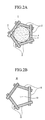
- FIG. 2A shows one possible configuration of various flake-shaped materials (2) that are capable of doping and dedoping lithium and a second polymer binder (4) formed during a preparation step of the negative active material according to one embodiment of the present invention.
- the second polymer binder 4 is disposed in a space 3 formed between flake-shaped materials 2 that are capable of doping and dedoping lithium.
- the polymer binder 4 attaches to each unit of the flake-shaped materials 2, thereby providing a stable structure in a shape of a spherical assembly after being fired at a low temperature.
- the mixture is fired at a low temperature to volatilize the first polymer binder and form a negative active material including the spherical assemblies with central pores therein (S3).
- the firing process is performed at a temperature less than or equal to 400°C. In one embodiment, the firing process is performed at 150 to 400° C. When the firing process is performed at less than or equal to 400°C, the particle crystallinity deterioration can be reduced or prevented. When the firing temperature is more than 400°C, the crystallinity of the metal thin plate may be damaged.
- the first polymer binder filled in the space between the flake-shaped materials is volatilized to form a spherical assembly including flake-shaped materials and a central pore therein.
- FIG. 2B shows a spherical assembly that is formed during a preparation step of the negative active material according to one embodiment of the present invention.
- the flake-shaped materials 12 contact each other to form a spherical assembly 10 including a central pore 13 therein.
- a rechargeable lithium battery including the negative active material is provided.
- the rechargeable lithium battery may include a negative electrode, a positive electrode, and an electrolyte.
- the positive electrode may include a positive active material that is capable of reversibly intercalating and deintercalating lithium ions (lithiated intercalation compound).
- Suitable examples of positive active materials include a composite oxide including lithium and a metal selected from cobalt, manganese, nickel, or combinations thereof.
- suitable lithiated intercalation compounds include those represented by the following Formula nos. (1) to (24). Chemical Formula 1 Li a A 1-b M b D 2 , where, 0.95 ⁇ a ⁇ 1.1 and 0 ⁇ b ⁇ 0.5.
- Chemical Formula 2 Li a E 1-b M b O 2-c X c , where, 0.95 ⁇ a ⁇ 1.1, 0 ⁇ b ⁇ 0.5, and 0 ⁇ c ⁇ 0.05.
- Chemical Formula 3 LiE 2-b M b O 4-c X c , where, 0 ⁇ b ⁇ 0.5 and 0 ⁇ c ⁇ 0.05.
- Chemical Formula 4 Li a N 1-b-c CO b M c D a , where,0.95 ⁇ 1.1, 0 ⁇ b, ⁇ 0.5, ⁇ c ⁇ 0.05, and 0 ⁇ a ⁇ 2.
- Chemical Formula 5 Li a Ni 1-b-c CO b M c O 2-a X a , where, 0.95 ⁇ a 1.1,0 ⁇ b ⁇ 0.5,0 ⁇ c ⁇ 0.05, and 0 ⁇ a ⁇ 2.
- Chemical Formula 6 Li a Ni 1-b-c CO b M c O 2-a X 2 , where, 0.95 ⁇ a ⁇ 1.1, 0 ⁇ b ⁇ 0.5, ⁇ c ⁇ 0.05, and 0 ⁇ a ⁇ 2.
- Chemical Formula 7 Li a Ni 1-b-c Mn b M c D a , where, 0.95 ⁇ a ⁇ 1.1, 0 ⁇ b ⁇ 0.5, 0 ⁇ c ⁇ 0.05, and 0 ⁇ a ⁇ 2).
- Chemical Formula 8 Li a Ni 1-b-c Mn b M c O 2-a X a , where, 0.95 ⁇ a ⁇ 1.1, 0 ⁇ b ⁇ 0.5, 0 ⁇ c ⁇ 0.05, and 0 ⁇ a ⁇ 2).
- Chemical Formula 9 Li a Ni 1-b-c Mn b M c O 2- ⁇ X 2 , where, 0.95 ⁇ a ⁇ 1.1, 0 ⁇ b ⁇ 0.5, 0 ⁇ c ⁇ 0.05, and 0 ⁇ a ⁇ 2).
- Chemical Formula 10 Li a Ni b E c G d O 2, where, 0.90 ⁇ a ⁇ 1.1, 0 ⁇ b ⁇ 0.9, 0 ⁇ c ⁇ 0.5, and 0.001 ⁇ d ⁇ 0.1.
- Chemical Formula 11 Li a Ni b Co c Mn d GeO 2 , where, 0.90 ⁇ a ⁇ 1.1, 0 ⁇ b ⁇ 0.9, 0 ⁇ c ⁇ 0.5, 0 ⁇ d ⁇ 0.5, and 0.001 ⁇ e ⁇ 0.1.
- Chemical Formula 12 Li a NiG b O 2 , where, 0.90 ⁇ a ⁇ 1.1 and 0.001 ⁇ b ⁇ 0.1.
- Chemical Formula 13 Li a COG b O 2 , where, 0.90 ⁇ a ⁇ 1.1 and 0.001 ⁇ b ⁇ 0.1.
- Chemical Formula 14 Li a MnG b O 2 , where, 0.90 ⁇ a ⁇ 1.1 and 0.001 ⁇ b ⁇ 0.1.
- Chemical Formula 15 Li a Mn 2 G b O 4 , where, 0.90 ⁇ a ⁇ 1.1 and 0.001 ⁇ b ⁇ 0.1.
- Chemical Formula 16 QS 2 Chemical Formula 17
- QS 2 Chemical Formula 18 LiQS 2 Chemical Formula 19 V 2 O 5
- Chemical Formula 20 LiV 2 O 5
- Chemical Formula 21 LiZO 2 Chemical Formula 22 LiNiVO 4
- Chemical Formula 23 Li (3-f) J 2 (PO 4 ) 3 (0 ⁇ f ⁇ 3)
- Chemical Formula 24 Li (3-f) Fe 2 (PO 4 ) 3 (0 ⁇ f ⁇ 2)
- the negative and positive electrodes are prepared as follows. An active material, a conductive agent, and a binder are mixed in a solvent to provide an active material composition, and the composition is applied onto a current collector. Various methods of fabricating the electrodes are well known in the art, hence they will not be described.
- Any electrically conductive material can be used as a conductive agent so long as it does not cause any chemical change.
- suitable conductive materials include natural graphite, artificial graphite, carbon black, acetylene black, ketjen black, carbon fiber, and metal powders or metal fibers, which include copper, nickel, aluminum, silver, etc. Other types of conductive materials can also be used.
- a mixture of one or more conductors such as polyphenylene derivatives is used as a conductive agent.
- Nonlimiting examples of suitable binders include polyvinylalcohol, carboxyl methyl cellulose, hydroxypolypropyl cellulose, diacetyl cellulose, polyvinylchloride, polyvinylpyrrolidone, polytetrafluoroethylene, polyvinylidene fluoride, polyethylene, polypropylene, and combinations thereof.
- One nonlimiting example of a suitable solvent includes N-methylpyrrol idone.
- the electrolyte includes a non-aqueous organic solvent and a lithium salt.
- the non-aqueous organic solvent acts as a medium for transmitting ions in the electrochemical reaction of the battery.
- suitable non-aqueous organic solvents include carbonate-based, ester-based, ether-based, ketone-based, alcohol-based, or aprotic solvents.
- suitable carbonate-based solvents include dimethyl carbonate (DMC), diethyl carbonate (DEC), dipropyl carbonate (DPC), methylpropyl carbonate (MPC), ethylpropyl carbonate (EPC), methylethyl carbonate (MEC), ethylmethyl carbonate (EMC), ethylene carbonate (EC), propylene carbonate (PC), butylene carbonate (BC), and so on.
- Nonlimiting examples of suitable ester-based solvents include methyl acetate, ethyl acetate, n-propyl acetate, methylpropionate, ethylpropionate, ⁇ -butyrolactone, decanolide, valerolactone, mevalonolactone, caprolactone, and so on.
- suitable ether-based solvents include dibutyl ether, tetraglyme, diglyme, dimethoxyethane, 2-methyltetrahydrofuran, tetrahydrofuran, and so on.
- suitable ketone-based solvents include cyclohexanone and so on.
- Nonlimiting examples of suitable alcohol-based solvents include ethanol, isopropyl alcohol, and so on.
- suitable aprotic solvents include nitriles such as X-CN (where, X is a C2 to C50 linear, branched, or cyclic hydrocarbon, a double bond, an aromatic ring, or an ether bond), amides such as dimethyl formamide, dioxolans such as 1,3-dioxolan, sulfolane, and so on.
- the non-aqueous organic solvent may be used by itself or in combination with others.
- the mixture ratio can be controlled in accordance with the desirable battery performance.
- the cyclic carbonate and the chain carbonate are preferably mixed together in a volume ratio ranging from 1:1 to 1:9.
- the electrolyte performance may be enhanced.
- the electrolyte of the present invention may further include mixtures of carbonate-based solvents and aromatic hydrocarbon solvents.
- the carbonate-based solvents and the aromatic hydrocarbon are mixed together in a volume ratio ranging from 1:1 to 30:1.
- the aromatic hydrocarbon-based organic solvent may be an aromatic hydrocarbon-based compound represented by the following Formula 25. where, each of R 1 to R 6 is independently selected from the group consisting of hydrogen, halogens, C1 to C10 alkyl groups, C1 to C10 haloalkyl groups, and combinations thereof.
- Nonlimiting examples of suitable aromatic hydrocarbon-based organic solvents include benzene, fluorobenzene, 1,2-difluorobenzene, 1,3-difluorobenzene, 1,4-difluorobenzene, 1,2,3-trifluorobenzene, 1,2,4-trifluorobenzene, chlorobenzene, 1,2-dichlorobenzene, 1,3-dichlorobenzene, 1,4-dichlorobenzene, 1,2,3-trichlorobenzene, 1,2,4-trichlorobenzene, iodobenzene, 1,2-diiodobenzene, 1,3-diiodobenzene, 1,4-diiodobenzene, 1,2,3-triiodobenzene, 1,2,4-triiodobenzene, toluene, fluorotoluene, 1,2-difluorotoluene, 1,3-diflu
- the electrolyte may further include an overcharge inhibiting additive, such as ethylene carbonates, pyrocarbonates, and so on.
- an overcharge inhibiting additive such as ethylene carbonates, pyrocarbonates, and so on.
- the electrolyte may be a solid electrolyte.
- suitable solid electrolytes include polyethylene oxide polymer electrolytes, polymer electrolytes with a polyorganosiloxane side chain or a polyoxyalkylene side chain, sulfide electrolytes, such as Li 2 S-SiS 2 , Li 2 S-GeS 2 , Li 2 S-P 2 S 5 , and Li 2 S-B 2 S 3 , or inorganic electrolytes, such as Li 2 S-SiS 2 -Li 3 PO 4 , and Li 2 S-SiS 2 -Li 3 SO 4 .
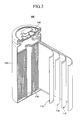
- FIG. 3 An exploded perspective view of a rechargeable lithium battery is shown in FIG. 3 .
- the rechargeable lithium battery 100 includes an electrode assembly 110 in which a positive electrode 112 and a negative electrode 113 are disposed with a separator 114 interposed therebetween, and a case 120 formed with an opening on the end of one side in order to allow the electrode assembly 110 and an electrolyte solution be disposed therein.
- a cap assembly 140 is mounted on the opening of the case 120 to seal it.
- FIG. 3 shows a cylindrical battery of a rechargeable lithium battery, but the shape of the rechargeable lithium battery is not limited thereto, and may have other shapes such as prismatic or pouch shapes.
- a Si-based alloy was dissolved and melt-spun according to an arc-melting method and quenched at a speed of 4000 rpm to provide a ribbon-type thin plate having an average thickness of 5 ⁇ m and an aspect ratio of 2.
- the obtained ribbon-type thin plate and polymethylmethacrylate were mixed at a weight ratio of 85:15.
- the mixture was fired under a nitrogen atmosphere at 400°C to provide a negative active material having a generally spherical assembly with an average central pore size of 0.1 ⁇ m or more and porosity of 65%.
- a negative active material was prepared according to the same procedure as in Example 1, except that a ribbon-type thin plate, polymethylmethacrylate, and a second polymer binder of polyimide were mixed at a weight ratio of 85:7.5:7.5.
- a negative active material was prepared according to the same procedure as in Example 1, except that polybutadiene rubber was used instead of polymethylmethacrylate.
- a negative active material was prepared according to the same procedure as in Example 2, except that carboxymethyl cellulose was used instead of polyimide.
- a negative active material was prepared according to the same procedure as in Example 2, except that diacetyl cellulose was used instead of polyimide.
- a negative active material was prepared according to the same procedure as in Example 2, except that hydroxypropyl cellulose was used instead of polyimide.
- a negative active material was prepared according to the same procedure as in Example 2, except that polyvinylchloride was used instead of polyimide.
- a negative active material was prepared according to the same procedure as in Example 2, except that polyvinylpyrrolidone was used instead of polyimide.
- a negative active material was prepared according to the same procedure as in Example 2, except that polytetrafluoroethylene was used instead of polyimide.
- a negative active material was prepared according to the same procedure as in Example 2, except that polyvinylidene fluoride was used instead of polyimide.
- a negative active material was prepared according to the same procedure as in Example 2, except that polyethylene was used instead of polyimide.
- a Si-based alloy powder was used as a negative active material.
- Each of negative active materials prepared from Examples 1 to 11 had a SEM photograph (5000X) taken, and a SEM photograph (5000X) of Example 1 is shown in FIG. 4 .
- a negative active material was formed of a spherical shaped assembly having an average particle diameter of about 10 ⁇ m and with a central pore having a particle diameter of 0.1 ⁇ m inside the assembly.
- Example 1 After a coin cell was fabricated using the negative active material prepared in accordance with each of Examples 1 to 11 and Comparative Example 1, it was measured to determine the battery characteristics. The results of Examples 1 to 4 and Comparative Example 1 are shown in Table 1. Each coin cell prepared using the negative materials of Examples 1 to 11 and Comparative Example 1 was charged and discharged at 0.1 C for one cycle and had a formation process carried out, and discharge capacity retention (%) was calculated after repeating charge and discharge for 100 cycles relative to the discharge capacity after the first charge and discharge. Table 1 Initial discharge capacity (mAh/g) Assembly pore ratio (%) 100 th cycle discharge capacity retention (%) Example 1 760 65 70 Example 2 790 45 90 Example 3 810 50 80 Example 4 770 60 85 Comparative Example 1 800 - 30
Landscapes
- Chemical & Material Sciences (AREA)
- Chemical Kinetics & Catalysis (AREA)
- Electrochemistry (AREA)
- General Chemical & Material Sciences (AREA)
- Engineering & Computer Science (AREA)
- Materials Engineering (AREA)
- Manufacturing & Machinery (AREA)
- Organic Chemistry (AREA)
- Inorganic Chemistry (AREA)
- Battery Electrode And Active Subsutance (AREA)
- Secondary Cells (AREA)
Claims (7)
- Procédé pour fabriquer un matériau actif négatif pour une pile au lithium rechargeable, comprenant :la préparation de matériaux en forme de paillettes (2, 12) qui sont aptes au dopage et au dédopage du lithium ;le mélange de matériaux en forme de paillettes (2, 12) et d'un premier liant polymère pour former un mélange ; etla cuisson du mélange à une température égale ou inférieure à 400°C pour former au moins un assemblage généralement sphérique (1, 10) renfermant un pore central (3, 13),caractérisé en ce quele premier liant polymère est choisi dans le groupe consistant en des polymères à base d'acrylate, des caoutchoucs à base de butadiène et leurs associations.
- Procédé suivant la revendication 1, dans lequel les matériaux en forme de paillettes (2, 12) sont choisis dans le groupe consistant en des matériaux à base de Si, des matériaux à base de Sn, des matériaux à base de Al, des matériaux à base de Ge, leurs alliages et leurs associations.
- Procédé suivant l'une quelconque des revendications 1 et 2, dans lequel le premier liant polymère est volatilisé à une température égale ou inférieure à 400°C.
- Procédé suivant l'une quelconque des revendications 1 à 3, dans lequel le premier liant polymère est volatilisé à une température de 150 à 400°C.
- Procédé suivant l'une quelconque des revendications 1 à 4, dans lequel les matériaux en forme de paillettes (2, 12) qui sont aptes au dopage et au dédopage du lithium et le premier liant polymère sont présents en un rapport pondéral compris entre 95 :5 et 50 :50.
- Procédé suivant l'une quelconque des revendications 1 à 5, dans lequel un second liant polymère (4) est en outre ajouté au cours du mélange des matériaux en forme de paillettes (2, 12) et du premier liant polymère.
- Procédé suivant la revendication 6, dans lequel le second liant polymère (4) est choisi dans le groupe consistant en un polyimide, l'alcool polyvinylique, la carboxyméthylcellulose, l'hydroxypropylcellulose, la diacétylcellulose, le chlorure de polyvinyle, la polyvinylpyrrolidone, le polytétrafluoréthylène, le fluorure de polyvinylidène, le polyéthylène, le polypropylène et leurs associations.
Applications Claiming Priority (1)
| Application Number | Priority Date | Filing Date | Title |
|---|---|---|---|
| KR1020070121724A KR101009622B1 (ko) | 2007-11-27 | 2007-11-27 | 리튬 이차 전지용 음극 활물질, 이의 제조 방법, 및 이를포함하는 리튬 이차 전지 |
Publications (2)
| Publication Number | Publication Date |
|---|---|
| EP2065955A1 EP2065955A1 (fr) | 2009-06-03 |
| EP2065955B1 true EP2065955B1 (fr) | 2012-04-18 |
Family
ID=40263518
Family Applications (1)
| Application Number | Title | Priority Date | Filing Date |
|---|---|---|---|
| EP08169972A Active EP2065955B1 (fr) | 2007-11-27 | 2008-11-26 | Procédé de préparation de matériau actif d'électrode négative pour batteries rechargeables au lithium |
Country Status (5)
| Country | Link |
|---|---|
| US (1) | US9391314B2 (fr) |
| EP (1) | EP2065955B1 (fr) |
| JP (1) | JP5065233B2 (fr) |
| KR (1) | KR101009622B1 (fr) |
| CN (1) | CN101447563B (fr) |
Families Citing this family (15)
| Publication number | Priority date | Publication date | Assignee | Title |
|---|---|---|---|---|
| KR100839369B1 (ko) * | 2006-11-27 | 2008-06-19 | 삼성에스디아이 주식회사 | 리튬 이차 전지용 음극 활물질 조성물, 이를 이용하여제조된 리튬 이차 전지용 음극 및 리튬 이차 전지 |
| US8257864B2 (en) * | 2009-06-29 | 2012-09-04 | 3M Innovative Properties Company | Method of making tin-based alloys for negative electrode compositions |
| US9077029B2 (en) * | 2010-02-23 | 2015-07-07 | Samsung Sdi Co., Ltd. | Negative active material for rechargeable lithium battery and rechargeable lithium battery including the same |
| CN102195038B (zh) * | 2010-03-05 | 2015-04-15 | 宁波杉杉新材料科技有限公司 | 一种锂离子电池及其负极材料和制备方法 |
| JP5617457B2 (ja) * | 2010-09-08 | 2014-11-05 | 株式会社豊田中央研究所 | 蓄電デバイス用電極材料、蓄電デバイス用電極、蓄電デバイスおよび蓄電デバイス用電極材料の製造方法 |
| JP5844048B2 (ja) * | 2011-02-01 | 2016-01-13 | 三洋電機株式会社 | 非水電解質二次電池 |
| JP5617744B2 (ja) * | 2011-03-31 | 2014-11-05 | Tdk株式会社 | 活物質粒子、活物質、電極及びリチウムイオン二次電池 |
| US20140377649A1 (en) * | 2011-12-26 | 2014-12-25 | Sanyo Electric Co., Ltd. | Method for producing negative electrode for lithium secondary batteries, negative electrode for lithium secondary batteries, and lithium secondary battery |
| JP5609915B2 (ja) * | 2012-04-27 | 2014-10-22 | Tdk株式会社 | 正極活物質、それを用いた正極及びリチウムイオン二次電池 |
| JP2015524988A (ja) * | 2012-11-30 | 2015-08-27 | エルジー・ケム・リミテッド | リチウム二次電池用負極活物質及びそれを含むリチウム二次電池 |
| US10741842B2 (en) | 2012-12-07 | 2020-08-11 | Samsung Electronics Co., Ltd. | Solid-state battery |
| US9711786B2 (en) | 2013-03-04 | 2017-07-18 | Sekisui Chemical Co., Ltd. | Fine particle-exfoliated graphite composite, negative electrode material for lithium ion secondary battery, and methods for producing the same, and lithium ion secondary battery |
| US10199658B2 (en) * | 2013-03-15 | 2019-02-05 | Eaglepicher Technologies, Llc | Wound thermal batteries and methods of manufacturing the same |
| WO2016152869A1 (fr) | 2015-03-24 | 2016-09-29 | 積水化学工業株式会社 | Composite de matériau actif/graphite lamellaire, matériau d'électrode négative pour une batterie rechargeable au lithium-ion, et batterie rechargeable au lithium-ion |
| KR20230031454A (ko) * | 2021-08-27 | 2023-03-07 | 주식회사 한솔케미칼 | 음극 활물질, 그의 제조방법 및 이를 포함하는 리튬 이차전지 |
Citations (3)
| Publication number | Priority date | Publication date | Assignee | Title |
|---|---|---|---|---|
| WO2004049473A2 (fr) * | 2002-11-26 | 2004-06-10 | Showa Denko K.K. | Materiau d'electrode et procedes de production et d'utilisation de celui-ci |
| EP1469537A2 (fr) * | 2003-04-10 | 2004-10-20 | Sony Corporation | Batterie avec un matériau spécial pour anode |
| EP2108209A1 (fr) * | 2006-12-20 | 2009-10-14 | 3M Innovative Properties Company | Composés fluorés pour une utilisation dans des électrolytes de batterie lithium |
Family Cites Families (15)
| Publication number | Priority date | Publication date | Assignee | Title |
|---|---|---|---|---|
| US6482547B1 (en) * | 1998-05-21 | 2002-11-19 | Samsung Display Devices Co., Ltd. | Negative active material for lithium secondary battery and lithium secondary battery using the same |
| JP3103357B1 (ja) * | 1999-09-28 | 2000-10-30 | 株式会社サムスン横浜研究所 | リチウム二次電池用の負極材料の製造方法 |
| KR100326447B1 (ko) * | 2000-01-03 | 2002-02-28 | 김순택 | 리튬 이차 전지용 음극 활물질 및 이를 이용하여 제조된리튬 이차 전지 |
| CA2435980C (fr) * | 2001-01-25 | 2008-07-29 | Hitachi Chemical Co., Ltd. | Particule de graphite artificiel et son procede de production, electrode negative de batterie secondaire a electrolyte non aqueux et son procede de production et batterie secondaire au lithium |
| JP3987853B2 (ja) * | 2002-02-07 | 2007-10-10 | 日立マクセル株式会社 | 電極材料およびその製造方法、並びに非水二次電池およびその製造方法 |
| JP4133151B2 (ja) * | 2002-09-13 | 2008-08-13 | 関西熱化学株式会社 | 二次電池用電極材料の製法 |
| US7498100B2 (en) * | 2003-08-08 | 2009-03-03 | 3M Innovative Properties Company | Multi-phase, silicon-containing electrode for a lithium-ion battery |
| JP3995050B2 (ja) * | 2003-09-26 | 2007-10-24 | Jfeケミカル株式会社 | リチウムイオン二次電池負極材料用複合粒子およびその製造方法、リチウムイオン二次電池用負極材料および負極、ならびにリチウムイオン二次電池 |
| JP2005108523A (ja) * | 2003-09-29 | 2005-04-21 | Hitachi Maxell Ltd | 薄膜電極とその製造方法およびその薄膜電極を用いたリチウム二次電池 |
| JP4693470B2 (ja) * | 2004-04-12 | 2011-06-01 | 三星エスディアイ株式会社 | リチウム二次電池用負極活物質、及びこれを含む負極、及びリチウム二次電池 |
| KR100639889B1 (ko) * | 2004-12-30 | 2006-10-31 | 주식회사 소디프신소재 | 비탄소재료 함유 소구체 탄소분말 및 그 제조방법 |
| JP5158460B2 (ja) * | 2005-02-21 | 2013-03-06 | 日本カーボン株式会社 | リチウムイオン二次電池用シリコン添加黒鉛負極材および製造法 |
| KR101220677B1 (ko) * | 2005-04-28 | 2013-01-09 | 닛산 지도우샤 가부시키가이샤 | 비수 전해질 리튬 이온 전지용 정극 재료 및 이를 이용한 전지 |
| KR100759556B1 (ko) | 2005-10-17 | 2007-09-18 | 삼성에스디아이 주식회사 | 음극 활물질, 그 제조 방법 및 이를 채용한 음극과 리튬전지 |
| KR100814618B1 (ko) * | 2005-10-27 | 2008-03-18 | 주식회사 엘지화학 | 이차 전지용 전극활물질 |
-
2007
- 2007-11-27 KR KR1020070121724A patent/KR101009622B1/ko active Active
-
2008
- 2008-11-26 EP EP08169972A patent/EP2065955B1/fr active Active
- 2008-11-26 JP JP2008301611A patent/JP5065233B2/ja active Active
- 2008-11-27 CN CN2008101815748A patent/CN101447563B/zh active Active
- 2008-11-28 US US12/324,943 patent/US9391314B2/en active Active
Patent Citations (3)
| Publication number | Priority date | Publication date | Assignee | Title |
|---|---|---|---|---|
| WO2004049473A2 (fr) * | 2002-11-26 | 2004-06-10 | Showa Denko K.K. | Materiau d'electrode et procedes de production et d'utilisation de celui-ci |
| EP1469537A2 (fr) * | 2003-04-10 | 2004-10-20 | Sony Corporation | Batterie avec un matériau spécial pour anode |
| EP2108209A1 (fr) * | 2006-12-20 | 2009-10-14 | 3M Innovative Properties Company | Composés fluorés pour une utilisation dans des électrolytes de batterie lithium |
Also Published As
| Publication number | Publication date |
|---|---|
| US9391314B2 (en) | 2016-07-12 |
| KR101009622B1 (ko) | 2011-01-21 |
| JP5065233B2 (ja) | 2012-10-31 |
| EP2065955A1 (fr) | 2009-06-03 |
| US20090186273A1 (en) | 2009-07-23 |
| CN101447563B (zh) | 2011-12-07 |
| JP2009129914A (ja) | 2009-06-11 |
| CN101447563A (zh) | 2009-06-03 |
| KR20090054834A (ko) | 2009-06-01 |
Similar Documents
| Publication | Publication Date | Title |
|---|---|---|
| EP2065955B1 (fr) | Procédé de préparation de matériau actif d'électrode négative pour batteries rechargeables au lithium | |
| EP1923937B1 (fr) | Électrode pour batterie au lithium rechargeable et batterie au lithium rechargeable fabriquée à partir de celle-ci | |
| EP1973183B1 (fr) | Matériau actif négatif pour batterie au lithium rechargeable et batterie au lithium rechargeable | |
| EP2237359B1 (fr) | Électrolyte incluant des additifs et batterie rechargeable au lithium l'incluant | |
| KR100869806B1 (ko) | 리튬 이차 전지용 음극 및 이를 포함하는 리튬 이차 전지 | |
| EP1962364B1 (fr) | Batterie au lithium rechargeable | |
| EP2498329B1 (fr) | Électrolyte non aqueux pour batterie rechargeable au lithium et batterie rechargeable au lithium l'incluant | |
| EP2068384B1 (fr) | Électrodes négatives pour batteries au lithium rechargeables, leur procédé de préparation, et batterie au lithium rechargeable les comprenant | |
| EP2432050B1 (fr) | Matériau actif négatif pour batterie au lithium rechargeable et batterie au lithium rechargeable l'incluant | |
| US20090053607A1 (en) | Electrode for rechargeable lithium battery and rechargeable lithium battery including same | |
| US20080233479A1 (en) | Negative active material for rechargeable lithium battery and rechargeable lithium battery including same | |
| EP3531490B1 (fr) | Batterie secondaire au lithium | |
| KR20140095810A (ko) | 리튬 이차 전지용 양극 활물질 및 이를 포함하는 리튬 이차 전지 | |
| KR20140048761A (ko) | 리튬 이차 전지용 음극 활물질, 리튬 이차 전지용 음극 활물질의 제조 방법 및 상기 리튬 이차 전지용 음극 활물질을 포함하는 리튬 이차 전지 | |
| EP2728651B1 (fr) | Électrode positive pour batterie au lithium rechargeable et batterie au lithium rechargeable la comprenant | |
| KR101191626B1 (ko) | 음극 활물질 및 이를 포함하는 리튬 이차 전지 | |
| US9496548B2 (en) | Negative active material for rechargeable lithium battery, method for preparing same, and rechargeable lithium battery including same | |
| KR20220153949A (ko) | 리튬 이차 전지용 전극 및 이를 포함하는 리튬 이차 전지 | |
| US9419272B2 (en) | Negative active material for rechargeable lithium battery, method of preparing same, and rechargeable lithium battery including same | |
| US9209481B2 (en) | Rechargeable battery with an electrode assembly having a polymer region | |
| EP3553851B1 (fr) | Ensemble d'électrode et batterie rechargeable le comprenant |
Legal Events
| Date | Code | Title | Description |
|---|---|---|---|
| PUAI | Public reference made under article 153(3) epc to a published international application that has entered the european phase |
Free format text: ORIGINAL CODE: 0009012 |
|
| 17P | Request for examination filed |
Effective date: 20081126 |
|
| AK | Designated contracting states |
Kind code of ref document: A1 Designated state(s): AT BE BG CH CY CZ DE DK EE ES FI FR GB GR HR HU IE IS IT LI LT LU LV MC MT NL NO PL PT RO SE SI SK TR |
|
| AX | Request for extension of the european patent |
Extension state: AL BA MK RS |
|
| RIN1 | Information on inventor provided before grant (corrected) |
Inventor name: CHRISTENSEN, LEIF Inventor name: SUNG, MIN-SEOK Inventor name: KIM, SUNG-SOO Inventor name: KANG, YONG-MOOK Inventor name: CHOI, NAM-SOON Inventor name: LEE, SANG-MIN Inventor name: JEONG, GOO-JIN |
|
| RIN1 | Information on inventor provided before grant (corrected) |
Inventor name: CHRISTENSEN, LEIF Inventor name: SUNG, MIN-SEOK Inventor name: KANG, YONG-MOOK Inventor name: CHOI, NAM-SOON Inventor name: JEONG, GOO-JIN Inventor name: KIM, SUNG-SOO Inventor name: LEE, SANG-MIN |
|
| 17Q | First examination report despatched |
Effective date: 20091127 |
|
| AKX | Designation fees paid |
Designated state(s): DE FR GB |
|
| REG | Reference to a national code |
Ref country code: DE Ref legal event code: R079 Ref document number: 602008014877 Country of ref document: DE Free format text: PREVIOUS MAIN CLASS: H01M0004020000 Ipc: H01M0010052500 |
|
| GRAP | Despatch of communication of intention to grant a patent |
Free format text: ORIGINAL CODE: EPIDOSNIGR1 |
|
| RIC1 | Information provided on ipc code assigned before grant |
Ipc: H01M 4/134 20100101ALI20111124BHEP Ipc: H01M 4/38 20060101ALI20111124BHEP Ipc: H01M 4/1395 20100101ALI20111124BHEP Ipc: H01M 10/0525 20100101AFI20111124BHEP |
|
| RTI1 | Title (correction) |
Free format text: METHOD OF PREPARING NEGATIVE ELECTRODE ACTIVE MATERIAL FOR RECHARGEABLE LITHIUM BATTERIES |
|
| GRAS | Grant fee paid |
Free format text: ORIGINAL CODE: EPIDOSNIGR3 |
|
| GRAA | (expected) grant |
Free format text: ORIGINAL CODE: 0009210 |
|
| AK | Designated contracting states |
Kind code of ref document: B1 Designated state(s): DE FR GB |
|
| REG | Reference to a national code |
Ref country code: GB Ref legal event code: FG4D |
|
| REG | Reference to a national code |
Ref country code: DE Ref legal event code: R096 Ref document number: 602008014877 Country of ref document: DE Effective date: 20120614 |
|
| PLBE | No opposition filed within time limit |
Free format text: ORIGINAL CODE: 0009261 |
|
| STAA | Information on the status of an ep patent application or granted ep patent |
Free format text: STATUS: NO OPPOSITION FILED WITHIN TIME LIMIT |
|
| 26N | No opposition filed |
Effective date: 20130121 |
|
| REG | Reference to a national code |
Ref country code: DE Ref legal event code: R097 Ref document number: 602008014877 Country of ref document: DE Effective date: 20130121 |
|
| REG | Reference to a national code |
Ref country code: FR Ref legal event code: PLFP Year of fee payment: 8 |
|
| REG | Reference to a national code |
Ref country code: DE Ref legal event code: R082 Ref document number: 602008014877 Country of ref document: DE Representative=s name: GULDE & PARTNER PATENT- UND RECHTSANWALTSKANZL, DE Ref country code: DE Ref legal event code: R081 Ref document number: 602008014877 Country of ref document: DE Owner name: SAMSUNG SDI CO., LTD., SUWON, KR Free format text: FORMER OWNERS: 3M INNOVATIVE PROPERTIES CO., ST. PAUL, MINN., US; SAMSUNG SDI CO., LTD., SUWON, KYONGGI, KR |
|
| REG | Reference to a national code |
Ref country code: FR Ref legal event code: PLFP Year of fee payment: 9 |
|
| REG | Reference to a national code |
Ref country code: GB Ref legal event code: 732E Free format text: REGISTERED BETWEEN 20161229 AND 20170104 |
|
| REG | Reference to a national code |
Ref country code: FR Ref legal event code: TP Owner name: SAMSUNG SDI CO., LTD., KR Effective date: 20170313 |
|
| REG | Reference to a national code |
Ref country code: FR Ref legal event code: PLFP Year of fee payment: 10 |
|
| REG | Reference to a national code |
Ref country code: FR Ref legal event code: PLFP Year of fee payment: 11 |
|
| PGFP | Annual fee paid to national office [announced via postgrant information from national office to epo] |
Ref country code: DE Payment date: 20251104 Year of fee payment: 18 |
|
| PGFP | Annual fee paid to national office [announced via postgrant information from national office to epo] |
Ref country code: GB Payment date: 20251030 Year of fee payment: 18 |
|
| PGFP | Annual fee paid to national office [announced via postgrant information from national office to epo] |
Ref country code: FR Payment date: 20251117 Year of fee payment: 18 |