EP2067347B1 - Systeme und verfahren zur implementierung generalisierter konferenzen - Google Patents
Systeme und verfahren zur implementierung generalisierter konferenzen Download PDFInfo
- Publication number
- EP2067347B1 EP2067347B1 EP07842899.2A EP07842899A EP2067347B1 EP 2067347 B1 EP2067347 B1 EP 2067347B1 EP 07842899 A EP07842899 A EP 07842899A EP 2067347 B1 EP2067347 B1 EP 2067347B1
- Authority
- EP
- European Patent Office
- Prior art keywords
- conferencing
- conference
- matrix
- participants
- participant
- Prior art date
- Legal status (The legal status is an assumption and is not a legal conclusion. Google has not performed a legal analysis and makes no representation as to the accuracy of the status listed.)
- Not-in-force
Links
- 238000000034 method Methods 0.000 title claims description 18
- 239000011159 matrix material Substances 0.000 claims description 202
- 238000012545 processing Methods 0.000 claims description 33
- 238000004422 calculation algorithm Methods 0.000 claims description 13
- 238000000354 decomposition reaction Methods 0.000 claims description 8
- 239000013598 vector Substances 0.000 description 54
- 238000004891 communication Methods 0.000 description 25
- 230000036962 time dependent Effects 0.000 description 10
- 230000008569 process Effects 0.000 description 6
- 230000035508 accumulation Effects 0.000 description 5
- 238000009825 accumulation Methods 0.000 description 5
- 238000002156 mixing Methods 0.000 description 5
- 230000001419 dependent effect Effects 0.000 description 4
- 230000004044 response Effects 0.000 description 4
- 230000008901 benefit Effects 0.000 description 3
- 238000004364 calculation method Methods 0.000 description 3
- 230000008859 change Effects 0.000 description 3
- 239000000470 constituent Substances 0.000 description 3
- 239000013256 coordination polymer Substances 0.000 description 3
- 238000005070 sampling Methods 0.000 description 3
- 241000657949 Elderberry carlavirus D Species 0.000 description 2
- 230000009471 action Effects 0.000 description 2
- 230000009977 dual effect Effects 0.000 description 2
- 238000002592 echocardiography Methods 0.000 description 2
- 230000000694 effects Effects 0.000 description 2
- 238000005192 partition Methods 0.000 description 2
- 238000012805 post-processing Methods 0.000 description 2
- 230000009467 reduction Effects 0.000 description 2
- 206010038743 Restlessness Diseases 0.000 description 1
- 238000007792 addition Methods 0.000 description 1
- 238000003491 array Methods 0.000 description 1
- 238000005284 basis set Methods 0.000 description 1
- 230000001413 cellular effect Effects 0.000 description 1
- 230000008878 coupling Effects 0.000 description 1
- 238000010168 coupling process Methods 0.000 description 1
- 238000005859 coupling reaction Methods 0.000 description 1
- 238000013500 data storage Methods 0.000 description 1
- 230000002950 deficient Effects 0.000 description 1
- 230000000881 depressing effect Effects 0.000 description 1
- 238000005516 engineering process Methods 0.000 description 1
- 230000006870 function Effects 0.000 description 1
- 230000002045 lasting effect Effects 0.000 description 1
- 238000004519 manufacturing process Methods 0.000 description 1
- 230000007246 mechanism Effects 0.000 description 1
- 238000012544 monitoring process Methods 0.000 description 1
- 230000006855 networking Effects 0.000 description 1
- 238000004088 simulation Methods 0.000 description 1
- 230000003068 static effect Effects 0.000 description 1
Images



Classifications
-
- H—ELECTRICITY
- H04—ELECTRIC COMMUNICATION TECHNIQUE
- H04M—TELEPHONIC COMMUNICATION
- H04M3/00—Automatic or semi-automatic exchanges
- H04M3/42—Systems providing special services or facilities to subscribers
- H04M3/56—Arrangements for connecting several subscribers to a common circuit, i.e. affording conference facilities
-
- H—ELECTRICITY
- H04—ELECTRIC COMMUNICATION TECHNIQUE
- H04M—TELEPHONIC COMMUNICATION
- H04M3/00—Automatic or semi-automatic exchanges
- H04M3/42—Systems providing special services or facilities to subscribers
- H04M3/56—Arrangements for connecting several subscribers to a common circuit, i.e. affording conference facilities
- H04M3/568—Arrangements for connecting several subscribers to a common circuit, i.e. affording conference facilities audio processing specific to telephonic conferencing, e.g. spatial distribution, mixing of participants
Definitions
- the present invention relates in general to communications systems, and in particular, to conferencing systems for managing conference calls.
- Voice conferencing services enable three or more parties on different telephone devices to participate in a single call.
- PBX private branch exchange
- LEC local exchange carrier
- conference bridges have been developed that are able to combine multimedia communications from multiple telephone devices in a multi-party conference call.
- a similar device is disclosed in the document US 6 178 237 B1 (HORN DAVID N [US]), published on the 23rd January 2001.
- a conference bridge may be located within a public or private network and may be implemented on a single centralized conference bridge switch. or on multiple centralized or distributed switches.
- the conference originator may reserve a certain number of connections (i.e., ports) on a conference bridge by manually interacting with an operator of the conference bridge or by directly interacting with an automated conferencing bridge system.
- the conference originator provides each participant with a dial-in telephone number and access code for the conference bridge and an access code for entering the conference call.
- each participant To join the conference call, each participant must dial the dial-in telephone number for the conference bridge, and when prompted, enter the access code for the conference call.
- conferencing systems have significant limitations, especially in applications such as security, first-response medical, emergency communications, as well as next-generation internet applications, such as social networking, online learning, simulations and gaming.
- applications such as security, first-response medical, emergency communications, as well as next-generation internet applications, such as social networking, online learning, simulations and gaming.
- next-generation internet applications such as social networking, online learning, simulations and gaming.
- the incident commander must be separately connected to both conference rooms which may employ differing types of communication devices (i.e., telephones, two-way radios, etc.) to coordinate the response.
- Current conferencing technology does not allow a conference participant to use a single communication device to simultaneously speak and/or listen within multiple conference rooms.
- a conference server in one embodiment of the present invention, enables generalized conferencing by maintaining and applying a conferencing matrix.
- the conferencing matrix defines the respective output media provided to each of the conference participants based on the respective input media received from other conference participants.
- the conference server includes an interface communicatively coupled to a plurality of media devices operated by the conference participants, a conferencing module operable to manage the conference calls by utilizing the conferencing matrix and processing circuitry operable to control the conferencing module and coupled to receive the input media from the conference participants via the interface and to provide the input media to the conferencing module and further coupled to receive the output media from the conferencing module and to provide the output media to the conference participants via the interface.
- the conferencing matrix includes real-valued coefficients associated with the conference participants.
- the coefficients can be time-varying and/or determined based on one or more conference policies, such as time of day, speaking conference participants, simulated physical distance between speaking and listening conference participants, number of speaking and/or listening conference participants, preferences of speaking and/or listening conference participants and other conference server policies.
- the input media includes one or more streams of voice and data
- each of the coefficients defines whether one of the conference participants is able to receive the input media from other conference participants.
- each of the coefficients defines a gain to be applied to voice streams associated with a particular speaking one of the conference participants as heard by a particular listening one of the conference participants.
- the output media provided to respective listening ones of the conference participants can be a linear weighted combination of voice streams associated with the speaking ones of the conference participants, in which the linear weighted combination is determined by respective gains applied to the speaking ones of the conference participants as defined by one row of the conferencing matrix.
- the conference server includes conference rooms for managing respective conference calls, each involving multiple conference participants, and the conferencing module is further operable to partition the conferencing matrix into respective constituent conferencing matrices, each associated with one of the conference rooms, when there is no overlap in conference participants between the conference rooms.
- the conferencing matrix can be represented in singular value decomposition form.
- the singular value decomposition form of the conferencing matrix can be calculated off-line and updated as conference participants leave or join conferences calls.
- the conferencing matrix can be a binary conferencing matrix.
- the conferencing module may be able to decompose the binary conferencing matrix into the product of two subspace matrices to produce a subspace representation of the binary conferencing matrix.
- the conferencing module may be able to reduce the rank of the binary conferencing matrix.
- a method for implementing generalized conferencing in yet another embodiment of the present invention, includes providing a conferencing matrix of conference participants to conference calls and setting values of coefficients of the conferencing matrix to define a respective output media provided to each of the conference participants based on respective input media received from other conference participants.
- the method further includes receiving respective input media from conference participants, determining respective output media for each of the conference participants based on the conferencing matrix and providing the respective output media to the conference participants.
- FIGURE 1 illustrates an exemplary communications system 10 providing generalized conferencing between multiple conference participants 30, in accordance with embodiments of the present invention.
- the communications system 10 includes a voice/data conference server 100 providing one or more conference rooms 150 for conference calls.
- Each conference room 150 is associated with a particular conference call, and is responsible for establishing the different connections (or legs) for the conference call and managing the states of the conference legs.
- each conference room 150 can establish a respective conference leg for each voice and data connection to the conference call, add additional voice and/or data conference legs to the conference call, drop one or more voice and/or data conference legs and mute or un-mute one or more of the voice conference legs.
- Each conference leg represents a logical connection between the conference server and a particular conference participant for a conference call. Such logical connections are illustrated in FIGURE 1 as dotted lines. It should be understood that the actual physical connection associated with a conference leg is between the conference server and a communications device operated by the conference participant associated with that conference leg.
- such communications devices may include plain old telephone sets (POTS), cellular telephones, PBX phone sets, VoIP and SIP phones, two-way radio devices, laptop computers, personal computers and other devices capable of communicating one or more forms of media (i.e., voice, text, video and/or multimedia)).
- POTS plain old telephone sets
- PBX phone sets PBX phone sets
- VoIP and SIP phones two-way radio devices
- laptop computers personal computers and other devices capable of communicating one or more forms of media (i.e., voice, text, video and/or multimedia)).
- each participant may operate different communications devices for different conference legs, or may use one communications device for multiple conference legs.
- all media destined for that communications device (whether for a single conference leg or multiple conference legs) is routed over a single physical connection (i.e., combined within the conference server).
- all media sent from a particular communications device to the conference server 100 is provided to one or more conference rooms 150 within the conference server 100.
- the conference server 100 within the conference server 100, multiple conference rooms 150 (e.g., Conference Room A 150a, Conference Room B 150b, Conference Room C 150c), each capable of supporting multiple conference legs, are able to exist in parallel.
- the conference server 100 is further able to support complex conferencing to accommodate any desired conferencing scenario between the participants 30 and the conference rooms 150.
- the conference server 100 can allow one or more participants 30 to simultaneously participate in two or more conference calls in two or more conference rooms.
- Participant C is simultaneously involved in conference calls with Participant A and Participant B through Conference Room A and with Participant D, Participant E and Participant F through Conference Room B.
- Participants E and F are involved in a conference call with Participants C and D through Conference Room B and in a separate conference call with each other through Conference Room C.
- voice between the conference rooms 150 is not mixed, so that participants 30 in one conference room (e.g., conference room 150a) do not unintentionally hear participants 30 in another conference room (e.g., conference room 150b).
- Participants A and B will not be able hear Participant's D, E and F, and vice-versa.
- the conference server 100 utilizes a conferencing matrix 155 that defines the individual outputs that are to be provided to each of the conference participants (i.e., Participants A-F) based on all of the different media inputs of all of the conference participants (i.e., Participants A-F).
- the conferencing matrix 155 is a matrix that maps participant inputs to participant outputs. More specifically, each element (or coefficient) of the conferencing matrix 155 defines whether one of the conference participants 30 is able to receive the input media from another one of the conference participants 30.
- a unity value of a particular element of the conferencing matrix 155 denotes that a particular participant (e.g., Participant A) is able to receive the input media provided by another particular participant (e.g., Participant B), whereas a value of zero indicates the contrary.
- each coefficient of the conferencing matrix 155 can define a gain to be applied to voice streams associated with a particular speaking conference participant as heard by a particular listening conference participant.
- the real-valued coefficients of the conference matrix 155 can be time-varying and/or determined based on various factors, such as time of day, speaking conference participants, simulated physical distance between speaking and listening conference participants, number of speaking and/or listening conference participants, preferences of speaking and/or listening conference participants and other conference server policies.
- the conferencing matrix 155 represents linear combinations of sampled speaker signals to produce the vector of sampled listener signals. To produce the individualized outputs provided to each listener, the conferencing matrix 155 premultiplies a vector of sampled speaker signals.
- the l ( n ) and S ( n ) column vectors represent discrete-time sampled representations of the analog voice signals heard and spoken respectively by participants 30.
- the j th element of S ( n ), s j (n) is a discrete-time sampled signal corresponding to the actual analog signal s j (t) , spoken by the j th speaker.
- the i th element of l ( n ), l i (n) is a discrete-time sampled signal corresponding to the actual analog signal l i (t) heard by the i th listener.
- a typical sampling rate for telephone quality speech is 8 kHz, so that each vector of values l ( n ) and S ( n ) occurs 125 ⁇ sec later in time than the previous vector of values.
- faster sampling rates can also be used so that the listener and speaker vectors represent speech signals with higher fidelity and quality.
- Equation 1 the ij th element of C represents the gain applied to the j th speaker as heard by the i th listener.
- the i th row of C which is the i th column of C T , represents the set of weighting factors applied within the linear combination of speaker signals that contribute to the sound heard by the i th listener.
- the i th listener signal is created by forming a linear combination, or a weighted sum, of the N speaker signals.
- the conferencing matrix 155 allows for the possibility that a listener might hear various speakers at different volume levels.
- a conferencing matrix 155 with time-dependent coefficients based on active speakers can be used to preferentially weigh one speaker over others.
- the conferencing matrix 155 coefficients can be set so that a listener might hear one speaker, who is located physically nearby, at a louder level than a second speaker, who is located farther away.
- a video conference signal is typically formed using a tiling operation, so that each individual participant's video signal is visible within a different square of the total image. That is, unlike voice where the signals are added together, the total video image is not formed by adding together the individual video images. Rather, each image is distinctly visible within a separate physical region of the tiled image.
- the conferencing matrix 155 does provide a concise and uniform way of specifying how images and text messages are seen and shown in a generalized fashion by conference participants.
- a unity value in the ij th element of the conferencing matrix 155 denotes that the video signal transmitted by the j th participant should appear within the tiled image seen by the i th participant. This value set to zero either implies that the j th participant does not want the i th participant to see him, or that the i th participant prefers not to see the j th participant, or that there is a conferencing policy in effect.
- the conferencing matrix 155 offers each participant the opportunity to be seen by some participants within the conference and not seen by others. That is, unlike conventional video conferencing which offers the participant only the possibility to mute his video for all other viewers, the conferencing matrix 155 offers the possibility for a participant to mute his video for some users and not for others.
- the conferencing matrix 155 can represent a way of describing how text messages are exchanged between participants 30.
- a unity value of the ij th element of the conferencing matrix 155 denotes that the i th participant will receive instant messages sent by the j th participant, whereas a value of zero indicates the contrary.
- the conferencing matrix 155 may include multiple conferencing matrices 155 for voice, video and instant messaging.
- some participants 30 may be participating in a generalized text messaging session while simultaneously participating in a generalized voice conference with other participants, while simultaneously participating in a generalized video conference with yet another set of other participants.
- the generalization of the generalized conferences may be represented as subscripted conferencing matrices 155 for voice, video and text, i.e., C Voice , C Video and C Text .
- participants in a generalized voice conference might be in the same generalized matrix 155 with other participants exchanging text and video.
- members of a group that have eavesdropping capabilities might be able to see the text messages and video of one or more other groups as well as listen in.
- each conferencing matrix 155 can be constructed and/or specified in a number of different ways.
- a human operator manipulates a graphical user interface (GUI) containing a graphical rendition of the conferencing matrix 155 and clicks or checks boxes within the rows and columns of the graphical matrix.
- GUI graphical user interface
- the human operator is essentially filling in the elements of the conferencing matrix 155.
- Each participant 30 may be a dial-in caller, or alternately, may be dialed-out, for example by the operator or administrator managing the conference.
- the rows and columns might be labeled with names or reference numbers of the participants, or alternately, might be labeled with group names.
- the operator may also be able to renumber the participants, for example, by dragging columns or rows around, so that groups of 1's appear nearby each other in the conferencing matrix 155, or the conferencing matrix 155 may be able to perform this renumbering automatically.
- the system may seek to automatically renumber the participants when a new participant joins or an existing participant leaves the conference.
- the conference server 100 when a new participant joins the conference server 100 with N people already present, there are 2 N + 1 additional 1's and 0's that must be specified.
- the first N values determine which of the N existing listeners hear the new speaker
- the second N values determine which of the N existing speakers are heard by the new listener
- the additional diagonal element of the (N + 1) x ( N + 1) conferencing matrix 155 an be set to either 1 or 0 in order to reduce computation, as will be described in more detail below. If set to 1, the new listener signal must be post-processed to subtract off the new speaker.
- the new participant specifies the elements of the N + 1 th column and the N + 1 th row.
- the N + 1 th participant seeks to hear or speak to other participants, they may not desire this to happen. For example, one or more other speakers may not wish to allow themselves to be heard by the new participant.
- each of the existing participants rather than the new participant, specifies the elements of the N + 1 th column and the N + 1 th row.
- the new participant may not desire this to happen.
- the new participant may only wish to hear some of the existing participants proposing to be heard.
- the N + 1 th column of C can be created as a combination of existing and new participant preferences.
- this column can be formed as the dot product, or logical AND, of two column vectors L ⁇ e ⁇ ⁇ S ⁇ n ⁇ , representing the existing-listener intent vector and the new-speaker intent vector, respectively.
- the i th element of L ⁇ e ⁇ is a 1 if the i th existing listener intends to hear the new speaker
- the i th element of S ⁇ n ⁇ is a 1 if the new speaker intends for the i th existing listener to hear him.
- the i th element of the new column in C is only a 1 if the corresponding dot product is a 1; that is, if the i th existing listener intends to hear the new speaker AND if the new speaker intends for the i th existing listener to hear him.
- the N + 1 th row of C can be created as the dot product of two row vectors L ⁇ n ⁇ T ⁇ S ⁇ e ⁇ T representing new-listener intent vector and the existing-speaker intent vectors respectively.
- the i th element of the row vector L ⁇ n ⁇ T is a 1 if the new listener intends to hear the i th existing speaker
- the i th element of the row vector S ⁇ e ⁇ T is a 1 if the i th existing speaker intends for the new listener to hear him.
- the i th element of the new row in C is only a 1 if the corresponding dot product is a 1; that is if the new listener intends to hear the i th existing speaker, AND if the existing speaker intends to be heard by the i th new listener.
- the conferencing matrix 155 can be derived by forming two dot products of the four preference vectors L ⁇ e ⁇ , S ⁇ n ⁇ , L ⁇ n ⁇ T and S ⁇ e ⁇ T .
- These preference vectors may be based on individual participants, or defined based on groups. For example, existing participants may belong to one or more groups, denoted, for example, as Groups 1-M, and the four preference vectors for each group are defined. Then, when a new participant joins and authenticates himself/herself as a member of the group, the four preference vectors are extracted from a table and used to derive the elements in the new column and new row of C .
- policies might also be used to fill in the elements of the conferencing matrix 155.
- one policy might be to allow a user who joins as a member of Group 3 to hear and speak with other Group 3 participants, as well as to only hear Group 1 participants.
- This policy might also override the preferences of the other participants.
- the policy might be used to honor the existing and new participant preferences, or in some cases, to override these preferences.
- an override flag can be set for each value of the new column in C .
- the i th element of the new column might be formed as O ⁇ ⁇ c i ⁇ L ⁇ e i ⁇ S ⁇ n i + O ⁇ c i ⁇ P ⁇ c i , where ⁇ denotes logical AND, + denotes logical OR, and - denotes logical NOT. If the override bit Oc i was set to 0, the existing preferences would be honored, whereas if the override bit was set to 1, the policy bit Pc i would be applied. In the latter case, setting the policy bit Pc i to 1 would cause the i th listener to hear the new speaker independent of the speaker or listener preferences.
- the i th element of the new row might be formed as O ⁇ ⁇ r i ⁇ L ⁇ n i ⁇ S ⁇ e i + O ⁇ r i ⁇ P ⁇ r i . If the override bit Or i was set to 0, the existing preferences would be honored whereas if the override bit was set to 1, the policy bit Pr i would be applied. In the latter case, setting the policy bit Pr i to 1 would case the new listener to hear the i th participant independent of speaker or listener preferences.
- policy may be employed to honor the preferences of the new participant over that of the existing participants, or alternately, to honor the preference of the existing participant over that of the new participant. It should be understood that there are many similar possibilities and combinations, and only a few of these are specifically described herein.
- the authentication occurs via entry of a multidigit dual tone multi-frequency (DTMF) access code when the new participant dials in.
- DTMF multidigit dual tone multi-frequency
- the conference server 100 may be managed to have a scheduled recurring conference every Monday for the next six months starting at 9AM, lasting for 90 minutes, with five groups, each having a different specific 7-digit DTMF access code. If a caller dialed in during the scheduled time and entered the access code corresponding to one of the four groups, the conferencing matrix 155 would automatically be reconstructed according to four preference vectors for the user in the new group.
- Groups 1-4 might exist where participants hear and speak to only the other members in their group, whereas a member of Group 5 would not only speak to and listen to other Group 5 members, but also eavesdrop on Groups 1 and 3.
- a dial-in participant entering the access code corresponding to Group 5 would derive the special eavesdropping properties of Group 5, whereas a dial-in participant entering an access code corresponding to one of the other four groups would not have this property.
- Dial-in participants entering an invalid group code, or trying to join the generalized conference outside the scheduled time would be denied entry.
- the access code may be used to identify a dial-in caller as belonging to a specific group, and to thereby specify the elements of the conferencing matrix 155.
- Group access codes may also be combined with leader and participant privileges.
- each group may have separate leader and participant codes. Entry of a single access code by the dial-in participant would designate both the group and the leader/participant status.
- the new participant would belong to the same group. For example, a member of Group 3 could not dial out to a participant who would then belong to Group 5.
- a participant having special administrative properties may be able to dial out and also designate the group code by DTMF entry.
- an incident commander belonging to Group 5 may be able to dial out to a participant who is then joined to Group 1, or to Group 2.
- a variation of the above access code techniques is to combine the policy bit with the group access properties. For example, if a specific policy bit was set to 1, this may allow a participant to modify his speaking and listening properties. As another example, policy may allow for a group moderator to be able to override properties for all members of his/her group. As a further example, an operator may have the ability to override the properties for one or more groups. It should be understood that there are many similar possibilities and combinations, and only a few of these are specifically described herein.
- a conference participant 30 or administrator/operator can initiate a conference call by providing an instruction to the conference server 100 that causes the conference server 100 to create a conference room 150 for the conference call and construct or reconstruct the conferencing matrix 155 based on the conference call.
- the conference participant 30 or administrator/operator generates the instruction by operating a console that can invite multiple participants 30 to the conference.
- the communications devices that the participants 30 are using may automatically answer, or alternately, one or more of the participants 30 may be required to accept the invite, for example, by depressing one or more dual tone multi-frequency (DTMF) keys on their communications device.
- DTMF dual tone multi-frequency
- a participant 30 or administrator/operator depresses a DTMF key or special sequence of keys on a communications device to generate an invitation to the conference server 100.
- the conference server 100 may automatically answer and then dial-out to invite a predetermined list of other participants 30 to the conference.
- the conference participant 30 generates the instruction to the conference server 100 by dialing-in to the conference server 100, and either entering an access code and/or PIN or interacting with an IVR to individually invite each participant 30 or to invite a pre-designated list of participants 30 to a specific conference.
- the conference participant 30 or administrator/operator provides the instruction to the conference server 100 via a graphical user interface (GUI) that provides a conference application program interface (API) to the conference server 100.
- GUI graphical user interface
- API conference application program interface
- the conference API can be accessed via a laptop computer, a personal computer, a cell phone, a personal digital assistant (PDA) or other similar data device.
- the conference server 100 creates a conference room 150 for the conference call and constructs or reconstructs the conferencing matrix 155 based on the conference call.
- the conference room 150 operates to establish and manage the conference call based on the conferencing matrix 155 and other conference policies maintained by the conference server 100.
- the conference room 150 generates messages to invite conference participants to join the conference call, authenticates conference participants wanting to join the conference call (e.g., with a conference room identifier and/or a participant identifier), establishes a separate conference leg for each voice and data connection to the conference call, mixes incoming voice received from the conference participants and transmits the mixed voice back out to the conference participants via unicast data packets, provides various data conferencing services to the conference participants during the conference call, such as instant messaging, presentation sharing, desktop sharing and video, and implements various policies for managing the conference legs of the conference call (e.g., muting or un-muting one or more participants, adding and/or dropping one or more participants).
- the conference room 150 is further operable to release one or more participants from the conference call either upon request from the participant (e.g., hang-up or via GUI) or based upon a policy associated with the conference call (e.g., based on a pre-determined time of release, occurrence of an event or action of another participant).
- the conference room 150 if during the conference call, the conference room 150 simultaneously receives voice from multiple participants 30, the conference room 150 mixes the voice and transmits the mixed voice back out to the participants 30 involved in the conference call. For example, if Conference Room A 150a receives incoming voice from Participant A and Participant B, based on the conferencing matrix 155, Conference Room A 150a mixes the voice and transmits the mixed voice back out to Participants A, B and C. To avoid echoes, Conference Room A 150a transmits the voice from Participant A to only Participants B and C, transits the voice from Participant B to Participants A and C, and transmits the voice from Participant C to Participants A and C.
- the conference server 100 creates and manages the conference rooms 150 in specialized conferencing hardware or circuitry. In another embodiment, the conference server 100 creates and manages and conference rooms 150 using a combination of specialized conferencing hardware or circuitry, software and/or firmware. In yet another embodiment, the conference server 100 executes software routines on a standard, general-purpose personal computer (PC) to create and manage the conference rooms 150. In this embodiment, the conference server 100 is designed to enable additional separate general-purpose PCs to be stacked together for increased system scalability and redundancy. As such, no special hardware or circuitry, such as DSP chips and boards and high speed audio busses, is required, thereby minimizing manufacturing costs of the conference server 100.
- PC general-purpose personal computer
- the conference server 100 includes processing circuitry 110, a memory 120 and various interfaces 180, 185 and 190.
- the interfaces can include an input interface 185 coupled to receive operator input from an input device, such as a keyboard, mouse, IP network or other similar input device and an output interface 180 coupled to provide status information to an output device, such as a display, speakers, printer, IP network or other output device.
- the interfaces can include a network interface 190 communicatively coupled to transmit and receive voice and/or data to and from various communications devices.
- the memory 120 includes an operating system 130 and a conferencing software module 140.
- the processing circuitry 100 includes one or more processors that are capable of executing the operating system 130 and the conferencing software module 140.
- processor is generally understood to be a device that drives a general-purpose computer, such as a PC. It is noted, however, that other processing devices, such as microcontrollers, Field Programmable Gate Arrays (FPGAs), Application Specific Integrated Circuits (ASICs), or a combination thereof, can be used as well to achieve the benefits and advantages described herein.
- the memory 120 includes any type of data storage device, including but not limited to, a hard drive, random access memory (RAM), read only memory (ROM), flash memory, compact disc, floppy disc, ZIP® drive, tape drive, database or other type of storage device or storage medium.
- the processing circuitry 110 accesses and runs the conferencing software module 140 to initiate and control a conference call between multiple participants. During execution of the conferencing software module 140, the processing circuitry 110 is operable to create a conference room 150 in the memory device 120 for the conference call and to connect the conference participants together in a conference call (i.e., establish the conference legs for the conference call) via the conference room 150.
- the conference room 150 communicates with one or more external interfaces (e.g., network interface 190) to receive incoming media 170 (e.g., voice and/or data) from the conference participants, process the received media 170 using the processing circuitry 110 and transmit the processed media 170 (e.g., mixed voice and/or data) back out to the conference participants during the conference call.
- incoming media 170 e.g., voice and/or data
- processing circuitry 110 e.g., mixed voice and/or data
- the conference room 150 and/or processing circuitry 110 can construct, specify and manage the conferencing matrix 155 and access one or more predefined conference policies 160 to control and/or manage the conference call and conferencing matrix 155.
- the processing circuitry 110 performs routines dictated by the conferencing matrix 155 and/or policies 160.
- a policy 160 may identify one or more conference participants to be included in a conference call.
- a policy 160 may control muting or un-muting of one or more participants during the conference call, and therefore, provide instructions for specifying elements of the conferencing matrix 155.
- a policy 160 may instruct the conference server 100 to create a conference room 150 for a conference call based on the time of day and/or day of week.
- policies 160 include setting and/or changing the conferencing matrix 155 based on the current speaking conference participants, simulated physical distance between speaking and listening conference participants, number of speaking and/or listening conference participants and preferences of speaking and/or listening conference participants.
- the conferencing matrix 155 may be static or be made time-dependent based on certain policies 160.
- C(n) does not necessarily vary at the same rate required to adequately sample and represent the listener and speaker signals.
- the coefficients of C may be a function of time-dependent policies 160, such as the time of day, who is speaking, or the dynamic conferencing policies of the service provider or enterprise.
- the coefficients of C may depend on other more complex time-dependent policies 160, such as the virtual distance between speakers and listeners, the number of currently active speakers, the number of currently active conferences, speaker preferences, listener preferences, conference server policies, and many other factors.
- the values of C are real-valued positive numbers
- the conferencing matrix 155 may be an active-speaker dependent conferencing matrix 155 that allows one speaker to be heard preferentially over other speakers.
- Yet another usage case might involve several incident managers in an emergency response scenario talking at the same time.
- the processing circuitry 110 might weigh more heavily the more experienced managers' voices over the other managers' voices.
- the coefficients might change only if there are more than two active speakers.
- the processing circuitry 110 might give preference to one speaker, and at other times, give preference to another speaker based on policies 160.
- the processing circuitry 110 might give preference to speakers dependent upon how much they have been speaking recently, or not speaking recently.
- the processing circuitry 110 would use an algorithm that is more robust than simply selecting the highest amplitude signal levels. Otherwise, the conferencing matrix 155 might incorrectly weigh background noise, rather than the speech from preferred speakers. For example, an exemplary algorithm for determining the active speakers to a conference call selects the highest amplitude signal as a possible candidate, and then discards it if it does not have the characteristics of human speech, such as typical pitch period, frequency contrast and structure.
- each row of C may differ from all other rows.
- some rows of C are either identical, or can be represented as linear combinations of other rows.
- the corresponding computation required by the processing circuitry 110 to perform the linear combination of speaker signals may be reduced.
- each listener can be determined by a linear combination of speaker signals, it can be seen that l 1 , l 2 and l 3 are determined by the exactly same combination of speaker signals, and that l 4 , l 5 and l 6 are determined by exactly the same combination of speaker signals that is distinct from the first.
- a simplification of the required number of linear combinations occurs whenever the matrix C is rank deficient. That is, whenever the matrix C is not full rank, some of its rows can be written as linear combinations of other rows.
- rows 2 and 3 are a linear combination of row 1.
- rows 5 and 6 are a linear combination of row 4.
- the number of non-zero singular values in A is the rank of C.
- the columns of U are the eigenvectors of CC T
- the columns of V are the eigenvectors of C T C
- the singular values are the positive square roots of the eigenvalues of CC T or of C T C.
- the rows of the matrix C (and the columns of the matrix C ) are linear combinations of each other if and only if C is not full rank, i.e., if and only if there exist some values of A that are zero.
- the SVD of the conferencing matrix 155 is used to reduce the computation performed by the processing circuitry 110.
- R is the rank of C .
- the linear combinations are formed using the columns of V from the SVD multiplied by the speaker vector. Each of these linear combinations, multiplied by its singular value, scales the associated column of U , and the vector results are then added together to form the total listener signal.
- Binary conferencing matrices can also be time-dependent, so that the presence of 1's and 0's within C can depend on many time-dependent factors (i.e., policies 160), such as speaker preference, listener preference, conference server policies, time of day, day of week, who is actively speaking, etc. However, to simplify notation, the time dependence will be represented implicitly.
- binary conferencing matrices can potentially be partitioned, so that a single large binary conferencing matrix can be expressed as one or more constituent binary conferencing matrices, as shown in Equation 19, with C 1 , C 2 ... C M having binary values.
- the RxN matrix P T produces a vector that resides in an R -dimensional subspace, instead of in the full N -dimensional space. Since P T contains only 1's and 0's, this subspace processing operation is achieved using only summations of the speaker signals.
- Equation 30 it is not always possible to determine the matrix D for an arbitrary choice of P T , i.e., to represent C as shown in Equations 30 and 34.
- the matrix P T P must be invertible, i.e., the R columns of P must be linearly independent.
- the range-space of P must be identical to the null-space of C. Otherwise, some specific speaker vectors will not yield a contribution to the listener vector using the representation in Equation 30, whereas they would using only C, i.e., Equation 34 is only true if the range-space of P matches the null-perpendicular space of C.
- P T is an RxN matrix containing only 1's and 0's.
- l c1 and l c2 are the summation operations, i.e., linear combinations containing only 1's and 0's, performed on the speaker vector, since the elements of p ⁇ 1 and p ⁇ 2 are 1's and 0's.
- U represents the set of orthogonal vectors that span the range of C
- V represents the set of orthogonal vectors that span the range of C T
- ⁇ represents some set of linearly independent vectors that span the range of C but are not necessarily orthogonal
- ⁇ represents some set of linearly independent vectors that span the range of C T but are not necessarily orthogonal.
- step (1) above is performed for only active speakers.
- the diagonal elements C ij of the conferencing matrix C represent the volume level at which the i th speaker hears himself.
- the diagonal elements of the conferencing matrix or binary conferencing matrix be set to zero.
- including values of 1 along the diagonal can reduce the rank of a binary C in many cases, thereby reducing computation complexity.
- whisper rooms are also supported, where two or more participants are participating in a sidebar conference, while simultaneously listening in to the main conference.
- Generalized conferencing can also be used to represent whisper rooms.
- participant 3 is an advisor to participant 1. That is, participant 3 hears the two-way conversation between participants 1 and 2, but when participant 3 speaks, he is heard by only participant 1.
- participant 3 is an announcer who talks to participants 1 and 2 who are in a conference together, but this announcer is unable to hear the participants who may be having a private discussion.
- the processing circuitry 110 can determine the weights (or gains) to be applied to each input voice signal for a particular conference room 150 from the matrix 155 coefficients, and then provide these weights to the voice mixer 320 to enable the voice mixer 320 to correctly mix the input voice signals and produce the desired individualized mixed output voice to each listening participant in the conference room 150.
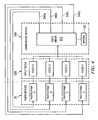
- FIGURE 4 illustrates an exemplary voice mixing operation of a conference room 150 in accordance with embodiments of the present invention.
- multiple participants 30 (A, B, C and D) are engaged in one or more conference calls via the conference server 100 and are coupled to transmit respective input voice 330 to the conference server 100 and receive output voice 340 from the conference server 100.
- the conference server 100 includes a voice mixer 320 that operates to mix the input voice 330 received from all participants 30 based on the conferencing matrix 155 and transmit the mixed voice 340 back out to the participants.
- the voice mixer 320 operates to mix the input voice 330 individually for each participant 30 (Participant A, Participant B, Participant C and Participant D) to produce respective mixed voice outputs 340a, 340b, 340c and 340d, and to provide the respective mixed voice outputs 340a, 340b, 340c and 340d to the appropriate participants.
- the voice mixer 320 is coupled to receive the input voice signals 330 (Voice A, Voice B, Voice C and Voice D) from all of the conference participants (Participant A, Participant B, Participant C and Participant D) and is operable to access the conferencing matrix 155 to determine what gain, if any, to apply to each input voice signal 330 for each listening conference participant 30. Based on the respective gains, the voice mixer 320 further operates to produce a linear combination of the received input voice signals 330 as the output voice signal 340 provided to the respective conference participant 30.
- FIGURE 5 input voice signals from three speaking participants, labeled Input Voice A 330a, Input Voice B 330b and Input Voice C 330c, are provided to the voice mixer 320.
- the voice mixer 320 retrieves from the conferencing matrix the coefficients associated with each input voice signal for a particular listening participant, labeled Coefficient A 350a, Coefficient B 350b and Coefficient C, 350c.
- the voice mixer 320 further multiplies, via respective multipliers 360a, 360b and 360c, each input voice signal 330a, 330b and 330c by the respective coefficient 350a, 350b and 350c to produce weighted voice signals to a summation node 370.
- the summation node 370 adds together the weighted voice signals to produce the mixed output voice signal 340 that is output to that particular listening participant.
- the conference room 150 Upon receipt of voice from one or more participants, the conference room 150 mixes the received voice and provides the mixed or combined voice back out to the communications devices 20a-20d, based on the coefficients of the conferencing matrix 155. For example, assuming all participants are un-muted to each other and equally weighted, if the conference room 150 simultaneously receives voice from VoIP personal computer 20a, telephone 20b and cell phone 20d, the conference room 150 combines the voice and outputs the combined voice 340 to each of the participants. To avoid echoes, the conference room 150 transmits only Voice B/C 340a to the PC 20a, transmits only Voice A/C 340b to the telephone 20b and transmits only Voice A/B 340d to the cell phone 20d.
- FIGURE 7 is a flowchart illustrating an exemplary process 700 for implementing generalized conferencing, in accordance with embodiments of the present invention.
- the process begins at step 710, where a conferencing matrix of conference participants is provided. More particularly, the conferencing matrix is a matrix of input conference participants to output conference participants. Thus, at step 720, each of the matrix coefficients is set to a real value that collectively defines a desired output for each conference participant based on inputs from the other conference participants.
- the process continues at step 730, where input media is received from conference participants.
- the conferencing matrix is used to determine the individualized output media to be provided to each conference participant based on the received input media.
- the process ends at step 750, where the desired individualized output media is provided to each conference participant.
Landscapes
- Engineering & Computer Science (AREA)
- Multimedia (AREA)
- Signal Processing (AREA)
- Telephonic Communication Services (AREA)
- Two-Way Televisions, Distribution Of Moving Picture Or The Like (AREA)
- Interconnected Communication Systems, Intercoms, And Interphones (AREA)
Claims (15)
- Konferenzserver (100), umfassend:Eine Schnittstelle (190), welche kommunikationsfähig an eine Vielzahl von von Konferenzteilnehmern (30) betriebenen Mediengeräten gekoppelt ist;ein Konferenzmodul (140), welches betreibbar ist, um eine oder mehrere Konferenzverbindungen zu verwalten, indem es eine Conference-Matrix (155) der besagten Konferenzteilnehmer (30) für die besagten Konferenzverbindungen pflegt, wobei die besagte Conference-Matrix (155) ein jeweiliges an einen jeden der besagten Konferenzteilnehmer (30) bereitgestelltes Ausgabemedium auf der Basis von jeweiligen von anderen der besagten Konferenzteilnehmer (30) empfangenen Eingabemedien definiert; undeine Verarbeitungsschaltungsanordnung (110), betreibbar für die Steuerung des besagten Konferenzmoduls und gekoppelt, um das besagte Eingabemedium von den besagten Konferenzteilnehmern (30) über die besagte Schnittstelle (190) zu empfangen und das besagte Eingabemedium an das besagte Konferenzmodul (140) bereitzustellen, und gekoppelt, um das besagte Ausgabemedium von dem besagten Konferenzmodul (140) zu empfangen und das besagte Ausgabemedium über die besagte Schnittstelle (190) an die besagten Konferenzteilnehmer (30) bereitzustellen, wobei der Server dadurch gekennzeichnet ist, dass er Koeffizienten der besagten Conference-Matrix (155) umfasst, welche auf der Basis einer oder mehrerer vorgespeicherter Konferenzrichtlinien bestimmt werden.
- Konferenzserver nach Anspruch 1, wobei ein jeder der besagten Koeffizienten eine auf mit einem bestimmten sprechenden der besagten Konferenzteilnehmer (30) assoziierte Sprachdatenströme, wie sie von einem bestimmten zuhörenden der besagten Konferenzteilnehmer (30) gehört werden, anzuwendende Verstärkung definiert, und wobei ein jeder der besagten Koeffizienten der besagten Conference-Matrix (155) anzeigt, ob die von dem besagten jeweiligen sprechenden der besagten Konferenzteilnehmer (30) stammende Stimme, wie sie von dem besagten zuhörenden der besagten Konferenzteilnehmer (30) gehört wird, stummzuschalten oder lautzuschalten ist.
- Konferenzserver nach Anspruch 1, wobei die Koeffizienten der besagten Conference-Matrix (155) zeitlich veränderlich sind.
- Konferenzserver nach Anspruch 1, wobei die besagten Konferenzrichtlinien eines oder mehrere der folgenden Kriterien umfassen: Uhrzeit, Wochentag, sprechende der besagten Konferenzteilnehmer (30), simulierte physische Entfernung zwischen sprechenden der besagten Konferenzteilnehmer (30) und zuhörenden der besagten Konferenzteilnehmer (30), Anzahl der besagten sprechenden der besagten Konferenzteilnehmer (30), Anzahl der besagten zuhörenden der besagten Konferenzteilnehmer (30), von einem oder mehreren der besagten sprechenden der besagten Konferenzteilnehmer (30) eingestellte Präferenzen, von einem oder mehreren der besagten zuhörenden der besagten Konferenzteilnehmer (30) eingestellte Präferenzen, und Konferenzserver-Richtlinien.
- Konferenzserver nach Anspruch 1, wobei die besagte Conference-Matrix (155) in der Form einer Singulärwertzerlegung dargestellt wird.
- Konferenzserver nach Anspruch 1, wobei die besagte Form der Singulärwertzerlegung der besagten Conference-Matrix (155) offline berechnet und aktualisiert wird, wenn einer oder mehrere der besagten Konferenzteilnehmer (30) die besagten Konferenzverbindungen verlassen oder diesen beitreten.
- Konferenzserver nach Anspruch 6, wobei die besagte Conference-Matrix (155) eine binäre Conference-Matrix (155) ist.
- Konferenzserver nach Anspruch 7, wobei das besagte Konferenzmodul (140) weiterhin betreibbar ist, um die besagte binäre Conference-Matrix (155) in das Produkt von zwei Unterraummatrizen zu zerlegen, um eine Unterraumdarstellung der besagten binären Conference-Matrix (155) zu erzeugen.
- Konferenzserver nach Anspruch 7, wobei das besagte Konferenzmodul (140) weiterhin betreibbar ist, um den Rang der besagten binären Conference-Matrix (155) unter Verwendung einer Brute-Force-Methode oder eines heuristischen Algorithmus zu reduzieren.
- Verfahren zur Implementierung von generalisierten Konferenzen, umfassend:Bereitstellen einer Conference-Matrix (155) von Konferenzteilnehmern (30) an Konferenzverbindungen;Einstellen von Koeffizientenwerten der besagten Conference-Matrix (155), um ein an einen jeden der besagten Konferenzteilnehmer (30) bereitgestelltes jeweiliges Ausgabemedium auf der Basis von jeweiligen von anderen der besagten Konferenzteilnehmer (30) empfangenen Eingabemedien zu definieren;Empfangen der besagten jeweiligen Eingabemedien von den besagten Konferenzteilnehmern (30);Bestimmten des besagten jeweiligen Ausgabemediums für einen jeden der besagten Konferenzteilnehmer (30) auf der Basis der besagten Conference-Matrix (155); undBereitstellen des besagten jeweiligen Ausgabemediums an die besagten Konferenzteilnehmer (30),wobei das Verfahren dadurch gekennzeichnet ist, dass es das Einstellen der Werte der besagten Koeffizienten der besagten Conference-Matrix (155), welche auf einer oder mehreren vorgespeicherten Konferenzrichtlinien basieren, umfasst.
- Verfahren nach Anspruch 10, wobei das besagte Einstellen der Werte der besagten Koeffizienten weiterhin umfasst:Einstellen von zeitlich veränderlichen Werten der besagten Koeffizienten der besagten Conference-Matrix (155).
- Verfahren nach Anspruch 10, weiterhin umfassend:Darstellen der besagten Conference-Matrix (155) in der Form einer Singulärwertzerlegung.
- Verfahren nach Anspruch 12, wobei das besagte Darstellen weiterhin umfasst:Berechnen der besagten Form der Singulärwertzerlegung der besagten Conference-Matrix (155) offline; undAktualisieren der besagten Form der Singulärwertzerlegung der besagten Conference-Matrix (155), wenn einer oder mehrere der besagten Konferenzteilnehmer (30) die besagten Konferenzverbindungen verlassen oder diesen beitreten.
- Verfahren nach Anspruch 10, wobei die besagte Conference-Matrix (155) eine binäre Conference-Matrix (155) ist, und weiterhin umfassend:Zerlegen der besagten binären Conference-Matrix (155) in das Produkt von zwei Unterraummatrizen, um eine Unterraumdarstellung der besagten binären Conference-Matrix (155) zu erzeugen.
- Verfahren nach Anspruch 10, wobei die besagte Conference-Matrix (155) eine binäre Conference-Matrix (155) ist, und weiterhin umfassend:Reduzieren eines Rangs der besagten binären Conference-Matrix (155) unter Verwendung einer Brute-Force-Methode oder eines heuristischen Algorithmus.
Applications Claiming Priority (2)
| Application Number | Priority Date | Filing Date | Title |
|---|---|---|---|
| US82634106P | 2006-09-20 | 2006-09-20 | |
| PCT/US2007/079066 WO2008036834A2 (en) | 2006-09-20 | 2007-09-20 | Systems and methods for implementing generalized conferencing |
Publications (2)
| Publication Number | Publication Date |
|---|---|
| EP2067347A2 EP2067347A2 (de) | 2009-06-10 |
| EP2067347B1 true EP2067347B1 (de) | 2013-06-19 |
Family
ID=39092266
Family Applications (1)
| Application Number | Title | Priority Date | Filing Date |
|---|---|---|---|
| EP07842899.2A Not-in-force EP2067347B1 (de) | 2006-09-20 | 2007-09-20 | Systeme und verfahren zur implementierung generalisierter konferenzen |
Country Status (4)
| Country | Link |
|---|---|
| US (1) | US20100020955A1 (de) |
| EP (1) | EP2067347B1 (de) |
| CN (1) | CN101518041A (de) |
| WO (1) | WO2008036834A2 (de) |
Families Citing this family (21)
| Publication number | Priority date | Publication date | Assignee | Title |
|---|---|---|---|---|
| JP5456683B2 (ja) * | 2007-10-24 | 2014-04-02 | ラントロニクス・インコーポレイテツド | 仮想ipアドレスを割り当てるための中央ステーションのための種々の方法および装置 |
| US20090232129A1 (en) * | 2008-03-10 | 2009-09-17 | Dilithium Holdings, Inc. | Method and apparatus for video services |
| US20100077318A1 (en) * | 2008-09-22 | 2010-03-25 | International Business Machines Corporation | Modifying environmental chat distance based on amount of environmental chat in an area of a virtual world |
| US9384469B2 (en) | 2008-09-22 | 2016-07-05 | International Business Machines Corporation | Modifying environmental chat distance based on avatar population density in an area of a virtual world |
| US9288096B2 (en) * | 2009-12-07 | 2016-03-15 | Qualcomm Incorporated | Enabling phase tracking for a communication device |
| EP2418835A1 (de) * | 2010-08-13 | 2012-02-15 | Dialog Semiconductor B.V. | Verfahren und Vorrichtung zur Sprachaudio-Verarbeitung |
| CN102487381A (zh) * | 2010-12-02 | 2012-06-06 | 北京市三希电子科技开发公司 | 会议实现系统、会议建立方法和装置 |
| US20120142324A1 (en) * | 2010-12-03 | 2012-06-07 | Qualcomm Incorporated | System and method for providing conference information |
| US9443518B1 (en) | 2011-08-31 | 2016-09-13 | Google Inc. | Text transcript generation from a communication session |
| US8612211B1 (en) * | 2012-09-10 | 2013-12-17 | Google Inc. | Speech recognition and summarization |
| CN103051816B (zh) * | 2012-12-10 | 2015-08-19 | 深圳市东微智能科技有限公司 | 一种数字音频矩阵及电话会议系统 |
| US8914007B2 (en) * | 2013-02-27 | 2014-12-16 | Nokia Corporation | Method and apparatus for voice conferencing |
| US20150006218A1 (en) * | 2013-06-27 | 2015-01-01 | Avaya Inc. | System and method for composing meeting invites in accordance with business rules |
| US9124707B2 (en) * | 2013-07-24 | 2015-09-01 | International Business Machines Corporation | Conference multiplexing |
| US9307089B2 (en) * | 2014-08-27 | 2016-04-05 | Verizon Patent And Licensing Inc. | Conference call systems and methods |
| US9697198B2 (en) * | 2015-10-05 | 2017-07-04 | International Business Machines Corporation | Guiding a conversation based on cognitive analytics |
| EP3160118B1 (de) * | 2015-10-19 | 2019-12-04 | Rebtel Networks AB | System und verfahren zum aufbau eines gruppenrufes |
| EP3583772B1 (de) * | 2017-02-02 | 2021-10-06 | Bose Corporation | Konferenzraum-audioeinrichtung |
| US9894211B1 (en) * | 2017-07-05 | 2018-02-13 | Republic Wireless, Inc. | Techniques for enhanced call routing for groups |
| JP7653641B2 (ja) * | 2020-05-22 | 2025-03-31 | i Smart Technologies株式会社 | オンライン会議システム |
| US12301748B2 (en) * | 2021-02-08 | 2025-05-13 | Samsung Electronics Co., Ltd. | System and method for simultaneous multi-call support capability on compatible audio devices |
Family Cites Families (10)
| Publication number | Priority date | Publication date | Assignee | Title |
|---|---|---|---|---|
| US4918742A (en) * | 1988-04-22 | 1990-04-17 | The Boeing Company | Image processing using multi-pass convolution with small kernels |
| CA2143591C (en) * | 1994-04-29 | 1999-01-26 | David N. Horn | Teleconferencing audio bridge |
| US5583925A (en) * | 1995-03-22 | 1996-12-10 | Lucent Technologies, Inc. | Automatic three-way calling feature for a telecommunications system |
| JP2001154631A (ja) * | 1999-11-24 | 2001-06-08 | Fujitsu General Ltd | Pdpにおける階調制御方法及び装置 |
| US20060067500A1 (en) * | 2000-05-15 | 2006-03-30 | Christofferson Frank C | Teleconferencing bridge with edgepoint mixing |
| US7428223B2 (en) * | 2001-09-26 | 2008-09-23 | Siemens Corporation | Method for background noise reduction and performance improvement in voice conferencing over packetized networks |
| US7269252B2 (en) * | 2003-08-06 | 2007-09-11 | Polycom, Inc. | Method and apparatus for improving nuisance signals in audio/video conference |
| US7933226B2 (en) * | 2003-10-22 | 2011-04-26 | Palo Alto Research Center Incorporated | System and method for providing communication channels that each comprise at least one property dynamically changeable during social interactions |
| US20060218027A1 (en) * | 2005-03-22 | 2006-09-28 | Carrion Veronica L | System and method for single user interface window event scheduling |
| US20060285671A1 (en) * | 2005-05-24 | 2006-12-21 | Tiruthani Saravanakumar V | Method and apparatus for dynamic authorization of conference joining |
-
2007
- 2007-09-20 US US12/441,095 patent/US20100020955A1/en not_active Abandoned
- 2007-09-20 CN CNA2007800348431A patent/CN101518041A/zh active Pending
- 2007-09-20 EP EP07842899.2A patent/EP2067347B1/de not_active Not-in-force
- 2007-09-20 WO PCT/US2007/079066 patent/WO2008036834A2/en not_active Ceased
Also Published As
| Publication number | Publication date |
|---|---|
| EP2067347A2 (de) | 2009-06-10 |
| WO2008036834A3 (en) | 2008-05-08 |
| US20100020955A1 (en) | 2010-01-28 |
| WO2008036834A2 (en) | 2008-03-27 |
| CN101518041A (zh) | 2009-08-26 |
Similar Documents
| Publication | Publication Date | Title |
|---|---|---|
| EP2067347B1 (de) | Systeme und verfahren zur implementierung generalisierter konferenzen | |
| US8150450B1 (en) | System and method for two-way radio and telephone conferencing and collaboration | |
| US7346654B1 (en) | Virtual meeting rooms with spatial audio | |
| US8515040B2 (en) | Geospatial telephony system | |
| US8526587B2 (en) | Web guided collaborative audio | |
| US7742587B2 (en) | Telecommunications and conference calling device, system and method | |
| US6178237B1 (en) | Teleconferencing audio bridge | |
| TWI226166B (en) | Facilitating conference calls by dynamically determining information streams to be received by a mixing unit | |
| EP2299673B1 (de) | System und Verfahren für eine kaskadierte Telekonferenz | |
| US8948060B2 (en) | Methods and apparatus for timeslot teleconferencing | |
| CN101772947A (zh) | 电话会议快速拨号 | |
| KR20070119568A (ko) | 피드백을 회피하기 위해 공동 거주 원격회의엔드포인트들을 조정하는 방법 | |
| US20130058473A1 (en) | Digital Network-Based Telephone Systems and Functionality | |
| US20100189243A1 (en) | Enhanced announcement of conference call participants | |
| US8897435B2 (en) | Method and system for enhanced conference call security | |
| US20080261576A1 (en) | Communication system for oil and gas platforms | |
| US11790880B2 (en) | Joint audio de-noise and de-reverberation for videoconferencing | |
| US8842813B2 (en) | Teleconferencing monitoring method | |
| US20120150542A1 (en) | Telephone or other device with speaker-based or location-based sound field processing | |
| Horn et al. | A versatile audio bridge for multimedia conferencing | |
| US12095836B2 (en) | Computer-implemented method for emulating a physical, open-office environment, UC application for carrying out the method, and communication for real-time communication and collaboration | |
| CA2725501C (en) | Method and system for enhanced conference call security | |
| US9450770B2 (en) | Communications system and method | |
| Alam et al. | Design for controlling media privacy in SIP conferencing systems | |
| WO2022092126A1 (ja) | 秘匿性会話可能なWeb会議システム |
Legal Events
| Date | Code | Title | Description |
|---|---|---|---|
| PUAI | Public reference made under article 153(3) epc to a published international application that has entered the european phase |
Free format text: ORIGINAL CODE: 0009012 |
|
| AK | Designated contracting states |
Kind code of ref document: A2 Designated state(s): AT BE BG CH CY CZ DE DK EE ES FI FR GB GR HU IE IS IT LI LT LU LV MC MT NL PL PT RO SE SI SK TR |
|
| AX | Request for extension of the european patent |
Extension state: AL BA HR MK RS |
|
| DAX | Request for extension of the european patent (deleted) | ||
| RAP1 | Party data changed (applicant data changed or rights of an application transferred) |
Owner name: ALCATEL LUCENT |
|
| 17P | Request for examination filed |
Effective date: 20090420 |
|
| R17D | Deferred search report published (corrected) |
Effective date: 20080508 |
|
| RBV | Designated contracting states (corrected) |
Designated state(s): AT BE BG CH CY CZ DE DK EE ES FI FR GB GR HU IE IS IT LI LT LU LV MC MT NL PL PT RO SE SI SK TR |
|
| GRAP | Despatch of communication of intention to grant a patent |
Free format text: ORIGINAL CODE: EPIDOSNIGR1 |
|
| RAP1 | Party data changed (applicant data changed or rights of an application transferred) |
Owner name: ALCATEL LUCENT |
|
| GRAS | Grant fee paid |
Free format text: ORIGINAL CODE: EPIDOSNIGR3 |
|
| GRAA | (expected) grant |
Free format text: ORIGINAL CODE: 0009210 |
|
| AK | Designated contracting states |
Kind code of ref document: B1 Designated state(s): AT BE BG CH CY CZ DE DK EE ES FI FR GB GR HU IE IS IT LI LT LU LV MC MT NL PL PT RO SE SI SK TR |
|
| REG | Reference to a national code |
Ref country code: GB Ref legal event code: FG4D |
|
| REG | Reference to a national code |
Ref country code: CH Ref legal event code: EP |
|
| REG | Reference to a national code |
Ref country code: AT Ref legal event code: REF Ref document number: 618193 Country of ref document: AT Kind code of ref document: T Effective date: 20130715 |
|
| REG | Reference to a national code |
Ref country code: IE Ref legal event code: FG4D |
|
| REG | Reference to a national code |
Ref country code: DE Ref legal event code: R096 Ref document number: 602007031183 Country of ref document: DE Effective date: 20130814 |
|
| REG | Reference to a national code |
Ref country code: FR Ref legal event code: GC Effective date: 20130802 |
|
| 111Z | Information provided on other rights and legal means of execution |
Free format text: AT BE BG CH CY CZ DE DK EE ES FI FR GB GR HU IE IS IT LI LT LU LV MC MT NL PL PT RO SE SI SK TR Effective date: 20130410 |
|
| REG | Reference to a national code |
Ref country code: GB Ref legal event code: 732E Free format text: REGISTERED BETWEEN 20130919 AND 20130925 |
|
| PG25 | Lapsed in a contracting state [announced via postgrant information from national office to epo] |
Ref country code: ES Free format text: LAPSE BECAUSE OF FAILURE TO SUBMIT A TRANSLATION OF THE DESCRIPTION OR TO PAY THE FEE WITHIN THE PRESCRIBED TIME-LIMIT Effective date: 20130930 Ref country code: GR Free format text: LAPSE BECAUSE OF FAILURE TO SUBMIT A TRANSLATION OF THE DESCRIPTION OR TO PAY THE FEE WITHIN THE PRESCRIBED TIME-LIMIT Effective date: 20130920 Ref country code: SE Free format text: LAPSE BECAUSE OF FAILURE TO SUBMIT A TRANSLATION OF THE DESCRIPTION OR TO PAY THE FEE WITHIN THE PRESCRIBED TIME-LIMIT Effective date: 20130619 Ref country code: FI Free format text: LAPSE BECAUSE OF FAILURE TO SUBMIT A TRANSLATION OF THE DESCRIPTION OR TO PAY THE FEE WITHIN THE PRESCRIBED TIME-LIMIT Effective date: 20130619 Ref country code: SI Free format text: LAPSE BECAUSE OF FAILURE TO SUBMIT A TRANSLATION OF THE DESCRIPTION OR TO PAY THE FEE WITHIN THE PRESCRIBED TIME-LIMIT Effective date: 20130619 Ref country code: LT Free format text: LAPSE BECAUSE OF FAILURE TO SUBMIT A TRANSLATION OF THE DESCRIPTION OR TO PAY THE FEE WITHIN THE PRESCRIBED TIME-LIMIT Effective date: 20130619 |
|
| REG | Reference to a national code |
Ref country code: AT Ref legal event code: MK05 Ref document number: 618193 Country of ref document: AT Kind code of ref document: T Effective date: 20130619 |
|
| REG | Reference to a national code |
Ref country code: LT Ref legal event code: MG4D |
|
| PG25 | Lapsed in a contracting state [announced via postgrant information from national office to epo] |
Ref country code: BG Free format text: LAPSE BECAUSE OF FAILURE TO SUBMIT A TRANSLATION OF THE DESCRIPTION OR TO PAY THE FEE WITHIN THE PRESCRIBED TIME-LIMIT Effective date: 20130919 |
|
| REG | Reference to a national code |
Ref country code: NL Ref legal event code: VDEP Effective date: 20130619 |
|
| PG25 | Lapsed in a contracting state [announced via postgrant information from national office to epo] |
Ref country code: LV Free format text: LAPSE BECAUSE OF FAILURE TO SUBMIT A TRANSLATION OF THE DESCRIPTION OR TO PAY THE FEE WITHIN THE PRESCRIBED TIME-LIMIT Effective date: 20130619 |
|
| PG25 | Lapsed in a contracting state [announced via postgrant information from national office to epo] |
Ref country code: BE Free format text: LAPSE BECAUSE OF FAILURE TO SUBMIT A TRANSLATION OF THE DESCRIPTION OR TO PAY THE FEE WITHIN THE PRESCRIBED TIME-LIMIT Effective date: 20130619 Ref country code: EE Free format text: LAPSE BECAUSE OF FAILURE TO SUBMIT A TRANSLATION OF THE DESCRIPTION OR TO PAY THE FEE WITHIN THE PRESCRIBED TIME-LIMIT Effective date: 20130619 Ref country code: CZ Free format text: LAPSE BECAUSE OF FAILURE TO SUBMIT A TRANSLATION OF THE DESCRIPTION OR TO PAY THE FEE WITHIN THE PRESCRIBED TIME-LIMIT Effective date: 20130619 Ref country code: IS Free format text: LAPSE BECAUSE OF FAILURE TO SUBMIT A TRANSLATION OF THE DESCRIPTION OR TO PAY THE FEE WITHIN THE PRESCRIBED TIME-LIMIT Effective date: 20131019 Ref country code: SK Free format text: LAPSE BECAUSE OF FAILURE TO SUBMIT A TRANSLATION OF THE DESCRIPTION OR TO PAY THE FEE WITHIN THE PRESCRIBED TIME-LIMIT Effective date: 20130619 Ref country code: PT Free format text: LAPSE BECAUSE OF FAILURE TO SUBMIT A TRANSLATION OF THE DESCRIPTION OR TO PAY THE FEE WITHIN THE PRESCRIBED TIME-LIMIT Effective date: 20131021 Ref country code: AT Free format text: LAPSE BECAUSE OF FAILURE TO SUBMIT A TRANSLATION OF THE DESCRIPTION OR TO PAY THE FEE WITHIN THE PRESCRIBED TIME-LIMIT Effective date: 20130619 Ref country code: CY Free format text: LAPSE BECAUSE OF FAILURE TO SUBMIT A TRANSLATION OF THE DESCRIPTION OR TO PAY THE FEE WITHIN THE PRESCRIBED TIME-LIMIT Effective date: 20130731 |
|
| PG25 | Lapsed in a contracting state [announced via postgrant information from national office to epo] |
Ref country code: PL Free format text: LAPSE BECAUSE OF FAILURE TO SUBMIT A TRANSLATION OF THE DESCRIPTION OR TO PAY THE FEE WITHIN THE PRESCRIBED TIME-LIMIT Effective date: 20130619 Ref country code: RO Free format text: LAPSE BECAUSE OF FAILURE TO SUBMIT A TRANSLATION OF THE DESCRIPTION OR TO PAY THE FEE WITHIN THE PRESCRIBED TIME-LIMIT Effective date: 20130619 Ref country code: NL Free format text: LAPSE BECAUSE OF FAILURE TO SUBMIT A TRANSLATION OF THE DESCRIPTION OR TO PAY THE FEE WITHIN THE PRESCRIBED TIME-LIMIT Effective date: 20130619 |
|
| PG25 | Lapsed in a contracting state [announced via postgrant information from national office to epo] |
Ref country code: CY Free format text: LAPSE BECAUSE OF FAILURE TO SUBMIT A TRANSLATION OF THE DESCRIPTION OR TO PAY THE FEE WITHIN THE PRESCRIBED TIME-LIMIT Effective date: 20130619 |
|
| PLBE | No opposition filed within time limit |
Free format text: ORIGINAL CODE: 0009261 |
|
| STAA | Information on the status of an ep patent application or granted ep patent |
Free format text: STATUS: NO OPPOSITION FILED WITHIN TIME LIMIT |
|
| PG25 | Lapsed in a contracting state [announced via postgrant information from national office to epo] |
Ref country code: MC Free format text: LAPSE BECAUSE OF FAILURE TO SUBMIT A TRANSLATION OF THE DESCRIPTION OR TO PAY THE FEE WITHIN THE PRESCRIBED TIME-LIMIT Effective date: 20130619 Ref country code: DK Free format text: LAPSE BECAUSE OF FAILURE TO SUBMIT A TRANSLATION OF THE DESCRIPTION OR TO PAY THE FEE WITHIN THE PRESCRIBED TIME-LIMIT Effective date: 20130619 |
|
| REG | Reference to a national code |
Ref country code: CH Ref legal event code: PL |
|
| 26N | No opposition filed |
Effective date: 20140320 |
|
| PG25 | Lapsed in a contracting state [announced via postgrant information from national office to epo] |
Ref country code: IT Free format text: LAPSE BECAUSE OF FAILURE TO SUBMIT A TRANSLATION OF THE DESCRIPTION OR TO PAY THE FEE WITHIN THE PRESCRIBED TIME-LIMIT Effective date: 20130619 |
|
| REG | Reference to a national code |
Ref country code: DE Ref legal event code: R097 Ref document number: 602007031183 Country of ref document: DE Effective date: 20140320 |
|
| REG | Reference to a national code |
Ref country code: IE Ref legal event code: MM4A |
|
| PG25 | Lapsed in a contracting state [announced via postgrant information from national office to epo] |
Ref country code: IE Free format text: LAPSE BECAUSE OF NON-PAYMENT OF DUE FEES Effective date: 20130920 Ref country code: LI Free format text: LAPSE BECAUSE OF NON-PAYMENT OF DUE FEES Effective date: 20130930 Ref country code: CH Free format text: LAPSE BECAUSE OF NON-PAYMENT OF DUE FEES Effective date: 20130930 |
|
| REG | Reference to a national code |
Ref country code: FR Ref legal event code: RG Effective date: 20141016 |
|
| PG25 | Lapsed in a contracting state [announced via postgrant information from national office to epo] |
Ref country code: TR Free format text: LAPSE BECAUSE OF FAILURE TO SUBMIT A TRANSLATION OF THE DESCRIPTION OR TO PAY THE FEE WITHIN THE PRESCRIBED TIME-LIMIT Effective date: 20130619 Ref country code: MT Free format text: LAPSE BECAUSE OF FAILURE TO SUBMIT A TRANSLATION OF THE DESCRIPTION OR TO PAY THE FEE WITHIN THE PRESCRIBED TIME-LIMIT Effective date: 20130619 |
|
| PG25 | Lapsed in a contracting state [announced via postgrant information from national office to epo] |
Ref country code: LU Free format text: LAPSE BECAUSE OF NON-PAYMENT OF DUE FEES Effective date: 20130920 Ref country code: HU Free format text: LAPSE BECAUSE OF FAILURE TO SUBMIT A TRANSLATION OF THE DESCRIPTION OR TO PAY THE FEE WITHIN THE PRESCRIBED TIME-LIMIT; INVALID AB INITIO Effective date: 20070920 |
|
| REG | Reference to a national code |
Ref country code: FR Ref legal event code: PLFP Year of fee payment: 9 |
|
| REG | Reference to a national code |
Ref country code: FR Ref legal event code: PLFP Year of fee payment: 10 |
|
| REG | Reference to a national code |
Ref country code: FR Ref legal event code: PLFP Year of fee payment: 11 |
|
| PGFP | Annual fee paid to national office [announced via postgrant information from national office to epo] |
Ref country code: FR Payment date: 20170621 Year of fee payment: 15 |
|
| REG | Reference to a national code |
Ref country code: DE Ref legal event code: R082 Ref document number: 602007031183 Country of ref document: DE Representative=s name: MENZIETTI WETZEL, DE Ref country code: DE Ref legal event code: R081 Ref document number: 602007031183 Country of ref document: DE Owner name: PROVENANCE ASSET GROUP LLC, PITTSFORD, US Free format text: FORMER OWNER: ALCATEL LUCENT, PARIS, FR |
|
| PG25 | Lapsed in a contracting state [announced via postgrant information from national office to epo] |
Ref country code: FR Free format text: LAPSE BECAUSE OF NON-PAYMENT OF DUE FEES Effective date: 20180930 |
|
| REG | Reference to a national code |
Ref country code: GB Ref legal event code: 732E Free format text: REGISTERED BETWEEN 20191205 AND 20191211 |
|
| PGFP | Annual fee paid to national office [announced via postgrant information from national office to epo] |
Ref country code: GB Payment date: 20200909 Year of fee payment: 14 |
|
| PGFP | Annual fee paid to national office [announced via postgrant information from national office to epo] |
Ref country code: DE Payment date: 20201001 Year of fee payment: 14 |
|
| REG | Reference to a national code |
Ref country code: DE Ref legal event code: R119 Ref document number: 602007031183 Country of ref document: DE |
|
| GBPC | Gb: european patent ceased through non-payment of renewal fee |
Effective date: 20210920 |
|
| PG25 | Lapsed in a contracting state [announced via postgrant information from national office to epo] |
Ref country code: GB Free format text: LAPSE BECAUSE OF NON-PAYMENT OF DUE FEES Effective date: 20210920 Ref country code: DE Free format text: LAPSE BECAUSE OF NON-PAYMENT OF DUE FEES Effective date: 20220401 |