EP2067492A1 - Pansement doté de particules de polyacrylate et son utilisation - Google Patents
Pansement doté de particules de polyacrylate et son utilisation Download PDFInfo
- Publication number
- EP2067492A1 EP2067492A1 EP07022915A EP07022915A EP2067492A1 EP 2067492 A1 EP2067492 A1 EP 2067492A1 EP 07022915 A EP07022915 A EP 07022915A EP 07022915 A EP07022915 A EP 07022915A EP 2067492 A1 EP2067492 A1 EP 2067492A1
- Authority
- EP
- European Patent Office
- Prior art keywords
- particles
- wound
- particle
- wound dressing
- particle size
- Prior art date
- Legal status (The legal status is an assumption and is not a legal conclusion. Google has not performed a legal analysis and makes no representation as to the accuracy of the status listed.)
- Granted
Links
Images


Classifications
-
- A—HUMAN NECESSITIES
- A61—MEDICAL OR VETERINARY SCIENCE; HYGIENE
- A61L—METHODS OR APPARATUS FOR STERILISING MATERIALS OR OBJECTS IN GENERAL; DISINFECTION, STERILISATION OR DEODORISATION OF AIR; CHEMICAL ASPECTS OF BANDAGES, DRESSINGS, ABSORBENT PADS OR SURGICAL ARTICLES; MATERIALS FOR BANDAGES, DRESSINGS, ABSORBENT PADS OR SURGICAL ARTICLES
- A61L15/00—Chemical aspects of, or use of materials for, bandages, dressings or absorbent pads
- A61L15/16—Bandages, dressings or absorbent pads for physiological fluids such as urine or blood, e.g. sanitary towels, tampons
- A61L15/42—Use of materials characterised by their function or physical properties
-
- A—HUMAN NECESSITIES
- A61—MEDICAL OR VETERINARY SCIENCE; HYGIENE
- A61F—FILTERS IMPLANTABLE INTO BLOOD VESSELS; PROSTHESES; DEVICES PROVIDING PATENCY TO, OR PREVENTING COLLAPSING OF, TUBULAR STRUCTURES OF THE BODY, e.g. STENTS; ORTHOPAEDIC, NURSING OR CONTRACEPTIVE DEVICES; FOMENTATION; TREATMENT OR PROTECTION OF EYES OR EARS; BANDAGES, DRESSINGS OR ABSORBENT PADS; FIRST-AID KITS
- A61F13/00—Bandages or dressings; Absorbent pads
- A61F13/02—Adhesive bandages or dressings
- A61F13/0203—Adhesive bandages or dressings with fluid retention members
- A61F13/0206—Adhesive bandages or dressings with fluid retention members with absorbent fibrous layers, e.g. woven or non-woven absorbent pads or island dressings
- A61F13/0209—Adhesive bandages or dressings with fluid retention members with absorbent fibrous layers, e.g. woven or non-woven absorbent pads or island dressings comprising superabsorbent material
-
- A—HUMAN NECESSITIES
- A61—MEDICAL OR VETERINARY SCIENCE; HYGIENE
- A61F—FILTERS IMPLANTABLE INTO BLOOD VESSELS; PROSTHESES; DEVICES PROVIDING PATENCY TO, OR PREVENTING COLLAPSING OF, TUBULAR STRUCTURES OF THE BODY, e.g. STENTS; ORTHOPAEDIC, NURSING OR CONTRACEPTIVE DEVICES; FOMENTATION; TREATMENT OR PROTECTION OF EYES OR EARS; BANDAGES, DRESSINGS OR ABSORBENT PADS; FIRST-AID KITS
- A61F13/00—Bandages or dressings; Absorbent pads
- A61F13/02—Adhesive bandages or dressings
- A61F13/0203—Adhesive bandages or dressings with fluid retention members
- A61F13/022—Adhesive bandages or dressings with fluid retention members having more than one layer with different fluid retention characteristics
-
- A—HUMAN NECESSITIES
- A61—MEDICAL OR VETERINARY SCIENCE; HYGIENE
- A61L—METHODS OR APPARATUS FOR STERILISING MATERIALS OR OBJECTS IN GENERAL; DISINFECTION, STERILISATION OR DEODORISATION OF AIR; CHEMICAL ASPECTS OF BANDAGES, DRESSINGS, ABSORBENT PADS OR SURGICAL ARTICLES; MATERIALS FOR BANDAGES, DRESSINGS, ABSORBENT PADS OR SURGICAL ARTICLES
- A61L15/00—Chemical aspects of, or use of materials for, bandages, dressings or absorbent pads
- A61L15/16—Bandages, dressings or absorbent pads for physiological fluids such as urine or blood, e.g. sanitary towels, tampons
- A61L15/42—Use of materials characterised by their function or physical properties
- A61L15/60—Liquid-swellable gel-forming materials, e.g. super-absorbents
-
- A—HUMAN NECESSITIES
- A61—MEDICAL OR VETERINARY SCIENCE; HYGIENE
- A61P—SPECIFIC THERAPEUTIC ACTIVITY OF CHEMICAL COMPOUNDS OR MEDICINAL PREPARATIONS
- A61P17/00—Drugs for dermatological disorders
- A61P17/02—Drugs for dermatological disorders for treating wounds, ulcers, burns, scars, keloids, or the like
Definitions
- the invention relates to wound dressings with a particle mixture of polyacrylate particles for use in modern wound treatment.
- the healing of skin wounds is based on the ability of the skin to regenerate epithelia as well as connective and supporting tissues. It is characterized as a complex event of interdisciplinary cell activities that progressively drive the healing process.
- three major healing phases of a wound are described in the literature. These include the inflammatory or exudative phase for hemostasis and wound cleansing (phase 1, cleansing phase), the proliferative phase for building granulation tissue (phase 2, granulation phase) and the differentiation phase for epithelialization and scarring (phase 3, epithelialization phase).
- polyacrylate particles are introduced, which may have a defined grain size of 100 to 900 microns.
- EP 1688109 A1 describes a wound dressing for the treatment of trophic disorders in the wound.
- carbon dioxide is used as a treatment agent.
- a depot for an aqueous phase which contains polyacrylate particles which have a defined particle distribution, the proportion of particles having a particle size of 850 to 300 ⁇ m being in particular more than 70% by weight, based on the total weight of the particles ,
- polyacrylate particles is always used as a storage medium or absorption medium for aqueous liquids.
- a wound dressing is to be provided which influences the pathological condition of a wound in such a way that a normal, natural wound healing process can take place.
- a wound dressing according to the invention comprises a particle mixture having a defined amount of a first particle fraction having a defined particle size and a second quantity of a second particle fraction having a second particle size different from the first particle size, each particle fraction containing polyacrylate particles.
- the polyacrylate particles of a size range can be composed of particles of the same or different size, wherein the particle size (s) is / are within the range.
- the specification of an amount of particles, in particular of a single size range, unless stated otherwise, is always given in% by weight (% by weight) based on the total amount of particles.
- the particle mixture contains polyacrylate particles which differ from one another with regard to the polyacrylates, that is to say that the particle mixture comprises at least two mutually different polyacrylate particle types.
- the polyacrylate particles of the first size range a) differ from the polyacrylate particles of the second size range b).
- the polyacrylates may differ, for example, in terms of the degree of neutralization, the degree of crosslinking, the crosslinking agent and / or the copolymers. In the simplest case, however, it is also possible to use polyacrylate particles which are identical in their structural structure and differ only in the stated particle sizes.
- the particles of the first or the second particle size range consists of different polyacrylate particles, ie, for example, that the particles of the first size range contains first polyacrylate particles and second, different from the first polyacrylate particles, wherein both types comprise polyacrylate particles within of the respective size range.
- a mixture of particles should be understood to mean a mixture whose individual constituents (particles) spatially next to each other, partially mixed, completely mixed or spatially separated from each other, wherein the mixture is considered in any case as part of a wound dressing ,
- the particles of the individual particle size ranges can also be spatially next to each other, partially mixed, completely mixed or spatially separated from each other.
- the particle size is determined in the context of the present invention analogously to EDANA 420.2-02, wherein the sieves (diameter 200 mm) have the information corresponding hole sizes.
- screens with other hole sizes such as e.g. 125 microns, 160 microns, 630 microns, 900 microns, and 1500 microns are used.
- dry polyacrylate particles having a moisture content of less than 10% by weight of water, based on the total weight of the particles, are used, the moisture content being determined according to EDANA 450.2-02.
- polyacrylate particles inhibit proteases via diffusible mechanisms as well as by direct binding compartmentalize and thus escape the wound exudate or the wound.
- polyacrylate particles are suitable for the inhibition of proteases in chronic wounds.
- metallo proteases are bound or compartmentalized by polyacrylate particles, so that these metalloproteases can be removed with the polyacrylate particles from a wound fluid or a wound.
- an excess of metallo-proteases in chronic wounds can be trapped so that a natural healing process can take place.
- polyacrylate particles having a particle size x with x ⁇ 300 ⁇ m are particularly well suited for this purpose. Particles of this size inhibit the activity of wound-healing proteases, in particular metalloproteases in a wound, particularly effectively, with particles of this size having at least four times as high affinity for metalloproteases compared to larger particles.
- polyacrylate particles with a particle size x with x ⁇ 300 ⁇ m are particularly well suited for the treatment of chronic wounds.
- Usual wound dressings with polyacylate particles for the treatment of chronic wounds contain polyacrylate particles with a particle size x with x> 300 ⁇ m, since these particles are usually well-suited for receiving wound exudate or as a storage medium for aqueous liquids.
- Polyacrylate particles with a particle size x with x ⁇ 300 ⁇ m are less suitable or not suitable for absorbing wound exudate, since these particles can absorb or hold a much smaller amount of aqueous liquids in comparison with particles having a particle size x with x> 300 ⁇ m ,
- a wound treatment agent can be provided which can inactivate both wound healing proteases in a wound and provide hydroactive properties.
- tissue structure is critically dependent on the stabilization of newly synthesized extracellular matrix molecules that are assembled into a three-dimensional tissue, followed by angiogenesis and proliferation of cells into the wound area in parallel and in further steps.
- polyacrylate particles having a particle size of x ⁇ 300 ⁇ m can be used in particular for poorly healing wounds in the granulation phase.
- possible inflammations have subsided or are absent so far that granulation and thus cell growth could take place, provided there is no excess of metallo-proteases.
- This excess can now be intercepted particularly well by means of polyacrylate particles of the indicated size.
- the tissue structure is promoted by the elimination of the wound healing disturbing mechanisms, which is clinically noticeable in an improvement of the wound state and the reduction of wounds by decreasing the wound volume and / or the size of the wound.
- polyacrylate particles having a particle size x with x ⁇ 300 microns for the inhibition or inhibition of proteases in particular serine proteases or metallo proteases for tissue engineering and / or for regulating the tissue structure in chronic wounds is also an object of the present invention.
- proteases peptidases, peptide hydrolases
- proteases are understood to mean enzymes which catalyze the hydrolytic cleavage of a peptide bond in proteins and peptides (proteolysis).
- Proteases thus belong systematically to the group of hydrolases. Proteases are subdivided with respect to the cleavage site in the substrate.
- endopeptidases proteinases
- peptide bonds at the end of a peptide or protein molecule are cleaved by exopeptidases (formerly peptidases).
- proteases can be made with regard to their groups responsible for catalysis in the active site.
- a) serine proteases, b) cysteine proteases, c) aspartate proteases and d) metallo proteases are distinguished from one another.
- the group of metallo proteases (metallo-peptidases) have, for example, in their active center metal ions which are attached to the catalytic Mechanism of proteolysis are involved. These metal ions, especially divalent metal cations such as magnesium, zinc, calcium, iron, etc., are also considered as coenzyme.
- metallo-endopeptidases metalloproteinases
- metallo-exopeptidases are furthermore a) metallo-exopeptidases.
- Matrix metallo-proteases also called matrixins - belong to a family of proteases that have been defined by structural homologies. Their enzymatic activity is dependent on metal ions in the active center. Metallo proteases were first identified by their role in tissue remodeling, particularly by degradation of the extracellular matrix. Systematically, this group of proteases belongs to the metallo-endopeptidases (metalloproteinases).
- the matrix metalloproteinases include collagenases, gelatinases, stromeolysins, matrilysin and others. An overview and classification is included in the literature Parks, Matrix Metalloproteinases, Biology of Extracellular Matrix Series, Ed.
- Serine proteases have an essential for catalysis L-serine residue in the active center, which can be inhibited by diisopropylfluorophosphate. These proteases are also assigned a crucial function in wound healing.
- the group of serine proteases include, for example, chromotrypsin, elastase, kallikrein, plasmin, trypsin, thrombin and others.
- Most known serine proteases have, in addition to the L-serine residue in their active center, the residues of the amino acids L-histidine and L-asparagine. All three amino acid residues participate in the protolysis of a cascade of reactions in which a proton of the L-serine residue is transferred to the substrate.
- an aqueous liquid is understood as meaning water, salt solutions, in particular physiological saline solutions, such as physiological saline solutions or Ringer solutions and wound exudate.
- a wound dressing which removes particularly effectively wound-healing proteases, in particular metalloproteases, from a wound.
- a particularly secure wound dressing is provided. Particles with a particle size x with x ⁇ 150 ⁇ m and in particular particles with a particle size x with x ⁇ 45 ⁇ m are particularly easy to get into a wound without special retention measures. This is not desirable.
- a wound dressing comprising a particle mixture of polyacrylate particles having particles with a particle size x of 300 ⁇ x ⁇ 1500 ⁇ m as the means for applying and / or dispensing aqueous solutions has particularly good absorption and retention properties.
- 0 to 90 wt .-%, in particular 0 to 80 wt .-%, in particular 0 to 60 wt .-%, in particular 0 to 40 wt .-%, in particular 0 to 20 wt .-% and very particularly in particular 0 to 10 wt .-% as an agent for raising and / or delivery of aqueous solutions used.
- the particle mixture consists of polyacrylate particles having a particle size x with x ⁇ 300 ⁇ m, in particular with 45 ⁇ x ⁇ 300 ⁇ m, and very particularly preferably 150 ⁇ x ⁇ 300 microns, which is an essential component of the wound dressing, proteases, in particular metallo-proteases such as matrix metallo-proteases MMP-2 or MMP-9 particularly well bound or compartmentalized.
- proteases in particular metallo-proteases such as matrix metallo-proteases MMP-2 or MMP-9 particularly well bound or compartmentalized.
- a wound dressing according to the invention comprises a particle mixture of polyacrylate particles having a particle size x with x ⁇ 300 ⁇ m as a protease inhibitor, wherein the proteases are bound and / or compartmentalized by the polyacrylate particles.
- compositions can be adapted to the needs of a wound. They can increasingly bind inhibitors of wound healing or, if they are present in not appreciably high concentrations, intervene as little as possible in normal wound healing by trapping growth factors and other endogenous physiologically regulated mediators in normal wound healing.
- polyacrylate particles are understood as meaning those particles which are formed from a polyacrylate.
- polyacrylates according to the invention have a monomer content of more than 80% by weight of acrylic acid and / or a salt thereof and very particularly preferably more than 95% by weight of acrylic acid and / or a salt thereof, based on the total weight of the polyacrylate.
- a wound dressing according to the invention comprises a particle mixture of polyacrylate particles which has a monomer content of more than 80% by weight of acrylic acid and / or a salt thereof and very particularly preferably more than 95% by weight of acrylic acid and / or a salt thereof based on Total weight of the polyacrylate, in particular as a means for inhibiting proteases in a wound.
- the polyacrylate may be present as homopolymer, copolymer or block polymer.
- the monomer content of monomer M1 in the polymer is greater than 70%, more preferably greater than 80% and most preferably greater than 95%, based on the total weight of the polyacrylate.
- copolymeric polyacrylates or block polymer polyacrylates in addition to the monomer M1 as comonomers M2 in particular ⁇ , ⁇ -unsaturated ethers (vinyl ethers), ⁇ , ⁇ -unsaturated carboxylic acids or ⁇ , ⁇ -unsaturated carboxylic acid esters (vinyl esters) may be included.
- comonomers M2 of the ⁇ , ⁇ -unsaturated carboxylic acids especially methacrylic acid (2-methylpropenoic acid), ethacrylic acid (2-ethylpropenoic acid), crotonic acid (2-butenoic acid), sorbic acid (trans-trans-2,4-hexadienoic acid), maleic acid (cis 2-butenedioic acid) or fumaric acid (trans-2-butenedioic acid).
- the polyacrylate is a mixture of different polyacrylates.
- the ⁇ , ⁇ -unsaturated carboxylic acids and the acrylic acid may be present in neutralized form as a salt, in unneutralized form as the free acid or in mixtures thereof.
- polyacrylates composed of acrylic acid and salts of acrylic acid have been found to be particularly effective.
- alkali metal or alkaline earth metal salts should be emphasized.
- polyacrylates consisting of homopolymers and / or of copolymers comprising as monomers acrylic acid and / or sodium or potassium acrylate have been found to be particularly effective.
- a wound dressing according to the invention preferably further comprises a particle mixture of polyacrylate particles which consist of homopolymers and / or of copolymers comprising as monomers acrylic acid and / or sodium or potassium acrylate, in particular as an agent for the inhibition of proteases.
- polyacrylates from the group of crosslinked and / or crosslinked and / or surface-crosslinked polyacrylates.
- These polyacrylates preferably comprise a) a homopolymer which consists of the monomers M1 and is crosslinked and / or cross-linked by means of a crosslinker, and / or b) a copolymer which consists of the monomers M1 and M3, the monomer M1 being acrylic acid and / or or a salt thereof and the monomer M3 is selected from the group of crosslinkers.
- these polyacrylates include a post-crosslinked polyacrylate and / or a polyacrylate copolymerized from acrylic acid and / or a salt thereof and a crosslinker.
- a wound dressing according to the invention preferably comprises a particle mixture of polyacrylate particles which comprise a crosslinked and / or crosslinked and / or surface-crosslinked polyacrylate, in particular as an agent for inhibiting proteases.
- Crosslinking of the polymers by the free-radical polymerization of the ethylenically unsaturated groups of the crosslinker molecule with the monoethylenically unsaturated monomers acrylic acid and / or one of its salts and / or one of the ⁇ , ⁇ -unsaturated comonomers is achieved by the compounds V1, while in the compounds V2 crosslinking of the polymers is achieved by condensation reaction of the functional groups with the functional groups of the acrylic acid and / or one of its salts or of an ⁇ , ⁇ -unsaturated comonomer.
- crosslinking of the polymer accordingly takes place both by free-radical polymerization of the ethylenically unsaturated group and by condensation reaction between the functional group of the crosslinker and the functional groups of the monomers.
- Preferred compounds V1 are polyacrylic acid esters or polymethacrylic acid esters obtained, for example, by the reaction of a polyol, such as, for example, ethylene glycol (1,2-ethanediol), propylene glycol (1,2-propanediol), trimethylolpropane (2-ethyl-2-hydroxymethyl-1,3-propanediol).
- a polyol such as, for example, ethylene glycol (1,2-ethanediol), propylene glycol (1,2-propanediol), trimethylolpropane (2-ethyl-2-hydroxymethyl-1,3-propanediol).
- propanediol 1,6-hexanediol, glycerol (1,2,3-propanetriol), pentaerythritol (2,2-bis (hydroxymethyl) propane-1,3-diol
- an aminoalcohol a polyalkylenepolyamine, such as diethylenetriamine or triethylenetetraamine, or an alkoxylated polyol with acrylic acid or methacrylic acid.
- a compound V1 which is a di-, tri- or tetraester of polyacrylic acid or polymethacrylic acid which is obtained by reacting an alkoxylated polyol, in particular an ethoxylated polyol.
- polyvinyl compounds, polyallyl compounds, polymethylallyl compounds, acrylic acid esters or methacrylic acid esters of a monovinyl compound, acrylic acid esters or methacrylic acid esters of a monoallyl compound or monomethylallyl compound, preferably monoallyl compounds or monomethylallyl compounds of a polyol or an aminoalcohol are preferable.
- DE 195 43 366 In this context is on DE 195 43 366 .
- the polyacrylate particles of the listed polyacrylates in the wound dressing in dry form have the particle sizes indicated above. These particles can be used in the wound dressing in dry or already swollen form. In swollen form, the polyacrylate particles are present in gel-like particles.
- the polyacrylate particles may be mixed with water, physiological saline solution or Ringer's solution.
- a wound dressing of the present invention comprises a particle mixture of polyacrylate particles comprising at most 10% by weight of water (based on the total weight of the polyacrylate particles), that is, the polyacrylate particles have a moisture content of at most 10%.
- the wound dressing comprises a particle mixture which comprises at most 7% by weight, preferably at most 5% by weight of water and very particularly preferably at most 4% by weight of water (based on the total weight of the polyacrylate particles).
- a wound dressing according to the invention can be provided as a multilayer wound dressing.
- This second layer can take on a variety of functions.
- the wound dressing furthermore comprises a wound contact layer which separates the particle mixture and the carrier material for the particle mixture from a wound, or furthermore a coating enclosing the particle mixture and the carrier material for the particle mixture. This ensures in particular that in the application-specific state of the wound dressing no particles get into the wound.
- this wound dressing comprising the particle mixture, the carrier material and the casing has a first layer comprising the particle mixture and the carrier material, as well as a second and a third layer formed from the casing.
- the sheath or the wound contact layer can in this case be formed, in particular, from a nonwoven, a knitted fabric, a knitted fabric or a woven fabric, wherein this wound contact layer or this sheath furthermore preferably has no particles.
- Particularly preferred here are nonwovens, since these materials are very dense and can not get particles into a wound.
- a wound dressing is the subject of the present invention, which is designed as a multilayer wound dressing and in addition to the layer comprising the particle mixture and the carrier material for the particle mixture comprising a second layer as a wound contact layer, said wound contact layer in particular contains no particles, subject of the present invention.
- non-wound-adhesive wound dressings are also the subject of the present invention.
- These wound dressings particularly support wound healing in the granulation phase of wound healing, since they inhibit their activity on the one hand by the content of particles having a particle size x with x ⁇ 300 ⁇ m proteases, in particular by compartmentalization or binding, and on the other hand newly grown tissue in one Do not damage dressing changes.
- These non-wound-adhesive wound dressings comprise, as a wound contact layer, in particular a nonwoven-adhesive knitted fabric, knitted fabric, woven fabric or nonwoven, which furthermore preferably consists of a hydrophobic fiber material.
- the wound contact layer may be a knit, knit or fabric of a hydrophobic polyethylene, polypropylene, polyester or viscose polymeric material.
- a knitted fabric, knitted fabric or tissue By designing as a knitted fabric, knitted fabric or tissue, the wound contact layer can be stretched or deformed in one or more directions without it contracting or aligning itself again.
- the surface of such a wound contact layer conforms precisely to the surface of the skin or wound to be treated.
- the wound dressing may also comprise a particle mixture of polyacrylate particles and a carrier material for the particle mixture, wherein the carrier material comprises a hydrophilic fiber material and wherein in particular the polyacrylate particles comprise a crosslinked and / or crosslinked polyacrylate.
- the carrier material comprises a hydrophilic fiber material
- the polyacrylate particles comprise a crosslinked and / or crosslinked polyacrylate.
- hydrophilic fiber material in particular water-insoluble as hydrophilic fiber material.
- Fibers of cellulose in particular largely delignified technical pulp fibers, in particular wood pulp fibers, in particular a fiber length of ⁇ 5 mm find use.
- the fiber material may also be hydrophilic fiber material of regenerated cellulose, carboxymethyl cellulose, carboxyethyl cellulose, Hydroxymethylcellulose or hydroxyethylcellulose.
- the wound dressing comprises a particle mixture of polyacrylate particles of the stated composition and a mixture of cellulose fibers, polypropylene fibers as carrier material for the particle mixture.
- a wound dressing comprising a particle mixture of the above-indicated composition and a carrier material for the particle mixture, which contains staple fibers of synthetic and / or natural polymers as first fibers, likewise forms the subject matter of the present invention.
- this wound dressing comprises first hydrophilic staple fibers. These fibers can be processed in a so-called air-laid process together with the particle mixture into a layer.
- a wound dressing according to the invention may have different amounts of polyacrylate particles and carrier material for the polyacrylate particles.
- the wound dressing comprises at least 10% by weight of polyacrylate particles (based on the carrier material), the polyacrylate particles having the composition listed in connection with the present invention.
- wound dressings which comprise at least 20% by weight, in particular at least 25% by weight and very particularly preferably at least 30% by weight, of polyacrylate particles (based on the support material) are particularly preferred.
- the content of polyacrylate particles with respect to the carrier material in particular not more than 80% by weight. % and in particular not more than 75 wt .-% is.
- a multilayer wound dressing according to the invention comprises a first particle-containing layer A and at least one second particle-containing layer B.
- the first layer A comprises particles of a first size
- the second layer B comprises particles of a second size which differs from the first size.
- a multilayer wound dressing may also have different amounts of polyacrylate particles and carrier material for the polyacrylate particles. If it is provided that the particles are arranged in different layers, the amount of particles should amount to at least 10% by weight, based on the carrier material of all particle-containing layers. In particular, it is also provided here that wound dressings with at least 20% by weight, in particular at least 25% by weight and in particular at least 30% by weight, of polyacrylate particles (based on the support material of all particle-containing layers) are particularly preferred.
- the content of polyacrylate particles in relation to the carrier material in particular not more than 80% by weight and in particular not more than 75% by weight (based on the support material of all the particle-containing layers).
- the polyacrylate particles having a particle size x with x ⁇ 300 are used for the production of an agent for the inhibition or inhibition by compartmentalization of proteases, in particular metalloproteases and very particularly preferably of matrix metalloproteases in chronic wounds.
- these polyacrylates can preferably be used for inhibiting proteases, in particular metalloproteases and very particularly preferably matrix metalloproteases for tissue engineering and / or for regulating the tissue structure in chronic wounds.
- Chronic wounds can be defined as wounds whose healing process deviates from normal wound healing in one or all stages of wound healing.
- wounds that cause acute wounds such as wound infection
- the transition from an acute to a chronic wound can take place at any stage of wound healing.
- chronic wounds are defined as wounds that require more than 6-8 weeks to heal, although this definition does not cover all clinical pictures correctly. Chronic wounds are more a diagnosis based on the clinical experience of the medical staff.
- Chronic wounds occur in particular due to mechanical stress (pressure sores, pressure ulcers, pressure ulcers), venous insufficiency (ulcus cruris venosum, venous ulcers), atherosclerotic vascular change (ulcus cruris arteriosum, arterial ulcers), neuropathic changes (diabetic foot syndrome, neuropathic Ulzera), but also as a result of autoimmune diseases, tumors (exulsive tumors) or radiation damage in tumor therapy.
- Decubitus ulcer is defined as the trophic disorder of tissues (including the skin and subcutaneous tissue) caused by external (prolonged) pressure with compression of vessels and local ischaemia, with necrosis, maceration, possibly infection. Decubital ulcers are especially associated with bed rest, especially at body sites where the skin is in direct contact with the bone, but also e.g. under badly fitting dentures and too narrow plaster casts.
- the polyacrylate particles are used for the inhibition by compartmentalization of proteases, in particular metalloproteases, and for the preparation of an agent for the inhibition by compartmentalization of proteases, in particular metalloproteases in pressure ulcers, venous leg ulcers, leg ulcers or diabetic foot syndrome.
- These polyacrylate particles can also be used preferably for the inhibition of metallo-proteases or matrix metallo-proteases for tissue building and / or for regulating the tissue structure in these diseases.
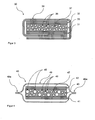
- FIG. 1 a wound dressing (10) according to the invention is shown in a first embodiment.
- the wound dressing has a first spacer layer (11) to be applied to a wound in intended use and a first cover layer (12). Between these two layers there is a further layer (13) which comprises a carrier material (17) and a particle mixture of polyacrylate particles (15, 16).
- the particle mixture contains in equal proportions polyacrylate particles (16) of a first particle size x with 45 ⁇ x ⁇ 300 ⁇ m and polyacrylate particles (15) of a second particle size x with 600 ⁇ x ⁇ 850 ⁇ m.
- the particle mixture thus contains 50% by weight of polyacrylate particles (16) of a first particle fraction having a first particle size x with 45 ⁇ x ⁇ 300 ⁇ m and 50% by weight of polyacrylate particles (15) of a second particle fraction having a second particle size x of 300 ⁇ ⁇ 850 ⁇ m (based on the total weight of particles).
- the carrier material (17) for the mixture of particles is a fiber material made of hydrophilic staple fibers comprising 94% by weight of hydrophilic cellulose fibers and 6% by weight of polypropylene fibers.
- the carrier material (17) and the polyacrylate particles (15, 16) are processed in an air-laid process into a layer, wherein the layer has a weight per unit area of 360 g / m 2 .
- the proportion of fiber material in the position is 198 g / m 2 , wherein the proportion of Polyäcrylatpumblen (15, 16) 162 g / m 2 .
- the proportion of polyacrylate (15, 16) corresponds to 45 wt .-% based on the carrier material (17).
- the first spacer layer (11) and the first cover layer (13) are made of a nonwoven fabric made of a hydrophobic fiber material made of polypropylene fibers.
- this wound dressing has a first spacer layer as wound contact layer, which shows no Wundverklebung.
- FIG. 2 an alternative wound dressing (20) is shown.
- This wound dressing has a wound contact layer (21) of a hydrophobic nonwoven polyester fibers.
- a first polyacrylate particle-containing layer (23), a second polyacrylate-particle-containing layer (24) and a covering layer (22) are arranged above this wound contact layer (21).
- the polyacrylate particles (26) of the first particle-containing layer (23) have a particle size x of 150 ⁇ x ⁇ 300 ⁇ m
- the polyacrylate particles (25) of the second particle-containing layer (24) have a particle size x of 600 ⁇ x ⁇ 1500 ⁇ m.
- the first particle-containing layer (23) contains 126 g / m 2 of polyacrylate particles having a particle size x of 150 ⁇ x ⁇ 300 ⁇ m (26) and 198 g / m 2 of hydrophilic staple fibers.
- the second particle-containing layer (24) are 42 g / m 2 polyacrylate particles having a particle size x with 600 ⁇ x ⁇ 1500 microns (25) and 63 g / m 2 contain hydrophilic staple fibers.
- the first layer (23) has a basis weight of 315 g / m 2 and the second layer (24) has a basis weight of 104 g / m 2 , wherein the particle fraction based on the carrier material of the particle-containing layers (23, 24) 40 wt and wherein 75 wt .-% polyacrylate particles having a particle size x with 150 ⁇ x ⁇ 300 microns (based on the total amount of polyacrylate particles) in the first layer (23) and 25 wt .-% polyacrylate particles having a particle size x with 600 ⁇ x ⁇ 1500 microns (based on the total amount of polyacrylate particles) in the second layer (24) are included.
- the carrier material (27, 28) of the first and the second particle-containing layer (23, 24) is a hydrophilic fiber material (hydrophilic staple fibers) of 90% cellulose fibers and 10 parts by weight polypropylene fibers, wherein both the first and the second particle-containing layer in a Air-laid process is made.
- the two layers were manufactured in an in-line process in successive steps.
- the total weight of the two particle-containing layers (23, 24) is 420 g / m 2 .
- the cover layer (22) consists of a water vapor permeable polyurethane film with a thickness of 60 microns.
- FIG. 3 a third alternative wound dressing (30) is shown.
- This wound dressing consists of a particle-containing layer (33) which is covered on both sides with a tissue (31, 32) of cellulose fibers.
- the basis weight of the tissue layers is 18 g / m 2 .
- This layer composite is surrounded by a sheath (39) made of a nonwoven permeable to wound exudate (staple fiber fleece made from 40% polyamide fibers and 60% viscose fibers), the sheath surrounding the layer composite in such a way that it is double-layered on the side facing away from the wound in the intended use of the wound dressing , These two layers are held together by a Hotmeltêt Grande (not shown).
- the particle-containing layer consists of 280 g / m 2 polyacrylate particles (Favor SMX 9170 - Stockhausen, Krefeld) and a 128 g / m 2 fluff (wood pulp fibers of a fiber length of ⁇ 5 mm).
- the polyacrylate particles (36) have a particle size x with 150 ⁇ x ⁇ 300 microns, wherein these particles from the crude product (Favor SMX 9170) were sieved. These particles consist of a cross-linked sodium polyacrylate and have a water content of max. 4 wt .-% water based on the polyacrylate on.
- the wound dressing 100 wt .-% polyacrylate with a particle size x with 150 ⁇ x ⁇ 300 microns (based on the total content of particles) and 60 wt .-% polyacrylate based on the carrier material.
- FIG. 4 a fourth alternative wound dressing (40) is shown.
- This wound dressing has a similar structure as the one with FIG. 1 shown wound dressing, wherein the Wound dressing comprises a particle-containing layer (43) which is covered on both sides with a tissue (31, 32).
- the tissue layers are made of 100% cellulose fibers and have a basis weight of 18 g / m 2 .
- the particle-containing layer (43) consists of a carrier material (47) and a particle mixture of polyacrylate particles (45, 46).
- the particle mixture contains 65 g / m 2 polyacrylate particles (46) of a first particle size x with 150 ⁇ x ⁇ 300 microns and 97 g / m 2 polyacrylate particles (45) of a second particle size x with 600 ⁇ x ⁇ 850 microns.
- the particle mixture thus contains 40% by weight of polyacrylate particles (46) of a first particle fraction having a first particle size x of 150 ⁇ x ⁇ 300 ⁇ m and 60% by weight of polyacrylate particles (45) of a second particle fraction having a second particle size x of 600 ⁇ x ⁇ 850 ⁇ m (based on the total weight of particles).
- the individual particle fractions were screened from polyacrylate particles (Favor PAC 300 - Stockhausen, Krefeld). These particles consist of a crosslinked sodium polyacrylate and have a water content of 3.0% by weight of water, based on the polyacrylate particles.
- the carrier material (47) for the mixture of particles is a fiber material made of hydrophilic staple fibers comprising 94% by weight of hydrophilic cellulose fibers and 6% by weight of polypropylene fibers.
- the carrier material (47) and the polyacrylate particles (45, 46) are processed into a layer in an air-laid method, the layer having a weight per unit area of 360 g / m 2 .
- the proportion of fiber material in the layer is 198 g / m 2 , wherein the proportion of polyacrylate particles (45, 46) is 162 g / m 2 .
- the proportion of polyacrylate particles (45, 46) corresponds to 45% by weight, based on the carrier material (47).
- the wound dressing is further surrounded by an outer sheath (39) made of a hydrophobic polyethylene fabric, which has a thickness of 0.8 mm in the relaxed state. This knitted fabric prevents the adhesion of wounds and has a good modeling ability, so that the entire wound dressing can adapt to the wound base.
- the envelope is heat-sealed on all sides.
- FIG. 5 shows the different binding of metallo-proteases to polyacrylate particles.
- polyacrylate particles crosslinked polyacrylate, Favor PAC 300, Stockhausen, Krefeld, Germany
- Fractions were investigated with particle sizes ⁇ 125 microns, between 160 and 300 microns and between 630 and 900 microns.
- the particles were preactivated with Ringer's solution (8.6 g NaCl, 0.3 g KCl, 0.33 g CaCl 2 .2H 2 O per 1000 mL water); In this case, 0.2 g of polyacrylate with 36.94 ml Ringer's solution was allowed to stand for 24 hours in a sealed vessel and discarded any excess Ringer's solution.
- 100 mg of the preactivated polyacrylate particles were incubated with 20 ⁇ g wound exudate protein in 50 ⁇ l for 2 hours with constant shaking at room temperature.
- the wound exudate protein was obtained from patients with leg ulcers, the protein content was determined with the Biorad protein assay (Bio-Rad DC Protein Assay Kit II, catalog number 500-0112) and adjusted to 20 ⁇ g / 50 ⁇ l with Ringer's solution.
- This technique is extremely sensitive and is based on a separation of the proteases in an SDS gel, which simultaneously contains a protease substrate (gelatin).
- the gels can be used as so-called minigels or in other apparatuses as conventional zymograms for the separation of the protein mixture.
- the expert are known apparatuses and methods.
- the sample application buffer may be any protein application buffer that is not allowed to receive reducing substances.
- the proteases are renatured (wash for 2x15 min in 2.5% Triton-X-100 in H 2 O, then wash for 2x15 min in 50 mM Tris / HCl pH 7.4, 5 mM CaCl 2 ). and incubated for 24-48 hr in the last wash buffer.
- the renatured metallo proteases degrade the gelatin substrate in their immediate vicinity. If these zymograms are stained with a protein dye (Coomassie CAS No.
- first lane 20 ⁇ l of the diluted starting wound exudate are applied.
- 2nd, 3rd and 4th lanes the bound wound exudate was removed by heating in 25 ⁇ l sample application buffer, whereby only a very small part remains on the polyacrylate particles.
- the proteins thus obtained were applied to the gelatin zymograms and developed.
- the band intensity of the first lane (wound exudate) was set at 100 for reference.
- the intensities of lanes 2, 3 and 4 are given as percentages of the reference.
- FIG. 4 The inhibition of matrix metalloproteases resulting in the healing of chronic wounds has been demonstrated in clinical studies.
- three representative patients suffering from an open squamous ulcer (ulcus cruris) were treated with a wound dressing that was coagulated with FIG. 4 has described structure.
- the particle fraction was chosen to be 40% by weight of polyacrylate particles with a fraction of 150 ⁇ ⁇ 300 ⁇ m, in order to inhibit excess protease quantities in these patients and to induce wound healing.
- Special attention should be paid to the initiation of the granulation tissue so that new connective tissue can be built up.
- the dressing was changed every 24 hours or every other day. The results are summarized in the table below.
- Table 3 begin The End Day coverings granulation wound size Day coverings granulation wound size Day coverings granulation wound size Patient 1 1 4 1 25 cm 2 34 1 4 20 cm 2 Patient 2 1 4 1 20 cm 2 12 1 4 19 cm 2 Patient 3 1 3 2 12 cm 2 21 0 5 5 cm 2
Landscapes
- Health & Medical Sciences (AREA)
- General Health & Medical Sciences (AREA)
- Engineering & Computer Science (AREA)
- Veterinary Medicine (AREA)
- Public Health (AREA)
- Life Sciences & Earth Sciences (AREA)
- Animal Behavior & Ethology (AREA)
- Chemical & Material Sciences (AREA)
- Hematology (AREA)
- Heart & Thoracic Surgery (AREA)
- Epidemiology (AREA)
- Materials Engineering (AREA)
- Biomedical Technology (AREA)
- Vascular Medicine (AREA)
- Dispersion Chemistry (AREA)
- Chemical Kinetics & Catalysis (AREA)
- Medicinal Chemistry (AREA)
- Pharmacology & Pharmacy (AREA)
- Organic Chemistry (AREA)
- General Chemical & Material Sciences (AREA)
- Nuclear Medicine, Radiotherapy & Molecular Imaging (AREA)
- Dermatology (AREA)
- Bioinformatics & Cheminformatics (AREA)
- Materials For Medical Uses (AREA)
- Medicinal Preparation (AREA)
- Pharmaceuticals Containing Other Organic And Inorganic Compounds (AREA)
Priority Applications (6)
| Application Number | Priority Date | Filing Date | Title |
|---|---|---|---|
| US12/744,681 US20110054375A1 (en) | 2007-11-27 | 2007-11-26 | Dressing comprising polyacrylate particles and use thereof |
| ES07022915T ES2686524T5 (en) | 2007-11-27 | 2007-11-27 | Wound dressing with polyacrylate particles and its application |
| EP07022915.8A EP2067492B2 (fr) | 2007-11-27 | 2007-11-27 | Pansement doté de particules de polyacrylate et son utilisation |
| PCT/EP2008/009998 WO2009068249A2 (fr) | 2007-11-27 | 2008-11-26 | Pansement pourvu de particules de polyacrylate et utilisation associée |
| JP2010535280A JP2011507804A (ja) | 2007-11-27 | 2008-11-26 | ポリアクリレート粒子を含む傷当て材およびその使用 |
| AU2008329177A AU2008329177B2 (en) | 2007-11-27 | 2008-11-26 | Dressing comprising polyacrylate particles and use thereof |
Applications Claiming Priority (1)
| Application Number | Priority Date | Filing Date | Title |
|---|---|---|---|
| EP07022915.8A EP2067492B2 (fr) | 2007-11-27 | 2007-11-27 | Pansement doté de particules de polyacrylate et son utilisation |
Publications (3)
| Publication Number | Publication Date |
|---|---|
| EP2067492A1 true EP2067492A1 (fr) | 2009-06-10 |
| EP2067492B1 EP2067492B1 (fr) | 2018-06-20 |
| EP2067492B2 EP2067492B2 (fr) | 2025-12-10 |
Family
ID=39319708
Family Applications (1)
| Application Number | Title | Priority Date | Filing Date |
|---|---|---|---|
| EP07022915.8A Active EP2067492B2 (fr) | 2007-11-27 | 2007-11-27 | Pansement doté de particules de polyacrylate et son utilisation |
Country Status (6)
| Country | Link |
|---|---|
| US (1) | US20110054375A1 (fr) |
| EP (1) | EP2067492B2 (fr) |
| JP (1) | JP2011507804A (fr) |
| AU (1) | AU2008329177B2 (fr) |
| ES (1) | ES2686524T5 (fr) |
| WO (1) | WO2009068249A2 (fr) |
Cited By (2)
| Publication number | Priority date | Publication date | Assignee | Title |
|---|---|---|---|---|
| WO2012118975A3 (fr) * | 2011-03-01 | 2012-11-29 | Basf Corporation | Pansements pour plaies en composé de polymère stratifié, leur mode fabrication et leur mode d'utilisation |
| WO2013083800A1 (fr) * | 2011-12-09 | 2013-06-13 | Birgit Riesinger | Ensemble comprenant un pansement et une substance de remplissage de plaie |
Families Citing this family (13)
| Publication number | Priority date | Publication date | Assignee | Title |
|---|---|---|---|---|
| DE102009031992A1 (de) | 2009-07-06 | 2011-01-13 | Paul Hartmann Ag | Vorrichtung zur Unterdrucktherapie von Wunden |
| GB201012333D0 (en) | 2010-07-22 | 2010-09-08 | Convatec Technologies Inc | Fibres, a process for producing such fibres and a wound dressing incorporating them |
| US8999376B2 (en) | 2012-02-03 | 2015-04-07 | Xcede Technologies, Inc. | Tissue patch |
| EP2711033A1 (fr) | 2012-09-25 | 2014-03-26 | Paul Hartmann AG | Système de traitement des plaies |
| EP2711029A1 (fr) | 2012-09-25 | 2014-03-26 | Paul Hartmann AG | Pansement |
| DE102012025124A1 (de) | 2012-12-21 | 2014-06-26 | Paul Hartmann Ag | Saugkörper zur therapeutischen Behandlung einer Wunde mittels Unterdruck |
| DE102012025125A1 (de) | 2012-12-21 | 2014-06-26 | Paul Hartmann Ag | Saugkörper zur therapeutischen Behandlung einer Wunde mittels Unterdruck |
| RU2673342C2 (ru) * | 2013-02-19 | 2018-11-26 | Джонсон энд Джонсон Консьюмер Инк. | Способы и композиции для улучшения внешнего вида и формирования рубцовой ткани |
| EP2968013B1 (fr) | 2013-03-14 | 2017-05-03 | KCI Licensing, Inc. | Pansement absorbant et procédé de fabrication de celui-ci |
| WO2017027378A1 (fr) | 2015-08-07 | 2017-02-16 | Xcede Technologies, Inc. | Compositions adhésives et procédés associés |
| US9833538B2 (en) | 2015-08-07 | 2017-12-05 | Xcede Technologies, Inc. | Adhesive compositions and related methods |
| US9540548B1 (en) | 2015-08-07 | 2017-01-10 | Xcede Technologies, Inc. | Adhesive compositions and related methods |
| DE102019134780A1 (de) * | 2019-12-17 | 2021-06-17 | KOB GmbH | Kompressionsbinde |
Citations (15)
| Publication number | Priority date | Publication date | Assignee | Title |
|---|---|---|---|---|
| DE19543368A1 (de) | 1995-11-21 | 1997-05-22 | Stockhausen Chem Fab Gmbh | Wasserabsorbierende Polymere mit verbesserten Eigenschaften, Verfahren zu deren Herstellung und deren Verwendung |
| DE19543366A1 (de) | 1995-11-21 | 1997-05-22 | Stockhausen Chem Fab Gmbh | Mit ungesättigten Aminoalkoholen vernetzte, wasserquellbare Polymerisate, deren Herstellung und Verwendung |
| WO1998028013A2 (fr) * | 1996-12-20 | 1998-07-02 | Procyte Corporation | Particules absorbantes d'hydrogel et leur utilisation dans des pansements |
| WO1999016812A1 (fr) * | 1997-09-27 | 1999-04-08 | Scimat Limited | Matieres gelifiantes |
| WO1999057201A1 (fr) * | 1998-05-07 | 1999-11-11 | H.B. Fuller Licensing & Financing, Inc. | Compositions comportant un composant thermoplastique et un polymere superabsorbant |
| EP1029886A2 (fr) * | 1999-02-15 | 2000-08-23 | Nippon Shokubai Co., Ltd. | Poudre de résine absorbant l'eau, son procédé de préparation et son utilisation |
| US20030065296A1 (en) * | 2001-02-26 | 2003-04-03 | Kaiser Thomas A. | Absorbent material of water absorbent polymer, thermoplastic polymer, and water and method for making same |
| WO2006069732A1 (fr) * | 2004-12-30 | 2006-07-06 | Basf Aktiengesellschaft | Particules de polymere super-absorbant ayant une quantite reduite de particules de faible taille, et procedes pour les preparer |
| EP1688109A1 (fr) | 2005-02-02 | 2006-08-09 | Paul Hartmann Aktiengesellschaft | Panement |
| US20060247377A1 (en) * | 2003-06-06 | 2006-11-02 | Basf Aktiengesellschaft | (Meth)acrylic ester of alkenylene glycols and the use thereof |
| EP1749508A1 (fr) * | 2005-08-05 | 2007-02-07 | The Procter and Gamble Company | Materiau absorbeur de liquide et procédé de fabrication du materiau |
| WO2007024972A2 (fr) * | 2005-08-22 | 2007-03-01 | Quick-Med Technologies, Inc. | Pansement absorbant presentant une activite antimicrobienne non lixiviante et un agent bioactif a liberation controlee |
| WO2007041075A1 (fr) * | 2005-09-30 | 2007-04-12 | The Procter & Gamble Company | Article absorbant comprenant un agent absorbant de liquide aqueux primaire |
| US7230154B2 (en) | 2002-12-31 | 2007-06-12 | Ossur Hf | Wound dressing |
| GB2433205A (en) * | 2005-12-16 | 2007-06-20 | Ethicon Inc | Wound dressing comprising a strong cation exchange resin |
Family Cites Families (9)
| Publication number | Priority date | Publication date | Assignee | Title |
|---|---|---|---|---|
| US6169223B1 (en) | 1999-02-08 | 2001-01-02 | Internationale Verbandstoff Fabrik Schaffhausen | Compress for medical treatment |
| WO2003000155A2 (fr) * | 2001-06-22 | 2003-01-03 | Millard Marsden Mershon | Compositions et procedes permettant de reduire le saignement et les pertes de liquide de plaies ouvertes |
| US6905986B2 (en) | 2001-10-09 | 2005-06-14 | Kimberly-Clark Worldwide, Inc. | Composites comprising superabsorbent materials having a bimodal particle size distribution and methods of making the same |
| US6765123B2 (en) * | 2001-12-21 | 2004-07-20 | Avery Dennison Corporation | Process for the manufacture of multilayered wound dressings |
| JP2005102790A (ja) * | 2003-09-29 | 2005-04-21 | Suzuki Sogyo Co Ltd | 創傷被覆材 |
| CA2628295C (fr) | 2005-11-02 | 2016-02-23 | Birgit Riesinger | Element absorbant a installer sur des surfaces de peau humaine ou animale |
| DE102005060461A1 (de) * | 2005-12-17 | 2007-07-12 | Paul Hartmann Ag | Medizinische Zusammensetzung |
| DE102006005659A1 (de) | 2006-02-08 | 2007-08-16 | Paul Hartmann Ag | Proteasen-Inhibitor zur Wundbehandlung |
| DE102006024748A1 (de) | 2006-05-26 | 2007-11-29 | Paul Hartmann Ag | Proteasen-Inhibitor zur Wundbehandlung |
-
2007
- 2007-11-26 US US12/744,681 patent/US20110054375A1/en not_active Abandoned
- 2007-11-27 EP EP07022915.8A patent/EP2067492B2/fr active Active
- 2007-11-27 ES ES07022915T patent/ES2686524T5/es active Active
-
2008
- 2008-11-26 JP JP2010535280A patent/JP2011507804A/ja active Pending
- 2008-11-26 WO PCT/EP2008/009998 patent/WO2009068249A2/fr not_active Ceased
- 2008-11-26 AU AU2008329177A patent/AU2008329177B2/en active Active
Patent Citations (16)
| Publication number | Priority date | Publication date | Assignee | Title |
|---|---|---|---|---|
| DE19543366A1 (de) | 1995-11-21 | 1997-05-22 | Stockhausen Chem Fab Gmbh | Mit ungesättigten Aminoalkoholen vernetzte, wasserquellbare Polymerisate, deren Herstellung und Verwendung |
| DE19543368A1 (de) | 1995-11-21 | 1997-05-22 | Stockhausen Chem Fab Gmbh | Wasserabsorbierende Polymere mit verbesserten Eigenschaften, Verfahren zu deren Herstellung und deren Verwendung |
| WO1998028013A2 (fr) * | 1996-12-20 | 1998-07-02 | Procyte Corporation | Particules absorbantes d'hydrogel et leur utilisation dans des pansements |
| US5977428A (en) | 1996-12-20 | 1999-11-02 | Procyte Corporation | Absorbent hydrogel particles and use thereof in wound dressings |
| WO1999016812A1 (fr) * | 1997-09-27 | 1999-04-08 | Scimat Limited | Matieres gelifiantes |
| WO1999057201A1 (fr) * | 1998-05-07 | 1999-11-11 | H.B. Fuller Licensing & Financing, Inc. | Compositions comportant un composant thermoplastique et un polymere superabsorbant |
| EP1029886A2 (fr) * | 1999-02-15 | 2000-08-23 | Nippon Shokubai Co., Ltd. | Poudre de résine absorbant l'eau, son procédé de préparation et son utilisation |
| US20030065296A1 (en) * | 2001-02-26 | 2003-04-03 | Kaiser Thomas A. | Absorbent material of water absorbent polymer, thermoplastic polymer, and water and method for making same |
| US7230154B2 (en) | 2002-12-31 | 2007-06-12 | Ossur Hf | Wound dressing |
| US20060247377A1 (en) * | 2003-06-06 | 2006-11-02 | Basf Aktiengesellschaft | (Meth)acrylic ester of alkenylene glycols and the use thereof |
| WO2006069732A1 (fr) * | 2004-12-30 | 2006-07-06 | Basf Aktiengesellschaft | Particules de polymere super-absorbant ayant une quantite reduite de particules de faible taille, et procedes pour les preparer |
| EP1688109A1 (fr) | 2005-02-02 | 2006-08-09 | Paul Hartmann Aktiengesellschaft | Panement |
| EP1749508A1 (fr) * | 2005-08-05 | 2007-02-07 | The Procter and Gamble Company | Materiau absorbeur de liquide et procédé de fabrication du materiau |
| WO2007024972A2 (fr) * | 2005-08-22 | 2007-03-01 | Quick-Med Technologies, Inc. | Pansement absorbant presentant une activite antimicrobienne non lixiviante et un agent bioactif a liberation controlee |
| WO2007041075A1 (fr) * | 2005-09-30 | 2007-04-12 | The Procter & Gamble Company | Article absorbant comprenant un agent absorbant de liquide aqueux primaire |
| GB2433205A (en) * | 2005-12-16 | 2007-06-20 | Ethicon Inc | Wound dressing comprising a strong cation exchange resin |
Non-Patent Citations (2)
| Title |
|---|
| HERRON ET AL., J BIOL CHEM., vol. 261, 1986, pages 2814 - 8 |
| PARKS: "Matrix Metalloproteinases, Biology of Extracellular Matrix Series", 1998, ACADEMIC PRESS, INC. |
Cited By (2)
| Publication number | Priority date | Publication date | Assignee | Title |
|---|---|---|---|---|
| WO2012118975A3 (fr) * | 2011-03-01 | 2012-11-29 | Basf Corporation | Pansements pour plaies en composé de polymère stratifié, leur mode fabrication et leur mode d'utilisation |
| WO2013083800A1 (fr) * | 2011-12-09 | 2013-06-13 | Birgit Riesinger | Ensemble comprenant un pansement et une substance de remplissage de plaie |
Also Published As
| Publication number | Publication date |
|---|---|
| US20110054375A1 (en) | 2011-03-03 |
| AU2008329177A1 (en) | 2009-06-04 |
| JP2011507804A (ja) | 2011-03-10 |
| ES2686524T3 (es) | 2018-10-18 |
| EP2067492B2 (fr) | 2025-12-10 |
| ES2686524T5 (en) | 2026-04-14 |
| WO2009068249A3 (fr) | 2010-02-04 |
| EP2067492B1 (fr) | 2018-06-20 |
| WO2009068249A2 (fr) | 2009-06-04 |
| AU2008329177B2 (en) | 2014-05-29 |
Similar Documents
| Publication | Publication Date | Title |
|---|---|---|
| EP2067492B1 (fr) | Particules de polyacrylate et ses utilisation | |
| DE2403269C2 (fr) | ||
| DE60209813T2 (de) | Hydrogelschicht enthaltender, absorbierender wundverband | |
| EP3033116B1 (fr) | Article pour le soin de plaies, présentant des fibres super-absorbantes et des particules super-absorbantes | |
| DE60130993T3 (de) | Wundverband | |
| DE4026153C2 (fr) | ||
| DE60307299T2 (de) | Enzymabhängige therapeutische wundverbände | |
| EP2747792B1 (fr) | Pansement comportant une certaine proportion de cuivre ou d'ions cuivre | |
| WO2009019227A2 (fr) | Article pour le soin des plaies, présentant des polymères super-absorbants sous forme de fibres et/ou de fils | |
| WO2009019229A2 (fr) | Article pour le soin des plaies, présentant au moins une couche de polymères super-absorbants et une couche de mousse souple | |
| DE19851334A1 (de) | Flexible Wundauflage auf Fibrinbasis und Verfahren zu ihrer Herstellung | |
| EP2787944A1 (fr) | Ensemble comprenant un pansement et une substance de remplissage de plaie | |
| DE102007063294A1 (de) | Wundauflage enthaltend superabsorbierende Polymere | |
| EP3558400A1 (fr) | Hydrogels aqueux pour le traitement de plaies | |
| DE3435718A1 (de) | Proteolytischer wundverband | |
| EP2051719B1 (fr) | Préparation à base de collagène marin pour inhiber la protéinase | |
| WO2007118664A1 (fr) | Compresse à fente | |
| DE69708141T2 (de) | Wundverbände und verfahren zu ihrer herstellung | |
| WO2007137733A2 (fr) | Pansement comprenant du polyacrylates et son utilisation | |
| DE4000797A1 (de) | Biologisch aktives material, verfahren zu seiner herstellung sowie verbandmittel | |
| EP1688109B1 (fr) | Pansement | |
| DE3139089C2 (fr) | ||
| DE102011050047A1 (de) | Wundpflegeartikel für Kavitäten | |
| WO2007090574A1 (fr) | Inhibiteur de protéases pour le traitement des plaies | |
| Hirsch et al. | Hydronephrosis and polycythemia |
Legal Events
| Date | Code | Title | Description |
|---|---|---|---|
| PUAI | Public reference made under article 153(3) epc to a published international application that has entered the european phase |
Free format text: ORIGINAL CODE: 0009012 |
|
| AK | Designated contracting states |
Kind code of ref document: A1 Designated state(s): AT BE BG CH CY CZ DE DK EE ES FI FR GB GR HU IE IS IT LI LT LU LV MC MT NL PL PT RO SE SI SK TR |
|
| AX | Request for extension of the european patent |
Extension state: AL BA HR MK RS |
|
| 17P | Request for examination filed |
Effective date: 20091117 |
|
| 17Q | First examination report despatched |
Effective date: 20091216 |
|
| AKX | Designation fees paid |
Designated state(s): AT BE BG CH CY CZ DE DK EE ES FI FR GB GR HU IE IS IT LI LT LU LV MC MT NL PL PT RO SE SI SK TR |
|
| STAA | Information on the status of an ep patent application or granted ep patent |
Free format text: STATUS: EXAMINATION IS IN PROGRESS |
|
| REG | Reference to a national code |
Ref country code: DE Ref legal event code: R079 Ref document number: 502007016236 Country of ref document: DE Free format text: PREVIOUS MAIN CLASS: A61L0015160000 Ipc: A61F0013020000 |
|
| GRAP | Despatch of communication of intention to grant a patent |
Free format text: ORIGINAL CODE: EPIDOSNIGR1 |
|
| STAA | Information on the status of an ep patent application or granted ep patent |
Free format text: STATUS: GRANT OF PATENT IS INTENDED |
|
| RIC1 | Information provided on ipc code assigned before grant |
Ipc: A61F 13/02 20060101AFI20180112BHEP Ipc: A61L 15/42 20060101ALI20180112BHEP Ipc: A61L 15/60 20060101ALI20180112BHEP |
|
| INTG | Intention to grant announced |
Effective date: 20180131 |
|
| GRAS | Grant fee paid |
Free format text: ORIGINAL CODE: EPIDOSNIGR3 |
|
| GRAA | (expected) grant |
Free format text: ORIGINAL CODE: 0009210 |
|
| STAA | Information on the status of an ep patent application or granted ep patent |
Free format text: STATUS: THE PATENT HAS BEEN GRANTED |
|
| AK | Designated contracting states |
Kind code of ref document: B1 Designated state(s): AT BE BG CH CY CZ DE DK EE ES FI FR GB GR HU IE IS IT LI LT LU LV MC MT NL PL PT RO SE SI SK TR |
|
| REG | Reference to a national code |
Ref country code: GB Ref legal event code: FG4D Free format text: NOT ENGLISH |
|
| REG | Reference to a national code |
Ref country code: IE Ref legal event code: FG4D Free format text: LANGUAGE OF EP DOCUMENT: GERMAN |
|
| REG | Reference to a national code |
Ref country code: DE Ref legal event code: R096 Ref document number: 502007016236 Country of ref document: DE |
|
| REG | Reference to a national code |
Ref country code: AT Ref legal event code: REF Ref document number: 1010041 Country of ref document: AT Kind code of ref document: T Effective date: 20180715 |
|
| REG | Reference to a national code |
Ref country code: ES Ref legal event code: FG2A Ref document number: 2686524 Country of ref document: ES Kind code of ref document: T3 Effective date: 20181018 |
|
| REG | Reference to a national code |
Ref country code: NL Ref legal event code: MP Effective date: 20180620 |
|
| PG25 | Lapsed in a contracting state [announced via postgrant information from national office to epo] |
Ref country code: BG Free format text: LAPSE BECAUSE OF FAILURE TO SUBMIT A TRANSLATION OF THE DESCRIPTION OR TO PAY THE FEE WITHIN THE PRESCRIBED TIME-LIMIT Effective date: 20180920 Ref country code: FI Free format text: LAPSE BECAUSE OF FAILURE TO SUBMIT A TRANSLATION OF THE DESCRIPTION OR TO PAY THE FEE WITHIN THE PRESCRIBED TIME-LIMIT Effective date: 20180620 Ref country code: SE Free format text: LAPSE BECAUSE OF FAILURE TO SUBMIT A TRANSLATION OF THE DESCRIPTION OR TO PAY THE FEE WITHIN THE PRESCRIBED TIME-LIMIT Effective date: 20180620 Ref country code: LT Free format text: LAPSE BECAUSE OF FAILURE TO SUBMIT A TRANSLATION OF THE DESCRIPTION OR TO PAY THE FEE WITHIN THE PRESCRIBED TIME-LIMIT Effective date: 20180620 |
|
| REG | Reference to a national code |
Ref country code: LT Ref legal event code: MG4D |
|
| PG25 | Lapsed in a contracting state [announced via postgrant information from national office to epo] |
Ref country code: GR Free format text: LAPSE BECAUSE OF FAILURE TO SUBMIT A TRANSLATION OF THE DESCRIPTION OR TO PAY THE FEE WITHIN THE PRESCRIBED TIME-LIMIT Effective date: 20180921 Ref country code: LV Free format text: LAPSE BECAUSE OF FAILURE TO SUBMIT A TRANSLATION OF THE DESCRIPTION OR TO PAY THE FEE WITHIN THE PRESCRIBED TIME-LIMIT Effective date: 20180620 |
|
| PG25 | Lapsed in a contracting state [announced via postgrant information from national office to epo] |
Ref country code: NL Free format text: LAPSE BECAUSE OF FAILURE TO SUBMIT A TRANSLATION OF THE DESCRIPTION OR TO PAY THE FEE WITHIN THE PRESCRIBED TIME-LIMIT Effective date: 20180620 |
|
| PG25 | Lapsed in a contracting state [announced via postgrant information from national office to epo] |
Ref country code: RO Free format text: LAPSE BECAUSE OF FAILURE TO SUBMIT A TRANSLATION OF THE DESCRIPTION OR TO PAY THE FEE WITHIN THE PRESCRIBED TIME-LIMIT Effective date: 20180620 Ref country code: SK Free format text: LAPSE BECAUSE OF FAILURE TO SUBMIT A TRANSLATION OF THE DESCRIPTION OR TO PAY THE FEE WITHIN THE PRESCRIBED TIME-LIMIT Effective date: 20180620 Ref country code: CZ Free format text: LAPSE BECAUSE OF FAILURE TO SUBMIT A TRANSLATION OF THE DESCRIPTION OR TO PAY THE FEE WITHIN THE PRESCRIBED TIME-LIMIT Effective date: 20180620 Ref country code: PL Free format text: LAPSE BECAUSE OF FAILURE TO SUBMIT A TRANSLATION OF THE DESCRIPTION OR TO PAY THE FEE WITHIN THE PRESCRIBED TIME-LIMIT Effective date: 20180620 Ref country code: EE Free format text: LAPSE BECAUSE OF FAILURE TO SUBMIT A TRANSLATION OF THE DESCRIPTION OR TO PAY THE FEE WITHIN THE PRESCRIBED TIME-LIMIT Effective date: 20180620 Ref country code: IS Free format text: LAPSE BECAUSE OF FAILURE TO SUBMIT A TRANSLATION OF THE DESCRIPTION OR TO PAY THE FEE WITHIN THE PRESCRIBED TIME-LIMIT Effective date: 20181020 |
|
| PG25 | Lapsed in a contracting state [announced via postgrant information from national office to epo] |
Ref country code: IT Free format text: LAPSE BECAUSE OF FAILURE TO SUBMIT A TRANSLATION OF THE DESCRIPTION OR TO PAY THE FEE WITHIN THE PRESCRIBED TIME-LIMIT Effective date: 20180620 |
|
| REG | Reference to a national code |
Ref country code: DE Ref legal event code: R026 Ref document number: 502007016236 Country of ref document: DE |
|
| PLBI | Opposition filed |
Free format text: ORIGINAL CODE: 0009260 |
|
| PLBI | Opposition filed |
Free format text: ORIGINAL CODE: 0009260 |
|
| PLAX | Notice of opposition and request to file observation + time limit sent |
Free format text: ORIGINAL CODE: EPIDOSNOBS2 |
|
| 26 | Opposition filed |
Opponent name: SCHILL + SEILACHER GMBH Effective date: 20190307 |
|
| 26 | Opposition filed |
Opponent name: MOELNLYCKE HEALTH CARE AB Effective date: 20190314 |
|
| PG25 | Lapsed in a contracting state [announced via postgrant information from national office to epo] |
Ref country code: DK Free format text: LAPSE BECAUSE OF FAILURE TO SUBMIT A TRANSLATION OF THE DESCRIPTION OR TO PAY THE FEE WITHIN THE PRESCRIBED TIME-LIMIT Effective date: 20180620 |
|
| PG25 | Lapsed in a contracting state [announced via postgrant information from national office to epo] |
Ref country code: MC Free format text: LAPSE BECAUSE OF FAILURE TO SUBMIT A TRANSLATION OF THE DESCRIPTION OR TO PAY THE FEE WITHIN THE PRESCRIBED TIME-LIMIT Effective date: 20180620 Ref country code: LU Free format text: LAPSE BECAUSE OF NON-PAYMENT OF DUE FEES Effective date: 20181127 |
|
| PLBB | Reply of patent proprietor to notice(s) of opposition received |
Free format text: ORIGINAL CODE: EPIDOSNOBS3 |
|
| REG | Reference to a national code |
Ref country code: BE Ref legal event code: MM Effective date: 20181130 |
|
| REG | Reference to a national code |
Ref country code: IE Ref legal event code: MM4A |
|
| PG25 | Lapsed in a contracting state [announced via postgrant information from national office to epo] |
Ref country code: SI Free format text: LAPSE BECAUSE OF FAILURE TO SUBMIT A TRANSLATION OF THE DESCRIPTION OR TO PAY THE FEE WITHIN THE PRESCRIBED TIME-LIMIT Effective date: 20180620 |
|
| PG25 | Lapsed in a contracting state [announced via postgrant information from national office to epo] |
Ref country code: IE Free format text: LAPSE BECAUSE OF NON-PAYMENT OF DUE FEES Effective date: 20181127 |
|
| PG25 | Lapsed in a contracting state [announced via postgrant information from national office to epo] |
Ref country code: BE Free format text: LAPSE BECAUSE OF NON-PAYMENT OF DUE FEES Effective date: 20181130 |
|
| PLBP | Opposition withdrawn |
Free format text: ORIGINAL CODE: 0009264 |
|
| PG25 | Lapsed in a contracting state [announced via postgrant information from national office to epo] |
Ref country code: MT Free format text: LAPSE BECAUSE OF FAILURE TO SUBMIT A TRANSLATION OF THE DESCRIPTION OR TO PAY THE FEE WITHIN THE PRESCRIBED TIME-LIMIT Effective date: 20180620 |
|
| PG25 | Lapsed in a contracting state [announced via postgrant information from national office to epo] |
Ref country code: TR Free format text: LAPSE BECAUSE OF FAILURE TO SUBMIT A TRANSLATION OF THE DESCRIPTION OR TO PAY THE FEE WITHIN THE PRESCRIBED TIME-LIMIT Effective date: 20180620 |
|
| PG25 | Lapsed in a contracting state [announced via postgrant information from national office to epo] |
Ref country code: PT Free format text: LAPSE BECAUSE OF FAILURE TO SUBMIT A TRANSLATION OF THE DESCRIPTION OR TO PAY THE FEE WITHIN THE PRESCRIBED TIME-LIMIT Effective date: 20180620 |
|
| PG25 | Lapsed in a contracting state [announced via postgrant information from national office to epo] |
Ref country code: CY Free format text: LAPSE BECAUSE OF FAILURE TO SUBMIT A TRANSLATION OF THE DESCRIPTION OR TO PAY THE FEE WITHIN THE PRESCRIBED TIME-LIMIT Effective date: 20180620 Ref country code: HU Free format text: LAPSE BECAUSE OF FAILURE TO SUBMIT A TRANSLATION OF THE DESCRIPTION OR TO PAY THE FEE WITHIN THE PRESCRIBED TIME-LIMIT; INVALID AB INITIO Effective date: 20071127 |
|
| APBM | Appeal reference recorded |
Free format text: ORIGINAL CODE: EPIDOSNREFNO |
|
| APBP | Date of receipt of notice of appeal recorded |
Free format text: ORIGINAL CODE: EPIDOSNNOA2O |
|
| APAH | Appeal reference modified |
Free format text: ORIGINAL CODE: EPIDOSCREFNO |
|
| APBM | Appeal reference recorded |
Free format text: ORIGINAL CODE: EPIDOSNREFNO |
|
| APBP | Date of receipt of notice of appeal recorded |
Free format text: ORIGINAL CODE: EPIDOSNNOA2O |
|
| APBQ | Date of receipt of statement of grounds of appeal recorded |
Free format text: ORIGINAL CODE: EPIDOSNNOA3O |
|
| APBQ | Date of receipt of statement of grounds of appeal recorded |
Free format text: ORIGINAL CODE: EPIDOSNNOA3O |
|
| APAH | Appeal reference modified |
Free format text: ORIGINAL CODE: EPIDOSCREFNO |
|
| P01 | Opt-out of the competence of the unified patent court (upc) registered |
Effective date: 20230518 |
|
| APBU | Appeal procedure closed |
Free format text: ORIGINAL CODE: EPIDOSNNOA9O |
|
| PLAY | Examination report in opposition despatched + time limit |
Free format text: ORIGINAL CODE: EPIDOSNORE2 |
|
| PLBC | Reply to examination report in opposition received |
Free format text: ORIGINAL CODE: EPIDOSNORE3 |
|
| PLAY | Examination report in opposition despatched + time limit |
Free format text: ORIGINAL CODE: EPIDOSNORE2 |
|
| PLBC | Reply to examination report in opposition received |
Free format text: ORIGINAL CODE: EPIDOSNORE3 |
|
| PUAH | Patent maintained in amended form |
Free format text: ORIGINAL CODE: 0009272 |
|
| STAA | Information on the status of an ep patent application or granted ep patent |
Free format text: STATUS: PATENT MAINTAINED AS AMENDED |
|
| REG | Reference to a national code |
Ref country code: CH Ref legal event code: M12 Free format text: ST27 STATUS EVENT CODE: U-0-0-M10-M12 (AS PROVIDED BY THE NATIONAL OFFICE) Effective date: 20251112 |
|
| REG | Reference to a national code |
Ref country code: CH Ref legal event code: U11 Free format text: ST27 STATUS EVENT CODE: U-0-0-U10-U11 (AS PROVIDED BY THE NATIONAL OFFICE) Effective date: 20251201 |
|
| 27A | Patent maintained in amended form |
Effective date: 20251210 |
|
| AK | Designated contracting states |
Kind code of ref document: B2 Designated state(s): AT BE BG CH CY CZ DE DK EE ES FI FR GB GR HU IE IS IT LI LT LU LV MC MT NL PL PT RO SE SI SK TR |
|
| REG | Reference to a national code |
Ref country code: DE Ref legal event code: R102 Ref document number: 502007016236 Country of ref document: DE |
|
| PGFP | Annual fee paid to national office [announced via postgrant information from national office to epo] |
Ref country code: DE Payment date: 20251118 Year of fee payment: 19 |
|
| PGFP | Annual fee paid to national office [announced via postgrant information from national office to epo] |
Ref country code: GB Payment date: 20251120 Year of fee payment: 19 |
|
| PGFP | Annual fee paid to national office [announced via postgrant information from national office to epo] |
Ref country code: AT Payment date: 20251117 Year of fee payment: 19 |
|
| PGFP | Annual fee paid to national office [announced via postgrant information from national office to epo] |
Ref country code: FR Payment date: 20251120 Year of fee payment: 19 |
|
| PGFP | Annual fee paid to national office [announced via postgrant information from national office to epo] |
Ref country code: CH Payment date: 20251201 Year of fee payment: 19 |
|
| PGFP | Annual fee paid to national office [announced via postgrant information from national office to epo] |
Ref country code: ES Payment date: 20251219 Year of fee payment: 19 |
|
| REG | Reference to a national code |
Ref country code: ES Ref legal event code: DC2A Ref document number: 2686524 Country of ref document: ES Kind code of ref document: T5 Effective date: 20260414 |