EP2067588B1 - Verfahren zur Herstellung eines Keramik-Wabenfilters - Google Patents
Verfahren zur Herstellung eines Keramik-Wabenfilters Download PDFInfo
- Publication number
- EP2067588B1 EP2067588B1 EP07828617A EP07828617A EP2067588B1 EP 2067588 B1 EP2067588 B1 EP 2067588B1 EP 07828617 A EP07828617 A EP 07828617A EP 07828617 A EP07828617 A EP 07828617A EP 2067588 B1 EP2067588 B1 EP 2067588B1
- Authority
- EP
- European Patent Office
- Prior art keywords
- blending
- moldable material
- pressure
- honeycomb filter
- breakage
- Prior art date
- Legal status (The legal status is an assumption and is not a legal conclusion. Google has not performed a legal analysis and makes no representation as to the accuracy of the status listed.)
- Active
Links
Images
Classifications
-
- B—PERFORMING OPERATIONS; TRANSPORTING
- B01—PHYSICAL OR CHEMICAL PROCESSES OR APPARATUS IN GENERAL
- B01D—SEPARATION
- B01D39/00—Filtering material for liquid or gaseous fluids
-
- B—PERFORMING OPERATIONS; TRANSPORTING
- B28—WORKING CEMENT, CLAY, OR STONE
- B28C—PREPARING CLAY; PRODUCING MIXTURES CONTAINING CLAY OR CEMENTITIOUS MATERIAL, e.g. PLASTER
- B28C1/00—Apparatus or methods for obtaining or processing clay
- B28C1/10—Apparatus or methods for obtaining or processing clay for processing clay-containing substances in non-fluid condition ; Plants
- B28C1/14—Apparatus or methods for obtaining or processing clay for processing clay-containing substances in non-fluid condition ; Plants specially adapted for homogenising, comminuting or conditioning clay in non-fluid condition or for separating undesired admixtures therefrom
- B28C1/16—Apparatus or methods for obtaining or processing clay for processing clay-containing substances in non-fluid condition ; Plants specially adapted for homogenising, comminuting or conditioning clay in non-fluid condition or for separating undesired admixtures therefrom for homogenising, e.g. by mixing, kneading ; forcing through slots
-
- B—PERFORMING OPERATIONS; TRANSPORTING
- B28—WORKING CEMENT, CLAY, OR STONE
- B28B—SHAPING CLAY OR OTHER CERAMIC COMPOSITIONS; SHAPING SLAG; SHAPING MIXTURES CONTAINING CEMENTITIOUS MATERIAL, e.g. PLASTER
- B28B3/00—Producing shaped articles from the material by using presses; Presses specially adapted therefor
- B28B3/20—Producing shaped articles from the material by using presses; Presses specially adapted therefor wherein the material is extruded
-
- B—PERFORMING OPERATIONS; TRANSPORTING
- B28—WORKING CEMENT, CLAY, OR STONE
- B28C—PREPARING CLAY; PRODUCING MIXTURES CONTAINING CLAY OR CEMENTITIOUS MATERIAL, e.g. PLASTER
- B28C1/00—Apparatus or methods for obtaining or processing clay
- B28C1/10—Apparatus or methods for obtaining or processing clay for processing clay-containing substances in non-fluid condition ; Plants
- B28C1/14—Apparatus or methods for obtaining or processing clay for processing clay-containing substances in non-fluid condition ; Plants specially adapted for homogenising, comminuting or conditioning clay in non-fluid condition or for separating undesired admixtures therefrom
- B28C1/22—Apparatus or methods for obtaining or processing clay for processing clay-containing substances in non-fluid condition ; Plants specially adapted for homogenising, comminuting or conditioning clay in non-fluid condition or for separating undesired admixtures therefrom combined with means for conditioning by heating, humidifying, or vacuum treatment, by cooling, by sub-atmospheric pressure treatment
-
- B—PERFORMING OPERATIONS; TRANSPORTING
- B28—WORKING CEMENT, CLAY, OR STONE
- B28C—PREPARING CLAY; PRODUCING MIXTURES CONTAINING CLAY OR CEMENTITIOUS MATERIAL, e.g. PLASTER
- B28C5/00—Apparatus or methods for producing mixtures of cement with other substances, e.g. slurries, mortars, porous or fibrous compositions
- B28C5/08—Apparatus or methods for producing mixtures of cement with other substances, e.g. slurries, mortars, porous or fibrous compositions using driven mechanical means affecting the mixing
- B28C5/10—Mixing in containers not actuated to effect the mixing
- B28C5/12—Mixing in containers not actuated to effect the mixing with stirrers sweeping through the materials, e.g. with incorporated feeding or discharging means or with oscillating stirrers
- B28C5/14—Mixing in containers not actuated to effect the mixing with stirrers sweeping through the materials, e.g. with incorporated feeding or discharging means or with oscillating stirrers the stirrers having motion about a horizontal or substantially horizontal axis
- B28C5/146—Mixing in containers not actuated to effect the mixing with stirrers sweeping through the materials, e.g. with incorporated feeding or discharging means or with oscillating stirrers the stirrers having motion about a horizontal or substantially horizontal axis with several stirrers with parallel shafts in one container
-
- C—CHEMISTRY; METALLURGY
- C04—CEMENTS; CONCRETE; ARTIFICIAL STONE; CERAMICS; REFRACTORIES
- C04B—LIME, MAGNESIA; SLAG; CEMENTS; COMPOSITIONS THEREOF, e.g. MORTARS, CONCRETE OR LIKE BUILDING MATERIALS; ARTIFICIAL STONE; CERAMICS; REFRACTORIES; TREATMENT OF NATURAL STONE
- C04B35/00—Shaped ceramic products characterised by their composition; Ceramics compositions; Processing powders of inorganic compounds preparatory to the manufacturing of ceramic products
- C04B35/01—Shaped ceramic products characterised by their composition; Ceramics compositions; Processing powders of inorganic compounds preparatory to the manufacturing of ceramic products based on oxide ceramics
- C04B35/16—Shaped ceramic products characterised by their composition; Ceramics compositions; Processing powders of inorganic compounds preparatory to the manufacturing of ceramic products based on oxide ceramics based on silicates other than clay
- C04B35/18—Shaped ceramic products characterised by their composition; Ceramics compositions; Processing powders of inorganic compounds preparatory to the manufacturing of ceramic products based on oxide ceramics based on silicates other than clay rich in aluminium oxide
- C04B35/195—Alkaline earth aluminosilicates, e.g. cordierite or anorthite
-
- C—CHEMISTRY; METALLURGY
- C04—CEMENTS; CONCRETE; ARTIFICIAL STONE; CERAMICS; REFRACTORIES
- C04B—LIME, MAGNESIA; SLAG; CEMENTS; COMPOSITIONS THEREOF, e.g. MORTARS, CONCRETE OR LIKE BUILDING MATERIALS; ARTIFICIAL STONE; CERAMICS; REFRACTORIES; TREATMENT OF NATURAL STONE
- C04B35/00—Shaped ceramic products characterised by their composition; Ceramics compositions; Processing powders of inorganic compounds preparatory to the manufacturing of ceramic products
- C04B35/622—Forming processes; Processing powders of inorganic compounds preparatory to the manufacturing of ceramic products
- C04B35/626—Preparing or treating the powders individually or as batches ; preparing or treating macroscopic reinforcing agents for ceramic products, e.g. fibres; mechanical aspects section B
- C04B35/63—Preparing or treating the powders individually or as batches ; preparing or treating macroscopic reinforcing agents for ceramic products, e.g. fibres; mechanical aspects section B using additives specially adapted for forming the products, e.g.. binder binders
- C04B35/632—Organic additives
- C04B35/636—Polysaccharides or derivatives thereof
- C04B35/6365—Cellulose or derivatives thereof
-
- C—CHEMISTRY; METALLURGY
- C04—CEMENTS; CONCRETE; ARTIFICIAL STONE; CERAMICS; REFRACTORIES
- C04B—LIME, MAGNESIA; SLAG; CEMENTS; COMPOSITIONS THEREOF, e.g. MORTARS, CONCRETE OR LIKE BUILDING MATERIALS; ARTIFICIAL STONE; CERAMICS; REFRACTORIES; TREATMENT OF NATURAL STONE
- C04B38/00—Porous mortars, concrete, artificial stone or ceramic ware; Preparation thereof
- C04B38/0006—Honeycomb structures
-
- B—PERFORMING OPERATIONS; TRANSPORTING
- B28—WORKING CEMENT, CLAY, OR STONE
- B28B—SHAPING CLAY OR OTHER CERAMIC COMPOSITIONS; SHAPING SLAG; SHAPING MIXTURES CONTAINING CEMENTITIOUS MATERIAL, e.g. PLASTER
- B28B3/00—Producing shaped articles from the material by using presses; Presses specially adapted therefor
- B28B3/20—Producing shaped articles from the material by using presses; Presses specially adapted therefor wherein the material is extruded
- B28B3/24—Producing shaped articles from the material by using presses; Presses specially adapted therefor wherein the material is extruded by reciprocating plunger
-
- C—CHEMISTRY; METALLURGY
- C04—CEMENTS; CONCRETE; ARTIFICIAL STONE; CERAMICS; REFRACTORIES
- C04B—LIME, MAGNESIA; SLAG; CEMENTS; COMPOSITIONS THEREOF, e.g. MORTARS, CONCRETE OR LIKE BUILDING MATERIALS; ARTIFICIAL STONE; CERAMICS; REFRACTORIES; TREATMENT OF NATURAL STONE
- C04B2111/00—Mortars, concrete or artificial stone or mixtures to prepare them, characterised by specific function, property or use
- C04B2111/00034—Physico-chemical characteristics of the mixtures
- C04B2111/00129—Extrudable mixtures
-
- C—CHEMISTRY; METALLURGY
- C04—CEMENTS; CONCRETE; ARTIFICIAL STONE; CERAMICS; REFRACTORIES
- C04B—LIME, MAGNESIA; SLAG; CEMENTS; COMPOSITIONS THEREOF, e.g. MORTARS, CONCRETE OR LIKE BUILDING MATERIALS; ARTIFICIAL STONE; CERAMICS; REFRACTORIES; TREATMENT OF NATURAL STONE
- C04B2111/00—Mortars, concrete or artificial stone or mixtures to prepare them, characterised by specific function, property or use
- C04B2111/00474—Uses not provided for elsewhere in C04B2111/00
- C04B2111/00793—Uses not provided for elsewhere in C04B2111/00 as filters or diaphragms
-
- C—CHEMISTRY; METALLURGY
- C04—CEMENTS; CONCRETE; ARTIFICIAL STONE; CERAMICS; REFRACTORIES
- C04B—LIME, MAGNESIA; SLAG; CEMENTS; COMPOSITIONS THEREOF, e.g. MORTARS, CONCRETE OR LIKE BUILDING MATERIALS; ARTIFICIAL STONE; CERAMICS; REFRACTORIES; TREATMENT OF NATURAL STONE
- C04B2111/00—Mortars, concrete or artificial stone or mixtures to prepare them, characterised by specific function, property or use
- C04B2111/00474—Uses not provided for elsewhere in C04B2111/00
- C04B2111/0081—Uses not provided for elsewhere in C04B2111/00 as catalysts or catalyst carriers
-
- C—CHEMISTRY; METALLURGY
- C04—CEMENTS; CONCRETE; ARTIFICIAL STONE; CERAMICS; REFRACTORIES
- C04B—LIME, MAGNESIA; SLAG; CEMENTS; COMPOSITIONS THEREOF, e.g. MORTARS, CONCRETE OR LIKE BUILDING MATERIALS; ARTIFICIAL STONE; CERAMICS; REFRACTORIES; TREATMENT OF NATURAL STONE
- C04B2235/00—Aspects relating to ceramic starting mixtures or sintered ceramic products
- C04B2235/02—Composition of constituents of the starting material or of secondary phases of the final product
- C04B2235/30—Constituents and secondary phases not being of a fibrous nature
- C04B2235/32—Metal oxides, mixed metal oxides, or oxide-forming salts thereof, e.g. carbonates, nitrates, (oxy)hydroxides, chlorides
- C04B2235/3217—Aluminum oxide or oxide forming salts thereof, e.g. bauxite, alpha-alumina
-
- C—CHEMISTRY; METALLURGY
- C04—CEMENTS; CONCRETE; ARTIFICIAL STONE; CERAMICS; REFRACTORIES
- C04B—LIME, MAGNESIA; SLAG; CEMENTS; COMPOSITIONS THEREOF, e.g. MORTARS, CONCRETE OR LIKE BUILDING MATERIALS; ARTIFICIAL STONE; CERAMICS; REFRACTORIES; TREATMENT OF NATURAL STONE
- C04B2235/00—Aspects relating to ceramic starting mixtures or sintered ceramic products
- C04B2235/02—Composition of constituents of the starting material or of secondary phases of the final product
- C04B2235/30—Constituents and secondary phases not being of a fibrous nature
- C04B2235/32—Metal oxides, mixed metal oxides, or oxide-forming salts thereof, e.g. carbonates, nitrates, (oxy)hydroxides, chlorides
- C04B2235/3217—Aluminum oxide or oxide forming salts thereof, e.g. bauxite, alpha-alumina
- C04B2235/3218—Aluminium (oxy)hydroxides, e.g. boehmite, gibbsite, alumina sol
-
- C—CHEMISTRY; METALLURGY
- C04—CEMENTS; CONCRETE; ARTIFICIAL STONE; CERAMICS; REFRACTORIES
- C04B—LIME, MAGNESIA; SLAG; CEMENTS; COMPOSITIONS THEREOF, e.g. MORTARS, CONCRETE OR LIKE BUILDING MATERIALS; ARTIFICIAL STONE; CERAMICS; REFRACTORIES; TREATMENT OF NATURAL STONE
- C04B2235/00—Aspects relating to ceramic starting mixtures or sintered ceramic products
- C04B2235/02—Composition of constituents of the starting material or of secondary phases of the final product
- C04B2235/30—Constituents and secondary phases not being of a fibrous nature
- C04B2235/34—Non-metal oxides, non-metal mixed oxides, or salts thereof that form the non-metal oxides upon heating, e.g. carbonates, nitrates, (oxy)hydroxides, chlorides
- C04B2235/3418—Silicon oxide, silicic acids or oxide forming salts thereof, e.g. silica sol, fused silica, silica fume, cristobalite, quartz or flint
-
- C—CHEMISTRY; METALLURGY
- C04—CEMENTS; CONCRETE; ARTIFICIAL STONE; CERAMICS; REFRACTORIES
- C04B—LIME, MAGNESIA; SLAG; CEMENTS; COMPOSITIONS THEREOF, e.g. MORTARS, CONCRETE OR LIKE BUILDING MATERIALS; ARTIFICIAL STONE; CERAMICS; REFRACTORIES; TREATMENT OF NATURAL STONE
- C04B2235/00—Aspects relating to ceramic starting mixtures or sintered ceramic products
- C04B2235/02—Composition of constituents of the starting material or of secondary phases of the final product
- C04B2235/30—Constituents and secondary phases not being of a fibrous nature
- C04B2235/34—Non-metal oxides, non-metal mixed oxides, or salts thereof that form the non-metal oxides upon heating, e.g. carbonates, nitrates, (oxy)hydroxides, chlorides
- C04B2235/3427—Silicates other than clay, e.g. water glass
- C04B2235/3436—Alkaline earth metal silicates, e.g. barium silicate
- C04B2235/3445—Magnesium silicates, e.g. forsterite
-
- C—CHEMISTRY; METALLURGY
- C04—CEMENTS; CONCRETE; ARTIFICIAL STONE; CERAMICS; REFRACTORIES
- C04B—LIME, MAGNESIA; SLAG; CEMENTS; COMPOSITIONS THEREOF, e.g. MORTARS, CONCRETE OR LIKE BUILDING MATERIALS; ARTIFICIAL STONE; CERAMICS; REFRACTORIES; TREATMENT OF NATURAL STONE
- C04B2235/00—Aspects relating to ceramic starting mixtures or sintered ceramic products
- C04B2235/02—Composition of constituents of the starting material or of secondary phases of the final product
- C04B2235/30—Constituents and secondary phases not being of a fibrous nature
- C04B2235/34—Non-metal oxides, non-metal mixed oxides, or salts thereof that form the non-metal oxides upon heating, e.g. carbonates, nitrates, (oxy)hydroxides, chlorides
- C04B2235/349—Clays, e.g. bentonites, smectites such as montmorillonite, vermiculites or kaolines, e.g. illite, talc or sepiolite
-
- C—CHEMISTRY; METALLURGY
- C04—CEMENTS; CONCRETE; ARTIFICIAL STONE; CERAMICS; REFRACTORIES
- C04B—LIME, MAGNESIA; SLAG; CEMENTS; COMPOSITIONS THEREOF, e.g. MORTARS, CONCRETE OR LIKE BUILDING MATERIALS; ARTIFICIAL STONE; CERAMICS; REFRACTORIES; TREATMENT OF NATURAL STONE
- C04B2235/00—Aspects relating to ceramic starting mixtures or sintered ceramic products
- C04B2235/60—Aspects relating to the preparation, properties or mechanical treatment of green bodies or pre-forms
- C04B2235/602—Making the green bodies or pre-forms by moulding
- C04B2235/6021—Extrusion moulding
-
- C—CHEMISTRY; METALLURGY
- C04—CEMENTS; CONCRETE; ARTIFICIAL STONE; CERAMICS; REFRACTORIES
- C04B—LIME, MAGNESIA; SLAG; CEMENTS; COMPOSITIONS THEREOF, e.g. MORTARS, CONCRETE OR LIKE BUILDING MATERIALS; ARTIFICIAL STONE; CERAMICS; REFRACTORIES; TREATMENT OF NATURAL STONE
- C04B2235/00—Aspects relating to ceramic starting mixtures or sintered ceramic products
- C04B2235/70—Aspects relating to sintered or melt-casted ceramic products
- C04B2235/74—Physical characteristics
- C04B2235/77—Density
-
- C—CHEMISTRY; METALLURGY
- C04—CEMENTS; CONCRETE; ARTIFICIAL STONE; CERAMICS; REFRACTORIES
- C04B—LIME, MAGNESIA; SLAG; CEMENTS; COMPOSITIONS THEREOF, e.g. MORTARS, CONCRETE OR LIKE BUILDING MATERIALS; ARTIFICIAL STONE; CERAMICS; REFRACTORIES; TREATMENT OF NATURAL STONE
- C04B2235/00—Aspects relating to ceramic starting mixtures or sintered ceramic products
- C04B2235/70—Aspects relating to sintered or melt-casted ceramic products
- C04B2235/96—Properties of ceramic products, e.g. mechanical properties such as strength, toughness, wear resistance
-
- C—CHEMISTRY; METALLURGY
- C04—CEMENTS; CONCRETE; ARTIFICIAL STONE; CERAMICS; REFRACTORIES
- C04B—LIME, MAGNESIA; SLAG; CEMENTS; COMPOSITIONS THEREOF, e.g. MORTARS, CONCRETE OR LIKE BUILDING MATERIALS; ARTIFICIAL STONE; CERAMICS; REFRACTORIES; TREATMENT OF NATURAL STONE
- C04B2235/00—Aspects relating to ceramic starting mixtures or sintered ceramic products
- C04B2235/70—Aspects relating to sintered or melt-casted ceramic products
- C04B2235/96—Properties of ceramic products, e.g. mechanical properties such as strength, toughness, wear resistance
- C04B2235/9607—Thermal properties, e.g. thermal expansion coefficient
- C04B2235/9615—Linear firing shrinkage
Definitions
- the present invention relates to a method for producing an exhaust-gas-cleaning ceramic honeycomb filter according to the preamble of claim 1.
- a ceramic honeycomb filter for removing the particulate matter to clean the exhaust gas has conventionally been mounted in an exhaust pipe connected to a diesel engine.
- a honeycomb filter 20 comprises a ceramic honeycomb structure 21 comprising porous cell walls 7 forming large numbers of flow paths 5, 6 and a peripheral wall 8, and plugs 11 a, 11b alternately sealing both ends 9, 10 of the flow paths 5, 6 in a checkerboard pattern.
- a method widely used for the production of the above honeycomb structure 21 comprises the steps of blending a mixture of a ceramic material, a molding aid, a pore-forming material for forming pores in the cell walls, etc. with water to prepare a moldable material for forming a honeycomb extrudate (hereinafter referred to simply as "moldable material"), and extrusion-molding and sintering the resultant blend to form a honeycomb structure.
- the pore diameter and the porosity should be controlled to improve the efficiency of capturing particulate matter in the exhaust gas and reduce pressure loss.
- the control of the pore diameter and the porosity has conventionally been conducted by adjusting the amount of a pore-forming material such as coal powder, wheat powder, etc.
- a pore-forming material such as coal powder, wheat powder, etc.
- microcapsules gas-containing resin balloons described, for instance, in JP 2003-38919 A have recently got used as a pore-forming material.
- JP 2005-271395 A discloses a screw-type, vacuum-blending machine comprising a first drum comprising a divider having pluralities of flow paths for finely dividing the moldable material at an outlet, and a second drum in which the moldable material coming from pluralities of flow paths of the divider is degassed in vacuum while blending.
- microcapsules gas-containing resin balloons
- JP 2005-271395 A is used, resulting in a honeycomb structure with small porosity.
- microcapsule shells are as thin as 0.1-2 ⁇ m, the microcapsules are easily broken. This is remarkable particularly when the shells are as thin as 0.1-0.8 ⁇ m, resulting in a honeycomb structure with extremely small porosity.
- the moldable material has a small viscosity, resulting in an extrusion-molded honeycomb with poor shape retention, and thus poor dimensional accuracy. It is thus difficult to produce, for instance, a large honeycomb structure having a diameter of 180 mm or more in a cross section perpendicular to flow paths, and large porosity.
- blending with a low speed and a low shearing force reduces the breakage of microcapsules, providing a honeycomb structure with large porosity, a uniform moldable material cannot be obtained because of insufficient blending.
- Such non-uniform moldable material contains small portions with different fluidity, providing an extrusion-molded honeycomb with breakage and/or undulation in cell walls.
- a ceramic honeycomb filter formed from such a non-uniformly molded body suffers a low particulate-matter-capturing ratio due to the breakage of cell walls, and large pressure loss due to the undulation of cell walls.
- JP 2006-264237 A discloses a method for producing molded honeycomb by blending starting materials containing ceramic materials in a blending machine to form a moldable material, which is extruded and cut to a desired length, and then extruded from a piston-type extruder. Even with the blending machine described in JP 2006-264237 A , microcapsules are broken by an excessive shearing force exerted during blending, resulting in a honeycomb structure with small porosity.
- EP 1 452 512 A1 discloses a method for producing a porous ceramic honeycomb filter, with which the invention has the features recalled in the pre-characterising first part of claim 1 in common.
- cross-linked starch is used as a pore-forming material.
- JP 2001 152026 A discloses a method for manufacturing an electromagnetic wave absorbing paste by pressure kneading.
- the dependent claims relate to preferred embodiments of the invention.
- the invention conducts efficient blending without excessive shearing forces, to avoid breakage of microcapsules.
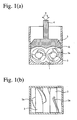
- Fig. 1 (a) is a cross-sectional view showing a pressure kneader used in the present invention.
- Fig. 1 (b) is a plan view showing a pressure kneader used in the present invention, with a pressure lid omitted.
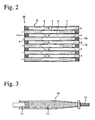
- Fig. 2 is a schematic cross-sectional view showing one example of the ceramic honeycomb filters.
- Fig. 3 is a cross-sectional view showing one example of the piston-type extruders.
- the inventor has found that such problems as the low porosity of a honeycomb structure due to the breakage of microcapsules in a blending step, and the breakage and undulation of a honeycomb structure because of air remaining in the moldable material and insufficient blending, can be prevented by blending a material comprising a ceramic material, a molding aid and a pore-forming material in a pressure kneader.
- a material comprising a ceramic material, a molding aid and a pore-forming material in a pressure kneader.
- the pressure kneader has a structure, in which a material (not shown) in a blending bath 1 is blended by rotors 2 while being pressurized by a pressure lid 3.
- a material not shown in a blending bath 1 is blended by rotors 2 while being pressurized by a pressure lid 3.
- each rotor 2 alternately has two blades 2a arranged without contact. Two rotors may rotate synchronously or independently.
- the material in the blending bath 1 is pressurized by a load applied by the pressure lid 3 and a piston shaft 4, and a force P of the piston shaft 4 pushing the pressure lid 3.
- the blending under pressure can shorten blending time because of higher efficiency than blending in a non-pressure kneader.
- the inventor has found that the amount of air remaining in the moldable material can be extremely reduced by high pressure in a pressure kneader. The higher the pressure, the more effect can be obtained. 0.12 MPa or more of pressure can reduce the defects of the honeycomb structure to a level causing no practical problems. When the pressure is lower than 0.12 MPa, air remains, and a moldable material pushed up by the rotors toward the pressure lid stays immediately below the pressure lid, causing insufficient blending and thus making the extrusion speed uneven. Thus, the resultant honeycomb structure suffers defects such as breakage and undulation.
- the pressure is too high, microcapsules are broken by an excessive shearing force. This is remarkable particularly when the pressure is higher than 0.5 MPa.
- the breakage of microcapsules is more prevented at the pressure of 0.5 MPa or less than when a screw-type blending machine is used, providing a honeycomb structure with larger porosity.
- the ceramic powder contains pulverized amorphous particles such as amorphous silica, ragged shapes of amorphous particles tend to break microcapsules.
- the pressure is preferably lower to avoid the breakage of microcapsules.
- the pressure lid is likely to hinder the moldable material from being pushed up by the rotors, resulting in insufficient blending.
- the resultant honeycomb structure has such defects as breakage and undulation.
- the ceramic materials have an average particle size of 0.1-30 ⁇ m, or when the moldable material containing 10-30 parts of water per 100 parts of the material powder is blended, such defects as breakage and undulation easily occur.
- the pressure in a pressure kneader is 0.12-0.5 MPa, preferably 0.15-0.4 MPa.
- the pressure is defined as a value obtained by dividing (force P of the piston shaft 4 pushing the pressure lid 3 + load by the pressure lid 3 + load by the piston shaft 4) by an area A of the pressure lid 3 coming into contact with the material.
- the pressure kneader can uniformly blend a moldable material in a short period of time while suppressing air from being introduced during blending with the properly set pressure as described above.
- the blending is conducted preferably in a reduced-pressure atmosphere.
- the vacuum degree of 2 x 10 -2 MPa or more as a gauge pressure during blending air can be removed from the moldable material in a shorter period of time. Accordingly, blending in the kneader can provide a molded honeycomb free from such defects as the breakage of cell walls, etc., without the step described in JP 2005-271395 A , in which the blended moldable material is extruded in a noodle shape to remove air.
- the vacuum degree is expressed by a gauge pressure (difference from the atmospheric pressure); the larger its value, the higher the vacuum degree.
- the vacuum degree during blending is more preferably 4 x 10 -2 MPa or more, further preferably 5 x 10 -2 MPa or more.
- An extremely high vacuum degree evaporates water in the moldable material during blending, providing the blended moldable material with too high hardness particularly when the moldable material has a small water content or a high temperature. Accordingly, the vacuum degree is preferably 8.5 x 10 -2 MPa or less.
- the blending step is preferably conducted only in the above pressure kneader.
- a piston-type extruder 30 is preferably used in the extrusion molding of the moldable material blended in the pressure kneader in a honeycomb shape.
- the moldable material 11 is extruded by a piston 12 to obtain a molded honeycomb 13.
- a shearing force applied to microcapsules in the moldable material 11 can be minimized, thereby preventing their breakage.
- the piston-type extrusion molding is preferably conducted immediately after blending in the pressure kneader.
- the resultant honeycomb structure is provided with low porosity by the breakage of microcapsules, and uneven hardness and viscosity by different degrees of blending between a region near the screw and a peripheral region and locally high temperatures in the moldable material.
- the moldable material is preferably soft.
- the reduction of the hardness of the moldable material prevents the breakage of microcapsules, providing the honeycomb structure with larger porosity.
- the moldable material after blending has hardness (measured by a type-C durometer according to JIS K7312, and hereinafter referred to simply as "durometer hardness") of preferably 23 or less, more preferably 22 or less.
- durometer hardness When the hardness of the moldable material is too low, an extrusion-molded body is deformed by its own weight. Accordingly, the durometer hardness of the moldable material after blending is preferably 16 or more, more preferably 18 or more. The durometer hardness can be adjusted by the amount of water relative to the ceramic materials.
- the temperature of the moldable material is preferably 15-35°C during blending.
- the moldable material has low viscosity at low temperatures, so that the extrusion-molded body is easily deformed by its own weight. With the moldable material at 15°C or higher during blending, the moldable material has high viscosity without heating during extrusion molding, resulting in small deformation of the molded body.
- the moldable material contains methylcellulose as a binder, the moldable material has extremely high viscosity at excessively high temperatures, so that the cell walls of the molded honeycomb tend to suffer breakage and undulation. Because the once increased viscosity does not easily lower even when the temperature decreases, the moldable material is preferably kept at 35°C or lower during blending.
- the more preferred temperature of the moldable material is 20-30°C. Because the temperature of the moldable material is usually elevated with time during blending, the temperature need only be within the above range when the blending is completed. The temperature is measured by a thermometer inserted into the moldable material balk within 3 minutes after the completion of the blending.
- the ceramic material preferably comprises at least one of cordierite, alumina, mullite, silicon nitride, sialon, silicon carbide, aluminum titanate, aluminum nitride, LAS, etc.
- a ceramic honeycomb structure made of cordierite as a main crystal preferably has a small thermal expansion coefficient and excellent thermal shock resistance.
- the pore-forming material is preferably in the form of a microcapsule of a resin shell containing a gas.
- the use of such pore-forming material remarkably provides the effect of the present invention.
- the microcapsule is more preferably a foamed resin (resin balloon) with a shell thickness of 0.1-0.8 ⁇ m.
- the resins are preferably made of acrylates, methacrylates, carboxylic acids, etc.
- the amount of microcapsules added may differ depending on the targeted porosity, etc. of the honeycomb structure. To obtain a honeycomb structure with large porosity, it is preferably 4-13% by mass, more preferably 5-10% by mass, based on the ceramic material.
- one or more other pore-forming materials may be used.
- carbon-based powder such as graphite, starch powder such as wheat powder and corn starch, resin powder such as polyethylene terephthalate powder, polymethyl methacrylate powder, etc.
- starch powder such as wheat powder and corn starch
- resin powder such as polyethylene terephthalate powder, polymethyl methacrylate powder, etc.
- Kaolin powder, talc powder, silica powder, alumina powder, and aluminum hydroxide powder were formulated to provide a cordierite-forming material powder having a composition comprising 50% by mass of SiO 2 , 35% by mass of Al 2 O 3 , and 15% by mass of MgO in a bath 1 in the pressure kneader shown in Fig. 1 .
- This powder was mixed with methylcellulose and hydroxypropylmethylcellulose as a molding aid, a lubricant, a foamed resin as a pore-forming material, and water, and blended under pressure of 0.5 MPa for 50 minutes without evacuating the bath 1 to form a moldable ceramic material.
- the temperature and durometer hardness of the moldable material were measured when the blending was completed. The results are shown in Table 1.
- the moldable material was extrusion-molded by a direct piston-type extruder to from a honeycomb having a diameter of 180 mm, a length of 180 mm, a cell wall thickness of 0.3 mm, and a cell wall pitch of 1.5 mm.
- This molded honeycomb was placed on a flat table with its flow paths vertical, and dried for 5 hours to measure its length before and after drying.
- the shrinkage ratio of the molded honeycomb was determined from the difference between the length before drying and the length after drying, and evaluated according to the following standard. The results are shown in Table 1. Excellent: Substantially no shrinkage (shrinkage ratio: less than 3%). Good: Shrank without practical problems (shrinkage ratio 3-4%). Poor: Shrank with practical problems (shrinkage ratio: more than 4%).
- the dried honeycomb was sintered at 1400°C for 4 hours to produce a honeycomb structure.
- the porosity of this honeycomb structure was measured by a mercury intrusion porosimetry, and the breakage and undulation of the honeycomb structure were observed by the naked eye and evaluated by the flowing standard. The results are shown in Table 1. Excellent: No breakage or undulation observed. Good: There were breakage or undulation without practical problems. Poor: There were breakage or undulation.
- Blending was conducted in the same manner as in Example 1 except for changing the pressure as shown in Table 1, to form moldable materials.
- the pressures and the moldable material temperatures in these Examples are shown in Table 1.
- the production of a molded body, the measurement of a shrinkage ratio, the sintering of a molded honeycomb, the measurement of porosity, and the evaluation of breakage and undulation were conducted in the same manner as in Example 1. The results are shown in Table 1.
- Blending was conducted in the same manner as in Example 3 except for changing the moldable material temperature and/or the durometer hardness as shown in Table 1, to form moldable materials.
- the pressures, and the temperatures and durometer hardness of the moldable materials in these Examples are shown in Table 1.
- the production of a molded body, the measurement of a shrinkage ratio, the sintering of a molded honeycomb, the measurement of porosity, and the evaluation of breakage and undulation were conducted in the same manner as in Example 1. The results are shown in Table 1.
- Blending was conducted in the same manner as in Example 3 except for changing the temperature and durometer hardness of the moldable material and/or the vacuum degree in the bath 1 as shown in Table 1, to form moldable materials.
- the pressures, and the temperatures and durometer hardness of the moldable materials in these Examples are shown in Table 1.
- the production of a molded body, the measurement of a shrinkage ratio, the sintering of a molded honeycomb, the measurement of porosity, and the evaluation of breakage and undulation were conducted in the same manner as in Example 1. The results are shown in Table 1.
- Blending was conducted in the same manner as in Example 1 except for changing the pressure, the vacuum degree, and the temperature and durometer hardness of the moldable material after blending as shown in Table 1, to form moldable materials of Comparative Examples 1-4.
- Blending was conducted in the same manner as in Example 1 except for conducting the blending in a screw-type blender without evacuation and then the molding by a screw-type extruder, to form a moldable material of Comparative Example 5.
- Blending was conducted in the same manner as in Comparative Example 1 except for changing the blending time to 70 minutes, to form a moldable material of Comparative Example 6.
- Examples 1-16 and Comparative Examples 1-6 indicate that in Examples 1-16 in which blending was conducted under a pressure of 0.12-0.5 MPa, the porosity was as high as 61-64%, with breakage or undulation not observed or on a practically harmless level.
- Comparative Examples 1 and 2 in which blending was conducted under a pressure of less than 0.12 M Pa, suffered breakage or undulation due to air remaining in the moldable material and insufficient blending, indicating that the blending was not completed in 50 minutes.
- Comparative Examples 3 and 4 in which blending was conducted under a pressure of more than 0.5 MPa, the sintered honeycomb structure had as small porosity as 54-57%, indicating that the resin balloons were broken during blending.
- Comparative Example 4 in which the pressure was as high as 1.0 MPa, breakage and undulation were observed.
- Comparative Example 4 using the screw-type blender the sintered honeycomb structure had as small porosity as 52%, indicating that the resin balloons were broken during blending. Also, the breakage or undulation was observed because of no evacuation during blending.
- Comparative Example 6 in which the blending was conducted without pressuring, suffered breakage or undulation due to the remaining of air in the moldable material and insufficient blending, indicating that the blending was not completed despite the blending time extended 1.4 times.
- Examples 6-10 having the durometer hardness of 16-23 exhibited higher porosity than Example 3 having the durometer hardness of 24, indicating that the percentage of the resin balloons remaining unbroken further increased.
- the bath 1 was evacuated to a vacuum degree of 2 x 10 -2 MPa or more as a gauge pressure while blending
- the moldable material temperature was 30°C or lower, and the durometer hardness was adjusted to 22 or less, no breakage or undulation was observed unlike Examples 1-5.
- Example 12-14 in which the moldable material temperature was 20°C or higher, and the durometer hardness was 18 or more, particularly good results were obtained with substantially no shrinkage.
- the method of the present invention conducts blending with a reduced shearing force applied to microcapsules, it can prevent the breakage of microcapsules, thereby providing a honeycomb structure having porosity of 50-70%, further as large as 60-70%. It is particularly suitable for obtaining a large-sized, large-porosity honeycomb structure having a diameter of 180 mm or more in a cross section perpendicular to its flow paths. Further, because the amount of air remaining in the moldable material is reduced, the honeycomb structure can avoid having breakage and undulation.
Landscapes
- Chemical & Material Sciences (AREA)
- Engineering & Computer Science (AREA)
- Ceramic Engineering (AREA)
- Structural Engineering (AREA)
- Manufacturing & Machinery (AREA)
- Materials Engineering (AREA)
- Organic Chemistry (AREA)
- Dispersion Chemistry (AREA)
- Mechanical Engineering (AREA)
- Inorganic Chemistry (AREA)
- Chemical Kinetics & Catalysis (AREA)
- Press-Shaping Or Shaping Using Conveyers (AREA)
- Filtering Materials (AREA)
- Preparation Of Clay, And Manufacture Of Mixtures Containing Clay Or Cement (AREA)
Claims (6)
- Verfahren zum Herstellen eines keramischen Wabenfilters mit einer Porosität von 50 bis 70 %, aufweisend:Mischen einer Ausgangsmaterialmischung, die ein Keramikmaterial, eine Formhilfe und ein porenbildendes Material enthält, um ein formbares Material für ein Wabenextrudat zu bilden,wobei das porenbildende Material Mikrokapseln aus einer Harzschale aufweist, die ein Gas enthält, dadurch gekennzeichnet, dassdas Mischen bei einem Druck von 0,12 bis 0,5 MPa in einem Druckkneter ausgeführt wird.
- Verfahren nach Anspruch 1, wobei das formbare Material nach dem Mischen eine Härte von 16 bis 23 aufweist (gemessen mit einem Durometer des Typs C nach JIS K7312).
- Verfahren nach Anspruch 1 oder 2, wobei das Mischen in einer Unterdruckatmosphäre ausgeführt wird.
- Verfahren nach Anspruch 3, wobei das Mischen in einer Unterdruckatmosphäre mit einem Vakuumgrad von 2 x 10⁻² MPa oder mehr als Messdruck ausgeführt wird.
- Verfahren nach einem der Ansprüche 1 bis 4, wobei die Temperatur des formbaren Materials während dem Mischen 15-35 °C beträgt.
- Verfahren nach einem der Ansprüche 1 bis 5 mit einem Schritt zum Extrusionsformen des gemischten formbaren Materials zur Wabenform unter Verwendung eines Kolbenextruders.
Applications Claiming Priority (2)
| Application Number | Priority Date | Filing Date | Title |
|---|---|---|---|
| JP2006265351 | 2006-09-28 | ||
| PCT/JP2007/068871 WO2008047557A1 (en) | 2006-09-28 | 2007-09-27 | Method for producing ceramic honeycomb filter |
Publications (3)
| Publication Number | Publication Date |
|---|---|
| EP2067588A1 EP2067588A1 (de) | 2009-06-10 |
| EP2067588A4 EP2067588A4 (de) | 2009-11-11 |
| EP2067588B1 true EP2067588B1 (de) | 2013-01-16 |
Family
ID=39313804
Family Applications (1)
| Application Number | Title | Priority Date | Filing Date |
|---|---|---|---|
| EP07828617A Active EP2067588B1 (de) | 2006-09-28 | 2007-09-27 | Verfahren zur Herstellung eines Keramik-Wabenfilters |
Country Status (6)
| Country | Link |
|---|---|
| US (1) | US7993561B2 (de) |
| EP (1) | EP2067588B1 (de) |
| JP (1) | JP5453809B2 (de) |
| KR (1) | KR101419290B1 (de) |
| CN (1) | CN101454129B (de) |
| WO (1) | WO2008047557A1 (de) |
Families Citing this family (5)
| Publication number | Priority date | Publication date | Assignee | Title |
|---|---|---|---|---|
| WO2015080254A1 (ja) * | 2013-11-28 | 2015-06-04 | 京セラ株式会社 | ハニカム構造体およびこれを備えるガス処理装置 |
| WO2015080255A1 (ja) * | 2013-11-29 | 2015-06-04 | 京セラ株式会社 | ハニカム構造体およびこれを備えるガス処理装置 |
| CN108621354A (zh) * | 2017-03-24 | 2018-10-09 | 中天精机股份有限公司 | 连续性发泡物控压成型方法 |
| JP6975442B2 (ja) * | 2017-04-17 | 2021-12-01 | 大東亜窯業株式会社 | 焼成物製造方法 |
| CN115008602A (zh) * | 2022-04-21 | 2022-09-06 | 罗林侠 | 一种陶瓷加工用陶瓷练泥机 |
Citations (1)
| Publication number | Priority date | Publication date | Assignee | Title |
|---|---|---|---|---|
| US20030137071A1 (en) * | 2001-03-01 | 2003-07-24 | Yasushi Noguchi | Method for producing ceramic structure |
Family Cites Families (23)
| Publication number | Priority date | Publication date | Assignee | Title |
|---|---|---|---|---|
| US5238627A (en) * | 1988-06-01 | 1993-08-24 | Ngk Insulators, Ltd. | Method for producing ceramics sintered article and molding method and molding apparatus to be used therefor |
| JPH0643048B2 (ja) | 1989-03-27 | 1994-06-08 | 日本碍子株式会社 | セラミック押出法およびそれに用いる装置 |
| ATE130831T1 (de) * | 1991-01-07 | 1995-12-15 | Takeda Chemical Industries Ltd | Verfahren zur formgebung und zum brennen von zeolith-pulver. |
| JPH05339601A (ja) | 1992-06-05 | 1993-12-21 | Daido Steel Co Ltd | 磁性合金材料 |
| JP3921863B2 (ja) * | 1999-02-22 | 2007-05-30 | 株式会社デンソー | セラミック成形体の押出成形装置 |
| JP2000280217A (ja) * | 1999-03-30 | 2000-10-10 | Ngk Insulators Ltd | 押出成形体の製造方法 |
| JP4441059B2 (ja) * | 1999-04-28 | 2010-03-31 | 日本碍子株式会社 | ハニカム成形体及びその製造方法 |
| US6680101B1 (en) * | 1999-04-28 | 2004-01-20 | Ngk Insulators, Ltd. | Molded honeycomb material and process for production thereof |
| JP2001152026A (ja) * | 1999-11-22 | 2001-06-05 | Maeta Techno Research Inc | 反応性無機組成物を含む電磁波吸収ペーストおよびこれを用いた電磁波吸収材の製造方法 |
| JP2003040687A (ja) * | 2000-06-30 | 2003-02-13 | Ngk Insulators Ltd | ハニカムセラミックス構造体とその製造方法 |
| JP4927268B2 (ja) | 2001-07-27 | 2012-05-09 | 積水化学工業株式会社 | 多孔質セラミックフィルタの製造方法 |
| JP4282960B2 (ja) | 2001-08-30 | 2009-06-24 | 日本碍子株式会社 | 高強度ハニカム構造体、その成形方法及びハニカム構造コンバーター |
| JP4266103B2 (ja) * | 2001-12-07 | 2009-05-20 | 日本碍子株式会社 | 多孔質セラミック体の製造方法 |
| DE60327616D1 (de) * | 2002-03-27 | 2009-06-25 | Ngk Insulators Ltd | Verfahren zur herstellung einer wabenstruktur |
| US7727613B2 (en) | 2002-06-17 | 2010-06-01 | Hitachi Metals, Ltd. | Ceramic honeycomb structure, process for producing the same and coat material for use in the production |
| JP4082574B2 (ja) * | 2002-08-21 | 2008-04-30 | 日本碍子株式会社 | ハニカム構造体の製造方法 |
| JP3935415B2 (ja) * | 2002-09-30 | 2007-06-20 | 積水化学工業株式会社 | 造孔剤、造孔剤の製造方法、多孔質セラミックフィルタおよび多孔質セラミックフィルタの製造方法 |
| US20060257620A1 (en) * | 2003-08-20 | 2006-11-16 | Ngk Insulators, Ltd. | Method for manufacturing honeycomb formed article, method for manufacturing honeycomb filter, and honeycomb filter |
| CN100418929C (zh) * | 2004-03-19 | 2008-09-17 | 日本碍子株式会社 | 多孔陶瓷结构体的制造方法 |
| JP2005271395A (ja) | 2004-03-24 | 2005-10-06 | Ngk Insulators Ltd | 細分盤と真空土練機及びセラミックス原料を含む柱状体の製造方法 |
| US20050221974A1 (en) * | 2004-03-31 | 2005-10-06 | Ngk Insulators, Ltd. | Ceramic clay, ceramic formed article, ceramic structure, and manufacturing methods thereof |
| JP2006289953A (ja) * | 2005-03-17 | 2006-10-26 | Ngk Insulators Ltd | ハニカム成形体の製造方法 |
| JP2006264237A (ja) | 2005-03-25 | 2006-10-05 | Ngk Insulators Ltd | セラミックの製造方法 |
-
2007
- 2007-09-27 EP EP07828617A patent/EP2067588B1/de active Active
- 2007-09-27 WO PCT/JP2007/068871 patent/WO2008047557A1/ja not_active Ceased
- 2007-09-27 JP JP2008539718A patent/JP5453809B2/ja active Active
- 2007-09-27 CN CN2007800189261A patent/CN101454129B/zh not_active Expired - Fee Related
- 2007-09-27 US US12/299,398 patent/US7993561B2/en active Active
- 2007-09-27 KR KR1020087026373A patent/KR101419290B1/ko not_active Expired - Fee Related
Patent Citations (1)
| Publication number | Priority date | Publication date | Assignee | Title |
|---|---|---|---|---|
| US20030137071A1 (en) * | 2001-03-01 | 2003-07-24 | Yasushi Noguchi | Method for producing ceramic structure |
Also Published As
| Publication number | Publication date |
|---|---|
| KR20090057346A (ko) | 2009-06-05 |
| US7993561B2 (en) | 2011-08-09 |
| US20090200693A1 (en) | 2009-08-13 |
| KR101419290B1 (ko) | 2014-07-14 |
| CN101454129A (zh) | 2009-06-10 |
| CN101454129B (zh) | 2011-12-14 |
| EP2067588A1 (de) | 2009-06-10 |
| EP2067588A4 (de) | 2009-11-11 |
| JP5453809B2 (ja) | 2014-03-26 |
| WO2008047557A1 (en) | 2008-04-24 |
| JPWO2008047557A1 (ja) | 2010-02-25 |
Similar Documents
| Publication | Publication Date | Title |
|---|---|---|
| EP1452512B1 (de) | Verfahren zur herstellung eines porösen keramikgegenstands | |
| US5188779A (en) | Production of ceramic honeycomb structural bodies | |
| KR100493755B1 (ko) | 세라믹스 구조체의 제조 방법 | |
| CN101553446B (zh) | 钛酸铝批料组合物及方法 | |
| EP1772242B1 (de) | Matrize zum Strangpressen und Verfahren zum Herstellen von keramischen porösen Gegenständen | |
| EP1847519B1 (de) | Wabenstruktur und Herstellungsverfahren dafür | |
| EP2364283B1 (de) | Cordierit-wabenkörper und herstellungsverfahren | |
| EP2105183B1 (de) | Wabenfilter | |
| EP2367774B1 (de) | Cordieritkörper mit niedriger dichte und verfahren zu deren herstellung | |
| US11447422B2 (en) | Batch compositions comprising spheroidal pre-reacted inorganic particles and spheroidal pore-formers and methods of manufacture of honeycomb bodies therefrom | |
| EP2067588B1 (de) | Verfahren zur Herstellung eines Keramik-Wabenfilters | |
| JP2000053464A (ja) | コ―ジェライト構造体 | |
| WO2004060830A1 (ja) | セラミックハニカム構造体の焼成方法 | |
| JPWO2008084844A1 (ja) | ハニカム構造体の製造方法 | |
| JP2004188819A (ja) | ハニカム成形体の製造方法、及びハニカム構造体 | |
| JP5282053B2 (ja) | ハニカム構造体の製造方法 |
Legal Events
| Date | Code | Title | Description |
|---|---|---|---|
| PUAI | Public reference made under article 153(3) epc to a published international application that has entered the european phase |
Free format text: ORIGINAL CODE: 0009012 |
|
| 17P | Request for examination filed |
Effective date: 20090326 |
|
| AK | Designated contracting states |
Kind code of ref document: A1 Designated state(s): AT BE BG CH CY CZ DE DK EE ES FI FR GB GR HU IE IS IT LI LT LU LV MC MT NL PL PT RO SE SI SK TR |
|
| AX | Request for extension of the european patent |
Extension state: AL BA HR MK RS |
|
| RA4 | Supplementary search report drawn up and despatched (corrected) |
Effective date: 20090918 |
|
| A4 | Supplementary search report drawn up and despatched |
Effective date: 20090918 |
|
| 17Q | First examination report despatched |
Effective date: 20100219 |
|
| DAX | Request for extension of the european patent (deleted) | ||
| RBV | Designated contracting states (corrected) |
Designated state(s): DE FR |
|
| REG | Reference to a national code |
Ref country code: DE Ref legal event code: R079 Ref document number: 602007028121 Country of ref document: DE Free format text: PREVIOUS MAIN CLASS: B28B0003200000 Ipc: B28C0001160000 |
|
| RIC1 | Information provided on ipc code assigned before grant |
Ipc: B28C 5/14 20060101ALI20120625BHEP Ipc: B28C 1/16 20060101AFI20120625BHEP Ipc: C04B 35/636 20060101ALI20120625BHEP Ipc: C04B 35/195 20060101ALI20120625BHEP Ipc: C04B 38/00 20060101ALI20120625BHEP |
|
| GRAP | Despatch of communication of intention to grant a patent |
Free format text: ORIGINAL CODE: EPIDOSNIGR1 |
|
| GRAS | Grant fee paid |
Free format text: ORIGINAL CODE: EPIDOSNIGR3 |
|
| GRAA | (expected) grant |
Free format text: ORIGINAL CODE: 0009210 |
|
| AK | Designated contracting states |
Kind code of ref document: B1 Designated state(s): DE FR |
|
| REG | Reference to a national code |
Ref country code: DE Ref legal event code: R096 Ref document number: 602007028121 Country of ref document: DE Effective date: 20130314 |
|
| PLBE | No opposition filed within time limit |
Free format text: ORIGINAL CODE: 0009261 |
|
| STAA | Information on the status of an ep patent application or granted ep patent |
Free format text: STATUS: NO OPPOSITION FILED WITHIN TIME LIMIT |
|
| 26N | No opposition filed |
Effective date: 20131017 |
|
| REG | Reference to a national code |
Ref country code: DE Ref legal event code: R097 Ref document number: 602007028121 Country of ref document: DE Effective date: 20131017 |
|
| REG | Reference to a national code |
Ref country code: FR Ref legal event code: PLFP Year of fee payment: 10 |
|
| REG | Reference to a national code |
Ref country code: FR Ref legal event code: PLFP Year of fee payment: 11 |
|
| REG | Reference to a national code |
Ref country code: FR Ref legal event code: PLFP Year of fee payment: 12 |
|
| PGFP | Annual fee paid to national office [announced via postgrant information from national office to epo] |
Ref country code: DE Payment date: 20250805 Year of fee payment: 19 |
|
| PGFP | Annual fee paid to national office [announced via postgrant information from national office to epo] |
Ref country code: FR Payment date: 20250808 Year of fee payment: 19 |