EP2068122A2 - Procédé et dispositif pour déterminer un itinéraire conseillé à partir d'une multitude d'itinéraires - Google Patents
Procédé et dispositif pour déterminer un itinéraire conseillé à partir d'une multitude d'itinéraires Download PDFInfo
- Publication number
- EP2068122A2 EP2068122A2 EP20080105547 EP08105547A EP2068122A2 EP 2068122 A2 EP2068122 A2 EP 2068122A2 EP 20080105547 EP20080105547 EP 20080105547 EP 08105547 A EP08105547 A EP 08105547A EP 2068122 A2 EP2068122 A2 EP 2068122A2
- Authority
- EP
- European Patent Office
- Prior art keywords
- route
- parameter
- distance
- optimized
- optimization
- Prior art date
- Legal status (The legal status is an assumption and is not a legal conclusion. Google has not performed a legal analysis and makes no representation as to the accuracy of the status listed.)
- Withdrawn
Links
Images

Classifications
-
- G—PHYSICS
- G01—MEASURING; TESTING
- G01C—MEASURING DISTANCES, LEVELS OR BEARINGS; SURVEYING; NAVIGATION; GYROSCOPIC INSTRUMENTS; PHOTOGRAMMETRY OR VIDEOGRAMMETRY
- G01C21/00—Navigation; Navigational instruments not provided for in groups G01C1/00 - G01C19/00
- G01C21/26—Navigation; Navigational instruments not provided for in groups G01C1/00 - G01C19/00 specially adapted for navigation in a road network
- G01C21/34—Route searching; Route guidance
- G01C21/3446—Details of route searching algorithms, e.g. Dijkstra, A*, arc-flags or using precalculated routes
Definitions
- the present invention relates to a method for determining a recommended route according to claim 1 and to a device for determining a recommended route according to claim 9.
- Conventional navigation systems determine routes that lead to a given destination on a particularly short or particularly fast route.
- the determination of a route based on a mixture of the fastest and shortest route is also known.
- the consideration of further traffic characteristics of roads for the determination of routes is known.
- These additional traffic features include data on static traffic characteristics, such as the presence of toll, tunnel or ferry connections, as well as data on dynamic traffic characteristics, such as the current traffic situation or other traffic-related messages.
- a route is calculated in which the relevant parameter for the route found is minimized. It is assumed that the assignment of properties for all roads is of the same high description quality. For some attributes, for example track length, likes that are most likely true, but not for other attributes, such as mean velocity.
- the route A is the somewhat slower, but contains very well classified roads
- the route B is the slightly faster, but which contains very inaccurately classified roads.
- the distance B always wins as the determined route (or recommended route), since the "faster" roads are used.
- the attribution quality is not taken into account, it is therefore not guaranteed that, firstly, the time of arrival is actually met for the particular route (route B) and, secondly, that the particular route is the optimum.
- the EP 1 159 586 B1 describes a navigation system for determining a route from a location to a destination, in which the determination of the route based on a weighting of a route or a section of track.
- These weights are time-dependent, so that, for example, for different times of the day for a road section, a different weight of this section results in the route determination.
- the disadvantage proves that such a weighting can be difficult to adapt to real or dynamic changes in the section or extend and further allows no indication of the quality of the weights.
- the actual travel time for the selected route can not be reliably estimated, if for a route only the average cruise speed value at a time of day is known as the only value for this route at the corresponding time of day.
- the present invention is based on the finding that by using the probability density of the probability of occurrence of the respective quantities or values of the parameter to be optimized, information about the quality or validity of this parameter is also taken into account.
- the scattering of the parameter to be optimized it can then be recognized, for example, that despite the lower actual travel time (or walking time), a route can not certainly be traveled in the shortest possible time. This applies in particular if the travel duration (walking time) of the "fastest" route has a significantly broader scattering characteristic. In this case, although the average travel time for the "fastest” route provides the least travel time for all available routes, there is also a significant probability that the actual travel time for the identified "fastest” route may be significantly longer than the averaged one driving time.
- the reliability of compliance with a value of the parameter to be optimized can be significantly increased if the recommended route is actually chosen.
- the advantage of the present invention is thus that the driver of a vehicle or a pedestrian compared to conventional approaches a much more reliable route recommendation with respect to the parameter to be optimized (such as the travel time or walking time, the costs caused by the route selection or the expected fuel consumption) can be given.
- the step of providing the probability density may include providing each partial route probability for each of the partial routes.
- the probability of occurrence of the respective quantities or values of the parameter to be optimized is mapped in the corresponding partial route sections.
- the step of providing the probability density also includes mathematically summarizing the partial route probabilities to obtain the aforementioned probability density for the route.
- the method may further comprise a step of outputting the optimization parameter value of the route that was output as route recommendation. This not only allows information of the driver about the optimal route, but also an indication of which specific expression of the parameter to be optimized has been achieved by the optimization parameter value. Such an output thus increases the comfort for the driver.
- the parameter to be optimized can consist of a travel time, a route length, an energy or fuel consumption, an environmental load, a driver load, stress and / or costs for the selected route.
- This offers the advantage that the optimization can be extended to different parameters.
- optimization before setting is carried out on a route to be issued as a route recommendation for several parameters, in which case the decision for the final route selection has to be made by a combination or weighting of the individual optimization results. For example, that distance can be output as a route recommendation for which two optimization parameters have the lowest value compared with the corresponding optimization parameters of the other distances.
- the optimization parameter values in the step of determining the optimization parameter values, can be determined in such a way that integration is made of probabilities of the parameters to be optimized whose probabilities are less than or equal to the optimization threshold value.
- the optimization threshold value can be set in accordance with the wishes of an operator via an input unit.
- the method may include a step of determining the current position of a vehicle in the route and subsequently recursively repeating the method using the determined current position of the vehicle. This allows for a change in the traffic situation, such as an accident that the issued route recommendation is revised.
- a possibly locked road can be taken out of the determination of the recommended route while driving, whereby a re-evaluation or - setting the recommendation for the remaining distance to the destination is possible.
- the step of providing a probability density provides the probability density of the one to be optimized Includes parameters from a previously read in road map.
- the provision of the probability density of the parameter to be optimized can also take place from the data of the parameter to be optimized for the corresponding route which are acquired and stored by the vehicle or by the user. This allows, besides the generally available data provided by a service provider, specific probability data for the corresponding route to be recorded and stored by the user. This data can be used to improve the probability density on routes frequently traveled by the user, so that an even better reliability of the route recommendation can be realized on these routes.
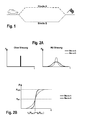
- Fig. 1 a starting situation for selecting a route from two available routes (route A and Route B), where one of the routes is selected as route recommendation.
- the invention described in more detail below takes into account not only the road characteristic per se (such as the determination of the shortest travel time) but also the attribution quality of the corresponding road property in the route calculation.
- the quality of the attribution can be described by the scattering or the probability density of an attribute.
- the route which has the lowest resistance value is determined as the route, also taking account of the attribution quality.
- a resistance value is understood in this context as a parameter that is to be optimized and that serves as a criterion for the selection of a route as a recommended route.
- the essence of this invention is essentially that not only the characteristics of the road itself, but also the attribution quality of this information is taken into account in the route optimization. Thus, not only the minimum of the value described by the route criterion is more important but also its dispersion.
- the system determining the route recommendation is to be given information about the fuel consumption of the vehicle on the routes to be traveled.
- the costs for the respective routes can also result from an amount of fuel costs and fuel consumption, so that the system determining the route recommendation can calculate the costs for the route itself.
- the consideration of the dispersion is applicable with the various route calculation methods, such as Ford-Moore, Dijkstra or A *, whereby the direction of optimization, from the destination to the start or vice versa, is insignificant.
- the property to be optimized is as far as possible represented by an abstract resistor, which should be minimized.
- the resistance for "short route” corresponds to the route length and "fast route” for the travel time, which in turn results from the route and the typical average speed.
- Two different routes with an average identical travel time can, for example, take very different travel times with regard to the daily, weekly or seasons. This scattering can be described by the probability density of the average travel time or speed.
- the resistance optimization should be adapted with regard to the resistance comparison. So it is no longer enough to compare the (average) resistance of the two routes. Instead, the distribution functions of the resistance of the two routes must be compared.
- a selection criterion serves a predetermined minimum probability and it is that route used as a route recommendation whose resistance R for this minimum probability P min is the least.
- P min should be greater than 50%. This relationship is shown in Equation 2. route ⁇ min R x P min x ⁇ over all routes
- the distance B compared to the distance A has a lower average travel time (ie R A (P 50% )> R B (P 50% )).
- the route B has a greater dispersion of the typical travel time.
- this is reflected in the form that, although the average resistance R B (P 50% ) of the distance B is less than the average resistance R A (P 50% ) of the distance A, but the resistance R for the minimum probability the distance A (ie R A (P min )) is smaller than the resistance R for the minimum probability of the distance B (ie R B (P min )).
- the route A is then selected as route recommendation, which is not the fastest, but the route with the safer arrival time.
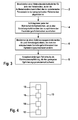
- a probability density p is provided for each of the routes (ie route A or route B) in which the probability of occurrence of the respective quantities or values of the parameter to be optimized (ie t or R) in the corresponding routes (ie Distances A or B) is shown.
- each of the probability densities p is integrated in order to obtain a respective distribution function P over the parameter to be optimized per distance.
- an optimization parameter value (eg R A (P min ) or R B (P min )) is determined from the parameter value range to be optimized for each distribution function P at which the corresponding distribution function value reaches the optimization threshold P min .
- an output is made the route as route recommendation that has the lowest optimization parameter value (R A (P min ) or R B (P min )).
- the method can be applied to a route with multiple legs. In this case, only the probability densities for the individual sections are mathematically to be summarized together (eg by summing up, folding and the like) to form the distribution function for the corresponding total distance. With the distribution function obtained, the step of determining the optimization parameter value can then be carried out analogously to step 6.
- the proposed method may be applied in addition to existing route optimization criteria such as "fast route”, “minimum fuel economy route” or “least costly route”.
- route optimization criteria such as "fast route”, “minimum fuel economy route” or "least costly route”.
- HMI Human Machine Interface
- a configuration option could be realized by a corresponding switch in the settings.
- the parameters describing a probability already accumulate during the data acquisition.
- the statistical data can be provided both by a global data pool of historical values, or can be determined by a vehicle while driving. They can thus be available as part of the raw data and thus also in the navigation data, so that they in turn can be used by the route calculation method proposed above.
- the route which is optimal only with regard to the parameter to be optimized is then no longer calculated, but another route which has a higher accuracy of the prediction for the time of arrival, the fuel consumption or the like ,
- different route recommendations may result in different driving behavior.
- FIG. 4 a block diagram of an embodiment of an inventive device 10 for determining a recommended route from a plurality of routes.
- the device 10 comprises a unit 12 for providing a probability density for each of the distances. This provision can take place, for example, from historical information of a data pool, which are stored for a section of the route in a digital road map. Alternatively or additionally, data values for a route section can also be detected and used to improve the information from the data pool.
- the device 10 comprises a unit 14 for integrating each of the probability densities in order to each obtain a distribution function over the parameter to be optimized per distance.
- the unit 14 for integration is connected to the unit 12 for providing.
- the apparatus 10 includes a unit 16 coupled to the integrating unit 14 for determining one optimization parameter value for the parameter to be optimized for each distribution function at which the corresponding distribution function value reaches the optimization threshold.
- the device 10 has an output unit 18 connected to the unit 16 for determining in order to output that distance as route recommendation for which the lowest optimization parameter value was determined.
- route recommendation may also be given for virtual route networks if the route network is only virtually depicted on a data processing unit, such as e.g. in a virtual environment, such as provided by SecondLife®.
Landscapes
- Engineering & Computer Science (AREA)
- Radar, Positioning & Navigation (AREA)
- Remote Sensing (AREA)
- Automation & Control Theory (AREA)
- Physics & Mathematics (AREA)
- General Physics & Mathematics (AREA)
- Navigation (AREA)
Applications Claiming Priority (1)
| Application Number | Priority Date | Filing Date | Title |
|---|---|---|---|
| DE102007058093.4A DE102007058093B4 (de) | 2007-12-03 | 2007-12-03 | Verfahren und Vorrichtung zum Ermitteln einer Routenempfehlung aus einer Mehrzahl von Wegstrecken |
Publications (1)
| Publication Number | Publication Date |
|---|---|
| EP2068122A2 true EP2068122A2 (fr) | 2009-06-10 |
Family
ID=40394004
Family Applications (1)
| Application Number | Title | Priority Date | Filing Date |
|---|---|---|---|
| EP20080105547 Withdrawn EP2068122A2 (fr) | 2007-12-03 | 2008-10-10 | Procédé et dispositif pour déterminer un itinéraire conseillé à partir d'une multitude d'itinéraires |
Country Status (2)
| Country | Link |
|---|---|
| EP (1) | EP2068122A2 (fr) |
| DE (1) | DE102007058093B4 (fr) |
Cited By (3)
| Publication number | Priority date | Publication date | Assignee | Title |
|---|---|---|---|---|
| EP2071287A3 (fr) * | 2007-12-13 | 2011-02-16 | Deutsche Telekom AG | Procédé de sélection d'une trajectoire pour une navigation dynamique d'un transport individuel |
| US10082403B2 (en) | 2011-12-02 | 2018-09-25 | Uber Technologies, Inc. | System for vehicle routing that combines real-time and likelihood information for traffic, construction and weather |
| CN110991684A (zh) * | 2018-10-02 | 2020-04-10 | 波音公司 | 垂直航道优化 |
Families Citing this family (6)
| Publication number | Priority date | Publication date | Assignee | Title |
|---|---|---|---|---|
| DE102009047409A1 (de) | 2009-12-02 | 2011-06-09 | Robert Bosch Gmbh | Verfahren und Rechnersystem zur Routenbestimmung unter Berücksichtigung von Störungswahrscheinlichkeiten |
| DE102010028090A1 (de) | 2010-04-22 | 2011-12-01 | Robert Bosch Gmbh | Navigationssystem und Navigationsverfahren für Fahrzeuge |
| DE102010064063B4 (de) * | 2010-12-23 | 2021-11-11 | Bayerische Motoren Werke Aktiengesellschaft | Verfahren und Vorrichtung zur rechnergestützten Prognose eine Fahrtdauer eines Fahrzeugs auf einer Route aus einem oder mehreren Routensegmenten |
| DE102011007146A1 (de) | 2011-04-11 | 2012-10-11 | Robert Bosch Gmbh | Stauresistente Route |
| DE102015205901A1 (de) * | 2015-04-01 | 2016-10-06 | Bayerische Motoren Werke Aktiengesellschaft | Verfahren zur Berechnung einer Route für ein Landfahrzeug |
| DE102016220561A1 (de) * | 2016-10-20 | 2018-04-26 | Bayerische Motoren Werke Aktiengesellschaft | Verfahren zur Ermittlung von Fahrrouten für Landfahrzeuge |
Citations (2)
| Publication number | Priority date | Publication date | Assignee | Title |
|---|---|---|---|---|
| EP1159586B1 (fr) | 1999-03-02 | 2004-12-15 | Robert Bosch Gmbh | Procede et systeme de navigation pour determiner l'itineraire d'un moyen de deplacement entre un lieu de depart et une destination |
| EP1061491B1 (fr) | 1999-06-11 | 2005-08-10 | DDG Gesellschaft für Verkehrsdaten mbH | Procédé de filtrage de données du trafic pour déterminer la vitesse sur les routes |
Family Cites Families (4)
| Publication number | Priority date | Publication date | Assignee | Title |
|---|---|---|---|---|
| DE19844289C2 (de) | 1998-09-18 | 2000-08-03 | Mannesmann Ag | Verfahren und Vorrichtung zum Zuordnen von von einem fahrzeugseitigen Endgerät ermittelten Stützpunktinformationen |
| JP4452474B2 (ja) | 2003-09-30 | 2010-04-21 | パイオニア株式会社 | 案内誘導システム、その方法、そのプログラム、および、そのプログラムを記録した記録媒体 |
| US7355528B2 (en) | 2003-10-16 | 2008-04-08 | Hitachi, Ltd. | Traffic information providing system and car navigation system |
| DE102004011604A1 (de) * | 2004-03-10 | 2005-09-29 | Morgenstern, Ingo, Prof. Dr. | Verfahren zur optimalen Auslastung eines Verkehrsnetzes |
-
2007
- 2007-12-03 DE DE102007058093.4A patent/DE102007058093B4/de active Active
-
2008
- 2008-10-10 EP EP20080105547 patent/EP2068122A2/fr not_active Withdrawn
Patent Citations (2)
| Publication number | Priority date | Publication date | Assignee | Title |
|---|---|---|---|---|
| EP1159586B1 (fr) | 1999-03-02 | 2004-12-15 | Robert Bosch Gmbh | Procede et systeme de navigation pour determiner l'itineraire d'un moyen de deplacement entre un lieu de depart et une destination |
| EP1061491B1 (fr) | 1999-06-11 | 2005-08-10 | DDG Gesellschaft für Verkehrsdaten mbH | Procédé de filtrage de données du trafic pour déterminer la vitesse sur les routes |
Cited By (5)
| Publication number | Priority date | Publication date | Assignee | Title |
|---|---|---|---|---|
| EP2071287A3 (fr) * | 2007-12-13 | 2011-02-16 | Deutsche Telekom AG | Procédé de sélection d'une trajectoire pour une navigation dynamique d'un transport individuel |
| US10082403B2 (en) | 2011-12-02 | 2018-09-25 | Uber Technologies, Inc. | System for vehicle routing that combines real-time and likelihood information for traffic, construction and weather |
| US10539427B2 (en) | 2011-12-02 | 2020-01-21 | Uber Technologies, Inc. | System and method for improved routing that combines real-time and likelihood information |
| US11067412B2 (en) | 2011-12-02 | 2021-07-20 | Uber Technologies, Inc. | System and method for improved routing that combines real-time and likelihood information |
| CN110991684A (zh) * | 2018-10-02 | 2020-04-10 | 波音公司 | 垂直航道优化 |
Also Published As
| Publication number | Publication date |
|---|---|
| DE102007058093A1 (de) | 2009-06-04 |
| DE102007058093B4 (de) | 2019-05-16 |
Similar Documents
| Publication | Publication Date | Title |
|---|---|---|
| DE102007058093B4 (de) | Verfahren und Vorrichtung zum Ermitteln einer Routenempfehlung aus einer Mehrzahl von Wegstrecken | |
| EP1741591B1 (fr) | Procédé pour prédire des situations de conduite dans un véhicule | |
| EP3279050B1 (fr) | Système de commande et procédé de commande destiné à sélectionner et à suivre un véhicule automobile | |
| EP3625785B1 (fr) | Procédé pour générer une compilation de probabilités de dépassement, procédé pour faire fonctionner un dispositif de commande d'un véhicule à moteur, dispositif de compilation de probabilités de dépassement et dispositif de commande | |
| DE19843395A1 (de) | Verfahren zur Geschwindigkeits- und/oder Abstandsregelung bei Kraftfahrzeugen | |
| EP1844373B1 (fr) | Procede pour prevoir la trajectoire d'automobiles dans des systemes d'assistance au conducteur | |
| EP3279049B1 (fr) | Système de commande et procédé de commande pour déterminer une voie de circulation | |
| WO2006037360A1 (fr) | Systeme pour informer un conducteur de la possibilite d'effectuer des depassements | |
| WO2012045558A1 (fr) | Procédé et système d'information pour communiquer à un conducteur de véhicule des informations sur les conditions d'un dépassement prévu | |
| EP1303845A1 (fr) | Procede de determination d'informations relatives a la situation du trafic | |
| EP1886093A1 (fr) | Procede pour determiner la geometrie d'un tronçon de route | |
| EP3279051B1 (fr) | Système de commande et procédé de commande destiné à sélectionner et à suivre un véhicule automobile | |
| WO2022253595A1 (fr) | Utilisation de données cartographiques pour guidage latéral par système d'aide à la conduite | |
| DE102018007022A1 (de) | Verfahren und Vorrichtung zum Betrieb eines Assistenzsystems eines Fahrzeuges und Fahrzeug | |
| EP1957939B1 (fr) | Dispositif et procede de fourniture d'informations de guidage vers une destination dans un systeme de navigation | |
| EP2881298B1 (fr) | Procédé d'influence prévisionnelle de la vitesse d'un véhicule automobile | |
| DE102019205942A1 (de) | Verfahren zum Bereitstellen einer Fahrtroute für ein Kraftfahrzeug mit mindestens einem Fahrerassistenzsystem und Kraftfahrzeug | |
| DE19601831C5 (de) | Verfahren zur Erkennung von relevanten Objekten | |
| WO2009074370A1 (fr) | Procédé de détermination d'un itinéraire, et dispositif correspondant | |
| DE102018007298A1 (de) | Verfahren zur Routenplanung | |
| DE102021005438A1 (de) | Verfahren zur Bestimmung von Streckenattributen in einer Straßenkarte eines Fahrzeugsystems aus Schilderbeobachtungen | |
| EP0813986B1 (fr) | Méthode de commande de distance d'un véhicule | |
| DE102016216538A1 (de) | Verfahren zum Betreiben einer Steuervorrichtung eines Kraftfahrzeugs, Steuervorrichtung und Kraftfahrzeug | |
| DE102021004330A1 (de) | Verfahren zur Routenführung eines Fahrzeugs und Fahrzeug | |
| DE102007049509A1 (de) | Kraftfahrzeug-Navigationssystem |
Legal Events
| Date | Code | Title | Description |
|---|---|---|---|
| PUAI | Public reference made under article 153(3) epc to a published international application that has entered the european phase |
Free format text: ORIGINAL CODE: 0009012 |
|
| AK | Designated contracting states |
Kind code of ref document: A2 Designated state(s): AT BE BG CH CY CZ DE DK EE ES FI FR GB GR HR HU IE IS IT LI LT LU LV MC MT NL NO PL PT RO SE SI SK TR |
|
| AX | Request for extension of the european patent |
Extension state: AL BA MK RS |
|
| STAA | Information on the status of an ep patent application or granted ep patent |
Free format text: STATUS: THE APPLICATION IS DEEMED TO BE WITHDRAWN |
|
| 18D | Application deemed to be withdrawn |
Effective date: 20110503 |