EP2068255A2 - Système et méthode pour génération éfficace des listes d'écoute à base de similarité sur des dispositifs portables - Google Patents
Système et méthode pour génération éfficace des listes d'écoute à base de similarité sur des dispositifs portables Download PDFInfo
- Publication number
- EP2068255A2 EP2068255A2 EP08105948A EP08105948A EP2068255A2 EP 2068255 A2 EP2068255 A2 EP 2068255A2 EP 08105948 A EP08105948 A EP 08105948A EP 08105948 A EP08105948 A EP 08105948A EP 2068255 A2 EP2068255 A2 EP 2068255A2
- Authority
- EP
- European Patent Office
- Prior art keywords
- musical
- digital
- works
- musical works
- playlist
- Prior art date
- Legal status (The legal status is an assumption and is not a legal conclusion. Google has not performed a legal analysis and makes no representation as to the accuracy of the status listed.)
- Ceased
Links
Images


Classifications
-
- G—PHYSICS
- G06—COMPUTING OR CALCULATING; COUNTING
- G06F—ELECTRIC DIGITAL DATA PROCESSING
- G06F16/00—Information retrieval; Database structures therefor; File system structures therefor
- G06F16/60—Information retrieval; Database structures therefor; File system structures therefor of audio data
- G06F16/68—Retrieval characterised by using metadata, e.g. metadata not derived from the content or metadata generated manually
- G06F16/683—Retrieval characterised by using metadata, e.g. metadata not derived from the content or metadata generated manually using metadata automatically derived from the content
-
- G—PHYSICS
- G06—COMPUTING OR CALCULATING; COUNTING
- G06F—ELECTRIC DIGITAL DATA PROCESSING
- G06F16/00—Information retrieval; Database structures therefor; File system structures therefor
- G06F16/60—Information retrieval; Database structures therefor; File system structures therefor of audio data
- G06F16/63—Querying
- G06F16/632—Query formulation
- G06F16/634—Query by example, e.g. query by humming
-
- G—PHYSICS
- G06—COMPUTING OR CALCULATING; COUNTING
- G06F—ELECTRIC DIGITAL DATA PROCESSING
- G06F16/00—Information retrieval; Database structures therefor; File system structures therefor
- G06F16/60—Information retrieval; Database structures therefor; File system structures therefor of audio data
- G06F16/63—Querying
- G06F16/638—Presentation of query results
- G06F16/639—Presentation of query results using playlists
-
- Y—GENERAL TAGGING OF NEW TECHNOLOGICAL DEVELOPMENTS; GENERAL TAGGING OF CROSS-SECTIONAL TECHNOLOGIES SPANNING OVER SEVERAL SECTIONS OF THE IPC; TECHNICAL SUBJECTS COVERED BY FORMER USPC CROSS-REFERENCE ART COLLECTIONS [XRACs] AND DIGESTS
- Y02—TECHNOLOGIES OR APPLICATIONS FOR MITIGATION OR ADAPTATION AGAINST CLIMATE CHANGE
- Y02D—CLIMATE CHANGE MITIGATION TECHNOLOGIES IN INFORMATION AND COMMUNICATION TECHNOLOGIES [ICT], I.E. INFORMATION AND COMMUNICATION TECHNOLOGIES AIMING AT THE REDUCTION OF THEIR OWN ENERGY USE
- Y02D10/00—Energy efficient computing, e.g. low power processors, power management or thermal management
Definitions
- the present invention relates generally to the field of data processing and more specifically to methods, systems and products for generation and management of similarity playlists of media files on portable devices.
- a user's audio collection is typically stored in a music database designed for that purpose.
- Each song typically has some minimal amount of metadata associated with it (e.g., song title, performer, style, etc.) that describes the content.
- a computerized database allows a user to quickly locate and initiate the playback of a particular song.
- a database-based approach to managing a large number of media items is most useful to the music user who has intimate knowledge of his or her entire music collection and is able to identify with some particularity the song or songs that that are to be played.
- the standard database search function will be used to locate music, but that approach is difficult to tune and the results returned tend to be either over or under inclusive.
- a playlist is a subset of the music database that contains a hand picked collection of music items that the user wishes to listen to sequentially, randomly, etc.
- playlist generation routines have been devised that allow the user to specify a genre, artist, year, album, etc., and have all of the music items in the database that match the specified criteria be assembled into a playlist.
- the problems associated with managing large music databases have led to the development of enhanced functionality in the database management software that resides on the user's personal computer.
- the current state-of-the-art provides PC-based software packages that allow a user to create and store playlist files and transfer these playlist files - along with the media items associated with the playlist if necessary - to a portable device where they can be played.
- This approach provides an easier form of playlist creation and management than would be feasible on a stand-alone portable device.
- this approach has its own problems.
- the portable device needs to store all the music files that are included in the playlist. Although the capacity of some music players is quite large, storage is still limited as compared with the user's personal computer. Additionally, this approach is not typically fully automated since the user still has to select the individual songs that comprise the playlist or specify the criteria for a database search and then arrange for the transfer of the playlist and associated songs to the portable device.
- a playlist once generated, is a static thing that represents the user's preferences or the search results exactly as specified at one moment in time. If a user were, for example, to want to modify a playlist, the search that created it would need to be manually entered again and/or the user would need to manually search for songs to add to the playlist. When a new song is added to an MP3 player, it will not be included in a playlist that would logically accommodate it unless the user remembers to add that song manually or unless a new search is conducted. Finally, none of these searches will uncover a song that has been misclassified as to genre, artist, etc., nor will a conventional search uncover songs that are sonically similar to a song that is a user favorite.
- the playlists generated via the conventional approach are, thus, either the product of a long and cumbersome manual process or they are products of automated algorithms that choose songs based on the associated music metadata (e.g., genre, artist, year, etc.) Additionally all of these approaches provide the user with a static playlist, i.e., the user is provided with a playlist file that does not change during the listening process.
- playlist generation algorithm creates a playlist that is based on the musical characteristics of the audio files, rather than being based on song metadata.
- the instant invention will allow users of portable media devices to initiate a playlist generation process that automatically provides playlists that are based on the musical features of the files stored on the portable devices, thereby providing playlists that contain musically similar audio files.
- the system would be most useful when used in combination with personal computer-based routines that are designed to cooperate with corresponding routines on a portable device.
- the playlist generation process will be performed on the portable device, although it is certainly possible that the playlist generation process of the instant invention might be performed on the personal computer also.
- the methods taught herein will provide the user with attribute data that will be stored on a portable device and that will then be used in the similarity playlist generation process.
- the attribute database will be generated on the personal computer as part of a preliminary analysis that is performed on each song in a digital music collection.
- the analysis step is an integral part of the functionality of the instant invention and will preferably be carried out by digital music management software that is resident on or accessible by a personal computer.
- the analysis step will preferably operate on the entire music database and will preferably generate one attribute record for each song contained therein.
- the attribute data obtained at this step will then be used as the starting point in the similarity playlist generation process.
- the system and method taught herein will preferably be designed to automatically generate a similarity playlist from the digital media files shared on portable devices. It is generally directed to providing users with an easy and simple way of experiencing the content of their entire digital music collection in a completely new way, by using the characteristics of each media item as the basis of a playlist generation process, thereby creating playlists that contain musically similar audio files.
- the instant invention provides the user of a portable device with a method of automatically generating playlists within that device, with the playlists having been created based on the musical characteristics or attributes of the media files themselves.
- the process will preferably be completely automatic and will be initiated by the user with a minimum of user input.
- the instant method will operate dynamically, i.e., the process will be performed repeatedly on a series of base media items and the instant invention will be able to quickly generate an associated similarity playlist without high resource demands on the portable device.
- the preferred method will be implemented by providing a separate, so-called, music attributes file which will be generated on a personal computer, then moved to and stored on the portable device.
- This file will preferably contain characteristic information about each media item stored in the music database. This information will be utilized during playlist generation on the portable device to create a similarity playlist.
- the steps involved with similarity playlist generation will preferably be invisible to the user, so that the user will only be required to select a base media item and the instant invention will then automatically create a similarity playlist on the user's portable device.
- the user interface will provide controls that allow the user to initiate the playlist generation process at any time while the portable device is in use.
- the user will not need to select a particular base media item as the start item. Instead, the instant invention will automatically provide the user with a proposal for a similarity playlist based on the song that is currently playing.
- the user will preferably be able to accept or reject the proposed playlist or, provisionally accept it and listen to some or all of the proposed playlist, before deciding whether or not to keep it.
- the instant invention preferably begins with the activation of the digital media management program, preferably a program that is able to store and manage digital music files.
- This program will preferably be stored on a personal computer that has access to the digital media content of the user.
- a first aspect of the instant invention will preferably be carried out on the user's personal computer and will use the user's music database to generate an attributes database.
- the user will preferably be presented with a graphical user interface that provides access to the functionality of a media management program, e.g., sorting, storing, and archiving digital mediafiles.
- the media management program will preferably allow the user to import new digital media files into an existing digital media collection.
- the digital media management program will preferably automatically assign an ID to each imported audio file - the ID being intended to provide a better localization of the audio files within the database of the media management program and is a key workflow element of the instant invention.
- each audio item in the database will have an unique ID.
- the instant invention will perform an analysis of the imported digital media files, the purpose of the analysis being to determine their musical characteristics.
- This analysis will preferably calculate or determine at least the following attributes: tonality, spectral flatness or any other frequency spectrum-based calculation, rhythm (e.g., whether the beats are regularly spaced or irregular / syncopated), tempo (e.g., beats per minute), key signature (e.g., base pitch of the song), etc.
- the result of this analysis will then be preferably stored together with the IDs of the digital media files in the database of the media management program.
- the analysis results may be stored as a collection of single values describing each individual musical characteristic or as a numerical value into which all the individual values for the different musical characteristics are combined.
- a single numerical value that represents the musical characteristics of a song might be calculated in many ways, but in a preferred embodiment each individual musical attribute will be associated with a numerical value, with the resulting numbers added together (or multiplied, a weighted average formed, etc.). For example if a song's tempo is 120 BPM a value of "45" might be added to its attribute score, whereas "42" might be added if the tempo were 110.
- Such a scale or translation will preferably be provided by the instant inventors for each individual musical characteristic used in the calculation to allow for the creation of a summed numerical value that represents the musical characteristics of a media file.
- the user will synchronize his or her portable media device with the personal computer, i.e., the content of the portable media device will be synchronized with the content of the database of the media management software. Synchronization will typically be performed by connecting the portable media device to the personal computer, selecting digital media files for transfer to the portable media device, and transferring the selected files.
- the digital media management software will preferably automatically detect that connection and will either automatically transfer previously selected digital media files to the portable media device or, in some cases, the software will wait for the user to initiate the selection and transfer of digital media files.
- the instant invention will then preferably automatically transfer the files that have been newly imported into the digital media management software since the last synchronization.
- the instant invention will also transfer a music attribute file, which contains the IDs of the digital media files and the attribute analysis results for each digital media file.
- a single music attribute file e.g., a database
- the transferred digital media files and the music attribute file will then be stored on the portable device.
- the music attribute file might be created dynamically during the synchronization process, thereby gathering and utilizing the data contained in the music database.
- the music attribute file will be created during an analysis of the entire database on the personal computer.
- the attribute file will be continually expanded as the music database grows.
- the user will initiate the playback of an arbitrary digital media file that has been stored on the portable device.
- the instant invention will then preferably determine the ID of that particular digital media file and the similarity value (analysis result) of that particular digital media file by reading that value (or those values) from the music attribute file.
- the similarity value will then be used in the construction of a similarity playlist.
- the instant invention will compare the similarity value with other similarity values in the music attribute file on the portable device, the preferred goal being to select those music items whose attributes are similar to attributes of the selected media item.
- the selected media file will be compared with each item in the database by comparing the analyzed results stored previously.
- the comparison results e.g., differences
- This difference value will preferably then be compared with a predetermined data range. If the difference value is within this range, the instant invention will preferably include this media item in a similarity playlist by inserting the ID or trackname therein.
- the user will preferably be given some control over the playlist generated according to the instant method.
- the user may be allowed to specify the length of the playlist, whether or not the playlist is to be updated/renewed as new items are added to the music database and the user will be allowed to change the data range used in the similarity calculation, etc.
- the user will be presented with the similarity playlist that has been generated as discussed above and he or she might accept the content of the playlist or generate a new playlist.
- the user may need to modify the data range or some other parameter.
- playlist generation can be implemented on a portable device with even very modest computing power.
- playlist generation can potentially take place in any portable device, be it a cell phone, a portable music player, a GPS unit with MP3 playback capabilities, or any other device that is capable of playback of digital media files.
- the system of the instant invention provides the user with an almost interactionless way of enjoying digital music on his or her portable device since the playlist generation process is executed without user interaction.
- the instant invention provides a mixture of functionalities, wherein the computationally intensive part, i.e., the music analysis, is carried out on a personal computer and where the results of the analysis are delivered to a portable device for use in playlist generation.
- the digital media files and the data generated in the analysis step will preferably be transferred to the portable device automatically as part of a synchronization process.
- FIG. 1 depicts the general environment of the instant invention.
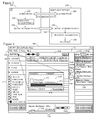
- FIG. 2 illustrates a preferred overview of the dataflow of the instant invention.
- Figure 3 contains a schematic illustration of the preferred functional allocation between personal computer and portable device.
- Figure 4 illustrates a preferred graphical user interface as it might appear on a user's personal computer.
- Figure 5 contains an illustration of a preferred graphical user interface of the instant invention as it might appear on a portable music player.
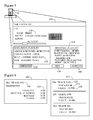
- Figure 6 describes possible variations of the content and layout of a media attribute record.
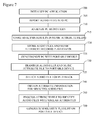
- Figure 7 illustrates a preferred general workflow of the instant invention.
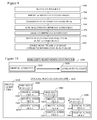
- Figure 8 depicts a preferred operating logic of the instant invention on a portable music device.
- Figure 9 illustrates a preferred workflow of the instant invention on a personal computer.
- Figure 10 displays an example of two preferred embodiments of the playlist generation process.
- the instant invention preferably utilizes a playlist generation method that improves on the standard playlist generation methods by utilizing the musical characteristics of the digital media files.
- the instant invention will preferably enable the user to generate this sort of playlist on a portable device that has limited processing power.
- the preferred embodiment of the instant invention is a combination of analysis and creation operations.
- the steps associated with these operations are preferably initiated automatically by the instant invention.
- the user will preferably be provided with a graphical user interface that contains information about the status of the playlist generation process and allows the user to configure individual settings thereof.
- the analysis operations will preferably be executed without a user interaction and preferably without user input.
- the analysis operations provide the data that is subsequently used in the playlist generation process.
- FIG. 1 At least a portion of the instant invention will be implemented in form of software running on a users computer 100.
- a computer will have some amount of program memory and nonvolatile storage (e.g., magnetic disk, flash RAM, etc.), whether internal or accessed via a network, as is conventionally utilized by such units.
- program memory e.g., magnetic disk, flash RAM, etc.
- nonvolatile storage e.g., magnetic disk, flash RAM, etc.
- an external camera 110 of some sort will be utilized with and will preferably be connectible to the computer so that video and/or graphic information can be transferred to and from the computer.
- the camera 110 will be a digital video camera, although that is not a requirement, as it is contemplated that the user might wish to utilize still images from a digital still camera in the creation of his or her multimedia work.
- the camera might be integrated into the computer or some other electronic device and, thus, might not be a traditional single-purposes video or still camera.
- the camera will preferably be digital in nature, any sort of camera might be used, provided that the proper interfacing hardware between it and the computer is utilized. Additionally, a microphone 130 might be utilized so that the user can add voice-over narration to the multimedia work and a CD or DVD reader / burner 120 could be useful for storing user data/content on optical disk.
- a portable music device 140 such as an MP3 player or at least a portable device capable of playing back digital music files will preferably be connected or connectible to the computer to allow the user to exchange digital music files between the computer and the portable device.
- the portable music device 140 will have an integrated loudspeaker through which digital music files may be performed for a listener.
- the player 140 will likely have at least an electronic connection which is designed to receive a connector for a pair of headphones (e.g., a headphone jack), or a wireless (e.g., Bluetooth or WiFi) connection to same, or a stereo or other connector that is suitable for electronic communication with an external amplifier and/or speaker, etc.
- FIG. 2 this figure illustrates a preferred dataflow of the instant invention.
- audio files preferably digital audio files 200
- the audio files will then preferably be processed by the instant invention on the personal computer and a music attribute file or files 220 will then be generated.
- These music attribute files will preferably be created via an analysis process that is performed on each individual digital audio file in the music database.
- the analysis process, and the storage and management of the digital audio files will preferably be administrated by a digital media management program that is installed on the user's personal computer or is accessible thereby.
- a portable device 230 preferably a portable device capable of playing digital audio material, is another essential part of the instant invention.
- a portable device will preferably be connected to the user's computer (either via wire or wirelessly) and a synchronization process will be activated.
- This synchronization process will preferably align the content stored in the portable device with that in the user's computer as is conventionally done.
- the digital media management program will scan the content of the connected portable device and initiate an automatic transfer of content to the portable device, if the portable device does not already contain that particular content.
- a person of ordinary skill in the art will know of such synchronization routines and the different algorithms that may be used to implement such synchronization.
- digital audio files will be transferred to the portable device. Additionally, in the preferred embodiment, the music attribute records 220 will be transferred as well. The structure and data field of the music attributes file is described below in connection with Figure 6 .
- the transferred audio files 200 and music attribute file 220 will then be stored on the portable device for use by the instant invention in creating a similarity playlist 240.
- Figure 3 indicates a preferred allocation of functionality of the instant invention between the personal computer and the portable device.
- a starting point of the instant invention is the audio files 200. These audio files, or digital music files, are preferably stored initially on a personal computer 210.
- an analysis program 300 (or programs) will operate on the digital audio files stored on the personal computer.
- the analysis algorithm will preferably be a part of the digital media management program and an analysis will be performed on each stored digital audio file.
- a music attribute record will preferably be created for each media item that contains the results of the analysis process, with all such records preferably being stored together in an attribute file or database 220.
- the results for each song will be assigned a unique ID that will be associated with the song from which those attributes were calculated and the ID and analysis results will be stored together to facilitate later retrieval of that information.
- Connecting a portable music device to the user's computer will preferably activate a synchronization process between the digital media management program on the user's computer and the portable device.
- This synchronization process preferably will transfer digital audio files and the music attribute records or files to the portable device.
- the synchronization process will at least transfer the audio files that are not already there to the portable device. Additionally, the music attribute files will also be transferred to the portable device for local storage.
- the similarity playlist algorithm 310 will preferably be activated either manually by the user or automatically, depending on the configuration options stored on the portable device. As is discussed in greater detail below, activating the instant invention on the portable device will result in the creation of a similarity playlist 240 whose contents are selected based on the musical characteristics of a selected file as compared with others in the database.
- a user will be presented with a graphical user interface 400 that contains screen components of the sort indicated in this figure.
- the graphical user interface will preferably be divided into five sections.
- section 410 contains the top-level program options. The options in this section will preferably allow a user to open new digital audio files separately, to edit the specifics of individual files, to access the digital library that is part of the digital media management program, to request help, etc.
- the next section 412 will preferably contain a listing of the metadata that relates to the currently selected digital audio file.
- the selectable subsections will include information about the artist, the album title, the year of the release of the digital media, the genre, etc.
- the parameters associated with the currently selected music item will be highlighted (e.g., "electronic" in Figure 4 )
- the next section 414 will preferably indicate the additional information about the currently selected digital media file and any other selected file (if any).
- the fourth section 416 contains controls that allow the user to run the similarity playlist generation algorithm on a personal computer.
- the user will preferably be presented with the similarity playlist after one has been generated.
- a similarity playlist 420 for the currently selected digital audio file has been generated.
- the user will have the option of saving the current list 424, generating another 422, loading 424 a previously stored playlist, or transferring 426 the playlist to a portable device.
- the user will preferably be able to generate the similarity playlist using music stored locally or using music accessed over the Internet by connecting to an online digital music database 430.
- the fifth section 418 will preferably contain on-screen elements that are used to control the replay of digital media files.
- This section preferably includes information about the currently playing digital audio file, the full play time of that song, and the current time point of the currently playing digital audio file 440.
- on-screen transport controls 450 are preferably styled to resemble their counterparts on a conventional VCR and provide a way for the user to use a computer to control playback of the multimedia work through the use of functions such as rewind, play, stop, fast forward etc. Those of ordinary skill in the art will recognize that such transport controls 450 are commonplace and well known in media editing programs.
- a dedicated import user control 460 When the user wishes to add new digital media to the music library of the instant invention, he or she will preferably activate a dedicated import user control 460. The user will then preferably be presented with a graphical display 470 that contains information concerning the current import process. The user will be presented with the title and artist of the digital audio file that is currently being imported 472 into the digital media library. Furthermore, the graphical display will preferably contain a progress bar that illustrates the progress of importing the current digital audio file and the progress of the overall importing process 474. The user will preferably be able to stop the import process at any time by initiating the "Cancel" user control 476. The import process will preferably assign each imported digital audio file an unique ID, which will be stored in the digital media library together with the digital audio file. Additionally, the analysis process that is used to obtain attribute data about each song will be performed on each music item, with the results being stored in the music attribute file/files.
- the music attributes file might be implemented as a single file that contains the analysis results for all of the different digital audio files keyed by their respective IDs.
- the music attribute file might also take the form of many files, each of which contains only the analysis results of a single music item.
- FIG. 5 this figure illustrates how the preferred portable device graphical user interface would appear.
- the portable device 140 is activated and running the operating software installed on the portable device.
- a user of this portable device will preferably be presented with a screen display 500 that contains a display of components of the sort indicated in this figure.
- the user will preferably be informed about the currently playing digital audio file 510, and might be presented with information regarding the title, the artist and the album to which the selected digital audio file belongs.
- a time line will preferably be used in conjunction with a position indicator to give the user a general indication of the location within the multimedia work of the digital audio file that is currently playing.
- the user will preferably be presented with a similarity playlist 520 that has been created based on the currently playing song. If the user desires another similarity playlist he or she can initiate the "refresh" user control 530 and the instant invention will generate another playlist. However, based on the user selection of the similarity playlist generation mode, it is possible that a new similarity playlist will be generated each time a new digital audio file is selected for reproduction. The specifics of the different similarity playlist generation modes will be described in greater detail below. In addition to the section representing the similarity playlist, the user will preferably also be able to generate a playlist 540 manually by adding 550 or removing 560 individual digital audio files from the selection.
- the media attributes file could be a collection of the analysis results 600 for each digital audio file stored in a single file.
- each analysis result of the musical characteristics 610 for a corresponding audio file will be stored in such a file.
- the media attributes file will contain the assigned ID 605 of that digital audio file to allow the storage and later easy access of the stored data.
- the second preferred approach 615 utilizes a single music attributes file that contains a number of attribute recordings, one record for each music file.
- the ID number 620 of each audio file, the track name 625 of the file, and a value representing the analysis results 630 will be stored in that record.
- the value that represents the analysis results is preferably a combination (e.g., sum or weighted sum) of the parameter values that have been determined to characterize the music.
- the instant invention could be implemented with either of the file structure described above, or some combination.
- Figure 7 illustrates a preferred general workflow of the instant invention.
- the digital media management program will be started and initialized, according to methods well known to those of ordinary skill in the art, on the computer.
- the user will preferably initiate the import of audio files into the digital media management program 705, if new files are to be added. This can be manually initiated by the user or activated automatically through a defined list of directories that the media management program is configured to monitor for updates.
- the media management program will execute an analysis 710 of the imported digital media files.
- the analysis might include the determination of a variety of different musical characteristics, such as tonality, spectral flatness, rhythm/tempo, key signature, center frequency, instantaneous frequency, loudness, etc.
- the instant invention will then preferably store some or all of the analysis results 715 in a music attributes file, with one record being devoted to each musical work, etc.
- the digital audio files and the music attributes will be stored within the data management program database 720.
- the computer will be synchronized with the portable device 725 according to methods well known to those of ordinary skill in the art.
- the instant invention will preferably transfer the audio files 730 that have been identified for transfer and the associated media attribute files or records to the portable device by extracting the records from the data management program database and creating the media attribute file.
- the next step will preferably take place within the portable device, where the user will select a digital audio file for playback 735.
- the instant invention will then preferably open the music attribute file and obtain the information that corresponds to the selected audio file (step 740).
- the instant invention will preferably process the attribute file 745 to identify IDs of audio files with similar attribute values.
- the playlist 750 will be displayed on the portable device.
- FIG. 8 this figure depicts a preferred workflow of the portion of the instant invention that resides within a portable device.
- the activity on the portable device preferably starts after the synchronization process 800 has completed.
- the instant invention will store 810 the transferred digital audio files and the music description file or files on the portable device.
- the user will preferably then select one audio file or a plurality of audio files for playback 820 .
- the instant invention will then preferably start to play the selected digital audio file(s) and will, additionally, and invisibly to the user, determine the ID of the currently selected track 830.
- the instant invention will then preferably open the music attributes file and find the record that corresponds to that ID (step 840 ). Additionally, the attribute values and/or similarity value will be read (step 845 ) for use in the steps that follow.
- the instant invention will compare each analysis record in the music attribute file with that of the selected audio file, the difference value being some mathematical or other combination of the individual differences between corresponding attribute values for the selected audio file and another file from the database. These difference values will then be compared with a pre-defined interval and, if a difference value is within this interval, the instant invention will preferably determine the ID of the associated digital audio file 850. Note that in some instances, a composite similarity value might be used for comparison, rather than the collection of individual attributes. In such a case, a similarity value might have been precomputed for each musical work and stored in the attribute database/file.
- the IDs that are most similar to the currently selected digital audio file will be used to form a playlist.
- Those of ordinary skill in the art will recognize that by adjusting, for example, the data range more (or fewer) items could be qualified for the playlist. The mechanism for changing this value might be made a part of the graphical user interface.
- the instant invention will then go through the identified IDs and will synchronize the content of that list with the content on the portable device to determine which of the similar files are also present on the portable device (step 860 ).
- the instant invention will determine the track names 870 reference to the IDs.
- the instant invention will preferably insert the tracks into the similarity playlist 880, the tracks being inserted representing the most similar tracks to the selected audio work. The most similar tracks will then be displayed to the user on the portable device 890.
- FIG. 9 this figure illustrates a preferred workflow of the instant invention on the users computer.
- the digital media management program will be initialized on the computer according to methods well known to those of ordinary skill in the art.
- the user will preferably initiate the import of audio files into the digital media management program 910 or arrange to access them. This might be done by allowing the user to select one or more files or directories, or automatically by scanning a predetermined list of directories.
- the instant invention will assign ID numbers 920 to each new digital audio file, so that every digital audio file that is stored in the database has an unique (preferably numerical) ID.
- the instant invention will perform an analysis of the imported digital audio files 930. That analysis will preferably be activated without input from the user.
- the analysis might include the determination of a variety of different musical characteristics, such as tonality, spectral flatness, rhythm/tempo, key signature, etc.
- the analysis results might be stored immediately without any further processing. However, it is preferred that these data values will be normalized and afterwards stored in a music attributes file 950 that is organized by ID.
- the music attributes file will preferably be a single database file that contains the IDs of all of the digital audio files together with their associated analysis results.
- the instant invention will store the audio files and the music attributes in the database of the data management program 960.
- FIG. 10 this figure illustrates the results of two different preferred embodiments of the playlist generation process.
- the user will have the option to utilize the similarity-based playlist generation process 1000, wherein the user selects a single digital audio file 1010 and the instant invention generates the similarity playlist 1020 based on the musical characteristics of that selected digital audio file.
- the user will be able to choose to utilize the dynamic similarity playlist generation process 1030.
- a dynamic similarity playlist will be generated each time the user selects a new digital audio file or when the generated similarity playlist moves to the next digital audio file in the similarity playlist.
- the generation process will preferably be the same as has been described previously in connection with the similarity-based methods.
- the user will next preferably select a digital audio file 1010 and the instant invention will generate similarity playlist 1 1040, which contains a plurality of digital audio files that, only for illustrative purposes, have been named digital audio file A through C 1050, 1060, and 1070.
- digital audio files that comprise the different similarity playlists may be different digital audio files because the dynamic similarity playlist generation process will potentially return a different playlist depending on the base work. Note that in this example, these will be some songs that are common to multiple playlists (e.g., file C 1070 and file A 1070 ) and others that only appear once (songs 1060 , 1065 , 1075 , and 1080 ).
- the user will listen to the first selected digital audio file (File A 1050 ).
- the dynamic playlist generation mode will automatically use that song as base work and generate another similarity playlist 1080 based on the musical characteristics of the currently selected digital audio file.
- the user will then have the option of accepting the new similarity playlist 1080 and listening to its contents, or he or she can choose to use the "old" similarity playlist 1040.
- the user will be able to choose to continue this dynamic generation process, by, for example, selecting similarity playlist 1080, listening to the first (or a subsequent) song in this list, and selecting a further playlist 1090 that is based on one of the songs in playlist 1080 (i.e., file D 1065 in this example).
- the user will be able to access an online database of digital music files and have a playlist generated from those files based on the user's selected song.
- Such an approach could further be enhanced by allowing the user to sample the content of the resulting similarity playlist and, additionally, to purchase content that he or she likes but does not own.
- databases should be broadly construed herein to include traditional hierarchical, relational, and flat databases as well as databases that consist of multiple files and/or that are resident on one or more computers.
- portable device should be broadly understood to include any sort of device that is portable, that can play music files (e.g., MP3 files, .WAV files, etc.), and that is capable in some sense of implementing a playlist or a similar feature that allows a user to listen to a subset of music items that are drawn from a larger database.
- music files e.g., MP3 files, .WAV files, etc.
- the ID that is assigned to each musical item in the database will be unique and numerical (e.g., a sequential count, a hashed value based on the song name, genre, etc.) those of ordinary skill in the art will recognize that there are many alternative ways to implement such an ID assignment process.
Landscapes
- Engineering & Computer Science (AREA)
- Theoretical Computer Science (AREA)
- Physics & Mathematics (AREA)
- Multimedia (AREA)
- Data Mining & Analysis (AREA)
- Databases & Information Systems (AREA)
- General Engineering & Computer Science (AREA)
- General Physics & Mathematics (AREA)
- Library & Information Science (AREA)
- Mathematical Physics (AREA)
- Management Or Editing Of Information On Record Carriers (AREA)
Applications Claiming Priority (1)
| Application Number | Priority Date | Filing Date | Title |
|---|---|---|---|
| US1218207P | 2007-12-07 | 2007-12-07 |
Publications (2)
| Publication Number | Publication Date |
|---|---|
| EP2068255A2 true EP2068255A2 (fr) | 2009-06-10 |
| EP2068255A3 EP2068255A3 (fr) | 2010-03-17 |
Family
ID=40470100
Family Applications (1)
| Application Number | Title | Priority Date | Filing Date |
|---|---|---|---|
| EP08105948A Ceased EP2068255A3 (fr) | 2007-12-07 | 2008-12-08 | Système et méthode pour génération éfficace des listes d'écoute à base de similarité sur des dispositifs portables |
Country Status (2)
| Country | Link |
|---|---|
| US (1) | US20090150445A1 (fr) |
| EP (1) | EP2068255A3 (fr) |
Cited By (3)
| Publication number | Priority date | Publication date | Assignee | Title |
|---|---|---|---|---|
| WO2012154470A1 (fr) * | 2011-05-09 | 2012-11-15 | Google Inc. | Génération d'une liste d'écoute |
| GB2490877A (en) * | 2011-05-11 | 2012-11-21 | British Broadcasting Corp | Processing audio data for producing metadata and determining aconfidence value based on a major or minor key |
| EP2939151B1 (fr) * | 2012-12-29 | 2020-08-19 | Nokia Technologies Oy | Procédé et appareil pour générer des informations audio |
Families Citing this family (21)
| Publication number | Priority date | Publication date | Assignee | Title |
|---|---|---|---|---|
| JP4655200B2 (ja) * | 2005-02-01 | 2011-03-23 | ソニー株式会社 | 情報処理装置および方法、並びにプログラム |
| US10296561B2 (en) | 2006-11-16 | 2019-05-21 | James Andrews | Apparatus, method and graphical user interface for providing a sound link for combining, publishing and accessing websites and audio files on the internet |
| US9361295B1 (en) | 2006-11-16 | 2016-06-07 | Christopher C. Andrews | Apparatus, method and graphical user interface for providing a sound link for combining, publishing and accessing websites and audio files on the internet |
| US8472874B2 (en) * | 2007-03-14 | 2013-06-25 | Apple Inc. | Method and system for pairing of wireless devices using physical presence |
| JP5135931B2 (ja) * | 2007-07-17 | 2013-02-06 | ヤマハ株式会社 | 楽曲加工装置およびプログラム |
| US8224899B2 (en) * | 2008-04-17 | 2012-07-17 | Eloy Technology, Llc | Method and system for aggregating media collections between participants of a sharing network |
| KR20090118752A (ko) * | 2008-05-14 | 2009-11-18 | 삼성전자주식회사 | 컨텐트 재생 목록 제공 방법 및 그 장치 |
| US8719867B2 (en) | 2009-11-20 | 2014-05-06 | At&T Intellectual Property I, Lp | Method and apparatus for presenting media content |
| CN201757904U (zh) * | 2010-05-04 | 2011-03-09 | 华为终端有限公司 | 一种读卡器的外接设备及读卡器 |
| US20120253492A1 (en) | 2011-04-04 | 2012-10-04 | Andrews Christopher C | Audio commenting system |
| US9576050B1 (en) * | 2011-12-07 | 2017-02-21 | Google Inc. | Generating a playlist based on input acoustic information |
| US20130173526A1 (en) * | 2011-12-29 | 2013-07-04 | United Video Properties, Inc. | Methods, systems, and means for automatically identifying content to be presented |
| US20130275353A1 (en) * | 2012-04-16 | 2013-10-17 | Apple Inc. | Systems and methods for selecting media items |
| US20130325853A1 (en) * | 2012-05-29 | 2013-12-05 | Jeffery David Frazier | Digital media players comprising a music-speech discrimination function |
| US9445267B2 (en) | 2012-08-31 | 2016-09-13 | Apple Inc. | Bump or close proximity triggered wireless technology |
| US10635676B2 (en) * | 2015-05-07 | 2020-04-28 | Google Llc | Algorithmic radio for arbitrary textual queries |
| US9743138B2 (en) | 2015-07-31 | 2017-08-22 | Mutr Llc | Method for sound recognition task trigger |
| US11195211B2 (en) | 2018-05-17 | 2021-12-07 | Spotify Ab | Systems, methods and computer program products for generating script elements and call to action components therefor |
| US11403663B2 (en) | 2018-05-17 | 2022-08-02 | Spotify Ab | Ad preference embedding model and lookalike generation engine |
| US11537428B2 (en) | 2018-05-17 | 2022-12-27 | Spotify Ab | Asynchronous execution of creative generator and trafficking workflows and components therefor |
| CN116662584A (zh) * | 2022-02-21 | 2023-08-29 | 脸萌有限公司 | 信息处理方法、装置、设备、存储介质及程序 |
Citations (1)
| Publication number | Priority date | Publication date | Assignee | Title |
|---|---|---|---|---|
| GB2427291A (en) | 2005-06-17 | 2006-12-20 | Queen Mary & Westfield College | A method of analysing audio, music or video data |
Family Cites Families (35)
| Publication number | Priority date | Publication date | Assignee | Title |
|---|---|---|---|---|
| US5918223A (en) * | 1996-07-22 | 1999-06-29 | Muscle Fish | Method and article of manufacture for content-based analysis, storage, retrieval, and segmentation of audio information |
| US6453281B1 (en) * | 1996-07-30 | 2002-09-17 | Vxi Corporation | Portable audio database device with icon-based graphical user-interface |
| US6953886B1 (en) * | 1998-06-17 | 2005-10-11 | Looney Productions, Llc | Media organizer and entertainment center |
| US5969283A (en) * | 1998-06-17 | 1999-10-19 | Looney Productions, Llc | Music organizer and entertainment center |
| US20010030667A1 (en) * | 2000-04-10 | 2001-10-18 | Kelts Brett R. | Interactive display interface for information objects |
| JP2001312497A (ja) * | 2000-04-28 | 2001-11-09 | Yamaha Corp | コンテンツ作成装置、コンテンツ配信システム、コンテンツ再生装置、及び方法並びに記憶媒体 |
| US6545209B1 (en) * | 2000-07-05 | 2003-04-08 | Microsoft Corporation | Music content characteristic identification and matching |
| US7532943B2 (en) * | 2001-08-21 | 2009-05-12 | Microsoft Corporation | System and methods for providing automatic classification of media entities according to sonic properties |
| US20020013784A1 (en) * | 2000-07-31 | 2002-01-31 | Swanson Raymond H. | Audio data transmission system and method of operation thereof |
| US7277766B1 (en) * | 2000-10-24 | 2007-10-02 | Moodlogic, Inc. | Method and system for analyzing digital audio files |
| EP1425745A2 (fr) * | 2001-08-27 | 2004-06-09 | Gracenote, Inc. | Production, remise et exploration de liste d'ecoute |
| US6987221B2 (en) * | 2002-05-30 | 2006-01-17 | Microsoft Corporation | Auto playlist generation with multiple seed songs |
| US20040029525A1 (en) * | 2002-08-05 | 2004-02-12 | Sun Microsystems, Inc. | Tuning engine and user interface for internet broadcasts on mobile devices |
| JP2004110422A (ja) * | 2002-09-18 | 2004-04-08 | Double Digit Inc | 曲分類装置、曲分類方法、及びプログラム |
| US7545758B2 (en) * | 2002-12-11 | 2009-06-09 | Siemens Communications, Inc. | System and method for collaboration summarization playback |
| US20060239648A1 (en) * | 2003-04-22 | 2006-10-26 | Kivin Varghese | System and method for marking and tagging wireless audio and video recordings |
| EP1642470B1 (fr) * | 2003-05-09 | 2019-07-17 | HERE Global B.V. | Publication de contenus au sein de reseaux mobiles |
| US7232948B2 (en) * | 2003-07-24 | 2007-06-19 | Hewlett-Packard Development Company, L.P. | System and method for automatic classification of music |
| US20060008256A1 (en) * | 2003-10-01 | 2006-01-12 | Khedouri Robert K | Audio visual player apparatus and system and method of content distribution using the same |
| EP1528536A1 (fr) * | 2003-10-09 | 2005-05-04 | Pioneer Corporation | Dispositif et méthode pour la sélection d'un morceau de musique |
| US7345232B2 (en) * | 2003-11-06 | 2008-03-18 | Nokia Corporation | Automatic personal playlist generation with implicit user feedback |
| JP4322691B2 (ja) * | 2004-01-22 | 2009-09-02 | パイオニア株式会社 | 選曲装置 |
| US20050245243A1 (en) * | 2004-04-28 | 2005-11-03 | Zuniga Michael A | System and method for wireless delivery of audio content over wireless high speed data networks |
| DE602005008041D1 (de) * | 2004-04-29 | 2008-08-21 | Koninkl Philips Electronics Nv | Verfahren und system zur klassifizierung eines audiosignals |
| JP4189758B2 (ja) * | 2004-06-30 | 2008-12-03 | ソニー株式会社 | コンテンツ記憶装置、コンテンツ記憶方法、コンテンツ記憶プログラム、コンテンツ転送装置、コンテンツ転送プログラム及びコンテンツ転送記憶システム |
| US20060248235A1 (en) * | 2005-03-21 | 2006-11-02 | Sony Corporation | Method and apparatus for data collection in a media player |
| US20060259464A1 (en) * | 2005-05-10 | 2006-11-16 | Szczublewski Francis E | Selection of audio categories and files in entertainment system |
| US7672916B2 (en) * | 2005-08-16 | 2010-03-02 | The Trustees Of Columbia University In The City Of New York | Methods, systems, and media for music classification |
| US7396990B2 (en) * | 2005-12-09 | 2008-07-08 | Microsoft Corporation | Automatic music mood detection |
| KR100717387B1 (ko) * | 2006-01-26 | 2007-05-11 | 삼성전자주식회사 | 유사곡 검색 방법 및 그 장치 |
| JP4665836B2 (ja) * | 2006-05-31 | 2011-04-06 | 日本ビクター株式会社 | 楽曲分類装置、楽曲分類方法、及び楽曲分類プログラム |
| TWI297486B (en) * | 2006-09-29 | 2008-06-01 | Univ Nat Chiao Tung | Intelligent classification of sound signals with applicaation and method |
| US20080250328A1 (en) * | 2007-04-03 | 2008-10-09 | Nokia Corporation | Systems, methods, devices, and computer program products for arranging a user's media files |
| US20080300702A1 (en) * | 2007-05-29 | 2008-12-04 | Universitat Pompeu Fabra | Music similarity systems and methods using descriptors |
| US7917083B2 (en) * | 2007-10-18 | 2011-03-29 | Mspot, Inc. | Method and apparatus for identifying a piece of content |
-
2008
- 2008-12-08 EP EP08105948A patent/EP2068255A3/fr not_active Ceased
- 2008-12-08 US US12/330,244 patent/US20090150445A1/en not_active Abandoned
Patent Citations (1)
| Publication number | Priority date | Publication date | Assignee | Title |
|---|---|---|---|---|
| GB2427291A (en) | 2005-06-17 | 2006-12-20 | Queen Mary & Westfield College | A method of analysing audio, music or video data |
Non-Patent Citations (1)
| Title |
|---|
| TZANETAKIS G. ET AL.: "Musical Genre Classifcation of Audio Signals", IEEE TRANS. ON SPEECH AND AUDIO PROCESSING, vol. 10, no. 5, July 2002 (2002-07-01), pages 293 - 302 |
Cited By (6)
| Publication number | Priority date | Publication date | Assignee | Title |
|---|---|---|---|---|
| WO2012154470A1 (fr) * | 2011-05-09 | 2012-11-15 | Google Inc. | Génération d'une liste d'écoute |
| US10055493B2 (en) | 2011-05-09 | 2018-08-21 | Google Llc | Generating a playlist |
| US11461388B2 (en) | 2011-05-09 | 2022-10-04 | Google Llc | Generating a playlist |
| GB2490877A (en) * | 2011-05-11 | 2012-11-21 | British Broadcasting Corp | Processing audio data for producing metadata and determining aconfidence value based on a major or minor key |
| GB2490877B (en) * | 2011-05-11 | 2018-07-18 | British Broadcasting Corp | Processing audio data for producing metadata |
| EP2939151B1 (fr) * | 2012-12-29 | 2020-08-19 | Nokia Technologies Oy | Procédé et appareil pour générer des informations audio |
Also Published As
| Publication number | Publication date |
|---|---|
| US20090150445A1 (en) | 2009-06-11 |
| EP2068255A3 (fr) | 2010-03-17 |
Similar Documents
| Publication | Publication Date | Title |
|---|---|---|
| EP2068255A2 (fr) | Système et méthode pour génération éfficace des listes d'écoute à base de similarité sur des dispositifs portables | |
| KR100718613B1 (ko) | 호스트 컴퓨터와 미디어 플레이어의 미디어 내용 동기화 방법 | |
| US6933432B2 (en) | Media player with “DJ” mode | |
| US20120023403A1 (en) | System and method for dynamic generation of individualized playlists according to user selection of musical features | |
| JP5232304B2 (ja) | 類似性データに基づいてプレイリストを生成するシステム及び方法 | |
| US9740774B2 (en) | System and method of organizing and editing metadata | |
| US7205471B2 (en) | Media organizer and entertainment center | |
| US8321042B2 (en) | Audio system | |
| EP2363777A1 (fr) | Synchronisation intelligente pour un diffuseur de médias | |
| US7930329B2 (en) | System, method and medium browsing media content using meta data | |
| CN101496094A (zh) | 浏览音乐的方法和系统 | |
| GB2405720A (en) | Method for playing a media item on a portable media player with automatic quality settings | |
| CN103327376A (zh) | 音乐视频服务器及其音乐视频个性化设置方法 | |
| US9886502B2 (en) | Providing similar content with similar playback rates | |
| US20060188215A1 (en) | Content transferring method, transferring apparatus, and transferring program | |
| JP2001209660A (ja) | コンテンツ検索・推奨システム | |
| US20060004893A1 (en) | Content storage device | |
| JP2008041043A (ja) | 情報処理装置 | |
| US20110125297A1 (en) | Method for setting up a list of audio files | |
| JP2009076158A (ja) | コンテンツ再生装置、ユーザインターフェース最適化方法およびユーザインターフェース最適化プログラム | |
| JP2009042265A (ja) | デジタルオーディオプレーヤ並びにカラオケ楽曲の選択方法 | |
| KR100829115B1 (ko) | 이동통신 단말기의 콘텐츠 재생 방법 및 장치 | |
| JP2004326907A (ja) | オーディオ再生装置 | |
| US20230376530A1 (en) | Content playback system | |
| AU2007202654B2 (en) | Intelligent synchronization for a media player |
Legal Events
| Date | Code | Title | Description |
|---|---|---|---|
| PUAI | Public reference made under article 153(3) epc to a published international application that has entered the european phase |
Free format text: ORIGINAL CODE: 0009012 |
|
| AK | Designated contracting states |
Kind code of ref document: A2 Designated state(s): AT BE BG CH CY CZ DE DK EE ES FI FR GB GR HR HU IE IS IT LI LT LU LV MC MT NL NO PL PT RO SE SI SK TR |
|
| AX | Request for extension of the european patent |
Extension state: AL BA MK RS |
|
| PUAL | Search report despatched |
Free format text: ORIGINAL CODE: 0009013 |
|
| AK | Designated contracting states |
Kind code of ref document: A3 Designated state(s): AT BE BG CH CY CZ DE DK EE ES FI FR GB GR HR HU IE IS IT LI LT LU LV MC MT NL NO PL PT RO SE SI SK TR |
|
| AX | Request for extension of the european patent |
Extension state: AL BA MK RS |
|
| 17P | Request for examination filed |
Effective date: 20100910 |
|
| AKX | Designation fees paid |
Designated state(s): AT BE BG CH CY CZ DE DK EE ES FI FR GB GR HR HU IE IS IT LI LT LU LV MC MT NL NO PL PT RO SE SI SK TR |
|
| RAP1 | Party data changed (applicant data changed or rights of an application transferred) |
Owner name: MAGIX GMBH & CO. KGAA |
|
| RAP1 | Party data changed (applicant data changed or rights of an application transferred) |
Owner name: BELLEVUE INVESTMENTS GMBH & CO. KGAA |
|
| 17Q | First examination report despatched |
Effective date: 20170412 |
|
| 18R | Application refused |
Effective date: 20180504 |
|
| RAP1 | Party data changed (applicant data changed or rights of an application transferred) |
Owner name: BELLEVUE INVESTMENTS GMBH & CO. KGAA |