EP2068661B1 - Verfahren zur unterdrückung von fischgerüchen in lebensmitteln durch proteine - Google Patents
Verfahren zur unterdrückung von fischgerüchen in lebensmitteln durch proteine Download PDFInfo
- Publication number
- EP2068661B1 EP2068661B1 EP07841267.3A EP07841267A EP2068661B1 EP 2068661 B1 EP2068661 B1 EP 2068661B1 EP 07841267 A EP07841267 A EP 07841267A EP 2068661 B1 EP2068661 B1 EP 2068661B1
- Authority
- EP
- European Patent Office
- Prior art keywords
- partially hydrolyzed
- whey protein
- hydrolyzed whey
- food product
- lipid
- Prior art date
- Legal status (The legal status is an assumption and is not a legal conclusion. Google has not performed a legal analysis and makes no representation as to the accuracy of the status listed.)
- Not-in-force
Links
Images
Classifications
-
- C—CHEMISTRY; METALLURGY
- C11—ANIMAL OR VEGETABLE OILS, FATS, FATTY SUBSTANCES OR WAXES; FATTY ACIDS THEREFROM; DETERGENTS; CANDLES
- C11B—PRODUCING, e.g. BY PRESSING RAW MATERIALS OR BY EXTRACTION FROM WASTE MATERIALS, REFINING OR PRESERVING FATS, FATTY SUBSTANCES, e.g. LANOLIN, FATTY OILS OR WAXES; ESSENTIAL OILS; PERFUMES
- C11B5/00—Preserving by using additives, e.g. anti-oxidants
- C11B5/0042—Preserving by using additives, e.g. anti-oxidants containing nitrogen
-
- A—HUMAN NECESSITIES
- A21—BAKING; EDIBLE DOUGHS
- A21D—TREATMENT OF FLOUR OR DOUGH FOR BAKING, e.g. BY ADDITION OF MATERIALS; BAKING; BAKERY PRODUCTS
- A21D2/00—Treatment of flour or dough by adding materials thereto before or during baking
- A21D2/08—Treatment of flour or dough by adding materials thereto before or during baking by adding organic substances
- A21D2/14—Organic oxygen compounds
- A21D2/16—Fatty acid esters
-
- A—HUMAN NECESSITIES
- A21—BAKING; EDIBLE DOUGHS
- A21D—TREATMENT OF FLOUR OR DOUGH FOR BAKING, e.g. BY ADDITION OF MATERIALS; BAKING; BAKERY PRODUCTS
- A21D2/00—Treatment of flour or dough by adding materials thereto before or during baking
- A21D2/08—Treatment of flour or dough by adding materials thereto before or during baking by adding organic substances
- A21D2/24—Organic nitrogen compounds
- A21D2/245—Amino acids, nucleic acids
-
- A—HUMAN NECESSITIES
- A21—BAKING; EDIBLE DOUGHS
- A21D—TREATMENT OF FLOUR OR DOUGH FOR BAKING, e.g. BY ADDITION OF MATERIALS; BAKING; BAKERY PRODUCTS
- A21D2/00—Treatment of flour or dough by adding materials thereto before or during baking
- A21D2/08—Treatment of flour or dough by adding materials thereto before or during baking by adding organic substances
- A21D2/24—Organic nitrogen compounds
- A21D2/26—Proteins
- A21D2/268—Hydrolysates from proteins
-
- A—HUMAN NECESSITIES
- A23—FOODS OR FOODSTUFFS; TREATMENT THEREOF, NOT COVERED BY OTHER CLASSES
- A23L—FOODS, FOODSTUFFS OR NON-ALCOHOLIC BEVERAGES, NOT OTHERWISE PROVIDED FOR; PREPARATION OR TREATMENT THEREOF
- A23L33/00—Modifying nutritive qualities of foods; Dietetic products; Preparation or treatment thereof
- A23L33/10—Modifying nutritive qualities of foods; Dietetic products; Preparation or treatment thereof using additives
- A23L33/115—Fatty acids or derivatives thereof; Fats or oils
- A23L33/12—Fatty acids or derivatives thereof
-
- A—HUMAN NECESSITIES
- A23—FOODS OR FOODSTUFFS; TREATMENT THEREOF, NOT COVERED BY OTHER CLASSES
- A23L—FOODS, FOODSTUFFS OR NON-ALCOHOLIC BEVERAGES, NOT OTHERWISE PROVIDED FOR; PREPARATION OR TREATMENT THEREOF
- A23L33/00—Modifying nutritive qualities of foods; Dietetic products; Preparation or treatment thereof
- A23L33/10—Modifying nutritive qualities of foods; Dietetic products; Preparation or treatment thereof using additives
- A23L33/17—Amino acids, peptides or proteins
- A23L33/175—Amino acids
-
- A—HUMAN NECESSITIES
- A23—FOODS OR FOODSTUFFS; TREATMENT THEREOF, NOT COVERED BY OTHER CLASSES
- A23L—FOODS, FOODSTUFFS OR NON-ALCOHOLIC BEVERAGES, NOT OTHERWISE PROVIDED FOR; PREPARATION OR TREATMENT THEREOF
- A23L33/00—Modifying nutritive qualities of foods; Dietetic products; Preparation or treatment thereof
- A23L33/10—Modifying nutritive qualities of foods; Dietetic products; Preparation or treatment thereof using additives
- A23L33/17—Amino acids, peptides or proteins
- A23L33/18—Peptides; Protein hydrolysates
-
- A—HUMAN NECESSITIES
- A23—FOODS OR FOODSTUFFS; TREATMENT THEREOF, NOT COVERED BY OTHER CLASSES
- A23L—FOODS, FOODSTUFFS OR NON-ALCOHOLIC BEVERAGES, NOT OTHERWISE PROVIDED FOR; PREPARATION OR TREATMENT THEREOF
- A23L5/00—Preparation or treatment of foods or foodstuffs, in general; Food or foodstuffs obtained thereby; Materials therefor
- A23L5/20—Removal of unwanted matter, e.g. deodorisation or detoxification
Definitions
- This invention relates generally to incorporation of oxidatively unstable fatty acids and oils into foods; and, more particularly, to a method to suppress the off aromas and tastes produced by oxidatively unstable oils and fatty acids, such as omega-3 polyunsaturated fatty acids, in foods.
- Long chain polyunsaturated fatty acids have been shown to be beneficial to human health.
- long chain polyunsaturated omega-3 fatty acids have been shown to be beneficial.
- the three long chain polyunsaturated fatty acids of primary interest are linolenic acid (18:3w-3), eicosapentaenoic acid (EPA) (20:5w-3), and docosahexaenoic acid (DHA) (22:6w-3).
- the health benefits associated with enhanced consumption of these omega-3 fatty acids include a lowering of serum cholesterol, reduction of blood pressure, reduction of the risk of heart disease, and a reduction of the risk of stroke.
- omega-3 fatty acids are also essential to normal neuronal development and their depletion has been associated with neurodegenerative diseases such as Alzheimer's disease.
- the ratio of DHA:EPA is 5:1 and their presence is essential for normal eye development.
- the fatty acid DHA is also believed to be essential for optimal cognitive development in infants.
- Food fortified with DHA is often called "brain food" in Asian countries.
- Preliminary studies suggest that long chain polyunsaturated omega-3 fatty acids may play a role in mediating chronic inflammatory assaults and use of them by individuals with mild asthma is documented to reduce the severity of the histamine response in asthmatics.
- omega-3 fatty acids there are several main sources of these beneficial long chain polyunsaturated omega-3 fatty acids.
- Certain plants provide an abundant source of linolenic fatty acid.
- Marine animals, such as fish and crustaceans, and marine plants, such as micro algae are the main sources of DHA and EPA.
- fatty fish such as mackerel and salmon contain high levels of DHA and EPA.
- Marine micro algae contain predominantly DHA.
- Marine micro algae have an advantage as a source of DHA in that large volumes can be rapidly produced using modem methods and there is no need for the extensive acreage associated with fish farms or the difficulty of fishing.
- the omega-3 fatty acids are generally found in the form of triglycerides, i.e.
- omega-3 fatty acid refers to both the free fatty acid form and the triglyceride form unless specifically noted otherwise. In this specification and the associated claims no distinction will be made between various sources of omega-3 fatty acids unless specifically noted.
- omega-3 fatty acids especially EPA and DHA
- EPA and DHA require relatively large amounts of the omega-3 fatty acids making it impractical to obtain the recommended daily amount by consuming fish.
- both EPA and DHA have been packaged together in caplet form. Consumers do not enjoy consuming the caplets because they are large and hard to swallow and the caplets can quickly develop an unpleasant fishy aroma and taste.
- Prior attempts to add DHA and/or EPA directly to food products have been unsuccessful because the unstable omega-3 fatty acids rapidly give rise to a fishy taste and aroma in the food product and make it unpalatable. It is believed that DHA and EPA are particularly unstable in the presence of water and high heat, this further complicates their use in food products.
- omega-3 fatty acids can not be stabilized in foods merely by adding the typical antioxidants to the foods.
- other oils and fatty acids are also oxidatively unstable in foods and can give rise to off odors and tastes.
- Example of these unstable oils and fatty acids include: soybean oil, flaxseed oil, marine oil, marine micro algae, linoleic acid, linolenic acid, docosahexaenoic acid, and eicosapentaenoic acid.
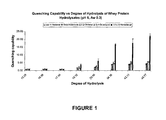
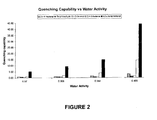
- this invention provides a method of quenching aldehyde products of lipid autoxidation comprising the steps of: providing a partially hydrolyzed whey protein having a degree of hydrolysis of 26% or greater and a water activity of 0.308 or greater; exposing a food product containing lipids prone to autoxidation comprising at least one of docosahexaenoic acid or eicosapentaenoic acid to the partially hydrolyzed whey protein such that the aldehyde products released by the autoxidation are quenched by the partially hydrolyzed whey protein and the shelf life of the food product is extended to at least 12 weeks under storage conditions of 29.4°C (85°F) and 50% relative humidity.
- the invention further provides the method of claim 6 and food product of claim 12.
- EPA and DHA As discussed marine animals and marine plants are the main sources of EPA and DHA.
- fish oils or marine oils as a source of EPA and DHA are well known.
- EPA and DHA are well known.
- a number of manufacturers have developed highly efficient processes for growing marine micro algae. These micro algae are a source for EPA and DHA at high yields and in a sustainable fashion.
- One source of micro algae derived EPA and DHA is Martek Biosciences Corporation, Columbia, MD, USA.
- a second source is Nutrinova Nutrition Specialties and Food Ingredients, DE.
- the EPA and DHA extracted from these sources are in the form of triglycerides.
- the omega-3 fatty acids can be provided as a free flowing powder or they can be supplied in the form of oils for the present invention.
- omega-3 fatty acids are encapsulated, a free flowing powder, or an oil mixture.
- One omega-3 fatty acid containing oil preparation is designated as HM by Martek Biosciences Corp. which has approximately 30 to 35% DHA.
- Martek also supplies a powder containing omega-3 fatty acids designated as Martek DHA(TM) powder KS35.
- Martek source can be used as can the sources of other and unless specifically noted no distinction is made between the two forms.
- aldehydes have been identified as potentially being the fishy odor and taste causative agents in marine oils. These include cis-4-heptenal; 2,4-octadienal; and trans-2, cis-6-nonadienal. Other aldehydes that have been shown to arise during autoxidation of other long chain polyunsaturated fatty acids include cis-4-heptenal and octanal.
- the present invention is directed toward a method for trapping the autoxidation products and thereby removing the rancid fishy aroma and taste in food products. This approach is different from those that have been used by others in the past. It was hypothesized that addition of proteins, protein fragments, partially hydrolyzed proteins, or amino acids in some manner to food products might be able to trap these aldehydes released from the food products and avoid the development of rancid or fishy aromas and tastes in foods having omega-3 fatty acids or other oxidatively unstable fatty acids and oils incorporated into them.
- a series of cereals with different levels of protein were tested for their ability to quench or remove a series of aldehydes, three of which have been positively identified as generated by DHA and EPA autoxidation, spiked into the cereal at a known amount.
- the five test aldehydes chosen were: cis-4-heptenal, octanal, trans-2-octenal, 2,4-octadienal, and trans-2-cis-6-nonadienal.
- the cereals chosen were Special K® vanilla, Special K® Protein Plus, Smart Start® Antioxidant, Smart Start® Healthy Heart, and Corn Flakes®.
- the cereal products were ground using a coffee mill and one gram of each ground cereal product was weighed into a 20 milliliter headspace vial.
- the five test aldehydes and an internal standard ethyl heptanoate were each dissolved in heptane.
- each vial containing ground cereal was spiked with either 5 or 30 micrograms of each test aldehyde and the internal control.
- Each vial was capped and stored at room temperature for three days.
- the remaining headspace aldehydes were analyzed by headspace Gas Chromotography-Flame Ionization Detection (GC-FID). The results are shown in Table 1 below.
- the AQC is calculated using the formula below wherein: A IS is the peak area of the internal standard; W IS is the weight of the spiked internal standard in micrograms; A A is the peak area of the spiked aldehyde compound; and W A is the weight of the spiked aldehyde compound in micrograms.
- corn starch which does not quench any of the test aldehydes, was used as a control internal standard and its AQI was set to 1. The larger the AQI the greater the quenching effect.
- WPI whey protein isolate
- AQC A IS * W A A A * W IS TABLE 2 Aldehyde Quenching Index (AQI at 1 hour) Corn Starch Gluten Dextrose Dextrin WPI Soy Protein Maltodextrin c4-Heptenal 1 2 2 1 5 7 1 1 Octanal 1 1 1 1 1 3 5 1 t2-Octenal 1 4 1 1 18 28 1 2,4-Octadienal 1 5 1 1 22 20 1 t2,c6-Nonadienal 1 5 1 1 22 50 1 10 microgram of each aldehydic compound was added to 1 gram of food ingredient Samples were kept at room temperature for 1 hour before analysis
- the amino acids L-Lysine, L-cysteine, ⁇ -alanine, L-Arginine, L-cysteine ethyl ester HCl, and ⁇ -amino butyric acid are the most effect in quenching the test aldehydic compounds.
- the AQIs of these amino acids are substantially higher than protein and partially hydrolyzed proteins.
- these most effect amino acids there is a common functional structure, i.e. the amino group is not in the ⁇ position of the amino acid.
- the most effective amino acids in quenching the test aldehydic compounds are those with the amino group in the ⁇ or farther position of the carbon chain from the carboxylic acid group of the same molecule or they have a sulfhydryl group like cysteine.
- the quenching effects were also tested by sniffing the products at the end of the incubations. Those with significant quenching were less odiferous and in some there was not detectable odor. The results demonstrate that the quenching can be accomplished in prepared foods by adding protein, partially hydrolyzed protein, or amino acids to the foods.
- the present invention can be used to quench the rancid or fishy odors and tastes found in foods containing long chain polyunsaturated fatty acids such as linoleic acid, linolenic acid, docosahexaenoic acid, eicosapentaenoic acid, and the oils discussed above.
- the quenching can occur in the interspatial headspace in the food and in the headspace of the food packages.
- the quenching effect can be demonstrated in low, intermediate and high moisture food products.
- the quenching effect occurs at ambient temperature. It is hypothesized that the reaction between the aldehyde and the amino acids, be they in a peptide or not, may occur via a Michael-type addition or through a Schiff base reaction.
- the amino acid source can be a partially hydrolyzed whey protein.
- the amino acid source can be used to encapsulate the oxidatively unstable oils and fatty acids.
- typical unstable oils/fatty acids include soybean oil, flaxseed oil, marine oil, marine micro algae oil, linoleic acid, linolenic acid, docosahexaenoic acid, and eicosapentaenoic acid.
- the encapsulation could be accomplished by simple blending of the oil or DHA source with the amino acid source in water followed by drying in a spray dryer or fluidized bed dryer. Alternatively, the amino acid source and the DHA source can simply be blended together.
- the source of amino acids comprises partially hydrolyzed whey proteins.
- the level of amino acid source can be varied depending on what is necessary to maintain the quenching for the desired period of storage time.
- the encapsulated oil can then be added to food products with the expectation that the food will remain stable, i.e. no rancid or fishy aromas or tastes, with respect to the oxidatively unstable fatty acids over a significant storage period.
- the amino acid source could be provided in a sachet and the sachet could be placed, for example, into a package of the food such as a box of ready to eat cereal.
- the amino acid source could be incorporated onto or into a bag liner or packaging material. It is believed that all of these methods will work to extend the shelf life of food products that contain oxidatively unstable oils or fatty acids.
- the teachings from the above experiments were applied to a first food example by using the insights to test the ability of a series of protein combinations that included varying amounts of partially hydrolyzed and non-hydrolyzed protein from a variety of sources to prevent development of fishy aroma in cold formed cereal bars that included the omega-3 fatty acid DHA. Both oil and powdered sources of DHA were tested in the protocol.
- the formula for the chocolate flavored cold formed cereal bar is given in Table 7 below.
- the protein sources were as follows: Barflex is a partially hydrolyzed whey protein, Provon 190 is a non-hydrolyzed whey protein, Solae 313 is a partially hydrolyzed soy protein, Solae 661 is a non-hydrolyzed soy protein.
- the source of DHA was either Martek's powder KS35 or the oil HM.
- a series of twenty conditions were created as noted in Table 8 below. All of the bars included 100 milligrams of DHA per serving, this required from 1 to 4% by weight of the DHA source and adjustments in the amount of the other components were made to accommodate this. After formation the cold formed bars were packaged and stored at 29.4°C (85°F) 50% relative humidity. Samples of each condition were evaluated for development of fishy aroma or taste by trained organoleptic specialists at time 0 and on a weekly basis thereafter over a 12 week period. Each sample was given a ranking of from 1 to 5, with 5 being the highest level of fishy aroma or taste. The bars were formed as follows the oil blend and the dry blend were combined.
- the mixture was then bound together using the binder syrup and cold formed into a mass that was cut into bars. All steps were performed at temperatures of 46.1°C (115° F) or less.
- the cold forming can be accomplished as known in the art by extrusion, compression rolling or other methods of cold forming. Cold forming refers to a process wherein external heat is not added to the forming system.
- the cold formed bars were then enrobed in a compound coating and packaged. The results of the analysis are given in Table 9 below. Each result is the average of at least 4 evaluations at each time point.
- the samples with Barflex and Provon 190 are numbers 1, 5, 8, 15, and 16.
- the samples with Barflex and Solae 661 are numbers 3, 7, 12, 17, and 19.
- many of the partially hydrolyzed soy protein samples achieved rankings of 3 to 5 that occurred early on and were maintained.
- the samples with Solae 313 and Provon 190 are numbers 6, 11, 13, 14, and 18.
- the samples with Solae 313 and Solae 661 are numbers 2, 4, 9, 10, and 20.
- the DHA source HM was combined with partially hydrolyzed whey protein at a weight ratio of 25% HM with 75% partially hydrolyzed whey protein.
- the partially hydrolyzed whey protein was in a water solution at a ratio of 1 part partially hydrolyzed whey protein to 20 parts water.
- the HM and partially hydrolyzed whey protein solution were homogenized together and then spray dried to form a powder. This powder was then incorporated into a variety of food types.
- the spray dried DHA and protein powder described above was used in a formulation for preparing a baked fruit filled bar product.
- the basic processing steps were as follows: formation of the dough; formation of the fruit-based filling material; co-extrusion of the filling material and the dough layer at a low temperature of less than about 54.4°C (130° F) with cutting to length, the dough surrounding the fruit based filling; and baking the bars at approximately 198.9°C (390° F) for 8 minutes; cooling the bars and packaging them.
- the bars were baked to have a final water activity of 0.7 or less.
- the fruit based filling is a typical fruit based filling as is know in the industry.
- the filling typically comprises: high fructose corn syrup, corn syrup, fruit puree concentrate, glycerin, sugar, modified corn starch, sodium citrate, citric acid, sodium alginate, natural and artificial flavors, dicalcium phosphate, modified cellulose, colorings, and malic acid. Any known filling material can be used in the invention.
- the stability of the omega-3 fatty acids is not altered by the filling composition in this invention.
- the finished bar comprises from 55 to 65% by weight dough with the remainder being filling.
- the fruit filled bar products included sufficient DHA source to produce 40 milligrams of DHA per serving.
- the formulas for the bars with and without the DHA protein powder are given in table 10 below.
- the control, sample 1 was addition of DHA to the dough without the amino acid source.
- Sample 2 included DHA and the partially hydrolyzed whey protein powder described above.
- the products were stored at under several conditions.
- the bars were stored at 29.4°C (85° F) 50% relative humidity and tested weekly for development of fishy aroma or taste.
- the control bars with DHA in the absence of protein began to fail at 6 weeks and all failed by 9 weeks. They all developed fishy aromas and tastes.
- none of the samples made with the DHA protein powder developed a fishy aroma or taste under this condition for over 12 weeks.
- the samples were stored at 21.1°C (70° F) 50% relative humidity and tested periodically for development of fishy aroma or taste. The control samples failed within 9 weeks while the samples made with DHA and protein were stable for at least 6 months.
- the discoveries of the present invention have wide application to a variety of food products.
- the results demonstrate that combining an amino acid source with sources of DHA or EPA stabilizes the DHA and EPA and prevents the development of fishy aromas and tastes over extended storage times.
- the amino acid source preferably comprises at least one partially hydrolyzed whey protein.
- the stabilization can be achieved either by initially combining the amino acid source with the DHA or EPA source or by including an amino acid source in a food product containing a DHA or EPA source.
- This invention is applicable to a wide range of food products including ready to eat cereals, potato chips, nacho chips, corn chips, crackers, cookies, toaster pastries, fruit filled bars, granola bar, cereal bars, baked cheese curls, fried cheese curls and other food products.
- the amino acid source is initially combined with the source of DHA or EPA that the weight ratio be 1 part DHA and/or EPA to 0.1 to 50 parts amino acid source, preferably partially hydrolyzed whey protein or other partially hydrolyzed proteins.
- a 100 gram serving includes from 10 to 2000 milligrams of DHA and/or EPA and 100 milligrams to 40 grams of an amino acid source.
- the amino acid source comprises partially hydrolyzed whey protein. It is believed that similar ratios of protein to autoxidation prone lipid are applicable to lipids other than DHA and EPA.
Landscapes
- Life Sciences & Earth Sciences (AREA)
- Chemical & Material Sciences (AREA)
- Engineering & Computer Science (AREA)
- Food Science & Technology (AREA)
- Health & Medical Sciences (AREA)
- Polymers & Plastics (AREA)
- Nutrition Science (AREA)
- Mycology (AREA)
- Proteomics, Peptides & Aminoacids (AREA)
- Molecular Biology (AREA)
- Oil, Petroleum & Natural Gas (AREA)
- Biochemistry (AREA)
- Chemical Kinetics & Catalysis (AREA)
- Wood Science & Technology (AREA)
- Organic Chemistry (AREA)
- Coloring Foods And Improving Nutritive Qualities (AREA)
- Dairy Products (AREA)
Claims (14)
- Verfahren zum Auslöschen von Aldehydprodukten der Lipidautoxidation, umfassend die Schritte:Bereitstellen eines teilweise hydrolysierten Molkenproteins mit einem Hydrolysegrad von 26% oder mehr und einer Wasseraktivität von 0,308 oder mehr;Aussetzen eines Nahrungsmittelprodukts, enthaltend für Autoxidation anfällige Lipide, umfassend mindestens eine von Docosahexaensäure oder Eicosapentaensäure, dem teilweise hydrolysierten Molkenprotein, derart, dass die Aldehydprodukte, freigesetzt durch die Autoxidation, durch das teilweise hydrolysierte Molkenprotein ausgelöscht werden und die Lagerbeständigkeit des Nahrungsmittelprodukts unter den Lagerungsbedingungen von 29,4°C (85°F) und 50% relativer Feuchtigkeit auf mindestens 12 Wochen ausgedehnt wird.
- Verfahren gemäß Anspruch 1, wobei der Schritt, das Nahrungsmittelprodukt dem teilweise hydrolysierten Molkenprotein auszusetzen, umfasst, das Nahrungsmittelprodukt in ein Verpackungsmaterial zu verpacken, worauf das teilweise hydrolysierte Molkenprotein aufgebracht worden ist oder worin es eingebracht worden ist.
- Verfahren gemäß Anspruch 1, wobei der Schritt, das Nahrungsmittelprodukt dem teilweise hydrolysierten Molkenprotein auszusetzen, umfasst, das Nahrungsmittelprodukt in ein Verpackungsmaterial zu verpacken und ein Kissen, enthaltend das teilweise hydrolysierte Molkenprotein, in das Verpackungsmaterial einzuschließen.
- Verfahren gemäß Anspruch 1, wobei der Schritt, das Nahrungsmittelprodukt dem teilweise hydrolysierte Molkenprotein auszusetzen, umfasst, das teilweise hydrolysierte Molkenprotein direkt zu dem Nahrungsmittelprodukt hinzuzufügen.
- Verfahren gemäß Anspruch 1, wobei das Verhältnis von teilweise hydrolysiertem Molkenprotein zu für Autoxidation anfälligem Lipid 1 Teil Lipid zu von 0,1 bis 50 Teile teilweise hydrolysiertem Molkenprotein ist.
- Verfahren zum Auslöschen der Aldehydprodukte aus der Autoxidation von für Autoxidation anfälligen Lipiden, umfassend die Schritte:Bereitstellen eines teilweise hydrolysierten Molkenproteins mit einem Hydrolysegrad von 26% oder mehr und einer Wasseraktivität von 0,308 oder mehr;Aussetzen eines für Autoxidation anfälligen Lipids, umfassend mindestens eine von Docosahexaensäure oder Eicosapentaensäure, dem teilweise hydrolysierten Molkenprotein, derart, dass die Aldehydprodukte, freigesetzt durch die Autoxidation, durch das teilweise hydrolysierte Molkenprotein ausgelöscht werden und die Lagerbeständigkeit des Lipids unter den Lagerungsbedingungen von 29,4°C (85°F) und 50% relativer Feuchtigkeit auf mindestens 12 Wochen ausgedehnt wird.
- Verfahren gemäß Anspruch 6, wobei der Schritt, das Lipid dem teilweise hydrolysierten Molkenprotein auszusetzen, umfasst, das Lipid in ein Verpackungsmaterial zu verpacken, worauf das teilweise hydrolysierte Molkenprotein aufgebracht worden ist oder worin es eingebracht worden ist.
- Verfahren gemäß Anspruch 6, wobei der Schritt, das Lipid dem teilweise hydrolysierten Molkenprotein auszusetzen, umfasst, das Lipid in ein Verpackungsmaterial zu verpacken und ein Kissen, enthaltend das teilweise hydrolysierte Molkenprotein, in das Verpackungsmaterial einzuschließen.
- Verfahren gemäß Anspruch 6, wobei das Gewichtsverhältnis von für Autoxidation anfälligem Lipid zu teilweise hydrolysiertem Molkenprotein 1 Teil Lipid zu von 0,1 bis 50 Teile teilweise hydrolysiertem Molkenprotein ist.
- Verfahren gemäß Anspruch 6, wobei der Schritt, das Lipid dem teilweise hydrolysierten Molkenprotein auszusetzen, umfasst, das teilweise hydrolysierte Molkenprotein mit dem Lipid zu vereinigen.
- Verfahren gemäß Anspruch 6, wobei das teilweise hydrolysierte Molkenprotein und das Lipid vereinigt und getrocknet werden, um ein pulverförmiges Material zu bilden.
- Nahrungsmittelprodukt, umfassend stabilisierte omega-3-Fettsäuren, umfassend:ein teilweise hydrolysiertes Molkenprotein mit einem Hydrolysegrad von 26% oder mehr und einer Wasseraktivität von 0,308 oder mehr;mindestens eine von einer omega-3-Fettsäure, umfassend Docosahexaensäure, Eicosapentaensäure oder ein Gemisch davon; undwobei das Nahrungsmittelprodukt unter den Lagerungsbedingungen von 29,4°C (85°F) und 50% relativer Feuchtigkeit für mindestens 12 Wochen lagerungsstabil ist.
- Nahrungsmittelprodukt wie in Anspruch 12 genannt, wobei das Nahrungsmittelprodukt von 0,1 bis 40 Gramm von dem teilweise hydrolysierten Molkenprotein und von 10 bis 2000 Milligramm von der mindestens einen omega-3-Fettsäure in 100 Gramm von dem Nahrungsmittelprodukt umfasst.
- Nahrungsmittelprodukt wie in Anspruch 12 genannt, wobei das Nahrungsmittelprodukt mindestens eines von einer essfertigen Getreideflocke, einem Chip, einem Cracker, einem Plätzchen, einem Müsliriegel, einem Getreideriegel, einer essfertigen Haferflocke, einer Backware, einem Toastergebäck, einer gebackenen Käselocke oder einer frittierten Käselocke umfasst.
Applications Claiming Priority (2)
| Application Number | Priority Date | Filing Date | Title |
|---|---|---|---|
| US82332206P | 2006-08-23 | 2006-08-23 | |
| PCT/US2007/076626 WO2008024904A1 (en) | 2006-08-23 | 2007-08-23 | Method for suppression of fishy aromas in food products by proteins |
Publications (2)
| Publication Number | Publication Date |
|---|---|
| EP2068661A1 EP2068661A1 (de) | 2009-06-17 |
| EP2068661B1 true EP2068661B1 (de) | 2013-05-22 |
Family
ID=38895964
Family Applications (1)
| Application Number | Title | Priority Date | Filing Date |
|---|---|---|---|
| EP07841267.3A Not-in-force EP2068661B1 (de) | 2006-08-23 | 2007-08-23 | Verfahren zur unterdrückung von fischgerüchen in lebensmitteln durch proteine |
Country Status (7)
| Country | Link |
|---|---|
| US (1) | US20080050486A1 (de) |
| EP (1) | EP2068661B1 (de) |
| AU (1) | AU2007286641B2 (de) |
| CA (1) | CA2660777C (de) |
| ES (1) | ES2425991T3 (de) |
| MX (1) | MX2009001968A (de) |
| WO (1) | WO2008024904A1 (de) |
Families Citing this family (4)
| Publication number | Priority date | Publication date | Assignee | Title |
|---|---|---|---|---|
| JP6041667B2 (ja) * | 2012-12-28 | 2016-12-14 | 太陽化学株式会社 | 油脂の劣化風味マスキング剤及びフライ食品 |
| CN108697120A (zh) * | 2016-02-26 | 2018-10-23 | 帝斯曼知识产权资产管理有限公司 | 新颖的包衣体系(ii) |
| CN109756146B (zh) * | 2019-01-04 | 2020-03-17 | 西安交通大学 | 含有微纳织构化蚕丝蛋白摩擦层的纳米发电机及制备方法 |
| CN111955538B (zh) * | 2020-08-10 | 2022-09-30 | 浙江工商大学 | 一种大黄鱼保鲜剂及其使用方法 |
Family Cites Families (21)
| Publication number | Priority date | Publication date | Assignee | Title |
|---|---|---|---|---|
| US3431112A (en) * | 1965-02-15 | 1969-03-04 | Pillsbury Co | Food bar and method for making |
| US4915876A (en) * | 1987-07-20 | 1990-04-10 | General Mills, Inc. | Process for the deodorization and stabilization of polyunsaturated oils |
| US5221668A (en) * | 1992-02-26 | 1993-06-22 | Abbott Laboratories | Nutritional product for trauma and surgery patients |
| US5723446A (en) * | 1993-12-23 | 1998-03-03 | Nestec Ltd. | Enteral formulation designed for optimized nutrient absorption and wound healing |
| US5676986A (en) * | 1994-12-22 | 1997-10-14 | University Of Alaska | Food products made from protease enzyme containing fish, methods of making same, and methods to inactivate protease enzyme in fish |
| CN1215381A (zh) * | 1995-12-15 | 1999-04-28 | 格雷斯公司 | 载金属离子交换除氧组合物 |
| JP3552856B2 (ja) * | 1996-09-27 | 2004-08-11 | 雪印乳業株式会社 | 栄養強化組成物 |
| FR2770224A1 (fr) * | 1997-10-03 | 1999-04-30 | Akio Usui | Desoxydant liquide visqueux, feuille desoxydante constituee de celui-ci et procede de fabrication de la feuille desoxydante |
| US7431986B2 (en) * | 2002-07-24 | 2008-10-07 | General Mills, Inc. | Encapsulation of sensitive components using pre-emulsification |
| KR20020074443A (ko) * | 2002-09-05 | 2002-09-30 | 주식회사 세퓨화인켐 | 염기성 아미노산을 이용한 수용성 지질의 제조방법 |
| US7399496B2 (en) * | 2003-02-07 | 2008-07-15 | Glanbia Nutritionals (Ireland) Limited | Hydrolyzed whey protein compositions |
| CN1969032B (zh) * | 2003-02-13 | 2010-12-29 | 株式会社林原生物化学研究所 | 抑制挥发性醛类的产生和/或脂肪酸类的分解的方法及其用途 |
| DE20309608U1 (de) * | 2003-06-20 | 2003-09-11 | Weber & Weber GmbH & Co. KG, 82266 Inning | Zusammensetzung von Mikronährstoffen für einen Riegel und andere Food-Formen |
| US20060280776A1 (en) * | 2003-09-02 | 2006-12-14 | Masafumi Koide | Diet food |
| US20050175762A1 (en) * | 2003-10-23 | 2005-08-11 | Richards Mark P. | Methods and compositions to inhibit lipid oxidation |
| CN1560024A (zh) * | 2004-03-02 | 2005-01-05 | 国家海洋局第一海洋研究所 | 功能脂肪酸-氨基酸复合物及其制备方法 |
| JP4534579B2 (ja) * | 2004-04-28 | 2010-09-01 | 味の素株式会社 | リジン含有抗肥満または抗高脂血症用食品、飼料またはサプリメント |
| ATE446686T1 (de) * | 2004-06-22 | 2009-11-15 | Nutricia Nv | Verbesserung der barriereintegrität bei hiv- patienten mit hilfe von fettsäuren |
| US20060083824A1 (en) * | 2004-10-20 | 2006-04-20 | Pbm Products Llc | Nutritional supplements for glucose intolerant individuals |
| US20060115554A1 (en) * | 2004-12-01 | 2006-06-01 | Slim-Fast Foods Company, Division Of Conopco, Inc. | Nutrition bar |
| US9179702B2 (en) * | 2005-07-13 | 2015-11-10 | Abbott Laboratories | Liquid nutritional compositions containing unsaturated fatty acids |
-
2007
- 2007-08-23 CA CA2660777A patent/CA2660777C/en not_active Expired - Fee Related
- 2007-08-23 EP EP07841267.3A patent/EP2068661B1/de not_active Not-in-force
- 2007-08-23 MX MX2009001968A patent/MX2009001968A/es active IP Right Grant
- 2007-08-23 ES ES07841267T patent/ES2425991T3/es active Active
- 2007-08-23 WO PCT/US2007/076626 patent/WO2008024904A1/en not_active Ceased
- 2007-08-23 AU AU2007286641A patent/AU2007286641B2/en not_active Ceased
- 2007-08-23 US US11/843,812 patent/US20080050486A1/en not_active Abandoned
Non-Patent Citations (2)
| Title |
|---|
| PENA-RAMOS E A ET AL: "WHEY AND SOY PROTEIN HYDROLYSATES INHIBIT LIPID OXIDATION IN COOKED PORK PATTIES", MEAT SCIENCE, ELSEVIER SCIENCE, GB, vol. 64, no. 3, 1 July 2003 (2003-07-01), pages 259 - 263, XP009062065, ISSN: 0309-1740, DOI: 10.1016/S0309-1740(02)00187-0 * |
| TSUGITA, A. ; SCHEFFLER, J-J.: "A Rapid Method for Acid Hydrolysis of Protein with a Mixture of Trifluoroacetic Acid and Hydrochloric Acid", EUROPEAN JOURNAL OF BIOCHEMISTRY, vol. 124, 1982, pages 585 - 588 * |
Also Published As
| Publication number | Publication date |
|---|---|
| WO2008024904A1 (en) | 2008-02-28 |
| EP2068661A1 (de) | 2009-06-17 |
| AU2007286641B2 (en) | 2012-12-13 |
| US20080050486A1 (en) | 2008-02-28 |
| ES2425991T3 (es) | 2013-10-18 |
| AU2007286641A1 (en) | 2008-02-28 |
| CA2660777A1 (en) | 2008-02-28 |
| MX2009001968A (es) | 2009-03-05 |
| CA2660777C (en) | 2013-10-15 |
Similar Documents
| Publication | Publication Date | Title |
|---|---|---|
| AU2007286643B2 (en) | Cold formed cereal bar fortified with omega-3 fatty acids and processes for making same | |
| US20170360738A1 (en) | Compositions containing as the active ingredient components from salvia sclarea seed | |
| US6287624B1 (en) | Foods containing fat or oil | |
| EP2068661B1 (de) | Verfahren zur unterdrückung von fischgerüchen in lebensmitteln durch proteine | |
| AU2007286640B2 (en) | Food products fortified with omega-3 fatty acids and processes for making the same | |
| CA2660784C (en) | Baked fruit filled bar fortified with omega-3 fatty acids and process for making same | |
| EP1675475B1 (de) | Einen geruchsstoff enthaltender futterzusatz für tiere | |
| US20080171128A1 (en) | Storage stable creme filling fortified with omega-3 fatty acids | |
| FR2783402A1 (fr) | Farine alimentaire enrichie en proteines | |
| FR2905827A1 (fr) | Additif antioxydant naturel d'origine vegetale destine a la nutrition animale | |
| Grumezescu et al. | Alternative and Replacement Foods |
Legal Events
| Date | Code | Title | Description |
|---|---|---|---|
| PUAI | Public reference made under article 153(3) epc to a published international application that has entered the european phase |
Free format text: ORIGINAL CODE: 0009012 |
|
| 17P | Request for examination filed |
Effective date: 20090213 |
|
| AK | Designated contracting states |
Kind code of ref document: A1 Designated state(s): AT BE BG CH CY CZ DE DK EE ES FI FR GB GR HU IE IS IT LI LT LU LV MC MT NL PL PT RO SE SI SK TR |
|
| AX | Request for extension of the european patent |
Extension state: AL BA HR MK RS |
|
| 17Q | First examination report despatched |
Effective date: 20090916 |
|
| RIC1 | Information provided on ipc code assigned before grant |
Ipc: A23L 1/305 20060101ALI20110808BHEP Ipc: C11B 5/00 20060101ALI20110808BHEP Ipc: A23L 1/015 20060101ALI20110808BHEP Ipc: A23L 1/30 20060101AFI20110808BHEP Ipc: A21D 2/26 20060101ALI20110808BHEP Ipc: A21D 2/24 20060101ALI20110808BHEP Ipc: A21D 2/16 20060101ALI20110808BHEP |
|
| DAX | Request for extension of the european patent (deleted) | ||
| GRAP | Despatch of communication of intention to grant a patent |
Free format text: ORIGINAL CODE: EPIDOSNIGR1 |
|
| GRAS | Grant fee paid |
Free format text: ORIGINAL CODE: EPIDOSNIGR3 |
|
| GRAA | (expected) grant |
Free format text: ORIGINAL CODE: 0009210 |
|
| AK | Designated contracting states |
Kind code of ref document: B1 Designated state(s): AT BE BG CH CY CZ DE DK EE ES FI FR GB GR HU IE IS IT LI LT LU LV MC MT NL PL PT RO SE SI SK TR |
|
| REG | Reference to a national code |
Ref country code: GB Ref legal event code: FG4D |
|
| REG | Reference to a national code |
Ref country code: CH Ref legal event code: EP |
|
| REG | Reference to a national code |
Ref country code: AT Ref legal event code: REF Ref document number: 612695 Country of ref document: AT Kind code of ref document: T Effective date: 20130615 |
|
| REG | Reference to a national code |
Ref country code: IE Ref legal event code: FG4D |
|
| REG | Reference to a national code |
Ref country code: DE Ref legal event code: R096 Ref document number: 602007030681 Country of ref document: DE Effective date: 20130718 |
|
| REG | Reference to a national code |
Ref country code: AT Ref legal event code: MK05 Ref document number: 612695 Country of ref document: AT Kind code of ref document: T Effective date: 20130522 |
|
| REG | Reference to a national code |
Ref country code: ES Ref legal event code: FG2A Ref document number: 2425991 Country of ref document: ES Kind code of ref document: T3 Effective date: 20131018 |
|
| REG | Reference to a national code |
Ref country code: LT Ref legal event code: MG4D |
|
| PG25 | Lapsed in a contracting state [announced via postgrant information from national office to epo] |
Ref country code: LT Free format text: LAPSE BECAUSE OF FAILURE TO SUBMIT A TRANSLATION OF THE DESCRIPTION OR TO PAY THE FEE WITHIN THE PRESCRIBED TIME-LIMIT Effective date: 20130522 Ref country code: IS Free format text: LAPSE BECAUSE OF FAILURE TO SUBMIT A TRANSLATION OF THE DESCRIPTION OR TO PAY THE FEE WITHIN THE PRESCRIBED TIME-LIMIT Effective date: 20130922 Ref country code: GR Free format text: LAPSE BECAUSE OF FAILURE TO SUBMIT A TRANSLATION OF THE DESCRIPTION OR TO PAY THE FEE WITHIN THE PRESCRIBED TIME-LIMIT Effective date: 20130823 Ref country code: AT Free format text: LAPSE BECAUSE OF FAILURE TO SUBMIT A TRANSLATION OF THE DESCRIPTION OR TO PAY THE FEE WITHIN THE PRESCRIBED TIME-LIMIT Effective date: 20130522 Ref country code: SE Free format text: LAPSE BECAUSE OF FAILURE TO SUBMIT A TRANSLATION OF THE DESCRIPTION OR TO PAY THE FEE WITHIN THE PRESCRIBED TIME-LIMIT Effective date: 20130522 Ref country code: FI Free format text: LAPSE BECAUSE OF FAILURE TO SUBMIT A TRANSLATION OF THE DESCRIPTION OR TO PAY THE FEE WITHIN THE PRESCRIBED TIME-LIMIT Effective date: 20130522 Ref country code: PT Free format text: LAPSE BECAUSE OF FAILURE TO SUBMIT A TRANSLATION OF THE DESCRIPTION OR TO PAY THE FEE WITHIN THE PRESCRIBED TIME-LIMIT Effective date: 20130923 Ref country code: SI Free format text: LAPSE BECAUSE OF FAILURE TO SUBMIT A TRANSLATION OF THE DESCRIPTION OR TO PAY THE FEE WITHIN THE PRESCRIBED TIME-LIMIT Effective date: 20130522 |
|
| REG | Reference to a national code |
Ref country code: NL Ref legal event code: VDEP Effective date: 20130522 |
|
| PG25 | Lapsed in a contracting state [announced via postgrant information from national office to epo] |
Ref country code: BG Free format text: LAPSE BECAUSE OF FAILURE TO SUBMIT A TRANSLATION OF THE DESCRIPTION OR TO PAY THE FEE WITHIN THE PRESCRIBED TIME-LIMIT Effective date: 20130822 Ref country code: PL Free format text: LAPSE BECAUSE OF FAILURE TO SUBMIT A TRANSLATION OF THE DESCRIPTION OR TO PAY THE FEE WITHIN THE PRESCRIBED TIME-LIMIT Effective date: 20130522 |
|
| PG25 | Lapsed in a contracting state [announced via postgrant information from national office to epo] |
Ref country code: LV Free format text: LAPSE BECAUSE OF FAILURE TO SUBMIT A TRANSLATION OF THE DESCRIPTION OR TO PAY THE FEE WITHIN THE PRESCRIBED TIME-LIMIT Effective date: 20130522 |
|
| PG25 | Lapsed in a contracting state [announced via postgrant information from national office to epo] |
Ref country code: EE Free format text: LAPSE BECAUSE OF FAILURE TO SUBMIT A TRANSLATION OF THE DESCRIPTION OR TO PAY THE FEE WITHIN THE PRESCRIBED TIME-LIMIT Effective date: 20130522 Ref country code: DK Free format text: LAPSE BECAUSE OF FAILURE TO SUBMIT A TRANSLATION OF THE DESCRIPTION OR TO PAY THE FEE WITHIN THE PRESCRIBED TIME-LIMIT Effective date: 20130522 Ref country code: CZ Free format text: LAPSE BECAUSE OF FAILURE TO SUBMIT A TRANSLATION OF THE DESCRIPTION OR TO PAY THE FEE WITHIN THE PRESCRIBED TIME-LIMIT Effective date: 20130522 Ref country code: BE Free format text: LAPSE BECAUSE OF FAILURE TO SUBMIT A TRANSLATION OF THE DESCRIPTION OR TO PAY THE FEE WITHIN THE PRESCRIBED TIME-LIMIT Effective date: 20130522 Ref country code: SK Free format text: LAPSE BECAUSE OF FAILURE TO SUBMIT A TRANSLATION OF THE DESCRIPTION OR TO PAY THE FEE WITHIN THE PRESCRIBED TIME-LIMIT Effective date: 20130522 |
|
| PG25 | Lapsed in a contracting state [announced via postgrant information from national office to epo] |
Ref country code: NL Free format text: LAPSE BECAUSE OF FAILURE TO SUBMIT A TRANSLATION OF THE DESCRIPTION OR TO PAY THE FEE WITHIN THE PRESCRIBED TIME-LIMIT Effective date: 20130522 Ref country code: RO Free format text: LAPSE BECAUSE OF FAILURE TO SUBMIT A TRANSLATION OF THE DESCRIPTION OR TO PAY THE FEE WITHIN THE PRESCRIBED TIME-LIMIT Effective date: 20130522 |
|
| PLBE | No opposition filed within time limit |
Free format text: ORIGINAL CODE: 0009261 |
|
| STAA | Information on the status of an ep patent application or granted ep patent |
Free format text: STATUS: NO OPPOSITION FILED WITHIN TIME LIMIT |
|
| REG | Reference to a national code |
Ref country code: CH Ref legal event code: PL |
|
| 26N | No opposition filed |
Effective date: 20140225 |
|
| PG25 | Lapsed in a contracting state [announced via postgrant information from national office to epo] |
Ref country code: LI Free format text: LAPSE BECAUSE OF NON-PAYMENT OF DUE FEES Effective date: 20130831 Ref country code: MC Free format text: LAPSE BECAUSE OF FAILURE TO SUBMIT A TRANSLATION OF THE DESCRIPTION OR TO PAY THE FEE WITHIN THE PRESCRIBED TIME-LIMIT Effective date: 20130522 Ref country code: CH Free format text: LAPSE BECAUSE OF NON-PAYMENT OF DUE FEES Effective date: 20130831 |
|
| REG | Reference to a national code |
Ref country code: DE Ref legal event code: R097 Ref document number: 602007030681 Country of ref document: DE Effective date: 20140225 |
|
| REG | Reference to a national code |
Ref country code: FR Ref legal event code: PLFP Year of fee payment: 9 |
|
| PG25 | Lapsed in a contracting state [announced via postgrant information from national office to epo] |
Ref country code: MT Free format text: LAPSE BECAUSE OF FAILURE TO SUBMIT A TRANSLATION OF THE DESCRIPTION OR TO PAY THE FEE WITHIN THE PRESCRIBED TIME-LIMIT Effective date: 20130522 Ref country code: CY Free format text: LAPSE BECAUSE OF FAILURE TO SUBMIT A TRANSLATION OF THE DESCRIPTION OR TO PAY THE FEE WITHIN THE PRESCRIBED TIME-LIMIT Effective date: 20130522 Ref country code: TR Free format text: LAPSE BECAUSE OF FAILURE TO SUBMIT A TRANSLATION OF THE DESCRIPTION OR TO PAY THE FEE WITHIN THE PRESCRIBED TIME-LIMIT Effective date: 20130522 |
|
| PG25 | Lapsed in a contracting state [announced via postgrant information from national office to epo] |
Ref country code: LU Free format text: LAPSE BECAUSE OF NON-PAYMENT OF DUE FEES Effective date: 20130823 Ref country code: HU Free format text: LAPSE BECAUSE OF FAILURE TO SUBMIT A TRANSLATION OF THE DESCRIPTION OR TO PAY THE FEE WITHIN THE PRESCRIBED TIME-LIMIT; INVALID AB INITIO Effective date: 20070823 |
|
| PGFP | Annual fee paid to national office [announced via postgrant information from national office to epo] |
Ref country code: DE Payment date: 20150818 Year of fee payment: 9 Ref country code: ES Payment date: 20150713 Year of fee payment: 9 Ref country code: GB Payment date: 20150819 Year of fee payment: 9 Ref country code: IE Payment date: 20150810 Year of fee payment: 9 |
|
| PGFP | Annual fee paid to national office [announced via postgrant information from national office to epo] |
Ref country code: FR Payment date: 20150629 Year of fee payment: 9 |
|
| PGFP | Annual fee paid to national office [announced via postgrant information from national office to epo] |
Ref country code: IT Payment date: 20150827 Year of fee payment: 9 |
|
| REG | Reference to a national code |
Ref country code: DE Ref legal event code: R119 Ref document number: 602007030681 Country of ref document: DE |
|
| GBPC | Gb: european patent ceased through non-payment of renewal fee |
Effective date: 20160823 |
|
| REG | Reference to a national code |
Ref country code: FR Ref legal event code: ST Effective date: 20170428 |
|
| REG | Reference to a national code |
Ref country code: IE Ref legal event code: MM4A |
|
| PG25 | Lapsed in a contracting state [announced via postgrant information from national office to epo] |
Ref country code: DE Free format text: LAPSE BECAUSE OF NON-PAYMENT OF DUE FEES Effective date: 20170301 Ref country code: GB Free format text: LAPSE BECAUSE OF NON-PAYMENT OF DUE FEES Effective date: 20160823 Ref country code: FR Free format text: LAPSE BECAUSE OF NON-PAYMENT OF DUE FEES Effective date: 20160831 Ref country code: IE Free format text: LAPSE BECAUSE OF NON-PAYMENT OF DUE FEES Effective date: 20160823 |
|
| PG25 | Lapsed in a contracting state [announced via postgrant information from national office to epo] |
Ref country code: IT Free format text: LAPSE BECAUSE OF NON-PAYMENT OF DUE FEES Effective date: 20160823 |
|
| PG25 | Lapsed in a contracting state [announced via postgrant information from national office to epo] |
Ref country code: ES Free format text: LAPSE BECAUSE OF NON-PAYMENT OF DUE FEES Effective date: 20160824 |
|
| REG | Reference to a national code |
Ref country code: ES Ref legal event code: FD2A Effective date: 20181128 |