EP2068955B1 - Abbaubarer komposit - Google Patents
Abbaubarer komposit Download PDFInfo
- Publication number
- EP2068955B1 EP2068955B1 EP07823914A EP07823914A EP2068955B1 EP 2068955 B1 EP2068955 B1 EP 2068955B1 EP 07823914 A EP07823914 A EP 07823914A EP 07823914 A EP07823914 A EP 07823914A EP 2068955 B1 EP2068955 B1 EP 2068955B1
- Authority
- EP
- European Patent Office
- Prior art keywords
- fibres
- fibre
- composite
- degradation
- matrix
- Prior art date
- Legal status (The legal status is an assumption and is not a legal conclusion. Google has not performed a legal analysis and makes no representation as to the accuracy of the status listed.)
- Not-in-force
Links
- 239000002131 composite material Substances 0.000 title claims abstract description 172
- 239000000835 fiber Substances 0.000 claims abstract description 166
- 230000015556 catabolic process Effects 0.000 claims abstract description 77
- 238000006731 degradation reaction Methods 0.000 claims abstract description 77
- 239000011159 matrix material Substances 0.000 claims abstract description 48
- 239000000203 mixture Substances 0.000 claims description 41
- 239000007943 implant Substances 0.000 claims description 25
- 238000000034 method Methods 0.000 claims description 25
- 239000000126 substance Substances 0.000 claims description 25
- 239000000178 monomer Substances 0.000 claims description 24
- 239000005365 phosphate glass Substances 0.000 claims description 24
- 230000008569 process Effects 0.000 claims description 17
- 239000000463 material Substances 0.000 claims description 16
- 229920000642 polymer Polymers 0.000 claims description 11
- 239000003365 glass fiber Substances 0.000 claims description 9
- -1 polyethylene Polymers 0.000 claims description 9
- VYPSYNLAJGMNEJ-UHFFFAOYSA-N Silicium dioxide Chemical compound O=[Si]=O VYPSYNLAJGMNEJ-UHFFFAOYSA-N 0.000 claims description 8
- 239000003795 chemical substances by application Substances 0.000 claims description 7
- 229920001577 copolymer Polymers 0.000 claims description 7
- 238000000137 annealing Methods 0.000 claims description 6
- 230000003014 reinforcing effect Effects 0.000 claims description 6
- 239000011347 resin Substances 0.000 claims description 6
- 229920005989 resin Polymers 0.000 claims description 6
- 238000004513 sizing Methods 0.000 claims description 6
- 239000007822 coupling agent Substances 0.000 claims description 5
- 238000004519 manufacturing process Methods 0.000 claims description 5
- 229920000728 polyester Polymers 0.000 claims description 5
- 239000000919 ceramic Substances 0.000 claims description 4
- 229920003229 poly(methyl methacrylate) Polymers 0.000 claims description 4
- 239000000377 silicon dioxide Substances 0.000 claims description 4
- 229920001169 thermoplastic Polymers 0.000 claims description 4
- PAPBSGBWRJIAAV-UHFFFAOYSA-N ε-Caprolactone Chemical compound O=C1CCCCCO1 PAPBSGBWRJIAAV-UHFFFAOYSA-N 0.000 claims description 4
- 239000004952 Polyamide Substances 0.000 claims description 3
- 239000004698 Polyethylene Substances 0.000 claims description 3
- XUIMIQQOPSSXEZ-UHFFFAOYSA-N Silicon Chemical compound [Si] XUIMIQQOPSSXEZ-UHFFFAOYSA-N 0.000 claims description 3
- 229920006397 acrylic thermoplastic Polymers 0.000 claims description 3
- 229910052799 carbon Inorganic materials 0.000 claims description 3
- 150000008282 halocarbons Chemical class 0.000 claims description 3
- 229920001778 nylon Polymers 0.000 claims description 3
- 229920002647 polyamide Polymers 0.000 claims description 3
- 229920000573 polyethylene Polymers 0.000 claims description 3
- 229920000098 polyolefin Polymers 0.000 claims description 3
- 229920002635 polyurethane Polymers 0.000 claims description 3
- 239000004814 polyurethane Substances 0.000 claims description 3
- 229910052710 silicon Inorganic materials 0.000 claims description 3
- 239000010703 silicon Substances 0.000 claims description 3
- ISXSCDLOGDJUNJ-UHFFFAOYSA-N tert-butyl prop-2-enoate Chemical compound CC(C)(C)OC(=O)C=C ISXSCDLOGDJUNJ-UHFFFAOYSA-N 0.000 claims description 3
- 229920002554 vinyl polymer Polymers 0.000 claims description 3
- RKDVKSZUMVYZHH-UHFFFAOYSA-N 1,4-dioxane-2,5-dione Chemical compound O=C1COC(=O)CO1 RKDVKSZUMVYZHH-UHFFFAOYSA-N 0.000 claims description 2
- 241000531908 Aramides Species 0.000 claims description 2
- OKTJSMMVPCPJKN-UHFFFAOYSA-N Carbon Chemical compound [C] OKTJSMMVPCPJKN-UHFFFAOYSA-N 0.000 claims description 2
- 229920003235 aromatic polyamide Polymers 0.000 claims description 2
- 239000005313 bioactive glass Substances 0.000 claims description 2
- JJTUDXZGHPGLLC-UHFFFAOYSA-N lactide Chemical compound CC1OC(=O)C(C)OC1=O JJTUDXZGHPGLLC-UHFFFAOYSA-N 0.000 claims description 2
- 239000000314 lubricant Substances 0.000 claims description 2
- XLYOFNOQVPJJNP-UHFFFAOYSA-N water Chemical compound O XLYOFNOQVPJJNP-UHFFFAOYSA-N 0.000 description 33
- 239000012153 distilled water Substances 0.000 description 27
- 238000001878 scanning electron micrograph Methods 0.000 description 12
- 210000000988 bone and bone Anatomy 0.000 description 10
- 239000011521 glass Substances 0.000 description 9
- 210000004027 cell Anatomy 0.000 description 7
- 229920001610 polycaprolactone Polymers 0.000 description 7
- 239000011575 calcium Substances 0.000 description 6
- 239000011777 magnesium Substances 0.000 description 6
- 210000001519 tissue Anatomy 0.000 description 6
- 238000001721 transfer moulding Methods 0.000 description 6
- LFQSCWFLJHTTHZ-UHFFFAOYSA-N Ethanol Chemical compound CCO LFQSCWFLJHTTHZ-UHFFFAOYSA-N 0.000 description 4
- 239000005347 annealed glass Substances 0.000 description 4
- 239000003054 catalyst Substances 0.000 description 4
- 230000009477 glass transition Effects 0.000 description 4
- 238000010438 heat treatment Methods 0.000 description 4
- 229920000747 poly(lactic acid) Polymers 0.000 description 4
- 239000004632 polycaprolactone Substances 0.000 description 4
- 238000001356 surgical procedure Methods 0.000 description 4
- BLRPTPMANUNPDV-UHFFFAOYSA-N Silane Chemical compound [SiH4] BLRPTPMANUNPDV-UHFFFAOYSA-N 0.000 description 3
- 239000003462 bioceramic Substances 0.000 description 3
- 210000000845 cartilage Anatomy 0.000 description 3
- 239000003814 drug Substances 0.000 description 3
- 238000007654 immersion Methods 0.000 description 3
- 239000010410 layer Substances 0.000 description 3
- 239000011148 porous material Substances 0.000 description 3
- 229910000077 silane Inorganic materials 0.000 description 3
- 239000000243 solution Substances 0.000 description 3
- 239000002407 tissue scaffold Substances 0.000 description 3
- WYTZZXDRDKSJID-UHFFFAOYSA-N (3-aminopropyl)triethoxysilane Chemical group CCO[Si](OCC)(OCC)CCCN WYTZZXDRDKSJID-UHFFFAOYSA-N 0.000 description 2
- IJGRMHOSHXDMSA-UHFFFAOYSA-N Atomic nitrogen Chemical compound N#N IJGRMHOSHXDMSA-UHFFFAOYSA-N 0.000 description 2
- 102000008186 Collagen Human genes 0.000 description 2
- 108010035532 Collagen Proteins 0.000 description 2
- XEEYBQQBJWHFJM-UHFFFAOYSA-N Iron Chemical compound [Fe] XEEYBQQBJWHFJM-UHFFFAOYSA-N 0.000 description 2
- XOJVVFBFDXDTEG-UHFFFAOYSA-N Norphytane Natural products CC(C)CCCC(C)CCCC(C)CCCC(C)C XOJVVFBFDXDTEG-UHFFFAOYSA-N 0.000 description 2
- 229910019142 PO4 Inorganic materials 0.000 description 2
- 229920000954 Polyglycolide Polymers 0.000 description 2
- 229920000331 Polyhydroxybutyrate Polymers 0.000 description 2
- 230000008901 benefit Effects 0.000 description 2
- 239000005312 bioglass Substances 0.000 description 2
- WTEOIRVLGSZEPR-UHFFFAOYSA-N boron trifluoride Chemical compound FB(F)F WTEOIRVLGSZEPR-UHFFFAOYSA-N 0.000 description 2
- 239000001506 calcium phosphate Substances 0.000 description 2
- 229920001436 collagen Polymers 0.000 description 2
- 238000000748 compression moulding Methods 0.000 description 2
- 238000009826 distribution Methods 0.000 description 2
- 239000003999 initiator Substances 0.000 description 2
- 238000012829 orthopaedic surgery Methods 0.000 description 2
- 239000010452 phosphate Substances 0.000 description 2
- NBIIXXVUZAFLBC-UHFFFAOYSA-K phosphate Chemical compound [O-]P([O-])([O-])=O NBIIXXVUZAFLBC-UHFFFAOYSA-K 0.000 description 2
- BASFCYQUMIYNBI-UHFFFAOYSA-N platinum Chemical compound [Pt] BASFCYQUMIYNBI-UHFFFAOYSA-N 0.000 description 2
- 239000005015 poly(hydroxybutyrate) Substances 0.000 description 2
- 239000004633 polyglycolic acid Substances 0.000 description 2
- 239000004626 polylactic acid Substances 0.000 description 2
- 239000002243 precursor Substances 0.000 description 2
- 238000002278 reconstructive surgery Methods 0.000 description 2
- 230000008439 repair process Effects 0.000 description 2
- 229940124597 therapeutic agent Drugs 0.000 description 2
- QORWJWZARLRLPR-UHFFFAOYSA-H tricalcium bis(phosphate) Chemical compound [Ca+2].[Ca+2].[Ca+2].[O-]P([O-])([O-])=O.[O-]P([O-])([O-])=O QORWJWZARLRLPR-UHFFFAOYSA-H 0.000 description 2
- 230000004580 weight loss Effects 0.000 description 2
- BOZRCGLDOHDZBP-UHFFFAOYSA-N 2-ethylhexanoic acid;tin Chemical compound [Sn].CCCCC(CC)C(O)=O BOZRCGLDOHDZBP-UHFFFAOYSA-N 0.000 description 1
- 239000011165 3D composite Substances 0.000 description 1
- CSDQQAQKBAQLLE-UHFFFAOYSA-N 4-(4-chlorophenyl)-4,5,6,7-tetrahydrothieno[3,2-c]pyridine Chemical compound C1=CC(Cl)=CC=C1C1C(C=CS2)=C2CCN1 CSDQQAQKBAQLLE-UHFFFAOYSA-N 0.000 description 1
- RZVAJINKPMORJF-UHFFFAOYSA-N Acetaminophen Chemical compound CC(=O)NC1=CC=C(O)C=C1 RZVAJINKPMORJF-UHFFFAOYSA-N 0.000 description 1
- 229910015900 BF3 Inorganic materials 0.000 description 1
- OYPRJOBELJOOCE-UHFFFAOYSA-N Calcium Chemical compound [Ca] OYPRJOBELJOOCE-UHFFFAOYSA-N 0.000 description 1
- 244000025254 Cannabis sativa Species 0.000 description 1
- 235000012766 Cannabis sativa ssp. sativa var. sativa Nutrition 0.000 description 1
- 235000012765 Cannabis sativa ssp. sativa var. spontanea Nutrition 0.000 description 1
- BVKZGUZCCUSVTD-UHFFFAOYSA-L Carbonate Chemical compound [O-]C([O-])=O BVKZGUZCCUSVTD-UHFFFAOYSA-L 0.000 description 1
- 240000000491 Corchorus aestuans Species 0.000 description 1
- 235000011777 Corchorus aestuans Nutrition 0.000 description 1
- 235000010862 Corchorus capsularis Nutrition 0.000 description 1
- DGAQECJNVWCQMB-PUAWFVPOSA-M Ilexoside XXIX Chemical compound C[C@@H]1CC[C@@]2(CC[C@@]3(C(=CC[C@H]4[C@]3(CC[C@@H]5[C@@]4(CC[C@@H](C5(C)C)OS(=O)(=O)[O-])C)C)[C@@H]2[C@]1(C)O)C)C(=O)O[C@H]6[C@@H]([C@H]([C@@H]([C@H](O6)CO)O)O)O.[Na+] DGAQECJNVWCQMB-PUAWFVPOSA-M 0.000 description 1
- JVTAAEKCZFNVCJ-REOHCLBHSA-N L-lactic acid Chemical compound C[C@H](O)C(O)=O JVTAAEKCZFNVCJ-REOHCLBHSA-N 0.000 description 1
- 240000006240 Linum usitatissimum Species 0.000 description 1
- 235000004431 Linum usitatissimum Nutrition 0.000 description 1
- FYYHWMGAXLPEAU-UHFFFAOYSA-N Magnesium Chemical compound [Mg] FYYHWMGAXLPEAU-UHFFFAOYSA-N 0.000 description 1
- 241001465754 Metazoa Species 0.000 description 1
- 229920001244 Poly(D,L-lactide) Polymers 0.000 description 1
- 229920002732 Polyanhydride Polymers 0.000 description 1
- 229920001710 Polyorthoester Polymers 0.000 description 1
- HCHKCACWOHOZIP-UHFFFAOYSA-N Zinc Chemical compound [Zn] HCHKCACWOHOZIP-UHFFFAOYSA-N 0.000 description 1
- 229920003232 aliphatic polyester Polymers 0.000 description 1
- 239000003242 anti bacterial agent Substances 0.000 description 1
- 238000013459 approach Methods 0.000 description 1
- 238000005452 bending Methods 0.000 description 1
- 230000003115 biocidal effect Effects 0.000 description 1
- 229920002988 biodegradable polymer Polymers 0.000 description 1
- 239000004621 biodegradable polymer Substances 0.000 description 1
- 238000006065 biodegradation reaction Methods 0.000 description 1
- 239000012620 biological material Substances 0.000 description 1
- 230000015572 biosynthetic process Effects 0.000 description 1
- 210000002449 bone cell Anatomy 0.000 description 1
- 229910052791 calcium Inorganic materials 0.000 description 1
- 229910000389 calcium phosphate Inorganic materials 0.000 description 1
- 235000011010 calcium phosphates Nutrition 0.000 description 1
- 235000009120 camo Nutrition 0.000 description 1
- 210000003321 cartilage cell Anatomy 0.000 description 1
- 230000010261 cell growth Effects 0.000 description 1
- 235000005607 chanvre indien Nutrition 0.000 description 1
- 238000009734 composite fabrication Methods 0.000 description 1
- 230000007797 corrosion Effects 0.000 description 1
- 238000005260 corrosion Methods 0.000 description 1
- 239000002537 cosmetic Substances 0.000 description 1
- 230000007547 defect Effects 0.000 description 1
- 230000002950 deficient Effects 0.000 description 1
- HQWPLXHWEZZGKY-UHFFFAOYSA-N diethylzinc Chemical compound CC[Zn]CC HQWPLXHWEZZGKY-UHFFFAOYSA-N 0.000 description 1
- 239000004744 fabric Substances 0.000 description 1
- 238000007380 fibre production Methods 0.000 description 1
- 238000009472 formulation Methods 0.000 description 1
- 230000005484 gravity Effects 0.000 description 1
- 239000007952 growth promoter Substances 0.000 description 1
- 239000011487 hemp Substances 0.000 description 1
- 125000002887 hydroxy group Chemical group [H]O* 0.000 description 1
- 229910052588 hydroxylapatite Inorganic materials 0.000 description 1
- 238000002513 implantation Methods 0.000 description 1
- 238000005470 impregnation Methods 0.000 description 1
- 238000011065 in-situ storage Methods 0.000 description 1
- 238000002347 injection Methods 0.000 description 1
- 239000007924 injection Substances 0.000 description 1
- 229910052742 iron Inorganic materials 0.000 description 1
- 230000001788 irregular Effects 0.000 description 1
- 229910052749 magnesium Inorganic materials 0.000 description 1
- 230000014759 maintenance of location Effects 0.000 description 1
- 230000005499 meniscus Effects 0.000 description 1
- 229910052757 nitrogen Inorganic materials 0.000 description 1
- 235000015097 nutrients Nutrition 0.000 description 1
- 230000011164 ossification Effects 0.000 description 1
- 210000000963 osteoblast Anatomy 0.000 description 1
- 150000003891 oxalate salts Chemical class 0.000 description 1
- 238000004806 packaging method and process Methods 0.000 description 1
- XYJRXVWERLGGKC-UHFFFAOYSA-D pentacalcium;hydroxide;triphosphate Chemical compound [OH-].[Ca+2].[Ca+2].[Ca+2].[Ca+2].[Ca+2].[O-]P([O-])([O-])=O.[O-]P([O-])([O-])=O.[O-]P([O-])([O-])=O XYJRXVWERLGGKC-UHFFFAOYSA-D 0.000 description 1
- 230000000704 physical effect Effects 0.000 description 1
- 230000004962 physiological condition Effects 0.000 description 1
- 229910052697 platinum Inorganic materials 0.000 description 1
- 238000013001 point bending Methods 0.000 description 1
- 229920001432 poly(L-lactide) Polymers 0.000 description 1
- 229920001484 poly(alkylene) Polymers 0.000 description 1
- 229920000218 poly(hydroxyvalerate) Polymers 0.000 description 1
- 239000002745 poly(ortho ester) Substances 0.000 description 1
- 229920000058 polyacrylate Polymers 0.000 description 1
- 229920000515 polycarbonate Polymers 0.000 description 1
- 239000004417 polycarbonate Substances 0.000 description 1
- 229920006149 polyester-amide block copolymer Polymers 0.000 description 1
- 239000004926 polymethyl methacrylate Substances 0.000 description 1
- 229920001299 polypropylene fumarate Polymers 0.000 description 1
- 229920000166 polytrimethylene carbonate Polymers 0.000 description 1
- 238000002360 preparation method Methods 0.000 description 1
- 238000012545 processing Methods 0.000 description 1
- 239000000047 product Substances 0.000 description 1
- 239000005297 pyrex Substances 0.000 description 1
- 239000011208 reinforced composite material Substances 0.000 description 1
- 238000011160 research Methods 0.000 description 1
- 238000007788 roughening Methods 0.000 description 1
- 238000007493 shaping process Methods 0.000 description 1
- 229920002379 silicone rubber Polymers 0.000 description 1
- 239000011734 sodium Substances 0.000 description 1
- 229910052708 sodium Inorganic materials 0.000 description 1
- 125000006850 spacer group Chemical group 0.000 description 1
- 238000010561 standard procedure Methods 0.000 description 1
- 230000003068 static effect Effects 0.000 description 1
- 238000003860 storage Methods 0.000 description 1
- 239000002344 surface layer Substances 0.000 description 1
- 238000009864 tensile test Methods 0.000 description 1
- 239000004753 textile Substances 0.000 description 1
- 239000004416 thermosoftening plastic Substances 0.000 description 1
- KSBAEPSJVUENNK-UHFFFAOYSA-L tin(ii) 2-ethylhexanoate Chemical compound [Sn+2].CCCCC(CC)C([O-])=O.CCCCC(CC)C([O-])=O KSBAEPSJVUENNK-UHFFFAOYSA-L 0.000 description 1
- 230000008467 tissue growth Effects 0.000 description 1
- 230000000472 traumatic effect Effects 0.000 description 1
- 229910000391 tricalcium phosphate Inorganic materials 0.000 description 1
- 235000019731 tricalcium phosphate Nutrition 0.000 description 1
- 229940078499 tricalcium phosphate Drugs 0.000 description 1
- 230000002792 vascular Effects 0.000 description 1
- 210000005167 vascular cell Anatomy 0.000 description 1
- 235000019195 vitamin supplement Nutrition 0.000 description 1
- 239000011701 zinc Substances 0.000 description 1
- 229910052725 zinc Inorganic materials 0.000 description 1
Images




Classifications
-
- A—HUMAN NECESSITIES
- A61—MEDICAL OR VETERINARY SCIENCE; HYGIENE
- A61L—METHODS OR APPARATUS FOR STERILISING MATERIALS OR OBJECTS IN GENERAL; DISINFECTION, STERILISATION OR DEODORISATION OF AIR; CHEMICAL ASPECTS OF BANDAGES, DRESSINGS, ABSORBENT PADS OR SURGICAL ARTICLES; MATERIALS FOR BANDAGES, DRESSINGS, ABSORBENT PADS OR SURGICAL ARTICLES
- A61L27/00—Materials for grafts or prostheses or for coating grafts or prostheses
- A61L27/50—Materials characterised by their function or physical properties, e.g. injectable or lubricating compositions, shape-memory materials, surface modified materials
- A61L27/56—Porous materials, e.g. foams or sponges
-
- A—HUMAN NECESSITIES
- A61—MEDICAL OR VETERINARY SCIENCE; HYGIENE
- A61L—METHODS OR APPARATUS FOR STERILISING MATERIALS OR OBJECTS IN GENERAL; DISINFECTION, STERILISATION OR DEODORISATION OF AIR; CHEMICAL ASPECTS OF BANDAGES, DRESSINGS, ABSORBENT PADS OR SURGICAL ARTICLES; MATERIALS FOR BANDAGES, DRESSINGS, ABSORBENT PADS OR SURGICAL ARTICLES
- A61L27/00—Materials for grafts or prostheses or for coating grafts or prostheses
- A61L27/40—Composite materials, i.e. containing one material dispersed in a matrix of the same or different material
- A61L27/44—Composite materials, i.e. containing one material dispersed in a matrix of the same or different material having a macromolecular matrix
- A61L27/446—Composite materials, i.e. containing one material dispersed in a matrix of the same or different material having a macromolecular matrix with other specific inorganic fillers other than those covered by A61L27/443 or A61L27/46
-
- A—HUMAN NECESSITIES
- A61—MEDICAL OR VETERINARY SCIENCE; HYGIENE
- A61L—METHODS OR APPARATUS FOR STERILISING MATERIALS OR OBJECTS IN GENERAL; DISINFECTION, STERILISATION OR DEODORISATION OF AIR; CHEMICAL ASPECTS OF BANDAGES, DRESSINGS, ABSORBENT PADS OR SURGICAL ARTICLES; MATERIALS FOR BANDAGES, DRESSINGS, ABSORBENT PADS OR SURGICAL ARTICLES
- A61L27/00—Materials for grafts or prostheses or for coating grafts or prostheses
- A61L27/40—Composite materials, i.e. containing one material dispersed in a matrix of the same or different material
- A61L27/44—Composite materials, i.e. containing one material dispersed in a matrix of the same or different material having a macromolecular matrix
- A61L27/46—Composite materials, i.e. containing one material dispersed in a matrix of the same or different material having a macromolecular matrix with phosphorus-containing inorganic fillers
-
- A—HUMAN NECESSITIES
- A61—MEDICAL OR VETERINARY SCIENCE; HYGIENE
- A61L—METHODS OR APPARATUS FOR STERILISING MATERIALS OR OBJECTS IN GENERAL; DISINFECTION, STERILISATION OR DEODORISATION OF AIR; CHEMICAL ASPECTS OF BANDAGES, DRESSINGS, ABSORBENT PADS OR SURGICAL ARTICLES; MATERIALS FOR BANDAGES, DRESSINGS, ABSORBENT PADS OR SURGICAL ARTICLES
- A61L27/00—Materials for grafts or prostheses or for coating grafts or prostheses
- A61L27/40—Composite materials, i.e. containing one material dispersed in a matrix of the same or different material
- A61L27/44—Composite materials, i.e. containing one material dispersed in a matrix of the same or different material having a macromolecular matrix
- A61L27/48—Composite materials, i.e. containing one material dispersed in a matrix of the same or different material having a macromolecular matrix with macromolecular fillers
-
- A—HUMAN NECESSITIES
- A61—MEDICAL OR VETERINARY SCIENCE; HYGIENE
- A61L—METHODS OR APPARATUS FOR STERILISING MATERIALS OR OBJECTS IN GENERAL; DISINFECTION, STERILISATION OR DEODORISATION OF AIR; CHEMICAL ASPECTS OF BANDAGES, DRESSINGS, ABSORBENT PADS OR SURGICAL ARTICLES; MATERIALS FOR BANDAGES, DRESSINGS, ABSORBENT PADS OR SURGICAL ARTICLES
- A61L27/00—Materials for grafts or prostheses or for coating grafts or prostheses
- A61L27/50—Materials characterised by their function or physical properties, e.g. injectable or lubricating compositions, shape-memory materials, surface modified materials
- A61L27/58—Materials at least partially resorbable by the body
-
- A—HUMAN NECESSITIES
- A61—MEDICAL OR VETERINARY SCIENCE; HYGIENE
- A61L—METHODS OR APPARATUS FOR STERILISING MATERIALS OR OBJECTS IN GENERAL; DISINFECTION, STERILISATION OR DEODORISATION OF AIR; CHEMICAL ASPECTS OF BANDAGES, DRESSINGS, ABSORBENT PADS OR SURGICAL ARTICLES; MATERIALS FOR BANDAGES, DRESSINGS, ABSORBENT PADS OR SURGICAL ARTICLES
- A61L31/00—Materials for other surgical articles, e.g. stents, stent-grafts, shunts, surgical drapes, guide wires, materials for adhesion prevention, occluding devices, surgical gloves, tissue fixation devices
- A61L31/12—Composite materials, i.e. containing one material dispersed in a matrix of the same or different material
- A61L31/125—Composite materials, i.e. containing one material dispersed in a matrix of the same or different material having a macromolecular matrix
- A61L31/127—Composite materials, i.e. containing one material dispersed in a matrix of the same or different material having a macromolecular matrix containing fillers of phosphorus-containing inorganic materials
-
- A—HUMAN NECESSITIES
- A61—MEDICAL OR VETERINARY SCIENCE; HYGIENE
- A61L—METHODS OR APPARATUS FOR STERILISING MATERIALS OR OBJECTS IN GENERAL; DISINFECTION, STERILISATION OR DEODORISATION OF AIR; CHEMICAL ASPECTS OF BANDAGES, DRESSINGS, ABSORBENT PADS OR SURGICAL ARTICLES; MATERIALS FOR BANDAGES, DRESSINGS, ABSORBENT PADS OR SURGICAL ARTICLES
- A61L31/00—Materials for other surgical articles, e.g. stents, stent-grafts, shunts, surgical drapes, guide wires, materials for adhesion prevention, occluding devices, surgical gloves, tissue fixation devices
- A61L31/12—Composite materials, i.e. containing one material dispersed in a matrix of the same or different material
- A61L31/125—Composite materials, i.e. containing one material dispersed in a matrix of the same or different material having a macromolecular matrix
- A61L31/128—Composite materials, i.e. containing one material dispersed in a matrix of the same or different material having a macromolecular matrix containing other specific inorganic fillers not covered by A61L31/126 or A61L31/127
-
- A—HUMAN NECESSITIES
- A61—MEDICAL OR VETERINARY SCIENCE; HYGIENE
- A61L—METHODS OR APPARATUS FOR STERILISING MATERIALS OR OBJECTS IN GENERAL; DISINFECTION, STERILISATION OR DEODORISATION OF AIR; CHEMICAL ASPECTS OF BANDAGES, DRESSINGS, ABSORBENT PADS OR SURGICAL ARTICLES; MATERIALS FOR BANDAGES, DRESSINGS, ABSORBENT PADS OR SURGICAL ARTICLES
- A61L31/00—Materials for other surgical articles, e.g. stents, stent-grafts, shunts, surgical drapes, guide wires, materials for adhesion prevention, occluding devices, surgical gloves, tissue fixation devices
- A61L31/12—Composite materials, i.e. containing one material dispersed in a matrix of the same or different material
- A61L31/125—Composite materials, i.e. containing one material dispersed in a matrix of the same or different material having a macromolecular matrix
- A61L31/129—Composite materials, i.e. containing one material dispersed in a matrix of the same or different material having a macromolecular matrix containing macromolecular fillers
-
- A—HUMAN NECESSITIES
- A61—MEDICAL OR VETERINARY SCIENCE; HYGIENE
- A61L—METHODS OR APPARATUS FOR STERILISING MATERIALS OR OBJECTS IN GENERAL; DISINFECTION, STERILISATION OR DEODORISATION OF AIR; CHEMICAL ASPECTS OF BANDAGES, DRESSINGS, ABSORBENT PADS OR SURGICAL ARTICLES; MATERIALS FOR BANDAGES, DRESSINGS, ABSORBENT PADS OR SURGICAL ARTICLES
- A61L31/00—Materials for other surgical articles, e.g. stents, stent-grafts, shunts, surgical drapes, guide wires, materials for adhesion prevention, occluding devices, surgical gloves, tissue fixation devices
- A61L31/14—Materials characterised by their function or physical properties, e.g. injectable or lubricating compositions, shape-memory materials, surface modified materials
- A61L31/146—Porous materials, e.g. foams or sponges
-
- A—HUMAN NECESSITIES
- A61—MEDICAL OR VETERINARY SCIENCE; HYGIENE
- A61L—METHODS OR APPARATUS FOR STERILISING MATERIALS OR OBJECTS IN GENERAL; DISINFECTION, STERILISATION OR DEODORISATION OF AIR; CHEMICAL ASPECTS OF BANDAGES, DRESSINGS, ABSORBENT PADS OR SURGICAL ARTICLES; MATERIALS FOR BANDAGES, DRESSINGS, ABSORBENT PADS OR SURGICAL ARTICLES
- A61L31/00—Materials for other surgical articles, e.g. stents, stent-grafts, shunts, surgical drapes, guide wires, materials for adhesion prevention, occluding devices, surgical gloves, tissue fixation devices
- A61L31/14—Materials characterised by their function or physical properties, e.g. injectable or lubricating compositions, shape-memory materials, surface modified materials
- A61L31/148—Materials at least partially resorbable by the body
-
- Y—GENERAL TAGGING OF NEW TECHNOLOGICAL DEVELOPMENTS; GENERAL TAGGING OF CROSS-SECTIONAL TECHNOLOGIES SPANNING OVER SEVERAL SECTIONS OF THE IPC; TECHNICAL SUBJECTS COVERED BY FORMER USPC CROSS-REFERENCE ART COLLECTIONS [XRACs] AND DIGESTS
- Y10—TECHNICAL SUBJECTS COVERED BY FORMER USPC
- Y10T—TECHNICAL SUBJECTS COVERED BY FORMER US CLASSIFICATION
- Y10T428/00—Stock material or miscellaneous articles
- Y10T428/25—Web or sheet containing structurally defined element or component and including a second component containing structurally defined particles
- Y10T428/252—Glass or ceramic [i.e., fired or glazed clay, cement, etc.] [porcelain, quartz, etc.]
Definitions
- the present invention relates to degradable composites and their use.
- the invention relates to degradable composites suitable for use in medical implants.
- composites have been used to produce medical implants.
- Known composites include synthetic permanent composites, made of materials such as acrylic polymer, silicone elastomer, ceramic polymer, polymethylmethacrylate, polyethylene and porous PTFE-carbon fibre.
- Such composites have been used to produce permanent implants used in the reconstruction of traumatic, developmental and surgical osseous defects.
- a disadvantage of many of these permanent implants is that the composites lack the strength conferred by bone. Also, as the composites are permanent, they are never replaced by natural bone. Thus if permanent composites are used in a child they will have to be replaced as the child grows.
- biodegradable composites for use in producing medical implants.
- biodegradable composites include bioceramics of calcium phosphate such as biodegradable tricalcium phosphate and hydroxyapatite products.
- Bioceramics whilst being biocompatible and biodegradable, do not appear to induce pronounced osteogenesis.
- the inherent hardness of bioceramics makes them difficult to shape.
- the implants are also rigid when implanted, which can place unwanted stresses around the implant site.
- W02005/005609 discloses an implantable biodegradable device containing a fibrous matrix constructed from two different forms of fibres of which one kind degrades faster than the other.
- WO98/56317 discloses a cylindrical, fibrous, porous joint spacer which is intended to be implanted as a prosthesis between bones to be joined together.
- the fabric comprises of two or more biosorbable fibres which have different degradation rates.
- US2004/0054372 describes a biodegradable fibre reinforced composite material adapted to be used as a medical implant.
- the composite is formed by injecting a monomer solution into a shaped fibre preform and polymerising the monomer.
- the matrix and the fibres display a differential rate of degradation.
- An aim of the present invention is to provide an improved degradable composite material with tailored biodegradation and mechanical properties.
- the composite is biodegradable.
- the invention provides a degradable composite having all the features of claim 10.
- the rate of degradation of the fibre and/or the matrix can be determined by using a method similar to that of Rinehart et al in Journal of Biomedical Materials Research Part B, 1999, Vol 48, Pgs 833-840 .
- the degradation rate of the fibre and/or matrix is preferably determined under physiological conditions, that is, the rate that the fibre or matrix would degrade when implanted in a human or animal body.
- Some or all of the fibres and/or the matrix may be biodegradable.
- the fibres may have a ratio of length to diameter of from about 10:1 to about 20.000:1.
- the fibres may have a diameter of from about 1 micron to about 5mm, preferably the fibres have a diameter of from about 10 to 500 microns, more preferably from about 10 to about 300 microns, more preferably from about 100 microns to about 300 microns.
- the fibres of the first and/or the second fibre type may be all of the same size, that is, of the same length and/or diameter.
- the composite may comprise fibres of the first and/or second fibre type that are of more than one size, that is, are of more than one length and/or diameter.
- the composite may comprise fibres that are as long as the longest length of the composite.
- the composite may additionally or alternatively comprise fibres that are shorter then the longest length of the composite.
- At least one of the first or second fibre types may have a degradation rate which is faster than that of the matrix.
- both the first and second fibre types may have faster rates of degradation than the matrix.
- the matrix may have a faster rate of degradation than either the first or second fibre type or both.
- the composite may contain more than one fibre of the first fibre type and/or more than one fibre of the second fibre type.
- the composite may comprise at least about 10 fibres of the first fibre type and at least about 10 fibres of the second fibre type.
- the composite may comprise hundreds, thousands or tens of thousand of fibres of the first and/or second fibre type.
- the composite may comprise between about 1% and about 90% volume fraction of fibre.
- the composite may comprise between about 10% and about 75% volume fraction of fibre.
- the composite may comprise between about 20% and about 60% volume fraction of fibre.
- the composite may comprise between about 10% and about 40% volume fraction of fibre.
- Up to about 99% of the fibres in the composite may be of the first fibre type. Up to about 99% of the fibres in the composite may be fibres of the second fibre type. Up to about 70% of the fibres in the composite may be of the first fibre type, and up to about 70% of the fibres in the composite may be fibres of the second fibre type. About 50% of the fibres in the composite may be fibres of the first type and about 50% of the fibres in the composite may be fibres of the second type.
- the composite may comprise additional fibres of one or more different types.
- the composite may comprise three, four, five, six or more different fibre types.
- the composite may comprise more than ten different fibre types.
- the additional fibre types may have a rate of degradation which is different to, or the same as, the rate of degradation as fibres of the first and/or second fibre type and/or the matrix.
- Fibres of the first and/or second fibre type may serve as reinforcing fibres.
- the composite may also comprise additional reinforcing fibres.
- the reinforcing fibres may improve the final strength of the composite.
- the reinforcing fibres may be fibres of the first or second fibre type, or they may be fibres of a different type.
- Fibres of the first fibre type and fibres of the second fibre type may be of a different chemical composition.
- Fibres of the first and second fibre type may both be derived from the same chemical composition. Fibres of the first and second fibre type may both be derived from fibres of the same chemical composition.
- Fibres of the first fibre type and fibres of the second fibre type may have the same chemical composition, but one or both of the fibre types may have been treated such that fibres of each type have altered degradation properties.
- the treatment to alter the degradation properties may not alter the chemical composition of the treated fibre when compared to untreated fibre.
- the fact that the treated fibres have a different rate of degradation is sufficient to distinguish the fibres into first and second fibre types.
- Treatment of one or more fibres of the first or second fibre type to alter the degradation properties may alter the chemical composition of the treated fibre when compared to untreated fibre.
- the first and/or second fibre type is treated to alter the degradation rate of the fibre after the fibre has been drawn.
- Fibres for use in the invention may be drawn using any suitable method; this may include processes similar to those used in glass fibre production.
- the material to be drawn may first be melted.
- the material may be melted in a crucible.
- the crucible may be made of platinum.
- the melted material may then be allowed to pass through one or more ports or holes in the base of the crucible (such a hole is generally referred to in the industry as a bushing).
- the material may then be drawn onto a bobbin or spool or similar, which may attenuate the fibre to the correct diameter.
- the fibre may then be cooled.
- Fibres for use in the invention may be chemically and/or thermally and/or mechanically treated to alter the rate at which they degrade.
- the fibres to be treated are treated after they have been drawn.
- fibres are drawn and then thermally treated, that is, they are subjected to a post drawing heating or annealing process in order to alter the degradation properties of the fibres.
- the rate of degradation and/or the mode of degradation may be altered.
- Annealing is a method of heat-treating a fibre by which the fibre is heated to a point below its glass transition temperature (Tg). This method may allow stresses to be removed from the material. The loss of stresses occurs at a different rate depending on the temperature at which the material is held.
- the fibres may be heat treated/annealed, by heating the fibres at a temperature of between about 1°C and about 20°C below the glass transition temperature of the fibres.
- the fibres are heated at a temperature of between about 1°C and about 10°C, preferably about 5°C, below the glass transition temperature of the fibres.
- the fibres are heated treated for from about 30 seconds to about 12 hours. More preferably the fibres are heat treated from about 1 minute to about 3 hours, preferably about 90 minutes or less.
- the fibres may be chemically treated with a sizing agent, this may make the glass surface more organophilic and more easily able to bond with a polymer matrix.
- the fibres may also be treated with a film former, this may be used to bind the fibres together into tows.
- Fibres may be chemically treated by the application of a lubricant, this may be applied to protect the fibre from damage and/or to make handling easier.
- the fibre surface may be etched to roughen it.
- the fibre may be hydrothermally treated to alter properties of the surface of the fibre, for example, to promote hydroxy groups on the surface; this may make the application of a sizing agent easier.
- a coupling agent and/or sizing agent may be applied to the surface of the fibres.
- the agent may be applied to some or all of the fibres used in the composite.
- a coupling agent and/or a sizing agent may be applied to only the first or second fibre type, the first and second fibre types may have the same or a different chemical composition.
- a coupling agent may be added to improve adhesion between fibre and matrix.
- An example of a coupling agent is 3-aminopropyl triethoxy silane. 3-aminopropyl triethoxy silane bonds to the surface of a fibre, such as a glass fibre, making it more organophilic, so that the fibre will bond more effectively with a polymer matrix.
- All of, or just a portion of, a fibre surface may be treated.
- the degradation properties of the fibres can be adjusted and controlled.
- the first fibre type is derived from a fibre of the same chemical composition as the second fibre type, but the first fibre type has been thermally treated/annealed to alter the degradation properties of the first fibre type compared to the second fibre type.
- the chemical composition of the first and second fibres is the same.
- the first and/or second fibre types could be synthetic and/or natural fibres.
- the first and/or second fibre types may be selected from the group comprising natural fibres, ceramic fibres, carbon fibres, glass fibres, Bioglass® fibres, silica based bioactive glasses, fibres made from silica mixtures, aramide fibres, polyethylene fibres, polyamide fibres, lactide fibres, glycolide fibres, caprolactone fibres and the like, or copolymers and/or mixtures thereof.
- Natural fibres may be flax, jute or hemp.
- first and/or second fibre types are phosphate glass fibres.
- both the first and second fibre types are phosphate glass fibres.
- Glass formulations used to make fibres for use in the invention may include any of, or mixtures of, phosphate, calcium, sodium, magnesium, zinc or iron.
- phosphate glass is a glass in which phosphate is the primary network former.
- Phosphate glass fibres may be fibres of P 40 Na 20 Ca 16 Mg 24 .
- the first and second fibre types may be different glass fibres, that is, with different chemical compositions; or they may be glass fibres with the same chemical composition, but where one or both fibre types have been treated to alter their degradation properties.
- the first and second fibre types are both phosphate glass fibres of the same chemical composition, but one fibre type has been treated, for example thermally, mechanically and/or chemically, to alter its rate of degradation compared to untreated fibres. Preferably one fibre type has been heat treated/annealed to alter the rate of degradation.
- first and second fibre types are both derived from phosphate glass fibres of the same chemical composition, but thermal, chemical or mechanical treatment of the first and/or second fibre type has altered the chemical composition of the fibre type, as well as the rate of degradation of the fibre type.
- the degradation rates of phosphate glass fibres which may be used in the invention may range from about 0.1 gcm -2 hr -1 to about 10 -8 gcm -2 hr -1 , depending on their composition.
- the phosphate glass fibres may have a degradation rate in the region of about 10 -6 /10 -7 gcm -2 hr -1 .
- the fibres may be in any form, length or diameter or mixtures thereof and arranged in any orientation or orientations, with or without directional bias.
- the fibres may be loose, aligned, knitted or woven.
- the length and orientation of the fibres may be selected to confer desired mechanical properties and/or a specific degradation profile on the composite.
- Composites may comprise long woven fibres.
- the fibres may be provided as layers of different types of fibre, such as different types of glass fibres.
- different types of fibre such as different types of glass fibres, may be used in the same weave.
- Different types of fibre may include fibres of the same chemical composition which have been treated to alter their rate of degradation.
- stiffness could be preferentially maintained in one direction or area, such as at a fixation point, of the composite by controlling what the fibres are and where they are.
- the fibres may be arranged in the composite in order to impart anisotropic properties to the composite
- the fibres may be arranged in the composite to provide areas which are stronger than others, or areas where the fibres will degrade more rapidly to produce a more porous area.
- the composite of the present invention offers the means to produce precise three-dimensional composite structures for surgical implants.
- composites can be designed to suit specific tissue growth characteristics. For example, by tailoring degradation rates in the composite, differential degradation of the composite can be effected, allowing an intermediate porous scaffold structure to form once the composite has been implanted. Mechanical properties of the composite can also be controlled to suit the loading conditions of the implant by controlling degradation in the composite.
- the matrix in the composite may be made of a material selected from the group comprising acrylics, polyesters, polyolefins, polyurethanes, silicon polymers, vinyl polymers, halogenated hydrocarbons such as TeflonTM, nylons, proteinaceous materials, and copolymers or combinations thereof.
- the matrix may be a polyorthoester made from polylactides, poly lactic acids (PLA, PLLA, PDLLA), epsilon caprolactone, polycaprolactone (PCL), polyglycolic acid (PGA), polypropylene fumarate, polycarbonates such as polymethyl carbonate and polytrimethylenecarbonate, polyiminocarbonate, polyhydroxybutyrate, polyhydroxyvalerate, polyoxalates such as poly(alkylene)oxalates, polyamides such as polyesteramide and polyanhydrides, and copolymers and combinations thereof.
- poly (DL-lactide-co-glycolide) DL-PLG
- poly (L-lactide-co-glycolide) copolymers of polyhydroxybutyrate and polyhrdroxyvalerate.
- the matrix is selected from polymers and copolymers of aliphatic polyesters, such as poly- ⁇ -caprolactone and/or biocompatible derivatives and analogues thereof.
- the matrix is a thermoplastic polymer.
- the matrix is biodegradable.
- the entire composite is biodegradable.
- the composite may degrade, in use, in between about 2 hours and about 6 years. Different components of the matrix may degrade at different rates.
- the matrix may be made of poly lactic acid, which takes from about 3 to about 5 years to be fully degraded when implanted in a human or non-human animal, some fibres within the composite may degrade much quicker.
- some fibres in the composite may degrade in between about 2 hours and less than about 2 years when implanted in a human or non-human animal. This differential degradation may allow the composite to develop pores or channels within the composite which allow the composite to serve as a scaffold.
- the porous scaffold may allow cells to adhere to it, or nutrients to pass through it, or agents to be released from the remaining composite. Where the composite is intended for use as a medical implant it may be necessary to ensure rapid and extensive vascularisation of the implant to ensure that cells can colonise and eventually replace the implant.
- the composite is bio-resorbable as well as biodegradable, that is, once the composite has degraded the body can resorb it.
- one or more of the fibres in the composite is arranged to degrade, in use, faster than the matrix. This may allow pores or channels to be formed in the composite. Cells, such as osteoblasts, may then infiltrate into the composite and allow tissue, such as bone, formation to begin. Tissue may eventually replace the composite once it has degraded.
- the pattern of degradation of the composite may be controlled and thus the porosity of the composite in use may be controlled and tailored to a particular environment and use. For example, specific cells may only, or may more efficiently, colonise pores of a specific size.
- the composite is designed for primary growth of cells selected from bone, cartilage, tissue and the like.
- the degradation of the fibres and matrix is preferably tailored to create a support structure for live bone or cartilage cells, or live vascular cells, within the partially degraded composite.
- the ability to control and vary the degradation properties in a composite is extremely desirable, in particular in biodegradable composites for use in medicine.
- anisotropic control of properties is particularly interesting, and allows control of degradation in different areas of the composite, which may help to maintain properties around key areas such as fixation points, or sides of the composite that experience, for example, greater bending stresses.
- the composite may initially be dense.
- the composite is nonporous.
- the composite may become porous and less dense.
- the composite is not initially a tissue scaffold.
- a tissue scaffold may form when the composite is implanted and partial degradation occurs.
- the composite is a polyester matrix with phosphate glass fibres.
- a portion of the phosphate glass fibres are thermally treated/annealed after being drawn, and a portion are not, such that the thermally treated/annealed fibres (fibres of a first type) and the non-annealed fibres (fibres of a second type) have different rates of degradation.
- the polyester matrix is preferably poly- ⁇ -caprolactone.
- the composite may be produced by any standard method of composite production, such as compression moulding, resin injection or monomer transfer moulding.
- monomer transfer moulding is used to produce the composite.
- Monomer transfer moulding may comprise placing at least the first and second fibre types into a sealed mould.
- the fibres are placed in the mould in the desired orientation to produce a composite with desired properties.
- the fibres, when placed in a desired shape and orientation, may be referred to as a shaped preform.
- a reacting mixture of monomer is then introduced into the mould containing the fibres.
- Polymerisation of the monomer in the mould may be achieved by any suitable means, for example, by heating or by the addition of an initiator or a catalyst.
- the mould is maintained at a set temperature for sufficient time for the polymerisation of the monomer to proceed. Once the monomer has polymerised, forming the matrix, the mould is then rapidly quenched to room temperature and the composite is de-moulded. This method is described in detail in European Patent No: 1 005 379 .
- Catalysts which may be used in monomer transfer moulding include, but are not limited to, diethyl zinc, stannous octoate boron trifluoride and mixtures thereof.
- composites according to the invention are made by in situ processing of a thermoplastic matrix precursor in a shaped preform of fibres, wherein the fibres include two or more fibre types each with different rates of degradation.
- a shaped preform of fibres may be any presentation of fibres in a suitable tool, mould or the like adapted for impregnation with polymer or polymer precursors to provide a composite.
- the shaped fibre preform preferably enables a predetermined regular, irregular or otherwise profiled fibre distribution.
- the composite may be used anywhere in which a degradable composite could be utilised.
- the composite is particularly suited to medical applications, and in particular to the repair of damaged or defective hard tissue. It also has potential application to any orthopaedic areas, in particular in areas of low-loading, for example, maxillofacial reconstructive surgery, such as orbital floor replacement.
- the composite may be used in implants for use in fracture fixation.
- the composite may be used to replace metallic equivalents and offers several advantages over these materials, for example, stiffness matching, colour matching, ease of shaping and contouring (even in theatre), non-magnetic, no temperature related discomfort and no x-ray artefact creation.
- the composite may be used in cosmetic or aesthetic surgery.
- a composite according to the invention may be a three-dimensional structure such as a pin, plate or custom shaped implants.
- the composition may be a flat, textile like material.
- a three-dimensional structure made from the composite may be used in osteosynthesis.
- Composites according to the invention may be used in transplant surgery, bone resurfacing or the fixation of fractures and/or tissue scaffolding.
- Composites according to the invention may be used in cranio-facial or maxillo-facial surgery, or in orthopaedic surgery such as the replacement of bone, cartilage and/or meniscus.
- Composites according to the invention may be moulded to any size or shape that is desired.
- Custom made implants with predetermined shape, physical properties and degradation profile may be made from composites according to the invention. This is particularly advantageous in implant/reconstructive surgery where no two implants are identical.
- the composite may be coated with, or associated with, or have embedded therein, or be impregnated with, an appropriate therapeutic agent.
- an appropriate therapeutic agent is one or more of an antibiotic, a growth promoter and a vitamin supplement.
- the composite may be coated with, or associated with, or have embedded therein, or be impregnated with, a population of host and/or compatible cells.
- the cells are derived from one or more of bone, cartilage, collagen or vascular tissue. The selection of cells will depend on the intended site of implantation of the composite.
- the composite may also have applications in the fields of consumer goods, packaging, storage and transport aids.
- the invention may provide a biodegradable composite comprising a biodegradable polymer matrix containing fibres of a first and fibres of a second fibre type, wherein the fibres of the first and second fibre types have the same chemical composition, or are derived from fibres with the same chemical composition, but have different rates of degradation.
- Fibres of the first and/or second fibre type have been treated to alter the rate of degradation of the fibres. Fibres of the first and/or second fibre type were treated after they were drawn.
- the first and second fibre types are phosphate glass fibres. Fibres of the first or second fibre type have been thermally treated/annealed after being drawn to alter the degradation behaviour/profile of the fibres. Preferably the fibres of the first and second fibre type have the same chemical composition and differ in that one has been thermally treated/annealed post-drawing to alter the rate of degradation.
- the invention provides a process for producing a degradable composite the process further comprising:
- the composition is injected in such a manner as to retain the distribution, orientation and/or shape of the fibres in the mould or tool.
- the monomers and/or co-monomers and/or oligomers and/or resin are polymerised either by the application of heat and/or by the addition of a catalyst and/or initiator.
- the process allows the production of a shaped composite, according to any preceding aspect of the invention, with controlled degradation and/or mechanical properties.
- the invention provides the use of a composite according to any aspect of the invention in the production of a medical implant.
- the medical implant is for use in cranio-facial or maxillo-facial surgery, or for orthopaedic surgery.
- P 40 Na 20 Ca 16 Mg 24 phosphate glass fibres were drawn by gravity feed through a bushing and onto a bobbin.
- the diameter of the fibres produced ranged from 15-25 microns.
- Phosphate glass fibres (annealed or non-annealed) were sized by treatment with 3-aminopropyl triethoxy silane.
- the silane was made up as a 1% v/v solution in a mixture of 90% ethanol and 10% distilled water. 1.5g of phosphate glass fibres were immersed in 100 ml of the silane solution for 15 minutes, before being vacuum filtered and washed with 50 ml of ethanol. The fibres were then dried for 24 hours at 120°C.
- the fibres were sized using silane to make the glass surface organophilic and thus more compatible with the polymer matrix, resulting in a better adhesion between fibre and matrix.
- a 25% volume fraction of fibre, annealed or non-annealed or a mixture thereof, was introduced into a mould of dimensions 84 mm x 30 mm x 2 mm. Bundles/tows of the fibre were cut to the correct length and carefully placed in the mould by hand. The mould was then sealed.
- ⁇ -caprolactone monomer was distilled under reduced pressure over fresh calcium hydride. The monomer was then placed into a sealed three necked flask equipped with a stirrer and purged with nitrogen. 0.1 mol% of catalyst (tin(II)2-ethylhexanoate) was introduced to the monomer and stirred for 5 minutes. The mixture was then injected into the sealed mould and placed into an oven at 120°C for 24 hours to polymerise and form the matrix. The mould was then opened and the composite removed.
- catalyst tin(II)2-ethylhexanoate
- the modulus of annealed fibres is seen to be higher than those that are not annealed.
- the strength is lower initially but recovers to a comparable value within a few days.
- This difference in properties can be used in composites according to the invention in order to control and tailor the properties of the composite.
- Figure 1 shows the difference in weight loss for bundles of annealed and non-annealed glass fibres immersed in distilled water at 37°C.
- the bundles contained approximately 100mg of fibres of around 40mm in length. They were suspended in a beaker containing 400ml of distilled water, held at 37°C. The annealed fibres are observed to degrade significantly more slowly.
- Figures 2 and 3 are scanning electron micrographs (SEMs) of untreated and treated/annealed (respectively) P 40 Na 20 Ca 16 Mg 24 phosphate glass fibres following 0, 1, 3, 7, 24 and 42 days immersion in distilled water at 37°C. The treated fibres were annealed as described above.
- the SEMs show the different modes of degradation in annealed and non-annealed fibres.
- Non-annealed fibres experience a roughening of the surface, while annealed fibres undergo a steady degradation, leaving a smooth surface.
- the composite samples used were 60x10x2mm in size and were immersed in 400ml of distilled water at 37 °C.
- the properties were obtained by performing 3 point bending analysis on the treated composite samples.
- the values given are an average of five specimens.
- the composites containing annealed fibres showed a better retention of properties during degradation in comparison to those with non-annealed fibres.
- Figure 4 shows the difference in mass gain (through water up-take when immersed in distilled water at 37°C) between composites with annealed fibres and those with non-annealed fibres. Annealed fibres show very little water uptake, providing much better dimensional stability for the composite.
- Figure 5 shows SEM pictures of the fracture surface of a non-annealed fibre-containing composite.
- the upper image shows the composite as produced, the lower image shows the composite after 1 week of degradation in distilled water at 37°C (lower). The degraded and deformed appearance of the fibres after degradation in water is clearly visible.
- Figure 6 shows SEM pictures of the fracture surface of annealed fibre-containing composite.
- the upper image shows the composite as produced, the lower image shows the composite after 1 week of degradation in distilled water at 37°C (lower).
- the relatively pristine appearance of the fibres after degradation is clearly visible.
- Figure 5 and 6 demonstrate that annealed and non-annealed fibres undergo different modes of degradation.
- Figure 7 is SEMs illustrating the difference in the mode of degradation between annealed (upper image) and non-annealed (lower image) phosphate glass fibres after degradation in water at 37°C for 7 days.
- the annealed glass is seen to degrade in a regular fashion, leaving a smooth surface.
- the non-annealed glass develops a rough surface as layers of glass peel away from the surface.
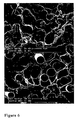
- Figure 8 is SEMs of different regions of the fracture surface of a mixed fibre composite.
- the composite was produced by using compression moulding, with a layer of non-annealed fibre at the base, annealed fibres in the middle and then non-annealed fibre again at the top.
- the composite was degraded in distilled water at 37°C for seven days.
- the annealed fibres (upper image) remain relatively pristine, whilst the non-annealed fibres (lower image) can be seen to crack and lose surface layers (areas marked A) and to begin to deform (area marked B).
- Single phosphate glass fibres were hot-pressed between two thin sheets of polymer to form a single fibre composite. These composites were then put under tensile stress until the fibre breaks, and continues to break until a static value of stress is obtained. The number of breaks observed in the fibre allow the interfacial shear strength to be determined. The quoted values are an average of five specimens.
- the annealed fibres exhibit a much-improved interfacial shear strength compared to non-annealed fibres, indicating a better adhesion between fibre and matrix. Better adhesion gives better composite properties. It should also help to maintain the composite/matrix interface and slow down the rate of degradation of composite properties.
Landscapes
- Health & Medical Sciences (AREA)
- Chemical & Material Sciences (AREA)
- Veterinary Medicine (AREA)
- Epidemiology (AREA)
- Life Sciences & Earth Sciences (AREA)
- Animal Behavior & Ethology (AREA)
- General Health & Medical Sciences (AREA)
- Public Health (AREA)
- Materials Engineering (AREA)
- Composite Materials (AREA)
- Engineering & Computer Science (AREA)
- Transplantation (AREA)
- Heart & Thoracic Surgery (AREA)
- Surgery (AREA)
- Vascular Medicine (AREA)
- Oral & Maxillofacial Surgery (AREA)
- Medicinal Chemistry (AREA)
- Dermatology (AREA)
- Inorganic Chemistry (AREA)
- Dispersion Chemistry (AREA)
- Reinforced Plastic Materials (AREA)
- Polymers With Sulfur, Phosphorus Or Metals In The Main Chain (AREA)
- Multicomponent Fibers (AREA)
Claims (18)
- Verfahren zum Bilden eines abbaubaren Verbundwerkstoffs, der eine abbaubare Matrix, einen ersten Fasertyp und einen zweiten Fasertyp aufweist, wobei der erste Fasertyp einen gegenüber dem zweiten Fasertyp unterschiedlichen Abbaugrad hat, wobei das Verfahren die Schritte aufweist:(a) Behandeln von Fasern des ersten und/oder zweiten Fasertyps, indem sie thermisch und/oder chemisch und/oder mechanisch behandelt werden um ihre Abbaurate zu verändern, wobei der erste und/oder zweite Fasertyp behandelt wird, nachdem er gezogen wurde, und(b) Bilden eines abbaubaren Verbundwerkstoffs, der eine abbaubare Matrix, den ersten Fasertyp und den zweiten Fasertyp aufweist.
- Verfahren nach Anspruch 1, wobei in Schritt (a) Fasern des ersten und/oder zweiten Fasertyps thermisch durch eine Temper-Behandlung behandelt werden, um ihre Abbauraten zu verändern.
- Verfahren nach irgendeinem der vorstehenden Ansprüche, wobei die ersten und/oder zweiten Fasertypen aus der Gruppe, die natürliche Fasern, keramische Fasern, Carbonfasern, Glasfasern, silikatische bioaktive Glasfasern, Fasern, die aus Silikatmischungen gefertigt sind, Aramidfasern, Polyethylenfasern, Polyamidfasern, Lactidfasern, Glycolidfasern, Caprolactonfasern oder Mischungen hiervon aufweist, ausgewählt werden.
- Verfahren nach Anspruch 3, wobei die ersten und/oder zweiten Fasertypen Phosphatglasfasern sind.
- Verfahren nach irgendeinem der vorstehenden Ansprüche, wobei nach Schritt (a) entweder:(i) zumindest einer der ersten oder zweiten Fasertypen eine Abbaurate aufweist, die höher ist als die der Matrix, oder(ii) die Matrix eine höhere Abbaurate als eine der ersten oder zweiten Fasertypen oder als beide hat.
- Verfahren nach irgendeinem der vorstehenden Ansprüche, wobei der abbaubare Verbundstoff, der in Schritt (b) gebildet wird, ferner zusätzliche Fasern eines oder mehrerer unterschiedlicher Typen umfasst und/oder ferner Verstärkungsfasern aufweist.
- Verfahren nach irgendeinem der vorstehenden Ansprüche, wobei in Schritt (a) Fasern des ersten und/oder des zweiten Fasertyps entweder (i) chemisch mit einem Schlichtungsagens und/oder (ii) mit einem Filmbildner behandelt werden, und/oder (iii) chemisch durch das Applizieren eines Schmiermittels behandelt werden, und/oder (iv) auf der Oberfläche geätzt sind und/oder (v) hydrothermal behandelt werden, um die Oberflächeneigenschaften der Faser zu verändern und/oder (vi) behandelt werden, um ein Kopplungsagens auf die Oberfläche der Fasern aufzubringen.
- Verfahren nach irgendeinem der vorstehenden Ansprüche, wobei die Matrix aus einem Material gefertigt ist, das aus der Gruppe, die Acryle, Polyester, Polyolefine, Polyurethane, Silikonpolymere, Vinylpolymere, halogenierte Kohlenwasserstoffe, Nylons, proteinöse Materialien und Copolymere oder Kombinationen hiervon aufweist, ausgewählt ist, und/oder wobei die Matrix ein thermoplastisches Polymer ist.
- Verfahren nach irgendeinem der vorstehenden Ansprüche, wobei Schritt (b) aufweist:Bereitstellen einer geformten Faser-Preform in einem Werkzeug oder einer Form, wobei die Preform die Fasern des ersten Typs und Fasern des zweiten Typs enthält;Injizieren einer Zusammensetzung, die Monomere und/oder Comonomere und/oder Oligomere und/oder Harz aufweist, in das Werkzeug oder die Form, die die Faser-Preform enthält, undPolymerisieren des Monomers und/oder Comonomers und/oder Oligomers und/oder Harzes, um einen Verbundwerkstoff zu bilden, der eine abbaubare Matrix, den ersten Fasertyp und den zweiten Fasertyp aufweist.
- Abbaubarer Verbundwerkstoff, der eine abbaubare Matrix, einen ersten Fasertyp und einen zweiten Fasertyp aufweist, wobei der erste und zweite Fasertyp Phosphatglasfasern sind und wobei der erste Fasertyp eine von dem zweiten Fasertyp unterschiedliche Abbaurate aufgrund der Tatsache aufweist, dass Fasern des ersten und/oder des zweiten Fasertypus thermisch behandelt worden sind, nachdem sie gezogen wurden, um ihre Abbauraten zu verändern.
- Verbundwerkstoff nach Anspruch 10, wobei die Fasern der ersten und/oder zweiten Fasertypen dieselben chemischen Zusammensetzungen haben oder aus Fasern mit denselben chemischen Zusammensetzungen erhalten wurden.
- Zusammensetzung nach Anspruch 10 oder 11, wobei Fasern des ersten und/oder zweiten Fasertypus thermisch behandelt wurden um ihre Abbauraten durch eine Temperbehandlung zu verändern.
- Zusammensetzung nach irgendeinem der Ansprüche 10 bis 12, wobei der erste Fasertyp und/oder der zweite Fasertyps oder die Matrix bioabbaubar sind.
- Zusammensetzung nach irgendeinem der Ansprüche 10 bis 13, wobei zumindest einer der ersten und/oder zweiten Fasertypen eine Abbaurate hat, die höher als die der Matrix ist, oder wobei die Matrix eine höhere Abbaurate hat als entweder der erste oder zweite Fasertyp oder beide.
- Zusammensetzung nach irgendeinem der Ansprüche 10 bis 14, die ferner zusätzliche Fasern eines oder mehrerer unterschiedlicher Typen und/oder ferner Verstärkungsfasern aufweist.
- Zusammensetzung nach irgendeinem der Ansprüche 10 bis 15, wobei die Matrix aus einem Material gemacht ist, das aus der Gruppe, die Acryle, Polyester, Polyolefine, Polyurethane, Silikonpolymere, Vinylpolymere, halogenierte Kohlenwasserstoffe, Nylons, proteinöse Materialien und Copolymere oder Kombinationen hiervon aufweist, ausgewählt wird und/oder wobei die Matrix ein thermoplastisches Polymer ist.
- Verwendung eines Verbundwerkstoffes gemäß irgendeinem der Ansprüche 10 bis 16, bei der Herstellung eines medizinischen Implantats.
- Medizinisches Implantat, aufweisend einen Verbundwerkstoff gemäß irgendeinem der Ansprüche 10 bis 16.
Applications Claiming Priority (2)
| Application Number | Priority Date | Filing Date | Title |
|---|---|---|---|
| GBGB0618787.6A GB0618787D0 (en) | 2006-09-23 | 2006-09-23 | Degradable composite |
| PCT/GB2007/003583 WO2008035088A2 (en) | 2006-09-23 | 2007-09-21 | Degradable composite |
Publications (2)
| Publication Number | Publication Date |
|---|---|
| EP2068955A2 EP2068955A2 (de) | 2009-06-17 |
| EP2068955B1 true EP2068955B1 (de) | 2012-01-11 |
Family
ID=37421518
Family Applications (1)
| Application Number | Title | Priority Date | Filing Date |
|---|---|---|---|
| EP07823914A Not-in-force EP2068955B1 (de) | 2006-09-23 | 2007-09-21 | Abbaubarer komposit |
Country Status (5)
| Country | Link |
|---|---|
| US (1) | US8182496B2 (de) |
| EP (1) | EP2068955B1 (de) |
| AT (1) | ATE540708T1 (de) |
| GB (1) | GB0618787D0 (de) |
| WO (1) | WO2008035088A2 (de) |
Families Citing this family (25)
| Publication number | Priority date | Publication date | Assignee | Title |
|---|---|---|---|---|
| GB2461743A (en) * | 2008-07-11 | 2010-01-20 | Smith & Nephew | Medical device or composition comprising at least two inorganic components |
| ES2379676T3 (es) | 2009-04-23 | 2012-04-30 | Vivoxid Oy | Material compuesto biocompatible y su uso |
| US10227568B2 (en) | 2011-03-22 | 2019-03-12 | Nanofiber Solutions, Llc | Fiber scaffolds for use in esophageal prostheses |
| US10239262B2 (en) | 2011-11-21 | 2019-03-26 | Nanofiber Solutions, Llc | Fiber scaffolds for use in tracheal prostheses |
| WO2013106822A1 (en) | 2012-01-12 | 2013-07-18 | Johnson Jed K | Nanofiber scaffolds for biological structures |
| US10328458B2 (en) * | 2012-02-28 | 2019-06-25 | Microvention, Inc. | Coating methods |
| CN103374208B (zh) * | 2012-04-24 | 2015-11-18 | 苏州纳晶医药技术有限公司 | 一种可梯度降解的聚合物材料及其制备方法 |
| EP3950019A1 (de) | 2013-03-15 | 2022-02-09 | Nanofiber Solutions, LLC | Biokompatible fasertextilien zur implantation |
| US9737632B2 (en) | 2013-09-25 | 2017-08-22 | Nanofiber Solutions, Inc. | Fiber scaffolds for use creating implantable structures |
| JP7219428B2 (ja) * | 2015-04-29 | 2023-02-08 | エヌエフエス アイピー ホールディングス、エルエルシー | 多成分系電界紡糸繊維スキャフォールド |
| US10166315B2 (en) | 2015-05-04 | 2019-01-01 | Nanofiber Solutions, Inc. | Chitosan-enhanced electrospun fiber compositions |
| EP3370788A4 (de) | 2015-11-02 | 2019-07-31 | Nanofiber Solutions, LLC | Elektrogesponnene fasern mit kontrastmitteln und verfahren zur herstellung davon |
| US11013836B2 (en) * | 2016-06-16 | 2021-05-25 | The Curators Of The University Of Missouri | Inorganic biodegradable substrates for devices and systems |
| US10543299B2 (en) | 2016-10-03 | 2020-01-28 | Microvention, Inc. | Surface coatings |
| JP7095897B2 (ja) | 2016-12-05 | 2022-07-05 | ニューロナノ アーベー | 接続用マイクロ繊維を含むマイクロ電極アレイ |
| US10898608B2 (en) | 2017-02-02 | 2021-01-26 | Nanofiber Solutions, Llc | Methods of improving bone-soft tissue healing using electrospun fibers |
| WO2019093936A1 (en) | 2017-11-09 | 2019-05-16 | Neuronano Ab | Positional stabilization of tissue-implanted medical devices |
| WO2019222482A1 (en) * | 2018-05-16 | 2019-11-21 | Spirox, Inc. | Allergic rhinitis drug delivery implant |
| WO2020123619A1 (en) | 2018-12-11 | 2020-06-18 | Nanofiber Solutions, Llc | Methods of treating chronic wounds using electrospun fibers |
| CN113631203A (zh) | 2019-01-28 | 2021-11-09 | 微仙美国有限公司 | 涂层 |
| KR20220043152A (ko) | 2019-07-26 | 2022-04-05 | 마이크로벤션, 인코포레이티드 | 코팅 |
| EP3881872B1 (de) * | 2020-03-19 | 2025-12-10 | Taiwan Fiber Optics, Inc. | Kombination aus einem bioaktiven silikat-medizinträger und einem shunt |
| WO2022005386A1 (en) | 2020-07-03 | 2022-01-06 | Neuronano Ab | Microelectrode for insertion into soft tissue |
| US11883564B2 (en) | 2020-07-30 | 2024-01-30 | Microvention, Inc. | Antimicrobial coatings |
| US11827862B2 (en) | 2020-08-07 | 2023-11-28 | Microvention, Inc. | Durable surface coatings |
Family Cites Families (20)
| Publication number | Priority date | Publication date | Assignee | Title |
|---|---|---|---|---|
| US4512038A (en) * | 1979-04-27 | 1985-04-23 | University Of Medicine And Dentistry Of New Jersey | Bio-absorbable composite tissue scaffold |
| US4655777A (en) * | 1983-12-19 | 1987-04-07 | Southern Research Institute | Method of producing biodegradable prosthesis and products therefrom |
| DK0687711T3 (da) * | 1994-06-16 | 2002-09-02 | Deutsch Zentr Luft & Raumfahrt | Fiberkompositmateriale og fremgangsmåde til fremstilling deraf |
| JP4132089B2 (ja) * | 1997-05-30 | 2008-08-13 | オステオバイオロジックス,インコーポレイテッド | 繊維強化多孔性生体分解性移植デバイス |
| US7524335B2 (en) * | 1997-05-30 | 2009-04-28 | Smith & Nephew, Inc. | Fiber-reinforced, porous, biodegradable implant device |
| US6113640A (en) * | 1997-06-11 | 2000-09-05 | Bionx Implants Oy | Reconstructive bioabsorbable joint prosthesis |
| GB9717433D0 (en) * | 1997-08-19 | 1997-10-22 | Univ Nottingham | Biodegradable composites |
| US6607530B1 (en) * | 1999-05-10 | 2003-08-19 | Highgate Orthopedics, Inc. | Systems and methods for spinal fixation |
| DE19930770A1 (de) * | 1999-07-03 | 2001-01-04 | Cognis Deutschland Gmbh | Verfahren zur Herstellung von Faserverbundwerkstoffen |
| US7005135B2 (en) * | 2001-01-30 | 2006-02-28 | Ethicon Inc. | Glass scaffolds with controlled resorption rates and methods for making same |
| US6685956B2 (en) * | 2001-05-16 | 2004-02-03 | The Research Foundation At State University Of New York | Biodegradable and/or bioabsorbable fibrous articles and methods for using the articles for medical applications |
| US6790455B2 (en) * | 2001-09-14 | 2004-09-14 | The Research Foundation At State University Of New York | Cell delivery system comprising a fibrous matrix and cells |
| US6955716B2 (en) * | 2002-03-01 | 2005-10-18 | American Dental Association Foundation | Self-hardening calcium phosphate materials with high resistance to fracture, controlled strength histories and tailored macropore formation rates |
| US8580291B2 (en) * | 2002-03-15 | 2013-11-12 | The Trustees Of The University Of Pennsylvania | Fibrous composite for tissue engineering |
| DK1405647T3 (da) * | 2002-10-03 | 2006-06-26 | Vivoxid Oy | Bioaktiv glassammensætning |
| WO2005005609A2 (en) * | 2003-06-30 | 2005-01-20 | Liefscan, Inc. | Multi-staged absorbable nonwoven structures for culturing pancreatic cells |
| WO2005078018A1 (en) * | 2004-02-11 | 2005-08-25 | Michigan State University | Anhydride functionalized polyhydroxyalkanoates, preparation and use thereof |
| EP1611906A1 (de) * | 2004-06-30 | 2006-01-04 | YLI-URPO, Antti | Ein mehrschichtiges Material |
| US20060147689A1 (en) * | 2004-12-30 | 2006-07-06 | Raj Wallajapet | Absorbent composites containing biodegradable reinforcing fibers |
| US8252064B2 (en) * | 2005-02-04 | 2012-08-28 | Poly-Med, Inc. | Fiber-reinforced composite absorbable endoureteral stent |
-
2006
- 2006-09-23 GB GBGB0618787.6A patent/GB0618787D0/en not_active Ceased
-
2007
- 2007-09-21 WO PCT/GB2007/003583 patent/WO2008035088A2/en not_active Ceased
- 2007-09-21 AT AT07823914T patent/ATE540708T1/de active
- 2007-09-21 US US12/442,466 patent/US8182496B2/en not_active Expired - Fee Related
- 2007-09-21 EP EP07823914A patent/EP2068955B1/de not_active Not-in-force
Also Published As
| Publication number | Publication date |
|---|---|
| US8182496B2 (en) | 2012-05-22 |
| EP2068955A2 (de) | 2009-06-17 |
| WO2008035088A2 (en) | 2008-03-27 |
| US20100105799A1 (en) | 2010-04-29 |
| ATE540708T1 (de) | 2012-01-15 |
| WO2008035088A3 (en) | 2009-04-09 |
| GB0618787D0 (en) | 2006-11-01 |
Similar Documents
| Publication | Publication Date | Title |
|---|---|---|
| EP2068955B1 (de) | Abbaubarer komposit | |
| Prasadh et al. | Unraveling the mechanical strength of biomaterials used as a bone scaffold in oral and maxillofacial defects | |
| EP1005379B1 (de) | Biologisch abbaubare verbundwerkstoff | |
| Lu et al. | Three‐dimensional, bioactive, biodegradable, polymer–bioactive glass composite scaffolds with improved mechanical properties support collagen synthesis and mineralization of human osteoblast‐like cells in vitro | |
| Gautam et al. | Processing of biomaterials for bone tissue engineering: State of the art | |
| Boccaccini et al. | A composites approach to tissue engineering | |
| CA2467260A1 (en) | A porous organic-inorganic composite implant material and process for producing the same | |
| Adamovic et al. | Review of existing biomaterials—method of material selection for specific applications in orthopedics | |
| US20110142790A1 (en) | Polyol Based - Bioceramic Composites | |
| CN113613688B (zh) | 增强型生物相容性支架 | |
| Bil et al. | Bioactivity of polyurethane-based scaffolds coated with Bioglass® | |
| US20120136088A1 (en) | Biocompatible ceramic-polymer hybrids and calcium phosphate porous body | |
| US8969430B2 (en) | Biocompatible ceramic-polymer hybrids | |
| Niemelä et al. | Bioactive glass and biodegradable polymer composites | |
| Antoniac et al. | Potential of the magnesium powder as filler for biomedical composites | |
| Wang | Materials selection and scaffold fabrication for tissue engineering in orthopaedics | |
| Kharazi et al. | Partially resorbable composite bone plate with controlled degradation rate, desired mechanical properties and bioactivity | |
| Hossain et al. | Phosphate glass fibres and their composites | |
| CN114099794A (zh) | 一种可生物吸收的骨科植入材料及其制备方法 | |
| Rabiee et al. | Bioactive nanomaterials | |
| Szaraniec | Durability of biodegradable internal fixation plates | |
| Verrier et al. | Bioactive composite materials for bone tissue engineering scaffolds | |
| Uppstu | Bioresorbable Polymer–Bioactive Glass Composite Scaffolds for Bone Regeneration | |
| Tusnim et al. | Bioresorbable biocomposites | |
| US20240197958A1 (en) | Hybrid, artificial bone tissue implant absorbing mechanical vibrations, whose architectural structure imitates trabecular bone, allowing the saturation of bone marrow, blood, and nutrients, supporting autological regeneration, which can be used with titanium structures |
Legal Events
| Date | Code | Title | Description |
|---|---|---|---|
| PUAI | Public reference made under article 153(3) epc to a published international application that has entered the european phase |
Free format text: ORIGINAL CODE: 0009012 |
|
| 17P | Request for examination filed |
Effective date: 20090420 |
|
| AK | Designated contracting states |
Kind code of ref document: A2 Designated state(s): AT BE BG CH CY CZ DE DK EE ES FI FR GB GR HU IE IS IT LI LT LU LV MC MT NL PL PT RO SE SI SK TR |
|
| 17Q | First examination report despatched |
Effective date: 20090728 |
|
| DAX | Request for extension of the european patent (deleted) | ||
| GRAP | Despatch of communication of intention to grant a patent |
Free format text: ORIGINAL CODE: EPIDOSNIGR1 |
|
| GRAS | Grant fee paid |
Free format text: ORIGINAL CODE: EPIDOSNIGR3 |
|
| GRAA | (expected) grant |
Free format text: ORIGINAL CODE: 0009210 |
|
| AK | Designated contracting states |
Kind code of ref document: B1 Designated state(s): AT BE BG CH CY CZ DE DK EE ES FI FR GB GR HU IE IS IT LI LT LU LV MC MT NL PL PT RO SE SI SK TR |
|
| REG | Reference to a national code |
Ref country code: GB Ref legal event code: FG4D |
|
| REG | Reference to a national code |
Ref country code: CH Ref legal event code: EP |
|
| REG | Reference to a national code |
Ref country code: AT Ref legal event code: REF Ref document number: 540708 Country of ref document: AT Kind code of ref document: T Effective date: 20120115 |
|
| REG | Reference to a national code |
Ref country code: IE Ref legal event code: FG4D |
|
| REG | Reference to a national code |
Ref country code: DE Ref legal event code: R096 Ref document number: 602007020040 Country of ref document: DE Effective date: 20120315 |
|
| REG | Reference to a national code |
Ref country code: NL Ref legal event code: VDEP Effective date: 20120111 |
|
| PG25 | Lapsed in a contracting state [announced via postgrant information from national office to epo] |
Ref country code: SI Free format text: LAPSE BECAUSE OF FAILURE TO SUBMIT A TRANSLATION OF THE DESCRIPTION OR TO PAY THE FEE WITHIN THE PRESCRIBED TIME-LIMIT Effective date: 20120111 |
|
| LTIE | Lt: invalidation of european patent or patent extension |
Effective date: 20120111 |
|
| PG25 | Lapsed in a contracting state [announced via postgrant information from national office to epo] |
Ref country code: BG Free format text: LAPSE BECAUSE OF FAILURE TO SUBMIT A TRANSLATION OF THE DESCRIPTION OR TO PAY THE FEE WITHIN THE PRESCRIBED TIME-LIMIT Effective date: 20120411 Ref country code: IS Free format text: LAPSE BECAUSE OF FAILURE TO SUBMIT A TRANSLATION OF THE DESCRIPTION OR TO PAY THE FEE WITHIN THE PRESCRIBED TIME-LIMIT Effective date: 20120511 Ref country code: LT Free format text: LAPSE BECAUSE OF FAILURE TO SUBMIT A TRANSLATION OF THE DESCRIPTION OR TO PAY THE FEE WITHIN THE PRESCRIBED TIME-LIMIT Effective date: 20120111 Ref country code: BE Free format text: LAPSE BECAUSE OF FAILURE TO SUBMIT A TRANSLATION OF THE DESCRIPTION OR TO PAY THE FEE WITHIN THE PRESCRIBED TIME-LIMIT Effective date: 20120111 Ref country code: NL Free format text: LAPSE BECAUSE OF FAILURE TO SUBMIT A TRANSLATION OF THE DESCRIPTION OR TO PAY THE FEE WITHIN THE PRESCRIBED TIME-LIMIT Effective date: 20120111 |
|
| PG25 | Lapsed in a contracting state [announced via postgrant information from national office to epo] |
Ref country code: FI Free format text: LAPSE BECAUSE OF FAILURE TO SUBMIT A TRANSLATION OF THE DESCRIPTION OR TO PAY THE FEE WITHIN THE PRESCRIBED TIME-LIMIT Effective date: 20120111 Ref country code: LV Free format text: LAPSE BECAUSE OF FAILURE TO SUBMIT A TRANSLATION OF THE DESCRIPTION OR TO PAY THE FEE WITHIN THE PRESCRIBED TIME-LIMIT Effective date: 20120111 Ref country code: PL Free format text: LAPSE BECAUSE OF FAILURE TO SUBMIT A TRANSLATION OF THE DESCRIPTION OR TO PAY THE FEE WITHIN THE PRESCRIBED TIME-LIMIT Effective date: 20120111 Ref country code: PT Free format text: LAPSE BECAUSE OF FAILURE TO SUBMIT A TRANSLATION OF THE DESCRIPTION OR TO PAY THE FEE WITHIN THE PRESCRIBED TIME-LIMIT Effective date: 20120511 Ref country code: GR Free format text: LAPSE BECAUSE OF FAILURE TO SUBMIT A TRANSLATION OF THE DESCRIPTION OR TO PAY THE FEE WITHIN THE PRESCRIBED TIME-LIMIT Effective date: 20120412 |
|
| REG | Reference to a national code |
Ref country code: AT Ref legal event code: MK05 Ref document number: 540708 Country of ref document: AT Kind code of ref document: T Effective date: 20120111 |
|
| PG25 | Lapsed in a contracting state [announced via postgrant information from national office to epo] |
Ref country code: CY Free format text: LAPSE BECAUSE OF FAILURE TO SUBMIT A TRANSLATION OF THE DESCRIPTION OR TO PAY THE FEE WITHIN THE PRESCRIBED TIME-LIMIT Effective date: 20120111 |
|
| PG25 | Lapsed in a contracting state [announced via postgrant information from national office to epo] |
Ref country code: EE Free format text: LAPSE BECAUSE OF FAILURE TO SUBMIT A TRANSLATION OF THE DESCRIPTION OR TO PAY THE FEE WITHIN THE PRESCRIBED TIME-LIMIT Effective date: 20120111 Ref country code: CZ Free format text: LAPSE BECAUSE OF FAILURE TO SUBMIT A TRANSLATION OF THE DESCRIPTION OR TO PAY THE FEE WITHIN THE PRESCRIBED TIME-LIMIT Effective date: 20120111 Ref country code: RO Free format text: LAPSE BECAUSE OF FAILURE TO SUBMIT A TRANSLATION OF THE DESCRIPTION OR TO PAY THE FEE WITHIN THE PRESCRIBED TIME-LIMIT Effective date: 20120111 Ref country code: DK Free format text: LAPSE BECAUSE OF FAILURE TO SUBMIT A TRANSLATION OF THE DESCRIPTION OR TO PAY THE FEE WITHIN THE PRESCRIBED TIME-LIMIT Effective date: 20120111 Ref country code: SE Free format text: LAPSE BECAUSE OF FAILURE TO SUBMIT A TRANSLATION OF THE DESCRIPTION OR TO PAY THE FEE WITHIN THE PRESCRIBED TIME-LIMIT Effective date: 20120111 |
|
| PLBE | No opposition filed within time limit |
Free format text: ORIGINAL CODE: 0009261 |
|
| STAA | Information on the status of an ep patent application or granted ep patent |
Free format text: STATUS: NO OPPOSITION FILED WITHIN TIME LIMIT |
|
| PG25 | Lapsed in a contracting state [announced via postgrant information from national office to epo] |
Ref country code: IT Free format text: LAPSE BECAUSE OF FAILURE TO SUBMIT A TRANSLATION OF THE DESCRIPTION OR TO PAY THE FEE WITHIN THE PRESCRIBED TIME-LIMIT Effective date: 20120111 Ref country code: SK Free format text: LAPSE BECAUSE OF FAILURE TO SUBMIT A TRANSLATION OF THE DESCRIPTION OR TO PAY THE FEE WITHIN THE PRESCRIBED TIME-LIMIT Effective date: 20120111 |
|
| 26N | No opposition filed |
Effective date: 20121012 |
|
| PG25 | Lapsed in a contracting state [announced via postgrant information from national office to epo] |
Ref country code: AT Free format text: LAPSE BECAUSE OF FAILURE TO SUBMIT A TRANSLATION OF THE DESCRIPTION OR TO PAY THE FEE WITHIN THE PRESCRIBED TIME-LIMIT Effective date: 20120111 |
|
| REG | Reference to a national code |
Ref country code: DE Ref legal event code: R097 Ref document number: 602007020040 Country of ref document: DE Effective date: 20121012 |
|
| PG25 | Lapsed in a contracting state [announced via postgrant information from national office to epo] |
Ref country code: MC Free format text: LAPSE BECAUSE OF NON-PAYMENT OF DUE FEES Effective date: 20120930 Ref country code: ES Free format text: LAPSE BECAUSE OF FAILURE TO SUBMIT A TRANSLATION OF THE DESCRIPTION OR TO PAY THE FEE WITHIN THE PRESCRIBED TIME-LIMIT Effective date: 20120422 |
|
| REG | Reference to a national code |
Ref country code: CH Ref legal event code: PL |
|
| REG | Reference to a national code |
Ref country code: IE Ref legal event code: MM4A |
|
| PG25 | Lapsed in a contracting state [announced via postgrant information from national office to epo] |
Ref country code: LI Free format text: LAPSE BECAUSE OF NON-PAYMENT OF DUE FEES Effective date: 20120930 Ref country code: CH Free format text: LAPSE BECAUSE OF NON-PAYMENT OF DUE FEES Effective date: 20120930 Ref country code: IE Free format text: LAPSE BECAUSE OF NON-PAYMENT OF DUE FEES Effective date: 20120921 |
|
| PG25 | Lapsed in a contracting state [announced via postgrant information from national office to epo] |
Ref country code: MT Free format text: LAPSE BECAUSE OF FAILURE TO SUBMIT A TRANSLATION OF THE DESCRIPTION OR TO PAY THE FEE WITHIN THE PRESCRIBED TIME-LIMIT Effective date: 20120111 |
|
| PG25 | Lapsed in a contracting state [announced via postgrant information from national office to epo] |
Ref country code: TR Free format text: LAPSE BECAUSE OF FAILURE TO SUBMIT A TRANSLATION OF THE DESCRIPTION OR TO PAY THE FEE WITHIN THE PRESCRIBED TIME-LIMIT Effective date: 20120111 |
|
| PG25 | Lapsed in a contracting state [announced via postgrant information from national office to epo] |
Ref country code: LU Free format text: LAPSE BECAUSE OF NON-PAYMENT OF DUE FEES Effective date: 20120921 |
|
| PG25 | Lapsed in a contracting state [announced via postgrant information from national office to epo] |
Ref country code: HU Free format text: LAPSE BECAUSE OF FAILURE TO SUBMIT A TRANSLATION OF THE DESCRIPTION OR TO PAY THE FEE WITHIN THE PRESCRIBED TIME-LIMIT Effective date: 20070921 |
|
| REG | Reference to a national code |
Ref country code: FR Ref legal event code: PLFP Year of fee payment: 9 |
|
| PGFP | Annual fee paid to national office [announced via postgrant information from national office to epo] |
Ref country code: DE Payment date: 20150930 Year of fee payment: 9 |
|
| PGFP | Annual fee paid to national office [announced via postgrant information from national office to epo] |
Ref country code: FR Payment date: 20150930 Year of fee payment: 9 |
|
| PGFP | Annual fee paid to national office [announced via postgrant information from national office to epo] |
Ref country code: GB Payment date: 20160929 Year of fee payment: 10 |
|
| REG | Reference to a national code |
Ref country code: DE Ref legal event code: R119 Ref document number: 602007020040 Country of ref document: DE |
|
| REG | Reference to a national code |
Ref country code: FR Ref legal event code: ST Effective date: 20170531 |
|
| PG25 | Lapsed in a contracting state [announced via postgrant information from national office to epo] |
Ref country code: DE Free format text: LAPSE BECAUSE OF NON-PAYMENT OF DUE FEES Effective date: 20170401 Ref country code: FR Free format text: LAPSE BECAUSE OF NON-PAYMENT OF DUE FEES Effective date: 20160930 |
|
| GBPC | Gb: european patent ceased through non-payment of renewal fee |
Effective date: 20170921 |
|
| PG25 | Lapsed in a contracting state [announced via postgrant information from national office to epo] |
Ref country code: GB Free format text: LAPSE BECAUSE OF NON-PAYMENT OF DUE FEES Effective date: 20170921 |