EP2070236B1 - Detektion einer diskontinuierlichen übertragung (dtx) unter verwendung einer von einem turbo-decoder erzeugten signalmetrik - Google Patents
Detektion einer diskontinuierlichen übertragung (dtx) unter verwendung einer von einem turbo-decoder erzeugten signalmetrik Download PDFInfo
- Publication number
- EP2070236B1 EP2070236B1 EP07838118.3A EP07838118A EP2070236B1 EP 2070236 B1 EP2070236 B1 EP 2070236B1 EP 07838118 A EP07838118 A EP 07838118A EP 2070236 B1 EP2070236 B1 EP 2070236B1
- Authority
- EP
- European Patent Office
- Prior art keywords
- dtx
- data frame
- frame
- signal
- transmitted data
- Prior art date
- Legal status (The legal status is an assumption and is not a legal conclusion. Google has not performed a legal analysis and makes no representation as to the accuracy of the status listed.)
- Not-in-force
Links
Images
Classifications
-
- H—ELECTRICITY
- H04—ELECTRIC COMMUNICATION TECHNIQUE
- H04L—TRANSMISSION OF DIGITAL INFORMATION, e.g. TELEGRAPHIC COMMUNICATION
- H04L1/00—Arrangements for detecting or preventing errors in the information received
- H04L1/004—Arrangements for detecting or preventing errors in the information received by using forward error control
- H04L1/0045—Arrangements at the receiver end
- H04L1/0047—Decoding adapted to other signal detection operation
- H04L1/005—Iterative decoding, including iteration between signal detection and decoding operation
-
- H—ELECTRICITY
- H04—ELECTRIC COMMUNICATION TECHNIQUE
- H04B—TRANSMISSION
- H04B7/00—Radio transmission systems, i.e. using radiation field
- H04B7/005—Control of transmission; Equalising
-
- H—ELECTRICITY
- H04—ELECTRIC COMMUNICATION TECHNIQUE
- H04L—TRANSMISSION OF DIGITAL INFORMATION, e.g. TELEGRAPHIC COMMUNICATION
- H04L1/00—Arrangements for detecting or preventing errors in the information received
-
- H—ELECTRICITY
- H04—ELECTRIC COMMUNICATION TECHNIQUE
- H04L—TRANSMISSION OF DIGITAL INFORMATION, e.g. TELEGRAPHIC COMMUNICATION
- H04L1/00—Arrangements for detecting or preventing errors in the information received
- H04L1/004—Arrangements for detecting or preventing errors in the information received by using forward error control
- H04L1/0072—Error control for data other than payload data, e.g. control data
-
- H—ELECTRICITY
- H04—ELECTRIC COMMUNICATION TECHNIQUE
- H04L—TRANSMISSION OF DIGITAL INFORMATION, e.g. TELEGRAPHIC COMMUNICATION
- H04L1/00—Arrangements for detecting or preventing errors in the information received
- H04L1/20—Arrangements for detecting or preventing errors in the information received using signal quality detector
-
- H—ELECTRICITY
- H04—ELECTRIC COMMUNICATION TECHNIQUE
- H04L—TRANSMISSION OF DIGITAL INFORMATION, e.g. TELEGRAPHIC COMMUNICATION
- H04L1/00—Arrangements for detecting or preventing errors in the information received
- H04L1/20—Arrangements for detecting or preventing errors in the information received using signal quality detector
- H04L1/201—Frame classification, e.g. bad, good or erased
-
- H—ELECTRICITY
- H04—ELECTRIC COMMUNICATION TECHNIQUE
- H04W—WIRELESS COMMUNICATION NETWORKS
- H04W52/00—Power management, e.g. Transmission Power Control [TPC] or power classes
- H04W52/04—Transmission power control [TPC]
- H04W52/18—TPC being performed according to specific parameters
- H04W52/20—TPC being performed according to specific parameters using error rate
-
- H—ELECTRICITY
- H04—ELECTRIC COMMUNICATION TECHNIQUE
- H04W—WIRELESS COMMUNICATION NETWORKS
- H04W52/00—Power management, e.g. Transmission Power Control [TPC] or power classes
- H04W52/04—Transmission power control [TPC]
- H04W52/38—TPC being performed in particular situations
- H04W52/44—TPC being performed in particular situations in connection with interruption of transmission
-
- H—ELECTRICITY
- H04—ELECTRIC COMMUNICATION TECHNIQUE
- H04B—TRANSMISSION
- H04B2201/00—Indexing scheme relating to details of transmission systems not covered by a single group of H04B3/00 - H04B13/00
- H04B2201/69—Orthogonal indexing scheme relating to spread spectrum techniques in general
- H04B2201/707—Orthogonal indexing scheme relating to spread spectrum techniques in general relating to direct sequence modulation
- H04B2201/70707—Efficiency-related aspects
- H04B2201/70709—Efficiency-related aspects with discontinuous detection
-
- H—ELECTRICITY
- H04—ELECTRIC COMMUNICATION TECHNIQUE
- H04W—WIRELESS COMMUNICATION NETWORKS
- H04W52/00—Power management, e.g. Transmission Power Control [TPC] or power classes
- H04W52/04—Transmission power control [TPC]
- H04W52/06—TPC algorithms
- H04W52/12—Outer and inner loops
Definitions
- Example embodiments of the present invention are generally related to detection of discontinuous transmission frames in transmitted data, and to a method of generating a signal metric for use in DTX detection.
- Third generation wireless standard 3GPP2-CDMA2000-1x is designed for both voice and data applications.
- transmission from a base station to a mobile station in a wireless communication system is known as a forward link
- transmission from the mobile station to the base station is known as a reverse link.
- reverse link channels required to support the application usually involve a dedicated control channel (R-DCCH), which is used to transmit control information, and a supplemental channel (R-SCH), which is used to transmit data.
- R-DCCH dedicated control channel
- R-SCH supplemental channel
- DTX discontinuous transmission
- a mobile station on its own discretion decides whether to send a packet of data to the base station on a frame-by-frame basis. The mobile station decides not to send a packet of data to extend the battery life of the mobile station battery life and reduce interferences in a radio environment.
- DTX is used when there is no data to transmit on either channel. In other words, no signal is actually transmitted during DTX frames of a particular channel.
- a mobile station or user equipment (UE) does not notify a base station that it has sent a frame without any symbols (data), i.e., a DTX frame.
- the base station or Node-B makes that determination on its own.
- a base station receives a checksum value, which is typically included at an end of a frame.
- Cyclic redundancy checking (CRC) checksum at a base station receiver is used to drive an outer-loop power control, so that a pre-defined frame error rate (FER) may be achieved.
- FER frame error rate
- the base station does not know that the mobile station has sent a frame without any data, so it processes the frame as if there is data transmitted. This may result in a CRC error since no signal is actually transmitted in that frame. This false CRC error may drive up the outer-loop power control target, which in turn increases interference level to other users and wastes power on a mobile station transmitter.
- a base station receiver must detect whether a DTX frame is present, so that an outer-loop power control can either ignore a data frame CRC report or uses some other metric, (such as pilot frame error defection) to drive the outer-loop power control.
- checksum error may occur when a transmitted frame becomes distorted during transmission due to poor channel conditions.
- the base station transmits a frame but the transmitted frame is not properly received by the base station. This type of error is known as an "erasure.”
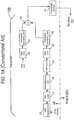
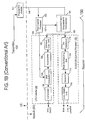
- FIGS.1A and 1B is a block diagram to illustrate Reverse link Dedicated Control Channel (R-DCCH) or Reverse link Supplement Channel (R-SCH) processing employing a conventional DTX detector.
- the blocks shown for the transmitter 100 at the UE and blocks at base station receiver 150 represent processing functions performed by software routines which are iterated by respective processors at the UE or Node-B respectively.
- a data packet or frame (i.e., DCCH, and/or SCH data) is appended with CRC bits at CRC append unit 105, forward error code (FEC) encoded at FEC coder 110, rate adjusted at rate matching unit 115, interleaved at interleaver 120 and weighted by gains at gain unit 135 to achieve certain power levels.
- the pilot channel is also weighted by gains at gain unit 140 to achieve certain power levels and then spread by an orthogonal Walsh code at orthogonal spreading unit 140.
- the two channels are then combined (code-division multiplexed) at multiplexer 145.
- the multiplexed signal may be scrambled and filtered by a shaping filter (not shown) before being modulated to RF (not shown for purposes of clarity) and sent through the propagation channel 147 to the base station (Node-B) receiver 150.
- the received signal 148 first passes a matched filter (not shown for clarity) and is sent to an R-DCCH/R-SCH despreader/demodulator to generate soft symbols for further processing by blocks such as decoder 176 to recover the transmitted data from the frame.
- the received signal 148 is additionally received by a pilot channel processor 155, which separates the pilot channel from other channels based on its Walsh code and generates channel estimates (shown at 157) and noise energy (shown at 158).
- the channel estimates 157 are transmitted to the R-DCCH or R-SCH despreader & demodulator 160 to generate the soft symbols (shown at 165) for further processing in an R-DCCH/ R-SCH post processor 170 and a DTX detector 180.
- the noise energy 185 is used for DTX detection on the corresponding data frame by the DTX detector 180.
- the R-DCCH or R-SCH post-processing by the R-DCCH or R-SCH post processor 170 may be the reverse processing of that performed at the UE transmitter side 100.
- the soft symbols 165 output from the R-DCCH /R-SCH despreader & demodulator 160 are de-interleaved at de-interleaver 172, rate de-matched at rate de-matching unit 174, decoded at decoder 176, and CRC checked at CRC check unit 178 to output the frame data and/or determine a CRC pass/fail.
- the DTX detector 180 calculates a signal energy in the received frame by accumulating L2-norms in accumulator 184.
- the L2-norms are this accumulated over the frame interval in accumulator 184 to output the signal energy.
- the detector 180 then calculates the signal-to-noise energy ratio (SNR) based on the noise energy 158 received from the pilot channel processor 155 and the determined signal energy from accumulator 184 at SNR calculation unit 186.
- SNR signal-to-noise energy ratio
- the SNR value is then sent to a comparator 186. If the comparator 188 determines that the SNR is less than some pre-defined threshold 188, the base station receiver 150 determines that the frame is a DTX frame, (DTX On), or not (DTX Off), respectively.
- DTX detection performance is not satisfactory for short data frames (5ms R-DCCH, or R-SCH with low data rates).
- energy is estimated prior to decoding. Therefore, to remove modulation, soft symbols must be squared or the absolute value of the soft symbols must be determined (at L2-norm calculation unit 182) prior to accumulation at accumulator 184 to generate the signal energy.
- the conventional DTX detector 180 also cannot accurately distinguish whether a checksum error was caused by an erasure or a DTX frame. For larger data frames, e.g., R-SCH with very high data rates, especially if the detector 180 is to be implemented in Digital Signal Processing (DSP) or Field-Programmable Gate Array (FPGA), accumulation typically takes too long.
- DSP Digital Signal Processing
- FPGA Field-Programmable Gate Array
- the embodiment of the present invention is directed to a method of generating a signal metric for use in detecting whether a transmitted data frame from a mobile station is a discontinuous transmission (DTX) frame.
- soft symbols are generated from a received signal carrying the transmitted data frame at a base station receiver, and the soft symbols are decoded in a turbo decoder of the receiver to generate the signal metric to be used for DTX detection.
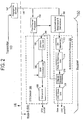
- FIG. 2 is block diagram illustrating DTX detection for a convolutionally-coded data frame according to an example. As in FIG. 1A , processing on the UE transmitter side is the same, and element numbers for the corresponding processing functions in FIG. 2 are the same as FIG. 1B unless otherwise indicated.
- the received signals 148 are processed initially as described in FIG. 1 , with channel estimates 257 being input to the R-DCCH/R-SCH despreader & demodulator 160 to output soft symbols, and with the noise energy being extracted at pilot channel processor 155 to be sent to SNR calculation unit 186.
- soft symbols 265 are only input to the post processor 270.
- the soft symbols are de-interleaved (at 172) and rate de-matched (at 174) before being decoded by a Viterbi decoder 276.
- a Viterbi decoder 276 is used because the FEC coder used to encode the data frame at the transmitter 100 was convolutional coder, thus generating a convolutionally-encoded data frame for transmission.
- the arrangement shown in the block diagram of FIG. 2 precludes the need for an accumulator 184 in the DTX detector 280; an accumulator 184 is not required to generate the signal energy used for the SNR calculation at 186.
- the Viterbi-decoder 276 decodes the soft symbols to recover the transmitted data from the frame. However, unlike FIG. 1B , the Viterbi decoder 276 generates a signal energy metric 285 ("signal metric") obtained at the last Viterbi decoding stage, which is sent to the DTX detector 280. In the DTX detector 280, an L2 norm is calculated for this signal energy metric in the L2-norm calculation unit 182.
- This signal energy metric 285 is referred to as a "final winning path metric" of the Viterbi decoder 276.
- this final winning path metric represents a path metric which has a final state of 0 at the last stage of the decoding process in the Viterbi decoder 276.
- This final winning path metric 285 is used by the L2-norm calculation unit 182 to determine a signal energy value for the received data frame.
- Noise energy 285 from the pilot channel processor 155 and the signal energy from 182 are input at SNR calculation unit 286 to calculate a signal to noise ratio (SNR).
- Comparator 188 compares the SNR value with a given threshold (DTX threshold value). If the SNR is less than the threshold, the received frame is determined to be a DTX frame.
- the signal input into the DTX detector 280 is a final winning path metric at the last stage of the Viterbi decoder 276.
- the final state of the winning path is 0 because the convolutional code defined in 3GPP and 3GPP2 starts and ends with an all-zero state. This is due to adding tail bits (zero) to a data block.
- the path with state 0 as its final state has a metric which represents a coherently combined signal amplitude over an entire code block. No additional processing is required to derive this metric, as the metric is available after the Viterbi decoding process.
- a final winning path metric has to be calculated, regardless of whether a frame is DTXed or not. Similarly, a final winning path metric has to be calculated, regardless of whether DTX detection in the Node-B receiver 150 is present or not.
- the signal metric 285 may yield improved DTX detection performance as compared to using soft symbols, because the uncertainty of data bits in a data frame is removed after Viterbi decoding. Also using the signal metric 285 for DTX detection may be desirable because the DTX detector 280 only has to calculate an L2-norm once every data frame, while the conventional DTX detector 180 has to calculate L2 norms 384 times for a 5ms R-DCCH frame and 1536 times for 20ms R-DCCH frame, depending on a data rate of a R-SCH frame. Additional complexity savings may be achieved as there is no need for accumulation operations to determine the signal energy for the SNR calculation.
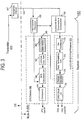
- FIG. 3 is block diagram illustrating DTX detection for a turbo coded data frame according to the embodiment of the invention.
- processing on the UE transmitter side is the same, and element numbers for the corresponding processing functions in FIG. 2 are the same as FIG. 1B unless otherwise indicated.
- the DTX detector 320 in FIG. 3 includes an accumulator 380 prior to the L2-Norm calculation unit 182, and the post processor 370 includes a turbo decoder 376 instead of the Viterbi decoder 276.
- a turbo decoder 376 is used because the FEC coder used to encode the data frame at the transmitter 100 was a turbo encoder, thus generating a turbo-encoded data frame for transmission.
- the turbo decoder 376 also generates a signal metric for input to the DTX detector 380, albeit a different signal metric.
- the signal metric input into the DTX detector 380 from the post processor 370 is a final turbo decoded Log-Likelihood Ratio (LLR) for all systematic bits in a data frame being processed by the turbo decoder 376.
- LLR Log-Likelihood Ratio
- turbo code is systematic code, where the coded sequence consists of systematic bits and parity bits.
- a turbo decoder computes LLRs for all systematic bits from the received soft symbols corresponding to all coded bits, including systematic bits and parity bits.
- the DTX detector 380 accumulates LLR amplitudes of all systematic bits over the entire data frame in accumulator 382 to output a sum.
- the L2 norm calculation unit 182 squares the sum to output a signal energy value for the transmitted data frame that is to be used in the SNR calculation.
- the functions of the comparator 188 are the same as described above and hence are omitted for brevity.
- the sum value determined at 182 represents a signal energy which may yield improved DTX detection performance as compared with using soft symbols.
- the L2-norm calculation is required only once every data frame, while the conventional DTX detector has to do the L2-norm calculation between 1536 times and 12288 times per frame, depending on the data rate of the R-SCH frame.
- the number of accumulation operations by accumulator 382 is reduced by at least 75% (excluding repetition due to rate-matching) as compared to accumulator 182 of the conventional DTX detector 180, and with a code rate of 1 ⁇ 4 (since accumulation is on systematic bits only).
Landscapes
- Engineering & Computer Science (AREA)
- Computer Networks & Wireless Communication (AREA)
- Signal Processing (AREA)
- Quality & Reliability (AREA)
- Mobile Radio Communication Systems (AREA)
- Detection And Prevention Of Errors In Transmission (AREA)
- Error Detection And Correction (AREA)
Claims (2)
- Verfahren zum Detektieren an einer Basisstation, ob ein von einer Mobilstation, UE, übertragener Datenrahmen ein diskontinuierlicher Übertragungs-DTX-Rahmen ist, umfassend:Erzeugen einer Signalmetrik (380) aus einem Signal (148), das den Rahmen trägt, der von dem Basisstationsempfänger (150) empfangen wird und dem übertragenen Datenrahmen in einem Dekodiervorgang entspricht, der zum Dekodieren des Datenrahmens verwendet wird,Extrahieren eines Rauschenergiewerts aus dem übertragenen Datenrahmen in einem Pilotkanalprozessor (155),Bestimmen einer Signalenergie des übertragenen Datenrahmens basierend auf der Signalmetrik, undBestimmen, ob der übertragene Datenrahmen ein DTX-Rahmen ist, unter Verwendung eines berechneten Signal-Rausch-Verhältnisses basierend auf der bestimmten Signalenergie und dem extrahierten Rauschenergiewert, wobei das Verfahren zum Erfassen gekennzeichnet ist durch:
Erzeugen der Signalmetrik (380) beinhaltet:Erzeugen von weichen Symbolen an der Basisstation aus einem empfangenen Signal (148), das den übertragenen Datenrahmen trägt, undDekodieren der weichen Symbole in einem Turbodekodierer (376), um die Signalmetrik zu erzeugen, die für die DTX-Detektion verwendet werden soll, wobei das Dekodieren beinhaltet:Berechnen des "Log-Likelihood" Quotienten, LLR, von Amplituden für alle systematischen Bits in dem übertragenen Datenrahmen, undBestimmen eines endgültigen turbodekodierten "Log-Likelihood" Quotienten, LLR, für jedes der systematischen Bits im Datenrahmen als Signalmetrik für die DTX-Detektion;Eingeben der Signalmetrik in einen Akkumulator (382) von LLR-Amplituden aller nur systematischen Bits über den gesamten Datenrahmen,wobei die Signalenergie des übertragenen Datenrahmens als ein Energiewert des Ausgangs des Akkumulators bestimmt wird. - Verfahren nach Anspruch 1, wobei das Bestimmen, ob der übertragene Datenrahmen ein DTX-Rahmen ist, beinhaltet:
Vergleichen des berechneten Signal-Rausch-Verhältnisses mit einem gegebenen Schwellenwert, um festzustellen, ob der übertragene Datenrahmen ein DTX-Rahmen ist.
Applications Claiming Priority (2)
| Application Number | Priority Date | Filing Date | Title |
|---|---|---|---|
| US11/526,725 US7782820B2 (en) | 2006-09-26 | 2006-09-26 | Method of detecting discontinuous transmission (DTX) and method of generating a signal metric for use in DTX detection |
| PCT/US2007/019856 WO2008039303A1 (en) | 2006-09-26 | 2007-09-12 | Discontinuous transmission (dtx) detection using a decoder generated signal metric |
Publications (2)
| Publication Number | Publication Date |
|---|---|
| EP2070236A1 EP2070236A1 (de) | 2009-06-17 |
| EP2070236B1 true EP2070236B1 (de) | 2019-08-14 |
Family
ID=38956408
Family Applications (1)
| Application Number | Title | Priority Date | Filing Date |
|---|---|---|---|
| EP07838118.3A Not-in-force EP2070236B1 (de) | 2006-09-26 | 2007-09-12 | Detektion einer diskontinuierlichen übertragung (dtx) unter verwendung einer von einem turbo-decoder erzeugten signalmetrik |
Country Status (6)
| Country | Link |
|---|---|
| US (1) | US7782820B2 (de) |
| EP (1) | EP2070236B1 (de) |
| JP (1) | JP5349314B2 (de) |
| KR (1) | KR101044569B1 (de) |
| CN (1) | CN101529772A (de) |
| WO (1) | WO2008039303A1 (de) |
Families Citing this family (14)
| Publication number | Priority date | Publication date | Assignee | Title |
|---|---|---|---|---|
| JP5436870B2 (ja) * | 2008-02-05 | 2014-03-05 | オリンパス株式会社 | 画像通信装置 |
| CN101568140B (zh) * | 2009-06-15 | 2012-08-15 | 华为技术有限公司 | 基于非连续发射的功率检测方法及基站 |
| US20110022916A1 (en) * | 2009-07-24 | 2011-01-27 | Prasanna Desai | Method and system for saving power for packet re-transmission in an encrypted bluetooth low power link layer connection |
| US8811452B2 (en) * | 2009-12-08 | 2014-08-19 | Samsung Electronics Co., Ltd. | Method and apparatus for parallel processing turbo decoder |
| CN102263769B (zh) * | 2010-05-25 | 2014-04-02 | 电信科学技术研究院 | 一种接收信号的方法和设备 |
| CN102468912B (zh) * | 2010-11-11 | 2014-12-10 | 中兴通讯股份有限公司 | 上行控制信道的解码方法和装置 |
| CN102740316B (zh) * | 2011-04-08 | 2016-01-20 | 中兴通讯股份有限公司 | Dtx状态的检测方法及装置 |
| US9209858B2 (en) | 2011-04-12 | 2015-12-08 | Alcatel Lucent | Method and apparatus for determining uplink noise power in a wireless communication system |
| US8767799B2 (en) | 2011-04-12 | 2014-07-01 | Alcatel Lucent | Method and apparatus for determining signal-to-noise ratio |
| US8879514B2 (en) * | 2012-09-14 | 2014-11-04 | Qualcomm Incorporated | Apparatus and method for detection of a dedicated control channel (DCCH) |
| US9167522B2 (en) | 2013-03-21 | 2015-10-20 | Telefonaktiebolaget L M Ericsson (Publ) | Fast detection of discontinuous transmission |
| US9480103B2 (en) | 2014-02-14 | 2016-10-25 | Freescale Semiconductor, Inc. | Method of DTX detection in a wireless communication system |
| US9414431B2 (en) * | 2014-02-14 | 2016-08-09 | Freescale Semiconductor, Inc. | Method of discontinuous transmission detection |
| CN108848525B (zh) * | 2018-08-02 | 2021-09-03 | 武汉虹信科技发展有限责任公司 | 一种用于精确测量lte上行功率的场强测量方法及装置 |
Family Cites Families (6)
| Publication number | Priority date | Publication date | Assignee | Title |
|---|---|---|---|---|
| US6782059B2 (en) * | 2002-01-31 | 2004-08-24 | Qualcomm Incorporated | Discontinuous transmission (DTX) detection |
| US6904557B2 (en) | 2003-01-31 | 2005-06-07 | Nokia Corporation | Discontinuous transmission (DTX) detection using decoder metric |
| US20040240529A1 (en) | 2003-05-28 | 2004-12-02 | Leonard Eric David | Discontinuous transmission detection method |
| US8074158B2 (en) * | 2005-02-02 | 2011-12-06 | Qualcomm Incorporated | Erasure detection for a transport channel with an unknown format |
| US8086257B2 (en) | 2005-08-11 | 2011-12-27 | Alcatel Lucent | Dedicated control channel detection for enhanced dedicated channel |
| US20080051126A1 (en) * | 2006-08-22 | 2008-02-28 | Shirish Nagaraj | Method for allocating transmit power in a wireless communication system |
-
2006
- 2006-09-26 US US11/526,725 patent/US7782820B2/en not_active Expired - Fee Related
-
2007
- 2007-09-12 WO PCT/US2007/019856 patent/WO2008039303A1/en not_active Ceased
- 2007-09-12 EP EP07838118.3A patent/EP2070236B1/de not_active Not-in-force
- 2007-09-12 KR KR1020097005820A patent/KR101044569B1/ko not_active Expired - Fee Related
- 2007-09-12 CN CNA2007800358221A patent/CN101529772A/zh active Pending
- 2007-09-12 JP JP2009529191A patent/JP5349314B2/ja not_active Expired - Fee Related
Non-Patent Citations (1)
| Title |
|---|
| None * |
Also Published As
| Publication number | Publication date |
|---|---|
| JP2010504065A (ja) | 2010-02-04 |
| JP5349314B2 (ja) | 2013-11-20 |
| US7782820B2 (en) | 2010-08-24 |
| CN101529772A (zh) | 2009-09-09 |
| WO2008039303A1 (en) | 2008-04-03 |
| EP2070236A1 (de) | 2009-06-17 |
| KR20090042987A (ko) | 2009-05-04 |
| KR101044569B1 (ko) | 2011-06-28 |
| US20080075046A1 (en) | 2008-03-27 |
Similar Documents
| Publication | Publication Date | Title |
|---|---|---|
| EP2070236B1 (de) | Detektion einer diskontinuierlichen übertragung (dtx) unter verwendung einer von einem turbo-decoder erzeugten signalmetrik | |
| US6356601B1 (en) | Method and apparatus for detecting zero rate frames in a communications system | |
| US6813323B2 (en) | Decoding method and communication terminal apparatus | |
| US8223869B2 (en) | Control channel detection scheme | |
| US8687570B2 (en) | Method and system for decoding control channels using repetition redundancy | |
| US7555069B2 (en) | Apparatus and method for receiving a forward packet data control channel in a mobile communication system supporting packet data service | |
| JP2005503715A (ja) | 受信機内でのフレーム誤り率の推定 | |
| US20020108090A1 (en) | Blind transport format detection of turbo-coded data | |
| US20090254792A1 (en) | Hybrid decoding using multiple turbo decoders in parallel | |
| US8028222B2 (en) | Apparatus and method for improving turbo code performance in a communication system | |
| US20150078187A1 (en) | Noise estimation based on control messages destined for other mobile terminals | |
| US7505534B1 (en) | Method for determination of discontinuous transmission, frame erasure, and rate | |
| US20070147548A1 (en) | Blind data rate identification for enhanced receivers | |
| JP4047825B2 (ja) | 電力制御方法及び装置 | |
| HK1016763A1 (en) | Cellular communication system with multiple code rates | |
| HK1016763B (en) | Cellular communication system with multiple code rates | |
| KR20120070811A (ko) | 디코더 및 디코더의 오류 데이터 제거 방법 | |
| JP2002217876A (ja) | 復号化装置および復号化方法 |
Legal Events
| Date | Code | Title | Description |
|---|---|---|---|
| PUAI | Public reference made under article 153(3) epc to a published international application that has entered the european phase |
Free format text: ORIGINAL CODE: 0009012 |
|
| 17P | Request for examination filed |
Effective date: 20090427 |
|
| AK | Designated contracting states |
Kind code of ref document: A1 Designated state(s): AT BE BG CH CY CZ DE DK EE ES FI FR GB GR HU IE IS IT LI LT LU LV MC MT NL PL PT RO SE SI SK TR |
|
| AX | Request for extension of the european patent |
Extension state: AL BA HR MK RS |
|
| RAP3 | Party data changed (applicant data changed or rights of an application transferred) |
Owner name: LUCENT TECHNOLOGIES INC. |
|
| DAX | Request for extension of the european patent (deleted) | ||
| RAP1 | Party data changed (applicant data changed or rights of an application transferred) |
Owner name: ALCATEL-LUCENT USA INC. |
|
| 17Q | First examination report despatched |
Effective date: 20130806 |
|
| 111Z | Information provided on other rights and legal means of execution |
Free format text: AT BE BG CH CY CZ DE DK EE ES FI FR GB GR HU IE IS IT LI LT LU LV MC MT NL PL PT RO SE SI SK TR Effective date: 20130410 |
|
| D11X | Information provided on other rights and legal means of execution (deleted) | ||
| STAA | Information on the status of an ep patent application or granted ep patent |
Free format text: STATUS: EXAMINATION IS IN PROGRESS |
|
| GRAP | Despatch of communication of intention to grant a patent |
Free format text: ORIGINAL CODE: EPIDOSNIGR1 |
|
| STAA | Information on the status of an ep patent application or granted ep patent |
Free format text: STATUS: GRANT OF PATENT IS INTENDED |
|
| RIC1 | Information provided on ipc code assigned before grant |
Ipc: H04W 52/44 20090101ALI20190408BHEP Ipc: H04L 1/00 20060101AFI20190408BHEP Ipc: H04L 1/20 20060101ALI20190408BHEP Ipc: H04W 52/20 20090101ALI20190408BHEP |
|
| INTG | Intention to grant announced |
Effective date: 20190429 |
|
| GRAS | Grant fee paid |
Free format text: ORIGINAL CODE: EPIDOSNIGR3 |
|
| GRAA | (expected) grant |
Free format text: ORIGINAL CODE: 0009210 |
|
| STAA | Information on the status of an ep patent application or granted ep patent |
Free format text: STATUS: THE PATENT HAS BEEN GRANTED |
|
| AK | Designated contracting states |
Kind code of ref document: B1 Designated state(s): AT BE BG CH CY CZ DE DK EE ES FI FR GB GR HU IE IS IT LI LT LU LV MC MT NL PL PT RO SE SI SK TR |
|
| RAP1 | Party data changed (applicant data changed or rights of an application transferred) |
Owner name: NOKIA OF AMERICA CORPORATION |
|
| REG | Reference to a national code |
Ref country code: GB Ref legal event code: FG4D |
|
| REG | Reference to a national code |
Ref country code: CH Ref legal event code: EP Ref country code: AT Ref legal event code: REF Ref document number: 1168270 Country of ref document: AT Kind code of ref document: T Effective date: 20190815 |
|
| REG | Reference to a national code |
Ref country code: DE Ref legal event code: R096 Ref document number: 602007059053 Country of ref document: DE |
|
| REG | Reference to a national code |
Ref country code: IE Ref legal event code: FG4D |
|
| PGFP | Annual fee paid to national office [announced via postgrant information from national office to epo] |
Ref country code: DE Payment date: 20190827 Year of fee payment: 13 |
|
| REG | Reference to a national code |
Ref country code: NL Ref legal event code: MP Effective date: 20190814 |
|
| REG | Reference to a national code |
Ref country code: LT Ref legal event code: MG4D |
|
| PGFP | Annual fee paid to national office [announced via postgrant information from national office to epo] |
Ref country code: GB Payment date: 20190912 Year of fee payment: 13 |
|
| PG25 | Lapsed in a contracting state [announced via postgrant information from national office to epo] |
Ref country code: PT Free format text: LAPSE BECAUSE OF FAILURE TO SUBMIT A TRANSLATION OF THE DESCRIPTION OR TO PAY THE FEE WITHIN THE PRESCRIBED TIME-LIMIT Effective date: 20191216 Ref country code: LT Free format text: LAPSE BECAUSE OF FAILURE TO SUBMIT A TRANSLATION OF THE DESCRIPTION OR TO PAY THE FEE WITHIN THE PRESCRIBED TIME-LIMIT Effective date: 20190814 Ref country code: SE Free format text: LAPSE BECAUSE OF FAILURE TO SUBMIT A TRANSLATION OF THE DESCRIPTION OR TO PAY THE FEE WITHIN THE PRESCRIBED TIME-LIMIT Effective date: 20190814 Ref country code: NL Free format text: LAPSE BECAUSE OF FAILURE TO SUBMIT A TRANSLATION OF THE DESCRIPTION OR TO PAY THE FEE WITHIN THE PRESCRIBED TIME-LIMIT Effective date: 20190814 Ref country code: BG Free format text: LAPSE BECAUSE OF FAILURE TO SUBMIT A TRANSLATION OF THE DESCRIPTION OR TO PAY THE FEE WITHIN THE PRESCRIBED TIME-LIMIT Effective date: 20191114 Ref country code: FI Free format text: LAPSE BECAUSE OF FAILURE TO SUBMIT A TRANSLATION OF THE DESCRIPTION OR TO PAY THE FEE WITHIN THE PRESCRIBED TIME-LIMIT Effective date: 20190814 |
|
| REG | Reference to a national code |
Ref country code: AT Ref legal event code: MK05 Ref document number: 1168270 Country of ref document: AT Kind code of ref document: T Effective date: 20190814 |
|
| PG25 | Lapsed in a contracting state [announced via postgrant information from national office to epo] |
Ref country code: ES Free format text: LAPSE BECAUSE OF FAILURE TO SUBMIT A TRANSLATION OF THE DESCRIPTION OR TO PAY THE FEE WITHIN THE PRESCRIBED TIME-LIMIT Effective date: 20190814 Ref country code: IS Free format text: LAPSE BECAUSE OF FAILURE TO SUBMIT A TRANSLATION OF THE DESCRIPTION OR TO PAY THE FEE WITHIN THE PRESCRIBED TIME-LIMIT Effective date: 20191214 Ref country code: GR Free format text: LAPSE BECAUSE OF FAILURE TO SUBMIT A TRANSLATION OF THE DESCRIPTION OR TO PAY THE FEE WITHIN THE PRESCRIBED TIME-LIMIT Effective date: 20191115 Ref country code: LV Free format text: LAPSE BECAUSE OF FAILURE TO SUBMIT A TRANSLATION OF THE DESCRIPTION OR TO PAY THE FEE WITHIN THE PRESCRIBED TIME-LIMIT Effective date: 20190814 |
|
| PG25 | Lapsed in a contracting state [announced via postgrant information from national office to epo] |
Ref country code: TR Free format text: LAPSE BECAUSE OF FAILURE TO SUBMIT A TRANSLATION OF THE DESCRIPTION OR TO PAY THE FEE WITHIN THE PRESCRIBED TIME-LIMIT Effective date: 20190814 |
|
| PG25 | Lapsed in a contracting state [announced via postgrant information from national office to epo] |
Ref country code: IT Free format text: LAPSE BECAUSE OF FAILURE TO SUBMIT A TRANSLATION OF THE DESCRIPTION OR TO PAY THE FEE WITHIN THE PRESCRIBED TIME-LIMIT Effective date: 20190814 Ref country code: RO Free format text: LAPSE BECAUSE OF FAILURE TO SUBMIT A TRANSLATION OF THE DESCRIPTION OR TO PAY THE FEE WITHIN THE PRESCRIBED TIME-LIMIT Effective date: 20190814 Ref country code: EE Free format text: LAPSE BECAUSE OF FAILURE TO SUBMIT A TRANSLATION OF THE DESCRIPTION OR TO PAY THE FEE WITHIN THE PRESCRIBED TIME-LIMIT Effective date: 20190814 Ref country code: AT Free format text: LAPSE BECAUSE OF FAILURE TO SUBMIT A TRANSLATION OF THE DESCRIPTION OR TO PAY THE FEE WITHIN THE PRESCRIBED TIME-LIMIT Effective date: 20190814 Ref country code: DK Free format text: LAPSE BECAUSE OF FAILURE TO SUBMIT A TRANSLATION OF THE DESCRIPTION OR TO PAY THE FEE WITHIN THE PRESCRIBED TIME-LIMIT Effective date: 20190814 Ref country code: PL Free format text: LAPSE BECAUSE OF FAILURE TO SUBMIT A TRANSLATION OF THE DESCRIPTION OR TO PAY THE FEE WITHIN THE PRESCRIBED TIME-LIMIT Effective date: 20190814 |
|
| PG25 | Lapsed in a contracting state [announced via postgrant information from national office to epo] |
Ref country code: SK Free format text: LAPSE BECAUSE OF FAILURE TO SUBMIT A TRANSLATION OF THE DESCRIPTION OR TO PAY THE FEE WITHIN THE PRESCRIBED TIME-LIMIT Effective date: 20190814 Ref country code: MC Free format text: LAPSE BECAUSE OF FAILURE TO SUBMIT A TRANSLATION OF THE DESCRIPTION OR TO PAY THE FEE WITHIN THE PRESCRIBED TIME-LIMIT Effective date: 20190814 Ref country code: IS Free format text: LAPSE BECAUSE OF FAILURE TO SUBMIT A TRANSLATION OF THE DESCRIPTION OR TO PAY THE FEE WITHIN THE PRESCRIBED TIME-LIMIT Effective date: 20200224 Ref country code: CZ Free format text: LAPSE BECAUSE OF FAILURE TO SUBMIT A TRANSLATION OF THE DESCRIPTION OR TO PAY THE FEE WITHIN THE PRESCRIBED TIME-LIMIT Effective date: 20190814 |
|
| REG | Reference to a national code |
Ref country code: CH Ref legal event code: PL |
|
| REG | Reference to a national code |
Ref country code: DE Ref legal event code: R097 Ref document number: 602007059053 Country of ref document: DE |
|
| PLBE | No opposition filed within time limit |
Free format text: ORIGINAL CODE: 0009261 |
|
| STAA | Information on the status of an ep patent application or granted ep patent |
Free format text: STATUS: NO OPPOSITION FILED WITHIN TIME LIMIT |
|
| PG2D | Information on lapse in contracting state deleted |
Ref country code: IS |
|
| PG25 | Lapsed in a contracting state [announced via postgrant information from national office to epo] |
Ref country code: LI Free format text: LAPSE BECAUSE OF NON-PAYMENT OF DUE FEES Effective date: 20190930 Ref country code: LU Free format text: LAPSE BECAUSE OF NON-PAYMENT OF DUE FEES Effective date: 20190912 Ref country code: CH Free format text: LAPSE BECAUSE OF NON-PAYMENT OF DUE FEES Effective date: 20190930 Ref country code: IE Free format text: LAPSE BECAUSE OF NON-PAYMENT OF DUE FEES Effective date: 20190912 |
|
| REG | Reference to a national code |
Ref country code: BE Ref legal event code: MM Effective date: 20190930 |
|
| 26N | No opposition filed |
Effective date: 20200603 |
|
| PG25 | Lapsed in a contracting state [announced via postgrant information from national office to epo] |
Ref country code: SI Free format text: LAPSE BECAUSE OF FAILURE TO SUBMIT A TRANSLATION OF THE DESCRIPTION OR TO PAY THE FEE WITHIN THE PRESCRIBED TIME-LIMIT Effective date: 20190814 Ref country code: BE Free format text: LAPSE BECAUSE OF NON-PAYMENT OF DUE FEES Effective date: 20190930 |
|
| PG25 | Lapsed in a contracting state [announced via postgrant information from national office to epo] |
Ref country code: FR Free format text: LAPSE BECAUSE OF NON-PAYMENT OF DUE FEES Effective date: 20191014 |
|
| REG | Reference to a national code |
Ref country code: DE Ref legal event code: R119 Ref document number: 602007059053 Country of ref document: DE |
|
| GBPC | Gb: european patent ceased through non-payment of renewal fee |
Effective date: 20200912 |
|
| PG25 | Lapsed in a contracting state [announced via postgrant information from national office to epo] |
Ref country code: CY Free format text: LAPSE BECAUSE OF FAILURE TO SUBMIT A TRANSLATION OF THE DESCRIPTION OR TO PAY THE FEE WITHIN THE PRESCRIBED TIME-LIMIT Effective date: 20190814 |
|
| PG25 | Lapsed in a contracting state [announced via postgrant information from national office to epo] |
Ref country code: DE Free format text: LAPSE BECAUSE OF NON-PAYMENT OF DUE FEES Effective date: 20210401 Ref country code: HU Free format text: LAPSE BECAUSE OF FAILURE TO SUBMIT A TRANSLATION OF THE DESCRIPTION OR TO PAY THE FEE WITHIN THE PRESCRIBED TIME-LIMIT; INVALID AB INITIO Effective date: 20070912 Ref country code: MT Free format text: LAPSE BECAUSE OF FAILURE TO SUBMIT A TRANSLATION OF THE DESCRIPTION OR TO PAY THE FEE WITHIN THE PRESCRIBED TIME-LIMIT Effective date: 20190814 |
|
| PG25 | Lapsed in a contracting state [announced via postgrant information from national office to epo] |
Ref country code: GB Free format text: LAPSE BECAUSE OF NON-PAYMENT OF DUE FEES Effective date: 20200912 |