EP2070431A1 - Stiefel - Google Patents
Stiefel Download PDFInfo
- Publication number
- EP2070431A1 EP2070431A1 EP08171334A EP08171334A EP2070431A1 EP 2070431 A1 EP2070431 A1 EP 2070431A1 EP 08171334 A EP08171334 A EP 08171334A EP 08171334 A EP08171334 A EP 08171334A EP 2070431 A1 EP2070431 A1 EP 2070431A1
- Authority
- EP
- European Patent Office
- Prior art keywords
- layer
- boot
- textile
- textile layer
- user
- Prior art date
- Legal status (The legal status is an assumption and is not a legal conclusion. Google has not performed a legal analysis and makes no representation as to the accuracy of the status listed.)
- Withdrawn
Links
- 239000004753 textile Substances 0.000 claims abstract description 43
- 235000017166 Bambusa arundinacea Nutrition 0.000 claims abstract description 8
- 235000017491 Bambusa tulda Nutrition 0.000 claims abstract description 8
- 241001330002 Bambuseae Species 0.000 claims abstract description 8
- 235000015334 Phyllostachys viridis Nutrition 0.000 claims abstract description 8
- 229920000297 Rayon Polymers 0.000 claims abstract description 8
- 239000011425 bamboo Substances 0.000 claims abstract description 8
- 239000004744 fabric Substances 0.000 claims abstract description 8
- 229920000728 polyester Polymers 0.000 claims abstract description 7
- 229920001971 elastomer Polymers 0.000 claims abstract description 6
- 239000010410 layer Substances 0.000 claims description 54
- 229920000742 Cotton Polymers 0.000 claims description 4
- 239000011241 protective layer Substances 0.000 claims description 2
- 239000000463 material Substances 0.000 description 4
- 210000004243 sweat Anatomy 0.000 description 4
- 239000004816 latex Substances 0.000 description 3
- 229920000126 latex Polymers 0.000 description 3
- 238000010521 absorption reaction Methods 0.000 description 2
- 239000006260 foam Substances 0.000 description 2
- 238000009940 knitting Methods 0.000 description 2
- 244000043261 Hevea brasiliensis Species 0.000 description 1
- 230000000694 effects Effects 0.000 description 1
- 238000000605 extraction Methods 0.000 description 1
- 239000007788 liquid Substances 0.000 description 1
- 238000004519 manufacturing process Methods 0.000 description 1
- 229920003052 natural elastomer Polymers 0.000 description 1
- 229920001194 natural rubber Polymers 0.000 description 1
- 238000005086 pumping Methods 0.000 description 1
Images
Classifications
-
- A—HUMAN NECESSITIES
- A43—FOOTWEAR
- A43B—CHARACTERISTIC FEATURES OF FOOTWEAR; PARTS OF FOOTWEAR
- A43B23/00—Uppers; Boot legs; Stiffeners; Other single parts of footwear
- A43B23/07—Linings therefor
-
- A—HUMAN NECESSITIES
- A43—FOOTWEAR
- A43B—CHARACTERISTIC FEATURES OF FOOTWEAR; PARTS OF FOOTWEAR
- A43B1/00—Footwear characterised by the material
- A43B1/02—Footwear characterised by the material made of fibres or fabrics made therefrom
- A43B1/028—Synthetic or artificial fibres
-
- A—HUMAN NECESSITIES
- A43—FOOTWEAR
- A43B—CHARACTERISTIC FEATURES OF FOOTWEAR; PARTS OF FOOTWEAR
- A43B1/00—Footwear characterised by the material
- A43B1/02—Footwear characterised by the material made of fibres or fabrics made therefrom
- A43B1/04—Footwear characterised by the material made of fibres or fabrics made therefrom braided, knotted, knitted or crocheted
-
- A—HUMAN NECESSITIES
- A43—FOOTWEAR
- A43B—CHARACTERISTIC FEATURES OF FOOTWEAR; PARTS OF FOOTWEAR
- A43B7/00—Footwear with health or hygienic arrangements
- A43B7/06—Footwear with health or hygienic arrangements ventilated
Definitions
- the invention relates to a boot, more particularly of the type comprising a rubber rod associated with a textile lining.
- a boot usually includes a liner to increase comfort for the user. Given that the stem is made of impermeable material, the user's foot sweats and sweat tends to accumulate in the boot.
- Moisture is thus generally stored in the textile liner, which is uncomfortable for the user.
- the document US 4,430,811 proposes a boot in which the lining comprises a first textile layer capable of allowing the evacuation of moisture and a second textile layer, intended to be in contact with the foot of a user, forming a protective layer of the foot against the 'humidity.
- the first layer being thin, an intermediate layer of foam must be added between the textile liner and the rubber rod to increase the comfort of the user, which increases the complexity of the boot.
- the first layer tends to crash gradually after long periods of use of the boot, so that the function of moisture evacuation is no longer properly provided.
- the material used to make the second layer does not provide sufficient protection of the foot against moisture.
- the invention aims to remedy these drawbacks by proposing a little complex boot and to increase the comfort of the user.
- the invention relates to a boot of the aforementioned type, characterized in that the first textile layer is made using a resilient fabric having a thickness greater than 3 mm, and the second textile layer is made to Bamboo viscose base.
- the thickness of the first layer preserves its resilience, even after a long period of use, in order to ensure a good evacuation of moisture. Such a thickness also provides sufficient comfort to the user, so that an additional layer of foam is no longer necessary.
- the bamboo viscose makes it possible, in combination with the aforementioned first layer, to provide good protection for the foot of the user against moisture.
- This type of material also retains its properties after being subjected to high temperatures. This ensures that the second layer is not degraded during the manufacturing process of the boot, the latter conventionally comprising a step of vulcanizing the rubber rod.
- the first textile layer is made of polyester.
- the first textile layer is in the form of a thick circular knit having a front face and a rear face, the two faces being interconnected by an intermediate layer made with a binding monofilament.
- the monofilament is made of polyester and has a title of 100 dtex.
- the thickness of the first textile layer is of the order of 4.3 mm.
- the second layer is made of terry fabric.
- This type of textile provides a great capacity for absorbing moisture and transferring it to the first layer intended to evacuate it.
- the absorption capacity of the aforementioned first layer is four times greater than that of a conventional cotton textile liner.
- the second textile layer is composed of about 60% bamboo viscose and about 40% cotton.
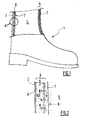
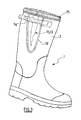
- FIG. figure 1 A boot 1 according to the invention is shown in FIG. figure 1 . It comprises a rod 2 connected to a sole 3.
- the rod 2 is impervious and is made of vulcanized natural rubber.
- the thickness of the rod 2 is between 16 and 35 mm.
- the rod further comprises a lateral adjustment zone having an opening 11 defining an edge 12 to which is attached a bellows 13.
- the bellows 13 is flexible and covers the opening 11 above.
- a clamp 14 is furthermore fixed on the rod 2, which makes it possible, if necessary, to bring the opposite edges of the opening 11 closer together so that the upper part of the boot 1 can be properly tightened, which accentuates the comfort for the user.
- a textile liner 4 is attached to the rod, on the inside 5 of the boot 1.
- This textile lining 4 comprises a first textile layer 6 formed from a fabric of the type described in the document WO 01/68963 .
- This first textile layer 6 is made of polyester and is in the form of a thick circular knit 3-dimensional type, having a front face and a rear face, the two faces being interconnected by an intermediate layer made to the using a bonding monofilament made of heat-set polyester.
- the title of the monofilament is of the order of 100 dtex.
- the first layer 6 is made by circular knitting.
- the thickness of the first textile layer 6 is greater than 3 mm, preferably of the order of 4.3 mm.
- the lining 4 furthermore has a second textile layer 7 situated on the side of the inner wall of the first textile layer 6.
- the second layer 7 is composed of about 60% bamboo viscose and about 40% combed cotton, which is also made of terry fabric.
- the lining 4 undergoes a so-called latex operation.
- the first textile layer 6 is coated with liquid rubber.
- the thickness of the coated latex layer is of the order of 0.05 mm, this layer must be sufficiently thin so as not to clog the first textile layer 6 latex, which affect the breathability properties of this layer and more generally the boot.
- the upper end of the liner 4 is extended by a folded edge 15 on the upper end of the rod 2.
- the edge 15 is made of a textile material having a plurality of openings, so as to facilitate the evacuation of humid air.
- the sweat from the user's foot 8 comes into contact with the second textile layer 7.
- the latter has high absorption and moisture transfer properties, so that the moisture or the sweat 9 internal to the boot 1 quickly passes through the second layer 7 until reaching the first layer 6.
- the moist and hot air then rises progressively upwardly inside the first textile layer 6, as represented by the arrow 10, towards the top of the stem of the boot 1, so as to evacuate the moisture at 15.
- the circulation of moist air is facilitated by the large thickness of the first textile layer 6 and the space provided in this layer by means of circular knitting of the 3-dimensional type.
- the elastic properties of the first layer 6 also increase the comfort for the user.
- the second layer 7 in bamboo viscose allows, by transferring moisture to the first layer 6, to keep the foot 8 of the user dry, thus also increasing comfort for the user.
Landscapes
- Health & Medical Sciences (AREA)
- Epidemiology (AREA)
- General Health & Medical Sciences (AREA)
- Public Health (AREA)
- Footwear And Its Accessory, Manufacturing Method And Apparatuses (AREA)
Applications Claiming Priority (1)
| Application Number | Priority Date | Filing Date | Title |
|---|---|---|---|
| FR0708733A FR2924902B1 (fr) | 2007-12-14 | 2007-12-14 | Botte |
Publications (1)
| Publication Number | Publication Date |
|---|---|
| EP2070431A1 true EP2070431A1 (de) | 2009-06-17 |
Family
ID=39638933
Family Applications (1)
| Application Number | Title | Priority Date | Filing Date |
|---|---|---|---|
| EP08171334A Withdrawn EP2070431A1 (de) | 2007-12-14 | 2008-12-11 | Stiefel |
Country Status (2)
| Country | Link |
|---|---|
| EP (1) | EP2070431A1 (de) |
| FR (1) | FR2924902B1 (de) |
Cited By (2)
| Publication number | Priority date | Publication date | Assignee | Title |
|---|---|---|---|---|
| US8074375B2 (en) * | 2009-03-16 | 2011-12-13 | Le Chameau | Boot |
| CN113073416A (zh) * | 2021-05-11 | 2021-07-06 | 李昌荣 | 一种基于可降解纤维生产的面料及其生产工艺 |
Citations (9)
| Publication number | Priority date | Publication date | Assignee | Title |
|---|---|---|---|---|
| US4430811A (en) | 1981-09-30 | 1984-02-14 | Sakashita Co., Ltd. | Footwear |
| DE4419801A1 (de) * | 1994-06-06 | 1995-12-07 | Akzo Nobel Nv | Verbundstoff und seine Verwendung in Schuhwerken |
| US5746013A (en) * | 1995-06-13 | 1998-05-05 | Faytex Corp. | Shoe having an air-cooled breathable shoe liner |
| US5955172A (en) * | 1997-01-29 | 1999-09-21 | Akzo Nobel Nv | Shoe with a ventilation layer |
| EP0968667A1 (de) * | 1998-06-29 | 2000-01-05 | Salomon S.A. | Schuh ausgestattet mit einer Absaug- und einer Feuchtigkeitsbeseitigungvorrichtung |
| WO2001068963A1 (fr) | 2000-03-15 | 2001-09-20 | Ames Europe | Nouveau tricot epais double face a structure souple |
| CN1544726A (zh) * | 2003-11-17 | 2004-11-10 | 宜宾丝丽雅股份有限公司 | 一种高性能的粘胶纤维及其制备方法 |
| CN1807708A (zh) * | 2006-01-26 | 2006-07-26 | 吉林化纤股份有限公司 | 高性能均质粘胶长丝及其制造方法 |
| CN101029420A (zh) * | 2007-03-24 | 2007-09-05 | 山东海龙股份有限公司 | 竹炭粘胶纤维及其制造方法 |
-
2007
- 2007-12-14 FR FR0708733A patent/FR2924902B1/fr not_active Expired - Fee Related
-
2008
- 2008-12-11 EP EP08171334A patent/EP2070431A1/de not_active Withdrawn
Patent Citations (9)
| Publication number | Priority date | Publication date | Assignee | Title |
|---|---|---|---|---|
| US4430811A (en) | 1981-09-30 | 1984-02-14 | Sakashita Co., Ltd. | Footwear |
| DE4419801A1 (de) * | 1994-06-06 | 1995-12-07 | Akzo Nobel Nv | Verbundstoff und seine Verwendung in Schuhwerken |
| US5746013A (en) * | 1995-06-13 | 1998-05-05 | Faytex Corp. | Shoe having an air-cooled breathable shoe liner |
| US5955172A (en) * | 1997-01-29 | 1999-09-21 | Akzo Nobel Nv | Shoe with a ventilation layer |
| EP0968667A1 (de) * | 1998-06-29 | 2000-01-05 | Salomon S.A. | Schuh ausgestattet mit einer Absaug- und einer Feuchtigkeitsbeseitigungvorrichtung |
| WO2001068963A1 (fr) | 2000-03-15 | 2001-09-20 | Ames Europe | Nouveau tricot epais double face a structure souple |
| CN1544726A (zh) * | 2003-11-17 | 2004-11-10 | 宜宾丝丽雅股份有限公司 | 一种高性能的粘胶纤维及其制备方法 |
| CN1807708A (zh) * | 2006-01-26 | 2006-07-26 | 吉林化纤股份有限公司 | 高性能均质粘胶长丝及其制造方法 |
| CN101029420A (zh) * | 2007-03-24 | 2007-09-05 | 山东海龙股份有限公司 | 竹炭粘胶纤维及其制造方法 |
Non-Patent Citations (3)
| Title |
|---|
| DATABASE WPI Week 200526, Derwent World Patents Index; AN 242878, XP002489974 * |
| DATABASE WPI Week 200706, Derwent World Patents Index; AN 046121, XP002489975 * |
| DATABASE WPI Week 200837, Derwent World Patents Index; AN F51625, XP002489976 * |
Cited By (2)
| Publication number | Priority date | Publication date | Assignee | Title |
|---|---|---|---|---|
| US8074375B2 (en) * | 2009-03-16 | 2011-12-13 | Le Chameau | Boot |
| CN113073416A (zh) * | 2021-05-11 | 2021-07-06 | 李昌荣 | 一种基于可降解纤维生产的面料及其生产工艺 |
Also Published As
| Publication number | Publication date |
|---|---|
| FR2924902A1 (fr) | 2009-06-19 |
| FR2924902B1 (fr) | 2010-03-12 |
Similar Documents
| Publication | Publication Date | Title |
|---|---|---|
| WO2016107990A1 (fr) | Procede de fabrication d'un article chaussant, article chaussant obtenu par ce procede, et machine servant a la fabrication d'un article chaussant | |
| EP2536370B1 (de) | Röhrenförmigen druck-orthese | |
| EP0968667B1 (de) | Schuh ausgestattet mit einer Absaug- und einer Feuchtigkeitsbeseitigungvorrichtung | |
| EP2222196B1 (de) | Bh, insbesondere trägerloser bh, mit versteifungselement und herstellungsverfahren dafür | |
| CA2915422A1 (fr) | Procede de fabrication d'un objet creux | |
| EP2740378A1 (de) | Vorrichtung, die einen Aufsatz für ein Schuhwerk bildet | |
| WO2007099261A2 (fr) | Article de protection du pied | |
| FR2924902A1 (fr) | Botte | |
| EP1795080A1 (de) | Wärmedämmverbundelement und Bekleidung, Schuh mit solchem Element | |
| WO2014146698A1 (fr) | Article de lingerie | |
| EP1465506A2 (de) | Nahtlose spitzenware | |
| EP0639946B1 (de) | Neuer sitzüberzug, sitzelement das mit diesem überzug ausgestattet ist und verfahren zum herstellen eines solchen elements | |
| EP1776879B1 (de) | Atmungsaktive Socke | |
| EP0981982B1 (de) | Verfahren zur Herstellung eines nichtzerreissbaren Bezuges für einen Sitz, und Sitzelement mit solchem Bezug | |
| FR2898248A1 (fr) | Vetement a porosite ajustable. | |
| EP2127845B1 (de) | Verbessertes Herstellungsverfahren eines Teils, das eine Armstütze mit Komfortüberzug bildet | |
| FR2750828A1 (fr) | Gant et doublure pour gant | |
| WO2008000934A2 (fr) | Bonnet de soutien-gorge a coussinet de protection d'armatures | |
| WO2025078402A1 (fr) | Manchon respirant de protection d'un site d'implantation d'un dispositif médical, et procédé de fabrication | |
| FR2895656A1 (fr) | Protection amovible pour un matelas | |
| WO2008145883A2 (fr) | Orthese plantaire en materiau composite et procede de fabrication | |
| WO2004021815A1 (fr) | Gant chauffable par l'haleine de l'utilisateur | |
| FR2908294A1 (fr) | Dispositif pour servir d'appareillage pour le corps du patient tel entre autre corset aussi bien de maintien, de soutien que de correction | |
| FR2898251A1 (fr) | Chaussure notamment de sport avec volet d'aeration | |
| FR2993756A3 (fr) | Coiffure |
Legal Events
| Date | Code | Title | Description |
|---|---|---|---|
| PUAI | Public reference made under article 153(3) epc to a published international application that has entered the european phase |
Free format text: ORIGINAL CODE: 0009012 |
|
| AK | Designated contracting states |
Kind code of ref document: A1 Designated state(s): AT BE BG CH CY CZ DE DK EE ES FI FR GB GR HR HU IE IS IT LI LT LU LV MC MT NL NO PL PT RO SE SI SK TR |
|
| AX | Request for extension of the european patent |
Extension state: AL BA MK RS |
|
| 17P | Request for examination filed |
Effective date: 20090810 |
|
| AKX | Designation fees paid |
Designated state(s): AT BE BG CH CY CZ DE DK EE ES FI FR GB GR HR HU IE IS IT LI LT LU LV MC MT NL NO PL PT RO SE SI SK TR |
|
| 17Q | First examination report despatched |
Effective date: 20111129 |
|
| STAA | Information on the status of an ep patent application or granted ep patent |
Free format text: STATUS: THE APPLICATION IS DEEMED TO BE WITHDRAWN |
|
| 18D | Application deemed to be withdrawn |
Effective date: 20121108 |