EP2070541A1 - Mittel zur förderung der regeneration von hartem gewebe - Google Patents
Mittel zur förderung der regeneration von hartem gewebe Download PDFInfo
- Publication number
- EP2070541A1 EP2070541A1 EP07828859A EP07828859A EP2070541A1 EP 2070541 A1 EP2070541 A1 EP 2070541A1 EP 07828859 A EP07828859 A EP 07828859A EP 07828859 A EP07828859 A EP 07828859A EP 2070541 A1 EP2070541 A1 EP 2070541A1
- Authority
- EP
- European Patent Office
- Prior art keywords
- diatomaceous earth
- bone
- hard
- regeneration
- administered
- Prior art date
- Legal status (The legal status is an assumption and is not a legal conclusion. Google has not performed a legal analysis and makes no representation as to the accuracy of the status listed.)
- Withdrawn
Links
Images




Classifications
-
- A—HUMAN NECESSITIES
- A61—MEDICAL OR VETERINARY SCIENCE; HYGIENE
- A61L—METHODS OR APPARATUS FOR STERILISING MATERIALS OR OBJECTS IN GENERAL; DISINFECTION, STERILISATION OR DEODORISATION OF AIR; CHEMICAL ASPECTS OF BANDAGES, DRESSINGS, ABSORBENT PADS OR SURGICAL ARTICLES; MATERIALS FOR BANDAGES, DRESSINGS, ABSORBENT PADS OR SURGICAL ARTICLES
- A61L27/00—Materials for grafts or prostheses or for coating grafts or prostheses
- A61L27/50—Materials characterised by their function or physical properties, e.g. injectable or lubricating compositions, shape-memory materials, surface modified materials
- A61L27/54—Biologically active materials, e.g. therapeutic substances
-
- A—HUMAN NECESSITIES
- A23—FOODS OR FOODSTUFFS; TREATMENT THEREOF, NOT COVERED BY OTHER CLASSES
- A23K—FODDER
- A23K20/00—Accessory food factors for animal feeding-stuffs
- A23K20/20—Inorganic substances, e.g. oligoelements
-
- A—HUMAN NECESSITIES
- A23—FOODS OR FOODSTUFFS; TREATMENT THEREOF, NOT COVERED BY OTHER CLASSES
- A23K—FODDER
- A23K20/00—Accessory food factors for animal feeding-stuffs
- A23K20/20—Inorganic substances, e.g. oligoelements
- A23K20/24—Compounds of alkaline earth metals, e.g. magnesium
-
- A—HUMAN NECESSITIES
- A23—FOODS OR FOODSTUFFS; TREATMENT THEREOF, NOT COVERED BY OTHER CLASSES
- A23L—FOODS, FOODSTUFFS OR NON-ALCOHOLIC BEVERAGES, NOT OTHERWISE PROVIDED FOR; PREPARATION OR TREATMENT THEREOF
- A23L29/00—Foods or foodstuffs containing additives; Preparation or treatment thereof
- A23L29/015—Inorganic compounds
-
- A—HUMAN NECESSITIES
- A23—FOODS OR FOODSTUFFS; TREATMENT THEREOF, NOT COVERED BY OTHER CLASSES
- A23L—FOODS, FOODSTUFFS OR NON-ALCOHOLIC BEVERAGES, NOT OTHERWISE PROVIDED FOR; PREPARATION OR TREATMENT THEREOF
- A23L33/00—Modifying nutritive qualities of foods; Dietetic products; Preparation or treatment thereof
- A23L33/10—Modifying nutritive qualities of foods; Dietetic products; Preparation or treatment thereof using additives
-
- A—HUMAN NECESSITIES
- A23—FOODS OR FOODSTUFFS; TREATMENT THEREOF, NOT COVERED BY OTHER CLASSES
- A23L—FOODS, FOODSTUFFS OR NON-ALCOHOLIC BEVERAGES, NOT OTHERWISE PROVIDED FOR; PREPARATION OR TREATMENT THEREOF
- A23L33/00—Modifying nutritive qualities of foods; Dietetic products; Preparation or treatment thereof
- A23L33/20—Reducing nutritive value; Dietetic products with reduced nutritive value
- A23L33/21—Addition of substantially indigestible substances, e.g. dietary fibres
- A23L33/29—Mineral substances, e.g. mineral oils or clays
-
- A—HUMAN NECESSITIES
- A61—MEDICAL OR VETERINARY SCIENCE; HYGIENE
- A61K—PREPARATIONS FOR MEDICAL, DENTAL OR TOILETRY PURPOSES
- A61K33/00—Medicinal preparations containing inorganic active ingredients
-
- A—HUMAN NECESSITIES
- A61—MEDICAL OR VETERINARY SCIENCE; HYGIENE
- A61K—PREPARATIONS FOR MEDICAL, DENTAL OR TOILETRY PURPOSES
- A61K35/00—Medicinal preparations containing materials or reaction products thereof with undetermined constitution
- A61K35/02—Medicinal preparations containing materials or reaction products thereof with undetermined constitution from inanimate materials
-
- A—HUMAN NECESSITIES
- A61—MEDICAL OR VETERINARY SCIENCE; HYGIENE
- A61K—PREPARATIONS FOR MEDICAL, DENTAL OR TOILETRY PURPOSES
- A61K36/00—Medicinal preparations of undetermined constitution containing material from algae, lichens, fungi or plants, or derivatives thereof, e.g. traditional herbal medicines
- A61K36/02—Algae
-
- A—HUMAN NECESSITIES
- A61—MEDICAL OR VETERINARY SCIENCE; HYGIENE
- A61L—METHODS OR APPARATUS FOR STERILISING MATERIALS OR OBJECTS IN GENERAL; DISINFECTION, STERILISATION OR DEODORISATION OF AIR; CHEMICAL ASPECTS OF BANDAGES, DRESSINGS, ABSORBENT PADS OR SURGICAL ARTICLES; MATERIALS FOR BANDAGES, DRESSINGS, ABSORBENT PADS OR SURGICAL ARTICLES
- A61L27/00—Materials for grafts or prostheses or for coating grafts or prostheses
- A61L27/36—Materials for grafts or prostheses or for coating grafts or prostheses containing ingredients of undetermined constitution or reaction products thereof, e.g. transplant tissue, natural bone, extracellular matrix
- A61L27/3637—Materials for grafts or prostheses or for coating grafts or prostheses containing ingredients of undetermined constitution or reaction products thereof, e.g. transplant tissue, natural bone, extracellular matrix characterised by the origin of the biological material other than human or animal, e.g. plant extracts, algae
-
- A—HUMAN NECESSITIES
- A61—MEDICAL OR VETERINARY SCIENCE; HYGIENE
- A61P—SPECIFIC THERAPEUTIC ACTIVITY OF CHEMICAL COMPOUNDS OR MEDICINAL PREPARATIONS
- A61P1/00—Drugs for disorders of the alimentary tract or the digestive system
- A61P1/02—Stomatological preparations, e.g. drugs for caries, aphtae, periodontitis
-
- A—HUMAN NECESSITIES
- A61—MEDICAL OR VETERINARY SCIENCE; HYGIENE
- A61P—SPECIFIC THERAPEUTIC ACTIVITY OF CHEMICAL COMPOUNDS OR MEDICINAL PREPARATIONS
- A61P19/00—Drugs for skeletal disorders
-
- A—HUMAN NECESSITIES
- A61—MEDICAL OR VETERINARY SCIENCE; HYGIENE
- A61P—SPECIFIC THERAPEUTIC ACTIVITY OF CHEMICAL COMPOUNDS OR MEDICINAL PREPARATIONS
- A61P19/00—Drugs for skeletal disorders
- A61P19/08—Drugs for skeletal disorders for bone diseases, e.g. rachitism, Paget's disease
-
- A—HUMAN NECESSITIES
- A61—MEDICAL OR VETERINARY SCIENCE; HYGIENE
- A61L—METHODS OR APPARATUS FOR STERILISING MATERIALS OR OBJECTS IN GENERAL; DISINFECTION, STERILISATION OR DEODORISATION OF AIR; CHEMICAL ASPECTS OF BANDAGES, DRESSINGS, ABSORBENT PADS OR SURGICAL ARTICLES; MATERIALS FOR BANDAGES, DRESSINGS, ABSORBENT PADS OR SURGICAL ARTICLES
- A61L2300/00—Biologically active materials used in bandages, wound dressings, absorbent pads or medical devices
- A61L2300/20—Biologically active materials used in bandages, wound dressings, absorbent pads or medical devices containing or releasing organic materials
- A61L2300/30—Compounds of undetermined constitution extracted from natural sources, e.g. Aloe Vera
-
- A—HUMAN NECESSITIES
- A61—MEDICAL OR VETERINARY SCIENCE; HYGIENE
- A61L—METHODS OR APPARATUS FOR STERILISING MATERIALS OR OBJECTS IN GENERAL; DISINFECTION, STERILISATION OR DEODORISATION OF AIR; CHEMICAL ASPECTS OF BANDAGES, DRESSINGS, ABSORBENT PADS OR SURGICAL ARTICLES; MATERIALS FOR BANDAGES, DRESSINGS, ABSORBENT PADS OR SURGICAL ARTICLES
- A61L2300/00—Biologically active materials used in bandages, wound dressings, absorbent pads or medical devices
- A61L2300/40—Biologically active materials used in bandages, wound dressings, absorbent pads or medical devices characterised by a specific therapeutic activity or mode of action
- A61L2300/404—Biocides, antimicrobial agents, antiseptic agents
-
- A—HUMAN NECESSITIES
- A61—MEDICAL OR VETERINARY SCIENCE; HYGIENE
- A61L—METHODS OR APPARATUS FOR STERILISING MATERIALS OR OBJECTS IN GENERAL; DISINFECTION, STERILISATION OR DEODORISATION OF AIR; CHEMICAL ASPECTS OF BANDAGES, DRESSINGS, ABSORBENT PADS OR SURGICAL ARTICLES; MATERIALS FOR BANDAGES, DRESSINGS, ABSORBENT PADS OR SURGICAL ARTICLES
- A61L2300/00—Biologically active materials used in bandages, wound dressings, absorbent pads or medical devices
- A61L2300/40—Biologically active materials used in bandages, wound dressings, absorbent pads or medical devices characterised by a specific therapeutic activity or mode of action
- A61L2300/41—Anti-inflammatory agents, e.g. NSAIDs
-
- A—HUMAN NECESSITIES
- A61—MEDICAL OR VETERINARY SCIENCE; HYGIENE
- A61L—METHODS OR APPARATUS FOR STERILISING MATERIALS OR OBJECTS IN GENERAL; DISINFECTION, STERILISATION OR DEODORISATION OF AIR; CHEMICAL ASPECTS OF BANDAGES, DRESSINGS, ABSORBENT PADS OR SURGICAL ARTICLES; MATERIALS FOR BANDAGES, DRESSINGS, ABSORBENT PADS OR SURGICAL ARTICLES
- A61L2300/00—Biologically active materials used in bandages, wound dressings, absorbent pads or medical devices
- A61L2300/40—Biologically active materials used in bandages, wound dressings, absorbent pads or medical devices characterised by a specific therapeutic activity or mode of action
- A61L2300/412—Tissue-regenerating or healing or proliferative agents
-
- A—HUMAN NECESSITIES
- A61—MEDICAL OR VETERINARY SCIENCE; HYGIENE
- A61L—METHODS OR APPARATUS FOR STERILISING MATERIALS OR OBJECTS IN GENERAL; DISINFECTION, STERILISATION OR DEODORISATION OF AIR; CHEMICAL ASPECTS OF BANDAGES, DRESSINGS, ABSORBENT PADS OR SURGICAL ARTICLES; MATERIALS FOR BANDAGES, DRESSINGS, ABSORBENT PADS OR SURGICAL ARTICLES
- A61L2300/00—Biologically active materials used in bandages, wound dressings, absorbent pads or medical devices
- A61L2300/40—Biologically active materials used in bandages, wound dressings, absorbent pads or medical devices characterised by a specific therapeutic activity or mode of action
- A61L2300/428—Vitamins, e.g. tocopherol, riboflavin
Definitions
- the present invention relates to agents, pharmaceutical compositions, food compositions, foods, animal feeds, etc., useful for regeneration of hard tissues.
- the object of the present invention is to provide hard-tissue regeneration promoters, pharmaceutical compositions, food compositions, foods, animal feeds, etc., useful for regeneration of an impaired or defective hard tissue, which can be prepared in low cost of production and labor.
- the inventors of the present application found that regeneration of a defective hard issue can be promoted by administering diatomaceous earth under the periosteum in the vicinity of the area having the defective hard tissue or orally administering diatomaceous earth, and have thus accomplished the present invention.
- the hard-tissue regeneration promoter according to the present invention contains diatomaceous earth as an active ingredient.
- the aforementioned hard tissue is exemplified by a hard bone, a reparative dentin, etc., the hard bone being exemplified by an alveolar bone, etc.
- the hard-tissue regeneration promoter according to the present invention may be administered or filled beneath the periosteum, may be administered into the defective medullary cavity associated with tooth extraction or the like or into the medullary cavity in the vicinity of a fractured site, or may be administered orally.
- the pharmaceutical composition according to the present invention contains diatomaceous earth as an active ingredient.
- the pharmaceutical composition according to the present invention may be a preparation to be administered beneath the periosteum, may be a preparation to be administered into the defective medullary cavity associated with tooth extraction or the like or into the medullary cavity in the vicinity of a fractured site, or may be a preparation to be administered orally.
- the food composition according to the present invention contains diatomaceous earth.
- the food according to the present invention contains diatomaceous earth.
- the animal feed according to the present invention contains diatomaceous earth.
- diatomaceous earth refers to a deposit composed of the remains of diatom, including marine diatomaceous earth including diatomaceous ooze, which is a deposit of marine diatom and freshwater diatomaceous earth, which is a deposit of freshwater diatom.
- the diatomaceous earth contained in the agent, pharmaceutical composition, food composition, food, animal feed, etc. according to the present invention may be either a burned product which is burned at a high temperature or a dried product dried with natural air.
- Embodiments of the present invention accomplished based on the above-described findings are hereinafter described in detail by giving Examples. When using commercial apparatuses, unless otherwise explained, protocols attached to them are used.
- a tooth 100 consists of an enamel 10, a dentine 20, a cementum 80, a pulp 30, etc., with components such as a gingiva (gum) 40, a periodontium 60 and a cortical bone (compact bone) 71, cancellous bone 72, etc. and is supported by periodontal tissues, such as alveolar bone which is a hard tissue.
- Example 1 after a tooth had been extracted in a dog, the gingiva 40 adhering to an alveolar bone was removed together with the periosteum 50 and diatomaceous earth was filled beneath the periosteum 50 covering the surface of the alveolar bone. It was found that regeneration of a new bone was promoted in the defective cancellous bone 72, on the cortical bone 71 near the site where diatomaceous earth had been administered, at the bottom of the medullary cavity 73 near the defective region (alveolar bone) of the tooth 100, and above the medullary cavity 73.
- Example 2 it was indicated that regeneration of a new bone was similarly promoted on the cortical bone 71 and the defective region of the tooth 100 (cancellous bone 72 in the alveolar region)by orally administering diatomaceous earth to a dog in which the inside of the alveolar bone had been smoothly drilled after a tooth had been extracted.
- diatomaceous earth is useful in promoting regeneration of hard tissues in impaired or defective areas resulting from osteoclasis, absorption or fracture, due to tooth extraction, embedeling and fixation of an implant, toxin of the bacteria associated with endodontal or periodontal disease, infection, bone deletion expediently performed during an operation, etc.
- the shaft of a hard bone which is a hard tissue, such as a long bone 200 of the humerus, femur, etc., as shown in FIG. 2 , consists of a periosteum 110, a cortical bone 120, a bone marrow 130, etc., the end portion of the bone 200 being composed of a periosteum 140, a cortical bone 150, a spongin 160, bone marrow, etc.
- the hard tissue can be regenerated in the impaired/defective area by administering diatomaceous earth beneath the periosteum 110 and/or the periosteum 140 in the vicinity of the impaired/defective area, administering diatomaceous earth into the medullary cavity, or orally administering diatomaceous earth.
- diatomaceous earth is useful in promoting the regeneration of hard tissues in the areas which have become impaired or defective due to fracture, implant embedding, bacterial toxin, suppuration, etc.
- Examples of the hard tissue in which regeneration can be promoted by using diatomaceous earth include hard bones (alveolar bones, jawbones, femurs, humeri, neck bones, radius, ulna, vertebra, etc.), reparative dentin of the tooth 100, and the like.
- the diatomaceous earth to be used is not particularly limited as long as it is a fossilized diatome, such as marine diatomaceous earth and freshwater diatomaceous earth, or a burned product or a dried product of diatomaceous earth.
- diatomaceous earth which promotes regeneration of impaired or defective hard tissues
- diatomaceous earth which promotes regeneration of impaired or defective hard tissues
- the agent containing diatomaceous earth as an active ingredient is useful as an agent which promotes regeneration of impaired or defective hard tissues.
- the food containing diatomaceous earth is useful as a functional food, a food for specified health uses, etc. for human patients in whom regeneration of impaired or defective hard tissues is required.
- the animal feed containing diatomaceous earth is useful for animal patients in which regeneration of impaired or defective hard tissues is required.
- diatomaceous earth is available at low prices and in large quantities. Therefore, the agents, pharmaceutical compositions, food compositions, foods, etc. according to the present invention can be provided in a low production and labor costs.
- the agent according to the present invention agent is not particularly limited as long as it contains diatomaceous earth as an active ingredient. It may further contain a pharmacologically acceptable formulation additive (e.g., an excipient, a pH adjuster, a binder, a lubricant, a disintegrator, a corrigent, a solvent, a stabilizer, a sugar coating agent, a preservative, a buffer, a suspending agent, an emulsifier, an aromatic, a solubilizing agent, a colorant, a viscous agent, etc.) depending on the body part at which it is used, the purpose of its use, or the mode of its administration.
- a pharmacologically acceptable formulation additive e.g., an excipient, a pH adjuster, a binder, a lubricant, a disintegrator, a corrigent, a solvent, a stabilizer, a sugar coating agent, a preservative, a buffer, a suspending agent,
- it may further contain an agent for promoting restoration and/or regeneration of periodontal tissues, preventing bacterial infection or suppressing inflammation, which is exemplified by a polyphosphate such as sodium polyphosphate and alginic acid as a wound dressing material.
- a polyphosphate such as sodium polyphosphate and alginic acid
- the agent according to the present invention may be administered, for example, orally to human or non-human vertebrates. Alternatively, it may be administered into the medullary cavity or beneath the periosteum 50/110/140, etc.
- it may be prepared into tablets, capsules, granules, powder, syrups, pills, etc.
- administration beneath the periosteum 50/110/140 it may be prepared into injections or the like. These preparations can be produced by the conventional methods using above-mentioned formulation additives.
- the food according to the present invention may be any kind of food as long as it contains diatomaceous earth.
- it may further contain an existing food additive (s) such as an antioxidant (e.g., vitamin A, C, E, K, polyphenol, etc.), a sweetener (e.g., aspartame, xylitol, etc.), a preservative (e.g., potassium sorbate, sodium benzoate, etc.), an antioxidant (e.g., sodium sulfite, L-ascorbic acid sodium, etc.), a coloring agent (turmeric pigment, paprika pigment, etc.), a seasoning (amino acid, meat extract, etc.), an acidulant (e.g., citric acid, malic acid, etc.), and/or the like.
- an antioxidant e.g., vitamin A, C, E, K, polyphenol, etc.
- a sweetener e.g., aspartame, xylitol, etc.
- the food according to the present invention can be used in the form of, but not limited to, for example, supplements (in capsule, tablet, or granular form), noodles (e.g., Japanese noodles etc.), yogurt, hard sweets (e.g., candies, drops, etc.), seasoned powders.
- supplements in capsule, tablet, or granular form
- noodles e.g., Japanese noodles etc.
- yogurt e.g., yogurt
- hard sweets e.g., candies, drops, etc.
- seasoned powders e.g., seasoned powders.
- the food according to the present invention can be in any form such as solid, powder, liquid, fluid, cream, gel, etc.
- the food according to the present invention is designed in principle for healthy people, but may be digested by those patients in whom regeneration of impaired or defective hare tissues is required.
- the animal feed according to the present invention is not limited as long as it contains diatomaceous earth and may further contain, besides diatomaceous earth, an existing feed additive, such as an antioxidant, an antifungal agent, a binder, an emulsifier, a regulator, an amino acid, a vitamin, a mineral, pigment, synthetic antimicrobials, antibiotics, a flavoring, a taste-improving agent, an enzyme, a probiotic agent, etc.
- an existing feed additive such as an antioxidant, an antifungal agent, a binder, an emulsifier, a regulator, an amino acid, a vitamin, a mineral, pigment, synthetic antimicrobials, antibiotics, a flavoring, a taste-improving agent, an enzyme, a probiotic agent, etc.
- the hard-tissue regeneration promoter containing diatomaceous earth as an active ingredient may be administered anywhere in the body of the patient having a impaired or defective hard tissue, but it is preferably administered directly to the impaired or defective area or to the vicinity of the area in which regeneration of a hard tissue is required.
- regeneration of hard bone can be promoted by administration beneath the periosteum 50/110/140, located nearest to the bone required to be regenerated, or to a perforated area in pulp cavity AA, a root tip 31, or the root canal 32 of a tooth 100.
- regeneration of reparative dentin is promoted by filling the dentine 20 of the impaired or defective tooth 100 or other such area with the aforementioned promoter.
- the dentine 20 of the impaired or defective tooth 100 or other point may be filled so that the tooth pulp 30 will not be exposed.
- the mode of administration includes, but not limited to, infusion, spreading, restoration, etc.
- the hard-tissue regeneration promoter may be orally administered to a patient who has the impaired or defective hard tissue.
- diatomaceous earth intake of diatomaceous earth may be started, as a pharmaceutical composition or a food containing diatomaceous earth as an active ingredient, even before a hard tissue becomes impaired or defective so that the effect of promoting hard-tissue regeneration can be exerted immediately.
- An alveolar bone defect was created in dogs, and, diatomaceous earth was administered beneath the periosteum to promote new bone regeneration at the defected site.
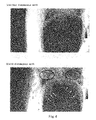
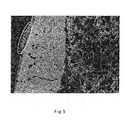
- the inside of the alveolar bone of the dogs was drilled smoothly. Then, the dogs were administered an oral dose of 8 to 20 g of diatomaceous earth together with their food, which corresponded to 2 to 5% of their daily food intake. After one month, by preparing sections, the new bone tissues near the defective alveolar bone were examined by calcium and silicon element mapping using an EPMA (Electron Probe Micro Analyzer; Shimadzu EPMA8705, acceleration voltage 2 kV, beam current 15 nA, MAP 512 x 512 point), (refer to FIG. 1 for areas observed). The results are shown in FIG. 5 .
- EPMA Electro Probe Micro Analyzer
- lower limb bones of rats were artificially perforated and diatomaceous earth was orally administered to promote new bone regeneration in the perforated area.
- a cassette containing an HR type imaging plate manufactured by Fujifilm Medical Co., Ltd. was placed with 3 x geometric enlargement ratio in a micro-focus X-ray inspection system, P70 II (focal spot size: 10 ⁇ m x 10 ⁇ m) manufactured by Pony Industry Co., Ltd., enlarged X-ray images of a mass of the bones from which the soft tissue had not been removed were projected under the exposure setting of 30 kV, 90 ⁇ A for 10 sec.
- the image data recorded on the imaging plate was scanned by a digital X-ray imaging diagnostic system FCR 5000MA manufactured by Fuji Photo Film Co., Ltd. and x-ray microscopic images of each sample were obtained. Referring to FIG. 6 , the results obtained by the observation are described in detail hereinbelow.
- FIG. 6 A to D At 2 weeks after perforation ( FIG. 6 A to D ): In the individual rats in the control group ( FIG. 6A ), a semicircular depression having a diameter close to that of the perforated hole was clearly observed, whereas in the diatomaceous earth-administered groups ( FIG. 6 B:2%, C:5%, D:10%) callus-like radiopaque region was observed in the semicircular depression; and as the concentration of the diatomaceous earth administered increased, the area of the radiopaque region increased in proportion to the concentration. Furthermore, in the diatomaceous earth-administered groups, remarkable reparative hypertrophy of the cortical bone was recognized in the bone marrow side of the bottom of the semicircular depression.
- FIG. 6 E to H At 4 weeks after perforation ( FIG. 6 E to H ): In the individual rats in the control group ( FIG. 6A ) the semicircular depression became shallow and recovered enough to appear as a dish-like depression. On the other hand, in the diatomaceous earth-administered groups ( FIG. 6 B:2%, C:5%, D:10%) such a dish-like depression was hardly observed; and as the concentration of the diatomaceous earth administered increased, the thickness of the cortical bone increased in proportion to the concentration.
- the radiolucency due to the bone regeneration which filled the site corresponding to a semicircular depression that had been observed two weeks after the perforation was recovered to the same degree as the surrounding areas; and at the bone marrow side near the area corresponding to the bottom of the depression site, a slight reparative hypertrophy of the cortical bone was observed.
- FIGs. 6 I to L At 5 weeks after perforation ( FIGs. 6 I to L ): In all the rats in the control group ( FIG. 6I ) as well as the diatomaceous earth-administered groups ( FIG. 6 J:2%, K:5%, L:10%), the semicircular depression area disappeared and the cortical bone was recovered to almost normal morphology. It should be noted that in the diatomaceous earth groups, the reparative hypertrophy at the bone marrow side of the cortical bone observed 4 weeks after perforation still rudimentarily remained.
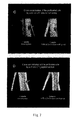
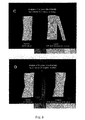
- volume-rendering image ( FIG. 7A ): In the control rats, a semicircular depression having a diameter close to that of the perforated hole was still clearly observed, whereas in the 10% diatomaceous earth-administered group, an obvious decrease in the diameter of the semicircular perforation area was observed and thus closure and healing of the wound caused by the perforation has been progressed. On the other hand, in the 10% diatomaceous earth-administered group, the radiolucency of the surrounding cortical bone increased.
- FIG. 7B Sagittally sectional image ( FIG. 7B ) : In the control rats, a semicircular depression having a diameter close to that of the perforated hole was clearly observed. Moreover, the bottom of the depression area was still broadly communicating with the medullary cavity; closure and healing of the perforation wound or regeneration of the cortical bone was hardly observed. In contrast, in the 10% diatomaceous earth-administered group, an obvious decrease in the depth of the semicircular depression was observed, the communication of the bottom of the depression area with the medullary cavity was narrowed, and thus closure and healing of the perforation wound as well as a sign of regeneration of the cortical bone was observed.
- FIG. 7D Sagittally sectional image ( FIG. 7D ) : In the control rats, although the semicircular depression became shallow, the thickness at the periosteum side of the cortical bone was insufficient and the thicknesses of all its layers were also insufficient. Meanwhile, in the diatomaceous earth-administered groups, a semilunar bone regeneration area bounded by one layer from the bottom of the semicircular depression was observed and all the cortical bone layers recovered their thicknesses which was almost equivalent to those of the surrounding areas.
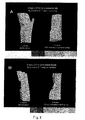
- volume-rendering image ( FIG. 8A ) : Both in the control and diatomaceous earth groups, a blocking substance serving to block the semicircular depression which had a much higher radiolucency, i.e., considerably lower density, than the surrounding areas was observed.
- FIG. 8B Sagittally sectional image ( FIG. 8B ) : In the control rats, although the half part of the depression was filled with the low-density blocking substance, the bottom had a low density without closure in the perforation communicating with the medullary cavity and thus restoration at the bottom resulting from dense regenerated bone was not observed. In contrast, in the diatomaceous earth-administrated groups, restoration resulting from tightly dense regenerated bone was observed at the bottom. The volume of the blocking substance in the depression was smaller than that in the depression of the control rats. This was probably because the regeneration of the cortical bone has been already progressing more rapidly than in the control group and thus bone substitution during early-stage mineralization caused by the filling substance through calcification occurred more rapidly than in the control group.
- volume-rendering image Although large differences were not observed, on the whole, the diatomaceous earth-administered groups had higher bone densities.
- FIG. 8D Sagittally sectional image ( FIG. 8D ) : In the control rats, although the semicircular depression became shallow, the thicknesses of all the cortical bone layers were still insufficient. The bone mineral density of the regenerated bone at the bottom was almost equivalent to those of the surrounding areas. On the other hand, in the diatomaceous earth-administered groups, the semilunar area of bone regeneration, bounded by one layer from the bottom of the semicircular depression, was observed and the cortical bone layers recovered their thicknesses which was almost equivalent to those of the surrounding areas. The bone density was similar to those of the surrounding areas. It was therefore concluded that the bone of the diatomaceous earth-administrate reel groups was recovered to the degree that it can bear loads in terms of structural strength as well.
- hard-tissue regeneration promoters useful for regeneration of impaired or defective hard tissues, which can be prepared in low production and labor costs.
Landscapes
- Health & Medical Sciences (AREA)
- Life Sciences & Earth Sciences (AREA)
- Chemical & Material Sciences (AREA)
- Engineering & Computer Science (AREA)
- Medicinal Chemistry (AREA)
- Polymers & Plastics (AREA)
- Public Health (AREA)
- Veterinary Medicine (AREA)
- Animal Behavior & Ethology (AREA)
- General Health & Medical Sciences (AREA)
- Epidemiology (AREA)
- Food Science & Technology (AREA)
- Pharmacology & Pharmacy (AREA)
- Inorganic Chemistry (AREA)
- Mycology (AREA)
- Nutrition Science (AREA)
- Biotechnology (AREA)
- Biomedical Technology (AREA)
- Botany (AREA)
- Animal Husbandry (AREA)
- Zoology (AREA)
- Natural Medicines & Medicinal Plants (AREA)
- Chemical Kinetics & Catalysis (AREA)
- Transplantation (AREA)
- Dermatology (AREA)
- Physical Education & Sports Medicine (AREA)
- Oral & Maxillofacial Surgery (AREA)
- Molecular Biology (AREA)
- Bioinformatics & Cheminformatics (AREA)
- Organic Chemistry (AREA)
- Nuclear Medicine, Radiotherapy & Molecular Imaging (AREA)
- General Chemical & Material Sciences (AREA)
- Dispersion Chemistry (AREA)
- Alternative & Traditional Medicine (AREA)
- Oil, Petroleum & Natural Gas (AREA)
- Medical Informatics (AREA)
- Microbiology (AREA)
- Orthopedic Medicine & Surgery (AREA)
- Rheumatology (AREA)
- Medicines Containing Material From Animals Or Micro-Organisms (AREA)
Applications Claiming Priority (2)
| Application Number | Priority Date | Filing Date | Title |
|---|---|---|---|
| JP2006256374 | 2006-09-21 | ||
| PCT/JP2007/069118 WO2008035816A1 (en) | 2006-09-21 | 2007-09-21 | Promoter of hard tissue regeneration |
Publications (2)
| Publication Number | Publication Date |
|---|---|
| EP2070541A1 true EP2070541A1 (de) | 2009-06-17 |
| EP2070541A4 EP2070541A4 (de) | 2011-04-13 |
Family
ID=39200632
Family Applications (1)
| Application Number | Title | Priority Date | Filing Date |
|---|---|---|---|
| EP07828859A Withdrawn EP2070541A4 (de) | 2006-09-21 | 2007-09-21 | Mittel zur förderung der regeneration von hartem gewebe |
Country Status (6)
| Country | Link |
|---|---|
| US (1) | US20100143488A1 (de) |
| EP (1) | EP2070541A4 (de) |
| JP (2) | JP5557448B2 (de) |
| KR (1) | KR20090098783A (de) |
| CN (1) | CN101573127B (de) |
| WO (1) | WO2008035816A1 (de) |
Families Citing this family (2)
| Publication number | Priority date | Publication date | Assignee | Title |
|---|---|---|---|---|
| EP2070541A4 (de) * | 2006-09-21 | 2011-04-13 | Toshiki Oguro | Mittel zur förderung der regeneration von hartem gewebe |
| KR101638373B1 (ko) | 2014-09-16 | 2016-07-12 | 주식회사 마루치 | 초속경 수경성 바인더 조성물 |
Family Cites Families (31)
| Publication number | Priority date | Publication date | Assignee | Title |
|---|---|---|---|---|
| US3271161A (en) * | 1964-06-22 | 1966-09-06 | John C Eshleman | Poultry feed containing about 1% diatomaceous earth |
| JPS5126211A (en) * | 1974-08-24 | 1976-03-04 | Masakuni Kanai | Honeno seiseisokushinzaino seizohoho |
| DE3316726A1 (de) * | 1983-05-07 | 1984-11-08 | Rex Ellis Preston Victoria Newnham | Therapeutisch wirksames gemisch |
| US4729902A (en) * | 1983-08-11 | 1988-03-08 | Control Feeds, Inc. | Animal and fowl feed supplement and process of manufacture |
| JPS6172671A (ja) * | 1984-09-18 | 1986-04-14 | 村井 吉雄 | セラミツクスの組成とその使用方法 |
| JPS6291447A (ja) * | 1985-10-17 | 1987-04-25 | 昭和薬品化工株式会社 | セメント組成物 |
| FI81010C (fi) * | 1986-09-05 | 1990-09-10 | Biocon Oy | Stoedstruktur foer bentransplantat. |
| JPH01228432A (ja) | 1988-03-07 | 1989-09-12 | Control Feeds Inc | 動物及び鳥類の飼料添加物及びその製造方法 |
| US4954448A (en) * | 1988-12-27 | 1990-09-04 | Nelson Research & Development Company | Modulation of adenylate cyclase response |
| FR2646084B1 (fr) | 1989-04-20 | 1994-09-16 | Fbfc International Sa | Materiau bioreactif de remplissage de cavites osseuses |
| US5563124A (en) * | 1991-04-22 | 1996-10-08 | Intermedics Orthopedics/ Denver, Inc. | Osteogenic product and process |
| DE69214005T2 (de) * | 1991-05-01 | 1997-05-15 | Chichibu Onoda Cement Corp | Erhärtende Zusammensetzungen zur Verwendung in der Medizin oder Zahnheilkunde |
| JPH05260905A (ja) * | 1992-01-20 | 1993-10-12 | Pfizer Pharmaceut Co Ltd | 家畜用飼料添加物およびそれを用いた家畜用飼料 |
| US5415547A (en) | 1993-04-23 | 1995-05-16 | Loma Linda University | Tooth filling material and method of use |
| JP2002504083A (ja) * | 1996-03-05 | 2002-02-05 | オーケスト インコーポレイテッド | ヒアルロン酸および増殖因子による骨の増殖を促進する方法 |
| US5707970A (en) * | 1997-02-12 | 1998-01-13 | Nutrition 21 | Arginine silicate complex and use thereof |
| AU4219100A (en) * | 1999-04-07 | 2000-10-23 | W.R. Grace & Co.-Conn. | Additives for desensitizing and remineralizing dentifrice compositions |
| ES2162746B1 (es) * | 1999-10-21 | 2003-02-16 | Lipotec Sa | Microcapsulas para la estabilizacion de productos cosmeticos, farmaceuticos o de alimentacion. |
| GB2363115A (en) * | 2000-06-10 | 2001-12-12 | Secr Defence | Porous or polycrystalline silicon orthopaedic implants |
| JP2002220314A (ja) * | 2000-11-21 | 2002-08-09 | Gc Corp | 根管充填用グラスアイオノマー系シーラー用粉末 |
| JP2003289829A (ja) * | 2002-04-04 | 2003-10-14 | Takatsugu Kakeida | 栄養補助食品 |
| JP2004137202A (ja) * | 2002-10-18 | 2004-05-13 | Yoshio Watanabe | 花粉症に対する免疫性向上クリ−ム |
| JP2005052065A (ja) * | 2003-08-04 | 2005-03-03 | Nof Corp | 栄養組成物 |
| US8895540B2 (en) * | 2003-11-26 | 2014-11-25 | DePuy Synthes Products, LLC | Local intraosseous administration of bone forming agents and anti-resorptive agents, and devices therefor |
| US20050123490A1 (en) * | 2003-12-04 | 2005-06-09 | Kazue Yamagishi | Composition and method for prevention and treatment of dental caries |
| AP2006003632A0 (en) * | 2003-12-16 | 2006-06-30 | Pfizer Prod Inc | Pyridol[2,3-D] pyrimidine-2,4-Diamines as PDE 2 inhibitors |
| JP2005253442A (ja) * | 2004-03-09 | 2005-09-22 | Hitachi Medical Corp | 発現プロファイルが人間の歯髄幹細胞と間葉幹細胞の間で異なる遺伝子のグループ |
| JP4588403B2 (ja) * | 2004-10-04 | 2010-12-01 | 森永乳業株式会社 | カルシウム・マグネシウム含有組成物の製造方法 |
| GB0504657D0 (en) * | 2005-03-05 | 2005-04-13 | Psimedica Ltd | Compositions and methods of treatment |
| CN101151039A (zh) * | 2005-04-04 | 2008-03-26 | 加利福尼亚大学董事会 | 用于止血调节和伤口愈合治疗的无机材料 |
| EP2070541A4 (de) * | 2006-09-21 | 2011-04-13 | Toshiki Oguro | Mittel zur förderung der regeneration von hartem gewebe |
-
2007
- 2007-09-21 EP EP07828859A patent/EP2070541A4/de not_active Withdrawn
- 2007-09-21 CN CN200780040020XA patent/CN101573127B/zh not_active Expired - Fee Related
- 2007-09-21 JP JP2008535422A patent/JP5557448B2/ja not_active Expired - Fee Related
- 2007-09-21 WO PCT/JP2007/069118 patent/WO2008035816A1/ja not_active Ceased
- 2007-09-21 US US12/441,788 patent/US20100143488A1/en not_active Abandoned
- 2007-09-21 KR KR1020097008045A patent/KR20090098783A/ko not_active Ceased
-
2012
- 2012-01-13 JP JP2012005534A patent/JP5898500B2/ja not_active Expired - Fee Related
Also Published As
| Publication number | Publication date |
|---|---|
| CN101573127A (zh) | 2009-11-04 |
| KR20090098783A (ko) | 2009-09-17 |
| CN101573127B (zh) | 2013-04-10 |
| US20100143488A1 (en) | 2010-06-10 |
| WO2008035816A1 (en) | 2008-03-27 |
| JPWO2008035816A1 (ja) | 2010-01-28 |
| JP2012116844A (ja) | 2012-06-21 |
| JP5557448B2 (ja) | 2014-07-23 |
| JP5898500B2 (ja) | 2016-04-06 |
| EP2070541A4 (de) | 2011-04-13 |
Similar Documents
| Publication | Publication Date | Title |
|---|---|---|
| Maiorana et al. | Alveolar socket preservation with demineralised bovine bone mineral and a collagen matrix | |
| Karaca et al. | Alveolar ridge preservation with a free gingival graft in the anterior maxilla: volumetric evaluation in a randomized clinical trial | |
| Avila-Ortiz et al. | Effectiveness of three different alveolar ridge preservation techniques: a pilot randomized controlled trial. | |
| Daif | Effect of a multiporous beta–tricalicum phosphate on bone density around dental implants inserted into fresh extraction sockets | |
| Hafez et al. | Platelet rich fibrin as a membrane for coverage of immediate implants: Case-series study on eight patients | |
| Jansisyanont et al. | The effect of acemannan sponges in post-extraction socket healing: A randomized trial | |
| Parashis et al. | Prospective clinical and radiographic study of alveolar ridge preservation combining freeze‐dried bone allograft with two xenogeneic collagen matrices | |
| Huja et al. | Effects of short-term zoledronic acid treatment on bone remodeling and healing at surgical sites in the maxilla and mandible of aged dogs | |
| Bays et al. | Systemic bone disease in patients with mandibular atrophy | |
| Kanda et al. | Implantation of octacalcium phosphate collagen composites (OCP/Col) after extraction of canine deciduous teeth achieved undisturbed permanent tooth eruption | |
| Zhou et al. | Treatment of mandibular grade III furcation involvement using platelet-rich fibrin and allogenic graft with 12-month follow-up—A case report | |
| EP2070541A1 (de) | Mittel zur förderung der regeneration von hartem gewebe | |
| Al-Hezaimi et al. | Histomorphometric analysis of bone regeneration using a dual layer of membranes (dPTFE placed over collagen) in fresh extraction sites: a canine model | |
| Dhondt et al. | Horizontal Guided Bone Regeneration: L-PRF Bone Block Versus a Mixture of Autogenous Bone with Deproteinized Bovine Bone Mineral--A Split-Mouth RCT Study with a 25-Month Follow-up. | |
| US20210154015A1 (en) | Surgical Technique for alveolar ridge augmentation with maxillary sinus elevation (lateral approach) using a pre-portioned and ready pre-packaged graft composition in gelatin bag and method of producing it | |
| Crespi et al. | Assessment of the alveolar bone loss in fresh socket implant procedures with immediate implant loading via temporary preformed anatomical healing caps: Comparison of two different lengths of the implant collar | |
| de Almeida Ferreira et al. | Grafting the nasal cavity with 100% anorganic bovine bone: a clinical and histomorphometric pilot report. | |
| Taschieri et al. | Replacement of vertically root-fractured endodontically treated teeth with immediate implants in conjunction with a synthetic bone cement | |
| Cafiero et al. | Soft and hard tissues healing at immediate transmucosal implants placed into molar extraction sites with collagen membrane uncovered: a 12-month prospective study | |
| Ezoe et al. | Application to open wound extraction socket of new bone regenerative material | |
| Blume et al. | CAD/CAM manufactured allogeneic bone blocks for three-dimensional ridge augmentation in implant dentistry: a retrospective clinical and radiological analysis | |
| Matsui et al. | Investigation of periodontal tissue regeneration using octacalcium phosphate and collagen composite | |
| RU2114601C1 (ru) | Способ лечения заболеваний пародонта | |
| ElSafty et al. | The effect of bone marrow aspirate concentrate in the treatment of mandibular cystic defects. A randomized clinical trial | |
| Faria et al. | Effects of early functional loading on maintenance of free autogenous bone graft and implant osseointegration: an experimental study in dogs |
Legal Events
| Date | Code | Title | Description |
|---|---|---|---|
| PUAI | Public reference made under article 153(3) epc to a published international application that has entered the european phase |
Free format text: ORIGINAL CODE: 0009012 |
|
| 17P | Request for examination filed |
Effective date: 20090421 |
|
| AK | Designated contracting states |
Kind code of ref document: A1 Designated state(s): AT BE BG CH CY CZ DE DK EE ES FI FR GB GR HU IE IS IT LI LT LU LV MC MT NL PL PT RO SE SI SK TR |
|
| A4 | Supplementary search report drawn up and despatched |
Effective date: 20110315 |
|
| DAX | Request for extension of the european patent (deleted) | ||
| 17Q | First examination report despatched |
Effective date: 20130502 |
|
| STAA | Information on the status of an ep patent application or granted ep patent |
Free format text: STATUS: THE APPLICATION IS DEEMED TO BE WITHDRAWN |
|
| 18D | Application deemed to be withdrawn |
Effective date: 20131113 |