EP2071045A2 - Verfahren und Vorrichtung zur Herstellung von gehärteten Bauteilen aus Stahlblech, die ein geschlossenes Profil oder ein offenes Profil mit Hinterschnitt aufweisen - Google Patents
Verfahren und Vorrichtung zur Herstellung von gehärteten Bauteilen aus Stahlblech, die ein geschlossenes Profil oder ein offenes Profil mit Hinterschnitt aufweisen Download PDFInfo
- Publication number
- EP2071045A2 EP2071045A2 EP08105568A EP08105568A EP2071045A2 EP 2071045 A2 EP2071045 A2 EP 2071045A2 EP 08105568 A EP08105568 A EP 08105568A EP 08105568 A EP08105568 A EP 08105568A EP 2071045 A2 EP2071045 A2 EP 2071045A2
- Authority
- EP
- European Patent Office
- Prior art keywords
- component
- profile
- protective gas
- inductor
- steel sheet
- Prior art date
- Legal status (The legal status is an assumption and is not a legal conclusion. Google has not performed a legal analysis and makes no representation as to the accuracy of the status listed.)
- Granted
Links
Images

Classifications
-
- B—PERFORMING OPERATIONS; TRANSPORTING
- B21—MECHANICAL METAL-WORKING WITHOUT ESSENTIALLY REMOVING MATERIAL; PUNCHING METAL
- B21D—WORKING OR PROCESSING OF SHEET METAL OR METAL TUBES, RODS OR PROFILES WITHOUT ESSENTIALLY REMOVING MATERIAL; PUNCHING METAL
- B21D53/00—Making other particular articles
- B21D53/88—Making other particular articles other parts for vehicles, e.g. cowlings, mudguards
-
- C—CHEMISTRY; METALLURGY
- C21—METALLURGY OF IRON
- C21D—MODIFYING THE PHYSICAL STRUCTURE OF FERROUS METALS; GENERAL DEVICES FOR HEAT TREATMENT OF FERROUS OR NON-FERROUS METALS OR ALLOYS; MAKING METAL MALLEABLE, e.g. BY DECARBURISATION OR TEMPERING
- C21D1/00—General methods or devices for heat treatment, e.g. annealing, hardening, quenching or tempering
- C21D1/34—Methods of heating
- C21D1/42—Induction heating
-
- C—CHEMISTRY; METALLURGY
- C21—METALLURGY OF IRON
- C21D—MODIFYING THE PHYSICAL STRUCTURE OF FERROUS METALS; GENERAL DEVICES FOR HEAT TREATMENT OF FERROUS OR NON-FERROUS METALS OR ALLOYS; MAKING METAL MALLEABLE, e.g. BY DECARBURISATION OR TEMPERING
- C21D1/00—General methods or devices for heat treatment, e.g. annealing, hardening, quenching or tempering
- C21D1/74—Methods of treatment in inert gas, controlled atmosphere, vacuum or pulverulent material
-
- C—CHEMISTRY; METALLURGY
- C21—METALLURGY OF IRON
- C21D—MODIFYING THE PHYSICAL STRUCTURE OF FERROUS METALS; GENERAL DEVICES FOR HEAT TREATMENT OF FERROUS OR NON-FERROUS METALS OR ALLOYS; MAKING METAL MALLEABLE, e.g. BY DECARBURISATION OR TEMPERING
- C21D9/00—Heat treatment, e.g. annealing, hardening, quenching or tempering, adapted for particular articles; Furnaces therefor
- C21D9/0068—Heat treatment, e.g. annealing, hardening, quenching or tempering, adapted for particular articles; Furnaces therefor for particular articles not mentioned below
-
- C—CHEMISTRY; METALLURGY
- C22—METALLURGY; FERROUS OR NON-FERROUS ALLOYS; TREATMENT OF ALLOYS OR NON-FERROUS METALS
- C22C—ALLOYS
- C22C38/00—Ferrous alloys, e.g. steel alloys
- C22C38/02—Ferrous alloys, e.g. steel alloys containing silicon
-
- C—CHEMISTRY; METALLURGY
- C22—METALLURGY; FERROUS OR NON-FERROUS ALLOYS; TREATMENT OF ALLOYS OR NON-FERROUS METALS
- C22C—ALLOYS
- C22C38/00—Ferrous alloys, e.g. steel alloys
- C22C38/04—Ferrous alloys, e.g. steel alloys containing manganese
-
- C—CHEMISTRY; METALLURGY
- C22—METALLURGY; FERROUS OR NON-FERROUS ALLOYS; TREATMENT OF ALLOYS OR NON-FERROUS METALS
- C22C—ALLOYS
- C22C38/00—Ferrous alloys, e.g. steel alloys
- C22C38/06—Ferrous alloys, e.g. steel alloys containing aluminium
-
- C—CHEMISTRY; METALLURGY
- C22—METALLURGY; FERROUS OR NON-FERROUS ALLOYS; TREATMENT OF ALLOYS OR NON-FERROUS METALS
- C22C—ALLOYS
- C22C38/00—Ferrous alloys, e.g. steel alloys
- C22C38/18—Ferrous alloys, e.g. steel alloys containing chromium
- C22C38/28—Ferrous alloys, e.g. steel alloys containing chromium with titanium or zirconium
-
- C—CHEMISTRY; METALLURGY
- C22—METALLURGY; FERROUS OR NON-FERROUS ALLOYS; TREATMENT OF ALLOYS OR NON-FERROUS METALS
- C22C—ALLOYS
- C22C38/00—Ferrous alloys, e.g. steel alloys
- C22C38/18—Ferrous alloys, e.g. steel alloys containing chromium
- C22C38/32—Ferrous alloys, e.g. steel alloys containing chromium with boron
-
- C—CHEMISTRY; METALLURGY
- C21—METALLURGY OF IRON
- C21D—MODIFYING THE PHYSICAL STRUCTURE OF FERROUS METALS; GENERAL DEVICES FOR HEAT TREATMENT OF FERROUS OR NON-FERROUS METALS OR ALLOYS; MAKING METAL MALLEABLE, e.g. BY DECARBURISATION OR TEMPERING
- C21D2211/00—Microstructure comprising significant phases
- C21D2211/008—Martensite
-
- C—CHEMISTRY; METALLURGY
- C21—METALLURGY OF IRON
- C21D—MODIFYING THE PHYSICAL STRUCTURE OF FERROUS METALS; GENERAL DEVICES FOR HEAT TREATMENT OF FERROUS OR NON-FERROUS METALS OR ALLOYS; MAKING METAL MALLEABLE, e.g. BY DECARBURISATION OR TEMPERING
- C21D2221/00—Treating localised areas of an article
-
- C—CHEMISTRY; METALLURGY
- C21—METALLURGY OF IRON
- C21D—MODIFYING THE PHYSICAL STRUCTURE OF FERROUS METALS; GENERAL DEVICES FOR HEAT TREATMENT OF FERROUS OR NON-FERROUS METALS OR ALLOYS; MAKING METAL MALLEABLE, e.g. BY DECARBURISATION OR TEMPERING
- C21D7/00—Modifying the physical properties of iron or steel by deformation
- C21D7/02—Modifying the physical properties of iron or steel by deformation by cold working
-
- C—CHEMISTRY; METALLURGY
- C21—METALLURGY OF IRON
- C21D—MODIFYING THE PHYSICAL STRUCTURE OF FERROUS METALS; GENERAL DEVICES FOR HEAT TREATMENT OF FERROUS OR NON-FERROUS METALS OR ALLOYS; MAKING METAL MALLEABLE, e.g. BY DECARBURISATION OR TEMPERING
- C21D9/00—Heat treatment, e.g. annealing, hardening, quenching or tempering, adapted for particular articles; Furnaces therefor
- C21D9/0075—Heat treatment, e.g. annealing, hardening, quenching or tempering, adapted for particular articles; Furnaces therefor for rods of limited length
-
- C—CHEMISTRY; METALLURGY
- C21—METALLURGY OF IRON
- C21D—MODIFYING THE PHYSICAL STRUCTURE OF FERROUS METALS; GENERAL DEVICES FOR HEAT TREATMENT OF FERROUS OR NON-FERROUS METALS OR ALLOYS; MAKING METAL MALLEABLE, e.g. BY DECARBURISATION OR TEMPERING
- C21D9/00—Heat treatment, e.g. annealing, hardening, quenching or tempering, adapted for particular articles; Furnaces therefor
- C21D9/08—Heat treatment, e.g. annealing, hardening, quenching or tempering, adapted for particular articles; Furnaces therefor for tubular bodies or pipes
-
- Y—GENERAL TAGGING OF NEW TECHNOLOGICAL DEVELOPMENTS; GENERAL TAGGING OF CROSS-SECTIONAL TECHNOLOGIES SPANNING OVER SEVERAL SECTIONS OF THE IPC; TECHNICAL SUBJECTS COVERED BY FORMER USPC CROSS-REFERENCE ART COLLECTIONS [XRACs] AND DIGESTS
- Y02—TECHNOLOGIES OR APPLICATIONS FOR MITIGATION OR ADAPTATION AGAINST CLIMATE CHANGE
- Y02P—CLIMATE CHANGE MITIGATION TECHNOLOGIES IN THE PRODUCTION OR PROCESSING OF GOODS
- Y02P10/00—Technologies related to metal processing
- Y02P10/25—Process efficiency
Definitions
- the invention relates to a method and a device for producing hardened components made of sheet steel, which have a closed profile or an open profile with undercut, in particular of correspondingly shaped impact beams for motor vehicles.
- Safety or structural components are known in the automotive industry in the form of bumpers, side impact beams and pillar reinforcements. At such components a variety of requirements are made. On the one hand, they have to absorb the kinetic energy of the impact in the event of an accident, but on the other hand, they have to be so strong that, in the event of an impact, they ensure optimum dimensional stability for the greatest possible protection of the occupants of the vehicle. Furthermore, such components have the additional requirement that they too are as light as possible in order to reduce the fuel consumption of the vehicles. Furthermore, the design space available for the arrangement of such components is generally limited, which makes it difficult to meet the requirements imposed on the components.
- the protective gas device comprises a housing, which surrounds the component in the manner of a shell. In the housing a plurality of nozzles for discharging the protective gas are arranged. This known protective gas device is suitable to prevent scaling of the heated point during inductive hardening of a sheet steel finished molded side impact beam, are formed in the mutually parallel beads.
- the present invention has for its object to provide a method and an apparatus for producing high-strength safety or structural components made of sheet steel in particular for underride protection systems, which have a closed profile or an open profile with undercut.
- the method according to the invention makes it possible to produce high-strength steel sheet components which have a closed profile or an open profile with an undercut.
- at least a portion of the respective component is heated to hardening temperature under protective gas, the component and an inductor inducing an electromagnetic field being moved relative to one another.
- the inventive method is characterized in that the inside of the component by means of an insertable in the channel defined by the profile Protective gas is applied to the protective gas device, wherein the component and the inert gas device are moved relative to each other.
- the solution to the above object is with respect to the apparatus for producing hardened components made of sheet steel, having a closed profile or an open profile with undercut, in that such a device with an inductor for heating a portion of the respective component to hardening temperature with a cooling device for quenching the heated to hardening temperature portion, with an outside of the component associated protective gas for applying at least one of the inductor detected sub-area acting protective gas stream, with a conveyor which moves the component and the inductor relative to each other during curing, and is equipped with a second protective gas device, which is insertable for acting on the inside of the detected by the inductor portion with inert gas in the channel defined by the component, wherein the component and the second inert gas device relati v are mutually movable.
- the component and the inductor are for this purpose starting from an initial position is moved relative to each other, so that at the end of the movement, the entire length of the portion to be cured or component has been heated by the inductor-induced electromagnetic field to a suitable hardening temperature.
- the hardening temperature is usually above the A C3 temperature of the steel from which the safety or structural components are made.
- the inductive heating takes place locally under a protective gas jacket in order to prevent the contact of the heated component surface with the ambient oxygen and thus the risk of scaling as far as possible.
- the process site is accompanied locally by special protective gas devices.
- the component surface in the inductively hardened area after quenching has such a degree of scale-free, that without a further intermediate treatment step, an immediately following phosphating and / or cathodic Dip painting is possible.
- scaling-free surface in this context is to be understood as meaning that the thickness of the heated on Surface inevitably forming oxide layer does not exceed a certain critical value, from which an immediately subsequent phosphating and / or cathodic dip is no longer possible without problems. Therefore, the exposure of the inductively heated component region with protective gas according to the invention is carried out such that the oxide layer thickness on the fully cured component is always below a critical in terms of suitability for phosphating or cathodic dip coating limit.
- the quenching of the inductively heated portion takes place with a quenching liquid, preferably a quenching emulsion.
- the heated portion of the component is preferably cooled so fast that a largely complete phase transformation of the material takes place in the appropriately treated portion in the martensite phase.
- safety or structural components made of sheet steel with a yield strength Re of at least 1250 MPa, a tensile strength Rm of at least 1750 MPa and an elongation at break A 80 of at least 2% can be achieved.
- the final martensite hardness can be adjusted within certain limits by the special composition of the quenching emulsion.
- An advantageous embodiment of the method according to the invention therefore provides that the emulsion composition, depending on the steel used and the set process parameters, in particular the set power of the inductor, frequency of the induced electromagnetic field, heating rate, hardening temperature and / or cooling rate is set.
- heat-treatable steels which have a sufficient hardening potential are suitable.
- the above-specified hardness values can be achieved particularly reliably if the component is produced from a boron-alloyed manganese steel.
- a steel may consist of (in wt%) 0.24% ⁇ C ⁇ 0.45%, 0.15% ⁇ Si ⁇ 0.40%, 1.10% ⁇ Mn ⁇ 1.45%, P ⁇ 0.025%, S ⁇ 0.015%, 0.020% ⁇ Al ⁇ 0.060%, 0.15% ⁇ Cr ⁇ 0.60%, 0.020% ⁇ Ti ⁇ 0.050%, 0.0008% ⁇ B ⁇ 0.0050%, balance iron and unavoidable impurities exist.
- Such a steel is known, for example, under the nickname 27 MnCrB 5-2 and is listed in the StahlEisenListe under the material number 1.7182.
- the component When carrying out the method according to the invention, the component is preferably heated locally to its hardening temperature over its entire profile cross-section under protective gas and quenched after this heating so that a completely martensitic structure is set over the entire profile cross-section.
- partial hardening of finished molded security or structural members is performed when a portion of the component in question is to convert the kinetic energy of the impact into deformation work in the event of a crash.
- a non-hardened portion is more suitable than the hardened portion due to its higher toughness.
- the non-hardened portion can be used to accurately connect the respective component to other body parts or vehicle body parts.
- the components produced therefrom according to the invention also exhibit a good residual elongation at break in their through-hardened area with complete hardness formation. Likewise, the components in their through-hardened area are still easy to weld when using suitable welding methods.
- the relative movement between the inductor and the component to be hardened can take place in that both the inductor and the component are moved in opposite directions by a respective associated conveyor.
- the moving mass reducing embodiment of the invention provides that the component is clamped stationary and the inductor along the component or the portion to be cured of the component is moved.
- a device according to the invention have a stationary clamping device for clamping the component and the conveying device move the inductor along the component or at least the portion of the component to be hardened.
- the inductor is designed as a ring inductor, through the opening of the component is guided.
- the shape of the ring inductor and its opening is preferably adapted to the profile of the component in order to ensure a uniform action of the field generated by the inductor on the component.
- one or more showers may be used whose Nozzles are preferably arranged so that the coolant jets reach equally well both the outside and the inside of the open, undercut or closed profile of the component.
- the quenching effect can be regulated not only by the composition of the coolant but also by the discharged volume flow of the coolant.
- discharge rates 10 to 100 liters / minute should be provided to ensure rapid cooling in the required short time.
- the cooling rate obtained in the course of this cooling should be at least 27 K / s.
- the outside of the component is acted upon by means of a protective gas device with inert gas, which is moved coupled to the inductor relative to the component.
- the protective gas is preferably conducted onto the respectively heated partial area of the component such that the protective gas flows completely around the heated cross section.
- the outer local protective gas jacket is produced, for example, in such a way that one or more ring showers are arranged in front of and behind the inductor and are moved together with this relative to the component.
- Nitrogen or inert gases for example argon
- nitrogen can be used as protective gas.
- the use of nitrogen as a protective gas can have a favorable effect on the Durohhärtungsient by nitriding of the surface is achieved by the action of nitrogen. Practical experiments have shown that one sufficient protective effect is achieved when 20 to 60 liters of inert gas / minute are applied.
- An advantageous embodiment of the device according to the invention is characterized in that the protective gas device acting on the inside of the component with protective gas is provided with spring-loaded rollers or spring-loaded sliding elements, via which it is supported on the inside of the component and at a distance to this along the longitudinal axis of the component movable ,
- This embodiment results in a reliable and substantially uniform spacing of the protective gas device relative to the inside of the component as well as easy movability or displaceability of the protective gas device within the component.
- the protective gas device is preferably provided with a flexible pressure rod, by means of which it is displaceable in the channel defined by the component.
- the flexible pressure rod which can be a flexible steel or plastic rod, allows a flexible approach to optionally present in the component profile curvatures.
- a further embodiment of the device according to the invention provides that a control and / or supply line for the protective gas device assigned to the inside of the component is connected to the flexible pressure rod.
- An advantageous feature of the invention for practical use is that the component is at the boundary of the to be hardened during the curing process Section is coupled each with a heat sink.
- This heat sink has the task of dissipating the heat from the portion to be cured to a non-hardening portion of the component penetrating heat, so that a precisely defined transition region between the hardened and the respective uncured portion of the component is produced.
- a heat sink may in practice be made by providing at least one clamping device positionable at the boundary between the portion to be through-hardened and the non-hardened portion of the component which is in heat-conducting contact with the component during inductive hardening and reaching the boundary region Dissipates heat.
- the effectiveness with which the unwanted heat flow between the part of the component to be hardened and a part to be preserved in the original state is suppressed can be additionally improved by active cooling of the tensioning device.
- a particularly simple and at the same time robust construction of a device according to the invention results when the inductor, the shower head and the nozzle required for dispensing the protective gas and the possibly existing housing of the protective gas device are coupled with respect to the movements performed by them.
- the distance of the quenching device to the inductor is preferably as small as possible in order to avoid uncontrolled cooling processes. Therefore, a preferred embodiment of the invention, the quenching device immediately after the inductor.
- a further advantageous embodiment of the invention provides that the component is immersed immediately after quenching in a corrosion protection solution. If necessary, the effect of the corrosion protection solution can be increased by an immediately downstream drying process. For special corrosion protection regulations, another dive can be carried out in a special anti-corrosion oil.
- a device according to the invention can be equipped with a device for quality assurance, which makes it possible to monitor the individual process steps online.
- a device for quality assurance includes a frequency control system for the induction frequency, a temperature monitoring of the heating point, for example via appropriate pyrometer and a monitoring of the relative movements of inductor and component.
- a temperature monitoring of the heating point for example via appropriate pyrometer
- a monitoring of the relative movements of inductor and component for example via appropriate pyrometer
- the volume flows of shielding gas and coolant are measured and recorded. All data can be linked together via a programmable logic controller and thus serve for active quality monitoring.
- the underrun protection system 1 is intended for a commercial vehicle, in particular a truck. It is intended to minimize the underrun of a passenger car in a head-on collision.
- the underrun protection system 1 comprises a tube-like impact beam 2, two longitudinal struts 3 extending substantially parallel to one another, two outer oblique struts 4 and flange-shaped support plates 5. It can be seen that the two ends 2.1, 2.2 of the impact beam 2 are opposite to its middle, substantially rectilinear section 2.3 bent back by about 10 ° to 15 °.
- the ends of the Impact beam 2 can be closed by welded sheet metal plates 7, 8.
- the underrun protection system 1 is mounted on the respective commercial vehicle, that the impact beam 2 is arranged approximately at the level of the axes of the front wheels. Alternatively, however, different altitudes relative to the axle position vehicle-specific (for example, low loaders, construction vehicles, etc.) are taken into account.
- the impact beam 2 is designed so that it converts the kinetic energy of the impact in deformation work in a head-on collision of the commercial vehicle with a passenger car. This results in a plastic deformation of the component 2 (impact carrier).
- the impact beam 2 formed of sheet steel has a closed profile.
- the impact beam 2 of the underride protection system can in principle also be designed as an open profile, for example an undercut C-shaped profile 2 'according to FIG Fig. 5 exhibit.
- the profile of the component (impact carrier) 2 is generated by continuous roll forming.
- Fig. 2 shows a production sequence in which strip-shaped steel sheet is fed from a coil 9 of a roll forming 10.
- the steel sheet has a sheet thickness ranging from 1.5 mm to 4.0 mm.
- the strip material is formed by a plurality of roller sets 11 into a rolled section W having a substantially tubular cross section.
- the rolling profiling unit 10 is followed by a welding device 12, by means of which the rolled section W is continuously joined to form a closed profile.
- a welding device 12 As a joining process, a high-frequency or induction welding process is provided, which works with the corresponding process speed of the roll forming process.
- the welding device 12 is followed by a cutting unit 13, which cuts the rolled section W into individual profile components 2.
- the respective profile component 2 is bent in a bending device 14 into a predetermined contour.
- the bending of the profile component 2 is preferably carried out as cold forming. In Fig. 2 It can be seen that the component 2 is bent at its ends 2.1, 2.2 in a certain contour.
- the finished molded component 2 is inductively hardened.
- the hardening of the component 2 takes place completely or in one or more subsections of the component 2 by means of a special device 15. An embodiment of this device is shown in FIGS Figures 3 and 4 shown schematically.
- the device 15 comprises an inductor 16 for heating a portion of the component 2 to hardening temperature. This is above the A C3 temperature of the steel from which the component 2 is made.
- the inductor 16 may be configured in a closed (annular) or open design. It is preferably hinged designed to facilitate its positioning for the start of the process.
- the inductor 16 is operated in consideration of the thickness of the steel sheet used with a power ranging between 20 and 300 kW at a frequency ranging from 80 to 100 kHz.
- the device 15 also has at least one clamping device 17 for clamping the component 2.
- the tensioning device 17 comprises movable supports 17.1, 17.2 which are capable of accommodating the longitudinal expansion of the component 2 occurring during the phase transformation (heating) of the component 2.
- the supports of the clamping device 17 have corresponding degrees of freedom.
- the inductor 16 is carried by a conveyor 18 which moves the inductor 16 on a guide track 19 extending between the supports of the tensioning device 17 from a starting position on the one support 17.1 in the conveying direction F to an end position on the other support 17.2.
- the conveyor 18 carries a seen in the conveying direction F behind the inductor 16 arranged shower head 20 which is Betstandteil a cooling device not shown for quenching the heated to hardening temperature portion of the component 2.
- the showerhead 20 like the inductor 16, surrounds the section of the component 2 to be through-hardened in the manner of a Ring.
- the showerhead 20 On its inner surface assigned to the component 2, the showerhead 20 has nozzles spaced apart from one another at regular intervals, not visible here, for dispensing quenching liquid.
- the showerhead 20 adjoins directly to the rear side of the inductor 16, so that the quenching liquid, preferably quenching emulsion, discharged from the showerhead 20 reaches the partial area of the component 2 heated by the inductor 16 immediately after this partial area has been heated to hardening temperature.
- quenching liquid preferably quenching emulsion
- housing 21 In the conveying direction F in front of the inductor 16 and immediately adjacent to its front side a likewise supported by the conveyor 18 housing 21 is arranged, which surrounds the component 2 in the manner of a shell.
- a plurality of nozzles 22 are arranged for discharging a protective gas.
- the protective gas used is preferably nitrogen.
- another inert gas, for example argon, can also be used as protective gas.
- the nozzles 22 are aligned so that the protective gas expelled from them flows in a near-surface laminar flow over the outer part of component 2 in the direction of the partial area, which is heated by the inductor 16 each to hardening temperature. In this way, a partition is formed by which the access of ambient oxygen to the heated portion is largely prevented.
- the inductor 16, the showerhead 20 and the housing 21 form a coupled assembly 30 with respect to their movements.
- the respective heated to hardening temperature point is also accompanied locally within the component 2 by a protective gas device, by a second inert gas device 23 which is formed so that they can be introduced 2.4 defined by the component 2 channel.
- This protective gas device 23 is mechanically coupled or coupled to the inductor 16 and the first, the outside of the component 2 associated protective gas device. It has a carrier body 24, which is provided with a plurality of nozzles 25 for the application of inert gas.
- the carrier body 24 is annular, wherein the nozzles 25 are arranged distributed substantially uniformly over the circumference of the carrier body 24. The nozzles 25 are aligned such that the protective gas expelled from them acts on the inside of the partial region of the component 2 heated by the inductor 16 to the hardening temperature and thus prevents the local scaling during the hardening process.
- the carrier body 24 of this protective gas device 23 is supported by a plurality of spring-loaded rollers 26 from the inside against the continuous profile contour of the component and thus allows a substantially concentric positioning of the protective gas device and a slight displacement within the profile.
- the rollers 26 associated springs 27 are supported on the carrier body 24 from.
- the pressure rod 28 is for this purpose preferably made of steel and / or plastic. At this pressure rod 28 and the control and supply lines (not shown) of the second protective gas device 23 are connected.
- the introduction of the second protective gas device 23 takes place at the open ends of the profile component 2.
- the control of the entire device 15 preferably takes place via a central CNC control of the induction machine.
- the protective gas volume flow supplied to the outside of the component 2 and the protective gas volume flow supplied to the inside of the component 2 are measured individually.
- the aim is to obtain a high-strength profile component 2, in particular for underride protection systems, which can be painted without further surface treatment directly after the inductive hardening process by means of cathodic dip painting.
- boron-alloyed manganese steel sheets are used for its production, for example boron-alloyed manganese steel sheets designated 27 MnCrB 5-2, 30 MnB 5, 37 MnB 4 or 42 Mn NiCrB 4-3 , These allow a good through hardening of the component 2 with optimal technological properties.
- the sheet thickness of the manganese steel sheets used is preferably in the range of 1.5 to 4 mm.
- the components 2 produced according to the invention have a yield strength Re of at least 1250 MPa, a tensile strength Rm of at least 1750 MPa and an elongation at break A 80 of at least 2%.
Landscapes
- Chemical & Material Sciences (AREA)
- Engineering & Computer Science (AREA)
- Mechanical Engineering (AREA)
- Materials Engineering (AREA)
- Metallurgy (AREA)
- Organic Chemistry (AREA)
- Physics & Mathematics (AREA)
- Thermal Sciences (AREA)
- Crystallography & Structural Chemistry (AREA)
- Heat Treatment Of Articles (AREA)
Abstract
Description
- Die Erfindung betrifft ein Verfahren und eine Vorrichtung zur Herstellung von gehärteten Bauteilen aus Stahlblech, die ein geschlossenes Profil oder ein offenes Profil mit Hinterschnitt aufweisen, insbesondere von entsprechend geformten Aufprallträgern für Kraftfahrzeuge.
- Sicherheits- oder Strukturbauteile sind im Kraftfahrzeugbau in Form von Stoßfängern, Seitenaufprallträgern und Säulenverstärkungen bekannt. An derartige Bauteile werden unterschiedlichste Anforderungen gestellt. Sie müssen bei einem Unfall einerseits die kinetische Energie des Aufpralls aufnehmen, sollen jedoch andererseits eine so hohe Festigkeit besitzen, dass sie bei einem Aufprall eine optimale Formstabilität für einen weitestmöglichen Schutz der Insassen des Fahrzeugs gewährleisten. Des Weiteren besteht an solche Bauteile die zusätzliche Anforderung, dass auch sie möglichst leicht sind, um den Kraftstoffverbrauch der Fahrzeuge zu senken. Ferner ist der für die Anordnung solcher Bauteile zur Verfügung stehende Konstruktionsbauraum in der Regel begrenzt, was die Erfüllung der an die Bauteile gestellten Anforderungen erschwert.
- Es ist bekannt, die an Bauteile der voranstehend erläuterten Art gestellten Anforderungen dadurch zu erfüllen, dass Profile aus Stahlblech zur Verfügung gestellt werden, die nach ihrer Formgebung zumindest partiell induktiv gehärtet werden. So sind beispielsweise aus der
DE 10 2005 012 522 B4 ein Verfahren und eine Vorrichtung zum abschnittsweisen Durchhärten von aus Stahlblech fertig geformten Bauteilen bekannt. Dabei wird der durchzuhärtende Bauteilabschnitt in dem von einem Ringinduktor erfassten Teilbereich induktiv auf Härtetemperatur erwärmt und unmittelbar nach dieser Erwärmung so abgeschreckt, dass in dem jeweils fertig gehärteten Teilbereich über die Dicke des Bauteils Härtegefüge erhalten wird. Während der Erwärmung wird der vom Induktor jeweils erfasste Teilbereich des durchzuhärtenden Bauteilabschnitts laufend mit einem Schutzgas gespült, um einen Zutritt von Sauerstoff zu der erhitzten Stelle und damit eine Verzunderung des Bauteils zu verhindern. Die Schutzgaseinrichtung umfasst ein Gehäuse, welches das Bauteil nach Art einer Hülle umgibt. In dem Gehäuse sind mehrere Düsen zum Ausbringen des Schutzgases angeordnet. Diese bekannte Schutzgaseinrichtung ist geeignet, um beim induktiven Härten eines aus Stahlblech fertig geformten Seitenaufprallträgers, in den parallel zueinander verlaufende Sicken eingeformt sind, eine Verzunderung der erhitzten Stelle zu verhindern. - Eine ähnliche Vorrichtung zum induktiven Härten von Sicherheitsfunktionen wahrnehmenden Strukturteilen ist in der
EP 1 052 295 A2 beschrieben. Die durchzuhärtenden Strukturteile sollen dabei als offene oder geschlossene Profile ausgeführt sein können. - Inzwischen werden für Nutzfahrzeuge besondere Unterfahrschutzsysteme gefordert, die das Unterfahren eines Personenkraftwagens bei einem Frontalzusammenstoß minimieren sollen.
- Der vorliegenden Erfindung liegt die Aufgabe zugrunde, ein Verfahren sowie eine Vorrichtung zur Herstellung hochfester Sicherheits- oder Strukturbauteile aus Stahlblech insbesondere für Unterfahrschutzsysteme anzugeben, die ein geschlossenes Profil oder ein offenes Profil mit Hinterschnitt aufweisen.
- In Bezug auf das Verfahren ist diese Aufgabe durch ein Verfahren mit den Merkmalen des Anspruchs 1 gelöst worden.
- Mit dem erfindungsgemäßen Verfahren lassen sich hochfeste Bauteile aus Stahlblech herstellen, die ein geschlossenes Profil oder ein offenes Profil mit Hinterschnitt aufweisen. Dabei wird - wie an sich bekannt - zumindest ein Teilbereich des jeweiligen Bauteils unter Schutzgas auf Härtetemperatur erwärmt, wobei das Bauteil und ein ein elektromagnetisches Feld induzierender Induktor relativ zueinander bewegt werden. Unmittelbar nach dieser Erwärmung wird der auf Härtetemperatur erwärmte Teilbereich des Bauteils abgeschreckt. Das erfindungsgemäße Verfahren ist dadurch gekennzeichnet, dass die Innenseite des Bauteils mittels einer in den vom Profil definierten Kanal einführbaren Schutzgaseinrichtung mit Schutzgas beaufschlagt wird, wobei das Bauteil und die Schutzgaseinrichtung relativ zueinander bewegt werden.
- Die Lösung der oben genannten Aufgabe besteht in Bezug auf die Vorrichtung zur Herstellung von gehärteten Bauteilen aus Stahlblech, die ein geschlossenes Profil oder ein offenes Profil mit Hinterschnitt aufweisen, darin, dass eine solche Vorrichtung mit einem Induktor zum Erwärmen eines Teilbereichs des jeweiligen Bauteils auf Härtetemperatur, mit einer Kühleinrichtung zum Abschrecken des auf Härtetemperatur erwärmten Teilbereichs, mit einer der Außenseite des Bauteils zugeordneten Schutzgaseinrichtung zum Ausbringen eines mindestens den vom Induktor erfassten Teilbereich beaufschlagenden Schutzgasstroms, mit einer Fördereinrichtung, die während des Härtens das Bauteil und den Induktor relativ zueinander bewegt, und mit einer zweiten Schutzgaseinrichtung ausgestattet ist, die zur Beaufschlagung der Innenseite des vom Induktor erfassten Teilbereichs mit Schutzgas in den vom Bauteil definierten Kanal einführbar ist, wobei das Bauteil und die zweite Schutzgaseinrichtung relativ zueinander bewegbar sind.
- Erfindungsgemäß werden die aus Stahlblech beispielsweise in einer Walzprofilieranlage geformten Sicherheits- oder Strukturbauteile, die ein offenes Querschnittsprofil mit Hinterschnitt oder ein geschlossenes Querschnittsprofil aufweisen, mittels eines Induktors komplett oder in einem oder mehreren Teilabschnitten, in dem bzw. denen eine Härtung gewünscht ist, auf Härtetemperatur erwärmt. Das Bauteil und der Induktor werden hierzu ausgehend von einer Anfangsposition relativ zueinander bewegt, so dass am Ende der Bewegung die gesamte Länge des zu härtenden Abschnitts bzw. Bauteils durch das vom Induktor induzierte elektromagnetische Feld auf eine geeignete Härtetemperatur erwärmt worden ist. Um eine vollständige Austenitbildung im jeweils erwärmten Teilbereich des zu härtenden Abschnitts zu erreichen, wird die Härtetemperatur in der Regel über der AC3-Temperatur des Stahls liegen, aus dem die Sicherheits- oder Strukturbauteile gefertigt sind.
- Die induktive Erwärmung erfolgt lokal unter einem Schutzgasmantel, um den Kontakt der erwärmten Bauteiloberfläche mit dem Umgebungssauerstoff und damit die Gefahr einer Verzunderung weitestgehend zu verhindern. Um bei dem geschlossenen oder offenen, einen Hinterschnitt aufweisenden Profil eine Verzunderung der Profilinnenseiten bei der induktiven Erwärmung zu verhindern, wird sowohl außerhalb als auch innerhalb des Profils die Prozessstelle durch spezielle Schutzgaseinrichtungen lokal begleitet.
- Mit der erfindungsgemäßen außen- und innenseitigen Beaufschlagung der vom Induktor erfassten Prozessstelle mit Schutzgas wird erreicht, dass die Bauteiloberfläche in dem induktiv gehärteten Bereich nach dem Vergüten ein derartiges Maß an Zunderfreiheit aufweist, dass ohne einen weiteren zwischengeschalteten Behandlungsschritt eine unmittelbar anschließende Phosphatierung und/oder kathodische Tauchlackierung möglich ist. Das Merkmal "zunderfreie Oberfläche" ist in diesem Zusammenhang so zu verstehen, dass die Dicke der sich auf der erwärmten Oberfläche unvermeidbar bildenden Oxidschicht einen bestimmten kritischen Wert nicht überschreitet, ab dem eine unmittelbar anschließende Phosphatierung und/oder kathodische Tauchlackierung nicht mehr problemlos möglich ist. Deshalb erfolgt die Beaufschlagung des induktiv erwärmten Bauteilbereiches mit Schutzgas erfindungsgemäß derart, dass die Oxidschichtdicke am fertig gehärteten Bauteil stets unter einem hinsichtlich der Eignung für das Phosphatieren oder kathodische Tauchlackieren kritischen Grenzwert liegt.
- Unmittelbar nach der Erwärmung erfolgt die Abschreckung des induktiv erwärmten Teilbereichs mit einer Abschreckflüssigkeit, vorzugsweise einer Abschreckemulsion. Der erwärmte Teilbereich des Bauteils wird dabei vorzugsweise so schnell abgekühlt, dass eine weitestgehend vollständige Phasenumwandlung des Werkstoffs in dem entsprechend behandelten Teilbereich in die Martensitphase erfolgt. Auf diese Weise können Sicherheits- oder Strukturbauteile aus Stahlblech mit einer Streckgrenze Re von mindestens 1250 MPa, einer Zugfestigkeit Rm von mindestens 1750 MPa und einer Bruchdehnung A 80 von mindestens 2% erzielt werden.
- Die endgültige Martensithärte lässt sich über die spezielle Zusammensetzung der Abschreckemulsion in gewissen Grenzen gezielt einstellen. Eine vorteilhafte Ausgestaltung des erfindungsgemäßen Verfahrens sieht daher vor, dass die Emulsionszusammensetzung in Abhängigkeit des verwendeten Stahls und der eingestellten Prozessparameter, insbesondere der eingestellten Leistung des Induktors, Frequenz des induzierten elektromagnetischen Feldes, Erwärmungsrate, Härtetemperatur und/oder Abkühlrate eingestellt wird.
- Zur Herstellung erfindungsgemäß behandelter Bauteile eignen sich vergütbare Stähle, die ein ausreichendes Härtungspotenzial aufweisen. Besonders zuverlässig erzielen lassen sich die vorstehend angegebenen Härtewerte, wenn das Bauteil aus einem borlegierten Manganstahl hergestellt wird. Ein solcher Stahl kann aus (in Gew.-%) 0,24% < C < 0,45%, 0,15% < Si < 0,40%, 1,10% < Mn < 1,45%, P < 0,025%, S < 0,015%, 0,020% < Al < 0,060%, 0,15% < Cr < 0,60%, 0,020% < Ti < 0,050%, 0,0008% < B < 0,0050%, Rest Eisen und unvermeidbare Verunreinigungen bestehen. Ein derartiger Stahl ist beispielsweise unter dem Kurznamen 27 MnCrB 5-2 bekannt und wird in der StahlEisenListe unter der Werkstoffnummer 1.7182 geführt.
- Mit dem erfindungsgemäßen Verfahren lassen sich besonders gut solche Bauteile herstellen, die ein aus einem 1,5 mm bis 4 mm dicken, aus einem borlegierten Manganstahl erzeugten Stahlblech fertig geformt sind, ein geschlossenes Profil oder offenes Profil mit Hinterschnitt besitzen und zumindest partiell, erforderlichenfalls aber über ihre vollständige Länge sowie den gesamten Profilquerschnitt ein martensitisches Gefüge mit den oben genannten Festigkeitseigenschaften aufweisen.
- Vorzugsweise wird das Bauteil bei der Durchführung des erfindungsgemäßen Verfahrens lokal über seinen gesamten Profilquerschnitt unter Schutzgas auf Härtetemperatur erwärmt und nach dieser Erwärmung so abgeschreckt, dass ein komplett martensitisches Gefüge über den gesamten Profilquerschnitt eingestellt wird.
- Eine nur partielle Härtung von fertig geformten Sicherheits- oder Strukturbauteilen wird beispielsweise durchgeführt, wenn ein Abschnitt des betreffenden Bauteils im Falle eines Aufpralls (Crashs) die kinetische Energie des Aufpralls in Verformungsarbeit umwandeln soll. Ein nicht gehärteter Abschnitt ist hierzu aufgrund seiner höheren Zähigkeit besser geeignet als der gehärtete Abschnitt. Ebenso kann der nicht gehärtete Abschnitt dazu genutzt werden, um das jeweilige Bauteil an andere Karosserie- oder Fahrzeugrahmenteile passgenau anzuschließen.
- Aufgrund der genannten chemischen Zusammensetzung des verwendeten Stahlblechs weisen die daraus erfindungsgemäß hergestellten Bauteile auch in ihrem durchgehärteten Bereich noch eine gute Restbruchdehnung bei vollständiger Härtegefügebildung auf. Ebenso sind die Bauteile in ihrem durchgehärteten Bereich bei Einsatz geeigneter Schweißverfahren noch gut schweißbar.
- Die Relativbewegung zwischen dem Induktor und dem zu härtenden Bauteil kann dadurch erfolgen, dass sowohl der Induktor als auch das Bauteil durch eine jeweils zugeordnete Fördereinrichtung in entgegengesetzte Richtungen bewegt werden. Eine bevorzugte, die bewegten Massen reduzierende Ausgestaltung der Erfindung sieht jedoch vor, dass das Bauteil ortsfest eingespannt und der Induktor entlang des Bauteils bzw. des zu härtenden Abschnitts des Bauteils bewegt wird. Zu diesem Zweck kann eine erfindungsgemäße Vorrichtung eine ortsfeste Spanneinrichtung zum Einspannen des Bauteils aufweisen und die Fördereinrichtung den Induktor entlang des Bauteils oder zumindest des zu härtenden Abschnitts des Bauteils bewegen. Es liegt jedoch ebenso im Rahmen der Erfindung, den Induktor ortsfest anzuordnen und das Bauteil entlang des Induktors zu führen. Dies kann in der Weise realisiert werden, dass der Induktor ortsfest angeordnet ist und die Fördereinrichtung das Bauteil längs des Induktors bewegt.
- Für eine besonders gleichmäßige induktive Erwärmung des Profilquerschnitts des zu härtenden Bauteils ist es günstig, wenn der Induktor als Ringinduktor ausgebildet ist, durch dessen Öffnung das Bauteil geführt wird. Die Form des Ringinduktors und seiner Öffnung ist dabei vorzugsweise an das Profil des Bauteils angepasst, um eine gleichmäßige Einwirkung des vom Induktor erzeugten Feldes auf das Bauteil zu gewährleisten.
- Um eine möglichst gleichmäßige, homogene Erwärmung über den Bauteilquerschnitt zu erreichen, kann es zweckmäßig sein, das Bauteil während der induktiven Erwärmung um eine Längsachse zu drehen.
- Praktische Versuche haben gezeigt, dass ausreichende Erwärmungsleistungen gewährleistet sind, wenn der Induktor mit einer Leistung von 10 bis 300 kW bei einer 50 bis 200 kHz betragenden Frequenz betrieben wird.
- Zum Abschrecken des erwärmten Bereichs des Bauteils können eine oder mehrere Brausen verwendet werden, deren Düsen bevorzugt so angeordnet sind, dass die Kühlmittelstrahlen sowohl die Außenseite als auch die Innenseite des offenen, hinterschnittenen bzw. geschlossenen Profils des Bauteils gleichmäßig gut erreichen. Die Abschreckwirkung kann dabei außer durch die Zusammensetzung des Kühlmittels auch durch den ausgebrachten Volumenstrom des Kühlmittels geregelt werden. So hat sich gezeigt, dass abhängig von der Dicke des Bauteils Ausbringraten von 10 bis 100 Liter/Minute vorgesehen werden sollten, um die rasche Abkühlung in der erforderlichen kurzen Zeit sicherzustellen. Die im Zuge dieser Abkühlung erzielte Abkühlrate sollte mindestens 27 K/s betragen.
- Die Außenseite des Bauteils wird mittels einer Schutzgaseinrichtung mit Schutzgas beaufschlagt, die gekoppelt mit dem Induktor relativ zum Bauteil bewegt wird. Das Schutzgas wird zum Schutz des erwärmten Bereichs vor Verzunderung bevorzugt so auf den jeweils erwärmten Teilbereich des Bauteils geleitet, dass das Schutzgas den erwärmten Querschnitt jeweils komplett umströmt. Der äußere lokale Schutzgasmantel wird beispielsweise in der Weise erzeugt, dass eine oder mehrere Ringbrausen vor und hinter dem Induktor angeordnet sind und zusammen mit diesem relativ vom Bauteil bewegt werden.
- Als Schutzgas können Stickstoff oder inerte Gase, zum Beispiel Argon eingesetzt werden. Die Verwendung von Stickstoff als Schutzgas kann sich günstig auf das Durohhärtungsergebnis auswirken, indem eine Nitrierung der Oberfläche durch die Stickstoffeinwirkung erzielt wird. Praktische Versuche haben ergeben, dass eine ausreichende Schutzwirkung erzielt wird, wenn 20 bis 60 Liter Schutzgas / Minute ausgebracht werden.
- Eine vorteilhafte Ausgestaltung der erfindungsgemäßen Vorrichtung ist dadurch gekennzeichnet, dass die die Innenseite des Bauteils mit Schutzgas beaufschlagende Schutzgaseinrichtung mit federbelasteten Rollen oder federbelasteten Gleitelementen versehen ist, über die sie an der Innenseite des Bauteils abgestützt und mit Abstand zu dieser entlang der Längsachse des Bauteils bewegbar ist. Diese Ausgestaltung bewirkt eine zuverlässige und im Wesentlichen gleichmäßige Beabstandung der Schutzgaseinrichtung gegenüber der Innenseite des Bauteils sowie eine leichte Verfahrbarkeit bzw. Verschiebbarkeit der Schutzgaseinrichtung innerhalb des Bauteils.
- Die Schutzgaseinrichtung ist dabei vorzugsweise mit einem flexiblen Druckstab versehen, mittels dem sie in dem vom Bauteil definierten Kanal verschiebbar ist. Der flexible Druckstab, bei dem es sich um einen flexiblen Stahl- oder Kunststoffstab handelt kann, ermöglicht ein flexibles Abfahren von im Bauteil gegebenenfalls vorhandenen Profilkrümmungen. Eine weitere Ausgestaltung der erfindungsgemäßen Vorrichtung sieht vor, das an dem flexiblen Druckstab eine Steuerungs- und/oder Versorgungsleitung für die der Innenseite des Bauteils zugeordneten Schutzgaseinrichtung angebunden ist.
- Ein für die praktische Anwendung vorteilhaftes Merkmal der Erfindung ist, dass das Bauteil während des Härtungsprozesses an der Grenze des zu härtenden Abschnitts jeweils mit einer Wärmesenke verkoppelt wird. Diese Wärmesenke hat die Aufgabe, die von dem zu härtenden Abschnitt zu einem nicht zu härtenden Abschnitt des Bauteils vordringende Wärme abzuleiten, so dass ein exakt definierter Übergangsbereich zwischen dem gehärteten und dem jeweils ungehärteten Abschnitt des Bauteils hergestellt wird. Eine solche Wärmesenke kann in der Praxis dadurch hergestellt werden, dass mindestens eine an der Grenze zwischen dem durchzuhärtenden Abschnitt und dem nicht gehärteten Abschnitt des Bauteils positionierbare Spanneinrichtung vorgesehen ist, die während des induktiven Härtens in wärmeleitendem Kontakt mit dem Bauteil steht und in den Grenzbereich gelangende Wärme abführt. Die Wirksamkeit, mit der der ungewollte Wärmefluss zwischen dem zu härtenden und einem im ursprünglichen Zustand zu erhaltenden Abschnitt des Bauteils unterdrückt wird, kann durch eine aktive Kühlung der Spanneinrichtung zusätzlich verbessert werden.
- Ein besonders einfacher und gleichzeitig robuster Aufbau einer erfindungsgemäßen Vorrichtung ergibt sich dann, wenn der Induktor, die Brause und die zum Ausbringen des Schutzgases benötigte Düse sowie das gegebenenfalls vorhandene Gehäuse der Schutzgaseinrichtung hinsichtlich der von ihnen ausgeführten Bewegungen miteinander verkoppelt sind.
- Der Abstand der Abschreckeinrichtung zum Induktor ist bevorzugt so klein wie möglich, um unkontrollierte Abkühlvorgänge zu vermeiden. Daher sieht eine bevorzugte Ausgestaltung der Erfindung vor, die Abschreckeinrichtung im unmittelbaren Anschluss an den Induktor zu positionieren.
- Eine weitere vorteilhafte Ausgestaltung der Erfindung sieht vor, dass das Bauteil unmittelbar nach dem Abschrecken in eine Korrosionsschutzlösung eingetaucht wird. Die Wirkung der Korrosionsschutzlösung kann erforderlichenfalls durch einen unmittelbar nachgeschalteten Trocknungsprozess erhöht werden. Bei besonderen Korrosionsschutzvorschriften kann ein weiterer Tauchgang in einem speziellen Korrosionsschutzöl erfolgen.
- Des Weiteren kann eine erfindungsgemäße Vorrichtung mit einer Einrichtung zur Qualitätssicherung ausgestattet sein, die es erlaubt, die einzelnen Prozessschritte online zu überwachen. Dazu gehören eine Frequenzregelanlage für die Induktionsfrequenz, eine Temperaturüberwachung der Erwärmungsstelle beispielsweise über entsprechende Pyrometertechnik und eine Überwachung der Relativbewegungen von Induktor und Bauteil. Ebenso werden die Volumenströme von Schutzgas und Kühlmittel gemessen und aufgezeichnet. Alle Daten können über eine speicherprogrammierbare Steuerung miteinander verknüpft werden und dienen somit der aktiven Qualitätsüberwachung.
- Nachfolgend wird die Erfindung anhand einer ein Ausführungsbeispiel darstellenden Zeichnung näher erläutert. Es zeigen jeweils schematisch:
- Fig. 1
- ein Unterfahrschutzsystem für ein Nutzfahrzeug mit einem Querrohr in perspektivischer Darstellung;
- Fig. 2
- eine Fertigungslinie zur Fertigung eines Sicherheits- oder Strukturbauteils;
- Fig. 3
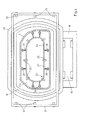
- eine Vorrichtung zum induktiven Härten eines Sicherheits- oder Strukturbauteils für ein Kraftfahrzeug in Draufsicht;
- Fig. 4
- die in
Fig. 3 dargestellte Vorrichtung in einem Schnitt entlang der inFig. 1 eingetragenen Schnittlinie A-A; und - Fig. 5
- ein aus Stahlblech geformtes Sicherheits- oder Strukturbauteil, welches ein offenes, hinterschnittenes Querschnittsprofil aufweist, in perspektivischer Darstellung.
- Das in
Fig. 1 dargestellte Unterfahrschutzsystem 1 ist für ein Nutzfahrzeug, insbesondere einen Lastkraftwagen bestimmt. Es soll das Unterfahren eines Personenkraftwagens bei einem Frontalzusammenstoss minimieren. Das Unterfahrschutzsystem 1 umfasst einen rohrartigen Aufprallträger 2, zwei im Wesentlichen parallel zueinander verlaufende Längsholme 3, zwei äußere Schrägholme 4 und flanschförmige Stützplatten 5. Es ist zu erkennen, dass die beiden Enden 2.1, 2.2 des Aufprallträgers 2 gegenüber seinem mittleren, im Wesentlichen geradlinigen Abschnitt 2.3 um etwa 10° bis 15° nach hinten gebogen sind. Die Enden des Aufprallträgers 2 können durch daran angeschweißte Blechplatten 7, 8 verschlossen sein. Das Unterfahrschutzsystem 1 wird so an dem jeweiligen Nutzfahrzeug montiert, dass der Aufprallträger 2 etwa im Niveau der Achsen der Vorderräder angeordnet ist. Alternativ können aber auch unterschiedliche Höhenlagen bezogen auf die Achslage fahrzeugspezifisch (beispielsweise Tieflader, Baustellenfahrzeuge, etc.) berücksichtigt werden. - Der Aufprallträger 2 ist so ausgelegt, dass er bei einem Frontalzusammenstoss des Nutzfahrzeuges mit einem Personenkraftwagen die kinetische Energie des Aufpralls in Verformungsarbeit umwandelt. Dabei kommt es zu einer plastischen Deformation des Bauteils 2 (Aufprallträgers).
- In dem dargestellten Beispiel weist der aus Stahlblech geformte Aufprallträger 2 ein geschlossenes Profil auf. Der Aufprallträger 2 des Unterfahrschutzsystems kann aber grundsätzlich auch als offenes Profil ausgeführt sein, beispielsweise ein hinterschnittenes C-förmiges Profil 2' gemäß
Fig. 5 aufweisen. - Das Profil des Bauteils (Aufprallträgers) 2 wird durch kontinuierliches Rollformen erzeugt. Denkbar sind aber auch andere aus dem Stand der Technik bekannte Verfahren zum Herstellen des Bauteils 2, beispielsweise ein Zusammenschweißen von zwei kaltumgeformten Halbschalen, oder die Herstellung oder Verwendung eines Blechzuschnittes, der kalt zu einem Aufprallträger umgeformt wird.
Fig. 2 zeigt eine Fertigungsfolge, bei welcher bandförmiges Stahlblech von einem Coil 9 einer Walzprofiliereinheit 10 zugeführt wird. Das Stahlblech weist eine Blechstärke auf, die im Bereich von 1,5 mm bis 4,0 mm liegt. In der Walzprofiliereinheit 10 wird das Bandmaterial durch mehrere Rollensätze 11 zu einem Walzprofil W mit im Wesentlichen rohrförmigen Querschnitt umgeformt. Der Walzprofiliereinheit 10 ist eine Schweißeinrichtung 12 nachgeschaltet, mittels der das Walzprofil W kontinuierlich zu einem geschlossenen Profil gefügt wird. Als Fügeprozess ist ein Hochfrequenz- oder Induktions-Schweissprozess vorgesehen, der mit der entsprechenden Prozessgeschwindigkeit des Rollformprozesses arbeitet. - Auf die Schweißeinrichtung 12 folgt eine Ablängeinheit 13, die das Walzprofil W in einzelne Profilbauteile 2 ablängt. Nach dem Ablängen des Walzprofils W wird das jeweilige Profilbauteil 2 in einer Biegeeinrichtung 14 in eine vorgegebene Kontur gebogen. Das Biegen des Profilbauteils 2 wird vorzugsweise als Kaltumformung durchgeführt. In
Fig. 2 ist zu erkennen, dass das Bauteil 2 an seinen Enden 2.1, 2.2 in eine bestimmte Kontur gebogen wird. - Nach dem Biegeprozess wird das fertig geformte Bauteil 2 induktiv gehärtet. Das Härten des Bauteils 2 erfolgt komplett oder in einem oder mehreren Teilabschnitten des Bauteils 2 mittels einer speziellen Vorrichtung 15. Ein Ausführungsbeispiel dieser Vorrichtung ist in den
Figuren 3 und4 schematisch dargestellt. - Die Vorrichtung 15 umfasst einen Induktor 16 zum Erwärmen eines Teilbereichs des Bauteils 2 auf Härtetemperatur. Diese liegt über der AC3-Temperatur des Stahls, aus dem das Bauteil 2 hergestellt ist. Der Induktor 16 kann in geschlossener (ringförmiger) oder offener Bauweise ausgeführt sein. Er ist vorzugsweise aufklappbar ausgebildet, um seine Positionierung zum Prozessstart zu erleichtern. Der Induktor 16 wird unter Berücksichtigung der Dicke des verwendeten Stahlblechs mit einer Leistung im Bereich zwischen 20 und 300 kW bei einer 80 bis 100 kHz betragenden Frequenz betrieben.
- Die Vorrichtung 15 weist ferner mindestens eine Spanneinrichtung 17 zum Einspannen des Bauteils 2 auf. Die Spanneinrichtung 17 umfasst bewegliche Auflager 17.1, 17.2, welche in der Lage sind, die bei der Phasenumwandlung (Erwärmung) des Bauteils 2 auftretende Längenausdehnung des Bauteils 2 aufzunehmen. Die Auflager der Spanneinrichtung 17 besitzen entsprechende Freiheitsgrade.
- Der Induktor 16 wird von einer Fördereinrichtung 18 getragen, die den Induktor 16 auf einer sich zwischen den Auflagern der Spanneinrichtung 17 erstreckenden Führungsbahn 19 von einer Startposition an dem einen Auflager 17.1 in Förderrichtung F zu einer Endposition an dem anderen Auflager 17.2 bewegt.
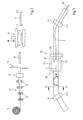
- Zusätzlich trägt die Fördereinrichtung 18 eine in Förderrichtung F gesehen hinter dem Induktor 16 angeordnete Brause 20, die Betstandteil einer nicht weiter dargestellten Kühleinrichtung zum Abschrecken des auf Härtetemperatur erwärmten Teilbereichs des Bauteils 2 ist. Die Brause 20 umgreift wie der Induktor 16 den durchzuhärtenden Abschnitt des Bauteils 2 nach Art eines Rings. Auf ihrer dem Bauteil 2 zugeordneten Innenfläche weist die Brause 20 in gleichmäßigen Abständen zueinander angeordnete, hier nicht sichtbare Düsen zum Ausbringen von Abschreckflüssigkeit auf. Die Brause 20 grenzt dabei unmittelbar an die Rückseite des Induktors 16 an, so dass die von der Brause 20 ausgebrachte Abschreckflüssigkeit, vorzugsweise Abschreckemulsion den vom Induktor 16 jeweils erwärmten Teilbereich des Bauteils 2 unmittelbar erreicht, nachdem dieser Teilbereich auf Härtetemperatur erhitzt ist.
- In Förderrichtung F vor dem Induktor 16 und unmittelbar angrenzend an seine Vorderseite ist ein ebenfalls von der Fördereinrichtung 18 getragenes Gehäuse 21 angeordnet, welches das Bauteil 2 nach Art einer Hülle umgibt. In dem Gehäuse 21 sind mehrere Düsen 22 zum Ausbringen eines Schutzgases angeordnet. Als Schutzgas wird vorzugsweise Stickstoff eingesetzt. Alternativ kann als Schutzgas auch ein anderes Inertgas, beispielsweise Argon eingesetzt werden.
- Die Düsen 22 sind so ausgerichtet, dass das von ihnen ausgebrachte Schutzgas in einer oberflächennahen laminaren Strömung über die Außenseite Bauteils 2 in Richtung des Teilsbereichs strömt, der vom Induktor 16 jeweils auf Härtetemperatur erwärmt wird. Auf diese Weise ist eine Abschottung gebildet, durch die der Zutritt von Umgebungssauerstoff zu dem erhitzten Teilbereich weitestgehend verhindert wird. Der Induktor 16, die Brause 20 und das Gehäuse 21 bilden eine hinsichtlich ihrer Bewegungen verkoppelte Baugruppe 30.
- Um auch eine Verzunderung der Innenseiten des Bauteils 2 während dessen induktiver Härtung zu verhindern, wird die jeweilige auf Härtetemperatur erwärmte Stelle auch innerhalb des Bauteils 2 durch eine Schutzgaseinrichtung lokal begleitet, und zwar durch eine zweite Schutzgaseinrichtung 23, die so ausgebildet ist, dass sie in den vom Bauteil 2 definierten Kanal 2.4 eingeführt werden kann. Diese Schutzgaseinrichtung 23 ist dabei mit dem Induktor 16 bzw. der ersten, der Außenseite des Bauteils 2 zugeordneten Schutzgaseinrichtung mechanisch verkoppelt bzw. koppelbar. Sie weist einen Trägerkörper 24 auf, der mit einer Mehrzahl von Düsen 25 zum Ausbringen von Schutzgas versehen ist. In dem dargestellten Ausführungsbeispiel ist der Trägerkörper 24 ringförmig ausgebildet, wobei die Düsen 25 im Wesentlichen gleichmäßig über den Umfang des Trägerkörper 24 verteilt angeordnet sind. Die Düsen 25 sind so ausgerichtet, dass das von ihnen ausgebrachte Schutzgas die Innenseite des vom Induktor 16 jeweils auf Härtetemperatur erhitzten Teilsbereichs des Bauteils 2 beaufschlagt und somit die lokale Verzunderung während des Härtungsprozesses verhindert.
- Der Trägerkörper 24 dieser Schutzgaseinrichtung 23 stützt sich über mehrere federbelastete Rollen 26 von innen gegen die durchgehende Profilkontur des Bauteils ab und ermöglicht somit eine im Wesentlichen konzentrische Positionierung der Schutzgaseinrichtung sowie ein leichtes Verschieben innerhalb des Profils. Die den Rollen 26 zugeordneten Federn 27 stützen sich an dem Trägerkörper 24 ab. Die Verschiebung des Trägerkörpers 24 erfolgt über einen flexibel biegbaren Druckstab 28, um gegebenenfalls vorhandene Profilkrümmungen des Bauteils 2 flexibel abfahren zu können. Der Druckstab 28 ist hierzu vorzugsweise aus Stahl und/oder Kunststoff gefertigt. An diesem Druckstab 28 sind auch die Steuerungs- und Versorgungsleitungen (nicht dargestellt) der zweiten Schutzgaseinrichtung 23 angebunden.
- Das Einführen der zweiten Schutzgaseinrichtung 23 erfolgt an den offenen Enden des Profilbauteils 2. Die Steuerung der gesamten Vorrichtung 15 erfolgt vorzugsweise über eine zentrale CNC-Steuerung der Induktionsmaschine. Zur Qualitätssicherung werden der der Außenseite des Bauteils 2 zugeführte Schutzgas-Volumenstrom und der der Innenseite des Bauteils 2 zugeführte Schutzgas-Volumenstrom einzeln gemessen. Ziel ist die Erlangung eines hochfesten Profilbauteils 2 insbesondere für Unterfahrschutzsysteme, das ohne weitere Oberflächenbearbeitung direkt nach dem induktiven Härtungsvorgang mittels kathodischer Tauchlackierung lackierfähig ist.
- Um die für den genannten Verwendungszweck des Bauteils 2 erforderlichen Festigkeitswerte zu erzielen, werden zu dessen Herstellung spezielle borlegierte Manganstahlbleche verwendet, beispielsweise borlegierte Manganstahlbleche mit der Bezeichnung 27 MnCrB 5-2, 30 MnB 5, 37 MnB 4 oder 42 Mn NiCrB 4-3 verwendet. Diese ermöglichen eine gute Durchhärtung des Bauteils 2 mit optimalen technologischen Eigenschaften. Wie bereits erwähnt, liegt die Blechstärke der verwendeten Manganstahlbleche vorzugsweise im Bereich von 1,5 bis 4 mm.
- Die erfindungsgemäß hergestellten Bauteile 2 besitzen eine Streckgrenze Re von mindestens 1250 MPa, eine Zugfestigkeit Rm von mindestens 1750 MPa und eine Bruchdehnung A80 von mindestens 2%.
-
- 1
- Unterfahrschutzsystem
- 2
- Bauteil (Aufprallträger)
- 2'
- offenes Profil
- 2.1
- Bauteilende
- 2.2
- Bauteilende
- 2.3
- mittlerer Abschnitt des Bauteils
- 2.4
- Kanal
- 3
- Längsholme
- 4
- Schrägholme
- 5
- Stützplatten
- 6
- Querträger
- 7
- Blechplatte
- 8
- Blechplatte
- 9
- Coil (abgewickeltes Blechband)
- 10
- Walzprofiliereinheit
- 11
- Rollensatz
- 12
- Schweißeinrichtung
- 13
- Ablängeinheit
- 14
- Biegeeinrichtung
- 15
- Härtungsvorrichtung
- 16
- Induktor
- 17
- Spanneinrichtung
- 17.1
- Auflager
- 17.2
- Auflager
- 18
- Fördereinrichtung
- 19
- Führungsbahn
- 20
- Brause (Kühleinrichtung)
- 21
- Gehäuse
- 22
- Düsen
- 23
- zweite Schutzgaseinrichtung
- 24
- Trägerkörper
- 25
- Düsen
- 26
- Rollen
- 27
- Feder
- 28
- Druckstab
- 30
- Baugruppe
- F
- Förderrichtung
- W
- Walzprofil
Claims (18)
- Verfahren zur Herstellung von gehärteten Bauteilen (2) aus Stahlblech, die ein geschlossenes Profil oder ein offenes Profil (2') mit Hinterschnitt aufweisen, insbesondere von Aufprallträgern, bei dem zumindest ein Teilbereich des jeweiligen Bauteils (2) unter Schutzgas auf Härtetemperatur erwärmt wird, wobei das Bauteil und ein ein elektromagnetisches Feld induzierender Induktor (16) relativ zueinander bewegt werden, und bei dem der auf Härtetemperatur erwärmte Teilbereich nach dieser Erwärmung abgeschreckt wird,
dadurch gekennzeichnet, dass
die Innenseite des Bauteils (2) mittels einer in den vom Profil definierten Kanal (2.4) einführbaren Schutzgaseinrichtung (23) mit Schutzgas beaufschlagt wird, wobei das Bauteil (2) und die Schutzgaseinrichtung (23) relativ zueinander bewegt werden. - Verfahren nach Anspruch 1,
dadurch gekennzeichnet, dass
das Bauteil (2) aus einem borlegierten Manganstahlblech hergestellt wird, wobei das Manganstahlblech vorzugsweise folgende chemische Zusammensetzung in Gewichtsprozent aufweist:C: 0,24 - 0,45 %Si: 0,15 - 0,40 %Mn: 1,10 - 1,45 %P: maximal 0,025 %S: maximal 0,015 %Al: 0,020 - 0,060 %Cr: 0,15 - 0,60 %Ti: 0,020 - 0,050 %B: 0,0008 - 0,0050 %Rest Eisen und unvermeidbare Verunreinigungen. - Verfahren nach Anspruch 1 oder 2,
dadurch gekennzeichnet, dass
das Profil (2') durch kontinuierliches Rollformen erzeugt wird. - Verfahren nach Anspruch 3,
dadurch gekennzeichnet, dass
das Profil im Anschluss an das Rollformen kontinuierlich zu einem geschlossenen Profil verschweißt wird. - Verfahren nach Anspruch 3 oder 4,
dadurch gekennzeichnet, dass
das Profil im Anschluss an das Rollformen oder im Anschluss an ein dem Rollformen folgenden Schweißen abgelängt und das so erhaltene Profil zu dem Bauteil (2) fertig geformt wird, indem das Profil in eine vorgegebene Kontur gebogen wird. - Verfahren nach einem der Ansprüche 1 bis 5,
dadurch gekennzeichnet, dass
die in den vom Bauteil (2) definierten Kanal (2.4) einführbare Schutzgaseinrichtung (16) mittels eines flexiblen Druckstabes (28) entlang der Längsachse des Bauteils (2) bewegt wird. - Verfahren nach einem der Ansprüche 1 bis 6,
dadurch gekennzeichnet, dass
die Außenseite des Bauteils (2) mittels einer Schutzgaseinrichtung (21, 22) mit Schutzgas beaufschlagt wird, die gekoppelt mit dem Induktor (16) relativ zum Bauteil (2) bewegt wird, wobei der der Außenseite des Bauteils (2) zugeführte Schutzgas-Volumenstrom und der der Innenseite des Bauteils (2) zugeführte Schutzgas-Volumenstrom einzeln gemessen werden. - Verfahren nach einem der Ansprüche 1 bis 7,
dadurch gekennzeichnet, dass
der auf Härtetemperatur erwärmte Teilbereich nach dieser Erwärmung mittels einer Emulsion abgeschreckt wird, und dass die Zusammensetzung der zur Abschreckung verwendeten Emulsion in Abhängigkeit des für das Bauteil (2) verwendeten Stahls und/oder in Abhängigkeit eingestellter Parameter des Härtungsprozesses, insbesondere der Härtetemperatur eingestellt wird. - Verfahren nach einem der Ansprüche 1 bis 8,
dadurch gekennzeichnet, dass
das Bauteil (2) nach Abschluss des Härtungsvorgangs eine Streckgrenze Re von mindestens 1250 MPa, eine Zugfestigkeit Rm von mindestens 1750 MPa und/oder eine Bruchdehnung A80 von mindestens 2 % besitzt. - Vorrichtung zur Herstellung von gehärteten Bauteilen aus Stahlblech, die ein geschlossenes Profil oder ein offenes Profil mit Hinterschnitt aufweisen, insbesondere von Aufprallträgern,
mit einem Induktor (16) zum Erwärmen eines Teilbereichs des jeweiligen Bauteils (2) auf Härtetemperatur,
mit einer Kühleinrichtung (20) zum Abschrecken des auf Härtetemperatur erwärmten Teilbereichs,
mit einer der Außenseite des Bauteils (2) zugeordneten Schutzgaseinrichtung (21, 22) zum Ausbringen eines mindestens den vom Induktor erfassten Teilbereich beaufschlagenden Schutzgasstroms und
mit einer Fördereinrichtung (18), die während des Härtens das Bauteil und den Induktor (16) relativ zueinander
bewegt,
gekennzeichnet durch
eine zweite Schutzgaseinrichtung, die zur Beaufschlagung der Innenseite des vom Induktor (16) erfassten Teilbereichs mit Schutzgas in den vom Bauteil (2) definierten Kanal einführbar ist, wobei das Bauteil (2) und die zweite Schutzgaseinrichtung (23) relativ zueinander bewegbar sind. - Vorrichtung nach Anspruch 10,
dadurch gekennzeichnet, dass
die zweite Schutzgaseinrichtung (23) mit dem Induktor (16) und/oder der der Außenseite des Bauteils (2) zugeordneten Schutzgaseinrichtung (21, 22) mechanisch verkoppelt ist. - Vorrichtung nach Anspruch 10 oder 11,
dadurch gekennzeichnet, dass
die zweite Schutzgaseinrichtung (23) mit federbelasteten Rollen (26) oder federbelasteten Gleitelementen versehen ist, über die sie an der Innenseite des Bauteils (2) abgestützt und mit Abstand zu dieser entlang der Längsachse des Bauteils (2) bewegbar ist. - Vorrichtung nach einem der Ansprüche 10 bis 12,
dadurch gekennzeichnet, dass
die zweite Schutzgaseinrichtung (23) mit einem flexiblen Druckstab (28) versehen ist, mittels dem sie in dem vom Bauteil (2) definierten Kanal (2.4) verschiebbar ist. - Vorrichtung nach Anspruch 13,
dadurch gekennzeichnet, dass
an dem flexiblen Druckstab (28) eine Steuerungs- und/oder Versorgungsleitung für die zweite Schutzgaseinrichtung (23) angebunden ist. - Vorrichtung nach einem der Ansprüche 10 bis 14,
dadurch gekennzeichnet, dass
die zweite Schutzgaseinrichtung (23) einen ringförmigen Trägerkörper (24) aufweist, der über seinen Umfang mit einer Mehrzahl von Düsen (25) zum Ausbringen von Schutzgas versehen ist. - Vorrichtung nach einem der Ansprüche 10 bis 15,
dadurch gekennzeichnet, dass
der Induktor (16) offen oder in Form eines geschlossenen Rings ausgebildet ist. - Vorrichtung nach einem der Ansprüche 10 bis 16,
dadurch gekennzeichnet, dass
der Induktor (16) aufklappbar ausgebildet ist. - Vorrichtung nach einem der Ansprüche 10 bis 17,
dadurch gekennzeichnet, dass
eine Spanneinrichtung (17, 17.1, 17.2) zum Einspannen des Bauteils (2) vorgesehen ist, wobei die Spanneinrichtung (17) bewegliche Auflager (17.1, 17.2) umfasst.
Applications Claiming Priority (1)
| Application Number | Priority Date | Filing Date | Title |
|---|---|---|---|
| DE102007059974A DE102007059974B3 (de) | 2007-12-11 | 2007-12-11 | Verfahren und Vorrichtung zur Herstellung von gehärteten Bauteilen aus Stahlblech, die ein geschlossenes Profil oder ein offenes Profil mit Hinterschnitt aufweisen |
Publications (3)
| Publication Number | Publication Date |
|---|---|
| EP2071045A2 true EP2071045A2 (de) | 2009-06-17 |
| EP2071045A3 EP2071045A3 (de) | 2010-11-24 |
| EP2071045B1 EP2071045B1 (de) | 2012-06-27 |
Family
ID=39986435
Family Applications (1)
| Application Number | Title | Priority Date | Filing Date |
|---|---|---|---|
| EP08105568A Not-in-force EP2071045B1 (de) | 2007-12-11 | 2008-10-14 | Verfahren und Vorrichtung zur Herstellung von gehärteten Bauteilen aus Stahlblech, die ein geschlossenes Profil oder ein offenes Profil mit Hinterschnitt aufweisen |
Country Status (2)
| Country | Link |
|---|---|
| EP (1) | EP2071045B1 (de) |
| DE (1) | DE102007059974B3 (de) |
Cited By (1)
| Publication number | Priority date | Publication date | Assignee | Title |
|---|---|---|---|---|
| US10995380B2 (en) | 2016-08-24 | 2021-05-04 | Wuhan Iron And Steel Company Limited | 1500 MPa grade press hardening steel by thin slab casting and direct rolling and method for producing the same |
Families Citing this family (5)
| Publication number | Priority date | Publication date | Assignee | Title |
|---|---|---|---|---|
| DE102010035195A1 (de) | 2010-08-24 | 2012-03-01 | Volkswagen Ag | Profilbauteil und Verfahren zur Herstellung eines Profilbauteils |
| CN101972798B (zh) * | 2010-09-06 | 2012-09-26 | 北方工业大学 | 辊心加热式辊弯成形方法及其装置 |
| DE102011120340A1 (de) * | 2011-12-06 | 2013-06-06 | Daimler Ag | Herstellverfahren zu einer Herstellung eines Kraftfahrzeugverbundbauteils |
| DE102017110631A1 (de) * | 2017-05-16 | 2018-11-22 | Thyssenkrupp Ag | Verfahren zur Herstellung eines verschleißfesten Stahlrohrs, verschleißfestes Stahlrohr und Verwendung eines solchen Stahlrohrs |
| DE102019201882A1 (de) * | 2019-02-13 | 2020-08-13 | Thyssenkrupp Steel Europe Ag | Verfahren zum Herstellen eines Stahlblechbauteils |
Citations (2)
| Publication number | Priority date | Publication date | Assignee | Title |
|---|---|---|---|---|
| EP1052295A2 (de) | 1999-05-12 | 2000-11-15 | Benteler Ag | Verfahren zur Herstellung von Strukturteilen im Automobilbau |
| DE102005012522B4 (de) | 2005-03-16 | 2007-03-22 | Thyssenkrupp Automotive Ag | Verfahren und Vorrichtung zum abschnittsweisen Durchhärten von aus Stahlblech fertig geformten Bauteilen |
Family Cites Families (2)
| Publication number | Priority date | Publication date | Assignee | Title |
|---|---|---|---|---|
| JPS536212A (en) * | 1976-07-08 | 1978-01-20 | Kobe Steel Ltd | Continuous bright annealing method and apparatus therefor |
| US6702980B2 (en) * | 2002-04-30 | 2004-03-09 | Martinrea Industries, Inc. | Annealing apparatus |
-
2007
- 2007-12-11 DE DE102007059974A patent/DE102007059974B3/de active Active
-
2008
- 2008-10-14 EP EP08105568A patent/EP2071045B1/de not_active Not-in-force
Patent Citations (2)
| Publication number | Priority date | Publication date | Assignee | Title |
|---|---|---|---|---|
| EP1052295A2 (de) | 1999-05-12 | 2000-11-15 | Benteler Ag | Verfahren zur Herstellung von Strukturteilen im Automobilbau |
| DE102005012522B4 (de) | 2005-03-16 | 2007-03-22 | Thyssenkrupp Automotive Ag | Verfahren und Vorrichtung zum abschnittsweisen Durchhärten von aus Stahlblech fertig geformten Bauteilen |
Cited By (1)
| Publication number | Priority date | Publication date | Assignee | Title |
|---|---|---|---|---|
| US10995380B2 (en) | 2016-08-24 | 2021-05-04 | Wuhan Iron And Steel Company Limited | 1500 MPa grade press hardening steel by thin slab casting and direct rolling and method for producing the same |
Also Published As
| Publication number | Publication date |
|---|---|
| EP2071045A3 (de) | 2010-11-24 |
| DE102007059974B3 (de) | 2008-12-18 |
| EP2071045B1 (de) | 2012-06-27 |
Similar Documents
| Publication | Publication Date | Title |
|---|---|---|
| EP2855041B1 (de) | Verfahren zur herstellung von umgeformten blechteilen bei tieftemperatur | |
| EP2335984B1 (de) | Crashbox und Verfahren zu deren Herstellung | |
| DE102010012830B4 (de) | Verfahren zur Herstellung einer Kraftfahrzeugkomponente und Karosseriebauteil | |
| WO2008145327A1 (de) | Verfahren zur herstellung eines lokal gehärteten profilbauteils, lokal gehärtetes profilbauteil und verwendung eines lokal gehärteten profilbauteils | |
| EP3011081A1 (de) | Verfahren zum herstellen eines erzeugnisses aus gewalztem bandmaterial | |
| DE102014008718B3 (de) | Maßgeschneidertes Halbzeug und Kraftfahrzeugbauteil | |
| DE102010049205B4 (de) | Warmumformlinie und Verfahren zum Warmumformen von blechförmigem Material | |
| DE4032992A1 (de) | Rohrfoermiges stahlprofil fuer die tuerverstaerkung | |
| EP2071045B1 (de) | Verfahren und Vorrichtung zur Herstellung von gehärteten Bauteilen aus Stahlblech, die ein geschlossenes Profil oder ein offenes Profil mit Hinterschnitt aufweisen | |
| EP2896466A1 (de) | Verfahren und Vorrichtung zur Herstellung eines Metallbauteils | |
| DE102018118826A1 (de) | Mehrschichtiger stahl und verfahren zum vermindern der versprödung von flüssigem metall | |
| DE102015103307A1 (de) | Verfahren zur Herstellung eines warmumgeformten und abschreckgehärteten innenhochdruckumgeformten Kraftfahrzeugbauteils | |
| EP2446977B1 (de) | Verfahren zur Herstellung eines Rohrprofils | |
| EP2169084B1 (de) | Verfahren zur Herstellung eines Formbauteils mit Bereichen unterschiedlicher Festigkeit aus Kaltband | |
| EP3420111B1 (de) | Verfahren zur gezielten bauteilzonenindividuellen wärmebehandlung | |
| EP1702993B1 (de) | Verfahren und Vorrichtung zum abschnittsweisen Durchhärten von aus Stahlblech fertig geformten Bauteilen | |
| DE102005041741B4 (de) | Verfahren zum Herstellen eines pressgehärteten Bauteils | |
| DE102013104299B4 (de) | Wirkmedienbasierte Tieftemperaturumformung | |
| EP3159419A1 (de) | Verfahren zum erzeugen rollgeformter teilgehärteter profile | |
| DE19933113C1 (de) | Verfahren zum Herstellen eines Bandes aus Stahl durch flexibles Walzen | |
| EP4296377A1 (de) | Verfahren zur herstellung eines einstückigen pressgehärteten türrings für ein kraftfahrzeug, der unterschiedliche blechdicken und festigkeiten aufweist | |
| WO2014187623A1 (de) | Verfahren und härtungswerkzeug zum härten eines bauteils oder halbzeugs | |
| DE102018107846B4 (de) | Verfahren zum Herstellen eines Profilbauteils sowie Fahrzeugquerträger oder Fahrzeuglängsträger | |
| DE102008063547A1 (de) | Verfahren und Vorrichtung zur Entzunderung eines Metallbandes | |
| DE102008005116B4 (de) | Verfahren und Einrichtung zur Herstellung eines Metallbandes mit über Länge und Breite unterschiedlichen Materialeigenschaften |
Legal Events
| Date | Code | Title | Description |
|---|---|---|---|
| PUAI | Public reference made under article 153(3) epc to a published international application that has entered the european phase |
Free format text: ORIGINAL CODE: 0009012 |
|
| AK | Designated contracting states |
Kind code of ref document: A2 Designated state(s): AT BE BG CH CY CZ DE DK EE ES FI FR GB GR HR HU IE IS IT LI LT LU LV MC MT NL NO PL PT RO SE SI SK TR |
|
| AX | Request for extension of the european patent |
Extension state: AL BA MK RS |
|
| PUAL | Search report despatched |
Free format text: ORIGINAL CODE: 0009013 |
|
| AK | Designated contracting states |
Kind code of ref document: A3 Designated state(s): AT BE BG CH CY CZ DE DK EE ES FI FR GB GR HR HU IE IS IT LI LT LU LV MC MT NL NO PL PT RO SE SI SK TR |
|
| AX | Request for extension of the european patent |
Extension state: AL BA MK RS |
|
| RIC1 | Information provided on ipc code assigned before grant |
Ipc: C21D 7/02 20060101ALN20101020BHEP Ipc: C21D 1/42 20060101ALI20101020BHEP Ipc: C21D 9/00 20060101AFI20090407BHEP Ipc: C21D 1/10 20060101ALI20101020BHEP Ipc: C21D 1/74 20060101ALI20101020BHEP Ipc: B21D 53/88 20060101ALI20101020BHEP |
|
| 17P | Request for examination filed |
Effective date: 20110311 |
|
| AKX | Designation fees paid |
Designated state(s): AT BE BG CH CY CZ DE DK EE ES FI FR GB GR HR HU IE IS IT LI LT LU LV MC MT NL NO PL PT RO SE SI SK TR |
|
| RIC1 | Information provided on ipc code assigned before grant |
Ipc: C21D 1/10 20060101ALI20110921BHEP Ipc: C21D 9/00 20060101AFI20110921BHEP Ipc: C21D 1/74 20060101ALI20110921BHEP Ipc: B21D 53/88 20060101ALI20110921BHEP Ipc: C21D 7/02 20060101ALN20110921BHEP Ipc: C21D 1/42 20060101ALI20110921BHEP Ipc: C22C 38/32 20060101ALI20110921BHEP |
|
| GRAP | Despatch of communication of intention to grant a patent |
Free format text: ORIGINAL CODE: EPIDOSNIGR1 |
|
| GRAS | Grant fee paid |
Free format text: ORIGINAL CODE: EPIDOSNIGR3 |
|
| RAP1 | Party data changed (applicant data changed or rights of an application transferred) |
Owner name: GMF UMFORMTECHNIK GMBH |
|
| GRAA | (expected) grant |
Free format text: ORIGINAL CODE: 0009210 |
|
| AK | Designated contracting states |
Kind code of ref document: B1 Designated state(s): AT BE BG CH CY CZ DE DK EE ES FI FR GB GR HR HU IE IS IT LI LT LU LV MC MT NL NO PL PT RO SE SI SK TR |
|
| REG | Reference to a national code |
Ref country code: GB Ref legal event code: FG4D Free format text: NOT ENGLISH |
|
| REG | Reference to a national code |
Ref country code: CH Ref legal event code: EP |
|
| REG | Reference to a national code |
Ref country code: AT Ref legal event code: REF Ref document number: 564296 Country of ref document: AT Kind code of ref document: T Effective date: 20120715 |
|
| REG | Reference to a national code |
Ref country code: IE Ref legal event code: FG4D Free format text: LANGUAGE OF EP DOCUMENT: GERMAN |
|
| REG | Reference to a national code |
Ref country code: DE Ref legal event code: R096 Ref document number: 502008007565 Country of ref document: DE Effective date: 20120823 |
|
| PG25 | Lapsed in a contracting state [announced via postgrant information from national office to epo] |
Ref country code: FI Free format text: LAPSE BECAUSE OF FAILURE TO SUBMIT A TRANSLATION OF THE DESCRIPTION OR TO PAY THE FEE WITHIN THE PRESCRIBED TIME-LIMIT Effective date: 20120627 Ref country code: LT Free format text: LAPSE BECAUSE OF FAILURE TO SUBMIT A TRANSLATION OF THE DESCRIPTION OR TO PAY THE FEE WITHIN THE PRESCRIBED TIME-LIMIT Effective date: 20120627 Ref country code: NO Free format text: LAPSE BECAUSE OF FAILURE TO SUBMIT A TRANSLATION OF THE DESCRIPTION OR TO PAY THE FEE WITHIN THE PRESCRIBED TIME-LIMIT Effective date: 20120927 Ref country code: SE Free format text: LAPSE BECAUSE OF FAILURE TO SUBMIT A TRANSLATION OF THE DESCRIPTION OR TO PAY THE FEE WITHIN THE PRESCRIBED TIME-LIMIT Effective date: 20120627 |
|
| REG | Reference to a national code |
Ref country code: NL Ref legal event code: VDEP Effective date: 20120627 |
|
| REG | Reference to a national code |
Ref country code: LT Ref legal event code: MG4D Effective date: 20120627 |
|
| PG25 | Lapsed in a contracting state [announced via postgrant information from national office to epo] |
Ref country code: HR Free format text: LAPSE BECAUSE OF FAILURE TO SUBMIT A TRANSLATION OF THE DESCRIPTION OR TO PAY THE FEE WITHIN THE PRESCRIBED TIME-LIMIT Effective date: 20120627 Ref country code: GR Free format text: LAPSE BECAUSE OF FAILURE TO SUBMIT A TRANSLATION OF THE DESCRIPTION OR TO PAY THE FEE WITHIN THE PRESCRIBED TIME-LIMIT Effective date: 20120928 Ref country code: LV Free format text: LAPSE BECAUSE OF FAILURE TO SUBMIT A TRANSLATION OF THE DESCRIPTION OR TO PAY THE FEE WITHIN THE PRESCRIBED TIME-LIMIT Effective date: 20120627 Ref country code: SI Free format text: LAPSE BECAUSE OF FAILURE TO SUBMIT A TRANSLATION OF THE DESCRIPTION OR TO PAY THE FEE WITHIN THE PRESCRIBED TIME-LIMIT Effective date: 20120627 |
|
| PG25 | Lapsed in a contracting state [announced via postgrant information from national office to epo] |
Ref country code: CY Free format text: LAPSE BECAUSE OF FAILURE TO SUBMIT A TRANSLATION OF THE DESCRIPTION OR TO PAY THE FEE WITHIN THE PRESCRIBED TIME-LIMIT Effective date: 20120627 Ref country code: SK Free format text: LAPSE BECAUSE OF FAILURE TO SUBMIT A TRANSLATION OF THE DESCRIPTION OR TO PAY THE FEE WITHIN THE PRESCRIBED TIME-LIMIT Effective date: 20120627 Ref country code: RO Free format text: LAPSE BECAUSE OF FAILURE TO SUBMIT A TRANSLATION OF THE DESCRIPTION OR TO PAY THE FEE WITHIN THE PRESCRIBED TIME-LIMIT Effective date: 20120627 Ref country code: CZ Free format text: LAPSE BECAUSE OF FAILURE TO SUBMIT A TRANSLATION OF THE DESCRIPTION OR TO PAY THE FEE WITHIN THE PRESCRIBED TIME-LIMIT Effective date: 20120627 Ref country code: EE Free format text: LAPSE BECAUSE OF FAILURE TO SUBMIT A TRANSLATION OF THE DESCRIPTION OR TO PAY THE FEE WITHIN THE PRESCRIBED TIME-LIMIT Effective date: 20120627 Ref country code: IS Free format text: LAPSE BECAUSE OF FAILURE TO SUBMIT A TRANSLATION OF THE DESCRIPTION OR TO PAY THE FEE WITHIN THE PRESCRIBED TIME-LIMIT Effective date: 20121027 |
|
| PG25 | Lapsed in a contracting state [announced via postgrant information from national office to epo] |
Ref country code: IT Free format text: LAPSE BECAUSE OF FAILURE TO SUBMIT A TRANSLATION OF THE DESCRIPTION OR TO PAY THE FEE WITHIN THE PRESCRIBED TIME-LIMIT Effective date: 20120627 Ref country code: PT Free format text: LAPSE BECAUSE OF FAILURE TO SUBMIT A TRANSLATION OF THE DESCRIPTION OR TO PAY THE FEE WITHIN THE PRESCRIBED TIME-LIMIT Effective date: 20121029 Ref country code: PL Free format text: LAPSE BECAUSE OF FAILURE TO SUBMIT A TRANSLATION OF THE DESCRIPTION OR TO PAY THE FEE WITHIN THE PRESCRIBED TIME-LIMIT Effective date: 20120627 |
|
| PG25 | Lapsed in a contracting state [announced via postgrant information from national office to epo] |
Ref country code: NL Free format text: LAPSE BECAUSE OF FAILURE TO SUBMIT A TRANSLATION OF THE DESCRIPTION OR TO PAY THE FEE WITHIN THE PRESCRIBED TIME-LIMIT Effective date: 20120627 |
|
| BERE | Be: lapsed |
Owner name: GMF UMFORMTECHNIK G.M.B.H. Effective date: 20121031 |
|
| PG25 | Lapsed in a contracting state [announced via postgrant information from national office to epo] |
Ref country code: ES Free format text: LAPSE BECAUSE OF FAILURE TO SUBMIT A TRANSLATION OF THE DESCRIPTION OR TO PAY THE FEE WITHIN THE PRESCRIBED TIME-LIMIT Effective date: 20121008 Ref country code: DK Free format text: LAPSE BECAUSE OF FAILURE TO SUBMIT A TRANSLATION OF THE DESCRIPTION OR TO PAY THE FEE WITHIN THE PRESCRIBED TIME-LIMIT Effective date: 20120627 |
|
| PLBE | No opposition filed within time limit |
Free format text: ORIGINAL CODE: 0009261 |
|
| STAA | Information on the status of an ep patent application or granted ep patent |
Free format text: STATUS: NO OPPOSITION FILED WITHIN TIME LIMIT |
|
| PG25 | Lapsed in a contracting state [announced via postgrant information from national office to epo] |
Ref country code: MC Free format text: LAPSE BECAUSE OF NON-PAYMENT OF DUE FEES Effective date: 20121031 |
|
| REG | Reference to a national code |
Ref country code: CH Ref legal event code: PL |
|
| 26N | No opposition filed |
Effective date: 20130328 |
|
| GBPC | Gb: european patent ceased through non-payment of renewal fee |
Effective date: 20121014 |
|
| REG | Reference to a national code |
Ref country code: IE Ref legal event code: MM4A |
|
| REG | Reference to a national code |
Ref country code: DE Ref legal event code: R097 Ref document number: 502008007565 Country of ref document: DE Effective date: 20130328 |
|
| REG | Reference to a national code |
Ref country code: FR Ref legal event code: ST Effective date: 20130628 |
|
| PG25 | Lapsed in a contracting state [announced via postgrant information from national office to epo] |
Ref country code: GB Free format text: LAPSE BECAUSE OF NON-PAYMENT OF DUE FEES Effective date: 20121014 Ref country code: IE Free format text: LAPSE BECAUSE OF NON-PAYMENT OF DUE FEES Effective date: 20121014 Ref country code: LI Free format text: LAPSE BECAUSE OF NON-PAYMENT OF DUE FEES Effective date: 20121031 Ref country code: CH Free format text: LAPSE BECAUSE OF NON-PAYMENT OF DUE FEES Effective date: 20121031 Ref country code: DE Free format text: LAPSE BECAUSE OF NON-PAYMENT OF DUE FEES Effective date: 20130501 Ref country code: BG Free format text: LAPSE BECAUSE OF FAILURE TO SUBMIT A TRANSLATION OF THE DESCRIPTION OR TO PAY THE FEE WITHIN THE PRESCRIBED TIME-LIMIT Effective date: 20120927 Ref country code: BE Free format text: LAPSE BECAUSE OF NON-PAYMENT OF DUE FEES Effective date: 20121031 |
|
| REG | Reference to a national code |
Ref country code: DE Ref legal event code: R119 Ref document number: 502008007565 Country of ref document: DE Effective date: 20130501 |
|
| PG25 | Lapsed in a contracting state [announced via postgrant information from national office to epo] |
Ref country code: FR Free format text: LAPSE BECAUSE OF NON-PAYMENT OF DUE FEES Effective date: 20121031 |
|
| PG25 | Lapsed in a contracting state [announced via postgrant information from national office to epo] |
Ref country code: MT Free format text: LAPSE BECAUSE OF FAILURE TO SUBMIT A TRANSLATION OF THE DESCRIPTION OR TO PAY THE FEE WITHIN THE PRESCRIBED TIME-LIMIT Effective date: 20120627 |
|
| PG25 | Lapsed in a contracting state [announced via postgrant information from national office to epo] |
Ref country code: TR Free format text: LAPSE BECAUSE OF FAILURE TO SUBMIT A TRANSLATION OF THE DESCRIPTION OR TO PAY THE FEE WITHIN THE PRESCRIBED TIME-LIMIT Effective date: 20120627 |
|
| PG25 | Lapsed in a contracting state [announced via postgrant information from national office to epo] |
Ref country code: LU Free format text: LAPSE BECAUSE OF NON-PAYMENT OF DUE FEES Effective date: 20121014 |
|
| PG25 | Lapsed in a contracting state [announced via postgrant information from national office to epo] |
Ref country code: HU Free format text: LAPSE BECAUSE OF FAILURE TO SUBMIT A TRANSLATION OF THE DESCRIPTION OR TO PAY THE FEE WITHIN THE PRESCRIBED TIME-LIMIT Effective date: 20081014 |
|
| REG | Reference to a national code |
Ref country code: AT Ref legal event code: MM01 Ref document number: 564296 Country of ref document: AT Kind code of ref document: T Effective date: 20131014 |
|
| PG25 | Lapsed in a contracting state [announced via postgrant information from national office to epo] |
Ref country code: AT Free format text: LAPSE BECAUSE OF NON-PAYMENT OF DUE FEES Effective date: 20131014 |