EP2071080A2 - Verfahren zur Aufarbeitung und Rückgewinnung von Energie aus Bitumenagglomeraten - Google Patents
Verfahren zur Aufarbeitung und Rückgewinnung von Energie aus Bitumenagglomeraten Download PDFInfo
- Publication number
- EP2071080A2 EP2071080A2 EP08405298A EP08405298A EP2071080A2 EP 2071080 A2 EP2071080 A2 EP 2071080A2 EP 08405298 A EP08405298 A EP 08405298A EP 08405298 A EP08405298 A EP 08405298A EP 2071080 A2 EP2071080 A2 EP 2071080A2
- Authority
- EP
- European Patent Office
- Prior art keywords
- rotating drum
- bituminous
- mix
- bwm
- heating
- Prior art date
- Legal status (The legal status is an assumption and is not a legal conclusion. Google has not performed a legal analysis and makes no representation as to the accuracy of the status listed.)
- Withdrawn
Links
Images
Classifications
-
- E—FIXED CONSTRUCTIONS
- E01—CONSTRUCTION OF ROADS, RAILWAYS, OR BRIDGES
- E01C—CONSTRUCTION OF, OR SURFACES FOR, ROADS, SPORTS GROUNDS, OR THE LIKE; MACHINES OR AUXILIARY TOOLS FOR CONSTRUCTION OR REPAIR
- E01C19/00—Machines, tools or auxiliary devices for preparing or distributing paving materials, for working the placed materials, or for forming, consolidating, or finishing the paving
- E01C19/02—Machines, tools or auxiliary devices for preparing or distributing paving materials, for working the placed materials, or for forming, consolidating, or finishing the paving for preparing the materials
- E01C19/10—Apparatus or plants for premixing or precoating aggregate or fillers with non-hydraulic binders, e.g. with bitumen, with resins, i.e. producing mixtures or coating aggregates otherwise than by penetrating or surface dressing; Apparatus for premixing non-hydraulic mixtures prior to placing or for reconditioning salvaged non-hydraulic compositions
- E01C19/1059—Controlling the operations; Devices solely for supplying or proportioning the ingredients
- E01C19/1063—Controlling the operations
-
- C—CHEMISTRY; METALLURGY
- C10—PETROLEUM, GAS OR COKE INDUSTRIES; TECHNICAL GASES CONTAINING CARBON MONOXIDE; FUELS; LUBRICANTS; PEAT
- C10B—DESTRUCTIVE DISTILLATION OF CARBONACEOUS MATERIALS FOR PRODUCTION OF GAS, COKE, TAR, OR SIMILAR MATERIALS
- C10B47/00—Destructive distillation of solid carbonaceous materials with indirect heating, e.g. by external combustion
- C10B47/28—Other processes
- C10B47/30—Other processes in rotary ovens or retorts
-
- C—CHEMISTRY; METALLURGY
- C10—PETROLEUM, GAS OR COKE INDUSTRIES; TECHNICAL GASES CONTAINING CARBON MONOXIDE; FUELS; LUBRICANTS; PEAT
- C10C—WORKING-UP PITCH, ASPHALT, BITUMEN, TAR; PYROLIGNEOUS ACID
- C10C3/00—Working-up pitch, asphalt, bitumen
- C10C3/007—Working-up pitch, asphalt, bitumen winning and separation of asphalt from mixtures with aggregates, fillers and other products, e.g. winning from natural asphalt and regeneration of waste asphalt
-
- E—FIXED CONSTRUCTIONS
- E01—CONSTRUCTION OF ROADS, RAILWAYS, OR BRIDGES
- E01C—CONSTRUCTION OF, OR SURFACES FOR, ROADS, SPORTS GROUNDS, OR THE LIKE; MACHINES OR AUXILIARY TOOLS FOR CONSTRUCTION OR REPAIR
- E01C19/00—Machines, tools or auxiliary devices for preparing or distributing paving materials, for working the placed materials, or for forming, consolidating, or finishing the paving
- E01C19/02—Machines, tools or auxiliary devices for preparing or distributing paving materials, for working the placed materials, or for forming, consolidating, or finishing the paving for preparing the materials
- E01C19/10—Apparatus or plants for premixing or precoating aggregate or fillers with non-hydraulic binders, e.g. with bitumen, with resins, i.e. producing mixtures or coating aggregates otherwise than by penetrating or surface dressing; Apparatus for premixing non-hydraulic mixtures prior to placing or for reconditioning salvaged non-hydraulic compositions
- E01C19/1013—Plant characterised by the mode of operation or the construction of the mixing apparatus; Mixing apparatus
- E01C19/1027—Mixing in a rotary receptacle
- E01C19/1036—Mixing in a rotary receptacle for in-plant recycling or for reprocessing, e.g. adapted to receive and reprocess an addition of salvaged material, adapted to reheat and remix cooled-down batches
Definitions
- the present invention relates to the sector of methods and plants used for converting, by means of a heat treatment, bituminous waste aggregates into materials which can be reutilised in the same field of application.
- bituminous waste aggregates the granular material obtained from milling and screening of road surfaces, bituminous residue and other waste from the production of road asphalt such as, for example, the end-of-production remainders, batches of unused asphalt, batches of road asphalt which do not satisfy the product specifications and therefore cannot be used and any other material which is composed of mixtures of mineral (for example calcareous or siliceous) aggregate and natural or petrochemical bitumen.
- the present invention concerns a method for upgrading and recovering energy from bituminous aggregates as described in the preamble of Claim 1, as well as a means for implementing said method as described in Claim 5.
- bituminous waste mixes in the asphalt industry has already been known for some time.
- the aim of reusing said mixes is associated with the possibility of converting a waste material with its associated disposal costs into a sellable product.
- waste mix is recycled by mixing it in well-defined maximum percentage amounts with the virgin bitumen being produced.
- This recycling is therefore necessarily performed at the premises of an asphalt manufacturer, something which proves to be on occasions a disadvantage owing to the large distances involved and the costs for transportation of the waste mix and the dependency on the virgin asphalt manufacturer who may impose their own commercial and technical conditions.
- the aggregate material thus heated is then transferred into a storage silo which is suitably heat-insulated.
- the hot aggregate material is mixed together with the bitumen and any other additives and then discharged into the transportation means which will transport it to the place of use.
- the first possibility offered consists in adding the waste to the virgin aggregate and heating the two together inside the furnace.
- the current technology uses two drums in parallel.
- the two drums have an identical design: both of them are of the direct-flame type.
- the second drum is used to heat solely the bituminous waste mix.
- the first drum may operate at the normal working temperature, for example 150°C
- the second drum for the reasons already mentioned beforehand, is limited to a maximum temperature of 90°C.
- the smoke point i.e. the temperature at which a substance produces smoke, in the case of bitumen is around 180 - 200°C in an oxidizing atmosphere.
- direct-flame heating also has the disadvantage of being very disadvantageous from an energy point of view, requiring a very high specific fuel consumption. High consumption is associated in particular with the fact that the combustion fumes exiting from the drum are still very hot and therefore still contain a lot of energy which can only be partly recovered.
- the particular feature of this type of technology consists in the energy heating vector.
- a burner which is physically separate from the receptacle containing the material to be heated is used.
- the combustion flame is cooled by means of the injection of water which vaporizes generating a mixture of combusted fumes and steam which is then used for actually heating the material.
- the object of the present invention is to provide a method for upgrading and recovering energy from bituminous aggregates which overcomes the abovementioned drawbacks and in particular results in a lower vapour emission, lower energy consumption and an improved thermal balance.
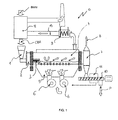
- Figure 1 shows a diagram of the method for upgrading bituminous aggregates.
- the bituminous waste mix to be treated is charged into the hopper 1 equipped with a compartment system which allows separation of the environment from the internal atmosphere of the apparatus.
- Double-clapper unloaders, rotary valves or pairs of guillotines may be used as compartment systems.
- a conveying system 3 such as, for example, a screw feeder, belt or vibrating chute performs continuous feeding to the heating drum 2.
- the heating drum is kept constantly rotating and heated externally until temperatures of the drum surface ranging between about 200 and about 550° are obtained, depending on the process to be performed.
- the material fed to the drum is deposited inside it and, as a result of its temperature inside the inner part 4 of the combustion chamber 5, is heated to the desired temperature.
- the material in the drum occupies only the bottom part of the volume: as a result of rotation the material is continuously churned, always bringing fresh material into contact with the wall, thus increasing the heat exchange effect and mixing thereof.
- the final heating temperature of the material is regulated by simultaneously varying the amount being fed and the speed of rotation of the drum (control of the stay time) and the surface temperature of the drum (control of the heat exchange power).
- the drum is inserted inside a large-size combustion chamber lined with refractory material 5.
- the combustion chamber contains one or more burners 6 operating with liquid or gas fuel such as methane gas, LPG, gas oil or LSC oils.
- liquid or gas fuel such as methane gas, LPG, gas oil or LSC oils.
- the same burners in the case where the method used envisages the production of aggregate, are designed to burn also the gases and vapours resulting from pyrolysis of the bitumen contained in the bituminous starting mixture.
- the combustion air of the burners may be preheated inside a heat exchanger arranged so as to intercept the discharge fumes of the apparatus 9.
- Pyrolysis is a thermochemical deposition process which is obtained by means of the application of heat and with the complete absence of an oxidising agent, in this case oxygen.
- the exchange of heat between the combustion fumes and the drum is mainly due to irradiation effects hence the need for a large-size refractory chamber in order to increase the irradiating state thickness and the re-irradiation effect.
- the combustion fumes may be used to dry or pre-heat the mix or for other direct uses or may be passed through an exchanger 9 preferably used to preheat the combustion air of the burners 6 or else for other heat-related functions, for example in order to produce process steam, heating water or the like.
- heating of the mix may result in the formation of vapours and gases.
- At low heating temperatures typically below 150°C, these are not formed so that the outlet 8 is solely composed of a flue for discharge into the atmosphere.
- gases and vapours are formed, in particular in the case where said temperatures are within the pyrolysis range.
- the outlet is combined with a device for suction of said vapours and gases, such as ventilators, blowers or Venturi ejectors.
- the suction device is regulated so as to keep the discharge hopper 8 and therefore the inside of the drum 4 always under a vacuum at the desired value (a few mbar).
- the vacuum is necessary in order to prevent part of the gases and vapours from being able to seep outside of the apparatus through the rotary seals with the consequent risk of fire or damage to objects or persons.
- the gases and vapours thus drawn off, having a high calorific power, are then conveyed to the burners 6 which are installed inside the combustion chamber 5, supplementing or replacing entirely the use of the primary fuel (natural gas, gas oil, or the like).
- the evaluation of the energy contribution of the gases and vapours to the overall consumption of the apparatus depends greatly on the characteristics of the incoming bituminous waste mix, and can be determined in particular depending on its bitumen content and its moisture level.
- the material is then extracted from the apparatus from the bottom of the hopper 7 via a conveying system 10 such as, for example, a screw feeder, Redler conveyor or conveyor belt.
- a conveying system 10 such as, for example, a screw feeder, Redler conveyor or conveyor belt.
- the outlet also has a compartment system of the same type.
- the outlet system is also provided with a system for cooling the aggregate produced 11.
- the type of cooler depends on the conveying system used.
- the screw feeder In the example of the screw feeder, the latter is enclosed inside a duct through which the cooling fluid (for example air or water) is passed.
- the recovered heat may be used in a manner similar to the heat recovered from the combustion fumes of the apparatus.
- the aggregate produced also contains the residual carbon part resulting from pyrolysis.
- said carbon part is, compared to the bitumen fraction converted into gas and vapour, of a limited amount.
- the carbon partly takes the form of a layer which covers the aggregate and partly takes the form of dust particles mixed with the aggregate as a result of rolling of the material inside the drum.
- the quantity of carbon contained in the aggregate does not create problems, but, if necessary, it is possible to separate it and extract it downstream of the apparatus according to the invention by means of screening.
- bituminous mix is heated in a controlled and inert atmosphere. Any bituminous vapours which may form at high heating temperatures remain "pure” and in continuous contact with the material, therefore ensuring conditions which are ideal for maintaining the characteristics of the bitumen.
- bituminous mix is heated more slowly, thus avoiding the high temperature gradients which instead occur in the case of direct heating.
- the throughput of any vapours produced during heating is substantially smaller than the throughput of vapours, smoke or any steam obtained in the case of direct fluid or flame heating. This results in a smoke-treatment system which is simpler, less costly and optimised only on the basis of the characteristics of the vapours to be treated.
- the thermal balance of the heating process is substantially better than that of the existing technologies.
- the combustion temperature In the case of heating systems based on a direct flame or with a mixture of fumes and steam, the combustion temperature must kept below certain limits in order to prevent burning of the bitumen.
- the heat exchange efficiency may be calculated in a simple manner, for example: Inlet T fumes material to be heated - Outlet T fumes from the material Inlet T fumes material to be heated - Surround .
- T * 100 ⁇
- a possibility offered by the present invention relates to the production of aggregate using the bituminous waste mix as starting material. This is possible using heating temperatures of around 350-450°C. At these temperatures the bituminous fraction contained in the mix is converted by means of pyrolysis into gas/vapours and carbon. The largest part of the pyrolysis products consists in the gas and vapours fraction which also contains most of the calorific power of the bitumen.
- this gaseous flow does not come into contact with flames and with oxygen so that it may be extracted from the apparatus according to the invention and used as a combustible gas for heating in place of or at least as a supplement to the primary fuel (natural gas or gas oil).
Landscapes
- Chemical & Material Sciences (AREA)
- Engineering & Computer Science (AREA)
- Civil Engineering (AREA)
- Structural Engineering (AREA)
- Materials Engineering (AREA)
- Architecture (AREA)
- Oil, Petroleum & Natural Gas (AREA)
- Organic Chemistry (AREA)
- Combustion & Propulsion (AREA)
- Analytical Chemistry (AREA)
- Chemical Kinetics & Catalysis (AREA)
- General Chemical & Material Sciences (AREA)
- Processing Of Solid Wastes (AREA)
Applications Claiming Priority (1)
| Application Number | Priority Date | Filing Date | Title |
|---|---|---|---|
| CH19272007A CH703226B1 (it) | 2007-12-11 | 2007-12-11 | Procedimento per la riqualifica e valorizzazione energetica di inerti bituminosi. |
Publications (2)
| Publication Number | Publication Date |
|---|---|
| EP2071080A2 true EP2071080A2 (de) | 2009-06-17 |
| EP2071080A3 EP2071080A3 (de) | 2012-09-12 |
Family
ID=40404887
Family Applications (1)
| Application Number | Title | Priority Date | Filing Date |
|---|---|---|---|
| EP08405298A Withdrawn EP2071080A3 (de) | 2007-12-11 | 2008-12-04 | Verfahren zur Aufarbeitung und Rückgewinnung von Energie aus Bitumenagglomeraten |
Country Status (2)
| Country | Link |
|---|---|
| EP (1) | EP2071080A3 (de) |
| CH (1) | CH703226B1 (de) |
Cited By (5)
| Publication number | Priority date | Publication date | Assignee | Title |
|---|---|---|---|---|
| WO2011047705A1 (de) * | 2009-10-23 | 2011-04-28 | Loesche Gmbh | Verfahren und anlage zum herstellen von asphaltmischgut |
| ITTO20120254A1 (it) * | 2012-03-20 | 2012-06-19 | Fenergia S R L | Sistema e procedimento di distruzione delle emissioni di cov (composti organici volatili) per impianto di preparazione di agglomerati bituminosi, ed impianto di preparazione di agglomerati bituminosi dotato di tale sistema. |
| EP2264368A3 (de) * | 2009-06-18 | 2017-12-06 | Eisenmann SE | Verfahren und Anlage zur Aufbereitung von Strassen-aufbruchmaterial |
| CN108300502A (zh) * | 2018-04-02 | 2018-07-20 | 大庆高新区百世环保科技开发有限公司 | 一种含油污染物超净处理热脱附装置 |
| CN118241522A (zh) * | 2024-05-30 | 2024-06-25 | 山西中润路科科技有限公司 | 一种沥青混凝土的制备系统 |
Citations (1)
| Publication number | Priority date | Publication date | Assignee | Title |
|---|---|---|---|---|
| WO1992001751A1 (en) | 1990-07-23 | 1992-02-06 | Seppo Aho | A method of processing an asphalt mixture |
Family Cites Families (3)
| Publication number | Priority date | Publication date | Assignee | Title |
|---|---|---|---|---|
| GB1526360A (en) * | 1976-12-08 | 1978-09-27 | Mendenhall R | Apparatus and method for producing asphalt-aggregate compositions |
| US5083870A (en) * | 1991-01-18 | 1992-01-28 | Sindelar Robert A | Asphalt plant with segmented drum and zonal heating |
| WO2007117135A1 (en) * | 2006-04-10 | 2007-10-18 | Volker Stevin Materieel Bv | Recycling bitumen containing used material |
-
2007
- 2007-12-11 CH CH19272007A patent/CH703226B1/it not_active IP Right Cessation
-
2008
- 2008-12-04 EP EP08405298A patent/EP2071080A3/de not_active Withdrawn
Patent Citations (1)
| Publication number | Priority date | Publication date | Assignee | Title |
|---|---|---|---|---|
| WO1992001751A1 (en) | 1990-07-23 | 1992-02-06 | Seppo Aho | A method of processing an asphalt mixture |
Cited By (6)
| Publication number | Priority date | Publication date | Assignee | Title |
|---|---|---|---|---|
| EP2264368A3 (de) * | 2009-06-18 | 2017-12-06 | Eisenmann SE | Verfahren und Anlage zur Aufbereitung von Strassen-aufbruchmaterial |
| WO2011047705A1 (de) * | 2009-10-23 | 2011-04-28 | Loesche Gmbh | Verfahren und anlage zum herstellen von asphaltmischgut |
| US8882899B2 (en) | 2009-10-23 | 2014-11-11 | Loesche Gmbh | Method and plant for producing asphalt mixture |
| ITTO20120254A1 (it) * | 2012-03-20 | 2012-06-19 | Fenergia S R L | Sistema e procedimento di distruzione delle emissioni di cov (composti organici volatili) per impianto di preparazione di agglomerati bituminosi, ed impianto di preparazione di agglomerati bituminosi dotato di tale sistema. |
| CN108300502A (zh) * | 2018-04-02 | 2018-07-20 | 大庆高新区百世环保科技开发有限公司 | 一种含油污染物超净处理热脱附装置 |
| CN118241522A (zh) * | 2024-05-30 | 2024-06-25 | 山西中润路科科技有限公司 | 一种沥青混凝土的制备系统 |
Also Published As
| Publication number | Publication date |
|---|---|
| CH703226B1 (it) | 2011-12-15 |
| EP2071080A3 (de) | 2012-09-12 |
Similar Documents
| Publication | Publication Date | Title |
|---|---|---|
| US3655518A (en) | Retort system for oil shales and the like | |
| RU2763026C2 (ru) | Печь | |
| US10428277B2 (en) | Device for processing scrap rubber | |
| RU2602147C2 (ru) | Способ и устройство получения сажи из резиновых отходов | |
| US9346030B2 (en) | Device for production of soot from rubber waste | |
| JPS6317519B2 (de) | ||
| AU3358389A (en) | Method and apparatus for stripping volatile organic compounds from solid materials | |
| RU2394680C2 (ru) | Способ и устройство для обработки резиновых отходов | |
| EP2071080A2 (de) | Verfahren zur Aufarbeitung und Rückgewinnung von Energie aus Bitumenagglomeraten | |
| SU862835A3 (ru) | Способ предварительного нагрева горючего сланца | |
| CN110129085A (zh) | 一种新型胶块热解制油系统 | |
| CA1172911A (en) | Refuse burning process and apparatus | |
| US20070012232A1 (en) | System and Methods for Organic Material Conversion and Energy Generation | |
| CZ2013677A3 (cs) | Způsob výroby paliv pro energetiku a zařízení pro výrobu paliv | |
| RU2666559C1 (ru) | Установка для термической переработки отходов | |
| RU2509838C2 (ru) | Способ и устройство для производства асфальтовой смеси | |
| US4399756A (en) | Refuse burning process | |
| JP3771887B2 (ja) | 活性汚泥の利用方法 | |
| US7361014B2 (en) | Injection of waste-derived materials into pre-calcining stage of a clinker production system | |
| CN102134496B (zh) | 控制灰渣可燃物含量的固体燃料气力输送升温方法及系统 | |
| EP0953628B1 (de) | Sofort verbrennbare Brennstoffzusammensetzung und Brennverfahren | |
| JPS60501516A (ja) | 流動層燃焼装置の運転方法 | |
| TWI819065B (zh) | 可燃物的處理方法及處理裝置 | |
| JPH1017312A (ja) | 炭化装置 | |
| CN119267923A (zh) | 浆状固废和脱硫废水协同处置的系统及方法 |
Legal Events
| Date | Code | Title | Description |
|---|---|---|---|
| PUAI | Public reference made under article 153(3) epc to a published international application that has entered the european phase |
Free format text: ORIGINAL CODE: 0009012 |
|
| AK | Designated contracting states |
Kind code of ref document: A2 Designated state(s): AT BE BG CH CY CZ DE DK EE ES FI FR GB GR HR HU IE IS IT LI LT LU LV MC MT NL NO PL PT RO SE SI SK TR |
|
| AX | Request for extension of the european patent |
Extension state: AL BA MK RS |
|
| PUAL | Search report despatched |
Free format text: ORIGINAL CODE: 0009013 |
|
| AK | Designated contracting states |
Kind code of ref document: A3 Designated state(s): AT BE BG CH CY CZ DE DK EE ES FI FR GB GR HR HU IE IS IT LI LT LU LV MC MT NL NO PL PT RO SE SI SK TR |
|
| AX | Request for extension of the european patent |
Extension state: AL BA MK RS |
|
| RIC1 | Information provided on ipc code assigned before grant |
Ipc: C10B 47/30 20060101ALI20120806BHEP Ipc: E01C 19/10 20060101AFI20120806BHEP Ipc: C10C 3/00 20060101ALI20120806BHEP |
|
| AKY | No designation fees paid | ||
| REG | Reference to a national code |
Ref country code: DE Ref legal event code: R108 |
|
| REG | Reference to a national code |
Ref country code: DE Ref legal event code: R108 Effective date: 20130515 |
|
| STAA | Information on the status of an ep patent application or granted ep patent |
Free format text: STATUS: THE APPLICATION IS DEEMED TO BE WITHDRAWN |
|
| 18D | Application deemed to be withdrawn |
Effective date: 20130313 |