EP2071091A2 - Dehnfugenband - Google Patents
Dehnfugenband Download PDFInfo
- Publication number
- EP2071091A2 EP2071091A2 EP08105977A EP08105977A EP2071091A2 EP 2071091 A2 EP2071091 A2 EP 2071091A2 EP 08105977 A EP08105977 A EP 08105977A EP 08105977 A EP08105977 A EP 08105977A EP 2071091 A2 EP2071091 A2 EP 2071091A2
- Authority
- EP
- European Patent Office
- Prior art keywords
- expansion joint
- joint tape
- tape according
- webs
- flange
- Prior art date
- Legal status (The legal status is an assumption and is not a legal conclusion. Google has not performed a legal analysis and makes no representation as to the accuracy of the status listed.)
- Withdrawn
Links
- 239000000758 substrate Substances 0.000 claims abstract description 23
- 229920005549 butyl rubber Polymers 0.000 claims abstract description 11
- 229920001577 copolymer Polymers 0.000 claims abstract description 9
- 239000013013 elastic material Substances 0.000 claims abstract description 9
- 238000000034 method Methods 0.000 claims abstract description 8
- 239000003365 glass fiber Substances 0.000 claims abstract description 7
- 229920003023 plastic Polymers 0.000 claims abstract description 7
- 239000004033 plastic Substances 0.000 claims abstract description 7
- 229920001971 elastomer Polymers 0.000 claims abstract description 5
- 239000000806 elastomer Substances 0.000 claims abstract description 5
- 238000004519 manufacturing process Methods 0.000 claims abstract description 4
- ONCZQWJXONKSMM-UHFFFAOYSA-N dialuminum;disodium;oxygen(2-);silicon(4+);hydrate Chemical compound O.[O-2].[O-2].[O-2].[O-2].[O-2].[O-2].[O-2].[O-2].[O-2].[O-2].[O-2].[O-2].[Na+].[Na+].[Al+3].[Al+3].[Si+4].[Si+4].[Si+4].[Si+4] ONCZQWJXONKSMM-UHFFFAOYSA-N 0.000 claims abstract description 3
- 229920002959 polymer blend Polymers 0.000 claims abstract description 3
- 229940080314 sodium bentonite Drugs 0.000 claims abstract description 3
- 229910000280 sodium bentonite Inorganic materials 0.000 claims abstract description 3
- 239000000463 material Substances 0.000 claims description 13
- 229910052751 metal Inorganic materials 0.000 claims description 7
- 239000002184 metal Substances 0.000 claims description 7
- 229920002943 EPDM rubber Polymers 0.000 claims description 5
- 230000001464 adherent effect Effects 0.000 claims description 5
- 238000004073 vulcanization Methods 0.000 claims description 5
- 239000000853 adhesive Substances 0.000 claims description 4
- 230000001070 adhesive effect Effects 0.000 claims description 4
- 230000008961 swelling Effects 0.000 claims description 4
- 239000004753 textile Substances 0.000 claims description 3
- 229920000058 polyacrylate Polymers 0.000 claims description 2
- 238000000926 separation method Methods 0.000 abstract description 3
- -1 polypropylene Polymers 0.000 description 8
- 238000010438 heat treatment Methods 0.000 description 5
- 239000004698 Polyethylene Substances 0.000 description 4
- 239000004743 Polypropylene Substances 0.000 description 4
- 239000004744 fabric Substances 0.000 description 4
- 229920000573 polyethylene Polymers 0.000 description 4
- 229920001155 polypropylene Polymers 0.000 description 4
- 239000010426 asphalt Substances 0.000 description 3
- 238000009434 installation Methods 0.000 description 3
- XLYOFNOQVPJJNP-UHFFFAOYSA-N water Substances O XLYOFNOQVPJJNP-UHFFFAOYSA-N 0.000 description 3
- 208000027418 Wounds and injury Diseases 0.000 description 2
- 229920001296 polysiloxane Polymers 0.000 description 2
- 238000003825 pressing Methods 0.000 description 2
- 229910000831 Steel Inorganic materials 0.000 description 1
- 230000015572 biosynthetic process Effects 0.000 description 1
- 239000004568 cement Substances 0.000 description 1
- 239000011248 coating agent Substances 0.000 description 1
- 238000000576 coating method Methods 0.000 description 1
- 239000002131 composite material Substances 0.000 description 1
- 230000006378 damage Effects 0.000 description 1
- 230000001419 dependent effect Effects 0.000 description 1
- 229920006332 epoxy adhesive Polymers 0.000 description 1
- 230000002349 favourable effect Effects 0.000 description 1
- 238000002347 injection Methods 0.000 description 1
- 239000007924 injection Substances 0.000 description 1
- 208000014674 injury Diseases 0.000 description 1
- 230000035515 penetration Effects 0.000 description 1
- 229920000728 polyester Polymers 0.000 description 1
- 238000007789 sealing Methods 0.000 description 1
- 239000010959 steel Substances 0.000 description 1
- 229920003051 synthetic elastomer Polymers 0.000 description 1
- 239000005061 synthetic rubber Substances 0.000 description 1
- 238000012795 verification Methods 0.000 description 1
- 238000004078 waterproofing Methods 0.000 description 1
Images


Classifications
-
- E—FIXED CONSTRUCTIONS
- E04—BUILDING
- E04B—GENERAL BUILDING CONSTRUCTIONS; WALLS, e.g. PARTITIONS; ROOFS; FLOORS; CEILINGS; INSULATION OR OTHER PROTECTION OF BUILDINGS
- E04B1/00—Constructions in general; Structures which are not restricted either to walls, e.g. partitions, or floors or ceilings or roofs
- E04B1/62—Insulation or other protection; Elements or use of specified material therefor
- E04B1/66—Sealings
- E04B1/68—Sealings of joints, e.g. expansion joints
- E04B1/6809—Reverse side strips
-
- B—PERFORMING OPERATIONS; TRANSPORTING
- B32—LAYERED PRODUCTS
- B32B—LAYERED PRODUCTS, i.e. PRODUCTS BUILT-UP OF STRATA OF FLAT OR NON-FLAT, e.g. CELLULAR OR HONEYCOMB, FORM
- B32B15/00—Layered products comprising a layer of metal
- B32B15/04—Layered products comprising a layer of metal comprising metal as the main or only constituent of a layer, which is next to another layer of the same or of a different material
- B32B15/08—Layered products comprising a layer of metal comprising metal as the main or only constituent of a layer, which is next to another layer of the same or of a different material of synthetic resin
-
- B—PERFORMING OPERATIONS; TRANSPORTING
- B32—LAYERED PRODUCTS
- B32B—LAYERED PRODUCTS, i.e. PRODUCTS BUILT-UP OF STRATA OF FLAT OR NON-FLAT, e.g. CELLULAR OR HONEYCOMB, FORM
- B32B15/00—Layered products comprising a layer of metal
- B32B15/04—Layered products comprising a layer of metal comprising metal as the main or only constituent of a layer, which is next to another layer of the same or of a different material
- B32B15/08—Layered products comprising a layer of metal comprising metal as the main or only constituent of a layer, which is next to another layer of the same or of a different material of synthetic resin
- B32B15/085—Layered products comprising a layer of metal comprising metal as the main or only constituent of a layer, which is next to another layer of the same or of a different material of synthetic resin comprising polyolefins
-
- B—PERFORMING OPERATIONS; TRANSPORTING
- B32—LAYERED PRODUCTS
- B32B—LAYERED PRODUCTS, i.e. PRODUCTS BUILT-UP OF STRATA OF FLAT OR NON-FLAT, e.g. CELLULAR OR HONEYCOMB, FORM
- B32B25/00—Layered products comprising a layer of natural or synthetic rubber
- B32B25/04—Layered products comprising a layer of natural or synthetic rubber comprising rubber as the main or only constituent of a layer, which is next to another layer of the same or of a different material
- B32B25/08—Layered products comprising a layer of natural or synthetic rubber comprising rubber as the main or only constituent of a layer, which is next to another layer of the same or of a different material of synthetic resin
-
- B—PERFORMING OPERATIONS; TRANSPORTING
- B32—LAYERED PRODUCTS
- B32B—LAYERED PRODUCTS, i.e. PRODUCTS BUILT-UP OF STRATA OF FLAT OR NON-FLAT, e.g. CELLULAR OR HONEYCOMB, FORM
- B32B25/00—Layered products comprising a layer of natural or synthetic rubber
- B32B25/18—Layered products comprising a layer of natural or synthetic rubber comprising butyl or halobutyl rubber
-
- B—PERFORMING OPERATIONS; TRANSPORTING
- B32—LAYERED PRODUCTS
- B32B—LAYERED PRODUCTS, i.e. PRODUCTS BUILT-UP OF STRATA OF FLAT OR NON-FLAT, e.g. CELLULAR OR HONEYCOMB, FORM
- B32B27/00—Layered products comprising a layer of synthetic resin
- B32B27/06—Layered products comprising a layer of synthetic resin as the main or only constituent of a layer, which is next to another layer of the same or of a different material
- B32B27/08—Layered products comprising a layer of synthetic resin as the main or only constituent of a layer, which is next to another layer of the same or of a different material of synthetic resin
-
- B—PERFORMING OPERATIONS; TRANSPORTING
- B32—LAYERED PRODUCTS
- B32B—LAYERED PRODUCTS, i.e. PRODUCTS BUILT-UP OF STRATA OF FLAT OR NON-FLAT, e.g. CELLULAR OR HONEYCOMB, FORM
- B32B27/00—Layered products comprising a layer of synthetic resin
- B32B27/12—Layered products comprising a layer of synthetic resin next to a fibrous or filamentary layer
-
- B—PERFORMING OPERATIONS; TRANSPORTING
- B32—LAYERED PRODUCTS
- B32B—LAYERED PRODUCTS, i.e. PRODUCTS BUILT-UP OF STRATA OF FLAT OR NON-FLAT, e.g. CELLULAR OR HONEYCOMB, FORM
- B32B27/00—Layered products comprising a layer of synthetic resin
- B32B27/32—Layered products comprising a layer of synthetic resin comprising polyolefins
-
- B—PERFORMING OPERATIONS; TRANSPORTING
- B32—LAYERED PRODUCTS
- B32B—LAYERED PRODUCTS, i.e. PRODUCTS BUILT-UP OF STRATA OF FLAT OR NON-FLAT, e.g. CELLULAR OR HONEYCOMB, FORM
- B32B3/00—Layered products comprising a layer with external or internal discontinuities or unevennesses, or a layer of non-planar shape; Layered products comprising a layer having particular features of form
- B32B3/10—Layered products comprising a layer with external or internal discontinuities or unevennesses, or a layer of non-planar shape; Layered products comprising a layer having particular features of form characterised by a discontinuous layer, i.e. formed of separate pieces of material
- B32B3/14—Layered products comprising a layer with external or internal discontinuities or unevennesses, or a layer of non-planar shape; Layered products comprising a layer having particular features of form characterised by a discontinuous layer, i.e. formed of separate pieces of material characterised by a face layer formed of separate pieces of material which are juxtaposed side-by-side
-
- B—PERFORMING OPERATIONS; TRANSPORTING
- B32—LAYERED PRODUCTS
- B32B—LAYERED PRODUCTS, i.e. PRODUCTS BUILT-UP OF STRATA OF FLAT OR NON-FLAT, e.g. CELLULAR OR HONEYCOMB, FORM
- B32B3/00—Layered products comprising a layer with external or internal discontinuities or unevennesses, or a layer of non-planar shape; Layered products comprising a layer having particular features of form
- B32B3/10—Layered products comprising a layer with external or internal discontinuities or unevennesses, or a layer of non-planar shape; Layered products comprising a layer having particular features of form characterised by a discontinuous layer, i.e. formed of separate pieces of material
- B32B3/18—Layered products comprising a layer with external or internal discontinuities or unevennesses, or a layer of non-planar shape; Layered products comprising a layer having particular features of form characterised by a discontinuous layer, i.e. formed of separate pieces of material characterised by an internal layer formed of separate pieces of material which are juxtaposed side-by-side
-
- B—PERFORMING OPERATIONS; TRANSPORTING
- B32—LAYERED PRODUCTS
- B32B—LAYERED PRODUCTS, i.e. PRODUCTS BUILT-UP OF STRATA OF FLAT OR NON-FLAT, e.g. CELLULAR OR HONEYCOMB, FORM
- B32B3/00—Layered products comprising a layer with external or internal discontinuities or unevennesses, or a layer of non-planar shape; Layered products comprising a layer having particular features of form
- B32B3/26—Layered products comprising a layer with external or internal discontinuities or unevennesses, or a layer of non-planar shape; Layered products comprising a layer having particular features of form characterised by a particular shape of the outline of the cross-section of a continuous layer; characterised by a layer with cavities or internal voids ; characterised by an apertured layer
- B32B3/263—Layered products comprising a layer with external or internal discontinuities or unevennesses, or a layer of non-planar shape; Layered products comprising a layer having particular features of form characterised by a particular shape of the outline of the cross-section of a continuous layer; characterised by a layer with cavities or internal voids ; characterised by an apertured layer characterised by a layer having non-uniform thickness
-
- E—FIXED CONSTRUCTIONS
- E04—BUILDING
- E04B—GENERAL BUILDING CONSTRUCTIONS; WALLS, e.g. PARTITIONS; ROOFS; FLOORS; CEILINGS; INSULATION OR OTHER PROTECTION OF BUILDINGS
- E04B1/00—Constructions in general; Structures which are not restricted either to walls, e.g. partitions, or floors or ceilings or roofs
- E04B1/62—Insulation or other protection; Elements or use of specified material therefor
- E04B1/66—Sealings
- E04B1/68—Sealings of joints, e.g. expansion joints
- E04B1/681—Sealings of joints, e.g. expansion joints for free moving parts
-
- G—PHYSICS
- G01—MEASURING; TESTING
- G01M—TESTING STATIC OR DYNAMIC BALANCE OF MACHINES OR STRUCTURES; TESTING OF STRUCTURES OR APPARATUS, NOT OTHERWISE PROVIDED FOR
- G01M3/00—Investigating fluid-tightness of structures
- G01M3/02—Investigating fluid-tightness of structures by using fluid or vacuum
- G01M3/04—Investigating fluid-tightness of structures by using fluid or vacuum by detecting the presence of fluid at the leakage point
- G01M3/042—Investigating fluid-tightness of structures by using fluid or vacuum by detecting the presence of fluid at the leakage point by using materials which expand, contract, disintegrate, or decompose in contact with a fluid
-
- B—PERFORMING OPERATIONS; TRANSPORTING
- B32—LAYERED PRODUCTS
- B32B—LAYERED PRODUCTS, i.e. PRODUCTS BUILT-UP OF STRATA OF FLAT OR NON-FLAT, e.g. CELLULAR OR HONEYCOMB, FORM
- B32B2262/00—Composition or structural features of fibres which form a fibrous or filamentary layer or are present as additives
- B32B2262/02—Synthetic macromolecular fibres
- B32B2262/0276—Polyester fibres
-
- B—PERFORMING OPERATIONS; TRANSPORTING
- B32—LAYERED PRODUCTS
- B32B—LAYERED PRODUCTS, i.e. PRODUCTS BUILT-UP OF STRATA OF FLAT OR NON-FLAT, e.g. CELLULAR OR HONEYCOMB, FORM
- B32B2262/00—Composition or structural features of fibres which form a fibrous or filamentary layer or are present as additives
- B32B2262/10—Inorganic fibres
- B32B2262/101—Glass fibres
-
- B—PERFORMING OPERATIONS; TRANSPORTING
- B32—LAYERED PRODUCTS
- B32B—LAYERED PRODUCTS, i.e. PRODUCTS BUILT-UP OF STRATA OF FLAT OR NON-FLAT, e.g. CELLULAR OR HONEYCOMB, FORM
- B32B2307/00—Properties of the layers or laminate
- B32B2307/50—Properties of the layers or laminate having particular mechanical properties
- B32B2307/51—Elastic
-
- B—PERFORMING OPERATIONS; TRANSPORTING
- B32—LAYERED PRODUCTS
- B32B—LAYERED PRODUCTS, i.e. PRODUCTS BUILT-UP OF STRATA OF FLAT OR NON-FLAT, e.g. CELLULAR OR HONEYCOMB, FORM
- B32B2581/00—Seals; Sealing equipment; Gaskets
-
- E—FIXED CONSTRUCTIONS
- E04—BUILDING
- E04B—GENERAL BUILDING CONSTRUCTIONS; WALLS, e.g. PARTITIONS; ROOFS; FLOORS; CEILINGS; INSULATION OR OTHER PROTECTION OF BUILDINGS
- E04B1/00—Constructions in general; Structures which are not restricted either to walls, e.g. partitions, or floors or ceilings or roofs
- E04B1/62—Insulation or other protection; Elements or use of specified material therefor
- E04B1/66—Sealings
- E04B1/68—Sealings of joints, e.g. expansion joints
- E04B2001/6818—Joints with swellable parts
Definitions
- the invention relates to an expansion joint tape according to the preamble of patent claim 1 and a method for its production.
- Such expansion joint tape made of elastic material, in particular synthetic rubber, for example, is made EP-A-0 440 870 known and has a central portion for bridging a Baufuge and two lateral edge portions where practically inextricable side strips are attached as a primer to the building.
- the side strips are applied or pressed on both surfaces of the edge sections, and flush with their longitudinal edges.
- the side panels may be woven, nonwoven, bituminous, or a combination of these materials. They can be stepped at the central portion or pressed into the material of the edge portions to allow a favorable cross-introduction or sealing.
- Joint tapes are used to bridge expansion joints in seals and between components.
- the side strips are flamed by flame in the surface seal or glued with an epoxy adhesive directly to the substrate.
- the heated and fused areas or glued areas are then merely compressed to form the adhesive bond and seal.
- After installing the expansion joint tapes it is not possible to check the watertightness against water so that the laying and installation of the expansion joint tapes must be carried out with the utmost care. In a later violation of the surface seal repair is relatively complex, since larger sections must be removed and replaced. When installed, the surface seal is also difficult to access because of earth fillets and the like.
- the present invention is based on the object of developing a Dehnfugenband such, which after the installation of the expansion joint tape a Checking for leaks allows easier repair of leaks.
- the invention has the advantage that the expansion joint tape can be checked for its tightness in the installed state.
- self-repair may optionally be effected by water penetration.
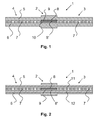
- FIG. 1 shows a first embodiment of an expansion joint tape 1 in cross-section with a reinforced central portion or Dehn Siemens 2 and two adjoining flange 3 and 4.
- the expansion joint strip 1 is formed of two webs 5 and 6 of a butyl elastomer and has in the flange 3 and 4 a non-stretchable core 7 made of a copolymer, polypropylene or polyethylene coated substrate or a glass fiber substrate, which may consist of a nonwoven, a fabric or a scrim.
- the expansion region 2 there is a flat chamber 8 between a release layer 9 of a non-adherent film, in particular a silicone-coated release paper or a textile fabric, and the upper web 5 and, on the other hand, a flat chamber 8 'between the release layer 9 and a substrate made of a swelling material 10 provided.
- the source material 10 preferably consists of sodium bentonite and butyl rubber, or of acrylic polymer, or of a rubber-polymer mixture.
- the thickness of the expansion region 2 is somewhat larger than the thickness of the two flange regions 3 and 4, and thus the expansion joint tape 1 has an increased material thickness in this region.
- the built in a bitumen waterproofing expansion joint tape 1 can now be checked for leaks by means of compressed air or under vacuum by no pressure drop is detected over a long time.
- a violation of the expansion joint tape 1 in the Dehn Scheme 2 is detected, by swelling the source material swell 10 and thus seal the leak. Since the source material 10 is enclosed by butyl elastomer, the water can no longer escape and the swelling material 10 remains swollen, i. Self-repair of the leak is permanent.
- expansion joint strip 1 With the expansion joint strip 1 according to the invention, an increased material thickness is present in the expansion region 2 through the installation of the source material 10, which provides additional protection against injury to the expansion joint strip.
- the flange portions 3 and 4 of a butyl elastomer with a core 7 of a copolymer substrate or glass fiber these are flexible and the expansion joint tape 1 can also be laid very well in corner areas.
- a second embodiment of the expansion joint tape 1 is shown, in which the webs 5 and 6 of butyl elastomer have a smaller thickness than in the first embodiment, but on the inside, each with a further sheet 11 and 12 of an ethylene-propylene-diene Rubber (EPDM elastomer) is provided.
- EPDM elastomer ethylene-propylene-diene Rubber
- the release layer 9 is provided with approximately the same thickness between the non-stretchable cores 7 disposed in both flange portions.
- the first or upper flat chamber 8 is formed between the top of the separation layer 9 and the top EPDM web 11 and the second or bottom chamber 8 'between the bottom of the separation layer 9 and the bottom EPDM web 12.
- the release layer 9 may consist of a silicone-coated paper or of a suitable non-adherent substrate, for example a glass fiber fabric.
- the tightness of the built-in expansion joint tape 1 can also be checked by means of compressed air or under vacuum. If a leak is found, it can be stuffed into the two chambers 8 and 8 'by means of an injection of a cement material and thus sealed again.
- a third embodiment of the expansion joint tape 1 is shown in cross section, wherein the webs 5 and 6 of butyl elastomer each have a stage immediately adjacent to the central portion 2, ie the web 5 is seen on the left in the figure narrower than the right and vice versa the web. 6 is narrower in the figure than on the left.
- a non-stretchable core 7 made of a copolymer, polypropylene or polyethylene coated substrate, or a copolymer, polypropylene or polyethylene film, or a glass fiber substrate, in particular glass fiber, is provided.
- an upper non-adherent Substrate 13 is fixed on one side to the core in the left flange area 4 and a lower non-adherent substrate 14 is fixed on one side to the core in the right flange area 3.
- the two substrates 13 and 14 lie loosely on each other and thus form a shallow chamber 8 ".
- the two substrates 13 and 14 can have on the inside, ie on the side associated with the chamber 8", a coating of a suitable non-adhesive plastic exhibit.
- the substrates 13 and 14 may also consist of a Kunststoffofffie or a thin metal sheet.
- FIGS. 4 to 7 is a fourth embodiment of the expansion joint tape 1 'is shown, in which a central portion 2' of two superimposed webs 15 and 16 is formed of an elastomer or plastic, which are mutually connected in their edge regions over a non-stretchable side strips 18 and 19, so that a flat chamber 17 is formed.
- the non-stretchable side panels 18 and 19 are made from a textile fabric, substrate coated with copolymer, polypropylene or polyethylene, or a thin metal sheet or a copolymer coated thin metal sheet.
- the two side strips 18 and 19 then form above and below a composite 20 with a building or a substrate such as bitumen.
- FIG. 5 the side strips 18 and 19 additionally provided at the top and bottom with a non-woven or fabric-like support 21, which is formed in particular from a polyester non-woven.
- a further variant is shown, in which on the supports 21, a further layer 22 made of an elastomer or plastic is attached.
- FIG. 7 is a variant of the execution of FIG. 4 represented, in which on the outside of the central portion 2, a thin metal sheet 23 is provided as a mechanical protection.
- expansion joint tape 1 made of an elastomer or plastic also allows a particularly simple laying technique with bitumen or with the known adhesives.
- Fig. 8 is purely schematically shown a rotary vulcanization plant 30 with a heating drum 31, a deflection drum 32, a pressure drum 33 with a clamping element 34 and a deflection drum 35.
- a continuous steel band 36 wraps around the heating drum 31 with a wrap of about 270 ° and is then guided via the deflection drum 32 to the pressure drum 33 and back over the deflection drum 35 to the heating drum 31 again.
- two webs 5 and 6 or 15 and 16 are stacked from an elastic material.
- a separating layer 9 between the two webs 5 and 6 is arranged approximately centrally thereto.
- a double belt press 40 with two upper drums 41 and one upper pressure belt 42 and with two lower drums 43 and a lower pressure belt 44 is shown.
- An upper pressure pad 45 and a lower pressure pad 46 ensure a uniform contact pressure in the entire pressing area.
- Such a double belt press 40 is used, for example, by Hymmen GmbH, DE-33613 Bielefeld offered. Similar to the previous method, two webs 5 and 6 of a rubber-elastic material with an intermediate release layer 9 or two webs 15 and 16 are superimposed without release layer and so introduced as loose assembled band 47 in the double belt press 40, where the band 47th at a pressure of about 4 to 6 bar and a temperature of 150 to 185 ° C at the flange areas vulcanized becomes. The finished expansion joint tape 1 or 1 'is then wound onto a roll 48.
- a two-piece squeeze mold 50 is shown with a punch-shaped upper part 51 and a trough-shaped lower part 52, which has a length of three meters.
- two sheets of rubber-elastic material with an intermediate release layer inserted into the crimp and by means of a hydraulic press at a specific surface pressure of 20 to 80 kg / cm 2 and a temperature of 150 to 185 ° C during some Cured at the flange areas for a few minutes.
- a hydraulic press is, for example, from the company Wickert Maschinenbau GmbH, DE-76829 Landau in the Palatinate expelled.
- the finished expansion joint tape 1 or 1 'rolled up on a roll, this process is intermittent with the pressing.
Landscapes
- Engineering & Computer Science (AREA)
- Architecture (AREA)
- Physics & Mathematics (AREA)
- Electromagnetism (AREA)
- Civil Engineering (AREA)
- Structural Engineering (AREA)
- General Physics & Mathematics (AREA)
- Joints Allowing Movement (AREA)
- Building Environments (AREA)
Abstract
Description
- Die Erfindung betrifft ein Dehnfugenband nach dem Oberbegriff des Patentanspruchs 1 und ein Verfahren zu dessen Herstellung.
- Ein solches Dehnfugenband aus elastischem Material, insbesondere Kunstgummi, ist beispielsweise aus
EP-A-0 440 870 bekannt und besitzt einen Mittelabschnitt zum Überbrücken einer Baufuge sowie zwei seitliche Randabschnitte, an denen praktisch undehnbare Seitenstreifen als Haftvermittler zum Baukörper angebracht sind. Die Seitenstreifen sind auf beiden Oberflächen der Randabschnitte aufgebracht bzw. aufgepresst, und mit deren Längskanten bündig. Die Seitenstreifen können aus Gewebe, Vlies, bituminösen Massen oder einer Kombination dieser Materialien bestehen. Sie können am Mittelabschnitt abgestuft oder in das Material der Randabschnitte eingepresst sein, um eine günstige Querzugeinleitung bzw. Abdichtung zu ermöglichen. - Fugenbänder werden zur Überbrückung von Dehnfugen in Abdichtungen und zwischen Bauteilen eingesetzt. Die Seitenstreifen werden sandwichartig mittels Flamme in die Flächenabdichtung geflämmt oder mit einem Epoxid-Kleber direkt auf den Untergrund geklebt. Die erhitzten und angeschmolzenen oder die geklebten Bereiche werden dann lediglich zusammengepresst, um die Klebeverbindung und Abdichtung zu bilden. Nach dem Einbau der Dehnfugenbänder ist eine Überprüfung der Dichtigkeit gegen Wasser nicht möglich, so dass die Verlegung und Einbau der Dehnfugenbänder mit grösster Sorgfalt vorgenommen werden muss. Bei einer späteren Verletzung der Flächenabdichtung ist eine Reparatur relativ aufwändig, da grössere Abschnitte entfernt und wieder eingesetzt werden müssen. Im eingebauten Zustand ist die Flächenabdichtung wegen Erdaufschüttungen und dergleichen auch schwer zugänglich.
- Der vorliegenden Erfindung liegt nun die Aufgabe zugrunde, ein Dehnfugenband derart weiterzubilden, welches nach erfolgter Einbau des Dehnfugenbandes eine Überprüfung der Dichtigkeit erlaubt und eine einfachere Reparatur von undichten Stellen ermöglicht.
- Diese Aufgabe wird durch ein Dehnfugenband mit den Merkmalen des Patentanspruchs 1 gelöst.
- Die Erfindung hat den Vorteil, dass das Dehnfugenband im eingebauten Zustand auf seine Dichtigkeit überprüft werden kann. In einer weiteren Ausführung kann gegebenenfalls durch eindringendes Wasser eine Selbst-Reparatur erfolgen.
- Weitere Vorteile der Erfindung folgen aus den abhängigen Patentansprüchen und aus der nachfolgenden Beschreibung, in welcher die Erfindung anhand eines in den schematischen Zeichnungen dargestellten Ausführungsbeispieles näher erläutert wird. Es zeigt:
- Fig. 1
- ein erste Ausführung des Dehnfugenbandes,
- Fig. 2
- eine zweite Ausführungsform des Dehnungsfugenbandes,
- Fig. 3
- eine dritte Ausführungsform des Dehnfugenbandes,
- Fig. 4
- eine vierte Ausführungsform des Dehnfugendbandes,
- Fig. 5
- eine erste Variante der vierten Ausführungsform,
- Fig. 6
- eine zweite Variante der vierten Ausführungsform,
- Fig. 7
- eine dritte Variante der vierten Ausführungsform
- Fig. 8
- schematisch eine Rotations-Vulkanisationsanlage,
- Fig. 9
- schematisch eine Doppelbandpresse, und
- Fig. 10
- einen Querschnitt durch eine zweiteilige Quetschform.
- In den Figuren sind für dieselben Elemente jeweils dieselben Bezugszeichen verwendet, wenn nicht anders angegeben.
- In der
Figur 1 zeigt eine erste Ausführung eines Dehnfugenbandes 1 im Querschnitt mit einem verstärkten Mittelabschnitt oder Dehnbereich 2 und zwei daran anschliessenden Flanschbereichen 3 und 4. Das Dehnfugenband 1 ist aus zwei Bahnen 5 und 6 aus einem Butyl-Elastomer geformt und weist in den Flanschbereichen 3 und 4 einen nicht-dehnbaren Kern 7 aus einem mit Copolymer, Polypropylen oder Polyäthylen beschichteten Substrat oder einem Glasfasersubstrat auf, welche aus einem Vlies, einem Gewebe oder einem Gelege bestehen können. Im Dehnbereich 2 ist einerseits eine flache Kammer 8 zwischen einer Trennschicht 9 von einer nicht-haftenden Folie, insbesondere einem silikonbeschichteten Trennpapier oder einem Textilgewebe, und der oberen Bahn 5 und andererseits eine flache Kammer 8' zwischen der Trennschicht 9 und einem Substrat aus einem Quellmaterial 10 vorgesehen. Das Quellmaterial 10 besteht vorzugsweise aus Natriumbentonit und Butylkautschuk, oder aus Acryl-Polymer, oder aus einer Kautschuk-Polymermischung. Wie ersichtlich ist die Dicke des Dehnbereiches 2 etwas grösser als die Dicke der beiden Flanschbereiche 3 und 4, und somit weist das Dehnfugenband 1 in diesem Bereich eine erhöhte Materialstärke auf. - In der Praxis kann nun das in einer Bitumenabdichtung eingebaute Dehnfugenband 1 mittels Druckluft oder unter Vakuum auf Dichtigkeit überprüft werden, indem über eine längere Zeit kein Druckabfall festgestellt wird. Wenn jedoch eine Verletzung des Dehnfugenbandes 1 im Dehnbereich 2 festgestellt wird, kann durch Wassereinwirkung das Quellmaterial 10 aufquellen und so die undichte Stelle abdichten. Da das Quellmaterial 10 von Butyl-Elastomer umschlossen ist, kann das Wasser nicht mehr entweichen und bleibt das Quellmaterial 10 in aufgequollenem Zustand, d.h. die Selbst-Reparatur der undichten Stelle ist dauerhaft.
- Mit dem erfindungsgemässen Dehnfugenband 1 ist im Dehnbereich 2 durch den Einbau des Quellmaterials 10 eine erhöhte Materialstärke vorhanden, was eine zusätzlicher Schutz gegen Verletzungen des Dehnfugenbandes bewirkt. Durch die Ausbildung der Flanschbereiche 3 und 4 aus einem Butyl-Elastomer mit einem Kern 7 aus einem Copolymer-Substrat oder Glasfasergelege sind diese biegsam und kann das Dehnfugenband 1 auch sehr gut in Eckbereichen verlegt werden.
- In
Fig. 2 ist eine zweite Ausführung des Dehnfugenbandes 1 dargestellt, bei welchem die Bahnen 5 und 6 aus Butyl-Elastomer eine geringere Dicke aufweisen als in der ersten Ausführung, jedoch auf der Innenseite mit je einer weiteren Bahn 11 und 12 aus einem Ethylen-Propylen-Dien-Kautschuk (EPDM-Elastomer) versehen ist. In diesem Fall ist die Trennschicht 9 mit etwa derselben Dicke zwischen den in beiden Flanschbereichen angeordneten nicht-dehnbaren Kernen 7 vorgesehen. Die erste oder obere flache Kammer 8 wird zwischen der Oberseite der Trennschicht 9 und der oberen EPDM-Bahn 11 und die zweite oder untere Kammer 8' zwischen der Unterseite der Trennschicht 9 und der unteren EPDM-Bahn 12 gebildet. Die beiden Kammern 8 und 8' sind durch hier nicht-dargestellte Einschnitte in die Trennschicht 9 miteinander verbunden. Die Trennschicht 9 kann aus einem silikonbeschichteten Papier oder aus einem geeigneten nicht-haftenden Substrat bestehen, beispielsweise einem Glasfasergewebe. - Bei dieser zweiten Ausbildung lässt sich ebenfalls die Dichtigkeit des eingebauten Dehnfugenbandes 1 mittels Druckluft oder unter Vakuum überprüfen. Falls eine Undichtigkeit festgestellt wird, kann diese mittels eine Injektion eines Kittmaterials in die beiden Kammern 8 und 8' gestopft und so wieder abgedichtet werden.
- In
Fig. 3 ist eine dritte Ausbildung des Dehnfugenbandes 1 im Querschnitt gezeigt, wobei die Bahnen 5 und 6 aus Butyl-Elastomer je eine Stufe unmittelbar anschliessend am Mittelabschnitt 2 aufweisen, d.h die Bahn 5 ist links in der Figur gesehen schmäler ausgebildet als rechts und umgekehrt die Bahn 6 ist rechts in der Figur schmäler ausgebildet als links. Zur Verstärkung der beiden Flanschbereiche 3 und 4 ist je ein nicht-dehnbarer Kern 7 aus einem Copolymer, Polypropylen oder Polyäthylen beschichteten Substrat, oder einem Copolymer-, Polypropylen- oder Polyäthylen-Film, oder einem Glasfasersubstrat, insbesondere Glasfasergelege, vorgesehen. Ferner ist im Mittelabschnitt ein oberes nicht-haftendes Substrat 13 einseitig am Kern im linken Flanschbereich 4 befestigt und ein unteres nicht-haftendes Substrat 14 ist einseitig am Kern im rechten Flanschbereich 3 befestigt. Somit liegen die beiden Substrate 13 und 14 lose aufeinander und bilden damit eine flache Kammer 8". Die beiden Substrate 13 und 14 können dabei auf der Innenseite, d.h. auf der der Kammer 8" zugeordnete Seite, eine Beschichtung aus einem geeigneten nicht-haftenden Kunststoff aufweisen. Die Substrate 13 und 14 können aber auch aus einer Kunstofffolie oder einem dünnen Metallblech bestehen. - In den
Figuren 4 bis 7 ist eine vierte Ausführung des Dehnfugenbandes 1' dargestellt, bei welchem ein Mittelabschnitt 2' von zwei übereinander gelegten Bahnen 15 und 16 aus einem Elastomer oder Kunststoff gebildet ist, die in ihren Randbereichen gegenseitig über einem nicht-dehnbaren Seitenstreifen 18 und 19 miteinander verbunden sind, so dass eine flache Kammer 17 gebildet ist. Die nicht-dehbaren Seitenstreifen 18 und 19 sind aus einem Textilgewebe, aus mit Copolymer, Polypropylen oder Polyäthylen beschichtetem Substrat, oder aus einem dünnen Metallblech oder einem mit Copolymer beschichteten dünnen Metallblech hergestellt. Die beiden Seitenstreifen 18 und 19 bilden sodann oben und unten einen Verbund 20 mit einem Baukörper oder einem Substrat wie beispielsweise Bitumen. InFigur 5 sind die Seitenstreifen 18 und 19 zusätzlich oben und unten mit einer vlies- oder gewebeartigen Auflage 21 versehen, die insbesondere aus einem Polyester-Vlies gebildet ist. InFigur 6 ist eine weitere Variante dargestellt, in welcher auf den Auflagen 21 eine weitere Schicht 22 aus einem Elastomer oder Kunststoff angebracht ist. InFigur 7 ist eine Variante der Ausführung derFigur 4 dargestellt, bei welcher auf der Aussenseite des Mittelabschnittes 2 ein dünnes Metallblech 23 als mechanischer Schutz vorgesehen ist. - Die Überprüfung der Dichtigkeit der dritten und vierten Ausbildung erfolgt in derselben Weise wie bei den beiden vorhergehenden Ausführungen.
- Die Ausbildung des Dehnfugenbandes 1 aus einem Elastomer oder Kunststoff erlaubt auch eine besonders einfache Verlegetechnik mit Bitumen oder mit den an sich bekannten Klebstoffen.
- In
Fig. 8 ist rein schematisch eine Rotations-Vulkanisationsanlage 30 mit einer Heiztrommel 31, einer Umlenktrommel 32, einer Andrücktrommel 33 mit einem Spannelement 34 und einer Umlenktrommel 35 gezeigt. Ein durchgehendes Stahlband 36 umschlingt die Heiztrommel 31 mit einer Umschlingung von etwa 270° und wird dann über die Umlenktrommel 32 zur Andrücktrommel 33 und zurück über die Umlenktrommel 35 wieder zur Heiztrommel 31 geführt. Zur Herstellung des Dehnfugenbandes 1 bzw. 1' werden zwei Bahnen 5 und 6 bzw. 15 und 16 aus einem elastischen Material aufeinandergelegt. Für die Ausführungen nach denFiguren 1 bis 3 wird eine Trennschicht 9 zwischen den beiden Bahnen 5 und 6 etwa mittig dazu angeordnet. Diese beiden Bahnen 5 und 6 bzw. 15 und 16 - mit einem Pfeil 37 angedeutet - werden in den Zwickel 38 zwischen der Umlenktrommel 35 und der Heiztrommel 31 eingeführt und so durch die Rotations-Vulkanisationsanlage 30 geleitet. Anschliessend wird das fertig vulkanisierte Dehnungsfugenband 1 bzw. 1' auf einer Rolle 39 aufgewickelt. Die Vulkanisation erfolgt bei einem Druck von etwa 4 bis 6 bar und einer Temperatur der Heiztrommel 31 von 150 bis 185 °C. - In
Fig. 9 ist eine Doppelbandpresse 40 mit zwei oberen Trommeln 41 und einem oberen Anpressband 42 und mit zwei unteren Trommeln 43 und einem unterem Anpressband 44 gezeigt. Ein oberes Druckkissen 45 und ein unteres Druckkissen 46 sorgen für einen gleichmässigen Anpressdruck im gesamten Pressbereich. Eine solche Doppelbandpresse 40 wird beispielsweise von der Firma Hymmen GmbH,DE-33613 Bielefeld angeboten. Ähnlich wie beim vorhergehende Verfahren werden zwei Bahnen 5 und 6 aus einem gummi-elastischem Material mit einer dazwischen liegenden Trennschicht 9 bzw. zwei Bahnen 15 und 16 ohne Trennschicht aufeinandergelegt und so als loses zusammengestelltes Band 47 in die Doppelbandpresse 40 eingeführt, wo das Band 47 bei einem Druck von etwa 4 bis 6 bar und einer Temperatur von 150 bis 185 °C an den Flanschbereichen vulkanisiert wird. Das fertige Dehnungsfugenband 1 bzw. 1' wird dann auf eine Rolle 48 aufgewickelt. - In
Fig. 10 ist eine zweiteilige Quetschform 50 mit einem stempelförmigen Oberteil 51 und einem wannenförmigen Unterteil 52 dargestellt, welche eine Länge von drei Metern aufweist. Ähnlich wie bei den oben beschriebenen Verfahren zwei Bahnen aus gummi-elastischem Material mit einer dazwischenliegenden Trennschicht in die Quetschform eingelegt und mittels einer hydraulischen Presse bei einem spezifischen Flächendruck von 20 bis 80 kg/cm2 und einer Temperatur von 150 bis 185 °C während einigen Minuten an den Flanschbereichen vulkanisiert. Eine solche hydraulische Presse wird beispielsweise von der Fa. Wickert Maschinenbau GmbH,DE-76829 Landau in der Pfalz vertrieben. Sodann wird das fertige Dehnfugenband 1 bzw. 1' um weitere 3 Meter verschoben und der nächste Abschnitt vulkanisiert. Anschliessend wird das fertige Dehnfugenband 1 bzw. 1' auf eine Rolle aufgerollt, wobei dieser Vorgang mit dem Pressen intermittierend erfolgt.
Claims (14)
- Dehnfugenband (1; 1') aus elastischem Material mit einem dehnbaren Mittelabschnitt (2; 2') und zwei beiderseits daran anschliessenden Flanschbereichen (3, 4), dadurch gekennzeichnet, dass im dehnbaren Mittelabschnitt (2; 2') eine flache Kammer (8, 8'; 17) vorgesehen ist.
- Dehnfugenband (1) nach Anspruch 1, dadurch gekennzeichnet, dass die flache Kammer (8, 8') von einer Trennschicht (9) gebildet ist.
- Dehnfugenband nach Anspruch 2, dadurch gekennzeichnet, dass der Mittelabschnitt (2) und die Flanschbereichen (3, 4) von zwei einstückigen Bahnen (5, 6) aus einem Butyl-Elastomer geformt sind und die Flanschbereiche (3, 4) einen nicht-dehnbaren Kern (7) aus einem Copolymer beschichteten Substrat oder einem Glasfasersubstrat aufweisen.
- Dehnfugenband nach Anspruch 2 oder 3, dadurch gekennzeichnet, dass der Mittelbereich (2) eine grössere Dicke als die Flanschbereiche (3, 4) aufweist.
- Dehnfugenband nach einem der Ansprüche 2 bis 4, dadurch gekennzeichnet, dass im Mittelabschnitt (2) ein Substrat aus einem Quellmaterial (10) vorgesehen ist.
- Dehnfugenband nach Anspruch 5, dadurch gekennzeichnet, dass das Quellmaterial (10) aus Natriumbentonit und Butylkautschuk, oder aus Acryl-Polymer, oder aus einer Kautschuk-Polymermischung besteht.
- Dehnfugenband nach Anspruch 3 oder 4, dass zwischen den Bahnen (5, 6) aus einem Butyl-Elastomer und dem Kern (7) je eine Bahn (11, 12) aus einem Ethylen-Propylen-Dien-Kautschuk vorgesehen ist.
- Dehnfugenband nach Anspruch 2 oder 3, dadurch gekennzeichnet, dass die flache Kammer (8") von einem nicht-haftenden oberen Substrat (13), welches einseitig an dem einen Flanschbereich (4) befestigt ist, und von einem nicht-haftenden unteren Substrat (14), welches einseitig an dem anderen Flanschbereich (3) befestigt ist, gebildet ist.
- Dehnfugenband nach Anspruch 1, dadurch gekennzeichnet, dass der Mittelabschnitt (2') von Bahnen (15, 16) aus einem Elastomer oder Kunststoff gebildet ist, welche an den Randbereichen je einen nicht-dehnbaren Seitenstreifen (18, 19) aus Textil, einem dünnen Metallblech oder einem Copolymer beschichteten dünnen Metallblech einschliessen, um derart die flache Kammer (17) zu bilden.
- Dehnfugenband nach Anspruch 9, dadurch gekennzeichnet, dass ein dünnes Metallblech (23) auf der Aussenseite eines der aus Elastomer oder Kunststoff bestehenden Bahnen (15, 16) als mechanischer Schutz für den Dehnbereich angeordnet ist.
- Verfahren zur Herstellung eines Dehnfugenbandes nach einem der Ansprüche 1 bis 10, dadurch gekennzeichnet, dass zwei Bahnen (5, 6; 15, 16) aus elastischem Material aufeinandergelegt und durchlaufend in einer Rotations-Vulkanisationsanlage (30) unter einem Druck von 4 bis 6 bar und einer Temperatur von 150 bis 185 °C an den Flanschbereichen vulkanisiert werden.
- Verfahren zur Herstellung eines Dehnfugenbandes nach einem der Ansprüche 1 bis 10, dadurch gekennzeichnet, dass zwei Bahnen (5, 6; 15, 16) aus elastischem Material aufeinandergelegt und abschnittsweise mittels einer zweiteiligen Quetschform (50) in einer hydraulischen Presse während einigen Minuten mit einem spezifischen Flächendruck von 20 bis 80 kg/cm2 und einer Temperatur von 150 bis 185 °C an den Flanschbereichen vulkanisiert werden.
- Verfahren zur Herstellung eines Dehnfugenbandes nach einem der Ansprüche 1 bis 10, dadurch gekennzeichnet, dass zwei Bahnen aus elastischem Material aufeinandergelegt und durchlaufend mittels einer Doppelbandpresse (40) bei einem Druck von 4 bis 6 bar und einer Temperatur von 150 bis 185 °C an den Flanschbereichen vulkanisiert werden.
- Verfahren nach einem der Ansprüche 11 bis 13, dadurch gekennzeichnet, dass zwischen den beiden Bahnen (5, 6) eine Trennschicht (9) etwa mittig dazu angeordnet wird.
Applications Claiming Priority (2)
| Application Number | Priority Date | Filing Date | Title |
|---|---|---|---|
| CH19422007A CH700909B1 (de) | 2007-12-14 | 2007-12-14 | Dehnfugenband. |
| CH5222008A CH701724B1 (de) | 2008-04-04 | 2008-04-04 | Dehnfugenband. |
Publications (2)
| Publication Number | Publication Date |
|---|---|
| EP2071091A2 true EP2071091A2 (de) | 2009-06-17 |
| EP2071091A3 EP2071091A3 (de) | 2014-08-06 |
Family
ID=40377681
Family Applications (1)
| Application Number | Title | Priority Date | Filing Date |
|---|---|---|---|
| EP08105977.6A Withdrawn EP2071091A3 (de) | 2007-12-14 | 2008-12-12 | Dehnfugenband |
Country Status (1)
| Country | Link |
|---|---|
| EP (1) | EP2071091A3 (de) |
Cited By (2)
| Publication number | Priority date | Publication date | Assignee | Title |
|---|---|---|---|---|
| EP2277685A1 (de) * | 2009-07-14 | 2011-01-26 | Schoop + Co. AG | Verfahren zum Verbinden von Teilen aus einem vulkanisierten Gummiwerkstoff und/oder aus Metall mittels einer Klebefolie |
| EP2405067B1 (de) | 2010-07-09 | 2017-06-21 | GABAG Produktions & Vertriebs AG | Dicht- und Montageband mit einem Schnittschutz |
Citations (3)
| Publication number | Priority date | Publication date | Assignee | Title |
|---|---|---|---|---|
| DE33613C (de) | VlLLEROY & BOCH in Mettlach | Läuferlagerung für Kollergänge | ||
| DE76829C (de) | E. A. PAPE in Wittenberg, Bez. Halle, Mauerstr | Federndes Lager für wagrecbt schwingende Körper | ||
| EP0440870A1 (de) | 1988-08-12 | 1991-08-14 | SCHOOP & CO. AG | Dehnfugenband |
Family Cites Families (5)
| Publication number | Priority date | Publication date | Assignee | Title |
|---|---|---|---|---|
| US4204373A (en) * | 1978-09-08 | 1980-05-27 | Davidson James D | Compressed expandable insulation tape and method |
| CA1145131A (en) * | 1980-04-05 | 1983-04-26 | Hajime Yamaji | Aqueously-swelling water stopper and a process of stopping water thereby |
| DE3841553C2 (de) * | 1987-12-09 | 2002-04-18 | Werner Doose | Klebeanschluß von Kunststoffdichtungsbahnen |
| DE4323216C2 (de) * | 1993-07-12 | 1999-07-08 | Helmut Hiendl | Unter Einfluß von Wasser quellendes Dichtungsmaterial sowie unter Verwendung dieses Materials hergestelltes Dichtungselement |
| DE4413599A1 (de) * | 1994-04-21 | 1995-10-26 | Beko Renate Lang | Verfahren zur Herstellung von innen liegenden Fugenbändern |
-
2008
- 2008-12-12 EP EP08105977.6A patent/EP2071091A3/de not_active Withdrawn
Patent Citations (3)
| Publication number | Priority date | Publication date | Assignee | Title |
|---|---|---|---|---|
| DE33613C (de) | VlLLEROY & BOCH in Mettlach | Läuferlagerung für Kollergänge | ||
| DE76829C (de) | E. A. PAPE in Wittenberg, Bez. Halle, Mauerstr | Federndes Lager für wagrecbt schwingende Körper | ||
| EP0440870A1 (de) | 1988-08-12 | 1991-08-14 | SCHOOP & CO. AG | Dehnfugenband |
Cited By (3)
| Publication number | Priority date | Publication date | Assignee | Title |
|---|---|---|---|---|
| EP2277685A1 (de) * | 2009-07-14 | 2011-01-26 | Schoop + Co. AG | Verfahren zum Verbinden von Teilen aus einem vulkanisierten Gummiwerkstoff und/oder aus Metall mittels einer Klebefolie |
| EP2405067B1 (de) | 2010-07-09 | 2017-06-21 | GABAG Produktions & Vertriebs AG | Dicht- und Montageband mit einem Schnittschutz |
| EP3263790B1 (de) * | 2010-07-09 | 2024-08-07 | Sanipat GmbH | Verwendung eines schnittschutz-streifens in kombination mit einem dicht- und montageband |
Also Published As
| Publication number | Publication date |
|---|---|
| EP2071091A3 (de) | 2014-08-06 |
Similar Documents
| Publication | Publication Date | Title |
|---|---|---|
| EP2349707B1 (de) | Wasserdichte membran | |
| EP2372041B1 (de) | Trägerplatte sowie Verfahren zu deren Herstellung | |
| WO2016128170A1 (de) | Dichtungsbahn und klebeband für nasszellen | |
| EP2213811A2 (de) | Schichtverbund als Träger für keramische, Stein- oder ähnliche Beläge | |
| EP2085212B1 (de) | Mehrlagiges faserverstärktes Thermoplast-Flachmaterial sowie Verfahren zu seiner Herstellung | |
| EP0440870B1 (de) | Dehnfugenband | |
| EP3464742B1 (de) | Dichtungsstreifen zur abdichtung von fugen zwischen bauelementen sowie verfahren zur herstellung eines dichtungsstreifens | |
| EP2071091A2 (de) | Dehnfugenband | |
| DE202010000225U1 (de) | Abdichtungsmembran | |
| DE19925573A1 (de) | Dichtungsbahn | |
| CH701724B1 (de) | Dehnfugenband. | |
| CH700909B1 (de) | Dehnfugenband. | |
| EP2949462B1 (de) | Flächenabdichtelement für baukörper | |
| DE2722139A1 (de) | Dichtungsband mit dehnungseigenschaften | |
| DE202014100560U1 (de) | Mehrlagiges Band zur Abdichtung von durch Wände hindurchgeführte Rohre | |
| DE19611382A1 (de) | Schalplatte für Betonschalungen mit Kantenschutz und Zwischenschicht | |
| CH695062A5 (de) | Verfahren zur Abdichtung von Tagbautunnelbauwerken und Sohlgewölbe für einen Tagbautunnel. | |
| DE202005015022U1 (de) | Injektions- oder Verpressschlauch | |
| DE102017103251A1 (de) | Vorgeformte Sanitärdichtecke sowie Sanitäranordnung | |
| EP1812652A1 (de) | Schichtaufbau | |
| DE20107230U1 (de) | Fugenabdichtung auf der Basis eines im beschichteten Bereich mindestens teilweise perforierten Vlies-Streifens | |
| DE2364025C3 (de) | Fasermatte zur trockenen Herstellung von gepreßten Formkörpern aus Lignozellulose-Fasern und Verfahren zur Herstellung der Matte | |
| DE29713365U1 (de) | Bauteilabdichtung | |
| DE19831632A1 (de) | Verfahren zur Herstellung von Verbundteilen aus Kunststofformteilen und Matten, z. B. aus Dachbahnen | |
| AT505478A1 (de) | Belagsplatte für beläge, insbesondere bodenbeläge |
Legal Events
| Date | Code | Title | Description |
|---|---|---|---|
| PUAI | Public reference made under article 153(3) epc to a published international application that has entered the european phase |
Free format text: ORIGINAL CODE: 0009012 |
|
| AK | Designated contracting states |
Kind code of ref document: A2 Designated state(s): AT BE BG CH CY CZ DE DK EE ES FI FR GB GR HR HU IE IS IT LI LT LU LV MC MT NL NO PL PT RO SE SI SK TR |
|
| AX | Request for extension of the european patent |
Extension state: AL BA MK RS |
|
| PUAL | Search report despatched |
Free format text: ORIGINAL CODE: 0009013 |
|
| AK | Designated contracting states |
Kind code of ref document: A3 Designated state(s): AT BE BG CH CY CZ DE DK EE ES FI FR GB GR HR HU IE IS IT LI LT LU LV MC MT NL NO PL PT RO SE SI SK TR |
|
| AX | Request for extension of the european patent |
Extension state: AL BA MK RS |
|
| RIC1 | Information provided on ipc code assigned before grant |
Ipc: E04B 1/68 20060101AFI20140630BHEP |
|
| AKY | No designation fees paid | ||
| AXX | Extension fees paid |
Extension state: AL Extension state: RS Extension state: BA Extension state: MK |
|
| REG | Reference to a national code |
Ref country code: DE Ref legal event code: R108 |
|
| REG | Reference to a national code |
Ref country code: DE Ref legal event code: R108 Effective date: 20150415 |
|
| STAA | Information on the status of an ep patent application or granted ep patent |
Free format text: STATUS: THE APPLICATION IS DEEMED TO BE WITHDRAWN |
|
| 18D | Application deemed to be withdrawn |
Effective date: 20150207 |