EP2071290B1 - Système de consultation pour aider la récupération de pilote à partir de désorientation spatiale durant un roulement excessif - Google Patents
Système de consultation pour aider la récupération de pilote à partir de désorientation spatiale durant un roulement excessif Download PDFInfo
- Publication number
- EP2071290B1 EP2071290B1 EP08170411.6A EP08170411A EP2071290B1 EP 2071290 B1 EP2071290 B1 EP 2071290B1 EP 08170411 A EP08170411 A EP 08170411A EP 2071290 B1 EP2071290 B1 EP 2071290B1
- Authority
- EP
- European Patent Office
- Prior art keywords
- roll
- angle
- vehicle
- alert
- signal
- Prior art date
- Legal status (The legal status is an assumption and is not a legal conclusion. Google has not performed a legal analysis and makes no representation as to the accuracy of the status listed.)
- Active
Links
Images


Classifications
-
- G—PHYSICS
- G01—MEASURING; TESTING
- G01C—MEASURING DISTANCES, LEVELS OR BEARINGS; SURVEYING; NAVIGATION; GYROSCOPIC INSTRUMENTS; PHOTOGRAMMETRY OR VIDEOGRAMMETRY
- G01C23/00—Combined instruments indicating more than one navigational value, e.g. for aircraft; Combined measuring devices for measuring two or more variables of movement, e.g. distance, speed or acceleration
- G01C23/005—Flight directors
-
- B—PERFORMING OPERATIONS; TRANSPORTING
- B64—AIRCRAFT; AVIATION; COSMONAUTICS
- B64D—EQUIPMENT FOR FITTING IN OR TO AIRCRAFT; FLIGHT SUITS; PARACHUTES; ARRANGEMENT OR MOUNTING OF POWER PLANTS OR PROPULSION TRANSMISSIONS IN AIRCRAFT
- B64D45/00—Aircraft indicators or protectors not otherwise provided for
Definitions
- US 2005/011 9802 discloses an aircraft pilot assistance system and method. This discloses a system wherein roll rate is monitored and wherein when roll rate exceeds a given threshold the presence of an altitude excavation is evaluated and in the event that the nose is low, provides an alert signal to a pilot.
- US 2003/001 6145 discloses a ground proximity warning system including a pitch angle alerting device.
- US 6,341,248 discloses an apparatus and method for monitoring the attitude of an aircraft based upon reviewing a combination of cooperated and sensed flightpath angles and calculated and sensed roll angles.
- An example system includes one or more altitude sensors that determine one of altitude above ground level or barometric altitude, one or more roll-angle sensors that determine the roll-angle of the vehicle, and a processor.
- the processor receives the altitude and roll-angle information, determines if an excessive roll-angle condition exists based on the received altitude and roll-angle information, and generates a roll-angle alert signal if a roll-angle alert condition exists.
- One or more output devices output one or more of an audio or video signal indicating an alert condition exists if the processor generated the roll-angle alert signal.
- the processor determines if the alert condition still exists after one of a predefined period of time, the vehicle roll-angle is deteriorating away from a desired threshold, or vehicle roll-angle rate is greater than a roll-angle rate threshold. If one of the condition still exists after the time delay, the vehicle roll-angle has deteriorated away from the desired threshold, or the roll-angle rate is greater than a roll-angle rate threshold, the processor generates a roll-direction signal based upon vehicle position relative to the horizon and outputs the determined roll-direction signal via the one or more output devices.
- the roll-angle signal and the roll-direction signal include one or more of a synthesized or pre-recorded voice, for example "bank angle,” "roll left,” or “roll right.”
- the roll-direction signal includes one or more of graphical or textual information.
- the graphical information includes an arrow pointing in the direction to roll the vehicle to attain level flight.
- the textual information includes the text "roll left” or "roll right.”
- FIGURE 1 illustrates a schematic diagram of an example system 20 for performing processes in accordance with embodiments of the present invention.
- the example system 20 includes a processing device 24 that is in signal communication with altitude sensor(s) 26, a roll-angle sensor 32, and output devices 27, such as speakers 28 and displays 30.
- the processing device 24 receives altitude information from the altitude sensor(s) 26 and vehicle roll-angle information and/or roll-angle rate information from the roll-angle sensor 32.
- the processing device 24 determines if a roll-alert condition exists and outputs a roll-alert signal via the output devices 27 based on the received altitude information, the roll-angle information and/or the roll-angle rate information.
- the system 20 may be incorporated into any of a number of different types of vehicles, such as aircraft or submarines.
- the present invention may be embodied in software and/or hardware that is included in an existing system located on the vehicle, such as a terrain awareness system (TAWS).
- the altitude sensor(s) 26 may be any one of or combination of existing altitude sensors, for example barometric altimeter, global positioning systems (GPS), radar altimeter (RADALT), or a geometric altitude calculated from information from the other types of altitude sensors.
- GPS global positioning systems
- RADALT radar altimeter
- the roll-angle and roll-angle rate are provided by an air data computer (ADC) or separate gyroscopes.
- the speakers 28 and displays 30 may be existing vehicle equipment.
- FIGURE 2 illustrates an example process 100 that is performed by the system 20 shown in FIGURE 1 .
- the processing device 24 receives roll-angle information from the roll-angle sensor 32 and altitude information from the altitude sensor(s) 26.
- the processing device 24 determines if an excessive roll-angle alert condition exists based on the received roll-angle and altitude information.
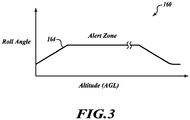
- FIGURE 3 shows a graph 160 of an example roll-angle threshold curve 164 that varies depending upon altitude above ground level (AGL).
- AGL below a predefined altitude is determined by the RADALT. Above the predefined altitude, altitude is determined by a barometric altimeter. If the processing device 24 does not determine that roll-angle alert condition exists (e.g., roll-angle values below the roll-angle threshold curve 164 (not in the alert zone)), then the process 100 returns to the beginning. However, if the processing device 24 does determine that a roll-angle alert condition exists, then at a block 108, the processing device 24 generates a roll-angle alert signal, sends it to one or more of the output devices 27 for presentation to the flight crew. In one embodiment the output signal that is generated is either a synthesized voice or prerecorded voice that includes the phrase "bank-angle.” The output signal is then outputted by the speaker 28, such as pilot head phones.
- a predefined delay is applied. Then, at a decision block 114, the processing device 24 determines if the roll-angle alert condition still exists after the delay. If at the decision block 114, the roll-angle alert condition was determined not to exist anymore, then the process 100 returns to the start. However, if the processing device 24 does determine that the condition still exists then, at a block 116, the processing device 24 determines the direction that the aircraft needs to roll in order to exit the roll-angle alert condition based on the roll-angle. At a block 120, the processing device 24 generates a roll-direction signal based on the determined direction that the vehicle needs to roll. An audio and/or visual signal is outputted by the output devices 27 based on the generated roll-direction signal.
- the roll-direction signal is a voice signal similar to that which was generated in block 108 except that the voice signal would be instructions to the pilot on which way to roll the vehicle, e.g., "roll left”; "roll right”.
- the processing device 24 selects the audio or visual signal that, if properly responded to by the pilot of the vehicle, would result in the least amount of roll in order to get the vehicle back to level flight.
- the processing device 24 produces display information that is sent to one or more of the displays 30. For example, a direction arrow with or without text may pop up on the vehicle's multifunction displays, heads-up display or may be outputted in the form of predesignated lights or roll indicators.
- the processing device 24 may be configured to process the functions performed at blocks 116 and 120 if the vehicle roll-angle received by the processing device 24 shows that the vehicle is continuing to roll in a direction that puts it further into the alert zone or the roll-angle rate is greater than a predefined threshold (see FIGURE 3 ). This may be performed immediately after the roll-angle alert is outputted at block 108. In a situation such as this, the processing device 24 determines that the pilot might be reacting incorrectly to the alert presented at block 108. When this occurs then the processing device 24 generates a "roll left" or "roll right” alert without delay and outputs it to the pilot.
Landscapes
- Engineering & Computer Science (AREA)
- Aviation & Aerospace Engineering (AREA)
- Radar, Positioning & Navigation (AREA)
- Remote Sensing (AREA)
- Physics & Mathematics (AREA)
- General Physics & Mathematics (AREA)
- Traffic Control Systems (AREA)
- Navigation (AREA)
Claims (10)
- Système (20) de production en sortie d'instructions quand un aéronef ne répond pas à une alerte d'angle de roulis, le système comprenant :un ou plusieurs capteurs d'altitude (26) configurés pour déterminer l'une d'une altitude au-dessus du sol ou d'une attitude barométrique ;un ou plusieurs capteurs d'angle de roulis (32) configurés pour déterminer l'angle de roulis du véhicule ;un processeur (24) configuré pour recevoir les informations d'altitude et de roulis, déterminer qu'une condition d'angle de roulis existe en fonction des informations d'altitude et d'angle de roulis reçues,
etgénérer un signal d'alerte d'angle de roulis si une condition d'alerte d'angle de roulis existe ;
etun ou plusieurs dispositifs de sortie (27) configurés pour produire en sortie un ou plusieurs d'un signal audio ou vidéo indiquant qu'une condition d'alerte existe si le processeur a généré le signal d'alerte d'angle de roulis,dans lequel le processeur est configuré en outre pourdéterminer que la condition d'alerte existe toujours après l'une d'une période de temps prédéfinie, d'une détérioration de l'angle de roulis du véhicule par rapport à une limite souhaitée, ou d'une vitesse angulaire de roulis de véhicule supérieure à une limite de vitesse angulaire de roulis,générer un signal de sens de roulis, différent du signal d'alerte d'angle de roulis, en fonction de la position du véhicule par rapport à l'horizon, si l'une de la condition existe toujours après le retard de temps, la détérioration de l'angle de roulis du véhicule par rapport à la limite souhaitée, ou de la vitesse angulaire de roulis supérieure à une limite de vitesse angulaire de roulis, etproduire en sortie le signal de sens de roulis déterminé par l'intermédiaire des un ou plusieurs dispositifs de sortie ;dans lequel le signal de sens de roulis comporte un signal visuel qui, si le pilote du véhicule lui répond correctement, entraînerait le moins de roulis possible afin de ramener le véhicule à un vol en palier. - Système selon la revendication 1, dans lequel le signal d'angle de roulis et le signal de sens de roulis comportent une ou plusieurs d'une voix synthétisée ou d'une voix préenregistrée, le signal d'alerte d'angle de roulis comporte la phrase énoncée "bank angle" (assiette latérale), le signal de sens de roulis comporte au moins l'une des phrases énoncées "roll left" (roulis à gauche) ou "roll right" (roulis à droite).
- Système selon la revendication 1, dans lequel le signal de sens de roulis comporte une ou plusieurs d'informations graphiques ou textuelles.
- Système selon la revendication 3, dans lequel le véhicule est un aéronef, et dans lequel les informations graphiques comportent une flèche pointant dans le sens dans lequel il convient d'effectuer un roulis de l'aéronef pour obtenir un vol en palier.
- Système selon la revendication 3, dans lequel les informations textuelles comportent le texte "roll left" ou "roll right".
- Procédé de production en sortie d'instructions quand un aéronef ne répond pas à une alerte d'angle de roulis, le procédé comprenant :la détermination de l'une d'une altitude au-dessus du sol ou d'une attitude barométrique ;la détermination de l'angle de roulis du véhicule ;la détermination qu'une condition d'angle de roulis existe en fonction des informations d'altitude et d'angle de roulis reçues,la génération d'un signal d'alerte d'angle de roulis si une condition d'alerte d'angle de roulis existe ; etla production en sortie d'un ou plusieurs d'un signal audio ou vidéo indiquant qu'une condition d'alerte existe si le processeur a généré le signal d'alerte d'angle de roulis ;la détermination que la condition d'alerte existe toujours après l'une d'une période de temps prédéfinie, d'une détérioration de l'angle de roulis du véhicule par rapport à une limite souhaitée, ou d'une vitesse angulaire de roulis de véhicule supérieure à une limite de vitesse angulaire de roulis,la génération d'un signal de sens de roulis, différent du signal d'alerte d'angle de roulis, en fonction de la position du véhicule par rapport à l'horizon, si l'une de la condition existe toujours après le retard de temps, la détérioration de l'angle de roulis du véhicule par rapport à la limite souhaitée, ou de la vitesse angulaire de roulis supérieure à une limite de vitesse angulaire de roulis, etla production en sortie du signal de sens de roulis déterminé par l'intermédiaire des un ou plusieurs dispositifs de sortie ;dans lequel le signal de sens de roulis comporte un signal visuel qui, si le pilote du véhicule lui répond correctement, entraînerait le moins de roulis possible afin de ramener le véhicule à un vol en palier.
- Procédé selon la revendication 6, dans lequel le signal d'angle de roulis et le signal de sens de roulis comportent une ou plusieurs d'une voix synthétisée ou d'une voix préenregistrée, le signal d'alerte d'angle de roulis comporte la phrase énoncée "bank angle" (assiette latérale), le signal de sens de roulis comporte au moins l'une des phrases énoncées "roll left" (roulis à gauche) ou "roll right" (roulis à droite).
- Procédé selon la revendication 6, dans lequel le signal de sens de roulis comporte une ou plusieurs d'informations graphiques ou textuelles.
- Procédé selon la revendication 8, dans lequel le véhicule est un aéronef et dans lequel les informations graphiques comportent une flèche pointant dans le sens dans lequel il convient d'effectuer un roulis de l'aéronef pour obtenir un vol en palier.
- Procédé selon la revendication 8, dans lequel les informations textuelles comportent le texte "roll left" ou "roll right".
Applications Claiming Priority (1)
| Application Number | Priority Date | Filing Date | Title |
|---|---|---|---|
| US11/955,095 US8086361B2 (en) | 2007-12-12 | 2007-12-12 | Advisory system to aid pilot recovery from spatial disorientation during an excessive roll |
Publications (3)
| Publication Number | Publication Date |
|---|---|
| EP2071290A2 EP2071290A2 (fr) | 2009-06-17 |
| EP2071290A3 EP2071290A3 (fr) | 2013-01-09 |
| EP2071290B1 true EP2071290B1 (fr) | 2017-01-18 |
Family
ID=40549621
Family Applications (1)
| Application Number | Title | Priority Date | Filing Date |
|---|---|---|---|
| EP08170411.6A Active EP2071290B1 (fr) | 2007-12-12 | 2008-12-01 | Système de consultation pour aider la récupération de pilote à partir de désorientation spatiale durant un roulement excessif |
Country Status (2)
| Country | Link |
|---|---|
| US (1) | US8086361B2 (fr) |
| EP (1) | EP2071290B1 (fr) |
Families Citing this family (6)
| Publication number | Priority date | Publication date | Assignee | Title |
|---|---|---|---|---|
| US9221552B2 (en) | 2012-06-29 | 2015-12-29 | Honeywell International Inc. | Aircraft systems and methods for attitude recovery |
| FR3007131B1 (fr) * | 2013-06-14 | 2015-12-11 | Thales Sa | Procede et dispositif de diagnostic d'une perte de controle d'un aeronef |
| US10216471B1 (en) | 2017-08-17 | 2019-02-26 | Honeywell International Inc. | Aircraft systems and methods for unusual attitude recovery |
| GB201714364D0 (en) * | 2017-09-07 | 2017-10-25 | Prismatic Ltd | Automated backup safety assurance system for unmanned aircraft |
| CN113925490B (zh) * | 2021-10-14 | 2023-06-27 | 河北医科大学 | 空间定向障碍分类方法 |
| CN114326801B (zh) * | 2021-12-28 | 2024-02-20 | 中国特种飞行器研究所 | 一种地效飞行器指数开关滚转限制器设计方法 |
Citations (1)
| Publication number | Priority date | Publication date | Assignee | Title |
|---|---|---|---|---|
| US20040150517A1 (en) * | 2003-01-31 | 2004-08-05 | Toyota Jidosha Kabushiki Kaisha | Seat belt warning apparatus and method |
Family Cites Families (12)
| Publication number | Priority date | Publication date | Assignee | Title |
|---|---|---|---|---|
| US4939513A (en) * | 1983-05-13 | 1990-07-03 | Sundstrand Data Control, Inc. | System for alerting a pilot of a dangerous flight profile during low level maneuvering |
| CA1234417A (fr) * | 1983-05-13 | 1988-03-22 | Noel S. Paterson | Systeme avertissant le pilote de profils de vol dangereux au cours d'evolutions a basse altitude |
| DE4314811A1 (de) * | 1993-05-05 | 1994-12-08 | Vdo Luftfahrtgeraete Werk Gmbh | Verfahren zur Darstellung von Flugführungsinformationen |
| US6028536A (en) * | 1995-11-16 | 2000-02-22 | Northrop Grumman Corporation | Integrated flight control indicator |
| WO1997040401A1 (fr) * | 1996-04-23 | 1997-10-30 | Alliedsignal Inc. | Systeme integre d'alerte au danger |
| US6567014B1 (en) * | 1998-11-05 | 2003-05-20 | Rockwell Collins, Inc. | Aircraft head up display system |
| US6341248B1 (en) * | 1999-06-22 | 2002-01-22 | Honeywell International, Inc. | Apparatus, methods, and computer program products for monitoring the attitude of an aircraft |
| US6456905B2 (en) * | 1999-12-22 | 2002-09-24 | Honeywell International, Inc. | Method and apparatus for limiting attitude drift during turns |
| WO2003008908A1 (fr) | 2001-07-17 | 2003-01-30 | Honeywell International Inc. | Dispositif d'avertissement d'angle de tangage pour systeme avertisseur ameliore de proximite du sol (egwps) |
| US6484072B1 (en) * | 2001-09-28 | 2002-11-19 | The United States Of America As Represented By The Secretary Of The Navy | Embedded terrain awareness warning system for aircraft |
| US7088264B2 (en) * | 2002-03-14 | 2006-08-08 | Honeywell International Inc. | Flight safety system monitoring combinations of state values |
| US7286911B2 (en) | 2003-12-01 | 2007-10-23 | Kane Richard L | Aircraft pilot assistance system and method |
-
2007
- 2007-12-12 US US11/955,095 patent/US8086361B2/en active Active
-
2008
- 2008-12-01 EP EP08170411.6A patent/EP2071290B1/fr active Active
Patent Citations (1)
| Publication number | Priority date | Publication date | Assignee | Title |
|---|---|---|---|---|
| US20040150517A1 (en) * | 2003-01-31 | 2004-08-05 | Toyota Jidosha Kabushiki Kaisha | Seat belt warning apparatus and method |
Also Published As
| Publication number | Publication date |
|---|---|
| US20090157240A1 (en) | 2009-06-18 |
| EP2071290A2 (fr) | 2009-06-17 |
| EP2071290A3 (fr) | 2013-01-09 |
| US8086361B2 (en) | 2011-12-27 |
Similar Documents
| Publication | Publication Date | Title |
|---|---|---|
| EP2333769B1 (fr) | Procédé et système pour l'opération d'un système électronique de véhicule doté d'une fonction de commande vocale | |
| US9533772B2 (en) | Visual search assistance for an occupant of a vehicle | |
| CN108069041B (zh) | 用于显示跑道延伸段信息的系统和方法 | |
| CN104443406B (zh) | 一种检测不符合规定的飞行员动作的飞行器系统和方法 | |
| US7570177B2 (en) | Aircraft terrain warning systems and methods | |
| US8989998B2 (en) | Predicted position and heading/track indicators for navigation display | |
| US8618923B2 (en) | Speed alarm system | |
| US8493239B2 (en) | Method and a device for detecting lack of reaction from the crew of an aircraft to an alarm related to a path | |
| US8086361B2 (en) | Advisory system to aid pilot recovery from spatial disorientation during an excessive roll | |
| CN105035335A (zh) | 用于改进的低空速警告的系统和方法 | |
| CN103630145A (zh) | 用于可能尾流湍流的呈现的系统和方法 | |
| EP1950718B1 (fr) | Procédés et systèmes pour la surveillance de l'approche d'un aéronef à voilure tournante | |
| CN102331730B (zh) | 执行过度负俯仰警报和偏置下降率警报的系统和方法 | |
| EP3156977B1 (fr) | Procédé et système d'utilisation de voix combinée et instructions personalisées pour déclencher des rapports de véhicule | |
| WO2016030934A1 (fr) | Dispositif de traitement d'informations, procédé de commande, programme et support de mémorisation | |
| US7286911B2 (en) | Aircraft pilot assistance system and method | |
| WO2019021697A1 (fr) | Dispositif de commande d'informations | |
| EP1895268B1 (fr) | Systèmes et procédés pour détecter et alerter le mauvais réglage d'un altimètre barométrique au-dessus d'une altitude de transition | |
| US10403132B2 (en) | Driving assistance device and a driving assistance method | |
| US10204523B1 (en) | Aircraft systems and methods for managing runway awareness and advisory system (RAAS) callouts | |
| EP4644205A1 (fr) | Procédé de commande d'une sortie d'une notification à un conducteur d'un véhicule, appareil de traitement de données, programme informatique, support de stockage lisible par ordinateur et véhicule | |
| KR20110106023A (ko) | 차량 네비게이션에서의 부가 서비스 제공 방법 및 그 장치 |
Legal Events
| Date | Code | Title | Description |
|---|---|---|---|
| PUAI | Public reference made under article 153(3) epc to a published international application that has entered the european phase |
Free format text: ORIGINAL CODE: 0009012 |
|
| 17P | Request for examination filed |
Effective date: 20081201 |
|
| AK | Designated contracting states |
Kind code of ref document: A2 Designated state(s): AT BE BG CH CY CZ DE DK EE ES FI FR GB GR HR HU IE IS IT LI LT LU LV MC MT NL NO PL PT RO SE SI SK TR |
|
| AX | Request for extension of the european patent |
Extension state: AL BA MK RS |
|
| PUAL | Search report despatched |
Free format text: ORIGINAL CODE: 0009013 |
|
| AK | Designated contracting states |
Kind code of ref document: A3 Designated state(s): AT BE BG CH CY CZ DE DK EE ES FI FR GB GR HR HU IE IS IT LI LT LU LV MC MT NL NO PL PT RO SE SI SK TR |
|
| AX | Request for extension of the european patent |
Extension state: AL BA MK RS |
|
| RIC1 | Information provided on ipc code assigned before grant |
Ipc: G01C 23/00 20060101AFI20121204BHEP Ipc: G05D 1/08 20060101ALI20121204BHEP |
|
| 17Q | First examination report despatched |
Effective date: 20130102 |
|
| AKX | Designation fees paid |
Designated state(s): DE FR GB |
|
| RAP1 | Party data changed (applicant data changed or rights of an application transferred) |
Owner name: HONEYWELL INTERNATIONAL INC. |
|
| REG | Reference to a national code |
Ref country code: DE Ref legal event code: R079 Ref document number: 602008048443 Country of ref document: DE Free format text: PREVIOUS MAIN CLASS: G01C0023000000 Ipc: B64D0045000000 |
|
| RIC1 | Information provided on ipc code assigned before grant |
Ipc: G05D 1/08 20060101ALI20160107BHEP Ipc: G01C 23/00 20060101ALI20160107BHEP Ipc: B64D 45/00 20060101AFI20160107BHEP |
|
| GRAP | Despatch of communication of intention to grant a patent |
Free format text: ORIGINAL CODE: EPIDOSNIGR1 |
|
| INTG | Intention to grant announced |
Effective date: 20160802 |
|
| GRAS | Grant fee paid |
Free format text: ORIGINAL CODE: EPIDOSNIGR3 |
|
| GRAA | (expected) grant |
Free format text: ORIGINAL CODE: 0009210 |
|
| AK | Designated contracting states |
Kind code of ref document: B1 Designated state(s): DE FR GB |
|
| REG | Reference to a national code |
Ref country code: GB Ref legal event code: FG4D |
|
| REG | Reference to a national code |
Ref country code: DE Ref legal event code: R096 Ref document number: 602008048443 Country of ref document: DE |
|
| REG | Reference to a national code |
Ref country code: DE Ref legal event code: R097 Ref document number: 602008048443 Country of ref document: DE |
|
| PLBE | No opposition filed within time limit |
Free format text: ORIGINAL CODE: 0009261 |
|
| STAA | Information on the status of an ep patent application or granted ep patent |
Free format text: STATUS: NO OPPOSITION FILED WITHIN TIME LIMIT |
|
| 26N | No opposition filed |
Effective date: 20171019 |
|
| REG | Reference to a national code |
Ref country code: FR Ref legal event code: PLFP Year of fee payment: 10 |
|
| P01 | Opt-out of the competence of the unified patent court (upc) registered |
Effective date: 20230525 |
|
| PGFP | Annual fee paid to national office [announced via postgrant information from national office to epo] |
Ref country code: GB Payment date: 20251223 Year of fee payment: 18 |
|
| PGFP | Annual fee paid to national office [announced via postgrant information from national office to epo] |
Ref country code: FR Payment date: 20251223 Year of fee payment: 18 |
|
| PGFP | Annual fee paid to national office [announced via postgrant information from national office to epo] |
Ref country code: DE Payment date: 20251229 Year of fee payment: 18 |