EP2071329B1 - Method for predicting a parameter of a bitumen - Google Patents
Method for predicting a parameter of a bitumen Download PDFInfo
- Publication number
- EP2071329B1 EP2071329B1 EP08171049.3A EP08171049A EP2071329B1 EP 2071329 B1 EP2071329 B1 EP 2071329B1 EP 08171049 A EP08171049 A EP 08171049A EP 2071329 B1 EP2071329 B1 EP 2071329B1
- Authority
- EP
- European Patent Office
- Prior art keywords
- bitumen
- hydrocarbons
- neural network
- parameter
- values
- Prior art date
- Legal status (The legal status is an assumption and is not a legal conclusion. Google has not performed a legal analysis and makes no representation as to the accuracy of the status listed.)
- Not-in-force
Links
Images


Classifications
-
- G—PHYSICS
- G01—MEASURING; TESTING
- G01N—INVESTIGATING OR ANALYSING MATERIALS BY DETERMINING THEIR CHEMICAL OR PHYSICAL PROPERTIES
- G01N33/00—Investigating or analysing materials by specific methods not covered by groups G01N1/00 - G01N31/00
- G01N33/26—Oils; Viscous liquids; Paints; Inks
- G01N33/28—Oils, i.e. hydrocarbon liquids
- G01N33/2823—Raw oil, drilling fluid or polyphasic mixtures
-
- G—PHYSICS
- G01—MEASURING; TESTING
- G01N—INVESTIGATING OR ANALYSING MATERIALS BY DETERMINING THEIR CHEMICAL OR PHYSICAL PROPERTIES
- G01N33/00—Investigating or analysing materials by specific methods not covered by groups G01N1/00 - G01N31/00
- G01N33/26—Oils; Viscous liquids; Paints; Inks
- G01N33/28—Oils, i.e. hydrocarbon liquids
- G01N33/2835—Specific substances contained in the oils or fuels
-
- G—PHYSICS
- G01—MEASURING; TESTING
- G01N—INVESTIGATING OR ANALYSING MATERIALS BY DETERMINING THEIR CHEMICAL OR PHYSICAL PROPERTIES
- G01N33/00—Investigating or analysing materials by specific methods not covered by groups G01N1/00 - G01N31/00
- G01N33/42—Road-making materials
Definitions
- the present invention relates to a method for predicting a parameter of a bitumen.
- the present invention can be inserted within the technical area of prevision methods of the properties of hydrocarbons and, in particular, bitumens.
- bitumen generally indicates blends of heavy hydrocarbons, having a solid consistency at room temperature, which are normally obtained as vacuum residue from refinery processes, which can be distillation (topping or vacuum) and conversion (thermal cracking and visbreaking) processes of suitable crude oils. They are mainly used for street paving, mixed with appropriate inert materials (crushed stones), but also in the building industry (waterproofing of roofs and foundations). They are commercially classified according to their "normal penetration” (nP) in dmm, by means of a standard needle which penetrates a bitumen sample at 25°C.
- nP normal penetration
- bitumen has long been used for waterproofing applications, such as, for example, roof covering.
- the covering materials must have specific chemical and physical characteristics, such as flexibility, break strength at low temperatures, high needle-punching resistance, good rigidity and elongation (to resist the stretching and possible movement of buildings), flow resistance at high temperatures, thermal and dimensional stability, etc..
- specific chemical and physical characteristics such as flexibility, break strength at low temperatures, high needle-punching resistance, good rigidity and elongation (to resist the stretching and possible movement of buildings), flow resistance at high temperatures, thermal and dimensional stability, etc.
- a covering material is the minimum susceptibility to temperature effects. It is also desirable for these properties to be maintained following trampling and exposure to atmospheric elements (such as solar light, vapour, atmospheric pollutants).
- bitumen itself does not have all these essential properties. For example, bitumen becomes rigid at low temperatures, therefore becoming fragile under said conditions even with respect to light impacts. At high temperatures, on the contrary, the viscosity of bitumen is so low that they spontaneously flows or permanently deforms even due to the effect of minimum mechanical strain. At intermediate temperatures, the viscosity is such to give the bitumen a semi-solid form. This state directly depends on the softening point of a bitumen, i.e. on the temperature at which, conventionally, the bitumen is considered to change from the semi-solid to the liquid state.
- bitumen As a bitumen is made up of numerous and different chemical compounds, it does not have a precise melting or liquefaction point and the change to a liquid state occurs within a range of temperatures. This range is more or less wide, according to the particular physico-chemical structure of a certain bitumen. In order for a bitumen to remain semi-solid at the operating temperature, it is therefore necessary for its softening point to be higher than that temperature.
- the softening point is determined by means of the Ring-and-Ball method ASTM D36, IP 58, CNR B.U. 35, as described in the embodiment examples of the present invention.
- the polymers commonly used for the modification of bitumens include atactic or amorphous polypropylene (PPA), amorphous polyalphaolefins, (APAO), thermoplastic polyolefins (TPO), styrene-butadiene-styrene (SBS), styrene-ethylene-butadiene-styrene (SEBS), synthetic rubber and others.
- PPA atactic or amorphous polypropylene
- APAO amorphous polyalphaolefins
- TPO thermoplastic polyolefins
- SBS styrene-butadiene-styrene
- SEBS styrene-ethylene-butadiene-styrene
- atactic polypropylene a byproduct of the production of isotactic or crystalline propylene (PPI)
- PPA atactic polypropylene
- PPI crystalline propylene
- the blends of bitumen modified with PPA have, with respect to the blends modified with SBS, better properties at low temperatures, good heat oxidation characteristics and long term resistance to atmospheric agents.
- the coverings produced by means of these modified bitumens have an excellent resistance to trampling on hot days.
- Bitumens modified with PPA also have a better UV resistance with respect to the corresponding bitumens modified with SBS.
- Bitumens modified with PPA alone do not have a sufficient rigidity and are subject to deformation even as a result of weak mechanical stress, especially at high temperatures.
- PPA is normally used together with other components, such as an ethylene-propylene copolymer and PPI.
- PPI ethylene-propylene copolymer
- the addition of PPI to a bitumen/PPA blend gives hardness and rigidity.
- the addition of an ethylene-propylene copolymer on the contrary, enhances the flexibility at low temperature. Consequently, depending on the type of bitumen and desired final properties, different modifiers are added to the bitumen, in varying proportions.
- modifiers such as, for example, polyethylene
- Roof coverings prepared starting from bitumen modified with polyethylene as primary modifier are not yet available on the market.
- bitumen is characterized by a so-called phase inversion: the polymer (component in a smaller quantity) englobes the bitumen (component in a larger quantity) forming a continuous phase of a polymeric nature. In correspondence with this phase, the bitumen acquires valuable application properties.
- phase inversion the polymer (component in a smaller quantity) englobes the bitumen (component in a larger quantity) forming a continuous phase of a polymeric nature. In correspondence with this phase, the bitumen acquires valuable application properties.
- the phase inversion in bitumens modified with PPA takes place as soon as a specific "threshold" content of PPA in the blend is reached, said threshold content being characteristic of the starting bitumen. It can generally be said that the higher the bitumen “compatibility” with PPA, the lower the “threshold” content is.
- the compatibility of the bitumen with PPA depends on the bitumen composition which, in turn, depends on the mixture of starting hydrocarbons (crude oils and/or distillation residues of crude oils), the transformation processes and the operative conditions adopted.
- bitumens which are most compatible with PPA have the advantage of requiring the use of lower quantities of modifier, thus considerably reducing the preparation costs of the modified bitumen. This leads to the necessity of identifying and selecting the bitumens with a higher compatibility with PPA and from these, consequently, starting crude oils which are more suitable for the production of the bitumen itself.
- the characteristics of the modified bitumen vary very significantly depending on the starting crude oil from which the particular type of bitumen to be modified, derives. It is therefore essential to know the chemical composition of the bitumen to determine the levels of saturated hydrocarbons and asphaltenes contained therein.
- phase compatibility of a bitumen with respect to the modifier is therefore an essential property in the field of production processes of modified bitumens, as also mentioned in US2007/0054988 A1 , as it represents an indication of the long-term behaviour of the finished product.
- the phase compatibility also defined as "networking”, also influences other key characteristics of the bitumen/modifier blend such as the viscosity, softening point, penetration at 25°C, low-temperature flexibility, heat stability and long-term heat oxidation.
- phase compatibility of a bitumen is normally experimentally evaluated by collecting small samples of the modified bitumen, depositing a thin layer of them on a slide and observing the dispersion of the modifying polymer with a fluorescence microscope at 250 magnifications.
- the image of the sample is normally compared with a graph containing reference images relating to layers of bitumen having different degrees of phase compatibility (the degrees are classified according to an evaluation scale varying from "very good” to "poor”).
- Each covering manufacturer typically has its own reference graph.
- the phase compatibility evaluations, obtained by means of the above comparison are relatively uniform.
- the crude assay does in fact contain a combination of data deriving from standard physico-chemical characterizations of a specific type of crude oil. These crude assays can be easily found in specialized databases or, alternatively, they can be obtained experimentally by laboratory analyses. Furthermore, in the case of crude hydrocarbon blends, it is also possible to obtain these characterization data by calculation models (so called blending models), which allow the characteristics of a blend of hydrocarbons to be predicted starting from the characterization data of the single components.
- WO97/14953 describes, for example, a method for predicting the physical properties of a hydrocarbon material, such as the residues that can be obtained from crude oils, fuel oils and bituminous compounds, which comprises:
- WO 02/47460 A2 describes a method for selecting a crude oil as raw material for the production of paving grade bitumen, by analyzing physical samples with a high resolution mass spectrometer. Also in this case, a non-conventional analytical method is used and the physical presence is necessary of the sample obtained starting from crude oil, by means of distillation under particular temperature and pressure conditions.
- the method which is specific for the production of paving grade bitumen by distillation, requires the construction of a specific database with the experimental data obtained by means of mass spectroscopy analysis and does not take into consideration either the indefiniteness of the production processes, such as for example thermal processes which alter the chemical structure and require onerous pilot operations for producing a physical product sample, or other uses or characteristics of the bitumen produced, for example compatibility with PPA.
- the document US 6,477,516 B1 defines a method which, starting from NMR analysis of a physical hydrocarbon sample, predicts the desired property for the same product by means of a neural network which has been subjected to appropriate training.
- the document shows how modelling with neural networks, based on NMR analysis of the product, is effective in also predicting other properties, but does not solve the technical problem faced by the present invention, not responding to the objectives.
- a first objective of the present invention is therefore to define a method capable of correlating the physico-chemical parameters characteristic of a hydrocarbon and the properties of the finished bitumen obtained starting therefrom, such as the phase compatibility between said bitumen and polymeric modifying agents, in particular PPA and SBS, or the softening point.
- a second objective of the present invention is to define a method capable of obtaining the above correlation starting from data available in crude assays of crude oils and/or other types of hydrocarbons which can be used for producing bitumens (for example distillation residues of crude oils).
- An object of the present invention therefore relates to a method for predicting a parameter of a bitumen having a penetration nP at 25°C, said bitumen being obtained by means of a process (P) applied to a hydrocarbon and/or a blend of hydrocarbons, according to claim 1.
- the method according to the present invention allows a parameter to be predicted, which is characteristic of a bitumen, such as for example its phase compatibility with polymer modifying agents (for example PPA, SBS, etc.) or the softening point, starting from physico-chemical data of the starting hydrocarbon from which the bitumen is obtained, and the penetration value at 25°C (nP) of the bitumen obtained with the process (P) from said starting hydrocarbon.
- a parameter to be predicted which is characteristic of a bitumen, such as for example its phase compatibility with polymer modifying agents (for example PPA, SBS, etc.) or the softening point, starting from physico-chemical data of the starting hydrocarbon from which the bitumen is obtained, and the penetration value at 25°C (nP) of the bitumen obtained with the process (P) from said starting hydrocarbon.
- the method according to the present invention is preferably applied for predicting a phase compatibility index of a bitumen with PPA, such as the phase inversion point.
- phase compatibility of the bitumen with PPA is evaluated on the basis of the value of an index, preferably on the basis of the value of the phase inversion point of the bitumen/PPA blend.
- the method according to the present invention can also be used, however, for correlating the compatibility of the bitumen with polymers different from PPA, to the physico-chemical characteristics of the starting hydrocarbons from which the bitumen can be obtained through a certain production process.
- phase inversion point of the bitumen/PPA blend corresponding to the weight percentage of PPA with respect to the total weight of the bitumen/PPA blend, necessary for obtaining phase inversion, is generally determined experimentally by means of the following method. The same method can be used for determining the phase compatibility of the bitumen with other modifying agents of the polymeric type such as SBS. 13% by weight of PPA are added, under standard temperature conditions (185°C), to a known quantity of bitumen, the whole mixture being maintained under stirring for 1 hour. At the end of this period, a drop of bitumen/PPA blend is removed and observed under a fluorescent microscope to observe whether possible phase inversion has taken place.
- the test must be repeated starting from a new blend with a known quantity of bitumen, adding 10% of PPA; if negative, a further 1% of PPA is added to the bitumen/13% PPA blend and the control is repeated after 30 minutes.
- the test continues with successive additions of PPA until the concentration at which inversion takes place, is reached. If the inversion does not take place even after a maximum addition of 24% of PPA, the test is suspended. Starting from values higher than 17% of PPA, in fact, it becomes increasingly more difficult to produce a modified bitumen under economically acceptable conditions and for values of around 24% of PPA the determination of the inversion point requires relatively long times (more than 1 day).
- phase inversion in a bitumen/ PPA blend is considered to take place when the image of a sample of the blend, obtained at a fluorescent microscope, has the following two characteristics:
- Figures 3 and 4 show, for illustrative purposes, two images at the fluorescence microscope which respectively illustrate a blend which does not have phase inversion and a blend with phase inversion.
- the starting hydrocarbon sent to the production process (P) of bitumen is a crude oil or a residue deriving from the processing of crude oil (for example distillation residues) and/or mixtures thereof.
- process (P) indicates the processing process of the hydrocarbon for producing a bitumen and the relative operating conditions which determine the characteristics of the finished product i.e. the bitumen. With variations in these conditions, the bitumen obtained starting from the same hydrocarbon can have different physico-chemical characteristics.
- the penetration at 25°C is a key parameter linked to the composition of the bitumen and consequently also to the physico-chemical characteristics depending on the composition, such as for example, the phase compatibility of the bitumen with modifying polymers such as PPA or SBS or the softening point.
- the penetration at 25°C nP determined through the so-called needle penetration method is an index of the softness or hardness of the material and therefore also of its applicative characteristics.
- the penetration at 25°C is also an important factor to be considered in the installation of roof coverings.
- the penetration value at 25°C can be varied, according to techniques known to experts in the field, to adapt it to the specific destinations and climatic conditions of use.
- the penetration value at 25°C is the starting parameter characteristic of bitumen to be used in the method according to the present invention.
- N is an integer preferably varying from 3 to 10, more preferably from 4 to 7.
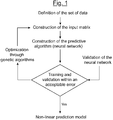
- the neural network is trained to correlate the same N physico-chemical parameters of a hydrocarbon, or blend of hydrocarbons, and the nP values of the bitumen to the parameter to be predicted.
- the neural network returns the value of the desired parameter (output data). If, for example, the phase compatibility of a bitumen with a polymeric modifying agent (for example PPA or SBS) is to be predicted, the parameter returned can be the value of the relative phase inversion point.
- a polymeric modifying agent for example PPA or SBS
- the neural network can consist of a variable number of layers of neurons depending on the type of bitumen considered. It has been observed that generally a network with a maximum number of three layers of neurons can give good correlation results for any type of bitumen.
- the transfer function for each parameter to be modelled with the neural algorithm can be linear or nonlinear, depending on the relations between input and output for each layer, and also regardless of the number of layers.
- any training system or software among those known to experts in the field can be used.
- the training phase of the neural network is effected by feeding, as input data, a matrix of values to the neural network.
- a set of samples consisting of number I of hydrocarbons and/or a number MI of hydrocarbon blends.
- the term set of samples refers to a set of samples of different hydrocarbons (crude and/or residue) or a set of various samples of the same hydrocarbon having different nP values in the relative non-modified bitumen produced starting from this.
- the numbers I and MI are integers, which can be the same or different, preferably varying from 10 to 90.
- N' is an integer preferably varying from 3 to 10, more preferably from 4 to 7.
- the possible physico-chemical parameters of the starting hydrocarbon those preferred are density, sulphur content and/or metals content and/or asphaltenes content, viscosity, CCR (carbon residue, determined according to the Conradson method, or according to the Microcarbon test method or according to the Ramsbottom method); with respect to the bitumen, the physico-chemical parameter is penetration at 25°C (nP).
- the information on the statistically relevant data obtained by means of a correlation analysis, is then combined with the corresponding values of the parameter to be predicted (for example phase compatibility index, softening point, etc.) of each of the bitumens resulting from the application of the process (P) to the I hydrocarbons and/or MI blends of hydrocarbons, to generate a matrix of parameters to be used as a basis for the neural network training.
- the values of the desired parameter are determined experimentally through standard analysis.
- the initial random weights associated with the input parameters are recalculated and optimized after each iteration process until the error is significantly lower than a preestablished acceptability value for the specific parameter to be predicted.
- the neural network is validated, by testing the accuracy of the output results with an adequate number of unknown samples to verify that the response is within an acceptable prevision standard.
- the optimization phase i.e. convergence towards the best network, is preferably obtained by means of genetic algorithms, defined as such as part of their terminology derives from genetics.
- the genetic algorithms starting from a selected number of possible solutions (individuals) called populations, allow them to evolve during the realization of the optimization process. With each iteration, the algorithms effect a selection of individuals of the current population, using them for generating new elements of the same population, which will substitute an equal number of individuals already present, thus forming a new starting population for the following iteration (or generation). This succession of generations evolves towards an optimum solution of the assigned problem.
- the above evolution is obtained through a partial recombination or crossover of the solutions, in which each individual transmits part of its own genetic patrimony to its descendants, and through the introduction of random mutations in the starting population, thus sporadically forming individuals with characteristics not included in those present in the genetic dowry of the original species.
- the optimization process preferably consists of the following successive phases:
- step 7 the process returns to step 4 and is re-iterated until a process-end criterion is satisfied.
- the solutions i.e. in this case the best neural networks, survive, their characteristics are transmitted to the future generations combined with other characteristics to find even-improving networks for the specific application.
- This genetic research is more effective than a random research, as the genetic recombination process of the characteristics improves the rate for identifying neural networks with good predictive capacities. It also has the potential advantage of being complementary and synergic to the experience of the user, of which the initial assumptions deriving from a knowledge of the parameters are necessary.
- the optimized and validated neural network is ready for use (predictive mode).
- the method according to the present invention therefore comprises, between phase a) and phase b), the following additional phase:
- the training of the neural network comprises the following operative phases:
- the parameters to be predicted which can be preferably used are the phase compatibility of the bitumen with a polymeric modifying agent (for example PPA, SBS, etc.) or its softening point.
- a polymeric modifying agent for example PPA, SBS, etc.
- the method according to the present invention has various advantages with respect to the state of the art. First of all, it allows the properties of bitumens to be predicted starting from easily available data relating to the physico-chemical characteristics of the hydrocarbons (residues and/or crude oils) to be processed and from the penetration value of the finished bitumen.
- the method allows reliable prediction data to be rapidly obtained, avoiding having to resort to lengthy conventional laboratory analyses.
- the method allows prediction data to be obtained for parameters of fundamental importance from the point of view of practical applicability of bitumens, such as phase compatibility with various kinds of polymeric modifying agents or the softening point.
- the method according to the present invention allows the rapid and economic evaluation of the potentiality of crude oils for which there is a standard characterization to be used profitably in the production of bitumens.
- the standard characterization data are easily available, as they are normally used by refinery operators for managing the supply of raw materials and optimizing refinery processes.
- the present invention is also a predictive instrument of the characteristics of bitumens in the case of the use of blends of crude-oils as starting hydrocarbons, as most frequently occurs in refineries, rather than a pure crude-oil.
- Calculation models are in fact known and commonly used, which allow the characteristics of blends of crude-oils to be evaluated, thus also providing physico-chemical characterization data for complex blends from which to start for predicting the phase compatibility of the bitumen.
- the method according to the present invention can also be applied for predicting the properties of bitumens produced starting from new crude-oils, for which, even if there are not yet any standard characterization data, it is possible to effect specific analytical characterizations in the laboratory, as in the case of distillation residues of crude-oils and/or blends thereof. Furthermore, in the case of blends, it is always possible to use blending models for predicting their characteristics starting from the characterization data of the single components.
- a neural network consisting of three layers of neurons was trained through a training matrix containing data relating to 69 bitumens.
- the bitumens were obtained with a process (P) which envisages thermal cracking transformations.
- Table 2 indicates the experimental range considered (i.e. the minimum value and maximum value for each parameter in the 69 samples and the relative average) and the results obtained with the neural network in the training phase of the neural network itself (see last column table 2).
- the trained neural network was subjected to a subsequent validation of the correlation algorithm.
- the network was used in predictive mode by feeding, as input data, the data relating to 19 unknown samples of bitumen.
- a neural network consisting of three layers of neurons was trained through a training matrix containing data relating to 36 bitumens.
- the bitumens were obtained with a process (P) which envisages thermal cracking transformations.
- the softening point which conventionally represents the temperature at which a bitumen passes from a semi-solid state to the liquid state, is measured with the Ring-and-Ball method, ASTM D36, IP 58, CNR B.U. 35 briefly described hereunder.
- a test-sample of bitumen being tested placed inside a special brass ring and loaded at the centre with a steel ball having certain dimensions and weight, is introduced into a bath which is heated with a gradient of 5°C per minute. With the increase in temperature, the bitumen, under the weight of the ball, is deformed, becoming progressively lower until it reaches a target situated 2.54 cm beneath the starting plane.
- the temperature of the bath read at that moment on a thermometer having its bulb at the height of the test-sample, represents the softening point of the bitumen.
- Table 4 indicates the experimental range considered (i.e. the minimum value and maximum value for each parameter in the 36 samples and the relative average) and the results obtained with the neural network in the training phase of the neural network itself (see last column of table 4).
- the trained neural network was subjected to a subsequent validation of the correlation algorithm.
- the network was used in predictive mode by feeding, as input data, the data relating to 15 unknown samples of bitumen.
Landscapes
- Chemical & Material Sciences (AREA)
- Health & Medical Sciences (AREA)
- Engineering & Computer Science (AREA)
- Life Sciences & Earth Sciences (AREA)
- Medicinal Chemistry (AREA)
- Oil, Petroleum & Natural Gas (AREA)
- General Chemical & Material Sciences (AREA)
- Food Science & Technology (AREA)
- Chemical Kinetics & Catalysis (AREA)
- Physics & Mathematics (AREA)
- Analytical Chemistry (AREA)
- Biochemistry (AREA)
- General Health & Medical Sciences (AREA)
- General Physics & Mathematics (AREA)
- Immunology (AREA)
- Pathology (AREA)
- Production Of Liquid Hydrocarbon Mixture For Refining Petroleum (AREA)
Applications Claiming Priority (1)
| Application Number | Priority Date | Filing Date | Title |
|---|---|---|---|
| ITMI20072329 ITMI20072329A1 (it) | 2007-12-13 | 2007-12-13 | Metodo per predire un parametro di un bitume e relativo sistema di previsione |
Publications (3)
| Publication Number | Publication Date |
|---|---|
| EP2071329A2 EP2071329A2 (en) | 2009-06-17 |
| EP2071329A3 EP2071329A3 (en) | 2014-06-11 |
| EP2071329B1 true EP2071329B1 (en) | 2016-06-29 |
Family
ID=40315572
Family Applications (1)
| Application Number | Title | Priority Date | Filing Date |
|---|---|---|---|
| EP08171049.3A Not-in-force EP2071329B1 (en) | 2007-12-13 | 2008-12-09 | Method for predicting a parameter of a bitumen |
Country Status (3)
| Country | Link |
|---|---|
| EP (1) | EP2071329B1 (it) |
| CA (1) | CA2645695A1 (it) |
| IT (1) | ITMI20072329A1 (it) |
Families Citing this family (14)
| Publication number | Priority date | Publication date | Assignee | Title |
|---|---|---|---|---|
| EP2699900B1 (en) * | 2012-01-06 | 2019-02-13 | Bharat Petroleum Corporation Limited | Prediction of refining characteristics of oil |
| US9208266B2 (en) * | 2012-12-21 | 2015-12-08 | Exxonmobil Research And Engineering Company | Property prediction for asphalts from blended sources |
| BR112015025384A2 (pt) | 2013-06-07 | 2017-07-18 | Halliburton Energy Services Inc | método |
| SG11201603257PA (en) * | 2014-01-09 | 2016-05-30 | Exxonmobil Res & Eng Co | Selection and blending of feeds for asphalt manufacture |
| CN113505527B (zh) * | 2021-06-24 | 2022-10-04 | 中国科学院计算机网络信息中心 | 一种基于数据驱动的材料性质预测方法及系统 |
| CN113779887A (zh) * | 2021-09-22 | 2021-12-10 | 上海上实龙创智能科技股份有限公司 | 一种mf浸渍胶生产工艺参数优化控制方法 |
| CN113867292B (zh) * | 2021-10-09 | 2023-09-19 | 益路恒丰衡水沥青科技有限公司 | 橡胶沥青质量控制方法 |
| CN114200113B (zh) * | 2021-11-15 | 2024-02-09 | 广东交通职业技术学院 | 一种确定岩沥青掺配比例的方法 |
| CN114970276B (zh) * | 2022-06-06 | 2024-05-24 | 邢台路桥建设集团有限公司 | 一种基于bp神经网络的沥青路面潜在破坏参数计算方法 |
| CN117831682B (zh) * | 2024-01-04 | 2024-07-23 | 哈尔滨工业大学 | 一种基于深度学习的虚拟沥青生成方法 |
| CN118380086B (zh) * | 2024-06-24 | 2024-09-10 | 苏交科集团股份有限公司 | 一种沥青混合料配合比智能设计方法及系统 |
| CN118817540A (zh) * | 2024-09-19 | 2024-10-22 | 福建南方路面机械股份有限公司 | 一种基于深度学习的沥青混合料质量在线监测方法及装置 |
| CN119005538B (zh) * | 2024-10-24 | 2025-02-07 | 山东百成新材料科技股份有限公司 | 低温改性沥青的路用指标优化方法及系统 |
| CN120409167B (zh) * | 2025-07-01 | 2025-10-17 | 中咨数据有限公司 | 一种用于沥青混合料的配比优化方法及系统 |
Family Cites Families (6)
| Publication number | Priority date | Publication date | Assignee | Title |
|---|---|---|---|---|
| AR003845A1 (es) | 1995-10-18 | 1998-09-09 | Shell Int Research | Un método para predecir una propiedad física de un residuo de petróleo crudo, de un petróleo combustible (fuel oil) residual o de un material bituminoso. |
| AR003846A1 (es) * | 1995-10-18 | 1998-09-09 | Shell Int Research | Una celula de transmision adecuada para el uso en un dispositivo para medir espectros infrarrojos (proximos) de un material hidrocarbonaceo, un espectrometro que la comprende, uso del mismo, metodos para predecir una propiedad fisica de dicho material con dicha celula o espectrometro, y un procedimiento para preparar una composición de betum usando dicho metodo con dicho espectometro |
| US6477516B1 (en) | 2000-05-16 | 2002-11-05 | Intevep, S.A. | System and method for predicting parameter of hydrocarbon with spectroscopy and neural networks |
| CN1481502A (zh) | 2000-12-15 | 2004-03-10 | 埃克森美孚研究工程公司 | 质谱仪的多变量分析 |
| US6534318B2 (en) * | 2000-12-15 | 2003-03-18 | Exxonmobil Research And Engineering Company | Mass spectrometric multivariate analysis |
| US7317045B2 (en) | 2005-09-06 | 2008-01-08 | Natalino Zanchetta | Polyethylene modified asphalt compositions |
-
2007
- 2007-12-13 IT ITMI20072329 patent/ITMI20072329A1/it unknown
-
2008
- 2008-12-03 CA CA 2645695 patent/CA2645695A1/en not_active Abandoned
- 2008-12-09 EP EP08171049.3A patent/EP2071329B1/en not_active Not-in-force
Also Published As
| Publication number | Publication date |
|---|---|
| ITMI20072329A1 (it) | 2009-06-14 |
| EP2071329A3 (en) | 2014-06-11 |
| CA2645695A1 (en) | 2009-06-13 |
| EP2071329A2 (en) | 2009-06-17 |
Similar Documents
| Publication | Publication Date | Title |
|---|---|---|
| EP2071329B1 (en) | Method for predicting a parameter of a bitumen | |
| JP5116669B2 (ja) | 石油精製用原料のコークスおよび瀝青の品質の評価方法 | |
| CN112415180B (zh) | 一种基于灰关联分析的橡胶沥青用基质沥青的选择方法 | |
| Petersen et al. | Binder characterization and evaluation. Volume 1 | |
| Xu et al. | Study on aging behavior and prediction of SBS modified asphalt with various contents based on PCA and PLS analysis | |
| Stratiev et al. | Commercial investigation of the ebullated-bed vacuum residue hydrocracking in the conversion range of 55–93% | |
| US9208266B2 (en) | Property prediction for asphalts from blended sources | |
| WO2017007845A1 (en) | Method for correlating physical and chemical measurement data sets to predict physical and chemical properties | |
| US10329427B2 (en) | Selection and blending of feeds for asphalt manufacture | |
| CN109507352B (zh) | 一种预测石化生产中任意流股分子组成的方法 | |
| CN106407628B (zh) | 基于粘度模型确定沥青调合方案的方法及系统 | |
| CN113627037A (zh) | 一种基于原油切割的直馏沥青性质预测方法 | |
| Zhang et al. | A fuzzy comprehensive evaluation method to select the optimal mineral filler for optimization of the performance of asphalt mastics | |
| US6477516B1 (en) | System and method for predicting parameter of hydrocarbon with spectroscopy and neural networks | |
| Ishaq et al. | Effect of polymers and micro fibres on the thermo-chemical and rheological properties of polymer modified binders | |
| AU694896B2 (en) | Method for predicting a physical property of a residual hydrocarbonaceous material | |
| Dehnad et al. | Rheological evaluation of modified bitumen by EVA and crumb rubber using RSM optimization | |
| Gong et al. | Investigation of the homogeneity of aggregate contact characteristics and thickness distribution of mortar in hot recycled asphalt mixtures | |
| Yuan et al. | Use of binder stress relaxation parameters and mixture IDEAL-CT for the control of pavement cracking: A case study from a Highway 655 trial in northeastern Ontario, Canada | |
| Ni et al. | Application of differential scanning calorimetry as advanced asphalt testing technology: A comprehensive review. | |
| Mirwald et al. | Evaluating the reproducibility and consistency of different sample preparation techniques used for ATR-FTIR spectroscopy from the RILEM 295-FBB TG1 round robin test | |
| Vassiliev et al. | Air blowing of supercritical asphalt fractions | |
| Karki et al. | Re-refined engine oil bottom: detection and upper limits in asphalt binders and seal coat binders | |
| Naderi et al. | Investigating the link between the chemical composition of bitumen and the kinetics of the styrene-butadiene-styrene swelling process | |
| Schwettmann-Lui et al. | Effect of multiple-repeated aging and rejuvenation processes on bitumen properties evaluated with physical and chemical tests and multivariate analysis methods |
Legal Events
| Date | Code | Title | Description |
|---|---|---|---|
| PUAI | Public reference made under article 153(3) epc to a published international application that has entered the european phase |
Free format text: ORIGINAL CODE: 0009012 |
|
| AK | Designated contracting states |
Kind code of ref document: A2 Designated state(s): AT BE BG CH CY CZ DE DK EE ES FI FR GB GR HR HU IE IS IT LI LT LU LV MC MT NL NO PL PT RO SE SI SK TR |
|
| AX | Request for extension of the european patent |
Extension state: AL BA MK RS |
|
| PUAL | Search report despatched |
Free format text: ORIGINAL CODE: 0009013 |
|
| AK | Designated contracting states |
Kind code of ref document: A3 Designated state(s): AT BE BG CH CY CZ DE DK EE ES FI FR GB GR HR HU IE IS IT LI LT LU LV MC MT NL NO PL PT RO SE SI SK TR |
|
| AX | Request for extension of the european patent |
Extension state: AL BA MK RS |
|
| RIC1 | Information provided on ipc code assigned before grant |
Ipc: G01N 33/28 20060101AFI20140506BHEP Ipc: G01N 33/42 20060101ALN20140506BHEP |
|
| 17P | Request for examination filed |
Effective date: 20141209 |
|
| AKX | Designation fees paid |
Designated state(s): AT BE BG CH CY CZ DE DK EE ES FI FR GB GR HR HU IE IS IT LI LT LU LV MC MT NL NO PL PT RO SE SI SK TR |
|
| AXX | Extension fees paid |
Extension state: BA Extension state: AL Extension state: MK Extension state: RS |
|
| RIC1 | Information provided on ipc code assigned before grant |
Ipc: G01N 33/42 20060101ALN20151216BHEP Ipc: G01N 33/28 20060101AFI20151216BHEP |
|
| GRAP | Despatch of communication of intention to grant a patent |
Free format text: ORIGINAL CODE: EPIDOSNIGR1 |
|
| RIC1 | Information provided on ipc code assigned before grant |
Ipc: G01N 33/42 20060101ALN20160113BHEP Ipc: G01N 33/28 20060101AFI20160113BHEP |
|
| INTG | Intention to grant announced |
Effective date: 20160126 |
|
| GRAS | Grant fee paid |
Free format text: ORIGINAL CODE: EPIDOSNIGR3 |
|
| GRAA | (expected) grant |
Free format text: ORIGINAL CODE: 0009210 |
|
| AK | Designated contracting states |
Kind code of ref document: B1 Designated state(s): AT BE BG CH CY CZ DE DK EE ES FI FR GB GR HR HU IE IS IT LI LT LU LV MC MT NL NO PL PT RO SE SI SK TR |
|
| REG | Reference to a national code |
Ref country code: GB Ref legal event code: FG4D |
|
| REG | Reference to a national code |
Ref country code: CH Ref legal event code: EP |
|
| REG | Reference to a national code |
Ref country code: AT Ref legal event code: REF Ref document number: 809500 Country of ref document: AT Kind code of ref document: T Effective date: 20160715 |
|
| REG | Reference to a national code |
Ref country code: IE Ref legal event code: FG4D |
|
| REG | Reference to a national code |
Ref country code: DE Ref legal event code: R096 Ref document number: 602008044866 Country of ref document: DE |
|
| REG | Reference to a national code |
Ref country code: LT Ref legal event code: MG4D |
|
| PG25 | Lapsed in a contracting state [announced via postgrant information from national office to epo] |
Ref country code: LT Free format text: LAPSE BECAUSE OF FAILURE TO SUBMIT A TRANSLATION OF THE DESCRIPTION OR TO PAY THE FEE WITHIN THE PRESCRIBED TIME-LIMIT Effective date: 20160629 Ref country code: FI Free format text: LAPSE BECAUSE OF FAILURE TO SUBMIT A TRANSLATION OF THE DESCRIPTION OR TO PAY THE FEE WITHIN THE PRESCRIBED TIME-LIMIT Effective date: 20160629 Ref country code: NO Free format text: LAPSE BECAUSE OF FAILURE TO SUBMIT A TRANSLATION OF THE DESCRIPTION OR TO PAY THE FEE WITHIN THE PRESCRIBED TIME-LIMIT Effective date: 20160929 |
|
| REG | Reference to a national code |
Ref country code: NL Ref legal event code: MP Effective date: 20160629 |
|
| PG25 | Lapsed in a contracting state [announced via postgrant information from national office to epo] |
Ref country code: NL Free format text: LAPSE BECAUSE OF FAILURE TO SUBMIT A TRANSLATION OF THE DESCRIPTION OR TO PAY THE FEE WITHIN THE PRESCRIBED TIME-LIMIT Effective date: 20160629 Ref country code: LV Free format text: LAPSE BECAUSE OF FAILURE TO SUBMIT A TRANSLATION OF THE DESCRIPTION OR TO PAY THE FEE WITHIN THE PRESCRIBED TIME-LIMIT Effective date: 20160629 Ref country code: GR Free format text: LAPSE BECAUSE OF FAILURE TO SUBMIT A TRANSLATION OF THE DESCRIPTION OR TO PAY THE FEE WITHIN THE PRESCRIBED TIME-LIMIT Effective date: 20160930 Ref country code: SE Free format text: LAPSE BECAUSE OF FAILURE TO SUBMIT A TRANSLATION OF THE DESCRIPTION OR TO PAY THE FEE WITHIN THE PRESCRIBED TIME-LIMIT Effective date: 20160629 Ref country code: HR Free format text: LAPSE BECAUSE OF FAILURE TO SUBMIT A TRANSLATION OF THE DESCRIPTION OR TO PAY THE FEE WITHIN THE PRESCRIBED TIME-LIMIT Effective date: 20160629 |
|
| REG | Reference to a national code |
Ref country code: AT Ref legal event code: MK05 Ref document number: 809500 Country of ref document: AT Kind code of ref document: T Effective date: 20160629 |
|
| PG25 | Lapsed in a contracting state [announced via postgrant information from national office to epo] |
Ref country code: EE Free format text: LAPSE BECAUSE OF FAILURE TO SUBMIT A TRANSLATION OF THE DESCRIPTION OR TO PAY THE FEE WITHIN THE PRESCRIBED TIME-LIMIT Effective date: 20160629 Ref country code: IT Free format text: LAPSE BECAUSE OF FAILURE TO SUBMIT A TRANSLATION OF THE DESCRIPTION OR TO PAY THE FEE WITHIN THE PRESCRIBED TIME-LIMIT Effective date: 20160629 Ref country code: IS Free format text: LAPSE BECAUSE OF FAILURE TO SUBMIT A TRANSLATION OF THE DESCRIPTION OR TO PAY THE FEE WITHIN THE PRESCRIBED TIME-LIMIT Effective date: 20161029 Ref country code: CZ Free format text: LAPSE BECAUSE OF FAILURE TO SUBMIT A TRANSLATION OF THE DESCRIPTION OR TO PAY THE FEE WITHIN THE PRESCRIBED TIME-LIMIT Effective date: 20160629 Ref country code: RO Free format text: LAPSE BECAUSE OF FAILURE TO SUBMIT A TRANSLATION OF THE DESCRIPTION OR TO PAY THE FEE WITHIN THE PRESCRIBED TIME-LIMIT Effective date: 20160629 Ref country code: SK Free format text: LAPSE BECAUSE OF FAILURE TO SUBMIT A TRANSLATION OF THE DESCRIPTION OR TO PAY THE FEE WITHIN THE PRESCRIBED TIME-LIMIT Effective date: 20160629 |
|
| PG25 | Lapsed in a contracting state [announced via postgrant information from national office to epo] |
Ref country code: PT Free format text: LAPSE BECAUSE OF FAILURE TO SUBMIT A TRANSLATION OF THE DESCRIPTION OR TO PAY THE FEE WITHIN THE PRESCRIBED TIME-LIMIT Effective date: 20161031 Ref country code: AT Free format text: LAPSE BECAUSE OF FAILURE TO SUBMIT A TRANSLATION OF THE DESCRIPTION OR TO PAY THE FEE WITHIN THE PRESCRIBED TIME-LIMIT Effective date: 20160629 Ref country code: ES Free format text: LAPSE BECAUSE OF FAILURE TO SUBMIT A TRANSLATION OF THE DESCRIPTION OR TO PAY THE FEE WITHIN THE PRESCRIBED TIME-LIMIT Effective date: 20160629 Ref country code: BE Free format text: LAPSE BECAUSE OF FAILURE TO SUBMIT A TRANSLATION OF THE DESCRIPTION OR TO PAY THE FEE WITHIN THE PRESCRIBED TIME-LIMIT Effective date: 20160629 Ref country code: PL Free format text: LAPSE BECAUSE OF FAILURE TO SUBMIT A TRANSLATION OF THE DESCRIPTION OR TO PAY THE FEE WITHIN THE PRESCRIBED TIME-LIMIT Effective date: 20160629 |
|
| REG | Reference to a national code |
Ref country code: DE Ref legal event code: R097 Ref document number: 602008044866 Country of ref document: DE |
|
| PLBE | No opposition filed within time limit |
Free format text: ORIGINAL CODE: 0009261 |
|
| STAA | Information on the status of an ep patent application or granted ep patent |
Free format text: STATUS: NO OPPOSITION FILED WITHIN TIME LIMIT |
|
| PG25 | Lapsed in a contracting state [announced via postgrant information from national office to epo] |
Ref country code: DK Free format text: LAPSE BECAUSE OF FAILURE TO SUBMIT A TRANSLATION OF THE DESCRIPTION OR TO PAY THE FEE WITHIN THE PRESCRIBED TIME-LIMIT Effective date: 20160629 |
|
| 26N | No opposition filed |
Effective date: 20170330 |
|
| REG | Reference to a national code |
Ref country code: CH Ref legal event code: PL |
|
| GBPC | Gb: european patent ceased through non-payment of renewal fee |
Effective date: 20161209 |
|
| PG25 | Lapsed in a contracting state [announced via postgrant information from national office to epo] |
Ref country code: BG Free format text: LAPSE BECAUSE OF FAILURE TO SUBMIT A TRANSLATION OF THE DESCRIPTION OR TO PAY THE FEE WITHIN THE PRESCRIBED TIME-LIMIT Effective date: 20160929 Ref country code: SI Free format text: LAPSE BECAUSE OF FAILURE TO SUBMIT A TRANSLATION OF THE DESCRIPTION OR TO PAY THE FEE WITHIN THE PRESCRIBED TIME-LIMIT Effective date: 20160629 |
|
| PG25 | Lapsed in a contracting state [announced via postgrant information from national office to epo] |
Ref country code: MC Free format text: LAPSE BECAUSE OF FAILURE TO SUBMIT A TRANSLATION OF THE DESCRIPTION OR TO PAY THE FEE WITHIN THE PRESCRIBED TIME-LIMIT Effective date: 20160629 |
|
| REG | Reference to a national code |
Ref country code: FR Ref legal event code: ST Effective date: 20170831 |
|
| REG | Reference to a national code |
Ref country code: IE Ref legal event code: MM4A |
|
| PG25 | Lapsed in a contracting state [announced via postgrant information from national office to epo] |
Ref country code: FR Free format text: LAPSE BECAUSE OF NON-PAYMENT OF DUE FEES Effective date: 20170102 Ref country code: CH Free format text: LAPSE BECAUSE OF NON-PAYMENT OF DUE FEES Effective date: 20161231 Ref country code: LI Free format text: LAPSE BECAUSE OF NON-PAYMENT OF DUE FEES Effective date: 20161231 Ref country code: LU Free format text: LAPSE BECAUSE OF NON-PAYMENT OF DUE FEES Effective date: 20161209 |
|
| PG25 | Lapsed in a contracting state [announced via postgrant information from national office to epo] |
Ref country code: GB Free format text: LAPSE BECAUSE OF NON-PAYMENT OF DUE FEES Effective date: 20161209 Ref country code: IE Free format text: LAPSE BECAUSE OF NON-PAYMENT OF DUE FEES Effective date: 20161209 |
|
| PG25 | Lapsed in a contracting state [announced via postgrant information from national office to epo] |
Ref country code: CY Free format text: LAPSE BECAUSE OF FAILURE TO SUBMIT A TRANSLATION OF THE DESCRIPTION OR TO PAY THE FEE WITHIN THE PRESCRIBED TIME-LIMIT Effective date: 20160629 Ref country code: HU Free format text: LAPSE BECAUSE OF FAILURE TO SUBMIT A TRANSLATION OF THE DESCRIPTION OR TO PAY THE FEE WITHIN THE PRESCRIBED TIME-LIMIT; INVALID AB INITIO Effective date: 20081209 |
|
| PG25 | Lapsed in a contracting state [announced via postgrant information from national office to epo] |
Ref country code: TR Free format text: LAPSE BECAUSE OF FAILURE TO SUBMIT A TRANSLATION OF THE DESCRIPTION OR TO PAY THE FEE WITHIN THE PRESCRIBED TIME-LIMIT Effective date: 20160629 |
|
| PG25 | Lapsed in a contracting state [announced via postgrant information from national office to epo] |
Ref country code: MT Free format text: LAPSE BECAUSE OF NON-PAYMENT OF DUE FEES Effective date: 20161209 |
|
| PGFP | Annual fee paid to national office [announced via postgrant information from national office to epo] |
Ref country code: DE Payment date: 20191231 Year of fee payment: 12 |
|
| REG | Reference to a national code |
Ref country code: DE Ref legal event code: R119 Ref document number: 602008044866 Country of ref document: DE |
|
| PG25 | Lapsed in a contracting state [announced via postgrant information from national office to epo] |
Ref country code: DE Free format text: LAPSE BECAUSE OF NON-PAYMENT OF DUE FEES Effective date: 20210701 |