EP2071394A1 - Aktivmatrixsubstrat und damit ausgestattete flüssigkristallanzeigeanordnung - Google Patents
Aktivmatrixsubstrat und damit ausgestattete flüssigkristallanzeigeanordnung Download PDFInfo
- Publication number
- EP2071394A1 EP2071394A1 EP07742948A EP07742948A EP2071394A1 EP 2071394 A1 EP2071394 A1 EP 2071394A1 EP 07742948 A EP07742948 A EP 07742948A EP 07742948 A EP07742948 A EP 07742948A EP 2071394 A1 EP2071394 A1 EP 2071394A1
- Authority
- EP
- European Patent Office
- Prior art keywords
- electrodes
- common electrode
- wires
- active matrix
- matrix substrate
- Prior art date
- Legal status (The legal status is an assumption and is not a legal conclusion. Google has not performed a legal analysis and makes no representation as to the accuracy of the status listed.)
- Granted
Links
Images






Classifications
-
- G—PHYSICS
- G02—OPTICS
- G02F—OPTICAL DEVICES OR ARRANGEMENTS FOR THE CONTROL OF LIGHT BY MODIFICATION OF THE OPTICAL PROPERTIES OF THE MEDIA OF THE ELEMENTS INVOLVED THEREIN; NON-LINEAR OPTICS; FREQUENCY-CHANGING OF LIGHT; OPTICAL LOGIC ELEMENTS; OPTICAL ANALOGUE/DIGITAL CONVERTERS
- G02F1/00—Devices or arrangements for the control of the intensity, colour, phase, polarisation or direction of light arriving from an independent light source, e.g. switching, gating or modulating; Non-linear optics
- G02F1/01—Devices or arrangements for the control of the intensity, colour, phase, polarisation or direction of light arriving from an independent light source, e.g. switching, gating or modulating; Non-linear optics for the control of the intensity, phase, polarisation or colour
- G02F1/13—Devices or arrangements for the control of the intensity, colour, phase, polarisation or direction of light arriving from an independent light source, e.g. switching, gating or modulating; Non-linear optics for the control of the intensity, phase, polarisation or colour based on liquid crystals, e.g. single liquid crystal display cells
- G02F1/133—Constructional arrangements; Operation of liquid crystal cells; Circuit arrangements
- G02F1/1333—Constructional arrangements; Manufacturing methods
- G02F1/1343—Electrodes
- G02F1/134309—Electrodes characterised by their geometrical arrangement
- G02F1/134363—Electrodes characterised by their geometrical arrangement for applying an electric field parallel to the substrate, i.e. in-plane switching [IPS]
-
- G—PHYSICS
- G02—OPTICS
- G02F—OPTICAL DEVICES OR ARRANGEMENTS FOR THE CONTROL OF LIGHT BY MODIFICATION OF THE OPTICAL PROPERTIES OF THE MEDIA OF THE ELEMENTS INVOLVED THEREIN; NON-LINEAR OPTICS; FREQUENCY-CHANGING OF LIGHT; OPTICAL LOGIC ELEMENTS; OPTICAL ANALOGUE/DIGITAL CONVERTERS
- G02F1/00—Devices or arrangements for the control of the intensity, colour, phase, polarisation or direction of light arriving from an independent light source, e.g. switching, gating or modulating; Non-linear optics
- G02F1/01—Devices or arrangements for the control of the intensity, colour, phase, polarisation or direction of light arriving from an independent light source, e.g. switching, gating or modulating; Non-linear optics for the control of the intensity, phase, polarisation or colour
- G02F1/13—Devices or arrangements for the control of the intensity, colour, phase, polarisation or direction of light arriving from an independent light source, e.g. switching, gating or modulating; Non-linear optics for the control of the intensity, phase, polarisation or colour based on liquid crystals, e.g. single liquid crystal display cells
- G02F1/133—Constructional arrangements; Operation of liquid crystal cells; Circuit arrangements
- G02F1/136—Liquid crystal cells structurally associated with a semi-conducting layer or substrate, e.g. cells forming part of an integrated circuit
- G02F1/13606—Liquid crystal cells structurally associated with a semi-conducting layer or substrate, e.g. cells forming part of an integrated circuit having means for reducing parasitic capacitance
-
- G—PHYSICS
- G02—OPTICS
- G02F—OPTICAL DEVICES OR ARRANGEMENTS FOR THE CONTROL OF LIGHT BY MODIFICATION OF THE OPTICAL PROPERTIES OF THE MEDIA OF THE ELEMENTS INVOLVED THEREIN; NON-LINEAR OPTICS; FREQUENCY-CHANGING OF LIGHT; OPTICAL LOGIC ELEMENTS; OPTICAL ANALOGUE/DIGITAL CONVERTERS
- G02F1/00—Devices or arrangements for the control of the intensity, colour, phase, polarisation or direction of light arriving from an independent light source, e.g. switching, gating or modulating; Non-linear optics
- G02F1/01—Devices or arrangements for the control of the intensity, colour, phase, polarisation or direction of light arriving from an independent light source, e.g. switching, gating or modulating; Non-linear optics for the control of the intensity, phase, polarisation or colour
- G02F1/13—Devices or arrangements for the control of the intensity, colour, phase, polarisation or direction of light arriving from an independent light source, e.g. switching, gating or modulating; Non-linear optics for the control of the intensity, phase, polarisation or colour based on liquid crystals, e.g. single liquid crystal display cells
- G02F1/133—Constructional arrangements; Operation of liquid crystal cells; Circuit arrangements
- G02F1/136—Liquid crystal cells structurally associated with a semi-conducting layer or substrate, e.g. cells forming part of an integrated circuit
- G02F1/1362—Active matrix addressed cells
- G02F1/136227—Through-hole connection of the pixel electrode to the active element through an insulation layer
-
- G—PHYSICS
- G02—OPTICS
- G02F—OPTICAL DEVICES OR ARRANGEMENTS FOR THE CONTROL OF LIGHT BY MODIFICATION OF THE OPTICAL PROPERTIES OF THE MEDIA OF THE ELEMENTS INVOLVED THEREIN; NON-LINEAR OPTICS; FREQUENCY-CHANGING OF LIGHT; OPTICAL LOGIC ELEMENTS; OPTICAL ANALOGUE/DIGITAL CONVERTERS
- G02F1/00—Devices or arrangements for the control of the intensity, colour, phase, polarisation or direction of light arriving from an independent light source, e.g. switching, gating or modulating; Non-linear optics
- G02F1/01—Devices or arrangements for the control of the intensity, colour, phase, polarisation or direction of light arriving from an independent light source, e.g. switching, gating or modulating; Non-linear optics for the control of the intensity, phase, polarisation or colour
- G02F1/13—Devices or arrangements for the control of the intensity, colour, phase, polarisation or direction of light arriving from an independent light source, e.g. switching, gating or modulating; Non-linear optics for the control of the intensity, phase, polarisation or colour based on liquid crystals, e.g. single liquid crystal display cells
- G02F1/133—Constructional arrangements; Operation of liquid crystal cells; Circuit arrangements
- G02F1/136—Liquid crystal cells structurally associated with a semi-conducting layer or substrate, e.g. cells forming part of an integrated circuit
- G02F1/1362—Active matrix addressed cells
- G02F1/136259—Repairing; Defects
- G02F1/136263—Line defects
-
- G—PHYSICS
- G02—OPTICS
- G02F—OPTICAL DEVICES OR ARRANGEMENTS FOR THE CONTROL OF LIGHT BY MODIFICATION OF THE OPTICAL PROPERTIES OF THE MEDIA OF THE ELEMENTS INVOLVED THEREIN; NON-LINEAR OPTICS; FREQUENCY-CHANGING OF LIGHT; OPTICAL LOGIC ELEMENTS; OPTICAL ANALOGUE/DIGITAL CONVERTERS
- G02F1/00—Devices or arrangements for the control of the intensity, colour, phase, polarisation or direction of light arriving from an independent light source, e.g. switching, gating or modulating; Non-linear optics
- G02F1/01—Devices or arrangements for the control of the intensity, colour, phase, polarisation or direction of light arriving from an independent light source, e.g. switching, gating or modulating; Non-linear optics for the control of the intensity, phase, polarisation or colour
- G02F1/13—Devices or arrangements for the control of the intensity, colour, phase, polarisation or direction of light arriving from an independent light source, e.g. switching, gating or modulating; Non-linear optics for the control of the intensity, phase, polarisation or colour based on liquid crystals, e.g. single liquid crystal display cells
- G02F1/133—Constructional arrangements; Operation of liquid crystal cells; Circuit arrangements
- G02F1/136—Liquid crystal cells structurally associated with a semi-conducting layer or substrate, e.g. cells forming part of an integrated circuit
- G02F1/1362—Active matrix addressed cells
- G02F1/136286—Wiring, e.g. gate line, drain line
- G02F1/13629—Multilayer wirings
-
- G—PHYSICS
- G02—OPTICS
- G02F—OPTICAL DEVICES OR ARRANGEMENTS FOR THE CONTROL OF LIGHT BY MODIFICATION OF THE OPTICAL PROPERTIES OF THE MEDIA OF THE ELEMENTS INVOLVED THEREIN; NON-LINEAR OPTICS; FREQUENCY-CHANGING OF LIGHT; OPTICAL LOGIC ELEMENTS; OPTICAL ANALOGUE/DIGITAL CONVERTERS
- G02F1/00—Devices or arrangements for the control of the intensity, colour, phase, polarisation or direction of light arriving from an independent light source, e.g. switching, gating or modulating; Non-linear optics
- G02F1/01—Devices or arrangements for the control of the intensity, colour, phase, polarisation or direction of light arriving from an independent light source, e.g. switching, gating or modulating; Non-linear optics for the control of the intensity, phase, polarisation or colour
- G02F1/13—Devices or arrangements for the control of the intensity, colour, phase, polarisation or direction of light arriving from an independent light source, e.g. switching, gating or modulating; Non-linear optics for the control of the intensity, phase, polarisation or colour based on liquid crystals, e.g. single liquid crystal display cells
- G02F1/133—Constructional arrangements; Operation of liquid crystal cells; Circuit arrangements
- G02F1/136—Liquid crystal cells structurally associated with a semi-conducting layer or substrate, e.g. cells forming part of an integrated circuit
- G02F1/1362—Active matrix addressed cells
- G02F1/1368—Active matrix addressed cells in which the switching element is a three-electrode device
-
- H—ELECTRICITY
- H10—SEMICONDUCTOR DEVICES; ELECTRIC SOLID-STATE DEVICES NOT OTHERWISE PROVIDED FOR
- H10D—INORGANIC ELECTRIC SEMICONDUCTOR DEVICES
- H10D86/00—Integrated devices formed in or on insulating or conducting substrates, e.g. formed in silicon-on-insulator [SOI] substrates or on stainless steel or glass substrates
- H10D86/40—Integrated devices formed in or on insulating or conducting substrates, e.g. formed in silicon-on-insulator [SOI] substrates or on stainless steel or glass substrates characterised by multiple TFTs
-
- H—ELECTRICITY
- H10—SEMICONDUCTOR DEVICES; ELECTRIC SOLID-STATE DEVICES NOT OTHERWISE PROVIDED FOR
- H10D—INORGANIC ELECTRIC SEMICONDUCTOR DEVICES
- H10D86/00—Integrated devices formed in or on insulating or conducting substrates, e.g. formed in silicon-on-insulator [SOI] substrates or on stainless steel or glass substrates
- H10D86/40—Integrated devices formed in or on insulating or conducting substrates, e.g. formed in silicon-on-insulator [SOI] substrates or on stainless steel or glass substrates characterised by multiple TFTs
- H10D86/441—Interconnections, e.g. scanning lines
-
- G—PHYSICS
- G02—OPTICS
- G02F—OPTICAL DEVICES OR ARRANGEMENTS FOR THE CONTROL OF LIGHT BY MODIFICATION OF THE OPTICAL PROPERTIES OF THE MEDIA OF THE ELEMENTS INVOLVED THEREIN; NON-LINEAR OPTICS; FREQUENCY-CHANGING OF LIGHT; OPTICAL LOGIC ELEMENTS; OPTICAL ANALOGUE/DIGITAL CONVERTERS
- G02F2201/00—Constructional arrangements not provided for in groups G02F1/00 - G02F7/00
- G02F2201/12—Constructional arrangements not provided for in groups G02F1/00 - G02F7/00 electrode
- G02F2201/121—Constructional arrangements not provided for in groups G02F1/00 - G02F7/00 electrode common or background
-
- H—ELECTRICITY
- H10—SEMICONDUCTOR DEVICES; ELECTRIC SOLID-STATE DEVICES NOT OTHERWISE PROVIDED FOR
- H10D—INORGANIC ELECTRIC SEMICONDUCTOR DEVICES
- H10D86/00—Integrated devices formed in or on insulating or conducting substrates, e.g. formed in silicon-on-insulator [SOI] substrates or on stainless steel or glass substrates
- H10D86/40—Integrated devices formed in or on insulating or conducting substrates, e.g. formed in silicon-on-insulator [SOI] substrates or on stainless steel or glass substrates characterised by multiple TFTs
- H10D86/451—Integrated devices formed in or on insulating or conducting substrates, e.g. formed in silicon-on-insulator [SOI] substrates or on stainless steel or glass substrates characterised by multiple TFTs characterised by the compositions or shapes of the interlayer dielectrics
-
- H—ELECTRICITY
- H10—SEMICONDUCTOR DEVICES; ELECTRIC SOLID-STATE DEVICES NOT OTHERWISE PROVIDED FOR
- H10D—INORGANIC ELECTRIC SEMICONDUCTOR DEVICES
- H10D86/00—Integrated devices formed in or on insulating or conducting substrates, e.g. formed in silicon-on-insulator [SOI] substrates or on stainless steel or glass substrates
- H10D86/40—Integrated devices formed in or on insulating or conducting substrates, e.g. formed in silicon-on-insulator [SOI] substrates or on stainless steel or glass substrates characterised by multiple TFTs
- H10D86/60—Integrated devices formed in or on insulating or conducting substrates, e.g. formed in silicon-on-insulator [SOI] substrates or on stainless steel or glass substrates characterised by multiple TFTs wherein the TFTs are in active matrices
Definitions
- the present invention relates to an active matrix substrate which incorporates a TFT, and a liquid crystal display device including the active matrix substrate.
- a liquid crystal display device of the FFS mode is arranged such that a counter electrode and a pixel electrode (i) are formed by transparent material such as ITO, (ii) have a narrower space between the counter electrode and the pixel electrode than a space between the upper and lower substrates, and further (iii) have a width between the counter electrode and the pixel electrode in a degree in which all of liquid molecules aligned on an upper part of an electrode are drivable.
- a counter electrode and a pixel electrode are formed by transparent material such as ITO, (ii) have a narrower space between the counter electrode and the pixel electrode than a space between the upper and lower substrates, and further (iii) have a width between the counter electrode and the pixel electrode in a degree in which all of liquid molecules aligned on an upper part of an electrode are drivable.
- the liquid crystal display device of the FFS mode can attain a higher aperture ratio than that of a liquid crystal display device of an IPS (In-Place-Switching) mode, since the electrodes and the like are formed by the transparent material. That is to say, a higher aperture ratio than that of the IPS mode is attainable by causing light transmission to occur at an electrode section.
- IPS In-Place-Switching
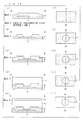
- FIG. 21 (a) is a plane view of an active matrix substrate to be used in a liquid crystal display device of the FFS mode, as described in Patent Document 1, and (b) is a cross sectional view taken on line A-A' indicated in (a) of Fig. 21 .
- the active matrix substrate mainly includes: a plurality of gate bus lines 101 and a plurality of source bus lines 107 which orthogonally intersect with each other; a plurality of pixel electrodes 109 provided comblike and parallel to the source bus lines 107 in pixel areas surrounded by the gate and source bus lines, respectively; TFTs 103 provided on sections in which the gate bus lines 101 diverge to the pixel area side; and common electrode wires (CS wires) 110 provided parallel to the gate bus lines 101.
- CS wires common electrode wires
- the active matrix substrate has common electrodes (gate bus line lower layer) 106 which consist of a transparent conductive film on an insulating substrate. Further, on the common electrodes 106 are provided a gate bus line upper layer 101 and CS wires 110. Moreover, a semiconductor layer 103, a contact layer 104, and a source/drain electrode upper layer 107 are stacked on the gate bus line upper layer 101 sandwiching a gate insulating film 102 between the semiconductor layer 103 and the gate bus line upper layer 101, so as to form a TFT. On an uppermost layer of the active matrix substrate is provided pixel electrodes 109 via an interlayer insulating film (passivation film) 108.
- the active matrix substrate described in Patent Document 1 has the following two problems, caused by the common electrodes which form the CS wires 110 being provided on the gate bus line lower layer 106.
- roughening of the common electrodes and the gate bus line upper layer causes the semiconductor layer 103, the contact layer 104, and the source/drain electrode upper layer 107 that are provided on the gate insulating film 102 to also roughen.
- the semiconductor layer 103, the contact layer 104, and the source/drain electrode upper layer 107 form a channel section 111 of the TFT.
- the flatness becomes low. This causes the roughness of the channel section 111 of the TFT to increase. As a result, a problem of a decrease in mobility occurs.
- the transparent electrodes have an extremely low transition temperature of crystallization, that is, the transparent electrodes polysiliconize (crystallize) from an amorphous state at around a temperature in a range of 150 ° to 200 °.
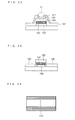
- the transparent electrodes are compared between a crystallized state and the amorphous state, a large difference is recognized in an etching rate. Therefore, polysiliconization of the transparent electrodes causes a need to etch for a remarkably long period of time. Namely, as illustrated in Fig. 23 , over-etching is required.
- the gate bus lines 101 become back tapered (peaked), and the gate insulating film 102 cannot cover the gate bus lines 101. This causes a problem that an efficiency percentage decreases, such as occurrence of leaking from the metal thin film formed on the upper layer.
- An active matrix substrate described in Patent Document 2 provides common electrodes on a gate insulating film.
- the common electrodes are provided on a layer upper than the gate bus lines. Therefore, the two aforementioned problems are solved.
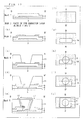
- Patent Documents 1 and 2 both form the common electrodes parallel to the gate bus lines by use of a metal layer of the gate bus lines arranged horizontally to the liquid crystal display section. That is to say, the CS wires 123 are horizontally provided, as illustrated in Fig. 24 .
- the gate bus lines are longer as compared to the source bus lines. Consequently, the common electrodes formed at the CS wires 123 have a high resistance, which causes a problem of signal delay.
- a width of the CS wires 123 is thickened so as to aim for low resistance, another problem occurs that an aperture ratio decreases.
- Patent Document 3 provides the common electrodes (transparent electrode material, for example ITO) on a further upper position than the pixel electrodes, as illustrated in Fig. 25 .
- the transparent electrode material is left remaining on all of an area except for a slit section of the common electrodes, so as to form the common electrodes.
- the transparent electrode material (CS wires) is provided on substantially the entire source bus lines and gate bus lines. As such, the problem of signal delay is solved by providing the CS wires parallel to the source bus lines.
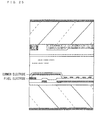
- the CS wires are formed so as to cover the entire source bus lines and gate bus lines illustrated in Fig. 26 . Therefore, defects such as a shortage and the like may possibly occur, and a parasitic capacitance between the gate and source bus lines and the CS wires increases.
- the present invention is attained in view of the problems, and its purpose is to provide an active matrix substrate and a liquid crystal display device including the same that has small signal delay caused by resistance and small signal delay caused by parasitic capacitance.
- an active matrix substrate of the present invention includes an insulating substrate; video signal lines and scanning signal lines provided orthogonally intersecting with each other on the insulating substrate; and thin film transistors provided at intersections of the video signal lines and the scanning signal lines, the thin film transistors including gate electrodes, source electrodes, and drain electrodes, respectively, a transparent electrode layer, formed to be used as a lower layer of the source electrodes and the drain electrodes, being used as (i) common electrodes provided in pixel areas surrounded by adjacent video signal lines and adjacent scanning signal lines, respectively and (ii) common electrode wires for connecting adjacent ones of the common electrodes parallel to the video signal lines.
- a transparent electrode layer that is formed to be used as a lower layer of source electrodes and drain electrodes is used as (i) common electrodes provided in pixel areas surrounded by adjacent video signal lines and adjacent scanning signal lines, respectively and (ii) common electrode wires for connecting adjacent ones of the common electrodes parallel to the video signal lines.
- the common electrodes and the common electrode wires are formed by use of the transparent electrode layer that is to be used as a lower layer of the source electrodes and the drain electrodes. This allows the common electrodes to be connected and extended in a parallel direction to the video signal lines that are connected to the source electrodes.
- video signal lines are shorter than the scanning signal lines. Therefore, it is possible to reduce resistance as compared to the common electrodes being extended parallel to the scanning signal lines.
- the common electrode wires do not have any part overlapping with the video signal lines, and are formed so as to overlap at a part where the common electrode wires orthogonally intersect with the scanning signal lines.
- the present invention reduces the resistance of the common electrodes and the common electrode wires, as well as reducing the parasitic capacitance between the common electrode wires and the signal lines. Therefore, it is possible to reduce the signal delay of the common electrode wires.
- a transparent electrode layer transparent conductive material such as ITO
- ITO transparent conductive material
- the active matrix substrate of the present invention is preferably arranged such that a metal film formed so as to create the gate electrodes is used as auxiliary common electrode wires that are provided parallel to the scanning signal lines, and the auxiliary common electrode wires and the common electrodes are electrically connected to each other via contact holes, respectively.
- auxiliary common electrode wires are provided parallel to the scanning signal lines, and the auxiliary common electrode wires and the common electrodes are electrically connected to each other via contact holes, respectively, provided on the gate insulating film. That is to say, a reticulate structure is formed by use of the common electrodes, common electrode wires and the auxiliary common electrode wires. Therefore, it is possible to have the structure close to one which a resistance is determined just by a relation of an aspect ratio (concept of sheet resistance), regardless of its size and material. Therefore, it is possible to reduce the resistance between two arbitrary points.
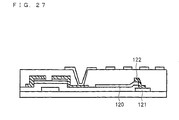
- the common electrodes 120 and the common electrode wires 121 are connected to each other via source metals (metal layer of source bus lines) as illustrated in Fig. 27 .
- source metals metal layer of source bus lines
- the reticulate structure enables the common electrodes to have four-directional redundancy. Therefore, even if a pixel that cannot make the ohmic contact, or, further even if one of the common electrodes and/or the auxiliary common electrodes have a breakage, the pixel defect and line defect is prevented to the utmost.
- each of the common electrodes has an opening section whose first and second end sections are located outside and inside, respectively, of an outer edge of a respective one of the contact holes; and contact electrode pads connected to (i) the auxiliary common electrode wires on the first end sections side of the common electrodes, and (ii) the common electrodes on the second end sections side of the common electrodes, respectively.
- each of the common electrodes has an opening whose first and second end sections are located outside and inside, respectively, of an outer edge of a respective one of the contact holes, and contact electrode pads are connected to (i) the auxiliary common electrode wires on the first end sections side of the common electrodes, and (ii) the common electrodes on the second end sections side of the common electrodes, respectively.
- This allows electrical connection between the common electrodes and the auxiliary common electrode wires by use of the contact electrode pads.
- this allows elimination of a contact hole forming step for connecting the common electrodes and the auxiliary common electrode wires, which forming step is to be carried out before formation of the source wires/electrodes and the drain electrodes.
- the active matrix substrate of the present invention is preferably arranged such that the pixel areas include pixel electrodes, and the contact electrode pads are formed to be made of a same material and in a same manufacturing step as the pixel electrodes.
- pixel electrodes and contact pads are formed by a same material and in a same manufacturing step. This allows simplification of a manufacturing method.
- the active matrix substrate of the present invention is preferably arranged such that the auxiliary common electrode wires are provided substantially mid between adjacent ones of the scanning signal lines, respectively.
- the auxiliary common electrode wires are provided substantially mid between adjacent ones of the scanning signal lines.
- the auxiliary common electrode wires are provided parallel to the scanning signal lines. Therefore, by providing the auxiliary common electrode wires substantially mid between the adjacent ones of the scanning signal lines, a distance between the auxiliary common electrode wires and the scanning signal lines is maximized. A longer distance from the auxiliary common electrode wires to the scanning signal line reduces a possibility of a shortage in the auxiliary common electrode wires and the scanning signal lines due to poor patterns and adherence of dust.
- the active matrix substrate of the present invention is preferably arranged such that the auxiliary common electrode wires are provided in a vicinity of one of adjacent ones of the scanning signal lines.
- the auxiliary common electrode wires are provided in a vicinity of one of the adjacent ones of the scanning signal lines.
- the vicinity of the scanning signal lines is an area that does not contribute to an aperture. Therefore, it is possible to realize a high aperture ratio since parts of the auxiliary common electrode wires are provided on the area which does not contribute to the aperture.
- the active matrix substrate of the present invention is preferably arranged such that the auxiliary common electrode wires extend to outer peripheral sections of the common electrodes, and extend in the outer peripheral sections so as to be parallel to the video signal lines, respectively.
- the outer peripheral section of the common electrode has a so-called disabled area (an area in which liquid crystal does not move, and a liquid crystal domain occurrence area).
- the auxiliary common electrode wires extend to the outer peripheral section of the common electrodes and extend in the outer peripheral sections so as to be parallel to the video signal lines, respectively. Therefore, light shielding of the disabled area is carried out by the auxiliary common electrode wires, therefore allows attainment of a high display quality.
- the active matrix substrate of the present invention is preferably arranged such that the auxiliary common electrode wires also extend to the outer peripheral sections of the common electrodes, and extend in the outer peripheral sections so as to be parallel to the scanning signal lines, respectively.
- the active matrix substrate of the present invention is preferably arranged such that a metal layer is provided so as to surround outer peripheries of the common electrodes, the metal layer being stacked to be used as an upper layer of the source electrodes and the drain electrodes.
- a metal layer stacked to be used as an upper layer of the source electrodes and the drain electrodes is provided so as to surround outer peripheries of the common electrodes. This allows the outer peripheries of the common electrodes to have a light shielding function, and the resistance between the common electrodes and the auxiliary common electrode wires is reduced.
- the active matrix substrate of the present invention is preferably arranged such that the metal layer is formed on parts on which the common electrode wires are provided.
- the active matrix substrate of the present invention is preferably arranged such that a metal layer is provided on intersections of the common electrode wires and the scanning signal lines.
- a metal layer is provided on intersections of the common electrode wires and the scanning signal lines. Therefore, it is possible to reduce the resistance of the common electrode wires. Further, the common electrode wires are of a stacked structure having the transparent electrode layer and the metal layer. This enables reduction of malfunction in the intersecting section with the scanning signal line such as breakage.
- the active matrix substrate of the present invention further preferably includes an interlayer insulating film including at least two layers, the two layers being a layer composed of an inorganic film and a layer composed of a low dielectric constant organic material.
- low dielectric constant organic material denotes for example material having a dielectric constant of not more than 5.
- an interlayer insulating film includes at least two layers, a layer composed of inorganic film and a layer composed of low dielectric constant organic material. Providing the low dielectric constant organic material allows decreasing of the parasitic capacitance. Further, by arranging the interlayer insulating film as having at least two layers, defects such as leakage is reduced. As a result, high reliability is realized.
- a liquid crystal display device of the present invention preferably includes any one of the foregoing active matrix substrates.
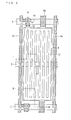
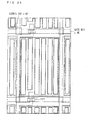
- Fig. 2 is a plane view illustrating one pixel area of an active matrix substrate of the present embodiment.
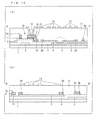
- An active matrix substrate of the present embodiment includes: a plurality of source wires 8a and a plurality of gate wires (scanning signal lines) 2, a plurality of rectangular-shaped (straight comblike) pixel electrodes 13, common electrodes 9, common electrode wires 8b, auxiliary electrode wires 3, and TFTs (Thin Film Transistor) 18, as illustrated in Fig. 2 .
- the plurality of source wires 8a and the plurality of gate wires 2 orthogonally intersect with each other.
- Each of the plurality of rectangular-shaped pixel electrodes 13 is provided parallel to the source wires (video signal lines) 8a in areas (pixel areas; later described) surrounded by the source wires 8a and the gate wires 2.
- Each of the common electrodes 9 is provided under the pixel electrodes 13.
- the common electrode wires 8b extend in a parallel direction to the source wires 8a from the common electrodes 9.
- Each of the auxiliary common electrode wires 3 are provided parallel to the gate wires 2 between adjacent gate wires 2.
- each of the common electrode wires 3 are provided between respective two adjacent gate wires 2, as illustrated in Fig. 2 .
- sources (source electrode) which form the TFTs 18 and gates (gate electrode) which also form the TFTs 18 are given identical reference numerals as the source wires and the gate wires, respectively.
- the common electrodes 9 are provided in the pixel areas, and the common electrode wires 8b are provided parallel to the source wires 8a so as to connect adjacent ones of the common electrodes 9. Further, the auxiliary common electrode wires 3 that are connected to the common electrodes 9 via contact holes are provided parallel to the gate wires 2.
- the common electrodes 9 and the auxiliary common electrode wires 3 intersect in the pixel areas, and on the common electrodes 9 at these intersections, contact holes 5 are provided (see (a) of Fig. 1 ).
- contact holes 12 are provided on the pixel electrodes 13 so as to connect the pixel electrodes 13 to respective TFTs 18 (see (a) of Fig. 1 ).
- the contact holes 5 are not necessarily provided in all of the pixel areas, and may be provided in pixel areas alternately skipped by one or two pixel areas.
- This method for manufacturing the active matrix substrate uses six masks.
- the auxiliary common electrode wires 3 are not essential in the arrangement. Therefore, in a case where the auxiliary common electrode wires 3 are not provided, a step for forming the contact hole 5 is unnecessary. As a result, the active matrix substrate can be manufactured by use of five masks.
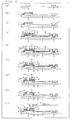
- a film is formed on the insulating substrate 1 by sputtering Ti/Al/Ti or the like in a thickness of approximately 250 nm. Thereafter, by a photolithography method, the gate 2 and the auxiliary common electrode wires 3 are formed spaced apart from each other. In this step 1, a first mask is to be used.
- the gate insulating film (silicon nitride; SiNx) 4, the a-Si layer 6, and the n+-Si layer 7 are formed consecutively in this order having a thickness of approximately 300 nm, 150 nm, and 50 nm, respectively.
- positions corresponding to the gate 2 and the auxiliary common electrode wires 3 are patterned as an island-shape by the photolithography method, as illustrated in (b) of Fig. 3 . Note that a channel section of the TFT 18 is still not formed at this point.
- a second mask is to be used.
- the gate insulating film 4 provided on the auxiliary common electrode wires 3 is etched in a predetermined pattern by the photolithography method as illustrated in (c) of Fig. 3 , so as to form the contact hole 5 and a wires lead-out terminal pad section (not illustrated) of the gate wires 2 and the source wires 8b.
- a third mask is to be used.
- a transparent conductive layer made of ITO is formed as a lower layer having a thickness of approximately 100 nm, and a metal layer made of Mo/Al/MoN or the like is formed as an upper layer having a thickness of approximately 150 nm, consecutively, by sputtering.
- a photoresist 14 is formed as illustrated in (d) of Fig. 3 .
- the photoresist 14 causes, by a halftone exposure method, a remaining amount of photoresist on the film in (i) an area in which the transparent conductive film and the metal layer are both to be removed, (ii) a first area (an area forming the source 8a or the drain 10) in which the transparent conductive film and the metal layer are both to remain, and (ii) a second area (an area forming the common electrode 9) in which the transparent conductive film and the metal layer are both to remain, to be approximately 0 nm, 3000 nm, and 1000 nm, respectively.
- the photoresist 14 that causes a film to remain by an amount of approximately 3000 nm is also formed on an area on which the common electrode wires 8b are to be formed. In this step, a fourth mask is to be used.
- the metal film is etched by a wet etching method by use of a wet etching liquid containing a phosphoric acid - hydrochloric acid - nitric acid type etching liquid. Further, the transparent conductive film is etched by a wet etching method by use of a ferric chloride etchant. This forms the source 8a and the drain 10, as illustrated in (e) of Fig. 3 .
- the source 8a and the drain 10 are formable as a double-layered structure by carrying out this step, having the transparent conductive film (ITO) 19 as a lower layer and the metal layer 21 as an upper layer. Further, the common electrode 9 is simultaneously formed.
- ITO transparent conductive film
- a bottommost layer of the source 8a and the drain 10 is the transparent conductive film (ITO) 19, and that this bottommost layer being the transparent conductive film (ITO) 19 also serves as the common electrode 9.
- the photoresist 14 provided on the area on which the common electrode 9 is formed is removed by a dry etching method utilizing a gas containing O 2 , as illustrated in (f) of Fig. 3 .
- the metal film on the area on which the common electrode 9 is formed is removed by the wet etching method utilizing the phosphoric acid - hydrochloric acid - nitric acid type etching liquid. Thereafter, a channel section including the a-Si layer 6 and the n + -Si layer 7 is formed by the dry etching method utilizing a gas containing SF 6 . This forms, for each pixel, a TFT 18 which serves as a switching element.
- the photoresist on the area on which the source 8a, the common electrode wires 8b, and the drain 10 are formed is removed by the dry etching method utilizing the gas containing O 2 , as illustrated in (h) of Fig. 2 .
- a silicon nitride film is formed in a thickness in a range of approximately 250 nm to 500 nm so as to serve as the interlayer insulating film 11, by the plasma CVD method.
- This interlayer insulating film 11 is then etched in a predetermined pattern by the photolithography method so as to form the contact hole 12 and the wires lead-out terminal pad section (not illustrated) of the gate wires 2 and source wires 8a.
- the transparent conductive film made of ITO is formed by sputtering in a thickness of approximately 100 nm on the interlayer insulating film 11.
- the pixel electrodes 13 are etched in a predetermined pattern (by use of a sixth mask). This concludes the formation of the active matrix substrate illustrated in (a) of Fig. 1 .
- the active matrix substrate of the present embodiment has a wiring structure in which the source/drain electrodes have transparent electrodes as the bottommost layer, and further has the transparent electrodes that are the bottommost layer to serve as a common electrode, as illustrated in (a) of Fig. 1 .
- the common electrodes are provided on the bottommost layer of the source electrodes/wires and the drain electrodes/wires, and not the ITO (common electrode) serving as a bottommost layer of the gate electrodes/wires.
- the ITO is provided parallel to the gate electrode/wires.
- the present embodiment forms the source electrodes/wires 8a and the drain electrodes/wires 10 by use of a transparent conductive film (ITO) 19 and an opaque metal layer 21 provided on the ITO 19 as an upper layer of the ITO 19. This allows leading out of the common electrode wires 8b formed by the ITO 19 parallel to the source wires.
- ITO transparent conductive film
- the ITO is provided on the bottommost layer of the gate electrodes/wires as with a conventional active matrix substrate, a problem occurs that the gate electrodes/wires roughens since an amorphous silicon on a gate insulating film is positioned on an upper side of the ITO. If the gate electrodes/wires roughens, the flatness decreases and the roughness of the TFT channel section increases. This causes a decrease in mobility. In comparison, the present embodiment does not provide the ITO on the bottommost layer of the gate electrodes/wires. Thus, it is possible to avoid the problem of the amorphous silicon to roughen.
- the ITO has an extremely low transition temperature of crystallization in a case where the ITO is provided on the bottommost layer of the gate electrodes/wires as with the conventional active matrix substrate. That is to say, the ITO polysiliconizes from an amorphous state at around a temperature in a range of 150 ° to 200 °.
- the transparent electrodes are compared between a crystallized state and the amorphous state, a large difference is recognized in an etching rate. Therefore, polysiliconization of the transparent electrodes cause a need to etch for a remarkably long period of time. In other words, over-etching is necessarily carried out.
- the gate wires become back tapered (peaked), which causes a problem that the gate insulting film cannot be covered.
- the ITO is not provided on the bottommost layer of the gate electrodes/wires. As a result, it is possible to avoid such problem.
- the ITO is provided as the bottommost layer of the source electrodes/wires and the drain electrodes/wires. Further, it is arranged such that the common electrode wires formed by the ITO be lead out parallel to the source wires.
- the source wires are shorter than the gate wires.
- a number of wires is 768 ⁇ 1024 (D ⁇ W). Therefore, an aspect ratio of the display section is 3 : 4.
- the number of wires is 1080 ⁇ 1920 (D ⁇ W), and the aspect ratio of the display screen is 9 : 16.
- the present embodiment has the auxiliary common electrode wires 3 provided parallel to the gate electrode/wires 2 between adjacent gate electrode/wires 2, in addition to the common electrode wires 8b provided parallel to the source wires/electrode 8a. That is to say, common electrode wires are reticulately provided, by connection of the wires. This thus allows having an arrangement in which resistance is determined just by relation of the aspect ratio, regardless of a size of a display section. As a result, the resistance between two arbitrary points is reduced. In addition, reticulately providing the common electrode wires allows having redundancy in four directions.
- the metal layer 22 is provided as an upper layer of the common electrode 8b in an area corresponding to the intersecting section of the gate electrodes/wires 2 and the common electrode wires 8b.
- the intersecting section has narrow common electrode wires 8b. Therefore, breaking of the wires may readily occur, and a loss due to resistance is great.
- the common electrode wires 8b having the metal layer 22 as the upper layer of the common electrode wires 8b secures connection at the metal layer even if breaking of the wires occur under the metal layer.
- the loss due to the resistance is suppressed by having a low resistant metal layer 22 stacked on the common electrode wires 8b.
- a semiconductor layer including the a-Si layer 6 and the n + -Si layer 7 is provided in the area corresponding to the intersecting section of the gate electrodes/wires 2 and the common electrode wires 8b. Therefore, it is possible to (i) have a reasonable distance between the gate electrodes/wires 2 and the common electrode wires 8b and (ii) reduce a capacitance between the gate electrodes/wires 2 and the common electrode wires 8b, as compared to an arrangement that does not provide the semiconductor layer.
- the common electrode wires 3 are provided mid between two respective adjacent gate electrodes/wires 2, as illustrated in Fig. 2 . This allows providing a reasonable distance between the common electrode wires 3 and the gate electrodes/wires 2. Consequently, it is possible to reduce the possibility of shortage between the common electrode wires 3 and the gate electrodes/wires 2 caused by poor patterning and adhering of dust.
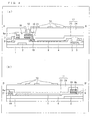
- Fig. 4 illustrates First Modification, wherein (a) is a cross sectional view taken on a line A-A' corresponding to (a) of Fig. 1 , and (b) is a cross sectional view taken on a line B-B' corresponding to (b) of Fig. 1 .
- a plane view of the First Modification is identical to Fig 2 . Therefore, the plane view of the First Modification is omitted here.
- the representative example has a single-layered interlayer insulating film 11 as illustrated in (a) and (b) of Fig. 1 .
- the First Modification has a double-layered interlayer insulating film 11, as illustrated in (a) and (b) of Fig. 4 .
- the interlayer insulating film 11 is so arranged as a double-layered structure including an inorganic film 23 made of SiNx, SiO 2 or the like, and a film 24 made of low-dielectric constant organic material.
- a pinhole or a defect in the single-layered insulting film causes a leakage in the upper and the lower metal layers.
- an echant etching liquid
- the lower metal layer is etched in a case where the single-layered insulating film has the pinhole or defect. This causes breaking of wires and the like.
- the insulating film has some pinhole or defect.
- the First Modification is manufactured by forming, in Step 9, as the interlayer insulating film, an inorganic film made of SiNx, SiO 2 or the like in a thickness in a range of 150 nm to 350 nm, and then forming a film made of low dielectric constant organic material in a thickness in a range of 2000 nm to 4000 nm on the inorganic film.
- the explanation of the First Modification describes an interlayer insulating film of a double-layered structure, however the structure of the interlayer insulating film is not limited to two layers, and may have three or more layers, by arbitrarily stacking the inorganic film 23 made of the SiNx, SiO 2 or the like and the film 24 made of low dielectric constant organic material.
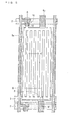
- Fig. 5 illustrates Second Modification, and is a plane view corresponding to Fig. 2 .
- (a) of Fig. 6 is a cross sectional view taken on a line A-A' as indicated in Fig. 5
- (b) of Fig. 6 is a cross sectional view taken on a line B-B' as indicated in Fig. 5 .
- the auxiliary common electrode wires 3 are arranged substantially mid between adjacent gate wires 2, respectively.
- the Second Modification arranges the auxiliary common electrode wires 3 in a vicinity of one of the respective adjacent gate wires 2. More specifically, the auxiliary common electrode wires 3 has a section that does not overlap with the pixel electrodes 13 in an extending direction of the source wires 8a. That is to say, the auxiliary common electrode wires 3 juts out from the pixel electrodes 13 in the extending direction of the source wires 8a.
- the Second Embodiment has a contact hole 5' at least on a part of the common electrode wires 8b.
- the arrangement illustrated in the cross section taken on the line A-A' as indicated in (a) of Fig. 6 that is, the cross section including an area in which the TFT 18 is provided to around a center of the pixel area, does not include the auxiliary common electrode wires 3, as different to Fig. 2(a) .
- the arrangement illustrated in the cross section taken on the line B-B' as indicated in (b) of Fig. 6 that is, the cross section including the area corresponding to the gate wires 2 to the area corresponding to the intersecting section of the gate wires 2 and the common electrode wires 8b via the pixel area includes the auxiliary common electrode wires 3 provided in the pixel area, as different to Fig. 2(b) .
- the auxiliary common electrode wires 3 and the common electrodes 9 are connected via the contact hole 5' formed on a position in which a part overlaps with the area of the common electrode wires 8b.
- the disabled area denotes areas of the following (A) through (D):
- the disabled area is (A) + (B) + (C) + (D).
- the disabled area is the area excluding the overlapping portions of the disabled areas (B) and (C) with area (A).
- the disabled area is reduced in the Second Modification as compared to the representative example. This allows realization of the high aperture ratio.
- the Second Modification is manufactured by changing, in Step 1, a provided position of the auxiliary common electrode wires 3 to a position closer to the gates 2.
- auxiliary common electrode wires 3 in the representative example is simply one example, and may be in any position as long as the auxiliary common electrode wires 3 are positioned between two adjacent gate wires 2.
- Fig. 7 illustrates Third Modification, and is a plane view corresponding to Fig. 2 .
- (a) of Fig. 8 is a cross sectional view taken on a line A-A' as indicated in Fig. 7
- (b) of Fig. 8 is a cross sectional view taken on a line B-B' as indicated in Fig. 7 .
- the Third Modification in addition to the arrangement of the representative example, has the auxiliary common electrode wires 3 extend to an outer peripheral section (disabled area) of the pixel area, and extend in the outer peripheral section so as to be parallel to the source wires 8a, as illustrated in Fig. 7 .
- the auxiliary common electrode wires 3 are extended to a surrounding section (outer peripheral section) of the common electrodes 9, and extended in the surrounding section so as to be parallel to the source wires 8a.
- a shape of the auxiliary common electrode wires 3 from a plane view is in an H-shape.
- the cross section of (a) of Fig. 8 taken on the line A-A' does not pass through characteristic parts of the Third Modification, therefore is identical to (a) of Fig. 2 .
- the auxiliary common electrode wires 3 is provided on the insulating substrate 1 in the disabled area (area in which liquid crystal does not move, and liquid crystal domain occurrence area) on the source wires 8a side of the pixel areas. Therefore, light shielding of the disabled area is possible without the need to add any processes to the representative example. This allows attainment of a high display quality.
- the Third Modification is manufactured by forming, in Step 1, the auxiliary common electrode wires 3 parallel to the source wires 8a in the disabled area on the source wires 8a side of the pixel areas.
- auxiliary common electrode wires 3 may be provided so as to extend to the outer peripheral section of the pixel area, and extend in the outer peripheral section so as to be parallel to the source wires 8a, and also extend in the outer peripheral section so as to be parallel to the gate wires 2, so as to surround the entire outer peripheral section of the pixel areas. That is to say, the common electrode wires 3 may be provided in a ring shape.
- Fig. 9 illustrates Fourth Modification, and is a plane view corresponding to Fig. 2 .
- (a) of Fig. 10 is a cross sectional view taken on a line A-A' as indicated in Fig. 9
- (b) of Fig. 10 is a cross sectional view taken on a line B-B' as indicated in Fig. 9 .
- a same metal layer as the metal layer 21 which is provided as the upper layer of the source 8a and the drain 10 is provided as a light shielding film (metal layer provided so as to surround outer peripheries of the common electrodes) 25 so as to shield a liquid crystal domain, at a surrounding section (outer peripheral section) of the common electrodes 9, as illustrated in Fig. 9 , and (a) and (b) of Fig. 10 .
- the light shielding film 25 may be provided so as to cover the entire common electrode wires 8b, as illustrated in Fig 9 .
- the metal layer used for the light shielding film 25 is not limited to ones that have a function of a light shielding film. Namely, the light shielding function is simply one example.
- the light shielding film 25 is formed by not removing all of a metal film corresponding to a position on which the common electrodes 9 are to be formed but have the metal film remain on the surrounding section of the common electrodes 9, when removing the metal film in Step 7.
- the arrangement allows surroundings of the common electrodes 9 to have a light shielding function, and allows reduction of a resistance of the common electrodes 9 and the auxiliary common electrode wires 3, by providing the light shielding film 25 that is made of a low resistance metal layer.
- Fig. 11 illustrates Fifth Modification, and is a plane view corresponding to Fig. 2 .
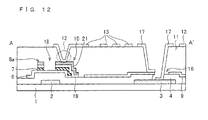
- Fig. 12 is a cross sectional view taken on a line A-A' as indicated in Fig. 11 .
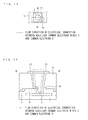
- Fig. 13 is an enlarged view of section C illustrated in Fig. 11 , that is, an intersecting section of the common electrode 9 and the common electrode wires 3.
- Fig. 14 is a cross sectional view taken on a line B-B' as indicated in Fig. 13 .
- the pixel electrodes 13 illustrated in the Fifth Modification are cut off at a part in which the common electrodes 9 and the auxiliary common electrode wires 3 intersect with each other.
- contact electrode pads 17 are provided separated from the pixel electrodes 13. The contact electrode pads 17 electrically connect the common electrodes 9 and the auxiliary common electrode wires 3.
- Reference numeral 16 in Fig. 13 illustrates an opening of the common electrodes 9. That is to say, in the Fifth Modification, an opening is provided at the intersecting section of the common electrodes 9 and the auxiliary common electrode wires 3, as illustrated in Figs. 12 and 14 . Further, as obvious from Figs. 12 and 14 , the interlayer insulating film 11 and the gate insulating film 4 are hollowed out at a position in which the contact electrode pad 17 is provided.
- the common electrodes 9 and the auxiliary electrode wires 3 are electrically connected to each other via the contact holes 5 provided on the gate insulating film 4.
- the Fifth Modification provides the contact electrode pads 17 that are connected to both the common electrodes 9 and the auxiliary common electrode wires 3, as illustrated in Figs. 12 and 14 .
- the common electrodes 9 and the auxiliary common electrode wires 3 are connected to each other via the contact electrode pads 17.
- the contact electrode pads 17 are formed along the interlayer insulating film 11, and one end is connected to the common electrodes 9, and the other end is connected to the auxiliary common electrode wires 3. This allows electrical connection between the auxiliary common electrode wires 3 and the common electrodes 9 as indicated by the broken arrow in Fig. 14 .
- the contact electrode pad 17 can be simultaneously formed with the formation of the pixel electrodes 13. Note that, although the contact electrode pads 17 connect the common electrodes 9 and the auxiliary common electrode wires 3 in the extending direction of the source wires 8a, this is simply one example, and the common electrodes 9 and the auxiliary common electrode wires 3 may be connected in an extending direction of the gate wires 2, for example.
- the Fifth Modification can manufacture the active matrix substrate in a five-mask process.
- a reason of this is because the contact holes 5 can be formed simultaneously with a photopatterning of the interlayer insulating film 11. This enables elimination of a photo step for forming the contact holes 5.
- a film is formed on the insulating substrate 1 by sputtering Ti/Al/Ti or the like in a thickness of approximately 250 nm. Thereafter, by a photolithography method, the gates 2 and the auxiliary common electrode wires 3 are formed spaced apart from each other. In this step 1, a first mask is to be used.
- the gate insulating film (silicon nitride; SiNx) 4, the a-Si layer 6, and the n+-Si layer 7 are formed consecutively in this order having a thickness of approximately 300 nm, 150 nm, and 50 nm, respectively.
- positions corresponding to the gates 2 and the auxiliary common electrode wires 3 are patterned as an island-shape by the photolithography method, as illustrated in (b) of Fig. 15 . Note that a channel section of the TFTs 18 is still not formed at this point.
- a second mask is to be used.
- a transparent conductive layer made of ITO is formed as a lower layer having a thickness of approximately 100 nm, and a metal layer made of Mo/Al/MoN or the like is formed as an upper layer having a thickness of approximately 150 nm, consecutively, by sputtering.
- a photoresist 14 is formed as illustrated in (c) of Fig. 15 .
- the photoresist 14 causes, by a halftone exposure method, a remaining amount of photoresist on the film in (i) an area in which the transparent conductive film and the metal layer are both to be removed, (ii) a first area (an area forming the sources 8a or the drains 10) in which the transparent conductive film and the metal layer are both to remain, and (ii) a second area (an area forming the common electrodes 9) in which the transparent conductive film and the metal layer are both to remain, to be approximately 0 nm, 3000 nm, and 1000 nm, respectively.
- the photoresist 14 that causes a film to remain by an amount of approximately 3000 nm is also formed on an area on which the common electrode wires 8b are to be formed.
- a third mask is to be used.
- the metal film is etched by a wet etching method by use of a wet etching liquid containing a phosphoric acid - hydrochloric acid - nitric acid type etching liquid. Further, the transparent conductive film is etched by a wet etching method by use of a ferric chloride etchant. This forms the sources 8a and the drains 10, as illustrated in (d) of Fig. 15 .
- the sources 8a and the drains 10 are formable as a double-layered structure by carrying out this step, having the transparent conductive film (ITO) 19 as a lower layer and the metal layer 21 as an upper layer. Further, the common electrodes 9 are simultaneously formed.
- ITO transparent conductive film
- the photoresist 14 provided on the area on which the common electrodes 9 are formed is removed by a dry etching method utilizing a gas containing O 2 , as illustrated in (e) of Fig. 15 .
- the metal film on the area on which the common electrodes 9 are formed is removed by the wet etching method utilizing the phosphoric acid - hydrochloric acid - nitric acid type etching liquid. Thereafter, channel sections including the a-Si layer 6 and the n + -Si layer 7 are formed by the dry etching method utilizing a gas containing SF 6 . This forms, for each pixel, TFTs 18 which serve as a switching element.
- the photoresist on the area on which the sources 8a, the common electrode wires 8b, and the drains 10 are formed is removed by the dry etching method utilizing the gas containing O 2 , as illustrated in (g) of Fig. 15 . Note that, although not illustrated in the drawing, the photoresist on the area on which the common electrode wires 8b are formed is simultaneously removed.
- a silicon nitride film is formed in a thickness in a range of approximately 150 nm to 650 nm so as to serve as the interlayer insulating film 11, by the plasma CVD method, as illustrated in (h) of Fig. 15 .
- This interlayer insulating film 11 is then etched in a predetermined pattern by the photolithography method so as to form the contact holes 5 and 12, and the wires lead-out terminal pad section (not illustrated) of the gate wires 2 and source wires 8a.
- dry etching of the gate insulating film 4 is carried out by use of the interlayer insulating film 11 as a mask, so that the contact holes 5 are hollowed to reach the auxiliary common electrode wires 3.
- the transparent conductive film made of ITO is formed by sputtering in a thickness of approximately 100 nm on the interlayer insulating film 11, as illustrated in (i) of Fig. 15 . Thereafter, the pixel electrodes 13, and the contact electrode pads 17 that electrically connect the common electrodes 9 and the auxiliary common electrode wires 3, are etched in a predetermined pattern by the photolithography method. This concludes the formation of the active matrix substrate as illustrated in Fig. 12 . In this step, a fifth mask is to be used.
- the Fifth Modification can manufacture the active matrix substrate by use of five masks.
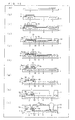
- FIG. 16 (a) through (e) are cross sectional views illustrating a manufacturing process of the contact hole 5 part of the active matrix substrate in a case where six masks are used, and (f) through (j) are schematic views illustrating plane views of Figs. (a) through (e), respectively.
- a first mask is used so as to form the auxiliary common electrode wires 3, as illustrated in (a) of Fig. 16 .
- a second mask is used in a photolithography method of a semiconductor layer (not illustrated).
- a third mask is used so as to form the contact holes 5, as illustrated in (b) of Fig. 16 .
- a fourth mask is used so as to form the common electrodes 9, as illustrated in (c) of Fig. 16 .
- a fifth mask is used so as to pattern the interlayer insulating film 11, as illustrated in (d) of Fig. 16 .
- a sixth mask is used so as to form the pixel electrodes 13, as illustrated in (e) of Fig. 16 .
- FIG. 17 are cross sectional views illustrating a manufacturing process of the contact hole 5 part of the active matrix substrate in a case where five masks are used, and (f) through (j) are schematic views illustrating plane views of (a) through (e), respectively.
- a first mask is used so as to form the auxiliary common electrode wires 3 as illustrated in (a) of Fig. 17 .
- a second mask is used in a photolithography method of a semiconductor layer (not illustrated).
- a third mask is used so as to form openings 16 of the common electrodes 9, as illustrated in (b) of Fig. 17 .
- a fourth mask is used so as to form the interlayer insulating film 11 as illustrated in (c) of Fig. 17 .
- Formation of the contact holes 5 that extend to the auxiliary common electrode wires 3 are carried out by dry etching the gate insulating film 2 by use of the interlayer insulating film 11 as a mask. Therefore, a new mask is not necessary in (d) of Fig. 17 .
- a fifth mask is used so as to form (i) the pixel electrodes 13 and (ii) the contact electrode pads 17 that electrically connect the common electrodes with the auxiliary common electrode wires 3, as illustrated in (e) of Fig. 17 .
- the arrow illustrated in broken lines in (d) of Fig. 17 indicates a flowing direction of an electrical connection between the auxiliary common electrode wires 3 and the common electrodes 9.
- FIG. 18 A comparative example is illustrated in (a) and (b) of Fig. 18 , whose openings 16 of common electrodes 9 are larger than openings of contact holes 5.
- (a) of Fig. 18 is a plane view
- (b) of Fig. 18 is a cross sectional view taken on a line B-B' as indicated in (a) of Fig. 18 .
- the contact electrode pads 17 are electrically connected to the auxiliary common electrode wires 3, however cannot be electrically connected to the common electrodes 9. The reason of this is obvious; therefore it is omitted here.
- FIG. 19 Another comparative example is illustrated in (a) and (b) of Fig. 19 , whose openings 16 of common electrodes 9 are smaller that of openings of contact holes.
- (a) of Fig. 19 is a plane view
- (b) of Fig. 19 is a cross sectional view taken on a line B-B' as indicated in (a) of Fig. 19 .
- the contact electrode pads 17 are electrically connected to the common electrodes 9, however cannot be electrically connected to the auxiliary common electrode wires 3.
- the common electrodes 9 are made of material such as ITO, the common electrodes 9 cannot be dry etched when the contact holes 5 are hollowed to the auxiliary common electrode wires 3 by dry etching the gate insulating film 4 by use of the interlayer insulating film 11 as a mask.
- the gate insulating film 4 becomes back tapered, in other words, peaked, which causes the contact electrode pads 17 to be disconnected.
- the active matrix substrate in the Fifth Modification of the present embodiment is so arranged that the contact electrode pads 17 are electrically connectable to both the common electrodes 9 and the auxiliary common electrode wires 3. That is to say, the Fifth Modification is so arranged that both arrangements of the two comparative examples are taken into account. Furthermore, in other words, the contact electrode pads 17 are connected to (i) the auxiliary common electrode wires 3 on a first end sections side of the common electrodes 9 located outside of an outer edge of the respective one of the contact holes 5, and (ii) the common electrodes on a second end sections side of the common electrodes 9 located inside of the outer edge of the respective one of the contact holes 5.
- the regular six mask process requires, before the formation of the sources and the drains, adding of a photo step so as to form the contact holes 5 that electrically connect the common electrodes 9 with the auxiliary common electrode wires 3.
- the photo step for forming the contact holes 5 is not carried out before the formation of the sources and the drains. Instead, openings are provided on parts of the common electrodes 9 (so as to allow hollowing out of the contact holes 5 to the bottommost layer of the auxiliary common electrode wires 3 later on). This allows the formation of the contact holes 5 simultaneously with the photopatterning of the interlayer insulating film 11.
- the contact electrode pads 17 that electrically connect the common electrodes 9 with the auxiliary common electrode wires 3 are formed at the time when the pixel electrodes 13 are formed.
- This enables the manufacture of the active matrix substrate by use of the five masks.
- the arrangement described in claim 1 does not require the foregoing processes, and is of a five-mask process. This is because the photopatterning step of the contact holes 5 carried out before the formation of the sources and the drains is originally not included.
- the pixel electrodes are of a straight comblike shape.
- Sixth Modification adds a change in a shape of the pixel electrodes 13.
- the pixel electrodes 13 may be of a V-shape whose center is positioned mid between two adjacent ones of the source wires 8a in the pixel areas, as illustrated in (a) of Fig. 20 .
- the pixel electrode 13 may be of a V-shape whose center is positioned mid between two adjacent ones of the gate wires 2 in the pixel areas.
- the present modification has the metal layer 21 which is the upper layer of the sources 8a remaining on the common electrodes 9 in areas in which a liquid crystal domain may occur. That is to say, as illustrated in (a) and (b) of Fig. 20 , the metal layer 21 is provided on parts of the common electrodes 9 (broken line section in (a) and (b) of Fig. 20 ).
- Having the pixel electrodes 13 in such a shape allows realization of a multi-domain broad angle of view.
- an active matrix substrate includes an insulating substrate; video signal lines and scanning signal lines provided orthogonally intersecting with each other on the insulating substrate; and thin film transistors provided at intersections of the video signal lines and the scanning signal lines, the thin film transistors including gate electrodes, source electrodes, and drain electrodes, respectively, a transparent electrode layer, formed to be used as a lower layer of the source electrodes and the drain electrodes, being used as (i) common electrodes provided in pixel areas surrounded by adjacent video signal lines and adjacent scanning signal lines, respectively and (ii) common electrode wires for connecting adjacent ones of the common electrodes parallel to the video signal lines.
- the invention is applicable to a liquid crystal display device, and is particularly suitable for use in large-screen televisions and the like.
Landscapes
- Physics & Mathematics (AREA)
- Nonlinear Science (AREA)
- Mathematical Physics (AREA)
- Chemical & Material Sciences (AREA)
- Crystallography & Structural Chemistry (AREA)
- General Physics & Mathematics (AREA)
- Optics & Photonics (AREA)
- Engineering & Computer Science (AREA)
- Microelectronics & Electronic Packaging (AREA)
- Geometry (AREA)
- Liquid Crystal (AREA)
- Thin Film Transistor (AREA)
Applications Claiming Priority (2)
| Application Number | Priority Date | Filing Date | Title |
|---|---|---|---|
| JP2006263506 | 2006-09-27 | ||
| PCT/JP2007/059513 WO2008038432A1 (fr) | 2006-09-27 | 2007-05-08 | Substrat de matrice active et dispositif d'affichage à cristaux liquides doté de celui-ci |
Publications (3)
| Publication Number | Publication Date |
|---|---|
| EP2071394A1 true EP2071394A1 (de) | 2009-06-17 |
| EP2071394A4 EP2071394A4 (de) | 2010-07-21 |
| EP2071394B1 EP2071394B1 (de) | 2011-10-26 |
Family
ID=39229875
Family Applications (1)
| Application Number | Title | Priority Date | Filing Date |
|---|---|---|---|
| EP07742948A Not-in-force EP2071394B1 (de) | 2006-09-27 | 2007-05-08 | Aktivmatrixsubstrat und damit ausgestattete flüssigkristallanzeigeanordnung |
Country Status (7)
| Country | Link |
|---|---|
| US (1) | US20090201455A1 (de) |
| EP (1) | EP2071394B1 (de) |
| JP (1) | JP4885968B2 (de) |
| KR (1) | KR101055011B1 (de) |
| CN (2) | CN101479657B (de) |
| AT (1) | ATE530945T1 (de) |
| WO (1) | WO2008038432A1 (de) |
Cited By (4)
| Publication number | Priority date | Publication date | Assignee | Title |
|---|---|---|---|---|
| US8492765B2 (en) | 2011-01-20 | 2013-07-23 | Samsung Display Co., Ltd. | Display device and method of fabricating the same |
| US10134912B2 (en) | 2009-09-04 | 2018-11-20 | Semiconductor Energy Laboratory Co., Ltd. | Display device and electronic device |
| US10317736B2 (en) | 2012-08-28 | 2019-06-11 | Semiconductor Energy Laboratory Co., Ltd. | Display device and electronic device |
| US11175542B2 (en) | 2008-12-03 | 2021-11-16 | Semiconductor Energy Laboratory Co., Ltd. | Liquid crystal display device |
Families Citing this family (40)
| Publication number | Priority date | Publication date | Assignee | Title |
|---|---|---|---|---|
| JP5216204B2 (ja) | 2006-10-31 | 2013-06-19 | 株式会社半導体エネルギー研究所 | 液晶表示装置及びその作製方法 |
| KR101329284B1 (ko) * | 2007-02-08 | 2013-11-14 | 삼성디스플레이 주식회사 | 표시 기판 및 이의 제조 방법 |
| JP5247507B2 (ja) * | 2008-08-22 | 2013-07-24 | 株式会社ジャパンディスプレイウェスト | 液晶表示装置 |
| JP2010060967A (ja) * | 2008-09-05 | 2010-03-18 | Epson Imaging Devices Corp | 液晶表示装置及び電子機器 |
| JP5054656B2 (ja) * | 2008-10-28 | 2012-10-24 | カシオ計算機株式会社 | 液晶表示素子 |
| JP2010145870A (ja) | 2008-12-19 | 2010-07-01 | Sony Corp | 液晶パネル及び電子機器 |
| JP4911167B2 (ja) | 2008-12-19 | 2012-04-04 | ソニー株式会社 | 液晶パネル及び電子機器 |
| KR101545642B1 (ko) * | 2009-02-09 | 2015-08-20 | 삼성디스플레이 주식회사 | 표시 장치 및 이의 제조 방법 |
| US8804081B2 (en) | 2009-12-18 | 2014-08-12 | Samsung Display Co., Ltd. | Liquid crystal display device with electrode having opening over thin film transistor |
| KR101035349B1 (ko) * | 2009-12-31 | 2011-05-20 | 하이디스 테크놀로지 주식회사 | 디지털 엑스-레이 검출기 및 그 제조방법 |
| JP2011158690A (ja) * | 2010-02-01 | 2011-08-18 | Sony Corp | 液晶表示パネル及び電子機器 |
| JP2012018970A (ja) * | 2010-07-06 | 2012-01-26 | Mitsubishi Electric Corp | 薄膜トランジスタアレイ基板、その製造方法、及び液晶表示装置 |
| BR112013022675A2 (pt) | 2011-03-25 | 2016-12-06 | Sharp Kk | dispositivo de visor |
| KR101841770B1 (ko) * | 2011-09-02 | 2018-03-26 | 엘지디스플레이 주식회사 | 산화물 박막 트랜지스터를 구비한 평판 표시장치 및 그의 제조방법 |
| CN102645803B (zh) * | 2011-10-17 | 2014-06-18 | 京东方科技集团股份有限公司 | 像素单元,阵列基板、液晶面板、显示装置及其制造方法 |
| KR101973584B1 (ko) | 2012-02-10 | 2019-04-30 | 삼성디스플레이 주식회사 | 박막 트랜지스터 표시판 및 이를 포함하는 액정 표시 장치 |
| US9368523B2 (en) * | 2012-03-27 | 2016-06-14 | Sharp Kabushiki Kaisha | Semiconductor device, method for manufacturing semiconductor device, and display device |
| US8927985B2 (en) * | 2012-09-20 | 2015-01-06 | Semiconductor Energy Laboratory Co., Ltd. | Semiconductor device |
| JP2014228565A (ja) | 2013-05-17 | 2014-12-08 | パナソニック液晶ディスプレイ株式会社 | 液晶表示装置及び液晶表示装置の製造方法 |
| KR102197416B1 (ko) | 2013-09-13 | 2020-12-31 | 가부시키가이샤 한도오따이 에네루기 켄큐쇼 | 표시 장치 |
| KR102098304B1 (ko) * | 2013-12-10 | 2020-05-27 | 삼성디스플레이 주식회사 | 액정 표시 장치 및 그 제조 방법 |
| JP2015118193A (ja) * | 2013-12-18 | 2015-06-25 | 株式会社ジャパンディスプレイ | 液晶表示装置 |
| US9530801B2 (en) * | 2014-01-13 | 2016-12-27 | Apple Inc. | Display circuitry with improved transmittance and reduced coupling capacitance |
| KR101877660B1 (ko) * | 2014-02-28 | 2018-07-12 | 도판 인사츠 가부시키가이샤 | 액정 표시 장치 |
| CN104218041B (zh) * | 2014-08-15 | 2017-12-08 | 京东方科技集团股份有限公司 | 阵列基板及制备方法和显示装置 |
| CN104460140B (zh) * | 2015-01-06 | 2017-09-29 | 京东方科技集团股份有限公司 | 阵列基板及显示装置 |
| US11710748B2 (en) | 2015-01-27 | 2023-07-25 | Beijing Boe Optoelectronics Technology Co., Ltd. | Array substrate and touch panel and manufacturing method of array substrate |
| CN104536636B (zh) * | 2015-01-27 | 2017-12-08 | 京东方科技集团股份有限公司 | 一种阵列基板、触控面板及阵列基板的制作方法 |
| CN104966719A (zh) * | 2015-06-29 | 2015-10-07 | 武汉华星光电技术有限公司 | 显示面板、薄膜晶体管阵列基板及其制作方法 |
| CN104932127B (zh) * | 2015-07-09 | 2018-07-06 | 京东方科技集团股份有限公司 | 一种阵列基板及其制作方法、显示装置 |
| CN105336684A (zh) * | 2015-10-22 | 2016-02-17 | 京东方科技集团股份有限公司 | 多晶硅阵列基板的制作方法、多晶硅阵列基板及显示面板 |
| JP6117316B2 (ja) * | 2015-11-05 | 2017-04-19 | 株式会社ジャパンディスプレイ | 液晶表示装置 |
| CN105655349B (zh) * | 2016-01-05 | 2019-08-20 | 京东方科技集团股份有限公司 | 阵列基板及其制作方法、显示面板、显示装置 |
| CN105720012A (zh) * | 2016-02-18 | 2016-06-29 | 深圳市华星光电技术有限公司 | 双栅极tft阵列基板及制作方法 |
| KR102510444B1 (ko) * | 2016-04-28 | 2023-03-15 | 삼성디스플레이 주식회사 | 표시 장치 및 표시 장치 제조용 마스크 |
| CN106206617A (zh) * | 2016-08-29 | 2016-12-07 | 武汉华星光电技术有限公司 | 基于低温多晶硅的阵列基板及其制作方法 |
| CN106935598B (zh) * | 2017-04-05 | 2019-08-27 | 上海中航光电子有限公司 | 阵列基板及其制造方法、触控面板和触控装置 |
| CN109786391B (zh) * | 2017-11-10 | 2021-08-03 | 京东方科技集团股份有限公司 | 阵列基板及其制作方法、显示装置 |
| JP2019090939A (ja) * | 2017-11-15 | 2019-06-13 | シャープ株式会社 | アクティブマトリックス基板、表示装置、および制御方法 |
| CN114019709B (zh) * | 2021-11-18 | 2022-10-04 | Tcl华星光电技术有限公司 | 阵列基板及液晶显示面板 |
Family Cites Families (16)
| Publication number | Priority date | Publication date | Assignee | Title |
|---|---|---|---|---|
| JP3170446B2 (ja) | 1996-02-27 | 2001-05-28 | シャープ株式会社 | アクティブマトリクス基板及び液晶表示装置 |
| US5852485A (en) * | 1996-02-27 | 1998-12-22 | Sharp Kabushiki Kaisha | Liquid crystal display device and method for producing the same |
| KR100507271B1 (ko) * | 1999-06-30 | 2005-08-10 | 비오이 하이디스 테크놀로지 주식회사 | 고개구율 및 고투과율 액정표시장치 및 그 제조방법 |
| KR100613766B1 (ko) * | 1999-07-30 | 2006-08-18 | 비오이 하이디스 테크놀로지 주식회사 | 고개구율 및 고투과율 액정 표시 장치 |
| KR100887325B1 (ko) * | 1999-09-07 | 2009-03-06 | 가부시키가이샤 히타치세이사쿠쇼 | 액정표시장치 |
| KR100325079B1 (ko) | 1999-12-22 | 2002-03-02 | 주식회사 현대 디스플레이 테크놀로지 | 고개구율 및 고투과율 액정표시장치의 제조방법 |
| KR100322968B1 (ko) | 1999-12-22 | 2002-02-02 | 주식회사 현대 디스플레이 테크놀로지 | 프린지 필드 구동 액정 표시 장치의 제조방법 |
| TW498178B (en) * | 2000-05-02 | 2002-08-11 | Hannstar Display Corp | Manufacturing method and structure for in-plane switching mode liquid crystal display unit |
| KR20020002052A (ko) * | 2000-06-29 | 2002-01-09 | 주식회사 현대 디스플레이 테크놀로지 | 프린지 필드 구동 모드 액정 표시 장치의 제조방법 |
| JP3881248B2 (ja) * | 2002-01-17 | 2007-02-14 | 株式会社日立製作所 | 液晶表示装置および画像表示装置 |
| JP4085170B2 (ja) * | 2002-06-06 | 2008-05-14 | 株式会社 日立ディスプレイズ | 液晶表示装置 |
| JP2004165286A (ja) * | 2002-11-11 | 2004-06-10 | Toshiba Corp | 薄膜トランジスタの製造方法 |
| KR100975734B1 (ko) * | 2003-09-08 | 2010-08-12 | 엘지디스플레이 주식회사 | 횡전계방식 액정 표시 장치용 어레이 기판 및 그 제조 방법 |
| JP4326307B2 (ja) * | 2003-11-19 | 2009-09-02 | 株式会社 日立ディスプレイズ | 液晶表示装置 |
| KR101007206B1 (ko) * | 2003-12-11 | 2011-01-12 | 엘지디스플레이 주식회사 | 프린지 필드 스위칭 모드 액정표시장치 및 그 제조방법 |
| JP4217170B2 (ja) * | 2004-01-28 | 2009-01-28 | 株式会社 日立ディスプレイズ | 液晶表示装置およびその駆動方法 |
-
2007
- 2007-05-08 CN CN2007800239330A patent/CN101479657B/zh not_active Expired - Fee Related
- 2007-05-08 AT AT07742948T patent/ATE530945T1/de not_active IP Right Cessation
- 2007-05-08 WO PCT/JP2007/059513 patent/WO2008038432A1/ja not_active Ceased
- 2007-05-08 US US12/301,651 patent/US20090201455A1/en not_active Abandoned
- 2007-05-08 KR KR1020087029724A patent/KR101055011B1/ko not_active Expired - Fee Related
- 2007-05-08 JP JP2008536287A patent/JP4885968B2/ja not_active Expired - Fee Related
- 2007-05-08 CN CN2010105361968A patent/CN102096251B/zh not_active Expired - Fee Related
- 2007-05-08 EP EP07742948A patent/EP2071394B1/de not_active Not-in-force
Cited By (10)
| Publication number | Priority date | Publication date | Assignee | Title |
|---|---|---|---|---|
| US11175542B2 (en) | 2008-12-03 | 2021-11-16 | Semiconductor Energy Laboratory Co., Ltd. | Liquid crystal display device |
| US10134912B2 (en) | 2009-09-04 | 2018-11-20 | Semiconductor Energy Laboratory Co., Ltd. | Display device and electronic device |
| US10700215B2 (en) | 2009-09-04 | 2020-06-30 | Semiconductor Energy Laboratory Co., Ltd. | Display device and electronic device |
| US11069817B2 (en) | 2009-09-04 | 2021-07-20 | Semiconductor Energy Laboratory Co., Ltd. | Display device and electronic device |
| US11430899B2 (en) | 2009-09-04 | 2022-08-30 | Semiconductor Energy Laboratory Co., Ltd. | Display device and electronic device |
| US11652174B2 (en) | 2009-09-04 | 2023-05-16 | Semiconductor Energy Laboratory Co., Ltd. | Display device and electronic device |
| US12206025B2 (en) | 2009-09-04 | 2025-01-21 | Semiconductor Energy Laboratory Co., Ltd. | Display device and electronic device |
| US12557344B2 (en) | 2009-09-04 | 2026-02-17 | Semiconductor Energy Laboratory Co., Ltd. | Display device and electronic device |
| US8492765B2 (en) | 2011-01-20 | 2013-07-23 | Samsung Display Co., Ltd. | Display device and method of fabricating the same |
| US10317736B2 (en) | 2012-08-28 | 2019-06-11 | Semiconductor Energy Laboratory Co., Ltd. | Display device and electronic device |
Also Published As
| Publication number | Publication date |
|---|---|
| CN101479657A (zh) | 2009-07-08 |
| CN102096251B (zh) | 2013-07-03 |
| KR101055011B1 (ko) | 2011-08-05 |
| HK1129148A1 (en) | 2009-11-20 |
| US20090201455A1 (en) | 2009-08-13 |
| CN101479657B (zh) | 2010-12-08 |
| KR20090015951A (ko) | 2009-02-12 |
| HK1130908A1 (en) | 2010-01-08 |
| JP4885968B2 (ja) | 2012-02-29 |
| JPWO2008038432A1 (ja) | 2010-01-28 |
| ATE530945T1 (de) | 2011-11-15 |
| CN102096251A (zh) | 2011-06-15 |
| EP2071394A4 (de) | 2010-07-21 |
| WO2008038432A1 (fr) | 2008-04-03 |
| EP2071394B1 (de) | 2011-10-26 |
Similar Documents
| Publication | Publication Date | Title |
|---|---|---|
| EP2071394B1 (de) | Aktivmatrixsubstrat und damit ausgestattete flüssigkristallanzeigeanordnung | |
| KR101492106B1 (ko) | 액정 표시 장치 및 이의 제조 방법 | |
| EP2565917B1 (de) | Herstellungsverfahren für ein arraysubstrat in ener flüssigkristallanzeige mit fringe-field-schaltungs-dünnfilmtransistor | |
| KR100250853B1 (ko) | 표시장치용 어레이 기판 및 그 제조방법 | |
| KR101250319B1 (ko) | 프린지 필드 스위칭 모드 액정표시장치용 어레이 기판과 그 제조방법 | |
| US8405788B2 (en) | TFT-LCD array substrate and manufacturing method thereof | |
| US8031285B2 (en) | Thin film transistor substrate, method of manufacturing the same, and liquid crystal display panel having the same | |
| US8703510B2 (en) | Array substrate and a manufacturing method thereof | |
| KR100660531B1 (ko) | 반사투과 복합형 박막트랜지스터 액정표시장치 | |
| US20080116459A1 (en) | Thin film transistor array substrate and method for fabricating same | |
| US7901951B2 (en) | Thin film transistor array substrate and method for fabricating same | |
| KR100436801B1 (ko) | 액정 표시 패널 | |
| US20230135065A1 (en) | Active matrix substrate | |
| HK1129148B (en) | Active matrix substrate and liquid crystal display device provided with same | |
| KR100603927B1 (ko) | 박막트랜지스터 액정표시장치 | |
| KR20080048721A (ko) | 횡전계형 액정표시장치용 어레이 기판 | |
| JP3265862B2 (ja) | 液晶表示装置とその製造方法 | |
| KR20070106260A (ko) | 액정표시장치용 어레이 기판 및 그 제조방법 | |
| KR101982727B1 (ko) | 어레이 기판 | |
| JP2007193326A (ja) | 薄膜トランジスタの製造方法 | |
| KR20090053401A (ko) | 액정표시장치용 어레이 기판 및 그 제조방법 | |
| KR20070115235A (ko) | 개구율이 향상된 표시 장치 및 그 제조 방법 | |
| JP2002091340A (ja) | マトリクスアレイ基板 | |
| KR100920357B1 (ko) | 박막 트랜지스터 표시판 및 그의 제조 방법 | |
| US8633491B2 (en) | Display device and manufacturing method thereof |
Legal Events
| Date | Code | Title | Description |
|---|---|---|---|
| PUAI | Public reference made under article 153(3) epc to a published international application that has entered the european phase |
Free format text: ORIGINAL CODE: 0009012 |
|
| 17P | Request for examination filed |
Effective date: 20081112 |
|
| AK | Designated contracting states |
Kind code of ref document: A1 Designated state(s): AT BE BG CH CY CZ DE DK EE ES FI FR GB GR HU IE IS IT LI LT LU LV MC MT NL PL PT RO SE SI SK TR |
|
| AX | Request for extension of the european patent |
Extension state: AL BA HR MK RS |
|
| REG | Reference to a national code |
Ref country code: HK Ref legal event code: DE Ref document number: 1129148 Country of ref document: HK |
|
| A4 | Supplementary search report drawn up and despatched |
Effective date: 20100618 |
|
| RIC1 | Information provided on ipc code assigned before grant |
Ipc: G02F 1/1368 20060101AFI20110214BHEP Ipc: H01L 29/786 20060101ALI20110214BHEP |
|
| GRAP | Despatch of communication of intention to grant a patent |
Free format text: ORIGINAL CODE: EPIDOSNIGR1 |
|
| GRAS | Grant fee paid |
Free format text: ORIGINAL CODE: EPIDOSNIGR3 |
|
| GRAA | (expected) grant |
Free format text: ORIGINAL CODE: 0009210 |
|
| DAX | Request for extension of the european patent (deleted) | ||
| AK | Designated contracting states |
Kind code of ref document: B1 Designated state(s): AT BE BG CH CY CZ DE DK EE ES FI FR GB GR HU IE IS IT LI LT LU LV MC MT NL PL PT RO SE SI SK TR |
|
| REG | Reference to a national code |
Ref country code: GB Ref legal event code: FG4D |
|
| REG | Reference to a national code |
Ref country code: CH Ref legal event code: EP |
|
| REG | Reference to a national code |
Ref country code: NL Ref legal event code: T3 |
|
| REG | Reference to a national code |
Ref country code: IE Ref legal event code: FG4D |
|
| REG | Reference to a national code |
Ref country code: DE Ref legal event code: R096 Ref document number: 602007018237 Country of ref document: DE Effective date: 20111222 |
|
| REG | Reference to a national code |
Ref country code: HK Ref legal event code: GR Ref document number: 1129148 Country of ref document: HK |
|
| LTIE | Lt: invalidation of european patent or patent extension |
Effective date: 20111026 |
|
| REG | Reference to a national code |
Ref country code: AT Ref legal event code: MK05 Ref document number: 530945 Country of ref document: AT Kind code of ref document: T Effective date: 20111026 |
|
| PG25 | Lapsed in a contracting state [announced via postgrant information from national office to epo] |
Ref country code: IS Free format text: LAPSE BECAUSE OF FAILURE TO SUBMIT A TRANSLATION OF THE DESCRIPTION OR TO PAY THE FEE WITHIN THE PRESCRIBED TIME-LIMIT Effective date: 20120226 Ref country code: BE Free format text: LAPSE BECAUSE OF FAILURE TO SUBMIT A TRANSLATION OF THE DESCRIPTION OR TO PAY THE FEE WITHIN THE PRESCRIBED TIME-LIMIT Effective date: 20111026 Ref country code: LT Free format text: LAPSE BECAUSE OF FAILURE TO SUBMIT A TRANSLATION OF THE DESCRIPTION OR TO PAY THE FEE WITHIN THE PRESCRIBED TIME-LIMIT Effective date: 20111026 |
|
| PG25 | Lapsed in a contracting state [announced via postgrant information from national office to epo] |
Ref country code: LV Free format text: LAPSE BECAUSE OF FAILURE TO SUBMIT A TRANSLATION OF THE DESCRIPTION OR TO PAY THE FEE WITHIN THE PRESCRIBED TIME-LIMIT Effective date: 20111026 Ref country code: SI Free format text: LAPSE BECAUSE OF FAILURE TO SUBMIT A TRANSLATION OF THE DESCRIPTION OR TO PAY THE FEE WITHIN THE PRESCRIBED TIME-LIMIT Effective date: 20111026 Ref country code: PL Free format text: LAPSE BECAUSE OF FAILURE TO SUBMIT A TRANSLATION OF THE DESCRIPTION OR TO PAY THE FEE WITHIN THE PRESCRIBED TIME-LIMIT Effective date: 20111026 Ref country code: SE Free format text: LAPSE BECAUSE OF FAILURE TO SUBMIT A TRANSLATION OF THE DESCRIPTION OR TO PAY THE FEE WITHIN THE PRESCRIBED TIME-LIMIT Effective date: 20111026 Ref country code: GR Free format text: LAPSE BECAUSE OF FAILURE TO SUBMIT A TRANSLATION OF THE DESCRIPTION OR TO PAY THE FEE WITHIN THE PRESCRIBED TIME-LIMIT Effective date: 20120127 Ref country code: PT Free format text: LAPSE BECAUSE OF FAILURE TO SUBMIT A TRANSLATION OF THE DESCRIPTION OR TO PAY THE FEE WITHIN THE PRESCRIBED TIME-LIMIT Effective date: 20120227 |
|
| PG25 | Lapsed in a contracting state [announced via postgrant information from national office to epo] |
Ref country code: CY Free format text: LAPSE BECAUSE OF FAILURE TO SUBMIT A TRANSLATION OF THE DESCRIPTION OR TO PAY THE FEE WITHIN THE PRESCRIBED TIME-LIMIT Effective date: 20111026 |
|
| PG25 | Lapsed in a contracting state [announced via postgrant information from national office to epo] |
Ref country code: SK Free format text: LAPSE BECAUSE OF FAILURE TO SUBMIT A TRANSLATION OF THE DESCRIPTION OR TO PAY THE FEE WITHIN THE PRESCRIBED TIME-LIMIT Effective date: 20111026 Ref country code: BG Free format text: LAPSE BECAUSE OF FAILURE TO SUBMIT A TRANSLATION OF THE DESCRIPTION OR TO PAY THE FEE WITHIN THE PRESCRIBED TIME-LIMIT Effective date: 20120126 Ref country code: EE Free format text: LAPSE BECAUSE OF FAILURE TO SUBMIT A TRANSLATION OF THE DESCRIPTION OR TO PAY THE FEE WITHIN THE PRESCRIBED TIME-LIMIT Effective date: 20111026 Ref country code: CZ Free format text: LAPSE BECAUSE OF FAILURE TO SUBMIT A TRANSLATION OF THE DESCRIPTION OR TO PAY THE FEE WITHIN THE PRESCRIBED TIME-LIMIT Effective date: 20111026 Ref country code: DK Free format text: LAPSE BECAUSE OF FAILURE TO SUBMIT A TRANSLATION OF THE DESCRIPTION OR TO PAY THE FEE WITHIN THE PRESCRIBED TIME-LIMIT Effective date: 20111026 |
|
| PG25 | Lapsed in a contracting state [announced via postgrant information from national office to epo] |
Ref country code: RO Free format text: LAPSE BECAUSE OF FAILURE TO SUBMIT A TRANSLATION OF THE DESCRIPTION OR TO PAY THE FEE WITHIN THE PRESCRIBED TIME-LIMIT Effective date: 20111026 Ref country code: IT Free format text: LAPSE BECAUSE OF FAILURE TO SUBMIT A TRANSLATION OF THE DESCRIPTION OR TO PAY THE FEE WITHIN THE PRESCRIBED TIME-LIMIT Effective date: 20111026 |
|
| PLBE | No opposition filed within time limit |
Free format text: ORIGINAL CODE: 0009261 |
|
| STAA | Information on the status of an ep patent application or granted ep patent |
Free format text: STATUS: NO OPPOSITION FILED WITHIN TIME LIMIT |
|
| 26N | No opposition filed |
Effective date: 20120727 |
|
| REG | Reference to a national code |
Ref country code: DE Ref legal event code: R097 Ref document number: 602007018237 Country of ref document: DE Effective date: 20120727 |
|
| PG25 | Lapsed in a contracting state [announced via postgrant information from national office to epo] |
Ref country code: MC Free format text: LAPSE BECAUSE OF NON-PAYMENT OF DUE FEES Effective date: 20120531 |
|
| REG | Reference to a national code |
Ref country code: CH Ref legal event code: PL |
|
| PG25 | Lapsed in a contracting state [announced via postgrant information from national office to epo] |
Ref country code: AT Free format text: LAPSE BECAUSE OF FAILURE TO SUBMIT A TRANSLATION OF THE DESCRIPTION OR TO PAY THE FEE WITHIN THE PRESCRIBED TIME-LIMIT Effective date: 20111026 Ref country code: CH Free format text: LAPSE BECAUSE OF NON-PAYMENT OF DUE FEES Effective date: 20120531 Ref country code: LI Free format text: LAPSE BECAUSE OF NON-PAYMENT OF DUE FEES Effective date: 20120531 |
|
| REG | Reference to a national code |
Ref country code: IE Ref legal event code: MM4A |
|
| REG | Reference to a national code |
Ref country code: FR Ref legal event code: ST Effective date: 20130131 |
|
| PG25 | Lapsed in a contracting state [announced via postgrant information from national office to epo] |
Ref country code: IE Free format text: LAPSE BECAUSE OF NON-PAYMENT OF DUE FEES Effective date: 20120508 Ref country code: FR Free format text: LAPSE BECAUSE OF NON-PAYMENT OF DUE FEES Effective date: 20120531 Ref country code: ES Free format text: LAPSE BECAUSE OF FAILURE TO SUBMIT A TRANSLATION OF THE DESCRIPTION OR TO PAY THE FEE WITHIN THE PRESCRIBED TIME-LIMIT Effective date: 20120206 |
|
| PG25 | Lapsed in a contracting state [announced via postgrant information from national office to epo] |
Ref country code: FI Free format text: LAPSE BECAUSE OF FAILURE TO SUBMIT A TRANSLATION OF THE DESCRIPTION OR TO PAY THE FEE WITHIN THE PRESCRIBED TIME-LIMIT Effective date: 20111026 |
|
| PG25 | Lapsed in a contracting state [announced via postgrant information from national office to epo] |
Ref country code: MT Free format text: LAPSE BECAUSE OF FAILURE TO SUBMIT A TRANSLATION OF THE DESCRIPTION OR TO PAY THE FEE WITHIN THE PRESCRIBED TIME-LIMIT Effective date: 20111026 |
|
| PG25 | Lapsed in a contracting state [announced via postgrant information from national office to epo] |
Ref country code: TR Free format text: LAPSE BECAUSE OF FAILURE TO SUBMIT A TRANSLATION OF THE DESCRIPTION OR TO PAY THE FEE WITHIN THE PRESCRIBED TIME-LIMIT Effective date: 20111026 |
|
| PG25 | Lapsed in a contracting state [announced via postgrant information from national office to epo] |
Ref country code: LU Free format text: LAPSE BECAUSE OF NON-PAYMENT OF DUE FEES Effective date: 20120508 |
|
| PG25 | Lapsed in a contracting state [announced via postgrant information from national office to epo] |
Ref country code: HU Free format text: LAPSE BECAUSE OF FAILURE TO SUBMIT A TRANSLATION OF THE DESCRIPTION OR TO PAY THE FEE WITHIN THE PRESCRIBED TIME-LIMIT Effective date: 20070508 |
|
| PGFP | Annual fee paid to national office [announced via postgrant information from national office to epo] |
Ref country code: NL Payment date: 20180518 Year of fee payment: 12 |
|
| PGFP | Annual fee paid to national office [announced via postgrant information from national office to epo] |
Ref country code: GB Payment date: 20180518 Year of fee payment: 12 |
|
| REG | Reference to a national code |
Ref country code: NL Ref legal event code: MM Effective date: 20190601 |
|
| GBPC | Gb: european patent ceased through non-payment of renewal fee |
Effective date: 20190508 |
|
| PG25 | Lapsed in a contracting state [announced via postgrant information from national office to epo] |
Ref country code: NL Free format text: LAPSE BECAUSE OF NON-PAYMENT OF DUE FEES Effective date: 20190601 Ref country code: GB Free format text: LAPSE BECAUSE OF NON-PAYMENT OF DUE FEES Effective date: 20190508 |
|
| PGFP | Annual fee paid to national office [announced via postgrant information from national office to epo] |
Ref country code: DE Payment date: 20200520 Year of fee payment: 14 |
|
| REG | Reference to a national code |
Ref country code: DE Ref legal event code: R119 Ref document number: 602007018237 Country of ref document: DE |
|
| PG25 | Lapsed in a contracting state [announced via postgrant information from national office to epo] |
Ref country code: DE Free format text: LAPSE BECAUSE OF NON-PAYMENT OF DUE FEES Effective date: 20211201 |