EP2071781A2 - Kommunikationssteuerungsverfahren, Kommunikationsvorrichtung und Kommunikationssystem - Google Patents
Kommunikationssteuerungsverfahren, Kommunikationsvorrichtung und Kommunikationssystem Download PDFInfo
- Publication number
- EP2071781A2 EP2071781A2 EP20080253616 EP08253616A EP2071781A2 EP 2071781 A2 EP2071781 A2 EP 2071781A2 EP 20080253616 EP20080253616 EP 20080253616 EP 08253616 A EP08253616 A EP 08253616A EP 2071781 A2 EP2071781 A2 EP 2071781A2
- Authority
- EP
- European Patent Office
- Prior art keywords
- communication
- relay
- communication interface
- allocation ratio
- primary
- Prior art date
- Legal status (The legal status is an assumption and is not a legal conclusion. Google has not performed a legal analysis and makes no representation as to the accuracy of the status listed.)
- Granted
Links
Images



Classifications
-
- H—ELECTRICITY
- H04—ELECTRIC COMMUNICATION TECHNIQUE
- H04L—TRANSMISSION OF DIGITAL INFORMATION, e.g. TELEGRAPHIC COMMUNICATION
- H04L47/00—Traffic control in data switching networks
- H04L47/10—Flow control; Congestion control
-
- H—ELECTRICITY
- H04—ELECTRIC COMMUNICATION TECHNIQUE
- H04L—TRANSMISSION OF DIGITAL INFORMATION, e.g. TELEGRAPHIC COMMUNICATION
- H04L12/00—Data switching networks
- H04L12/54—Store-and-forward switching systems
- H04L12/56—Packet switching systems
- H04L12/5691—Access to open networks; Ingress point selection, e.g. ISP selection
- H04L12/5692—Selection among different networks
-
- H—ELECTRICITY
- H04—ELECTRIC COMMUNICATION TECHNIQUE
- H04L—TRANSMISSION OF DIGITAL INFORMATION, e.g. TELEGRAPHIC COMMUNICATION
- H04L47/00—Traffic control in data switching networks
- H04L47/10—Flow control; Congestion control
- H04L47/12—Avoiding congestion; Recovering from congestion
- H04L47/125—Avoiding congestion; Recovering from congestion by balancing the load, e.g. traffic engineering
-
- H—ELECTRICITY
- H04—ELECTRIC COMMUNICATION TECHNIQUE
- H04L—TRANSMISSION OF DIGITAL INFORMATION, e.g. TELEGRAPHIC COMMUNICATION
- H04L47/00—Traffic control in data switching networks
- H04L47/70—Admission control; Resource allocation
Definitions
- the present invention relates to a communication control method, a communication apparatus, and a communication system.
- embodiments of the present invention relate to a communication apparatus, a communication system, and a communication control method employed in a communication interface coupling apparatus that includes a primary communication interface and a plurality of relay communication interfaces and which transfers a transmission/reception frame of the primary communication interface (i.e., a frame received and transmitted by the primary communication interface) through one of the plurality of relay communication interfaces.
- LAN local area network
- Power line communication is also known as a technology for building a network in a building.
- PLC Power line communication
- devices that are supplied with power via a power line and which have a communication capability to communicate with each other via the power line by superimposing a communication signal upon the power line.
- wired LANs typified by the Ethernet (registered brand) LANs offer a transmission rate of more than 100 Mbps
- the construction of the wired LANs in the homes is not so widespread as in offices.
- use of wireless LANs, power line communication LANs, and the like, which are easy to construct, has been becoming widespread.
- the wireless LANs, power line communication LANs, and the like have a drawback such as unstable communication quality compared to the wired networks, and still have many problems to be solved to accomplish stable, high-quality transmission of a large amount of data.
- IEEE 802.3ad link aggregation or the like has standardized a technology of virtually grouping a plurality of physical interfaces as one logical link to increase the bandwidth in order to achieve high-capacity and high-quality transmission with easy implementation.
- several methods have been devised for determining a path, i.e., one of the plurality of physical interfaces, to which data should be transmitted, in order to secure higher communication quality.
- JP-A-2007-60494 and JP-T-2007-527170 disclose methods for determining the path to which the data should be transmitted, as related-art techniques.
- characteristic information concerning each of the plurality of paths is obtained, and based on these pieces of information, the optimum path is dynamically determined from among the plurality of paths.
- information include time stamps, a throughput, and information about the communication quality typified by packet loss information.
- Embodiments of the present invention address the above-identified, and other problems associated with conventional methods and apparatuses, and provide a communication control method, a communication apparatus, and a communication system which allow a communication interface coupling apparatus that includes a primary communication interface and a plurality of relay communication interfaces, and which transfers a transmission/reception frame of the primary communication interface through one of the plurality of relay communication interfaces to allocate transmission/reception frames among the plurality of relay communication interfaces appropriately, without the need for a complicated mechanism, to secure higher communication quality.
- a communication control method employed by a communication apparatus that includes a primary communication interface and a plurality of relay communication interfaces and has a communication interface coupling function of transferring a transmission/reception frame of the primary communication interface through one of the plurality of relay communication interfaces, the method including the steps of: acquiring traffic information concerning the primary communication interface; and dynamically varying a transfer allocation ratio between the plurality of relay communication interfaces based on the traffic information.
- a communication apparatus including: a primary communication interface; a plurality of relay communication interfaces; and a control section configured to acquire traffic information concerning the primary communication interface, and dynamically vary a transfer allocation ratio between the plurality of relay communication interfaces based on the traffic information.
- the communication apparatus has a communication interface coupling function of transferring a transmission/reception frame of the primary communication interface through one of the plurality of relay communication interfaces.
- a communication system including two or more communication apparatuses, each of the two or more communication apparatuses including: a primary communication interface; a plurality of relay communication interfaces; and a control section for acquire traffic information concerning the primary communication interface, and dynamically vary a transfer allocation ratio between the plurality of relay communication interfaces based on the traffic information.
- Each of the two or more communication apparatuses has a communication interface coupling function of transferring a transmission/reception frame of the primary communication interface through one of the plurality of relay communication interfaces.
- Each of the plurality of relay communication interfaces of each of the two or more communication apparatuses is connected to a corresponding one of the plurality of relay communication interfaces of another of the two or more communication apparatuses.
- the transfer allocation ratio between the plurality of relay communication interfaces is dynamically varied based on the traffic information concerning the primary communication interface.
- FIG. 1 is a block diagram that schematically illustrates a communication system using a communication interface coupling apparatus (a bridge apparatus) as a communication apparatus according to one embodiment of the present invention.
- a communication interface coupling apparatus 100 includes: a control section 105 for at least performing communication control; a primary communication interface (hereinafter referred to as a "primary interface” or a “primary IF” as appropriate) 106 that is connected to a primary communication network 120 such as the Internet; and a plurality of relay communication interfaces (hereinafter referred to as “relay interfaces” or “relay IFs” as appropriate), i.e., two relay communication interfaces (a relay IF-A 107 and a relay IF-B 108) in this embodiment.
- the communication interface coupling apparatus 100 is applied, for example, as a bridge apparatus having a bridge function, such as a router used in a home.
- the communication interface coupling apparatus 100 is connected to a communication interface coupling apparatus 200 having a similar structure directly or indirectly via a communication path of a relay section 150.
- the communication interface coupling apparatus 200 includes: a control section 205 for at least performing communication control; a primary communication interface (i.e., a primary IF) 206 that is connected to a primary communication network 220 such as the Internet; and two relay communication interfaces (a relay IF-A 207 and a relay IF-B 208).
- a primary communication interface i.e., a primary IF
- a relay IF-A 207 and a relay IF-B 208 two relay communication interfaces
- the relay IF-A 107 of the communication interface coupling apparatus 100 communicates with the relay IF-A 207 of the communication interface coupling apparatus 200
- the relay IF-B 108 of the communication interface coupling apparatus 100 communicates with the relay IF-B 208 of the communication interface coupling apparatus 200.
- the control section 105 of the communication interface coupling apparatus 100 acquires traffic information concerning the primary communication interface (i.e., the primary IF 106) (as indicated by a broken-line arrow in the figure), and, based on the traffic information, dynamically varies a transfer allocation ratio, i.e., a ratio of allocation between the relay communication interfaces (i.e., the relay IF-A 107 and the relay IF-B 108).
- a transfer allocation ratio i.e., a ratio of allocation between the relay communication interfaces (i.e., the relay IF-A 107 and the relay IF-B 108).
- control section 205 of the communication interface coupling apparatus 200 acquires traffic information concerning the primary communication interface (i.e., the primary IF 206) (as indicated by a broken-line arrow in the figure), and, based on the traffic information, dynamically varies a transfer allocation ratio between the relay communication interfaces (i.e., the relay IF-A 207 and the relay IF-B 208).
- FIG. 2 an exemplary internal structure of the communication interface coupling apparatus 100 will now be described below. Note that because the communication interface coupling apparatus 200 has a similar structure, illustration and description thereof are omitted.
- the communication interface coupling apparatus 100 includes the control section 105, the primary communication interface (i.e., the primary IF) 106, and the two relay communication interfaces, i.e., the relay IF-A 107 and the relay IF-B 108, as described above.
- the control section 105 includes a central processing unit (CPU) 101, a read-only memory (ROM) 102, a random access memory (RAM) 103, and a storage device 104.
- CPU central processing unit
- ROM read-only memory
- RAM random access memory
- the CPU 101 executes specified program codes to perform centralized control over an overall operation of the communication interface coupling apparatus 100 with software processing.
- the ROM 102 stores an initial boot program, initially activated data, and so on fixedly.
- the RAM 103 is a main memory.
- the CPU 101 performs a variety of processes in accordance with a program in the RAM 103.
- the storage device 104 is formed by a hard disk, a large-capacity flash memory, any of a variety of memory cards, or the like.
- the storage device 104 is used to store a file of an additional software program, data, or the like, for example.
- the control section 105 at least has a function of measuring and acquiring the traffic information such as the number of transmission/reception frames (the number of packets) or a transfer rate at the primary communication interface (i.e., the primary IF) 106, and determining and controlling the allocation ratio between the relay communication interfaces (i.e., the relay IF-A 107 and the relay IF-B 108) based on the traffic information and so on.
- the traffic information such as the number of transmission/reception frames (the number of packets) or a transfer rate at the primary communication interface (i.e., the primary IF) 106, and determining and controlling the allocation ratio between the relay communication interfaces (i.e., the relay IF-A 107 and the relay IF-B 108) based on the traffic information and so on.
- Specific examples of the acquisition of the traffic information include: measuring a transfer rate at which frames (i.e., reception frames) are received from the network; measuring the number of reception frames transferred from the network to the relay communication interfaces through the primary communication interface; measuring a transfer rate at which frames (i.e., transmission frames) are transmitted to the network; and measuring the number of transmission frames transmitted to the network through the primary communication interface.
- the transmission frames and the reception frames are units for data communication. Instead of the number of frames, the number of packets may be measured for the acquisition of the traffic information, for example.
- the control of the transfer allocation ratio between the relay communication interfaces may be performed by referring to fluctuation of the traffic information only, for example.
- the transfer allocation ratio starts with an arbitrary initial value and is caused to increase or decrease recursively based on a change in the fluctuation of the traffic information.
- the transfer allocation ratio may be controlled in such a manner that when a traffic volume of the primary communication interface (i.e., the primary IF 106) has increased after the transfer allocation ratio between the relay communication interfaces was varied in one direction, the transfer allocation ratio is varied in the same direction the next time the transfer allocation ratio is varied, whereas when the traffic volume of the primary communication interface has decreased after the transfer allocation ratio was varied in one direction, the transfer allocation ratio is varied in the opposite direction the next time the transfer allocation ratio is varied.
- the transfer allocation ratio between the relay communication interfaces may be determined based on the size of the reception frames as received by the primary communication interface (i.e., the primary IF 106). Still further, the allocation ratio may be determined at random when it takes a long time until optimum traffic is achieved, for example.
- control section 105 is not limited to the structure as illustrated in FIG. 2 , and that the control section 105 does not need to include all the blocks as illustrated in FIG. 2 as long as an equivalent function is fulfilled.
- all the blocks as illustrated in FIG. 2 may be integrated into a single integrated circuit, and this single integrated circuit may be adopted as the control section 105.
- a wired LAN interface such as an Ethernet (registered brand) interface
- a relay communication interface i.e., the relay IF-A 107 and the relay IF-B 108
- PLC power line communication
- IEEE 802.11-compliant wireless LAN interface or the like
- a communication system using the power line communication exhibits different behaviors depending on a structure of a building in which the communication is performed, and is subject to influence of noise caused due to a life rhythm.
- the communication interface coupling apparatus as the bridge apparatus according to this embodiment of the present invention is configured to perform the communication using a composite bridge function of relaying the communication using combined media of a wireless transmission path and a power line transmission path.
- Wireless communication is subject to influence of interference from another system that uses an identical frequency channel.
- transmission output is limited because of legal regulations related to radio waves and in order to avoid interference with another system, for example, and thus a communication range is limited and communication between different rooms may be impossible because of presence of a wall therebetween.
- the power line communication an existing facility can be used to realize communication between different rooms, but the power line communication exhibits different behaviors depending on the structure of the building, and is subject to the influence of the noise (e.g., noise cased by plugging in and out of a cord, use of a dryer, etc.) caused due to the life rhythm.
- the noise e.g., noise cased by plugging in and out of a cord, use of a dryer, etc.
- the communication interface coupling apparatus is capable of, by combining or selecting the transmission media, realizing efficient data transfer while allowing high-speed communication and securing high communication quality in accordance with a transfer mode and a communication condition. If the communication interface coupling apparatus allocates pieces of data to be transferred to the wireless transmission path and the power line transmission path alternately, a transfer speed will be increased as compared to when only one of the transmission media is employed. Such a manner of data transfer is therefore suitable for download of large-size data, such as high definition video signals, from a server to an information terminal, for example, and also for applications that require isochronous transfer, such as video streaming.
- large-size data such as high definition video signals
- the transfer allocation ratio between the relay communication interfaces is dynamically varied so as to achieve appropriate allocation, whereby higher communication quality is secured. That is, the transfer allocation ratio between the relay communication interfaces is varied, and a resulting change in, for example, the traffic volume of the primary interface is checked, and based on this change, the direction in which the transfer allocation ratio is varied is controlled so that the traffic volume will increase. This control is performed recursively, whereby the transmission/reception frames are allocated appropriately between the relay communication interfaces.
- FIG. 3 is a block diagram illustrating a specific example of a communication interface coupling apparatus that employs a wired LAN IF 116, such as an Ethernet (registered brand) interface, as the primary communication interface (i.e., the primary IF), and employs a power line communication (PLC) IF 117 and a wireless LAN IF 118 as the relay communication interfaces (i.e., the relay IF-A and the relay IF-B).
- PLC power line communication
- a control section 115 as shown in FIG.
- the power line communication (PLC) IF 117 is connected to a commercial AC socket 131 so as to be capable of communicating with a power line communication (PLC) IF of another communication interface coupling apparatus, whereas the wireless LAN IF 118 is connected to a wireless antenna 132 so as to be capable of communicating with a wireless LAN IF of the other communication interface coupling apparatus.
- PLC power line communication
- the frames from the network 120 are received by the primary communication interface (i.e., the primary IF 106) in the communication interface coupling apparatus 100, and each of the frames is transferred to one of the two relay communication interfaces (i.e., the relay IF-A 107 and the relay IF-B 108).
- the transfer allocation ratio for the frames is determined and controlled based on the traffic information supplied from the primary communication interface (i.e., the primary IF 106) as described above.
- the frames are transferred from the relay IF-A 107 and the relay IF-B 108 to the corresponding relay communication interfaces (i.e., the relay IF-A 207 and the relay IF-B 208, respectively) in the communication interface coupling apparatus 200 through the relay section 150.
- the frames received by the relay IF-A 207 and the relay IF-B 208 are transferred to the primary communication interface (i.e., the primary IF 206) and then transmitted to the network 220.
- the transmission of the frames (packets) from the network 220 to the network 120 is performed in a similar manner.
- the frames are received by the primary IF 206 in the communication interface coupling apparatus 200, and each of the frames is transferred to one of the relay IF-A 207 and the relay IF-B 208. Then, the frames are transferred from the relay IF-A 207 and the relay IF-B 208 to the relay IF-A 107 and the relay IF-B 108, respectively, in the communication interface coupling apparatus 100 through the relay section 150. Then, the frames received by the relay IF-A 107 and the relay IF-B 108 are transferred to the primary IF 106 and then transmitted to the network 120.
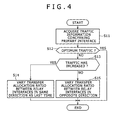
- FIG. 4 is a flowchart illustrating an exemplary operation of controlling the frame transfer allocation ratio between the relay interfaces. This operation of controlling the transfer allocation ratio is typically activated periodically, but may be activated based on some trigger or at random.
- the traffic information (e.g., the number of frames transmitted or received, the transfer rate, etc.) concerning the primary interface (i.e., the primary IF) is acquired at step S11.
- the traffic information e.g., the number of frames transmitted or received, the transfer rate, etc.
- the primary interface i.e., the primary IF
- it is determined whether end-to-end traffic i.e., traffic between connection terminals of each communication interface coupling apparatus to the network
- the frame transfer allocation ratio is varied.
- the control of the frame transfer allocation ratio is performed in the following manners, for example.
- One exemplary manner of the control of the frame transfer allocation ratio is as follows: if the end-to-end traffic has become poor as a result of varying the transfer allocation ratio in one direction, the transfer allocation ratio is varied in the opposite direction.
- Another manner of the control of the frame transfer allocation ratio is as follows: the transfer allocation ratio is set at random.
- Steps S12 to S15 in FIG. 4 represent a specific example of the former manner.
- step S12 it is determined whether or not the optimum traffic has been achieved.
- the achievement of the optimum traffic is determined, for example, when a change in the traffic volume as derived from the above traffic information falls within a predetermined range, or when the traffic volume has alternately increased and decreased for longer than a predetermined period of time as a result of the variations of the transfer allocation ratio in accordance with the traffic information.
- this operation is finished without varying the allocation ratio.
- control proceeds to step S13, and it is determined whether or not the traffic has increased.
- step S14 If it is determined at step S13 that the traffic volume has increased (Yes), control proceeds to step S14, and the transfer allocation ratio between the relay interfaces is varied in the same direction as that in which the transfer allocation ratio was varied the last time. Specifically, in the case where the transfer allocation ratio was varied the last time in such a direction that a greater percentage of frames would be transferred to one relay interface (e.g., the relay IF-A) and a smaller percentage of frames would be transferred to the other relay interface (e.g., the relay IF-B), the transfer allocation ratio is varied this time in the same direction again, so that a still greater percentage of frames will be transferred to the relay IF-A and a still smaller percentage of frames will be transferred to the relay IF-B.
- the transfer allocation ratio is varied this time in the same direction again, so that a still greater percentage of frames will be transferred to the relay IF-A and a still smaller percentage of frames will be transferred to the relay IF-B.
- step S15 control proceeds to step S15, and the transfer allocation ratio between the relay interfaces is varied in the opposite direction to that in which the transfer allocation ratio was varied the last time.
- the transfer allocation ratio is varied this time in the opposite direction, so that a smaller percentage of frames will be transferred to the relay IF-A and a greater percentage of frames will be transferred to the relay IF-B.
- FIGS. 5A to 5C are time charts illustrating an example of the operation of the flowchart as shown in FIG. 4 .
- FIG. 5A shows the traffic volume of the primary interface (i.e., the primary IF)
- FIG. 5B shows the percentage of the frames allocated to one of the relay interfaces (e.g., the relay IF-A)
- FIG. 5C shows the percentage of the frames allocated to the other relay interface (e.g., the relay IF-B).
- the percentage of the frames allocated to the relay IF-A is increased to 70%, while the percentage of the frames allocated to the relay IF-B is decreased to 30%.
- the traffic volume increases as shown in FIG. 5A .
- the determination of Yes is made at step S13 because the traffic volume has increased, and accordingly, control proceeds to step S14, and the transfer allocation ratio between the relay interfaces is varied in the same direction as that in which the transfer allocation ratio was varied the last time.
- the percentage of the frames allocated to the relay IF-A is increased to 80%, while the percentage of the frames allocated to the relay IF-B is decreased to 20%. As a result, the traffic volume decreases as shown in FIG. 5A .
- step S13 in FIG. 4 the determination of No is made at step S13 in FIG. 4 because the traffic volume has decreased, and accordingly, control proceeds to step S15, and the transfer allocation ratio between the relay interfaces is varied in the opposite direction to that in which the transfer allocation ratio was varied the last time (i.e., at time t2).
- the percentage of the frames allocated to the relay IF-A is decreased to 70%, while the percentage of the frames allocated to the relay IF-B is increased to 30%.
- the traffic volume increases as shown in FIG. 5A .
- step S14 the transfer allocation ratio between the relay interfaces is varied in the same direction as that in which the transfer allocation ratio was varied the last time (i.e., at time t3).
- the percentage of the frames allocated to the relay IF-A was decreased and the percentage of the frames allocated to the relay IF-B was increased the last time (i.e., at time t3)
- the percentage of the frames allocated to the relay IF-A is decreased to 60% and the percentage of the frames allocated to the relay IF-B is increased to 40% at time t4 in the example as illustrated in FIGS. 5B and 5C .
- the traffic volume decreases as shown in FIG. 5A .
- step S15 the transfer allocation ratio between the relay interfaces is varied in the opposite direction to that in which the transfer allocation ratio was varied the last time (i.e., at time t4).
- the percentage of the frames allocated to the relay IF-A is increased to 70%, while the percentage of the frames allocated to the relay IF-B is decreased to 30%.
- the communication apparatus i.e., the communication interface coupling apparatus
- the communication apparatus that has a plurality of relay interfaces whose communication quality is not necessarily steady
- the size of the frames (packets) is used as the traffic information concerning the primary communication interface (i.e., the primary IF). That is, as the traffic information concerning the primary communication interface (i.e., the primary IF), the size of the communication frames (packets) is acquired, and the transfer allocation ratio is controlled in accordance with the size of the frames as detected. Specifically, a table is prepared in which a plurality of transfer allocation ratios between the two relay interfaces are set so as to be associated with communication frame sizes, and the transfer allocation ratio is controlled in accordance with the size of the frames supplied from the primary communication interface (i.e., the primary IF) with reference to the table.
- the primary communication interface i.e., the primary IF
- the plurality of transfer allocation ratios associated with the frame sizes as set in the table are as follows, for example: Frame sizes of 1 to 100 bytes 1:1 Frame sizes of 101 to 500 bytes 4:3 Frame sizes of 501 to 1000 bytes 4:1 Frame sizes of 1001 to 1500 bytes 5:1
- the above table is simply one example of such a table.
- the transfer allocation ratio may be varied dynamically.
- the setting of the plurality of transfer allocation ratios associated with the different frame sizes is suitable for the case where frames with a particular size are allocated appropriately between the two relay interfaces having different attributes and characteristics.
- the relay interfaces For example, suppose that one of the relay interfaces has a high physical rate (data transfer rate) but involves a relatively long delay, while the other relay interface has a low physical rate but involves a short delay.
- packets with a small size e.g., about 80 bytes, such as acknowledge (Ack) packets in the transmission control protocol (TCP) standard
- TCP transmission control protocol
- the percentage of the packets allocated to the latter relay interface be high, because low delay and high responsivity are desirable.
- packets with a large size e.g., close to 1500 bytes, which is the maximum data size in the TCP standard, are transferred, it is preferable that the percentage of the packets allocated to the former relay interface be high.
- the relay interfaces are the power line communication (PLC) IF and the wireless LAN IF, for example. While there are a variety of known standards for the wireless LAN IF, the power line communication (PLC) IF is generally capable of transferring packets with larger sizes, i.e., has a higher physical rate (data transfer rate), and involves a longer delay than the wireless LAN IF.
- PLC power line communication
- the percentage of the packets allocated to the wireless LAN IF be high, in order to increase the responsivity, whereas when the packets with a large size are transferred, it is preferable that the percentage of the packets allocated to the power line communication (PLC) IF be high.
- PLC power line communication
- the transfer allocation ratio is controlled so as to be adapted to combined characteristics of the two relay interfaces. As a result, higher communication quality is secured, and data transfer throughput will be increased.
- the communication control method as described above can be implemented as a program for causing a computer to perform each step, and also may be provided as a computer-readable storage medium having such a program stored therein.
Landscapes
- Engineering & Computer Science (AREA)
- Computer Networks & Wireless Communication (AREA)
- Signal Processing (AREA)
- Small-Scale Networks (AREA)
- Communication Control (AREA)
- Data Exchanges In Wide-Area Networks (AREA)
- Cable Transmission Systems, Equalization Of Radio And Reduction Of Echo (AREA)
- Mobile Radio Communication Systems (AREA)
Applications Claiming Priority (1)
| Application Number | Priority Date | Filing Date | Title |
|---|---|---|---|
| JP2007316210A JP4450061B2 (ja) | 2007-12-06 | 2007-12-06 | 通信制御方法、通信装置、及び通信システム |
Publications (3)
| Publication Number | Publication Date |
|---|---|
| EP2071781A2 true EP2071781A2 (de) | 2009-06-17 |
| EP2071781A3 EP2071781A3 (de) | 2009-12-09 |
| EP2071781B1 EP2071781B1 (de) | 2013-02-20 |
Family
ID=40578767
Family Applications (1)
| Application Number | Title | Priority Date | Filing Date |
|---|---|---|---|
| EP20080253616 Ceased EP2071781B1 (de) | 2007-12-06 | 2008-11-05 | Kommunikationssteuerungsverfahren, Kommunikationsvorrichtung und Kommunikationssystem |
Country Status (3)
| Country | Link |
|---|---|
| US (2) | US7924877B2 (de) |
| EP (1) | EP2071781B1 (de) |
| JP (1) | JP4450061B2 (de) |
Families Citing this family (6)
| Publication number | Priority date | Publication date | Assignee | Title |
|---|---|---|---|---|
| JP2011109471A (ja) * | 2009-11-18 | 2011-06-02 | Oki Electric Industry Co Ltd | 通信経路制御装置及び通信経路制御方法 |
| FR2957700B1 (fr) * | 2010-03-22 | 2012-04-13 | Bull Sas | Procede, programme d'ordinateur et dispositif d'optimisation de chargement et de demarrage d'un systeme d'exploitation dans un systeme informatique via un reseau de communication |
| JP2011223432A (ja) * | 2010-04-13 | 2011-11-04 | Giga-Byte Technology Co Ltd | ネットワーク通信装置及び該装置に適用されるデータ伝送方法 |
| US8483291B2 (en) * | 2011-06-30 | 2013-07-09 | Broadcom Corporation | Analog to digital converter with increased sub-range resolution |
| JP5840469B2 (ja) * | 2011-11-24 | 2016-01-06 | 株式会社メガチップス | 通信システムおよび通信装置 |
| EP4000500A1 (de) * | 2020-11-12 | 2022-05-25 | Optos PLC | Volumetrische oct-bilddatenverarbeitung |
Citations (4)
| Publication number | Priority date | Publication date | Assignee | Title |
|---|---|---|---|---|
| US20040148632A1 (en) | 2003-01-23 | 2004-07-29 | Ji-Hyun Park | Remote controller and set-top-box therefor |
| JP2007060494A (ja) | 2005-08-26 | 2007-03-08 | Nippon Telegr & Teleph Corp <Ntt> | ネットワークシステム、送信側振分装置、パケット通信方法、および、パケット通信プログラム |
| WO2007059037A2 (en) | 2005-11-10 | 2007-05-24 | Junxion, Inc. | Gateway network multiplexing |
| JP2007527170A (ja) | 2004-02-19 | 2007-09-20 | ジョージア テック リサーチ コーポレイション | 並列通信のためのシステムおよび方法 |
Family Cites Families (7)
| Publication number | Priority date | Publication date | Assignee | Title |
|---|---|---|---|---|
| JP2004272563A (ja) * | 2003-03-07 | 2004-09-30 | Fujitsu Ltd | 通信制御プログラム、コンテンツ配信プログラム、端末装置、およびコンテンツサーバ |
| EP1678897A2 (de) * | 2003-09-23 | 2006-07-12 | Arkados, Inc. | Integrierter universeller netzwerkadapter |
| US20060098722A1 (en) * | 2004-11-09 | 2006-05-11 | Osamu Tanaka | Repeating installation, communication speed adjusting method, program, and recording medium |
| US20060221987A1 (en) * | 2005-03-30 | 2006-10-05 | Junxion Inc. | LAN and WWAN gateway |
| JP5094004B2 (ja) * | 2005-10-20 | 2012-12-12 | パナソニック株式会社 | データ中継装置及びデータ中継方法 |
| US20070198748A1 (en) * | 2006-02-01 | 2007-08-23 | Leviton Manufacturing Co., Inc. | Power line communication hub system and method |
| US20080205417A1 (en) * | 2007-02-26 | 2008-08-28 | Huamin Li | Method and apparatus for bridging wired and wireless communication networks |
-
2007
- 2007-12-06 JP JP2007316210A patent/JP4450061B2/ja not_active Expired - Fee Related
-
2008
- 2008-11-05 EP EP20080253616 patent/EP2071781B1/de not_active Ceased
- 2008-11-25 US US12/313,968 patent/US7924877B2/en active Active
-
2011
- 2011-03-02 US US13/038,854 patent/US8467414B2/en active Active
Patent Citations (4)
| Publication number | Priority date | Publication date | Assignee | Title |
|---|---|---|---|---|
| US20040148632A1 (en) | 2003-01-23 | 2004-07-29 | Ji-Hyun Park | Remote controller and set-top-box therefor |
| JP2007527170A (ja) | 2004-02-19 | 2007-09-20 | ジョージア テック リサーチ コーポレイション | 並列通信のためのシステムおよび方法 |
| JP2007060494A (ja) | 2005-08-26 | 2007-03-08 | Nippon Telegr & Teleph Corp <Ntt> | ネットワークシステム、送信側振分装置、パケット通信方法、および、パケット通信プログラム |
| WO2007059037A2 (en) | 2005-11-10 | 2007-05-24 | Junxion, Inc. | Gateway network multiplexing |
Also Published As
| Publication number | Publication date |
|---|---|
| JP2009141692A (ja) | 2009-06-25 |
| US20090147801A1 (en) | 2009-06-11 |
| EP2071781B1 (de) | 2013-02-20 |
| US20110149996A1 (en) | 2011-06-23 |
| EP2071781A3 (de) | 2009-12-09 |
| US8467414B2 (en) | 2013-06-18 |
| JP4450061B2 (ja) | 2010-04-14 |
| US7924877B2 (en) | 2011-04-12 |
Similar Documents
| Publication | Publication Date | Title |
|---|---|---|
| TWI539780B (zh) | 同時使用在不同無線帶中操作的多個wlan模組之系統及方法 | |
| JP7229387B2 (ja) | 無線lanにおいてデータを受送信する方法、端末、システム及びネットワークアクセス機器 | |
| JP6724174B2 (ja) | 分散Wi−Fiネットワークの最適化を可能にするためのデータ収集 | |
| US8213456B2 (en) | Communications system and communication apparatus | |
| US9225551B2 (en) | Communications device | |
| CN102187621B (zh) | 用于改善基于时分多址的协议中的信道利用的方法 | |
| US8467414B2 (en) | Communication control method, communication apparatus, and communication system | |
| JP2012508496A (ja) | マルチキャスト通信のためのデータ速度適合の方法 | |
| WO2015133648A1 (ja) | 通信制御装置、無線端末、メモリーカード、集積回路および無線通信方法 | |
| CN101997916A (zh) | 一种基于网络进行文件传输的方法和装置 | |
| CN106465161A (zh) | 仅当无线电链路的质量足够好时才批准互联网接入的wlan接入点 | |
| CN117793776A (zh) | 基于流分类服务的通信方法及装置 | |
| US20250344103A1 (en) | Multi-link operation (mlo) in wi-fi networks | |
| CN111836209A (zh) | 提升LoRa单通道数据传输效率的方法及系统 | |
| CN1694559A (zh) | 无线局域网中的动态信道分配 | |
| US9432999B1 (en) | Optimization of airtime among Wi-Fi clients connected to an access point | |
| US20110205918A1 (en) | Apparatus for Power Line and Wireless Communications | |
| CN111182508B (zh) | LoRa通信网络及其通信方法 | |
| CN114867064A (zh) | 聚合通信系统及方法 | |
| CN115150028B (zh) | 多链路设备之间建立块确认协议的方法、装置及介质 | |
| EP2175590A1 (de) | Verfahren und Vorrichtung zur Kommunikation über mehrfache Netzwerke | |
| CN106686645B (zh) | 一种提高多跳传输链路吞吐量的方法及系统 | |
| TWI363488B (en) | Bi-directional amplifier for data over coax applications | |
| JP3699083B2 (ja) | 無線通信方法 | |
| CN119729201A (zh) | 一种多台高帧率相机的远程控制及传输装置 |
Legal Events
| Date | Code | Title | Description |
|---|---|---|---|
| PUAI | Public reference made under article 153(3) epc to a published international application that has entered the european phase |
Free format text: ORIGINAL CODE: 0009012 |
|
| 17P | Request for examination filed |
Effective date: 20081120 |
|
| AK | Designated contracting states |
Kind code of ref document: A2 Designated state(s): AT BE BG CH CY CZ DE DK EE ES FI FR GB GR HR HU IE IS IT LI LT LU LV MC MT NL NO PL PT RO SE SI SK TR |
|
| AX | Request for extension of the european patent |
Extension state: AL BA MK RS |
|
| PUAL | Search report despatched |
Free format text: ORIGINAL CODE: 0009013 |
|
| AK | Designated contracting states |
Kind code of ref document: A3 Designated state(s): AT BE BG CH CY CZ DE DK EE ES FI FR GB GR HR HU IE IS IT LI LT LU LV MC MT NL NO PL PT RO SE SI SK TR |
|
| AX | Request for extension of the european patent |
Extension state: AL BA MK RS |
|
| RIC1 | Information provided on ipc code assigned before grant |
Ipc: H04L 12/46 20060101ALI20091104BHEP Ipc: H04L 12/56 20060101AFI20090506BHEP |
|
| 17Q | First examination report despatched |
Effective date: 20100112 |
|
| AKX | Designation fees paid |
Designated state(s): DE FR GB |
|
| GRAP | Despatch of communication of intention to grant a patent |
Free format text: ORIGINAL CODE: EPIDOSNIGR1 |
|
| GRAS | Grant fee paid |
Free format text: ORIGINAL CODE: EPIDOSNIGR3 |
|
| REG | Reference to a national code |
Ref country code: DE Ref legal event code: R079 Ref document number: 602008022268 Country of ref document: DE Free format text: PREVIOUS MAIN CLASS: H04L0012560000 Ipc: H04L0012460000 |
|
| GRAA | (expected) grant |
Free format text: ORIGINAL CODE: 0009210 |
|
| AK | Designated contracting states |
Kind code of ref document: B1 Designated state(s): DE FR GB |
|
| REG | Reference to a national code |
Ref country code: GB Ref legal event code: FG4D |
|
| RIC1 | Information provided on ipc code assigned before grant |
Ipc: H04L 12/46 20060101AFI20130115BHEP Ipc: H04L 12/801 20130101ALI20130115BHEP |
|
| REG | Reference to a national code |
Ref country code: DE Ref legal event code: R096 Ref document number: 602008022268 Country of ref document: DE Effective date: 20130418 |
|
| PLBE | No opposition filed within time limit |
Free format text: ORIGINAL CODE: 0009261 |
|
| STAA | Information on the status of an ep patent application or granted ep patent |
Free format text: STATUS: NO OPPOSITION FILED WITHIN TIME LIMIT |
|
| 26N | No opposition filed |
Effective date: 20131121 |
|
| REG | Reference to a national code |
Ref country code: DE Ref legal event code: R097 Ref document number: 602008022268 Country of ref document: DE Effective date: 20131121 |
|
| REG | Reference to a national code |
Ref country code: DE Ref legal event code: R084 Ref document number: 602008022268 Country of ref document: DE |
|
| REG | Reference to a national code |
Ref country code: GB Ref legal event code: 746 Effective date: 20150421 |
|
| REG | Reference to a national code |
Ref country code: DE Ref legal event code: R084 Ref document number: 602008022268 Country of ref document: DE Effective date: 20150410 |
|
| REG | Reference to a national code |
Ref country code: FR Ref legal event code: PLFP Year of fee payment: 8 |
|
| REG | Reference to a national code |
Ref country code: FR Ref legal event code: PLFP Year of fee payment: 9 |
|
| REG | Reference to a national code |
Ref country code: FR Ref legal event code: PLFP Year of fee payment: 10 |
|
| PGFP | Annual fee paid to national office [announced via postgrant information from national office to epo] |
Ref country code: DE Payment date: 20171121 Year of fee payment: 10 Ref country code: FR Payment date: 20171121 Year of fee payment: 10 |
|
| PGFP | Annual fee paid to national office [announced via postgrant information from national office to epo] |
Ref country code: GB Payment date: 20171123 Year of fee payment: 10 |
|
| REG | Reference to a national code |
Ref country code: DE Ref legal event code: R119 Ref document number: 602008022268 Country of ref document: DE |
|
| GBPC | Gb: european patent ceased through non-payment of renewal fee |
Effective date: 20181105 |
|
| PG25 | Lapsed in a contracting state [announced via postgrant information from national office to epo] |
Ref country code: FR Free format text: LAPSE BECAUSE OF NON-PAYMENT OF DUE FEES Effective date: 20181130 Ref country code: DE Free format text: LAPSE BECAUSE OF NON-PAYMENT OF DUE FEES Effective date: 20190601 |
|
| PG25 | Lapsed in a contracting state [announced via postgrant information from national office to epo] |
Ref country code: GB Free format text: LAPSE BECAUSE OF NON-PAYMENT OF DUE FEES Effective date: 20181105 |