EP2071949A1 - Dispositif d'application destiné à l'épandage sélectif de pesticides - Google Patents
Dispositif d'application destiné à l'épandage sélectif de pesticides Download PDFInfo
- Publication number
- EP2071949A1 EP2071949A1 EP07024768A EP07024768A EP2071949A1 EP 2071949 A1 EP2071949 A1 EP 2071949A1 EP 07024768 A EP07024768 A EP 07024768A EP 07024768 A EP07024768 A EP 07024768A EP 2071949 A1 EP2071949 A1 EP 2071949A1
- Authority
- EP
- European Patent Office
- Prior art keywords
- application
- application device
- bar
- spray mixture
- acted
- Prior art date
- Legal status (The legal status is an assumption and is not a legal conclusion. Google has not performed a legal analysis and makes no representation as to the accuracy of the status listed.)
- Withdrawn
Links
- 239000000575 pesticide Substances 0.000 title claims description 8
- 239000007921 spray Substances 0.000 claims abstract description 61
- 239000000203 mixture Substances 0.000 claims abstract description 54
- 239000000463 material Substances 0.000 claims abstract description 47
- 241000196324 Embryophyta Species 0.000 claims abstract description 34
- 239000007788 liquid Substances 0.000 claims abstract description 30
- 238000000034 method Methods 0.000 claims abstract description 9
- 229910052751 metal Inorganic materials 0.000 claims abstract description 8
- 239000002184 metal Substances 0.000 claims abstract description 8
- 238000003860 storage Methods 0.000 claims description 27
- 238000009826 distribution Methods 0.000 claims description 12
- 235000007164 Oryza sativa Nutrition 0.000 claims description 7
- 239000002250 absorbent Substances 0.000 claims description 7
- 230000002745 absorbent Effects 0.000 claims description 7
- 239000004744 fabric Substances 0.000 claims description 7
- 235000009566 rice Nutrition 0.000 claims description 7
- 230000009471 action Effects 0.000 claims description 5
- 239000010985 leather Substances 0.000 claims description 5
- 239000011888 foil Substances 0.000 claims description 4
- 102000016751 Fringe-like Human genes 0.000 claims description 3
- 108050006300 Fringe-like Proteins 0.000 claims description 3
- 239000006260 foam Substances 0.000 claims description 3
- 239000004745 nonwoven fabric Substances 0.000 claims description 2
- 230000001276 controlling effect Effects 0.000 claims 2
- 240000007594 Oryza sativa Species 0.000 claims 1
- 230000001105 regulatory effect Effects 0.000 claims 1
- 230000008901 benefit Effects 0.000 description 7
- 241000209094 Oryza Species 0.000 description 6
- 230000000694 effects Effects 0.000 description 4
- 239000004009 herbicide Substances 0.000 description 4
- 230000005484 gravity Effects 0.000 description 3
- 230000033001 locomotion Effects 0.000 description 3
- 230000005540 biological transmission Effects 0.000 description 2
- 230000015572 biosynthetic process Effects 0.000 description 2
- 239000000969 carrier Substances 0.000 description 2
- 238000010008 shearing Methods 0.000 description 2
- 238000003892 spreading Methods 0.000 description 2
- 230000007480 spreading Effects 0.000 description 2
- 239000004753 textile Substances 0.000 description 2
- 240000006829 Ficus sundaica Species 0.000 description 1
- 241001465754 Metazoa Species 0.000 description 1
- 241001481789 Rupicapra Species 0.000 description 1
- 239000004480 active ingredient Substances 0.000 description 1
- 230000006978 adaptation Effects 0.000 description 1
- 229910052782 aluminium Inorganic materials 0.000 description 1
- XAGFODPZIPBFFR-UHFFFAOYSA-N aluminium Chemical compound [Al] XAGFODPZIPBFFR-UHFFFAOYSA-N 0.000 description 1
- 230000009286 beneficial effect Effects 0.000 description 1
- 210000001520 comb Anatomy 0.000 description 1
- 238000010276 construction Methods 0.000 description 1
- 238000005260 corrosion Methods 0.000 description 1
- 230000007797 corrosion Effects 0.000 description 1
- 244000038559 crop plants Species 0.000 description 1
- 238000005520 cutting process Methods 0.000 description 1
- 230000001419 dependent effect Effects 0.000 description 1
- 238000013461 design Methods 0.000 description 1
- 238000011161 development Methods 0.000 description 1
- 230000018109 developmental process Effects 0.000 description 1
- 238000011156 evaluation Methods 0.000 description 1
- XDDAORKBJWWYJS-UHFFFAOYSA-N glyphosate Chemical compound OC(=O)CNCP(O)(O)=O XDDAORKBJWWYJS-UHFFFAOYSA-N 0.000 description 1
- 230000036541 health Effects 0.000 description 1
- 239000000479 mixture part Substances 0.000 description 1
- 238000005457 optimization Methods 0.000 description 1
- 238000003825 pressing Methods 0.000 description 1
- 238000012545 processing Methods 0.000 description 1
- 230000008439 repair process Effects 0.000 description 1
- 238000005070 sampling Methods 0.000 description 1
- 230000006641 stabilisation Effects 0.000 description 1
- 238000011105 stabilization Methods 0.000 description 1
- 239000000725 suspension Substances 0.000 description 1
- 238000010408 sweeping Methods 0.000 description 1
- 230000007704 transition Effects 0.000 description 1
- 230000000007 visual effect Effects 0.000 description 1
- 239000002759 woven fabric Substances 0.000 description 1
Images

Classifications
-
- A—HUMAN NECESSITIES
- A01—AGRICULTURE; FORESTRY; ANIMAL HUSBANDRY; HUNTING; TRAPPING; FISHING
- A01M—CATCHING, TRAPPING OR SCARING OF ANIMALS; APPARATUS FOR THE DESTRUCTION OF NOXIOUS ANIMALS OR NOXIOUS PLANTS
- A01M21/00—Apparatus for the destruction of unwanted vegetation, e.g. weeds
- A01M21/04—Apparatus for destruction by steam, chemicals, burning, or electricity
- A01M21/043—Apparatus for destruction by steam, chemicals, burning, or electricity by chemicals
Definitions
- the invention relates to an application device for the selective application of pesticides on weeds, which project beyond the crops in height, with an application bar having at least one component which can be acted upon with a liquid, and with a suitable for temporary storage of the spray mixture material, the at least partially abuts the component acted upon by a liquid.
- the invention relates to an application system and a method for the selective control of weeds, which project beyond the crop plants in height, wherein the width of the cultivated areas is variable.
- crossbars are known which consist of a tube with an opening and a tube surrounding absorbent fabric.
- the selectivity of weed control is dependent on the growth height of the harmful plants, especially in surface coaters. Selective application of pesticides is only possible if the weeds to be controlled clearly exceed the height of the crops.
- the disadvantage of the devices known from the state of the art, in particular of the surface coaters, is, above all, that the contact surface between the fabric soaked with spray mixture and the weed to be controlled is small.
- the plants swept over by means of a canvas or wick-soaked with spray mixture are bent over when they are painted over and thus usually touched only from one side. That with a single processing of a weedy parcel, the weeds are touched from one side only.
- low-weed weeds such as e.g. weedy rice in rice crops, slightly off the side, so it does not cause an intense, i. can come flat contact between the wetted with spray mixture part of the application device and the weeds.
- the object of the present invention is to provide an application device for improving the selective application of pesticides to high-growth, i.e. the crops superior in height to weeds, especially in the application of herbicides to thin-leaved and / or small-leaved weeds, e.g. Weedy rice in rice cultures.
- the device should also be able to be used on culture surfaces with varying width, without resulting in a double treatment of surface sections.
- the object is achieved by an application device according to claim 1, wherein emanating from the material suitable for the temporary storage of the spray mixture, a plurality of further distribution elements.
- the application beam associated with the application device is constructed either in one piece or in several parts.
- the distributor elements allow the temporary storage and re-delivery of the spray mixture, i. their transmission to the weeds.
- the distributor elements are aligned substantially perpendicular to the longitudinal direction of the application bar.
- a liquid i. in the present case with spray mixture
- acted upon component can either consist of a space integrated in the application bar or alternatively can be made of a separate component, such as. a tube or hose, which is connected to the application bar.
- loadable in the sense of the invention means that the respective component can be charged with a liquid, ie it can be filled.
- the type of connection is not fixed, with a detachable connection being preferred in order to facilitate possible repair work.
- a preferred and advantageously also technically easy to implement multi-part application device consists of two joint-like interconnected sections.
- the working width of such a device is greatest when the two sections are in line, i. are completely unfolded. With increasing folding of the two sections, the working width can be reduced. This may be of particular advantage when the application device is used on surfaces that vary widely in width. This is e.g. in terraced rice fields the case.
- handles can be advantageously achieved in this embodiment that the workers used to handle the device need not go to already treated with pesticide surface areas, but can move without exception on untreated surface sections.
- the application bar consists of at least one tubular hollow profile.
- the hollow profile may be made of metal or plastic and have a circular, oval or polygonal cross-section. Hollow profiles made of plastic and aluminum are due to the corrosion resistance and low weight of both materials especially for the present purposes.
- the application bar consists of only one hollow profile.
- the interior of the hollow profile can form the liquid-loadable section integrated in the application bar.
- the shell of the hollow profile has distributed over the entire length of the profile openings from which the spray mixture can escape to moisten the material that is suitable for temporary storage of the spray mixture.
- the multi-part application beam consists of two concentric hollow profiles, which are movable in the direction of their common longitudinal axes, i. extendible, so that the application bar is adjustable to a variable working width.
- the multi-part application beam consists of a total of four hollow profiles, of which two are each movable concentrically into each other and are arranged parallel to each other. The arrangement is made so that in each case the end face of a profile with a larger diameter and the end face of a profile with a smaller diameter come to rest on the same side and are connected to each other by a transverse element on the two sides. (This embodiment is in Fig. 4 exemplified.)
- the hollow sections which are movably guided concentrically one inside the other, each have the same length, so that in the extended state, taken together, they have approximately twice the length of a single hollow profile.
- two concentrically movable into each other guided hollow sections are sealed so that the spray mixture at the transition of the two hollow sections can not escape. This is achieved by arranging an O-ring seal in the end portion of the larger diameter profile. In this way, the movable concentric hollow profiles in the extended state, with the exception of the outlet of the spray liquid regularly provided openings, liquid-tight.
- the application bar consists of concentrically movable hollow profiles
- the interior of the hollow profile with the larger diameter forms the portion that can be acted upon with a liquid in the application bar, the shell having this, the larger diameter Hollow profile is provided with openings which are distributed over the length of the profile.
- the arrangement of the openings is limited to the hollow profile with the larger diameter, because the lateral surface of the hollow profile with the smaller diameter is not available for the attachment of additional individual elements for distributing the spray mixture.
- an application bar which consists of two concentrically guided into each other and movable in the direction of the longitudinal axes hollow profiles, is connected to a separate tube, wherein the tube has a plurality of distributed over the length of the tube arranged openings.
- the hose receiving the spray liquor replaces the function of the hollow profile as a transverse distributor for the spray liquor in the horizontal direction.
- an application beam consisting of two hollow sections which are movably concentrically guided into one another is connected to a separate bendable hose, the hose having a length which corresponds to the length of the hollow sections in the extended state.
- the hose is connected to the two hollow sections in such a way that the hose forms a loop as the hollow sections are pushed together.
- the tube After the adaptation, ie the movement of the tube relative to the application bar, the tube is parallel to the application bar regardless of its length.
- the advantage of adapting the hose length to the actual length of an extendable application beam is that, by avoiding the loop, the output of spray mixture is homogeneous over the entire hose length.
- the material used for temporary storage and delivery i. the transmission of the spray mixture to the weeds serves, the integrated in the application bar with a liquid acted upon section, or the separate also acted upon by a liquid component which is connected to the application bar completely surrounds, with the material a variety of further, with respect are connected to the longitudinal direction of the application beam substantially vertically arranged distribution elements.
- the distributor elements consist of a flexible and at the same time absorbent material.
- materials for the distributor elements are thus fabric-like fabrics, nonwovens, leather or absorbent foams in question.
- the choice of material for However, the distribution elements is not limited to the materials mentioned.
- a preferred example of a woven fabric is towels, in particular towels made of terry. It has been found that terry towels have a suitable absorbency with respect to the spray mixture. As a suitable leather has become household chamois leather.
- the distributor elements consist of a flexible material, gravity alone will ensure that the distributor elements are oriented substantially perpendicular to the longitudinal axis of the application bar and thus also substantially perpendicular to the earth's surface.
- the distributor elements consist of a flexible, non-textile material that at least in sections has a structured surface.
- the structuring of the surface causes it to temporarily store a certain volume of liquid due to the capillary action of the surface structure. If such a material is drizzled with spray mixture, it collects, with even distribution, on the surface of the material and easily passes on contact with the weeds on this.
- a flexible sheet of metal or plastic is provided.
- Flexible in this context means that the thickness of the film is dimensioned so that these, or their vertically oriented individual elements, can bend when in contact with weeds.
- the additional distributor elements arranged perpendicularly to the application bar consist of individual fringe-like tissue parts arranged close to each other.
- the distributor elements are provided by cuts in the material. This is achieved in that a tissue section hanging freely downwards on the application bar or a metal foil or plastic foil section has incisions in a direction preferably perpendicular to the application bar which do not cut through the entire tissue section. Through these cuts arise individual distribution elements, which are aligned to the transverse in the transverse direction, ie in the horizontal direction, extending application beam or to the hose attached to the beam, substantially vertically (vertical distribution elements).
- the flexible, non-textile material with respect to the longitudinal axis of the application bar has not perpendicular, but oblique, running incisions.
- Such an embodiment could, with appropriate strength of the overall nonetheless flexible material, and easy rotation of the application beam around its longitudinal axis in the working direction, perform the function of a comb which combs the weeds like a rake and thereby due to the caused by the skew shear for even better spreading the spray mixture provides.
- the width of the tissue section is preferably such that the distribution elements separated by incisions have a length of at least 7 cm.
- the maximum length of the distributor elements depends on the respective application and can be up to 20 cm if the suction or capillary action of the material is appropriate.
- a ring made of metal or plastic on the free-cutting end sections of the distributor elements.
- plastic is preferred.
- the coated with a film of spray mixture Due to the expansion of the ring in the horizontal direction it comes to an additional contact of the weeds. This can be of particular advantage, because thereby the stems, inflorescences and leaves of the weeds are also coated from below with spray mixture.
- the diameter of the ring is variable, with increasing the diameter of the ring and the spacing of the individual Vertellerrii increases. The optimization of the ring diameter takes into account that the spacing of the distributor elements must not become too large if the application of the spray mixture to the weeds is to remain effective, ie flat.
- the distributor element also consist of individual chains.
- the spray mixture emerging from the openings of the distributor hose or from the interior of the application bar consisting of a hollow profile can come into direct contact with the uppermost chain link.
- the number of openings in this embodiment will be higher than when the distributor elements are made of a material which actively draws the spray liquid itself out of the opening, which is in the component which can be acted upon with liquid, owing to its capillarity or due to its suction effect.
- the embodiment which has constructed as a vertical Vertelleretti of individual links chains, is suitable for spreading larger volumes per operation.
- the distributing elements consisting of individual chains at the bottom have, as an additional link, a ring whose diameter is greater than the diameter of the remaining chain links.
- the application bar has handles for manual handling. These are preferably arranged on one or both end portions of the application bar.
- a one-piece application bar can be sized so that it can be easily used by a single person with a handle.
- handles are releasably, ie interchangeable, attached to the application bar. It is also envisaged that the or Grab handles is used in combination with a shoulder strap carrying the application bar. (A corresponding embodiment in which the combined use of shoulder belt and lever-like handles are advantageously connected to each other, is in FIG. 2 shown.)
- a connecting line with a storage tank. It is provided that a valve is arranged to regulate the flow rate in the connecting line.
- the connecting line is connected to the storage tank so that the removal of the spray mixture takes place at the lowest point of the storage tank.
- the storage tank down, d. H. tapered towards the sampling point.
- the escape of the spray mixture may be caused solely by gravity or be assisted by means of a pump.
- the application device is used in connection with a transportable storage tank as an application system.
- the storage tank for the spray mixture can either be mounted on the back of a person or on the back of a pack animal or on a vehicle. If the delivery of the spray mixture is based solely on gravity, i. is not carried out using a pump, the storage tank is disposed within the application system so that its lowest liquid level always above the application bar, i. the openings provided for the escape of the spray mixture, lies.
- the invention also includes a method in which the application device described above is used, wherein the application bar in its Use is kept substantially at a level that exceeds the height of the crops and the height of the weeds falls below.
- the application bar in its Use is kept substantially at a level that exceeds the height of the crops and the height of the weeds falls below.
- the height of the weeds in a crop is generally not homogeneous. The particular working height thus depends on the visual evaluation, ie on the level of judgment, of the user.
- variable in the working width application devices in particular culture surfaces are provided with variable width. Cultivated areas with variable width are mainly found in terraced rice fields. These can be optimally treated with the application device according to the invention or a corresponding application system.
- Fig. 1a shows the application device 1.
- the application bar 2 consists of a hollow profile, which has grab handles 10 on both sides.
- the lateral surface of the application beam 2 has openings 9 in the lower region, from which the spray mixture located in the interior 6 of the application beam 2 can emerge.
- the application bar 2 is surrounded on the outside by the material 4 for the temporary storage of the spray mixture.
- the material 4 consists of a hanging down tissue or film section, which has incisions in the lower part, so that the individual distributor elements 5 result with a variable width of the incisions.
- the material 4 for temporary storage of the spray mixture may consist either of an absorbent fabric or non-woven. Alternatively, the use of a flexible film made of metal or plastic comes into question, wherein the surface of the film has a structuring, which allows the temporary storage of the spray mixture.
- the cuts in the material 4 are oriented substantially perpendicular to the longitudinal axis of the application beam.
- the comb-like effect of the distributor elements 5 with respect to the weeds can be additionally increased, in which the incisions are made obliquely relative to the longitudinal axis of the application bar 2. If such a designed application beam is rotated slightly in use about its longitudinal axis in the direction of movement unfolds the section 4 relative to the weeds, in addition to the comb-like effect, an additional shearing action.
- the shearing action can advantageously lead to the weeds in the lateral area coming into greater contact with the spray mixture.
- the structuring, not shown here but also within the scope of the invention, of the section 4 with a sawtooth pattern, i. with V-shaped cuts, has a similar beneficial effect.
- Fig. 1b shows a one-piece application bar 2, which has grab handles 10 on both sides.
- the spray mixture is not over the interior of the Applied application bar 2, but via a separate liquid acted upon component 3, which consists in the example shown of a hose 3 or a tube, which is supplied via the connecting line 11 spray mixture.
- the application bar 2 and the component 3 detachably fastened along the longitudinal axis of the application bar are surrounded by the material 4 for the temporary storage of the spray mixture.
- the distributor elements 5 are arranged in the lower portion of the material 4 for temporarily storing the spray mixture.
- the distributor elements 5 shown in the example consist of individual elements, which may consist of other materials. Suitable are cord-like or fringe-like sections made of an absorbent material.
- the distributor elements 5 have in the example shown at the bottom of a ring.
- the ring provides alignment of the distribution elements and, advantageously, increased resistance as the distribution elements contact the weeds.
- the material 4 shown in the example for the temporary storage of the spray mixture consists of an absorbent material.
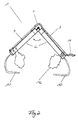
- Fig. 2 shows an application device 1, which consists of two articulated by hinge interconnected beam sections 2.
- the beam sections 2 are detachably connected to a hose 7, which is flexible, in particular in the region of the joint.
- the hose 7 is acted upon by the connecting line 11 with spray mixture.
- the spray mixture can exit through the openings 9 and wet the material 4, not shown in the example, for the temporary storage of the spray mixture.
- the working width of the application device 1 can be varied steplessly, the maximum working width being determined by the total length of the hose 3, which is identical to the total length of the two beam sections 2.
- the application device 1 shown has at the ends of the two application bar sections 2, the handles 10.
- the handles 10 are deliberately designed like a lever. While the main weight of the application beam is supported by the shoulder straps 12, which are also arranged in the end region of the beam sections 2, the serve Handles 10 to the user to stabilize the application device 1.
- the in Fig. 2 shown application device 1 carried by one or two people.
- the carriers of the application device 1 can always move on the not yet treated with pesticide crop surface. This also applies if the application device is expanded to its maximum working width, because the inwardly bent handles 10 allow a corresponding positioning of the carriers still within the working width of the device. For the health of the users this is a substantial advantage.
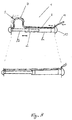
- Fig. 3 shows a further embodiment of the invention, which is characterized in that the working width of the application device 1 is variable, without causing a double treatment of the crop surface.
- the avoidance of a double treatment is achieved in that the hose 7 connected to the two concentrically guided hollow sections 8a, 8b forms a loop when the hollow sections 8a, 8b are pushed together.
- the application device 1 is shown in the state of maximum working width.
- the two hollow sections 8a and 8b each have a handle 10 at the ends.
- the component 3 which can be acted upon with liquid, which consists in the example shown of a flexible hose 7, that the hose is movable relative to the application beam.
- the mobility of the tube is symbolically displayed by the two double arrows on the right side of the application bar in the region of the designated with the reference numeral 11 connecting line.
- the hose can be adapted to the actual length of the application beam, even if it is not extended to its full length.
- the avoidance of the existing of the flexible hose loop 7 is that the output quantity of spray mixture is independent of the selected working width of the extendable spray bar 1 uniform.
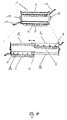
- Fig. 4 shows an application device 1, which is also characterized by a variable working width.
- Each of the two application bars 2 consists of two hollow profiles 8a, 8b, which are movable concentrically, and which are arranged parallel to one another, wherein the end face of a profile with the larger diameter 8a and the end face of a profile with the smaller diameter 8b lie on the same side come and are each connected by a cross element.
- the transverse elements consist of the handles 10.
- the hollow profile with the larger diameter 8a is supplied through the connecting line 11 with spray mixture.
- the hollow sections 8a each have openings 9 through which the spray mixture can exit and wet the distributor elements 5.
Landscapes
- Life Sciences & Earth Sciences (AREA)
- Health & Medical Sciences (AREA)
- General Health & Medical Sciences (AREA)
- Toxicology (AREA)
- Engineering & Computer Science (AREA)
- Insects & Arthropods (AREA)
- Pest Control & Pesticides (AREA)
- Wood Science & Technology (AREA)
- Zoology (AREA)
- Environmental Sciences (AREA)
- Catching Or Destruction (AREA)
Priority Applications (3)
| Application Number | Priority Date | Filing Date | Title |
|---|---|---|---|
| EP07024768A EP2071949A1 (fr) | 2007-12-20 | 2007-12-20 | Dispositif d'application destiné à l'épandage sélectif de pesticides |
| PCT/EP2008/009997 WO2009080172A1 (fr) | 2007-12-20 | 2008-11-26 | Dispositif applicateur pour la distribution sélective de pesticides |
| TW97149456A TW201002200A (en) | 2007-12-20 | 2008-12-18 | Application device for the selective application of pesticides |
Applications Claiming Priority (1)
| Application Number | Priority Date | Filing Date | Title |
|---|---|---|---|
| EP07024768A EP2071949A1 (fr) | 2007-12-20 | 2007-12-20 | Dispositif d'application destiné à l'épandage sélectif de pesticides |
Publications (1)
| Publication Number | Publication Date |
|---|---|
| EP2071949A1 true EP2071949A1 (fr) | 2009-06-24 |
Family
ID=39186766
Family Applications (1)
| Application Number | Title | Priority Date | Filing Date |
|---|---|---|---|
| EP07024768A Withdrawn EP2071949A1 (fr) | 2007-12-20 | 2007-12-20 | Dispositif d'application destiné à l'épandage sélectif de pesticides |
Country Status (3)
| Country | Link |
|---|---|
| EP (1) | EP2071949A1 (fr) |
| TW (1) | TW201002200A (fr) |
| WO (1) | WO2009080172A1 (fr) |
Families Citing this family (1)
| Publication number | Priority date | Publication date | Assignee | Title |
|---|---|---|---|---|
| WO2017089249A1 (fr) | 2015-11-25 | 2017-06-01 | Bayer Cropscience Aktiengesellschaft | Pulvérisateur à dos pour l'application améliorée de pesticides |
Citations (3)
| Publication number | Priority date | Publication date | Assignee | Title |
|---|---|---|---|---|
| US1764952A (en) * | 1929-08-30 | 1930-06-17 | Clarence B Hay | Insect destroyer |
| US4305224A (en) * | 1979-09-04 | 1981-12-15 | Maddock Mitchell E | Apparatus for selective application of herbicide |
| EP0124672A1 (fr) * | 1983-05-04 | 1984-11-14 | Tecnoma | Perfectionnement aux dispositifs de traitement de culture par humectation |
-
2007
- 2007-12-20 EP EP07024768A patent/EP2071949A1/fr not_active Withdrawn
-
2008
- 2008-11-26 WO PCT/EP2008/009997 patent/WO2009080172A1/fr not_active Ceased
- 2008-12-18 TW TW97149456A patent/TW201002200A/zh unknown
Patent Citations (3)
| Publication number | Priority date | Publication date | Assignee | Title |
|---|---|---|---|---|
| US1764952A (en) * | 1929-08-30 | 1930-06-17 | Clarence B Hay | Insect destroyer |
| US4305224A (en) * | 1979-09-04 | 1981-12-15 | Maddock Mitchell E | Apparatus for selective application of herbicide |
| EP0124672A1 (fr) * | 1983-05-04 | 1984-11-14 | Tecnoma | Perfectionnement aux dispositifs de traitement de culture par humectation |
Also Published As
| Publication number | Publication date |
|---|---|
| TW201002200A (en) | 2010-01-16 |
| WO2009080172A1 (fr) | 2009-07-02 |
Similar Documents
| Publication | Publication Date | Title |
|---|---|---|
| DE69404865T2 (de) | Landwirtschaftliche sprüheinheit und deren luftstromerzeuger | |
| DE2362965A1 (de) | Spruehvorrichtung | |
| DE20307668U1 (de) | Gerät für die Pflege von Reitböden | |
| EP0163154B1 (fr) | Pulvérisateur pour des liquides de pulvérisation | |
| DE4016878A1 (de) | Vorrichtung zur gleichmaessigen gutverteilung bei maehdreschern | |
| DE202019106971U1 (de) | Geräteträger zur Rasenpflege | |
| WO2009080172A1 (fr) | Dispositif applicateur pour la distribution sélective de pesticides | |
| EP2071948A1 (fr) | Lance de pulvérisation et ensemble d'adaptateur et de buse pour pulvérisateur porté sur le dos | |
| EP0361070B1 (fr) | Dispositif pour pulvériser sur culture en lignes | |
| EP2868181B1 (fr) | Épandeur agricole | |
| WO2015091307A1 (fr) | Lance à buse à jet plat à angle étroit pour appliquer manuellement des pesticides, notamment sur une large surface, à l'aide d'un pulvérisateur portable sur le dos | |
| EP2961261B1 (fr) | Dispositif d'irrigation de plantes | |
| DE69210974T2 (de) | Auftragsvorrichtung zum Auftragen von einer Flüssigkeit auf Kulturen | |
| DE3104727A1 (de) | "auffangvorrichtung fuer pferdemist" | |
| DE2701695C2 (de) | Verfahren und Vorrichtung zum Einbringen eines Veredlungsmittels in das Erdreich | |
| AT14597U1 (de) | Vorrichtung und Verfahren zur Bodenbearbeitung, -bewässerung und -aufbereitung | |
| DE2833604A1 (de) | Spruehvorrichtung | |
| WO2017089249A1 (fr) | Pulvérisateur à dos pour l'application améliorée de pesticides | |
| DE3108851C2 (fr) | ||
| WO2020088948A1 (fr) | Ensemble buse de pulvérisation agricole | |
| CH700510A2 (de) | Landwirtschaftliches Gerät. | |
| DE102024129576A1 (de) | Aufsammelvorrichtung und Aufsammelsystem | |
| DE4411168C2 (de) | Tragevorrichtung | |
| DE848720C (de) | Vorrichtung zum Duengen oder zum Heranbringen sonstigen Streugutes an einzeln oder inReihen gesetzte Kulturpflanzen | |
| DE280603C (fr) |
Legal Events
| Date | Code | Title | Description |
|---|---|---|---|
| PUAI | Public reference made under article 153(3) epc to a published international application that has entered the european phase |
Free format text: ORIGINAL CODE: 0009012 |
|
| AK | Designated contracting states |
Kind code of ref document: A1 Designated state(s): AT BE BG CH CY CZ DE DK EE ES FI FR GB GR HU IE IS IT LI LT LU LV MC MT NL PL PT RO SE SI SK TR |
|
| AX | Request for extension of the european patent |
Extension state: AL BA HR MK RS |
|
| AKX | Designation fees paid | ||
| REG | Reference to a national code |
Ref country code: DE Ref legal event code: 8566 |
|
| STAA | Information on the status of an ep patent application or granted ep patent |
Free format text: STATUS: THE APPLICATION IS DEEMED TO BE WITHDRAWN |
|
| 18D | Application deemed to be withdrawn |
Effective date: 20091229 |