EP2072005A1 - Système permettant de déterminer et de surveiller les indices de désaturations et de fréquence respiratoire instantanée - Google Patents
Système permettant de déterminer et de surveiller les indices de désaturations et de fréquence respiratoire instantanée Download PDFInfo
- Publication number
- EP2072005A1 EP2072005A1 EP07730474A EP07730474A EP2072005A1 EP 2072005 A1 EP2072005 A1 EP 2072005A1 EP 07730474 A EP07730474 A EP 07730474A EP 07730474 A EP07730474 A EP 07730474A EP 2072005 A1 EP2072005 A1 EP 2072005A1
- Authority
- EP
- European Patent Office
- Prior art keywords
- desaturation
- index
- indices
- processing
- monitoring
- Prior art date
- Legal status (The legal status is an assumption and is not a legal conclusion. Google has not performed a legal analysis and makes no representation as to the accuracy of the status listed.)
- Withdrawn
Links
Images



Classifications
-
- A—HUMAN NECESSITIES
- A61—MEDICAL OR VETERINARY SCIENCE; HYGIENE
- A61B—DIAGNOSIS; SURGERY; IDENTIFICATION
- A61B5/00—Measuring for diagnostic purposes; Identification of persons
- A61B5/08—Measuring devices for evaluating the respiratory organs
- A61B5/0816—Measuring devices for examining respiratory frequency
-
- A—HUMAN NECESSITIES
- A61—MEDICAL OR VETERINARY SCIENCE; HYGIENE
- A61B—DIAGNOSIS; SURGERY; IDENTIFICATION
- A61B5/00—Measuring for diagnostic purposes; Identification of persons
-
- A—HUMAN NECESSITIES
- A61—MEDICAL OR VETERINARY SCIENCE; HYGIENE
- A61B—DIAGNOSIS; SURGERY; IDENTIFICATION
- A61B5/00—Measuring for diagnostic purposes; Identification of persons
- A61B5/145—Measuring characteristics of blood in vivo, e.g. gas concentration or pH-value ; Measuring characteristics of body fluids or tissues, e.g. interstitial fluid or cerebral tissue
- A61B5/1455—Measuring characteristics of blood in vivo, e.g. gas concentration or pH-value ; Measuring characteristics of body fluids or tissues, e.g. interstitial fluid or cerebral tissue using optical sensors, e.g. spectral photometrical oximeters
-
- A—HUMAN NECESSITIES
- A61—MEDICAL OR VETERINARY SCIENCE; HYGIENE
- A61B—DIAGNOSIS; SURGERY; IDENTIFICATION
- A61B5/00—Measuring for diagnostic purposes; Identification of persons
- A61B5/48—Other medical applications
- A61B5/4806—Sleep evaluation
- A61B5/4818—Sleep apnoea
Definitions
- the system object of this patent is based on extracting components by means of the frequency analysis of the signal captured exclusively by an oximeter, obtaining and processing information from blood oxygen saturation (SpO 2 ) data. It is therefore an invention linked to the field of bioengineering, with applications in the field of medicine, allowing monitoring and assisting with the diagnosis of respiratory disorders, for its use in hospitals and in the home, and for assisting with the diagnosis of sleep apnea-hypopnea syndrome (SAHS).
- SAHS sleep apnea-hypopnea syndrome
- Oximetry is essentially based on the so-called Beer-Lambert law, which allows calculating the concentration of a substance in solution from its optical absorption at a certain wavelength.
- hemoglobin Hb
- oxyhemoglobin HbO 2
- red and infrared wavelengths which allow distinguishing oxygenated hemoglobin from reduced hemoglobin.
- SAHS sleep apnea-hypopnea syndrome
- DI saturation index
- the first group includes those algorithms in which the baseline level is obtained as a statistical average of the SpO 2 values during the total recorded during the experiment [4].
- the baseline level is obtained as an average of the signal during the complete period of the experiment, excluding artifacts and faults in the measurement. For the detection of respiratory events, this approach is based on searching for decreases below 4% of this baseline level.
- the baseline level is a moving average of the values located in the 95 th percentile for one or several minutes before the treated instant. Therefore, before the calculation of the moving average, all the data of the treated period will have been subjected to a statistical filtering eliminating those values less than that corresponding to the 95 th percentile. This ensures high baseline level values leading to good practical results in the discrimination of respiratory events [3,4].
- the percentile approach to filtering the desaturation periods in the patient are automatically excluded in the calculation of the baseline level, and the dynamics of the time evolution of the oximetry of the patient are furthermore conserved [2].
- the second group takes into account that the apnea events can be completely located below the standard baseline level of 90% and that even when the baseline level is a statistical average for each patient, a considerable number of desaturations cannot be detected due to the fact that the SpO 2 recoveries do not reach the threshold marked by the baseline. This situation leads to error in the calculation of the DI.
- Rauscher proposes 2 new methods which do not require determining the baseline level, since it only considers level increases or decreases during a certain time interval, or in other words, it exclusively considers the average slope of the SpO 2 signal during defined time intervals. According to this approach, Rauscher obtains event rates by means of detecting the number of decreases greater than 4% during a time interval not less than 40 seconds, and by means of detecting the number of recoveries greater than 3% in a time interval of at least 10 seconds. This process justifies the difference in the up- and down-slopes, adducing that the restorations respond more quickly to the restoration of the respiratory activity.
- respiratory rates are calculated through oronasal flow cannulas, extensometric gauges, accelerometers and other indirect measurement devices, and neither patents nor literature for measurement based on exclusively using oximetry have been found.
- the method object of this patent is based on extracting frequency components from the signal captured by an oximeter, obtaining information from vital respiratory physiological data, for assisting with the automated diagnosis of problems related to hypoxia in general and the sleep apnea-hypopnea syndrome in particular, independently of the baseline and absolute SpO 2 values.
- the invention allows:
- a method is provided for calculating the desaturation index based on frequency analysis, therefore the method is not affected by the calculation of baselines used in traditional methods, or by the existence of artifacts outside or inside the patient which can modify the measurement.
- a method which is not included in current oximeters is described for determining the respiratory rhythms of patients, also based on the frequency analysis of the respiratory rhythms detected in the signals provided by the oximeter.
- the invention described and set forth consequently involves a simplification of the tests for the diagnosis of certain dysfunctions associated with respiratory disorders such as the obstructive sleep apnea-hypopnea syndrome (SAHS), providing an aid for the diagnosis of respiratory disorders and for evaluation in risk situations.
- SAHS obstructive sleep apnea-hypopnea syndrome
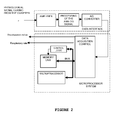
- the oximetry sensor provides an electrical signal, proportional to arterial oxyhemoglobin saturation (SaO 2 ). This electric signal is transmitted to a processing circuitry, which amplifies the signal, filters it and converts it into a digital signal. The filtering parameters prior to the A/D conversion are conditioned by the sampling frequency. This filtering can be implemented through hardware or software or by means of a combination of both. The resulting digital signal is delivered to a microprocessor system for its evaluation.
- SaO 2 arterial oxyhemoglobin saturation
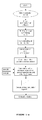
- This system will operate according to instructions stored in memory, implementing the calculation process shown in Figures 1-a and 1-b .
- the system may store the data captured and obtained through the processing in a memory.
- the storage can be carried out in any storage system or combination thereof, such as volatile memories (DRAM), non-volatile memories, hard drives, CD-RW, DVD, removable memories (SD, MMC cards,).
- the microprocessor system can furthermore display the results to the operator through a display, generate acoustic alerts, luminous alerts or alerts of any other type. It can contain input devices such as touch screens, keyboards, or any other device intended for the input of information by the operator.
- microprocessor system can be physically implemented by one or several devices, capable of fulfilling the described functions. They can be general or specific purpose systems such as microprocessors, microcontrollers, digital signal processors, application-specific integrated circuits (ASICs), personal computers, PDAs, smartphones, ...
- ASICs application-specific integrated circuits
- the preprocessing steps for the signal captured by the oximeter are identical.
- the collected signal is subjected to an initial filtering to eliminate artifacts in the measurement.
- a low-pass filtering is subsequently applied by a moving average filter, with a sample index for the average which can vary about 5 samples.
- the pre-processing block thus ends.
- the power spectral density of the signal resulting from the previous preprocessing is calculated, using to that end any of the methods described in the literature (parametric or non-parametric).
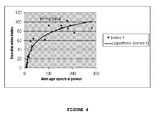
- the average value of the previous spectral estimation in the [1/60 Hz, 1/20 Hz] band is calculated. This average value allows directly obtaining the DI value through the logarithmic ratio statistically linking both amounts, according to the adjustment performed with a control group.
- the desaturation index is stored by the system.
- the average value of the spectral estimation in the [0.1 Hz, 0.2 Hz], [0.2 Hz, 0.3 Hz], [0.4 Hz, 0.5 Hz] bands is calculated.
- These average values again allow directly obtaining the normal respiration, bradypnea and tachypnea index values through the ratio statistically linking the respective amounts, according to the adjustment performed with a control group.
- the normal respiration, bradypnea and tachypnea indices are stored by the system.
- the method includes the following phases:
Landscapes
- Health & Medical Sciences (AREA)
- Life Sciences & Earth Sciences (AREA)
- Physics & Mathematics (AREA)
- Medical Informatics (AREA)
- Surgery (AREA)
- Biophysics (AREA)
- Pathology (AREA)
- Engineering & Computer Science (AREA)
- Biomedical Technology (AREA)
- Heart & Thoracic Surgery (AREA)
- Veterinary Medicine (AREA)
- Molecular Biology (AREA)
- Public Health (AREA)
- Animal Behavior & Ethology (AREA)
- General Health & Medical Sciences (AREA)
- Pulmonology (AREA)
- Optics & Photonics (AREA)
- Spectroscopy & Molecular Physics (AREA)
- Physiology (AREA)
- Measurement Of The Respiration, Hearing Ability, Form, And Blood Characteristics Of Living Organisms (AREA)
Applications Claiming Priority (2)
| Application Number | Priority Date | Filing Date | Title |
|---|---|---|---|
| ES200602577A ES2302446B1 (es) | 2006-10-10 | 2006-10-10 | Sistema para la determinacion y monitorizacion de los indices de desaturaciones y tasa respiratoria instantanea. |
| PCT/ES2007/000253 WO2008043864A1 (fr) | 2006-10-10 | 2007-04-26 | Système permettant de déterminer et de surveiller les indices de désaturations et de fréquence respiratoire instantanée |
Publications (2)
| Publication Number | Publication Date |
|---|---|
| EP2072005A1 true EP2072005A1 (fr) | 2009-06-24 |
| EP2072005A4 EP2072005A4 (fr) | 2013-11-27 |
Family
ID=39282453
Family Applications (1)
| Application Number | Title | Priority Date | Filing Date |
|---|---|---|---|
| EP07730474.9A Withdrawn EP2072005A4 (fr) | 2006-10-10 | 2007-04-26 | Système permettant de déterminer et de surveiller les indices de désaturations et de fréquence respiratoire instantanée |
Country Status (4)
| Country | Link |
|---|---|
| US (1) | US20100094108A1 (fr) |
| EP (1) | EP2072005A4 (fr) |
| ES (1) | ES2302446B1 (fr) |
| WO (1) | WO2008043864A1 (fr) |
Families Citing this family (15)
| Publication number | Priority date | Publication date | Assignee | Title |
|---|---|---|---|---|
| EP1628571B1 (fr) | 2003-02-27 | 2011-08-24 | Nellcor Puritan Bennett Ireland | Procede et dispositif d'analyse et de traitement de signaux par analyse de transformees par ondelettes |
| US8403865B2 (en) | 2004-02-05 | 2013-03-26 | Earlysense Ltd. | Prediction and monitoring of clinical episodes |
| US8942779B2 (en) | 2004-02-05 | 2015-01-27 | Early Sense Ltd. | Monitoring a condition of a subject |
| US20080275349A1 (en) * | 2007-05-02 | 2008-11-06 | Earlysense Ltd. | Monitoring, predicting and treating clinical episodes |
| WO2009138976A2 (fr) | 2008-05-12 | 2009-11-19 | Earlysense Ltd | Surveillance, évaluation et traitement d’épisodes cliniques |
| US9883809B2 (en) | 2008-05-01 | 2018-02-06 | Earlysense Ltd. | Monitoring, predicting and treating clinical episodes |
| US8882684B2 (en) | 2008-05-12 | 2014-11-11 | Earlysense Ltd. | Monitoring, predicting and treating clinical episodes |
| US9314168B2 (en) | 2008-09-30 | 2016-04-19 | Nellcor Puritan Bennett Ireland | Detecting sleep events using localized blood pressure changes |
| US9155493B2 (en) | 2008-10-03 | 2015-10-13 | Nellcor Puritan Bennett Ireland | Methods and apparatus for calibrating respiratory effort from photoplethysmograph signals |
| US9011347B2 (en) | 2008-10-03 | 2015-04-21 | Nellcor Puritan Bennett Ireland | Methods and apparatus for determining breathing effort characteristics measures |
| US8428677B2 (en) | 2010-05-28 | 2013-04-23 | Covidien Lp | Retinopathy of prematurity determination and alarm system |
| US8374666B2 (en) | 2010-05-28 | 2013-02-12 | Covidien Lp | Retinopathy of prematurity determination and alarm system |
| US8834378B2 (en) | 2010-07-30 | 2014-09-16 | Nellcor Puritan Bennett Ireland | Systems and methods for determining respiratory effort |
| US10292625B2 (en) | 2010-12-07 | 2019-05-21 | Earlysense Ltd. | Monitoring a sleeping subject |
| US10022068B2 (en) | 2013-10-28 | 2018-07-17 | Covidien Lp | Systems and methods for detecting held breath events |
Family Cites Families (11)
| Publication number | Priority date | Publication date | Assignee | Title |
|---|---|---|---|---|
| JP3464697B2 (ja) * | 1993-12-21 | 2003-11-10 | 興和株式会社 | 酸素飽和度測定装置 |
| US5853364A (en) * | 1995-08-07 | 1998-12-29 | Nellcor Puritan Bennett, Inc. | Method and apparatus for estimating physiological parameters using model-based adaptive filtering |
| US5765563A (en) * | 1996-08-15 | 1998-06-16 | Nellcor Puritan Bennett Incorporated | Patient monitoring system |
| US6839581B1 (en) * | 2000-04-10 | 2005-01-04 | The Research Foundation Of State University Of New York | Method for detecting Cheyne-Stokes respiration in patients with congestive heart failure |
| JP2003235819A (ja) * | 2001-12-14 | 2003-08-26 | Nippon Koden Corp | 信号処理方法および脈波信号処理方法 |
| US7020507B2 (en) * | 2002-01-31 | 2006-03-28 | Dolphin Medical, Inc. | Separating motion from cardiac signals using second order derivative of the photo-plethysmogram and fast fourier transforms |
| US7309314B2 (en) * | 2003-09-23 | 2007-12-18 | U.S. Department Of Veterans Affairs | Method for predicting apnea-hypopnea index from overnight pulse oximetry readings |
| JP4216810B2 (ja) * | 2004-03-30 | 2009-01-28 | 株式会社東芝 | 生体情報計測装置 |
| JP2006204742A (ja) * | 2005-01-31 | 2006-08-10 | Konica Minolta Sensing Inc | 睡眠評価方法、睡眠評価システム及びその動作プログラム、パルスオキシメータ並びに睡眠支援システム |
| JP2007117591A (ja) * | 2005-10-31 | 2007-05-17 | Konica Minolta Sensing Inc | 脈波解析装置 |
| US8055320B2 (en) * | 2005-10-31 | 2011-11-08 | Konica Minolta Sensing, Inc. | Vital information measuring device |
-
2006
- 2006-10-10 ES ES200602577A patent/ES2302446B1/es active Active
-
2007
- 2007-04-26 EP EP07730474.9A patent/EP2072005A4/fr not_active Withdrawn
- 2007-04-26 US US12/445,054 patent/US20100094108A1/en not_active Abandoned
- 2007-04-26 WO PCT/ES2007/000253 patent/WO2008043864A1/fr not_active Ceased
Non-Patent Citations (3)
| Title |
|---|
| C Zamarro ET AL: "Oximetry spectral analysis in the diagnosis of obstructive sleep apnoea", Clinical Science, 1 January 1999 (1999-01-01), pages 467-473, XP055083758, Retrieved from the Internet: URL:http://www.clinsci.org/cs/097/0467/0970467.pdf [retrieved on 2013-10-14] * |
| NIKOLAUS NETZER ET AL: "Overnight Pulse Oximetry for Sleep-Disordered Breathing in Adults *", CHEST, vol. 120, no. 2, 1 August 2001 (2001-08-01), page 625, XP055083747, ISSN: 0012-3692, DOI: 10.1378/chest.120.2.625 * |
| See also references of WO2008043864A1 * |
Also Published As
| Publication number | Publication date |
|---|---|
| ES2302446A1 (es) | 2008-07-01 |
| ES2302446B1 (es) | 2009-05-21 |
| WO2008043864A1 (fr) | 2008-04-17 |
| US20100094108A1 (en) | 2010-04-15 |
| EP2072005A4 (fr) | 2013-11-27 |
Similar Documents
| Publication | Publication Date | Title |
|---|---|---|
| US20100094108A1 (en) | System for determining and monitoring desaturation indices and instantaneous respiratory rate | |
| Iqbal et al. | Photoplethysmography-Based Respiratory Rate Estimation Algorithm for Health Monitoring Applications: T. Iqbal et al. | |
| US11963744B2 (en) | Bio-information output device, bio-information output method and program | |
| US7785262B2 (en) | Method and apparatus for diagnosing respiratory disorders and determining the degree of exacerbations | |
| US6997880B2 (en) | Waveform interpreter for respiratory analysis | |
| JP6199330B2 (ja) | 酸素測定信号を用いるチェーンストークス呼吸パターンの識別 | |
| US6936011B2 (en) | Analysis of sleep apnea | |
| US20100030085A1 (en) | System for monitoring and analysing cardiorespiratory signals and snoring | |
| AU2011213041B2 (en) | System and method for diagnosing sleep apnea based on results of multiple approaches to sleep apnea identification | |
| Katiyar et al. | FBSE-EWT-based approach for the determination of respiratory rate from PPG signals | |
| Younes et al. | Accuracy of automatic polysomnography scoring using frontal electrodes | |
| JP2004321807A (ja) | 睡眠無呼吸の診断装置及び方法 | |
| JP2002538920A (ja) | 改良型パルス酸素濃度計プローブオフ検出器 | |
| JP4205470B2 (ja) | 検査装置、治療システム | |
| US20130204105A1 (en) | Method and apparatus for monitoring a blood oxygen saturation level relative to a saturation threshold value | |
| US7630758B2 (en) | Separation of natural and drug-induced sleep of a subject | |
| Fattah et al. | Wrist-card: PPG sensor based wrist wearable unit for low cost personalized cardio healthcare system | |
| CN104271036B (zh) | 基于佐证的交互监控设备和方法 | |
| US20200345275A1 (en) | A method for measuring a sedation state of a patient | |
| JP2004283194A (ja) | 生体情報モニタ装置、治療システム | |
| soo Kim et al. | Advanced Detection of Cardiac Beat Intervals in Functional Near-Infrared Spectroscopy (fNIRS) through Signal Integration Reconstruction | |
| Schneider et al. | Alternative class III distributed polysomnography system | |
| Gaiduk et al. | Feasibility and signal quality evaluation of a sleep apnoea detection system using wearable sensor technology | |
| Chreiteh et al. | Long-term quasi-continuous oxygen saturation levels obtained from sternal photoplethysmography on patients with obstructive lung diseases | |
| Scalise et al. | Rejection of false saturation data in optical pulse-oximeter |
Legal Events
| Date | Code | Title | Description |
|---|---|---|---|
| PUAI | Public reference made under article 153(3) epc to a published international application that has entered the european phase |
Free format text: ORIGINAL CODE: 0009012 |
|
| 17P | Request for examination filed |
Effective date: 20090422 |
|
| AK | Designated contracting states |
Kind code of ref document: A1 Designated state(s): AT BE BG CH CY CZ DE DK EE ES FI FR GB GR HU IE IS IT LI LT LU LV MC MT NL PL PT RO SE SI SK TR |
|
| DAX | Request for extension of the european patent (deleted) | ||
| A4 | Supplementary search report drawn up and despatched |
Effective date: 20131024 |
|
| RIC1 | Information provided on ipc code assigned before grant |
Ipc: A61B 5/00 20060101AFI20131018BHEP Ipc: A61B 5/08 20060101ALI20131018BHEP |
|
| STAA | Information on the status of an ep patent application or granted ep patent |
Free format text: STATUS: THE APPLICATION IS DEEMED TO BE WITHDRAWN |
|
| 18D | Application deemed to be withdrawn |
Effective date: 20131101 |