EP2072074A1 - Dispositif de trachéostomie - Google Patents
Dispositif de trachéostomie Download PDFInfo
- Publication number
- EP2072074A1 EP2072074A1 EP08021873A EP08021873A EP2072074A1 EP 2072074 A1 EP2072074 A1 EP 2072074A1 EP 08021873 A EP08021873 A EP 08021873A EP 08021873 A EP08021873 A EP 08021873A EP 2072074 A1 EP2072074 A1 EP 2072074A1
- Authority
- EP
- European Patent Office
- Prior art keywords
- tube
- tracheostomy
- curved tube
- transitional
- tracheostomy device
- Prior art date
- Legal status (The legal status is an assumption and is not a legal conclusion. Google has not performed a legal analysis and makes no representation as to the accuracy of the status listed.)
- Withdrawn
Links
- 238000000034 method Methods 0.000 abstract description 24
- 210000003437 trachea Anatomy 0.000 abstract description 17
- 238000003780 insertion Methods 0.000 abstract description 9
- 230000037431 insertion Effects 0.000 abstract description 9
- 210000005062 tracheal ring Anatomy 0.000 description 6
- 230000008901 benefit Effects 0.000 description 4
- 230000007423 decrease Effects 0.000 description 3
- 230000000916 dilatatory effect Effects 0.000 description 3
- 206010002091 Anaesthesia Diseases 0.000 description 2
- 229920001609 Poly(3,4-ethylenedioxythiophene) Polymers 0.000 description 2
- 230000037005 anaesthesia Effects 0.000 description 2
- 230000009286 beneficial effect Effects 0.000 description 2
- 210000003205 muscle Anatomy 0.000 description 2
- 238000002428 photodynamic therapy Methods 0.000 description 2
- 230000000241 respiratory effect Effects 0.000 description 2
- RYGMFSIKBFXOCR-UHFFFAOYSA-N Copper Chemical group [Cu] RYGMFSIKBFXOCR-UHFFFAOYSA-N 0.000 description 1
- 208000034693 Laceration Diseases 0.000 description 1
- 208000031481 Pathologic Constriction Diseases 0.000 description 1
- 208000027418 Wounds and injury Diseases 0.000 description 1
- 230000001154 acute effect Effects 0.000 description 1
- 210000003484 anatomy Anatomy 0.000 description 1
- 210000000709 aorta Anatomy 0.000 description 1
- QVGXLLKOCUKJST-UHFFFAOYSA-N atomic oxygen Chemical compound [O] QVGXLLKOCUKJST-UHFFFAOYSA-N 0.000 description 1
- 210000002168 brachiocephalic trunk Anatomy 0.000 description 1
- 230000006931 brain damage Effects 0.000 description 1
- 231100000874 brain damage Toxicity 0.000 description 1
- 208000029028 brain injury Diseases 0.000 description 1
- 239000006227 byproduct Substances 0.000 description 1
- 230000002308 calcification Effects 0.000 description 1
- 210000000845 cartilage Anatomy 0.000 description 1
- 239000003054 catalyst Substances 0.000 description 1
- 238000004891 communication Methods 0.000 description 1
- 229910052802 copper Inorganic materials 0.000 description 1
- 239000010949 copper Substances 0.000 description 1
- 230000006378 damage Effects 0.000 description 1
- 238000013461 design Methods 0.000 description 1
- 238000011161 development Methods 0.000 description 1
- 230000010339 dilation Effects 0.000 description 1
- 210000003238 esophagus Anatomy 0.000 description 1
- 201000003872 goiter Diseases 0.000 description 1
- 208000015181 infectious disease Diseases 0.000 description 1
- 208000014674 injury Diseases 0.000 description 1
- 230000002427 irreversible effect Effects 0.000 description 1
- 239000003589 local anesthetic agent Substances 0.000 description 1
- 230000007774 longterm Effects 0.000 description 1
- 239000000463 material Substances 0.000 description 1
- 238000005259 measurement Methods 0.000 description 1
- 210000001370 mediastinum Anatomy 0.000 description 1
- 239000002184 metal Substances 0.000 description 1
- 229910052751 metal Inorganic materials 0.000 description 1
- 230000003287 optical effect Effects 0.000 description 1
- 229910052760 oxygen Inorganic materials 0.000 description 1
- 239000001301 oxygen Substances 0.000 description 1
- 230000000750 progressive effect Effects 0.000 description 1
- 239000000523 sample Substances 0.000 description 1
- 210000004872 soft tissue Anatomy 0.000 description 1
- 239000007787 solid Substances 0.000 description 1
- 230000036262 stenosis Effects 0.000 description 1
- 208000037804 stenosis Diseases 0.000 description 1
- 210000001685 thyroid gland Anatomy 0.000 description 1
- 238000002627 tracheal intubation Methods 0.000 description 1
- 208000006601 tracheal stenosis Diseases 0.000 description 1
- 230000007704 transition Effects 0.000 description 1
- 238000009423 ventilation Methods 0.000 description 1
- 230000003519 ventilatory effect Effects 0.000 description 1
- 230000000007 visual effect Effects 0.000 description 1
Images

Classifications
-
- A—HUMAN NECESSITIES
- A61—MEDICAL OR VETERINARY SCIENCE; HYGIENE
- A61M—DEVICES FOR INTRODUCING MEDIA INTO, OR ONTO, THE BODY; DEVICES FOR TRANSDUCING BODY MEDIA OR FOR TAKING MEDIA FROM THE BODY; DEVICES FOR PRODUCING OR ENDING SLEEP OR STUPOR
- A61M16/00—Devices for influencing the respiratory system of patients by gas treatment, e.g. ventilators; Tracheal tubes
- A61M16/04—Tracheal tubes
- A61M16/0465—Tracheostomy tubes; Devices for performing a tracheostomy; Accessories therefor, e.g. masks, filters
-
- A—HUMAN NECESSITIES
- A61—MEDICAL OR VETERINARY SCIENCE; HYGIENE
- A61M—DEVICES FOR INTRODUCING MEDIA INTO, OR ONTO, THE BODY; DEVICES FOR TRANSDUCING BODY MEDIA OR FOR TAKING MEDIA FROM THE BODY; DEVICES FOR PRODUCING OR ENDING SLEEP OR STUPOR
- A61M16/00—Devices for influencing the respiratory system of patients by gas treatment, e.g. ventilators; Tracheal tubes
- A61M16/04—Tracheal tubes
- A61M16/0465—Tracheostomy tubes; Devices for performing a tracheostomy; Accessories therefor, e.g. masks, filters
- A61M16/0472—Devices for performing a tracheostomy
-
- A—HUMAN NECESSITIES
- A61—MEDICAL OR VETERINARY SCIENCE; HYGIENE
- A61M—DEVICES FOR INTRODUCING MEDIA INTO, OR ONTO, THE BODY; DEVICES FOR TRANSDUCING BODY MEDIA OR FOR TAKING MEDIA FROM THE BODY; DEVICES FOR PRODUCING OR ENDING SLEEP OR STUPOR
- A61M2209/00—Ancillary equipment
- A61M2209/06—Packaging for specific medical equipment
Definitions
- tracheostomy also known as tracheotomy.
- the terms are used interchangeably herein.
- Some tracheostomies are elective, others are performed as an emergency.
- An elective tracheostomy procedure may require approximately 45 minutes of operating room (OR) time.
- An emergency procedure may become necessary in a matter of seconds.
- a patient deprived of oxygen for a maximum of five minutes will suffer irreversible brain damage or even death.
- Tracheotomy as it is performed today was first described by Chevalier Jackson in 1909. It consisted of making a vertical or horizontal incision between the cricoid and sternal notch on the neck then dissecting and exposing the strap muscles and bridge of the thyroid. The muscles are retracted, exposing the anterior tracheal wall. A window is created by resecting a segment of a tracheal ring between the second or third space. A tracheotomy tube is then introduced.
- Sheldon described for the first time a modem alternative to the Jackson tracheotomy. Sheldon's method consisted of the percutaneous introduction of a tracheotomy tube loaded to a trocar. This technique produced a significant complication rate due to laceration of adjacent structures and was later abandoned.
- percutaneous tracheotomies are the same as per the ones for conventional surgical tracheotomies: namely, patients requiring long term intubation, patients who need tracheal bronchial toilette, patients who need better management of their ventilatory activity, and patients with any condition that produces upper respiratory obstruction of a significant degree.
- Few contraindications apply to PDT. These include, for example, large goiters, anatomical deformities of the neck, and acute infection of the anterior neck.
- Devices as claimed and described herein include, for example, a curved tube having a proximal end, designed to allow insertion of tools and including a lip to prevent the tube from slipping out of a conventional tracheostomy tube.
- the curved tube also has a distal end that is pointed, sharpened, and beveled upwards.
- the distal end of the device is useful for cutting the throat and trachea of a patient in need of a tracheostomy, allowing the insertion of the device into the trachea of the patient.
- the proximal end may have one or more additional integral tubes of increasing diameter. Although the interior and exterior diameters of the additional tubes may both increase relative to the curved tube and any intervening tubes, the exterior diameter may increase without a corresponding increase of the interior diameter.
- a tracheostomy may be performed using devices as described herein.
- a tracheostomy may be an emergency tracheostomy in which the device is used alone and allowed to remain in the trachea, or it may be a tracheostomy in which the device is inserted into a patient's trachea while the device is situated in a conventional tracheostomy tube. After insertion of the device and the conventional tracheostomy tube, the device is removed from the patient, leaving the conventional tracheostomy tube for further use.
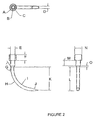
- FIG. 1 shows a perspective view of a device 1 according to one embodiment of the invention.
- the device 1 includes a tube 2 having a distal end 3 and a proximal end 4.
- the embodiment shown includes a beveled connector 5 intermediate the tube 2 and the transitional tube 6.
- the transitional tube 6 is intermediate the beveled connector 5 and the stopping end 7. It is this stopping end 7 that prevents the device from being pushed out of the end of a conventional trach tube when the device 1 is inserted while in a trach tube.
- Tube 2 further includes a proximal opening 8 and distal opening 9, both of which place the environment in communication with the interior of the tube 2.
- a cutting edge 10 is disposed on the distal end 3 of tube 2.
- Figure 2 shows a top, side, and front view of a device 1 as taught herein.
- the sizes of the device are as set forth below. It should be noted, of course, that these sizes are exemplary, and that while certain embodiments may be of the same size, or may be of different size but have identical proportions, this recitation should not be interpreted to limit the claims unless, of course, the specific dimensions are recited in the claims.
- the wall thickness of the tube 2 is consistently 0.04 inches.
- Embodiments typically provide an all-in-one puncture, knife, tracheal dilator, and tracheostomy tube inserter.
- Devices may comprise, for example, a curved tube having a proximal end, designed to allow insertion of tools and including a lip to prevent the tube from slipping out of a conventional tracheostomy tube.
- the proximal end includes a beveled connector, which is a tube, leading to a transitional tube.
- the transitional tube is connected to a stopping end, which is also a tube. Between the transitional tube and the stopping end there may be, but is not required to be, a second beveled connector.
- the diameter of the transitional tube is greater than the diameter of the curved tube, and is uniform throughout the transitional tube.
- the diameter of the stopping end is greater than the diameter of the transitional tube.
- the diameter of the beveled connector increases between that of the curved tube and that of the transitional tube.
- the stopping tube prevents the tracheostomy device from being pushed completely through a tracheostomy tube. It may also facilitate connection to a bag valve mask. Furthermore, the use of differing diameters may facilitate handling and insertion of the device.
- the curved tube also has a distal end that is pointed, sharpened, and beveled upwards.
- the distal end of the device is useful for cutting the throat and trachea of a patient in need of a tracheostomy, allowing the insertion of the device into the trachea of the patient.
- embodiments of the invention are tracheostomy devices that conform to the curvature and inner diameter of the conventional tracheostomy tubes currently available in the operating rooms in hospitals in the United States. It has the advantage that the tube itself can be used temporarily as a ventilation device attached to a bag valve mask (for example, an AMBU® bag) or an anesthesia machine. Of course, other acceptable sizes may be used.
- the device when it is inserted in the lumen of a tracheostomy tube, typically protrudes beyond the tip of the tube. Preferably this protrusion is about 2.5 cm.
- the tip of the device is beveled upward.
- the bevel is 30 degrees, though it may range between, for example, 20 degrees and 40 degrees.
- the tip is sharp and the borders of the bevel are sharp to allow cutting.
- the device may be any material suitable for surgical insertion. Typically it is a metal or plastic. In one embodiment it is copper.
- Embodiments of the device may have a constant inner and/or outer diameter throughout the entire tube.
- Other embodiments may have an inner and/or outer diameter that decreases along the length of the tube.
- the amount of decrease may be uniform along the length of the device or not uniform. The decrease may only continue from the distal end of the device through about half of the device's length.
- the thickness of the wall of the device may be constant. The thickness may be constant throughout part of the length of the device and may vary throughout another part of the length.
- the diameter of the device may transition to the conventional tracheostomy tube in a smooth fashion when the device is loaded in a tube.
- the entire device including but not limited to the device's tip, may be solid and inflexible.
- the shape of the instrument conforms to a standard tracheotomy tube such as a Shiley, therefore the dilating pressure is not exerted on an anterior-posterior direction as is the case with the other techniques but horizontally along the vertical axis of the trachea, preventing fracture of the tracheal rings or misplacement.
- a standard tracheal retractor placed in the space of the bevel and pulling gently allowing an easy introduction of the tube.
- Embodiments of the invention may be offered in different tracheal tube sizes and possibly to fit different brands, such as Portex, Bivona, or others.
- the device may be offered in a kit with other tracheal tubes and instructions for use.
- Devices described herein may have a single interior passage. They may have a plurality of interior passages. Where a plurality of interior passages are provided, they may be of the same shape or different shapes, and of the same size or different sizes.
- the interior of a device may further include one or more grooves and/or connectors for situating, orienting, or connecting accessories to the device.
- Optical attachments can be added to this device. These may include, for example, rigid fiberoptic probes conforming to the curvature of the tube and attached to the video monitor device. This could be utilized as a teaching device as well.
- Embodiments as presented herein are not meant to replace conventional tracheal tubes that are inserted into the trachea, but rather to act as a facilitator and a carrier of these tubes into the trachea lumen in a simple, one step, one instrument procedure in a safe and effective manner.
- the device has an interiorly placed bevel with a sharp tip and cutting borders, and a diameter similar to available tracheal tubes, it can, if desired, be introduced only partially and can be attached it to an AMBU® bag or an anesthesia machine in extreme emergency situations, until specialized help arrives. Therefore it would be very useful, for example, in ERs, in ambulances, at restaurants, in the battle field, etc. because it will save lives.
- a vertical 1.5 cm incision is made two finger breadths from the sternal notch in the midline. Then the soft tissues are spread with standard scissors and a tracheostomy device as described herein is put through the incision down to the anterior tracheal wall. By moving the device up and down just slightly the surgeon can feel the inter-tracheal space and then apply pressure downward gently until air through the tube is heard or noticed. At this point additional pressure is applied until the tip of the tracheostomy tube is in the tracheal lumen. Next the tracheostomy device is removed and the remainder of the tracheal tube length advanced and fixed in place.
- the described technique has the advantage of streamlining the tracheostomy process by puncturing, cutting and dilating the trachea and introducing a loaded trach tube all with one single instrument.
- This technique does not require endoscopic guidance because it produces visual and auditory feedback when the instrument is inserted; it is easy to identify the tracheal spaces by sliding the tip of the instrument up and down over the tracheal rings. Because of its simplicity the procedure can be completed in about 2-3.
- the procedure reported herein has a number of advantages over the prior art. For example, it can be performed under both elective and emergent conditions. It can be indicated in pediatric patients under 12. It can be easily done after watching an instructional video that will be provided with the kit or purchased independently through a website or after attending seminars arranged by the manufacturer.
Landscapes
- Health & Medical Sciences (AREA)
- Pulmonology (AREA)
- Emergency Medicine (AREA)
- Engineering & Computer Science (AREA)
- Anesthesiology (AREA)
- Biomedical Technology (AREA)
- Heart & Thoracic Surgery (AREA)
- Hematology (AREA)
- Life Sciences & Earth Sciences (AREA)
- Animal Behavior & Ethology (AREA)
- General Health & Medical Sciences (AREA)
- Public Health (AREA)
- Veterinary Medicine (AREA)
- Prostheses (AREA)
- Surgical Instruments (AREA)
Applications Claiming Priority (1)
| Application Number | Priority Date | Filing Date | Title |
|---|---|---|---|
| US1484807P | 2007-12-19 | 2007-12-19 |
Publications (1)
| Publication Number | Publication Date |
|---|---|
| EP2072074A1 true EP2072074A1 (fr) | 2009-06-24 |
Family
ID=40361524
Family Applications (1)
| Application Number | Title | Priority Date | Filing Date |
|---|---|---|---|
| EP08021873A Withdrawn EP2072074A1 (fr) | 2007-12-19 | 2008-12-17 | Dispositif de trachéostomie |
Country Status (3)
| Country | Link |
|---|---|
| US (1) | US20090159087A1 (fr) |
| EP (1) | EP2072074A1 (fr) |
| CA (1) | CA2647393A1 (fr) |
Families Citing this family (3)
| Publication number | Priority date | Publication date | Assignee | Title |
|---|---|---|---|---|
| US20110211339A1 (en) * | 2010-02-26 | 2011-09-01 | Qing Rong Technology Inc. | Light emitter diode module |
| CN114502226B (zh) | 2019-05-15 | 2024-08-27 | 泰利福生命科学公司 | 气管造口扩张器 |
| WO2023242808A1 (fr) * | 2022-06-17 | 2023-12-21 | Fisher & Paykel Healthcare Limited | Tubes médicaux et raccords pour circuits respiratoires |
Citations (4)
| Publication number | Priority date | Publication date | Assignee | Title |
|---|---|---|---|---|
| GB125754A (en) * | 1918-04-25 | 1919-04-25 | Arthur Lawrence Abel | A New Laryngotome and Tracheotome. |
| US3499450A (en) * | 1967-10-25 | 1970-03-10 | Dow Corning | Pediatric size tracheal tube |
| US3511243A (en) * | 1967-07-18 | 1970-05-12 | Frederic J Toy | Apparatus for providing a breathing conduit communicating with the trachea at the base of the neck |
| JPH10234753A (ja) * | 1997-02-22 | 1998-09-08 | Kunihiko Sawa | 動物への気管内チューブ挿入方法及び動物用気管内チュ ーブ |
Family Cites Families (17)
| Publication number | Priority date | Publication date | Assignee | Title |
|---|---|---|---|---|
| US125754A (en) * | 1872-04-16 | Improvement in glass globes or reservoirs for lamps | ||
| US4556059A (en) * | 1982-09-03 | 1985-12-03 | Adamson Jr Howard | Spring operated tracheotome |
| US4502482A (en) * | 1983-05-23 | 1985-03-05 | Deluccia Victor C | Endotracheal tube complex |
| US5259377A (en) * | 1992-03-30 | 1993-11-09 | Stephen M. Daugherty | Endotracheal tube stylet |
| US5546936A (en) * | 1992-05-19 | 1996-08-20 | Mallinckrodt Medical, Inc. | Tracheal tube with reinforced flexible segment |
| CA2220285C (fr) * | 1996-11-06 | 2006-10-03 | Archibald I.J. Brain | Construction d'un tube endotracheal |
| GB9706372D0 (en) * | 1997-03-27 | 1997-05-14 | Smiths Industries Plc | Medical tube assemblies |
| US5954050A (en) * | 1997-10-20 | 1999-09-21 | Christopher; Kent L. | System for monitoring and treating sleep disorders using a transtracheal catheter |
| US6330882B1 (en) * | 1998-03-06 | 2001-12-18 | Ronald French | Emergency apparatus for evacuating air from the body cavity |
| US20010013344A1 (en) * | 1999-04-08 | 2001-08-16 | Hsiu-Chin Chou | Adjustable oropharyngeal airway apparatus |
| US6637435B2 (en) * | 1999-12-07 | 2003-10-28 | Cook Incorporated | Percutaneous dilational device |
| US6378523B1 (en) * | 2000-03-15 | 2002-04-30 | Evergreen Medical Incorporated | Endotracheal tube having a beveled tip and orientation indicator |
| US6706017B1 (en) * | 2000-09-18 | 2004-03-16 | Pavel Dulguerov | Percutaneous ostomy device and method for creating a stoma and implanting a canula |
| GB0201436D0 (en) * | 2002-01-23 | 2002-03-13 | Smiths Group Plc | Medico-surgical apparatus |
| GB0421938D0 (en) * | 2004-10-02 | 2004-11-03 | Smiths Group Plc | Tracheostomy apparatus |
| US7604627B2 (en) * | 2006-05-11 | 2009-10-20 | Kourosh Kojouri | Nasopharyngeal sheath for nasogastric intubation |
| CN101541365A (zh) * | 2006-05-18 | 2009-09-23 | 呼吸科技公司 | 气管切开方法和装置 |
-
2008
- 2008-12-17 CA CA002647393A patent/CA2647393A1/fr not_active Abandoned
- 2008-12-17 US US12/337,068 patent/US20090159087A1/en not_active Abandoned
- 2008-12-17 EP EP08021873A patent/EP2072074A1/fr not_active Withdrawn
Patent Citations (4)
| Publication number | Priority date | Publication date | Assignee | Title |
|---|---|---|---|---|
| GB125754A (en) * | 1918-04-25 | 1919-04-25 | Arthur Lawrence Abel | A New Laryngotome and Tracheotome. |
| US3511243A (en) * | 1967-07-18 | 1970-05-12 | Frederic J Toy | Apparatus for providing a breathing conduit communicating with the trachea at the base of the neck |
| US3499450A (en) * | 1967-10-25 | 1970-03-10 | Dow Corning | Pediatric size tracheal tube |
| JPH10234753A (ja) * | 1997-02-22 | 1998-09-08 | Kunihiko Sawa | 動物への気管内チューブ挿入方法及び動物用気管内チュ ーブ |
Also Published As
| Publication number | Publication date |
|---|---|
| US20090159087A1 (en) | 2009-06-25 |
| CA2647393A1 (fr) | 2009-06-19 |
Similar Documents
| Publication | Publication Date | Title |
|---|---|---|
| Myatra et al. | All India Difficult Airway Association 2016 guidelines for the management of unanticipated difficult tracheal intubation in adults | |
| Coté et al. | Pediatric transtracheal and cricothyrotomy airway devices for emergency use: which are appropriate for infants and children? | |
| EP2326377B1 (fr) | Dilatateur tronconique de trachéostomie aisé à tenir | |
| McKenna et al. | Cricothyrotomy | |
| US8307824B2 (en) | Method of performing a tracheostomy | |
| JP2016531706A (ja) | 気管内チューブ及び使用方法 | |
| US12171940B2 (en) | Endotracheal tube insertion | |
| US20180099110A1 (en) | Endotracheal tube | |
| US20230191061A1 (en) | Systems, apparatus, and methods for performing a percutaneous tracheostomy | |
| John et al. | Contemporary issues in adult tracheostomy management | |
| US20180272090A1 (en) | System and method for protecting a patient's tracheal wall during percutaneous procedures | |
| US20210275766A1 (en) | Systems, apparatus, and methods for performing a percutaneous tracheostomy | |
| EP2812060B1 (fr) | Prothèse trachéale | |
| EP2072074A1 (fr) | Dispositif de trachéostomie | |
| US20200405990A1 (en) | Medical device system and method including an endotracheal tube | |
| US20200069900A1 (en) | Percutaneous dilation tracheostomy device and method of using | |
| Regan et al. | How to care for a patient with a tracheostomy | |
| Flaherty | Tracheostomy care: the role of the nurse before, during and after insertion | |
| Laurin et al. | Extraglottic devices for emergency airway management in adults | |
| US20120017916A1 (en) | Dilator With Integrated Guiding Catheter | |
| Doody et al. | Percutaneous tracheostomy and cricothyrotomy techniques | |
| Stevenson et al. | Front-of-neck airway: percutaneous tracheostomy and cricothyrotomy | |
| Doody et al. | Percutaneous tracheostomy and cricothyrotomy techniques | |
| Pujari | Front of Neck Access Procedures | |
| Cossey et al. | Practical procedures |
Legal Events
| Date | Code | Title | Description |
|---|---|---|---|
| PUAI | Public reference made under article 153(3) epc to a published international application that has entered the european phase |
Free format text: ORIGINAL CODE: 0009012 |
|
| AK | Designated contracting states |
Kind code of ref document: A1 Designated state(s): AT BE BG CH CY CZ DE DK EE ES FI FR GB GR HR HU IE IS IT LI LT LU LV MC MT NL NO PL PT RO SE SI SK TR |
|
| AX | Request for extension of the european patent |
Extension state: AL BA MK RS |
|
| AKX | Designation fees paid | ||
| REG | Reference to a national code |
Ref country code: DE Ref legal event code: 8566 |
|
| STAA | Information on the status of an ep patent application or granted ep patent |
Free format text: STATUS: THE APPLICATION IS DEEMED TO BE WITHDRAWN |
|
| 18D | Application deemed to be withdrawn |
Effective date: 20091229 |