EP2072688A1 - Structure de réseau d'espace à assemblage à tenon - Google Patents
Structure de réseau d'espace à assemblage à tenon Download PDFInfo
- Publication number
- EP2072688A1 EP2072688A1 EP07123636A EP07123636A EP2072688A1 EP 2072688 A1 EP2072688 A1 EP 2072688A1 EP 07123636 A EP07123636 A EP 07123636A EP 07123636 A EP07123636 A EP 07123636A EP 2072688 A1 EP2072688 A1 EP 2072688A1
- Authority
- EP
- European Patent Office
- Prior art keywords
- lattice
- tenon
- hollow
- joint type
- type space
- Prior art date
- Legal status (The legal status is an assumption and is not a legal conclusion. Google has not performed a legal analysis and makes no representation as to the accuracy of the status listed.)
- Withdrawn
Links
- 239000000463 material Substances 0.000 claims abstract description 30
- 230000005484 gravity Effects 0.000 claims abstract description 10
- 238000000034 method Methods 0.000 claims description 21
- 229910000831 Steel Inorganic materials 0.000 claims description 9
- 239000010959 steel Substances 0.000 claims description 9
- 239000004567 concrete Substances 0.000 claims description 8
- 239000002131 composite material Substances 0.000 claims description 5
- 239000002184 metal Substances 0.000 claims description 5
- 239000002689 soil Substances 0.000 claims description 5
- 239000004575 stone Substances 0.000 claims description 5
- 239000002023 wood Substances 0.000 claims description 4
- 239000011159 matrix material Substances 0.000 claims description 3
- 229910052755 nonmetal Inorganic materials 0.000 claims description 3
- 229920005989 resin Polymers 0.000 claims description 3
- 239000011347 resin Substances 0.000 claims description 3
- 239000007787 solid Substances 0.000 claims description 3
- 230000008878 coupling Effects 0.000 claims 1
- 238000010168 coupling process Methods 0.000 claims 1
- 238000005859 coupling reaction Methods 0.000 claims 1
- XLYOFNOQVPJJNP-UHFFFAOYSA-N water Substances O XLYOFNOQVPJJNP-UHFFFAOYSA-N 0.000 abstract description 16
- 238000010276 construction Methods 0.000 description 20
- 230000000694 effects Effects 0.000 description 5
- 238000004519 manufacturing process Methods 0.000 description 5
- 230000009286 beneficial effect Effects 0.000 description 2
- 238000012407 engineering method Methods 0.000 description 2
- 238000004321 preservation Methods 0.000 description 2
- 239000004568 cement Substances 0.000 description 1
- 230000007812 deficiency Effects 0.000 description 1
- 230000002708 enhancing effect Effects 0.000 description 1
- 230000007613 environmental effect Effects 0.000 description 1
- 238000002474 experimental method Methods 0.000 description 1
- 238000009434 installation Methods 0.000 description 1
- 238000012423 maintenance Methods 0.000 description 1
- 239000002905 metal composite material Substances 0.000 description 1
- 238000012986 modification Methods 0.000 description 1
- 230000004048 modification Effects 0.000 description 1
- 238000005192 partition Methods 0.000 description 1
- 238000011160 research Methods 0.000 description 1
- 239000004576 sand Substances 0.000 description 1
- 230000000576 supplementary effect Effects 0.000 description 1
- 229920003002 synthetic resin Polymers 0.000 description 1
Images











Classifications
-
- E—FIXED CONSTRUCTIONS
- E02—HYDRAULIC ENGINEERING; FOUNDATIONS; SOIL SHIFTING
- E02D—FOUNDATIONS; EXCAVATIONS; EMBANKMENTS; UNDERGROUND OR UNDERWATER STRUCTURES
- E02D29/00—Independent underground or underwater structures; Retaining walls
- E02D29/02—Retaining or protecting walls
- E02D29/0258—Retaining or protecting walls characterised by constructional features
- E02D29/0266—Retaining or protecting walls characterised by constructional features made up of preformed elements
Definitions
- the present invention relates to a tenon joint type space lattice structure, and more particularly to a multifunctional space lattice structure having a retaining wall, a water drainage and an earth fill vegetation by jointly using a tenon joint assembling of components and a combining pillar.
- a tenon joint type space lattice structure includes a predetermined quantity of lattice units and combining pillar and is characterized in that the lattice unit comprises two or more pre-molded components coupled with each other, and a convex tenon and a concave tenon groove disposed on an end of the lattice unit, and the tenon and the tenon groove form a tenon-and-groove structure, such that the tenon protruded between each component is embedded into an adjacent tenon groove and coupled with the tenon groove by a tenon joint assembling process, and the components are coupled with each other in series to constitute a continuously extended lattice unit.
- the continuous lattice unit further forms a plane year of a space lattice structure, uses the combining pillar to pass through a hollow portion of the component perpendicularly, and connects the plane layers of the lattice unit in series along the direction of the height of the structure, so as to constitute a three-dimensional space lattice structure.
- the present invention is characterized in that the lattice unit is manufactured in the best mode according to transmitted force, stylish appearance, construction convenience, transportation, vegetation space and economic factors. Therefore, the lattice unit includes a light hollow component made of a light material and a heavy component made of a heavy material.
- the lattice unit of the heavy component is made of a heavy material such as steel concrete, steel, steel concrete and wood, etc.
- the heavy component requires a hollow portion at the position of the tenon for passing through a combining pillar, and the lattices of the lattice unit may or may not have a hollow portion depending on the required structural strength, but the overall constructability and cost of the manufacturing process should be taken into consideration. The manufacturing process will become simpler and easier if it is not necessary to build the hollow portion.
- the lattice unit of the heavy component used for the construction makes the transportation by labor more difficult due to the heavy weight, and thus a hoisting machine is required for the transportation. Furthermore, the flexibility of adjusting the tenon joint assembling process will be affected greatly.
- the gravitation force produced by the mass of the lattice unit of the heavy component on the structure is one of the structural resistance sources, and thus the constructed tenon joint type space lattice structure is formed as a gravity structure, and heavy filling materials such as soils and stones are filled into the hollow portion of the structure, and the gravitational force produced by the heavy filling material is also one of the structural resistance sources that can form a gravity structure as well.
- the combining pillar is piled into a stratum or a base, so that the combining pillar forms a cantilever support, which is also one of the resistance sources to the structure and makes the structure as a cantilever structure.
- the lattice unit of the light component is made of a light and high-strength material such as a polymer (resin), a metal base, an inorganic non-metal base composite, or an industrial plastic material, and both light component and heavy component require to have a hollow portion at the position of the tenon for passing through the combining pillar, and the lattices of the light component and the lattices of the heavy component may or may not have a hollow portion with the same factors of consideration, but the manufacture of the lattice unit of the heavy component does not require special processes, and general manpower can be used for the manufacture.
- a light and high-strength material such as a polymer (resin), a metal base, an inorganic non-metal base composite, or an industrial plastic material
- lattices of the lattice unit of the light component preferably construct a hollow portion.
- the lattice unit of the light component in a construction can be transported and assembled by manpower due to the light weight of the lattice unit. Except special requirements, it is not necessary to employ additional hoisting machines, and the flexibility of adjusting the lattice units of the heavy component is much higher. In the meantime, a construction precision on the plane and height of the structure higher than those of the lattice units of the heavy component can be achieved.
- the mass of the lattice unit of the light component produces a gravitational force which is insufficient to be one of the structural resistance sources
- the constructed tenon joint type space lattice structure is a light structure
- one of the structural resistance sources is a heavy filling material of a hollow portion of the structure, and the gravitational force produced by the heavy filling material is provided for forming a gravity structure.
- the combining pillar is piled into a stratum or a base, and the combining pillar constitutes a cantilever support which is another source of the structural resistance for forming a cantilever structure.
- the methods of transmitting forces between the components of a tenon joint type space lattice structure and a general space lattice structure are different, primarily residing on that the source of an external force and a support method of a structure.
- the external force of a space lattice structure is generally the weight of the structure, the equipment and people carried by the structure, and the wind force, and the force is centralized for a support such as a pillar or a wall, and then transmitted into the stratum or base, and finally transmitted from the base to the stratum.
- the external forces of the tenon joint type space lattice structure are primarily earth pressure, water impact force, and water tractive force.
- the structure produces the gravitational force by the weights of the structure itself and the heavy filling material, and the friction produced by the gravitational force uses a distributed support method to resist the external forces.
- the external force After an external force is exerted onto each combining pillar, the external force is transmitted directly into the stratum or base by the cantilever support of the combining pillar.
- a distributed method is provided for resisting external forces, and such method can be used separately or used for the whole structure.
- a shift is usually occurred between plane layers of each structure of the construction, which makes the construction of the combining pillar very difficult, and may even cause a different dynamic mode of each structural layer.
- a combining pillar is built at a lower layer of the construction, and the combining pillar serves as a construction base for each plane layer along the direction of the height of the structure.
- the lattice of the lattice unit does not come with a hollow portion, but is built on the lattices at the upper and lower layers of the lattice unit and corresponding to the convex tenon and the concave tenon groove, and the protruded tenon is embedded into the corresponding tenon groove in the tenon joint assembly, such that the lattices at upper and lower layers of the lattice unit so as to prevent the shift between layers.
- the installation of accessory facilities is a feasible solution to achieve the same purpose.
- the lattices of the lattice unit are installed in the hollow portion, and a specific quantity of accessory short pillars is used as a base for the assembling of the upper and lower layers of the structure along the direction of the height of the structure to prevent the occurrence of a shift between layers.
- the invention can complete constructing a tenon joint type space lattice structure quickly and successfully, and soils and stones can be filled into the hollow portion of the structure for a large scale of vegetation. It is necessary to be aware of the strength of the tenon joint of the structure.
- a rigid or flexible ring can be used for sheathing and connecting the combining pillar, and thus not only improving the strength of the tenon joint, but also enhancing the overall structural strength.
- the lattice unit of the light component can be converted to a heavy component by filling a heavy filling material such as concrete into a light component in the hollow portion of the lattice to seal the bottom of the lattice.
- a heavy filling material such as cement or sand pulp to achieve the same purpose.
- heavy and light components of the hollow portion can be built on the lattice, and a straight or slanting reinforced partition can be installed at the hollow portion to enhance the structural strength of the components as well as the overall strength of the structure.
- the tenon joint type space lattice structure of the invention is not just used for many civil engineering jobs such as the application for retaining walls, dams, water passages and walls only, but is also multifunctional in different areas as list below.
- the tenon joint type space lattice structure of the invention have a multiple of functions and features of the structure, such as providing a quick and simple construction, preserving water preservation, reducing the use of accessory facilities, standing a heavy subsidence, performing earth fill vegetation and creating landscape, etc.
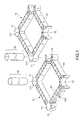
- the invention comprises a predetermined quantity of lattice unit 10 and a specific quantity of combining pillars 20.
- the lattice unit 10 is preferably a module made of a light and high-strength resin matrix composite material, but not limited to such material only, and a metal base, an inorganic non-metal composite material and a plastic material may be used to make the lattice unit of the light hollow component.
- Each side or edge has two or more convex and concave tenons 11 and tenon grooves 12, and the tenons 11 and the tenon grooves 12 are corresponding tenon-and-groove structures, and the tenon 11 protruded between the lattice units 10 of the light hollow component can be embedded into the corresponding tenon groove 12 for connecting with each other by a tenon joint assembling method, so as to construct a plane layer 10A of a predetermined frame structure.
- the lattice unit 10 of the light hollow component comprises: a frame body with a plurality of hollow lattices 13 formed by erected and transversally and longitudinally interlaced sheet bodies on each frame edge; a hollow tenon 11 formed at an end on one of the sides of the lattice 13, such that the tenon 11 has a hollow portion 111; and a tenon groove 12 with an opening facing outward and disposed at an end of another corresponding lattice 13.
- the tenon 11 is of the same height with the hollow cylindrical body of the lattice 13, and the tenon groove 12 is of the same height with C-shaped body of the lattice 13.
- the hollow lattice 13 as shown in FIG. 1 is a body with a hollow 131 at its bottom.
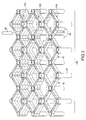
- the combining pillar 20 comprises a hollow or solid pillar made of the same material such as steel concrete, steel and light hollow component, and the combining pillar 20 is provided for passing through a hollow portion of the lattice unit 10 of the light hollow component, and the hollow portion includes a hollow body in the lattice 13, but preferably the aforementioned hollow tenon 11 and hollow tenon groove 12, for connecting each plane layer 10A, 10B, 10C in series along the height and direction of the structure as shown in FIG. 3 to constitute a three-dimensional space lattice structure 100.
- FIG. 1 The combining pillar 20 comprises a hollow or solid pillar made of the same material such as steel concrete, steel and light hollow component, and the combining pillar 20 is provided for passing through a hollow portion of the lattice unit 10 of the light hollow component, and the hollow portion includes a hollow body in the lattice 13, but preferably the aforementioned hollow tenon 11 and hollow tenon groove 12, for connecting each plane layer 10A, 10B, 10C in series
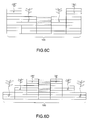
- the present invention can also fill a soil and stone filling material 30A into a hollow portion of the space lattice structure 100 in addition to filling a heavy filling material 30 into the hollow lattice 13 of the light lattice unit 10 to constitute a gravity structure, and a portion of the combining pillar 20 is piled into a stratum or a foundation 40 to form a cantilever structure.
- the light lattice unit 10 comprises a hollow lattice 13, and the bottom of any one of the hollow lattices 13 is in a sealed status 132, and the heavy filling material 30 is filled in the hollow lattice 13 to convert the component from a component of a light structure into a component of a gravity structure.
- the invention adopts the foregoing technical measure to provide different functions including a simple and quick construction of a retaining wall, a dam, a water passage and a landscape according to the construction requirements, and also provides a good effect on the structure.
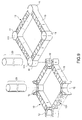
- FIGS. 7 and 8 for a second preferred embodiment of the present invention, same numerals are used to represent same elements of the previous structure, and the difference of this structure from the previous structure resides on that both upper and lower ends of the tenon 11 are protruded from the lattice 13, and have a hollow cylindrical body of the upper and lower extended portions 11a, 11b.
- the tenon groove 12 includes upper and lower ends protruded from the lattice 13 and a C-shaped body having upper and lower extended portions 12a, 12b.
- external periphery of upper and lower extended portions 12a, 12b of the tenon groove 12 includes a rigid or flexible ring 50 for sheathing and connecting the tenon joint assembling and the combining pillar 20 to form another type of space lattice structure 101, such that a gap 51 with a height equal to one ring 50 is formed between each plane layer 10A, 10B, 10C, which is beneficial to the structure for a certain special construction.
- the same numerals are used to represent the same elements of the previous structure, and the difference of this structure from the previous structure one resides on that the lattice unit 10 of the previous structure includes two tenons 11 and two tenon grooves 12 disposed a same lattice unit 10.
- a hollow tenon 11 is formed at an end of the lattice 13, and a tenon groove 12 with its opening facing outward is formed at an end of an adjacent lattice 13 that is coupled to another frame body by a tenon joint assembling.
- two different types of lattice units 10 are connected alternately by a tenon joint method to produce a plane layer 10A as the previous embodiment.
- the same numerals are used to represent the same elements of the previous structure, and the difference of this structure from the previous structure one resides on that the lattice unit 10 is a heavy component made by a heavy material such as metal, steel concrete and wood, etc.
- the lattice 13a, tenon 11, and tenon groove 12 are heavy components.
- the tenon 11 also has a hollow portion 111 with a smaller through hole to go with a combining pillar 20 which is a solid cylindrical body.
- the tenon 11 and the tenon groove 12 of this embodiment are formed at an end of one of the lattice units 10, but not limited to such arrangement.
- a lattice unit 10 of this embodiment may have two tenons 11 and two tenon grooves 12 in the same time as shown in FIG. 1 , and thus will not be described here.
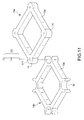
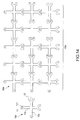
- the first plane layer 10A installed by the lattice unit 10 as shown in FIG. 13 , and the second plane layer 10B disposed thereon vertically corresponds to the first plane layer 10A, such that the tenon groove 12 is disposed at the top of the tenon 11, and then the lattice units 10 can be stacked alternately upward to facilitate the overall stability of the structure.
- the lattices 13a of the lattice unit 10B are perpendicular with each other, and two tenons 11 with a hollow portion 111 and two corresponding tenon grooves 12 are disposed at an end of the tenon 11, and can be coupled to form a plane layer 10A by a tenon joint assembling process, and the characteristics and effects are the same as the aforementioned preferred embodiment.
- a same lattice unit 10B can be a tenon 11 or a tenon groove 12 at the same time, and the plane layer 10A of its tenon joint assembling has the same effect.
- the lattice units 10, 10A, 10B in accordance with the foregoing embodiments come with the same size and are formed integrally as a whole, but the invention is not limited to such arrangement only.
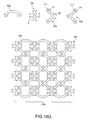
- the lattice unit of the invention can be the one as shown in FIGS. 16A ⁇ C , and comprises a large lattice unit 10A, 10B to go with a small lattice unit 10C, and it can be a lattice unit as shown in FIG. 16D and comprised of three different lattice units 10A, 10B, 10C coupled to form a plane layer 10A by a tenon joint assembling process.
- the lattice unit can be the one as shown in FIG. 16E and comprised of a small lattice unit 10C and a lattice 13a coupled with each other by a tenon joint assembling process to form a plane layer 10A.
- the perspective view as shown in FIG. 16F illustrates that the lattice 13a occupies a space with a specific height
- FIGS. 16G and 16H are planar view and perspective view of the arc shape of the tenon joint of the lattice 13a and the lattice units 10A, 10C.
- the continuously extended lattice unit disclosed in the present invention is formed integrally as a whole or formed by building a convex tenon 11 and a concave tenon groove 12 onto two or more corresponding lattice units, such that the two lattice units can be coupled with each other by a tenon joint assembling process, so as to produce a structure with continuously extended lattice units.
Landscapes
- Engineering & Computer Science (AREA)
- Environmental & Geological Engineering (AREA)
- Life Sciences & Earth Sciences (AREA)
- General Life Sciences & Earth Sciences (AREA)
- Mining & Mineral Resources (AREA)
- Paleontology (AREA)
- Civil Engineering (AREA)
- General Engineering & Computer Science (AREA)
- Structural Engineering (AREA)
- Revetment (AREA)
Priority Applications (1)
| Application Number | Priority Date | Filing Date | Title |
|---|---|---|---|
| EP07123636A EP2072688A1 (fr) | 2007-12-19 | 2007-12-19 | Structure de réseau d'espace à assemblage à tenon |
Applications Claiming Priority (1)
| Application Number | Priority Date | Filing Date | Title |
|---|---|---|---|
| EP07123636A EP2072688A1 (fr) | 2007-12-19 | 2007-12-19 | Structure de réseau d'espace à assemblage à tenon |
Publications (1)
| Publication Number | Publication Date |
|---|---|
| EP2072688A1 true EP2072688A1 (fr) | 2009-06-24 |
Family
ID=39310894
Family Applications (1)
| Application Number | Title | Priority Date | Filing Date |
|---|---|---|---|
| EP07123636A Withdrawn EP2072688A1 (fr) | 2007-12-19 | 2007-12-19 | Structure de réseau d'espace à assemblage à tenon |
Country Status (1)
| Country | Link |
|---|---|
| EP (1) | EP2072688A1 (fr) |
Cited By (4)
| Publication number | Priority date | Publication date | Assignee | Title |
|---|---|---|---|---|
| WO2011098643A1 (fr) * | 2010-02-09 | 2011-08-18 | Berdejo Alonso Agustin | Module de soutènement de terres |
| CN105605411A (zh) * | 2015-12-23 | 2016-05-25 | 北京博简复才技术咨询有限公司 | 复合材料曲面结构单元和复合材料胞元点阵结构 |
| GB2536917A (en) * | 2015-03-31 | 2016-10-05 | Rsm Aviation Ltd | A Construction system |
| CN110777932A (zh) * | 2019-10-22 | 2020-02-11 | 天津大学 | 一种铝合金空间网格结构自铆式节点 |
Citations (4)
| Publication number | Priority date | Publication date | Assignee | Title |
|---|---|---|---|---|
| US4707962A (en) * | 1986-02-25 | 1987-11-24 | Meheen Engineering Corp. | Cascade wall structure |
| EP0595193A1 (fr) * | 1992-10-30 | 1994-05-04 | Impresa Concari Prefabbricati Di P. Concari | Remblai comportant des éléments préfabriqués, collaborants et assemblables en particulier pour des constructions routières ou ferroviaires et son procédé de réalisation |
| US20060257209A1 (en) * | 2005-05-13 | 2006-11-16 | Piao-Chin Li | Trussed embankment dam and wall structure |
| WO2007021880A1 (fr) * | 2005-08-10 | 2007-02-22 | New Technology Resources, Inc. | Blocs de confinement de masses a cavite continue et leur utilisation |
-
2007
- 2007-12-19 EP EP07123636A patent/EP2072688A1/fr not_active Withdrawn
Patent Citations (4)
| Publication number | Priority date | Publication date | Assignee | Title |
|---|---|---|---|---|
| US4707962A (en) * | 1986-02-25 | 1987-11-24 | Meheen Engineering Corp. | Cascade wall structure |
| EP0595193A1 (fr) * | 1992-10-30 | 1994-05-04 | Impresa Concari Prefabbricati Di P. Concari | Remblai comportant des éléments préfabriqués, collaborants et assemblables en particulier pour des constructions routières ou ferroviaires et son procédé de réalisation |
| US20060257209A1 (en) * | 2005-05-13 | 2006-11-16 | Piao-Chin Li | Trussed embankment dam and wall structure |
| WO2007021880A1 (fr) * | 2005-08-10 | 2007-02-22 | New Technology Resources, Inc. | Blocs de confinement de masses a cavite continue et leur utilisation |
Cited By (6)
| Publication number | Priority date | Publication date | Assignee | Title |
|---|---|---|---|---|
| WO2011098643A1 (fr) * | 2010-02-09 | 2011-08-18 | Berdejo Alonso Agustin | Module de soutènement de terres |
| ES2363954A1 (es) * | 2010-02-09 | 2011-08-22 | Agustin Berdejo Alonso | Módulo de contención de tierras. |
| GB2536917A (en) * | 2015-03-31 | 2016-10-05 | Rsm Aviation Ltd | A Construction system |
| CN105605411A (zh) * | 2015-12-23 | 2016-05-25 | 北京博简复才技术咨询有限公司 | 复合材料曲面结构单元和复合材料胞元点阵结构 |
| CN105605411B (zh) * | 2015-12-23 | 2018-04-24 | 北京博简复才技术咨询有限公司 | 复合材料曲面结构单元和复合材料胞元点阵结构 |
| CN110777932A (zh) * | 2019-10-22 | 2020-02-11 | 天津大学 | 一种铝合金空间网格结构自铆式节点 |
Similar Documents
| Publication | Publication Date | Title |
|---|---|---|
| US7857552B2 (en) | Tenon joint type space lattice structure | |
| JP5984085B2 (ja) | 基礎構造及び基礎の構築方法 | |
| CN115821972B (zh) | 一种输电线路装配式岩石锚杆基础及施工方法 | |
| CN102493475B (zh) | 一种格构桩基础及其施工方法 | |
| EP2072688A1 (fr) | Structure de réseau d'espace à assemblage à tenon | |
| JP6240625B2 (ja) | 擁壁、造成地及び造成地の造成方法 | |
| KR101290140B1 (ko) | 강관말뚝과 중공 콘크리트 말뚝의 합성에 의한 심부구속구조를 가지는 합성말뚝 및 그 시공방법 | |
| KR102263958B1 (ko) | 옹벽용 조립식 블록 시공방법 | |
| CN201746850U (zh) | 一种装配整体式悬臂式挡土墙 | |
| KR101281910B1 (ko) | 친환경 옹벽 축조시스템 및 그 시공방법 | |
| WO2013093128A1 (fr) | Module de formation de parements et procédé d'utilisation dudit module dans la construction | |
| KR102178399B1 (ko) | 내진성능이 우수한 보강지지구조를 구비한 보강토 옹벽블록 및 그 시공방법 | |
| Lutenegger | Foundation alternatives for ground mount solar panel installations | |
| JP5943202B2 (ja) | 複合擁壁及びその施工方法 | |
| KR101146757B1 (ko) | 적층식 옹벽구조물 및 그 시공방법 | |
| JP6765680B2 (ja) | ブロック組立式砂防ダム | |
| CN111206616A (zh) | 一种用于生态挡土墙的装配式墙砖及挡土墙 | |
| KR101841433B1 (ko) | 폐플라스틱 및 폐무기분말을 이용한 친환경 고강도 중력식 보강토 옹벽 블럭 | |
| CN212452702U (zh) | 一种可拼装的三维网状加筋带柔性支挡结构 | |
| JP4847265B2 (ja) | 擁壁 | |
| KR100994426B1 (ko) | 사면보강형 조경블럭 | |
| JP3140286U (ja) | 嵌合式空間格子の構造 | |
| KR101037502B1 (ko) | 기초 바닥층 내의 기초구조 강도 보강용 합성 구조체 | |
| JP2009155997A (ja) | 嵌合式空間格子の構造 | |
| CN201148623Y (zh) | 榫接式空间网格结构 |
Legal Events
| Date | Code | Title | Description |
|---|---|---|---|
| PUAI | Public reference made under article 153(3) epc to a published international application that has entered the european phase |
Free format text: ORIGINAL CODE: 0009012 |
|
| AK | Designated contracting states |
Kind code of ref document: A1 Designated state(s): AT BE BG CH CY CZ DE DK EE ES FI FR GB GR HU IE IS IT LI LT LU LV MC MT NL PL PT RO SE SI SK TR |
|
| AX | Request for extension of the european patent |
Extension state: AL BA HR MK RS |
|
| 17P | Request for examination filed |
Effective date: 20091222 |
|
| AKX | Designation fees paid |
Designated state(s): AT BE BG CH CY CZ DE DK EE ES FI FR GB GR HU IE IS IT LI LT LU LV MC MT NL PL PT RO SE SI SK TR |
|
| 17Q | First examination report despatched |
Effective date: 20100302 |
|
| STAA | Information on the status of an ep patent application or granted ep patent |
Free format text: STATUS: THE APPLICATION IS DEEMED TO BE WITHDRAWN |
|
| 18D | Application deemed to be withdrawn |
Effective date: 20120626 |