EP2072839A1 - Herstellungsverfahren eines isolierenden Konstruktionsproduktes für Gebäude und so hergestelltes Produkt - Google Patents
Herstellungsverfahren eines isolierenden Konstruktionsproduktes für Gebäude und so hergestelltes Produkt Download PDFInfo
- Publication number
- EP2072839A1 EP2072839A1 EP07425820A EP07425820A EP2072839A1 EP 2072839 A1 EP2072839 A1 EP 2072839A1 EP 07425820 A EP07425820 A EP 07425820A EP 07425820 A EP07425820 A EP 07425820A EP 2072839 A1 EP2072839 A1 EP 2072839A1
- Authority
- EP
- European Patent Office
- Prior art keywords
- block
- insulating element
- cavity
- building product
- proceeding
- Prior art date
- Legal status (The legal status is an assumption and is not a legal conclusion. Google has not performed a legal analysis and makes no representation as to the accuracy of the status listed.)
- Granted
Links
Images
Classifications
-
- E—FIXED CONSTRUCTIONS
- E04—BUILDING
- E04C—STRUCTURAL ELEMENTS; BUILDING MATERIALS
- E04C1/00—Building elements of block or other shape for the construction of parts of buildings
- E04C1/40—Building elements of block or other shape for the construction of parts of buildings built-up from parts of different materials, e.g. composed of layers of different materials or stones with filling material or with insulating inserts
- E04C1/41—Building elements of block or other shape for the construction of parts of buildings built-up from parts of different materials, e.g. composed of layers of different materials or stones with filling material or with insulating inserts composed of insulating material and load-bearing concrete, stone or stone-like material
-
- F—MECHANICAL ENGINEERING; LIGHTING; HEATING; WEAPONS; BLASTING
- F16—ENGINEERING ELEMENTS AND UNITS; GENERAL MEASURES FOR PRODUCING AND MAINTAINING EFFECTIVE FUNCTIONING OF MACHINES OR INSTALLATIONS; THERMAL INSULATION IN GENERAL
- F16B—DEVICES FOR FASTENING OR SECURING CONSTRUCTIONAL ELEMENTS OR MACHINE PARTS TOGETHER, e.g. NAILS, BOLTS, CIRCLIPS, CLAMPS, CLIPS OR WEDGES; JOINTS OR JOINTING
- F16B13/00—Dowels or other devices fastened in walls or the like by inserting them in holes made therein for that purpose
- F16B13/14—Non-metallic plugs or sleeves; Use of liquid, loose solid or kneadable material therefor
- F16B13/141—Fixing plugs in holes by the use of settable material
-
- E—FIXED CONSTRUCTIONS
- E04—BUILDING
- E04B—GENERAL BUILDING CONSTRUCTIONS; WALLS, e.g. PARTITIONS; ROOFS; FLOORS; CEILINGS; INSULATION OR OTHER PROTECTION OF BUILDINGS
- E04B2/00—Walls, e.g. partitions, for buildings; Wall construction with regard to insulation; Connections specially adapted to walls
- E04B2/02—Walls, e.g. partitions, for buildings; Wall construction with regard to insulation; Connections specially adapted to walls built-up from layers of building elements
- E04B2002/0202—Details of connections
- E04B2002/0204—Non-undercut connections, e.g. tongue and groove connections
- E04B2002/0208—Non-undercut connections, e.g. tongue and groove connections of trapezoidal shape
Definitions
- the present invention relates to a proceeding for manufacturing an insulating building product for buildings and to an insulating building product obtainable with said proceeding.
- the present invention is suitable for use in the building field and more specifically for houses, buildings and similar constructions requiring an appropriate thermal and/or acoustic insulation from the surrounding environment.
- manufacture of the outside main walls of said buildings takes place through formation of a first wall designed to constituite the inner face of the wall, made up of bricks vertically piled up according to horizontal courses.
- a series of insulating panels is subsequently applied onto the external side of the first wall, by suitable fastening means, so as to define a substantially continuous insulating layer.
- a second wall of bricks is erected which is designed to constitute the outer face of the wall.
- the second wall of bricks can be either directly manufactured against the insulating panels thus forming a single body, or manufactured to a predetermined distance from the insulating panels so as to define an air space for aeration and/or arrangement of electric elements or other elements.
- Another known and widespread technique for manufacturing insulating walls contemplates formation of an inner brick-made wall and, subsequently, of an outer brick-made wall spaced apart from the first one, so as to define an air space therebetween. Finally, an expandable insulating material is poured into the air space, which material solidifies thereby defining an insulating layer.
- a type of insulating building product for buildings has been put on the market which substantially comprises two blocks usually made of a brick material such as mixed clay for example, between which a body of insulating material consisting of foamed polystyrene is interposed.
- Patent EP 1085137 it is disclosed a building product provided with suitable mechanical constraint members, adapted to steadily keep the blocks in engagement with the respective insulating material.
- this solution involves a series of small metal springs associable on the opposite sides of a respective insulating layer and each of which has respective elastically deformable projecting tongues.
- the tongues of each spring are bent inside surface cavities formed in the blocks and urged to get hooked on respective undercuts defined at the cavities themselves. In this manner a steady mechanical constraint is defined between said springs previously fastened to the insulating material and the brick-made blocks.
- the technical task of the present invention is to conceive an insulating building product for buildings and a proceeding for manufacturing this insulating building product that are capable of obviating the mentioned drawbacks.
- the present invention aims at manufacturing an insulating building product that is free from mechanical hooking members that must be stored and subsequently coupled to the insulating material during manufacture of the building product.
- Another important aim of the invention is to conceive a proceeding for manufacturing an insulating building product which is quick, simple and of reduced production costs.
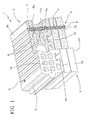
- an insulating building product for buildings in accordance with the present invention has been generally identified with 1.
- the insulating building product 1 comprises a first block 2 preferably consisting of a clay brick. It would be recognised that block 2 can be made of any other building material suitable for performing its load-bearing and insulating function, such as stone, ceramic, terra cotta, concrete, etc.
- a first block 2 consisting of a partially hollow body 3, of the type commonly referred to as "hollow brick” and having a plurality of inner through openings 3a usually oriented in a vertical direction on installation.
- the product 1 further comprises at least one insulating element 4 associated with the first block 2 and made of foamed polyester, for example.
- the insulating element 4 can be made of any material suitable for performing its thermal and/ acoustic-insulation function.
- the insulating element 4 is a plate-shaped element having a respective flat inner surface 4a coupled to an inner surface 2a of the first block 2 and a flat outer surface 4b opposite to the inner surface 2a.
- the first block and the insulating element 4 are steadily linked to each other through suitable engagement means 5.
- the engagement means 5 comprises at least one expansion insert 6 extending in a cavity 7 formed in the first block 2 and in the insulating element 4.
- the engagement means 5 comprises one or more, and preferably at least two, expansion inserts 6 extending in respective cavities 7.
- each cavity 7 is defined by a first hole 7a which is preferably a through hole, formed in the first block 2 and by a second through hole 7b formed in the insulating element 4.
- the first hole 7a extends over the whole width of the first block 2, passing through all openings 3a present along the path of the hole itself.
- the second hole 7b extends in alignment with, and in the continuation of the first hole so as to define a straight cavity 7 therewith.
- holes 7a, 7b can be obliquely oriented through the first block 2 and the insulating element 4.
- the expansion insert 6 has at least one first anchoring portion 8 located at the first hole 7a and a second anchoring portion 9 located at the second hole 7b.
- a plurality of anchoring portions 8 is provided, each of them being disposed in a respective inner opening 3a, while the second anchoring portion 9 is disposed at an end of the expansion insert 6 and extends at least partly on said outer surface 4b of the insulating element 4.
- the first block 2 is made of a solid brick, in which case the first and second anchoring portions 8, 9 are disposed in respective opposite end portions of the expansion insert 6, the first anchoring portion 8 acting against a corresponding outer surface 2b of the first block.
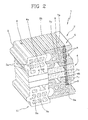
- FIG. 2 Shown in Fig. 2 is a second preferred embodiment of the insulating building product 1.
- the insulating element 4 is interposed between the first block 2 and a second block 11 preferably consisting of a hollow brick too, provided with respective through openings 3a.
- a second block 11 preferably consisting of a hollow brick too, provided with respective through openings 3a.
- solid bricks is also possible in this case too.
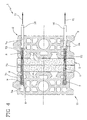
- Cavity 7 is defined by the first hole 7a formed in the first block 2, the second hole 7b formed in the insulating element 4 and a third hole 7c formed in the second block 11, in alignment with, and in the continuation of the first and second holes 7a, 7b.
- holes 7a, 7b and 7c are mutually in register in axial-extension relationship, so as to form a straight cavity 7, and the building product 1 is preferably provided with two or more cavities 7 parallel to each other or oriented in an oblique direction.
- each cavity 7 Extending within each cavity 7 is said expansion insert 6, provided with at least one respective first anchoring portion 8 disposed in the first hole 7a and at least one second anchoring portion 9 disposed in the third hole 7c.
- the expansion insert 6 can be provided with a series of first and second anchoring portions 8, 9, each of which is housed in one of the inner openings 3a of the respective first or second block 2, 11.
- the expansion insert 6 has a plurality of first anchoring portions 8 disposed one after the other, each in a respective opening 3a of the first block 2 and a pair of second anchoring portions 9, each housed in one of the openings 3a of the second block 11, close to the insulating element 4.
- the expansion insert 6 consists of an elongated body having a plurality of bulges 6a defining said anchoring portions 8, 9. These bulges 6a seen in cross-section advantageously have a greater size than the width of the respective first, second and/or third holes 7a, 7b, 7c.
- bulges 6a housed in the inner openings 3a or out of cavities 7 constitute an enlargement of the section of element 6 to prevent mutual sliding between insert 6 and cavity 7.
- the anchoring portions 8, 9 ensure a steady engagement of blocks 2, 11 and of the insulating element 4.
- the expansion insert 6 is preferably made of plastic material, based for example on polypropylene, silicone, chemical glue, chemical cement, or other suitable materials that, when inserted into cavity 7 are in a pasty or semifluid state, to be then submitted to an expansion and hardening process.
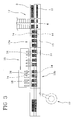
- FIG. 3 there is shown an industrial plant 12 for putting into practice a proceeding for manufacturing the above described building product 1, according to the embodiment seen in Fig. 2 .
- At least one first block 2 which has been previously formed is provided on a conveyor belt 13.
- the insulating element 4 is directly provided on belt 13 and brought into contact with the first and second blocks 2, 11 at the respective inner surfaces 2a, 4a, 11a.
- This step is carried out at an assembling station 13a where respective clamps diagrammatically identified with 14 keep the first block 2 and the insulating element 4 steadily in engagement with each other.
- belt 13 moves blocks 2, 11 and the insulating element 4 to an engagement station 13b where said components are steadily engaged with each other.
- This step is carried out through creation of a pair of through cavities 7 by means of a drilling operation preferably made by one or more drills or other suitable drilling device 15 that by a single operation forms the first, second and/or third holes 7a, 7b, 7c of each cavity 7.
- the first and third holes 7a, 7c can be formed during the step of making blocks 2, 11 before the step of baking them.
- the second hole 7b too can be obtained in the insulating element during manufacture of same.
- cavity 7 is not necessarily a through cavity, because the third hole 7c of the second block 11 can extend until about half way of the second block 11.
- an expansion insert 6 is inserted into each cavity 7 to anchor the blocks and the insulating element 4 together through formation of said anchoring portions 8, 9 in the first and second blocks 2, 11.
- the anchoring portions 8, 9 are made through permanent set of the expansion insert 6 that, as above said, in this step is in a semifluid or pasty state.
- expansion insert 6 takes place by distributing a plastic material in a semifluid or pasty form at the inside of cavity 7. Subsequently, the plastic material is expanded inside cavity 7 and gradually hardened so as to form an elongated stiff body.
- Distribution of the plastic material can be carried out through injection of same by means of a nozzle 16 connected to an extrusion apparatus for example, not shown as known by itself.
- Nozzle 16 is axially insertable into cavity 7 to gradually deliver the plastic material in said cavity 7, which material is preferably heated so that it reaches the semifluid state adapted to enable easy extrusion of same from the nozzle, while keeping a sufficient consistency in order to avoid undesirable percolations that would impair the structural integrity of the insert being made.
- nozzle 16 can be gradually pulled out of cavity 7, preferably at a speed V1 lower than the delivery speed V2 of the plastic material from the nozzle itself.
- V1 lower than the delivery speed V2 of the plastic material from the nozzle itself.
- distribution of the plastic material can be carried out by mixing at least two components close to nozzle 16 or immediately upstream of said nozzle, which components, once in contact with each other, initiate a chemical cross-linking reaction giving rise to hardening.
- the plastic material being distributed may comprise at least two components that, mixed with each other close to nozzle 16 and/or in cavity 7, can react generating gases that expand in the material thus causing a volume increase and forming the anchoring portions 8, 9.
- the building product 1 thus formed is picked up from the conveyor belt 13 by means of a mechanical handling device 17, to be transferred to a subsequent station for packaging of the finished product.
- the step of inserting element 6 is carried out by making the first anchoring portion 8 in one of the inner openings 3a of the first block 2, and making the second anchoring portion 9 on the outer surface 4b of the insulating element 4, in the absence of the second block 3.
- a counter-mould can be moved close to the outer surface 4b of the insulating element, to facilitate moulding of the second anchoring portion.
- the present invention achieves important advantages.
- blocks 2, 11 are engaged with the insulating element 4 without additional elements, made and stored at a time preceding their use.
- the expansion insert 6 delivered in a pasty form into cavity 7, enables a very steady engagement to be ensured between the components, thus eliminating use of additional mechanical hooking members.
- the building product 1 is simpler from a structural point of view and can be manufactured at lower costs.
- the proceeding for manufacturing the building product 1 appears to be very simple and quick because particular care and accuracy is not required during the assembly.
- formation of the hole and delivery of the deformable insert 6 take place while blocks 2, 11 are maintained coupled to the insulating element 4, without any possibility of misalignment between the blocks themselves.
Landscapes
- Engineering & Computer Science (AREA)
- Architecture (AREA)
- General Engineering & Computer Science (AREA)
- Civil Engineering (AREA)
- Structural Engineering (AREA)
- Mechanical Engineering (AREA)
- Building Environments (AREA)
- Polyurethanes Or Polyureas (AREA)
- Wing Frames And Configurations (AREA)
- Casting Or Compression Moulding Of Plastics Or The Like (AREA)
Priority Applications (3)
| Application Number | Priority Date | Filing Date | Title |
|---|---|---|---|
| DE602007008448T DE602007008448D1 (de) | 2007-12-21 | 2007-12-21 | Herstellungsverfahren eines isolierenden Konstruktionsproduktes für Gebäude und so hergestelltes Produkt |
| AT07425820T ATE477422T1 (de) | 2007-12-21 | 2007-12-21 | Herstellungsverfahren eines isolierenden konstruktionsproduktes für gebäude und so hergestelltes produkt |
| EP07425820A EP2072839B1 (de) | 2007-12-21 | 2007-12-21 | Herstellungsverfahren eines isolierenden Konstruktionsproduktes für Gebäude und so hergestelltes Produkt |
Applications Claiming Priority (1)
| Application Number | Priority Date | Filing Date | Title |
|---|---|---|---|
| EP07425820A EP2072839B1 (de) | 2007-12-21 | 2007-12-21 | Herstellungsverfahren eines isolierenden Konstruktionsproduktes für Gebäude und so hergestelltes Produkt |
Publications (2)
| Publication Number | Publication Date |
|---|---|
| EP2072839A1 true EP2072839A1 (de) | 2009-06-24 |
| EP2072839B1 EP2072839B1 (de) | 2010-08-11 |
Family
ID=39870562
Family Applications (1)
| Application Number | Title | Priority Date | Filing Date |
|---|---|---|---|
| EP07425820A Active EP2072839B1 (de) | 2007-12-21 | 2007-12-21 | Herstellungsverfahren eines isolierenden Konstruktionsproduktes für Gebäude und so hergestelltes Produkt |
Country Status (3)
| Country | Link |
|---|---|
| EP (1) | EP2072839B1 (de) |
| AT (1) | ATE477422T1 (de) |
| DE (1) | DE602007008448D1 (de) |
Cited By (1)
| Publication number | Priority date | Publication date | Assignee | Title |
|---|---|---|---|---|
| WO2011080372A1 (es) * | 2010-01-04 | 2011-07-07 | Innovaciones Cerámicas Ediam, S.L. | Bloque de cerramiento perforado horizontalmente |
Citations (3)
| Publication number | Priority date | Publication date | Assignee | Title |
|---|---|---|---|---|
| DE29617495U1 (de) * | 1996-09-13 | 1996-11-28 | Palacky, Alois, Zasova | Spreize |
| EP1085137A1 (de) | 1999-09-08 | 2001-03-21 | Fornaci Di Masserano Bruno Tarello S.R.L. | Wärmedämmender Baublock |
| DE102006021513A1 (de) * | 2006-05-04 | 2007-11-15 | Deutsche Amphibolin-Werke Von Robert Murjahn Stiftung & Co Kg | Verfahren zur Befestigung eines flächigen Elementes an einem flächigen Träger, sowie Dübel und Schäum- und Druckgasvorrichtung zur Durchführung des Verfahrens |
-
2007
- 2007-12-21 AT AT07425820T patent/ATE477422T1/de not_active IP Right Cessation
- 2007-12-21 EP EP07425820A patent/EP2072839B1/de active Active
- 2007-12-21 DE DE602007008448T patent/DE602007008448D1/de active Active
Patent Citations (3)
| Publication number | Priority date | Publication date | Assignee | Title |
|---|---|---|---|---|
| DE29617495U1 (de) * | 1996-09-13 | 1996-11-28 | Palacky, Alois, Zasova | Spreize |
| EP1085137A1 (de) | 1999-09-08 | 2001-03-21 | Fornaci Di Masserano Bruno Tarello S.R.L. | Wärmedämmender Baublock |
| DE102006021513A1 (de) * | 2006-05-04 | 2007-11-15 | Deutsche Amphibolin-Werke Von Robert Murjahn Stiftung & Co Kg | Verfahren zur Befestigung eines flächigen Elementes an einem flächigen Träger, sowie Dübel und Schäum- und Druckgasvorrichtung zur Durchführung des Verfahrens |
Cited By (2)
| Publication number | Priority date | Publication date | Assignee | Title |
|---|---|---|---|---|
| WO2011080372A1 (es) * | 2010-01-04 | 2011-07-07 | Innovaciones Cerámicas Ediam, S.L. | Bloque de cerramiento perforado horizontalmente |
| ES2364168A1 (es) * | 2010-01-04 | 2011-08-26 | Innovaciones Cerámicas Ediam, Sl | Bloque de cerramiento perforado horizontalmente. |
Also Published As
| Publication number | Publication date |
|---|---|
| EP2072839B1 (de) | 2010-08-11 |
| DE602007008448D1 (de) | 2010-09-23 |
| ATE477422T1 (de) | 2010-08-15 |
Similar Documents
| Publication | Publication Date | Title |
|---|---|---|
| EP1819887B1 (de) | Isolierender betonblock | |
| US7415805B2 (en) | Wall system with masonry external surface and associated method | |
| US20190093355A1 (en) | Insulated concrete panel form and method of making same | |
| AU2010292822B2 (en) | High strength adjustable vertical concrete form | |
| US6240693B1 (en) | Interlocking and insulating form pattern assembly for creating a wall structure for receiving poured concrete and method for producing a form pattern assembly | |
| US20060242921A1 (en) | Masonry cavity wall construction and method of making same | |
| US20140102027A1 (en) | Web structure for knockdown insulating concrete block | |
| EP1002911A3 (de) | Modulares Betonkonstruktionssystem | |
| US10753109B2 (en) | Concrete form tie, and concrete formwork comprising same | |
| EP1926865B1 (de) | Modulare elemente, netzwerk, stützstruktur, konstruktion | |
| WO2010109270A1 (en) | Proceeding for manufacturing an insulating building product for buildings and building product thereby obtained | |
| EP2072839B1 (de) | Herstellungsverfahren eines isolierenden Konstruktionsproduktes für Gebäude und so hergestelltes Produkt | |
| CN101220617B (zh) | 一种现场发泡的保温墙体及其施工方法 | |
| JP2019038236A (ja) | コンクリートパネル積層体およびその製造法並びに型枠 | |
| US9228344B2 (en) | System of disposable moulds used to make-up modular formworks to build-up concrete walls featuring complex shapes | |
| CN215483056U (zh) | 一种装配式砖胎模 | |
| EP2920380B1 (de) | Verfahren zur herstellung von mauerwerk und mit solch einem herstellungsverfahren hergestelltes mauerwerk, system zur herstellung des mauerwerks und verwendung solch eines systems | |
| FI97634C (fi) | Rakennuselementti | |
| JP3191198B2 (ja) | リブ付きスラブ基盤の製造方法 | |
| SI26557A2 (sl) | Montažni gradbeni blok z izdelano toplotno izolacijo za fasado | |
| JPS60236707A (ja) | 形材 | |
| CN119427519A (zh) | 一种砖墙饰面花饰预制反打模板及其施工方法 | |
| JP2867106B2 (ja) | コンクリート製品用の表面装飾材、それを取り付けたコンクリート製品、およびそのコンクリート製品の製造方法 | |
| WO2004057124A1 (en) | Building element, especially for erecting vertical and horizontal structures | |
| TW200637956A (en) | Structure of concrete board and manufacturing method thereof |
Legal Events
| Date | Code | Title | Description |
|---|---|---|---|
| PUAI | Public reference made under article 153(3) epc to a published international application that has entered the european phase |
Free format text: ORIGINAL CODE: 0009012 |
|
| 17P | Request for examination filed |
Effective date: 20081128 |
|
| AK | Designated contracting states |
Kind code of ref document: A1 Designated state(s): AT BE BG CH CY CZ DE DK EE ES FI FR GB GR HU IE IS IT LI LT LU LV MC MT NL PL PT RO SE SI SK TR |
|
| AX | Request for extension of the european patent |
Extension state: AL BA HR MK RS |
|
| 17Q | First examination report despatched |
Effective date: 20090824 |
|
| AKX | Designation fees paid |
Designated state(s): AT BE BG CH CY CZ DE DK EE ES FI FR GB GR HU IE IS IT LI LT LU LV MC MT NL PL PT RO SE SI SK TR |
|
| AXX | Extension fees paid |
Extension state: BA Payment date: 20090325 Extension state: AL Payment date: 20090325 Extension state: HR Payment date: 20090325 Extension state: RS Payment date: 20090325 |
|
| GRAP | Despatch of communication of intention to grant a patent |
Free format text: ORIGINAL CODE: EPIDOSNIGR1 |
|
| GRAS | Grant fee paid |
Free format text: ORIGINAL CODE: EPIDOSNIGR3 |
|
| GRAA | (expected) grant |
Free format text: ORIGINAL CODE: 0009210 |
|
| AK | Designated contracting states |
Kind code of ref document: B1 Designated state(s): AT BE BG CH CY CZ DE DK EE ES FI FR GB GR HU IE IS IT LI LT LU LV MC MT NL PL PT RO SE SI SK TR |
|
| AX | Request for extension of the european patent |
Extension state: AL BA HR RS |
|
| REG | Reference to a national code |
Ref country code: GB Ref legal event code: FG4D |
|
| REG | Reference to a national code |
Ref country code: CH Ref legal event code: EP |
|
| REG | Reference to a national code |
Ref country code: IE Ref legal event code: FG4D |
|
| REF | Corresponds to: |
Ref document number: 602007008448 Country of ref document: DE Date of ref document: 20100923 Kind code of ref document: P |
|
| REG | Reference to a national code |
Ref country code: CH Ref legal event code: NV Representative=s name: VALIPAT / PATENTS.EU S.A. C/O GUINNARD SA |
|
| REG | Reference to a national code |
Ref country code: NL Ref legal event code: VDEP Effective date: 20100811 |
|
| LTIE | Lt: invalidation of european patent or patent extension |
Effective date: 20100811 |
|
| PG25 | Lapsed in a contracting state [announced via postgrant information from national office to epo] |
Ref country code: AT Free format text: LAPSE BECAUSE OF FAILURE TO SUBMIT A TRANSLATION OF THE DESCRIPTION OR TO PAY THE FEE WITHIN THE PRESCRIBED TIME-LIMIT Effective date: 20100811 Ref country code: FI Free format text: LAPSE BECAUSE OF FAILURE TO SUBMIT A TRANSLATION OF THE DESCRIPTION OR TO PAY THE FEE WITHIN THE PRESCRIBED TIME-LIMIT Effective date: 20100811 Ref country code: NL Free format text: LAPSE BECAUSE OF FAILURE TO SUBMIT A TRANSLATION OF THE DESCRIPTION OR TO PAY THE FEE WITHIN THE PRESCRIBED TIME-LIMIT Effective date: 20100811 Ref country code: LT Free format text: LAPSE BECAUSE OF FAILURE TO SUBMIT A TRANSLATION OF THE DESCRIPTION OR TO PAY THE FEE WITHIN THE PRESCRIBED TIME-LIMIT Effective date: 20100811 |
|
| PG25 | Lapsed in a contracting state [announced via postgrant information from national office to epo] |
Ref country code: PT Free format text: LAPSE BECAUSE OF FAILURE TO SUBMIT A TRANSLATION OF THE DESCRIPTION OR TO PAY THE FEE WITHIN THE PRESCRIBED TIME-LIMIT Effective date: 20101213 Ref country code: PL Free format text: LAPSE BECAUSE OF FAILURE TO SUBMIT A TRANSLATION OF THE DESCRIPTION OR TO PAY THE FEE WITHIN THE PRESCRIBED TIME-LIMIT Effective date: 20100811 Ref country code: IS Free format text: LAPSE BECAUSE OF FAILURE TO SUBMIT A TRANSLATION OF THE DESCRIPTION OR TO PAY THE FEE WITHIN THE PRESCRIBED TIME-LIMIT Effective date: 20101211 Ref country code: CY Free format text: LAPSE BECAUSE OF FAILURE TO SUBMIT A TRANSLATION OF THE DESCRIPTION OR TO PAY THE FEE WITHIN THE PRESCRIBED TIME-LIMIT Effective date: 20100811 Ref country code: BG Free format text: LAPSE BECAUSE OF FAILURE TO SUBMIT A TRANSLATION OF THE DESCRIPTION OR TO PAY THE FEE WITHIN THE PRESCRIBED TIME-LIMIT Effective date: 20101111 Ref country code: SI Free format text: LAPSE BECAUSE OF FAILURE TO SUBMIT A TRANSLATION OF THE DESCRIPTION OR TO PAY THE FEE WITHIN THE PRESCRIBED TIME-LIMIT Effective date: 20100811 |
|
| PG25 | Lapsed in a contracting state [announced via postgrant information from national office to epo] |
Ref country code: SE Free format text: LAPSE BECAUSE OF FAILURE TO SUBMIT A TRANSLATION OF THE DESCRIPTION OR TO PAY THE FEE WITHIN THE PRESCRIBED TIME-LIMIT Effective date: 20100811 Ref country code: GR Free format text: LAPSE BECAUSE OF FAILURE TO SUBMIT A TRANSLATION OF THE DESCRIPTION OR TO PAY THE FEE WITHIN THE PRESCRIBED TIME-LIMIT Effective date: 20101112 Ref country code: LV Free format text: LAPSE BECAUSE OF FAILURE TO SUBMIT A TRANSLATION OF THE DESCRIPTION OR TO PAY THE FEE WITHIN THE PRESCRIBED TIME-LIMIT Effective date: 20100811 Ref country code: BE Free format text: LAPSE BECAUSE OF FAILURE TO SUBMIT A TRANSLATION OF THE DESCRIPTION OR TO PAY THE FEE WITHIN THE PRESCRIBED TIME-LIMIT Effective date: 20100811 |
|
| PG25 | Lapsed in a contracting state [announced via postgrant information from national office to epo] |
Ref country code: DK Free format text: LAPSE BECAUSE OF FAILURE TO SUBMIT A TRANSLATION OF THE DESCRIPTION OR TO PAY THE FEE WITHIN THE PRESCRIBED TIME-LIMIT Effective date: 20100811 |
|
| PG25 | Lapsed in a contracting state [announced via postgrant information from national office to epo] |
Ref country code: EE Free format text: LAPSE BECAUSE OF FAILURE TO SUBMIT A TRANSLATION OF THE DESCRIPTION OR TO PAY THE FEE WITHIN THE PRESCRIBED TIME-LIMIT Effective date: 20100811 Ref country code: RO Free format text: LAPSE BECAUSE OF FAILURE TO SUBMIT A TRANSLATION OF THE DESCRIPTION OR TO PAY THE FEE WITHIN THE PRESCRIBED TIME-LIMIT Effective date: 20100811 Ref country code: SK Free format text: LAPSE BECAUSE OF FAILURE TO SUBMIT A TRANSLATION OF THE DESCRIPTION OR TO PAY THE FEE WITHIN THE PRESCRIBED TIME-LIMIT Effective date: 20100811 Ref country code: CZ Free format text: LAPSE BECAUSE OF FAILURE TO SUBMIT A TRANSLATION OF THE DESCRIPTION OR TO PAY THE FEE WITHIN THE PRESCRIBED TIME-LIMIT Effective date: 20100811 |
|
| PLBE | No opposition filed within time limit |
Free format text: ORIGINAL CODE: 0009261 |
|
| STAA | Information on the status of an ep patent application or granted ep patent |
Free format text: STATUS: NO OPPOSITION FILED WITHIN TIME LIMIT |
|
| PG25 | Lapsed in a contracting state [announced via postgrant information from national office to epo] |
Ref country code: ES Free format text: LAPSE BECAUSE OF FAILURE TO SUBMIT A TRANSLATION OF THE DESCRIPTION OR TO PAY THE FEE WITHIN THE PRESCRIBED TIME-LIMIT Effective date: 20101122 |
|
| 26N | No opposition filed |
Effective date: 20110512 |
|
| PG25 | Lapsed in a contracting state [announced via postgrant information from national office to epo] |
Ref country code: MC Free format text: LAPSE BECAUSE OF NON-PAYMENT OF DUE FEES Effective date: 20101231 |
|
| REG | Reference to a national code |
Ref country code: DE Ref legal event code: R097 Ref document number: 602007008448 Country of ref document: DE Effective date: 20110512 |
|
| PG25 | Lapsed in a contracting state [announced via postgrant information from national office to epo] |
Ref country code: IE Free format text: LAPSE BECAUSE OF NON-PAYMENT OF DUE FEES Effective date: 20101221 |
|
| PG25 | Lapsed in a contracting state [announced via postgrant information from national office to epo] |
Ref country code: IT Free format text: LAPSE BECAUSE OF NON-PAYMENT OF DUE FEES Effective date: 20101221 Ref country code: MT Free format text: LAPSE BECAUSE OF FAILURE TO SUBMIT A TRANSLATION OF THE DESCRIPTION OR TO PAY THE FEE WITHIN THE PRESCRIBED TIME-LIMIT Effective date: 20100811 |
|
| PGFP | Annual fee paid to national office [announced via postgrant information from national office to epo] |
Ref country code: CH Payment date: 20111230 Year of fee payment: 5 |
|
| PGFP | Annual fee paid to national office [announced via postgrant information from national office to epo] |
Ref country code: FR Payment date: 20120111 Year of fee payment: 5 |
|
| PGFP | Annual fee paid to national office [announced via postgrant information from national office to epo] |
Ref country code: DE Payment date: 20120229 Year of fee payment: 5 |
|
| GBPC | Gb: european patent ceased through non-payment of renewal fee |
Effective date: 20111221 |
|
| PG25 | Lapsed in a contracting state [announced via postgrant information from national office to epo] |
Ref country code: LU Free format text: LAPSE BECAUSE OF NON-PAYMENT OF DUE FEES Effective date: 20101221 Ref country code: HU Free format text: LAPSE BECAUSE OF FAILURE TO SUBMIT A TRANSLATION OF THE DESCRIPTION OR TO PAY THE FEE WITHIN THE PRESCRIBED TIME-LIMIT Effective date: 20110212 |
|
| PG25 | Lapsed in a contracting state [announced via postgrant information from national office to epo] |
Ref country code: TR Free format text: LAPSE BECAUSE OF FAILURE TO SUBMIT A TRANSLATION OF THE DESCRIPTION OR TO PAY THE FEE WITHIN THE PRESCRIBED TIME-LIMIT Effective date: 20100811 Ref country code: GB Free format text: LAPSE BECAUSE OF NON-PAYMENT OF DUE FEES Effective date: 20111221 |
|
| REG | Reference to a national code |
Ref country code: CH Ref legal event code: PL |
|
| REG | Reference to a national code |
Ref country code: FR Ref legal event code: ST Effective date: 20130830 |
|
| REG | Reference to a national code |
Ref country code: DE Ref legal event code: R119 Ref document number: 602007008448 Country of ref document: DE Effective date: 20130702 |
|
| PG25 | Lapsed in a contracting state [announced via postgrant information from national office to epo] |
Ref country code: LI Free format text: LAPSE BECAUSE OF NON-PAYMENT OF DUE FEES Effective date: 20121231 Ref country code: CH Free format text: LAPSE BECAUSE OF NON-PAYMENT OF DUE FEES Effective date: 20121231 Ref country code: DE Free format text: LAPSE BECAUSE OF NON-PAYMENT OF DUE FEES Effective date: 20130702 |
|
| PG25 | Lapsed in a contracting state [announced via postgrant information from national office to epo] |
Ref country code: FR Free format text: LAPSE BECAUSE OF NON-PAYMENT OF DUE FEES Effective date: 20130102 |
|
| PGFP | Annual fee paid to national office [announced via postgrant information from national office to epo] |
Ref country code: IT Payment date: 20171220 Year of fee payment: 11 |
|
| PG25 | Lapsed in a contracting state [announced via postgrant information from national office to epo] |
Ref country code: IT Free format text: LAPSE BECAUSE OF NON-PAYMENT OF DUE FEES Effective date: 20181221 |