EP2073192A1 - Dispositif d'affichage, procédé d'affichage, support d'enregistrement d'informations et programme - Google Patents
Dispositif d'affichage, procédé d'affichage, support d'enregistrement d'informations et programme Download PDFInfo
- Publication number
- EP2073192A1 EP2073192A1 EP07829700A EP07829700A EP2073192A1 EP 2073192 A1 EP2073192 A1 EP 2073192A1 EP 07829700 A EP07829700 A EP 07829700A EP 07829700 A EP07829700 A EP 07829700A EP 2073192 A1 EP2073192 A1 EP 2073192A1
- Authority
- EP
- European Patent Office
- Prior art keywords
- text
- graphic
- enlargement
- image
- display screen
- Prior art date
- Legal status (The legal status is an assumption and is not a legal conclusion. Google has not performed a legal analysis and makes no representation as to the accuracy of the status listed.)
- Withdrawn
Links
Images


Classifications
-
- G—PHYSICS
- G09—EDUCATION; CRYPTOGRAPHY; DISPLAY; ADVERTISING; SEALS
- G09G—ARRANGEMENTS OR CIRCUITS FOR CONTROL OF INDICATING DEVICES USING STATIC MEANS TO PRESENT VARIABLE INFORMATION
- G09G5/00—Control arrangements or circuits for visual indicators common to cathode-ray tube indicators and other visual indicators
- G09G5/36—Control arrangements or circuits for visual indicators common to cathode-ray tube indicators and other visual indicators characterised by the display of a graphic pattern, e.g. using an all-points-addressable [APA] memory
-
- G—PHYSICS
- G09—EDUCATION; CRYPTOGRAPHY; DISPLAY; ADVERTISING; SEALS
- G09G—ARRANGEMENTS OR CIRCUITS FOR CONTROL OF INDICATING DEVICES USING STATIC MEANS TO PRESENT VARIABLE INFORMATION
- G09G5/00—Control arrangements or circuits for visual indicators common to cathode-ray tube indicators and other visual indicators
- G09G5/22—Control arrangements or circuits for visual indicators common to cathode-ray tube indicators and other visual indicators characterised by the display of characters or indicia using display control signals derived from coded signals representing the characters or indicia, e.g. with a character-code memory
- G09G5/222—Control of the character-code memory
- G09G5/227—Resolution modifying circuits, e.g. variable screen formats, resolution change between memory contents and display screen
-
- G—PHYSICS
- G06—COMPUTING OR CALCULATING; COUNTING
- G06F—ELECTRIC DIGITAL DATA PROCESSING
- G06F3/00—Input arrangements for transferring data to be processed into a form capable of being handled by the computer; Output arrangements for transferring data from processing unit to output unit, e.g. interface arrangements
- G06F3/01—Input arrangements or combined input and output arrangements for interaction between user and computer
- G06F3/03—Arrangements for converting the position or the displacement of a member into a coded form
- G06F3/033—Pointing devices displaced or positioned by the user, e.g. mice, trackballs, pens or joysticks; Accessories therefor
- G06F3/0346—Pointing devices displaced or positioned by the user, e.g. mice, trackballs, pens or joysticks; Accessories therefor with detection of the device orientation or free movement in a three-dimensional [3D] space, e.g. 3D mice, 6-DOF [six degrees of freedom] pointers using gyroscopes, accelerometers or tilt-sensors
-
- G—PHYSICS
- G06—COMPUTING OR CALCULATING; COUNTING
- G06F—ELECTRIC DIGITAL DATA PROCESSING
- G06F3/00—Input arrangements for transferring data to be processed into a form capable of being handled by the computer; Output arrangements for transferring data from processing unit to output unit, e.g. interface arrangements
- G06F3/01—Input arrangements or combined input and output arrangements for interaction between user and computer
- G06F3/048—Interaction techniques based on graphical user interfaces [GUI]
- G06F3/0481—Interaction techniques based on graphical user interfaces [GUI] based on specific properties of the displayed interaction object or a metaphor-based environment, e.g. interaction with desktop elements like windows or icons, or assisted by a cursor's changing behaviour or appearance
-
- G—PHYSICS
- G06—COMPUTING OR CALCULATING; COUNTING
- G06F—ELECTRIC DIGITAL DATA PROCESSING
- G06F3/00—Input arrangements for transferring data to be processed into a form capable of being handled by the computer; Output arrangements for transferring data from processing unit to output unit, e.g. interface arrangements
- G06F3/01—Input arrangements or combined input and output arrangements for interaction between user and computer
- G06F3/048—Interaction techniques based on graphical user interfaces [GUI]
- G06F3/0481—Interaction techniques based on graphical user interfaces [GUI] based on specific properties of the displayed interaction object or a metaphor-based environment, e.g. interaction with desktop elements like windows or icons, or assisted by a cursor's changing behaviour or appearance
- G06F3/04815—Interaction with a metaphor-based environment or interaction object displayed as three-dimensional [3D], e.g. changing the user viewpoint with respect to the environment or object
-
- G—PHYSICS
- G09—EDUCATION; CRYPTOGRAPHY; DISPLAY; ADVERTISING; SEALS
- G09G—ARRANGEMENTS OR CIRCUITS FOR CONTROL OF INDICATING DEVICES USING STATIC MEANS TO PRESENT VARIABLE INFORMATION
- G09G5/00—Control arrangements or circuits for visual indicators common to cathode-ray tube indicators and other visual indicators
- G09G5/36—Control arrangements or circuits for visual indicators common to cathode-ray tube indicators and other visual indicators characterised by the display of a graphic pattern, e.g. using an all-points-addressable [APA] memory
- G09G5/37—Details of the operation on graphic patterns
- G09G5/377—Details of the operation on graphic patterns for mixing or overlaying two or more graphic patterns
-
- G—PHYSICS
- G09—EDUCATION; CRYPTOGRAPHY; DISPLAY; ADVERTISING; SEALS
- G09G—ARRANGEMENTS OR CIRCUITS FOR CONTROL OF INDICATING DEVICES USING STATIC MEANS TO PRESENT VARIABLE INFORMATION
- G09G5/00—Control arrangements or circuits for visual indicators common to cathode-ray tube indicators and other visual indicators
- G09G5/36—Control arrangements or circuits for visual indicators common to cathode-ray tube indicators and other visual indicators characterised by the display of a graphic pattern, e.g. using an all-points-addressable [APA] memory
- G09G5/38—Control arrangements or circuits for visual indicators common to cathode-ray tube indicators and other visual indicators characterised by the display of a graphic pattern, e.g. using an all-points-addressable [APA] memory with means for controlling the display position
-
- H—ELECTRICITY
- H04—ELECTRIC COMMUNICATION TECHNIQUE
- H04N—PICTORIAL COMMUNICATION, e.g. TELEVISION
- H04N21/00—Selective content distribution, e.g. interactive television or video on demand [VOD]
- H04N21/40—Client devices specifically adapted for the reception of or interaction with content, e.g. set-top-box [STB]; Operations thereof
- H04N21/41—Structure of client; Structure of client peripherals
- H04N21/422—Input-only peripherals, i.e. input devices connected to specially adapted client devices, e.g. global positioning system [GPS]
- H04N21/42204—User interfaces specially adapted for controlling a client device through a remote control device; Remote control devices therefor
-
- H—ELECTRICITY
- H04—ELECTRIC COMMUNICATION TECHNIQUE
- H04N—PICTORIAL COMMUNICATION, e.g. TELEVISION
- H04N21/00—Selective content distribution, e.g. interactive television or video on demand [VOD]
- H04N21/40—Client devices specifically adapted for the reception of or interaction with content, e.g. set-top-box [STB]; Operations thereof
- H04N21/47—End-user applications
- H04N21/472—End-user interface for requesting content, additional data or services; End-user interface for interacting with content, e.g. for content reservation or setting reminders, for requesting event notification, for manipulating displayed content
- H04N21/4728—End-user interface for requesting content, additional data or services; End-user interface for interacting with content, e.g. for content reservation or setting reminders, for requesting event notification, for manipulating displayed content for selecting a Region Of Interest [ROI], e.g. for requesting a higher resolution version of a selected region
-
- G—PHYSICS
- G09—EDUCATION; CRYPTOGRAPHY; DISPLAY; ADVERTISING; SEALS
- G09G—ARRANGEMENTS OR CIRCUITS FOR CONTROL OF INDICATING DEVICES USING STATIC MEANS TO PRESENT VARIABLE INFORMATION
- G09G2340/00—Aspects of display data processing
- G09G2340/04—Changes in size, position or resolution of an image
- G09G2340/045—Zooming at least part of an image, i.e. enlarging it or shrinking it
-
- G—PHYSICS
- G09—EDUCATION; CRYPTOGRAPHY; DISPLAY; ADVERTISING; SEALS
- G09G—ARRANGEMENTS OR CIRCUITS FOR CONTROL OF INDICATING DEVICES USING STATIC MEANS TO PRESENT VARIABLE INFORMATION
- G09G2340/00—Aspects of display data processing
- G09G2340/14—Solving problems related to the presentation of information to be displayed
-
- G—PHYSICS
- G09—EDUCATION; CRYPTOGRAPHY; DISPLAY; ADVERTISING; SEALS
- G09G—ARRANGEMENTS OR CIRCUITS FOR CONTROL OF INDICATING DEVICES USING STATIC MEANS TO PRESENT VARIABLE INFORMATION
- G09G5/00—Control arrangements or circuits for visual indicators common to cathode-ray tube indicators and other visual indicators
- G09G5/14—Display of multiple viewports
-
- G—PHYSICS
- G09—EDUCATION; CRYPTOGRAPHY; DISPLAY; ADVERTISING; SEALS
- G09G—ARRANGEMENTS OR CIRCUITS FOR CONTROL OF INDICATING DEVICES USING STATIC MEANS TO PRESENT VARIABLE INFORMATION
- G09G5/00—Control arrangements or circuits for visual indicators common to cathode-ray tube indicators and other visual indicators
- G09G5/36—Control arrangements or circuits for visual indicators common to cathode-ray tube indicators and other visual indicators characterised by the display of a graphic pattern, e.g. using an all-points-addressable [APA] memory
- G09G5/37—Details of the operation on graphic patterns
- G09G5/373—Details of the operation on graphic patterns for modifying the size of the graphic pattern
-
- H—ELECTRICITY
- H04—ELECTRIC COMMUNICATION TECHNIQUE
- H04N—PICTORIAL COMMUNICATION, e.g. TELEVISION
- H04N21/00—Selective content distribution, e.g. interactive television or video on demand [VOD]
- H04N21/40—Client devices specifically adapted for the reception of or interaction with content, e.g. set-top-box [STB]; Operations thereof
- H04N21/41—Structure of client; Structure of client peripherals
- H04N21/422—Input-only peripherals, i.e. input devices connected to specially adapted client devices, e.g. global positioning system [GPS]
- H04N21/42204—User interfaces specially adapted for controlling a client device through a remote control device; Remote control devices therefor
- H04N21/42206—User interfaces specially adapted for controlling a client device through a remote control device; Remote control devices therefor characterized by hardware details
- H04N21/42222—Additional components integrated in the remote control device, e.g. timer, speaker, sensors for detecting position, direction or movement of the remote control, microphone or battery charging device
Definitions
- the present invention relates to a display device and a display method that are preferable for changing the size of text and graphics to be displayed on the screen according to the distance between the display screen and the user looking thereat as well as for enhancing the viewability thereof. Also, the present invention relates to a program for implementing the above device and method on a computer as well as a computer-readable information recording medium recording the program.
- Patent Literature 1 proposes a technique to correct trapezoidal distortions on a liquid crystal projector using a prism.
- Adjustment of the size of a display screen or correction of the shape thereof is in general performed by a user who is actually looking at the display screen.
- Adjustment of the size of a display screen or correction of trapezoidal distortions can be seen as one form of coordinate conversion, and calculation therefor can be performed by computer.
- one perspective and projection technique for three-dimensional (3D) graphics defines, as the display position of the object, the position where the line connecting the viewpoint and an object in a virtual 3D space intersects the projection plane.
- 3D three-dimensional
- the display screen of a game, etc. usually displays graphical images (i.e., images illustrating a virtual world by presenting the background, characters, etc.) and graphical images (i.e., images showing the text of character speeches, explanations of the game, etc.) which are often superimposed in the form of a window display.
- graphical images i.e., images illustrating a virtual world by presenting the background, characters, etc.
- graphical images i.e., images showing the text of character speeches, explanations of the game, etc.
- the player in order to adjust the sizes of graphical and text-containing images to be displayed on the display screen, the player in general adjusted the size of the display screen by properly constructing settings of the aspect ratio (e.g., 4:3 or 16:9) and the display resolution of the display screen.
- the aspect ratio e.g., 4:3 or 16:9
- the viewability of the user looking at enlarged/contracted text-containing images differs from that of the user looking at enlarged/contracted graphical images.
- Contracting graphical images to a certain extent does not result in significantly reducing the amount of information to be conveyed.
- the text is blurred and become less legible.
- Another problem is the situation where the user is watching the display screen of a large-screen television from a close range.
- the graphic can occupy the entire field of view and obstruct the user from viewing the whole screen.
- Graphics in the field of view can look as if they are distorted in an unnatural manner, and "jaggies" of dots - artifacts on images - can become visibly noticeable.
- the present invention by solving the above problems, is directed to providing a display device and a display method that are preferable for changing the size of text and graphics to be displayed on the display screen according to the distance between the display screen and the user looking thereat as well as for enhancing the viewability thereof. Also, the present invention is directed to providing a program for implementing the above method and device on a computer as well as a computer-readable information recording medium recording the program.
- a display device in accordance with a first aspect of the present invention comprises a displaying unit, a measuring unit, an enlargement/contraction ratio acquiring unit, a text-containing image generating unit, a graphic image generating unit, and a control unit. These units have the features described below.
- the displaying unit When the displaying unit is provided with a plurality of images, each of which is paired with an enlargement/contraction ratio, the images are enlarged/contracted at their respective ratios to be displayed on the display screen.
- the displaying unit performs the so-called window display.
- the displaying unit displays a plurality of images on the display screen, the images can be enlarged/contracted for display. As described later, it is common to set the display position of the images using the displaying unit. When one image overlaps another image, which one must be above and below is determined for overlay processing, whereby the image above covers the one below.
- the display screen of a television is used.
- the measuring unit measures the distance between the display screen and the user looking at an image displayed thereon.
- game devices employ a technique to measure the player position based on the principle of triangulation using infrared light, supersonic waves, and a CCD camera in order to determine the positional relationship between the player controller and the television (i.e., the display screen). This technique is commonly employed in the measuring unit.
- infrared light emitted from the controller is received by a plurality of infrared CCD cameras installed on the television to find the path of the infrared light so as to identify the position of the controller.
- supersonic waves are generated from the controller, and a plurality of supersonic wave microphones detect phase differences between the supersonic waves that have reached thereat.
- the enlargement/contraction ratio acquiring unit acquires graphic enlargement/contraction and text enlargement/contraction ratios, both of which are determined based on the measured distance.
- One of the characteristics of the present invention is that a graphic enlargement/contraction ratio for displaying a graphic on the display screen and a text enlargement/contraction ratio for displaying text thereon are separately acquired.
- the graphic enlargement/contraction ratio is set to increase.
- the rate of change in the text enlargement/contraction ratio is set to be smaller than that in the graphic enlargement/contraction ratio.
- the rate of change in the text enlargement/contraction ratio is smaller than that in the graphic enlargement/contraction ratio.
- the change in the size of a text-containing image is smaller than that of a graphic image.
- the text-containing image generating unit generates a text-containing image with a specific size, which shows a string to be presented to the user.
- text with a specific font size is generally arranged to generate a text-containing image representing a string.
- strings of character speeches and the like are presented in a text-containing image.
- the graphic image generating unit generates a graphic image with a specific size, which is a graphic to be presented to the user.
- the graphic image generating unit generates a 3D graphic image which represents the perspective and projection of a virtual space viewed from a specific viewpoint in a specific line of sight direction. Also, the graphic image generating unit displays (superimposes, if necessary) the background image and a character image in order to generate a two-dimensional (2D) graphic image representing the character at a certain location. A graphic image is also typically generated to fit in a graphic display window with a specific size.
- control unit controls the displaying unit. More specifically, the control unit provides the displaying unit with a pair of a generated graphic image and an acquired graphic enlargement/contraction ratio as well as a pair of a generated text-containing image and an acquired text enlargement/contraction ratio.
- the control unit provides the displaying unit with a pair of a graphic image and a graphic enlargement/contraction ratio and a pair of a text-containing image and a text enlargement/contraction ratio. Then the displaying unit displays the graphic and text-containing images at their respective enlargement/contraction ratios on the display screen.
- an overlay display is usually made such that the latter image is on the former.
- the enlargement/contraction ratio of a graphic image is processed for display separately from that of a text-containing image, based on the distance between the user and the display screen.
- the size of a graphic image can be changed quickly in response to a change in the aforesaid distance so that the user does not feel strange, and the display size of a text-containing image is changed slowly so as to enhance the viewability.
- the text enlargement/contraction ratio acquired on a display device according to the present invention can be set constant regardless of the measured distance.
- the present invention relates to the above preferred embodiment of the invention. Even if the distance between the user and the display screen changes, a text-containing image is displayed at a constant size. Therefore, the size of text does not change.
- the graphic enlargement/contraction ratio can be, in a range between specified lower and upper limits, set proportional to the measured distance.
- the present invention relates to the above preferred embodiment of the invention.
- the ratio of the area of a character displayed on the display screen to the area of the field of view of the user is constant.
- this embodiment is applied to a gun action game, etc., the ratio of the area occupied by the target to the area of the field of view of the user is constant.
- the displaying unit when the displaying unit is further provided with the display positions of images, the displaying unit displays the images that are enlarged/contracted at given enlargement/contraction ratios at the display positions on the display screen.
- the control unit controls the displaying unit so that the whole display regions of graphic and text-containing images fit within the display screen.
- the control unit provides the displaying unit with the display positions of the graphic and text-containing images on the display screen, so that the area of overlap between the display regions of the graphic and text-containing images decreases on the display screen.
- the present invention is directed to addressing this kind of situation.
- Display position control can be performed so that the whole regions of graphic and text-containing images are displayed on the display screen, while addressing the need to decrease the area where these images overlap.
- the amount of image information provided to the user can be increased as much as possible.
- the control unit sets on the display screen a predetermined graphic reference position, a predetermined graphic reference direction, a predetermined text reference position, and a predetermined text reference direction, so that an obtuse angle is formed between the graphic reference direction and the text reference direction.
- the control unit controls the displaying unit by providing the displaying unit with the display positions of graphic and text-containing images on the display screen.
- the present invention relates to the above preferred embodiment of the invention. As the user moves nearer to the display screen, the distance increases between the display positions of graphic and text-containing images. As the user moves farther from the display screen, the distance therebetween decreases.
- the user can easily find out whether his/her distance to the display screen has changed from the previous game to the current game.
- the user can easily find his/her distance to the display screen.
- a display method comprises a displaying step, a measuring step, an enlargement/contraction ratio acquiring step, a text-containing image generating step, a graphic image generating step, and a control step. These steps have the features described below.
- the display method according to the present invention is typically performed by a display device comprising a displaying unit, a measuring unit, an enlargement/contraction ratio acquiring unit, a text-containing image generating unit, a graphic image generating unit, and a control unit.
- a display device comprising a displaying unit, a measuring unit, an enlargement/contraction ratio acquiring unit, a text-containing image generating unit, a graphic image generating unit, and a control unit.
- a typical embodiment is referred to in the explanations to follow.
- the displaying unit When a plurality of images, each of which is paired with an enlargement/contraction ratio, are provided in the displaying step, the displaying unit enlarges/contracts the images at their respective enlargement/contraction ratios and displays the images on the display screen.
- the measuring unit measures the distance between the display screen and the user looking at an image displayed thereon.
- the enlargement/contraction ratio acquiring unit acquires text and graphic enlargement/contraction ratios, which are determined according to the measured distance.
- the text-containing image generating unit In the text-containing image generating step, the text-containing image generating unit generates a text-containing image with a specific size showing a string to be presented to the user.
- the graphic image generating unit In the graphic image generating step, the graphic image generating unit generates a graphic image with a specific size showing a graphic to be presented to the user.
- control unit controls the displaying step. More specifically, the control unit controls the displaying step by passing to the displaying step a pair of a generated graphic image and an acquired graphic enlargement/contraction ratio as well as a pair of a generated text-containing image and an acquired text enlargement/contraction ratio.
- the graphic enlargement/contraction ratio is set to increase as the measured distance increases.
- the acquired text enlargement/contraction ratio is set to be greater than the acquired graphic enlargement/contraction ratio.
- a program according to yet another aspect of the present invention causes a computer to act as the above display device, so that the computer performs the above display method.
- the program according to the present invention may be recorded in a computer readable information storage device, such as a compact disc, a flexible disk, a hard disk, a magnetic optical disk, a digital video disk, a magnetic tape, or a semiconductor memory.
- a computer readable information storage device such as a compact disc, a flexible disk, a hard disk, a magnetic optical disk, a digital video disk, a magnetic tape, or a semiconductor memory.
- the above program may be sold and distributed via a computer communication network, separately from a computer on which it is executed.
- the above information storage device may be sold and distributed, separately therefrom as well.
- a display device and a display method that are preferable for changing the size of text and graphics to be displayed on the display screen according to the distance between the display screen and the user looking thereat as well as for enhancing the viewability thereof can be provided.
- a program for implementing the above method and device on a computer and a computer-readable information recording medium recording the program can be provided thereby as well.
- Embodiments of the present invention are explained below.
- an information processing device for games is used to explain embodiments in which the present invention is achieved.
- the embodiments below are described for the purpose of explanation, and the scope of the present invention is in no way restricted thereby.
- One of ordinary skill in the art can achieve embodiments of the present invention that are different from the embodiments below by substituting some or all of the components of the embodiments below. Such embodiments are also within the scope of the present invention.
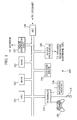
- FIG. 1 is a schematic diagram illustrating main features of a typical information processing device that executes a program to serve as a display device according to the present invention. This figure is referred to in the explanations to follow.
- An information processing device 100 comprises a Central Processing Unit (CPU) 101, a ROM 102, a Random Access Memory (RAM) 103, an interface 104, a controller 105, an external memory 106, an image processing unit 107, a Digital Versatile Disc ROM (DVD-ROM) drive 108, a Network Interface Card (NIC) 109, a sound processing unit 110, and a microphone 111.
- CPU Central Processing Unit
- ROM 102 Read Only Memory
- RAM Random Access Memory
- interface 104 a controller 105
- an external memory 106 an image processing unit 107
- DVD-ROM Digital Versatile Disc ROM
- NIC Network Interface Card
- sound processing unit 110 and a microphone 111.
- the program is launched, and the device according to this embodiment is achieved.
- the CPU 101 controls the overall operation of the information processing device 100 and is connected with other components for exchanging control signals and data.
- the CPU 101 uses an Arithmetic Logic Unit (ALU) (not shown) to perform four arithmetic operations (addition, subtraction, multiplication, and division), logical operations (logical addition, logical multiplication, logical NOT, etc.), and bit operations (bitwise OR, bitwise AND, bit inversion, bit shift, bit rotation, etc.) in a fast-access storage area called a register (not shown).
- ALU Arithmetic Logic Unit
- the CPU 101 may be designed to, either by itself or with the assistance of a coprocessor, perform saturate calculations (four arithmetic operations for multimedia processing), vector calculations (trigonometric calculations, etc.), and the like at high speeds.
- an Initial Program Loader (IPL), which is executed immediately after the power is turned on, is recorded.
- IPL Initial Program Loader
- the program recorded in a DVD-ROM is read out to the RAM 103 for execution by the CPU 101.
- Programs and data of the operating system required for the overall control and operation of the information processing device 100 are also recorded in the ROM 102.
- the RAM 103 is used for temporary storage of data and programs.
- the RAM 103 holds data and programs read out from the DVD-ROM as well as other data needed for the progress of the game and chat communications.
- the CPU 101 sets a variable area in the RAM 103 and sends a value stored in the storage area directly to the ALU for operation to be performed thereby. Also, the CPU 101 stores temporarily in the register a value stored in the RAM 103, performs an operation in the register, and writes the operation results back to the memory.
- the controller 105 which is connected via the interface 104, receives operation inputs from the user for game play.
- the hand held module 201 and the light emitting module 251 are used. The details of the controller 105 are described below.
- the external memory 106 is detachably connected via the interface 104.
- Data rewritably recorded in the external memory 106 include data on the player performance in the game, etc. (past results, etc.), the progress of the game, and logs (records) of chat communications for a network match-up.
- the user can appropriately record such data in the external memory 106 by inputting instructions via the controller 105.
- a program for executing the game as well as image and sound data that accompany therewith are recorded.
- the DVD-ROM drive 108 reads out, from the DVD-ROM mounted thereon, required programs and data.
- the above program and data are stored temporarily in the RAM 103, etc.
- the image processing unit 107 upon processing of data read out from the DVD-ROM by an image operation processor (not shown) comprised in the image processing unit 107 or the CPU 101, records the data in a frame memory (not shown) comprised in the image processing unit 107.
- the image information recorded in the frame memory is converted into video signals at a predetermined synchronization timing and output to a monitor (not shown) connected to the image processing unit 107. Many kinds of image display are thereby enabled.
- the image operation processor can perform overlay calculation for 2D images, transparent operations (alpha blending, etc.), and many kinds of saturate calculation at high speeds.
- the Z buffer method is used for rendering polygon information to acquire a rendering image in which a polygon in a virtual space can be seen from a predetermined viewpoint in a predetermined line of sight direction.
- a string can be presented as a 2D image in the frame memory or on each polygon surface according to font information defining text shapes.
- the NIC 109 is used for connecting the information processing device 100 to a computer communication network (not shown), such as the Internet.
- the NIC 109 comprises ones compliant with the 10 BASE-T/100 BASE-T standard which is used to configure a Local Area Network (LAN), an analog modem for Internet connection via a telephone circuit, an Integrated Services Digital Network (ISDN) modem, an Asymmetric Digital Subscriber Line (ADSL) modem, a cable modem for Internet connection via a cable television circuit and the like, and an interface (not shown) which intervenes between these modems and the CPU 101.
- LAN Local Area Network
- ISDN Integrated Services Digital Network
- ADSL Asymmetric Digital Subscriber Line
- cable modem for Internet connection via a cable television circuit and the like
- an interface not shown
- the sound processing unit 110 converts, into an analog sound signal, sound data read out from the DVD-ROM and outputs the sound signal from a speaker (not shown) connected thereto. Under control of the CPU 101, the sound processing unit 110 generates sound effects and music data to be generated during the game and outputs sounds corresponding thereto from the speaker.
- the sound processing unit 110 refers to the sound source data included in the sound data and converts the MIDI data into PCM data.
- the sound data is compressed sound data in the Adaptive Differential Pulse Code Modulation (ADPCM) format, the Ogg Vorbis format, or the like
- ADPCM Adaptive Differential Pulse Code Modulation
- the sound processing unit 110 decompresses the data and converts it to PCM data.
- the PCM data is, upon (digital/analog) D/A conversion at a timing corresponding to the sampling frequency of the PCM data, output to the speaker, thereby enabling sound output.
- the information processing device 100 can be connected to the microphone 111 via the interface 104.
- A/D conversion is performed for analog signals from the microphone 111 at an appropriate sampling frequency, so that the signals are processed as PCM-format digital signals for mixing or the like by the sound processing unit 110.
- the information processing device 100 may use a large-capacity external storage device, such as a hard disk, so that the information processing device 100 has the functions of the ROM 102, the RAM 103, the external memory 106, a DVD-ROM loaded onto the DVD-ROM drive 108, or the like.
- a large-capacity external storage device such as a hard disk
- the information processing device 100 is an equivalent of the so-called "TV Game Device for Consumers". Any device that performs image processing for virtual space display can be used to achieve the present invention.
- the present invention can be achieved on many kinds of computing devices, such as cellular phones, portable game devices, karaoke devices, and computers generally used for business.
- ordinary computers like the information processing device 100, comprise a CPU, a RAM, a ROM, a DVD-ROM drive, an NIC, an image processing unit with features not as advanced as those of the information processing device 100, and a hard disk as an external storage device. They are also designed to be able to use a flexible disk, a magnetic optical disk, a magnetic tape, etc. Input devices they use include not the controller 105, but a keyboard and a mouse.
- This embodiment employs the controller 105, whereby various parameters, such as orientations and positions in a real space, can be measured.
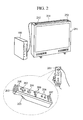
- FIG. 2 is an explanatory diagram illustrating exterior views of the controller 105 and the information processing device 100, whereby various parameters, such as orientations and positions in a real space, can be measured. This figure is referred in the explanations to follows.
- the controller 105 comprises a combination of the hand held module 201 and the light emitting module 251.
- the hand held module 201 is communicably connected to the information processing device 100 through the air.
- the light emitting module 251 is communicably connected to the information processing device 100 by cable. Sound and images processed by the information processing device 100 are output and displayed by a television 291.
- the hand held module 201 has an exterior appearance similar to that of the remote controller of the television 291.
- the CCD camera 202 is provided at the front end of the hand held module 201.
- the light emitting module 251 is fixed to an upper portion of the television 291.
- the CCD camera 202 of the hand held module 201 takes a photograph of the light emitting module 251.
- the photographed image information is sent to the information processing device 100, which acquires the position of the hand held module 201 with respect to the light emitting module 251 based on the positions of the light emitting diodes 252 in the photographed image.
- the hand held module 201 Built-in components of the hand held module 201 include an acceleration sensor, an angular acceleration sensor, and a slope sensor.
- the hand held module 201 can measure its own orientation, whose results are transmitted to the information processing device 100.
- a cross-shaped key 203 is provided on the upper surface of the hand held module 201.
- a button A 204 and buttons 206 are also provided on the upper surface for input of respective instructions assigned thereto.
- a button B 205 is provided on the lower surface of the hand held module 201. Coupled with a recess formed thereon, this button simulates the trigger of a rifle or a magic hand. In general, an instruction is input via the button B 205 for holding by a magic hand or shooting by rifle in a virtual space.
- An indicator 207 on the upper surface of the hand held module 201 presents the player with the operation status of the hand held module 201, the status of wireless communications with the information processing device 100, and the like.
- a power supply button 208 provided on the upper surface of the hand held module 201 turns on and off the hand held module 201.
- the hand held module 201 is powered by a built-in battery (not shown).
- the hand held module 201 is also provided with a vibrator (not shown) inside.
- the vibrator can control the level of vibration according to instructions from the information processing device 100.
- the CCD camera 202 may be located on the side of the information processing device 100 and the television 291 (on the side of the light emitting module 251 according to the above embodiment), and the hand held module 201 may be provided with the light emitting diodes 252. In this setting, by providing a plurality of CCD cameras 202, the relative position of the hand held module 201 with respect to the television 291 and the distance therebetween can be found based on the principle of triangulation.
- the controller 105 in which the hand held module 201 is combined with the light emitting module 251, is used to measure its own real-world position and orientation.
- the real-world position and orientation of the controller 105 can be measured using supersonic waves, infrared communication, the Global Positioning System (GPS), or the like in order to obtain the relative position of the controller 105 with respect to the television 291.
- GPS Global Positioning System
- FIG. 3 is an explanatory diagram illustrating main features of a display device according to an embodiment of the present invention. This figure is referred to in the explanations to follow.
- a display device 301 comprises a displaying unit 302, a measuring unit 303, an enlargement/contraction ratio acquiring unit 304, a text-containing image generating unit 305, a graphic image generating unit 306, and a control unit 307.
- the displaying unit 302 When provided with an image and its enlargement/contraction ratio and display position, the displaying unit 302 enlarges/contracts the image according to the ratio for display (and overlay, if necessary) on the display screen.
- the displaying unit 302 performs so-called window display.
- the displaying unit 302 enlarges/contracts the images.
- the display position of an image on the display screen can be specified for use by the displaying unit 302.
- the displaying unit 302 determines which image is above and which image is below so as to perform overlay processing, whereby one image partially hides the other one therebelow.
- overlay processing is executed by the image processing unit 107 under control of the CPU 101.
- the display screen to be used is that of the television 291.
- Images to be finally displayed on the display screen of the television 291 are deployed in a frame buffer in the RAM 103 and are processed at each vertical synchronizing interruption by the image processing unit 107.
- the image is enlarged/contracted at a specified enlargement/contraction ratio at a specified display position in the frame buffer.
- This set of steps is performed each time an image is specified, and each image thus specified can be regarded as a display window.
- overlay display is performed for two windows such that the window below displays the former image and that the window above displays the latter image.
- Graphic images are used for generating 3D graphic images, whose perspective and projection are in a predetermined line of sight direction from a predetermined viewpoint in a virtual space. Also, graphic images are equivalents of 2D graphic images showing a character at a certain location, which is produced by overlaying the character image on the background image.
- Text-containing images present strings of characters' speeches and numerical strings of the values of parameters representing the game situation.
- Text-containing images are produced by placing text with a predetermined font size in a text display window with a predetermined size.
- the text-containing image generating unit 305 generates text-containing images
- the graphic image generating unit 306 generates graphic images.
- the CPU 101 acts as the text-containing image generating unit 305 and the graphic image generating unit 306. These images are generally generated each time vertical synchronization interrupt is performed.
- FIG. 4 presents explanatory diagrams illustrating the sizes of the traditional display screen, a graphic image, and a text-containing image as well as their positional relationship.
- FIG. 4 (a) is an explanatory diagram illustrating the sizes of the traditional display screen, a graphic image, and a text-containing image.
- FIG. 4 (b) is an explanatory diagram illustrating their positional relationship when the images are displayed on the display screen.
- a graphic image 402 is displayed at the center of a display screen 401, and a text-containing image 403 is overlaid on the lower half of the graphic image 402.
- the distances from the left, right, and lower sides of the text-containing image 403 to their opposing edges of the display screen 401 are all equal.
- the user can read text information appearing on the text-containing image 403, but the user cannot see the graphic image 402, which is covered by the text information (however, the graphic image 402 can be seen through the text-containing image 403 when the text-containing image 403 is either transparent or semi-transparent).
- the display positions and enlargement/contraction ratios of the graphic image 402 and the text-containing image 403 on the traditional display screen 401 are assumed as their reference display positions and enlargement/contraction ratios.
- the horizontal and vertical directions are set, respectively, to an x axis 451 and a y axis 452, and the upper left corner is the origin.
- the graphic image 402 and the text-containing image 403 in order for the graphic image 402 and the text-containing image 403 to be entirely within the bounds of the display screen 401, the following inequalities must hold true: 0 ⁇ gx ⁇ gx + p ⁇ ga ⁇ W , 0 ⁇ gy ⁇ gy + q ⁇ ga ⁇ H ; and 0 ⁇ tx ⁇ tx + r ⁇ ta ⁇ W , 0 ⁇ ty ⁇ ty + s ⁇ ta ⁇ H . If not, the graphic image 402 and the text-containing image 403 are, in whole or in part, out of the bounds of the display screen 401. It means there is a region of an image that is not viewable for the user.
- the measuring unit 303 measures the distance between the display screen and the user looking at an image displayed on the display screen.
- the user is holding the hand held module 201 in his/her hand, so the distance between the light emitting module 251 and the hand held module 201 can be regarded as the distance (or an approximate value thereof) between the user and the display screen.
- the hand held module 201, the light emitting module 251, and the CPU 101 work together to serve as the measuring unit 303.
- the distance between the vertical line, which runs downward from the hand held module 201, and the plane containing the display screen of the television 291 may be regarded as the distance between the user and the display screen.
- the distance to the hand held module 201 from the center of the display screen of the television 291 or from that of the light emitting module 251 can be used as well.
- FIG. 5 is a flowchart illustrating the flow of controlling the display method to be performed by a display device according to this embodiment. This figure is referred to in the explanations to follow.
- the text-containing image generating unit 305 After the process starts, under control of the CPU 101, the text-containing image generating unit 305 generates a text-containing image 403, which presents a string to be presented to the user (step S501). Also under control of the CPU 101, the graphic image generating unit 306 generates a graphic image 402, which is a graphic to be presented to the user (step S502). The specifics of the text-containing image 403 and the graphic image 402 are described above.
- the CPU 101 instructs the measuring unit 303 to measure a distance L between the user and the display screen (step S503).
- the measured distance L is stored in a register of the CPU 101, the RAM 103, and the like.
- an average value in a predetermined time period or a decay average value should be adopted, in lieu of a real-time measured value, as a measured value representing the distance L.
- the enlargement/contraction ratio acquiring unit 304 acquires, from the measured distance L, a text enlargement/contraction ratio ta and a graphic enlargement/contraction ratio ga (step S504). These values are for example acquired by computation based on the following methods:
- the rate of change in the graphic enlargement/contraction ratio ga with respect to the distance L which is represented by (d/dL)ga, is 1/K or 0.
- (d/dL) denotes a differential operator, which means that differentiation is performed with respect to the distance L.
- the ratio of the area of graphics (typically, those of game characters and targets in a gun action game, etc.), which are in the graphic image 402 on the display screen 401, to the area of the field of view of the user is constant.
- the ratio of the area of characters to the area of the field of view of the user is thereby made constant without respect to the distance to the display screen. Then the display screen does not look odd to the user due to noticeable "jaggies" of dots. Since the ratio of the area of targets to the area of the user field of view is constant without respect to the distance to the display screen, it is possible to limit changes in the level of difficulty of the game.
- This embodiment is characterized in handling the text enlargement/contraction ratio ta and the graphic enlargement/contraction ratio ga separately by employing the above methods.
- the CPU 101 acts as the enlargement/contraction ratio acquiring unit 304.
- the CPU 101 calculates the display position (gx, gy) of the graphic image 402 on the display screen 401 (step S505) and the display position (tx, ty) of the text-containing image 403 on the display screen 401 (step S506).
- the methods for calculating the display position (gx, gy) of the graphic image 402 and the display position (tx, ty) of the text-containing image 403 are as follows:
- FIG. 6 are explanatory diagrams illustrating the sizes of a display screen, a graphic image, and a text-containing image as well as positional relationships thereamong based on the above three methods. This figure is referred to in the explanations to follow.
- the graphic image 402 and the text-containing image 403 have their upper left corners fixed in the region where they are displayed.
- the lower right corner of the graphic image 402 moves in a direction 602 for expansion (contraction), and that of the text-containing image 403 moves in a direction 603 for expansion (contraction) as well.
- the center of the graphic image 402 always agrees with that of the display screen 401. Also, the center of the text-containing image 403 always agrees with the coordinate position (w/2, cy) on the display screen 401.
- the image area not viewable for the user decreases. A greater amount of image information can be thereby conveyed to the user.
- the graphic image 402 and the text-containing image 403 are normally separated from each other. If the distance therebetween is stored before stopping playing the game and turning off the power, the user can check the positional relationship between the graphic image 402 and the text-containing image 403 when the user plays the same game again later. The user can thereby easily check the distance to the television 291 is the same as that when the user last played the same game.
- the CPU 101 clears the frame buffer, whose contents are readily available for the RAM 103 (step S507).
- the graphic image 402 as well as its display position (gx, gy) and graphic enlargement/contraction ratio ga are provided to the displaying unit 302 (step S508).
- the graphic image 402 is thereby appropriately enlarged/contracted and deployed in the frame buffer.
- the text-containing image 403 as well as its display position (tx, ty) and graphic enlargement/contraction ratio ta are provided to the displaying unit 302 (step S509).
- the text-containing image 403 is thereby appropriately enlarged/contracted and deployed in the frame buffer. At this time, the text-containing image 403 is overlaid on the graphic image 402 for display.
- the pixels of the text-containing image 403 should be overwritten to the corresponding pixels of the graphic image 402, which is disposed under the text-containing image 403. If the text-containing image 403 is semi-transparent, alpha blending should be performed appropriately.
- the CPU 101 acts as the control unit 307.
- the CPU 101 stands by until vertical synchronizing interruption occurs (step S510). During this "stand-by" period, the CPU 101 may perform another process as in a manner that a coroutine is executed.
- the CPU 101 Upon occurrence of vertical synchronizing interruption, the CPU 101 instructs the image processing unit 107 to reflect the contents of the frame buffer in the RAM 103 on the display screen 401 of the television 291 (step S511). Then the process goes back to step S501, and actual display is performed.
- different enlargement/contraction ratios are set to a graphic image and a text-containing image depending on the distance from the user to the display screen.
- the display size of a graphic image changes swiftly in response to changes in the distance so that it does not look odd to the user.
- the display size of the text-containing image changes slowly for enhanced viewability.
- correction of trapezoidal distortions may be performed.
- trapezoidal distortion correction is performed for a projection device (a projector, etc.)
- the condition of the center axis of the projector lens not being orthogonal to the screen is corrected.
- This condition is an equivalent of the condition where a line originating from the user to the display screen 401 does not pass through the center thereof.
- trapezoidal distortion correction for the graphic image 402 and the text-containing image 403
- the text may be blurred.
- a method without trapezoidal distortion correction may be adopted for the text-containing image 403. Since the graphic image 402 and the text-containing image 403 are processed separately, such a method can be easily adopted in the present invention.
- the sizes of text and graphics to be displayed on the display screen are changed depending on the distance between the display screen and the user looking at the screen for improved viewability.
- a display device and a display method preferable therefor, a program for implementing the display device and display device on a computer, and a computer-readable information recording medium that records the program can be provided.
Landscapes
- Engineering & Computer Science (AREA)
- Theoretical Computer Science (AREA)
- Human Computer Interaction (AREA)
- General Physics & Mathematics (AREA)
- General Engineering & Computer Science (AREA)
- Physics & Mathematics (AREA)
- Computer Hardware Design (AREA)
- Multimedia (AREA)
- Signal Processing (AREA)
- Databases & Information Systems (AREA)
- Controls And Circuits For Display Device (AREA)
- User Interface Of Digital Computer (AREA)
- Processing Or Creating Images (AREA)
Applications Claiming Priority (2)
| Application Number | Priority Date | Filing Date | Title |
|---|---|---|---|
| JP2006279615A JP4142073B2 (ja) | 2006-10-13 | 2006-10-13 | 表示装置、表示方法、ならびに、プログラム |
| PCT/JP2007/069964 WO2008044768A1 (fr) | 2006-10-13 | 2007-10-12 | Dispositif d'affichage, procédé d'affichage, support d'enregistrement d'informations et programme |
Publications (2)
| Publication Number | Publication Date |
|---|---|
| EP2073192A1 true EP2073192A1 (fr) | 2009-06-24 |
| EP2073192A4 EP2073192A4 (fr) | 2009-12-09 |
Family
ID=39282955
Family Applications (1)
| Application Number | Title | Priority Date | Filing Date |
|---|---|---|---|
| EP07829700A Withdrawn EP2073192A4 (fr) | 2006-10-13 | 2007-10-12 | Dispositif d'affichage, procédé d'affichage, support d'enregistrement d'informations et programme |
Country Status (7)
| Country | Link |
|---|---|
| US (1) | US8159507B2 (fr) |
| EP (1) | EP2073192A4 (fr) |
| JP (1) | JP4142073B2 (fr) |
| KR (1) | KR100942231B1 (fr) |
| CN (1) | CN101523482B (fr) |
| TW (1) | TWI373035B (fr) |
| WO (1) | WO2008044768A1 (fr) |
Cited By (6)
| Publication number | Priority date | Publication date | Assignee | Title |
|---|---|---|---|---|
| US20100111419A1 (en) * | 2008-10-31 | 2010-05-06 | Fuji Xerox Co., Ltd. | Image display device, image display method, and computer readable medium |
| EP2351366A4 (fr) * | 2008-11-24 | 2013-01-02 | Shenzhen Tcl New Technology | Procédé de réglage de l'utilisation de bande passante de dispositifs d'affichage distants en fonction de la proximité de l'utilisateur |
| EP2582146A1 (fr) * | 2011-10-12 | 2013-04-17 | Sony Mobile Communications AB | Rendu basé sur la distance de fichiers multimédia |
| EP2779153A1 (fr) * | 2013-03-14 | 2014-09-17 | Samsung Electronics Co., Ltd. | Procédé d'affichage d'image dynamique et dispositif électronique correspondant |
| WO2015095316A1 (fr) * | 2013-12-20 | 2015-06-25 | Qualcomm Incorporated | Gpu dynamique et commande de résolution vidéo utilisant le modèle de perception de rétine |
| WO2016001646A1 (fr) * | 2014-07-01 | 2016-01-07 | Echostar Uk Holdings Limited | Systèmes et procédés facilitant des caractéristiques d'affichage renforcées sur la base de l'état du spectateur |
Families Citing this family (29)
| Publication number | Priority date | Publication date | Assignee | Title |
|---|---|---|---|---|
| US9003315B2 (en) * | 2008-04-01 | 2015-04-07 | Litl Llc | System and method for streamlining user interaction with electronic content |
| WO2010073363A1 (fr) * | 2008-12-26 | 2010-07-01 | 富士通株式会社 | Dispositif de changement de résolution, procédé de changement de résolution et programme de changement de résolution |
| JP5249841B2 (ja) * | 2009-04-17 | 2013-07-31 | 株式会社コナミデジタルエンタテインメント | ゲーム装置、ゲームシステム、ゲーム装置の制御方法、ならびに、プログラム |
| US8649554B2 (en) * | 2009-05-01 | 2014-02-11 | Microsoft Corporation | Method to control perspective for a camera-controlled computer |
| JP5517160B2 (ja) * | 2010-06-25 | 2014-06-11 | 株式会社日立ハイテクノロジーズ | 自動分析装置 |
| KR101750896B1 (ko) | 2010-10-12 | 2017-07-03 | 엘지전자 주식회사 | 이동 단말기 및 그 제어방법 |
| JP5741821B2 (ja) * | 2011-03-24 | 2015-07-01 | コニカミノルタ株式会社 | データ加工送信装置およびデータ加工送信プログラム、方法 |
| US9323339B2 (en) | 2011-04-27 | 2016-04-26 | Nec Solution Innovators, Ltd. | Input device, input method and recording medium |
| US9509922B2 (en) | 2011-08-17 | 2016-11-29 | Microsoft Technology Licensing, Llc | Content normalization on digital displays |
| KR101975906B1 (ko) * | 2012-01-09 | 2019-05-08 | 삼성전자주식회사 | 영상 표시 장치에서 응용 프로그램의 레이아웃을 스케일링하기 위한 장치 및 방법 |
| US10150028B2 (en) * | 2012-06-04 | 2018-12-11 | Sony Interactive Entertainment Inc. | Managing controller pairing in a multiplayer game |
| TW201408057A (zh) * | 2012-08-10 | 2014-02-16 | Hon Hai Prec Ind Co Ltd | 手持設備及控制方法 |
| US9020189B2 (en) | 2012-12-07 | 2015-04-28 | The Nielsen Company (Us), Llc | Methods and apparatus to monitor environments |
| JP6073664B2 (ja) * | 2012-12-07 | 2017-02-01 | 株式会社東芝 | コンテンツ再生装置及びコンテンツ再生プログラム |
| CN103870149B (zh) * | 2012-12-18 | 2017-08-29 | 联想(北京)有限公司 | 数据处理方法及电子设备 |
| KR101283852B1 (ko) * | 2013-01-11 | 2013-07-09 | 은명진 | 위치에 따른 글자 크기의 왜곡을 보상하는 인쇄방법 및 이 인쇄방법으로 인쇄한 인쇄물 |
| WO2014156896A1 (fr) * | 2013-03-26 | 2014-10-02 | シャープ株式会社 | Appareil d'affichage, terminal portable, récepteur de télévision, procédé d'affichage, programme et support d'enregistrement |
| CN107368200B (zh) * | 2013-06-18 | 2020-06-02 | 原相科技股份有限公司 | 遥控装置 |
| US10379610B2 (en) | 2013-09-02 | 2019-08-13 | Sony Corporation | Information processing device and information processing method |
| PL3062791T3 (pl) * | 2013-10-28 | 2020-06-15 | Drexel University | Nowoczesne terapie zaburzeń uwagi i zaburzeń poznawczych oraz otępienia związanych z zaburzeniem neurodegeneracyjnym |
| JPWO2016117194A1 (ja) * | 2015-01-21 | 2017-12-07 | ソニー株式会社 | 情報処理装置、通信システム、情報処理方法およびプログラム |
| CN105635809A (zh) * | 2015-12-29 | 2016-06-01 | 小米科技有限责任公司 | 图像处理方法、装置及终端 |
| TWI581636B (zh) * | 2016-05-23 | 2017-05-01 | 鴻海精密工業股份有限公司 | 螢幕顯示比例調整裝置及方法 |
| CN114820880B (zh) * | 2017-09-08 | 2025-11-11 | 创新先进技术有限公司 | 图像生成方法、装置及设备 |
| CN109696953B (zh) * | 2017-10-19 | 2020-10-16 | 华为技术有限公司 | 虚拟现实文字显示的方法、装置和虚拟现实设备 |
| CN107748656B (zh) * | 2017-10-19 | 2021-07-09 | Oppo广东移动通信有限公司 | 一种画面显示方法、装置、终端及存储介质 |
| CN109683703A (zh) * | 2018-10-30 | 2019-04-26 | 努比亚技术有限公司 | 一种显示控制方法、终端及计算机可读存储介质 |
| CN111110272B (zh) * | 2019-12-31 | 2022-12-23 | 深圳开立生物医疗科技股份有限公司 | 超声图像测量信息显示方法、装置、设备及可读存储介质 |
| CN115083343A (zh) * | 2022-06-02 | 2022-09-20 | 海信视像科技股份有限公司 | 显示设备和分辨率调节方法 |
Family Cites Families (17)
| Publication number | Priority date | Publication date | Assignee | Title |
|---|---|---|---|---|
| JPS62272668A (ja) | 1986-05-20 | 1987-11-26 | Fujitsu General Ltd | テレビジヨン受像機 |
| JPH04100386A (ja) | 1990-08-18 | 1992-04-02 | Matsushita Electric Ind Co Ltd | ビデオ機器 |
| US5686940A (en) * | 1993-12-24 | 1997-11-11 | Rohm Co., Ltd. | Display apparatus |
| JPH0954374A (ja) | 1995-08-15 | 1997-02-25 | Nec Home Electron Ltd | 立体視用液晶投写装置 |
| JPH10260666A (ja) * | 1997-03-17 | 1998-09-29 | Casio Comput Co Ltd | 表示制御装置、及び表示制御プログラムを記録した記録媒体 |
| JPH11238124A (ja) | 1998-02-19 | 1999-08-31 | Nec Shizuoka Ltd | 画像表示方法および装置 |
| US7148909B2 (en) * | 1998-05-27 | 2006-12-12 | Canon Kabushiki Kaisha | Image display system capable of displaying and scaling images on plurality of image sources and display control method therefor |
| US7345684B2 (en) * | 1998-06-25 | 2008-03-18 | Intel Corporation | Perceptually based display |
| US6971072B1 (en) * | 1999-05-13 | 2005-11-29 | International Business Machines Corporation | Reactive user interface control based on environmental sensing |
| JP2003140632A (ja) * | 2001-11-05 | 2003-05-16 | Hitachi Ltd | 画像表示方法および装置 |
| KR20030097310A (ko) * | 2002-06-20 | 2003-12-31 | 삼성전자주식회사 | 디스플레이장치의 화상크기조절방법 및 그화상크기조절시스템과 화상크기조절방법을 수행하는프로그램이 저장된 기록매체 |
| US9474968B2 (en) * | 2002-07-27 | 2016-10-25 | Sony Interactive Entertainment America Llc | Method and system for applying gearing effects to visual tracking |
| US7272258B2 (en) * | 2003-01-29 | 2007-09-18 | Ricoh Co., Ltd. | Reformatting documents using document analysis information |
| JP3819853B2 (ja) | 2003-01-31 | 2006-09-13 | 株式会社東芝 | 表示装置 |
| JP2004287168A (ja) * | 2003-03-24 | 2004-10-14 | Pioneer Electronic Corp | 情報表示装置及び情報表示方法 |
| US20050229200A1 (en) * | 2004-04-08 | 2005-10-13 | International Business Machines Corporation | Method and system for adjusting a display based on user distance from display device |
| JP5132131B2 (ja) * | 2006-11-17 | 2013-01-30 | 任天堂株式会社 | ポインティング装置の調整プログラムおよびポインティング装置 |
-
2006
- 2006-10-13 JP JP2006279615A patent/JP4142073B2/ja not_active Expired - Fee Related
-
2007
- 2007-10-12 KR KR1020097007468A patent/KR100942231B1/ko not_active Expired - Fee Related
- 2007-10-12 TW TW096138420A patent/TWI373035B/zh not_active IP Right Cessation
- 2007-10-12 EP EP07829700A patent/EP2073192A4/fr not_active Withdrawn
- 2007-10-12 US US12/445,183 patent/US8159507B2/en not_active Expired - Fee Related
- 2007-10-12 WO PCT/JP2007/069964 patent/WO2008044768A1/fr not_active Ceased
- 2007-10-12 CN CN200780037830XA patent/CN101523482B/zh not_active Expired - Fee Related
Cited By (13)
| Publication number | Priority date | Publication date | Assignee | Title |
|---|---|---|---|---|
| US20100111419A1 (en) * | 2008-10-31 | 2010-05-06 | Fuji Xerox Co., Ltd. | Image display device, image display method, and computer readable medium |
| US8358875B2 (en) * | 2008-10-31 | 2013-01-22 | Fuji Xerox Co., Ltd. | Image display device, image display method, and computer readable medium |
| EP2351366A4 (fr) * | 2008-11-24 | 2013-01-02 | Shenzhen Tcl New Technology | Procédé de réglage de l'utilisation de bande passante de dispositifs d'affichage distants en fonction de la proximité de l'utilisateur |
| US9693088B2 (en) | 2011-10-12 | 2017-06-27 | Sony Corporation | Distance based rendering of media files |
| US8917877B2 (en) | 2011-10-12 | 2014-12-23 | Sony Corporation | Distance-based rendering of media files |
| EP2582146A1 (fr) * | 2011-10-12 | 2013-04-17 | Sony Mobile Communications AB | Rendu basé sur la distance de fichiers multimédia |
| EP2779153A1 (fr) * | 2013-03-14 | 2014-09-17 | Samsung Electronics Co., Ltd. | Procédé d'affichage d'image dynamique et dispositif électronique correspondant |
| WO2015095316A1 (fr) * | 2013-12-20 | 2015-06-25 | Qualcomm Incorporated | Gpu dynamique et commande de résolution vidéo utilisant le modèle de perception de rétine |
| WO2016001646A1 (fr) * | 2014-07-01 | 2016-01-07 | Echostar Uk Holdings Limited | Systèmes et procédés facilitant des caractéristiques d'affichage renforcées sur la base de l'état du spectateur |
| US9684948B2 (en) | 2014-07-01 | 2017-06-20 | Echostar Uk Holdings Limited | Systems and methods for facilitating enhanced display characteristics based on viewer state |
| US9916639B2 (en) | 2014-07-01 | 2018-03-13 | Echostar Technologies L.L.C. | Systems and methods for facilitating enhanced display characteristics based on viewer state |
| US10339630B2 (en) | 2014-07-01 | 2019-07-02 | DISH Technologies L.L.C. | Systems and methods for facilitating enhanced display characteristics based on viewer state |
| US10943329B2 (en) | 2014-07-01 | 2021-03-09 | DISH Technologies L.L.C. | Systems and methods for facilitating enhanced display characteristics based on viewer state |
Also Published As
| Publication number | Publication date |
|---|---|
| KR20090052391A (ko) | 2009-05-25 |
| EP2073192A4 (fr) | 2009-12-09 |
| TW200828261A (en) | 2008-07-01 |
| JP2008096776A (ja) | 2008-04-24 |
| WO2008044768A1 (fr) | 2008-04-17 |
| CN101523482A (zh) | 2009-09-02 |
| CN101523482B (zh) | 2013-04-17 |
| KR100942231B1 (ko) | 2010-02-16 |
| JP4142073B2 (ja) | 2008-08-27 |
| US20100118055A1 (en) | 2010-05-13 |
| US8159507B2 (en) | 2012-04-17 |
| TWI373035B (en) | 2012-09-21 |
Similar Documents
| Publication | Publication Date | Title |
|---|---|---|
| US8159507B2 (en) | Display device, display method, information recording medium and program | |
| EP2105905A2 (fr) | Appareil de génération d'image | |
| US7614954B2 (en) | Game image display control program, game device, and recoding medium | |
| US8013865B2 (en) | Program, information storage medium, image generation system, and image generation method for generating an image for overdriving the display device | |
| JP3949674B2 (ja) | 表示装置、表示方法、ならびに、プログラム | |
| EP1033682A2 (fr) | Appareil et méthode de traitement d'image | |
| EP2395474A2 (fr) | Support de stockage doté d'un programme de reconnaissance d'images stocké sur celui-ci, appareil de reconnaissance d'images, système de reconnaissance d'images et procédé de reconnaissance d'images | |
| KR20010033214A (ko) | 기록 매체, 화상 처리장치 및 화상 처리방법 | |
| US20050009602A1 (en) | Storage medium and game device storing image generating program | |
| US20090305782A1 (en) | Double render processing for handheld video game device | |
| JP2013050883A (ja) | 情報処理プログラム、情報処理システム、情報処理装置および情報処理方法 | |
| JP5213500B2 (ja) | 画像変換プログラムおよび画像変換装置 | |
| EP1808207B1 (fr) | Support d'enregistrement pour programme de jeu et dispositif de jeu | |
| JP4305903B2 (ja) | 画像生成システム、プログラム及び情報記憶媒体 | |
| JP4878396B2 (ja) | 画像認識プログラム、画像認識装置、画像認識システム、および画像認識方法 | |
| JP4749198B2 (ja) | プログラム、情報記憶媒体及び画像生成システム | |
| KR101860215B1 (ko) | 프로젝터 자세에 연동하는 콘텐츠 디스플레이 시스템 및 방법 | |
| JP2002230577A (ja) | ゲーム装置および情報記憶媒体 | |
| JP4307403B2 (ja) | 位置向き推定装置、位置向き推定方法、ならびに、プログラム | |
| US20050119049A1 (en) | Program for projecting an image onto a character in a game, game machine incorporating the program, and storage medium having the program stored thereon | |
| US20030032477A1 (en) | Method, apparatus, storage medium and program for generating image data of virtual space | |
| JP4447000B2 (ja) | 画像生成システム、プログラム及び情報記憶媒体 | |
| JP4815410B2 (ja) | 表示装置、表示方法、ならびに、プログラム | |
| US20240416235A1 (en) | Non-transitory storage medium, game apparatus, game system, and game method | |
| EP1249791A2 (fr) | Méthode et dispositif de traitement d'images de jeu 3-D pour designer des lignes de contour |
Legal Events
| Date | Code | Title | Description |
|---|---|---|---|
| PUAI | Public reference made under article 153(3) epc to a published international application that has entered the european phase |
Free format text: ORIGINAL CODE: 0009012 |
|
| 17P | Request for examination filed |
Effective date: 20090409 |
|
| AK | Designated contracting states |
Kind code of ref document: A1 Designated state(s): AT BE BG CH CY CZ DE DK EE ES FI FR GB GR HU IE IS IT LI LT LU LV MC MT NL PL PT RO SE SI SK TR |
|
| AX | Request for extension of the european patent |
Extension state: AL BA HR MK RS |
|
| A4 | Supplementary search report drawn up and despatched |
Effective date: 20091106 |
|
| 17Q | First examination report despatched |
Effective date: 20100419 |
|
| DAX | Request for extension of the european patent (deleted) | ||
| STAA | Information on the status of an ep patent application or granted ep patent |
Free format text: STATUS: THE APPLICATION IS DEEMED TO BE WITHDRAWN |
|
| 18D | Application deemed to be withdrawn |
Effective date: 20140110 |