EP2073477A2 - Kombiniertes 16QAM-De-Mapping, 16QAM-Konstellationsneuanordnung und TD-SCDMA-Entschlüsselung - Google Patents
Kombiniertes 16QAM-De-Mapping, 16QAM-Konstellationsneuanordnung und TD-SCDMA-Entschlüsselung Download PDFInfo
- Publication number
- EP2073477A2 EP2073477A2 EP08172310A EP08172310A EP2073477A2 EP 2073477 A2 EP2073477 A2 EP 2073477A2 EP 08172310 A EP08172310 A EP 08172310A EP 08172310 A EP08172310 A EP 08172310A EP 2073477 A2 EP2073477 A2 EP 2073477A2
- Authority
- EP
- European Patent Office
- Prior art keywords
- constellation
- constellation point
- data representing
- portions
- arrangement
- Prior art date
- Legal status (The legal status is an assumption and is not a legal conclusion. Google has not performed a legal analysis and makes no representation as to the accuracy of the status listed.)
- Granted
Links
- 238000004891 communication Methods 0.000 title claims description 32
- 238000000034 method Methods 0.000 claims abstract description 49
- 238000004590 computer program Methods 0.000 claims description 18
- 230000006870 function Effects 0.000 description 17
- 230000015654 memory Effects 0.000 description 17
- 230000005540 biological transmission Effects 0.000 description 13
- 238000012545 processing Methods 0.000 description 12
- 238000013507 mapping Methods 0.000 description 11
- 230000001413 cellular effect Effects 0.000 description 10
- 230000008707 rearrangement Effects 0.000 description 10
- 238000010586 diagram Methods 0.000 description 9
- 230000008569 process Effects 0.000 description 5
- 238000013461 design Methods 0.000 description 4
- 230000003044 adaptive effect Effects 0.000 description 2
- 230000000694 effects Effects 0.000 description 2
- 230000003287 optical effect Effects 0.000 description 2
- 238000012546 transfer Methods 0.000 description 2
- 230000008859 change Effects 0.000 description 1
- 230000003750 conditioning effect Effects 0.000 description 1
- 238000012937 correction Methods 0.000 description 1
- 238000013500 data storage Methods 0.000 description 1
- 230000001934 delay Effects 0.000 description 1
- 230000002708 enhancing effect Effects 0.000 description 1
- 230000007613 environmental effect Effects 0.000 description 1
- 239000000284 extract Substances 0.000 description 1
- GVVPGTZRZFNKDS-JXMROGBWSA-N geranyl diphosphate Chemical compound CC(C)=CCC\C(C)=C\CO[P@](O)(=O)OP(O)(O)=O GVVPGTZRZFNKDS-JXMROGBWSA-N 0.000 description 1
- 230000001771 impaired effect Effects 0.000 description 1
- 230000000873 masking effect Effects 0.000 description 1
- 230000010363 phase shift Effects 0.000 description 1
- 230000000644 propagated effect Effects 0.000 description 1
- 239000004065 semiconductor Substances 0.000 description 1
- 230000008054 signal transmission Effects 0.000 description 1
- 230000005236 sound signal Effects 0.000 description 1
- 230000007480 spreading Effects 0.000 description 1
- 230000001360 synchronised effect Effects 0.000 description 1
- 230000033772 system development Effects 0.000 description 1
Images



Classifications
-
- H—ELECTRICITY
- H04—ELECTRIC COMMUNICATION TECHNIQUE
- H04L—TRANSMISSION OF DIGITAL INFORMATION, e.g. TELEGRAPHIC COMMUNICATION
- H04L27/00—Modulated-carrier systems
- H04L27/32—Carrier systems characterised by combinations of two or more of the types covered by groups H04L27/02, H04L27/10, H04L27/18 or H04L27/26
- H04L27/34—Amplitude- and phase-modulated carrier systems, e.g. quadrature-amplitude modulated carrier systems
- H04L27/38—Demodulator circuits; Receiver circuits
-
- H—ELECTRICITY
- H04—ELECTRIC COMMUNICATION TECHNIQUE
- H04L—TRANSMISSION OF DIGITAL INFORMATION, e.g. TELEGRAPHIC COMMUNICATION
- H04L1/00—Arrangements for detecting or preventing errors in the information received
- H04L1/004—Arrangements for detecting or preventing errors in the information received by using forward error control
- H04L1/0045—Arrangements at the receiver end
- H04L1/0047—Decoding adapted to other signal detection operation
-
- H—ELECTRICITY
- H04—ELECTRIC COMMUNICATION TECHNIQUE
- H04L—TRANSMISSION OF DIGITAL INFORMATION, e.g. TELEGRAPHIC COMMUNICATION
- H04L25/00—Baseband systems
- H04L25/02—Details ; arrangements for supplying electrical power along data transmission lines
- H04L25/06—DC level restoring means; Bias distortion correction ; Decision circuits providing symbol by symbol detection
- H04L25/061—DC level restoring means; Bias distortion correction ; Decision circuits providing symbol by symbol detection providing hard decisions only; arrangements for tracking or suppressing unwanted low frequency components, e.g. removal of DC offset
- H04L25/066—Multilevel decisions, not including self-organising maps
-
- H—ELECTRICITY
- H04—ELECTRIC COMMUNICATION TECHNIQUE
- H04L—TRANSMISSION OF DIGITAL INFORMATION, e.g. TELEGRAPHIC COMMUNICATION
- H04L25/00—Baseband systems
- H04L25/02—Details ; arrangements for supplying electrical power along data transmission lines
- H04L25/06—DC level restoring means; Bias distortion correction ; Decision circuits providing symbol by symbol detection
- H04L25/067—DC level restoring means; Bias distortion correction ; Decision circuits providing symbol by symbol detection providing soft decisions, i.e. decisions together with an estimate of reliability
-
- H—ELECTRICITY
- H04—ELECTRIC COMMUNICATION TECHNIQUE
- H04L—TRANSMISSION OF DIGITAL INFORMATION, e.g. TELEGRAPHIC COMMUNICATION
- H04L1/00—Arrangements for detecting or preventing errors in the information received
- H04L1/004—Arrangements for detecting or preventing errors in the information received by using forward error control
- H04L1/0056—Systems characterized by the type of code used
- H04L1/0071—Use of interleaving
Definitions
- This description relates to a system and method for decoding signals such as quadrature amplitude modulated signals to access embedded information.
- a method in one aspect, includes identifying a soft decision from a constellation point of a modulated signal. The identification is based upon a logical combination of data representing a first and second portion of the constellation point, data representing an arrangement of the first and second portions of the constellation point, and data representing a scrambling of the first and second portions of the constellation point.
- Implementations may include one or more of the following features.
- the first portion of the constellation point may represent a coordinate pair of an outer constellation.
- the second portion of the constellation point may represent a coordinate pair of an inner constellation.
- the data representing the arrangement of the first and second portions of the constellation point may represent an arrangement of an inner constellation coordinate pair and an outer constellation coordinate pair.
- the data representing the scrambling of the first and second portions of the constellation point may include at least one bit of a scramble code.
- the first portion of the constellation point may represent an in-phase component or a quadrature component.
- the first portion of the constellation point may also represent a constellation gain.
- Various types of signal modulations may be implemented, for example, Quadrature Amplitude Modulation (QAM) signal may be implemented.
- the logical combination may include one or more logic gates or other types of circuitry.
- a system in one aspect, includes a communication receiver for receiving a modulated signal.
- the communication receiver includes a decoder for identifying a soft decision from a constellation point of a modulated signal. The identification is based upon a logical combination of data representing a first and second portion of the constellation point, data representing an arrangement of the first and second portions of the constellation point and data representing a scrambling of the first and second portions of the constellation point.
- Implementations may include one or more of the following features.
- the first portion of the constellation point may represent a coordinate pair of an outer constellation.
- the second portion of the constellation point may represent a coordinate pair of an inner constellation.
- the data representing the arrangement of the first and second portions of the constellation point may represent an arrangement of an inner constellation coordinate pair and an outer constellation coordinate pair.
- the data representing the scrambling of the first and second portions of the constellation point may include at least one bit of a scramble code.
- the first portion of the constellation point may represent an in-phase component or a quadrature component.
- the first portion of the constellation point may also represent a constellation gain.
- Various types of signal modulations may be implemented, for example, Quadrature Amplitude Modulation (QAM) signal may be implemented.
- the logical combination may include one or more logic gates or other types of circuitry.
- a computer program product is tangibly embodied in an information carrier and comprising instructions.
- a processor When the instructions are executed, a processor performs a method that includes identifying a soft decision from a constellation point of a modulated signal. The identification is based upon a logical combination of data representing a first and second portion of the constellation point, data representing an arrangement of the first and second portions of the constellation point and data representing a scrambling of the first and second portions of the constellation point.
- Implementations may include one or more of the following features.
- the first portion of the constellation point may represent a coordinate pair of an outer constellation.
- the second portion of the constellation point may represent a coordinate pair of an inner constellation.
- the data representing the arrangement of the first and second portions of the constellation point may represent an arrangement of an inner constellation coordinate pair and an outer constellation coordinate pair.
- the data representing the scrambling of the first and second portions of the constellation point may include at least one bit of a scramble code.
- the first portion of the constellation point may represent an in-phase component or a quadrature component.
- the first portion of the constellation point may also represent a constellation gain.
- Various types of signal modulations may be implemented, for example, Quadrature Amplitude Modulation (QAM) signal may be implemented.
- the logical combination may include one or more logic gates or other types of circuitry.
- a system in one aspect, includes means for receiving a modulated signal.
- the receiving means includes means for identifying a soft decision from a constellation point of a modulated signal. The identification is based upon a logical combination of data representing a first and second portion of the constellation point, data representing an arrangement of the first and second portions of the constellation point and data representing a scrambling of the first and second portions of the constellation point.
- Implementations may include one or more of the following features.
- the first portion of the constellation point may represent a coordinate pair of an outer constellation.
- the second portion of the constellation point may represent a coordinate pair of an inner constellation.
- the data representing the arrangement of the first and second portions of the constellation point may represent an arrangement of an inner constellation coordinate pair and an outer constellation coordinate pair.
- the data representing the scrambling of the first and second portions of the constellation point may include at least one bit of a scramble code.
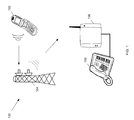
- FIG. 1 illustrates a communication system
- FIG. 2 is a block diagram of a portion of a communication receiver.
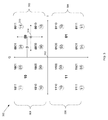
- FIG. 3 illustrates a quadrature amplitude modulation constellation diagram
- FIG. 4 includes a truth table.
- FIG. 5 includes Karnough maps.
- FIG. 6 is a block diagram of an exemplary decoder architecture.
- FIG. 7 is a flowchart of operations of a decoder.
- communication systems such as a cellular system 100 include communication channels that may be impaired by one or more sources such as environmental noise.
- modulation, encoding/decoding and processing techniques have been developed to assist data transmission and reception.
- standards have been promoted to adopt particular techniques and methodologies. For example, time division synchronous code division multiple access (TD-SCDMA) standards call for combining time division multiple access (TDMA) with an adaptive, synchronous-mode code division multiple access (CDMA) component.
- TD-SCDMA time division synchronous code division multiple access
- CDMA adaptive, synchronous-mode code division multiple access
- TD-SCDMA Time Division Multiple Access
- QPSK Quadrature Phase Shift Keying
- QAM quadrature amplitude modulation
- One or more protocols and communication schemes may be implemented by the cellular system 100 for complying with standards and for achieving particular data transfer rates.
- the High-Speed Downlink Packet Access (HSDPA) communication scheme which is a 3G (third generation) mobile telephony communications protocol, may be implemented to allow the cellular system 100 (or other types of communication systems and networks such as Universal Mobile Telecommunications Systems (UMTS)) to provide relatively high data transfer speeds (and capacity) and lower latency for end users.
- HSDPA is an integral feature of Release 5 of the 3 GPP specification and supports downlink speeds of approximately 14.4 Mbit/s and round trip delays of 70 ms.
- the High-Speed Downlink Shared Channel (HS-DSCH) which is the transport channel carrying user data with HSDPA operation, has been added to the UMTS specification.
- HS-DSCH may lack two fundamental features of other WCDMA channels, namely, variable spreading factors and fast power control. Rather, HS-DSCH provides improvements in downlink performance through the utilization of adaptive modulation and coding (AMC), a fast packet scheduling algorithm for base stations, and fast retransmission from base stations, often referred to as hybrid automatic repeat-request (HARQ).
- AMC adaptive modulation and coding
- HARQ uses incremental redundancy (IR) and chase combining, in which data may be transmitted multiple times using one or more coding techniques. For example, when a corrupt packet is received, the packet is combined with retransmitted packets to efficiently correct encountered errors. In some situations when the retransmissions are corrupted, appropriate decoding may still yield an error-free packet.
- the illustrative communication system 100 may allow efficient information transmission without significant content loss.
- data e.g., an audio signal
- a cellular network e.g., represented by a cellular tower 104
- a cellular terminal 106 for delivery to a telephone 108.
- other equipment may also be used for collecting and processing the communication signals, for example, a computing device (e.g., a computer system, personal digital assistant (PDA), etc.) with appropriate equipment (e.g., modem, wireless connection device such as an air-card, etc.) may be used for connecting to the communication network (e.g., cellular system 100).
- PDA personal digital assistant
- a block diagram represents a portion of an exemplary communication receiver 200 of a wireless connection device such as a cellular terminal or an air-card (for use with a computing device).
- an antenna 202 is capable of transmitting and receiving electromagnetic signals to exchange data with one or more other devices and systems.
- the communication receiver 200 includes an radio frequency (RF) stage 204 that processes (e.g., removes carrier signals) the electromagnetic signals received by the antenna 202 and provides a corresponding analog signal to an analog baseband stage 206 for converting into the digital domain.
- the analog baseband stage 206 includes one or multiple analog-to-digital (A/D) converters for digitizing the signals from the RF stage 204.
- A/D analog-to-digital
- a collection of data channels (referred to as physical channels) is provided to a digital baseband stage 208 that processes (e.g., demodulates, decodes, etc.) the channel data and produces binary data appropriately formatted for the next portion of the receiver 200 (e.g., a software application layer).
- processes e.g., demodulates, decodes, etc.
- the digital baseband stage 208 includes a receiver 210 (e.g., a joint detector receiver, a rake receiver, an equalizer, etc.) that detects channels present in the digital data (provided from the analog baseband stage 206).
- the digital data received by the receiver 210 may represent a number of channels (e.g., up to sixteen channels) that include various content (e.g., control channels, voice channels, etc.).
- the receiver 210 may also detect the physical channel (or channels) present in the digital data.
- the data received may represent a sum of physical channels, in which each channel includes a segment with an equivalent number of symbols (e.g., forty-four symbols).
- the receiver 210 may address a number of types of noise embedded in the digital signal. For example, noise may be introduced by multi-path signals received by the antenna 202, interference associated with the signal content (e.g., inter-code interference), etc. Various operations such as channel equalization along with other techniques and methodologies may be executed by the receiver 210 for addressing noise issues and signal correction.
- noise may be introduced by multi-path signals received by the antenna 202, interference associated with the signal content (e.g., inter-code interference), etc.
- Various operations such as channel equalization along with other techniques and methodologies may be executed by the receiver 210 for addressing noise issues and signal correction.
- the receiver 210 also extracts individual physical channels.
- the input of the receiver 210 may include a sum the physical channels (e.g., one summed channel with forty-four symbols) and the output may include the extracted individual channels (e.g., sixteen channels, each channel being forty-four symbols in length).
- a post receiver 212 also performs other operations in preparation of channel decoding such as preparing the physical channels for demodulation. For example, demodulating physical channels that implement QPSK and QAM (e.g., 16-QAM, 64-QAM, etc.) may be assisted by estimating parameters associated with the modulation schemes such as estimating constellation gain (p) and variance ( ⁇ 2 ). From the estimations, other quantities may be determined such as signal-and-interference-to-noise-ratio (SINR), for example, to assist with channel demodulation and to provide feedback (e.g., to one or more networks) that represents channel quality.
- SINR signal-and-interference-to-noise-ratio
- constellation rotation operations may be executed for rotating QPSK or QAM constellations, as needed.
- each constellation may be rotated 45° by the post receiver 212 to produce constellations with equivalent orientations that are associated with one or more communication standards (e.g., W-CDMA, TD-SCDMA).
- W-CDMA Wideband Code Division Multiple Access
- TD-SCDMA Time Division Multiple Access
- hardware, software and other portions of the communication receiver 200 may be used with wireless standards associated with one or more other constellation arrangements.
- the post receiver 212 provides the extracted physical channels and other information (e.g., estimated parameters) to other portions of the communication receiver 200 (e.g., for processing channels).
- the channels are provided to a channel decoder and demultiplexer 214 (also included in the digital baseband stage 208), e.g., a bit rate processor, by the post receiver 212.
- the channel decoder and demultiplexer 214 demodulates and decodes individual transport channels and may provide additional conditioning prior to passing decoded binary data to another portion of the receiver 200 (e.g., a software layer).
- the channel decoder and demultiplexer 214 converts data received (from the post receiver 212) into a format corresponding to the points of the constellation (referred to as soft decisions) being used (e.g., QPSK, QAM, etc.).
- Complex values may be provided to the bit rate processor 214 that represent constellation points and formatted to comply with wireless standards such as W-CDMA (e.g., 12-bit floating point representation for use with Frequency Division Duplex (FDD), a 16-bit fixed point representation for use with Time Division Duplex (TDD), etc.).
- W-CDMA e.g., 12-bit floating point representation for use with Frequency Division Duplex (FDD), a 16-bit fixed point representation for use with Time Division Duplex (TDD), etc.
- the channel decoder and demultiplexer 214 may represent the data in a reduced precision format (e.g., 4-bit fixed representation) to reduce storage needs while retaining or enhancing dynamic range.
- the channel decoder and demultiplexer 214 includes a decoder 216 that executes operations associated with decoding the stream of soft decisions provided by the post receiver 212. For example, de-mapping, de-interleaving, constellation re-arrangement and de-scrambling operations are performed by the decoder 216. Performing such operations may call for the use of considerable resources (e.g., memory, processing time, etc.) for each of these three functions. For example, to execute each of the three functions individually, data may be stored at the completion of each function and retrieved in preparation to execute the next function. By combining the execution of the functions, computational resources (e.g., memory space, processing time, etc.) can be conserved and used for the execution of other operations and procedures.
- decoder 216 executes operations associated with decoding the stream of soft decisions provided by the post receiver 212. For example, de-mapping, de-interleaving, constellation re-arrangement and de-scrambling operations are performed by the decoder
- Modulation schemes, protocols and other communication parameters may factor into combining the functions. For example, operations may be combined in one arrangement for one type of modulation (e.g., QPSK) and in a similar or different arrangement for another type of modulation (e.g., QAM).
- one or more modulation parameters may be used to execute the combined functions.
- the constellation gain (p) associated with the modulation scheme may be used along with other parameters.
- constellation gain is determined by another portion of the communication receiver 200 (e.g., the post receiver 212), however, the channel decoder and demultiplexer 214 may be configured for such an operation.
- Information associated with the combined functions may also be provided from sources external to the communication receiver 200. For example, information included in received transmissions may also be used for by the decoder 216 to execute the combined functions.
- a diagram 300 is illustrates a constellation of an exemplary modulation scheme that may be used by the system 100.
- constellation diagram 300 represents a 16-QAM modulated signal and includes four quadrants 302, 304, 306 and 308. Each of the four quadrants respectively includes four constellation points, which each uniquely represent one of the sixteen individual symbols.
- Complex values provide coordinates of the constellation diagram 300 and include a real part (referred to as the in-phase component) represented on the horizontal axis and an imaginary part (referred to as the quadrature component) represented on the vertical axis.
- each symbol may be uniquely represented with data that represents the one quadrant within which the symbol is located and data that represents each one of the four symbols within that quadrant.
- a two-bit number i.e., 00
- a two-bit number may be used to represent each quadrant (illustrated in bold font in the figure) and another two-bit number to represent each of the four symbols (represented in normal font in the figure) within the quadrant.
- each of the sixteen symbols are uniquely represented by a four-bit number.
- symbol 310 may be represented with the four-bit value 0011, in which "00" represents the quadrant and "11" represents the particular symbol (of the four) within that quadrant.
- each symbol can be identified from two constellations, an outer constellation (represented with coordinate axes 312, which define the quadrants 302-308) and an inner constellation (represented with coordinate axes 314).
- Both the inner and outer constellations each provide two-bit representations that combine to produce a four-bit representation of one of the sixteen symbols.
- the decoder 216 processes the soft decisions to produce a representation of the symbols.
- the decoder 216 attempts to identify the particular four-bit symbol being represented.
- in-phase (I) and quadrature (Q) components may be used to identify a quadrant (e.g., quadrant 302) of the outer constellation 312 associated with each received soft decision.
- quadrant 302 For example, for positive values of I and Q, constellation quadrant 302 is identified, and for negative values of both I and Q, constellation quadrant 308 is identified.
- one or more constellation parameters may be used with the I and Q data. For example, as illustrated in the figure, the constellation gain (p) provides a value that represents the center of each inner constellation.
- the constellation gain can be used in conjunction with the I and Q data to uniquely identify each symbol within the inner constellation.
- may be used for identifying the symbol within the inner constellation.
- each soft decision may be uniquely demapped using the four quantities: I , Q , p - I , p - Q . While equation (1) provides one particular arrangement of the quantities for identifying each of the sixteen symbols, other soft decision arrangements may also be used. Further, while I and Q data along with constellation gain is used here for symbol identification, other transmission parameters (e.g., modulation parameters) may be used separately or in combination.
- the decoder 216 also performs other operations for symbol identification.
- the four terms of equation (1) may be arranged to reduce the probability of transmission loss.
- Various rearrangement schemes may be implemented, for example, terms may be rearranged for each four-term group transmitted, or rearranged for a predefined number of groups (e.g., terms rearranged for every four groups, etc.), or rearranged after a predefined amount of time (e.g., terms rearranged every second).
- the probability of error is less for more significant terms such as the first term (I) and the second term (Q) provided by equation 1.
- ) may reduce transmission error.
- the four terms may be individually arranged for reducing error.
- different arrangements may be used for the term pair (I and Q) and the term pair (p -
- the terms may be arranged as: I , Q , p - I , p - Q , or as p - I , p - Q , I , Q .
- a single bit may be used to identify which particular arrangement is being used.
- negation may be applied (e.g., a sign change) to the terms to further differentiate the transmitted terms and reduce the probability of error. Similar to identifying the arrangement, a single bit may be used to identify negation. Thus, two bits may represent parameters (referred to as b(1) and b(2)) for re-arrangement parameters that identify term pair arrangements and negation. In one scenario, these re-arrangement parameters are transmitted to the receiver 200 within a high-speed shared control channel (HS-SCCH), however, one or more transmission methodologies and techniques may be implemented.
- HS-SCCH high-speed shared control channel
- the decoder 216 also de-scrambles (along with de-mapping and re-arranging) the constellation points that represent the soft decisions.
- the soft decisions are bit level scrambled with a predefined scramble code that is provided to the receiver 200.
- the decoder 216 can use the binary code to de-scramble the soft decisions, for example, by using a masking technique or other similar techniques.
- One or more techniques and methodologies may be implemented by the decoder 216 to de-interleave, de-scramble, de-map and re-arrange the received soft decisions and thereby provide, e.g., bit representations (e.g., 4-bit representation) that corresponds to a constellation point.
- the decoder 216 may execute each of these functions in a combined fashion to reduce memory and processing needs, and thereby conserve resources.
- logical states representative of de-interleaving, de-scrambling, de-mapping and re-arrangement may be combined to define logical operations to perform the functions.
- the decoder 216 may use combinational logic and other types of circuitry to provide the logical operations.
- Processor based designs and other types of architectures may also be implemented to provide the combined logical operations for de-interleaving, de-scrambling, de-mapping and constellation rearrangement.
- one or more microprocessors may execute instructions to provide the logical operations.
- a chart 400 includes a truth table with entries that represent each of the logical states of the de-interleaving, de-scrambling, de-mapping and constellation rearrangement operations.
- Five binary parameters are used to represent each of the logical states of the operations, which correspond to thirty-two entries of the chart 400.
- de-scrambling operations are represented in a column 402 with binary values (i.e., logic 1 or logic 0) of one bit of a scrambling code.
- the binary values of two bits are represented in columns 404 and 406.
- De-mapping/de-interleaving is provided by a one-bit parameter (referred to as col(1) in column 408) that represents a selection between an inner or outer constellation, and a column 410 represents the sign of the soft decision received by the receiver 200 and provided to the decoder 216.
- col(1) in column 408 a one-bit parameter that represents a selection between an inner or outer constellation
- a column 410 represents the sign of the soft decision received by the receiver 200 and provided to the decoder 216.
- the soft decisions are represented as a function of the variables s (which represent I or Q as provided by col(0)) and p (constellation gain), as provided by columns 412 and 414. From this logical representation, logical operations may be defined to provide the soft decisions from the logical input values (provided by columns 402-410).
- the map 500 represents a selection (referred to as LSB) between the values 0 or p (the constellation gain) while the map 502 represents the selection (referred to as INV) between the values s and -s and the map 504 provides a selection (referred to as NEG) between the values p and -p.
- the LSB and NEG selection terms operate similarly such that terms in which LSB is logic 0 can be treated as a "don't care" condition for NEG (for situations in which LSB is a higher priority selection).
- the de-scrambling term has been omitted since term can be provided with an exclusive-or logical operation between NEG and INV (for instances when INV is active).
- a block diagram represents a portion of a decoder 600 capable of de-scrambling, re-arranging and de-interleaving/de-mapping soft decisions in a combined manner.
- the functionality represented in the Karnough maps 500, 502 and 504 (shown in FIG. 5 ) is realized with a combination of logic gates 602 included in the decoder 600.
- the combinational logic includes a series of AND gates and exclusive-OR gates, however in other arrangements, other types of logic gates may be used (e.g., NAND, OR, NOT gates, etc.) to produce the logic signals for de-scrambling, constellation rearranging and de-mapping an input stream of soft decisions.
- other types of logic gates e.g., NAND, OR, NOT gates, etc.
- the constellation gain (p) is provided to the decoder 600, for example, from another portion of the receiver (e.g., a post receiver).
- other transmitted information aids the decoder 600 to provide the combined functionality.
- a sequence of bits used to scramble the soft decisions is provided to combination logic gates 602 for de-scrambling the received data.
- Two digital input signals which respectively represent b(0) and b(1), are provided for assisting with the constellation rearrangement of the soft decision.
- a digital signal (labeled "Channel Active") is provided (e.g., from the receiver) that indicates if a channel has been received and is ready to be processed by the decoder 600.
- the soft decisions are provided to a sign identifier 604 that strips and passes the sign to the combinational logic 602.
- the input is also passed to a pair a parallel connected de-interleaver 606 and 608 that provide soft-decision pairs.
- one de-interleaver provides constellation points associated with an outer constellation and the second de-interleaver provides constellation points associated with an inner constellation.
- the de-interleavers 606, 608 also provide a logic signal (labeled col(1)) that represents if inner or outer constellation data is being provided by the de-interleavers 606, 608.
- the de-interleavers 606, 608 may provide other functionality such as providing one or more addresses for retrieving soft decisions (e.g. from memory) that are associated with the de-interleaving pattern.
- a series of multiplexers 610, 612, 614, 616, a logical operator 618 (combination inverter and incrementer), an inverter 620 and a summer 624 provide the quad of soft decision outputs (e.g., represented as a 4-bit fixed representation).
- combinational logic By using combinational logic to combine the three functions, less processing resources along with memory space (e.g., for storing data between execution of the functions) is needed.
- decoder 600 is represented with one particular architecture (e.g., using combination logic 602), other implementations may be used for combining the functions of de-scrambling, de-interleaving/de-mapping and constellation rearrangement.
- a flowchart 700 represents some of the operations of the decoder 216.
- the decoder 216 may include combinational logic gates, a processor based architecture or other type of design.
- the decoder 216 may be executed on a single processor or distributed across multiple processors.
- Various types of circuitry e.g., combinational logic, sequential logic, etc.
- computing devices e.g., a computer system
- a processor e.g., a microprocessor
- Such instructions may be stored in a storage device (e.g., hard drive, CD-ROM, etc.) and provided to the processor (or multiple processors) for execution.
- Operations of the decoder 216 include receiving 702 constellation points (of a modulation scheme) that represent soft decisions. For example, the points may be provided to the decoder 216 from the post receiver 212, via the channel decoder and demultiplexer 214. Operations also include receiving 704 data that represents parameters associated with the constellation such as constellation gain. Additionally, constellation parameters indicative of if the received constellation points are associated with an inner or outer portion of the constellation are received. Briefly referring to FIG. 6 , the parameter col(1), from the pair of de-interleavers 606, 608, represents if data is inner or outer constellation data. Along with data representative of constellations, operations also include receiving 706 data that represents the arrangement of the constellation data.
- two received bits may represent how constellation point pairs (e.g., I , Q and p -
- Data representative of scrambling may also be received 708 by the decoder 216 such as a bit sequence that represents scrambling of the constellation points prior to transmission.
- operations of the decoder 216 include de-scrambling, de-interleaving/de-mapping and rearranging 710 the constellation points in a combined manner. For example, as shown in FIG. 6 , combinational logic may be implemented by the decoder 216 to perform such operations.
- operations of the decoder 216 may include outputting 712 the processed data, e.g., for processing by another portion of the channel decoder and demultiplexer 214 and the communication receiver 200.
- the decoder 216 and optionally with other portions of the channel decoder and demultiplexer 214 may perform any of the computer-implement methods described previously, according to one implementation.
- the receiver 200 may include a computing device (e.g., a computer system) for executing instructions associated with the decoder 216.
- the computing device may include a processor, a memory, a storage device, and an input/output device. Each of the components may be interconnected using a system bus or other similar structure.
- the processor may be capable of processing instructions for execution within the computing device.
- the processor is a single-threaded processor.
- the processor is a multi-threaded processor.
- the processor is capable of processing instructions stored in the memory or on the storage device to display graphical information for a user interface on the input/output device.
- the memory stores information within the computing device.
- the memory is a computer-readable medium.
- the memory is a volatile memory unit.
- the memory is a non-volatile memory unit.
- the storage device is capable of providing mass storage for the computing device.
- the storage device is a computer-readable medium.
- the storage device may be a floppy disk device, a hard disk device, an optical disk device, or a tape device.
- the input/output device provides input/output operations for the computing device.
- the input/output device includes a keyboard and/or pointing device.
- the input/output device includes a display unit for displaying graphical user interfaces.
- the features described can be implemented in digital electronic circuitry, or in computer hardware, firmware, software, or in combinations of them.
- the apparatus can be implemented in a computer program product tangibly embodied in an information carrier, e.g., in a machine-readable storage device or in a propagated signal, for execution by a programmable processor; and method steps can be performed by a programmable processor executing a program of instructions to perform functions of the described implementations by operating on input data and generating output.
- the described features can be implemented advantageously in one or more computer programs that are executable on a programmable system including at least one programmable processor coupled to receive data and instructions from, and to transmit data and instructions to, a data storage system, at least one input device, and at least one output device.
- a computer program is a set of instructions that can be used, directly or indirectly, in a computer to perform a certain activity or bring about a certain result.
- a computer program can be written in any form of programming language, including compiled or interpreted languages, and it can be deployed in any form, including as a stand-alone program or as a module, component, subroutine, or other unit suitable for use in a computing environment.
- Suitable processors for the execution of a program of instructions include, by way of example, both general and special purpose microprocessors, and the sole processor or one of multiple processors of any kind of computer.
- a processor will receive instructions and data from a read-only memory or a random access memory or both.
- the essential elements of a computer are a processor for executing instructions and one or more memories for storing instructions and data.
- a computer will also include, or be operatively coupled to communicate with, one or more mass storage devices for storing data files; such devices include magnetic disks, such as internal hard disks and removable disks; magneto-optical disks; and optical disks.
- Storage devices suitable for tangibly embodying computer program instructions and data include all forms of non-volatile memory, including by way of example semiconductor memory devices, such as EPROM, EEPROM, and flash memory devices; magnetic disks such as internal hard disks and removable disks; magneto-optical disks; and CD-ROM and DVD-ROM disks.
- semiconductor memory devices such as EPROM, EEPROM, and flash memory devices
- magnetic disks such as internal hard disks and removable disks
- magneto-optical disks and CD-ROM and DVD-ROM disks.
- the processor and the memory can be supplemented by, or incorporated in, ASICs (application-specific integrated circuits).
- ASICs application-specific integrated circuits
- the features can be implemented in a computer system that includes a back-end component, such as a data server, or that includes a middleware component, such as an application server or an Internet server, or that includes a front-end component, such as a client computer having a graphical user interface or an Internet browser, or any combination of them.
- the components of the system can be connected by any form or medium of digital data communication such as a communication network. Examples of communication networks include, e.g., a LAN, a WAN, and the computers and networks forming the Internet.
- the computer system can include clients and servers.
- a client and server are generally remote from each other and typically interact through a network, such as the described one.
- the relationship of client and server arises by virtue of computer programs running on the respective computers and having a client-server relationship to each other.
- a method comprising: identifying a soft decision from a constellation point of a modulated signal, wherein the identification is based upon a logical combination of data representing a first and second portion of the constellation point, data representing an arrangement of the first and second portions of the constellation point and data representing a scrambling of the first and second portions of the constellation point.
- a system comprising: a communication receiver for receiving a modulated signal, the communication receiver including, a decoder for identifying a soft decision from a constellation point of a modulated signal, wherein the identification is based upon a logical combination of data representing a first and second portion of the constellation point, data representing an arrangement of the first and second portions of the constellation point and data representing a scrambling of the first and second portions of the constellation point.
- modulated signal is a Quadrature Amplitude Modulation (QAM) signal.
- QAM Quadrature Amplitude Modulation
- a system comprising: means for receiving a modulated signal, including, means for identifying a soft decision from a constellation point of a modulated signal, wherein the identification is based upon a logical combination of data representing a first and second portion of the constellation point, data representing an arrangement of the first and second portions of the constellation point and data representing a scrambling of the first and second portions of the constellation point.
Landscapes
- Engineering & Computer Science (AREA)
- Computer Networks & Wireless Communication (AREA)
- Signal Processing (AREA)
- Power Engineering (AREA)
- Digital Transmission Methods That Use Modulated Carrier Waves (AREA)
- Error Detection And Correction (AREA)
- Mobile Radio Communication Systems (AREA)
Applications Claiming Priority (3)
| Application Number | Priority Date | Filing Date | Title |
|---|---|---|---|
| US896607P | 2007-12-21 | 2007-12-21 | |
| US9118008P | 2008-08-22 | 2008-08-22 | |
| US12/272,380 US20090161799A1 (en) | 2007-12-21 | 2008-11-17 | Decoding communication signals |
Publications (3)
| Publication Number | Publication Date |
|---|---|
| EP2073477A2 true EP2073477A2 (de) | 2009-06-24 |
| EP2073477A3 EP2073477A3 (de) | 2014-08-06 |
| EP2073477B1 EP2073477B1 (de) | 2017-03-15 |
Family
ID=40564973
Family Applications (1)
| Application Number | Title | Priority Date | Filing Date |
|---|---|---|---|
| EP08172310.8A Not-in-force EP2073477B1 (de) | 2007-12-21 | 2008-12-19 | Kombiniertes 16QAM-De-Mapping, 16QAM-Konstellationsneuanordnung und TD-SCDMA-Entschlüsselung |
Country Status (4)
| Country | Link |
|---|---|
| US (1) | US20090161799A1 (de) |
| EP (1) | EP2073477B1 (de) |
| TW (1) | TWI401893B (de) |
| WO (1) | WO2009082947A1 (de) |
Families Citing this family (5)
| Publication number | Priority date | Publication date | Assignee | Title |
|---|---|---|---|---|
| EP2523412B1 (de) * | 2011-05-11 | 2018-09-26 | Samsung Electronics Co., Ltd. | Vorrichtung und Verfahren zum sanften Demapping |
| US9237050B2 (en) | 2011-05-20 | 2016-01-12 | Broadcom Corporation | High peak to average power ratio (PAPR) mitigation in high speed data networks using symbol mapping adjustment |
| CN108170370B (zh) | 2016-12-07 | 2021-01-26 | 慧荣科技股份有限公司 | 数据储存装置与数据传输速率控制方法 |
| TWI610179B (zh) | 2016-12-07 | 2018-01-01 | 慧榮科技股份有限公司 | 主機裝置與資料傳輸速率控制方法 |
| CN108173608B (zh) * | 2017-11-24 | 2021-09-14 | 北京小米松果电子有限公司 | 获取功率估计值的方法、装置和存储介质以及电子设备 |
Citations (2)
| Publication number | Priority date | Publication date | Assignee | Title |
|---|---|---|---|---|
| US896608A (en) | 1906-06-15 | 1908-08-18 | Vulkan Maschinenfabriks Actien Ges | Arrangement of the winding of electromagnetic clutches. |
| US9118008B2 (en) | 2012-06-01 | 2015-08-25 | Freescale Semiconductor, Inc. | Field focusing features in a ReRAM cell |
Family Cites Families (18)
| Publication number | Priority date | Publication date | Assignee | Title |
|---|---|---|---|---|
| US5377194A (en) * | 1991-12-16 | 1994-12-27 | At&T Corp. | Multiplexed coded modulation with unequal error protection |
| JP3323124B2 (ja) * | 1998-01-09 | 2002-09-09 | 富士通株式会社 | 変調方法及び装置 |
| US6661849B1 (en) * | 2000-03-28 | 2003-12-09 | Advanced Micro Devices, Inc. | Multiple payload slicer system with prenormalization integer values |
| US6988236B2 (en) * | 2000-04-07 | 2006-01-17 | Broadcom Corporation | Method for selecting frame encoding parameters in a frame-based communications network |
| US7023931B2 (en) * | 2001-11-05 | 2006-04-04 | Texas Instruments Incorporated | System and method for soft slicing |
| CN1493137A (zh) * | 2001-11-14 | 2004-04-28 | 连宇通信有限公司 | 一种用于数字移动通信系统的正交振幅调制方法 |
| US7103112B2 (en) * | 2001-12-04 | 2006-09-05 | Conexant, Inc. | Transmit frequency domain equalizer |
| US7136435B2 (en) * | 2002-03-30 | 2006-11-14 | Broadcom Corporation | Modified branch metrics for processing soft decisions to account for phase noise impact on cluster variance |
| US7822157B2 (en) * | 2002-12-31 | 2010-10-26 | L-3 Communications, Corp. | Acquisition and tracking of burst code signals |
| KR100594021B1 (ko) * | 2003-11-13 | 2006-06-30 | 삼성전자주식회사 | 무선통신 시스템에서 패킷 송수신을 위한 비트 스크램블링방법 및 장치 |
| US7308047B2 (en) * | 2003-12-31 | 2007-12-11 | Intel Corporation | Symbol de-mapping methods in multiple-input multiple-output systems |
| EP1779553A4 (de) * | 2004-07-26 | 2008-02-20 | Interdigital Tech Corp | Coprozessor für hochgeschwindigkeitspaketzugriff in abwärtsverbindungen zur leistungsverbesserung eines vorhandenen modem-host |
| CN1921472A (zh) * | 2005-08-24 | 2007-02-28 | 展讯通信(上海)有限公司 | 一种适用于hsdpa业务的16qam解调方法 |
| US7668188B2 (en) * | 2006-02-14 | 2010-02-23 | Broadcom Corporation | Method and system for HSDPA bit level processor engine |
| US20080123788A1 (en) * | 2006-11-29 | 2008-05-29 | Supat Wongwirawat | Method and apparatus for detecting and correcting modulated signal impairments |
| GB2447080B8 (en) * | 2007-03-01 | 2011-08-03 | Artimi Inc | Signal decoding systems |
| US7929652B2 (en) * | 2007-04-10 | 2011-04-19 | Qualcomm Incorporated | Adaptive pilot and data symbol estimation |
| US8155241B2 (en) * | 2007-12-21 | 2012-04-10 | Mediatek Inc. | System for processing common gain values |
-
2008
- 2008-11-17 US US12/272,380 patent/US20090161799A1/en not_active Abandoned
- 2008-12-19 TW TW097149634A patent/TWI401893B/zh not_active IP Right Cessation
- 2008-12-19 WO PCT/CN2008/073613 patent/WO2009082947A1/en not_active Ceased
- 2008-12-19 EP EP08172310.8A patent/EP2073477B1/de not_active Not-in-force
Patent Citations (2)
| Publication number | Priority date | Publication date | Assignee | Title |
|---|---|---|---|---|
| US896608A (en) | 1906-06-15 | 1908-08-18 | Vulkan Maschinenfabriks Actien Ges | Arrangement of the winding of electromagnetic clutches. |
| US9118008B2 (en) | 2012-06-01 | 2015-08-25 | Freescale Semiconductor, Inc. | Field focusing features in a ReRAM cell |
Also Published As
| Publication number | Publication date |
|---|---|
| EP2073477A3 (de) | 2014-08-06 |
| US20090161799A1 (en) | 2009-06-25 |
| TWI401893B (zh) | 2013-07-11 |
| WO2009082947A1 (en) | 2009-07-09 |
| TW200931815A (en) | 2009-07-16 |
| EP2073477B1 (de) | 2017-03-15 |
Similar Documents
| Publication | Publication Date | Title |
|---|---|---|
| KR102274595B1 (ko) | 중첩 전송을 위한 장치 및 방법 | |
| KR101409905B1 (ko) | 조인트 llr 추출 및 연역적인 확률을 사용하는 단일화된 반복 디코딩 아키텍처 | |
| JP5744878B2 (ja) | Harq結合を伴う、および、軟判定指向形チャネル推定を伴う、反復デコーディングアーキテクチャ | |
| EP2073475B1 (de) | System zur Verarbeitung gemeinsamer Verstärkungswerte | |
| CN101606368A (zh) | 解码通信信号 | |
| US8699316B2 (en) | USF coding | |
| US8149702B2 (en) | Multi-mode bit rate processor | |
| JP2003046586A (ja) | ディジタル無線通信システム | |
| JP2005151571A (ja) | 無線通信システムにおけるパケット送受信のためのビットスクランブリング方法及び装置 | |
| EP2073477B1 (de) | Kombiniertes 16QAM-De-Mapping, 16QAM-Konstellationsneuanordnung und TD-SCDMA-Entschlüsselung | |
| EP1982421A1 (de) | Iterative decodierung von verketteten ldpc-codes | |
| JP5074594B2 (ja) | 乗算ネットワーク・コーディング | |
| JP2008507941A (ja) | 既存モデムホストの能力をアップグレードさせるhsdpaコプロセッサ | |
| EP2272227A1 (de) | Systeme und verfahren zum approximieren von log-likelihood-verhältnissen in einem kommunikationssystem | |
| US10027457B2 (en) | Methods and apparatus for providing soft and blind combining for PUSCH CQI processing | |
| JP4821771B2 (ja) | Hs−pdschデコーダ及びそれを搭載した移動式無線通信装置 | |
| CN100558096C (zh) | 一种应用于通信系统的正交幅度调制解调方法和装置 | |
| US8397123B2 (en) | Recursive realization of polynomial permutation interleaving | |
| CA2625111C (en) | A soft demodulating method for 16qam in communication system | |
| CN101163126A (zh) | 一种用16qam调制实现qpsk调制的方法 | |
| EP2827546B1 (de) | Raum- und latenzeffizienter HSDPA-Empfänger unter Verwendung eines Symbolentschachtelers | |
| CN115801187A (zh) | 数据处理方法、装置、电子设备及介质 | |
| HK1105721A (en) | High speed downlink packet access co-processor for upgrading the capabilities of an existing modem host | |
| HK1150099A1 (en) | Scrambling and modulation to constrain the constellation size of ack/nak transmission |
Legal Events
| Date | Code | Title | Description |
|---|---|---|---|
| PUAI | Public reference made under article 153(3) epc to a published international application that has entered the european phase |
Free format text: ORIGINAL CODE: 0009012 |
|
| AK | Designated contracting states |
Kind code of ref document: A2 Designated state(s): AT BE BG CH CY CZ DE DK EE ES FI FR GB GR HR HU IE IS IT LI LT LU LV MC MT NL NO PL PT RO SE SI SK TR |
|
| AX | Request for extension of the european patent |
Extension state: AL BA MK RS |
|
| PUAL | Search report despatched |
Free format text: ORIGINAL CODE: 0009013 |
|
| AK | Designated contracting states |
Kind code of ref document: A3 Designated state(s): AT BE BG CH CY CZ DE DK EE ES FI FR GB GR HR HU IE IS IT LI LT LU LV MC MT NL NO PL PT RO SE SI SK TR |
|
| AX | Request for extension of the european patent |
Extension state: AL BA MK RS |
|
| RIC1 | Information provided on ipc code assigned before grant |
Ipc: H04L 27/38 20060101ALI20140701BHEP Ipc: H04L 25/06 20060101AFI20140701BHEP Ipc: H04L 1/18 20060101ALI20140701BHEP |
|
| 17P | Request for examination filed |
Effective date: 20150206 |
|
| RBV | Designated contracting states (corrected) |
Designated state(s): AT BE BG CH CY CZ DE DK EE ES FI FR GB GR HR HU IE IS IT LI LT LU LV MC MT NL NO PL PT RO SE SI SK TR |
|
| RBV | Designated contracting states (corrected) |
Designated state(s): AT BE BG CH CY CZ DE DK EE ES FI FR GB GR HR HU IE IS IT LI LT LU LV MC MT NL NO PL PT RO SE SI SK TR |
|
| RBV | Designated contracting states (corrected) |
Designated state(s): AT BE BG CH CY CZ DE DK EE ES FI FR GB GR HR HU IE IS IT LI LT LU LV MC MT NL NO PL PT RO SE SI SK TR |
|
| AKX | Designation fees paid |
Designated state(s): AT BE BG CH CY CZ DE DK EE ES FI FR GB GR HR HU IE IS IT LI LT LU LV MC MT NL NO PL PT RO SE SI SK TR |
|
| AXX | Extension fees paid |
Extension state: MK Extension state: AL Extension state: BA Extension state: RS |
|
| REG | Reference to a national code |
Ref country code: DE Ref legal event code: R079 Ref document number: 602008049192 Country of ref document: DE Free format text: PREVIOUS MAIN CLASS: H04L0027340000 Ipc: H04L0001000000 |
|
| RIC1 | Information provided on ipc code assigned before grant |
Ipc: H04L 1/18 20060101ALI20160930BHEP Ipc: H04L 25/06 20060101ALI20160930BHEP Ipc: H04L 27/38 20060101ALI20160930BHEP Ipc: H04L 1/00 20060101AFI20160930BHEP |
|
| GRAP | Despatch of communication of intention to grant a patent |
Free format text: ORIGINAL CODE: EPIDOSNIGR1 |
|
| INTG | Intention to grant announced |
Effective date: 20161111 |
|
| GRAS | Grant fee paid |
Free format text: ORIGINAL CODE: EPIDOSNIGR3 |
|
| GRAA | (expected) grant |
Free format text: ORIGINAL CODE: 0009210 |
|
| AK | Designated contracting states |
Kind code of ref document: B1 Designated state(s): AT BE BG CH CY CZ DE DK EE ES FI FR GB GR HR HU IE IS IT LI LT LU LV MC MT NL NO PL PT RO SE SI SK TR |
|
| REG | Reference to a national code |
Ref country code: CH Ref legal event code: EP Ref country code: GB Ref legal event code: FG4D |
|
| REG | Reference to a national code |
Ref country code: IE Ref legal event code: FG4D |
|
| REG | Reference to a national code |
Ref country code: AT Ref legal event code: REF Ref document number: 876543 Country of ref document: AT Kind code of ref document: T Effective date: 20170415 |
|
| REG | Reference to a national code |
Ref country code: DE Ref legal event code: R096 Ref document number: 602008049192 Country of ref document: DE |
|
| REG | Reference to a national code |
Ref country code: NL Ref legal event code: MP Effective date: 20170315 |
|
| REG | Reference to a national code |
Ref country code: LT Ref legal event code: MG4D |
|
| PG25 | Lapsed in a contracting state [announced via postgrant information from national office to epo] |
Ref country code: HR Free format text: LAPSE BECAUSE OF FAILURE TO SUBMIT A TRANSLATION OF THE DESCRIPTION OR TO PAY THE FEE WITHIN THE PRESCRIBED TIME-LIMIT Effective date: 20170315 Ref country code: LT Free format text: LAPSE BECAUSE OF FAILURE TO SUBMIT A TRANSLATION OF THE DESCRIPTION OR TO PAY THE FEE WITHIN THE PRESCRIBED TIME-LIMIT Effective date: 20170315 Ref country code: FI Free format text: LAPSE BECAUSE OF FAILURE TO SUBMIT A TRANSLATION OF THE DESCRIPTION OR TO PAY THE FEE WITHIN THE PRESCRIBED TIME-LIMIT Effective date: 20170315 Ref country code: NO Free format text: LAPSE BECAUSE OF FAILURE TO SUBMIT A TRANSLATION OF THE DESCRIPTION OR TO PAY THE FEE WITHIN THE PRESCRIBED TIME-LIMIT Effective date: 20170615 Ref country code: GR Free format text: LAPSE BECAUSE OF FAILURE TO SUBMIT A TRANSLATION OF THE DESCRIPTION OR TO PAY THE FEE WITHIN THE PRESCRIBED TIME-LIMIT Effective date: 20170616 |
|
| REG | Reference to a national code |
Ref country code: AT Ref legal event code: MK05 Ref document number: 876543 Country of ref document: AT Kind code of ref document: T Effective date: 20170315 |
|
| PG25 | Lapsed in a contracting state [announced via postgrant information from national office to epo] |
Ref country code: SE Free format text: LAPSE BECAUSE OF FAILURE TO SUBMIT A TRANSLATION OF THE DESCRIPTION OR TO PAY THE FEE WITHIN THE PRESCRIBED TIME-LIMIT Effective date: 20170315 Ref country code: LV Free format text: LAPSE BECAUSE OF FAILURE TO SUBMIT A TRANSLATION OF THE DESCRIPTION OR TO PAY THE FEE WITHIN THE PRESCRIBED TIME-LIMIT Effective date: 20170315 Ref country code: BG Free format text: LAPSE BECAUSE OF FAILURE TO SUBMIT A TRANSLATION OF THE DESCRIPTION OR TO PAY THE FEE WITHIN THE PRESCRIBED TIME-LIMIT Effective date: 20170615 |
|
| PG25 | Lapsed in a contracting state [announced via postgrant information from national office to epo] |
Ref country code: NL Free format text: LAPSE BECAUSE OF FAILURE TO SUBMIT A TRANSLATION OF THE DESCRIPTION OR TO PAY THE FEE WITHIN THE PRESCRIBED TIME-LIMIT Effective date: 20170315 |
|
| PG25 | Lapsed in a contracting state [announced via postgrant information from national office to epo] |
Ref country code: IT Free format text: LAPSE BECAUSE OF FAILURE TO SUBMIT A TRANSLATION OF THE DESCRIPTION OR TO PAY THE FEE WITHIN THE PRESCRIBED TIME-LIMIT Effective date: 20170315 Ref country code: CZ Free format text: LAPSE BECAUSE OF FAILURE TO SUBMIT A TRANSLATION OF THE DESCRIPTION OR TO PAY THE FEE WITHIN THE PRESCRIBED TIME-LIMIT Effective date: 20170315 Ref country code: SK Free format text: LAPSE BECAUSE OF FAILURE TO SUBMIT A TRANSLATION OF THE DESCRIPTION OR TO PAY THE FEE WITHIN THE PRESCRIBED TIME-LIMIT Effective date: 20170315 Ref country code: ES Free format text: LAPSE BECAUSE OF FAILURE TO SUBMIT A TRANSLATION OF THE DESCRIPTION OR TO PAY THE FEE WITHIN THE PRESCRIBED TIME-LIMIT Effective date: 20170315 Ref country code: RO Free format text: LAPSE BECAUSE OF FAILURE TO SUBMIT A TRANSLATION OF THE DESCRIPTION OR TO PAY THE FEE WITHIN THE PRESCRIBED TIME-LIMIT Effective date: 20170315 Ref country code: EE Free format text: LAPSE BECAUSE OF FAILURE TO SUBMIT A TRANSLATION OF THE DESCRIPTION OR TO PAY THE FEE WITHIN THE PRESCRIBED TIME-LIMIT Effective date: 20170315 Ref country code: AT Free format text: LAPSE BECAUSE OF FAILURE TO SUBMIT A TRANSLATION OF THE DESCRIPTION OR TO PAY THE FEE WITHIN THE PRESCRIBED TIME-LIMIT Effective date: 20170315 |
|
| PG25 | Lapsed in a contracting state [announced via postgrant information from national office to epo] |
Ref country code: IS Free format text: LAPSE BECAUSE OF FAILURE TO SUBMIT A TRANSLATION OF THE DESCRIPTION OR TO PAY THE FEE WITHIN THE PRESCRIBED TIME-LIMIT Effective date: 20170715 Ref country code: PL Free format text: LAPSE BECAUSE OF FAILURE TO SUBMIT A TRANSLATION OF THE DESCRIPTION OR TO PAY THE FEE WITHIN THE PRESCRIBED TIME-LIMIT Effective date: 20170315 Ref country code: PT Free format text: LAPSE BECAUSE OF FAILURE TO SUBMIT A TRANSLATION OF THE DESCRIPTION OR TO PAY THE FEE WITHIN THE PRESCRIBED TIME-LIMIT Effective date: 20170717 |
|
| REG | Reference to a national code |
Ref country code: DE Ref legal event code: R097 Ref document number: 602008049192 Country of ref document: DE |
|
| PLBE | No opposition filed within time limit |
Free format text: ORIGINAL CODE: 0009261 |
|
| STAA | Information on the status of an ep patent application or granted ep patent |
Free format text: STATUS: NO OPPOSITION FILED WITHIN TIME LIMIT |
|
| PG25 | Lapsed in a contracting state [announced via postgrant information from national office to epo] |
Ref country code: DK Free format text: LAPSE BECAUSE OF FAILURE TO SUBMIT A TRANSLATION OF THE DESCRIPTION OR TO PAY THE FEE WITHIN THE PRESCRIBED TIME-LIMIT Effective date: 20170315 |
|
| 26N | No opposition filed |
Effective date: 20171218 |
|
| PG25 | Lapsed in a contracting state [announced via postgrant information from national office to epo] |
Ref country code: SI Free format text: LAPSE BECAUSE OF FAILURE TO SUBMIT A TRANSLATION OF THE DESCRIPTION OR TO PAY THE FEE WITHIN THE PRESCRIBED TIME-LIMIT Effective date: 20170315 |
|
| REG | Reference to a national code |
Ref country code: CH Ref legal event code: PL |
|
| REG | Reference to a national code |
Ref country code: IE Ref legal event code: MM4A |
|
| PG25 | Lapsed in a contracting state [announced via postgrant information from national office to epo] |
Ref country code: MT Free format text: LAPSE BECAUSE OF NON-PAYMENT OF DUE FEES Effective date: 20171219 Ref country code: LU Free format text: LAPSE BECAUSE OF NON-PAYMENT OF DUE FEES Effective date: 20171219 |
|
| REG | Reference to a national code |
Ref country code: FR Ref legal event code: ST Effective date: 20180831 |
|
| REG | Reference to a national code |
Ref country code: BE Ref legal event code: MM Effective date: 20171231 |
|
| PG25 | Lapsed in a contracting state [announced via postgrant information from national office to epo] |
Ref country code: IE Free format text: LAPSE BECAUSE OF NON-PAYMENT OF DUE FEES Effective date: 20171219 Ref country code: FR Free format text: LAPSE BECAUSE OF NON-PAYMENT OF DUE FEES Effective date: 20180102 |
|
| PG25 | Lapsed in a contracting state [announced via postgrant information from national office to epo] |
Ref country code: LI Free format text: LAPSE BECAUSE OF NON-PAYMENT OF DUE FEES Effective date: 20171231 Ref country code: CH Free format text: LAPSE BECAUSE OF NON-PAYMENT OF DUE FEES Effective date: 20171231 Ref country code: BE Free format text: LAPSE BECAUSE OF NON-PAYMENT OF DUE FEES Effective date: 20171231 |
|
| PG25 | Lapsed in a contracting state [announced via postgrant information from national office to epo] |
Ref country code: HU Free format text: LAPSE BECAUSE OF FAILURE TO SUBMIT A TRANSLATION OF THE DESCRIPTION OR TO PAY THE FEE WITHIN THE PRESCRIBED TIME-LIMIT; INVALID AB INITIO Effective date: 20081219 Ref country code: MC Free format text: LAPSE BECAUSE OF FAILURE TO SUBMIT A TRANSLATION OF THE DESCRIPTION OR TO PAY THE FEE WITHIN THE PRESCRIBED TIME-LIMIT Effective date: 20170315 |
|
| PG25 | Lapsed in a contracting state [announced via postgrant information from national office to epo] |
Ref country code: CY Free format text: LAPSE BECAUSE OF NON-PAYMENT OF DUE FEES Effective date: 20170315 |
|
| PG25 | Lapsed in a contracting state [announced via postgrant information from national office to epo] |
Ref country code: TR Free format text: LAPSE BECAUSE OF FAILURE TO SUBMIT A TRANSLATION OF THE DESCRIPTION OR TO PAY THE FEE WITHIN THE PRESCRIBED TIME-LIMIT Effective date: 20170315 |
|
| PGFP | Annual fee paid to national office [announced via postgrant information from national office to epo] |
Ref country code: GB Payment date: 20200102 Year of fee payment: 12 Ref country code: DE Payment date: 20191231 Year of fee payment: 12 |
|
| REG | Reference to a national code |
Ref country code: DE Ref legal event code: R119 Ref document number: 602008049192 Country of ref document: DE |
|
| GBPC | Gb: european patent ceased through non-payment of renewal fee |
Effective date: 20201219 |
|
| PG25 | Lapsed in a contracting state [announced via postgrant information from national office to epo] |
Ref country code: DE Free format text: LAPSE BECAUSE OF NON-PAYMENT OF DUE FEES Effective date: 20210701 Ref country code: GB Free format text: LAPSE BECAUSE OF NON-PAYMENT OF DUE FEES Effective date: 20201219 |