EP2074255B1 - Ionische flüssigkeiten zur lösung von polymeren - Google Patents
Ionische flüssigkeiten zur lösung von polymeren Download PDFInfo
- Publication number
- EP2074255B1 EP2074255B1 EP07821248.7A EP07821248A EP2074255B1 EP 2074255 B1 EP2074255 B1 EP 2074255B1 EP 07821248 A EP07821248 A EP 07821248A EP 2074255 B1 EP2074255 B1 EP 2074255B1
- Authority
- EP
- European Patent Office
- Prior art keywords
- alkyl
- chosen
- cellulose
- cycloalkyl
- aryl
- Prior art date
- Legal status (The legal status is an assumption and is not a legal conclusion. Google has not performed a legal analysis and makes no representation as to the accuracy of the status listed.)
- Not-in-force
Links
- 239000002608 ionic liquid Substances 0.000 title claims description 70
- 229920000642 polymer Polymers 0.000 title claims description 56
- 230000003381 solubilizing effect Effects 0.000 title description 3
- -1 NE1E2 Chemical group 0.000 claims description 355
- 229920002678 cellulose Polymers 0.000 claims description 83
- 239000001913 cellulose Substances 0.000 claims description 81
- 239000000203 mixture Substances 0.000 claims description 79
- 125000003118 aryl group Chemical group 0.000 claims description 62
- 239000007788 liquid Substances 0.000 claims description 51
- 239000004952 Polyamide Substances 0.000 claims description 49
- 229920002647 polyamide Polymers 0.000 claims description 49
- 239000002904 solvent Substances 0.000 claims description 48
- 125000000753 cycloalkyl group Chemical group 0.000 claims description 47
- 125000000217 alkyl group Chemical group 0.000 claims description 46
- 239000001257 hydrogen Substances 0.000 claims description 43
- 229910052739 hydrogen Inorganic materials 0.000 claims description 43
- 238000000034 method Methods 0.000 claims description 38
- 150000001875 compounds Chemical class 0.000 claims description 37
- 150000001450 anions Chemical class 0.000 claims description 36
- 230000008569 process Effects 0.000 claims description 36
- 229920005610 lignin Polymers 0.000 claims description 33
- 125000000592 heterocycloalkyl group Chemical group 0.000 claims description 32
- 125000001072 heteroaryl group Chemical group 0.000 claims description 30
- 239000000463 material Substances 0.000 claims description 28
- 125000001424 substituent group Chemical group 0.000 claims description 28
- 229910052736 halogen Inorganic materials 0.000 claims description 24
- 150000002367 halogens Chemical class 0.000 claims description 24
- 150000001768 cations Chemical class 0.000 claims description 23
- 125000002887 hydroxy group Chemical group [H]O* 0.000 claims description 22
- 229920001577 copolymer Polymers 0.000 claims description 20
- 229920006395 saturated elastomer Polymers 0.000 claims description 20
- BDHFUVZGWQCTTF-UHFFFAOYSA-M sulfonate Chemical compound [O-]S(=O)=O BDHFUVZGWQCTTF-UHFFFAOYSA-M 0.000 claims description 19
- 150000007942 carboxylates Chemical class 0.000 claims description 18
- 125000004093 cyano group Chemical group *C#N 0.000 claims description 16
- 125000004435 hydrogen atom Chemical group [H]* 0.000 claims description 16
- XLYOFNOQVPJJNP-UHFFFAOYSA-N water Substances O XLYOFNOQVPJJNP-UHFFFAOYSA-N 0.000 claims description 16
- 229910006069 SO3H Inorganic materials 0.000 claims description 15
- 125000003178 carboxy group Chemical group [H]OC(*)=O 0.000 claims description 15
- 229920002492 poly(sulfone) Polymers 0.000 claims description 15
- 230000007928 solubilization Effects 0.000 claims description 15
- 238000005063 solubilization Methods 0.000 claims description 15
- 125000000020 sulfo group Chemical group O=S(=O)([*])O[H] 0.000 claims description 15
- 229920002635 polyurethane Polymers 0.000 claims description 14
- 239000004814 polyurethane Substances 0.000 claims description 14
- 125000002252 acyl group Chemical group 0.000 claims description 13
- 125000000392 cycloalkenyl group Chemical group 0.000 claims description 12
- 229920001059 synthetic polymer Polymers 0.000 claims description 12
- 125000003342 alkenyl group Chemical group 0.000 claims description 11
- 125000000449 nitro group Chemical group [O-][N+](*)=O 0.000 claims description 11
- 229920001222 biopolymer Polymers 0.000 claims description 10
- 239000000470 constituent Substances 0.000 claims description 10
- 125000000623 heterocyclic group Chemical group 0.000 claims description 10
- 125000003367 polycyclic group Chemical group 0.000 claims description 10
- 125000006413 ring segment Chemical group 0.000 claims description 10
- 125000003545 alkoxy group Chemical group 0.000 claims description 9
- 150000004292 cyclic ethers Chemical class 0.000 claims description 9
- 229920006393 polyether sulfone Polymers 0.000 claims description 9
- 239000004721 Polyphenylene oxide Substances 0.000 claims description 8
- 125000004453 alkoxycarbonyl group Chemical group 0.000 claims description 8
- 125000004414 alkyl thio group Chemical group 0.000 claims description 8
- 125000002485 formyl group Chemical group [H]C(*)=O 0.000 claims description 8
- 239000012071 phase Substances 0.000 claims description 7
- 238000005191 phase separation Methods 0.000 claims description 7
- 229920000233 poly(alkylene oxides) Polymers 0.000 claims description 7
- 229920000570 polyether Polymers 0.000 claims description 7
- 125000004644 alkyl sulfinyl group Chemical group 0.000 claims description 6
- 125000004390 alkyl sulfonyl group Chemical group 0.000 claims description 6
- 229920001519 homopolymer Polymers 0.000 claims description 6
- 239000007791 liquid phase Substances 0.000 claims description 6
- 238000004519 manufacturing process Methods 0.000 claims description 6
- 229920002396 Polyurea Polymers 0.000 claims description 5
- 229920001282 polysaccharide Polymers 0.000 claims description 5
- 239000005017 polysaccharide Substances 0.000 claims description 5
- 150000003863 ammonium salts Chemical class 0.000 claims description 4
- 125000003739 carbamimidoyl group Chemical group C(N)(=N)* 0.000 claims description 4
- 125000006574 non-aromatic ring group Chemical group 0.000 claims description 4
- 125000005110 aryl thio group Chemical group 0.000 claims description 3
- 125000004104 aryloxy group Chemical group 0.000 claims description 3
- 125000000000 cycloalkoxy group Chemical group 0.000 claims description 3
- 125000005366 cycloalkylthio group Chemical group 0.000 claims description 3
- 238000000926 separation method Methods 0.000 claims description 3
- 150000004676 glycans Chemical class 0.000 claims 2
- 241000237519 Bivalvia Species 0.000 claims 1
- 125000000320 amidine group Chemical group 0.000 claims 1
- 235000020639 clam Nutrition 0.000 claims 1
- JABYJIQOLGWMQW-UHFFFAOYSA-N undec-4-ene Chemical compound CCCCCCC=CCCC JABYJIQOLGWMQW-UHFFFAOYSA-N 0.000 claims 1
- GQHTUMJGOHRCHB-UHFFFAOYSA-N 2,3,4,6,7,8,9,10-octahydropyrimido[1,2-a]azepine Chemical compound C1CCCCN2CCCN=C21 GQHTUMJGOHRCHB-UHFFFAOYSA-N 0.000 description 65
- 229910019142 PO4 Inorganic materials 0.000 description 32
- 150000003254 radicals Chemical class 0.000 description 28
- 239000002585 base Substances 0.000 description 26
- OKKJLVBELUTLKV-UHFFFAOYSA-N Methanol Chemical compound OC OKKJLVBELUTLKV-UHFFFAOYSA-N 0.000 description 24
- 150000002431 hydrogen Chemical class 0.000 description 24
- 125000004432 carbon atom Chemical group C* 0.000 description 19
- LYCAIKOWRPUZTN-UHFFFAOYSA-N Ethylene glycol Chemical compound OCCO LYCAIKOWRPUZTN-UHFFFAOYSA-N 0.000 description 18
- LFQSCWFLJHTTHZ-UHFFFAOYSA-N Ethanol Chemical compound CCO LFQSCWFLJHTTHZ-UHFFFAOYSA-N 0.000 description 17
- 229920005862 polyol Polymers 0.000 description 17
- 150000003077 polyols Chemical class 0.000 description 17
- 239000002023 wood Substances 0.000 description 16
- PEDCQBHIVMGVHV-UHFFFAOYSA-N Glycerine Chemical compound OCC(O)CO PEDCQBHIVMGVHV-UHFFFAOYSA-N 0.000 description 15
- 239000002253 acid Substances 0.000 description 15
- 238000006243 chemical reaction Methods 0.000 description 15
- 239000000243 solution Substances 0.000 description 15
- RTZKZFJDLAIYFH-UHFFFAOYSA-N Diethyl ether Chemical compound CCOCC RTZKZFJDLAIYFH-UHFFFAOYSA-N 0.000 description 14
- 125000004122 cyclic group Chemical group 0.000 description 14
- 229920006097 Ultramide® Polymers 0.000 description 13
- 229920006324 polyoxymethylene Polymers 0.000 description 13
- 239000003795 chemical substances by application Substances 0.000 description 12
- MTHSVFCYNBDYFN-UHFFFAOYSA-N diethylene glycol Chemical compound OCCOCCO MTHSVFCYNBDYFN-UHFFFAOYSA-N 0.000 description 12
- 150000001298 alcohols Chemical class 0.000 description 11
- 125000005842 heteroatom Chemical group 0.000 description 11
- IJGRMHOSHXDMSA-UHFFFAOYSA-N Atomic nitrogen Chemical compound N#N IJGRMHOSHXDMSA-UHFFFAOYSA-N 0.000 description 10
- KFZMGEQAYNKOFK-UHFFFAOYSA-N Isopropanol Chemical compound CC(C)O KFZMGEQAYNKOFK-UHFFFAOYSA-N 0.000 description 10
- IISBACLAFKSPIT-UHFFFAOYSA-N bisphenol A Chemical compound C=1C=C(O)C=CC=1C(C)(C)C1=CC=C(O)C=C1 IISBACLAFKSPIT-UHFFFAOYSA-N 0.000 description 10
- 150000002009 diols Chemical class 0.000 description 10
- 125000002496 methyl group Chemical group [H]C([H])([H])* 0.000 description 10
- YMWUJEATGCHHMB-UHFFFAOYSA-N Dichloromethane Chemical compound ClCCl YMWUJEATGCHHMB-UHFFFAOYSA-N 0.000 description 9
- HEMHJVSKTPXQMS-UHFFFAOYSA-M Sodium hydroxide Chemical compound [OH-].[Na+] HEMHJVSKTPXQMS-UHFFFAOYSA-M 0.000 description 9
- WYURNTSHIVDZCO-UHFFFAOYSA-N Tetrahydrofuran Chemical compound C1CCOC1 WYURNTSHIVDZCO-UHFFFAOYSA-N 0.000 description 9
- YXFVVABEGXRONW-UHFFFAOYSA-N Toluene Chemical compound CC1=CC=CC=C1 YXFVVABEGXRONW-UHFFFAOYSA-N 0.000 description 9
- 125000001931 aliphatic group Chemical group 0.000 description 9
- 229910052909 inorganic silicate Inorganic materials 0.000 description 9
- 229920000728 polyester Polymers 0.000 description 9
- QTBSBXVTEAMEQO-UHFFFAOYSA-M Acetate Chemical compound CC([O-])=O QTBSBXVTEAMEQO-UHFFFAOYSA-M 0.000 description 8
- LRHPLDYGYMQRHN-UHFFFAOYSA-N N-Butanol Chemical compound CCCCO LRHPLDYGYMQRHN-UHFFFAOYSA-N 0.000 description 8
- DKGAVHZHDRPRBM-UHFFFAOYSA-N Tert-Butanol Chemical compound CC(C)(C)O DKGAVHZHDRPRBM-UHFFFAOYSA-N 0.000 description 8
- 239000000047 product Substances 0.000 description 8
- BDERNNFJNOPAEC-UHFFFAOYSA-N propan-1-ol Chemical compound CCCO BDERNNFJNOPAEC-UHFFFAOYSA-N 0.000 description 8
- 239000000126 substance Substances 0.000 description 8
- NLHHRLWOUZZQLW-UHFFFAOYSA-N Acrylonitrile Chemical compound C=CC#N NLHHRLWOUZZQLW-UHFFFAOYSA-N 0.000 description 7
- KAKZBPTYRLMSJV-UHFFFAOYSA-N Butadiene Chemical compound C=CC=C KAKZBPTYRLMSJV-UHFFFAOYSA-N 0.000 description 7
- VEXZGXHMUGYJMC-UHFFFAOYSA-M Chloride anion Chemical compound [Cl-] VEXZGXHMUGYJMC-UHFFFAOYSA-M 0.000 description 7
- WSFSSNUMVMOOMR-UHFFFAOYSA-N Formaldehyde Chemical compound O=C WSFSSNUMVMOOMR-UHFFFAOYSA-N 0.000 description 7
- BZLVMXJERCGZMT-UHFFFAOYSA-N Methyl tert-butyl ether Chemical compound COC(C)(C)C BZLVMXJERCGZMT-UHFFFAOYSA-N 0.000 description 7
- 229920002292 Nylon 6 Polymers 0.000 description 7
- 229930040373 Paraformaldehyde Natural products 0.000 description 7
- WNLRTRBMVRJNCN-UHFFFAOYSA-N adipic acid Chemical compound OC(=O)CCCCC(O)=O WNLRTRBMVRJNCN-UHFFFAOYSA-N 0.000 description 7
- UHOVQNZJYSORNB-UHFFFAOYSA-N benzene Substances C1=CC=CC=C1 UHOVQNZJYSORNB-UHFFFAOYSA-N 0.000 description 7
- 239000011230 binding agent Substances 0.000 description 7
- 238000000576 coating method Methods 0.000 description 7
- 125000005442 diisocyanate group Chemical group 0.000 description 7
- 150000002148 esters Chemical class 0.000 description 7
- 125000001495 ethyl group Chemical group [H]C([H])([H])C([H])([H])* 0.000 description 7
- 239000000835 fiber Substances 0.000 description 7
- 239000010408 film Substances 0.000 description 7
- 239000004922 lacquer Substances 0.000 description 7
- 239000000123 paper Substances 0.000 description 7
- 229920000909 polytetrahydrofuran Polymers 0.000 description 7
- 239000000843 powder Substances 0.000 description 7
- 239000007858 starting material Substances 0.000 description 7
- ZMXDDKWLCZADIW-UHFFFAOYSA-N N,N-Dimethylformamide Chemical compound CN(C)C=O ZMXDDKWLCZADIW-UHFFFAOYSA-N 0.000 description 6
- 229920006121 Polyxylylene adipamide Polymers 0.000 description 6
- KWYUFKZDYYNOTN-UHFFFAOYSA-M Potassium hydroxide Chemical compound [OH-].[K+] KWYUFKZDYYNOTN-UHFFFAOYSA-M 0.000 description 6
- KKEYFWRCBNTPAC-UHFFFAOYSA-N Terephthalic acid Chemical compound OC(=O)C1=CC=C(C(O)=O)C=C1 KKEYFWRCBNTPAC-UHFFFAOYSA-N 0.000 description 6
- 229920003291 Ultrason® E Polymers 0.000 description 6
- WERYXYBDKMZEQL-UHFFFAOYSA-N butane-1,4-diol Chemical compound OCCCCO WERYXYBDKMZEQL-UHFFFAOYSA-N 0.000 description 6
- 238000010276 construction Methods 0.000 description 6
- 229920001971 elastomer Polymers 0.000 description 6
- JBKVHLHDHHXQEQ-UHFFFAOYSA-N epsilon-caprolactam Chemical compound O=C1CCCCCN1 JBKVHLHDHHXQEQ-UHFFFAOYSA-N 0.000 description 6
- 150000002170 ethers Chemical class 0.000 description 6
- NAQMVNRVTILPCV-UHFFFAOYSA-N hexane-1,6-diamine Chemical compound NCCCCCCN NAQMVNRVTILPCV-UHFFFAOYSA-N 0.000 description 6
- 239000012948 isocyanate Substances 0.000 description 6
- 239000002609 medium Substances 0.000 description 6
- DNIAPMSPPWPWGF-UHFFFAOYSA-N monopropylene glycol Natural products CC(O)CO DNIAPMSPPWPWGF-UHFFFAOYSA-N 0.000 description 6
- VLKZOEOYAKHREP-UHFFFAOYSA-N n-Hexane Chemical compound CCCCCC VLKZOEOYAKHREP-UHFFFAOYSA-N 0.000 description 6
- 229910052757 nitrogen Inorganic materials 0.000 description 6
- 239000005056 polyisocyanate Substances 0.000 description 6
- 229920001228 polyisocyanate Polymers 0.000 description 6
- 239000004800 polyvinyl chloride Substances 0.000 description 6
- 238000002360 preparation method Methods 0.000 description 6
- 150000003839 salts Chemical class 0.000 description 6
- 150000005846 sugar alcohols Polymers 0.000 description 6
- 229920003002 synthetic resin Polymers 0.000 description 6
- CVHZOJJKTDOEJC-UHFFFAOYSA-M 1,1-dioxo-1,2-benzothiazol-3-olate Chemical compound C1=CC=C2C([O-])=NS(=O)(=O)C2=C1 CVHZOJJKTDOEJC-UHFFFAOYSA-M 0.000 description 5
- OKTJSMMVPCPJKN-UHFFFAOYSA-N Carbon Chemical group [C] OKTJSMMVPCPJKN-UHFFFAOYSA-N 0.000 description 5
- IAYPIBMASNFSPL-UHFFFAOYSA-N Ethylene oxide Chemical compound C1CO1 IAYPIBMASNFSPL-UHFFFAOYSA-N 0.000 description 5
- PPBRXRYQALVLMV-UHFFFAOYSA-N Styrene Natural products C=CC1=CC=CC=C1 PPBRXRYQALVLMV-UHFFFAOYSA-N 0.000 description 5
- 239000004433 Thermoplastic polyurethane Substances 0.000 description 5
- 150000001252 acrylic acid derivatives Chemical class 0.000 description 5
- 239000000853 adhesive Substances 0.000 description 5
- 230000001070 adhesive effect Effects 0.000 description 5
- 239000000839 emulsion Substances 0.000 description 5
- QAOWNCQODCNURD-UHFFFAOYSA-M hydrogensulfate Chemical compound OS([O-])(=O)=O QAOWNCQODCNURD-UHFFFAOYSA-M 0.000 description 5
- 150000002513 isocyanates Chemical class 0.000 description 5
- 229910052751 metal Inorganic materials 0.000 description 5
- 239000002184 metal Substances 0.000 description 5
- 239000000178 monomer Substances 0.000 description 5
- 125000001997 phenyl group Chemical group [H]C1=C([H])C([H])=C(*)C([H])=C1[H] 0.000 description 5
- 235000021317 phosphate Nutrition 0.000 description 5
- 150000003013 phosphoric acid derivatives Chemical class 0.000 description 5
- 239000004014 plasticizer Substances 0.000 description 5
- 229920000139 polyethylene terephthalate Polymers 0.000 description 5
- 229920000915 polyvinyl chloride Polymers 0.000 description 5
- 238000001556 precipitation Methods 0.000 description 5
- CXMXRPHRNRROMY-UHFFFAOYSA-N sebacic acid Chemical compound OC(=O)CCCCCCCCC(O)=O CXMXRPHRNRROMY-UHFFFAOYSA-N 0.000 description 5
- 239000000057 synthetic resin Substances 0.000 description 5
- 239000004753 textile Substances 0.000 description 5
- 229920002803 thermoplastic polyurethane Polymers 0.000 description 5
- JOXIMZWYDAKGHI-UHFFFAOYSA-M toluene-4-sulfonate Chemical compound CC1=CC=C(S([O-])(=O)=O)C=C1 JOXIMZWYDAKGHI-UHFFFAOYSA-M 0.000 description 5
- 229920002554 vinyl polymer Polymers 0.000 description 5
- 125000004400 (C1-C12) alkyl group Chemical group 0.000 description 4
- SGUVLZREKBPKCE-UHFFFAOYSA-N 1,5-diazabicyclo[4.3.0]-non-5-ene Chemical compound C1CCN=C2CCCN21 SGUVLZREKBPKCE-UHFFFAOYSA-N 0.000 description 4
- OEPOKWHJYJXUGD-UHFFFAOYSA-N 2-(3-phenylmethoxyphenyl)-1,3-thiazole-4-carbaldehyde Chemical compound O=CC1=CSC(C=2C=C(OCC=3C=CC=CC=3)C=CC=2)=N1 OEPOKWHJYJXUGD-UHFFFAOYSA-N 0.000 description 4
- CSCPPACGZOOCGX-UHFFFAOYSA-N Acetone Chemical compound CC(C)=O CSCPPACGZOOCGX-UHFFFAOYSA-N 0.000 description 4
- HEDRZPFGACZZDS-UHFFFAOYSA-N Chloroform Chemical compound ClC(Cl)Cl HEDRZPFGACZZDS-UHFFFAOYSA-N 0.000 description 4
- KKUKTXOBAWVSHC-UHFFFAOYSA-N Dimethylphosphate Chemical compound COP(O)(=O)OC KKUKTXOBAWVSHC-UHFFFAOYSA-N 0.000 description 4
- IAZDPXIOMUYVGZ-UHFFFAOYSA-N Dimethylsulphoxide Chemical compound CS(C)=O IAZDPXIOMUYVGZ-UHFFFAOYSA-N 0.000 description 4
- YNQLUTRBYVCPMQ-UHFFFAOYSA-N Ethylbenzene Chemical compound CCC1=CC=CC=C1 YNQLUTRBYVCPMQ-UHFFFAOYSA-N 0.000 description 4
- BDAGIHXWWSANSR-UHFFFAOYSA-M Formate Chemical compound [O-]C=O BDAGIHXWWSANSR-UHFFFAOYSA-M 0.000 description 4
- JVTAAEKCZFNVCJ-UHFFFAOYSA-M Lactate Chemical compound CC(O)C([O-])=O JVTAAEKCZFNVCJ-UHFFFAOYSA-M 0.000 description 4
- OFOBLEOULBTSOW-UHFFFAOYSA-N Malonic acid Chemical compound OC(=O)CC(O)=O OFOBLEOULBTSOW-UHFFFAOYSA-N 0.000 description 4
- AFVFQIVMOAPDHO-UHFFFAOYSA-N Methanesulfonic acid Chemical compound CS(O)(=O)=O AFVFQIVMOAPDHO-UHFFFAOYSA-N 0.000 description 4
- OFBQJSOFQDEBGM-UHFFFAOYSA-N Pentane Chemical compound CCCCC OFBQJSOFQDEBGM-UHFFFAOYSA-N 0.000 description 4
- 239000004695 Polyether sulfone Substances 0.000 description 4
- 229920002125 Sokalan® Polymers 0.000 description 4
- NINIDFKCEFEMDL-UHFFFAOYSA-N Sulfur Chemical compound [S] NINIDFKCEFEMDL-UHFFFAOYSA-N 0.000 description 4
- DTQVDTLACAAQTR-UHFFFAOYSA-M Trifluoroacetate Chemical compound [O-]C(=O)C(F)(F)F DTQVDTLACAAQTR-UHFFFAOYSA-M 0.000 description 4
- ZJCCRDAZUWHFQH-UHFFFAOYSA-N Trimethylolpropane Chemical compound CCC(CO)(CO)CO ZJCCRDAZUWHFQH-UHFFFAOYSA-N 0.000 description 4
- BZHJMEDXRYGGRV-UHFFFAOYSA-N Vinyl chloride Chemical compound ClC=C BZHJMEDXRYGGRV-UHFFFAOYSA-N 0.000 description 4
- 125000002947 alkylene group Chemical group 0.000 description 4
- BTANRVKWQNVYAZ-UHFFFAOYSA-N butan-2-ol Chemical compound CCC(C)O BTANRVKWQNVYAZ-UHFFFAOYSA-N 0.000 description 4
- 125000000484 butyl group Chemical group [H]C([*])([H])C([H])([H])C([H])([H])C([H])([H])[H] 0.000 description 4
- 229910052799 carbon Inorganic materials 0.000 description 4
- 150000001732 carboxylic acid derivatives Chemical group 0.000 description 4
- MVPPADPHJFYWMZ-UHFFFAOYSA-N chlorobenzene Chemical compound ClC1=CC=CC=C1 MVPPADPHJFYWMZ-UHFFFAOYSA-N 0.000 description 4
- 239000003431 cross linking reagent Substances 0.000 description 4
- 150000004985 diamines Chemical class 0.000 description 4
- 150000001991 dicarboxylic acids Chemical class 0.000 description 4
- 239000000806 elastomer Substances 0.000 description 4
- 239000003822 epoxy resin Substances 0.000 description 4
- 239000004744 fabric Substances 0.000 description 4
- 150000002334 glycols Chemical class 0.000 description 4
- LNEPOXFFQSENCJ-UHFFFAOYSA-N haloperidol Chemical compound C1CC(O)(C=2C=CC(Cl)=CC=2)CCN1CCCC(=O)C1=CC=C(F)C=C1 LNEPOXFFQSENCJ-UHFFFAOYSA-N 0.000 description 4
- ZMZDMBWJUHKJPS-UHFFFAOYSA-N hydrogen thiocyanate Natural products SC#N ZMZDMBWJUHKJPS-UHFFFAOYSA-N 0.000 description 4
- 230000001965 increasing effect Effects 0.000 description 4
- NIMLQBUJDJZYEJ-UHFFFAOYSA-N isophorone diisocyanate Chemical compound CC1(C)CC(N=C=O)CC(C)(CN=C=O)C1 NIMLQBUJDJZYEJ-UHFFFAOYSA-N 0.000 description 4
- QQVIHTHCMHWDBS-UHFFFAOYSA-N isophthalic acid Chemical compound OC(=O)C1=CC=CC(C(O)=O)=C1 QQVIHTHCMHWDBS-UHFFFAOYSA-N 0.000 description 4
- 125000004108 n-butyl group Chemical group [H]C([H])([H])C([H])([H])C([H])([H])C([H])([H])* 0.000 description 4
- 125000002347 octyl group Chemical group [H]C([*])([H])C([H])([H])C([H])([H])C([H])([H])C([H])([H])C([H])([H])C([H])([H])C([H])([H])[H] 0.000 description 4
- 239000003960 organic solvent Substances 0.000 description 4
- 229910052760 oxygen Inorganic materials 0.000 description 4
- 229920001515 polyalkylene glycol Polymers 0.000 description 4
- 238000006068 polycondensation reaction Methods 0.000 description 4
- 229920000647 polyepoxide Polymers 0.000 description 4
- 239000005020 polyethylene terephthalate Substances 0.000 description 4
- 229920002959 polymer blend Polymers 0.000 description 4
- 238000006116 polymerization reaction Methods 0.000 description 4
- 235000013772 propylene glycol Nutrition 0.000 description 4
- 239000002994 raw material Substances 0.000 description 4
- 239000004627 regenerated cellulose Substances 0.000 description 4
- 229920005989 resin Polymers 0.000 description 4
- 239000011347 resin Substances 0.000 description 4
- 229910052717 sulfur Inorganic materials 0.000 description 4
- 239000011593 sulfur Substances 0.000 description 4
- YLQBMQCUIZJEEH-UHFFFAOYSA-N tetrahydrofuran Natural products C=1C=COC=1 YLQBMQCUIZJEEH-UHFFFAOYSA-N 0.000 description 4
- 239000003981 vehicle Substances 0.000 description 4
- 125000000391 vinyl group Chemical group [H]C([*])=C([H])[H] 0.000 description 4
- DNIAPMSPPWPWGF-VKHMYHEASA-N (+)-propylene glycol Chemical compound C[C@H](O)CO DNIAPMSPPWPWGF-VKHMYHEASA-N 0.000 description 3
- 125000000008 (C1-C10) alkyl group Chemical group 0.000 description 3
- 125000004169 (C1-C6) alkyl group Chemical group 0.000 description 3
- DNIAPMSPPWPWGF-GSVOUGTGSA-N (R)-(-)-Propylene glycol Chemical compound C[C@@H](O)CO DNIAPMSPPWPWGF-GSVOUGTGSA-N 0.000 description 3
- YPFDHNVEDLHUCE-UHFFFAOYSA-N 1,3-propanediol Substances OCCCO YPFDHNVEDLHUCE-UHFFFAOYSA-N 0.000 description 3
- ZWEHNKRNPOVVGH-UHFFFAOYSA-N 2-Butanone Chemical compound CCC(C)=O ZWEHNKRNPOVVGH-UHFFFAOYSA-N 0.000 description 3
- 125000003903 2-propenyl group Chemical group [H]C([*])([H])C([H])=C([H])[H] 0.000 description 3
- PQJDVWIMJWFZTI-UHFFFAOYSA-N 3,4,5,6,7,8,9,10-octahydro-2h-pyrimido[1,2-a]azepin-5-ium;thiocyanate Chemical compound [S-]C#N.C1CCCC[NH+]2CCCN=C21 PQJDVWIMJWFZTI-UHFFFAOYSA-N 0.000 description 3
- UPMLOUAZCHDJJD-UHFFFAOYSA-N 4,4'-Diphenylmethane Diisocyanate Chemical compound C1=CC(N=C=O)=CC=C1CC1=CC=C(N=C=O)C=C1 UPMLOUAZCHDJJD-UHFFFAOYSA-N 0.000 description 3
- WAZPLXZGZWWXDQ-UHFFFAOYSA-N 4-methyl-4-oxidomorpholin-4-ium;hydrate Chemical compound O.C[N+]1([O-])CCOCC1 WAZPLXZGZWWXDQ-UHFFFAOYSA-N 0.000 description 3
- QGZKDVFQNNGYKY-UHFFFAOYSA-N Ammonia Chemical compound N QGZKDVFQNNGYKY-UHFFFAOYSA-N 0.000 description 3
- LSNNMFCWUKXFEE-UHFFFAOYSA-M Bisulfite Chemical compound OS([O-])=O LSNNMFCWUKXFEE-UHFFFAOYSA-M 0.000 description 3
- 229920000742 Cotton Polymers 0.000 description 3
- 241000196324 Embryophyta Species 0.000 description 3
- XEKOWRVHYACXOJ-UHFFFAOYSA-N Ethyl acetate Chemical compound CCOC(C)=O XEKOWRVHYACXOJ-UHFFFAOYSA-N 0.000 description 3
- UFHFLCQGNIYNRP-UHFFFAOYSA-N Hydrogen Chemical compound [H][H] UFHFLCQGNIYNRP-UHFFFAOYSA-N 0.000 description 3
- 239000005058 Isophorone diisocyanate Substances 0.000 description 3
- RRHGJUQNOFWUDK-UHFFFAOYSA-N Isoprene Chemical compound CC(=C)C=C RRHGJUQNOFWUDK-UHFFFAOYSA-N 0.000 description 3
- 229920002302 Nylon 6,6 Polymers 0.000 description 3
- 239000004698 Polyethylene Substances 0.000 description 3
- 239000004642 Polyimide Substances 0.000 description 3
- 239000004372 Polyvinyl alcohol Substances 0.000 description 3
- GOOHAUXETOMSMM-UHFFFAOYSA-N Propylene oxide Chemical compound CC1CO1 GOOHAUXETOMSMM-UHFFFAOYSA-N 0.000 description 3
- 229910020489 SiO3 Inorganic materials 0.000 description 3
- FDLQZKYLHJJBHD-UHFFFAOYSA-N [3-(aminomethyl)phenyl]methanamine Chemical compound NCC1=CC=CC(CN)=C1 FDLQZKYLHJJBHD-UHFFFAOYSA-N 0.000 description 3
- 150000007513 acids Chemical class 0.000 description 3
- 239000001361 adipic acid Substances 0.000 description 3
- 235000011037 adipic acid Nutrition 0.000 description 3
- 150000001299 aldehydes Chemical class 0.000 description 3
- 150000001409 amidines Chemical class 0.000 description 3
- 239000003849 aromatic solvent Substances 0.000 description 3
- 125000003710 aryl alkyl group Chemical group 0.000 description 3
- QVGXLLKOCUKJST-UHFFFAOYSA-N atomic oxygen Chemical compound [O] QVGXLLKOCUKJST-UHFFFAOYSA-N 0.000 description 3
- 125000001797 benzyl group Chemical group [H]C1=C([H])C([H])=C(C([H])=C1[H])C([H])([H])* 0.000 description 3
- 150000001720 carbohydrates Chemical class 0.000 description 3
- 150000001805 chlorine compounds Chemical class 0.000 description 3
- 239000008199 coating composition Substances 0.000 description 3
- 238000009833 condensation Methods 0.000 description 3
- 230000005494 condensation Effects 0.000 description 3
- 239000006260 foam Substances 0.000 description 3
- 150000004820 halides Chemical class 0.000 description 3
- RRAMGCGOFNQTLD-UHFFFAOYSA-N hexamethylene diisocyanate Chemical compound O=C=NCCCCCCN=C=O RRAMGCGOFNQTLD-UHFFFAOYSA-N 0.000 description 3
- XXMIOPMDWAUFGU-UHFFFAOYSA-N hexane-1,6-diol Chemical compound OCCCCCCO XXMIOPMDWAUFGU-UHFFFAOYSA-N 0.000 description 3
- 239000010985 leather Substances 0.000 description 3
- 230000004048 modification Effects 0.000 description 3
- 238000012986 modification Methods 0.000 description 3
- 125000001280 n-hexyl group Chemical group C(CCCCC)* 0.000 description 3
- 125000000740 n-pentyl group Chemical group [H]C([H])([H])C([H])([H])C([H])([H])C([H])([H])C([H])([H])* 0.000 description 3
- 125000004123 n-propyl group Chemical group [H]C([H])([H])C([H])([H])C([H])([H])* 0.000 description 3
- 229920003052 natural elastomer Polymers 0.000 description 3
- 229920001194 natural rubber Polymers 0.000 description 3
- 125000004433 nitrogen atom Chemical group N* 0.000 description 3
- 239000001301 oxygen Substances 0.000 description 3
- 125000004430 oxygen atom Chemical group O* 0.000 description 3
- 239000003973 paint Substances 0.000 description 3
- 229920000090 poly(aryl ether) Polymers 0.000 description 3
- 229920003229 poly(methyl methacrylate) Polymers 0.000 description 3
- 229920002401 polyacrylamide Polymers 0.000 description 3
- 239000004584 polyacrylic acid Substances 0.000 description 3
- 229920002239 polyacrylonitrile Polymers 0.000 description 3
- 239000004417 polycarbonate Substances 0.000 description 3
- 229920000515 polycarbonate Polymers 0.000 description 3
- 229920005906 polyester polyol Polymers 0.000 description 3
- 229920000573 polyethylene Polymers 0.000 description 3
- 229920001721 polyimide Polymers 0.000 description 3
- 150000004804 polysaccharides Chemical class 0.000 description 3
- 229920000166 polytrimethylene carbonate Polymers 0.000 description 3
- 229920002451 polyvinyl alcohol Polymers 0.000 description 3
- 239000005033 polyvinylidene chloride Substances 0.000 description 3
- 238000010107 reaction injection moulding Methods 0.000 description 3
- 239000011541 reaction mixture Substances 0.000 description 3
- 239000007787 solid Substances 0.000 description 3
- 125000003107 substituted aryl group Chemical group 0.000 description 3
- 238000006467 substitution reaction Methods 0.000 description 3
- 150000004763 sulfides Chemical class 0.000 description 3
- LSNNMFCWUKXFEE-UHFFFAOYSA-L sulfite Chemical class [O-]S([O-])=O LSNNMFCWUKXFEE-UHFFFAOYSA-L 0.000 description 3
- 125000000858 thiocyanato group Chemical group *SC#N 0.000 description 3
- 150000004072 triols Chemical class 0.000 description 3
- 239000008096 xylene Substances 0.000 description 3
- PUPZLCDOIYMWBV-UHFFFAOYSA-N (+/-)-1,3-Butanediol Chemical compound CC(O)CCO PUPZLCDOIYMWBV-UHFFFAOYSA-N 0.000 description 2
- 125000006702 (C1-C18) alkyl group Chemical group 0.000 description 2
- 125000000923 (C1-C30) alkyl group Chemical group 0.000 description 2
- SCYULBFZEHDVBN-UHFFFAOYSA-N 1,1-Dichloroethane Chemical compound CC(Cl)Cl SCYULBFZEHDVBN-UHFFFAOYSA-N 0.000 description 2
- UIAFKZKHHVMJGS-UHFFFAOYSA-N 2,4-dihydroxybenzoic acid Chemical compound OC(=O)C1=CC=C(O)C=C1O UIAFKZKHHVMJGS-UHFFFAOYSA-N 0.000 description 2
- XKZQKPRCPNGNFR-UHFFFAOYSA-N 2-(3-hydroxyphenyl)phenol Chemical compound OC1=CC=CC(C=2C(=CC=CC=2)O)=C1 XKZQKPRCPNGNFR-UHFFFAOYSA-N 0.000 description 2
- HZAXFHJVJLSVMW-UHFFFAOYSA-N 2-Aminoethan-1-ol Chemical compound NCCO HZAXFHJVJLSVMW-UHFFFAOYSA-N 0.000 description 2
- NIXOWILDQLNWCW-UHFFFAOYSA-N 2-Propenoic acid Natural products OC(=O)C=C NIXOWILDQLNWCW-UHFFFAOYSA-N 0.000 description 2
- 125000001731 2-cyanoethyl group Chemical group [H]C([H])(*)C([H])([H])C#N 0.000 description 2
- 125000000954 2-hydroxyethyl group Chemical group [H]C([*])([H])C([H])([H])O[H] 0.000 description 2
- 125000000094 2-phenylethyl group Chemical group [H]C1=C([H])C([H])=C(C([H])=C1[H])C([H])([H])C([H])([H])* 0.000 description 2
- ZEKCYPANSOJWDH-UHFFFAOYSA-N 3,3-bis(4-hydroxy-3-methylphenyl)-1H-indol-2-one Chemical compound C1=C(O)C(C)=CC(C2(C3=CC=CC=C3NC2=O)C=2C=C(C)C(O)=CC=2)=C1 ZEKCYPANSOJWDH-UHFFFAOYSA-N 0.000 description 2
- BRPSWMCDEYMRPE-UHFFFAOYSA-N 4-[1,1-bis(4-hydroxyphenyl)ethyl]phenol Chemical compound C=1C=C(O)C=CC=1C(C=1C=CC(O)=CC=1)(C)C1=CC=C(O)C=C1 BRPSWMCDEYMRPE-UHFFFAOYSA-N 0.000 description 2
- UMPGNGRIGSEMTC-UHFFFAOYSA-N 4-[1-(4-hydroxyphenyl)-3,3,5-trimethylcyclohexyl]phenol Chemical compound C1C(C)CC(C)(C)CC1(C=1C=CC(O)=CC=1)C1=CC=C(O)C=C1 UMPGNGRIGSEMTC-UHFFFAOYSA-N 0.000 description 2
- RQTDWDATSAVLOR-UHFFFAOYSA-N 4-[3,5-bis(4-hydroxyphenyl)phenyl]phenol Chemical compound C1=CC(O)=CC=C1C1=CC(C=2C=CC(O)=CC=2)=CC(C=2C=CC(O)=CC=2)=C1 RQTDWDATSAVLOR-UHFFFAOYSA-N 0.000 description 2
- SLXKOJJOQWFEFD-UHFFFAOYSA-N 6-aminohexanoic acid Chemical compound NCCCCCC(O)=O SLXKOJJOQWFEFD-UHFFFAOYSA-N 0.000 description 2
- NLXLAEXVIDQMFP-UHFFFAOYSA-N Ammonia chloride Chemical compound [NH4+].[Cl-] NLXLAEXVIDQMFP-UHFFFAOYSA-N 0.000 description 2
- HTVITOHKHWFJKO-UHFFFAOYSA-N Bisphenol B Chemical compound C=1C=C(O)C=CC=1C(C)(CC)C1=CC=C(O)C=C1 HTVITOHKHWFJKO-UHFFFAOYSA-N 0.000 description 2
- SDDLEVPIDBLVHC-UHFFFAOYSA-N Bisphenol Z Chemical compound C1=CC(O)=CC=C1C1(C=2C=CC(O)=CC=2)CCCCC1 SDDLEVPIDBLVHC-UHFFFAOYSA-N 0.000 description 2
- CPELXLSAUQHCOX-UHFFFAOYSA-M Bromide Chemical compound [Br-] CPELXLSAUQHCOX-UHFFFAOYSA-M 0.000 description 2
- ZTQSAGDEMFDKMZ-UHFFFAOYSA-N Butyraldehyde Chemical compound CCCC=O ZTQSAGDEMFDKMZ-UHFFFAOYSA-N 0.000 description 2
- ZAMOUSCENKQFHK-UHFFFAOYSA-N Chlorine atom Chemical compound [Cl] ZAMOUSCENKQFHK-UHFFFAOYSA-N 0.000 description 2
- 229920001634 Copolyester Polymers 0.000 description 2
- RYGMFSIKBFXOCR-UHFFFAOYSA-N Copper Chemical compound [Cu] RYGMFSIKBFXOCR-UHFFFAOYSA-N 0.000 description 2
- XDTMQSROBMDMFD-UHFFFAOYSA-N Cyclohexane Chemical compound C1CCCCC1 XDTMQSROBMDMFD-UHFFFAOYSA-N 0.000 description 2
- 239000001856 Ethyl cellulose Substances 0.000 description 2
- ZZSNKZQZMQGXPY-UHFFFAOYSA-N Ethyl cellulose Chemical compound CCOCC1OC(OC)C(OCC)C(OCC)C1OC1C(O)C(O)C(OC)C(CO)O1 ZZSNKZQZMQGXPY-UHFFFAOYSA-N 0.000 description 2
- ZHNUHDYFZUAESO-UHFFFAOYSA-N Formamide Chemical compound NC=O ZHNUHDYFZUAESO-UHFFFAOYSA-N 0.000 description 2
- 229920002488 Hemicellulose Polymers 0.000 description 2
- 239000005057 Hexamethylene diisocyanate Substances 0.000 description 2
- 229920002153 Hydroxypropyl cellulose Polymers 0.000 description 2
- WMFOQBRAJBCJND-UHFFFAOYSA-M Lithium hydroxide Chemical compound [Li+].[OH-] WMFOQBRAJBCJND-UHFFFAOYSA-M 0.000 description 2
- BAPJBEWLBFYGME-UHFFFAOYSA-N Methyl acrylate Chemical compound COC(=O)C=C BAPJBEWLBFYGME-UHFFFAOYSA-N 0.000 description 2
- IMNFDUFMRHMDMM-UHFFFAOYSA-N N-Heptane Chemical compound CCCCCCC IMNFDUFMRHMDMM-UHFFFAOYSA-N 0.000 description 2
- 229920000571 Nylon 11 Polymers 0.000 description 2
- 229920000299 Nylon 12 Polymers 0.000 description 2
- 229920000305 Nylon 6,10 Polymers 0.000 description 2
- 229920000393 Nylon 6/6T Polymers 0.000 description 2
- CTQNGGLPUBDAKN-UHFFFAOYSA-N O-Xylene Chemical compound CC1=CC=CC=C1C CTQNGGLPUBDAKN-UHFFFAOYSA-N 0.000 description 2
- ISWSIDIOOBJBQZ-UHFFFAOYSA-N Phenol Chemical compound OC1=CC=CC=C1 ISWSIDIOOBJBQZ-UHFFFAOYSA-N 0.000 description 2
- 239000004734 Polyphenylene sulfide Substances 0.000 description 2
- 239000004743 Polypropylene Substances 0.000 description 2
- 229920001328 Polyvinylidene chloride Polymers 0.000 description 2
- LSNNMFCWUKXFEE-UHFFFAOYSA-N Sulfurous acid Chemical compound OS(O)=O LSNNMFCWUKXFEE-UHFFFAOYSA-N 0.000 description 2
- ZMZDMBWJUHKJPS-UHFFFAOYSA-M Thiocyanate anion Chemical compound [S-]C#N ZMZDMBWJUHKJPS-UHFFFAOYSA-M 0.000 description 2
- GSEJCLTVZPLZKY-UHFFFAOYSA-N Triethanolamine Chemical compound OCCN(CCO)CCO GSEJCLTVZPLZKY-UHFFFAOYSA-N 0.000 description 2
- 229920003521 Ultramid® A Polymers 0.000 description 2
- 229920001807 Urea-formaldehyde Polymers 0.000 description 2
- XDODWINGEHBYRT-UHFFFAOYSA-N [2-(hydroxymethyl)cyclohexyl]methanol Chemical compound OCC1CCCCC1CO XDODWINGEHBYRT-UHFFFAOYSA-N 0.000 description 2
- YIMQCDZDWXUDCA-UHFFFAOYSA-N [4-(hydroxymethyl)cyclohexyl]methanol Chemical compound OCC1CCC(CO)CC1 YIMQCDZDWXUDCA-UHFFFAOYSA-N 0.000 description 2
- 150000001241 acetals Chemical class 0.000 description 2
- 229920000180 alkyd Polymers 0.000 description 2
- 150000001412 amines Chemical class 0.000 description 2
- 150000001413 amino acids Chemical class 0.000 description 2
- 229960002684 aminocaproic acid Drugs 0.000 description 2
- 239000008346 aqueous phase Substances 0.000 description 2
- 150000004984 aromatic diamines Chemical class 0.000 description 2
- 125000004429 atom Chemical group 0.000 description 2
- QMKYBPDZANOJGF-UHFFFAOYSA-N benzene-1,3,5-tricarboxylic acid Chemical compound OC(=O)C1=CC(C(O)=O)=CC(C(O)=O)=C1 QMKYBPDZANOJGF-UHFFFAOYSA-N 0.000 description 2
- PXKLMJQFEQBVLD-UHFFFAOYSA-N bisphenol F Chemical compound C1=CC(O)=CC=C1CC1=CC=C(O)C=C1 PXKLMJQFEQBVLD-UHFFFAOYSA-N 0.000 description 2
- 239000006085 branching agent Substances 0.000 description 2
- 229910052794 bromium Inorganic materials 0.000 description 2
- 235000014633 carbohydrates Nutrition 0.000 description 2
- 150000004649 carbonic acid derivatives Chemical class 0.000 description 2
- 150000004651 carbonic acid esters Chemical class 0.000 description 2
- 150000001733 carboxylic acid esters Chemical class 0.000 description 2
- 229920003086 cellulose ether Polymers 0.000 description 2
- 239000000460 chlorine Substances 0.000 description 2
- 229910052801 chlorine Inorganic materials 0.000 description 2
- 229910052681 coesite Inorganic materials 0.000 description 2
- 229910052802 copper Inorganic materials 0.000 description 2
- 239000010949 copper Substances 0.000 description 2
- 229910052906 cristobalite Inorganic materials 0.000 description 2
- 125000000582 cycloheptyl group Chemical group [H]C1([H])C([H])([H])C([H])([H])C([H])([H])C([H])(*)C([H])([H])C1([H])[H] 0.000 description 2
- PFURGBBHAOXLIO-UHFFFAOYSA-N cyclohexane-1,2-diol Chemical compound OC1CCCCC1O PFURGBBHAOXLIO-UHFFFAOYSA-N 0.000 description 2
- 125000000113 cyclohexyl group Chemical group [H]C1([H])C([H])([H])C([H])([H])C([H])(*)C([H])([H])C1([H])[H] 0.000 description 2
- 125000000640 cyclooctyl group Chemical group [H]C1([H])C([H])([H])C([H])([H])C([H])([H])C([H])(*)C([H])([H])C([H])([H])C1([H])[H] 0.000 description 2
- 125000001511 cyclopentyl group Chemical group [H]C1([H])C([H])([H])C([H])([H])C([H])(*)C1([H])[H] 0.000 description 2
- NNBZCPXTIHJBJL-UHFFFAOYSA-N decalin Chemical compound C1CCCC2CCCCC21 NNBZCPXTIHJBJL-UHFFFAOYSA-N 0.000 description 2
- FOTKYAAJKYLFFN-UHFFFAOYSA-N decane-1,10-diol Chemical compound OCCCCCCCCCCO FOTKYAAJKYLFFN-UHFFFAOYSA-N 0.000 description 2
- UCQFCFPECQILOL-UHFFFAOYSA-N diethyl hydrogen phosphate Chemical compound CCOP(O)(=O)OCC UCQFCFPECQILOL-UHFFFAOYSA-N 0.000 description 2
- SZXQTJUDPRGNJN-UHFFFAOYSA-N dipropylene glycol Chemical compound OCCCOCCCO SZXQTJUDPRGNJN-UHFFFAOYSA-N 0.000 description 2
- 238000001035 drying Methods 0.000 description 2
- 230000000694 effects Effects 0.000 description 2
- 238000005516 engineering process Methods 0.000 description 2
- 229920001249 ethyl cellulose Polymers 0.000 description 2
- 235000019325 ethyl cellulose Nutrition 0.000 description 2
- 238000000605 extraction Methods 0.000 description 2
- 239000003925 fat Substances 0.000 description 2
- 239000008394 flocculating agent Substances 0.000 description 2
- QDQAJBRBVOLCNH-UHFFFAOYSA-N fluoroform;sulfamic acid Chemical compound FC(F)F.NS(O)(=O)=O QDQAJBRBVOLCNH-UHFFFAOYSA-N 0.000 description 2
- 230000004927 fusion Effects 0.000 description 2
- BTCSSZJGUNDROE-UHFFFAOYSA-N gamma-aminobutyric acid Chemical compound NCCCC(O)=O BTCSSZJGUNDROE-UHFFFAOYSA-N 0.000 description 2
- ZSIAUFGUXNUGDI-UHFFFAOYSA-N hexan-1-ol Chemical compound CCCCCCO ZSIAUFGUXNUGDI-UHFFFAOYSA-N 0.000 description 2
- 125000004051 hexyl group Chemical group [H]C([H])([H])C([H])([H])C([H])([H])C([H])([H])C([H])([H])C([H])([H])* 0.000 description 2
- WBGWDOBIGKFQJP-UHFFFAOYSA-N hydron;3,4,5,6,7,8,9,10-octahydro-2h-pyrimido[1,2-a]azepin-5-ium;sulfate Chemical compound OS([O-])(=O)=O.C1CCCC[NH+]2CCCN=C21 WBGWDOBIGKFQJP-UHFFFAOYSA-N 0.000 description 2
- WGCNASOHLSPBMP-UHFFFAOYSA-N hydroxyacetaldehyde Natural products OCC=O WGCNASOHLSPBMP-UHFFFAOYSA-N 0.000 description 2
- 239000001863 hydroxypropyl cellulose Substances 0.000 description 2
- 235000010977 hydroxypropyl cellulose Nutrition 0.000 description 2
- 125000002632 imidazolidinyl group Chemical group 0.000 description 2
- 125000002883 imidazolyl group Chemical group 0.000 description 2
- 239000012535 impurity Substances 0.000 description 2
- 125000001041 indolyl group Chemical group 0.000 description 2
- 239000000976 ink Substances 0.000 description 2
- 238000009434 installation Methods 0.000 description 2
- 125000000959 isobutyl group Chemical group [H]C([H])([H])C([H])(C([H])([H])[H])C([H])([H])* 0.000 description 2
- IQPQWNKOIGAROB-UHFFFAOYSA-N isocyanate group Chemical group [N-]=C=O IQPQWNKOIGAROB-UHFFFAOYSA-N 0.000 description 2
- 125000001449 isopropyl group Chemical group [H]C([H])([H])C([H])(*)C([H])([H])[H] 0.000 description 2
- 150000002739 metals Chemical class 0.000 description 2
- 229920000609 methyl cellulose Polymers 0.000 description 2
- 239000001923 methylcellulose Substances 0.000 description 2
- 235000010981 methylcellulose Nutrition 0.000 description 2
- 239000002480 mineral oil Substances 0.000 description 2
- 238000005065 mining Methods 0.000 description 2
- 238000002156 mixing Methods 0.000 description 2
- RXOHFPCZGPKIRD-UHFFFAOYSA-N naphthalene-2,6-dicarboxylic acid Chemical compound C1=C(C(O)=O)C=CC2=CC(C(=O)O)=CC=C21 RXOHFPCZGPKIRD-UHFFFAOYSA-N 0.000 description 2
- 125000001624 naphthyl group Chemical group 0.000 description 2
- SLCVBVWXLSEKPL-UHFFFAOYSA-N neopentyl glycol Chemical compound OCC(C)(C)CO SLCVBVWXLSEKPL-UHFFFAOYSA-N 0.000 description 2
- 230000007935 neutral effect Effects 0.000 description 2
- QJGQUHMNIGDVPM-UHFFFAOYSA-N nitrogen group Chemical group [N] QJGQUHMNIGDVPM-UHFFFAOYSA-N 0.000 description 2
- 239000003921 oil Substances 0.000 description 2
- 150000002924 oxiranes Chemical class 0.000 description 2
- 150000002989 phenols Chemical class 0.000 description 2
- 125000005498 phthalate group Chemical class 0.000 description 2
- 239000000049 pigment Substances 0.000 description 2
- 125000004193 piperazinyl group Chemical group 0.000 description 2
- 125000003386 piperidinyl group Chemical group 0.000 description 2
- 229920003023 plastic Polymers 0.000 description 2
- 239000004033 plastic Substances 0.000 description 2
- 229920001643 poly(ether ketone) Polymers 0.000 description 2
- 229920002037 poly(vinyl butyral) polymer Polymers 0.000 description 2
- 229920001707 polybutylene terephthalate Polymers 0.000 description 2
- 229920001223 polyethylene glycol Polymers 0.000 description 2
- 239000002861 polymer material Substances 0.000 description 2
- 229920006380 polyphenylene oxide Polymers 0.000 description 2
- 229920000069 polyphenylene sulfide Polymers 0.000 description 2
- 229920001155 polypropylene Polymers 0.000 description 2
- 229920001451 polypropylene glycol Polymers 0.000 description 2
- 239000005077 polysulfide Substances 0.000 description 2
- 229920001021 polysulfide Polymers 0.000 description 2
- 150000008117 polysulfides Polymers 0.000 description 2
- 229920002689 polyvinyl acetate Polymers 0.000 description 2
- 239000011118 polyvinyl acetate Substances 0.000 description 2
- 108090000623 proteins and genes Proteins 0.000 description 2
- 102000004169 proteins and genes Human genes 0.000 description 2
- 125000002577 pseudohalo group Chemical group 0.000 description 2
- 125000003373 pyrazinyl group Chemical group 0.000 description 2
- 125000003072 pyrazolidinyl group Chemical group 0.000 description 2
- 125000003226 pyrazolyl group Chemical group 0.000 description 2
- 125000002098 pyridazinyl group Chemical group 0.000 description 2
- 125000004076 pyridyl group Chemical group 0.000 description 2
- 125000000714 pyrimidinyl group Chemical group 0.000 description 2
- 125000000719 pyrrolidinyl group Chemical group 0.000 description 2
- 125000000168 pyrrolyl group Chemical group 0.000 description 2
- 125000002943 quinolinyl group Chemical group N1=C(C=CC2=CC=CC=C12)* 0.000 description 2
- 238000010526 radical polymerization reaction Methods 0.000 description 2
- 238000004064 recycling Methods 0.000 description 2
- 238000007142 ring opening reaction Methods 0.000 description 2
- 239000005060 rubber Substances 0.000 description 2
- 239000012266 salt solution Substances 0.000 description 2
- 125000002914 sec-butyl group Chemical group [H]C([H])([H])C([H])([H])C([H])(*)C([H])([H])[H] 0.000 description 2
- 229920006024 semi-aromatic copolyamide Polymers 0.000 description 2
- 239000000377 silicon dioxide Substances 0.000 description 2
- VYPSYNLAJGMNEJ-UHFFFAOYSA-N silicon dioxide Inorganic materials O=[Si]=O VYPSYNLAJGMNEJ-UHFFFAOYSA-N 0.000 description 2
- 229910052682 stishovite Inorganic materials 0.000 description 2
- 125000005346 substituted cycloalkyl group Chemical group 0.000 description 2
- 150000003871 sulfonates Chemical class 0.000 description 2
- 150000003459 sulfonic acid esters Chemical class 0.000 description 2
- 125000000542 sulfonic acid group Chemical group 0.000 description 2
- 150000003463 sulfur Chemical class 0.000 description 2
- 150000003467 sulfuric acid derivatives Chemical class 0.000 description 2
- 229920003051 synthetic elastomer Polymers 0.000 description 2
- 239000005061 synthetic rubber Substances 0.000 description 2
- 125000000999 tert-butyl group Chemical group [H]C([H])([H])C(*)(C([H])([H])[H])C([H])([H])[H] 0.000 description 2
- VZGDMQKNWNREIO-UHFFFAOYSA-N tetrachloromethane Chemical compound ClC(Cl)(Cl)Cl VZGDMQKNWNREIO-UHFFFAOYSA-N 0.000 description 2
- 125000003718 tetrahydrofuranyl group Chemical group 0.000 description 2
- 239000012815 thermoplastic material Substances 0.000 description 2
- 239000002562 thickening agent Substances 0.000 description 2
- 229910052905 tridymite Inorganic materials 0.000 description 2
- ZIBGPFATKBEMQZ-UHFFFAOYSA-N triethylene glycol Chemical compound OCCOCCOCCO ZIBGPFATKBEMQZ-UHFFFAOYSA-N 0.000 description 2
- ITMCEJHCFYSIIV-UHFFFAOYSA-M triflate Chemical compound [O-]S(=O)(=O)C(F)(F)F ITMCEJHCFYSIIV-UHFFFAOYSA-M 0.000 description 2
- 239000001993 wax Substances 0.000 description 2
- KIUKXJAPPMFGSW-DNGZLQJQSA-N (2S,3S,4S,5R,6R)-6-[(2S,3R,4R,5S,6R)-3-Acetamido-2-[(2S,3S,4R,5R,6R)-6-[(2R,3R,4R,5S,6R)-3-acetamido-2,5-dihydroxy-6-(hydroxymethyl)oxan-4-yl]oxy-2-carboxy-4,5-dihydroxyoxan-3-yl]oxy-5-hydroxy-6-(hydroxymethyl)oxan-4-yl]oxy-3,4,5-trihydroxyoxane-2-carboxylic acid Chemical compound CC(=O)N[C@H]1[C@H](O)O[C@H](CO)[C@@H](O)[C@@H]1O[C@H]1[C@H](O)[C@@H](O)[C@H](O[C@H]2[C@@H]([C@@H](O[C@H]3[C@@H]([C@@H](O)[C@H](O)[C@H](O3)C(O)=O)O)[C@H](O)[C@@H](CO)O2)NC(C)=O)[C@@H](C(O)=O)O1 KIUKXJAPPMFGSW-DNGZLQJQSA-N 0.000 description 1
- LNAZSHAWQACDHT-XIYTZBAFSA-N (2r,3r,4s,5r,6s)-4,5-dimethoxy-2-(methoxymethyl)-3-[(2s,3r,4s,5r,6r)-3,4,5-trimethoxy-6-(methoxymethyl)oxan-2-yl]oxy-6-[(2r,3r,4s,5r,6r)-4,5,6-trimethoxy-2-(methoxymethyl)oxan-3-yl]oxyoxane Chemical compound CO[C@@H]1[C@@H](OC)[C@H](OC)[C@@H](COC)O[C@H]1O[C@H]1[C@H](OC)[C@@H](OC)[C@H](O[C@H]2[C@@H]([C@@H](OC)[C@H](OC)O[C@@H]2COC)OC)O[C@@H]1COC LNAZSHAWQACDHT-XIYTZBAFSA-N 0.000 description 1
- 125000003837 (C1-C20) alkyl group Chemical group 0.000 description 1
- 125000004178 (C1-C4) alkyl group Chemical group 0.000 description 1
- 125000004191 (C1-C6) alkoxy group Chemical group 0.000 description 1
- 125000004454 (C1-C6) alkoxycarbonyl group Chemical group 0.000 description 1
- 125000004209 (C1-C8) alkyl group Chemical group 0.000 description 1
- 125000006710 (C2-C12) alkenyl group Chemical group 0.000 description 1
- 125000006552 (C3-C8) cycloalkyl group Chemical group 0.000 description 1
- FKTXDTWDCPTPHK-UHFFFAOYSA-N 1,1,1,2,3,3,3-heptafluoropropane Chemical group FC(F)(F)[C](F)C(F)(F)F FKTXDTWDCPTPHK-UHFFFAOYSA-N 0.000 description 1
- OWEYKIWAZBBXJK-UHFFFAOYSA-N 1,1-Dichloro-2,2-bis(4-hydroxyphenyl)ethylene Chemical compound C1=CC(O)=CC=C1C(=C(Cl)Cl)C1=CC=C(O)C=C1 OWEYKIWAZBBXJK-UHFFFAOYSA-N 0.000 description 1
- 125000001399 1,2,3-triazolyl group Chemical group N1N=NC(=C1)* 0.000 description 1
- MTZUIIAIAKMWLI-UHFFFAOYSA-N 1,2-diisocyanatobenzene Chemical compound O=C=NC1=CC=CC=C1N=C=O MTZUIIAIAKMWLI-UHFFFAOYSA-N 0.000 description 1
- BGJSXRVXTHVRSN-UHFFFAOYSA-N 1,3,5-trioxane Chemical compound C1OCOCO1 BGJSXRVXTHVRSN-UHFFFAOYSA-N 0.000 description 1
- XSCLFFBWRKTMTE-UHFFFAOYSA-N 1,3-bis(isocyanatomethyl)cyclohexane Chemical compound O=C=NCC1CCCC(CN=C=O)C1 XSCLFFBWRKTMTE-UHFFFAOYSA-N 0.000 description 1
- IKYNWXNXXHWHLL-UHFFFAOYSA-N 1,3-diisocyanatopropane Chemical compound O=C=NCCCN=C=O IKYNWXNXXHWHLL-UHFFFAOYSA-N 0.000 description 1
- WNXJIVFYUVYPPR-UHFFFAOYSA-N 1,3-dioxolane Chemical compound C1COCO1 WNXJIVFYUVYPPR-UHFFFAOYSA-N 0.000 description 1
- WZCQRUWWHSTZEM-UHFFFAOYSA-N 1,3-phenylenediamine Chemical compound NC1=CC=CC(N)=C1 WZCQRUWWHSTZEM-UHFFFAOYSA-N 0.000 description 1
- RYHBNJHYFVUHQT-UHFFFAOYSA-N 1,4-Dioxane Chemical compound C1COCCO1 RYHBNJHYFVUHQT-UHFFFAOYSA-N 0.000 description 1
- PXGZQGDTEZPERC-UHFFFAOYSA-N 1,4-cyclohexanedicarboxylic acid Chemical compound OC(=O)C1CCC(C(O)=O)CC1 PXGZQGDTEZPERC-UHFFFAOYSA-N 0.000 description 1
- OCJBOOLMMGQPQU-UHFFFAOYSA-N 1,4-dichlorobenzene Chemical compound ClC1=CC=C(Cl)C=C1 OCJBOOLMMGQPQU-UHFFFAOYSA-N 0.000 description 1
- OVBFMUAFNIIQAL-UHFFFAOYSA-N 1,4-diisocyanatobutane Chemical compound O=C=NCCCCN=C=O OVBFMUAFNIIQAL-UHFFFAOYSA-N 0.000 description 1
- CDMDQYCEEKCBGR-UHFFFAOYSA-N 1,4-diisocyanatocyclohexane Chemical compound O=C=NC1CCC(N=C=O)CC1 CDMDQYCEEKCBGR-UHFFFAOYSA-N 0.000 description 1
- CBCKQZAAMUWICA-UHFFFAOYSA-N 1,4-phenylenediamine Chemical compound NC1=CC=C(N)C=C1 CBCKQZAAMUWICA-UHFFFAOYSA-N 0.000 description 1
- SBJCUZQNHOLYMD-UHFFFAOYSA-N 1,5-Naphthalene diisocyanate Chemical compound C1=CC=C2C(N=C=O)=CC=CC2=C1N=C=O SBJCUZQNHOLYMD-UHFFFAOYSA-N 0.000 description 1
- UTFSEWQOIIZLRH-UHFFFAOYSA-N 1,7-diisocyanatoheptane Chemical compound O=C=NCCCCCCCN=C=O UTFSEWQOIIZLRH-UHFFFAOYSA-N 0.000 description 1
- QUPKOUOXSNGVLB-UHFFFAOYSA-N 1,8-diisocyanatooctane Chemical compound O=C=NCCCCCCCCN=C=O QUPKOUOXSNGVLB-UHFFFAOYSA-N 0.000 description 1
- 125000004973 1-butenyl group Chemical group C(=CCC)* 0.000 description 1
- 125000006039 1-hexenyl group Chemical group 0.000 description 1
- LDKSCZJUIURGMW-UHFFFAOYSA-N 1-isothiocyanato-3-methylsulfanylpropane Chemical group CSCCCN=C=S LDKSCZJUIURGMW-UHFFFAOYSA-N 0.000 description 1
- RTBFRGCFXZNCOE-UHFFFAOYSA-N 1-methylsulfonylpiperidin-4-one Chemical compound CS(=O)(=O)N1CCC(=O)CC1 RTBFRGCFXZNCOE-UHFFFAOYSA-N 0.000 description 1
- 125000006023 1-pentenyl group Chemical group 0.000 description 1
- 125000004343 1-phenylethyl group Chemical group [H]C1=C([H])C([H])=C(C([H])=C1[H])C([H])(*)C([H])([H])[H] 0.000 description 1
- 125000006017 1-propenyl group Chemical group 0.000 description 1
- GUOSQNAUYHMCRU-UHFFFAOYSA-N 11-Aminoundecanoic acid Chemical compound NCCCCCCCCCCC(O)=O GUOSQNAUYHMCRU-UHFFFAOYSA-N 0.000 description 1
- YBYIRNPNPLQARY-UHFFFAOYSA-N 1H-indene Natural products C1=CC=C2CC=CC2=C1 YBYIRNPNPLQARY-UHFFFAOYSA-N 0.000 description 1
- LHOBKFFUEUQRQX-UHFFFAOYSA-N 2,2,4-trimethylpentane-1,5-diol Chemical compound OCC(C)CC(C)(C)CO LHOBKFFUEUQRQX-UHFFFAOYSA-N 0.000 description 1
- CAFMJFDXVWEWSV-UHFFFAOYSA-N 2,3,4,6,7,8,9,10-octahydropyrimido[1,2-a]azepine;2,2,2-trifluoroacetic acid Chemical compound [O-]C(=O)C(F)(F)F.C1CCCC[NH+]2CCCN=C21 CAFMJFDXVWEWSV-UHFFFAOYSA-N 0.000 description 1
- CVFRFSNPBJUQMG-UHFFFAOYSA-N 2,3-bis(2-hydroxyethyl)benzene-1,4-diol Chemical compound OCCC1=C(O)C=CC(O)=C1CCO CVFRFSNPBJUQMG-UHFFFAOYSA-N 0.000 description 1
- PQXKWPLDPFFDJP-UHFFFAOYSA-N 2,3-dimethyloxirane Chemical compound CC1OC1C PQXKWPLDPFFDJP-UHFFFAOYSA-N 0.000 description 1
- 125000005808 2,4,6-trimethoxyphenyl group Chemical group [H][#6]-1=[#6](-[#8]C([H])([H])[H])-[#6](-*)=[#6](-[#8]C([H])([H])[H])-[#6]([H])=[#6]-1-[#8]C([H])([H])[H] 0.000 description 1
- VPVTXVHUJHGOCM-UHFFFAOYSA-N 2,4-bis[2-(4-hydroxyphenyl)propan-2-yl]phenol Chemical compound C=1C=C(O)C(C(C)(C)C=2C=CC(O)=CC=2)=CC=1C(C)(C)C1=CC=C(O)C=C1 VPVTXVHUJHGOCM-UHFFFAOYSA-N 0.000 description 1
- MAQOZOILPAMFSW-UHFFFAOYSA-N 2,6-bis[(2-hydroxy-5-methylphenyl)methyl]-4-methylphenol Chemical compound CC1=CC=C(O)C(CC=2C(=C(CC=3C(=CC=C(C)C=3)O)C=C(C)C=2)O)=C1 MAQOZOILPAMFSW-UHFFFAOYSA-N 0.000 description 1
- KLIDCXVFHGNTTM-UHFFFAOYSA-N 2,6-dimethoxyphenol Chemical group COC1=CC=CC(OC)=C1O KLIDCXVFHGNTTM-UHFFFAOYSA-N 0.000 description 1
- SMZOUWXMTYCWNB-UHFFFAOYSA-N 2-(2-methoxy-5-methylphenyl)ethanamine Chemical compound COC1=CC=C(C)C=C1CCN SMZOUWXMTYCWNB-UHFFFAOYSA-N 0.000 description 1
- SBASXUCJHJRPEV-UHFFFAOYSA-N 2-(2-methoxyethoxy)ethanol Chemical compound COCCOCCO SBASXUCJHJRPEV-UHFFFAOYSA-N 0.000 description 1
- CJWNFAKWHDOUKL-UHFFFAOYSA-N 2-(2-phenylpropan-2-yl)phenol Chemical compound C=1C=CC=C(O)C=1C(C)(C)C1=CC=CC=C1 CJWNFAKWHDOUKL-UHFFFAOYSA-N 0.000 description 1
- LCZVSXRMYJUNFX-UHFFFAOYSA-N 2-[2-(2-hydroxypropoxy)propoxy]propan-1-ol Chemical compound CC(O)COC(C)COC(C)CO LCZVSXRMYJUNFX-UHFFFAOYSA-N 0.000 description 1
- 125000005999 2-bromoethyl group Chemical group 0.000 description 1
- VADKRMSMGWJZCF-UHFFFAOYSA-N 2-bromophenol Chemical compound OC1=CC=CC=C1Br VADKRMSMGWJZCF-UHFFFAOYSA-N 0.000 description 1
- 125000004974 2-butenyl group Chemical group C(C=CC)* 0.000 description 1
- 125000000143 2-carboxyethyl group Chemical group [H]OC(=O)C([H])([H])C([H])([H])* 0.000 description 1
- 125000001340 2-chloroethyl group Chemical group [H]C([H])(Cl)C([H])([H])* 0.000 description 1
- ISPYQTSUDJAMAB-UHFFFAOYSA-N 2-chlorophenol Chemical compound OC1=CC=CC=C1Cl ISPYQTSUDJAMAB-UHFFFAOYSA-N 0.000 description 1
- 125000003006 2-dimethylaminoethyl group Chemical group [H]C([H])([H])N(C([H])([H])[H])C([H])([H])C([H])([H])* 0.000 description 1
- 125000006040 2-hexenyl group Chemical group 0.000 description 1
- KFROTTCTYXRVOQ-UHFFFAOYSA-N 2-hydroxypropanoic acid;2,3,4,6,7,8,9,10-octahydropyrimido[1,2-a]azepine Chemical compound CC(O)C([O-])=O.C1CCCC[NH+]2CCCN=C21 KFROTTCTYXRVOQ-UHFFFAOYSA-N 0.000 description 1
- 125000004200 2-methoxyethyl group Chemical group [H]C([H])([H])OC([H])([H])C([H])([H])* 0.000 description 1
- 125000004204 2-methoxyphenyl group Chemical group [H]C1=C([H])C(*)=C(OC([H])([H])[H])C([H])=C1[H] 0.000 description 1
- 125000004398 2-methyl-2-butyl group Chemical group CC(C)(CC)* 0.000 description 1
- 125000004918 2-methyl-2-pentyl group Chemical group CC(C)(CCC)* 0.000 description 1
- 125000004922 2-methyl-3-pentyl group Chemical group CC(C)C(CC)* 0.000 description 1
- 125000004493 2-methylbut-1-yl group Chemical group CC(C*)CC 0.000 description 1
- QTWJRLJHJPIABL-UHFFFAOYSA-N 2-methylphenol;3-methylphenol;4-methylphenol Chemical compound CC1=CC=C(O)C=C1.CC1=CC=CC(O)=C1.CC1=CC=CC=C1O QTWJRLJHJPIABL-UHFFFAOYSA-N 0.000 description 1
- 125000006024 2-pentenyl group Chemical group 0.000 description 1
- RFDSHFWVUOCHRM-UHFFFAOYSA-N 3,4,5,6,7,8,9,10-octahydro-2h-pyrimido[1,2-a]azepin-5-ium;acetate Chemical compound CC(O)=O.C1CCCCN2CCCN=C21 RFDSHFWVUOCHRM-UHFFFAOYSA-N 0.000 description 1
- PDCVWAHVROSMJO-UHFFFAOYSA-N 3,4,5,6,7,8,9,10-octahydro-2h-pyrimido[1,2-a]azepin-5-ium;chloride Chemical compound Cl.C1CCCCN2CCCN=C21 PDCVWAHVROSMJO-UHFFFAOYSA-N 0.000 description 1
- QJRIZVSWGFQENI-UHFFFAOYSA-N 3,4,5,6,7,8,9,10-octahydro-2h-pyrimido[1,2-a]azepin-5-ium;diacetate Chemical compound CC([O-])=O.CC([O-])=O.C1CCCC[NH+]2CCCN=C21.C1CCCC[NH+]2CCCN=C21 QJRIZVSWGFQENI-UHFFFAOYSA-N 0.000 description 1
- FKPRQRCHWPBBBF-UHFFFAOYSA-N 3,4,5,6,7,8,9,10-octahydro-2h-pyrimido[1,2-a]azepin-5-ium;formate Chemical compound OC=O.C1CCCCN2CCCN=C21 FKPRQRCHWPBBBF-UHFFFAOYSA-N 0.000 description 1
- HGQWHLOUWAOLMD-UHFFFAOYSA-N 3,4,5,6,7,8,9,10-octahydro-2h-pyrimido[1,2-a]azepin-5-ium;sulfamate Chemical compound NS([O-])(=O)=O.C1CCCC[NH+]2CCCN=C21 HGQWHLOUWAOLMD-UHFFFAOYSA-N 0.000 description 1
- YCGKJPVUGMBDDS-UHFFFAOYSA-N 3-(6-azabicyclo[3.1.1]hepta-1(7),2,4-triene-6-carbonyl)benzamide Chemical compound NC(=O)C1=CC=CC(C(=O)N2C=3C=C2C=CC=3)=C1 YCGKJPVUGMBDDS-UHFFFAOYSA-N 0.000 description 1
- 125000004975 3-butenyl group Chemical group C(CC=C)* 0.000 description 1
- 125000006041 3-hexenyl group Chemical group 0.000 description 1
- QOXOZONBQWIKDA-UHFFFAOYSA-N 3-hydroxypropyl Chemical group [CH2]CCO QOXOZONBQWIKDA-UHFFFAOYSA-N 0.000 description 1
- WTKWFNIIIXNTDO-UHFFFAOYSA-N 3-isocyanato-5-methyl-2-(trifluoromethyl)furan Chemical compound CC1=CC(N=C=O)=C(C(F)(F)F)O1 WTKWFNIIIXNTDO-UHFFFAOYSA-N 0.000 description 1
- 125000004917 3-methyl-2-butyl group Chemical group CC(C(C)*)C 0.000 description 1
- 125000004919 3-methyl-2-pentyl group Chemical group CC(C(C)*)CC 0.000 description 1
- 125000004921 3-methyl-3-pentyl group Chemical group CC(CC)(CC)* 0.000 description 1
- 125000006201 3-phenylpropyl group Chemical group [H]C1=C([H])C([H])=C(C([H])=C1[H])C([H])([H])C([H])([H])C([H])([H])* 0.000 description 1
- VPWNQTHUCYMVMZ-UHFFFAOYSA-N 4,4'-sulfonyldiphenol Chemical class C1=CC(O)=CC=C1S(=O)(=O)C1=CC=C(O)C=C1 VPWNQTHUCYMVMZ-UHFFFAOYSA-N 0.000 description 1
- ZZBDBIMYAMWYDY-UHFFFAOYSA-N 4-[1,1-bis(4-hydroxyphenyl)heptyl]phenol Chemical compound C=1C=C(O)C=CC=1C(C=1C=CC(O)=CC=1)(CCCCCC)C1=CC=C(O)C=C1 ZZBDBIMYAMWYDY-UHFFFAOYSA-N 0.000 description 1
- XJGTVJRTDRARGO-UHFFFAOYSA-N 4-[2-(4-hydroxyphenyl)propan-2-yl]benzene-1,3-diol Chemical compound C=1C=C(O)C=C(O)C=1C(C)(C)C1=CC=C(O)C=C1 XJGTVJRTDRARGO-UHFFFAOYSA-N 0.000 description 1
- PVFQHGDIOXNKIC-UHFFFAOYSA-N 4-[2-[3-[2-(4-hydroxyphenyl)propan-2-yl]phenyl]propan-2-yl]phenol Chemical compound C=1C=CC(C(C)(C)C=2C=CC(O)=CC=2)=CC=1C(C)(C)C1=CC=C(O)C=C1 PVFQHGDIOXNKIC-UHFFFAOYSA-N 0.000 description 1
- MIJYTDQAOVQRRT-UHFFFAOYSA-N 4-[4,6-bis(4-hydroxyphenyl)-4,6-dimethylhept-2-en-2-yl]phenol Chemical compound C=1C=C(O)C=CC=1C(C)=CC(C)(C=1C=CC(O)=CC=1)CC(C)(C)C1=CC=C(O)C=C1 MIJYTDQAOVQRRT-UHFFFAOYSA-N 0.000 description 1
- CIEGINNQDIULCT-UHFFFAOYSA-N 4-[4,6-bis(4-hydroxyphenyl)-4,6-dimethylheptan-2-yl]phenol Chemical compound C=1C=C(O)C=CC=1C(C)CC(C)(C=1C=CC(O)=CC=1)CC(C)(C)C1=CC=C(O)C=C1 CIEGINNQDIULCT-UHFFFAOYSA-N 0.000 description 1
- IQNDEQHJTOJHAK-UHFFFAOYSA-N 4-[4-[2-[4,4-bis(4-hydroxyphenyl)cyclohexyl]propan-2-yl]-1-(4-hydroxyphenyl)cyclohexyl]phenol Chemical compound C1CC(C=2C=CC(O)=CC=2)(C=2C=CC(O)=CC=2)CCC1C(C)(C)C(CC1)CCC1(C=1C=CC(O)=CC=1)C1=CC=C(O)C=C1 IQNDEQHJTOJHAK-UHFFFAOYSA-N 0.000 description 1
- LIDWAYDGZUAJEG-UHFFFAOYSA-N 4-[bis(4-hydroxyphenyl)-phenylmethyl]phenol Chemical compound C1=CC(O)=CC=C1C(C=1C=CC(O)=CC=1)(C=1C=CC(O)=CC=1)C1=CC=CC=C1 LIDWAYDGZUAJEG-UHFFFAOYSA-N 0.000 description 1
- BOCLKUCIZOXUEY-UHFFFAOYSA-N 4-[tris(4-hydroxyphenyl)methyl]phenol Chemical compound C1=CC(O)=CC=C1C(C=1C=CC(O)=CC=1)(C=1C=CC(O)=CC=1)C1=CC=C(O)C=C1 BOCLKUCIZOXUEY-UHFFFAOYSA-N 0.000 description 1
- 125000004801 4-cyanophenyl group Chemical group [H]C1=C([H])C(C#N)=C([H])C([H])=C1* 0.000 description 1
- 125000004860 4-ethylphenyl group Chemical group [H]C1=C([H])C(=C([H])C([H])=C1*)C([H])([H])C([H])([H])[H] 0.000 description 1
- 125000006042 4-hexenyl group Chemical group 0.000 description 1
- SXIFAEWFOJETOA-UHFFFAOYSA-N 4-hydroxy-butyl Chemical group [CH2]CCCO SXIFAEWFOJETOA-UHFFFAOYSA-N 0.000 description 1
- 125000004861 4-isopropyl phenyl group Chemical group [H]C1=C([H])C(=C([H])C([H])=C1*)C([H])(C([H])([H])[H])C([H])([H])[H] 0.000 description 1
- 125000004172 4-methoxyphenyl group Chemical group [H]C1=C([H])C(OC([H])([H])[H])=C([H])C([H])=C1* 0.000 description 1
- 125000004920 4-methyl-2-pentyl group Chemical group CC(CC(C)*)C 0.000 description 1
- VAIAHWBLSPENDF-UHFFFAOYSA-N 4-methylbenzenesulfonate;3,4,5,6,7,8,9,10-octahydro-2h-pyrimido[1,2-a]azepin-5-ium Chemical compound CC1=CC=C(S([O-])(=O)=O)C=C1.C1CCCCC2=[N+]1CCCN2 VAIAHWBLSPENDF-UHFFFAOYSA-N 0.000 description 1
- IVNPXOUPZCTJAK-UHFFFAOYSA-N 4-methylmorpholin-4-ium;hydroxide Chemical compound O.CN1CCOCC1 IVNPXOUPZCTJAK-UHFFFAOYSA-N 0.000 description 1
- QHPQWRBYOIRBIT-UHFFFAOYSA-N 4-tert-butylphenol Chemical compound CC(C)(C)C1=CC=C(O)C=C1 QHPQWRBYOIRBIT-UHFFFAOYSA-N 0.000 description 1
- NSPMIYGKQJPBQR-UHFFFAOYSA-N 4H-1,2,4-triazole Chemical compound C=1N=CNN=1 NSPMIYGKQJPBQR-UHFFFAOYSA-N 0.000 description 1
- SQDAZGGFXASXDW-UHFFFAOYSA-N 5-bromo-2-(trifluoromethoxy)pyridine Chemical compound FC(F)(F)OC1=CC=C(Br)C=N1 SQDAZGGFXASXDW-UHFFFAOYSA-N 0.000 description 1
- 125000006043 5-hexenyl group Chemical group 0.000 description 1
- ZCYVEMRRCGMTRW-UHFFFAOYSA-N 7553-56-2 Chemical group [I] ZCYVEMRRCGMTRW-UHFFFAOYSA-N 0.000 description 1
- WEVYAHXRMPXWCK-UHFFFAOYSA-N Acetonitrile Chemical compound CC#N WEVYAHXRMPXWCK-UHFFFAOYSA-N 0.000 description 1
- HRPVXLWXLXDGHG-UHFFFAOYSA-N Acrylamide Chemical compound NC(=O)C=C HRPVXLWXLXDGHG-UHFFFAOYSA-N 0.000 description 1
- NIXOWILDQLNWCW-UHFFFAOYSA-M Acrylate Chemical compound [O-]C(=O)C=C NIXOWILDQLNWCW-UHFFFAOYSA-M 0.000 description 1
- 229920000178 Acrylic resin Polymers 0.000 description 1
- 239000004925 Acrylic resin Substances 0.000 description 1
- 244000198134 Agave sisalana Species 0.000 description 1
- GEHMBYLTCISYNY-UHFFFAOYSA-N Ammonium sulfamate Chemical compound [NH4+].NS([O-])(=O)=O GEHMBYLTCISYNY-UHFFFAOYSA-N 0.000 description 1
- 229920002955 Art silk Polymers 0.000 description 1
- 229920002749 Bacterial cellulose Polymers 0.000 description 1
- BVKZGUZCCUSVTD-UHFFFAOYSA-M Bicarbonate Chemical compound OC([O-])=O BVKZGUZCCUSVTD-UHFFFAOYSA-M 0.000 description 1
- 239000002028 Biomass Substances 0.000 description 1
- 229930185605 Bisphenol Natural products 0.000 description 1
- VOWWYDCFAISREI-UHFFFAOYSA-N Bisphenol AP Chemical compound C=1C=C(O)C=CC=1C(C=1C=CC(O)=CC=1)(C)C1=CC=CC=C1 VOWWYDCFAISREI-UHFFFAOYSA-N 0.000 description 1
- WKBOTKDWSSQWDR-UHFFFAOYSA-N Bromine atom Chemical group [Br] WKBOTKDWSSQWDR-UHFFFAOYSA-N 0.000 description 1
- DKPFZGUDAPQIHT-UHFFFAOYSA-N Butyl acetate Natural products CCCCOC(C)=O DKPFZGUDAPQIHT-UHFFFAOYSA-N 0.000 description 1
- FERIUCNNQQJTOY-UHFFFAOYSA-M Butyrate Chemical compound CCCC([O-])=O FERIUCNNQQJTOY-UHFFFAOYSA-M 0.000 description 1
- FERIUCNNQQJTOY-UHFFFAOYSA-N Butyric acid Natural products CCCC(O)=O FERIUCNNQQJTOY-UHFFFAOYSA-N 0.000 description 1
- 125000005915 C6-C14 aryl group Chemical group 0.000 description 1
- VMUGNMJJWGDGIB-UHFFFAOYSA-N CC(C1=C)C1=N Chemical compound CC(C1=C)C1=N VMUGNMJJWGDGIB-UHFFFAOYSA-N 0.000 description 1
- 244000025254 Cannabis sativa Species 0.000 description 1
- 235000012766 Cannabis sativa ssp. sativa var. sativa Nutrition 0.000 description 1
- 235000012765 Cannabis sativa ssp. sativa var. spontanea Nutrition 0.000 description 1
- 239000004215 Carbon black (E152) Substances 0.000 description 1
- 229920002134 Carboxymethyl cellulose Polymers 0.000 description 1
- 229920003043 Cellulose fiber Polymers 0.000 description 1
- 229920002101 Chitin Polymers 0.000 description 1
- 229920001661 Chitosan Polymers 0.000 description 1
- 229920001287 Chondroitin sulfate Polymers 0.000 description 1
- 244000060011 Cocos nucifera Species 0.000 description 1
- 235000013162 Cocos nucifera Nutrition 0.000 description 1
- 108010035532 Collagen Proteins 0.000 description 1
- 102000008186 Collagen Human genes 0.000 description 1
- 240000000491 Corchorus aestuans Species 0.000 description 1
- 235000011777 Corchorus aestuans Nutrition 0.000 description 1
- 235000010862 Corchorus capsularis Nutrition 0.000 description 1
- 229920000089 Cyclic olefin copolymer Polymers 0.000 description 1
- FBPFZTCFMRRESA-FSIIMWSLSA-N D-Glucitol Natural products OC[C@H](O)[C@H](O)[C@@H](O)[C@H](O)CO FBPFZTCFMRRESA-FSIIMWSLSA-N 0.000 description 1
- FBPFZTCFMRRESA-JGWLITMVSA-N D-glucitol Chemical compound OC[C@H](O)[C@@H](O)[C@H](O)[C@H](O)CO FBPFZTCFMRRESA-JGWLITMVSA-N 0.000 description 1
- 229920002307 Dextran Polymers 0.000 description 1
- RWSOTUBLDIXVET-UHFFFAOYSA-N Dihydrogen sulfide Chemical class S RWSOTUBLDIXVET-UHFFFAOYSA-N 0.000 description 1
- 229920000875 Dissolving pulp Polymers 0.000 description 1
- 229920002943 EPDM rubber Polymers 0.000 description 1
- 108010014258 Elastin Proteins 0.000 description 1
- 102000016942 Elastin Human genes 0.000 description 1
- BRLQWZUYTZBJKN-UHFFFAOYSA-N Epichlorohydrin Chemical compound ClCC1CO1 BRLQWZUYTZBJKN-UHFFFAOYSA-N 0.000 description 1
- KMHZPJNVPCAUMN-UHFFFAOYSA-N Erbon Chemical compound CC(Cl)(Cl)C(=O)OCCOC1=CC(Cl)=C(Cl)C=C1Cl KMHZPJNVPCAUMN-UHFFFAOYSA-N 0.000 description 1
- 239000004386 Erythritol Substances 0.000 description 1
- UNXHWFMMPAWVPI-UHFFFAOYSA-N Erythritol Natural products OCC(O)C(O)CO UNXHWFMMPAWVPI-UHFFFAOYSA-N 0.000 description 1
- VGGSQFUCUMXWEO-UHFFFAOYSA-N Ethene Chemical compound C=C VGGSQFUCUMXWEO-UHFFFAOYSA-N 0.000 description 1
- KIWBPDUYBMNFTB-UHFFFAOYSA-N Ethyl hydrogen sulfate Chemical compound CCOS(O)(=O)=O KIWBPDUYBMNFTB-UHFFFAOYSA-N 0.000 description 1
- 239000005977 Ethylene Substances 0.000 description 1
- 108010010803 Gelatin Proteins 0.000 description 1
- 244000043261 Hevea brasiliensis Species 0.000 description 1
- 101000576320 Homo sapiens Max-binding protein MNT Proteins 0.000 description 1
- 229920000663 Hydroxyethyl cellulose Polymers 0.000 description 1
- 239000004354 Hydroxyethyl cellulose Substances 0.000 description 1
- RAXXELZNTBOGNW-UHFFFAOYSA-O Imidazolium Chemical compound C1=C[NH+]=CN1 RAXXELZNTBOGNW-UHFFFAOYSA-O 0.000 description 1
- VQTUBCCKSQIDNK-UHFFFAOYSA-N Isobutene Chemical group CC(C)=C VQTUBCCKSQIDNK-UHFFFAOYSA-N 0.000 description 1
- 240000006240 Linum usitatissimum Species 0.000 description 1
- 235000004431 Linum usitatissimum Nutrition 0.000 description 1
- 229920000106 Liquid crystal polymer Polymers 0.000 description 1
- 239000004977 Liquid-crystal polymers (LCPs) Substances 0.000 description 1
- AFVFQIVMOAPDHO-UHFFFAOYSA-M Methanesulfonate Chemical compound CS([O-])(=O)=O AFVFQIVMOAPDHO-UHFFFAOYSA-M 0.000 description 1
- FXHOOIRPVKKKFG-UHFFFAOYSA-N N,N-Dimethylacetamide Chemical compound CN(C)C(C)=O FXHOOIRPVKKKFG-UHFFFAOYSA-N 0.000 description 1
- KAEIHZNNPOMFSS-UHFFFAOYSA-N N=C=O.N=C=O.C=1C=CC=CC=1CCC1=CC=CC=C1 Chemical compound N=C=O.N=C=O.C=1C=CC=CC=1CCC1=CC=CC=C1 KAEIHZNNPOMFSS-UHFFFAOYSA-N 0.000 description 1
- 239000004677 Nylon Substances 0.000 description 1
- 229920000572 Nylon 6/12 Polymers 0.000 description 1
- 239000002033 PVDF binder Substances 0.000 description 1
- ALQSHHUCVQOPAS-UHFFFAOYSA-N Pentane-1,5-diol Chemical compound OCCCCCO ALQSHHUCVQOPAS-UHFFFAOYSA-N 0.000 description 1
- JPYHHZQJCSQRJY-UHFFFAOYSA-N Phloroglucinol Natural products CCC=CCC=CCC=CCC=CCCCCC(=O)C1=C(O)C=C(O)C=C1O JPYHHZQJCSQRJY-UHFFFAOYSA-N 0.000 description 1
- YGYAWVDWMABLBF-UHFFFAOYSA-N Phosgene Chemical compound ClC(Cl)=O YGYAWVDWMABLBF-UHFFFAOYSA-N 0.000 description 1
- ABLZXFCXXLZCGV-UHFFFAOYSA-N Phosphorous acid Chemical class OP(O)=O ABLZXFCXXLZCGV-UHFFFAOYSA-N 0.000 description 1
- OAICVXFJPJFONN-UHFFFAOYSA-N Phosphorus Chemical compound [P] OAICVXFJPJFONN-UHFFFAOYSA-N 0.000 description 1
- NQRYJNQNLNOLGT-UHFFFAOYSA-O Piperidinium(1+) Chemical compound C1CC[NH2+]CC1 NQRYJNQNLNOLGT-UHFFFAOYSA-O 0.000 description 1
- 229920012485 Plasticized Polyvinyl chloride Polymers 0.000 description 1
- 229920003171 Poly (ethylene oxide) Polymers 0.000 description 1
- 229930182556 Polyacetal Natural products 0.000 description 1
- 229920001283 Polyalkylene terephthalate Polymers 0.000 description 1
- 239000004962 Polyamide-imide Substances 0.000 description 1
- 239000002202 Polyethylene glycol Substances 0.000 description 1
- 229920005830 Polyurethane Foam Polymers 0.000 description 1
- 241000183024 Populus tremula Species 0.000 description 1
- XBDQKXXYIPTUBI-UHFFFAOYSA-M Propionate Chemical compound CCC([O-])=O XBDQKXXYIPTUBI-UHFFFAOYSA-M 0.000 description 1
- KYQCOXFCLRTKLS-UHFFFAOYSA-N Pyrazine Chemical compound C1=CN=CC=N1 KYQCOXFCLRTKLS-UHFFFAOYSA-N 0.000 description 1
- WTKZEGDFNFYCGP-UHFFFAOYSA-O Pyrazolium Chemical compound C1=CN[NH+]=C1 WTKZEGDFNFYCGP-UHFFFAOYSA-O 0.000 description 1
- RWRDLPDLKQPQOW-UHFFFAOYSA-O Pyrrolidinium ion Chemical compound C1CC[NH2+]C1 RWRDLPDLKQPQOW-UHFFFAOYSA-O 0.000 description 1
- 229920000297 Rayon Polymers 0.000 description 1
- 240000000111 Saccharum officinarum Species 0.000 description 1
- 235000007201 Saccharum officinarum Nutrition 0.000 description 1
- 229920002472 Starch Polymers 0.000 description 1
- AWMVMTVKBNGEAK-UHFFFAOYSA-N Styrene oxide Chemical compound C1OC1C1=CC=CC=C1 AWMVMTVKBNGEAK-UHFFFAOYSA-N 0.000 description 1
- KDYFGRWQOYBRFD-UHFFFAOYSA-N Succinic acid Natural products OC(=O)CCC(O)=O KDYFGRWQOYBRFD-UHFFFAOYSA-N 0.000 description 1
- QAOWNCQODCNURD-UHFFFAOYSA-L Sulfate Chemical compound [O-]S([O-])(=O)=O QAOWNCQODCNURD-UHFFFAOYSA-L 0.000 description 1
- 229920003289 Ultrason® S Polymers 0.000 description 1
- XTXRWKRVRITETP-UHFFFAOYSA-N Vinyl acetate Chemical compound CC(=O)OC=C XTXRWKRVRITETP-UHFFFAOYSA-N 0.000 description 1
- 229920002522 Wood fibre Polymers 0.000 description 1
- 240000008042 Zea mays Species 0.000 description 1
- 235000016383 Zea mays subsp huehuetenangensis Nutrition 0.000 description 1
- 235000002017 Zea mays subsp mays Nutrition 0.000 description 1
- LUSFFPXRDZKBMF-UHFFFAOYSA-N [3-(hydroxymethyl)cyclohexyl]methanol Chemical compound OCC1CCCC(CO)C1 LUSFFPXRDZKBMF-UHFFFAOYSA-N 0.000 description 1
- 238000005299 abrasion Methods 0.000 description 1
- 125000002777 acetyl group Chemical group [H]C([H])([H])C(*)=O 0.000 description 1
- 150000008065 acid anhydrides Chemical class 0.000 description 1
- 125000000641 acridinyl group Chemical group C1(=CC=CC2=NC3=CC=CC=C3C=C12)* 0.000 description 1
- 229920000800 acrylic rubber Polymers 0.000 description 1
- 239000000654 additive Substances 0.000 description 1
- 150000001279 adipic acids Chemical class 0.000 description 1
- 230000002411 adverse Effects 0.000 description 1
- 238000004220 aggregation Methods 0.000 description 1
- 230000002776 aggregation Effects 0.000 description 1
- 125000002723 alicyclic group Chemical group 0.000 description 1
- 229910000272 alkali metal oxide Inorganic materials 0.000 description 1
- 150000001340 alkali metals Chemical class 0.000 description 1
- 229910001860 alkaline earth metal hydroxide Inorganic materials 0.000 description 1
- 125000003302 alkenyloxy group Chemical group 0.000 description 1
- 125000005108 alkenylthio group Chemical group 0.000 description 1
- 150000004703 alkoxides Chemical class 0.000 description 1
- 125000004183 alkoxy alkyl group Chemical group 0.000 description 1
- 125000005083 alkoxyalkoxy group Chemical group 0.000 description 1
- 125000003282 alkyl amino group Chemical group 0.000 description 1
- 125000000304 alkynyl group Chemical group 0.000 description 1
- 125000003368 amide group Chemical group 0.000 description 1
- 150000001414 amino alcohols Chemical class 0.000 description 1
- 229910021529 ammonia Inorganic materials 0.000 description 1
- 235000019270 ammonium chloride Nutrition 0.000 description 1
- SOIFLUNRINLCBN-UHFFFAOYSA-N ammonium thiocyanate Chemical compound [NH4+].[S-]C#N SOIFLUNRINLCBN-UHFFFAOYSA-N 0.000 description 1
- 150000008064 anhydrides Chemical class 0.000 description 1
- JFCQEDHGNNZCLN-UHFFFAOYSA-N anhydrous glutaric acid Natural products OC(=O)CCCC(O)=O JFCQEDHGNNZCLN-UHFFFAOYSA-N 0.000 description 1
- 238000010539 anionic addition polymerization reaction Methods 0.000 description 1
- 125000002178 anthracenyl group Chemical group C1(=CC=CC2=CC3=CC=CC=C3C=C12)* 0.000 description 1
- 239000012736 aqueous medium Substances 0.000 description 1
- 239000003125 aqueous solvent Substances 0.000 description 1
- 125000003435 aroyl group Chemical group 0.000 description 1
- 239000012298 atmosphere Substances 0.000 description 1
- 239000005016 bacterial cellulose Substances 0.000 description 1
- 230000008901 benefit Effects 0.000 description 1
- 125000003354 benzotriazolyl group Chemical group N1N=NC2=C1C=CC=C2* 0.000 description 1
- 125000003236 benzoyl group Chemical group [H]C1=C([H])C([H])=C(C([H])=C1[H])C(*)=O 0.000 description 1
- 229940114055 beta-resorcylic acid Drugs 0.000 description 1
- 150000001602 bicycloalkyls Chemical group 0.000 description 1
- 238000004061 bleaching Methods 0.000 description 1
- 229920001400 block copolymer Polymers 0.000 description 1
- 238000009835 boiling Methods 0.000 description 1
- 125000005621 boronate group Chemical class 0.000 description 1
- 150000001642 boronic acid derivatives Chemical class 0.000 description 1
- GDTBXPJZTBHREO-UHFFFAOYSA-N bromine Chemical group BrBr GDTBXPJZTBHREO-UHFFFAOYSA-N 0.000 description 1
- KDYFGRWQOYBRFD-NUQCWPJISA-N butanedioic acid Chemical compound O[14C](=O)CC[14C](O)=O KDYFGRWQOYBRFD-NUQCWPJISA-N 0.000 description 1
- 125000004063 butyryl group Chemical group O=C([*])C([H])([H])C([H])([H])C([H])([H])[H] 0.000 description 1
- AXCZMVOFGPJBDE-UHFFFAOYSA-L calcium dihydroxide Chemical compound [OH-].[OH-].[Ca+2] AXCZMVOFGPJBDE-UHFFFAOYSA-L 0.000 description 1
- 239000000920 calcium hydroxide Substances 0.000 description 1
- 229910001861 calcium hydroxide Inorganic materials 0.000 description 1
- 235000009120 camo Nutrition 0.000 description 1
- 239000002775 capsule Substances 0.000 description 1
- 235000013877 carbamide Nutrition 0.000 description 1
- 125000000609 carbazolyl group Chemical group C1(=CC=CC=2C3=CC=CC=C3NC12)* 0.000 description 1
- 125000001589 carboacyl group Chemical group 0.000 description 1
- 125000002837 carbocyclic group Chemical group 0.000 description 1
- 150000001721 carbon Chemical group 0.000 description 1
- 239000001768 carboxy methyl cellulose Substances 0.000 description 1
- 235000010948 carboxy methyl cellulose Nutrition 0.000 description 1
- 125000002057 carboxymethyl group Chemical group [H]OC(=O)C([H])([H])[*] 0.000 description 1
- 239000008112 carboxymethyl-cellulose Substances 0.000 description 1
- 239000011111 cardboard Substances 0.000 description 1
- 206010061592 cardiac fibrillation Diseases 0.000 description 1
- 238000006555 catalytic reaction Methods 0.000 description 1
- 125000002091 cationic group Chemical group 0.000 description 1
- 238000010538 cationic polymerization reaction Methods 0.000 description 1
- 210000002421 cell wall Anatomy 0.000 description 1
- 230000001413 cellular effect Effects 0.000 description 1
- 229920002301 cellulose acetate Polymers 0.000 description 1
- 229920001727 cellulose butyrate Polymers 0.000 description 1
- 229920006218 cellulose propionate Polymers 0.000 description 1
- 235000013339 cereals Nutrition 0.000 description 1
- 235000005607 chanvre indien Nutrition 0.000 description 1
- 235000013351 cheese Nutrition 0.000 description 1
- 229940112822 chewing gum Drugs 0.000 description 1
- 235000015218 chewing gum Nutrition 0.000 description 1
- 229940045110 chitosan Drugs 0.000 description 1
- 229940059329 chondroitin sulfate Drugs 0.000 description 1
- 125000002676 chrysenyl group Chemical group C1(=CC=CC=2C3=CC=C4C=CC=CC4=C3C=CC12)* 0.000 description 1
- PMMYEEVYMWASQN-IMJSIDKUSA-N cis-4-Hydroxy-L-proline Chemical compound O[C@@H]1CN[C@H](C(O)=O)C1 PMMYEEVYMWASQN-IMJSIDKUSA-N 0.000 description 1
- 238000005345 coagulation Methods 0.000 description 1
- 230000015271 coagulation Effects 0.000 description 1
- 229920001436 collagen Polymers 0.000 description 1
- 239000000084 colloidal system Substances 0.000 description 1
- 210000001520 comb Anatomy 0.000 description 1
- 239000002131 composite material Substances 0.000 description 1
- 239000007859 condensation product Substances 0.000 description 1
- 238000007334 copolymerization reaction Methods 0.000 description 1
- 229930003836 cresol Natural products 0.000 description 1
- 229920006037 cross link polymer Polymers 0.000 description 1
- 238000004132 cross linking Methods 0.000 description 1
- 229920006039 crystalline polyamide Polymers 0.000 description 1
- 150000007973 cyanuric acids Chemical class 0.000 description 1
- MGNCLNQXLYJVJD-UHFFFAOYSA-N cyanuric chloride Chemical compound ClC1=NC(Cl)=NC(Cl)=N1 MGNCLNQXLYJVJD-UHFFFAOYSA-N 0.000 description 1
- 150000001923 cyclic compounds Chemical class 0.000 description 1
- 125000001995 cyclobutyl group Chemical group [H]C1([H])C([H])([H])C([H])(*)C1([H])[H] 0.000 description 1
- FSDSKERRNURGGO-UHFFFAOYSA-N cyclohexane-1,3,5-triol Chemical compound OC1CC(O)CC(O)C1 FSDSKERRNURGGO-UHFFFAOYSA-N 0.000 description 1
- XBZSBBLNHFMTEB-UHFFFAOYSA-N cyclohexane-1,3-dicarboxylic acid Chemical compound OC(=O)C1CCCC(C(O)=O)C1 XBZSBBLNHFMTEB-UHFFFAOYSA-N 0.000 description 1
- VKONPUDBRVKQLM-UHFFFAOYSA-N cyclohexane-1,4-diol Chemical compound OC1CCC(O)CC1 VKONPUDBRVKQLM-UHFFFAOYSA-N 0.000 description 1
- HPXRVTGHNJAIIH-UHFFFAOYSA-N cyclohexanol Chemical compound OC1CCCCC1 HPXRVTGHNJAIIH-UHFFFAOYSA-N 0.000 description 1
- 125000004145 cyclopenten-1-yl group Chemical group [H]C1=C(*)C([H])([H])C([H])([H])C1([H])[H] 0.000 description 1
- 125000001559 cyclopropyl group Chemical group [H]C1([H])C([H])([H])C1([H])* 0.000 description 1
- 230000005595 deprotonation Effects 0.000 description 1
- 238000010537 deprotonation reaction Methods 0.000 description 1
- 238000001212 derivatisation Methods 0.000 description 1
- 238000011161 development Methods 0.000 description 1
- 230000018109 developmental process Effects 0.000 description 1
- 229960002086 dextran Drugs 0.000 description 1
- SEGLCEQVOFDUPX-UHFFFAOYSA-N di-(2-ethylhexyl)phosphoric acid Chemical compound CCCCC(CC)COP(O)(=O)OCC(CC)CCCC SEGLCEQVOFDUPX-UHFFFAOYSA-N 0.000 description 1
- ZBCBWPMODOFKDW-UHFFFAOYSA-N diethanolamine Chemical compound OCCNCCO ZBCBWPMODOFKDW-UHFFFAOYSA-N 0.000 description 1
- 125000001028 difluoromethyl group Chemical group [H]C(F)(F)* 0.000 description 1
- GYZLOYUZLJXAJU-UHFFFAOYSA-N diglycidyl ether Chemical class C1OC1COCC1CO1 GYZLOYUZLJXAJU-UHFFFAOYSA-N 0.000 description 1
- 125000004852 dihydrofuranyl group Chemical group O1C(CC=C1)* 0.000 description 1
- 125000005057 dihydrothienyl group Chemical group S1C(CC=C1)* 0.000 description 1
- IEJIGPNLZYLLBP-UHFFFAOYSA-N dimethyl carbonate Chemical compound COC(=O)OC IEJIGPNLZYLLBP-UHFFFAOYSA-N 0.000 description 1
- BLTQUMGSCQHJAM-UHFFFAOYSA-N dioctan-3-yl hydrogen phosphate Chemical compound CCCCCC(CC)OP(O)(=O)OC(CC)CCCCC BLTQUMGSCQHJAM-UHFFFAOYSA-N 0.000 description 1
- 125000000532 dioxanyl group Chemical group 0.000 description 1
- ROORDVPLFPIABK-UHFFFAOYSA-N diphenyl carbonate Chemical compound C=1C=CC=CC=1OC(=O)OC1=CC=CC=C1 ROORDVPLFPIABK-UHFFFAOYSA-N 0.000 description 1
- 238000005553 drilling Methods 0.000 description 1
- 229920002549 elastin Polymers 0.000 description 1
- 238000004870 electrical engineering Methods 0.000 description 1
- 238000010292 electrical insulation Methods 0.000 description 1
- 238000007720 emulsion polymerization reaction Methods 0.000 description 1
- 230000007613 environmental effect Effects 0.000 description 1
- UNXHWFMMPAWVPI-ZXZARUISSA-N erythritol Chemical compound OC[C@H](O)[C@H](O)CO UNXHWFMMPAWVPI-ZXZARUISSA-N 0.000 description 1
- 229940009714 erythritol Drugs 0.000 description 1
- 235000019414 erythritol Nutrition 0.000 description 1
- UHESRSKEBRADOO-UHFFFAOYSA-N ethyl carbamate;prop-2-enoic acid Chemical class OC(=O)C=C.CCOC(N)=O UHESRSKEBRADOO-UHFFFAOYSA-N 0.000 description 1
- 125000000816 ethylene group Chemical group [H]C([H])([*:1])C([H])([H])[*:2] 0.000 description 1
- 230000002600 fibrillogenic effect Effects 0.000 description 1
- 239000002657 fibrous material Substances 0.000 description 1
- 238000005188 flotation Methods 0.000 description 1
- 230000009969 flowable effect Effects 0.000 description 1
- 239000012530 fluid Substances 0.000 description 1
- 125000003983 fluorenyl group Chemical group C1(=CC=CC=2C3=CC=CC=C3CC12)* 0.000 description 1
- 229910052731 fluorine Inorganic materials 0.000 description 1
- 239000011737 fluorine Substances 0.000 description 1
- 125000001153 fluoro group Chemical group F* 0.000 description 1
- LWABVBZQEUCCLG-UHFFFAOYSA-N fluoroform;3,4,5,6,7,8,9,10-octahydro-2h-pyrimido[1,2-a]azepin-5-ium;sulfamate Chemical compound FC(F)F.NS([O-])(=O)=O.C1CCCC[NH+]2CCCN=C21 LWABVBZQEUCCLG-UHFFFAOYSA-N 0.000 description 1
- 125000004216 fluoromethyl group Chemical group [H]C([H])(F)* 0.000 description 1
- 239000012458 free base Substances 0.000 description 1
- 238000010528 free radical solution polymerization reaction Methods 0.000 description 1
- 235000015203 fruit juice Nutrition 0.000 description 1
- 229960003692 gamma aminobutyric acid Drugs 0.000 description 1
- 239000007789 gas Substances 0.000 description 1
- 229920000159 gelatin Polymers 0.000 description 1
- 235000019322 gelatine Nutrition 0.000 description 1
- 235000011852 gelatine desserts Nutrition 0.000 description 1
- 230000009477 glass transition Effects 0.000 description 1
- 238000000227 grinding Methods 0.000 description 1
- 238000003306 harvesting Methods 0.000 description 1
- 238000010438 heat treatment Methods 0.000 description 1
- 239000011487 hemp Substances 0.000 description 1
- 125000006343 heptafluoro propyl group Chemical group 0.000 description 1
- 125000000268 heptanoyl group Chemical group O=C([*])C([H])([H])C([H])([H])C([H])([H])C([H])([H])C([H])([H])C([H])([H])[H] 0.000 description 1
- FUZZWVXGSFPDMH-UHFFFAOYSA-M hexanoate Chemical group CCCCCC([O-])=O FUZZWVXGSFPDMH-UHFFFAOYSA-M 0.000 description 1
- 125000003104 hexanoyl group Chemical group O=C([*])C([H])([H])C([H])([H])C([H])([H])C([H])([H])C([H])([H])[H] 0.000 description 1
- 125000003707 hexyloxy group Chemical group [H]C([H])([H])C([H])([H])C([H])([H])C([H])([H])C([H])([H])C([H])([H])O* 0.000 description 1
- 229920002674 hyaluronan Polymers 0.000 description 1
- 229960003160 hyaluronic acid Drugs 0.000 description 1
- 229930195733 hydrocarbon Natural products 0.000 description 1
- 150000002430 hydrocarbons Chemical group 0.000 description 1
- XMBWDFGMSWQBCA-UHFFFAOYSA-N hydrogen iodide Chemical compound I XMBWDFGMSWQBCA-UHFFFAOYSA-N 0.000 description 1
- ZCQWOFVYLHDMMC-UHFFFAOYSA-O hydron;1,3-oxazole Chemical compound C1=COC=[NH+]1 ZCQWOFVYLHDMMC-UHFFFAOYSA-O 0.000 description 1
- CZPWVGJYEJSRLH-UHFFFAOYSA-O hydron;pyrimidine Chemical compound C1=CN=C[NH+]=C1 CZPWVGJYEJSRLH-UHFFFAOYSA-O 0.000 description 1
- SMWDFEZZVXVKRB-UHFFFAOYSA-O hydron;quinoline Chemical compound [NH+]1=CC=CC2=CC=CC=C21 SMWDFEZZVXVKRB-UHFFFAOYSA-O 0.000 description 1
- PEYVWSJAZONVQK-UHFFFAOYSA-N hydroperoxy(oxo)borane Chemical compound OOB=O PEYVWSJAZONVQK-UHFFFAOYSA-N 0.000 description 1
- 125000002768 hydroxyalkyl group Chemical group 0.000 description 1
- 235000019447 hydroxyethyl cellulose Nutrition 0.000 description 1
- 125000002636 imidazolinyl group Chemical group 0.000 description 1
- 125000005462 imide group Chemical group 0.000 description 1
- 150000003949 imides Chemical class 0.000 description 1
- 125000003453 indazolyl group Chemical group N1N=C(C2=C1C=CC=C2)* 0.000 description 1
- 125000003454 indenyl group Chemical group C1(C=CC2=CC=CC=C12)* 0.000 description 1
- 230000001939 inductive effect Effects 0.000 description 1
- 239000011261 inert gas Substances 0.000 description 1
- 239000011810 insulating material Substances 0.000 description 1
- 239000011630 iodine Chemical group 0.000 description 1
- 229910052740 iodine Chemical group 0.000 description 1
- 229920000554 ionomer Polymers 0.000 description 1
- ZFSLODLOARCGLH-UHFFFAOYSA-N isocyanuric acid Chemical group OC1=NC(O)=NC(O)=N1 ZFSLODLOARCGLH-UHFFFAOYSA-N 0.000 description 1
- FZWBNHMXJMCXLU-BLAUPYHCSA-N isomaltotriose Chemical compound O[C@@H]1[C@@H](O)[C@H](O)[C@@H](CO)O[C@@H]1OC[C@@H]1[C@@H](O)[C@H](O)[C@@H](O)[C@@H](OC[C@@H](O)[C@@H](O)[C@H](O)[C@@H](O)C=O)O1 FZWBNHMXJMCXLU-BLAUPYHCSA-N 0.000 description 1
- 125000001972 isopentyl group Chemical group [H]C([H])([H])C([H])(C([H])([H])[H])C([H])([H])C([H])([H])* 0.000 description 1
- AWJUIBRHMBBTKR-UHFFFAOYSA-O isoquinolin-2-ium Chemical compound C1=[NH+]C=CC2=CC=CC=C21 AWJUIBRHMBBTKR-UHFFFAOYSA-O 0.000 description 1
- 125000002183 isoquinolinyl group Chemical group C1(=NC=CC2=CC=CC=C12)* 0.000 description 1
- 125000004628 isothiazolidinyl group Chemical group S1N(CCC1)* 0.000 description 1
- 125000001786 isothiazolyl group Chemical group 0.000 description 1
- 125000003965 isoxazolidinyl group Chemical group 0.000 description 1
- 150000002576 ketones Chemical class 0.000 description 1
- 239000002655 kraft paper Substances 0.000 description 1
- 150000003951 lactams Chemical class 0.000 description 1
- 239000005340 laminated glass Substances 0.000 description 1
- 229920000126 latex Polymers 0.000 description 1
- 239000000314 lubricant Substances 0.000 description 1
- 125000000040 m-tolyl group Chemical group [H]C1=C([H])C(*)=C([H])C(=C1[H])C([H])([H])[H] 0.000 description 1
- VTHJTEIRLNZDEV-UHFFFAOYSA-L magnesium dihydroxide Chemical compound [OH-].[OH-].[Mg+2] VTHJTEIRLNZDEV-UHFFFAOYSA-L 0.000 description 1
- 239000000347 magnesium hydroxide Substances 0.000 description 1
- 229910001862 magnesium hydroxide Inorganic materials 0.000 description 1
- 235000009973 maize Nutrition 0.000 description 1
- 239000011159 matrix material Substances 0.000 description 1
- 239000012528 membrane Substances 0.000 description 1
- 125000005395 methacrylic acid group Chemical group 0.000 description 1
- XHWMNFVXMMSKBI-UHFFFAOYSA-N methanesulfonate;3,4,5,6,7,8,9,10-octahydro-2h-pyrimido[1,2-a]azepin-5-ium Chemical compound CS([O-])(=O)=O.C1CCCC[NH+]2CCCN=C21 XHWMNFVXMMSKBI-UHFFFAOYSA-N 0.000 description 1
- 125000005525 methide group Chemical group 0.000 description 1
- 125000000956 methoxy group Chemical group [H]C([H])([H])O* 0.000 description 1
- JIQNWFBLYKVZFY-UHFFFAOYSA-N methoxycyclohexatriene Chemical compound COC1=C[C]=CC=C1 JIQNWFBLYKVZFY-UHFFFAOYSA-N 0.000 description 1
- 150000004702 methyl esters Chemical class 0.000 description 1
- JZMJDSHXVKJFKW-UHFFFAOYSA-M methyl sulfate(1-) Chemical compound COS([O-])(=O)=O JZMJDSHXVKJFKW-UHFFFAOYSA-M 0.000 description 1
- 238000004377 microelectronic Methods 0.000 description 1
- TVIDDXQYHWJXFK-UHFFFAOYSA-N n-Dodecanedioic acid Natural products OC(=O)CCCCCCCCCCC(O)=O TVIDDXQYHWJXFK-UHFFFAOYSA-N 0.000 description 1
- 125000003136 n-heptyl group Chemical group [H]C([H])([H])C([H])([H])C([H])([H])C([H])([H])C([H])([H])C([H])([H])C([H])([H])* 0.000 description 1
- 125000005487 naphthalate group Chemical group 0.000 description 1
- KYTZHLUVELPASH-UHFFFAOYSA-N naphthalene-1,2-dicarboxylic acid Chemical compound C1=CC=CC2=C(C(O)=O)C(C(=O)O)=CC=C21 KYTZHLUVELPASH-UHFFFAOYSA-N 0.000 description 1
- 125000001038 naphthoyl group Chemical group C1(=CC=CC2=CC=CC=C12)C(=O)* 0.000 description 1
- 239000012299 nitrogen atmosphere Substances 0.000 description 1
- 125000005246 nonafluorobutyl group Chemical group FC(F)(F)C(F)(F)C(F)(F)C(F)(F)* 0.000 description 1
- 229920001778 nylon Polymers 0.000 description 1
- 125000003261 o-tolyl group Chemical group [H]C1=C([H])C(*)=C(C([H])=C1[H])C([H])([H])[H] 0.000 description 1
- TVMXDCGIABBOFY-UHFFFAOYSA-N octane Chemical compound CCCCCCCC TVMXDCGIABBOFY-UHFFFAOYSA-N 0.000 description 1
- 239000011368 organic material Substances 0.000 description 1
- 125000000160 oxazolidinyl group Chemical group 0.000 description 1
- 125000002971 oxazolyl group Chemical group 0.000 description 1
- AHHWIHXENZJRFG-UHFFFAOYSA-N oxetane Chemical compound C1COC1 AHHWIHXENZJRFG-UHFFFAOYSA-N 0.000 description 1
- 230000001590 oxidative effect Effects 0.000 description 1
- 125000001037 p-tolyl group Chemical group [H]C1=C([H])C(=C([H])C([H])=C1*)C([H])([H])[H] 0.000 description 1
- WXZMFSXDPGVJKK-UHFFFAOYSA-N pentaerythritol Chemical compound OCC(CO)(CO)CO WXZMFSXDPGVJKK-UHFFFAOYSA-N 0.000 description 1
- 125000006340 pentafluoro ethyl group Chemical group FC(F)(F)C(F)(F)* 0.000 description 1
- 125000003538 pentan-3-yl group Chemical group [H]C([H])([H])C([H])([H])C([H])(*)C([H])([H])C([H])([H])[H] 0.000 description 1
- 239000003208 petroleum Substances 0.000 description 1
- 125000001792 phenanthrenyl group Chemical group C1(=CC=CC=2C3=CC=CC=C3C=CC12)* 0.000 description 1
- 229920001568 phenolic resin Polymers 0.000 description 1
- 125000000843 phenylene group Chemical group C1(=C(C=CC=C1)*)* 0.000 description 1
- QCDYQQDYXPDABM-UHFFFAOYSA-N phloroglucinol Chemical compound OC1=CC(O)=CC(O)=C1 QCDYQQDYXPDABM-UHFFFAOYSA-N 0.000 description 1
- 229960001553 phloroglucinol Drugs 0.000 description 1
- 125000005538 phosphinite group Chemical group 0.000 description 1
- AQSJGOWTSHOLKH-UHFFFAOYSA-N phosphite(3-) Chemical class [O-]P([O-])[O-] AQSJGOWTSHOLKH-UHFFFAOYSA-N 0.000 description 1
- XRBCRPZXSCBRTK-UHFFFAOYSA-N phosphonous acid Chemical class OPO XRBCRPZXSCBRTK-UHFFFAOYSA-N 0.000 description 1
- 229910052698 phosphorus Inorganic materials 0.000 description 1
- 239000011574 phosphorus Substances 0.000 description 1
- 229920001084 poly(chloroprene) Polymers 0.000 description 1
- 229920003055 poly(ester-imide) Polymers 0.000 description 1
- 229920000058 polyacrylate Polymers 0.000 description 1
- 229920001281 polyalkylene Polymers 0.000 description 1
- 229920002312 polyamide-imide Polymers 0.000 description 1
- 229920002480 polybenzimidazole Polymers 0.000 description 1
- 229920005547 polycyclic aromatic hydrocarbon Polymers 0.000 description 1
- 229920001225 polyester resin Polymers 0.000 description 1
- 239000004645 polyester resin Substances 0.000 description 1
- 229920001601 polyetherimide Polymers 0.000 description 1
- 229920000582 polyisocyanurate Polymers 0.000 description 1
- 229920001195 polyisoprene Polymers 0.000 description 1
- 239000002952 polymeric resin Substances 0.000 description 1
- 229920000193 polymethacrylate Polymers 0.000 description 1
- 229920000098 polyolefin Polymers 0.000 description 1
- 229920005606 polypropylene copolymer Polymers 0.000 description 1
- 239000011496 polyurethane foam Substances 0.000 description 1
- 229920002620 polyvinyl fluoride Polymers 0.000 description 1
- 229920002981 polyvinylidene fluoride Polymers 0.000 description 1
- 238000012673 precipitation polymerization Methods 0.000 description 1
- 125000002924 primary amino group Chemical group [H]N([H])* 0.000 description 1
- ULWHHBHJGPPBCO-UHFFFAOYSA-N propane-1,1-diol Chemical compound CCC(O)O ULWHHBHJGPPBCO-UHFFFAOYSA-N 0.000 description 1
- 125000001325 propanoyl group Chemical group O=C([*])C([H])([H])C([H])([H])[H] 0.000 description 1
- 125000001436 propyl group Chemical group [H]C([*])([H])C([H])([H])C([H])([H])[H] 0.000 description 1
- ODLMAHJVESYWTB-UHFFFAOYSA-N propylbenzene Chemical class CCCC1=CC=CC=C1 ODLMAHJVESYWTB-UHFFFAOYSA-N 0.000 description 1
- 230000001681 protective effect Effects 0.000 description 1
- 238000000746 purification Methods 0.000 description 1
- 125000000561 purinyl group Chemical group N1=C(N=C2N=CNC2=C1)* 0.000 description 1
- 125000002755 pyrazolinyl group Chemical group 0.000 description 1
- 125000001725 pyrenyl group Chemical group 0.000 description 1
- PBMFSQRYOILNGV-UHFFFAOYSA-N pyridazine Chemical compound C1=CC=NN=C1 PBMFSQRYOILNGV-UHFFFAOYSA-N 0.000 description 1
- JUJWROOIHBZHMG-UHFFFAOYSA-O pyridinium Chemical compound C1=CC=[NH+]C=C1 JUJWROOIHBZHMG-UHFFFAOYSA-O 0.000 description 1
- 230000008929 regeneration Effects 0.000 description 1
- 238000011069 regeneration method Methods 0.000 description 1
- 238000007151 ring opening polymerisation reaction Methods 0.000 description 1
- CVHZOJJKTDOEJC-UHFFFAOYSA-N saccharin Chemical class C1=CC=C2C(=O)NS(=O)(=O)C2=C1 CVHZOJJKTDOEJC-UHFFFAOYSA-N 0.000 description 1
- 238000007789 sealing Methods 0.000 description 1
- 150000003335 secondary amines Chemical class 0.000 description 1
- 125000000467 secondary amino group Chemical group [H]N([*:1])[*:2] 0.000 description 1
- 150000004760 silicates Chemical class 0.000 description 1
- RMAQACBXLXPBSY-UHFFFAOYSA-N silicic acid Chemical class O[Si](O)(O)O RMAQACBXLXPBSY-UHFFFAOYSA-N 0.000 description 1
- 238000004513 sizing Methods 0.000 description 1
- 239000000344 soap Substances 0.000 description 1
- 229910052979 sodium sulfide Inorganic materials 0.000 description 1
- GRVFOGOEDUUMBP-UHFFFAOYSA-N sodium sulfide (anhydrous) Chemical compound [Na+].[Na+].[S-2] GRVFOGOEDUUMBP-UHFFFAOYSA-N 0.000 description 1
- 239000012453 solvate Substances 0.000 description 1
- 239000011877 solvent mixture Substances 0.000 description 1
- 239000000600 sorbitol Substances 0.000 description 1
- 238000009987 spinning Methods 0.000 description 1
- 235000019698 starch Nutrition 0.000 description 1
- 239000008107 starch Substances 0.000 description 1
- 238000003756 stirring Methods 0.000 description 1
- 239000010902 straw Substances 0.000 description 1
- 229920003048 styrene butadiene rubber Polymers 0.000 description 1
- 125000005017 substituted alkenyl group Chemical group 0.000 description 1
- 125000000547 substituted alkyl group Chemical group 0.000 description 1
- 125000005463 sulfonylimide group Chemical group 0.000 description 1
- 239000004094 surface-active agent Substances 0.000 description 1
- 239000000725 suspension Substances 0.000 description 1
- 238000010557 suspension polymerization reaction Methods 0.000 description 1
- 229920002994 synthetic fiber Polymers 0.000 description 1
- 239000012209 synthetic fiber Substances 0.000 description 1
- 229920001897 terpolymer Polymers 0.000 description 1
- 125000001935 tetracenyl group Chemical group C1(=CC=CC2=CC3=CC4=CC=CC=C4C=C3C=C12)* 0.000 description 1
- HQHCYKULIHKCEB-UHFFFAOYSA-N tetradecanedioic acid Natural products OC(=O)CCCCCCCCCCCCC(O)=O HQHCYKULIHKCEB-UHFFFAOYSA-N 0.000 description 1
- 125000001412 tetrahydropyranyl group Chemical group 0.000 description 1
- 125000005958 tetrahydrothienyl group Chemical group 0.000 description 1
- 229920001169 thermoplastic Polymers 0.000 description 1
- 229920001187 thermosetting polymer Polymers 0.000 description 1
- 239000004416 thermosoftening plastic Substances 0.000 description 1
- 125000001984 thiazolidinyl group Chemical group 0.000 description 1
- 125000000335 thiazolyl group Chemical group 0.000 description 1
- 239000010409 thin film Substances 0.000 description 1
- 125000003396 thiol group Chemical class [H]S* 0.000 description 1
- 150000007944 thiolates Chemical class 0.000 description 1
- 229910052723 transition metal Inorganic materials 0.000 description 1
- 150000003624 transition metals Chemical class 0.000 description 1
- 125000004306 triazinyl group Chemical group 0.000 description 1
- 125000001425 triazolyl group Chemical group 0.000 description 1
- 125000002023 trifluoromethyl group Chemical group FC(F)(F)* 0.000 description 1
- 125000005591 trimellitate group Chemical group 0.000 description 1
- QXJQHYBHAIHNGG-UHFFFAOYSA-N trimethylolethane Chemical compound OCC(C)(CO)CO QXJQHYBHAIHNGG-UHFFFAOYSA-N 0.000 description 1
- 229920006337 unsaturated polyester resin Polymers 0.000 description 1
- 150000003672 ureas Chemical class 0.000 description 1
- HGBOYTHUEUWSSQ-UHFFFAOYSA-N valeric aldehyde Natural products CCCCC=O HGBOYTHUEUWSSQ-UHFFFAOYSA-N 0.000 description 1
- 125000003774 valeryl group Chemical group O=C([*])C([H])([H])C([H])([H])C([H])([H])C([H])([H])[H] 0.000 description 1
- PXXNTAGJWPJAGM-UHFFFAOYSA-N vertaline Natural products C1C2C=3C=C(OC)C(OC)=CC=3OC(C=C3)=CC=C3CCC(=O)OC1CC1N2CCCC1 PXXNTAGJWPJAGM-UHFFFAOYSA-N 0.000 description 1
- 239000002912 waste gas Substances 0.000 description 1
- 239000002699 waste material Substances 0.000 description 1
- 239000002025 wood fiber Substances 0.000 description 1
- 229920001221 xylan Polymers 0.000 description 1
- 150000004823 xylans Chemical class 0.000 description 1
- 150000003738 xylenes Chemical class 0.000 description 1
Classifications
-
- C—CHEMISTRY; METALLURGY
- C08—ORGANIC MACROMOLECULAR COMPOUNDS; THEIR PREPARATION OR CHEMICAL WORKING-UP; COMPOSITIONS BASED THEREON
- C08J—WORKING-UP; GENERAL PROCESSES OF COMPOUNDING; AFTER-TREATMENT NOT COVERED BY SUBCLASSES C08B, C08C, C08F, C08G or C08H
- C08J3/00—Processes of treating or compounding macromolecular substances
- C08J3/02—Making solutions, dispersions, lattices or gels by other methods than by solution, emulsion or suspension polymerisation techniques
- C08J3/09—Making solutions, dispersions, lattices or gels by other methods than by solution, emulsion or suspension polymerisation techniques in organic liquids
- C08J3/091—Making solutions, dispersions, lattices or gels by other methods than by solution, emulsion or suspension polymerisation techniques in organic liquids characterised by the chemical constitution of the organic liquid
- C08J3/096—Nitrogen containing compounds
-
- C—CHEMISTRY; METALLURGY
- C07—ORGANIC CHEMISTRY
- C07D—HETEROCYCLIC COMPOUNDS
- C07D487/00—Heterocyclic compounds containing nitrogen atoms as the only ring hetero atoms in the condensed system, not provided for by groups C07D451/00 - C07D477/00
- C07D487/02—Heterocyclic compounds containing nitrogen atoms as the only ring hetero atoms in the condensed system, not provided for by groups C07D451/00 - C07D477/00 in which the condensed system contains two hetero rings
- C07D487/04—Ortho-condensed systems
Definitions
- the present invention relates to a liquid composition which comprises at least one polymer and at least one ionic liquid, the cations of which are derived from polycyclic amidine bases, and a process for isolating cellulose from cellulose-containing sources using at least one such ionic liquid.
- a main problem in providing liquid polymer compositions is the low water-solubility of many polymers. It has an adverse effect, in particular, if these must already be necessarily solubilized to obtain them. Thus e.g. many biopolymers are obtained from natural sources by liquid extraction or must be dissolved for their purification. Solubilization of a polymer must furthermore often be relied upon in order to be able to subject it to a chemical or physical modification. Recycling of various polymers also comprises solubilization as an essential step in order to be able to separate off and recover the polymer from other components.
- Cellulose is a raw material which has very diverse uses.
- cellulose is, for example, the most important constituent of fiber raw materials, in particular cotton. With a content of about 700 thousand million tonnes of the estimated biomass reserve of 1.5 billion tonnes on the earth, cellulose is the most important representative in the group of organic biopolymers. Pulp which is obtained from wood and cotton, and which has a very high content of cellulose, is currently the most important raw material base for the production of paper, cardboard and regenerated cellulose fibers and film.
- Cellulose can be employed in unchanged form or after physical or chemical treatment. For the last two cases mentioned, it is of advantage here if cellulose is in a form dissolved as completely as possible in a solvent. However, cellulose is insoluble in most solvents.
- NMMO N-methylmorpholine-N-oxide-monohydrate
- a further problem which has not yet been satisfactorily solved industrially is the obtaining of cellulose from lignocellulose-containing sources, such as wood, with the cellulose being separated off as completely as possible in a high purity.
- lignin delignification
- the cellulose is separated off by boiling lignocellulose material, e.g. wood chips, in an alkaline sulfur salt solution.
- a brown cellulose is obtained, which necessitates subsequent bleaching with chlorine or oxygen.
- the lignin is boiled in an acid sulfur salt solution and separated off.
- the pulp obtained from the sulfite process is lighter-colored and softer, but not so firm. Only half the wood is processed in these two processes. The other half is burned and used to produce energy. These processes lead to a considerable load on the environment. More recent processes for obtaining pulp (e.g. the all-cell process or the organocell process) dissolve the concomitant lignins out of the wood with the aid of organic solvents at elevated temperature and pressure. This results in the problem of recycling of the organic (readily volatile) solvents employed.
- Ionic liquids are gaining increasing importance as solvents, e.g. for carrying out chemical reactions.
- Peter Wasserscheidt, Angew. Chem. 2000, 112, 3926-3945 gives an overview of the use of ionic liquids in transition metal catalysis.
- Ionic liquids which are already in the liquid state of aggregation at room temperature are described, for example, by K.N. Marsh et al., Fluid Phase Equilibria 219 (2004), 93-98 and J.G. Huddleston et al., Green Chemistry 2001, 3, 156-164 .
- DE-A 102 02 838 describes the use of ionic liquids for separating off acids from chemical mixtures.
- WO 2005/019137 describes a process for extraction of impurities with ionic liquids.
- WO 2006/108861 discloses a solution comprising cellulose, an ionic liquid containing anions and cations as solvent and 6 to 30 wt. % of a nitrogenous base, based on the total weight of the solution.
- WO 2007/057235 discloses a solution containing cellulose and an ionic liquid containing anions and cations as a solvent, the cations being provided with at least one atom selected among the group comprising nitrogen, oxygen, sulfur, and phosphorus supplied in a protonated form.
- WO 2007/076979 describes a solvent system for biopolymers in the form of carbohydrates which is based on a molten ionic liquid, with additives being present in the solvent system if appropriate.
- WO 2005/007657 describes the use of salts of 1,5-diazabicyclo[4.3.0]non-5-ene (DBN) and 1,8-diazabicyclo[5.4.0]undec-7-ene (DBU) which are liquid at temperatures below 35 °C and 760 mm Hg or of other salts which are liquid at temperatures below 35 °C and 760 mm Hg, inter alia formed from saturated, cyclic amines having 1, 2 or more nitrogen atoms as ionic liquids.
- DBN 1,5-diazabicyclo[4.3.0]non-5-ene
- DBU 1,8-diazabicyclo[5.4.0]undec-7-ene
- a use for solubilizing polymers and specifically cellulose is not described.
- WO 2004/084627 describes a process for the preparation of capsules of regenerated cellulose with an active constituent, in which an ionic liquid is used as the solvent.
- the cations of the ionic liquid are derived from various cyclic amine bases, pyridinium, pyridazinium, pyrimidinium, pyrazinium, imidazolium, pyrazolium, oxazolium, 1,2,3- and 1,2,4-triazolium, thiazolium, piperidinium, pyrrolidinium, quinolinium and isoquinolinium being mentioned concretely.
- WO 2005/017001 describes a process for dissolving a lignocellulose material with an ionic liquid under microwave irradiation and/or pressure and in the absence of water.
- the cations of the ionic liquid correspond to those mentioned in WO 2004/084627 .
- WO 2005/017252 describes a process for treatment of a lignocellulose material with an ionic liquid, e.g. for delignification.
- the use of ionic liquids, the cations of which are derived from polycyclic amine bases, is not described.
- ionic liquids for solubilization of various polymers. Specifically, there is a need for ionic liquids which are suitable for treatment of lignocellulose materials to obtain a product enriched in cellulose.
- the obtaining of cellulose from lignin-containing sources, such as wood, with the cellulose being separated off as completely as possible in a high purity should be rendered possible by this means.
- the ionic liquids employed should moreover be as easy as possible to recycle.
- the object is achieved, surprisingly, by an ionic liquid, the cations of which are derived from polycyclic amidine bases.
- the invention therefore first relates to a liquid composition
- a liquid composition comprising at least one ionic liquid of the general formula I wherein
- the cation in the formula I represents a mesomeric resonance structure. Those cations which result from a delocalization of the positive charge from the protonated or alkylated nitrogen atom via at least a part of the remaining molecule are also included. In this context, however, the bridging group B does not form an aromatic ring with the amidino group to which it is bonded.
- Cations and anions are present in the ionic liquid.
- a proton or an alkyl radical can be transferred from the cation to the anion, whereby two neutral molecules result.
- An equilibrium of anions, cations and neutral molecules can therefore be present in the ionic liquid employed according to the invention.
- the ionic liquids employed according to the invention are advantageously suitable for solubilizing polymers, and specifically polysaccharides and polyurethanes.
- the term “solubilization” is understood broadly, and means quite generally conversion into a flowable state.
- the term “solubilization” includes the provision of solutions of the polymers and also conversion into a solubilized state which differs therefrom.
- solubilization using ionic liquids is in general achieved without considerable heating. In the context of the invention, this is understood as meaning that temperatures of preferably not more than 200 °C, preferably not more than 150 °C, particularly preferably not more than 120 °C and especially not more than 100 °C are employed for the solubilization.
- alkyl includes straight-chain or branched alkyl. It is preferably straight-chain or branched C 1 -C 30 -alkyl, in particular C 1 -C 20 -alkyl and very particularly preferably C 1 -C 12 -alkyl.
- alkyl groups are, in particular, methyl, ethyl, n-propyl, isopropyl, n-butyl, isobutyl, sec-butyl, tert-butyl, n-pentyl, n-hexyl, n-heptyl, n-octyl, n-nonyl, n-decyl, n-undecyl, n-dodecyl, n-tridecyl, n-tetradecyl, n-hexadecyl, n-octadecyl and n-eicosyl.
- alkyl also includes alkyl radicals in which the carbon chains can be interrupted by one or more non-adjacent groups which are chosen from -O-, -S-, -NR e -, -CO- and/or -SO 2 -.
- R e preferably represents hydrogen, alkyl, cycloalkyl, heterocycloalkyl, aryl or hetaryl.
- alkyl radicals in which the carbon chains can be interrupted by one or more non-adjacent groups are the following:
- alkyl radicals in which the carbon chains can be interrupted by several non-adjacent groups are also polyoxyalkylenes, i.e. compounds with recurring units, which are preferably chosen from (CH 2 CH 2 O) x1 , (CH(CH 3 )CH 2 O) x2 and ((CH 2 ) 4 O) x3 , wherein x1, x2 and x3 independently of one another represent an integer from 2 to 100, preferably 3 to 80. The sum of x1, x2 and x3 represents an integer from 2 to 300, preferably 3 to 100.
- polyoxyalkylenes which contain two or three different recurring units, the sequence is as desired, i.e.
- polyoxyalkylenes can be statistically distributed, alternating or block-like recurring units.
- the above statements for the polyoxyalkylenes apply analogously to polyalkyleneimines, wherein the oxygen atom is in each case replaced by an NR e group, wherein R e preferably represents hydrogen or C 1 -C 4 -alkyl.
- alkyl also includes substituted alkyl radicals.
- Substituted alkyl groups can contain one or more (e.g. 1, 2, 3, 4, 5 or more than 5) substituents, depending on the length of the alkyl chain. These are preferably chosen independently of one another from cycloalkyl, heterocycloalkyl, aryl, hetaryl, halogen, hydroxyl, SH, COOH, carboxylate, SO 3 H, sulfonate, NE 1 E 2 , nitro and cyano, wherein E 1 and E 2 independently of one another represent hydrogen, alkyl, cycloalkyl, heterocycloalkyl, aryl or hetaryl.
- Carboxylate and sulfonate represent a derivative of a carboxylic acid function or of a sulfonic acid function, in particular a metal carboxylate or sulfonate, a carboxylic acid ester or sulfonic acid ester or a carboxylic acid amide or sulfonic acid amide.
- Cycloalkyl, heterocycloalkyl, aryl and hetaryl substituents of the alkyl groups can in their turn be unsubstituted or substituted; suitable substituents are those mentioned below for these groups.
- alkyl also apply to the alkyl moieties in alkoxy, alkylamino, alkylthio (alkylsulfanyl), alkylsulfinyl, alkylsulfonyl, etc.
- Suitable substituted alkyl radicals are the following:
- alkoxy examples are: methoxy, ethoxy, propoxy, butoxy, pentoxy and hexoxy;
- alkylthio examples are methylthio, ethylthio, propylthio, butylthio, pentylthio and hexylthio.
- Alkyl radicals substituted by aryl contain at least one, as defined below, unsubstituted or substituted aryl group.
- the alkyl group in "arylalkyl” can carry at least one further substituent and/or be interrupted by one or more non-adjacent groups which are chosen from -O-, -S-, -NR e- , -CO- and/or -SO 2 -.
- R e preferably represents hydrogen, alkyl, cycloalkyl, heterocycloalkyl, aryl or hetaryl.
- Arylalkyl preferably represents phenyl-C 1 -C 10 -alkyl, particularly preferably phenyl-C 1 -C 4 -alkyl, e.g. benzyl, 1-phenylethyl, 2-phenylethyl, 1-phenylprop-1-yl, 2-phenylprop-1-yl, 3-phenylprop-1-yl, 1-phenylbut-1-yl, 2-phenylbut-1-yl, 3-phenylbut-1-yl, 4-phenylbut-1-yl, 1-phenylbut-2-yl, 2-phenylbut-2-yl, 3-phenylbut-2-yl, 4-phenylbut-2-yl, 1-(benzyl)-eth-1-yl, 1-(benzyl)-1-(methyl)-eth-1-yl or 1-(benzyl)-1-(methyl)-prop-1-yl; preferably benzyl and 2-phenylethyl.
- alkenyl includes straight-chain and branched alkenyl groups, which can carry one or more double bonds (e.g. 1, 2, 3, 4 or more than 4), depending on the chain length. Preferred groups are C 2 -C 18 -, particularly preferably C 2 -C 12 -alkenyl groups.
- alkenyl also includes substituted alkenyl groups, which can carry one or more (e.g. 1, 2, 3, 4, 5 or more than 5) substituents. Suitable substituents are chosen e.g.
- E 3 and E 4 independently of one another represent hydrogen, alkyl, cycloalkyl, heterocycloalkyl, aryl or hetaryl.
- Alkenyl then represents, for example, ethenyl, 1-propenyl, 2-propenyl, 1-butenyl, 2-butenyl, 3-butenyl, 1-pentenyl, 2-pentenyl, 3-pentenyl, 4-pentenyl, 1-hexenyl, 2-hexenyl, 3-hexenyl, 4-pentenyl, 1-hexenyl, 2-hexenyl, 3-hexenyl, 4-hexenyl, 5-hexenyl, penta-1,3-dien-1-yl, hexa-1,4-dien-1-yl, hexa-1,4-dien-3-yl, hexa-1,4-dien-6-yl, hexa-1,5-dien-1-yl, hexa-1,5-dien-3-yl, hexa-1,5-dien-4-yl, hepta-1,4-dien-1-yl, h
- cycloalkyl includes unsubstituted and also substituted cycloalkyl groups, preferably C 3 -C 8 -cycloalkyl groups, such as cyclopropyl, cyclobutyl, cyclopentyl, cyclohexyl, cycloheptyl or cyclooctyl, in particular C 5 -C 8 -cycloalkyl.
- Substituted cycloalkyl groups can contain one or more (e.g. 1, 2, 3, 4, 5 or more than 5) substituents. These are preferably chosen independently of one another from alkyl and the substituents mentioned above for the alkyl groups.
- the cycloalkyl groups preferably carry one or more, for example one, two, three, four or five, C 1 -C 6 -alkyl groups.
- cycloalkyl groups are cyclopentyl, 2- and 3-methylcyclopentyl, 2-and 3-ethylcyclopentyl, cyclohexyl, 2-, 3- and 4-methylcyclohexyl, 2-, 3- and 4-ethylcyclohexyl, 3- and 4-propylcyclohexyl, 3- and 4-isopropylcyclohexyl, 3- and 4-butylcyclohexyl, 3- and 4-sec-butylcyclohexyl, 3- and 4-tert-butylcyclohexyl, cycloheptyl, 2-, 3- and 4-methylcycloheptyl, 2-, 3- and 4-ethylcycloheptyl, 3- and 4-propylcycloheptyl, 3- and 4-isopropylcycloheptyl, 3- and 4-butylcycloheptyl, 3- and 4-sec-butylcycloheptyl, 3- and 4-tert-butylcyclohepty
- cycloalkenyl includes unsubstituted and substituted monounsaturated hydrocarbon groups having 3 to 8, preferably 5 to 6 carbon ring members, such as cyclopenten-1-yl, cyclopenten-3-yl, cyclohexen-1-yl, cyclohexen-3-yl, cyclohexen-4-yl and the like. Suitable substituents are those mentioned above for cycloalkyl.
- polycyclyl includes in the broadest sense compounds which contain at least two rings, independently of how these rings are linked. They can be carbocyclic and/or heterocyclic rings. The rings can be linked via a single or double bond ("polynuclear compounds"), bonded by fusion ("condensed ring systems") or bridged ("bridged ring systems", “cage compounds”). Preferred polycyclic compounds are bridged ring systems and condensed ring systems. Condensed ring systems can be aromatic, hydroaromatic and cyclic compounds linked by fusion (condensed on). Condensed ring systems comprise two, three or more than three rings.
- each ring has in each case one edge or two atoms in common with each adjacent ring, and peri-fusion, in which one carbon atom belongs to more than two rings.
- ortho-condensed ring systems are preferred.
- the bridged ring systems include those which are not included in the polynuclear ring systems and are not included in the condensed ring systems and in which at least two ring atoms belong to at least two different rings.
- bicycloalkyl includes bicyclic hydrocarbon radicals having preferably 5 to 10 C atoms, such as bicyclo[2.2.1]hept-1-yl, bicyclo[2.2.1]hept-2-yl, bicyclo[2.2.1]hept-7-yl, bicyclo[2.2.2]oct-1-yl, bicyclo[2.2.2]oct-2-yl, bicyclo[3.3.0]octyl, bicyclo[4.4.0]decyl and the like.
- aryl includes mono- or polynuclear aromatic hydrocarbon radicals, which can be unsubstituted or substituted.
- Aryl preferably represents unsubstituted or substituted phenyl, naphthyl, fluorenyl, anthracenyl, phenanthrenyl, naphthacenyl, chrysenyl, pyrenyl, etc., and particularly preferably phenyl or naphthyl.
- Substituted aryls can contain one or more (e.g. 1, 2, 3, 4, 5 or more than 5) substituents, depending on the number and size of their ring systems.
- Aryl particularly preferably represents phenyl, which in the case of substitution in general can carry 1, 2, 3, 4 or 5, preferably 1, 2 or 3 substituents.
- Aryl which carries one or more radicals, represents, for example, 2-, 3- and 4-methylphenyl, 2,4-, 2,5-, 3,5- and 2,6-dimethylphenyl, 2,4,6-trimethylphenyl, 2-, 3-and 4-ethylphenyl, 2,4-, 2,5-, 3,5- and 2,6-diethylphenyl, 2,4,6-triethylphenyl, 2-, 3- and 4-propylphenyl, 2,4-, 2,5-, 3,5- and 2,6-dipropylphenyl, 2,4,6-tripropylphenyl, 2-, 3- and 4-isopropylphenyl, 2,4-, 2,5-, 3,5- and 2,6-diisopropylphenyl, 2,4,6-triisopropylphenyl, 2-, 3- and 4-butylphenyl, 2,4-, 2,5-, 3,5- and 2,6-dibutylphenyl, 2,4,6-tributylphenyl, 2-,
- heterocycloalkyl includes nonaromatic, unsaturated or completely saturated, cycloaliphatic groups having in general 5 to 8 ring atoms, preferably 5 or 6 ring atoms, in which 1, 2 or 3 of the ring carbon atoms are replaced by heteroatoms chosen from oxygen, nitrogen, sulfur and an -NR e -group and which is unsubstituted or substituted by one or more, for example 1, 2, 3, 4, 5 or 6, C 1 -C 6 -alkyl groups.
- Re preferably represents hydrogen, alkyl, cycloalkyl, heterocycloalkyl, aryl or hetaryl.
- heterocycloaliphatic groups examples include pyrrolidinyl, piperidinyl, 2,2,6,6-tetramethyl-piperidinyl, imidazolidinyl, pyrazolidinyl, oxazolidinyl, morpholidinyl, thiazolidinyl, isothiazolidinyl, isoxazolidinyl, piperazinyl, tetrahydrothienyl, dihydrothienyl, tetrahydrofuranyl, dihydrofuranyl, tetrahydropyranyl, 1,2-oxazolinyl, 1,3-oxazolinyl and dioxanyl.
- heteroaryl includes unsubstituted or substituted, heteroaromatic, mono- or polynuclear groups containing, for example, one, two, three or four heteroatoms from the group consisting of O, N, -NRe- or S as ring atoms, preferably the groups pyridyl, quinolinyl, acridinyl, pyridazinyl, pyrimidinyl, pyrazinyl, pyrrolyl, imidazolyl, pyrazolyl, indolyl, purinyl, indazolyl, benzotriazolyl, 1,2,3-triazolyl, 1,3,4-triazolyl and carbazolyl, where these heterocycloaromatic groups can carry in general 1, 2 or 3 substituents in the case of substitution.
- the substituents are preferably chosen from C 1 -C 6 -alkyl, C 1 -C 6 -alkoxy, hydroxy
- 5- to 7-membered nitrogen containing heterocycloalkyl or heteroaryl radicals which optionally contain further heteroatoms represent, for example pyrrolyl, pyrazolyl, imidazolyl, triazolyl, pyrrolidinyl, pyrazolinyl, pyrazolidinyl, imidazolinyl, imidazolidinyl, pyridinyl, pyridazinyl, pyrimidinyl, pyrazinyl, triazinyl, piperidinyl, piperazinyl, oxazolyl, isooxazolyl, thiazolyl, isothiazolyl, indolyl, quinolinyl, isoquinolinyl or quinaldinyl.
- Halogen represents fluorine, chlorine, bromine or iodine.
- carboxylate and sulfonate preferably represent a derivative of a carboxylic acid function or of a sulfonic acid function, in particular a metal carboxylate or sulfonate, a carboxylic acid ester or sulfonic acid ester function or a carboxylic acid or sulfonic acid amide function.
- these include e.g. the esters with C 1 -C 4 -alkanols, such as methanol, ethanol, n-propanol, isopropanol, n-butanol, sec-butanol and tert-butanol.
- acyl represents alkanoyl or aroyl groups having in general 2 to 11, preferably 2 to 8 carbon atoms, for example the acetyl, propanoyl, butanoyl, pentanoyl, hexanoyl, heptanoyl, 2-ethylhexanoyl, 2-propylheptanoyl, benzoyl or naphthoyl group.
- the radicals E 1 to E 3 , E 4 to E 6 , E 7 to E 9 or E 10 to E 12 are chosen independently of one another from hydrogen, alkyl, cycloalkyl and aryl.
- the NE 1 E 2 groups preferably represent N,N-dimethylamino, N,N-diethylamino, N,N-dipropylamino, N,N-diisopropylamino, N,N-di-n-butylamino, N,N-di-tert-butylamino, N,N-dicyclohexylamino or N,N-diphenylamino.
- the expression "the anion equivalent X" represents a monovalent anion or the proportion of a polyvalent anion.
- the anion X - serves only as counterion to balance the positively charged groups, and can be selected freely from among monovalent anions and the proportions of polyvalent anions corresponding to a single negative charge.
- suitable anions are halide ions X-, e.g. chloride and bromide.
- Preferred anions are sulfate and sulfonate, e.g. SO 4 2- , tosylate, trifluoromethanesulfonate and methylsulfonate.
- the radical R preferably represents hydrogen, alkyl, alkenyl, alkynyl, cycloalkyl, cycloalkenyl, polycyclyl, heterocycloalkyl, aryl or heteroaryl, as defined above.
- the radical R represents unbranched or branched, unsubstituted or mono-or polysubstituted C 1 -C 18 -alkyl, wherein the substituents are preferably chosen independently of one another from hydroxyl, halogen, phenyl, cyano, C 1 -C 6 -alkoxycarbonyl and SO 3 H.
- the radical R furthermore represents alkoxyalkyl, hydroxyalkyl, alkoxyalkyloxy or hydroxyalkyloxy, wherein the alkyl groups preferably in each case contain 1 to 14 carbon atoms, in particular 1 to 8 carbon atoms.
- the radical R furthermore represents a polyalkylene oxide having 3 to 100 units and a hydrogen or a C 1 -C 8 -alkyl as the end group, such as, for example, R A O-(CHR B -CH 2 -O) m -CHR B -CH 2 -or R A O-(CH 2 CH 2 CH 2 CH 2 O) m -CH 2 CH 2 CH 2 CH 2 O-, where R A and R B are preferably hydrogen, methyl or ethyl and m is preferably 0 to 3, in particular 3-oxabutyl, 3-oxapentyl, 3,6-dioxaheptyl, 3,6-dioxaoctyl, 3,6,9-trioxadecyl, 3,6,9-trioxaundecyl, 3,6,9,12-tetraoxatridecyl and 3,6,9,12-tetraoxatetradecyl.
- R A O-(CHR B
- the radical R furthermore represents vinyl or allyl.
- the radical R represents hydrogen and unbranched and unsubstituted C 1 -C 18 -alkyl, in particular methyl, ethyl, 1-propyl, 1-butyl, 1-pentyl, 1-hexyl, 1-heptyl, 1-octyl, 1-decyl, 1-dodecyl, 1-tetradecyl, 1-hexadecyl or 1-octadecyl, as well as allyl.
- the radical R represents hydrogen, methyl, ethyl, 1-butyl and 1-octyl.
- the cations are chosen from cations of the formulae I.1 or I.2 wherein
- the group A represents a 4- to 8-membered, saturated or unsaturated or aromatic ring, which is optionally substituted and/or which can optionally contain further heteroatoms or heteroatom-containing groups and/or which can include further fused-on saturated, unsaturated or aromatic carbocyclic rings or heterocyclic rings.
- A together with the C-N group to which it is bonded, represents a 5- to 8-membered ring, which is optionally additionally fused with one, two or three cycloalkyl, cycloalkenyl, heterocycloalkyl, aryl or hetaryl, wherein the heterocyclic radical and, if present, the fused-on groups independently of one another can each carry one, two, three or four substituents which are chosen from alkyl, cycloalkyl, cycloalkenyl, heterocycloalkyl, aryl, hetaryl, hydroxyl, SH, polyalkylene oxide, polyalkyleneimine, alkoxy, halogen, COOH, carboxylate, SO 3 H, sulfonate, NE 10 E 11 , (NE 10 E 11 E 12 ) + X - , nitro, alkoxycarbonyl, formyl, acyl and cyano, wherein E 10 , E 11 and E
- A represents an unsubstituted, linear C 2 -C 6 -alkylene bridge, in particular an unsubstituted C 3 -C 5 -alkylene bridge.
- the cations are chosen from cations of 1,5-diazabicyclo[4.3.0]non-5-ene (DBN) and 1,8-diazabicyclo[5.4.0]undec-7-ene (DBU).
- DBN 1,5-diazabicyclo[4.3.0]non-5-ene
- DBU 1,8-diazabicyclo[5.4.0]undec-7-ene
- R is selected from hydrogen and C 1 -C 12 alkyl. More preferably, R is selected from hydrogen and C 1 -C 10 alkyl.
- a 1,8-diazabicyclo[5.4.0]undec-7-enium cation wherein R is hydrogen or C 1 -C 12 alkyl, in particular C 1 -C 10 alkyl, specially methyl, ethyl, butyl, hexyl or octyl, in particular hydrogen, methyl, butyl or octyl is most preferred.
- a further object of the invention is a compound of the formula I.2a and their salts I.2b wherein
- Suitable and preferred embodiments of A, R, R 1 , R 2 , R 3 and R 4 are those mentioned before.
- the anion Y n- of the ionic liquids employed according to the invention is chosen, for example, from halides, pseudohalides and halogen-containing compounds of the formulae: F-, Cl-, Br, I-, PF 6 -, CF 3 SO 3 -, (CF 3 SO 3 ) 2 N-, CF 3 CO 2 , CCL 3 CO 2 -, CN-, SCN-, OCN-; sulfates, sulfites and sulfonates of the general formulae: SO 4 2- , HSO 4 - , SO 3 2- , HSO 3 - , R a OSO 3 - , R a SO 3 - ; phosphates of the general formulae: PO 4 3- , HPO 4 2- , H 2 PO 4 - , R a PO 4 2- , HR a PO 4 - , R a R b PO 4 - ; phosphonates and phosphin
- radicals R a , R b , R c and R d are chosen independently of one another from hydrogen, alkyl, cycloalkyl, heterocycloalkyl, aryl, hetaryl and polycyclyl.
- the radicals R a , R b , R c and R d are chosen independently of one another from optionally substituted C 1 -C 30 -alkyl, C 2 -C 18 -alkyl radicals in which the carbon chains are interrupted by one or more non-adjacent groups, optionally substituted C 6 -C 14 -aryl, optionally substituted C 5 -C 12 -cycloalkyl, optionally substituted heterocycloalkyl having 5 or 6 ring atoms, optionally substituted hetaryl having 5 or 6 ring atoms and optionally substituted polycyclic radicals having 6 to 24 ring atoms.
- suitable and preferred embodiments reference is made to the definitions given above for these radicals in their full scope.
- Preferred anions are chosen from halides, pseudohalides, halogen-containing compounds, carboxylic acid anions, hydroxycarboxylic acid anions, sugar acid anions, sulfates, sulfites, sulfonates and phosphates.
- Particularly preferred anions are chloride, bromide, iodide, SCN-, OCN-, CN-, formate, acetate, propionate, butyrate, lactate, saccharinate, methyl-sulfate, ethyl-sulfate, methanesulfonate, tosylate, trifluoroacetate, dimethyl-phosphate, diethyl-phosphate, di-(2-ethylhexyl)-phosphate and hydrogen sulfate.
- a 1,8-diazabicyclo[5.4.0]undec-7-enium cation wherein R is hydrogen or C 1 -C 12 alkyl, in particular C 1 -C 10 alkyl, specially methyl, ethyl, butyl, hexyl or octyl, in particular hydrogen, methyl, butyl or octyl is most preferred and chloride, hydrogen sulfate, dimethyl phosphate, SCN-, formate, acetate, trifluoroacetate, lactate, saccharinate, tosylate, methanesulfonate and trifluoromethane sulfamate are the most preferred anions.
- the liquid compositions according to the invention comprise at least one completely solubilized polymer in an amount of at least 1 wt.%, based on the total weight of the composition. More preferably, more than 3 wt.%, particularly preferably more than 5 wt.% and especially preferably at least 7 wt.%, based on the total weight of the composition, is completely solubilized.
- the liquid compositions according to the invention comprise at least one completely solubilized polymer in an amount of up to 30 wt.%, particularly preferably up to 35 wt.%, based on the total weight of the composition.
- a preferred embodiment of the present invention relates to a liquid composition which comprises a halogen-containing polymer as the polymer.
- Halogen-containing polymers include polychloroprene, chlorinated and fluorinated rubbers, chlorinated and brominated copolymer of isobutylene/isoprene (halogen rubber), chlorinated and sulfochlorinated polyethylene, copolymers of ethylene and chlorinated ethylene, epichlorohydrin homo- and copolymers, in particular polymers of halogen-containing vinyl compounds, e.g.
- polyvinyl chloride PVC
- polyvinylidene chloride PVDC
- polyvinyl fluoride polyvinylidene fluoride and copolymers thereof, such as vinyl chloride/vinylidene chloride, vinyl chloride/vinyl acetate or vinylidene chloride/vinyl acetate copolymers.
- Polyvinyl chloride is employed with a varying content of plasticizers, with a content of plasticizers of 0 - 12 % as rigid PVC, of more than 12 % as plasticized PVC or with a very high content of plasticizers as PVC paste.
- Conventional plasticizers are e.g. phthalates, epoxides and adipic acid esters.
- Polyvinyl chloride is prepared by free-radical polymerization of vinyl chloride in bulk, suspension, microsuspension and emulsion polymerization.
- PVC is employed in diverse uses, for example as foamed imitation leather, insulating wallpapers, domestic articles, shoe soles, furniture profiles, floor coverings or pipes.
- Polyvinylidene chloride is prepared by free-radical polymerization of vinylidene chloride. Vinylidene chloride can also be copolymerized with (meth)acrylates, vinyl chloride or acrylonitrile. Polyvinylidene chloride and the vinylidene copolymers are processed, for example, to films, and also to profiles, pipes and fibers.
- a further preferred embodiment of the present invention relates to liquid compositions, wherein the polymer is chosen from homopolymers and copolymers of cyclic ethers, such as polyalkylene glycols, e.g. polyethylene oxide, polypropylene oxide or copolymers thereof with bisglycidyl ethers.
- Polyalkylene glycols are formed by polyaddition of an cyclic ether, such as, for example, ethylene oxide, propylene oxide or tetrahydrofuran, with an OH compound as the starter molecule, such as water. Starter molecules for the polyaddition can also be di- or polyhydric alcohols.
- Low molecular weight polyalkylene glycols are employed as synthetic lubricants.
- Polyalkylene glycols are furthermore employed as solubilizing agents for surfactant combinations, as binders in soaps, as constituents in inks and stamp inks, and as plasticizers and release agents.
- a further preferred embodiment of the present invention relates to liquid compositions, wherein the polymer is chosen from polyacetals, copolymers of polyacetals with cyclic ethers and polyacetals which are modified with thermoplastic polyurethanes, acrylates or methyl acrylate/butadiene/styrene copolymers.
- Polyacetals are formed by polymerization of aldehydes or of cyclic acetals.
- An industrially important polyacetal is polyoxymethylene (POM), which is obtainable by cationic or anionic polymerization of formaldehyde or trioxane.
- Modified POM is obtained, for example, by copolymerization with cyclic ethers, such as ethylene oxide or 1,3-dioxolane. Combination of POM with thermoplastic polyurethane elastomers gives POM-based polymer blends. Non-reinforced POM is distinguished by a very high rigidity, strength and toughness. POM is preferably used for domestic appliance and apparatus construction, vehicle construction, machine construction and sanitary and installation engineering.
- a further preferred embodiment of the present invention relates to liquid compositions, wherein the polymer is chosen from polyaryl ethers, polyaryl sulfides and mixtures of polyaryl ethers with styrene polymers and polyamides.
- polyaryl ethers are polyphenylene oxides, the main chain of which is built up from phenylene units which are linked via oxygen atoms and are optionally substituted by alkyl groups.
- An industrially important polyphenylene oxide is poly-2,6-dimethylphenyl ether.
- An example of polyaryl sulfides are polyphenylene sulfides, which are obtainable by polycondensation of 1,4-dichlorobenzene with sodium sulfide. They are distinguished by a high strength, rigidity and hardness. They are suitable as a substitute for metals in construction of pump housings and in other elements of machine and apparatus construction. Further fields of use for polyphenylene sulfides are electrical engineering and electronics.
- a further preferred embodiment of the present invention relates to liquid compositions, wherein the polymer is chosen from polyurethanes.
- Suitable polyisocyanate polyaddition products are, for example, cellular polyurethanes, e.g. rigid or flexible polyurethane foams, compact polyurethanes, thermoplastic polyurethanes (TPU), thermosetting or elastic polyurethanes or polyisocyanurates. These are generally known and their preparation is described in many instances. It is conventionally carried out by reaction of di- and more highly functional isocyanates or of corresponding isocyanate analogs with compounds which are reactive towards isocyanates.
- the preparation is carried out by conventional processes, for example in the one-shot process or by the prepolymer process, e.g. in molds, in a reaction extruder or also a belt installation.
- a specific preparation process is the reaction injection molding (RIM) process, which is preferably used for the preparation of polyurethanes having a foamed or compact core and a predominantly compact, nonporous surface.
- RIM reaction injection molding
- Polyurethanes are in general built up from at least one polyisocyanate and at least one compound having at least two groups per molecule which are reactive towards isocyanate groups.
- Suitable polyisocyanates preferably have 2 to 5 NCO groups.
- the groups which are reactive towards isocyanate groups are preferably chosen from hydroxyl, mercapto and primary and secondary amino groups. These include, preferably, di- or more highly hydric polyols.
- Suitable polyisocyanates are aliphatic, cycloaliphatic, araliphatic and aromatic isocyanates.
- Suitable aromatic diisocyanates are, for example, 2,2'-, 2,4'- and/or 4,4'-diphenylmethane diisocyanate (MDI), 1,5-naphthylene diisocyanate (NDI), 2,4-and/or 2,6-toluylene diisocyanate (TDI), diphenylmethane diisocyanate, 3,3'-dimethyl-diphenyl diisocyanate, 1,2-diphenylethane diisocyanate and/or phenylene diisocyanate.
- MDI 2,2'-, 2,4'- and/or 4,4'-diphenylmethane diisocyanate
- NDI 1,5-naphthylene diisocyanate
- TDI 2,6-toluylene diisocyanate
- Aliphatic and cycloaliphatic diisocyanates include, for example, tri-, tetra-, penta-, hexa-, hepta- and/or octamethylene diisocyanate, 2-methyl-pentamethylene-1,5-diisocyanate, 2-ethylbutylene-1,4-diisocyanate, 1-isocyanato-3,3,5-trimethyl-5-isocyanatomethyl-cyclohexane (isophorone diisocyanate, IPDI), 1,4- and/or 1,3-bis(isocyanatomethyl)cyclohexane (HXDI), cyclohexane- 1,4-diisocyanate, 1-methyl-2,4- and/or 2,6-cyclohexane diisocyanato and/or 4,4'-, 2,4'- and/or 2,2'-dicyclohexylmethane diisocyanate.
- IPDI iso
- the preferred diisocyanates include hexamethylene diisocyanate (HMDI) and isophorone diisocyanate.
- HMDI hexamethylene diisocyanate
- isophorone diisocyanate examples of more highly functional isocyanates are triisocyanates, e.g. triphenylmethane-4,4',4"-triisocyanate, and furthermore the cyanurates of the abovementioned diisocyanates, as well as the oligomers obtainable by partial reaction of diisocyanates with water, e.g. the biurets of the abovementioned diisocyanates, and furthermore oligomers which are obtainable by controlled reaction of semi-blocked diisocyanates with polyols which contain on average more than 2 and preferably 3 or more hydroxyl groups.
- polyol components which are employed for polyurethane rigid foams, which can optionally contain isocyanurate structures are highly functional polyols, in particular polyether polyols based on highly functional alcohols, sugar alcohols and/or saccharides as starter molecules.
- polyether polyols based on highly functional alcohols, sugar alcohols and/or saccharides as starter molecules.
- polyurethane flexible foams or RIM materials 2- and/or 3-functional polyether polyols based on glycerol and/or trimethylolpropane and/or glycols as starter molecules are preferred as polyols and 2- and/or 3-functional polyester polyols based on glycerol and/or trimethylolpropane and/or glycols as alcohols to be esterified are preferred as polyols.
- Thermoplastic polyurethanes are conventionally based on predominantly difunctional polyester polyalcohols and/or polyether polyalcohols, which preferably have an average functionality of from 1.8 to 2.5, particularly preferably 1.9 to 2.1.
- the polyether polyols are prepared by a known technology.
- Suitable alkylene oxides for the preparation of the polyols are, for example, 1,3-propylene oxide, 1,2- or 2,3-butylene oxide, styrene oxide and, preferably, ethylene oxide and 1,2-propylene oxide.
- the alkylene oxides can be used individually, alternately in succession or as mixtures.
- alkylene oxides which lead to primary hydroxyl groups in the polyol are used.
- polyols which are employed are those which have been alkoxylated with ethylene oxide to conclude the alkoxylation and therefore contain primary hydroxyl groups.
- Further suitable polyetherols are polytetrahydrofurans and polyoxymethylenes.
- the polyether polyols have a functionality of preferably from 2 to 6, and in particular 2 to 4, and molecular weights of from 200 to 10,000, preferably 200 to 8,000.
- Suitable polyester polyols can be prepared, for example, from organic dicarboxylic acids having 2 to 12 carbon atoms, preferably aliphatic dicarboxylic acids having 4 to 6 carbon atoms, and polyhydric alcohols, preferably diols, having 2 to 12 carbon atoms, preferably 2 to 6 carbon atoms.
- the polyester polyols preferably have a functionality of from 2 to 4, in particular 2 to 3, and a molecular weight of from 480 to 3,000, preferably 600 to 2,000 and in particular 600 to 1,500.
- the polyol component can furthermore also include diols or more highly hydric alcohols.
- Suitable diols are glycols having preferably 2 to 25 carbon atoms. These include 1,2-ethanediol, 1,2-propanediol, 1,3-propanediol, 1,4-butanediol, 1,5-pentanediol, 1,6-hexanediol, 1,10-decanediol, diethylene glycol, 2,2,4-trimethylpentane-1,5-diol, 2,2-dimethylpropane-1,3-diol, 1,4-dimethylolcyclohexane, 1,6-dimethylolcyclohexane, 2,2-bis(4-hydroxyphenyl)-propane (bisphenol A), 2,2-bis(4-hydroxyphenyl)butane (bisphenol B) or 1,1-bis(4-hydroxyphenyl)-3,3,5-trimethyl
- Suitable more highly hydric alcohols are e.g. trihydric (triols), tetrahydric (tetrols) and/or pentahydric alcohols (pentols). As a rule, they contain 3 to 25, preferably 3 to 18 carbon atoms. These include glycerol, trimethylolethane, trimethylolpropane, erythritol, pentaerythritol, sorbitol and alkoxylates thereof.
- chain-lengthening agents may prove advantageous for modification of the mechanical properties, e.g. the hardness.
- the chain-lengthening and/or crosslinking agents have, for example, a molecular weight of from 40 to 300.
- Possible compounds are, for example, aliphatic, cycloaliphatic and/or araliphatic diols having 2 to 14, preferably 2 to 10 carbon atoms, such as e.g.
- Suitable terminators include, for example, monofunctional alcohols or secondary amines.
- Polyurethanes are mostly processed to foams.
- a further preferred embodiment of the present invention relates to liquid compositions, wherein the polymer is chosen from polyureas, polyimides, polyamide-imides, polyether-imides, polyester-imides, polyhydantoins and polybenzimidazoles.
- polyureas are formed by polyaddition of diamines and diisocyanates.
- Polyimides the essential structural element of which is the imide group in the main chain, are formed by reaction of aromatic tetracarboxylic acid dianhydrides with aliphatic or aromatic diamines.
- Polyimides are employed, inter alia, as adhesives in composite materials, and moreover for coatings, thin films, for example as insulating material in microelectronics, for high modulus fibers, for semipermeable membranes and as liquid crystal polymers.
- a further preferred embodiment of the present invention relates to liquid compositions, wherein the polymer is chosen from polyesters.
- polyesters Suitable polyesters and copolyesters are described in EP-A-0678376 , EP-A-0 595 413 and US 6,096,854 , to which reference is herewith made.
- polyesters are condensation products of one or more polyols and one or more polycarboxylic acids.
- the polyol is a diol and the polycarboxylic acid is a dicarboxylic acid.
- the diol component can be chosen from ethylene glycol, 1,4-cyclohexanedimethanol, 1,2-propanediol, 1,3-propanediol, 1,4-butanediol, 2,2-dimethyl-1,3-propanediol, 1,6-hexanediol, 1,2-cyclohexanediol, 1,4-cyclohexanediol, 1,2-cyclohexanedimethanol and 1,3-cyclohexanedimethanol.
- Diols in which the alkylene chain is interrupted once or several times by non-adjacent oxygen atoms are furthermore possible.
- diethylene glycol triethylene glycol, dipropylene glycol, tripropylene glycol and the like.
- the diol contains 2 to 18 carbon atoms, preferably 2 to 8 carbon atoms.
- Cycloaliphatic diols can be employed in the form of their cis or trans isomers or as an isomer mixture.
- the acid component can be an aliphatic, alicyclic or aromatic dicarboxylic acid.
- the acid component of linear polyesters is as a rule chosen from terephthalic acid, isophthalic acid, 1,4-cyclohexanedicarboxylic acid, 1,3-cyclohexanedicarboxylic acid, succinic acid, glutaric acid, adipic acid, sebacic acid, 1,12-dodecanedioic acid, 2,6-naphthalenedicarboxylic acid and mixtures thereof.
- the functional derivatives of the acid component such as esters, for example methyl ester, anhydrides or halides, preferably chlorides, can of course also be employed.
- Preferred polyesters are polyalkylene terephthalates, and polyalkylene naphthalates, which are obtainable by condensation of terephthalic acid or, respectively, naphthalenedicarboxylic acid with an aliphatic diol.
- PET and polybutylene terephthalates PBT are widely employed for production of fibers, and moreover have a high resistance as thermoplastic materials for industrial parts, such as bearings, toothed wheels, cam disks, pulleys, switch housings, plugs, handles and control buttons.
- PET is used to a high degree as a material for drinks bottles.
- a further preferred embodiment of the present invention relates to liquid compositions, wherein the polymer is chosen from polycarbonates, polyester carbonates and mixtures thereof.
- Polycarbonates are formed e.g. by condensation of phosgene or carbonic acid esters, such as diphenyl carbonate or dimethyl carbonate, with dihydroxy compounds. Suitable dihydroxy compounds are aliphatic or aromatic dihydroxy compounds.
- Aromatic dihydroxy compounds which may be mentioned are, for example, bisphenols, such as 2,2-bis-(4-hydroxyphenyl)-propane (bisphenol A), tetraalkylbisphenol-A, 4,4-(meta-phenylenediisopropyl)diphenol (bisphenol M), 4,4-(para-phenylenediisopropyl)diphenol, 1,1-bis-(4-hydroxyphenyl)-3,3,5-trimethylcyclohexane (BP-TMC), 2,2-bis-(4-hydroxyphenyl)-2-phenylethane, 1,1-bis-(4-hydroxyphenyl)-cyclohexane (bisphenol Z) and optionally mixtures thereof.
- bisphenols such as 2,2-bis-(4-hydroxyphenyl)-propane (bisphenol A), tetraalkylbisphenol-A, 4,4-(meta-phenylenediisopropyl)diphenol (bisphenol M), 4,4-(
- the polycarbonates can be branched by using small amounts of branching agents.
- Suitable branching agents include phloroglucinol, 4,6-dimethyl-2,4,6-tri-(4-hydroxyphenyl)-hept-2-ene, 4,6-dimethyl-2,4,6-tri(4-hydroxyphenyl)-heptane; 1,3,5-tri-(4-hydroxyphenyl)-benzene; 1,1,1-tri(4-hydroxyphenyl)-heptane; 1,3,5-tri-(4-hydroxyphenyl)-benzene; 1,1,1-tri-(4-hydroxyphenyl)-ethane; tri-(4-hydroxyphenyl)-phenylmethane, 2,2-bis-[4,4-bis-(4-hydroxyphenyl)-cyclohexyl]-propane; 2,4-bis-(4-hydroxyphenyl-isopropyl)-phenol; 2,6-bis(2-hydroxy-5'-methylbenzyl)-4-
- Phenols such as phenol, alkylphenols, such as cresol and 4-tert-butylphenol, chlorophenol, bromophenol, cumylphenol or mixtures thereof are suitable, for example, for chain termination.
- the content of chain terminators is as a rule 1 to 20 mol% per mol of dihydroxy compound.
- a further preferred embodiment of the present invention relates to liquid compositions, wherein the polymer is chosen from polysulfones, polyether sulfones, polyether ketones and mixtures thereof.
- Polyether ketones are employed, for example, in the electrical industry and in vehicle construction.
- a further preferred embodiment of the present invention relates to liquid compositions, wherein the polymer is chosen from synthetic resins.
- Synthetic resins include crosslinked polymers which are derived from aldehydes on the one hand and phenols, and ureas on the other hand, such as phenol-formaldehyde resins, and ureaformaldehyde resins.
- Synthetic resins likewise include drying and non-drying alkyd resins and unsaturated polyester resins derived from copolyesters of saturated and unsaturated dicarboxylic acids with polyhydric alcohols and vinyl compounds as crosslinking agents and also halogen-containing modifications thereof of low flammability.
- Synthetic resins furthermore include crosslinkable acrylic resins which are derived from substituted acrylates, such as epoxyacrylates, urethane acrylates or polyester acrylates. Synthetic resins furthermore include alkyd resins, polyester resins and acrylate resins, crosslinked with urea resins, isocyanates, isocyanurates, polyisocyanates or epoxy resins and crosslinked epoxy resins which are derived from aliphatic, cycloaliphatic, heterocyclic or aromatic glycidyl compounds. As is known, epoxy resins are formed by a ring-opening crosslinking reaction of polyfunctional epoxides. Examples of epoxy resins include diglycidyl ethers of bisphenol A or bisphenol F. They can be crosslinked with acid anhydrides or amines, with or without an accelerator.
- a further preferred embodiment of the present invention relates to a liquid composition, wherein the polymer is chosen from naturally occurring and synthetic organic materials which are prepared from pure monomeric compounds or mixtures of such compounds, e.g. mineral oils, animal and plant fats, oils and waxes, or oils, fats and waxes which are based on synthetic esters, such as phthalates, adipates, phosphates or trimellitates, and also mixtures of synthetic esters with mineral oils in any desired weight ratios, in general those which are used as spinning agents, as well as aqueous emulsions of such materials.
- synthetic esters such as phthalates, adipates, phosphates or trimellitates, and also mixtures of synthetic esters with mineral oils in any desired weight ratios, in general those which are used as spinning agents, as well as aqueous emulsions of such materials.
- a further preferred embodiment of the present invention relates to a liquid composition, wherein the polymer is chosen from aqueous emulsions of natural or synthetic rubber.
- Aqueous emulsions of natural or synthetic rubber include natural latex or latices of carboxylated styrene/butadiene copolymers.
- a further preferred embodiment of the invention relates to a liquid composition, wherein the polymer is chosen from polymers which are derived from unsaturated alcohols and amines or from acyl derivatives or acetals thereof, such as polyvinyl acetate (PVAC) and polyvinyl alcohol (PVAL).
- PVAC polyvinyl acetate
- PVAL polyvinyl alcohol
- Polyvinyl acetals are formed in the reaction of polyvinyl alcohol with an aldehyde, for example polyvinyl formals (PVFM) in the reaction with formaldehyde or polyvinyl butyrals (PVB) with butyraldehyde. Because of their low glass transition temperature, polyvinyl compounds are not thermoplastic materials but polymer resins.
- coating compositions for example for carpet backing coatings, cheese coatings, paper coating compositions, lacquer and pigment binders, lacquer raw material, sizes, adhesives, protective colloids, chewing gum base, concrete admixture, films for production of laminated glass for windscreens of motor vehicles and for many other purposes.
- a further preferred embodiment of the invention relates to a liquid composition, wherein the polymer is chosen from polyamides (abbreviated to PA) or copolyamides which contain amide groups as the essential structural element in the polymer main chain.
- Polyamides can be prepared, for example, by polycondensation from diamines and dicarboxylic acids or derivatives thereof.
- Suitable diamines are, for example, alkyldiamines, such as C 2 -C 20 -alkyldiamines, e.g. hexamethylenediamine, or aromatic diamines, such as C 6 - to C 20 -aromatic diamines, e.g. m- or p-phenylenediamine or m-xylenediamine.
- Suitable dicarboxylic acids include aliphatic dicarboxylic acids or derivatives thereof, for example chlorides, such as C 2 - to C 20 -aliphatic dicarboxylic acid, e.g. sebacic acid, decanedicarboxylic acid or adipic acid, or aromatic dicarboxylic acids, for example, C 6 - to C 20 -aromatic dicarboxylic acids or derivatives thereof, for example chlorides, such as 2,6-naphthalenedicarboxylic acid, isophthalic acid or terephthalic acid.
- chlorides such as C 2 - to C 20 -aliphatic dicarboxylic acid, e.g. sebacic acid, decanedicarboxylic acid or adipic acid
- aromatic dicarboxylic acids for example, C 6 - to C 20 -aromatic dicarboxylic acids or derivatives thereof, for example chlorides, such as 2,6-naphthalenedicarboxylic acid, isophthal
- polyamides examples include poly-2,4,4-trimethylhexamethyleneterephthalamide or poly-m-phenyleneisophthalamide, PA 66 (polyhexamethyleneadipamide), PA 46 (polytetramethyleneadipamide), PA 610 (polyhexamethylenesebacamide), PA 69, PA 612, PA 46 and PA 1212, wherein the first number(s) always indicates the number of carbon atoms of the diamine followed by the number(s) indicating the number of carbon atoms of the dicarboxylic acid.
- Polyamides are likewise obtainable by polycondensation from amino acid, for example C 2 -C 20 -amino acids, such as 6-aminocaproic acid or 11-aminoundecanoic acid, or by ring-opening polymerization from lactams, e.g. caprolactam.
- Examples of such polyamides are PA 4 (built up from 4-aminobutyric acid) and PA 6 (built up from 6-aminohexanoic acid).
- PA 11 is, for example, a polyundecanolactam and PA 12 is a polydodecanolactam.
- PA indicates the number of carbon atoms of the monomer.
- Polyamides can optionally be prepared with an elastomer as a modifying agent.
- Suitable copolyamides are, for example, block copolymers of the abovementioned polyamides with polyolefins, olefin copolymers, ionomers or chemically bonded or grafted elastomers; or with polyethers, for example with polyethylene glycol, polypropylene glycol or polytetramethylene glycol.
- Suitable polyamides or copolyamides are furthermore those modified with EPDM or ABS; and polyamides subjected to condensation during processing (RIM polyamide systems).
- Polyamide is used in injection-molded parts with high requirements in respect of toughness, abrasion resistance and heat stability (dimensional stability), such as, for example, for structural components of plastic in the engine compartment of automobiles, toothed wheels, etc.
- Polyamide is moreover employed in synthetic fibers (e.g. nylon, Perlon).
- the polyamide is a light- and heat stabilized polyamide.
- the polyamide is a polyamide of low viscosity.
- the polyamide is a polyamide of high viscosity.
- the polyamide is a partially-aromatic copolyamide.
- the polyamide is one of the crystalline polyamide resins.
- a suitable polyamide of this type is e.g. derived from the polycondensation of m-xylylene diamine (MXDA) and adipic acid.
- MXDA m-xylylene diamine
- Such a polyamide may also be used in combination with polyethylene terephthalate (PET), polypropylene (PP), or polyethylene (PE).
- a further preferred embodiment of the present invention relates to a liquid composition, wherein the polymer is chosen from polymers which are derived from ⁇ , ⁇ -unsaturated acids and derivatives thereof, such as polyacrylates and polymethacrylates; polymethyl methacrylates (PMMA), polyacrylamides (PAA) and polyacrylonitriles (PC), impact-modified with butyl acetate.
- polyacrylic acids are formed by polymerization of acrylic acid. The polymerization can be carried out as solution polymerization in water, as precipitation polymerization, for example in benzene, or as suspension polymerization.
- Polyacrylic acid is employed in the form of its salts as a thickener and in aqueous media for coatings.
- Polyacrylic acid and its copolymers with acrylamide are used as suspending auxiliaries for pigments, as flocculating agents in water treatment, as drilling aids in mining, as paper auxiliaries, as an adhesive for metal/plastic bonds and for many other purposes.
- Polyacrylic acid esters are chiefly used as binders for paints and lacquers, in the paper industry in coating compositions and as binders and sizing agents, for finishing of textiles, in adhesives and sealing compositions, as leather auxiliaries, as elastomers and for many other purposes.
- PMMA polymethyl methacrylate
- binders of lacquer resins In combination with acrylates, it produces high-quality coatings which are distinguished by their durability, film toughness, gloss and weather resistance.
- Such resins are employed in primers and coatings, and emulsion paints and lacquers.
- PAA is chiefly used as a flocculating agent in water treatment, as a paper auxiliary and as a flotation auxiliary in mining. It is moreover also employed as a clarifying aid for fruit juices, textile auxiliary, as a crosslinking agent in coatings, e.g. in the leather branch, as a thickener in emulsion paints, in adhesives and many other uses.
- Fields of use of PAC are knitted goods, home textiles (e.g. blankets, curtains, cushion fabrics) and carpets.
- a further preferred embodiment of the present invention relates to a liquid composition, wherein the polymer is chosen from copolymers of the monomers mentioned in the above paragraph with one another or with other unsaturated monomers, such as acrylonitrile/butadiene copolymers, acrylonitrile/alkyl acrylate copolymers, acrylonitrile/alkoxyalkyl acrylate or acrylonitrile/vinyl halide copolymers or acrylonitrile/alkyl methacrylate/butadiene terpolymers.
- unsaturated monomers such as acrylonitrile/butadiene copolymers, acrylonitrile/alkyl acrylate copolymers, acrylonitrile/alkoxyalkyl acrylate or acrylonitrile/vinyl halide copolymers or acrylonitrile/alkyl methacrylate/butadiene terpolymers.
- a further preferred embodiment of the present invention relates to a liquid composition, wherein the polymer is a copolymer of styrene with acrylonitrile and optionally additionally with butadiene and/or acrylic or methacrylic esters.
- a further preferred embodiment of the present invention relates to a liquid composition, wherein the polymer is a polymer blend.
- polymer blend is understood as meaning a mixture of two or more polymers or copolymers. Polymer blends serve to improve the properties of the base component.
- the polymer component comprises at least one biopolymer.
- a biopolymer is understood as meaning a polymer of which the monomers at least partly occur in nature, e.g. carbohydrates and amino acids. Biopolymers of which the total structure occurs in nature are preferred. Examples of biopolymers are lignin, proteins, e.g. silk protein, gelatins, collagen, elastin and polysaccharides and modified polysaccharides, e.g. cellulose, cellulose derivatives, chitin, chitosan, dextran, hyaluronic acid, chondroitin sulfate, xylan and starch.
- Suitable cellulose derivatives are, for example, cellulose ester, such as cellulose acetates, cellulose propionates and cellulose butyrates, or the cellulose ethers, such as methylcellulose, ethyl cellulose, hydroxypropyl cellulose or carboxymethyl cellulose, silylated cellulose, etc.
- Cellulose is used, above all, in the clothing sector; and moreover as artificial silk, lining fabrics, curtain fabrics, tire cord, wadding, bandages and hygiene articles.
- Cellulose esters are processed, for example, to screwdriver handles, spectacles frames, brushes, combs, ballpoint pens, industrial parts, such as motor vehicle steering wheels, lighting and equipment covers, typewriter keys, electrical insulation films, films for photographic purposes and to light- and heat-resistant thermoplastic binders for lacquers.
- Cellulose ethers serve as binders for clear lacquer for textiles, paper, films and metals.
- Natural rubber (1,4-cis-polyisoprene) is indispensable for many uses, for example radial tires.
- the polymer component comprises at least one synthetic polymer.
- Especially preferred synthetic polymers are selected from polyurethanes, polyureas, polyamides and mixtures thereof. Further preferred synthetic polymers are selected from homopolymers and copolymers of cyclic ethers, polyamides, polysulfones and polyether sulfones.
- a further preferred embodiment regards mixtures, comprising at least one biopolymer and at least one synthetic polymer.
- a particularly preferred embodiment regards mixtures, comprising cellulose or a cellulose derivative as biopolymer and at least one synthetic polymer selected from the group of homopolymers and copolymers of cyclic ethers, polyamides, polysulfones and polyether sulfones.
- An especially preferred embodiment of the present invention regards mixtures, comprising cellulose and at least one polyamide. Another especially preferred embodiment of the present invention regards mixtures, comprising cellulose or a cellulose derivative and at least one polysulfone. Another especially preferred embodiment of the present invention regards mixtures, comprising cellulose or a cellulose derivative and at least one polyether sulfone. Another especially preferred embodiment of the present invention regards mixtures, comprising cellulose or a cellulose derivative and polytetramethylene ether glycol.
- a further preferred embodiment regards mixtures, comprising as synthetic polymers at least one polyamide and polytetramethylene ether glycol. Another especially preferred embodiment of the present invention regards mixtures, comprising as synthetic polymers at least one polyamide and at least one polysulfone. Another especially preferred embodiment of the present invention regards mixtures, comprising as synthetic polymers at least one polyamide and at least one polyether sulfone.
- Another especially preferred embodiment of the present invention regards mixtures, comprising as synthetic polymers at least one polysulfone and at least one polyether sulfone. Another especially preferred embodiment of the present invention regards mixtures, comprising as synthetic polymers at least one polysulfone and polytetramethylene ether glycol. Another especially preferred embodiment of the present invention regards mixtures, comprising as synthetic polymers at least one polyether sulfone and polytetramethylene ether glycol.
- the liquid composition according to the invention comprises as the polymer component cellulose or a cellulose derivative.
- Suitable cellulose derivatives are e.g. methylcellulose, ethylcellulose, propylcellulose, hydroxyethylcellulose and hydroxypropylcellulose.
- Cellulose is used in particular. Any known form of cellulose can be employed as the cellulose, e.g. from wood fibers, linter fabric, pulp, cotton, cellulose obtained from paper, regenerated cellulose or bacterial cellulose.
- the polymer is suitably subjected to mechanical comminution, e.g. by grinding and/or shredders.
- the solubilization is as a rule carried out by mixing the optionally previously comminuted polymer mechanically with the ionic liquid and stirring the mixture until solution is complete.
- the mixture in order to accelerate the dissolving and homogenizing process the mixture is heated during or after the mixing, e.g. by microwave irradiation, but preferably not to a temperature of more than 180°C, preferably not more than 150°C, in particular not more than 120°C.
- the ionic liquids of the general formula I as defined above are particularly advantageously suitable for partial or complete solubilization of lignocellulose materials.
- at least one component of the lignocellulose material it is possible for at least one component of the lignocellulose material to be solubilized selectively or to be liberated selectively from a solubilized product which comprises several components of the lignocellulose material.
- the invention therefore also relates to a process for selectively obtaining at least one constituent of a lignocellulose material, wherein the constituent is solubilized selectively and/or liberated selectively from a solubilized product of the lignocellulose material, and wherein at least one ionic liquid of the general formula I as defined above is employed for the solubilization.
- the term “selectively obtaining” is understood broadly. It includes obtaining in the pure or at least an enriched form. “Selectively obtaining” in the context of the invention therefore also exists if mixtures of the components wherein one component is enriched compared with the lignocellulose starting material are obtained.
- at least one constituent of the lignocellulose material is obtained by the process according to the invention in a percentage amount which is at least 50%, particularly preferably at least 80% and at least 90% of the total amount of this constituent in the lignocellulose starting material.
- Lignocellulose forms the structural matrix of the plant cell wall and comprises as main constituents lignin, hemicelluloses and cellulose.
- Lignin is a high molecular weight derivative of phenylpropane and has one or more methoxy groups on the phenyl rings and at least one hydroxyl group on the propyl units, depending on the natural source.
- Hemicelluloses or polyoses, like cellulose, are built up from glycosidically linked sugar units, but the chains are branched to a greater or lesser degree and the degree of polymerization is lower than in the case of cellulose (in general about 50 to 250).
- the lignocellulose materials employed according to the invention are obtainable e.g. from wood and plant fibers as the starting substance. They are preferably cellulose-rich natural fiber materials, such as flax, hemp, sisal, jute, straw, coconut fibers and other natural fibers. Suitable lignocellulose materials are also obtained as a residue in agriculture and forestry, e.g. in the harvesting of cereals, maize, sugar cane etc.
- the process according to the invention comprises treatment of the lignocellulose material with at least one ionic liquid of the general formula I at a temperature of not more than 200°C, particularly preferably not more then 150°C and in particular not more than 120°C.
- the treatment is preferably carried out at a temperature of at least 20°C, particularly preferably at least 40°C, in particular at least 60°C.
- the pressure during the treatment of the lignocellulose material with at least one ionic liquid of the general formula I is in general in a range of from 0.1 bar to 100 bar, preferably 1 bar to 10 bar.
- the duration of the treatment of the lignocellulose material with at least one ionic liquid of the general formula I is in general 1 minute to 10 days, preferably 30 minutes to 5 days.
- a liquid phase enriched in lignin and a residue enriched in cellulose is obtained in the treatment of the lignocellulose material with at least one ionic liquid of the general formula I.
- at least one ionic liquid of the general formula I is employed for the treatment of the lignocellulose material, the anion being chosen from tosylate, trifluoroacetate, saccharinate, lactate, hydrogensulfate, trifluoromethanesulfonate, di(ethylhexyl)phosphate and thiocyanate.
- a liquid phase enriched in lignin and in cellulose is obtained in the treatment of the lignocellulose material with at least one ionic liquid of the general formula I and the liquid phase is subjected to a separation into a fraction enriched in lignin and a fraction enriched in cellulose.
- at least one ionic liquid of the general formula I is employed for the treatment of the lignocellulose material, the anion being chosen from chloride, methanesulfonate, formate, acetate and di(C 1 -C 4 -alkyl)phosphates. Suitable phosphates are dimethylphosphate and diethylphosphate.
- the separation into a fraction enriched in lignin and a fraction enriched in cellulose is carried out by addition of at least one further solvent to the ionic liquid.
- This can be a solvent which is not miscible with the ionic liquid or at least a solvent which has a miscibility gap with the ionic liquid, and is brought into intimate contact with the ionic liquid, a phase separation then being carried out to give a phase enriched in lignin and a phase enriched in cellulose.
- the solvent here can furthermore be a solvent which is at least partly miscible with the ionic liquid, and is brought into intimate contact with the ionic liquid, at least some of the lignin or cellulose being precipitated out.
- a solvent or solvent mixture which is chosen from water, alcohols, such as methanol, ethanol, n-propanol, isopropanol, n-butanol and tert-butanol, di- and polyols, such as ethanediol, propanediol and glycol, amino alcohols, such as ethanolamine, diethanolamine and triethanolamine, aromatic solvents, e.g. benzene, toluene, ethylbenzene or xylenes, halogenated solvents, e.g.
- alcohols such as methanol, ethanol, n-propanol, isopropanol, n-butanol and tert-butanol
- di- and polyols such as ethanediol, propanediol and glycol
- amino alcohols such as ethanolamine, diethanolamine and triethanolamine
- aromatic solvents e.g. benzene,
- methylene chloride, chloroform, carbon tetrachloride, dichloroethane or chlorobenzene aliphatic solvents, e.g. pentane, hexane, heptane, octane, ligroin, petroleum ether, cyclohexane and decalin, ethers, e.g. tetrahydrofuran, diethyl ether, methyl tert-butyl ether and diethylene glycol monomethyl ether, ketones, such as acetone and methyl ethyl ketone, esters, e.g. ethyl acetate, formamide, dimethylformamide (DMF), dimethylacetamide, dimethylsulfoxide (DMSO) and mixtures thereof, is employed for the selective precipitation.
- aliphatic solvents e.g. pentane, hexane, heptane, octane, ligroin
- the aforementioned processes can be carried out continuously, discontinuously, or batch-wise.
- the free bases can be isolated in the form of a separate phase if a base in a solvent (S1) comprising water and/or at least one water-miscible solvent) is employed for the deprotonation in an amount which simultaneously induces phase separation.
- a solvent comprising water and/or at least one water-miscible solvent
- phase separation can also be carried out by addition of an organic solvent (S2) which is not or at least not completely water-miscible.
- S2 organic solvent
- These solvents (S2) can also additionally be employed for addition of an amount of base in a solvent (S1) sufficient for inducing the phase separation. This then serves e.g. to accelerate the phase separation or to bring the enrichment of the free base in the non-aqueous phase to completion.
- the invention also relates to a process for obtaining a base of the formula I.a from a liquid treatment medium which comprises at least one ionic liquid of the general formula I wherein the groups A and B are as defined before and R represents hydrogen, in which a solution of a suitable base (Bs) in a solvent (S1) comprising water an/or at least one water-miscible solvent is added to the liquid medium and a phase separation is induced to give a phase enriched in the base of the formula I.a.
- the liquid treatment medium can be quite generally a spent treatment liquid, e.g. from a chemical or physical treatment process.
- the liquid treatment medium originates from one of the processes described above in which a liquid composition comprising at least one ionic liquid of the general formula I is employed for solubilization of at least one polymer.
- the liquid treatment medium originates from one of the processes described above in which a liquid composition comprising at least one ionic liquid of the general formula I is employed for solubilization of cellulose or lignocelluloses.
- the bases of the formula I.a can be converted back, optionally after working up, into ionic liquids of the general formula I. They can thus be recycled in an advantageous manner, and minimize losses.
- the bases can be subjected e.g. to a removal of the solvent and/or any impurities they still contain from the treatment processes in which they were employed.
- the base (Bs) is preferably chosen from alkali metal and alkaline earth metal hydroxides, such as LiOH, NaOH, KOH, Ca(OH) 2 and Mg(OH) 2 .
- the base (Bs) is preferably NaOH or KOH.
- the base (Bs) is employed in an amount of at least 2 molar equivalents, particularly preferably at least 3 molar equivalents, based on the content of the ionic liquid of the formula (I) in the liquid treatment medium.
- Preferred solvents (S1) are aqueous solvents, such as water and mixtures of water with water-miscible solvents, for example alcohols, such as methanol, ethanol, n-propanol, isopropanol, n-butanol, sec-butanol, tert-butanol, n-hexanol and cyclohexanol, and glycols, such as ethylene glycol, propylene glycol and butylene glycol, and the methyl or ethyl ethers of the dihydric alcohols, diethylene glycol, triethylene glycol, polyethylene glycols with number-average molecular weights up to about 3000, glycerol and dioxane. Particular preference is given to water/alcohol mixture, for example in a water/ethanol mixture.
- alcohols such as methanol, ethanol, n-propanol, isopropanol, n-butanol, sec-butano
- Preferred organic solvents (S2) are, for example, aromatic solvents, e.g. toluene, ethylbenzene or xylene, halogenated solvents, e.g. methylene chloride, dichloroethane or chlorobenzene, aliphatic solvents, e.g. pentane, hexane or cyclohexane, and ethers, e.g. tetrahydrofuran, diethyl ether and methyl tert-butyl ether. They are particularly preferably ethers, and in particular methyl tert-butyl ether.
- the ionic liquid can be recycled or purified from substances therein.
- a further object of the invention is to provide a process for preparing a compound of the formula I wherein
- the reaction of the amidine base of the formula (I) with an ammonium salt with liberation of ammonia can be carried out in an organic solvent.
- Suitable solvents are alcohols, such as methanol, ethanol, n-propanol, isopropanol, n-butanol and tert-butanol, ethers, e.g. diethyl ether and tetrahydrofurane, aromatic solvents, such as toluene, xylene or phenol, etc.
- the molar ratio of compound (I) to ammonium salt is preferably 1 : 1 to 1 : 4, more preferably 1 : 1 to 1 : 2.
- the reaction temperature is preferably from 0°C up to 100°C, more preferably 10°C to 60°C.
- Ionic liquids of the general formula I can also be obtained by a solvent free process, wherein a compound of the formula I.A is reacted with an acid H n Y.
- a solution of a compound of the formula I.A can be reacted with an acid H n Y or a solution thereof.
- Preferred solvents are ethers, especially MTBE. Here the products separate from the solvent and can be isolated easily.
- the reaction can be carried out under inert atmosphere, e.g. under nitrogen atmosphere.
Landscapes
- Chemical & Material Sciences (AREA)
- Organic Chemistry (AREA)
- General Chemical & Material Sciences (AREA)
- Dispersion Chemistry (AREA)
- Health & Medical Sciences (AREA)
- Chemical Kinetics & Catalysis (AREA)
- Medicinal Chemistry (AREA)
- Polymers & Plastics (AREA)
- Organic Low-Molecular-Weight Compounds And Preparation Thereof (AREA)
- Pharmaceuticals Containing Other Organic And Inorganic Compounds (AREA)
Claims (13)
- Flüssige Zusammensetzung, umfassend mindestens eine ionische Flüssigkeit der allgemeinen Formel I
 A zusammen mit der C-N-Gruppe, an die es gebunden ist, einen 7-gliedrigen, gesättigten Ring bildet, der gegebenenfalls substituiert ist und der weitere annelierte gesättigte, ungesättigte oder aromatische carbocyclische Ringe oder heterocyclische Ringe enthalten kann,B zusammen mit der Amidinogruppe, an die es gebunden ist, einen 6-gliedrigen, einfach ungesättigten, nichtaromatischen Ring bildet, der gegebenenfalls substituiert ist und weitere annelierte gesättigte, ungesättigte oder aromatische carbocyclische Ringe oder heterocyclische Ringe enthalten kann,R für Wasserstoff oder einen Organylrest steht,Yn- für ein ein-, zwei-, drei- oder vierwertiges Anion steht undn für eins, zwei, drei oder vier steht,und mindestens ein darin solubilisiertes Polymer, ausgewählt aus Biopolymeren, Polyurethanen, Polyharnstoffen, Polyamiden, Polysulfonen, Polyethersulfonen, Homopolymeren und Copolymeren von cyclischen Ethern und Mischungen davon.
- Flüssige Zusammensetzung nach Anspruch 1, wobei in den Verbindungen der Formel I die Kationen ausgewählt sind aus Kationen der Formeln I.1
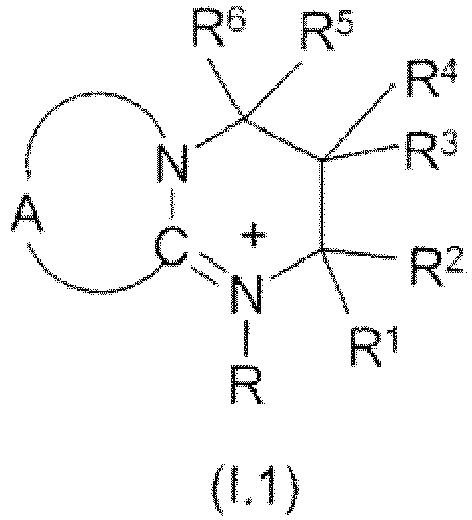 R und A die oben angegebenen Bedeutungen besitzen undR1, R2, R3, R4, R5 und R6 unabhängig voneinander für Wasserstoff, Alkyl, Alkenyl, Cycloalkyl, Cycloalkenyl, Polycyclyl, Heterocycloalkyl, Aryl, Hetaryl, Hydroxy, SH, Polyalkylenoxid, Polyalkylenimin, Alkoxy, Alkylthio, Alkylsulfinyl, Alkylsulfonyl, Halogen, SO3H, Sulfonat, NE1E2, Nitro, Alkoxycarbonyl, COOH, Carboxylat, Formyl, Acyl oder Cyano stehen, wobei E1 und E2 jeweils gleiche oder verschiedene Reste, die aus Wasserstoff, Alkyl, Cyclo-alkyl und Aryl ausgewählt sind, bedeuten,
wobei die Reste R1, R2, R3, R4, R5 und R6, die für Alkylreste stehen, 1, 2, 3, 4 oder 5 Substituenten, die aus Cycloalkyl, Heterocycloalkyl, Aryl, Hetaryl, Cycloalkoxy, Cycloalkylthio, Heterocycloalkoxy, Heterocycloalkylthio, Aryloxy, Arylthio, Hetaryloxy, Hetarylthio, Hydroxy, SH, COOH, Carboxylat, SO3H, Sulfonat, NE4E5, (NE4E5E6)+X-, Halogen, Nitro, Formyl, Acyl und Cyano ausgewählt sind, enthalten können, wobei E4, E5 und E6 jeweils gleiche oder verschiedene Reste, die aus Wasserstoff, Alkyl, Cycloalkyl und Aryl ausgewählt sind, bedeuten und X- für ein Anionäquivalent steht,
und wobei die Reste R1, R2, R3, R4, R5 und R6, die für Cycloalkyl, Cycloalkenyl, Polycyclyl, Heterocycloalkyl, Aryl und Hetaryl stehen, 1, 2, 3, 4 oder 5 Substituenten, die aus Alkyl und den oben für die Alkylreste R1 bis R6 genannten Substituenten ausgewählt sind, enthalten können, oder
R1 und R3 und/oder, falls vorhanden, R4 und R6 gemeinsam mit den Ringkohlenstoffatomen, an die sie gebunden sind, für einen 5- bis 8-gliedrigen gesättigten, ungesättigten oder aromatischen carbo- oder heterocyclischen Rest stehen, der gegebenenfalls zusätzlich ein-, zwei- oder dreifach mit Cycloalkyl, Heterocycloalkyl, Aryl oder Hetaryl anelliert ist, wobei der carbo- oder heterocyclische Rest und, falls vorhanden, die anellierten Gruppen unabhängig voneinander je einen, zwei, drei oder vier Substituenten, die aus Alkyl, Cycloalkyl, Heterocycloalkyl, Aryl, Hetaryl, Hydroxy, SH, Halogen, COOH, Carboxylat, SO3H, Sulfonat, NE7E8, (NE7E8E9)+X-, Nitro, Alkoxycarbonyl, Formyl, Acyl und Cyano ausgewählt sind, tragen können, wobei E7, E8 und E9 jeweils gleiche oder verschiedene Reste, die aus Wasserstoff, Alkyl, Cycloalkyl und Aryl ausgewählt sind, bedeuten und X- für ein Anionäquivalent steht,
wobei in den Verbindungen der Formel I.1 R1 und R3 oder R3 und R5 auch gemeinsam für den Bindungsanteil einer Doppelbindung zwischen den Ringatomen, die diese Reste tragen, stehen können. - Flüssige Zusammensetzung nach einem der Ansprüche 1 oder 2, wobei A zusammen mit der C-N-Gruppe, an die es gebunden ist, einen 7-gliedrigen Ring bildet, der gegebenenfalls zusätzlich ein-, zwei- oder dreifach mit Cycloalkyl, Cycloalkenyl, Heterocycloalkyl, Aryl oder Hetaryl anelliert ist, wobei der Heterocyclus und, falls vorhanden, die anellierten Gruppen unabhängig voneinander je einen, zwei, drei oder vier Substituenten, die aus Alkyl, Alkenyl, Cycloalkyl, Cycloalkenyl, Heterocycloalkyl, Aryl, Hetaryl, Hydroxy, SH, Polyalkylenoxid, Polyalkylenimin, Alkoxy, Halogen, COOH, Carboxylat, SO3H, Sulfonat, NE10E11, (NE10E11E12)+X-, Nitro, Alkoxycarbonyl, Formyl, Acyl und Cyano ausgewählt sind, tragen können, wobei E10, E11 und E12 jeweils gleiche oder verschiedene Reste, die aus Wasserstoff, Alkyl, Cycloalkyl und Aryl ausgewählt sind, bedeuten und X- für ein Anionäquivalent steht.
- Flüssige Zusammensetzung nach einem der vorhergehenden Ansprüche, wobei in den Verbindungen der Formel I die Kationen aus Kationen von 1,8-Diazabicyclo[5.4.0]undec-7-en ausgewählt sind.
- Flüssige Zusammensetzung nach den Ansprüchen 1-4, wobei die Polymerkomponente aus Polysacchariden und modifizierten Polysacchariden ausgewählt ist.
- Flüssige Zusammensetzung nach Anspruch 5, wobei es sich bei der Polymerkomponente um Cellulose handelt.
- Flüssige Zusammensetzung nach einem der Ansprüche 1 bis 4, wobei die Polymerkomponente Cellulose und mindestens ein synthetisches Polymer aus der Gruppe bestehend aus Polyurethanen, Polyharnstoffen, Polyamiden, Polysulfonen, Polyethersulfonen, Homopolymeren und Copolymeren von cyclischen Ethern und Mischungen davon umfasst.
- Flüssige Zusammensetzung nach einem der Ansprüche 1 bis 4, wobei die flüssige Zusammensetzung durch Behandlung von mindestens einem Lignocellulosematerial mit mindestens einer ionischen Flüssigkeit der allgemeinen Formel I gemäß einem der Ansprüche 1 bis 4 erhältlich ist.
- Verfahren zur Gewinnung mindestens eines Bestandteils eines Lignocellulosematerials, bei dem man den Bestandteil selektiv solubilisiert und/oder aus einem Solubilisat des Lignocellulosematerials selektiv freisetzt, wobei zur Solubilisierung mindestens eine ionische Flüssigkeit der allgemeinen Formel I gemäß einem der Ansprüche 1 bis 4 eingesetzt wird.
- Verfahren nach Anspruch 9, bei dem bei der Behandlung des Lignocellulosematerials mit mindestens einer ionischen Flüssigkeit der allgemeinen Formel I eine an Lignin angereicherte flüssige Phase und ein an Cellulose angereicherter Rückstand erhalten werden.
- Verfahren nach Anspruch 9, bei dem bei der Behandlung des Lignocellulosematerials mit mindestens einer ionischen Flüssigkeit der allgemeinen Formel I eine an Lignin und an Cellulose angereicherte flüssige Phase erhalten wird und man die flüssige Phase einer Auftrennung in eine an Lignin angereicherte Fraktion und eine an Cellulose angereicherte Fraktion unterwirft.
- Verfahren zur Gewinnung einer Base der Formel I.a


- Verfahren zur Herstellung einer Verbindung der Formel I
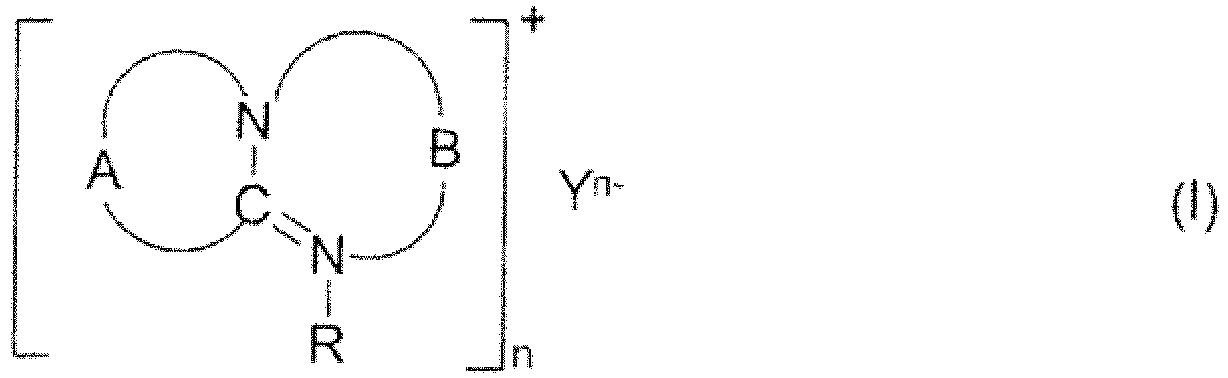 A zusammen mit der C-N-Gruppe, an die es gebunden ist, einen 7-gliedrigen, gesättigten Ring bildet, der gegebenenfalls substituiert ist,B zusammen mit der Amidinogruppe, an die es gebunden ist, einen 6-gliedrigen, einfach ungesättigten, nichtaromatischen Ring bildet, der gegebenenfalls substituiert ist,R für Wasserstoff oder einen Organylrest steht,Yn- für ein ein-, zwei-, drei- oder vierwertiges Anion steht undn für eins, zwei, drei oder vier steht,bei dem man eine Verbindung der Formel I.A

Priority Applications (1)
| Application Number | Priority Date | Filing Date | Title |
|---|---|---|---|
| EP07821248.7A EP2074255B1 (de) | 2006-10-13 | 2007-10-12 | Ionische flüssigkeiten zur lösung von polymeren |
Applications Claiming Priority (3)
| Application Number | Priority Date | Filing Date | Title |
|---|---|---|---|
| EP06122300 | 2006-10-13 | ||
| PCT/EP2007/060881 WO2008043837A1 (en) | 2006-10-13 | 2007-10-12 | Ionic liquids for solubilizing polymers |
| EP07821248.7A EP2074255B1 (de) | 2006-10-13 | 2007-10-12 | Ionische flüssigkeiten zur lösung von polymeren |
Publications (2)
| Publication Number | Publication Date |
|---|---|
| EP2074255A1 EP2074255A1 (de) | 2009-07-01 |
| EP2074255B1 true EP2074255B1 (de) | 2016-12-14 |
Family
ID=38918813
Family Applications (1)
| Application Number | Title | Priority Date | Filing Date |
|---|---|---|---|
| EP07821248.7A Not-in-force EP2074255B1 (de) | 2006-10-13 | 2007-10-12 | Ionische flüssigkeiten zur lösung von polymeren |
Country Status (4)
| Country | Link |
|---|---|
| US (2) | US8044120B2 (de) |
| EP (1) | EP2074255B1 (de) |
| CN (1) | CN101522985B (de) |
| WO (1) | WO2008043837A1 (de) |
Families Citing this family (120)
| Publication number | Priority date | Publication date | Assignee | Title |
|---|---|---|---|---|
| JP2010510402A (ja) * | 2006-11-23 | 2010-04-02 | ビーエーエスエフ ソシエタス・ヨーロピア | 繊維の製造方法 |
| GB0623473D0 (en) | 2006-11-24 | 2007-01-03 | Bristol Myers Squibb Co | Dissolution and processing of cellulose |
| JP2010516266A (ja) * | 2007-01-23 | 2010-05-20 | ビーエーエスエフ ソシエタス・ヨーロピア | 多原子アニオンを有するイオン性液体の使用下でリグノセルロース含有材料から得られたセルロースの酵素的加水分解によりグルコースを製造する方法 |
| US9834516B2 (en) | 2007-02-14 | 2017-12-05 | Eastman Chemical Company | Regioselectively substituted cellulose esters produced in a carboxylated ionic liquid process and products produced therefrom |
| US10174129B2 (en) | 2007-02-14 | 2019-01-08 | Eastman Chemical Company | Regioselectively substituted cellulose esters produced in a carboxylated ionic liquid process and products produced therefrom |
| US8148518B2 (en) | 2007-02-14 | 2012-04-03 | Eastman Chemical Company | Cellulose esters and their production in carboxylated ionic liquids |
| US7674608B2 (en) | 2007-02-23 | 2010-03-09 | The University Of Toledo | Saccharifying cellulose |
| CN101765663B (zh) | 2007-03-14 | 2014-11-05 | 托莱多大学 | 生物质预处理 |
| WO2008119770A1 (de) * | 2007-03-30 | 2008-10-09 | Basf Se | Verfahren zur modifizierung der struktur eines cellulosematerials durch behandeln mit einer ionischen flüssigkeit |
| US11001776B2 (en) | 2007-07-31 | 2021-05-11 | Richard B. Hoffman | System and method of preparing pre-treated biorefinery feedstock from raw and recycled waste cellulosic biomass |
| KR20100098440A (ko) * | 2007-12-14 | 2010-09-06 | 바스프 에스이 | 이온성 액체의 가수분해 안정성을 개선하는 방법 |
| US20100297532A1 (en) * | 2008-01-09 | 2010-11-25 | Basf Se | Process for working up ionic liquids |
| WO2009101111A1 (de) | 2008-02-11 | 2009-08-20 | Basf Se | Verfahren zur herstellung poröser strukturen aus synthetischen polymeren |
| BRPI0908350A2 (pt) | 2008-02-11 | 2015-10-27 | Basf Se | processos para preparar poliamidas, para funcionalizar poliamidas por transmidação e para produzir fibras, folhas, filmes ou revestimentos a partir de poliamidas |
| US8188267B2 (en) | 2008-02-13 | 2012-05-29 | Eastman Chemical Company | Treatment of cellulose esters |
| US9777074B2 (en) | 2008-02-13 | 2017-10-03 | Eastman Chemical Company | Regioselectively substituted cellulose esters produced in a halogenated ionic liquid process and products produced therefrom |
| US8158777B2 (en) | 2008-02-13 | 2012-04-17 | Eastman Chemical Company | Cellulose esters and their production in halogenated ionic liquids |
| US8354525B2 (en) | 2008-02-13 | 2013-01-15 | Eastman Chemical Company | Regioselectively substituted cellulose esters produced in a halogenated ionic liquid process and products produced therefrom |
| WO2009105236A1 (en) * | 2008-02-19 | 2009-08-27 | The Board Of Trustees Of The University Of Alabama | Ionic liquid systems for the processing of biomass, their components and/or derivatives, and mixtures thereof |
| WO2010000834A1 (de) * | 2008-07-04 | 2010-01-07 | Basf Se | Verwendung ionischer flüssigkeiten als katalysatoren |
| JP5576373B2 (ja) * | 2008-09-01 | 2014-08-20 | エクスペリアー アイエヌティ リミテッド | 基材からチューイングガム残滓を除去するための組成物および方法 |
| PL2346927T3 (pl) * | 2008-10-17 | 2014-12-31 | Maxbiogas Gmbh | Sposób fermentacji biomasy zawierającej ligninę wraz z celulozą i/lub hemicelulozą |
| CN101723771B (zh) * | 2008-10-20 | 2012-12-05 | 浙江医药股份有限公司新昌制药厂 | 功能离子液体催化制备β-氨基酮、酯、腈和酰胺衍生物的方法 |
| WO2010056790A1 (en) * | 2008-11-12 | 2010-05-20 | The Board Of Trustees Of The University Of Alabama | Ionic liquid systems for the processing of biomass, their components and/or derivatives, and mixtures thereof |
| EP2202262B1 (de) | 2008-12-24 | 2013-05-29 | Samsung Electronics Co., Ltd. | Zusammensetzung für Polyurethanhartschaum und damit hergestellter Polyurethanhartschaum |
| US8435355B2 (en) | 2008-12-29 | 2013-05-07 | Weyerhaeuser Nr Company | Fractionation of lignocellulosic material using ionic liquids |
| JP5055314B2 (ja) * | 2009-02-27 | 2012-10-24 | 株式会社日立製作所 | セルロース/樹脂複合体及びその製造方法 |
| KR101071774B1 (ko) * | 2009-03-06 | 2011-10-11 | 기아자동차주식회사 | 아마이드로부터 유도된 이온성 액체계 이산화탄소 흡수제 |
| US8524887B2 (en) | 2009-04-15 | 2013-09-03 | Eastman Chemical Company | Regioselectively substituted cellulose esters produced in a tetraalkylammonium alkylphosphate ionic liquid process and products produced therefrom |
| DE102010028550A1 (de) | 2009-05-05 | 2010-11-11 | Basf Se | Verfahren zur Herstellung von Eisen-Nanopartikel enthaltenden thermoplastischen Polymerformmassen |
| WO2010141470A2 (en) | 2009-06-01 | 2010-12-09 | The Board Of Trustees Of The University Of Alabama | Process for forming films, fibers, and beads from chitinous biomass |
| SG176136A1 (en) | 2009-06-08 | 2011-12-29 | Basf Se | Use of ionic fluids for pretreating plastic surfaces for metallization |
| FR2948671B1 (fr) | 2009-07-31 | 2011-08-19 | Univ Paris Curie | Procede de synthese de polyesters en milieu liquide ionique acide |
| US8772406B2 (en) * | 2009-08-06 | 2014-07-08 | Robert J. Linhardt | Synthetic wood composite |
| WO2011027220A1 (en) | 2009-09-01 | 2011-03-10 | Paul O'connor | Improved process for dissolving cellulose-containing biomass material in an ionic liquid medium |
| US8882924B2 (en) | 2009-09-01 | 2014-11-11 | Kior, Inc. | Pretreatment of solid biomass material comprising cellulose with ionic liquid medium |
| WO2011026822A2 (de) | 2009-09-03 | 2011-03-10 | Basf Se | Ionische flüssigkeiten mit verbesserter viskosität |
| WO2011045231A1 (de) | 2009-10-16 | 2011-04-21 | Basf Se | Verfahren zur entfernung von kationen aus celluloseformkörpern |
| EP2507300A1 (de) | 2009-12-04 | 2012-10-10 | Basf Se | Verfahren zur herstellung einer polymerisatdispersion |
| US20110133110A1 (en) * | 2009-12-04 | 2011-06-09 | Basf Se | Process for producing a polymer dispersion |
| KR101778321B1 (ko) | 2009-12-10 | 2017-09-13 | 바스프 에스이 | 정전기 방지 열가소성 조성물 |
| KR20120118010A (ko) | 2010-01-15 | 2012-10-25 | 바스프 에스이 | 다당류 또는 올리고당의 염소화 방법 |
| US8884003B2 (en) | 2010-01-15 | 2014-11-11 | Basf Se | Method of chlorinating polysaccharides or oligosaccharides |
| WO2011110423A1 (de) | 2010-03-08 | 2011-09-15 | Basf Se | Salze von thiophosphorsäuren und deren verwendung in schmierstoffen |
| US8507419B2 (en) | 2010-03-08 | 2013-08-13 | Basf Se | Salts of thiophosphoric acids and use thereof in lubricants |
| DE102011005441A1 (de) | 2010-03-15 | 2011-09-15 | Basf Se | Korrosionsinhibitoren für ionische Flüssigkeiten |
| DE102011007559A1 (de) | 2010-04-19 | 2011-10-20 | Basf Se | Verfahren zur Herstellung von Elektrolyten für die Aluminiumabscheidung |
| DE102011007566A1 (de) | 2010-04-19 | 2012-01-19 | Basf Se | Verfahren zur Herstellung von Zusammensetzungen, welche Aluminiumtrihalogenide enthalten |
| DE102011007639A1 (de) | 2010-04-23 | 2011-10-27 | Basf Se | Verfahren zur mechanischen Bearbeitung von Werkstücken mit einem Hochdruckstrahl |
| WO2011154370A1 (en) | 2010-06-10 | 2011-12-15 | Basf Se | Process for determining the purity of and reusing ionic liquids |
| FI125827B (fi) * | 2010-06-23 | 2016-02-29 | Stora Enso Oyj | Menetelmä lignoselluloosamateriaalien liuottamiseksi |
| US8980050B2 (en) | 2012-08-20 | 2015-03-17 | Celanese International Corporation | Methods for removing hemicellulose |
| JP5607442B2 (ja) * | 2010-07-09 | 2014-10-15 | スリーエム イノベイティブ プロパティズ カンパニー | フルオロポリマー系粘接着性組成物 |
| WO2012016835A2 (de) | 2010-07-26 | 2012-02-09 | Basf Se | Ionische flüssigkeiten mit einem gehalt an ionischen polymeren |
| US8703670B2 (en) | 2010-07-26 | 2014-04-22 | Basf Se | Ionic liquids having a content of ionic polymers |
| DE102011083361A1 (de) | 2010-09-27 | 2012-03-29 | Basf Se | Verfahren zur Herstellung von Bisoxazolidinen |
| US8563787B2 (en) | 2010-10-05 | 2013-10-22 | Basf Se | Preparation of homoallyl alcohols in the presence of noncovalently supported ionic liquid phase catalysts under gas-phase reaction conditions |
| FI20106142A0 (fi) * | 2010-11-01 | 2010-11-01 | Aabo Akademi | Menetelmä lignoselluloosamateriaalin fraktioimiseksi ja siihen tarkoitettuja uusia ionisia nesteitä |
| WO2012080702A2 (en) * | 2010-12-15 | 2012-06-21 | Imperial Innovations Ltd | Treatment |
| WO2012123411A1 (de) | 2011-03-15 | 2012-09-20 | Basf Se | Verfahren zum abreichern von säuren aus zusammensetzungen, welche ionische flüssigkeiten enthalten |
| EP2686304B1 (de) | 2011-03-15 | 2016-05-18 | Basf Se | Verfahren zur Herstellung von ionischen Flüssigkeiten durch Anionenaustausch |
| US9090567B2 (en) | 2011-03-15 | 2015-07-28 | Basf Se | Process for preparing ionic liquids by anion exchange |
| US9394375B2 (en) | 2011-03-25 | 2016-07-19 | Board Of Trustees Of The University Of Alabama | Compositions containing recyclable ionic liquids for use in biomass processing |
| US9796791B2 (en) | 2011-04-13 | 2017-10-24 | Eastman Chemical Company | Cellulose ester optical films |
| EP2532646A1 (de) | 2011-06-07 | 2012-12-12 | Basf Se | Verfahren zur Herstellung von Estern und organischen Halogenen |
| WO2013021015A1 (de) | 2011-08-09 | 2013-02-14 | Basf Se | Verfahren zur reinigung von ionischen flüssigkeiten |
| US8580886B2 (en) | 2011-09-20 | 2013-11-12 | Dow Corning Corporation | Method for the preparation and use of bis (alkoxysilylorgano)-dicarboxylates |
| WO2013041402A1 (de) | 2011-09-20 | 2013-03-28 | Basf Se | Verfahren zur reinigung von ionischen flüssigkeiten |
| US8691893B2 (en) * | 2011-10-07 | 2014-04-08 | Masdar Institute Of Science And Technology | Biodegradable composite materials |
| JP2014532106A (ja) | 2011-10-14 | 2014-12-04 | ビーエイエスエフ・ソシエタス・エウロパエアBasf Se | アミン基含有オリゴ糖の製造方法 |
| EP2785726B1 (de) | 2011-12-02 | 2018-08-01 | Dow Silicones Corporation | Esterfunktionelle silane sowie ihre herstellung und verwendung und verwendung von iminiumverbindungen als phasentransferkatalysatoren |
| DE102013201971A1 (de) | 2012-02-10 | 2013-08-14 | Basf Se | Salze der Thiocarbamidsäure als Korrosionsinhibitoren |
| DE102012006501A1 (de) | 2012-03-29 | 2013-10-02 | Fraunhofer-Gesellschaft zur Förderung der angewandten Forschung e.V. | Lignocellulose-Spinnlösung, Lignocellulose-Regeneratfaser sowie Verfahren zu deren Herstellung |
| KR20150023709A (ko) | 2012-06-15 | 2015-03-05 | 바스프 에스이 | 친핵체 존재 하의 유기 기판의 애노드 산화 |
| US8986501B2 (en) | 2012-08-20 | 2015-03-24 | Celanese International Corporation | Methods for removing hemicellulose |
| WO2014043083A2 (en) * | 2012-09-12 | 2014-03-20 | Drexel University | Polymerized ionic liquid block copolymers as battery membranes |
| US9287597B2 (en) | 2012-11-14 | 2016-03-15 | Fluidic, Inc. | Ionic liquid containing hydroxamate and N-alkyl sulfamate ions |
| US20140174320A1 (en) * | 2012-12-05 | 2014-06-26 | Taiwan Textile Research Institute | Ionic liquid and viscose composition |
| US9265906B2 (en) * | 2013-02-25 | 2016-02-23 | Covidien Lp | Compressible cannula connector with release grip |
| US11118308B2 (en) | 2013-03-15 | 2021-09-14 | Ip2Ipo Innovations Limited | Treatment of lignocellulosic biomass with ionic liquid |
| CA2908764C (en) | 2013-04-04 | 2021-07-27 | Aalto University Foundation | Process for the production of shaped cellulose articles |
| EP2853559A1 (de) | 2013-09-27 | 2015-04-01 | Bayer MaterialScience AG | Polycarbonatzusammensetzung mit verbesserten elektrischen Eigenschaften enthaltend Ruß |
| EP2853560A1 (de) | 2013-09-27 | 2015-04-01 | Bayer MaterialScience AG | Polycarbonatzusammensetzung mit verbesserten elektrischen Eigenschaften enthaltend Kohlenstoffnanoröhrchen |
| US9222223B1 (en) | 2014-06-30 | 2015-12-29 | Weyerhaeuser Nr Company | Esterified cellulose pulp compositions and related methods |
| US9708760B2 (en) | 2014-06-30 | 2017-07-18 | International Paper Company | Esterified cellulose pulp compositions and related methods |
| CN104130263B (zh) * | 2014-07-02 | 2016-09-07 | 东华大学 | 一种高折射率室温离子液体 |
| US10100131B2 (en) | 2014-08-27 | 2018-10-16 | The Board Of Trustees Of The University Of Alabama | Chemical pulping of chitinous biomass for chitin |
| US10011931B2 (en) | 2014-10-06 | 2018-07-03 | Natural Fiber Welding, Inc. | Methods, processes, and apparatuses for producing dyed and welded substrates |
| US10982381B2 (en) * | 2014-10-06 | 2021-04-20 | Natural Fiber Welding, Inc. | Methods, processes, and apparatuses for producing welded substrates |
| KR20180034615A (ko) | 2015-07-30 | 2018-04-04 | 바스프 에스이 | 금속화를 위한 플라스틱 표면의 전처리 방법 |
| WO2017016965A1 (en) | 2015-07-30 | 2017-02-02 | Basf Se | Process for metallizing plastic surfaces |
| CN105220552B (zh) * | 2015-09-09 | 2017-03-29 | 郑州轻工业学院 | 利用咪唑类非对称Gemini离子液体提取纤维素的方法 |
| GB201520453D0 (en) | 2015-11-20 | 2016-01-06 | Imp Innovations Ltd | Process |
| EP3414371B1 (de) | 2016-02-11 | 2025-07-30 | Technikum Laubholz GmbH | Verfahren zur herstellung von polymerfasern aus in ionischen flüssigkeiten gelösten polymeren durch einen luftspaltspinnprozess |
| EP3433416B1 (de) | 2016-03-25 | 2023-12-06 | Natural Fiber Welding, Inc. | Verfahren zur herstellung von einem geschweissten substrat |
| AU2017259983B2 (en) | 2016-05-03 | 2021-08-19 | Natural Fiber Welding, Inc. | Methods, processes, and apparatuses for producing dyed and welded substrates |
| WO2018039505A1 (en) * | 2016-08-24 | 2018-03-01 | National Technology & Engineering Solutions Of Sandia Llc (Ntess) | Novel protic or phosphate-based ionic liquids useful for lignocellulosic processing |
| EP3528856B1 (de) | 2016-10-18 | 2023-07-12 | Marquette University | Verbundwerkstoffe mit strukturellen polymeren und photoreaktiven stickstoffdioxidfreisetzungsmitteln und verwendungen davon für wundauflagen |
| JP2018070451A (ja) * | 2016-10-24 | 2018-05-10 | Jnc株式会社 | ジアザビシクロ化合物の製造方法 |
| JP7186170B2 (ja) | 2016-10-25 | 2022-12-08 | アリゾナ ボード オブ リージェンツ オン ビハーフ オブ アリゾナ ステート ユニバーシティ | 無溶媒イオン性液体エポキシ樹脂 |
| US10927191B2 (en) | 2017-01-06 | 2021-02-23 | The Board Of Trustees Of The University Of Alabama | Coagulation of chitin from ionic liquid solutions using kosmotropic salts |
| WO2018236445A2 (en) | 2017-03-24 | 2018-12-27 | The Board Of Trustees Of The University Of Alabama | METALLIC-CHITIN PARTICLE COMPOSITE MATERIALS AND METHODS OF MAKING SAME |
| US11753565B2 (en) | 2017-06-22 | 2023-09-12 | Teknologian Tutkimuskeskus Vtt Oy | Method of joining polymeric biomaterials |
| EP3684571A4 (de) | 2017-09-08 | 2021-07-14 | DTE Materials Incorporated | Selektiv depolymerisierende cellulosematerialien zur verwendung als thermische und akustische isolatoren |
| TWI829660B (zh) | 2017-11-11 | 2024-01-21 | 美商天然纖維焊接股份有限公司 | 紗與熔接紗 |
| JP7183565B2 (ja) * | 2018-04-25 | 2022-12-06 | Dic株式会社 | 樹脂組成物の製造方法、および前記樹脂組成物を用いた成形体の製造方法 |
| CN113646355B (zh) | 2019-02-18 | 2025-02-25 | 亚利桑那州立大学董事会 | 无溶剂离子液体环氧树脂 |
| GB2583719B (en) | 2019-05-02 | 2023-05-31 | Worn Again Tech Ltd | Recycling process |
| US12239948B2 (en) | 2019-06-17 | 2025-03-04 | Marquette University | Materials based on natural pollen grains and uses thereof |
| CN110330569A (zh) * | 2019-08-22 | 2019-10-15 | 齐鲁工业大学 | 一种高取代度氧化纤维素的制备方法 |
| CN111995772B (zh) * | 2020-09-10 | 2023-04-18 | 贵州大学 | 一种蚕丝-聚合物混合溶液的制备方法 |
| CN113481619B (zh) * | 2021-07-27 | 2023-11-03 | 齐鲁工业大学 | 一种高强度再生纤维素纤维的制备方法 |
| JP7060152B1 (ja) * | 2021-09-01 | 2022-04-26 | 日清紡ホールディングス株式会社 | イオン液体のカチオン成分の回収方法およびイオン液体の再生方法 |
| CN114195791B (zh) * | 2021-11-25 | 2023-09-08 | 华南理工大学 | 一种多元离子液体及其制备方法和应用 |
| CN114213845A (zh) * | 2021-12-10 | 2022-03-22 | 中化学科学技术研究有限公司 | 一种可纺聚酰胺及其制备方法和制品 |
| CN115403585A (zh) * | 2022-08-12 | 2022-11-29 | 华南理工大学 | 离子液体及其制备方法与在纤维素转酯化改性中的应用 |
| CN117988146B (zh) * | 2022-10-31 | 2025-10-03 | 中国石油化工股份有限公司 | 一种从生物质中提取富纤维素材料的方法 |
| CN119505452A (zh) * | 2023-08-24 | 2025-02-25 | 中国石油化工股份有限公司 | 一种热塑性聚乙烯醇组合物及其制备方法 |
| EP4703496A1 (de) | 2024-08-26 | 2026-03-04 | Basf Se | Ätzzusammensetzung mit mindestens einer ionischen flüssigkeit und mindestens einem lactamid und verfahren zur beschichtung von kunststoffoberflächen mit metallen unter verwendung davon |
| CN122013510B (zh) * | 2026-04-15 | 2026-07-17 | 浙江理工大学 | 一种表面改性纤维素纤维及其制备方法 |
Family Cites Families (17)
| Publication number | Priority date | Publication date | Assignee | Title |
|---|---|---|---|---|
| DE4228510A1 (de) * | 1992-08-27 | 1994-03-03 | Herberts Gmbh | Wäßrige Polyurethanharzdispersion, Verfahren zu deren Herstellung und deren Verwendung in wäßrigen Überzugsmitteln |
| IT1273616B (it) * | 1995-05-05 | 1997-07-08 | Enichem Spa | Composizioni acquose termoreattive a base di dispersioni o soluzioni poliuretaniche stabili |
| US6824599B2 (en) * | 2001-10-03 | 2004-11-30 | The University Of Alabama | Dissolution and processing of cellulose using ionic liquids |
| US6808557B2 (en) * | 2001-10-03 | 2004-10-26 | The University Of Alabama | Cellulose matrix encapsulation and method |
| DE10202838A1 (de) | 2002-01-24 | 2003-08-07 | Basf Ag | Verfahren zur Abtrennung von Säuren aus chemischen Reaktionsgemischen mit Hilfe von ionischen Flüssigkeiten |
| WO2005007657A2 (de) * | 2003-07-11 | 2005-01-27 | Solvay Fluor Gmbh | Verwendung von dbn und dbu-salzen als ionische flüssigkeiten |
| DE502004007160D1 (de) | 2003-07-21 | 2008-06-26 | Basf Se | Verfahren zur extraktion von verunreinigungen mit ionischen flüssigkeiten |
| AU2003904323A0 (en) * | 2003-08-13 | 2003-08-28 | Viridian Chemical Pty Ltd | Solvents based on salts of aryl acids |
| FI115835B (fi) | 2003-08-15 | 2005-07-29 | Kemira Oyj | Liuotusmenetelmä |
| FI116140B (fi) * | 2003-12-03 | 2005-09-30 | Kemira Oyj | Eetteröintimenetelmä |
| US20050288431A1 (en) * | 2004-06-25 | 2005-12-29 | Gindin Lyubov K | Polyurethane dispersion prepared from a high acid functional polyester |
| GB0500028D0 (en) * | 2005-01-04 | 2005-02-09 | Univ Belfast | Base stable ionic liquids |
| GB0505064D0 (en) * | 2005-03-11 | 2005-04-20 | Univ Belfast | Production of bio-diesel |
| DE102005017715A1 (de) | 2005-04-15 | 2006-10-19 | Basf Ag | Lösungen von Cellulose in ionischen Flüssigkeiten |
| DE102005017733A1 (de) | 2005-04-15 | 2006-10-19 | Basf Ag | Löslichkeit von Cellulose in ionischen Flüssigkeiten unter Zugabe von Aminbase |
| WO2007076979A1 (de) | 2005-12-23 | 2007-07-12 | Basf Se | Lösungssystem auf der basis geschmolzener ionischer flüssigkeiten, dessen herstellung sowie verwendung zur herstellung regenerierter kohlenhydrate |
| CA2539418C (en) * | 2006-03-13 | 2013-10-29 | Queen's University At Kingston | Switchable solvents and methods of use thereof |
-
2007
- 2007-10-12 EP EP07821248.7A patent/EP2074255B1/de not_active Not-in-force
- 2007-10-12 WO PCT/EP2007/060881 patent/WO2008043837A1/en not_active Ceased
- 2007-10-12 US US12/445,081 patent/US8044120B2/en not_active Expired - Fee Related
- 2007-10-12 CN CN200780038071.9A patent/CN101522985B/zh not_active Expired - Fee Related
-
2011
- 2011-09-20 US US13/237,495 patent/US20120010334A1/en not_active Abandoned
Non-Patent Citations (1)
| Title |
|---|
| None * |
Also Published As
| Publication number | Publication date |
|---|---|
| US20120010334A1 (en) | 2012-01-12 |
| CN101522985A (zh) | 2009-09-02 |
| US20100048829A1 (en) | 2010-02-25 |
| US8044120B2 (en) | 2011-10-25 |
| CN101522985B (zh) | 2013-01-16 |
| EP2074255A1 (de) | 2009-07-01 |
| WO2008043837A1 (en) | 2008-04-17 |
Similar Documents
| Publication | Publication Date | Title |
|---|---|---|
| US8044120B2 (en) | Ionic liquids for solubilizing polymers | |
| CN101589153A (zh) | 通过对可用含多原子阴离子的离子液体预处理的纤维素进行酶促水解制备葡萄糖的方法 | |
| US20100081798A1 (en) | Method for producing glucose by enzymatic hydrolysis of cellulose that is obtained from material containing ligno-cellulose using an ionic liquid that comprises a polyatomic anion | |
| DE2238734C2 (de) | Bis-benzofuranyl-Verbindungen und deren Verwendung als optische Aufheller | |
| HUANG et al. | Recycling and reuse of ionic liquid in homogeneous cellulose acetylation | |
| CN101918368B (zh) | 改善离子液体的水解稳定性的方法 | |
| DE60118966T2 (de) | Prozess für die produktion von anhydrozucker-alkoholen | |
| BR112015024633A2 (pt) | processo de produção de 1,4-butanodiol e processo de produção de um poliéster | |
| AU2022279334B2 (en) | Method for extraction and transformation of phthalates contained in pvc plastics by means of alcohol | |
| CN102276788A (zh) | 一种基于没食子酸的环氧树脂及其制备方法和应用 | |
| EP2176356B1 (de) | Wässrige synthese von perylenpigmenten | |
| TWI472545B (zh) | 離子液體以及黏液組成物 | |
| US20100297532A1 (en) | Process for working up ionic liquids | |
| CH697009A5 (de) | Kristallisiertes Polyethylenterephthalat, welches Silizium enthält, und Verfahren zu dessen Herstellung. | |
| CN106631813A (zh) | 一种溴硝醇精制工艺 | |
| US20020103266A1 (en) | Chemical method of removing paint film on plastic resin using isopropyl alchohol | |
| DE69306693T2 (de) | Verfahren zur Herstellung von Polyethlenterephthalat mit hohem Molekulargewicht aus wiederverwendetem PET | |
| US20170218317A1 (en) | Method for processing biobased materials and the resulting compositions | |
| EP4063437A1 (de) | Gassperrfilm und verbundharzzusammensetzung | |
| EP1385906B1 (de) | Polyamid-formmassen zur herstellung transparenter folien | |
| WO2016072457A1 (ja) | エポキシ-アミン付加物、樹脂組成物、サイジング剤、サイジング剤塗布炭素繊維、及び繊維強化複合材料 | |
| CN104401075A (zh) | 一种具有隔氧性改性制剂的bopp复合薄膜的制备方法 | |
| DE10353328A1 (de) | Verwendung von Naphthalin-1,8-dicarbonsäuremonoimiden | |
| CN108841166A (zh) | 一种可降解tpu包装膜 | |
| DE2238644C2 (de) | Benzofuran- und Naphthofuran-derivate, Verfahren zu deren Herstellung und ihre Verwendung als optische Aufheller |
Legal Events
| Date | Code | Title | Description |
|---|---|---|---|
| PUAI | Public reference made under article 153(3) epc to a published international application that has entered the european phase |
Free format text: ORIGINAL CODE: 0009012 |
|
| 17P | Request for examination filed |
Effective date: 20090330 |
|
| AK | Designated contracting states |
Kind code of ref document: A1 Designated state(s): AT BE BG CH CY CZ DE DK EE ES FI FR GB GR HU IE IS IT LI LT LU LV MC MT NL PL PT RO SE SI SK TR |
|
| AX | Request for extension of the european patent |
Extension state: AL BA HR MK RS |
|
| 17Q | First examination report despatched |
Effective date: 20090907 |
|
| DAX | Request for extension of the european patent (deleted) | ||
| REG | Reference to a national code |
Ref country code: DE Ref legal event code: R079 Ref document number: 602007049164 Country of ref document: DE Free format text: PREVIOUS MAIN CLASS: D21C0003200000 Ipc: C07D0487040000 |
|
| GRAP | Despatch of communication of intention to grant a patent |
Free format text: ORIGINAL CODE: EPIDOSNIGR1 |
|
| RIC1 | Information provided on ipc code assigned before grant |
Ipc: C07D 487/04 20060101AFI20160805BHEP Ipc: C08J 3/09 20060101ALI20160805BHEP |
|
| INTG | Intention to grant announced |
Effective date: 20160901 |
|
| GRAS | Grant fee paid |
Free format text: ORIGINAL CODE: EPIDOSNIGR3 |
|
| GRAA | (expected) grant |
Free format text: ORIGINAL CODE: 0009210 |
|
| AK | Designated contracting states |
Kind code of ref document: B1 Designated state(s): AT BE BG CH CY CZ DE DK EE ES FI FR GB GR HU IE IS IT LI LT LU LV MC MT NL PL PT RO SE SI SK TR |
|
| REG | Reference to a national code |
Ref country code: GB Ref legal event code: FG4D |
|
| REG | Reference to a national code |
Ref country code: CH Ref legal event code: EP |
|
| REG | Reference to a national code |
Ref country code: IE Ref legal event code: FG4D |
|
| REG | Reference to a national code |
Ref country code: AT Ref legal event code: REF Ref document number: 853464 Country of ref document: AT Kind code of ref document: T Effective date: 20170115 |
|
| REG | Reference to a national code |
Ref country code: DE Ref legal event code: R096 Ref document number: 602007049164 Country of ref document: DE |
|
| PG25 | Lapsed in a contracting state [announced via postgrant information from national office to epo] |
Ref country code: LV Free format text: LAPSE BECAUSE OF FAILURE TO SUBMIT A TRANSLATION OF THE DESCRIPTION OR TO PAY THE FEE WITHIN THE PRESCRIBED TIME-LIMIT Effective date: 20161214 |
|
| REG | Reference to a national code |
Ref country code: SE Ref legal event code: TRGR |
|
| REG | Reference to a national code |
Ref country code: LT Ref legal event code: MG4D |
|
| REG | Reference to a national code |
Ref country code: NL Ref legal event code: MP Effective date: 20161214 |
|
| PG25 | Lapsed in a contracting state [announced via postgrant information from national office to epo] |
Ref country code: LT Free format text: LAPSE BECAUSE OF FAILURE TO SUBMIT A TRANSLATION OF THE DESCRIPTION OR TO PAY THE FEE WITHIN THE PRESCRIBED TIME-LIMIT Effective date: 20161214 Ref country code: GR Free format text: LAPSE BECAUSE OF FAILURE TO SUBMIT A TRANSLATION OF THE DESCRIPTION OR TO PAY THE FEE WITHIN THE PRESCRIBED TIME-LIMIT Effective date: 20170315 |
|
| PG25 | Lapsed in a contracting state [announced via postgrant information from national office to epo] |
Ref country code: NL Free format text: LAPSE BECAUSE OF FAILURE TO SUBMIT A TRANSLATION OF THE DESCRIPTION OR TO PAY THE FEE WITHIN THE PRESCRIBED TIME-LIMIT Effective date: 20161214 |
|
| PG25 | Lapsed in a contracting state [announced via postgrant information from national office to epo] |
Ref country code: RO Free format text: LAPSE BECAUSE OF FAILURE TO SUBMIT A TRANSLATION OF THE DESCRIPTION OR TO PAY THE FEE WITHIN THE PRESCRIBED TIME-LIMIT Effective date: 20161214 Ref country code: CZ Free format text: LAPSE BECAUSE OF FAILURE TO SUBMIT A TRANSLATION OF THE DESCRIPTION OR TO PAY THE FEE WITHIN THE PRESCRIBED TIME-LIMIT Effective date: 20161214 Ref country code: EE Free format text: LAPSE BECAUSE OF FAILURE TO SUBMIT A TRANSLATION OF THE DESCRIPTION OR TO PAY THE FEE WITHIN THE PRESCRIBED TIME-LIMIT Effective date: 20161214 Ref country code: IS Free format text: LAPSE BECAUSE OF FAILURE TO SUBMIT A TRANSLATION OF THE DESCRIPTION OR TO PAY THE FEE WITHIN THE PRESCRIBED TIME-LIMIT Effective date: 20170414 Ref country code: SK Free format text: LAPSE BECAUSE OF FAILURE TO SUBMIT A TRANSLATION OF THE DESCRIPTION OR TO PAY THE FEE WITHIN THE PRESCRIBED TIME-LIMIT Effective date: 20161214 |
|
| PG25 | Lapsed in a contracting state [announced via postgrant information from national office to epo] |
Ref country code: BG Free format text: LAPSE BECAUSE OF FAILURE TO SUBMIT A TRANSLATION OF THE DESCRIPTION OR TO PAY THE FEE WITHIN THE PRESCRIBED TIME-LIMIT Effective date: 20170314 Ref country code: ES Free format text: LAPSE BECAUSE OF FAILURE TO SUBMIT A TRANSLATION OF THE DESCRIPTION OR TO PAY THE FEE WITHIN THE PRESCRIBED TIME-LIMIT Effective date: 20161214 Ref country code: PT Free format text: LAPSE BECAUSE OF FAILURE TO SUBMIT A TRANSLATION OF THE DESCRIPTION OR TO PAY THE FEE WITHIN THE PRESCRIBED TIME-LIMIT Effective date: 20170414 Ref country code: PL Free format text: LAPSE BECAUSE OF FAILURE TO SUBMIT A TRANSLATION OF THE DESCRIPTION OR TO PAY THE FEE WITHIN THE PRESCRIBED TIME-LIMIT Effective date: 20161214 Ref country code: IT Free format text: LAPSE BECAUSE OF FAILURE TO SUBMIT A TRANSLATION OF THE DESCRIPTION OR TO PAY THE FEE WITHIN THE PRESCRIBED TIME-LIMIT Effective date: 20161214 Ref country code: BE Free format text: LAPSE BECAUSE OF FAILURE TO SUBMIT A TRANSLATION OF THE DESCRIPTION OR TO PAY THE FEE WITHIN THE PRESCRIBED TIME-LIMIT Effective date: 20161214 |
|
| REG | Reference to a national code |
Ref country code: DE Ref legal event code: R097 Ref document number: 602007049164 Country of ref document: DE |
|
| PLBE | No opposition filed within time limit |
Free format text: ORIGINAL CODE: 0009261 |
|
| STAA | Information on the status of an ep patent application or granted ep patent |
Free format text: STATUS: NO OPPOSITION FILED WITHIN TIME LIMIT |
|
| 26N | No opposition filed |
Effective date: 20170915 |
|
| PG25 | Lapsed in a contracting state [announced via postgrant information from national office to epo] |
Ref country code: DK Free format text: LAPSE BECAUSE OF FAILURE TO SUBMIT A TRANSLATION OF THE DESCRIPTION OR TO PAY THE FEE WITHIN THE PRESCRIBED TIME-LIMIT Effective date: 20161214 |
|
| PG25 | Lapsed in a contracting state [announced via postgrant information from national office to epo] |
Ref country code: SI Free format text: LAPSE BECAUSE OF FAILURE TO SUBMIT A TRANSLATION OF THE DESCRIPTION OR TO PAY THE FEE WITHIN THE PRESCRIBED TIME-LIMIT Effective date: 20161214 |
|
| REG | Reference to a national code |
Ref country code: DE Ref legal event code: R119 Ref document number: 602007049164 Country of ref document: DE |
|
| REG | Reference to a national code |
Ref country code: SE Ref legal event code: EUG |
|
| PG25 | Lapsed in a contracting state [announced via postgrant information from national office to epo] |
Ref country code: MC Free format text: LAPSE BECAUSE OF FAILURE TO SUBMIT A TRANSLATION OF THE DESCRIPTION OR TO PAY THE FEE WITHIN THE PRESCRIBED TIME-LIMIT Effective date: 20161214 |
|
| REG | Reference to a national code |
Ref country code: CH Ref legal event code: PL |
|
| GBPC | Gb: european patent ceased through non-payment of renewal fee |
Effective date: 20171012 |
|
| REG | Reference to a national code |
Ref country code: IE Ref legal event code: MM4A |
|
| REG | Reference to a national code |
Ref country code: FR Ref legal event code: ST Effective date: 20180629 |
|
| PG25 | Lapsed in a contracting state [announced via postgrant information from national office to epo] |
Ref country code: LU Free format text: LAPSE BECAUSE OF NON-PAYMENT OF DUE FEES Effective date: 20171012 Ref country code: DE Free format text: LAPSE BECAUSE OF NON-PAYMENT OF DUE FEES Effective date: 20180501 Ref country code: FI Free format text: LAPSE BECAUSE OF NON-PAYMENT OF DUE FEES Effective date: 20171012 Ref country code: CH Free format text: LAPSE BECAUSE OF NON-PAYMENT OF DUE FEES Effective date: 20171031 Ref country code: LI Free format text: LAPSE BECAUSE OF NON-PAYMENT OF DUE FEES Effective date: 20171031 Ref country code: GB Free format text: LAPSE BECAUSE OF NON-PAYMENT OF DUE FEES Effective date: 20171012 |
|
| PG25 | Lapsed in a contracting state [announced via postgrant information from national office to epo] |
Ref country code: SE Free format text: LAPSE BECAUSE OF NON-PAYMENT OF DUE FEES Effective date: 20171013 Ref country code: FR Free format text: LAPSE BECAUSE OF NON-PAYMENT OF DUE FEES Effective date: 20171031 |
|
| PG25 | Lapsed in a contracting state [announced via postgrant information from national office to epo] |
Ref country code: MT Free format text: LAPSE BECAUSE OF NON-PAYMENT OF DUE FEES Effective date: 20171012 |
|
| PG25 | Lapsed in a contracting state [announced via postgrant information from national office to epo] |
Ref country code: IE Free format text: LAPSE BECAUSE OF NON-PAYMENT OF DUE FEES Effective date: 20171012 |
|
| REG | Reference to a national code |
Ref country code: AT Ref legal event code: MM01 Ref document number: 853464 Country of ref document: AT Kind code of ref document: T Effective date: 20171012 |
|
| PG25 | Lapsed in a contracting state [announced via postgrant information from national office to epo] |
Ref country code: AT Free format text: LAPSE BECAUSE OF NON-PAYMENT OF DUE FEES Effective date: 20171012 |
|
| PG25 | Lapsed in a contracting state [announced via postgrant information from national office to epo] |
Ref country code: HU Free format text: LAPSE BECAUSE OF FAILURE TO SUBMIT A TRANSLATION OF THE DESCRIPTION OR TO PAY THE FEE WITHIN THE PRESCRIBED TIME-LIMIT; INVALID AB INITIO Effective date: 20071012 |
|
| REG | Reference to a national code |
Ref country code: AT Ref legal event code: UEP Ref document number: 853464 Country of ref document: AT Kind code of ref document: T Effective date: 20161214 |
|
| PG25 | Lapsed in a contracting state [announced via postgrant information from national office to epo] |
Ref country code: CY Free format text: LAPSE BECAUSE OF NON-PAYMENT OF DUE FEES Effective date: 20161214 |
|
| PG25 | Lapsed in a contracting state [announced via postgrant information from national office to epo] |
Ref country code: TR Free format text: LAPSE BECAUSE OF FAILURE TO SUBMIT A TRANSLATION OF THE DESCRIPTION OR TO PAY THE FEE WITHIN THE PRESCRIBED TIME-LIMIT Effective date: 20161214 |