EP2074413B1 - Verfahren zum nachweis stickstoffhaltiger materialien über gamma-resonanzabsorption (gra) - Google Patents
Verfahren zum nachweis stickstoffhaltiger materialien über gamma-resonanzabsorption (gra) Download PDFInfo
- Publication number
- EP2074413B1 EP2074413B1 EP07827249.9A EP07827249A EP2074413B1 EP 2074413 B1 EP2074413 B1 EP 2074413B1 EP 07827249 A EP07827249 A EP 07827249A EP 2074413 B1 EP2074413 B1 EP 2074413B1
- Authority
- EP
- European Patent Office
- Prior art keywords
- resonant
- gamma
- gra
- proton
- mev
- Prior art date
- Legal status (The legal status is an assumption and is not a legal conclusion. Google has not performed a legal analysis and makes no representation as to the accuracy of the status listed.)
- Not-in-force
Links
- 238000000034 method Methods 0.000 title claims description 51
- 238000010521 absorption reaction Methods 0.000 title claims description 14
- 239000000463 material Substances 0.000 title claims description 9
- QJGQUHMNIGDVPM-UHFFFAOYSA-N nitrogen group Chemical group [N] QJGQUHMNIGDVPM-UHFFFAOYSA-N 0.000 title claims description 8
- IJGRMHOSHXDMSA-UHFFFAOYSA-N Atomic nitrogen Chemical compound N#N IJGRMHOSHXDMSA-UHFFFAOYSA-N 0.000 claims description 48
- 238000001514 detection method Methods 0.000 claims description 29
- 230000004907 flux Effects 0.000 claims description 27
- 230000005251 gamma ray Effects 0.000 claims description 27
- 229910052757 nitrogen Inorganic materials 0.000 claims description 25
- 238000007689 inspection Methods 0.000 claims description 23
- 239000002360 explosive Substances 0.000 claims description 22
- 238000003384 imaging method Methods 0.000 claims description 19
- ORTYMGHCFWKXHO-UHFFFAOYSA-N diethadione Chemical compound CCC1(CC)COC(=O)NC1=O ORTYMGHCFWKXHO-UHFFFAOYSA-N 0.000 claims description 14
- 230000004044 response Effects 0.000 claims description 13
- 238000012216 screening Methods 0.000 claims description 12
- 238000009826 distribution Methods 0.000 claims description 9
- 230000005284 excitation Effects 0.000 claims description 7
- 230000035945 sensitivity Effects 0.000 claims description 7
- 239000000835 fiber Substances 0.000 claims description 6
- 238000002601 radiography Methods 0.000 claims description 6
- 238000003325 tomography Methods 0.000 claims description 5
- 230000003287 optical effect Effects 0.000 claims description 4
- 230000005461 Bremsstrahlung Effects 0.000 claims description 3
- 239000000696 magnetic material Substances 0.000 claims 1
- 239000007769 metal material Substances 0.000 claims 1
- 238000006243 chemical reaction Methods 0.000 description 18
- 230000005855 radiation Effects 0.000 description 15
- 230000000694 effects Effects 0.000 description 9
- 238000001228 spectrum Methods 0.000 description 9
- 239000007788 liquid Substances 0.000 description 8
- 230000008569 process Effects 0.000 description 7
- 150000002500 ions Chemical class 0.000 description 6
- 239000002245 particle Substances 0.000 description 6
- 125000004429 atom Chemical group 0.000 description 5
- 238000003491 array Methods 0.000 description 4
- 230000008901 benefit Effects 0.000 description 4
- 230000005540 biological transmission Effects 0.000 description 4
- 230000003993 interaction Effects 0.000 description 4
- 238000010606 normalization Methods 0.000 description 4
- 239000007787 solid Substances 0.000 description 4
- 238000012937 correction Methods 0.000 description 3
- 238000006731 degradation reaction Methods 0.000 description 3
- 238000004519 manufacturing process Methods 0.000 description 3
- 230000003595 spectral effect Effects 0.000 description 3
- 239000006096 absorbing agent Substances 0.000 description 2
- 238000004458 analytical method Methods 0.000 description 2
- 238000013459 approach Methods 0.000 description 2
- 229910052797 bismuth Inorganic materials 0.000 description 2
- JCXGWMGPZLAOME-UHFFFAOYSA-N bismuth atom Chemical compound [Bi] JCXGWMGPZLAOME-UHFFFAOYSA-N 0.000 description 2
- 230000008859 change Effects 0.000 description 2
- 238000004880 explosion Methods 0.000 description 2
- 238000012545 processing Methods 0.000 description 2
- 230000000135 prohibitive effect Effects 0.000 description 2
- 239000000523 sample Substances 0.000 description 2
- 238000012360 testing method Methods 0.000 description 2
- 0 C=ICC=[U]=C*NN Chemical compound C=ICC=[U]=C*NN 0.000 description 1
- UFHFLCQGNIYNRP-UHFFFAOYSA-N Hydrogen Chemical compound [H][H] UFHFLCQGNIYNRP-UHFFFAOYSA-N 0.000 description 1
- 229920005439 Perspex® Polymers 0.000 description 1
- 238000009825 accumulation Methods 0.000 description 1
- -1 atomic deuterium ions Chemical class 0.000 description 1
- QVGXLLKOCUKJST-UHFFFAOYSA-N atomic oxygen Chemical compound [O] QVGXLLKOCUKJST-UHFFFAOYSA-N 0.000 description 1
- 230000015556 catabolic process Effects 0.000 description 1
- 150000001793 charged compounds Chemical class 0.000 description 1
- 150000001875 compounds Chemical class 0.000 description 1
- 238000007405 data analysis Methods 0.000 description 1
- 238000013461 design Methods 0.000 description 1
- 230000001066 destructive effect Effects 0.000 description 1
- 238000004141 dimensional analysis Methods 0.000 description 1
- 230000005442 electron-positron pair Effects 0.000 description 1
- 230000008030 elimination Effects 0.000 description 1
- 238000003379 elimination reaction Methods 0.000 description 1
- 238000005516 engineering process Methods 0.000 description 1
- 238000000695 excitation spectrum Methods 0.000 description 1
- 238000002474 experimental method Methods 0.000 description 1
- 230000002349 favourable effect Effects 0.000 description 1
- 239000011521 glass Substances 0.000 description 1
- 150000002431 hydrogen Chemical class 0.000 description 1
- 229910052739 hydrogen Inorganic materials 0.000 description 1
- 239000001257 hydrogen Substances 0.000 description 1
- 238000001427 incoherent neutron scattering Methods 0.000 description 1
- 238000009533 lab test Methods 0.000 description 1
- 230000033001 locomotion Effects 0.000 description 1
- 238000005259 measurement Methods 0.000 description 1
- 238000012986 modification Methods 0.000 description 1
- 230000004048 modification Effects 0.000 description 1
- 239000011824 nuclear material Substances 0.000 description 1
- 238000012634 optical imaging Methods 0.000 description 1
- 239000001301 oxygen Substances 0.000 description 1
- 229910052760 oxygen Inorganic materials 0.000 description 1
- 239000005022 packaging material Substances 0.000 description 1
- 238000004806 packaging method and process Methods 0.000 description 1
- 230000000149 penetrating effect Effects 0.000 description 1
- 230000035515 penetration Effects 0.000 description 1
- 239000004033 plastic Substances 0.000 description 1
- 229920003023 plastic Polymers 0.000 description 1
- 239000004926 polymethyl methacrylate Substances 0.000 description 1
- 230000003389 potentiating effect Effects 0.000 description 1
- 238000004064 recycling Methods 0.000 description 1
- 238000011160 research Methods 0.000 description 1
- 230000006335 response to radiation Effects 0.000 description 1
- 238000005096 rolling process Methods 0.000 description 1
- 238000004611 spectroscopical analysis Methods 0.000 description 1
- 238000002235 transmission spectroscopy Methods 0.000 description 1
Images




Classifications
-
- G—PHYSICS
- G01—MEASURING; TESTING
- G01N—INVESTIGATING OR ANALYSING MATERIALS BY DETERMINING THEIR CHEMICAL OR PHYSICAL PROPERTIES
- G01N23/00—Investigating or analysing materials by the use of wave or particle radiation, e.g. X-rays or neutrons, not covered by groups G01N3/00 – G01N17/00, G01N21/00 or G01N22/00
- G01N23/02—Investigating or analysing materials by the use of wave or particle radiation, e.g. X-rays or neutrons, not covered by groups G01N3/00 – G01N17/00, G01N21/00 or G01N22/00 by transmitting the radiation through the material
- G01N23/06—Investigating or analysing materials by the use of wave or particle radiation, e.g. X-rays or neutrons, not covered by groups G01N3/00 – G01N17/00, G01N21/00 or G01N22/00 by transmitting the radiation through the material and measuring the absorption
- G01N23/095—Gamma-ray resonance absorption, e.g. using the Mössbauer effect
-
- G—PHYSICS
- G01—MEASURING; TESTING
- G01N—INVESTIGATING OR ANALYSING MATERIALS BY DETERMINING THEIR CHEMICAL OR PHYSICAL PROPERTIES
- G01N2223/00—Investigating materials by wave or particle radiation
- G01N2223/10—Different kinds of radiation or particles
- G01N2223/101—Different kinds of radiation or particles electromagnetic radiation
- G01N2223/1013—Different kinds of radiation or particles electromagnetic radiation gamma
-
- G—PHYSICS
- G01—MEASURING; TESTING
- G01N—INVESTIGATING OR ANALYSING MATERIALS BY DETERMINING THEIR CHEMICAL OR PHYSICAL PROPERTIES
- G01N2223/00—Investigating materials by wave or particle radiation
- G01N2223/20—Sources of radiation
- G01N2223/204—Sources of radiation source created from radiated target
-
- G—PHYSICS
- G01—MEASURING; TESTING
- G01N—INVESTIGATING OR ANALYSING MATERIALS BY DETERMINING THEIR CHEMICAL OR PHYSICAL PROPERTIES
- G01N2223/00—Investigating materials by wave or particle radiation
- G01N2223/60—Specific applications or type of materials
- G01N2223/643—Specific applications or type of materials object on conveyor
-
- G—PHYSICS
- G01—MEASURING; TESTING
- G01N—INVESTIGATING OR ANALYSING MATERIALS BY DETERMINING THEIR CHEMICAL OR PHYSICAL PROPERTIES
- G01N2223/00—Investigating materials by wave or particle radiation
- G01N2223/60—Specific applications or type of materials
- G01N2223/66—Specific applications or type of materials multiple steps inspection, e.g. coarse/fine
Definitions
- the present invention relates generally to the Gamma Resonance Absorption (GRA) imaging method for detecting nitrogenous objects, such as explosives in baggage, cargo or vehicles, both in stand-alone mode and in conjunction with other methods, to interdict a broad spectrum of contemporary threats.
- GAA Gamma Resonance Absorption
- GAA Gamma Resonance Absorption
- GRA is an automatic-decision, non-invasive, non-destructive interrogation method. It detects explosives and distinguishes them from benign objects via spatial reconstruction of the nitrogen density distribution within the inspected item from several radiographic views.
- GRA is uniquely well-suited to inspection of large, massive items such as air-baggage aggregates, aviation and marine containers, heavy vehicles or railroad cars.
- One reason is that it combines excellent sensitivity and specificity to nitrogenous explosives with very high radiation penetration, the nitrogen-resonant gamma-ray probe being at 9.172 MeV.
- GRA radiation doses to the environment and screened items are about one order-of-magnitude lower than with any X-ray-based interrogation method, and more than 2 orders of magnitude less than with fast-neutron-based methods.
- the TRIUMF/Crrumman group developed and patented their own version of a non-resonant detector (also employing BGO) - U.S. 5,282,235 (1993 ), GRA inspection-configuration and chlorine-detection expertise - U.S. 5,784,430 (1996 ), as well as accelerator target - U.S. 6,215,851 (1998 ).
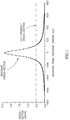
- Fig. 1 The resonant absorption cross-section (in the absence of Doppler broadening) for 14 N nuclei near the 9.172 MeV level is shown in Fig. 1 , along with the more familiar non-resonant atomic attenuation processes, primarily Compton scattering and pair production.
- the non-resonant attenuation varies very slowly with gamma-ray energy (by only a few % over a range of ⁇ 1 MeV around the 14 N resonance energy).
- the resonance energy (9.172 MeV)
- the nitrogen resonant absorption cross section is 2.4 barns/atom, which is ⁇ 5 times higher than the non-resonant attenuation cross section.
- the inspected object is scanned by a beam of gamma-rays, a fraction of which represent on-resonance flux at 9.172 MeV, capable of being absorbed by 14 N nuclei.
- the latter will undergo an additional, nuclear resonance component of attenuation that is proportional to the line-integrated areal density of nitrogen in the line-of-sight from source to detector.
- the explosives detection capability of GRA stems from its unique combination of high nitrogen specificity and good spatial resolution (by nuclear-based method standards) of typically, 0.1-1.0 cm.
- the method is potentially attractive for inspecting massive items such as aviation or marine containers, road or rail-based vehicles, by virtue of its 9.172 MeV gamma-ray probe, which is highly penetrating.
- the radiation doses to inspected items or the environment are at least one order of magnitude lower than with any other X-ray, gamma-ray or neutron-based interrogation method.
- the ideal gamma-ray source for nitrogen-GRA would be one that emits photons concentrated in an energy interval of the order of the total level width around the 9.172 MeV 14 N resonance, so that all of them undergo resonant attenuation if the inspected item contains nitrogenous material.
- a fundamental difficulty arises from the fact that nuclear recoil losses incurred during emission and subsequent resonant absorption of the gamma-ray by 14 N nuclei are of the order of 2 keV each, much larger than the 128 eV level width.
- any radiation emitted from the 9.172 MeV level by nuclei at rest will, of necessity, be far off resonance.
- the gamma-ray source closest to the ideal (and in fact, the only practical one for GRA) is the de-excitation spectrum of the 14 N 9.172 MeV level following proton capture via the reaction 13 C(p, ⁇ ) 14 N .
- This reaction is the inverse of the photo-nuclear resonant reaction 14 N( ⁇ , p) 13 C . It occurs at a proton energy of 1.746 MeV and the total, thick-target reaction yield into 4 ⁇ is ⁇ 6•10 -9 y/proton.
- a critical component in all GRA applications is the detector-type used. It has important bearing on the efficiency, contrast sensitivity and susceptibility to scattered radiation. In terms of basic concept, application mode and performance, the latter fall into the following two categories:
- resonant events are distinguished from non-resonant ones via the identity of the internally-produced charged particle (protons or leptons).
- proton counting mode such detectors are inherently insensitive to the non-resonant flux fraction and thus suffer no loss of GRA nitrogen-contrast-sensitivity as a result of the broadened emission line.
- the proton events in an image pixel determine the total attenuation (resonant and non-resonant) undergone by the gamma-ray beam, at that particular line-of sight from beam/target to detector.
- the lepton events determine the non-resonant component of attenuation in the same pixel. They are counted in a separate channel.
- the pixel-by-pixel lepton count distribution forms the non-resonant (integral-absorber) image ("Gammagram”), which is a conventional transmission radiogram at 9.172 MeV.
- the corresponding pixel-by-pixel ratios of proton to lepton count form the net-resonant (total nitrogen) image ("Nitrogram").
- the improvements in GRA system performance due to the above pertain to nitrogen-image contrast, spatial resolution, image noise, as well as the elimination of normalization artifacts due to accelerator-beam instabilities and(or) 13 C-target-degradation effects. These improvements translate to enhanced system performance characteristics for inspected-object handling logistics and throughput, threat object detection, as well as reduced false-alarm rates.
- Some embodiments of the invention provide stand-alone GRA explosives detection systems that are truly of multi-level nature. In practical terms, this means that the screening sequence undergone by each inspected item is flexible, automatically-controlled and optimally-geared to clarifying its threat status with the highest achievable confidence level and within the minimal screening time.
- Some embodiments of the invention provide enhanced detection of threat objects, primarily via improved spatial resolution. Thereby, they also tend to reduce the false alarm rates.
- Some embodiments of the invention employ liquid-capillary array or solid-fiber-bundle scintillators in fast-neutron and gamma-ray spectrometry-cum-imaging methods and systems that operate in mixed gamma-ray and neutron radiation fields.
- Some embodiments of the invention provide for real-time corrections to the pixel data due to accelerator beam instability or target degradation effects. Thereby, they tend to improve GRA image quality, by reducing normalization artifacts.
- Some embodiments of the invention provide for enhanced GRA spatial resolution and detection efficiency by employing ultra-high energy-resolution proton beams.
- Some embodiments of the invention provide for operation of a GRA inspection system in conjunction with other technologies/systems (a number of which may share a common particle accelerator), to enhance throughput and to address a broader spectrum of threat materials.
- the interrogating radiation needs to be judiciously utilized, if a GRA system is to achieve high throughput and high detection probability for small quantities of explosives with few false-alarms.
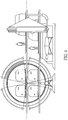
- this flux cone can be divided into angular segments, in which (see Fig. 2 ) a plurality of GRA inspection stations can be constructed. This opens up a number of attractive options that can exert a major bearing on the methodology of GRA inspection and the performance of operational systems based thereupon. Specifically, the latter refer to the following:
- FIG. 6 and 7 A non-limiting embodiment of a GRA system that screens palletized cargo, containers, trucks and other massive objects by taking a plurality of discrete radiographic views is illustrated in Figs. 6 and 7 .
- the typical inspection sequence for such an object may include one or more (in most cases, not more than two) of the following stages:
- step I is performed and repeated.
- a flexible-inspection-sequence GRA facility may function as follows:
- Fig. 4 shows an exploded-view photograph of one such detector, a nitrogen-rich liquid scintillator (NRLS) possessing pulse-shape-discrimination (PSD) properties, along with the two-dimensional (scintillation decay-time vs. pulse-height) 9.172 MeV spectra registered with it on and off the resonant angle.
- NRLS nitrogen-rich liquid scintillator
- PSD pulse-shape-discrimination
- PSD Pulse Shape Discrimination
- the internally-produced 1.5 MeV proton events are detected with 100% efficiency and can be distinguished via Pulse Shape Discrimination (PSD) from the numerous electrons and positrons (leptons) produced by gamma-rays that do not interact resonantly.
- PSD is based on the difference in scintillation decay times for high ionization (proton) and low ionization (lepton) events, which can be translated by an appropriate analog or digital electronic circuit to time peaks separated by, typically, 10-20 ns.
- Counting the proton signal provides a measure of the total transmission attenuation (resonant and non-resonant). In a simultaneous measurement, the non-resonant attenuation is determined by counting the integral lepton signal.
- the detector enclosure may be a parallelepiped-shaped vessel, typically 20 x 20 x 240 mm 3 in dimensions, with at least one glass side for viewing the scintillation light.
- the vessel may be coupled via a parabolic Perspex light-guide to a 50.8 mm PM tube, the entire assembly being enclosed by a light-tight cover.
- the 20 x 20 mm 2 detector face is presented normal to the ⁇ -ray beam, forming a pixel of these dimensions, the long (240 mm) dimension being in the efficiency direction (extending radially along ⁇ R ).
- Fig. 4 shows that the 1.5 MeV proton events created in the 14 N( ⁇ ,p) 13 C reaction by resonant photons are well separated from the continuum of leptons created by all photons in the incident spectrum.
- solid organic scintillators do exhibit PSD properties, albeit to a lesser extent than the optimal liquids developed for this purpose.
- solid versions have clear advantages over their liquid counterparts, particular where multi-detector arrays are required, as in large-cargo inspection systems based on nitrogen-GRA.
- the overall detector configuration may be similar, but is not limited to, that of the liquid detector described above.
- an alternative particle identification method can be implemented if the transverse dimensions of a basic scintillator cell are reduced to capillary or fiber size ( ⁇ 50 ⁇ m), comparable to 1.5 MeV proton ranges, but appreciably smaller than typical tracks of energetic leptons.
- a detector unit of the above type is built up as a 2-dimensional aggregate of such basic cells, each acting as a fiber light-guide for scintillation light, as illustrated in Fig. 5 .
- FNR Fast-Neutron Radiography
- FNRR Fast-Neutron Resonant Radiography
- PNTS Pulsed Fast-Neutron Transmission Spectrometry
- the detector needs to contain appreciable amounts of hydrogen, does not have to be nitrogen-rich and may possess the following properties:
- Liquid-capillary-array or solid-fiber-bundle scintillator detectors coupled to an optical imaging device, such as a CCD camera, are eminently appropriate for these applications.
- the neutron is detected by measuring the scintillation light yield and the track length of a resulting recoil proton.
- a two-parameter analysis track length projection and total light yield
- the direction of the neutrons incident on the detector is known.
- the incident neutron energy can be determined from the scintillation light yield due to the resulting recoil proton and the projection of its track, using a readout system and data analysis procedure similar to that described above in section 2.2.1.
- FNR & PFNTS utilize several variants of time-of-flight spectrometry, in order to obtain gamma/neutron discrimination combined with high neutron energy resolution.
- Such methods necessarily: a) rely on neutron beam bursts that are, typically, 1-2 nanoseconds broad (which can only be produced with complex, pulsed accelerators), and b) involve relatively long flight-paths from neutron-source to detector (typically, 5-15 meters). On both these counts, the useful neutron flux intensity is quite severely limited and the experimental infrastructure cumbersome and costly.
- the present invention will also permit, but is not limited to, operation with a CW neutron source and furthermore, will be practicable at considerably shorter neutron-source/detector distances (typically 1-3 meters) than is presently the case. Operationally, this is of crucial importance, particularly when working in intense radiation fields.
- the intensity, emission-line width and energy-centroid of the 9.172 MeV photon beam emitted from the 13 C(p, ⁇ ) 14 N reaction may fluctuate during data accumulation due to accelerator-beam-instabilities or 13 C-target-degradation effects.
- a non-resonant detector such as NaI or BGO.
- emission-line broadening has far-reaching implications for the methodology and performance of components and systems.
- it severely reduces the nitrogen contrast-sensitivity achievable with non-resonant-response detectors, which tips the scales heavily in favor of resonant-response devices.
- the target can be bombarded at a mean energy on the low-E flank of the p-capture resonance excitation curve, such that the purely-nuclear reaction process is energetically allowed, but the simultaneous nuclear-atomic excitation process is forbidden, as it requires a supplementary energy of ⁇ 400 eV that the protons do not possess.
- the GRA screener described here as part of a multi-tiered explosives-detection facility, in conjunction with another inspection system or systems.
- Option (d) may provide a solution for applications that call for detection of high- Z materials and nitrogenous explosives in a single system, or even in the very same scan.
- one could bombard a thin 13 C layer deposited on the surface of a thick 11 B target, with a mixed mass 2 beam of H 2 + (majority ion) and d + (minority ion).
- the H 2 + molecular ions when they impinge on the 13 C layer, will break up (via the so-called Coulomb explosion process) into two almost parallel, equal-energy protons at the 1.746 MeV resonance, as required for a GRA screener.
- the emission-line broadening contribution due to the Coulomb explosion is not expected to prove excessively large for GRA applications.
- the protons After traversing the 13 C layer, the protons will enter the 11 B target, where they will contribute to high-energy gamma-ray production via the p-capture reaction.
- the deuteron component will traverse the 13 C layer (which will contribute little in the way of reaction yield, the 13 C being thin) and interact with the 11 B target via the (d,n) reaction described in IL Patent Application No. 159406 (filed Dec. 16, 2003 ) and PCT Application No. 10/582,763 (filed Dec. 14, 2004 ).
Landscapes
- Physics & Mathematics (AREA)
- Health & Medical Sciences (AREA)
- Life Sciences & Earth Sciences (AREA)
- Chemical & Material Sciences (AREA)
- Analytical Chemistry (AREA)
- Biochemistry (AREA)
- General Health & Medical Sciences (AREA)
- General Physics & Mathematics (AREA)
- Immunology (AREA)
- Pathology (AREA)
- Analysing Materials By The Use Of Radiation (AREA)
Claims (13)
- Verfahren zum Nachweis stickstoffhaltiger Materialien in einem Objekt mittels Gamma-Resonanzabsorption (GRA), umfassend:(i) Anordnen eines Ziels an einer Seite eines inspizierten Objekts, wobei das Ziel 13C zum Beschuss mit einem Protonenstrahl mit einer Energie von ungefähr 1,75 MeV enthält, um eine Quelle von 9,172 MeV-Gammastrahlen zu produzieren;(ii) Anordnen eines Gammastrahlendetektors mit einem stickstoffreichen Detektionsmedium an einer entgegengesetzten Seite des Objekts, auf dem Umfang eines Abstrahlflusskegels an Polarkoordinatenwinkel θR = 80,7° in Bezug zu dem Protonenstrahl;(iii) Screenen des Objekts mit einem Gammastrahl von besagter Quelle;(iv) von dem Gammastrahlendetektor Ablesen der gesamten und nichtresonanten Schwächungen des einfallenden Photonenflusses;(v) aus diesen Schwächungen Ableiten einer Netto-Resonanzschwächung und der räumlichen Verteilung davon; und(vi) Bestimmen eines Status des inspizierten Objekts auf Basis einer Stickstoffdichteverteilung, abgeleitet aus der Netto-Resonanzschwächung und der räumlichen Verteilung davon;dadurch gekennzeichnet, dass das Screenen des Objekts umfasst:einen Schritt der Durchführung eines schnellen Prescans zur Klassifizierung eines Gesamt-Gammastrahlungsschwächungssystems und Lokalisierung von Regionen mit hoher physikalischer Dichte;und Wiederholen des Schritts der Durchführung eines schnellen Prescans bei Bedarf zur Bestimmung des Status des inspizierten Objekts;und dass der Gammastrahlendetektor einen Szintillator umfasst, dessen Basiszellenquerabmessungen mit Protonenbereichen von In-Resonanz-Fällen vergleichbar und erheblich kleiner als Leptonenbereiche aus Außer-Resonanz-Fällen sind.
- Verfahren nach Anspruch 1, weiter das Erzeugen einer Vielzahl von diskreten radiographischen Ansichten in denselben Segmenten umfassend.
- Verfahren nach Anspruch 1, weiter das Erzeugen einer Vielzahl von diskreten radiographischen Ansichten in verschiedenen Segmenten umfassend.
- Verfahren nach Anspruch 1, wobei der Gammastrahlendetektor einen Szintillator umfasst, dessen Basiszellenquerabmessungen ∼50 µm betragen.
- Verfahren nach Anspruch 1, wobei der Szintillator Basiszellen aufweiset, die als Faser-Lichtleiter für Szintillationslicht wirkten, und wobei Protonen-/Leptonen-Unterscheidung durch Abbilden von Spurlängen individueller Fälle und Szintillationsausbeute je Spurlängeneinheit bewerkstelligt wir.
- Verfahren nach Anspruch 5, weiter die Durchführung von Protonen-/Leptonen-Fallunterscheidung mittels mindestens eines einer Einzelfallzähltechnik, einer integrativen Technik und einer optischen Technik umfassend.
- Verfahren nach Anspruch 1, wobei das Screenen des Objekts mit dem Gammastrahl die Durchführung von GRA-Bildgebung mit räumlicher sub-mm-Auflösung umfasst.
- Verfahren nach Anspruch 1, weiter das Messen der Resonanzfraktion des einfallenden Photonenflusses in Echtzeit mit einem Resonanzflussmonitor und Verwenden von Abgaben des Resonanzflussmonitors zur Einstellung von mit dem Screenen des Objekts zusammenhängenden Betriebsparametern umfassend.
- Verfahren nach Anspruch 8, weiter das Messen eines momentanen Verhältnisses eines detektierten Protonen-zu-Leptonen-Zählwertverhältnisses in dem Resonanzflussmonitor und Anwenden des Verhältnisses zur Normalisierung der Bildgebungsarraydaten zur Verbesserung der GRA-Bildqualität umfassend.
- Verfahren nach Anspruch 1, wobei der Protonenstrahl, der den 9,172 MeV-Gammastrahl auf der 13C(p,γ)-Erfassungsresonanz produziert, eine Energiestreuung aufweiset, die klein genug ist, um reine Kernanregung zu gestatten, jedoch energetisch gegen Fälle unterscheiden kann, die gleichzeitige Kernanregung und Ausstoß von Elektronen der inneren Valenzschale beinhalten.
- Verfahren nach Anspruch 10, wobei der ultrahochauflösende Protonenstrahl GRA-Screening gestatten kann mit einem oder mehreren von: a) verbesserter Detektoreffizienz aufgrund der Möglichkeit der Verwerdung von Nichtresonanzreaktionsdetektor mit unverminderter Kontrastempfindlichkeit; b) höherer räumlicher Auflösung; und c) verbessertem Detektionsvermögen für in Plattenform vorliegende Explosivstoffe.
- Verfahren nach Anspruch 1, wobei das Screenen des Objekts mit dem Gammastrahl von besagter Quelle in Zusammenwirken mit einem anderen Inspektionssystem durchgeführt wird, entweder als Teil einer mehrschichtigen Explosivstoffdetektionsanlage oder als Detektionsanlage für verschiedene Bedrohungen.
- Verfahren nach Anspruch 12, wobei das andere Inspektionssystem mindestens eines umfasst eines Bremsstrahlungbasierten Systems, eines Radiographiesystems, eines Tomographiesystems, eines Bildgebungssystems auf Basis schneller Neutronen, eines Metall- oder Magnetmaterialien-Detektionssystems oder eines Spurendetektionssystems auf Basis von Dämpfen.
Applications Claiming Priority (2)
| Application Number | Priority Date | Filing Date | Title |
|---|---|---|---|
| US86281506P | 2006-10-25 | 2006-10-25 | |
| PCT/IL2007/001275 WO2008050327A2 (en) | 2006-10-25 | 2007-10-24 | Method & system for detecting nitrogenous materials via gamma-resonance absorption (gra) |
Publications (2)
| Publication Number | Publication Date |
|---|---|
| EP2074413A2 EP2074413A2 (de) | 2009-07-01 |
| EP2074413B1 true EP2074413B1 (de) | 2017-12-20 |
Family
ID=38992306
Family Applications (1)
| Application Number | Title | Priority Date | Filing Date |
|---|---|---|---|
| EP07827249.9A Not-in-force EP2074413B1 (de) | 2006-10-25 | 2007-10-24 | Verfahren zum nachweis stickstoffhaltiger materialien über gamma-resonanzabsorption (gra) |
Country Status (3)
| Country | Link |
|---|---|
| US (1) | US8110812B2 (de) |
| EP (1) | EP2074413B1 (de) |
| WO (1) | WO2008050327A2 (de) |
Families Citing this family (6)
| Publication number | Priority date | Publication date | Assignee | Title |
|---|---|---|---|---|
| US20090003651A1 (en) * | 2007-05-29 | 2009-01-01 | Peter Dugan | Object segmentation recognition |
| NO346536B1 (en) * | 2019-04-10 | 2022-09-26 | Bergen Teknologioverfoering As | System for charged particle therapy verification |
| CN114509802B (zh) * | 2022-02-18 | 2024-08-16 | 西北核技术研究所 | 用于光学成像能谱测量系统的质子灵敏度刻度装置及方法 |
| CN115565711A (zh) * | 2022-09-22 | 2023-01-03 | 中国原子能科学研究院 | 一种单能高能伽马源的制备方法 |
| CN115598693A (zh) * | 2022-10-20 | 2023-01-13 | 南京航空航天大学(Cn) | 一种中子信号的测量装置及测量方法 |
| CN116046807A (zh) * | 2022-12-21 | 2023-05-02 | 中国原子能科学研究院 | 一种基于激光的集装箱爆炸物检测系统及方法 |
Family Cites Families (3)
| Publication number | Priority date | Publication date | Assignee | Title |
|---|---|---|---|---|
| US5182764A (en) * | 1991-10-03 | 1993-01-26 | Invision Technologies, Inc. | Automatic concealed object detection system having a pre-scan stage |
| IL159406A (en) * | 2003-12-16 | 2013-10-31 | Mark Goldberg | A method and system for detecting materials, such as special nuclear materials |
| US7501624B1 (en) * | 2005-04-28 | 2009-03-10 | Brookhaven Technology Group, Inc. | System and method for detecting concealed nuclear materials, radiological materials and chemical explosives |
-
2007
- 2007-10-24 US US12/446,608 patent/US8110812B2/en not_active Expired - Fee Related
- 2007-10-24 WO PCT/IL2007/001275 patent/WO2008050327A2/en not_active Ceased
- 2007-10-24 EP EP07827249.9A patent/EP2074413B1/de not_active Not-in-force
Also Published As
| Publication number | Publication date |
|---|---|
| WO2008050327A2 (en) | 2008-05-02 |
| US8110812B2 (en) | 2012-02-07 |
| WO2008050327A3 (en) | 2008-07-03 |
| EP2074413A2 (de) | 2009-07-01 |
| US20100019165A1 (en) | 2010-01-28 |
Similar Documents
| Publication | Publication Date | Title |
|---|---|---|
| US7381962B2 (en) | Method and system for detecting substances, such as special nuclear materials | |
| Cavallaro et al. | Neutron decay of c 15 resonances by measurements of neutron time-of-flight | |
| US5930314A (en) | Coded aperture imaging | |
| EP2589955B1 (de) | Artikeldetektor und detektionsverfahren dafür | |
| US8149988B2 (en) | Use of nearly monochromatic and tunable photon sources with nuclear resonance fluorescence in non-intrusive inspection of containers for material detection and imaging | |
| US8374310B2 (en) | Method and system for contraband detection using photoneutrons and X-rays | |
| EP2589954B1 (de) | Artikeldetektionsvorrichtung und detektionsverfahren dafür | |
| EP2287636B1 (de) | Verfahren und system zur überprüfung von speziellem kernmaterial | |
| Harding et al. | X-ray diffraction imaging with the Multiple Inverse Fan Beam topology: Principles, performance and potential for security screening | |
| US7630474B2 (en) | Radiation scanning with photon tagging | |
| WO1997045755A9 (en) | Coded aperture imaging | |
| US8110812B2 (en) | Method and system for detecting nitrogenous materials via gamma-resonance absorption (GRA) | |
| US8804911B2 (en) | Nondestructive inspection system using nuclear resonance fluorescence | |
| EP2889610B1 (de) | Doppelisotop-detektor für kernresonanzfluoreszenz zur isotopenidentifizierung, test und abbildung mit mono-energetischen gammastrahl-quellen | |
| Perot et al. | The EURITRACK project: development of a tagged neutron inspection system for cargo containers | |
| Capponi et al. | First in-beam experiment with the ELIADE detectors: a spectroscopic study of 130La | |
| Vartsky et al. | Detectors for the gamma-ray resonant absorption (GRA) method of explosives detection in cargo: a comparative study | |
| Goldberg et al. | A dual-purpose ion-accelerator for nuclear-reaction-based explosives-and SNM-detection in massive cargo | |
| Zhu | Measuring neutrons in heavy ion collisions | |
| El Kanawati et al. | Improvement of the calibration database of the EURITRACK tagged neutron inspection system | |
| Ledoux | Advances in Nondestructive Elemental Assaying Technologies | |
| Bishnoi | Fast Neutron Imaging Techniques | |
| Toyokawa et al. | Two-dimensional imaging of heavily shielded materials by NRF with laser-compton photon beam | |
| Warren et al. | Detectors for Accelerator-Based Security Applications | |
| Peerani et al. | The EURITRACK concept for cargo inspection with tagged neutrons |
Legal Events
| Date | Code | Title | Description |
|---|---|---|---|
| PUAI | Public reference made under article 153(3) epc to a published international application that has entered the european phase |
Free format text: ORIGINAL CODE: 0009012 |
|
| 17P | Request for examination filed |
Effective date: 20090506 |
|
| AK | Designated contracting states |
Kind code of ref document: A2 Designated state(s): AT BE BG CH CY CZ DE DK EE ES FI FR GB GR HU IE IS IT LI LT LU LV MC MT NL PL PT RO SE SI SK TR |
|
| DAX | Request for extension of the european patent (deleted) | ||
| 17Q | First examination report despatched |
Effective date: 20130711 |
|
| GRAP | Despatch of communication of intention to grant a patent |
Free format text: ORIGINAL CODE: EPIDOSNIGR1 |
|
| STAA | Information on the status of an ep patent application or granted ep patent |
Free format text: STATUS: GRANT OF PATENT IS INTENDED |
|
| INTG | Intention to grant announced |
Effective date: 20170725 |
|
| GRAS | Grant fee paid |
Free format text: ORIGINAL CODE: EPIDOSNIGR3 |
|
| GRAA | (expected) grant |
Free format text: ORIGINAL CODE: 0009210 |
|
| STAA | Information on the status of an ep patent application or granted ep patent |
Free format text: STATUS: THE PATENT HAS BEEN GRANTED |
|
| AK | Designated contracting states |
Kind code of ref document: B1 Designated state(s): AT BE BG CH CY CZ DE DK EE ES FI FR GB GR HU IE IS IT LI LT LU LV MC MT NL PL PT RO SE SI SK TR |
|
| REG | Reference to a national code |
Ref country code: GB Ref legal event code: FG4D |
|
| REG | Reference to a national code |
Ref country code: CH Ref legal event code: EP |
|
| REG | Reference to a national code |
Ref country code: IE Ref legal event code: FG4D |
|
| REG | Reference to a national code |
Ref country code: AT Ref legal event code: REF Ref document number: 956816 Country of ref document: AT Kind code of ref document: T Effective date: 20180115 |
|
| REG | Reference to a national code |
Ref country code: DE Ref legal event code: R096 Ref document number: 602007053485 Country of ref document: DE |
|
| REG | Reference to a national code |
Ref country code: NL Ref legal event code: MP Effective date: 20171220 |
|
| PG25 | Lapsed in a contracting state [announced via postgrant information from national office to epo] |
Ref country code: LT Free format text: LAPSE BECAUSE OF FAILURE TO SUBMIT A TRANSLATION OF THE DESCRIPTION OR TO PAY THE FEE WITHIN THE PRESCRIBED TIME-LIMIT Effective date: 20171220 Ref country code: FI Free format text: LAPSE BECAUSE OF FAILURE TO SUBMIT A TRANSLATION OF THE DESCRIPTION OR TO PAY THE FEE WITHIN THE PRESCRIBED TIME-LIMIT Effective date: 20171220 Ref country code: SE Free format text: LAPSE BECAUSE OF FAILURE TO SUBMIT A TRANSLATION OF THE DESCRIPTION OR TO PAY THE FEE WITHIN THE PRESCRIBED TIME-LIMIT Effective date: 20171220 |
|
| REG | Reference to a national code |
Ref country code: LT Ref legal event code: MG4D |
|
| REG | Reference to a national code |
Ref country code: AT Ref legal event code: MK05 Ref document number: 956816 Country of ref document: AT Kind code of ref document: T Effective date: 20171220 |
|
| PG25 | Lapsed in a contracting state [announced via postgrant information from national office to epo] |
Ref country code: LV Free format text: LAPSE BECAUSE OF FAILURE TO SUBMIT A TRANSLATION OF THE DESCRIPTION OR TO PAY THE FEE WITHIN THE PRESCRIBED TIME-LIMIT Effective date: 20171220 Ref country code: GR Free format text: LAPSE BECAUSE OF FAILURE TO SUBMIT A TRANSLATION OF THE DESCRIPTION OR TO PAY THE FEE WITHIN THE PRESCRIBED TIME-LIMIT Effective date: 20180321 Ref country code: BG Free format text: LAPSE BECAUSE OF FAILURE TO SUBMIT A TRANSLATION OF THE DESCRIPTION OR TO PAY THE FEE WITHIN THE PRESCRIBED TIME-LIMIT Effective date: 20180320 |
|
| PG25 | Lapsed in a contracting state [announced via postgrant information from national office to epo] |
Ref country code: NL Free format text: LAPSE BECAUSE OF FAILURE TO SUBMIT A TRANSLATION OF THE DESCRIPTION OR TO PAY THE FEE WITHIN THE PRESCRIBED TIME-LIMIT Effective date: 20171220 |
|
| PG25 | Lapsed in a contracting state [announced via postgrant information from national office to epo] |
Ref country code: CZ Free format text: LAPSE BECAUSE OF FAILURE TO SUBMIT A TRANSLATION OF THE DESCRIPTION OR TO PAY THE FEE WITHIN THE PRESCRIBED TIME-LIMIT Effective date: 20171220 Ref country code: SK Free format text: LAPSE BECAUSE OF FAILURE TO SUBMIT A TRANSLATION OF THE DESCRIPTION OR TO PAY THE FEE WITHIN THE PRESCRIBED TIME-LIMIT Effective date: 20171220 Ref country code: ES Free format text: LAPSE BECAUSE OF FAILURE TO SUBMIT A TRANSLATION OF THE DESCRIPTION OR TO PAY THE FEE WITHIN THE PRESCRIBED TIME-LIMIT Effective date: 20171220 Ref country code: EE Free format text: LAPSE BECAUSE OF FAILURE TO SUBMIT A TRANSLATION OF THE DESCRIPTION OR TO PAY THE FEE WITHIN THE PRESCRIBED TIME-LIMIT Effective date: 20171220 Ref country code: CY Free format text: LAPSE BECAUSE OF FAILURE TO SUBMIT A TRANSLATION OF THE DESCRIPTION OR TO PAY THE FEE WITHIN THE PRESCRIBED TIME-LIMIT Effective date: 20171220 |
|
| PG25 | Lapsed in a contracting state [announced via postgrant information from national office to epo] |
Ref country code: IS Free format text: LAPSE BECAUSE OF FAILURE TO SUBMIT A TRANSLATION OF THE DESCRIPTION OR TO PAY THE FEE WITHIN THE PRESCRIBED TIME-LIMIT Effective date: 20180420 Ref country code: RO Free format text: LAPSE BECAUSE OF FAILURE TO SUBMIT A TRANSLATION OF THE DESCRIPTION OR TO PAY THE FEE WITHIN THE PRESCRIBED TIME-LIMIT Effective date: 20171220 Ref country code: PL Free format text: LAPSE BECAUSE OF FAILURE TO SUBMIT A TRANSLATION OF THE DESCRIPTION OR TO PAY THE FEE WITHIN THE PRESCRIBED TIME-LIMIT Effective date: 20171220 Ref country code: AT Free format text: LAPSE BECAUSE OF FAILURE TO SUBMIT A TRANSLATION OF THE DESCRIPTION OR TO PAY THE FEE WITHIN THE PRESCRIBED TIME-LIMIT Effective date: 20171220 Ref country code: IT Free format text: LAPSE BECAUSE OF FAILURE TO SUBMIT A TRANSLATION OF THE DESCRIPTION OR TO PAY THE FEE WITHIN THE PRESCRIBED TIME-LIMIT Effective date: 20171220 |
|
| REG | Reference to a national code |
Ref country code: DE Ref legal event code: R097 Ref document number: 602007053485 Country of ref document: DE |
|
| PLBE | No opposition filed within time limit |
Free format text: ORIGINAL CODE: 0009261 |
|
| STAA | Information on the status of an ep patent application or granted ep patent |
Free format text: STATUS: NO OPPOSITION FILED WITHIN TIME LIMIT |
|
| 26N | No opposition filed |
Effective date: 20180921 |
|
| PG25 | Lapsed in a contracting state [announced via postgrant information from national office to epo] |
Ref country code: DK Free format text: LAPSE BECAUSE OF FAILURE TO SUBMIT A TRANSLATION OF THE DESCRIPTION OR TO PAY THE FEE WITHIN THE PRESCRIBED TIME-LIMIT Effective date: 20171220 |
|
| PG25 | Lapsed in a contracting state [announced via postgrant information from national office to epo] |
Ref country code: SI Free format text: LAPSE BECAUSE OF FAILURE TO SUBMIT A TRANSLATION OF THE DESCRIPTION OR TO PAY THE FEE WITHIN THE PRESCRIBED TIME-LIMIT Effective date: 20171220 |
|
| REG | Reference to a national code |
Ref country code: DE Ref legal event code: R119 Ref document number: 602007053485 Country of ref document: DE |
|
| REG | Reference to a national code |
Ref country code: CH Ref legal event code: PL |
|
| GBPC | Gb: european patent ceased through non-payment of renewal fee |
Effective date: 20181024 |
|
| REG | Reference to a national code |
Ref country code: BE Ref legal event code: MM Effective date: 20181031 |
|
| PG25 | Lapsed in a contracting state [announced via postgrant information from national office to epo] |
Ref country code: MC Free format text: LAPSE BECAUSE OF FAILURE TO SUBMIT A TRANSLATION OF THE DESCRIPTION OR TO PAY THE FEE WITHIN THE PRESCRIBED TIME-LIMIT Effective date: 20171220 Ref country code: LU Free format text: LAPSE BECAUSE OF NON-PAYMENT OF DUE FEES Effective date: 20181024 |
|
| REG | Reference to a national code |
Ref country code: IE Ref legal event code: MM4A |
|
| PG25 | Lapsed in a contracting state [announced via postgrant information from national office to epo] |
Ref country code: DE Free format text: LAPSE BECAUSE OF NON-PAYMENT OF DUE FEES Effective date: 20190501 |
|
| PG25 | Lapsed in a contracting state [announced via postgrant information from national office to epo] |
Ref country code: FR Free format text: LAPSE BECAUSE OF NON-PAYMENT OF DUE FEES Effective date: 20181031 Ref country code: BE Free format text: LAPSE BECAUSE OF NON-PAYMENT OF DUE FEES Effective date: 20181031 Ref country code: LI Free format text: LAPSE BECAUSE OF NON-PAYMENT OF DUE FEES Effective date: 20181031 Ref country code: CH Free format text: LAPSE BECAUSE OF NON-PAYMENT OF DUE FEES Effective date: 20181031 |
|
| PG25 | Lapsed in a contracting state [announced via postgrant information from national office to epo] |
Ref country code: GB Free format text: LAPSE BECAUSE OF NON-PAYMENT OF DUE FEES Effective date: 20181024 Ref country code: IE Free format text: LAPSE BECAUSE OF NON-PAYMENT OF DUE FEES Effective date: 20181024 |
|
| PG25 | Lapsed in a contracting state [announced via postgrant information from national office to epo] |
Ref country code: MT Free format text: LAPSE BECAUSE OF NON-PAYMENT OF DUE FEES Effective date: 20181024 |
|
| PG25 | Lapsed in a contracting state [announced via postgrant information from national office to epo] |
Ref country code: TR Free format text: LAPSE BECAUSE OF FAILURE TO SUBMIT A TRANSLATION OF THE DESCRIPTION OR TO PAY THE FEE WITHIN THE PRESCRIBED TIME-LIMIT Effective date: 20171220 |
|
| PG25 | Lapsed in a contracting state [announced via postgrant information from national office to epo] |
Ref country code: PT Free format text: LAPSE BECAUSE OF FAILURE TO SUBMIT A TRANSLATION OF THE DESCRIPTION OR TO PAY THE FEE WITHIN THE PRESCRIBED TIME-LIMIT Effective date: 20171220 |
|
| PG25 | Lapsed in a contracting state [announced via postgrant information from national office to epo] |
Ref country code: HU Free format text: LAPSE BECAUSE OF FAILURE TO SUBMIT A TRANSLATION OF THE DESCRIPTION OR TO PAY THE FEE WITHIN THE PRESCRIBED TIME-LIMIT; INVALID AB INITIO Effective date: 20071024 |