EP2074631B1 - Verfahren zum verarbeiten von siliziumkarbid enthaltenden kernbrennstoffen und zum entmanteln von kernbrennstoffpartikeln - Google Patents
Verfahren zum verarbeiten von siliziumkarbid enthaltenden kernbrennstoffen und zum entmanteln von kernbrennstoffpartikeln Download PDFInfo
- Publication number
- EP2074631B1 EP2074631B1 EP07821732A EP07821732A EP2074631B1 EP 2074631 B1 EP2074631 B1 EP 2074631B1 EP 07821732 A EP07821732 A EP 07821732A EP 07821732 A EP07821732 A EP 07821732A EP 2074631 B1 EP2074631 B1 EP 2074631B1
- Authority
- EP
- European Patent Office
- Prior art keywords
- sic
- carbon
- chlorine
- oxygen
- fuel
- Prior art date
- Legal status (The legal status is an assumption and is not a legal conclusion. Google has not performed a legal analysis and makes no representation as to the accuracy of the status listed.)
- Not-in-force
Links
Images


Classifications
-
- G—PHYSICS
- G21—NUCLEAR PHYSICS; NUCLEAR ENGINEERING
- G21C—NUCLEAR REACTORS
- G21C19/00—Arrangements for treating, for handling, or for facilitating the handling of, fuel or other materials which are used within the reactor, e.g. within its pressure vessel
- G21C19/42—Reprocessing of irradiated fuel
- G21C19/44—Reprocessing of irradiated fuel of irradiated solid fuel
- G21C19/48—Non-aqueous processes
-
- G—PHYSICS
- G21—NUCLEAR PHYSICS; NUCLEAR ENGINEERING
- G21C—NUCLEAR REACTORS
- G21C19/00—Arrangements for treating, for handling, or for facilitating the handling of, fuel or other materials which are used within the reactor, e.g. within its pressure vessel
- G21C19/34—Apparatus or processes for dismantling nuclear fuel, e.g. before reprocessing ; Apparatus or processes for dismantling strings of spent fuel elements
- G21C19/38—Chemical means only
-
- Y—GENERAL TAGGING OF NEW TECHNOLOGICAL DEVELOPMENTS; GENERAL TAGGING OF CROSS-SECTIONAL TECHNOLOGIES SPANNING OVER SEVERAL SECTIONS OF THE IPC; TECHNICAL SUBJECTS COVERED BY FORMER USPC CROSS-REFERENCE ART COLLECTIONS [XRACs] AND DIGESTS
- Y02—TECHNOLOGIES OR APPLICATIONS FOR MITIGATION OR ADAPTATION AGAINST CLIMATE CHANGE
- Y02E—REDUCTION OF GREENHOUSE GAS [GHG] EMISSIONS, RELATED TO ENERGY GENERATION, TRANSMISSION OR DISTRIBUTION
- Y02E30/00—Energy generation of nuclear origin
- Y02E30/30—Nuclear fission reactors
-
- Y—GENERAL TAGGING OF NEW TECHNOLOGICAL DEVELOPMENTS; GENERAL TAGGING OF CROSS-SECTIONAL TECHNOLOGIES SPANNING OVER SEVERAL SECTIONS OF THE IPC; TECHNICAL SUBJECTS COVERED BY FORMER USPC CROSS-REFERENCE ART COLLECTIONS [XRACs] AND DIGESTS
- Y02—TECHNOLOGIES OR APPLICATIONS FOR MITIGATION OR ADAPTATION AGAINST CLIMATE CHANGE
- Y02W—CLIMATE CHANGE MITIGATION TECHNOLOGIES RELATED TO WASTEWATER TREATMENT OR WASTE MANAGEMENT
- Y02W30/00—Technologies for solid waste management
- Y02W30/50—Reuse, recycling or recovery technologies
Definitions
- the present invention relates to a process for treating nuclear fuels comprising silicon carbide (SiC) and optionally carbon as a heterogeneous matrix.
- the present invention relates in particular to a method of stripping TRISO or BISO nuclear fuel particles.
- TRISO particles are most commonly in the form of beads, usually millimeter-sized, consisting of a core of fissile material and a gangue or outer sheath to confine the fissile material.
- the fissile material of the core is generally composed of actinide oxides or, more rarely, carbides or oxy-carbides of actinides.
- the sheath may be mono- or multilayer. In the most commonly used TRISO nuclear fuels, the sheath comprises from the core to the outside: a porous carbon layer allowing the expansion of the fission gases; a dense pyrolytic carbon layer; a layer of silicon carbide; and, again, a pyrolytic carbon layer.
- BISO particles are TRISO particles without the outer layer of pyrolytic carbon.
- TRISO fuels were designed in the 60s.
- the treatment of this type of fuel by conventional techniques, for example by hydrometallurgy in nitric acid medium for the dissolution of the fuel, is not practical from the industrial point of view because it requires grinding of the particles leading to the formation of contaminated and difficult to manage nuclear fines.
- studies conducted in the 1970s showed that the recovery rate was not quantitative.
- the inventors of the present invention provide precisely such a method.
- the method of the present invention is a method of treating a nuclear fuel comprising a fissile material contained in a sheath or a coating of SiC and optionally of carbon, said process comprising bringing said fuel into contact with a mixture of chlorine and oxygen at a temperature below 950 ° C., in particular strictly below 950 ° C. and, more particularly, at a temperature between 400 and 900 ° C, so as to remove the SiC, and carbon if any, said fuel.
- fisionable material is meant, in the context of the present invention, any radioactive material used to create energy in the service of man.
- nuclear fuel comprising a fissile material, SiC and possibly carbon is meant, in the context of the present invention, a nuclear fuel comprising a fissile material and SiC, or such a fuel further comprising carbon.
- heterogeneous matrix is meant, in the context of the present invention, the fact that, in the nuclear fuel used, the SiC and optionally the carbon are in the form of distinct layers of the fissile material such as a gangue , a sheath or a coating.
- the process of the present invention is particularly suitable for the treatment of fuels nuclear particles which are in the form of particles, more particularly in the form of particles comprising SiC and optionally carbon and, more particularly, nuclear fuels TRISO or BISO. It may be particles comprising a core of fissile material and a sheath (mono- or multilayer) comprising alternating layers of carbon and SiC, for example as described above.
- the treatment by the process of the invention is then, in fact, a stripping treatment of said particles.
- a heterogeneous SiC matrix fuel is a nuclear fuel in which the SiC and optionally the carbon are in the form of layers (the matrix) distinct from the fissile material.
- the treatment by the method of the invention is an elimination treatment of said matrix i.e. a removal treatment of said layers.
- TRISO or BISO fuels are often composed of actinide oxides and more rarely actinide carbides or actinide oxy-carbons.
- the present invention applies not only to these fuels, but also to all fuels, regardless of the nature of their core or gangue, since their gangue comprises SiC and possibly carbon.
- the process of the invention can be used not only in the aforementioned treatments, but also, for example, to extract a fissile material by removing it from SiC and unwanted carbon (s).
- Carbon removal is done by burning with oxygen. This chemical reaction occurs at 400 ° C, as shown by thermogravimetric analyzes carried out by the inventors herein. For this elimination, pure oxygen is advantageously used.
- the removal of the SiC is in one step by chemical reaction with the mixture of chlorine and oxygen.
- a mixture of chlorine and oxygen allows to attack the SiC and transform it entirely into SiCl 4 and CO x without solid carbonaceous residues, nor silica.
- a mixture rich in chlorine in order to avoid the formation of silica.
- it may be, for example, a mixture comprising from 1 to 30%, advantageously from 5 to 25%, particularly from 10 to 25%, and more particularly from 15 to 20% by volume of oxygen and 70 to 99%, preferably 75 to 95%, particularly 75 to 90%, and more particularly 80 to 85% by volume of chlorine.
- the treatment temperature should not exceed 950 ° C and, even more advantageously, it should be less than and in particular strictly less than 950 ° C., in order to avoid the possible formation of volatile actinide chlorides.
- the terminals of this range are included in the present invention as are all values temperature in this range. More particularly, the temperature of the process of the invention may be 400 ° C, 450 ° C, 500 ° C, 550 ° C, 600 ° C, 650 ° C, 700 ° C, 750 ° C, 800 ° C, 850 ° C. ° C or 900 ° C.
- the relative amount of chlorine and oxygen in the gaseous mixture can be modified depending on the SiC and carbon content of the fuel to be treated. This makes it possible to optimize the treatment and to adapt it to different types of fuels to be treated and during the treatment itself.
- the mixture of chlorine and oxygen can be modified to follow this variation.
- the fuel comprises SiC and carbon
- one of the following two cases occurs (a) there is more SiC than carbon to eliminate, or ( b) there is more carbon than SiC to eliminate; then, at the moment M, the mixture of chlorine and oxygen can be modified so that there is for the case (a) more chlorine than oxygen or for case (b) more oxygen than chlorine, even pure oxygen if only carbon remains to be removed.
- the treatment used and, in particular, the amounts of oxygen and chlorine used and the temperature of the reaction will depend on the nature of the fuels to be treated and, more particularly, on the composition of the sheath (gangue or coating) of said fuels.
- the initial proportion of oxygen may be in the high values of the ranges proposed above, or even at higher values and the reaction temperature may be chosen in the lower values of the ranges proposed above.
- the removal of SiC, and if any carbon generates a gas emission. It is advantageous to analyze the chemical composition of said emission and then modify the composition of the mixture of chlorine and oxygen according to this analysis.
- This analysis can be carried out for example by assaying the SiCl 4 and CO x contents emitted during the treatment. This analysis can be performed for example by means of infrared spectrometry or mass spectrometry.
- the presence of SiCl 4 in the gases informs the elimination of SiC, which imposes the maintenance of a relative amount of high chlorine in the mixture.
- a higher CO x content than the content of SiCl 4 (in mol) indicates excess carbon, which commands an advantageous increase in the relative amount of oxygen in the mixture.
- the analysis and modification of the mixture can be automated by means of mass flow controllers controlling the flow of chlorine and oxygen, controlled by the contents of SiCl 4 and CO x in the flue gases.
- the contact between the mixture of chlorine and oxygen and the SiC and optionally the carbon is, of course, preferably used in such a way as to promote the chemical reactions between this mixture and the SiC, and the carbon if is present, the fuel to be treated.
- This contacting can be carried out, for example, in a reactor comprising heating means and means for introducing the mixture of chlorine and oxygen.
- this reactor also comprises means for stirring the combustible material to be treated in order to facilitate and optimize its contact with the mixture of chlorine and of oxygen, and therefore its treatment.
- this reactor also comprises recovery means, and possibly analysis, gases from the removal of SiC and carbon if there are any.
- the method of the invention allows in particular chemical stripping of nuclear fuel particles of BISO or TRISO type or SiC matrix. This is a chemical attack in the gas phase to volatilize, for example between 400 and 900 ° C, the carbon layers (pyrolytic and intermediate sheath ("buffer")) and SiC coating the core of fissile material.
- buffer pyrolytic and intermediate sheath
- the process of the present invention is clean because only gaseous fumes without nuclear-contaminated fines are to be managed ("chemical stripping").
- the process of the present invention involves only simple chemical reactions and none of the reagents are sensitive to radiation. It can therefore be applied to fuels with a low cooling time.
- the figure 1 annexed describes the composition zone of the gaseous mixture for which there is theoretically no solid residue (darkest zone).
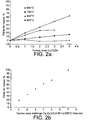
- Carbon combustion is effective from 400 ° C. This has been verified experimentally by thermogravimetric analysis. For this experiment, pure oxygen was used.
- the volatilization of SiC was verified on powder, on particles and on bulk samples.
- the BISO particles treated in this example are TRISO particles without the outer layer of carbon.
- the core material consists of ZrO 2 simulating UO 2 .
- the sheath comprises from the core outwardly: a porous carbon layer, a dense pyrolytic carbon layer, and a SiC layer.
- weight loss measurements are shown as the amount of Si + C of the treated BISO fuel sample (continuous curve), and the weight loss measurements (in% by weight) reduced to the whole sample of treated BISO fuel (discontinuous line). These measurements were carried out at a temperature of 900 ° C. with a mixture consisting of 80% by volume of Cl 2 and 20% by volume of oxygen.
Landscapes
- Physics & Mathematics (AREA)
- Engineering & Computer Science (AREA)
- Plasma & Fusion (AREA)
- General Engineering & Computer Science (AREA)
- High Energy & Nuclear Physics (AREA)
- Chemical & Material Sciences (AREA)
- Chemical Kinetics & Catalysis (AREA)
- General Chemical & Material Sciences (AREA)
- Monitoring And Testing Of Nuclear Reactors (AREA)
- Carbon And Carbon Compounds (AREA)
- Solid Fuels And Fuel-Associated Substances (AREA)
Claims (10)
- Verfahren zur Aufarbeitung eines Kernbrennstoffs, der ein spaltbares Material, SiC und gegebenenfalls Kohlenstoff umfasst, wobei das Verfahren das In-Kontakt-Bringen des Brennstoffs mit einem Gemisch aus Chlor und Sauerstoff bei einer Temperatur unter 950 °C und insbesondere bei einer Temperatur zwischen 400 und 900 °C umfasst, zum das SiC und den gegebenenfalls vorhandenen Kohlenstoff aus diesem Brennstoff zu entfernen.
- Verfahren gemäß Anspruch 1, wobei das Gemisch aus Chlor und Sauerstoff ein Gemisch ist, das 1 bis 30 Vo).-% Sauerstoff und 70 bis 99 Vol.-% Chlor umfasst.
- Verfahren gemäß Anspruch 1, wobei die Menge des zu entfernenden SiC während der Aufarbeitung schwankt und das Gemisch aus Chlor und Sauerstoff so verändert wird, dass es dieser Schwankung folgt.
- Verfahren gemäß Anspruch 1, wobei der Brennstoff SiC und Kohlenstoff umfasst und wobei zu einem Zeitpunkt M der Aufarbeitung einer der beiden folgenden Fälle auftritt: (a) es ist mehr SiC als Kohlenstoff zu entfernen oder (b) es ist mehr Kohlenstoff als SiC zu entfernen und wobei zu diesem Zeitpunkt M das Gemisch aus Chlor und Sauerstoff absichtlich so verändert wird, dass es im Fall (a) mehr Chlor als Sauerstoff oder im Fall (b) mehr Sauerstoff als Chlor aufweist.
- Verfahren gemäß Anspruch 1, wobei das Entfernen des SiC und des gegebenenfalls vorhandenen Kohlenstoffs einen Gasaustrag erzeugt, die chemische Zusammensetzung dieses Austrags bestimmt wird und anschließend die Zusammensetzung des Gemisches aus Chlor und Sauerstoff gemäß dieser Bestimmung verändert wird.
- Aufarbeitungsverfahren gemäß einem der vorangehenden Ansprüche, wobei der Kernbrennstoff ein TRISO- oder BISO-Brennstoff ist.
- Aufarbeitungsverfahren gemäß Anspruch 6, wobei sich der Kernbrennstoff aus SiC und Kohlenstoff umfassenden TRISO- oder BISO-Teilchen zusammensetzt.
- Verfahren gemäß Anspruch 7, wobei die Teilchen einen Kern aus spaltbarem Material und eine sich abwechselnde Schichten aus Kohlenstoff und SiC umfassende Hülle umfassen und die Aufarbeitung eine Behandlung zur Entmantelung der Teilchen ist.
- Verfahren gemäß einem der vorangehenden Ansprüche, wobei das spaltbare Material aus der Gruppe ausgewählt ist, die sich aus Actinidenoxiden, Actinidencarbiden und Actinidenoxycarbiden zusammensetzt.
- Aufarbeitungsverfahren gemäß einem der Ansprüche 1 bis 6, wobei der Kernbrennstoff ein Brennstoff mit einer heterogenen SiC-Matrix ist und die Aufarbeitung eine Behandlung zum Entfernen dieser Matrix ist.
Applications Claiming Priority (3)
| Application Number | Priority Date | Filing Date | Title |
|---|---|---|---|
| FR0654464A FR2907588B1 (fr) | 2006-10-24 | 2006-10-24 | Procede de traitement de combustibles nucleaires comprenant du carbure de silicium et degainage de particules de combustible nucleaire. |
| US88770007P | 2007-02-01 | 2007-02-01 | |
| PCT/EP2007/061369 WO2008049847A1 (fr) | 2006-10-24 | 2007-10-23 | Procede de traitement de combustibles nucleaires comprenant du carbure de silicium et degainage de particules de combustible nucleaire |
Publications (2)
| Publication Number | Publication Date |
|---|---|
| EP2074631A1 EP2074631A1 (de) | 2009-07-01 |
| EP2074631B1 true EP2074631B1 (de) | 2012-05-02 |
Family
ID=37907134
Family Applications (1)
| Application Number | Title | Priority Date | Filing Date |
|---|---|---|---|
| EP07821732A Not-in-force EP2074631B1 (de) | 2006-10-24 | 2007-10-23 | Verfahren zum verarbeiten von siliziumkarbid enthaltenden kernbrennstoffen und zum entmanteln von kernbrennstoffpartikeln |
Country Status (10)
| Country | Link |
|---|---|
| US (1) | US20100314592A1 (de) |
| EP (1) | EP2074631B1 (de) |
| JP (1) | JP5222852B2 (de) |
| KR (1) | KR101484982B1 (de) |
| CN (1) | CN101529527B (de) |
| AT (1) | ATE556413T1 (de) |
| FR (1) | FR2907588B1 (de) |
| RU (1) | RU2447522C2 (de) |
| WO (1) | WO2008049847A1 (de) |
| ZA (1) | ZA200902677B (de) |
Families Citing this family (2)
| Publication number | Priority date | Publication date | Assignee | Title |
|---|---|---|---|---|
| US8475747B1 (en) * | 2008-06-13 | 2013-07-02 | U.S. Department Of Energy | Processing fissile material mixtures containing zirconium and/or carbon |
| CN119889750B (zh) * | 2025-01-13 | 2025-11-28 | 西北工业大学 | 一种棱柱型triso颗粒弥散增材燃料元件及其制备方法和应用 |
Family Cites Families (9)
| Publication number | Priority date | Publication date | Assignee | Title |
|---|---|---|---|---|
| DE1771401U (de) * | 1957-12-17 | 1958-07-31 | Max Simon | Schluessel fuer moebelstuecke. |
| DE1771401A1 (de) * | 1968-05-18 | 1971-12-09 | Kali Chemie Ag | Verfahren zur Entfernung der Beschichtungen aus Siliciumcarbid oder aus Siliciumcarbid und Pyrokohlenstoff von uran- und thoriumhaltigen Kernbrennstoffen |
| DE2152069A1 (de) * | 1970-10-20 | 1972-04-27 | Atomic Energy Authority Uk | Verfahren zur Wiedergewinmung von Kernbrannstoff |
| JPS5035200B2 (de) * | 1973-06-13 | 1975-11-14 | ||
| DE2428383A1 (de) * | 1974-06-12 | 1976-01-02 | Uni Presse Publicite S A R L | Bedrucktes blatt und verfahren zu dessen herstellung |
| US4227081A (en) * | 1979-06-13 | 1980-10-07 | The United States Of America As Represented By The United States Department Of Energy | Method of evaluating the integrity of the outer carbon layer of triso-coated reactor fuel particles |
| RU2035773C1 (ru) * | 1991-01-08 | 1995-05-20 | Мельников Юрий Тихонович | Способ растворения оболочек топливных элементов из цирконийсодержащего сплава |
| JP4679070B2 (ja) * | 2004-04-30 | 2011-04-27 | 株式会社東芝 | 使用済み酸化物燃料の再処理方法 |
| RU2376667C1 (ru) * | 2008-04-16 | 2009-12-20 | Открытое акционерное общество "Свердловский научно-исследовательский институт химического машиностроения" (ОАО "СвердНИИхиммаш") | Способ разрушения циркониевых оболочек стержневых тепловыделяющих элементов тепловыделяющей сборки |
-
2006
- 2006-10-24 FR FR0654464A patent/FR2907588B1/fr not_active Expired - Fee Related
-
2007
- 2007-10-23 CN CN2007800398515A patent/CN101529527B/zh not_active Expired - Fee Related
- 2007-10-23 JP JP2009533818A patent/JP5222852B2/ja not_active Expired - Fee Related
- 2007-10-23 EP EP07821732A patent/EP2074631B1/de not_active Not-in-force
- 2007-10-23 WO PCT/EP2007/061369 patent/WO2008049847A1/fr not_active Ceased
- 2007-10-23 US US12/446,516 patent/US20100314592A1/en not_active Abandoned
- 2007-10-23 KR KR20097009925A patent/KR101484982B1/ko not_active Expired - Fee Related
- 2007-10-23 RU RU2009119482/07A patent/RU2447522C2/ru not_active IP Right Cessation
- 2007-10-23 AT AT07821732T patent/ATE556413T1/de active
-
2009
- 2009-04-17 ZA ZA200902677A patent/ZA200902677B/xx unknown
Also Published As
| Publication number | Publication date |
|---|---|
| WO2008049847A1 (fr) | 2008-05-02 |
| JP5222852B2 (ja) | 2013-06-26 |
| EP2074631A1 (de) | 2009-07-01 |
| JP2010507790A (ja) | 2010-03-11 |
| KR20090071639A (ko) | 2009-07-01 |
| ZA200902677B (en) | 2010-04-28 |
| FR2907588A1 (fr) | 2008-04-25 |
| KR101484982B1 (ko) | 2015-01-21 |
| ATE556413T1 (de) | 2012-05-15 |
| RU2009119482A (ru) | 2010-12-10 |
| CN101529527A (zh) | 2009-09-09 |
| CN101529527B (zh) | 2012-07-04 |
| US20100314592A1 (en) | 2010-12-16 |
| RU2447522C2 (ru) | 2012-04-10 |
| FR2907588B1 (fr) | 2009-01-23 |
Similar Documents
| Publication | Publication Date | Title |
|---|---|---|
| EP0249514B1 (de) | Verfahren zur Charakterisierung eines Katalysators durch Feststellung seines Umwandlungs- und Verkokungsvermögens | |
| EP2074631A1 (de) | Verfahren zum verarbeiten von siliziumkarbid enthaltenden kernbrennstoffen und zum entmanteln von kernbrennstoffpartikeln | |
| Guo et al. | Quantitative measurement of uranium in ore using fiber-optic laser-induced breakdown spectroscopy and multivariate calibration | |
| EP2791945A2 (de) | Verarbeitung chlorhaltiger radioaktiver abfälle auf kohlenstoffbasis | |
| EP2737494B1 (de) | Verfahren zur chemischen stabilisierung von urancarbidverbindungen und vorrichtung zur umsetzung des verfahrens | |
| FR2822721A1 (fr) | Procede et installation de reduction des oxydes d'azote presents dans les fumees de combustion d'un gaz issu d'un processus de thermolyse | |
| FR3147632A1 (fr) | Procédé pour quantifier le carbone pyrogénique présent dans un échantillon d’une matrice organo-minérale ou minérale comprenant du charbon et/ou du biochar | |
| WO2013004967A1 (fr) | Procede de fabrication de carbure de silicium | |
| EP1048037B1 (de) | Neutronenabsorbierendes verbundmaterial und herstellungsverfahren dafür | |
| EP0306420B1 (de) | Verfahren zur Entfernung von Spuren radioaktiver Elemente, die während der Lagerung von Uran gebildet werden, das bei der Wiederaufbereitung von nuklearen Brennstoffen anfällt | |
| Stockinger | Study and analysis of Soot Filter Regeneration by using the Lattice Boltzmann Method | |
| FR3101422A1 (fr) | Procédé pour caractériser les composés organiques hydrocarbonés contenus dans un dépôt solide d'une installation géothermique | |
| Mu et al. | Distribution characteristics of secondary organic aerosol tracers in PM2. 5 in Jinzhong | |
| JP4241977B2 (ja) | 金属元素吸着剤の焼却方法 | |
| WO2012066228A1 (fr) | Procede de desorption thermique de radionucleides et/ou de metaux lourds fixes dans un support lignocellulosique, dispositif adapte | |
| FR3158518A1 (fr) | Procédé de traitement d’un minerai de fer | |
| Dusek et al. | Evaluation of a 2-step thermal method for separating organic and elemental carbon for radiocarbon analysis | |
| EP4689645A1 (de) | Verfahren zur quantifizierung des pyrogenen kohlenstoffs in einer probe einer organomineralischen oder mineralischen matrix mit holzkohle und/oder biokohle | |
| FR3053151A1 (fr) | Procede de dissolution d'un combustible nucleaire | |
| Liu et al. | Assessment of particle deposition inside payload fairing from launch vehicle plume contribution | |
| Regnaud et al. | Analysis of dissolution residues of irradiated fuels | |
| Sone et al. | Reduction of radioactive secondary waste with steam reforming in treatment of waste TBP/dodecane | |
| Xie et al. | Macro-TG Reactor and Thermogravimetric Analysis for Cooking Oil Tar Samples | |
| Salze | Study of the interactions between uranium and organic compounds in the hydrothermal systems | |
| Accary et al. | Recent developments in the field of refractory fuels |
Legal Events
| Date | Code | Title | Description |
|---|---|---|---|
| PUAI | Public reference made under article 153(3) epc to a published international application that has entered the european phase |
Free format text: ORIGINAL CODE: 0009012 |
|
| 17P | Request for examination filed |
Effective date: 20090416 |
|
| AK | Designated contracting states |
Kind code of ref document: A1 Designated state(s): AT BE BG CH CY CZ DE DK EE ES FI FR GB GR HU IE IS IT LI LT LU LV MC MT NL PL PT RO SE SI SK TR |
|
| RAP1 | Party data changed (applicant data changed or rights of an application transferred) |
Owner name: COMMISSARIAT A L'ENERGIE ATOMIQUE ET AUX ENERGIES |
|
| GRAP | Despatch of communication of intention to grant a patent |
Free format text: ORIGINAL CODE: EPIDOSNIGR1 |
|
| DAX | Request for extension of the european patent (deleted) | ||
| GRAS | Grant fee paid |
Free format text: ORIGINAL CODE: EPIDOSNIGR3 |
|
| GRAA | (expected) grant |
Free format text: ORIGINAL CODE: 0009210 |
|
| AK | Designated contracting states |
Kind code of ref document: B1 Designated state(s): AT BE BG CH CY CZ DE DK EE ES FI FR GB GR HU IE IS IT LI LT LU LV MC MT NL PL PT RO SE SI SK TR |
|
| REG | Reference to a national code |
Ref country code: GB Ref legal event code: FG4D Free format text: NOT ENGLISH |
|
| REG | Reference to a national code |
Ref country code: AT Ref legal event code: REF Ref document number: 556413 Country of ref document: AT Kind code of ref document: T Effective date: 20120515 Ref country code: CH Ref legal event code: EP |
|
| REG | Reference to a national code |
Ref country code: IE Ref legal event code: FG4D Free format text: LANGUAGE OF EP DOCUMENT: FRENCH |
|
| REG | Reference to a national code |
Ref country code: DE Ref legal event code: R096 Ref document number: 602007022481 Country of ref document: DE Effective date: 20120628 |
|
| REG | Reference to a national code |
Ref country code: NL Ref legal event code: VDEP Effective date: 20120502 |
|
| REG | Reference to a national code |
Ref country code: LT Ref legal event code: MG4D Effective date: 20120502 |
|
| PG25 | Lapsed in a contracting state [announced via postgrant information from national office to epo] |
Ref country code: FI Free format text: LAPSE BECAUSE OF FAILURE TO SUBMIT A TRANSLATION OF THE DESCRIPTION OR TO PAY THE FEE WITHIN THE PRESCRIBED TIME-LIMIT Effective date: 20120502 Ref country code: CY Free format text: LAPSE BECAUSE OF FAILURE TO SUBMIT A TRANSLATION OF THE DESCRIPTION OR TO PAY THE FEE WITHIN THE PRESCRIBED TIME-LIMIT Effective date: 20120502 Ref country code: IS Free format text: LAPSE BECAUSE OF FAILURE TO SUBMIT A TRANSLATION OF THE DESCRIPTION OR TO PAY THE FEE WITHIN THE PRESCRIBED TIME-LIMIT Effective date: 20120902 Ref country code: SE Free format text: LAPSE BECAUSE OF FAILURE TO SUBMIT A TRANSLATION OF THE DESCRIPTION OR TO PAY THE FEE WITHIN THE PRESCRIBED TIME-LIMIT Effective date: 20120502 Ref country code: PL Free format text: LAPSE BECAUSE OF FAILURE TO SUBMIT A TRANSLATION OF THE DESCRIPTION OR TO PAY THE FEE WITHIN THE PRESCRIBED TIME-LIMIT Effective date: 20120502 Ref country code: LT Free format text: LAPSE BECAUSE OF FAILURE TO SUBMIT A TRANSLATION OF THE DESCRIPTION OR TO PAY THE FEE WITHIN THE PRESCRIBED TIME-LIMIT Effective date: 20120502 |
|
| REG | Reference to a national code |
Ref country code: AT Ref legal event code: MK05 Ref document number: 556413 Country of ref document: AT Kind code of ref document: T Effective date: 20120502 |
|
| PG25 | Lapsed in a contracting state [announced via postgrant information from national office to epo] |
Ref country code: LV Free format text: LAPSE BECAUSE OF FAILURE TO SUBMIT A TRANSLATION OF THE DESCRIPTION OR TO PAY THE FEE WITHIN THE PRESCRIBED TIME-LIMIT Effective date: 20120502 Ref country code: SI Free format text: LAPSE BECAUSE OF FAILURE TO SUBMIT A TRANSLATION OF THE DESCRIPTION OR TO PAY THE FEE WITHIN THE PRESCRIBED TIME-LIMIT Effective date: 20120502 Ref country code: PT Free format text: LAPSE BECAUSE OF FAILURE TO SUBMIT A TRANSLATION OF THE DESCRIPTION OR TO PAY THE FEE WITHIN THE PRESCRIBED TIME-LIMIT Effective date: 20120903 Ref country code: GR Free format text: LAPSE BECAUSE OF FAILURE TO SUBMIT A TRANSLATION OF THE DESCRIPTION OR TO PAY THE FEE WITHIN THE PRESCRIBED TIME-LIMIT Effective date: 20120803 |
|
| PG25 | Lapsed in a contracting state [announced via postgrant information from national office to epo] |
Ref country code: SK Free format text: LAPSE BECAUSE OF FAILURE TO SUBMIT A TRANSLATION OF THE DESCRIPTION OR TO PAY THE FEE WITHIN THE PRESCRIBED TIME-LIMIT Effective date: 20120502 Ref country code: RO Free format text: LAPSE BECAUSE OF FAILURE TO SUBMIT A TRANSLATION OF THE DESCRIPTION OR TO PAY THE FEE WITHIN THE PRESCRIBED TIME-LIMIT Effective date: 20120502 Ref country code: DK Free format text: LAPSE BECAUSE OF FAILURE TO SUBMIT A TRANSLATION OF THE DESCRIPTION OR TO PAY THE FEE WITHIN THE PRESCRIBED TIME-LIMIT Effective date: 20120502 Ref country code: NL Free format text: LAPSE BECAUSE OF FAILURE TO SUBMIT A TRANSLATION OF THE DESCRIPTION OR TO PAY THE FEE WITHIN THE PRESCRIBED TIME-LIMIT Effective date: 20120502 Ref country code: EE Free format text: LAPSE BECAUSE OF FAILURE TO SUBMIT A TRANSLATION OF THE DESCRIPTION OR TO PAY THE FEE WITHIN THE PRESCRIBED TIME-LIMIT Effective date: 20120502 Ref country code: AT Free format text: LAPSE BECAUSE OF FAILURE TO SUBMIT A TRANSLATION OF THE DESCRIPTION OR TO PAY THE FEE WITHIN THE PRESCRIBED TIME-LIMIT Effective date: 20120502 |
|
| PG25 | Lapsed in a contracting state [announced via postgrant information from national office to epo] |
Ref country code: IT Free format text: LAPSE BECAUSE OF FAILURE TO SUBMIT A TRANSLATION OF THE DESCRIPTION OR TO PAY THE FEE WITHIN THE PRESCRIBED TIME-LIMIT Effective date: 20120502 |
|
| PLBE | No opposition filed within time limit |
Free format text: ORIGINAL CODE: 0009261 |
|
| STAA | Information on the status of an ep patent application or granted ep patent |
Free format text: STATUS: NO OPPOSITION FILED WITHIN TIME LIMIT |
|
| 26N | No opposition filed |
Effective date: 20130205 |
|
| PG25 | Lapsed in a contracting state [announced via postgrant information from national office to epo] |
Ref country code: ES Free format text: LAPSE BECAUSE OF FAILURE TO SUBMIT A TRANSLATION OF THE DESCRIPTION OR TO PAY THE FEE WITHIN THE PRESCRIBED TIME-LIMIT Effective date: 20120813 |
|
| REG | Reference to a national code |
Ref country code: DE Ref legal event code: R097 Ref document number: 602007022481 Country of ref document: DE Effective date: 20130205 |
|
| PG25 | Lapsed in a contracting state [announced via postgrant information from national office to epo] |
Ref country code: MC Free format text: LAPSE BECAUSE OF NON-PAYMENT OF DUE FEES Effective date: 20121031 |
|
| REG | Reference to a national code |
Ref country code: CH Ref legal event code: PL |
|
| REG | Reference to a national code |
Ref country code: IE Ref legal event code: MM4A |
|
| PG25 | Lapsed in a contracting state [announced via postgrant information from national office to epo] |
Ref country code: BG Free format text: LAPSE BECAUSE OF FAILURE TO SUBMIT A TRANSLATION OF THE DESCRIPTION OR TO PAY THE FEE WITHIN THE PRESCRIBED TIME-LIMIT Effective date: 20120802 Ref country code: CH Free format text: LAPSE BECAUSE OF NON-PAYMENT OF DUE FEES Effective date: 20121031 Ref country code: IE Free format text: LAPSE BECAUSE OF NON-PAYMENT OF DUE FEES Effective date: 20121023 Ref country code: LI Free format text: LAPSE BECAUSE OF NON-PAYMENT OF DUE FEES Effective date: 20121031 |
|
| PG25 | Lapsed in a contracting state [announced via postgrant information from national office to epo] |
Ref country code: MT Free format text: LAPSE BECAUSE OF FAILURE TO SUBMIT A TRANSLATION OF THE DESCRIPTION OR TO PAY THE FEE WITHIN THE PRESCRIBED TIME-LIMIT Effective date: 20120502 |
|
| PG25 | Lapsed in a contracting state [announced via postgrant information from national office to epo] |
Ref country code: TR Free format text: LAPSE BECAUSE OF FAILURE TO SUBMIT A TRANSLATION OF THE DESCRIPTION OR TO PAY THE FEE WITHIN THE PRESCRIBED TIME-LIMIT Effective date: 20120502 |
|
| PG25 | Lapsed in a contracting state [announced via postgrant information from national office to epo] |
Ref country code: LU Free format text: LAPSE BECAUSE OF NON-PAYMENT OF DUE FEES Effective date: 20121023 |
|
| PG25 | Lapsed in a contracting state [announced via postgrant information from national office to epo] |
Ref country code: HU Free format text: LAPSE BECAUSE OF FAILURE TO SUBMIT A TRANSLATION OF THE DESCRIPTION OR TO PAY THE FEE WITHIN THE PRESCRIBED TIME-LIMIT Effective date: 20071023 |
|
| REG | Reference to a national code |
Ref country code: FR Ref legal event code: PLFP Year of fee payment: 9 |
|
| REG | Reference to a national code |
Ref country code: FR Ref legal event code: PLFP Year of fee payment: 10 |
|
| PGFP | Annual fee paid to national office [announced via postgrant information from national office to epo] |
Ref country code: CZ Payment date: 20170925 Year of fee payment: 11 |
|
| REG | Reference to a national code |
Ref country code: FR Ref legal event code: PLFP Year of fee payment: 11 |
|
| PGFP | Annual fee paid to national office [announced via postgrant information from national office to epo] |
Ref country code: DE Payment date: 20171010 Year of fee payment: 11 Ref country code: FR Payment date: 20171031 Year of fee payment: 11 |
|
| PGFP | Annual fee paid to national office [announced via postgrant information from national office to epo] |
Ref country code: BE Payment date: 20171025 Year of fee payment: 11 Ref country code: GB Payment date: 20171016 Year of fee payment: 11 |
|
| REG | Reference to a national code |
Ref country code: DE Ref legal event code: R119 Ref document number: 602007022481 Country of ref document: DE |
|
| GBPC | Gb: european patent ceased through non-payment of renewal fee |
Effective date: 20181023 |
|
| REG | Reference to a national code |
Ref country code: BE Ref legal event code: MM Effective date: 20181031 |
|
| PG25 | Lapsed in a contracting state [announced via postgrant information from national office to epo] |
Ref country code: CZ Free format text: LAPSE BECAUSE OF NON-PAYMENT OF DUE FEES Effective date: 20181023 Ref country code: DE Free format text: LAPSE BECAUSE OF NON-PAYMENT OF DUE FEES Effective date: 20190501 |
|
| PG25 | Lapsed in a contracting state [announced via postgrant information from national office to epo] |
Ref country code: FR Free format text: LAPSE BECAUSE OF NON-PAYMENT OF DUE FEES Effective date: 20181031 Ref country code: BE Free format text: LAPSE BECAUSE OF NON-PAYMENT OF DUE FEES Effective date: 20181031 |
|
| PG25 | Lapsed in a contracting state [announced via postgrant information from national office to epo] |
Ref country code: GB Free format text: LAPSE BECAUSE OF NON-PAYMENT OF DUE FEES Effective date: 20181023 |