EP2074885A2 - Angelrolle - Google Patents
Angelrolle Download PDFInfo
- Publication number
- EP2074885A2 EP2074885A2 EP08022137A EP08022137A EP2074885A2 EP 2074885 A2 EP2074885 A2 EP 2074885A2 EP 08022137 A EP08022137 A EP 08022137A EP 08022137 A EP08022137 A EP 08022137A EP 2074885 A2 EP2074885 A2 EP 2074885A2
- Authority
- EP
- European Patent Office
- Prior art keywords
- line
- state
- reverse
- rotor
- support member
- Prior art date
- Legal status (The legal status is an assumption and is not a legal conclusion. Google has not performed a legal analysis and makes no representation as to the accuracy of the status listed.)
- Withdrawn
Links
Images








Classifications
-
- A—HUMAN NECESSITIES
- A01—AGRICULTURE; FORESTRY; ANIMAL HUSBANDRY; HUNTING; TRAPPING; FISHING
- A01K—ANIMAL HUSBANDRY; AVICULTURE; APICULTURE; PISCICULTURE; FISHING; REARING OR BREEDING ANIMALS, NOT OTHERWISE PROVIDED FOR; NEW BREEDS OF ANIMALS
- A01K89/00—Reels
- A01K89/01—Reels with pick-up, i.e. with the guiding member rotating and the spool not rotating during normal retrieval of the line
- A01K89/0108—Pick-up details
- A01K89/01081—Guiding members on rotor axially rearward of spool
- A01K89/01082—Guiding members shiftable on rotor
- A01K89/01083—Guiding members shiftable on rotor to wind position by rotor drive
-
- A—HUMAN NECESSITIES
- A01—AGRICULTURE; FORESTRY; ANIMAL HUSBANDRY; HUNTING; TRAPPING; FISHING
- A01K—ANIMAL HUSBANDRY; AVICULTURE; APICULTURE; PISCICULTURE; FISHING; REARING OR BREEDING ANIMALS, NOT OTHERWISE PROVIDED FOR; NEW BREEDS OF ANIMALS
- A01K89/00—Reels
- A01K89/01—Reels with pick-up, i.e. with the guiding member rotating and the spool not rotating during normal retrieval of the line
- A01K89/0108—Pick-up details
-
- A—HUMAN NECESSITIES
- A01—AGRICULTURE; FORESTRY; ANIMAL HUSBANDRY; HUNTING; TRAPPING; FISHING
- A01K—ANIMAL HUSBANDRY; AVICULTURE; APICULTURE; PISCICULTURE; FISHING; REARING OR BREEDING ANIMALS, NOT OTHERWISE PROVIDED FOR; NEW BREEDS OF ANIMALS
- A01K89/00—Reels
- A01K89/01—Reels with pick-up, i.e. with the guiding member rotating and the spool not rotating during normal retrieval of the line
- A01K89/0114—Reciprocating mechanisms
-
- A—HUMAN NECESSITIES
- A01—AGRICULTURE; FORESTRY; ANIMAL HUSBANDRY; HUNTING; TRAPPING; FISHING
- A01K—ANIMAL HUSBANDRY; AVICULTURE; APICULTURE; PISCICULTURE; FISHING; REARING OR BREEDING ANIMALS, NOT OTHERWISE PROVIDED FOR; NEW BREEDS OF ANIMALS
- A01K89/00—Reels
- A01K89/01—Reels with pick-up, i.e. with the guiding member rotating and the spool not rotating during normal retrieval of the line
- A01K89/0117—Anti-reverse mechanisms
-
- A—HUMAN NECESSITIES
- A01—AGRICULTURE; FORESTRY; ANIMAL HUSBANDRY; HUNTING; TRAPPING; FISHING
- A01K—ANIMAL HUSBANDRY; AVICULTURE; APICULTURE; PISCICULTURE; FISHING; REARING OR BREEDING ANIMALS, NOT OTHERWISE PROVIDED FOR; NEW BREEDS OF ANIMALS
- A01K89/00—Reels
- A01K89/02—Brake devices for reels
- A01K89/027—Brake devices for reels with pick-up, i.e. for reels with the guiding member rotating and the spool not rotating during normal retrieval of the line
- A01K89/028—Continuously applied
Definitions
- the present invention relates to a fishing spinning reel in which a support member having a line guide portion is supported in such a manner as to rotate reversely between a line winding position and a line releasing position on a rotor linked with a handle for rotation.
- JP-A-2002-281873 discloses a fishing spinning reel which includes a flipping mechanism for supporting a support member having a line guide portion at a front part of a support arm of a rotor in such a manner as to rotate reversibly and biasing the support member so as to be switched between a line winding position and a line releasing position to thereby be held in place in either of the positions to which the support member is so switched, and additionally, a reversing and restoring mechanism for automatically restoring the support member staying in the line releasing position to the line winding position and a rotation control mechanism for controlling the rotation of the rotor in a line winding direction in order to prevent an erroneous restoration and failure or damage to the rotor due to abrupt rotation of the rotor during an releasing operation of a line.
- a fishing spinning reel includes an anti-reverse mechanism and a switching lever which enable the rotation of a rotor to be switched between an anti-reverse state (ON) and a rotation enabling state (OFF) in which the rotor is allowed to rotate forwards and backwards, and the anti-reverse mechanism is normally set in the ON state when the spinning wheel is in operation for fishing (winding a line).
- an angler switches the anti-reverse mechanism to the rotation enabling state (with the switching lever located in the OFF position) to adjust the suspended length of a jig and the like from a tip top of a rod and thereafter causes the rotor to rotate forwards or backwards to have an appropriately adjusted suspended length.
- the invention has been made in view of these situations and an object thereof is to provide a fishing spinning reel which can restrict the reversal of a support member to a line releasing position when a switching lever is in a rotation enabling state.
- a further object thereof is to provide a fishing spinning reel which can forcibly switch an anti-reverse mechanism lying in a rotation enabling state to an anti-reverse state when a bail support member is reversed to a line releasing position.
- the angler can recognize that the line releasing mode is not present by directly touching the support member or the bail, whereby not only can an erroneous line releasing operation be avoided beforehand in such a state that the anti-reverse mechanism is in the rotation enabling state, but also the application of a very large magnitude of force to the rotor and the reel main body can be prevented, thereby making it possible to realize a long life of the reel.
- the anti-reverse mechanism when the bail support member is reversed to the line releasing position, the anti-reverse mechanism, which is in the rotation enabling state can forcibly be switched to the anti-reverse state. Namely, an erroneous line releasing operation in the forward and backward rotating enabling state can be avoided in an ensured fashion, whereby a forcible reverse rotation of the rotor can be prevented which would otherwise take place due to momentum produced when the rod is swung downwards with force or effects imposed by the position of the handle. Consequently, the application of a very large magnitude of force to the rotor and the reel main body can be prevented, thereby making it possible to realize a long life of the reel.
- Fig. 1 is a partially sectional view showing an overall configuration of a fishing spinning reel 10 according to a first embodiment of the invention together with the configuration of a main part thereof.
- the fishing spinning reel 10 has a reel main body 12 which is formed of, for example, a metal into a rigid construction, a rotor 14 which is provide rotatably at the front of the reel main body 12, and a spool 16 which is provided in such a manner as to move back and forth in synchronism with rotary motion of the rotor 14.
- This reel main body 12 is mounted on a fishing rod, not shown, via a reel foot or a rod mount portion 12b which is formed at an end portion of a leg portion 12a which is extended from a position where the rotor 14 and the spool 16 are provided.
- a handle shaft 22 is supported rotatably within the reel main body 12, and a handle 24, which is operated to wind a line, is attached to a projecting end portion of the handle shaft 22.
- a winding drive mechanism is brought into engagement with the handle shaft 22 for driving the rotor 14 to perform a winding operation.
- This winding drive mechanism includes a drive gear 32 attached to the handle shaft 22 and having internal teeth formed on an inside thereof and a tubular pinion gear 34 meshing with the drive gear 32, extending in a direction which intersects the handle shaft 22 at right angles and having a cavity portion formed in an interior thereof in such a manner as to extend in an axial direction thereof.
- the pinion gear 34 is supported rotatably on a support portion 50, which will be described later, via a bearing 34a, and a spool shaft 36, which extends in a direction which intersects the handle shaft 22 at right angles and to a distal end side of which the spool 16 is attached, is supported in the cavity portion in such a state that the spool shaft 36 is inserted into the cavity portion in such a manner as to move in the axial direction.
- an oscillating mechanism for reciprocating the spool shaft 36 is brought into engagement with the pinion gear 34.
- This oscillating mechanism has a screw shaft which extends in parallel with the spool shaft 36 and an engagement element 40 adapted to be brought into engagement with a spiral groove 38a formed on an outer circumferential surface of the screw shaft 38 and fastened to a proximal end portion of the spool shaft 36 with a machine screw.
- An interlocking gear 42 adapted to mesh with the pinion gear 34 is attached to an end portion of the screw shaft 38, and by the screw shaft 38 being driven to rotate via the pinion gear 34 and the interlocking gear 42, the spool shaft 36 is caused to move back and forth via an engagement pin 40s of the engagement element 40 which is guided into the spiral groove 38a.
- the pinion gear 34 is extended towards the spool 16 side, and the rotor 14 is attached to a distal end portion of the pinion gear 34 via a nut 44.
- a rolling type one-way clutch (an anti-reverse mechanism) 46 shown in Figs. 2A and 3A is attached to an intermediate portion of the pinion gear 34.
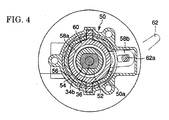
- Figs. 2A , 3A and 4 show the support portion 50 which is provided on the reel main body 12 for supporting the pinion gear 34.
- This support portion 50 has a stepped portion 50a in front of the bearing 34a, and the rolling type one-way clutch 46 is accommodated and supported within the stepped portion 50a.
- this one-way clutch 46 a plurality of roller-like rolling members 58 which are retained by a retainer or cage 58a are provided between an inner ring member 52 which is fitted on an operating portion 34b of the pinion gear 34 in such a manner as not to rotate thereon and an outer ring member 56 fitted in the front stepped portion 50a.
- the outer ring member 56 is prevented from rotating within the support portion 50 by a rotation preventive member 60.
- the rolling members 58 are caused to move between a clutch 46 operating state (refer to Fig. 2A ) in which the rolling members 58 act as a wedge between an outer circumferential surface of the inner ring member 52 which is formed by a smooth cylindrical surface and an inner circumferential surface of the outer ring member 56 and a clutch 46 non-operating state (refer to Fig. 3A ) in which the rolling members 58 roll freely between the outer circumferential surface of the inner ring member 52 and the inner circumferential surface of the outer ring member 56.
- the cage 58a can move the rolling members 58 between a free rotation permitted region and a rotation restricted region.
- an operation arm 58b is caused to project radially outwards from the cage 58a.
- a switching lever 62 (refer to Fig. 1 ) which is disposed at a rear end portion of the reel main body 12 is connected to the operation arm 58b via a control shaft 62a which extends in a longitudinal direction within the reel main body 12.
- the control shaft 62a is rotated so as to move the cage 58a between the free rotation permitted region and the rotation restricted region, so that the one-way clutch 46 is made to be switched between the operating state (an anti-reverse state in which the rotor 14 can rotate forwards) (refer two Fig. 2A ) and the non-operating state (a rotation enabling state in which the rotor 14 can rotate forward and backwards) (refer to Fig. 3A ).
- the switching lever 62 being switched to the anti-reverse state (ON)
- the handle 24 is permitted to rotate in a forward direction (for winding a line) and is prevented from rotating in a reverse direction (for releasing the line)
- the switching lever 62 being switched to the rotation enabling state (OFF)
- the handle 24 is allowed to rotate forwards and backwards.
- the rotor 14 has a tubular portion (a cylindrical portion) 14a which is situated within a skirt portion 16a of the spool 16 and a pair of arm portions 14ba, 14bb.
- a first and second bail support members 14ca, 14cb (reference numeral 14c is used when they are represented as a bail support member) are supported rotatably (reversibly) between a line winding position (refer to Fig. 5A ) and a line releasing position (refer to Fig. 5B ) at respective front end portions of the arm portions 14ba, 14bc (reference numeral 14b is used when they are represented as an arm portion).
- a bail 14d for picking up the fine which is in the line releasing state is provided between the bail support members 14ca, 14cb.
- one of proximal end portions of the bail 14d is attached to the bail support member 14ca, while the other end portion of the bail 14d is attached to a line guide portion 14e which is provided integrally on the bail support member 14cb.
- the spool 16 includes a line winding barrel portion 16c round which a line is wound between the skirt portion 16a and a front side flange 16b and is attached to the spool shaft 36 via a drag knob 72.
- a reversing mechanism (a rotation control mechanism) 80 of the bail 14d is provided on the reel main body 12 and the rotor 14 for restricting the rotation of the rotor 14 in a line winding direction when the bail 14d is disposed in the line releasing position.
- a reversing mechanism 80 of the bail 14d is provided on the reel main body 12 and the rotor 14 for restricting the rotation of the rotor 14 in a line winding direction when the bail 14d is disposed in the line releasing position.
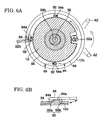
- Fig. 2B is a sectional view taken along the line 2B-2B in Fig. 5A
- Fig. 3B is a sectional view taken along the line 3B-3B in Fig. 5B
- Figs. 5A and 5B show a state in which an external cover 14f (refer to Figs. 2A and 3A ) is removed so as to expose a restoring movable member 82.
- Fig. 5A is a drawing showing a state in which the bail 14d is rotated to the line winding position
- Fig. 5B is a drawing showing a state in which the bail 14d is rotated to the line releasing position.
- the reversing mechanism 80 is provided within the arm portion 14ba of the rotor 14 and includes a vertically movable restoring movable member 82 and a restoring thrust contact portion 84 which is provided at a front part of the reel main body 12 and with which part of the restoring movable member 82 can be brought into abutment.
- the restoring thrust contact portion 84 is such as to be formed on an outer circumferential portion (a flange portion 12c) of a front end face of the reel main body 12 in such a manner as to project therefrom and includes a restricting portion 84a with which a boss (abutment portion) 82b of the restoring movable member 82, which will be described later, is brought into abutment to thereby restrict the rotation of the rotor 14 in the line winding direction.
- the restoring movable member 82 in the first embodiment is made into a rod shape so as to extend into the arm portion 14ba, and a boss 82a is formed at one end side of the restoring movable member 82 in such a manner as to be bent towards an outside of the reel and at the other end side of the restoring movable member 82, the boss (abutment portion) 82b is formed in such a manner as to be bent so as to enter an interior of the cylindrical portion 14a from the arm portion 14ba.
- a substantially arc-shaped elongated hole 14g is formed in the vicinity of a rotational support portion thereof, and the boss 82a (refer to Figs. 2A and 3A ) of the restoring movable member 82 is provided in the elongated hole 14g.
- a vertically extending elongated hole 14h is formed at a lower end portion of the arm portion 14ba, so that the boss 82b (refer to Figs. 2A, 2B , 3A and 3B ) of the restoring movable member 82 is provided in the elongated hole 14h.
- the restoring movable member 82 on which the bosses 82a, 82b are formed and the respective elongated holes 14g, 14h are configured in such a manner as to be in the following positional relationship and to operate in the following manner.
- Fig. 5A when the support member 14c of the bail 14d is in the line winding position, the boss 82a is in engagement with a lower end portion 14m of the elongated hole 14g, and the boss 82b is located in an upper position in the elongated hole 14h. As this occurs, as is shown in Figs.
- the boss 82b is located in a position where it does not interfere with the restoring thrust contact portion 84 formed on the reel main body 12. In other words, the boss 82b is made not to be brought into abutment with the restricting portion 84a of the restoring thrust contact portion 84 even in the event that the rotor 14 rotates.
- a control mechanism (control means) 90 is provided on the reel main body 12 and the rotor 14 for controlling the movement of the bail 14d in such a manner that the bail 14d does not reverse from the line winding position to the line releasing position (holding the bail 14d in the line winding position) with the switching lever 62 located in the OFF position.
- the control mechanism 90 has a plurality of raised portions (engagement portions) 92 which are provided on the flange portion 12c of the reel main body 12 in such a manner as to be disposed further transversely inwards (closer to the spool shaft 36) than the restoring thrust contact portion 84, a substantially ring-shaped preventive collar (a preventive member) 94 for preventing the movement of the position of the boss 82b of the restoring movable member 82 from the line winding position to the line releasing position with the switching lever 62 located in the OFF position, and a coil spring 96 functioning as a biasing means for biasing the preventive collar 94 towards the raised portions 92.
- the preventive collar 94 is provided on the control shaft 62a and is rotated within a predetermined range by an ON/OFF operation (switching) of the switching lever 62 (refer to Fig. 6A ).
- a plurality of rectangular openings 94a are formed in the preventive collar 94 at, for example, predetermined intervals.
- the raised portions 92 are also formed at the same intervals as those of the openings 94a in the preventive collar 94. Namely, the plurality of raised portions 92 are formed at, for example, predetermined intervals on the reel main body 12.
- the preventive collar 94 is placed on the plurality of raised portions 92 provided on the reel main body 12.
- an inclined surface 92a and a flat surface 92b which continuously connect to the inclined surface 92a are formed on the raised portion 92.
- the raised portions 92 are provided in such a manner as to go out of and into the rectangular openings 94a in the preventive collar 94. Because of this, the preventive collar 94 is made to be raised or lowered along the inclined surfaces 92a of the raised portions 92 in association with the rotation of the preventive collar 94 as a result of the switching lever 62 being switched (refer to Fig. 6B ).
- the preventive collar 94 is located in a position indicated by a solid line in Fig. 6B when the switching lever 62 is disposed in the ON position, while when the switching lever 62 is disposed in the OFF position, the preventive collar 94 is located in a position indicated by a broken line in Fig. 6B .
- one end (an upper end in Figs. 2B and Fig. 3B ) of the coil spring 96 is brought into abutment with a dislocation preventive member 98 which is fixed to the reel main body 12.
- the other end (a lower end) of the coil spring 96 is brought into abutment with the preventive collar 94. Because of this, the preventive collar 94 is biased downwards as viewed in Figs. 2B and 3B by the coil spring 96.
- the preventive collar 94 climbs up the inclined surfaces 92a of the raised portions 92 against the biasing force of the coil spring 96 in a direction indicated by an arrow in Fig. 6B so as to rest on the flat surfaces 92b of the raised portions 92.
- the preventive collar 94 is caused to slide down the inclined surfaces 92a of the raised portions 92 in a direction indicated by an arrow in Fig. 6B by virtue of the biasing force of the coil spring.
- a flipping mechanism (a reversing mechanism) 100 is provided in an interior of the arm portion 14bb which supports rotatably the second bail support member 14cb for switching and biasing the bail support member 14c between the line winding position and the line releasing position to thereby be held in place in either of the line winding position and the line releasing position to which the bail support member 14c is so switched.
- this flipping mechanism 100 includes a tubular oscillating member 104 which is attached to the arm portion 14bb via a pivot 102 in such a manner as to oscillate, a switching member 106 which connects the bail support member 14cb and the oscillating member 104 and switches the bail support member 14c between two positions in cooperation with the oscillating member 104 and a compression coil spring 108 which is interposed between the switching member 106 and the oscillating member 104.
- the bail support member 14cb has a substantially semi-annular mount portion 110 which is supported rotatably by a pin 110a in an interior of the arm portion 14bb.
- This mount portion 110 is made to be guided and supported by an arc-shaped space which is defined between an arc-shaped inner surface of the arm portion 14bb and an outer circumferential surface of the pin 110a.
- the switching member 106 has a connecting end portion 106a having an engagement portion 106b which is brought into rotatable engagement and connection with the mount portion 110 in a position which deviates from a center of the pin 110a and a shaft portion 106c which is inserted into a tubular interior of the oscillating member 104.
- the compression coil spring 108 is fitted on an outer circumference of the shaft portion 106c, and one end side of the compression coil spring 108 is inserted into the oscillating member 104 so as to be received at a bottom portion of the oscillating member 104, while the other end side of the compression coil spring 108 is received by a spring receiving surface of the switching member 106.
- Fig. 7A shows a state in which the second bail support member 14cb is switched to be held in the line winding position by virtue of a biasing force of the compression coil spring 108.
- the compression coil spring 108 imparts the second bail support member 14cb its biasing force in a direction in which the biasing force acts to rotate the second bail support member 14cb in a counterclockwise direction as viewed in Fig. 7A and brings an end portion 110c of the mount portion 110 of the second bail support member 14cb into abutment with an abutment portion 112 of the arm portion 14bb.
- the switching member 106 which is in engagement and connection with the second bail support member 14cb rotates about the engagement portion 106b in the counterclockwise direction relative to the second bail support member 14cb while moving together with the second bail support member 14cb and causes the oscillating member 104 to oscillate about the pivot 102 in the counterclockwise direction by the shaft portion 106c thereof which is received in the oscillating member 104.
- the switching member 106 compresses the compression coil spring 108 which is interposed between the shaft portion 106c thereof and the oscillating member 104 by the shaft portion 106c entering the interior of the oscillating member 104. Then, the compression coil spring 108 comes to impart the second bail support member 14cb its biasing force in a direction in which the biasing force acts to rotate the second bail support member 14cb in a clockwise direction as viewed in Fig.
- the compression coil spring 108 comes to impart the second bail support member 14cb its biasing force in a direction in which the biasing force acts to rotate the second bail support member 14cb in a counterclockwise direction as viewed in Fig. 7B (in a direction in which the second bail support member 14cb is rotated to the line winding position) at a point in time when the second bail support member 14cb has been rotated in the counterclockwise direction to a region which surpasses a dead point of the flipping mechanism 100, and thereafter, the second bail support member 14cb (and the first bail support member 14ca which connects to the second bail support member 14cb via the bail 14d) is rotated to the line winding position not manually but by virtue of the biasing force of the compression spring 108 which is now extending and is then held in this position (the position shown in Fig. 7A ).
- the switching lever 62 is disposed in the anti-reverse state, which is the ON position, the first and second bail support members 14ca, 14cb (the bail 14d) are operated to reverse from the line winding position (refer to Figs. 2A , 5A , 7A ) to the line releasing position (refer to Figs. 5B , 7B ) by the flipping mechanism 100, the line is dislocated from the line guide portion 14e, and the rod is forcibly swung down from its upward casting position.
- the preventive collar 94 is placed on upper sides of the flat surfaces 92b of the raised portions 92 while the preventive collar 94 is rotating against the biasing force of the coil spring 96. Namely, the preventive collar 94 moves upwards as viewed in Fig. 3A along the axial direction of the spool shaft 36 relative to the switching lever 62 being disposed in the ON position.
- the preventive collar 94 is in such a state that the preventive collar 94 rests on the upper sides of the raised portions 92, even in the event that the angler thoughtlessly attempts to reverse the bail support members 14ca, 14cb from the line winding position to the line releasing position when the switching lever 62 (the anti-reverse mechanism) is in the rotation enabling state, the boss 82b of the restoring movable member 82 is restricted from moving downwards as viewed in Figs. 3A and 3B (moving from the line winding position to the line releasing position) by the preventive collar 94. Namely, the bail 14d is prevented from rotating from the line winding position to the line releasing position (the bail 14d is prevented from being erected).
- the angler can recognize that the line releasing mode is not present in an ensured fashion from the fact that the angler cannot reverse the bail 14d manually and directly, and the angler switches the mode of the spinning reel 10 to the normal anti-reverse state.
- the abrupt and forcible reverse rotation of the rotor 14 is prevented which would otherwise take place due to the momentum produced when the rod is swung downwards with force or effects imposed by the position of the handle 24, thereby making it possible to prevent the application of a large magnitude of force to the rotor 14, the reversing mechanism 80 of the reel main body 12 and the arm portion 14b.
- the boss 82b of the restoring movable member 82 is allowed to move between the solid line (the line winding position) and the broken line (the line releasing position) in Fig. 2B .
- the bail support member 14c is allowed to freely rotate between the line winding position (refer to Fig. 5A ) and the line releasing position (refer to Fig. 5B ).
- the rotor 14 When the switching lever 62 is in the ON position, the rotor 14 is prevented from rotating in the reverse rotational direction by the rolling type one-way clutch 46. In rotating the bail 14d to the line releasing position in this state, although the rotor 14 is allowed to rotate only in the forward rotational direction, when the rotor 14 is operated to rotate, the lower end side boss 82b is brought into abutment with the restricting portion 84a, whereby the rotor 14 is restricted from rotating in the forward rotational direction, resulting in a forward and backward rotation disabling state.
- the rotor 14 is made not to rotate by the reverse rotation preventing action by the rolling type one-way clutch 46 and the forward rotation preventing action by the reversing mechanism 80.
- the switching lever 62 When the switching lever 62 is disposed in the ON position, the restoring movable member 82 can be switched freely between the line winding position and the line releasing position. In addition, even though the bail 14d is rotated so as to move the restoring movable member 82 between the line winding position and the line releasing position, the switching lever 62 can be held in the ON position.
- the switching lever 62 when the switching lever 62 is disposed in the OFF position, the restoring movable member 82 is allowed to be disposed only to the line winding position without being restricted by the preventive collar 94 but is restricted from moving to the line releasing position, so that the support members 14ca, 14cb are restricted from reversing to the line releasing position.
- the angler can recognize in the ensured fashion that the switching lever 62 is not positioned in the casting mode, thereby making it possible to prevent such an erroneous operation that the line is unwound with the switching lever 62 located in the OFF position.
- the single coil spring (the coil spring having a large diameter) 96 is described as being provided concentrically about the spool shaft 36, a plurality of coil springs (coil springs having a small diameter) may preferably be provided at appropriate intervals in the position where the preventive collar 94 is disposed.
- the biasing means is not limited to the coil spring 96, and hence, various types of springs or elastic elements can be used.
- preventive collar 94 While the preventive collar 94 is described as being formed into the annular or ring shape, the preventive collar 94 does not have to be formed into the annular shape, and hence, a preventive means may preferably be provided in a range where the boss 82b of the restoring movable member 82 can be pressed against thereby. Furthermore, in moving the preventive collar 94 back and force, in place of the cam engagement, the rotation of the switching lever 62 may be converted into back and forth motions of the preventive collar 94 through screw engagement with the reel main body 12.
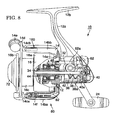
- a substantially arc-shaped elongated hole 14g is formed in the vicinity of a rotational support portion thereof, and the boss 82a (refer to Figs. 9A and 10A ) of the restoring movable member 82 is provided in the elongated hole 14g.
- a vertically extending elongated hole 14h is formed at a lower end portion of the arm portion 14ba, so that the boss 82b (refer to Figs. 9A and 10A ) of the restoring movable member 82 is provided in the elongated hole 14h.
- the restoring movable member 82 on which the bosses 82a, 82b are formed and the respective elongated holes 14g, 14h are configured in such a manner as to be in the following positional relationship and to operate in the following manner.
- Fig. 9B when the support member 14c of the bail 14d is in the line winding position, the boss 82a is in engagement with a lower end portion 14m of the elongated hole 14g, and the boss 82b is located in an upper position in the elongated hole 14h. As this occurs, as is shown in Figs.
- the boss 82b is located in a position where it does not interfere with the restoring thrust contact portion 84 formed on the reel main body 12. In other words, the boss 82b is made not to be brought into abutment with the restricting portion 84a of the restoring thrust contact portion 84 even in the event that the rotor 14 rotates.
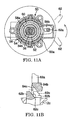
- an automatic switching mechanism (an automatic switching means) 90 is provided on the reel main body 12 and the rotor 14 which forcibly switches the switching lever 62 to the ON position while the switching lever 62 is in the OFF position, when the bail support member 14c is reversed from the line winding position to the line releasing position.
- the automatic switching mechanism 90 has a coil spring 92 which is supported at one end (a lower end) thereof on an external flange portion 12c of the support portion 50 of the reel main body 12, a switching member 94 provided at the other end (an upper end) of the coil spring 92, and a dislocation preventive member 96 for restricting the movement of the switching member 94.
- the switching member 94 is provided between the coil spring 92 and the dislocation preventive member 96.
- the switching member 94 is formed into a substantially annular shape (a substantially tubular shape) so as to move along a longitudinal direction on an outside of the support portion 50 of the reel main body 12.
- a control shaft 62a of the switching lever 62 is inserted into the switching member 94. Because of this, the switching member 94 rotates as the switching lever 62 is operated to be switched between the ON position and the OFF position.
- a flange portion 94a is formed on the switching member 94 in such a manner as to be pressed against by the boss 82b of the reversing movable member 82.
- a position which is disposed on the reversing thrust contact portion 84 is formed smaller in diameter than a position which is pressed against by the flange portion 94a of the switching member 90. Because of this, the boss 82b of the restoring movable member 82 and the flange portion 94a of the switching member 94 can be provided in a narrower space.
- a projecting portion (a second movable member) 94b is formed on the periphery of the control shaft 62a of the switching lever 62 in such a manner as to project therefrom towards the flange portion 12c of the reel main body 12.
- a projecting portion (a first movable member) 62b is formed integrally on the control shaft 62a of the switching lever 62 in parallel with the projecting portion 94b of the switching member 94 so that the projecting portion 94b is brought into abutment with the projecting portion 62b in such a manner as to move towards and away therefrom.
- the projecting portion 62b is provided in such a state that the projecting portion 62b projects towards the an operation arm 58b relative to the flange portion 12c of the reel main body 12.
- Inclined surfaces 94c, 62c are formed respectively on confronting portions of the projecting portion 94b of the switching member 94 and the projecting portion 62b of the control shaft 62a. These inclined surfaces 94c, 62c are formed into smooth planes so as to slide on each other when the projecting portions 94c, 62c are brought into abutment with each other.
- the switching fever 62 is disposed in the ON position, which is the anti-reverse state
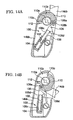
- the first and second bail support members 14ca, 14cb are operated to reverse from the line winding position (refer to Figs. 9A to 9D , 14A ) to the line releasing position (refer to Figs. 10B to 10D , 14B ) by the flipping mechanism 100, the line is dislocated from the line guide portion 14e, and the rod is forcibly swung down from its upward casting position.
- the lower end side boss 82b of the restoring movable member 82 is moved from a state as resulting when in the line winding position shown in Fig. 9C in which the boss 82b is spaced apart from the restricting portion 84a of the restoring thrust contact portion 84 and is disposed in a state as resulting when in the line releasing position shown in Fig. 10C in which the boss 82b can be brought into abutment with the restricting portion 84a of the restoring thrust contact portion 84.
- the rotor 14 is prevented from rotating forwards by the boss 82b of the restoring movable member 82. Namely, in casting the jig and its related parts by erecting the bail 14d, the rotor 14 is made not to rotate by the reverse rotation preventive action by the rolling type one-way clutch 46 and the forward rotation preventive action by the reversing mechanism 80.
- the switching lever 62 which is in the OFF position or in the rotation enabling state can forcibly be switched to the ON position. Because of this, should a line releasing operation be attempted erroneously in such a state that the switching lever 62 is in the OFF position, such an attempt can be prevented in an ensured fashion. Consequently, for example, a high-speed rotation of the rotor 14 or an application of a large magnitude of force to the arm portion 14b can be prevented which would otherwise take place when releasing the line. Because of this, the life of the reel 10 can be extended long.
- the single coil spring (the coil spring having a large diameter) 92 is described as being provided concentrically about the spool shaft 36, a plurality of coil springs (coil springs having a small diameter) may preferably be provided at appropriate intervals in the position where the switching member 94 is disposed.
- the biasing means is not limited to the coil spring 92, and hence, various types of springs or elastic elements can be used.
- the switching member 94 has been described as being formed into the substantially annular (the substantially tubular shape), the switching member 94 does not have to be formed into the annular shape, and hence, a switching means may preferably be provided in a range where the boss 82b of the restoring movable member 82 can be pressed against thereby.
Landscapes
- Life Sciences & Earth Sciences (AREA)
- Environmental Sciences (AREA)
- Animal Husbandry (AREA)
- Biodiversity & Conservation Biology (AREA)
Applications Claiming Priority (2)
| Application Number | Priority Date | Filing Date | Title |
|---|---|---|---|
| JP2007338317A JP4887277B2 (ja) | 2007-12-27 | 2007-12-27 | 魚釣用スピニングリール |
| JP2007338320A JP4887278B2 (ja) | 2007-12-27 | 2007-12-27 | 魚釣用スピニングリール |
Publications (1)
| Publication Number | Publication Date |
|---|---|
| EP2074885A2 true EP2074885A2 (de) | 2009-07-01 |
Family
ID=40547816
Family Applications (1)
| Application Number | Title | Priority Date | Filing Date |
|---|---|---|---|
| EP08022137A Withdrawn EP2074885A2 (de) | 2007-12-27 | 2008-12-19 | Angelrolle |
Country Status (2)
| Country | Link |
|---|---|
| US (1) | US20090166458A1 (de) |
| EP (1) | EP2074885A2 (de) |
Families Citing this family (3)
| Publication number | Priority date | Publication date | Assignee | Title |
|---|---|---|---|---|
| JP5894545B2 (ja) * | 2013-01-31 | 2016-03-30 | グローブライド株式会社 | 魚釣用スピニングリール |
| JP7143116B2 (ja) * | 2018-05-18 | 2022-09-28 | シマノコンポネンツ マレーシア エスディーエヌ.ビーエッチディー. | スピニングリール |
| WO2024186365A1 (en) | 2023-03-06 | 2024-09-12 | Drake Dean Gongwer | Automatically adjusting variable gear ratio fishing reel |
Citations (1)
| Publication number | Priority date | Publication date | Assignee | Title |
|---|---|---|---|---|
| JP2002281873A (ja) | 2001-01-16 | 2002-10-02 | Daiwa Seiko Inc | 魚釣用スピニングリール |
Family Cites Families (7)
| Publication number | Priority date | Publication date | Assignee | Title |
|---|---|---|---|---|
| DE69606497T2 (de) * | 1995-11-14 | 2000-07-06 | Daiwa Seiko Inc | Angelwinde |
| US6176447B1 (en) * | 1996-01-10 | 2001-01-23 | Daiwa Seiko, Inc. | Spinning reel for fishing with a spool having front and rear flange portions |
| TW474782B (en) * | 2000-06-23 | 2002-02-01 | Shimano Kk | Spinning reel rotor braking device |
| JP2002306032A (ja) * | 2001-04-16 | 2002-10-22 | Shimano Inc | スピニングリールのベール反転装置 |
| US6644578B2 (en) * | 2002-02-13 | 2003-11-11 | Eugene Hong | Fishing reel with a bail arm unit |
| JP4266719B2 (ja) * | 2003-06-13 | 2009-05-20 | 株式会社シマノ | スピニングリールのロータ制動装置 |
| US6913216B2 (en) * | 2003-08-07 | 2005-07-05 | Heligear Engineering (H.K.) Company, Ltd. | Trip mechanism for fishing reel |
-
2008
- 2008-12-19 EP EP08022137A patent/EP2074885A2/de not_active Withdrawn
- 2008-12-22 US US12/340,866 patent/US20090166458A1/en not_active Abandoned
Patent Citations (1)
| Publication number | Priority date | Publication date | Assignee | Title |
|---|---|---|---|---|
| JP2002281873A (ja) | 2001-01-16 | 2002-10-02 | Daiwa Seiko Inc | 魚釣用スピニングリール |
Also Published As
| Publication number | Publication date |
|---|---|
| US20090166458A1 (en) | 2009-07-02 |
Similar Documents
| Publication | Publication Date | Title |
|---|---|---|
| CN107125219B (zh) | 双轴承渔线轮 | |
| US20090166458A1 (en) | Fishing spinning reel | |
| US4337905A (en) | Bail latching and releasing mechanism for spinning reel of outside spool type | |
| US4964590A (en) | Fishing reel | |
| US5299757A (en) | Stopper apparatus for a spinning reel | |
| US4747559A (en) | Bail arm turning-over device for a fishing reel | |
| JP4887277B2 (ja) | 魚釣用スピニングリール | |
| US6216969B1 (en) | Fishing reel with anti-reverse mechanism | |
| JP2553303Y2 (ja) | スピニングリール | |
| TWI817804B (zh) | 釣魚用紡車式捲線器 | |
| JP4887278B2 (ja) | 魚釣用スピニングリール | |
| JP3809111B2 (ja) | 魚釣用リールの逆転防止装置 | |
| JPH052679U (ja) | 釣り用リールの軸支構造 | |
| JPH0616506Y2 (ja) | スピニングリールのベールアーム反転装置 | |
| JP4027883B2 (ja) | 魚釣用スピニングリ−ル | |
| US6499683B1 (en) | Spinning reel for fishing | |
| JP4875964B2 (ja) | 魚釣用スピニングリール | |
| JP2019103426A (ja) | 魚釣用スピニングリール | |
| JP4804250B2 (ja) | 魚釣用スピニングリール | |
| JP2003274817A (ja) | 魚釣用スピニングリール | |
| JP2994151B2 (ja) | 逆転防止装置 | |
| JP2003153642A (ja) | クローズドフェースリール | |
| JP2010252755A (ja) | 魚釣用リール | |
| JP2008245566A (ja) | 魚釣用リール | |
| JPS5921663Y2 (ja) | 魚釣用スピニングリ−ルのベ−ルア−ム反転装置 |
Legal Events
| Date | Code | Title | Description |
|---|---|---|---|
| PUAI | Public reference made under article 153(3) epc to a published international application that has entered the european phase |
Free format text: ORIGINAL CODE: 0009012 |
|
| AK | Designated contracting states |
Kind code of ref document: A2 Designated state(s): AT BE BG CH CY CZ DE DK EE ES FI FR GB GR HR HU IE IS IT LI LT LU LV MC MT NL NO PL PT RO SE SI SK TR |
|
| AX | Request for extension of the european patent |
Extension state: AL BA MK RS |
|
| STAA | Information on the status of an ep patent application or granted ep patent |
Free format text: STATUS: THE APPLICATION HAS BEEN WITHDRAWN |
|
| 18W | Application withdrawn |
Effective date: 20090918 |