EP2074890B1 - Procédé de réduction de la teneur en acrylamide dans des aliments contenant des glucides - Google Patents
Procédé de réduction de la teneur en acrylamide dans des aliments contenant des glucides Download PDFInfo
- Publication number
- EP2074890B1 EP2074890B1 EP08022002.3A EP08022002A EP2074890B1 EP 2074890 B1 EP2074890 B1 EP 2074890B1 EP 08022002 A EP08022002 A EP 08022002A EP 2074890 B1 EP2074890 B1 EP 2074890B1
- Authority
- EP
- European Patent Office
- Prior art keywords
- food
- monosodium citrate
- citrate
- content
- acrylamide
- Prior art date
- Legal status (The legal status is an assumption and is not a legal conclusion. Google has not performed a legal analysis and makes no representation as to the accuracy of the status listed.)
- Active
Links
- 235000013305 food Nutrition 0.000 title claims description 49
- HRPVXLWXLXDGHG-UHFFFAOYSA-N Acrylamide Chemical compound NC(=O)C=C HRPVXLWXLXDGHG-UHFFFAOYSA-N 0.000 title claims description 41
- 238000000034 method Methods 0.000 title claims description 25
- 150000001720 carbohydrates Chemical class 0.000 title claims description 12
- 235000014633 carbohydrates Nutrition 0.000 title description 8
- HWPKGOGLCKPRLZ-UHFFFAOYSA-M monosodium citrate Chemical compound [Na+].OC(=O)CC(O)(C([O-])=O)CC(O)=O HWPKGOGLCKPRLZ-UHFFFAOYSA-M 0.000 claims description 70
- 239000002524 monosodium citrate Substances 0.000 claims description 70
- 235000018342 monosodium citrate Nutrition 0.000 claims description 70
- KRKNYBCHXYNGOX-UHFFFAOYSA-N citric acid Chemical compound OC(=O)CC(O)(C(O)=O)CC(O)=O KRKNYBCHXYNGOX-UHFFFAOYSA-N 0.000 claims description 25
- 239000000243 solution Substances 0.000 claims description 25
- 230000015572 biosynthetic process Effects 0.000 claims description 18
- 235000012020 french fries Nutrition 0.000 claims description 15
- 239000000203 mixture Substances 0.000 claims description 15
- 238000004519 manufacturing process Methods 0.000 claims description 10
- 238000010411 cooking Methods 0.000 claims description 8
- HRXKRNGNAMMEHJ-UHFFFAOYSA-K trisodium citrate Chemical compound [Na+].[Na+].[Na+].[O-]C(=O)CC(O)(CC([O-])=O)C([O-])=O HRXKRNGNAMMEHJ-UHFFFAOYSA-K 0.000 claims description 8
- 235000015496 breakfast cereal Nutrition 0.000 claims description 7
- 238000010438 heat treatment Methods 0.000 claims description 7
- 239000001509 sodium citrate Substances 0.000 claims description 7
- 229940038773 trisodium citrate Drugs 0.000 claims description 7
- 239000007864 aqueous solution Substances 0.000 claims description 6
- 238000002360 preparation method Methods 0.000 claims description 5
- 238000005507 spraying Methods 0.000 claims description 5
- 230000001007 puffing effect Effects 0.000 claims description 3
- 238000011065 in-situ storage Methods 0.000 claims 1
- 238000002791 soaking Methods 0.000 claims 1
- XLYOFNOQVPJJNP-UHFFFAOYSA-N water Substances O XLYOFNOQVPJJNP-UHFFFAOYSA-N 0.000 description 15
- 235000013339 cereals Nutrition 0.000 description 13
- 239000004615 ingredient Substances 0.000 description 13
- 230000001953 sensory effect Effects 0.000 description 12
- 239000002994 raw material Substances 0.000 description 8
- 230000009467 reduction Effects 0.000 description 8
- 150000003839 salts Chemical class 0.000 description 7
- 239000000126 substance Substances 0.000 description 6
- 235000000346 sugar Nutrition 0.000 description 6
- 235000019263 trisodium citrate Nutrition 0.000 description 6
- 238000007598 dipping method Methods 0.000 description 5
- 238000007654 immersion Methods 0.000 description 5
- 230000008569 process Effects 0.000 description 5
- 235000007319 Avena orientalis Nutrition 0.000 description 4
- 244000075850 Avena orientalis Species 0.000 description 4
- 235000021307 Triticum Nutrition 0.000 description 4
- 241000209140 Triticum Species 0.000 description 4
- 230000000694 effects Effects 0.000 description 4
- 238000012360 testing method Methods 0.000 description 4
- UXVMQQNJUSDDNG-UHFFFAOYSA-L Calcium chloride Chemical compound [Cl-].[Cl-].[Ca+2] UXVMQQNJUSDDNG-UHFFFAOYSA-L 0.000 description 3
- 240000005979 Hordeum vulgare Species 0.000 description 3
- 235000007340 Hordeum vulgare Nutrition 0.000 description 3
- GXCLVBGFBYZDAG-UHFFFAOYSA-N N-[2-(1H-indol-3-yl)ethyl]-N-methylprop-2-en-1-amine Chemical compound CN(CCC1=CNC2=C1C=CC=C2)CC=C GXCLVBGFBYZDAG-UHFFFAOYSA-N 0.000 description 3
- 235000002017 Zea mays subsp mays Nutrition 0.000 description 3
- 230000008901 benefit Effects 0.000 description 3
- 239000001110 calcium chloride Substances 0.000 description 3
- 229910001628 calcium chloride Inorganic materials 0.000 description 3
- 239000012153 distilled water Substances 0.000 description 3
- 238000001035 drying Methods 0.000 description 3
- 239000003995 emulsifying agent Substances 0.000 description 3
- 238000001125 extrusion Methods 0.000 description 3
- 235000011868 grain product Nutrition 0.000 description 3
- 235000012907 honey Nutrition 0.000 description 3
- 239000007788 liquid Substances 0.000 description 3
- 238000005259 measurement Methods 0.000 description 3
- 238000002156 mixing Methods 0.000 description 3
- 238000005096 rolling process Methods 0.000 description 3
- 239000011734 sodium Substances 0.000 description 3
- 239000006188 syrup Substances 0.000 description 3
- 235000020357 syrup Nutrition 0.000 description 3
- 235000015099 wheat brans Nutrition 0.000 description 3
- 206010013911 Dysgeusia Diseases 0.000 description 2
- DGAQECJNVWCQMB-PUAWFVPOSA-M Ilexoside XXIX Chemical compound C[C@@H]1CC[C@@]2(CC[C@@]3(C(=CC[C@H]4[C@]3(CC[C@@H]5[C@@]4(CC[C@@H](C5(C)C)OS(=O)(=O)[O-])C)C)[C@@H]2[C@]1(C)O)C)C(=O)O[C@H]6[C@@H]([C@H]([C@@H]([C@H](O6)CO)O)O)O.[Na+] DGAQECJNVWCQMB-PUAWFVPOSA-M 0.000 description 2
- CKLJMWTZIZZHCS-REOHCLBHSA-N L-aspartic acid Chemical compound OC(=O)[C@@H](N)CC(O)=O CKLJMWTZIZZHCS-REOHCLBHSA-N 0.000 description 2
- 240000007594 Oryza sativa Species 0.000 description 2
- 235000007164 Oryza sativa Nutrition 0.000 description 2
- 244000299461 Theobroma cacao Species 0.000 description 2
- 235000009470 Theobroma cacao Nutrition 0.000 description 2
- 240000008042 Zea mays Species 0.000 description 2
- 235000005824 Zea mays ssp. parviglumis Nutrition 0.000 description 2
- 239000002253 acid Substances 0.000 description 2
- 239000000654 additive Substances 0.000 description 2
- 235000003704 aspartic acid Nutrition 0.000 description 2
- OQFSQFPPLPISGP-UHFFFAOYSA-N beta-carboxyaspartic acid Natural products OC(=O)C(N)C(C(O)=O)C(O)=O OQFSQFPPLPISGP-UHFFFAOYSA-N 0.000 description 2
- 235000015895 biscuits Nutrition 0.000 description 2
- 230000008859 change Effects 0.000 description 2
- 239000000470 constituent Substances 0.000 description 2
- 235000005822 corn Nutrition 0.000 description 2
- 230000006735 deficit Effects 0.000 description 2
- 238000011156 evaluation Methods 0.000 description 2
- 238000002474 experimental method Methods 0.000 description 2
- 235000012438 extruded product Nutrition 0.000 description 2
- 239000000796 flavoring agent Substances 0.000 description 2
- 235000019634 flavors Nutrition 0.000 description 2
- 235000013312 flour Nutrition 0.000 description 2
- 230000006872 improvement Effects 0.000 description 2
- JVTAAEKCZFNVCJ-UHFFFAOYSA-N lactic acid Chemical compound CC(O)C(O)=O JVTAAEKCZFNVCJ-UHFFFAOYSA-N 0.000 description 2
- 239000008188 pellet Substances 0.000 description 2
- 235000013573 potato product Nutrition 0.000 description 2
- 235000009566 rice Nutrition 0.000 description 2
- 229910052708 sodium Inorganic materials 0.000 description 2
- AEQDJSLRWYMAQI-UHFFFAOYSA-N 2,3,9,10-tetramethoxy-6,8,13,13a-tetrahydro-5H-isoquinolino[2,1-b]isoquinoline Chemical compound C1CN2CC(C(=C(OC)C=C3)OC)=C3CC2C2=C1C=C(OC)C(OC)=C2 AEQDJSLRWYMAQI-UHFFFAOYSA-N 0.000 description 1
- KRKNYBCHXYNGOX-UHFFFAOYSA-K Citrate Chemical compound [O-]C(=O)CC(O)(CC([O-])=O)C([O-])=O KRKNYBCHXYNGOX-UHFFFAOYSA-K 0.000 description 1
- 235000019483 Peanut oil Nutrition 0.000 description 1
- 244000061456 Solanum tuberosum Species 0.000 description 1
- 235000002595 Solanum tuberosum Nutrition 0.000 description 1
- 229920002472 Starch Polymers 0.000 description 1
- 235000019486 Sunflower oil Nutrition 0.000 description 1
- 241000482268 Zea mays subsp. mays Species 0.000 description 1
- 150000007513 acids Chemical class 0.000 description 1
- 230000002411 adverse Effects 0.000 description 1
- 125000003277 amino group Chemical group 0.000 description 1
- 238000000137 annealing Methods 0.000 description 1
- 235000021545 balls of chocolate Nutrition 0.000 description 1
- 239000007853 buffer solution Substances 0.000 description 1
- 239000001354 calcium citrate Substances 0.000 description 1
- FNAQSUUGMSOBHW-UHFFFAOYSA-H calcium citrate Chemical compound [Ca+2].[Ca+2].[Ca+2].[O-]C(=O)CC(O)(CC([O-])=O)C([O-])=O.[O-]C(=O)CC(O)(CC([O-])=O)C([O-])=O FNAQSUUGMSOBHW-UHFFFAOYSA-H 0.000 description 1
- 230000000711 cancerogenic effect Effects 0.000 description 1
- 231100000315 carcinogenic Toxicity 0.000 description 1
- 150000001768 cations Chemical class 0.000 description 1
- 230000001364 causal effect Effects 0.000 description 1
- 239000004464 cereal grain Substances 0.000 description 1
- 239000003638 chemical reducing agent Substances 0.000 description 1
- 230000001055 chewing effect Effects 0.000 description 1
- 235000010675 chips/crisps Nutrition 0.000 description 1
- 235000015165 citric acid Nutrition 0.000 description 1
- 238000011109 contamination Methods 0.000 description 1
- 235000012495 crackers Nutrition 0.000 description 1
- 235000012777 crisp bread Nutrition 0.000 description 1
- 230000006866 deterioration Effects 0.000 description 1
- 239000002526 disodium citrate Substances 0.000 description 1
- 235000019262 disodium citrate Nutrition 0.000 description 1
- CEYULKASIQJZGP-UHFFFAOYSA-L disodium;2-(carboxymethyl)-2-hydroxybutanedioate Chemical compound [Na+].[Na+].[O-]C(=O)CC(O)(C(=O)O)CC([O-])=O CEYULKASIQJZGP-UHFFFAOYSA-L 0.000 description 1
- 238000004090 dissolution Methods 0.000 description 1
- 238000005516 engineering process Methods 0.000 description 1
- 238000001704 evaporation Methods 0.000 description 1
- 230000008020 evaporation Effects 0.000 description 1
- 235000019197 fats Nutrition 0.000 description 1
- 230000002349 favourable effect Effects 0.000 description 1
- 235000015203 fruit juice Nutrition 0.000 description 1
- 235000012432 gingerbread Nutrition 0.000 description 1
- 239000011521 glass Substances 0.000 description 1
- 230000001771 impaired effect Effects 0.000 description 1
- 238000011835 investigation Methods 0.000 description 1
- 239000004310 lactic acid Substances 0.000 description 1
- 235000014655 lactic acid Nutrition 0.000 description 1
- 235000012054 meals Nutrition 0.000 description 1
- 244000005700 microbiome Species 0.000 description 1
- 231100000219 mutagenic Toxicity 0.000 description 1
- 230000003505 mutagenic effect Effects 0.000 description 1
- 239000003921 oil Substances 0.000 description 1
- 235000019198 oils Nutrition 0.000 description 1
- 239000000312 peanut oil Substances 0.000 description 1
- 235000012015 potatoes Nutrition 0.000 description 1
- 239000000843 powder Substances 0.000 description 1
- 235000012434 pretzels Nutrition 0.000 description 1
- 238000011160 research Methods 0.000 description 1
- 239000012266 salt solution Substances 0.000 description 1
- 238000007493 shaping process Methods 0.000 description 1
- 235000002639 sodium chloride Nutrition 0.000 description 1
- 239000000176 sodium gluconate Substances 0.000 description 1
- 235000012207 sodium gluconate Nutrition 0.000 description 1
- 229940005574 sodium gluconate Drugs 0.000 description 1
- 239000007787 solid Substances 0.000 description 1
- 239000007858 starting material Substances 0.000 description 1
- 150000008163 sugars Chemical class 0.000 description 1
- 239000002600 sunflower oil Substances 0.000 description 1
- 238000005496 tempering Methods 0.000 description 1
- 235000013337 tricalcium citrate Nutrition 0.000 description 1
- 230000001960 triggered effect Effects 0.000 description 1
- 238000009827 uniform distribution Methods 0.000 description 1
- 235000019871 vegetable fat Nutrition 0.000 description 1
- 230000000007 visual effect Effects 0.000 description 1
- 229940100445 wheat starch Drugs 0.000 description 1
- 235000020985 whole grains Nutrition 0.000 description 1
- 235000011844 whole wheat flour Nutrition 0.000 description 1
Images

Classifications
-
- A—HUMAN NECESSITIES
- A23—FOODS OR FOODSTUFFS; TREATMENT THEREOF, NOT COVERED BY OTHER CLASSES
- A23L—FOODS, FOODSTUFFS OR NON-ALCOHOLIC BEVERAGES, NOT OTHERWISE PROVIDED FOR; PREPARATION OR TREATMENT THEREOF
- A23L5/00—Preparation or treatment of foods or foodstuffs, in general; Food or foodstuffs obtained thereby; Materials therefor
- A23L5/20—Removal of unwanted matter, e.g. deodorisation or detoxification
- A23L5/27—Removal of unwanted matter, e.g. deodorisation or detoxification by chemical treatment, by adsorption or by absorption
- A23L5/276—Treatment with inorganic compounds
Definitions
- the present invention relates to a process for reducing the content of acrylamide in carbohydrate-containing foods and carbohydrate-containing foods with reduced potential for the formation of acrylamide when heated.
- acrylamide is formed by a Maillard reaction of the amino group of aspartic acid with the anomeric center of sugars.
- Acrylamide formation is triggered or promoted by low water content and high temperatures, typically above 120 ° C., as in the case of grilling, baking, frying. Since sugar and aspartic acid are normal components of starchy foods, acrylamide formation is an inevitable feature of such products when cooked at higher temperatures. The first recommendations were therefore to not starchy foods or to heat as little as possible and / or to limit the consumption of higher-heat products.
- WO 2004/060078 describes the use of a pH-reducing agent, such as acids, buffer solutions or fruit juice, with which the food is added, sprayed or soaked.
- WO 2004/028277 Proposes the use of lactic acid-producing microorganisms for the treatment of food.
- WO 2005/034649 Finally, the addition of polyvalent cations is proposed.
- the above object is therefore achieved by a method for reducing the content of acrylamide in heated, carbohydrate-containing foods, wherein the food is treated prior to heating with monosodium citrate, in particular treated with an aqueous solution of monosodium citrate, the treatment containing monosodium citrate in which food provides from 0.1 to 3% by weight. Furthermore, the object is achieved by carbohydrate-containing foods having a reduced potential for formation of acrylamide on heating treated with monosodium citrate, in particular treated with an aqueous solution of monosodium citrate, wherein the treatment has a content of monosodium citrate in the food of 0.1 to 3 wt .-% provides.
- Monosodium citrate is a commercially available product whose use in food, provided adequate purity, is free of any concerns.
- treatment in the context of the present invention any method which can provide a desired level of monosodium citrate in the food.
- the treatment leads to more advantageous do not lead to an impairment of the food in the taste or sensory direction. This is especially important for foods such as chips or chips, where appearance, feel and feel play a big role.
- the method according to the invention ensures that neither the appearance of the treated food adversely changes nor the sensory and / or haptic properties. In the example of French fries, there was no change in taste or even deterioration. The crispness was unchanged. Compared to the known measure of reducing the frying temperature, there is thus the important advantage that the sensory nature of the food remains unchanged or is not impaired.
- the aqueous solution preferably used according to the invention for the treatment can be prepared by dissolving monosodium citrate in water. Concentrations of from 0.1 to 10% by weight, preferably from 0.5 to 5% by weight and in particular from 1 to 4% by weight, have proved successful. This concentration represents a compromise between the effect on the acrylamide content on the one hand and the costs on the other hand. Also at significantly higher concentrations, a taste impairment is to be expected.
- the aqueous solution can be prepared by dissolving appropriate amounts of citric acid and trisodium citrate or disodium citrate. Since in the concentrations used, the salts are completely dissolved, there is no difference between the solution of the salt and a solution prepared by dissolving corresponding approximately equimolar amounts of acid and di- or trisodium salt solutions. The amounts should be chosen so that the molar ratio of Na + : citrate 3- from about 1.1: 1 to about 1: 1.1.
- carbohydrate-containing foods are, for example, French fries, chips, crispbread, breakfast cereals, crackers, biscuits, gingerbread, speculaas, pretzel sticks, popcorn, etc. to name a few.
- the method is suitable for Potato products such as French fries and chips and especially for French fries, as well as cereal products such as breakfast cereals.
- French fries are usually freshly prepared by the consumer so that a strictly controlled temperature-controlled preparation is hardly possible. A limitation of the acrylamide content by the temperature is thus eliminated. In addition, consumers are to a large extent children, who also consume French fries more often, which further aggravates the problem.
- Breakfast cereals are finished products that are consumed by the consumer directly in unaltered form. In this case, the consumer has no influence on the acrylamide content.
- Treatment with the monosodium citrate solution can effectively reduce acrylamide formation.
- a reduction in the content of about 2000 ⁇ g / kg when treated with distilled water was found to be 146 ⁇ g / kg when treated with 0.6% monosodium citrate solution.
- the treatment with distilled water resulted in a level of 210 ⁇ g / kg, which was obtained by the treatment according to the invention with monosodium citrate, e.g. could be lowered to 160 ⁇ g / kg with 1% solution.
- the current signal value for a questionable acrylamide content is given as 530 ⁇ g / kg.
- the treatment according to the invention with monosodium citrate leads e.g. at solution concentrations of 0.5 to 4 wt .-% neither optically, nor sensory or flavor to changes in French fries.
- the invention is also particularly suitable for cereal products (eg from oats, wheat, rice, spelled, corn, etc.), such as breakfast cereals and the like Products made by processes such as cooking, extruding and / or puffing.
- cereal products eg from oats, wheat, rice, spelled, corn, etc.
- Products made by processes such as cooking, extruding and / or puffing.
- puffing is mostly made of cereal grains.
- a raw material or a dough is usually first prepared by mixing the ingredients. Flakes can be made either by rolling the grains or pellets, which are also produced from a raw material.
- the main constituents of the raw material are in each case the carbohydrate-containing cereal components such as cereal flour, cereal groats and / or cereal meal. These are usually flavoring ingredients such. As sugar, salt, honey, cocoa or barley malt in variable amounts depending on the flavor and, if necessary, other additives such as emulsifiers.
- the raw material is mixed in the process with a liquid, usually water.
- the soluble ingredients can be dissolved in the liquid, the solution being called a syrup, or the raw mass added directly.
- the raw material When produced by cooking, the raw material is typically heated after mixing the ingredients and held at the selected temperature for a longer time.
- the mixing takes place directly in the digester, but can also be carried out in particular for parts of the ingredients in separate mixers.
- the dry mix of the grain components and the syrup of the soluble components are fed to the digester.
- Typical conditions for cooking are temperatures of about 110 to 130 ° C at a pressure of 1.0 to 1.6 bar and times in the range of 30 to 120 minutes.
- the mass is often tempered and / or pre-dried for uniform distribution of the moisture. During tempering, the mass, usually without energy, for a certain time, for example, 60 to 120 minutes, left to rest.
- drying usually takes place.
- the temperature during the drying process is 60 - 140 ° C with a dwell time of 60 - 180 minutes, depending on the system.
- the shaping of the product is often done by pelleting and / or rolling.
- the starting raw material eg wheat or rice or their flours and grits
- this is first pelleted.
- the corn groats or grains are rolled.
- the flake thickness can be adjusted.
- roasting which is also the main source of acrylamide formation, since in the roaster very high temperatures and a low product moisture prevail.
- the temperature during roasting is usually 140 to 280 ° C, the roasting time is usually 1 to 4 minutes, typically about 2 minutes.
- the moisture is rapidly removed from the product, which reduces the product properties such as e.g. Taste and color influenced positively, but also promotes acrylamide formation.
- a dough or a raw mass is also prepared, wherein the ingredients are fed directly to the extruder and mixed there.
- the temperature in the extruder is typically 80 to 180 ° C, the residence time of the raw material is 90 to 240 seconds.
- the extruded products usually undergo drying, typical conditions are 80 to 120 ° C for 10 to 30 minutes. Often extruded products are coated with syrup and then usually dried again.
- the main source of acrylamide formation are the last modules in the extruder and the nozzle plate. In addition to the high temperatures, high pressures are generated, which lead to the rapid evaporation of the moisture in the product Although the product properties such as taste and color influenced positively, but also promotes acrylamide formation.
- the treatment of the food according to the invention can take place by admixing or by dipping, spraying or pouring over, preferably by immersion in potato products and by admixing with cereal products.
- the dipping / spraying is typically for a few seconds, for example 1 to 10, preferably 2 to 5 seconds.
- immersion / spraying is a recording of monosodium citrate in the food, which is approximately proportional to the concentration of the solution.
- the treatment provides in the food a content of from 0.1 to 3% by weight, in particular from 0.4 to 1.0% by weight of monosodium citrate, based on the dry matter of the food.
- the treatment according to the invention by immersion / spraying, in particular an immersion bath can be easily integrated into existing production processes, since the solution used according to the invention is storage-stable. It is advisable to monitor the concentration of the solution in the dipping bath and to take appropriate measures to ensure their constancy. Thus, for example, the solution can be pumped and the concentration can be kept constant by appropriate replacement or supply of fresh solution.
- the duration of the treatment as well as the concentration of the solution affects the amount of monosodium citrate absorbed. Therefore, for lower concentration solutions, a longer treatment time, eg from 5 seconds to 10 minutes, preferably 1 to 5 minutes, should be chosen. For more concentrated solutions, 1 to 10 seconds, preferably 2 to 5 seconds, are sufficient.
- the invention Method can thus be easily adapted to processes in the manufacturing process.
- an admixture may also be considered for the treatment.
- the monosodium citrate may be added in dry form to a dough for making biscuits.
- the addition of food in the production of which water is added anyway, also be done by adding in the form of a solution.
- the monosodium citrate is added to a raw material, it can advantageously be used as a solid.
- the monosodium citrate "Type D” from Jungbunzlauer Ladenburg GmbH has proven to be particularly suitable.
- the "Type D” dissolves very quickly and can therefore be added as dry substance to other dry constituents in particular.
- Conductivity measurements show that Type D is completely dissolved in water within a few seconds at room temperature, while an equal amount (20 g / l) of crystalline or powdered types requires more than 30 seconds or several minutes.
- Type D Due to its good solubility, Type D is also suitable for applications in which only a small amount of water / liquid is available or in which only a short time is available for complete dissolution of the salt.
- the monosodium citrate "Type D" due to the better flowability compared to other types has very good conveying properties. This is an advantage in pneumatic conveying, for example, so that Type D requires less time to run, for example, through a glass funnel with an outlet cross-section of 2 cm than the pulverulent type F0100, which is still comparatively soluble.
- test substance Acrylamide content [ ⁇ g / kg] Sensory result in comparison to dest. water least. water 2074 Mono-sodium citrate 146 unchanged Tri-sodium citrate 514 enhanced baking aroma citric acid 1061 unchanged sodium gluconate 1290 unchanged calcium chloride 55 "medical" aftertaste Tri-calcium citrate 873 unchanged
- citric acid which is proposed in the prior art, although effective, but much less effective than the product of the invention. Contrary to previous assumptions, it does not appear that the pH value drops, because this reduction is more pronounced for citric acid than for monosodium citrate, and trisodium citrate also performs significantly better than citric acid. This result is completely unexpected for the skilled person. Even more effective than the invention Product would only be calcium chloride, but this already causes a marked aftertaste in the low concentration of 0.62% in the dipping solution and is therefore not suitable. In addition to calcium chloride, only trisodium citrate had an effect on the taste, but in this case, rather, an improvement. All other substances did not change the sensory properties.
- FIG. 1 The increase in dry matter is in FIG. 1 shown. It can be seen that the increase in dry matter in the fried French fries tends to be higher for the mixture (TNC / CAA) than for monosodium citrate (MNC). A significant increase occurs for monosodium citrate and the mixture from a Tauchbadkonzentration of 3 wt .-%.
- the increase in sodium content in the dry matter was measured as a function of the immersion bath concentration. Like the in FIG. 2 For both monosodium citrate (MNC) and the mixture (TNC / CAA), the sodium content is increased in proportion to the concentration of the dipping solution.
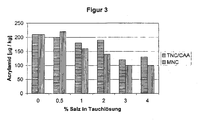
- the acrylamide content was measured and is in FIG. 3 illustrated. It can be seen that at a concentration of 0.5% by weight, under the conditions optimized with regard to acrylamide formation, no significant reduction was measured. At concentrations of 1, 2 and 3% by weight, a significant reduction can be achieved, while at still higher concentrations no significant further improvement is achieved. There is no significant difference between monosodium citrate (MNC) and the mixture (TNC / CAA), although monosodium citrate always yields somewhat better values. It can thus be concluded that the method according to the invention is suitable for lowering the potential for acrylamide formation to a low level, so that compliance with upper limits can be reliably achieved.
- MNC monosodium citrate
- TAC / CAA monosodium citrate
- monosodium citrate is particularly effective. Another great benefit is that monosodium citrate does not affect the taste, look and feel of foods. Since sensor technology plays a decisive role in food, it is extremely important not to impair the visual or sensory impression when touching and chewing. Both are ensured by the method according to the invention.
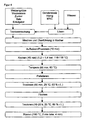
- the preparation of the flakes was carried out according to the in FIG. 4 shown scheme.
- the cereal components (wholegrain wheat bran and wheat bran) were dry blended with sugar, salt and emulsifier. Barley malt, honey and the indicated amount of monosodium citrate were dissolved in water and mixed with the dry mix. Subsequently, the mass was transferred to a digester. After heating for about 10 minutes, the cooking was carried out for 45 minutes at 116 to 118 ° C and 1.2 to 1.4 bar. An annealing at 60 ° C for 60 minutes followed. Subsequently, the mass was pelleted and the pellets 60 minutes at 25 ° C and 60% rel. Air humidity dried. Flakes were prepared and again 16 to 20 h at 25 ° C and 60% rel. Air humidity dried. Finally, the product was roasted at 180 ° C for 2 or 4 minutes.
- Table 3 The sensory evaluation of the breakfast cereals is summarized in Table 3.
- Table 3 mixture Sensory assessment Deviation from the standard A standard without MNC light brown color, sweetish-malty - B with 0.5% MNC light brown color, sweetish-malty none C with 0.75% MNC light brown color, sweetish-malty none D with 1.25% MNC light brown color, sweetish malty, slightly sour low
- the monosodium citrate treatment according to the invention leads in each case to a significant reduction in the content of acrylamide, depending on the moisture content, by up to 80%. As with the French fries, the higher the initial value, the greater the reduction. It can therefore be assumed that by the method according to the invention even more critical goods can be reliably brought to harmless levels of acrylamide.
- Table 6 The sensory evaluation of the breakfast cereals is summarized in Table 6.
- Table 6 mixture Sensory assessment Deviation from the standard E standard without MNC brown color, sweetish to cereals - F with 0.5% MNC brown color, sweetish to cereals none G with 0.75% MNC brown color, sweetish to cereals none H with 1.25% MNC brownish color, sweetish with cereals, slightly sourish low
Landscapes
- Health & Medical Sciences (AREA)
- Nutrition Science (AREA)
- Life Sciences & Earth Sciences (AREA)
- Chemical & Material Sciences (AREA)
- Engineering & Computer Science (AREA)
- Food Science & Technology (AREA)
- Polymers & Plastics (AREA)
- Preparation Of Fruits And Vegetables (AREA)
Claims (9)
- Procédé pour la réduction de la teneur en acrylamide dans des aliments chauffés, contenant des hydrates de carbone, caractérisé en ce que l'aliment est traité avant le chauffage avec du citrate monosodique, le traitement mettant à disposition une teneur en citrate monosodique dans l'aliment de 0,1 à 3% en poids par rapport à la masse sèche de l'aliment.
- Procédé selon la revendication 1, caractérisé en ce que l'aliment est traité par une solution aqueuse de citrate monosodique, en particulier aspergé par la solution ou plongé dans la solution.
- Procédé selon la revendication 2, caractérisé en ce que la solution présente une concentration dans la plage de 0,1 à 10% en poids, de préférence de 0,5 à 5% en poids, en particulier de 1 à 4% en poids.
- Procédé selon la revendication 1, caractérisé en ce que le citrate monosodique est mélangé à une masse brute ou à une pâte en vue de la préparation de l'aliment.
- Procédé selon l'une quelconque des revendications 1 à 4, caractérisé en ce que le citrate monosodique est formé in situ dans une solution à partir d'un mélange d'acide citrique et de citrate trisodique dans un rapport molaire Na+ :citrate3- de 1,1:1 à 1:1,1.
- Procédé selon au moins l'une quelconque des revendications précédentes, caractérisé en ce que le traitement met à disposition une teneur en citrate monosodique dans l'aliment de 0,4 à 1,0% en poids par rapport à la masse sèche de l'aliment.
- Aliment contenant des hydrates de carbone sous forme de frites ou chips présentant un potentiel réduit de formation d'acrylamide lors du chauffage, caractérisé en ce que l'aliment a été traité avant le chauffage par une solution aqueuse de citrate monosodique en une concentration dans la plage de 0,1 à 10% en poids par immersion, aspersion et/ou arrosage, le traitement mettant à disposition dans l'aliment une teneur en citrate monosodique de 0,1 à 3% en poids par rapport à la masse sèche de l'aliment.
- Aliment contenant des hydrates de carbone sous forme de céréales pour le petit déjeuner, qui sont préparées par cuisson, extrusion et/ou soufflage, caractérisé en ce que l'aliment a été traité avant le chauffage par du citrate monosodique, le traitement mettant à disposition dans l'aliment une teneur en citrate monosodique de 0,1 à 3% en poids par rapport à la masse sèche de l'aliment.
- Aliment contenant des hydrates de carbone selon la revendication 8, caractérisé en ce que le citrate monosodique est mélangé à une pâte ou à une masse brute en vue de la préparation de l'aliment.
Applications Claiming Priority (1)
| Application Number | Priority Date | Filing Date | Title |
|---|---|---|---|
| DE102007061350 | 2007-12-21 |
Publications (2)
| Publication Number | Publication Date |
|---|---|
| EP2074890A1 EP2074890A1 (fr) | 2009-07-01 |
| EP2074890B1 true EP2074890B1 (fr) | 2014-11-26 |
Family
ID=40524711
Family Applications (1)
| Application Number | Title | Priority Date | Filing Date |
|---|---|---|---|
| EP08022002.3A Active EP2074890B1 (fr) | 2007-12-21 | 2008-12-18 | Procédé de réduction de la teneur en acrylamide dans des aliments contenant des glucides |
Country Status (1)
| Country | Link |
|---|---|
| EP (1) | EP2074890B1 (fr) |
Families Citing this family (2)
| Publication number | Priority date | Publication date | Assignee | Title |
|---|---|---|---|---|
| US20150366223A1 (en) * | 2013-01-18 | 2015-12-24 | Vural Gokmen | Acrylamide-free bakery product and the production method thereof |
| LU103185B1 (en) * | 2023-08-07 | 2025-02-07 | Sampochem Gmbh | Gmo-free composition of reduction of food-borne toxins and production method thereof |
Citations (2)
| Publication number | Priority date | Publication date | Assignee | Title |
|---|---|---|---|---|
| GB869536A (en) * | 1956-07-25 | 1961-05-31 | Benckiser Gmbh Joh A | A method for the treatment of fruits and plants |
| EP1785041A1 (fr) * | 2005-11-14 | 2007-05-16 | Unilever N.V. | Procédé de préparation de croûtons |
Family Cites Families (3)
| Publication number | Priority date | Publication date | Assignee | Title |
|---|---|---|---|---|
| GB0222185D0 (en) | 2002-09-24 | 2002-10-30 | Forinnova As | Use |
| US20060240174A1 (en) | 2003-01-03 | 2006-10-26 | Jung Mun Y | Method for the reduction of acrylamide formation |
| US20050079254A1 (en) | 2003-10-10 | 2005-04-14 | The Procter & Gamble Company | Method for reducing acrylamide in foods, foods having reduced levels of acrylamide, and article of commerce |
-
2008
- 2008-12-18 EP EP08022002.3A patent/EP2074890B1/fr active Active
Patent Citations (2)
| Publication number | Priority date | Publication date | Assignee | Title |
|---|---|---|---|---|
| GB869536A (en) * | 1956-07-25 | 1961-05-31 | Benckiser Gmbh Joh A | A method for the treatment of fruits and plants |
| EP1785041A1 (fr) * | 2005-11-14 | 2007-05-16 | Unilever N.V. | Procédé de préparation de croûtons |
Also Published As
| Publication number | Publication date |
|---|---|
| EP2074890A1 (fr) | 2009-07-01 |
Similar Documents
| Publication | Publication Date | Title |
|---|---|---|
| DE69310749T2 (de) | Verfahren zur herstellung von vitaminangereichtem getreide | |
| DE69929085T2 (de) | Körnerförmiges nahrungsmittel | |
| DE69329378T2 (de) | Verfahren zur herstellung von rohen dreischichtigen nudeln | |
| DE69917873T2 (de) | Gepuffte Getreidekuchen | |
| DE2442552C3 (de) | Verfahren zur Verbesserung der Backeigenschaften von Weizen | |
| WO2014068433A1 (fr) | Produit alimentaire à base de parties de plantes contenant de l'amidon ainsi que son procédé de fabrication | |
| EP3618641A1 (fr) | Procédé destiné à la production d'une matière de remplissage composée de drêche, matière de remplissage, utilisation d'une matière de remplissage et produit alimentaire | |
| EP2900075B1 (fr) | Fondant avec une phase non-cristalline, comprenant de l'isomaltulose et du saccharose | |
| DE69422150T2 (de) | Backzusammensetzung mit einem hohen zuckergehalt | |
| DE202016008304U1 (de) | Cellobiose in Zusammensetzungen zum Verzehr oder zur Einnahme | |
| EP2074890B1 (fr) | Procédé de réduction de la teneur en acrylamide dans des aliments contenant des glucides | |
| DE69630217T2 (de) | Verfahren zur aromatisierung und texturisierung von lebensmittelpartikeln und produkte davon | |
| DE60108968T2 (de) | Verfahren zur herstellung von snack- und frühstückszerealien-produkten und ein gemäss diesem verfahren hergestelltes produkt | |
| DE69324665T2 (de) | Verfahren zur Herstellung von gekochten Getreideprodukten | |
| DE3779458T2 (de) | Verfahren um das altbackenwerden von einer staerke enthaltenden zusammensetzung zu verhindern. | |
| DE29704037U1 (de) | Glutenfreie Fertigmehlmischung | |
| CH626786A5 (en) | Process for preparing a foodstuff from edible seeds. | |
| EP1956925A2 (fr) | Substance de base servant à produire des produits alimentaires destinés aux êtres humains et des produits alimentaires destinés aux animaux | |
| DE60308962T2 (de) | Verfahren zur Herstellung von fettarmen, faserangereicherten Imbissprodukten, und so erhaltene Imbissprodukte | |
| DE2035979C3 (de) | Wiederwässerbare Teigware und Verfahren zu deren Herstellung | |
| DE60312337T2 (de) | Eingekapselte kristalline milchsäure | |
| DE202011004314U1 (de) | Lebensmittelprodukt aus nährstoffhaltigem Pflanzenmaterial | |
| EP3987937A1 (fr) | Procédé de fabrication d'un produit de remplissage à partir de drêche, matière de charge, utilisation d'une matière de charge et denrée alimentaire | |
| EP3307080B1 (fr) | Édulcorant et son utilisation | |
| DE3686912T2 (de) | Backwaren mit lagerstabiler textur. |
Legal Events
| Date | Code | Title | Description |
|---|---|---|---|
| PUAI | Public reference made under article 153(3) epc to a published international application that has entered the european phase |
Free format text: ORIGINAL CODE: 0009012 |
|
| AK | Designated contracting states |
Kind code of ref document: A1 Designated state(s): AT BE BG CH CY CZ DE DK EE ES FI FR GB GR HR HU IE IS IT LI LT LU LV MC MT NL NO PL PT RO SE SI SK TR |
|
| AX | Request for extension of the european patent |
Extension state: AL BA MK RS |
|
| RIN1 | Information on inventor provided before grant (corrected) |
Inventor name: PFEIFFER, MATTHIAS Inventor name: GERSTNER, GERHARD Inventor name: JANTSCHEWSKI, VITALIJ |
|
| RIN1 | Information on inventor provided before grant (corrected) |
Inventor name: PFEIFFER, MATTHIAS Inventor name: GERSTNER, GERHARD Inventor name: SCHOLTEN, CLAUDIA Inventor name: JANTSCHEWSKI, VITALIJ |
|
| 17P | Request for examination filed |
Effective date: 20100104 |
|
| 17Q | First examination report despatched |
Effective date: 20100129 |
|
| AKX | Designation fees paid |
Designated state(s): AT BE BG CH CY CZ DE DK EE ES FI FR GB GR HR HU IE IS IT LI LT LU LV MC MT NL NO PL PT RO SE SI SK TR |
|
| AXX | Extension fees paid |
Extension state: MK Payment date: 20100104 Extension state: RS Payment date: 20100104 Extension state: AL Payment date: 20100104 Extension state: BA Payment date: 20100104 |
|
| RAP1 | Party data changed (applicant data changed or rights of an application transferred) |
Owner name: JUNGBUNZLAUER LADENBURG GMBH |
|
| GRAP | Despatch of communication of intention to grant a patent |
Free format text: ORIGINAL CODE: EPIDOSNIGR1 |
|
| INTG | Intention to grant announced |
Effective date: 20140610 |
|
| RIN1 | Information on inventor provided before grant (corrected) |
Inventor name: SCHOLTEN, CLAUDIA Inventor name: PFEIFFER, MATTHIAS Inventor name: JANTSCHEWSKI, VITALIJ Inventor name: GERSTNER, GERHARD |
|
| GRAS | Grant fee paid |
Free format text: ORIGINAL CODE: EPIDOSNIGR3 |
|
| GRAA | (expected) grant |
Free format text: ORIGINAL CODE: 0009210 |
|
| AK | Designated contracting states |
Kind code of ref document: B1 Designated state(s): AT BE BG CH CY CZ DE DK EE ES FI FR GB GR HR HU IE IS IT LI LT LU LV MC MT NL NO PL PT RO SE SI SK TR |
|
| AX | Request for extension of the european patent |
Extension state: AL BA MK RS |
|
| REG | Reference to a national code |
Ref country code: GB Ref legal event code: FG4D Free format text: NOT ENGLISH |
|
| REG | Reference to a national code |
Ref country code: CH Ref legal event code: EP |
|
| REG | Reference to a national code |
Ref country code: AT Ref legal event code: REF Ref document number: 697662 Country of ref document: AT Kind code of ref document: T Effective date: 20141215 |
|
| REG | Reference to a national code |
Ref country code: IE Ref legal event code: FG4D Free format text: LANGUAGE OF EP DOCUMENT: GERMAN |
|
| REG | Reference to a national code |
Ref country code: DE Ref legal event code: R096 Ref document number: 502008012423 Country of ref document: DE Effective date: 20150108 |
|
| REG | Reference to a national code |
Ref country code: NL Ref legal event code: VDEP Effective date: 20141126 |
|
| REG | Reference to a national code |
Ref country code: LT Ref legal event code: MG4D |
|
| PG25 | Lapsed in a contracting state [announced via postgrant information from national office to epo] |
Ref country code: FI Free format text: LAPSE BECAUSE OF FAILURE TO SUBMIT A TRANSLATION OF THE DESCRIPTION OR TO PAY THE FEE WITHIN THE PRESCRIBED TIME-LIMIT Effective date: 20141126 Ref country code: NL Free format text: LAPSE BECAUSE OF FAILURE TO SUBMIT A TRANSLATION OF THE DESCRIPTION OR TO PAY THE FEE WITHIN THE PRESCRIBED TIME-LIMIT Effective date: 20141126 Ref country code: IS Free format text: LAPSE BECAUSE OF FAILURE TO SUBMIT A TRANSLATION OF THE DESCRIPTION OR TO PAY THE FEE WITHIN THE PRESCRIBED TIME-LIMIT Effective date: 20150326 Ref country code: LT Free format text: LAPSE BECAUSE OF FAILURE TO SUBMIT A TRANSLATION OF THE DESCRIPTION OR TO PAY THE FEE WITHIN THE PRESCRIBED TIME-LIMIT Effective date: 20141126 Ref country code: NO Free format text: LAPSE BECAUSE OF FAILURE TO SUBMIT A TRANSLATION OF THE DESCRIPTION OR TO PAY THE FEE WITHIN THE PRESCRIBED TIME-LIMIT Effective date: 20150226 Ref country code: ES Free format text: LAPSE BECAUSE OF FAILURE TO SUBMIT A TRANSLATION OF THE DESCRIPTION OR TO PAY THE FEE WITHIN THE PRESCRIBED TIME-LIMIT Effective date: 20141126 Ref country code: PT Free format text: LAPSE BECAUSE OF FAILURE TO SUBMIT A TRANSLATION OF THE DESCRIPTION OR TO PAY THE FEE WITHIN THE PRESCRIBED TIME-LIMIT Effective date: 20150326 |
|
| PG25 | Lapsed in a contracting state [announced via postgrant information from national office to epo] |
Ref country code: SE Free format text: LAPSE BECAUSE OF FAILURE TO SUBMIT A TRANSLATION OF THE DESCRIPTION OR TO PAY THE FEE WITHIN THE PRESCRIBED TIME-LIMIT Effective date: 20141126 Ref country code: LV Free format text: LAPSE BECAUSE OF FAILURE TO SUBMIT A TRANSLATION OF THE DESCRIPTION OR TO PAY THE FEE WITHIN THE PRESCRIBED TIME-LIMIT Effective date: 20141126 Ref country code: HR Free format text: LAPSE BECAUSE OF FAILURE TO SUBMIT A TRANSLATION OF THE DESCRIPTION OR TO PAY THE FEE WITHIN THE PRESCRIBED TIME-LIMIT Effective date: 20141126 Ref country code: CY Free format text: LAPSE BECAUSE OF FAILURE TO SUBMIT A TRANSLATION OF THE DESCRIPTION OR TO PAY THE FEE WITHIN THE PRESCRIBED TIME-LIMIT Effective date: 20141126 Ref country code: GR Free format text: LAPSE BECAUSE OF FAILURE TO SUBMIT A TRANSLATION OF THE DESCRIPTION OR TO PAY THE FEE WITHIN THE PRESCRIBED TIME-LIMIT Effective date: 20150227 |
|
| PG25 | Lapsed in a contracting state [announced via postgrant information from national office to epo] |
Ref country code: BE Free format text: LAPSE BECAUSE OF NON-PAYMENT OF DUE FEES Effective date: 20141231 |
|
| PG25 | Lapsed in a contracting state [announced via postgrant information from national office to epo] |
Ref country code: DK Free format text: LAPSE BECAUSE OF FAILURE TO SUBMIT A TRANSLATION OF THE DESCRIPTION OR TO PAY THE FEE WITHIN THE PRESCRIBED TIME-LIMIT Effective date: 20141126 Ref country code: EE Free format text: LAPSE BECAUSE OF FAILURE TO SUBMIT A TRANSLATION OF THE DESCRIPTION OR TO PAY THE FEE WITHIN THE PRESCRIBED TIME-LIMIT Effective date: 20141126 Ref country code: SK Free format text: LAPSE BECAUSE OF FAILURE TO SUBMIT A TRANSLATION OF THE DESCRIPTION OR TO PAY THE FEE WITHIN THE PRESCRIBED TIME-LIMIT Effective date: 20141126 Ref country code: RO Free format text: LAPSE BECAUSE OF FAILURE TO SUBMIT A TRANSLATION OF THE DESCRIPTION OR TO PAY THE FEE WITHIN THE PRESCRIBED TIME-LIMIT Effective date: 20141126 Ref country code: CZ Free format text: LAPSE BECAUSE OF FAILURE TO SUBMIT A TRANSLATION OF THE DESCRIPTION OR TO PAY THE FEE WITHIN THE PRESCRIBED TIME-LIMIT Effective date: 20141126 |
|
| REG | Reference to a national code |
Ref country code: CH Ref legal event code: PL |
|
| REG | Reference to a national code |
Ref country code: DE Ref legal event code: R097 Ref document number: 502008012423 Country of ref document: DE |
|
| PG25 | Lapsed in a contracting state [announced via postgrant information from national office to epo] |
Ref country code: PL Free format text: LAPSE BECAUSE OF FAILURE TO SUBMIT A TRANSLATION OF THE DESCRIPTION OR TO PAY THE FEE WITHIN THE PRESCRIBED TIME-LIMIT Effective date: 20141126 Ref country code: MC Free format text: LAPSE BECAUSE OF FAILURE TO SUBMIT A TRANSLATION OF THE DESCRIPTION OR TO PAY THE FEE WITHIN THE PRESCRIBED TIME-LIMIT Effective date: 20141126 |
|
| REG | Reference to a national code |
Ref country code: IE Ref legal event code: MM4A |
|
| PLBE | No opposition filed within time limit |
Free format text: ORIGINAL CODE: 0009261 |
|
| STAA | Information on the status of an ep patent application or granted ep patent |
Free format text: STATUS: NO OPPOSITION FILED WITHIN TIME LIMIT |
|
| PG25 | Lapsed in a contracting state [announced via postgrant information from national office to epo] |
Ref country code: IE Free format text: LAPSE BECAUSE OF NON-PAYMENT OF DUE FEES Effective date: 20141218 Ref country code: CH Free format text: LAPSE BECAUSE OF NON-PAYMENT OF DUE FEES Effective date: 20141231 Ref country code: LI Free format text: LAPSE BECAUSE OF NON-PAYMENT OF DUE FEES Effective date: 20141231 |
|
| 26N | No opposition filed |
Effective date: 20150827 |
|
| REG | Reference to a national code |
Ref country code: DE Ref legal event code: R079 Ref document number: 502008012423 Country of ref document: DE Free format text: PREVIOUS MAIN CLASS: A23L0001015000 Ipc: A23L0005200000 |
|
| REG | Reference to a national code |
Ref country code: FR Ref legal event code: PLFP Year of fee payment: 8 |
|
| PG25 | Lapsed in a contracting state [announced via postgrant information from national office to epo] |
Ref country code: IT Free format text: LAPSE BECAUSE OF FAILURE TO SUBMIT A TRANSLATION OF THE DESCRIPTION OR TO PAY THE FEE WITHIN THE PRESCRIBED TIME-LIMIT Effective date: 20141126 |
|
| PGFP | Annual fee paid to national office [announced via postgrant information from national office to epo] |
Ref country code: GB Payment date: 20151221 Year of fee payment: 8 |
|
| REG | Reference to a national code |
Ref country code: AT Ref legal event code: MM01 Ref document number: 697662 Country of ref document: AT Kind code of ref document: T Effective date: 20141218 |
|
| PG25 | Lapsed in a contracting state [announced via postgrant information from national office to epo] |
Ref country code: SI Free format text: LAPSE BECAUSE OF FAILURE TO SUBMIT A TRANSLATION OF THE DESCRIPTION OR TO PAY THE FEE WITHIN THE PRESCRIBED TIME-LIMIT Effective date: 20141126 |
|
| PGFP | Annual fee paid to national office [announced via postgrant information from national office to epo] |
Ref country code: FR Payment date: 20151218 Year of fee payment: 8 |
|
| PG25 | Lapsed in a contracting state [announced via postgrant information from national office to epo] |
Ref country code: AT Free format text: LAPSE BECAUSE OF NON-PAYMENT OF DUE FEES Effective date: 20141218 Ref country code: BG Free format text: LAPSE BECAUSE OF FAILURE TO SUBMIT A TRANSLATION OF THE DESCRIPTION OR TO PAY THE FEE WITHIN THE PRESCRIBED TIME-LIMIT Effective date: 20141126 |
|
| PG25 | Lapsed in a contracting state [announced via postgrant information from national office to epo] |
Ref country code: HU Free format text: LAPSE BECAUSE OF FAILURE TO SUBMIT A TRANSLATION OF THE DESCRIPTION OR TO PAY THE FEE WITHIN THE PRESCRIBED TIME-LIMIT; INVALID AB INITIO Effective date: 20081218 Ref country code: TR Free format text: LAPSE BECAUSE OF FAILURE TO SUBMIT A TRANSLATION OF THE DESCRIPTION OR TO PAY THE FEE WITHIN THE PRESCRIBED TIME-LIMIT Effective date: 20141126 Ref country code: MT Free format text: LAPSE BECAUSE OF FAILURE TO SUBMIT A TRANSLATION OF THE DESCRIPTION OR TO PAY THE FEE WITHIN THE PRESCRIBED TIME-LIMIT Effective date: 20141126 Ref country code: LU Free format text: LAPSE BECAUSE OF NON-PAYMENT OF DUE FEES Effective date: 20141218 |
|
| PGFP | Annual fee paid to national office [announced via postgrant information from national office to epo] |
Ref country code: DE Payment date: 20161231 Year of fee payment: 9 |
|
| GBPC | Gb: european patent ceased through non-payment of renewal fee |
Effective date: 20161218 |
|
| REG | Reference to a national code |
Ref country code: FR Ref legal event code: ST Effective date: 20170831 |
|
| PG25 | Lapsed in a contracting state [announced via postgrant information from national office to epo] |
Ref country code: FR Free format text: LAPSE BECAUSE OF NON-PAYMENT OF DUE FEES Effective date: 20170102 |
|
| PG25 | Lapsed in a contracting state [announced via postgrant information from national office to epo] |
Ref country code: GB Free format text: LAPSE BECAUSE OF NON-PAYMENT OF DUE FEES Effective date: 20161218 |
|
| REG | Reference to a national code |
Ref country code: DE Ref legal event code: R119 Ref document number: 502008012423 Country of ref document: DE |
|
| PG25 | Lapsed in a contracting state [announced via postgrant information from national office to epo] |
Ref country code: DE Free format text: LAPSE BECAUSE OF NON-PAYMENT OF DUE FEES Effective date: 20180703 |