EP2074945A1 - Schlafbewertungsvorrichtung und Schlafbewertungsverfahren dafür - Google Patents
Schlafbewertungsvorrichtung und Schlafbewertungsverfahren dafür Download PDFInfo
- Publication number
- EP2074945A1 EP2074945A1 EP08021561A EP08021561A EP2074945A1 EP 2074945 A1 EP2074945 A1 EP 2074945A1 EP 08021561 A EP08021561 A EP 08021561A EP 08021561 A EP08021561 A EP 08021561A EP 2074945 A1 EP2074945 A1 EP 2074945A1
- Authority
- EP
- European Patent Office
- Prior art keywords
- standard deviations
- value
- human subject
- body movement
- sleep
- Prior art date
- Legal status (The legal status is an assumption and is not a legal conclusion. Google has not performed a legal analysis and makes no representation as to the accuracy of the status listed.)
- Granted
Links
Images










Classifications
-
- A—HUMAN NECESSITIES
- A61—MEDICAL OR VETERINARY SCIENCE; HYGIENE
- A61B—DIAGNOSIS; SURGERY; IDENTIFICATION
- A61B5/00—Measuring for diagnostic purposes; Identification of persons
- A61B5/103—Measuring devices for testing the shape, pattern, colour, size or movement of the body or parts thereof, for diagnostic purposes
- A61B5/11—Measuring movement of the entire body or parts thereof, e.g. head or hand tremor or mobility of a limb
- A61B5/113—Measuring movement of the entire body or parts thereof, e.g. head or hand tremor or mobility of a limb occurring during breathing
-
- A—HUMAN NECESSITIES
- A61—MEDICAL OR VETERINARY SCIENCE; HYGIENE
- A61B—DIAGNOSIS; SURGERY; IDENTIFICATION
- A61B5/00—Measuring for diagnostic purposes; Identification of persons
- A61B5/103—Measuring devices for testing the shape, pattern, colour, size or movement of the body or parts thereof, for diagnostic purposes
- A61B5/11—Measuring movement of the entire body or parts thereof, e.g. head or hand tremor or mobility of a limb
- A61B5/1118—Determining activity level
-
- A—HUMAN NECESSITIES
- A61—MEDICAL OR VETERINARY SCIENCE; HYGIENE
- A61B—DIAGNOSIS; SURGERY; IDENTIFICATION
- A61B5/00—Measuring for diagnostic purposes; Identification of persons
- A61B5/48—Other medical applications
- A61B5/4806—Sleep evaluation
- A61B5/4812—Detecting sleep stages or cycles
-
- A—HUMAN NECESSITIES
- A61—MEDICAL OR VETERINARY SCIENCE; HYGIENE
- A61B—DIAGNOSIS; SURGERY; IDENTIFICATION
- A61B5/00—Measuring for diagnostic purposes; Identification of persons
- A61B5/68—Arrangements of detecting, measuring or recording means, e.g. sensors, in relation to patient
- A61B5/6887—Arrangements of detecting, measuring or recording means, e.g. sensors, in relation to patient mounted on external non-worn devices, e.g. non-medical devices
Definitions
- the present invention relates to a device for evaluating sleep by determining whether or not a subject is asleep and the depth of sleep (for example, sleep duration and quality of sleep) and to a method therefor.
- sleep evaluation devices devices for measuring biometric information of a human body during sleep or for executing a certain type of evaluation based on the measured biometric information (hereinafter referred to collectively as “sleep evaluation devices").
- sleep evaluation devices information such as how many hours of substantial sleep were obtained since a human subject went to bed until the subject woke up can be confirmed by specific values.
- a device that has a function of issuing a warning to an attendant or the like, in a case in which an abnormality is observed in the biometric information during sleep, so as to prompt the attendant or the like to take appropriate measures.
- JP 2000-000214 Japanese Patent Application Laid-Open Publication No. 2000-000214 (hereinafter referred to as JP 2000-000214 ) is known as an example of such a sleep evaluation device.
- JP 2000-000214 has "a body movement detection means ... positioned under a test subject's body” and "a signal extraction means to extract at least one signal from an output signal of the body movement detection means among a signal of a heart rate, a respiration rate, rolling-over frequency, and snoring", to "detect this test subject's body data” from the signal extracted by the signal extraction means (quoted from Claim 1 of JP 2000-000214 ).
- the signal extraction means can be considered as a means for "shaping" "body data" (Section [0021]) as described in JP 2000-000214 or a type of intermediate means for carrying out the shaping of body data, but "extracting at least one signal from among a signal of a heart rate, a respiration rate, rolling-over frequency, and snoring" is not necessarily very easy.
- JP 2000-000214 says that "since these body movement signals are characterized by each of frequency, amplitude, etc., there are no great difficulties in extraction” (Section 0025), a method for carrying out the extraction is not mentioned at all.
- the question is how to evaluate a human's sleep states as accurately as possible at low cost and using an easy method based on body movement data having relatively monotonic characteristics in a sense in which the body data is obtained as a certain data string in a time line.
- the present invention has been considered in view of the above and has as an object to provide a sleep evaluation device for solving all or a part of the above described problems, and to provide a sleep evaluation method therefor.
- a sleep evaluation device has a body movement detector that constantly detects body movements of a human subject lying on bedding, and a determiner that determines, based on results of the detection of the body movement detector, at least whether the human subject is in a sleep state or is in an aroused state.
- the determiner 1) quantifies, at a predetermined time interval, the results of the detection of the body movement detector as N number of body movement data, in which N is a positive integral number satisfying N ⁇ 2, 2) obtains G number of standard deviations for each of G groups dividing the N number of body movement data and for each body movement data included in each group, in which the G is an integral number satisfying 2 ⁇ G ⁇ N, 3) obtains L number of average values of standard deviations on the basis of gs number of standard deviations ( gs ⁇ G ) that have been selected from the G number of standard deviations, in which L is an integral number satisfying 2 ⁇ L ⁇ G , and 4) determines, on the basis of the G number of standard deviations and the L number of average values of standard deviations, whether the human subject is in a sleep state or is in an aroused state.
- the body movement data output is obtained as chronological data.
- the “standard deviation” represents, for each of G groups, a degree of variation in the body movement data that is chronological data.
- the "average value of standard deviations” is the average of the "standard deviations” and therefore represents a degree of variation in the body movement data over a period longer than a period corresponding to the "standard deviation” (furthermore after leveling the standard deviations to a certain degree).
- the present invention uses the "standard deviations” and the "average value of standard deviations", i.e., data obtained basically by carrying out addition, subtraction, multiplication, and division on the raw data, no complicated configuration and processing is particularly required.
- the "standard deviation” and “the average value of standard deviation” are different in characteristics in that the "standard deviation” appropriately represents changes in body movement of a human subject in a relatively short period of time, and furthermore, “the average value of standard deviations” appropriately represents changes in body movement in a relatively long period of time (cyclic changes can be cancelled, in particular).
- the understanding of sleep states of a human subject can be performed properly to a certain degree.
- the determination of sleep states of a human subject is possible at low cost and using an easy method, at a degree of accuracy that is as high as possible.
- a time interval indicated by the word, "constantly” may be considered as being the same as “at predetermined time intervals” according to the present invention.
- the former is shorter than the latter.
- body movement data can be preferably obtained as digital data by performing a predetermined sampling process on "results of detection” that are analog signals.
- the determiner may 1) obtain the L number of average values on the basis of consecutive gs number of standard deviations ( gs ⁇ G ), from among the G number of standard deviations, 2) obtain, as a baseline value, from among the L number of average values of standard deviations, the average value of all the p th average values of standard deviations that satisfy a condition that an absolute value of a difference between the p th average value of standard deviations and ( p + 1)th average value of standard deviations is equal to or less than a predetermined value, in which p is an integral number satisfying p ⁇ L - 1, and 3) determine, based on the baseline value, whether the human subject is in a sleep state or is in an aroused state.
- the baseline value is obtained.
- the baseline value is the average value of all HenAv [ p ]s that satisfy ABS [ HenAv [ p ] - HenAv [ p + 1]] ⁇ A
- ABS means obtaining the absolute value inside the brackets "[ ]”
- A represents the predetermined value.
- Such a “baseline value” indicates the average value of all HenAv [ p ]s in a case in which the body movement of a human subject remains in a stable state to a certain degree with reference to A .
- the sleep state of a human subject can be understood based on the average value of all HenAv [ p ]s in a case in which the body movement of a human subject remains in a stable state to a certain degree with reference to A .
- the sleep state of a human subject is understood by assuming that a period that is in a relatively stable period from among periods corresponding to the body movements of a human subject based on the observation performed over a relatively long period of time is a basic line (i.e., "baseline”) of the human subject.
- L number of average values of standard deviations are numbered (i.e., there are “the p th", or “the ( p + 1)th such value).
- the numbers are preferably assigned based on a time of acquiring the "body movement data" included in the group on the basis of which body movement data each of the L number of average values of standard deviations was calculated.
- the L1-th and the L2-th average values of standard deviations can be determined respectively as “the p th" and "the ( p + 1)th” in a case in which the L1-th average value of standard deviations of the L number of average values of standard deviations is the average value of the standard deviation corresponding to each of the G1-th, G2-th, ..., G 10-th groups and in which a point in time at which the earliest body movement data of plural pieces of body movement data included in each group was acquired is T1, whereas in a case in which the L2-th average value of standard deviations is the average value of the standard deviations corresponding to each of the G11-th, G 12-th, ..., G20-th groups and in which a time at which the earliest body movement data of plural pieces of body movement data included in each group was acquired is T2, and in which T2 > T1 (i.e., T2 is a time that is later than T1) is satisfied.
- T1 i.e., T2 is a time that
- the determiner may obtain the L number of average values of standard deviations as a moving average value of the gs number of standard deviations.
- the L number of average values of standard deviations can be appropriately determined.
- individual average values of standard deviations are the moving average value of gs number of standard deviations
- the above-described leveling or the cancellation of cyclic changes can be more appropriately achieved by determining the value of gs properly.
- the significance is enhanced of using "the average value of standard deviations" as an index indicating changes in body movements in a relatively long period of time.
- the baseline value can be more appropriately determined according to this mode.
- the "moving average value" as used here includes, for example, a case in which the p th average value of standard deviations is the average value of standard deviations corresponding to the p th, ( p - 1)th, and ( p - 2)th groups, and the ( p + 1)th average value of standard deviations is the average value of standard deviations corresponding to the (p + 1)th, p th, and ( p - 1)th groups.
- description will also be given of another example included in the "moving average value" of this mode.
- the determiner determines, in a case in which any one of the G number of standard deviations falls below a predetermined value E , that the human subject was in an aroused state at a point in time at which a result of detection was obtained, on the basis of which result of the detection body movement data was obtained and on the basis of which body movement data the standard deviation that has fallen below the predetermined value E was calculated.
- a particular case of the aroused state can be detected in which a human subject is no longer in bed, by properly setting the predetermined value E to a relatively low value.
- the determiner may determine, in a case in which, from among the G number of standard deviations, a ( q + 1)th standard deviation is greater than a value obtained by adding a predetermined value F1 to a q th standard deviation, that the human subject was in an aroused state at a point in time at which a result of detection was obtained, on the basis of which result of detection body movement data was obtained and on the basis of which body movement data the ( q + 1)th standard deviation was calculated, in which q is an integer satisfying q ⁇ G - 1.
- a point in time at which a human subject transitions to an aroused state can be appropriately determined if the predetermined value F1 is set appropriately.
- the determiner may determine, in a case in which any one of the G number of standard deviations is greater than a predetermined value F2 , that the human subject was in an aroused state at a point in time at which a result of detection was obtained, on the basis of which a result of detection of the body movement data was obtained and on the basis of which body movement data the standard deviation was calculated.
- a point in time at which a human subject transitions to an aroused state can be appropriately determined if the predetermined value F2 is properly set.
- the determiner may obtain a standard deviation of the G number of standard deviations as an overall standard deviation, obtain an index showing the quantity of body movements of the human subject by subtracting the baseline value from the average value of G number of standard deviations and by dividing a resulting value of the subtraction by the overall standard deviation, and determine a point in time at which a transition from a sleep state to an aroused state has taken place on the basis of the index showing the quantity of body movements of the human subject.
- Move can be considered as indicating the frequency of movements of a human subject in the literal meaning
- the transition from a sleep state to an aroused state of a human subject can be appropriately determined by, for example, comparing values between a standard value suitably set on the basis of Move and each of G number of standard deviations.
- the body movement detector may include a mattress containing a predetermined fluid and detect body movements of the human subject depending on changes in pressure of the fluid.
- the body movement detector can detect body movements of a human subject without tethering a body of the human subject or a portion of the body.
- the sleep evaluation device does not place an excessive burden on a human subject, but nevertheless, the sleep states of the human subject can be accurately determined in the present invention or in various modes of the present invention.
- the present invention provides a sleep evaluation method including: obtaining N number of body movement data by quantifying, at a predetermined time interval, body movements of a human subject lying on bedding, in which N is a positive integral number: obtaining G number of standard deviations for each of G groups dividing the N number of body movement data and for each body movement data included in each group, in which the G is an integral number satisfying 2 ⁇ G ⁇ N ; obtaining L number of average values of standard deviations on the basis of gs standard deviations ( gs ⁇ G ) that have been selected from the G number of standard deviations, in which L is an integral number satisfying 2 ⁇ L ⁇ G ; and determining, on the basis of the G number of standard deviations and the L number of average values of standard deviations, whether the human subject is in a sleep state or is in an aroused state.
- Figs. 1 and 2 will be first referred to, to describe a configuration of a sleep evaluation device.
- Fig. 1 is a block diagram showing an external view of sleep evaluation device 1 when the device is being used.
- Fig. 2 is a block diagram showing a configuration of sleep evaluation device 1.
- sleep evaluation device 1 has a sensor unit 2 for detecting biometric signals of a human subject lying on the bedding and a control console 3 that is connected to sensor unit 2 and that determines a sleep state and evaluates the quality of the sleep.
- Control console 3 includes a display unit 4 for displaying the result of the determination of the sleep stages and also for displaying guidance such as showing evaluation indices of the sleep.
- Control console 3 also includes an operation unit 5 for performing operations such as power-on or power-off operations and measurement-start or measurement-ending operations.
- Sensor unit 2 is, for example, capable of detecting, through a microphone (for example, a condenser microphone), variations in the pressure on a mattress 6 in which an incompressible fluid is sealed. As shown in the figure, the mattress is spread under the bedding, so that sensor unit 2 detects biometric signals including respiration signals or the changes in posture of a human subject who is lying on the bedding.
- a microphone for example, a condenser microphone
- sleep evaluation device 1 As shown in Fig. 1 , sleep evaluation device 1 according to the present embodiment, there is no need to tether the body of a human subject when the measurements are being performed. This is because, as described above, the body movements of a human subject can be detected simply by placing sensor unit 2 under the bedding.
- control console 3 is provided with, as shown in Fig. 2 , a power source 10, a time keeping unit 11, a controller CP, a memory storage device 20 and an analyzing unit 30, in addition to the above described display unit 4 and operation unit 5, among which a unit that is central to the device is the controller CP.
- a unit that is central to the device is the controller CP.
- Each of the above elements is thus connected to the controller CP, so is sensor unit 2.
- the controller CP is provided with an AD (analog to digital) converter for converting input signals received from sensor unit 2 into digital signals, a CPU (Central Process Unit), RAM (Random Access Memory), ROM (Read Only Memory), and other elements that are necessary (not shown).
- AD analog to digital
- the controller CP performs overall control so that sleep evaluation device 1 according to the present embodiment operates in harmony overall.
- Power source 10 supplies electric power to sleep evaluation device 1 of the present embodiment. Furthermore, time keeping unit 11 recognizes a current time for supply to the controller CP.
- Analyzing unit 30 based on changes in postures of a human subject detected by sensor unit 2 and information of a current time measured by time keeping unit 11, determines or judges the chronological changes in sleep states and the quality of sleep through calculation, analysis, and evaluation.
- Memory storage device 20 stores results of the determination by the above analyzing unit 30.
- memory storage device 20 when necessary, stores intermediate results, intermediate achievement information, and the like obtained during the calculation in analyzing unit 30, and stores other various types of information and programs required for the operation of sleep evaluation device 1.
- a determiner includes at least the controller CP, analyzing unit 30, and memory storage device 20 of the present embodiment.
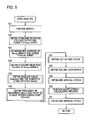
- the controller CP obtains a current time (Step S 1 in Fig. 3 ), to display the obtained current time on display unit 4 (Step S2 in Fig. 3 ).
- the controller CP determines whether an instruction for starting the measurement has been made (Step S3 in Fig. 3 ).
- the instruction is issued, for example, based on a pressing operation by a user of a measurement start button of operation unit 5, or alternatively is automatically issued in a case in which it has reached a certain time.
- the term "measurement” as used here means measuring chronological changes in the body movements of a human subject detected by sensor unit 2.
- sleep evaluation device 1 In a case in which no measurement start instruction has been issued, sleep evaluation device 1 according to the present embodiment basically repeats the above current time acquiring process and the display process thereafter (refer to Step S4: NO in Fig. 3 ). However, in a case in which another current time is set by a user by using operation unit 5 (Step S4: YES in Fig. 3 ) when the repeat process is being executed, a process of displaying the set time (Step S5 in Fig. 3 ) is inserted.
- Step S6 in Fig. 3
- the controller CP executes an AD conversion on a signal scanned through sensor unit 2 (Step S7 in Fig. 3 ), and digital data obtained through the AD conversion process is stored in memory storage device 20 as body movement data (Step S8 in Fig. 3 ).
- a data table T1 as shown as an example in Fig. 4 is configured in memory storage device 20.
- the data table T1 sequentially accepts a write operation of body movement data corresponding to address numbers 1 to 100 of memory storage device 20.
- each body movement piece of data 512, 356, ..., 457, 615, 601, ..., 824 has been written in an address.
- D[0], D[1], ..., D[99] are variable identifiers, and that the number of pieces of data for body movements being 100 is merely an example.
- the controller CP obtains (Step S9 in Fig. 3 ) and displays (Step S10 in Fig. 3 ) a current time in parallel while constructing such a data table T1.
- Step S6 in Fig. 3 in a case in which it is determined that the measurement is finished, i.e., in a case in which the construction of the data table T1 is completed (Step S6: YES in Fig. 3 ), the body movement data in the data table T1 is analyzed (Step S11 in Fig. 3 ). This data analysis process will be described in detail later in the description.
- Step S12 in Fig. 3 the controller CP displays a result of the analysis (Step S12 in Fig. 3 ). It is then determined whether to return to the display process of a current time, and when this determination is affirmative, the controller CP returns to the repeat process (from Step S13: YES to Step S1 in Fig. 3 ). It is to be noted that the determination of Step S 13 can also be understood as, for example, the determination as to whether the results of the analysis are displayed long enough for a user to view it. This determination can be confirmed when the controller CP determines that a certain period has elapsed or when it is so indicated by the user.
- the analyzing unit 30 prepares different types of array variables required for the data analysis according to the present embodiment (Step S21 in Fig. 5 ).
- the different types of array variable are, for example, as shown in Fig. 4 , Stage [ x ], Hensa [ x ], and HenAV[x].
- sqr is a square root (hereinafter the same).
- SS means summing i for an expression in (). (i.e., this corresponds to the Greek capital letter sigma).
- Hensa [0] has a standard deviation of D[0], D[1], ..., D[9], and Hensa [5] has a standard deviation of D[50], D[51], ..., D[59]. Since the total number of body movement data is 100 in the present embodiment, the total of 10 Hensa [ x ]s: Hensa [0], Hensa [1], ..., and Hensa [9] are defined.
- Hensa [ x ] represents, as is understood from the above basis for calculation, or Equation (1), a degree of variation in body movements of a human subject in a certain time period (hereinafter, this will sometimes be referred to as "a unit period").
- the unit period in the present embodiment roughly agrees with a time period in which 10 units of body movement data as raw data are obtained by sensor unit 2, as it is clear from the foregoing.
- the "unit period” agrees with a period conceptualized by one "group” according to the present invention.
- HenAv [ x ] is a type of moving average value of a predetermined number of Hensa [t], Hensa [ t + 1], ..., and Hensa [ t + y] selected with reference to x from the above-described Hensa [0], Hensa [1], ... , and Hensa [9], in which t is one of 0, 1, 2, ... , and 8, and y is (the predetermined number minus 1).
- HenAv x Hensa t , Hensa ⁇ t + 1 , ... , Hensa ⁇ t + y / y + 1
- HenAv [1] has the average value of Hensa [0], Hensa [1], and Hensa [2]. Since the total number of Hensa [ x ] is 10 in the present embodiment, the total of eight HenAv [ x ]s: Hensa [1], Hensa [2], ..., and Hensa [8] are defined. In the present embodiment, however, HenAv [0] and HenAv [9] are additionally set, and ten HenAv [ x ]s are defined in total.
- the calculation process such as described above is the same as the process performed in Step S23 of Fig. 5 .
- each actual value of HenAv [0], HenAv [1], ... , and HenAv [9] will be written in the data table T4.
- the data table T4 corresponds to the address numbers 221 to 230 of the memory storage device 20.
- HenAv [ x ] represents the average value of degrees of variation in body movements of a human subject in a period conceptualized for Hensa [ x - 1], Hensa [ x ], and Hensa [ x + 1], i.e., three unit periods centering around x .
- the "moving average value" according to the present invention includes such a case.
- Stage [ x ] represents whether a human subject is in a sleep state or in an aroused state.
- the x in this case means an "epoch" in the present embodiment. This is the same for x in the above Hensa [ x ].
- one x represents 10 units of body movement data
- one unit i.e., "1 epoch”
- Stage [0] and Stage [9] has a value of "1", meaning that a human subject is in an aroused state in these epochs 0 and 9.
- Stage [1] has a value of "0”, meaning that a human subject is in a sleep state during the epoch 1.
- the settings of values in each Stage [x] will be performed in the processes in the Fig. 8 (an out-of-bed epoch calculation process), Fig. 9 (a rolling-over epoch calculation process), Figs. 11 and 12 (a mid-arousal epoch calculation process), Fig. 15 (a sleep latency calculation process), and Figs. 16 and 17 (a mid-arousal epoch calculation process).
- Stage [ x ] will be described again at a later time in describing these processes.
- SS means summing j for an expression in (). (i.e., it corresponds to the Greek capital letter sigma).
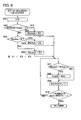
- Analyzing unit 30 obtains a baseline value, Baseline, and the number of stable epochs, Stable (Step S25 in Fig. 5 ). The details of this process are shown in Fig. 6 . The meanings of the baseline value, Baseline, and the number of stable epochs, Stable, will be described later.
- analyzing unit 30 determines "true” or "false” based on the following conditional equation (Step S42 in Fig. 6 ).
- conditional expression expresses that the determination is performed as to whether the absolute value of a difference between two consecutive values (or two consecutive unit periods) of HenAv [ x ] is equal to or less than a predetermined value " A ".
- analyzing unit 30 increments by 1 a value of the variable, " Counter ", and increments a value of the variable, "Baseline”, by a value corresponding to the HenAv [ I ] (Step S43 and S44 in Fig. 6 ).
- analyzing unit 30 proceeds to determine whether the following conditional expression is true or false (Step S45 in Fig. 6 ). ABS ⁇ Hensa I - Hensa ⁇ I + 1 ⁇ B in which B > A.
- analyzing unit 30 increments a value of the variable, Stable , by 1 (Step S46 in Fig. 6 ), but in a case in which it is not satisfied, no changes are made to the values of Counter, Baseline, or Stable.
- HenAv [ x ] expresses the average value of degrees of variations in the body movement of a human subject, during three unit periods centered around x , " HenAv [ I ] - HenAV[ I + 1]" found in Equation (4) corresponds to the difference between the average value of degrees in variation for the periods ( I - 1), I , and ( I + 1) and that for the periods I, ( I + 1), and ( I + 2) (Since HenAv is a moving average value, the unit periods partially overlap with each other).
- the absolute value being equal to or smaller than " A " means that a human subject has maintained a certain degree of stability in a state during the transition from I to ( I + 1).
- the baseline value expresses the average value of selected HenAv [ x ] that corresponds to a case in which a certain degree of stability in a state was maintained.
- Equation (5) when the absolute value shown in Equation (5) is equal to or less than "B (> A )" means that a human subject did not perform a relatively large body movement, such as a rolling over, in the transition from the same period I to ( I + 1) (however, the value to be compared to B is Hensa [ x ]). In this case, the value of the number of stable epochs, Stable , is increased during a period of the transition, so that the fact that no roll-overs occurred is recorded. If a human subject supposedly did not roll over at all during the measurement period, the process in Step S46 in Fig. 6 is inevitably performed, and the value of Stable will be ( I - 1).
- the number of stable epochs indicates the number of periods (this period can be counted based on a unit period as a standard or as a unit) in which there was no relatively large body movement of a human subject.
- analyzing unit 30 obtains an index, Move, showing the frequency of movements and the ratio of stable periods during sleep, Percent , (Step S26 in Fig. 5 ). The details of this process are shown in Fig. 7 .
- the Move is obtained as a value obtained by subtracting the baseline value, Baseline, obtained above from the average value of the Hensa [ x ] (the same as " AveHensa " appearing in the above Equation (3)) and dividing the subtracted result by HenStd (Step S51 in Fig. 7 ). As this value of the Move is greater, the movement of a human subject is more frequent.
- the Percent is 100 times of the number of stable epochs, Stable , divided by the number of arrays of the Hensa [ x ], i.e., 10 (the total number of "unit periods") in the present embodiment (Step S52 in Fig. 7 ).
- analyzing unit 30 obtains an out-of-bed epoch (Step S27 in Fig. 5 ). The details of this process are shown in Fig. 8 .
- analyzing unit 30 determines whether the average value of the Hensa [ x ] (the same as " AveHensa " in the above Equation (3)) falls below a predetermined value C (Step S62 in Fig. 8 ). In a case in which it is determined that it falls below the predetermined value C (Step S62 in Fig. 8 : YES), a predetermined value E1 is assigned to a variable, Bedout (Step S64 in Fig. 8 ).
- Step S62 in Fig. 8 NO
- a predetermined value E2 is assigned to the variable, Bedout (Step S65 in Fig. 8 ).
- a predetermined value E3 is assigned to the variable, Bedout (Step S66 in Fig. 8 ).
- the E1, E2, and E3 satisfy E1 ⁇ E2 ⁇ E3.
- Analyzing unit 30 determines whether a value of Hensa [ I ] falls below the variable, Bedout, that has a value, depending on a result of the above determination, E1, E2, or E3 (Step S67 in Fig. 8 ). In a case in which it falls below the predetermined number, "Wake” is assigned to Stage [ x ] (Step S68 in Fig. 8 ). On the other hand, if this is not the case, no changes are made to a value of Stage [ x ] (refer to Step S67: NO in Fig. 8 ).
- this process is performed until Hensa[9] is reached (refer to Steps S69 and S70 in Fig. 8 ).
- a value of Stage [ x ] described with reference to Fig. 4 is determined for each epoch.
- Fig. 8 as it is understood from the value of "Bedout" in Step S67 having a different value: E1, E2, or E3, the basis is changed for determination as to whether a human subject is in bed or out of bed.
- E1 ⁇ E2 ⁇ E3 is true, and that E1 corresponds to a case in which AveHensa ⁇ C is true, E2 corresponds to a case in which the baseline value, Baseline ⁇ D is true, and E3 corresponds to other cases, E1 to E3 are defined depending on a degree of stability of a human subject during sleep. Since a case in which AveHensa falls below C means a case in which the variation in body movements of a human subject throughout all the periods is relatively small, a smaller basal value E1 should be preferably used to determine whether an "out-of-bed" state has taken place.
- Baseline is the average value of HenAv [ x ]s, the HenAv [ x ]s having been selected assuming, as described above, that Baseline corresponds to a case in which a certain degree of stable state is maintained. Therefore, it can be inferred that this human subject is relatively quiet, at least in a stable period, and thus, a basal value E2 that is greater than E1 is preferably used.
- the other cases are those in which the above two cases are not true, and therefore, a basal value E3 that is greater than the E2 is preferable.
- the determination as to whether an "out-of-bed" state has taken place is based on differences in general characteristics of body movements of a human subject during sleep.
- analyzing unit 30 obtains a rolling over epoch (Step S28 in Fig. 5 ). The details of this process are shown in Fig. 9 .
- analyzing unit 30 determines whether the following conditional expression is true or false (Step S72 in Fig. 9 ). Hensa ⁇ I + 1 > Hensa I + F ⁇ 1
- this period ( I + 1) is determined as an epoch in which a "rolling over” has taken place.
- This event of a "rolling over” can be regarded to be the same as, at this point in time, the human subject being "awake” or "arisen”. This is because brain waves that are observed when a "rolling over” is taking place can be regarded in the same way as those when the human subject is in the aroused state.
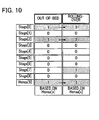
- each Stage [ x ] will have a value as shown as an example in Fig. 10 .
- the exemplary values in this Fig. 10 show that, as a result of the process according to Fig. 8 , an "out-of-bed" takes place in Stage [0], Stage [2], and Stage [9] , and that after the process according to Fig. 9 , a "rolling over” takes place in Stage [7]. (The values of Stage [0], Stage [2], and Stage [9] are retained as they were before the processes according to Figs. 8 and 9 are performed, as indicated by the arrows shown in the figure.)
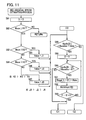
- analyzing unit 30 obtains a mid-arousal epoch (Step S29 in Fig. 5 ). The details of this process are shown in Figs. 11 and 12 .
- analyzing unit 30 determines whether the above obtained index, Move, indicating the frequency of movements (refer to Fig. 5 ) is equal to or greater than H1 (Step S82 in Fig. 11 ). In a case in which it is determined to be false, the routine returns to the main flowchart according to the data analysis process of Fig. 5 . This is because, at this point in time, it is already finally decided that "the human subject was not awake during sleep", i.e., "there was no mid-arousal".
- analyzing unit 30 determines whether Move is equal to or greater than H2 (Step S83 in Fig. 11 ), and in a case in which this is false, it is further determined whether Move is equal to or greater than H3 (Step S84 in Fig. 11 ).
- J1 is assigned to a variable, Value, (Step S85 in Fig. 11 ).
- J2 is assigned to Value (Step S86 in Fig. 11 ).
- J3 is assigned to Value (Step S87 in Fig. 11 ).
- H1, H2 and H3 satisfy H2 > H3 > H1. Furthermore, the above J1, J2 and J3 satisfy J3 > J2 > J1.
- analyzing unit 30 determines whether the following conditional expression is true or false (Step S88 in Fig. 11 ). HenAv I ⁇ 1 ⁇ Baseline + Value
- analyzing unit 30 determines whether HenAv [ I1 - I2 ] ⁇ Baseline + K is true or not (Step S90 in Fig. 11 ) after initializing a variable ( I2 in this case) (Step S89 in Fig. 11 ). In a case in which this is determined to be true, "Wake" is assigned to Stage [ I1 - I2 ] (Step S91 in Fig. 11 ). Then, in Step S92, the value of 12 is incremented by 1.
- This process using 12 is performed repeatedly until the value of 12 reaches the value of I1 as of a point in time at which this process was started (refer to Steps S92 and S93 in Fig. 11 ).
- Step S90 in a case in which HenAv [ I1 - I2 ] ⁇ Baseline + K is determined to be false, analyzing unit 30 determines whether HenAv [ I1 + I2 ] ⁇ Baseline + K is true (Step S95 in Fig. 12 ) after initializing the variable ( I2 in this case), (from Connection symbol "C1" of Figs. 11 and 12 to Step S94 in Fig. 12 ). In a case in which a result of the determination of Step S95 is true, "Wake" is assigned to Stage [ I1 + 12 ] (Step S96 in Fig. 12 ).
- This process using I2 is performed repeatedly until a value obtained by adding I2 and I1 as of a point in time at which this process was started agrees with the total number of HenAv arrays (refer to Steps S97 and S98 in Fig. 12 ).
- a value of Stage [ x ] could be changed; however, in a case in which, in the above Step S88 in Fig. 11 , HenAv [ I1 ] ⁇ Baseline + Value is determined to be false, analyzing unit 30 does not change a value of Stage [ x ] (refer to the flow from Step S88: NO in Fig. 11 , to Connection symbol "C2", and to Step S99 in Fig. 12 ).
- Steps S88 to S98 are performed until HenAv [9] is reached in the present embodiment (refer to Steps S99 and S 100 in Fig. 12 and Connection symbol "C3" in Figs. 12 and 11 ).
- the first half of this process i.e., the process from Steps 82 to S87 in Fig. 11 in which J1 to J3 are set based on H1 to H3 means setting a basal value depending on the frequency of movements of a human subject.
- the basal value is set to the minimum J1 , and otherwise (i.e., H2 > Move ⁇ H3 (> H1 )), the basal value is set to J2 of a medium degree, and in a case in which the movement is minimal (i.e., H3 > Move ⁇ H1 ), the basal value is set to the maximum J3 .
- J1, J2, and J3 serve as bias values as is understood from Equation (9). Specifically, as described above, although the process with respect to I1 is completed if Equation (9) is false, as the movement of a human subject changes from being extremely active, to being moderate, and then to being minimal, the basal value gradually becomes greater, and the basal value indicating whether Stage [ x ] could be changed.
- the second half of the process i.e., the process from Step S88 in Fig. 11 to Step S100 in Fig. 12 , will be performed to obtain a mid-arousal epoch.
- This process can be considered as having two types of processes.
- the first type of process is a process from Steps S89 to S93 in Fig. 11 .
- it is determined whether there was any event of mid-arousal at a point in time that is earlier in time with reference to the period I1 (determination at "a point in time that is earlier in time” means that, in this first type of process, the determination is performed with reference to I1 , i.e., as I1 - 0, I1 - 1, I1 - 2, ). Furthermore, the basis for the determination is "Baseline + K" (refer to Step S90 in Fig. 11 ).
- the second type of process is a process from Steps S94 to S98 in Fig. 12 .
- this process it is determined whether there was any event of mid-arousal at a point in time that is later in time with reference to the period I1 (determination at "a point in time that is later in time" means that, in this second type of process, the determination is performed with reference to I1, i.e., as I1 + 0, I1 + 1, I1 + 2, ).
- the basis for determination used is the same as that used in the first type of process (refer to Step S95 in Fig. 12 ).
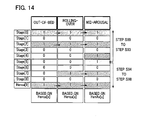
- Fig. 14 shows an example in which, in addition to Stage [5], Stage [4] is determined as a mid-arousal epoch. It is to be noted that the left portion of Fig. 14 is the same as that in Fig. 10 , and the implications of right-pointing arrows in the figure are the same as that which has been described with reference to Fig. 10 .
- a sleep state of a human subject in epoch I1 is evaluated first on the basis of an index, Move, and the baseline value, Baseline (refer to Step S88 in Fig. 12 ), and then based on this evaluation, it is posteriori and cyclopaedically determined whether there was a mid-arousal or not (refer to the above description on the first-type and the second-type processes).
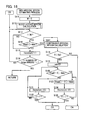
- Mid-arousal epochs are obtained in the manner described above, and analyzing unit 30 then performs a sleep latency calculation process (Step S30 in Fig. 5 ). The details of this process are shown in Fig. 15 .
- analyzing unit 30 obtains a sleep latency epoch (Step S101 in Fig. 15 ).
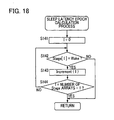
- Fig. 18 The details of this step are shown in Fig. 18 .
- analyzing unit 30 determines whether Stage [ I ] corresponds to "Wake" (Step S142 in Fig. 18 ). If this is negative, the routine returns to the main process of Fig. 15 (from Step S 142 in Fig. 18 : NO, to Step S102 in Fig. 15 ). On the other hand, if the determination is affirmative, I is increased by 1, to repeat the subsequent process (refer to Step S142:YES, Steps S143 and S144 in Fig. 18 ).
- Step S102 if Stage[I + Ka1 ] is not Wake, Ka1 will be simply incremented by 1 (Step S106 in Fig. 15 ). Such a process will be repeated until Ka1 reaches 0 or until Stage [ I + Ka1 ] that agrees with Wake is hit (refer to Step S107 in Fig. 15 ). If Stage [ I + Ka1 ] that agrees with Wake is found, the above-described process will be executed.
- Stage [ I + Ka1 ] Wake at a point in time that is away from I as of sleep latency by an arbitrary set Ka1 , this point in time cannot be determined as an epoch in which a human subject enters a sleep state in a true sense. This is based on an empirical rule or a logical rule that a "rolling over is usually unlikely to take place immediately after "sleep latency" (i.e., an epoch at such a point in time usually will not be " Wake "). Therefore, in such a case, Stage [ I + 1], Stage [ I + 2], ..., and Stage [ I + Ka1 ] will be redetermined as being aroused states.
- analyzing unit 30 obtains a mid-arousal epoch (Step S31 in Fig. 5 ). The details of this process are shown in Figs. 16 and 17 .
- analyzing unit 30 obtains a sleep latency epoch (Step S 112 in Fig. 16 ). In this step, the above-described process shown in Fig. 18 is performed. Therefore, when the process of Fig. 18 is finished, I as of sleep latency will be acquired.
- Analyzing unit 30 subsequently determines whether I as of sleep latency falls below M (Step S 113 in Fig. 16 ). In a case in which it is determined that it falls below M , then it is determined whether Stage [ I ] agrees with " Wake " (Step S114 in Fig. 16 ). In a case in which Stage [ I ] agrees with "Wake", analyzing unit 30 proceeds to a continuous arousal epoch calculation process (from Step S 114: YES, to Step S 117 in Fig. 16 ). On the other hand, in a case in which, in Step S113, I ⁇ M is satisfied, the determination according to Step S 114 will not be performed (Step S113: NO, to Step S 115 in Fig. 16 ).
- the number of repeating process is limited to the total number of Stage [ x ]s (the total number of epochs) (refer to Step S 116 in Fig. 16 ). If this limit is reached, the routine returns to the data analysis process according to the main flowchart of Fig. 5 .
- Fig. 19 The details of the continuous arousal epoch calculation process are shown in Fig. 19 .
- analyzing unit 30 determines whether Stage [ I + X ] corresponds to "Wake” (Step S 152 in Fig. 19 ).
- Stage [ I ] Wake as long as the affirmative determination was given to the above Step S 114 (in other words, at this point in time, I is no longer " I as of sleep latency").
- Analyzing unit 30 determines whether X of the continuous arousal is equal to or greater than Ne (Step S 118 in Fig. 16 ). If this is affirmative, the following process will be performed.
- analyzing unit 30 determines whether Stage [ I - O ] has "Wake” (Step S120 in Fig. 16 ). In a case in which this is affirmative, "Wake” is reassigned to Stage [ I - O ] (Step S123 in Fig. 16 ), O is decremented by 1 (Step S124 in Fig. 16 ). Such a process is repeated until O reaches 1 (refer to the flow from Steps S125 to S123 in Fig. 16 ). As a result, all Stage [x1]s having an array number x1 that is back in time by O since the initial I as of the start of arousal will have a value " Wake ".
- Step S123 if Stage[I - O ] is not Wake, O will be simply decremented by 1 (Step S121 in Fig. 16 ). Such a process will be repeated until O reaches 1 or Stage[I - O ] that agrees with Wake is found (refer to the flow from Steps S122 to S120 in Fig. 16 ). In a case in which Stage[I - O ] that agrees with Wake is found, the above described process will be executed.
- analyzing unit 30 then proceeds to a process of Fig. 17 (refer to Connection symbol "C5" in Figs. 16 and 17 ), an arbitrary value will be again set to variable O (Step S126 in Fig. 17 ).
- Analyzing unit 30 in a case in which it is determined that the sum of I as of the start of arousal, X as of the continuous arousal, and the arbitrarily set O agrees with the total number of epochs, the routine returns to the main flowchart of the data analysis process of Fig. 5 (Step S127: YES in Fig. 17 ). Otherwise, the following process will be performed (Step S127: NO in Fig. 17 ).
- analyzing unit 30 determines whether Stage [ I + X + O ] has " Wake " (Step S128 in Fig. 17 ). In a case in which this is affirmative, " Wake " is reassigned to Stage [ I + X + O ] (Step S 131 in Fig. 17 ), and then O is decremented by 1 (Step S132 in Fig. 17 ). Such a process is repeated until O reaches 1 (refer to Step S 133 to Step S131 in Fig. 17 ).
- Step S1208 if Stage [ I + X + O ] is not Wake, O will simply be decremented by 1 (Step S129 in Fig. 17 ). Such a process is repeated until O reaches 1 or until Stage [ I + X + O ] that agrees with Wake is found (refer to the flow from Steps S130 to S128 in Fig. 17 ). In a case in which Stage [ I + X + O ] that agrees with Wake is found, the above described process will be executed.
- analyzing unit 30 assigns I + X to M (Step S 134 in Fig. 17 ) and then returns to the process of Fig. 16 (refer to Connection symbol "C6" in Figs. 17 and 16 ).
- Step S 118 in Fig. 16 X ⁇ Ne is not satisfied (i.e., X ⁇ Ne )
- the immediately above-mentioned process of assigning I + X to M (Step S 134 in Fig. 17 ) is only performed, and then the routine returns to a process of Fig. 16 (refer to Step S 118: NO in Fig. 16 ⁇ Connection symbol "C4" ⁇ Step S 134 in Fig. 17 ⁇ Connection symbol "C6").
- the process supplements the above process according to Figs. 11 and 12 .
- the continuous arousal X particularly plays a significant role (refer to Step S 118 in Fig. 16 ). Specifically, if this continuous arousal X has a value equal to or greater than a certain value Ne, it is strongly presumable that a human subject was actually in an aroused state in a period around that time.
- Figs. 16 and 17 can be regarded as having two types of processes, similarly to the process according to Figs. 11 and 12 .
- the first type of process is a process from Steps S 119 to S 125 in Fig. 16 .
- it is determined whether there was any arousal at a point in time that is earlier in time with reference to I as of the start of arousal means that, in the first type of process, the determination is performed with reference to I as I - O , I - ( O - 1), I - ( O - 2), .
- the second type of process is a process from Step S126 to S 13 3 in Fig. 16 .
- this process it is determined whether there was any arousal at a point in time that is later in time with reference to [( I as of the start of arousal) + ( X as of the continuous arousal)] (performing determination at "a point in time that is later in time” means, in this second type of process, this determination is performed, with reference to ( I + X ) as I + X + O , I + X + ( O - 1), I + X + ( O - 2), ... ).
- the criteria for determination is the same as that used for the first-type process (refer to Step S128 in Fig. 17 ).
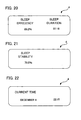
- controller CP displays the results as described earlier (Step S12 in Fig. 3 ), the display example of which will be such as shown in Fig. 20 or Fig. 21.
- Fig. 20 shows an example in which display unit 4 displays a result being "sleep efficiency 89.2%, sleep duration 07:16" (i.e., 7 hours and 16 minutes).
- Fig. 21 shows an example in which display unit 4 displays "sleep stability 76.0%".
- the “sleep efficiency” shows a percentage of 0 from among the values of Stage [ x ] 1, 0, 1, 0, 1, 1, 0, ..., 1, 1 that have been set by performing each process of Figs. 11 and 12 , or Figs. 16 and 17 described above.
- “sleep stability” is a value of " Percent " shown in Fig. 7 .
- Fig. 22 is the details of what is displayed in a normal state so that it can be compared with what are shown in Figs. 20 and 21 . This corresponds to a result of a display process of a current time in Step S2 of Fig. 3 .
- a direct usage process a process in which the baseline value, Baseline
- these other processes indirectly receive benefits of the baseline value, Baseline.
- the Stage[a] could be a new initiation point in the process in Figs. 16 and 17 (for example, refer to Step S 120 or Step S128).
- the baseline value, Baseline itself is set by using a moving average value of HenAv [ x ] (refer to Figs. 4 and 6 and the description thereof), the accuracy of determining a sleep state of a human subject is further enhanced.
Landscapes
- Health & Medical Sciences (AREA)
- Life Sciences & Earth Sciences (AREA)
- Surgery (AREA)
- Biophysics (AREA)
- Pathology (AREA)
- Engineering & Computer Science (AREA)
- Biomedical Technology (AREA)
- Heart & Thoracic Surgery (AREA)
- Medical Informatics (AREA)
- Molecular Biology (AREA)
- Physics & Mathematics (AREA)
- Animal Behavior & Ethology (AREA)
- General Health & Medical Sciences (AREA)
- Public Health (AREA)
- Veterinary Medicine (AREA)
- Physiology (AREA)
- Dentistry (AREA)
- Oral & Maxillofacial Surgery (AREA)
- Measurement Of The Respiration, Hearing Ability, Form, And Blood Characteristics Of Living Organisms (AREA)
- Measuring And Recording Apparatus For Diagnosis (AREA)
Applications Claiming Priority (1)
| Application Number | Priority Date | Filing Date | Title |
|---|---|---|---|
| JP2007338993A JP4680252B2 (ja) | 2007-12-28 | 2007-12-28 | 睡眠評価装置及び睡眠評価方法 |
Publications (2)
| Publication Number | Publication Date |
|---|---|
| EP2074945A1 true EP2074945A1 (de) | 2009-07-01 |
| EP2074945B1 EP2074945B1 (de) | 2010-08-11 |
Family
ID=40469986
Family Applications (1)
| Application Number | Title | Priority Date | Filing Date |
|---|---|---|---|
| EP08021561A Not-in-force EP2074945B1 (de) | 2007-12-28 | 2008-12-11 | Schlafbewertungsvorrichtung und Schlafbewertungsverfahren dafür |
Country Status (5)
| Country | Link |
|---|---|
| US (1) | US8622921B2 (de) |
| EP (1) | EP2074945B1 (de) |
| JP (1) | JP4680252B2 (de) |
| CN (1) | CN101467881B (de) |
| DE (1) | DE602008002133D1 (de) |
Cited By (2)
| Publication number | Priority date | Publication date | Assignee | Title |
|---|---|---|---|---|
| CN103349547A (zh) * | 2013-05-02 | 2013-10-16 | 北京博实联创科技有限公司 | 用于生理参数检测系统的防振动传递装置 |
| EP3766424A4 (de) * | 2018-03-14 | 2021-12-01 | Minebea Mitsumi Inc. | Schlaf/wach-bestimmungssystem |
Families Citing this family (18)
| Publication number | Priority date | Publication date | Assignee | Title |
|---|---|---|---|---|
| US8974394B2 (en) * | 2001-07-30 | 2015-03-10 | Henry Ford Health System | Device and method for detecting irregular placement of an extracorporeal vascular access needle |
| US20110144455A1 (en) * | 2007-08-31 | 2011-06-16 | Bam Labs, Inc. | Systems and methods for monitoring a subject at rest |
| JP5720295B2 (ja) * | 2011-02-22 | 2015-05-20 | オムロンヘルスケア株式会社 | 睡眠評価装置および睡眠評価装置における表示方法 |
| JP5803169B2 (ja) | 2011-03-14 | 2015-11-04 | オムロンヘルスケア株式会社 | 睡眠評価装置および睡眠評価方法 |
| KR101213400B1 (ko) * | 2011-12-05 | 2012-12-21 | 주식회사 세라젬셀루피딕 | 매트리스의 압력조절 방법 및 그 장치 |
| CN103815910B (zh) * | 2013-04-24 | 2015-09-16 | 感至源电子科技(上海)有限公司 | 一种监护系统及床垫、报警系统及其睡眠状态识别方法 |
| JP6107403B2 (ja) * | 2013-05-16 | 2017-04-05 | オムロンヘルスケア株式会社 | 生体情報測定装置およびプログラム |
| KR20150033197A (ko) * | 2013-09-23 | 2015-04-01 | 삼성전자주식회사 | 수면 무호흡증 추정 방법, 상기 방법을 기록한 컴퓨터 판독 가능 저장매체 및 수면 무호흡증 추정 장치 |
| US20160192218A1 (en) * | 2014-07-14 | 2016-06-30 | Under Armour, Inc. | Techniques for classifying sleep sessions |
| CN105434043A (zh) * | 2014-09-01 | 2016-03-30 | 上海宽带技术及应用工程研究中心 | 确定匹兹堡睡眠质量指数的方法及系统 |
| KR101575112B1 (ko) | 2014-10-30 | 2015-12-07 | 순천향대학교 산학협력단 | 키넥트 센서를 이용한 수면 모니터링 시스템 |
| DE102016109524A1 (de) | 2015-12-30 | 2017-07-06 | Dewertokin Gmbh | Schlaf-oder Ruhemöbel und elektromotorischer Möbelantrieb für ein solches Möbel sowie Verfahren zum Bereitstellen eines Informations und/oder Warnsignals durch einen elektromotorischen Möbelantrieb |
| CN105708420A (zh) * | 2016-03-09 | 2016-06-29 | 顾天华 | 一种睡眠情况监测装置及其监测方法 |
| WO2018053461A1 (en) | 2016-09-19 | 2018-03-22 | Henry Ford Health System | System and method of monitoring dislodgement of venous needles in dialysis patients |
| EP3300662B1 (de) * | 2016-09-30 | 2022-08-17 | Nokia Technologies Oy | Bestimmung einer intimen aktivität durch eine detektionsvorrichtung |
| CN106618560B (zh) * | 2016-12-23 | 2021-02-09 | 北京怡和嘉业医疗科技股份有限公司 | 脑电波信号的处理方法和装置 |
| CN108042108B (zh) * | 2017-12-06 | 2020-12-08 | 中国科学院苏州生物医学工程技术研究所 | 一种基于体震信号的睡眠质量监测方法与系统 |
| CN115866485B (zh) * | 2022-11-30 | 2025-10-21 | 北京京东拓先科技有限公司 | 基于睡眠检测的播放控制方法、装置、设备及存储介质 |
Citations (2)
| Publication number | Priority date | Publication date | Assignee | Title |
|---|---|---|---|---|
| JP2000000214A (ja) | 1998-06-15 | 2000-01-07 | Arata Nemoto | 就寝モニタ装置 |
| US20070118054A1 (en) * | 2005-11-01 | 2007-05-24 | Earlysense Ltd. | Methods and systems for monitoring patients for clinical episodes |
Family Cites Families (10)
| Publication number | Priority date | Publication date | Assignee | Title |
|---|---|---|---|---|
| US4306567A (en) * | 1977-12-22 | 1981-12-22 | Krasner Jerome L | Detection and monitoring device |
| FI915228A7 (fi) | 1990-03-09 | 1991-11-06 | Matsushita Electric Industrial Co Ltd | Unenhavaitsemislaite |
| JP3099338B2 (ja) * | 1990-03-09 | 2000-10-16 | 松下電器産業株式会社 | 入眠判定装置および在床判定装置 |
| JP2817358B2 (ja) * | 1990-05-25 | 1998-10-30 | 松下電器産業株式会社 | 入眠判定装置 |
| JP2718302B2 (ja) * | 1991-10-07 | 1998-02-25 | 松下電器産業株式会社 | 睡眠状態判定装置 |
| JP2959376B2 (ja) * | 1994-01-26 | 1999-10-06 | 松下電器産業株式会社 | 監視装置 |
| US8403865B2 (en) * | 2004-02-05 | 2013-03-26 | Earlysense Ltd. | Prediction and monitoring of clinical episodes |
| JP3976752B2 (ja) * | 2004-07-07 | 2007-09-19 | 三洋電機株式会社 | 睡眠状態推定装置及びプログラム |
| JP2006271474A (ja) * | 2005-03-28 | 2006-10-12 | Honda Motor Co Ltd | 睡眠状態推定装置 |
| JP5073371B2 (ja) * | 2007-06-06 | 2012-11-14 | 株式会社タニタ | 睡眠評価装置 |
-
2007
- 2007-12-28 JP JP2007338993A patent/JP4680252B2/ja not_active Expired - Fee Related
-
2008
- 2008-12-09 US US12/330,883 patent/US8622921B2/en not_active Expired - Fee Related
- 2008-12-11 EP EP08021561A patent/EP2074945B1/de not_active Not-in-force
- 2008-12-11 DE DE602008002133T patent/DE602008002133D1/de active Active
- 2008-12-26 CN CN2008101850563A patent/CN101467881B/zh not_active Expired - Fee Related
Patent Citations (2)
| Publication number | Priority date | Publication date | Assignee | Title |
|---|---|---|---|---|
| JP2000000214A (ja) | 1998-06-15 | 2000-01-07 | Arata Nemoto | 就寝モニタ装置 |
| US20070118054A1 (en) * | 2005-11-01 | 2007-05-24 | Earlysense Ltd. | Methods and systems for monitoring patients for clinical episodes |
Cited By (2)
| Publication number | Priority date | Publication date | Assignee | Title |
|---|---|---|---|---|
| CN103349547A (zh) * | 2013-05-02 | 2013-10-16 | 北京博实联创科技有限公司 | 用于生理参数检测系统的防振动传递装置 |
| EP3766424A4 (de) * | 2018-03-14 | 2021-12-01 | Minebea Mitsumi Inc. | Schlaf/wach-bestimmungssystem |
Also Published As
| Publication number | Publication date |
|---|---|
| US20090171165A1 (en) | 2009-07-02 |
| EP2074945B1 (de) | 2010-08-11 |
| JP2009160001A (ja) | 2009-07-23 |
| CN101467881B (zh) | 2010-07-07 |
| US8622921B2 (en) | 2014-01-07 |
| CN101467881A (zh) | 2009-07-01 |
| DE602008002133D1 (de) | 2010-09-23 |
| JP4680252B2 (ja) | 2011-05-11 |
Similar Documents
| Publication | Publication Date | Title |
|---|---|---|
| EP2074945B1 (de) | Schlafbewertungsvorrichtung und Schlafbewertungsverfahren dafür | |
| US10289652B2 (en) | Calibration method for the prospective calibration of measuring equipment | |
| US10750988B2 (en) | Fatigue degree determination device, and fatigue degree determination method | |
| US20060112754A1 (en) | Method and device for correcting acceleration sensor axis information | |
| EP3384839B1 (de) | Vorrichtung zur erzeugung von blutdruckkorrekturinformationen, blutdruckmessvorrichtung, verfahren zur erzeugung von blutdruckkorrekturinformationen und programm zur erzeugung von blutdruckkorrekturinformationen | |
| JP2010094379A (ja) | 睡眠評価装置及び睡眠評価方法 | |
| US20040230398A1 (en) | Sleep analyzer and program product for giving sleep analysis function to computer | |
| CN114340483B (zh) | 一种血压标定选择方法及其建模方法 | |
| US20200008690A1 (en) | Blood pressure data processing apparatus, blood pressure data processing method, and program | |
| JP4059867B2 (ja) | 睡眠分析装置および睡眠分析機能をコンピュータに付与するプログラム | |
| CN102131461A (zh) | 睡眠判断装置以及睡眠判断方法 | |
| CN104586371B (zh) | 一种脉搏波形的判别方法及装置 | |
| Molkkari et al. | Non-linear heart rate variability measures in sleep stage analysis with photoplethysmography | |
| CN106821336A (zh) | 睡眠监测方法及系统 | |
| CN112817378B (zh) | 一种智能手表的抬腕亮屏方法及智能手表 | |
| JP2007000280A (ja) | 覚醒度低下判定装置 | |
| CN117694843A (zh) | 血管连续生理测量的趋势线 | |
| CN113208576A (zh) | Pai值计算方法、装置、设备和存储介质 | |
| Crowe et al. | Cuff-Less Blood Pressure Monitoring in a Cohort of People with Parkinson's Disease | |
| CN116018088A (zh) | 生物体信息运算系统 | |
| JP2006167368A (ja) | 生体情報検出装置 | |
| CN119279571B (zh) | 一种步态特征提取与分析方法及装置 | |
| JP6077239B2 (ja) | 生体情報処理装置、生体情報処理方法、生体情報処理プログラム及び生体情報処理プログラム記録媒体 | |
| CN120071973B (zh) | 一种早期急性心力衰竭患者的心音异常识别方法 | |
| Ying et al. | Dual-Modality Smart Shoes for Health Assessment: A Primary Study in Heart Failure using the 6-Minute Walk Test |
Legal Events
| Date | Code | Title | Description |
|---|---|---|---|
| PUAI | Public reference made under article 153(3) epc to a published international application that has entered the european phase |
Free format text: ORIGINAL CODE: 0009012 |
|
| AK | Designated contracting states |
Kind code of ref document: A1 Designated state(s): AT BE BG CH CY CZ DE DK EE ES FI FR GB GR HR HU IE IS IT LI LT LU LV MC MT NL NO PL PT RO SE SI SK TR |
|
| AX | Request for extension of the european patent |
Extension state: AL BA MK RS |
|
| 17P | Request for examination filed |
Effective date: 20091012 |
|
| GRAP | Despatch of communication of intention to grant a patent |
Free format text: ORIGINAL CODE: EPIDOSNIGR1 |
|
| AKX | Designation fees paid |
Designated state(s): DE FR GB NL SE |
|
| GRAS | Grant fee paid |
Free format text: ORIGINAL CODE: EPIDOSNIGR3 |
|
| GRAA | (expected) grant |
Free format text: ORIGINAL CODE: 0009210 |
|
| AK | Designated contracting states |
Kind code of ref document: B1 Designated state(s): DE FR GB NL SE |
|
| REG | Reference to a national code |
Ref country code: GB Ref legal event code: FG4D |
|
| REF | Corresponds to: |
Ref document number: 602008002133 Country of ref document: DE Date of ref document: 20100923 Kind code of ref document: P |
|
| REG | Reference to a national code |
Ref country code: NL Ref legal event code: T3 |
|
| REG | Reference to a national code |
Ref country code: SE Ref legal event code: TRGR |
|
| PLBE | No opposition filed within time limit |
Free format text: ORIGINAL CODE: 0009261 |
|
| STAA | Information on the status of an ep patent application or granted ep patent |
Free format text: STATUS: NO OPPOSITION FILED WITHIN TIME LIMIT |
|
| 26N | No opposition filed |
Effective date: 20110512 |
|
| REG | Reference to a national code |
Ref country code: DE Ref legal event code: R097 Ref document number: 602008002133 Country of ref document: DE Effective date: 20110512 |
|
| PGFP | Annual fee paid to national office [announced via postgrant information from national office to epo] |
Ref country code: SE Payment date: 20141211 Year of fee payment: 7 |
|
| PGFP | Annual fee paid to national office [announced via postgrant information from national office to epo] |
Ref country code: NL Payment date: 20141108 Year of fee payment: 7 |
|
| REG | Reference to a national code |
Ref country code: FR Ref legal event code: PLFP Year of fee payment: 8 |
|
| PGFP | Annual fee paid to national office [announced via postgrant information from national office to epo] |
Ref country code: DE Payment date: 20151208 Year of fee payment: 8 Ref country code: GB Payment date: 20151209 Year of fee payment: 8 |
|
| PGFP | Annual fee paid to national office [announced via postgrant information from national office to epo] |
Ref country code: FR Payment date: 20151110 Year of fee payment: 8 |
|
| REG | Reference to a national code |
Ref country code: SE Ref legal event code: EUG |
|
| PG25 | Lapsed in a contracting state [announced via postgrant information from national office to epo] |
Ref country code: SE Free format text: LAPSE BECAUSE OF NON-PAYMENT OF DUE FEES Effective date: 20151212 |
|
| REG | Reference to a national code |
Ref country code: NL Ref legal event code: MM Effective date: 20160101 |
|
| PG25 | Lapsed in a contracting state [announced via postgrant information from national office to epo] |
Ref country code: NL Free format text: LAPSE BECAUSE OF NON-PAYMENT OF DUE FEES Effective date: 20160101 |
|
| REG | Reference to a national code |
Ref country code: DE Ref legal event code: R119 Ref document number: 602008002133 Country of ref document: DE |
|
| GBPC | Gb: european patent ceased through non-payment of renewal fee |
Effective date: 20161211 |
|
| REG | Reference to a national code |
Ref country code: FR Ref legal event code: ST Effective date: 20170831 |
|
| PG25 | Lapsed in a contracting state [announced via postgrant information from national office to epo] |
Ref country code: FR Free format text: LAPSE BECAUSE OF NON-PAYMENT OF DUE FEES Effective date: 20170102 |
|
| PG25 | Lapsed in a contracting state [announced via postgrant information from national office to epo] |
Ref country code: GB Free format text: LAPSE BECAUSE OF NON-PAYMENT OF DUE FEES Effective date: 20161211 Ref country code: DE Free format text: LAPSE BECAUSE OF NON-PAYMENT OF DUE FEES Effective date: 20170701 |