EP2075735A1 - Auswahl von Zugangsbedingungen für tragbare Token - Google Patents
Auswahl von Zugangsbedingungen für tragbare Token Download PDFInfo
- Publication number
- EP2075735A1 EP2075735A1 EP07291633A EP07291633A EP2075735A1 EP 2075735 A1 EP2075735 A1 EP 2075735A1 EP 07291633 A EP07291633 A EP 07291633A EP 07291633 A EP07291633 A EP 07291633A EP 2075735 A1 EP2075735 A1 EP 2075735A1
- Authority
- EP
- European Patent Office
- Prior art keywords
- command
- portable token
- access conditions
- token
- portable
- Prior art date
- Legal status (The legal status is an assumption and is not a legal conclusion. Google has not performed a legal analysis and makes no representation as to the accuracy of the status listed.)
- Withdrawn
Links
Images
Classifications
-
- G—PHYSICS
- G06—COMPUTING OR CALCULATING; COUNTING
- G06F—ELECTRIC DIGITAL DATA PROCESSING
- G06F21/00—Security arrangements for protecting computers, components thereof, programs or data against unauthorised activity
- G06F21/70—Protecting specific internal or peripheral components, in which the protection of a component leads to protection of the entire computer
- G06F21/71—Protecting specific internal or peripheral components, in which the protection of a component leads to protection of the entire computer to assure secure computing or processing of information
- G06F21/77—Protecting specific internal or peripheral components, in which the protection of a component leads to protection of the entire computer to assure secure computing or processing of information in smart cards
-
- G—PHYSICS
- G06—COMPUTING OR CALCULATING; COUNTING
- G06F—ELECTRIC DIGITAL DATA PROCESSING
- G06F21/00—Security arrangements for protecting computers, components thereof, programs or data against unauthorised activity
- G06F21/70—Protecting specific internal or peripheral components, in which the protection of a component leads to protection of the entire computer
- G06F21/71—Protecting specific internal or peripheral components, in which the protection of a component leads to protection of the entire computer to assure secure computing or processing of information
- G06F21/74—Protecting specific internal or peripheral components, in which the protection of a component leads to protection of the entire computer to assure secure computing or processing of information operating in dual or compartmented mode, i.e. at least one secure mode
Definitions
- the invention relates to a portable token which commands can be protected by access conditions. It also relates to a system comprising a portable token and a middleware for accessing the portable token, and to a method for selecting the access conditions applicable to a portable token.
- portable tokens are electronic devices which can be easily carried by an individual, and which can receive orders from other entities in the form of commands.
- portable tokens include smart cards, USB keys, MMC or SD cards, etc.
- smart cards have various applications (e.g. bank cards for financial applications, SIM cards for mobile telephony, contact-less cards such as Navigo for public transportation, healthcare cards such as Sesame Vitale, etc.).
- Smart cards can implement a contact interface, a contact-less interface, or both contact and contact-less interfaces. They can also offer different types of interfaces in the same category (e.g. ISO 7816 and USB are both contact interfaces which can be simultaneously supported by a given smart card).
- Certain portable tokens offer security features allowing them to protect access to their commands based on access conditions. An entity willing to read certain private data from such portable token may be denied access if it does not prove its knowledge of a PIN code or of a cryptographic key, while the same entity would be authorized to read public data or to call all sorts of innocuous commands.
- access conditions defining the level of protection of commands giving access to sensitive data or/and services, including cryptographic services such as digital signature is mainly performed via ISO/IEC 7816-4 security architecture (see for example clause 5.4).
- Security attributes are attached for example to data (data comprise files and logical data structures), or to cryptographic objects (including objects nested in files or in logical data structures), and typically comprise access mode bytes and related security conditions.
- Such security attributes are generally nested in a File Control Parameter template (see for example clause 5.3.3).
- Such security attributes are static, in the sense that they are the same whatever the environment from which the portable token receives commands.
- ISO/IEC 7816-4 does not provide any specific means to distinguish between two or more different environments and to define dynamic access conditions wherein a different set of security attributes is used depending on the current environment.
- the term environment encompasses not only the interface through which the communication takes place, but also the entity initiating the communication with the portable token by sending commands.
- two different entities could send commands through the same interface (e.g. a IEEE 1394 firewire interface), or the same entity could send commands alternatively through several interfaces (e.g. a USB interface, an ISO 7816 interface, and a Mifare contact-less interface).
- a USB interface e.g. a USB interface
- ISO 7816 interface e.g. a USB interface
- Mifare contact-less interface e.g. a Mifare contact-less interface
- ISO 24727 specifies certain environments for smart cards and possibly other types of portable tokens.
- An initial step of a transaction in a 24727-environment is the bootstrap mechanism described in ISO/IEC 24727-2 - Identification cards --- Integrated circuit card programming interfaces --- Part 2: Generic Card Interface.
- the ATR (Answer To Reset, standardized in ISO 7816), is the answer of a smart card to a reset signal, and consists in a series of bytes informing the terminal to which the smart card is connected of the characteristics of the smart card.
- GCAL Generic Card Access Layer
- the CCD comprises a set of data objects that deliver information reflecting the smart card capabilities to the middleware.
- Several alternatives are available through the standard (ref. ISO/IEC 24727-2 clause 6.4.2) for determining the value of the CCD.
- the CCD may be obtained from the initial data string as per ISO/IEC 7816-4, by GET DATA based on the CCD, by reading the relevant part of EF.ATR, or by selecting a dedicated alpha card-application hosting the CCD and by then applying a GET DATA to retrieve the CCD.
- the CCD should preferably be available on smart cards in order to fit properly in 24727 environments.
- the CCD typically contains a piece of bytecode called "Procedural Elements” and nested in a data object 'A1' called “Procedure Elements Description Template”. These Procedural Elements are used mainly to translate the generic APDUs from the Service Access Layer into APDUs understandable by the smart card. This translation takes place in the Generic Card Access Layer (GCAL). Procedural Elements are however not mandatory in ISO 24727, and some smart cards may implement the generic set of APDUs employed by the Service Access Layer (SAL ref. ISO/IEC 24727- 3) and consequently do not require Procedural Elements since no translation is in principle necessary.
- SAL ref. ISO/IEC 24727- 3 Service Access Layer
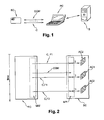
- Figure 1 represents a system comprising a server S, a personal computer PC and a personal token SC
- Figure 2 is a symbolic representation of a series of commands exchanged between a personal computer PC and a personal token SC.
- a portable token SC comprises a capability query mechanism CQM.
- the capability query mechanism CQM is set to inform entities willing to communicate with the portable token SC of at least a subset of the command(s) C available in the portable token SC.
- the command C typically consists of a piece of software accessible through an application programming interface API. It can be one of the commands provided by an operating system installed on the portable token, such as a READ_BINARY APDU command according to ISO 7816-4.
- the capability query mechanism CQM is typically used by entities not knowing the portable token SC in advance, i.e. not knowing exactly which features it has. It may also be used by entities knowing the features, but not knowing the specific version, and therefore not knowing the details of how the commands of the portable token operate.
- the capability query mechanism CQM may return a list of all commands which are supported, or a subset of the commands. For example, it may report only publicly documented commands and discard certain proprietary commands which are not supposed to be used by third parties. Alternatively, the capability query mechanism CQM can simply report an identifier of the portable token type and version, or any other information (serial numbers, etc.) from which the entity (PC, MW) can infer the features of the portable token SC, possibly through a database.
- the portable token SC is arranged to set a flag when the capability query mechanism CQM is invoked, and, when a command C is called, to enforce first access conditions AC1 for the command C if the flag is set, or to enforce second access conditions AC2 for the command C if the flag is cleared.
- the first access conditions AC1 may mandate a PIN code presentation in addition to a challenge response for the command C (e.g. a command for reading sensitive data) when the command C is called with the flag set (which indicates that it comes from an environment not knowing the portable token in advance), while second access conditions AC2 may require a challenge response authentication only, the command C being called with the flag cleared (indicating that it comes from an environment knowing the portable token).
- a flag e.g. a variable containing an indication that the capability query mechanism CQM has been invoked, etc.
- the capability query mechanism CQM is further set to notify said entities of a first format F1 for the command(s) C.
- the flag is set only if a command C is received with said format F1.
- the portable token SC could react to format F3 by applying third access conditions AC3.
- the format F1 for the command may vary from other possible formats simply by one field, which may contain a different value.
- the format may be notified by sending the whole format of the command, e.g.
- the format notification issued by the capability query mechanism consists of pieces of information allowing the entity to convert a "generic" command into a command understandable by the portable token, wherein according to the translation, the translated command reveals to the portable token that it has been translated and not built directly by the entity sending the command to the portable token.
- the translation may be apparent for example if one of the input parameters contains a flag "translation" set to TRUE, or any input value indicating that a translation occurred, for example if the command is an ISO 7816 APDU, the class of the command may be different if the APDU has been translated.
- the indication of the format may also be located in one of the many fields of one of the input parameters (instead of constituting itself an input parameter, which may make it easier to reverse engineer). An environment knowing the portable token SC in advance and calling a command C with the format F1 would nonetheless enjoy second access conditions AC2 if it didn't have to call the capability query mechanism CQM in order to build the command C with format F1.
- the flag has been set, it is possible to leave it set until the end of the session, which results in all subsequent commands being run with first access conditions AC1, irrespective of the format of such subsequent commands.
- This is convenient for systems where a given environment is associated with a whole session of the portable token. For example when buying a train ticket from a train station dedicated ATM with a smart card, the smart card remains in the train station dedicated ATM environment. When it is extracted, it is typically powered down (smart cards are typically powered by the terminal, unless they have a battery, which is still very rare). When powered down, all RAM memory is cleared, including the flag which is preferably in RAM.
- first access conditions AC1 any command, within the same session, which is not sent with the first format F1 would be subject to second access conditions AC2.
- second access conditions AC2 are typically more lax than first access conditions AC1.
- the flag could remain set until a particular event clears it, for example a command received with a certain format, or a special command for clearing the flag.
- first access conditions AC1 are in fact a set of access conditions, since the access conditions may vary from command to command. The same is true for second access conditions AC2.
- each command may be associated with a given access condition (first or second), which is potential different from access conditions (either first or second) applied to another command.
- first access condition for reading the user's certificate may be "PIN code verification”
- second access condition for reading the user's certificate may be "always” (meaning that there is no restriction on this command)
- first access condition may be "never” (meaning that it is impossible to carry out this operation)
- second access condition may be "AES challenge response” (meaning that there must be a cryptographic authentication using the AES algorithm and a key shared between the personal token SC and the middleware MW).
- the first access conditions AC1 can be more stringent than second access conditions AC2. This amounts to raising the bar for environments which do not know the personal token at all. For example, when the portable token SC is connected to a first environment well known to the issuer, implementing a dedicated middleware MW, and that may be considered a priori secure, the portable token enforces second access conditions AC2. But when the portable token is connected to another environment based on another middleware stack or any equivalent intermediate set of software/hardware components capable of recognizing the portable token SC (with the capability query mechanism CQM), wherein this other environment is less trusted, first access conditions AC1 are enforced.
- the portable token is a smart card
- the command C is an ISO 7816-4 compliant command, for example it can be the command SELECT.
- FIG. 2 illustrates a communication between a middleware MW (e.g. piece of software, typically a set of DLLs) installed on a personal computer PC and a smart card SC according to the invention.
- the communication is fictitious, and used only to illustrate the behavior of a smart card SC according to the invention depending on the behavior of the middleware MW.
- the smart card SC comprises an application programming interface API allowing entities such as the middleware MW to communicate with it.
- the middleware MW first sends a command C with a format F1 (top arrow), while no capability query mechanism CQM has been invoked.
- the smart card SC therefore checks whether second access conditions AC2 (illustrated by a wall) have been met before executing the command C.
- the middleware MW queries the smart card SC for its capabilities using the capability query mechanism CQM (second arrow from top).
- the capability query mechanism CQM may consist in a regular smart card command (e.g. APDU), or in series of commands, etc.
- the middleware then sends, within the same session, a command C with the format F1 (third arrow).
- the smart card SC enforces first access conditions AC1 since the conditions for setting the flag have been met. From this time, it is possible either to apply first access conditions AC1 to all subsequent commands within the same session (e.g. until the smart card SC is powered down or reset).
- the smart card may detect that a command C with a second format F2 has been sent (fourth arrow) and decide that the flag should be cleared. Therefore, in such alternative embodiment, second access conditions AC2 are applied again, until the conditions for setting the flag are met again.
- the invention also relate to a system comprising a portable token SC as described above.
- the system comprises a middleware MW, wherein the middleware MW is set either to query the portable token SC for its capabilities, the middleware MW being thereby requested to comply with first access conditions AC1 when calling a command C of the portable token SC, or to call a command C without having previously queried the portable token SC for its capabilities, being thereby requested to comply with second access conditions AC2.
- the middleware MW typically resides on a personal computer PC (e.g. a laptop) from which a user connects to a server S delivering a given service (e.g. online shopping, etc.), as illustrated on Figure 1 .
- the middleware MW may be used for example by the personal computer PC in order to authenticate the user to the server S by using credentials stored in the portable token SC.
- access conditions may also be made dependent on a specific context determined by the middleware stack (for example secure and insecure context) or/and the intermediate software and hardware layers located between an application running on the portable token SC and an electronic service application running on the server S.
- Such system is advantageous because it assists in protecting data and/or services, including cryptographic services operated in the portable token, according to the environment, while no obvious criteria so far allowed identifying the environment from the portable token. While contact versus contact-less environments could be easily differentiable by a portable token, two different middleware stacks relying on the same hardware interface in order to communicate with the portable token are not easy to distinguish, unless a technique according to above described embodiments is implemented.
- the portable token is an ISO 7816 compliant smart card, and the middleware is compliant with ISO 24727.
- the smart card keeps track of the 24727 bootstrap mechanism.
- the smart card raises reversibly a flag called VSR.
- the alpha card application is defined in ISO 24727, as an application which provides application-independent information (as defined in ISO/IEC 7816-4) such as card, file, and card-application management information.
- This VSR flag may be examined by the application currently running in the smart card, informing it that the environment to which the smart card is connected is most likely a 24727-environment. Accordingly, the current card application may define certain access conditions (e.g. unlock or lock some data or services, or apply different security rules).
- the invention also relate to a method for a personal token SC to select the access conditions enforced by the personal token SC when an entity (PC, MW) calls a command C of the portable token SC, wherein
- the flag remain set without need for repeatedly calling the capability query mechanism CQM before each command C (this would typically affect the performance significantly).
- the capability query mechanism QCM in order for the portable token SC to enforce the first access condition AC1 for the command C, is further set to notify the entity (PC, MW) of a first format F1 for the command(s) C.
- the portable token SC enforces the first access condition AC1 only once a command C has been called with the first format F1.
- the personal token SC is a smart card, and the method implements the following steps.
- a smart card SC is inserted in a reader connected to a terminal PC running a 24727-compliant middleware.
- a boostrap mechanism takes place: the middleware applies a procedure to read the CCD out of the smart card.
- the APDU commands that might be sent to the smart card for that purpose are typically as follows:
- the smart card is preferably personalized with a CCD hosting Procedural Elements with a specific instruction confirming that the translation code is being run on GCAL layer and giving a reasonably high level of confidence, when receiving a translated command and analyzing it, that the environment from which the command was sent is actually enabled with 24727 features.
- the Procedural Elements supplied by the smart card are therefore preferably such that the first APDU command delivered by the GCAL contains and indication (for instance a specific data object) denoting that the Procedural Elements were run.
- the APDU command most likely to be the first to be translated by the Procedural Elements is a SELECT command for selecting a card application.
- the smart card application identifiers are typically supplied in the CCD in the data object 'A0' as a sequence of application identifiers of card-applications (ref. ISO/IEC FCD 24727-2 clause 6.1 Table 14).
- the smart card sets the 'VSR' flag if two conditions are fulfilled:
- the smart card upon first selection of an application referenced by its identifier in the CCD, the smart card raises a 'VSR' flag.
- the SELECT APDU command is typically identified as a translated command by conveying in its data field further discretionary information in addition to the AID template. This additional information is up to the issuer, and its very presence in the SELECT APDU command denotes the effective translation procedure. It is possible to implement a 'VSR' flag maintenance mechanism which, while reflecting the smart card middleware environment, does not require the presence of procedural elements. It is for example possible to rely on other structures for the translation rules, such as the CardInfo structure promoted by some German players.
- the smart card issuer typically carries out the personalization of his cards according to standard recommendations and prepares a translation bytecode (Procedural Elements). When doing so, the issuer can implement a discretionary procedure in this translation code in order to stamp the APDU commands of his choice. Therefore, it is not necessary to stamp all APDU commands. Stamping one APDU is sufficient, and it is preferably the first APDU output by the translation code which is stamped.
- the terminal it is not necessarily possible to know which card application will be selected first by the terminal (in case several card applications are present in the smart card), and instead of stamping all SELECT AID commands, to only stamp the first one that is sent by the middleware, on the fly.
- Other alternatives are possible in case the smart card raises the 'VSR' flag upon reception of APDU commands other than SELECT for card applications which identifier is listed in the CCD.
- the first APDU command processed by the translation code is up to the smart card issuer and may be whatever APDU command likely to be submitted to the translation code by the GCAL.
- the current card application checks the flag value to determine whether the bootstrap mechanism took place or not and whether a GCAL is running in the middleware stack.
- the card application adapts a more stringent access condition (e.g. on a set of data in a file belonging to this application). For instance, the card application may require a PIN code to be verified before disclosing the set of data.
- the invention is particularly advantageous in the context of CEN/TS 15480-2 - Identification card systems - European Citizen Card - Part 2: Logical data structures and card services.
- the invention is advantageous by its simplicity, since it avoids having to carry out an authentication of the environment to the portable token, in order for the portable token to figure out that it is engaged in a 24727-compliant environment, and to apply a specific set of access conditions to given data or services, including cryptographic services, while the same data or services are protected by different access conditions in other environment(s).
- Authenticating the environment would typically mean authenticating a terminal to which the portable token is connected, as well as certain software components running on the terminal. Such authentication would be a complex task, since it would typically require distributing cryptographic key material in the terminal.
- the terminal is not necessarily highly trusted, therefore the authentication would not necessarily provide a much higher level of security compared to the invention (which adapts the access conditions to a behavior of the environment, rather than to a cryptographic authentication of the environment).
- data are always readable in a dedicated environment such as dedicated terminals delivering electronic services (such as update of Sesame Vitale healthcare cards by special terminals located in French Sécurotti Sociale premises) and implementing an intermediate set of software/hardware components dedicated to these portable tokens, while the same data must be protected differently in another environment with more stringent rules such as a personal computer of a doctor in which the smart card is inserted, bearing in mind that the doctor's personal computer is not necessarily well protected and could be infested with viruses.
- dedicated terminals delivering electronic services (such as update of Sesame Vitale healthcare cards by special terminals located in French Sécurotti Sociale premises) and implementing an intermediate set of software/hardware components dedicated to these portable tokens, while the same data must be protected differently in another environment with more stringent rules such as a personal computer of a doctor in which the smart card is inserted, bearing in mind that the doctor's personal computer is not necessarily well protected and could be infested with viruses.
- a private set of information read out of the portable token without restriction in a dedicated environment may require preferably a higher protection in an ISO 24727 environment, or some services performed by the portable token may become accessible or be preferably locked in a 24727-environment.
- highly sensitive commands should be adequately protected with stringent access conditions even in a secure environment (and not only in the other environment), since it cannot be excluded that a clever virus would find a way to mimic a secure environment and be granted the lowest access conditions of the two environments (typically second access conditions AC2 rather than first access conditions AC1).
Landscapes
- Engineering & Computer Science (AREA)
- Physics & Mathematics (AREA)
- Computer Hardware Design (AREA)
- Theoretical Computer Science (AREA)
- Mathematical Physics (AREA)
- Computer Security & Cryptography (AREA)
- Software Systems (AREA)
- General Engineering & Computer Science (AREA)
- General Physics & Mathematics (AREA)
- Storage Device Security (AREA)
- Telephone Function (AREA)
- Mobile Radio Communication Systems (AREA)
Priority Applications (5)
| Application Number | Priority Date | Filing Date | Title |
|---|---|---|---|
| EP07291633A EP2075735A1 (de) | 2007-12-27 | 2007-12-27 | Auswahl von Zugangsbedingungen für tragbare Token |
| US12/810,848 US8881255B2 (en) | 2007-12-27 | 2008-12-18 | Selection of access conditions for portable tokens |
| AU2008342657A AU2008342657B2 (en) | 2007-12-27 | 2008-12-18 | Selection of access conditions for portable tokens |
| PCT/EP2008/067866 WO2009083473A1 (en) | 2007-12-27 | 2008-12-18 | Selection of access conditions for portable tokens |
| EP08867436A EP2225694A1 (de) | 2007-12-27 | 2008-12-18 | Auswahl von zugangsbedingungen für tragbare tokens |
Applications Claiming Priority (1)
| Application Number | Priority Date | Filing Date | Title |
|---|---|---|---|
| EP07291633A EP2075735A1 (de) | 2007-12-27 | 2007-12-27 | Auswahl von Zugangsbedingungen für tragbare Token |
Publications (1)
| Publication Number | Publication Date |
|---|---|
| EP2075735A1 true EP2075735A1 (de) | 2009-07-01 |
Family
ID=39684208
Family Applications (2)
| Application Number | Title | Priority Date | Filing Date |
|---|---|---|---|
| EP07291633A Withdrawn EP2075735A1 (de) | 2007-12-27 | 2007-12-27 | Auswahl von Zugangsbedingungen für tragbare Token |
| EP08867436A Withdrawn EP2225694A1 (de) | 2007-12-27 | 2008-12-18 | Auswahl von zugangsbedingungen für tragbare tokens |
Family Applications After (1)
| Application Number | Title | Priority Date | Filing Date |
|---|---|---|---|
| EP08867436A Withdrawn EP2225694A1 (de) | 2007-12-27 | 2008-12-18 | Auswahl von zugangsbedingungen für tragbare tokens |
Country Status (4)
| Country | Link |
|---|---|
| US (1) | US8881255B2 (de) |
| EP (2) | EP2075735A1 (de) |
| AU (1) | AU2008342657B2 (de) |
| WO (1) | WO2009083473A1 (de) |
Cited By (1)
| Publication number | Priority date | Publication date | Assignee | Title |
|---|---|---|---|---|
| CN103916840A (zh) * | 2012-12-30 | 2014-07-09 | 北京握奇数据系统有限公司 | 一种移动设备和外接设备进行绑定和校验的方法 |
Families Citing this family (3)
| Publication number | Priority date | Publication date | Assignee | Title |
|---|---|---|---|---|
| CN105321069A (zh) * | 2014-07-16 | 2016-02-10 | 中兴通讯股份有限公司 | 一种实现远程支付的方法及装置 |
| EP3545646A4 (de) * | 2016-11-29 | 2019-10-23 | Habraken Holdings Llc | Cloud-implementierte auf physischem token beruhende sicherheit |
| US10506426B1 (en) * | 2019-07-19 | 2019-12-10 | Capital One Services, Llc | Techniques for call authentication |
Citations (3)
| Publication number | Priority date | Publication date | Assignee | Title |
|---|---|---|---|---|
| FR2799021A1 (fr) * | 1999-09-27 | 2001-03-30 | Schlumberger Systems & Service | Procede de gestion de commandes dans une carte |
| EP1306764A1 (de) * | 2000-07-31 | 2003-05-02 | Dai Nippon Printing Co., Ltd. | Tragbarer informationsprozessor mit passwortcodeprüffunktion |
| WO2007107829A2 (en) * | 2006-03-17 | 2007-09-27 | Axalto S.A. | A personal security token for at least two security environments and different access conditions thereupon |
Family Cites Families (14)
| Publication number | Priority date | Publication date | Assignee | Title |
|---|---|---|---|---|
| US6438550B1 (en) * | 1998-12-10 | 2002-08-20 | International Business Machines Corporation | Method and apparatus for client authentication and application configuration via smart cards |
| US7111321B1 (en) * | 1999-01-25 | 2006-09-19 | Dell Products L.P. | Portable computer system with hierarchical and token-based security policies |
| US6738901B1 (en) * | 1999-12-15 | 2004-05-18 | 3M Innovative Properties Company | Smart card controlled internet access |
| US20040220791A1 (en) * | 2000-01-03 | 2004-11-04 | Interactual Technologies, Inc. A California Corpor | Personalization services for entities from multiple sources |
| US7023858B2 (en) * | 2000-04-14 | 2006-04-04 | Sony Corporation | Data delivery in set-top box |
| US20030093812A1 (en) * | 2001-11-09 | 2003-05-15 | Sony Corporation | System and method for delivering data to an information appliance using the ISO07816 |
| US20040243580A1 (en) * | 2003-05-27 | 2004-12-02 | Outi Markki | System and method for message handling in a peer-to-peer environment |
| US7716291B2 (en) * | 2004-02-03 | 2010-05-11 | Joel Thorson | Method and apparatus for a message targeting and filtering database system |
| US8078669B2 (en) * | 2004-02-18 | 2011-12-13 | Time Warner Cable Inc. | Media extension apparatus and methods for use in an information network |
| US7912777B2 (en) * | 2004-03-12 | 2011-03-22 | American Express Travel Related Services Company, Inc. | System and method for using cash rebates |
| EP1815309A2 (de) * | 2004-11-19 | 2007-08-08 | Triad Biometrics, LLC | Verfahren und systeme zur verwendung bei der biometrischen authentifizierung und/oder identifizierung |
| WO2007004161A1 (en) * | 2005-06-30 | 2007-01-11 | Koninklijke Philips Electronics, N.V. | Method and system for providing conditional access to data in an mhp or ocap broadcast system |
| US7552467B2 (en) * | 2006-04-24 | 2009-06-23 | Jeffrey Dean Lindsay | Security systems for protecting an asset |
| US20090083147A1 (en) * | 2007-09-21 | 2009-03-26 | Toni Paila | Separation of advertising content and control |
-
2007
- 2007-12-27 EP EP07291633A patent/EP2075735A1/de not_active Withdrawn
-
2008
- 2008-12-18 EP EP08867436A patent/EP2225694A1/de not_active Withdrawn
- 2008-12-18 US US12/810,848 patent/US8881255B2/en not_active Expired - Fee Related
- 2008-12-18 AU AU2008342657A patent/AU2008342657B2/en not_active Ceased
- 2008-12-18 WO PCT/EP2008/067866 patent/WO2009083473A1/en not_active Ceased
Patent Citations (3)
| Publication number | Priority date | Publication date | Assignee | Title |
|---|---|---|---|---|
| FR2799021A1 (fr) * | 1999-09-27 | 2001-03-30 | Schlumberger Systems & Service | Procede de gestion de commandes dans une carte |
| EP1306764A1 (de) * | 2000-07-31 | 2003-05-02 | Dai Nippon Printing Co., Ltd. | Tragbarer informationsprozessor mit passwortcodeprüffunktion |
| WO2007107829A2 (en) * | 2006-03-17 | 2007-09-27 | Axalto S.A. | A personal security token for at least two security environments and different access conditions thereupon |
Non-Patent Citations (1)
| Title |
|---|
| ISO: "7816 part 4: Interindustry command for interchange", INTERNATIONAL STANDARD ISO/IEC, XX, XX, vol. 7816, no. 4, 1 September 1995 (1995-09-01), pages 1 - 73, XP002169265 * |
Cited By (2)
| Publication number | Priority date | Publication date | Assignee | Title |
|---|---|---|---|---|
| CN103916840A (zh) * | 2012-12-30 | 2014-07-09 | 北京握奇数据系统有限公司 | 一种移动设备和外接设备进行绑定和校验的方法 |
| CN103916840B (zh) * | 2012-12-30 | 2018-08-07 | 北京握奇数据系统有限公司 | 一种移动设备和外接设备进行绑定和校验的方法 |
Also Published As
| Publication number | Publication date |
|---|---|
| EP2225694A1 (de) | 2010-09-08 |
| AU2008342657A1 (en) | 2009-07-09 |
| WO2009083473A1 (en) | 2009-07-09 |
| US8881255B2 (en) | 2014-11-04 |
| US20100293191A1 (en) | 2010-11-18 |
| AU2008342657B2 (en) | 2013-09-05 |
Similar Documents
| Publication | Publication Date | Title |
|---|---|---|
| EP2279502B1 (de) | Mobile nfc-kommunikationsvorrichtung und lesegerät | |
| US7503064B2 (en) | Framework for providing a security context and configurable firewall for computing systems | |
| EP2048594A1 (de) | Kommunikationsverfahren, Kommunikationsvorrichtung und sicherer Prozessor | |
| Rankl | Smart Card Applications: Design models for using and programming smart cards | |
| WO2005066802A1 (ja) | データ通信装置及びデータ通信装置のメモリ管理方法 | |
| Hendry | Multi-application smart cards: technology and applications | |
| EP2048591B1 (de) | Kommunikationsverfahren, Kommunikationsvorrichtung und sicherer Prozessor | |
| JP2013065340A (ja) | リトリーブ可能なトークン(例えば、スマートカード)内の独立した実行環境におけるアプリケーション間のセキュリティで保護されたリソース共有 | |
| WO2005076204A1 (en) | Smart card for containing plural issuer security domain and method for installing plural issuer security domain in a smart card | |
| WO2009074173A1 (en) | Interaction between secured and unsecured environments | |
| US11922399B2 (en) | System, method, and computer-accessible medium for blocking malicious EMV transactions | |
| US8881255B2 (en) | Selection of access conditions for portable tokens | |
| CN109753837B (zh) | 一种ic卡的防复制及防篡改方法 | |
| TWI534711B (zh) | 智慧卡及其存取方法 | |
| US20100211488A1 (en) | License enforcement | |
| WO2007107829A2 (en) | A personal security token for at least two security environments and different access conditions thereupon | |
| JP2008527488A (ja) | Pinコードを入力する入力要素をもつカード及びpinコードを入力する方法 | |
| Shepherd et al. | Isolated hardware execution platforms | |
| Corcoran et al. | An open middleware for smart cards | |
| HK40076726A (zh) | 阻止恶意emv交易的系统、方法和计算机可访问介质 | |
| Brinkman | JavaCards As Secure Objects Network | |
| WO2009016541A1 (en) | Mobile communication device and method for recovering mifare memory | |
| KR20060087000A (ko) | 집적회로 카드의 접근 제어 장치 및 이를 이용한 접근제어 방법 |
Legal Events
| Date | Code | Title | Description |
|---|---|---|---|
| PUAI | Public reference made under article 153(3) epc to a published international application that has entered the european phase |
Free format text: ORIGINAL CODE: 0009012 |
|
| AK | Designated contracting states |
Kind code of ref document: A1 Designated state(s): AT BE BG CH CY CZ DE DK EE ES FI FR GB GR HU IE IS IT LI LT LU LV MC MT NL PL PT RO SE SI SK TR |
|
| AX | Request for extension of the european patent |
Extension state: AL BA HR MK RS |
|
| AKX | Designation fees paid | ||
| REG | Reference to a national code |
Ref country code: DE Ref legal event code: 8566 |
|
| STAA | Information on the status of an ep patent application or granted ep patent |
Free format text: STATUS: THE APPLICATION IS DEEMED TO BE WITHDRAWN |
|
| 18D | Application deemed to be withdrawn |
Effective date: 20100105 |