EP2075770A2 - Beschleunigte Ausführung von Transaktionen in einem Selbstbedienungsterminal - Google Patents
Beschleunigte Ausführung von Transaktionen in einem Selbstbedienungsterminal Download PDFInfo
- Publication number
- EP2075770A2 EP2075770A2 EP08169142A EP08169142A EP2075770A2 EP 2075770 A2 EP2075770 A2 EP 2075770A2 EP 08169142 A EP08169142 A EP 08169142A EP 08169142 A EP08169142 A EP 08169142A EP 2075770 A2 EP2075770 A2 EP 2075770A2
- Authority
- EP
- European Patent Office
- Prior art keywords
- media
- amount
- dispenser
- stacked
- dispensing
- Prior art date
- Legal status (The legal status is an assumption and is not a legal conclusion. Google has not performed a legal analysis and makes no representation as to the accuracy of the status listed.)
- Granted
Links
- 238000000034 method Methods 0.000 claims abstract description 42
- 238000004064 recycling Methods 0.000 claims description 14
- 230000007246 mechanism Effects 0.000 description 12
- 230000006870 function Effects 0.000 description 8
- 238000010586 diagram Methods 0.000 description 7
- 230000009977 dual effect Effects 0.000 description 6
- 230000008569 process Effects 0.000 description 6
- 238000010926 purge Methods 0.000 description 6
- 230000009286 beneficial effect Effects 0.000 description 5
- 210000003195 fascia Anatomy 0.000 description 5
- 230000008901 benefit Effects 0.000 description 3
- 238000004590 computer program Methods 0.000 description 3
- 238000001514 detection method Methods 0.000 description 3
- 230000001419 dependent effect Effects 0.000 description 2
- 230000000694 effects Effects 0.000 description 2
- 238000003780 insertion Methods 0.000 description 2
- 230000037431 insertion Effects 0.000 description 2
- XUIMIQQOPSSXEZ-UHFFFAOYSA-N Silicon Chemical compound [Si] XUIMIQQOPSSXEZ-UHFFFAOYSA-N 0.000 description 1
- 230000004075 alteration Effects 0.000 description 1
- 238000007796 conventional method Methods 0.000 description 1
- 238000012423 maintenance Methods 0.000 description 1
- 238000012986 modification Methods 0.000 description 1
- 230000004048 modification Effects 0.000 description 1
- 238000010200 validation analysis Methods 0.000 description 1
Images


Classifications
-
- G—PHYSICS
- G07—CHECKING-DEVICES
- G07F—COIN-FREED OR LIKE APPARATUS
- G07F19/00—Complete banking systems; Coded card-freed arrangements adapted for dispensing or receiving monies or the like and posting such transactions to existing accounts, e.g. automatic teller machines
- G07F19/20—Automatic teller machines [ATMs]
- G07F19/206—Software aspects at ATMs
-
- G—PHYSICS
- G07—CHECKING-DEVICES
- G07F—COIN-FREED OR LIKE APPARATUS
- G07F19/00—Complete banking systems; Coded card-freed arrangements adapted for dispensing or receiving monies or the like and posting such transactions to existing accounts, e.g. automatic teller machines
- G07F19/20—Automatic teller machines [ATMs]
Definitions
- the present invention relates to reducing transaction time in a self-service terminal. It is particularly related to, but in no way limited to, dispensing pre-stacked media in a self-service terminal (SST) such as an automated teller machine (ATM), which may comprise a dual dispenser.
- SST self-service terminal
- ATM automated teller machine
- a self-service terminal such as an ATM
- a self-service terminal such as an ATM
- a fascia which has set into it a keypad, a screen, a card insertion slot and / or identification device and a dispensing slot.
- some ATMs have been developed which include two dispensing units 101, 102, as shown in the schematic diagram shown in figure 1 .
- the fascia 103 of the ATM includes a card insertion slot / identification device 104, a screen 105, which may be touch sensitive and therefore also act as a user input device, and two dispensing slots 106.
- the fascia may include function keys and / or a keypad (not shown in figure 1 ).
- Each of the dispensing units 101, 102 may include a dispenser 107, and one or more media cassettes 108.
- the inclusion of two dispensing units may be used to increase the capacity of the ATM and / or to increase the denominations, currencies or media types dispensed (e.g. where the cassettes 108 in each of the dispensing units contain a different denomination / currency / media type).
- the inclusion of two dispensing units may also be used for redundancy, with the second dispensing unit being used during downtime of the first dispensing unit (e.g. when it is out of order, being serviced, has a fault or has run out of media to dispense).
- One means to increase the throughput is to reduce the overall transaction time and this may also result in increased customer satisfaction.
- One technique which is used to reduce the time taken by a customer to withdraw money is to provide the customer with a number of predefined amounts from which to select the amount they wish to withdraw. If the customer chooses one of these predefined amounts they need only push the button corresponding to the particular amount (or a particular function key or touch area, as appropriate); however to select a different amount they must push a button for 'other' and then enter the required amount using the keypad. By selecting one of the predefined amounts, the transaction time is shorter than when entering a bespoke amount and the overall throughput through the machine is increased.
- the methods involve pre-stacking a defined amount of media, such as a commonly withdrawn amount of money, before the user has performed any service selection.
- a defined amount of media such as a commonly withdrawn amount of money
- the user is given an option to withdraw the defined amount of money and if the user selects this option, the pre-stacked amount is dispensed.
- a second dispenser in the self-service terminal may be used to stack and dispense this different amount.
- a first aspect provides a method of operating a self-service terminal comprising: stacking a defined amount of media; presenting a user of the self-service terminal with a plurality of options, one of the plurality of options corresponding to dispensing the defined amount of media; and on selection of said one of the plurality of options by the user, dispensing the stacked defined amount of media.
- the defined amount of media may be determined according to the user of the self-service terminal and / or according to a history of use of the self-service terminal.
- the method may further comprise: recycling the stacked defined amount of media if said one of the plurality of options is not selected by the user.
- a second of the plurality of options may correspond to dispensing a different amount of media.
- the self-service terminal may comprise a first and a second dispenser, the first dispenser being used for stacking and dispensing the defined amount of media, and the method may further comprise: on selection of said second of the plurality of options by the user, stacking and dispensing the different amount of media using the second dispenser.
- the method may further comprise: alternating the dispenser used for stacking and dispensing the defined amount of media and the dispenser used for stacking and dispensing the different amount of media.
- the method may further comprise: on selection of said second of the plurality of options, stacking additional media onto the defined amount of media to create a stack of the different amount of media; and dispensing the different amount of media.
- the self-service terminal comprises a first and a second dispenser, the first dispenser being used for stacking and dispensing the defined amount of media, wherein the different amount of media comprises a second defined amount of media and wherein the method may further comprise: prior to presenting the user with the plurality of options, stacking the second defined amount of media using the second dispenser; and on selection of said second of the plurality of options by the user, dispensing the second defined amount of media using the second dispenser.
- the step of stacking the defined amount of media may occur prior to presenting the user with a plurality of options during predefined time periods.
- the step of stacking the defined amount of media may occur prior to authentication of the user.
- the method may further comprise: purging the stacked defined amount of media on detection of a physical attack on the self-service terminal.
- the self-service terminal may be an automated teller machine and wherein the media may be money.
- the defined amount of media may comprise a commonly dispensed amount of money.
- a second aspect provides a computer program comprising computer program code means adapted to perform all the steps of any of the methods described above when said program is run on a computer.
- the computer program may be embodied on a tangible computer readable medium.
- a third aspect provides a self-service terminal comprising a dispenser arranged to: stack a defined amount of media prior to service selection by a user; and dispense the stacked amount of media if selected by the user during service selection.
- the self-service terminal may further comprise a second dispenser arranged to dispense an alternative amount of media if selected by the user during service selection.
- the dispenser may be further arranged to: recycle the stacked amount of media if not selected by the user during service selection.
- the defined amount may be determined according to the user of the self-service terminal.
- a fourth aspect provides one or more tangible device-readable media with device-executable instructions for performing steps comprising: stacking a defined amount of media using a first dispenser in a self-service terminal; presenting a user with a plurality of options, one of the plurality of options corresponding to dispensing the defined amount of media; and on selection of said one of the plurality of options by the user, dispensing the stacked defined amount of media using the first dispenser.
- a second of the plurality of options may correspond to dispensing a different amount of media and the one or more tangible device-readable media may further comprise device-executable instructions for performing steps comprising: on selection of said second of the plurality of options by the user, stacking and dispensing the different amount of media using a second dispenser in the self-service terminal.
- Embodiments of the present invention are described below by way of example only. These examples represent the best ways of putting the invention into practice that are currently known to the Applicant although they are not the only ways in which this could be achieved.
- Figure 2 shows a flow diagram of an example method of reducing the transaction time of an ATM which comprises two dispensing units (e.g. as shown in figure 1 and described above) which are referred to as 'dispenser A' and 'dispenser B' for the purposes of the following explanation only.
- the transaction time is reduced by using one of the dispensers (dispenser A) to pre-stack a defined amount (block 201).
- This pre-stacked amount may be fixed by the manufacturer of the ATM or the operator of the ATM or the defined amount may be variable, and various examples are described below.
- the pre-stacking may occur before the customer's card is read (block 202), substantially in parallel with reading the card or after the customer's card has been read.
- the pre-stacking may occur before customer identification, substantially in parallel with user identification or after user identification. Where the pre-stacking occurs after the customer's card has been read or the user has been otherwise identified, the pre-stacking may occur substantially in parallel with the user authentication process (which may include PIN entry).
- the customer is presented with options, including withdrawing the pre-stacked amount (block 203). Other options may include cancelling the transaction, withdrawing an alternative amount, checking an account balance or any other service. If the customer selects to withdraw the pre-stacked amount ('Yes' in block 204), the pre-stacked amount is dispensed by dispenser A (block 205). If however, the customer chooses to withdraw another amount ('No' in block 204), this alternative amount is stacked by dispenser B (block 206) and then dispensed (block 207). The pre-stacked amount may be left in dispenser A.
- figure 2 shows the customer being identified using a card (which is read in block 202), in other examples the customer may be identified in other ways, e.g. using a mobile telephone, fingerprint, etc.
- reading of the customer's card is used by way of example only as one method by which the customer may be identified.
- the transaction time is reduced because the time taken to stack the notes does not form part of the transaction, but instead either occurs before the start of the transaction (i.e. before the customer inserts their card) or in parallel with other transaction processes (e.g. whilst the card is being read or the customer is otherwise being identified or whilst authentication is occurring).
- the stacking process can typically take 7-10 seconds in a total transaction time which may be typically around 20-30 seconds
- the overall transaction time can be reduced by around 30-50% where a pre-stacked amount is withdrawn.
- the pre-stacked amount may be fixed (e.g. the same for all customers or for all ATMs operated by the same bank) or may be variable.
- the value of the pre-stacked amount may determined based on customer history, where this history may be based on all customers, all customers of the particular ATM provider (e.g. the most common amount withdrawn in the last 24 hours from any ATM), all customers of the particular ATM (e.g. the most common amount withdrawn in the last 7 days from the ATM), the particular customer (e.g. the most common amount withdrawn in the last month by the customer) etc. In another example it may be configured by the manufacturer, operator or customer of the ATM. Other variables may also affect the pre-stacked amount, such as the time of day, the day of the week (e.g.
- the value of the pre-stacked amount may be determined by an algorithm running on the ATM or may be determined centrally and communicated to the ATM. Where the value is fixed, this may be programmed in the ATM.
- the maximum value of the pre-stacked amount may be limited (e.g. to £50).
- the pre-stacking (block 201) does not occur until after the customer's card has been read (block 202) or the user has otherwise been identified (e.g. using their mobile phone, fingerprint etc).
- the value of the amount to be pre-stacked may be stored on the card (or other media / device used to identify the customer) or the value may be accessible in a central database based on the customer's identification details (e.g. account number and sort code or card number) or the value may be determined by a Customer Relationship Management system on authentication of the customer and this value provided to the ATM.
- the pre-stacking may occur in parallel to providing the options to the customer (block 203) or in parallel with the authentication process (not shown in figure 2 ).
- Use of a pre-stacked amount which is specific to a particular user's history may increase the likelihood that the pre-stacked amount is actually withdrawn.
- the pre-stacking may occur at any time prior to dispensing (block 205).
- the pre-stacking may occur between transactions (e.g. whilst one customer removes their card and walks away from the ATM and then the next customer walks up to the ATM and inserts their card) or may occur during customer identification (e.g. during the card reading in block 202) and customer authentication (e.g. PIN entry) processes.
- the pre-stacked amount is based on the actual customer using the ATM
- the required pre-stacked amount for the next customer using the ATM may be the same or different.
- the pre-stacked amount for the first customer remains in dispenser A.
- the pre-stacked amount may be purged (i.e. the notes may be placed in the purge or reject bin within the dispenser).
- the pre-stacked amount may remain in dispenser A until is determined that the appropriate pre-stacked amount for the second customer is not the same as that already pre-stacked in dispenser A, and at this point the pre-stacked amount may be purged and the new pre-stacked amount stacked for the second customer.
- one or both of the dispensing units may have recycling capability and such units may be referred to as 'recycling units' or 'recyclers'.
- a recycling unit is capable of returning media to one or more of the media cassettes within the ATM, such that it can be picked, stacked and dispensed in a subsequent transaction. Use of a recycler has the benefit that the number of purged notes is reduced and therefore the purge bin is less likely to become full. Also as the notes can be dispensed, the ATM will not run out of media to dispense as quickly. This mean that the intervals between servicing the ATM (e.g. for replenishment of cassettes and emptying the purge bin) may be increased.
- a recycling unit may also be capable of receiving media from the customer to perform deposits and in this case the recycling unit may also perform validation of the notes deposited before placing them in a media cassette.
- dispenser A has recycling capability, instead of purging the pre-stacked amount (in the situations described above), the pre-stacked amount may be recycled and returned to a media cassette. This is particularly beneficial where the pre-stacked amount is specific for the particular customer using the ATM.
- the time taken to dispense notes using a recycling unit is often considerably longer than using a dispensing unit without recycling capability. As a result, the time saving achieved through pre-stacking may be particularly beneficial when using a recycling unit.
- Figure 3 shows a flow diagram of another example method of reducing the transaction time of an ATM, which is a variation of that shown in figure 2 .
- the pre-stacked amount may be considered as a seed amount.
- the value of the pre-stacked amount may be fixed or variable and may be based on any of the parameters described above. In this example, however, if the customer chooses to withdraw a different amount to that which is pre-stacked ('No' in block 204), it is determined whether the requested amount is greater than the pre-stacked amount (block 301). If the amount that the customer requests to withdraw is less than the pre-stacked amount ('No' in block 301), the requested amount is stacked in dispenser B (block 206) and dispensed (block 207), as described above.
- the additional notes may be added to the pre-stacked amount by dispenser A (block 302) and the resultant requested amount dispensed (block 303).
- the pre-stacked amount may be a single bank note.
- an ATM may only offer to provide pre-stacked amounts, as shown in figure 4 .
- a different amount may be pre-stacked in each dispenser (blocks 201 and 401) and the customer may be offered a choice of the pre-stacked amounts (block 402). Once the customer confirms their choice of pre-stacked amount (block 403), it is dispensed from the appropriate dispenser (block 404). Whilst this provides limited choice for the customer, this may be beneficial for high usage ATMs.
- the pre-stacking functionality described above may be enabled at all times or may be enabled on an ATM only at certain times of the day.
- the pre-stacking functionality may be enabled during peak hours of operation of the ATM but may be disabled at times of low usage (e.g. at night) and / or at times when an ATM is more vulnerable to attack (which may also be at night).
- the pre-stacking functionality may be implemented at times of high demand (which may be pre-defined or determined by the ATM based on interval between transactions) but at times of lower demand the customer may be able to withdraw different amounts of money.
- an ATM may operate as shown in figure 4 during times of high demand (i.e. only pre-stacked amounts can be withdrawn) and as shown in figure 2 at other times.
- the pre-stacking function may be disabled on detection of certain events, such as detection of a physical attack, entering supervisor mode (for maintenance, replenishment etc) or when one of the dispensers goes out of service. At the same time as disabling the pre-stacking function, any pre-stacked notes may be purged / recycled.
- dispenser A is shown to dispense the pre-stacked amount whilst dispenser B dispenses other amounts, this is by way of example only.
- the pre-stacking may be performed alternately by each dispenser (i.e. dispenser A pre-stacks for a first transaction and dispenser B pre-stacks for a second transaction) or the dispenser used for pre-stacking may be selected substantially at random or according to any pattern.
- the choice of dispenser used for pre-stacking may be dependent on the availability of notes within the dispensers in an ATM and by alternating between dispensers, the amount of notes dispensed by each dispenser may be balanced. By varying the dispenser used to pre-stack the money, the security of the ATM against a physical attack may be enhanced.
- the mix of notes within that dispenser can be targeted to the amount which is pre-stacked.
- the mix of notes in the other dispenser may also be targeted to dispensing other amounts. As a result, replenishment may not be required so often.
- money is only dispensed from one of the dispensers in any one transaction.
- money may be dispensed from both dispensers in a single transaction.
- the additional notes dispensed in block 302 may be dispensed using dispenser B (instead of being added to the existing pre-stacked amount by dispenser A) and then both the pre-stacked amount from dispenser A and the additional amount from dispenser B may be dispensed to the customer.
- a customer in a variation of the method shown in figure 4 , a customer may be offered three different amounts which they can withdraw: the pre-stacked amount in dispenser A, the pre-stacked amount in dispenser B or the sum of both pre-stacked amounts. If the customer selects the third of these options (in block 403), then both pre-stacked amounts are dispensed (in block 404).
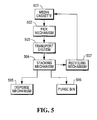
- FIG. 5 shows a schematic diagram of the path traversed by media in an ATM.
- An item of media (such as a bank note) starts in a media cassette 501.
- a pick mechanism 502 removes the media from the cassette 501 and a transport system 503 carries the media to the stacking mechanism 504.
- a bundle of media is dispensed to a customer via a dispense mechanism 505, purged into a purge bin 506, or, if the ATM has the facility, recycled (in recycling mechanism 507) back into a media cassette 501.
- a dual dispenser ATM such as shown in figure 1 , elements 501-506 of figure 5 are duplicated.
- a dual dispenser ATM may have a duplicated recycling mechanism 507, but not all ATMs may have recycling capability 507 or only one of the dispensers may have this capability.
- the pre-stacking functionality described above may also be implemented in an ATM with one dispensing unit or in an ATM with more than two dispensing units.
- An ATM with more than two dispensers may provide more than one pre-stacked amount (e.g. block 401 may be duplicated in figure 4 for each of the additional dispensers).
- an ATM with only one dispenser may function as shown in figure 3 , with an initial amount being pre-stacked (which may in some cases only be one bank note) and the customer being able to choose to withdraw the pre-stacked amount or an amount greater than the pre-stacked amount (e.g. as in figure 3 with blocks 206-207 omitted).
- the pre-stacked amount may be purged / recycled if the amount selected is less than the pre-stacked amount (following a 'No' in block 301) and the requested amount subsequently stacked and dispensed.
- an ATM with only one dispenser may function as shown in figure 4 with only a single amount being pre-stacked (block 201 with block 401 omitted) and offered to a customer (in block 402). Whilst the flexibility for the customer is reduced, it may be beneficial to implement this in high volume ATMs and / or at high volume times.
- the pre-stacking functionality may be used to pre-stack pre-printed train tickets (e.g. an 'out' and a 'return' ticket) to a most common destination (e.g. a London terminus) or to pre-stack pairs of cinema or theatre tickets (which may be most commonly purchased in pairs).
- pre-stack pre-printed train tickets e.g. an 'out' and a 'return' ticket
- a most common destination e.g. a London terminus
- pre-stack pairs of cinema or theatre tickets which may be most commonly purchased in pairs.
- the methods described herein may be performed by software in machine readable form on a tangible storage medium.
- the software can be suitable for execution on a parallel processor or a serial processor such that the method steps may be carried out in any suitable order, or simultaneously.
- HDL hardware description language
- a remote computer may store an example of the process described as software.
- a local or terminal computer may access the remote computer and download a part or all of the software to run the program.
- the local computer may download pieces of the software as needed, or execute some software instructions at the local terminal and some at the remote computer (or computer network).
- a dedicated circuit such as a DSP, programmable logic array, or the like.
Landscapes
- Business, Economics & Management (AREA)
- Accounting & Taxation (AREA)
- Finance (AREA)
- Physics & Mathematics (AREA)
- General Physics & Mathematics (AREA)
- Financial Or Insurance-Related Operations Such As Payment And Settlement (AREA)
Applications Claiming Priority (1)
| Application Number | Priority Date | Filing Date | Title |
|---|---|---|---|
| US12/004,365 US8360309B2 (en) | 2007-12-20 | 2007-12-20 | Reducing transaction time in a self-service terminal |
Publications (3)
| Publication Number | Publication Date |
|---|---|
| EP2075770A2 true EP2075770A2 (de) | 2009-07-01 |
| EP2075770A3 EP2075770A3 (de) | 2010-04-28 |
| EP2075770B1 EP2075770B1 (de) | 2011-04-27 |
Family
ID=40256987
Family Applications (1)
| Application Number | Title | Priority Date | Filing Date |
|---|---|---|---|
| EP08169142A Not-in-force EP2075770B1 (de) | 2007-12-20 | 2008-11-14 | Beschleunigte Ausführung von Transaktionen in einem Selbstbedienungsterminal |
Country Status (5)
| Country | Link |
|---|---|
| US (1) | US8360309B2 (de) |
| EP (1) | EP2075770B1 (de) |
| CN (1) | CN101465025B (de) |
| DE (1) | DE602008006508D1 (de) |
| ES (1) | ES2361790T3 (de) |
Cited By (3)
| Publication number | Priority date | Publication date | Assignee | Title |
|---|---|---|---|---|
| US8413891B2 (en) | 2011-06-02 | 2013-04-09 | Talaris Holdings Limited | System and method for facilitating banking transactions |
| EP2856442A4 (de) * | 2012-06-05 | 2016-02-17 | Redbox Automated Retail Llc | System und verfahren für gleichzeitigen artikelabruf und validierung von transaktionen |
| CN110766858A (zh) * | 2019-10-31 | 2020-02-07 | 浪潮金融信息技术有限公司 | 一种金融自助终端的加钞方法 |
Families Citing this family (4)
| Publication number | Priority date | Publication date | Assignee | Title |
|---|---|---|---|---|
| US8706629B2 (en) * | 2010-05-24 | 2014-04-22 | Bank Of America Corporation | Deposit for entity associated non-account holders |
| US8874482B2 (en) * | 2010-05-24 | 2014-10-28 | Bank Of America Corporation | Deposit permissions for specific non-account holders |
| US20140222660A1 (en) * | 2013-02-04 | 2014-08-07 | John C. Huang | Method for determining a bill mix in an electronic cash dispenser |
| US9971919B1 (en) * | 2017-09-15 | 2018-05-15 | Symbol Technologies, Llc | Systems and method to adaptively optimize RFID-based point-of-sale performance |
Citations (1)
| Publication number | Priority date | Publication date | Assignee | Title |
|---|---|---|---|---|
| US5389773A (en) | 1993-09-29 | 1995-02-14 | Ncr Corporation | Self-service system having transaction predictive capability and method of using |
Family Cites Families (12)
| Publication number | Priority date | Publication date | Assignee | Title |
|---|---|---|---|---|
| US4185646A (en) * | 1977-08-15 | 1980-01-29 | Trw Inc. | Control circuit for multi-denomination cash dispenser |
| US4319132A (en) * | 1979-12-14 | 1982-03-09 | Honeywell Information Systems Inc. | Purge control for automatic note dispenser |
| US6736251B2 (en) * | 1992-09-04 | 2004-05-18 | Coinstar, Inc. | Coin counter and voucher dispensing machine and method |
| JP3318206B2 (ja) * | 1996-07-19 | 2002-08-26 | 株式会社三協精機製作所 | 自動取引装置 |
| US7591414B2 (en) * | 1996-11-15 | 2009-09-22 | Diebold, Incorporated | Automated banking machine |
| EP0967581A3 (de) * | 1998-06-26 | 2004-06-09 | Hitachi, Ltd. | Maschine zur Einnahme und Ausgabe von Geldscheinen |
| US7784680B1 (en) * | 2002-10-31 | 2010-08-31 | Diebold Self-Service Systems, Division Of Diebold, Incorporated | Delayed annunciation of receipt jam for automated banking machine |
| JP2004310653A (ja) * | 2003-04-10 | 2004-11-04 | Hitachi Ltd | 現金自動取引装置およびその運用方法 |
| JP4332379B2 (ja) * | 2003-07-29 | 2009-09-16 | 日立オムロンターミナルソリューションズ株式会社 | 紙幣取扱装置 |
| US7175076B1 (en) * | 2004-07-07 | 2007-02-13 | Diebold Self-Service Systems Division Of Diebold, Incorporated | Cash dispensing automated banking machine user interface system and method |
| US7516881B1 (en) * | 2004-07-07 | 2009-04-14 | Diebold Self-Service Systems Division Of Diebold, Incorporated | Cash dispensing automated banking machine user interface system and method |
| US7843339B2 (en) * | 2007-08-27 | 2010-11-30 | Verifone, Inc. | Secure point of sale device employing capacitive sensors |
-
2007
- 2007-12-20 US US12/004,365 patent/US8360309B2/en active Active
-
2008
- 2008-11-14 ES ES08169142T patent/ES2361790T3/es active Active
- 2008-11-14 EP EP08169142A patent/EP2075770B1/de not_active Not-in-force
- 2008-11-14 DE DE602008006508T patent/DE602008006508D1/de active Active
- 2008-12-19 CN CN2008101863883A patent/CN101465025B/zh not_active Expired - Fee Related
Patent Citations (1)
| Publication number | Priority date | Publication date | Assignee | Title |
|---|---|---|---|---|
| US5389773A (en) | 1993-09-29 | 1995-02-14 | Ncr Corporation | Self-service system having transaction predictive capability and method of using |
Cited By (3)
| Publication number | Priority date | Publication date | Assignee | Title |
|---|---|---|---|---|
| US8413891B2 (en) | 2011-06-02 | 2013-04-09 | Talaris Holdings Limited | System and method for facilitating banking transactions |
| EP2856442A4 (de) * | 2012-06-05 | 2016-02-17 | Redbox Automated Retail Llc | System und verfahren für gleichzeitigen artikelabruf und validierung von transaktionen |
| CN110766858A (zh) * | 2019-10-31 | 2020-02-07 | 浪潮金融信息技术有限公司 | 一种金融自助终端的加钞方法 |
Also Published As
| Publication number | Publication date |
|---|---|
| EP2075770B1 (de) | 2011-04-27 |
| CN101465025B (zh) | 2012-10-03 |
| US20090162184A1 (en) | 2009-06-25 |
| DE602008006508D1 (de) | 2011-06-09 |
| EP2075770A3 (de) | 2010-04-28 |
| ES2361790T3 (es) | 2011-06-22 |
| CN101465025A (zh) | 2009-06-24 |
| US8360309B2 (en) | 2013-01-29 |
Similar Documents
| Publication | Publication Date | Title |
|---|---|---|
| EP2075770B1 (de) | Beschleunigte Ausführung von Transaktionen in einem Selbstbedienungsterminal | |
| US20090260948A1 (en) | Money handling machine | |
| US20190026970A1 (en) | Money management apparatus, money handling system, and money handling method | |
| JP2014093032A (ja) | 貨幣管理システム及び貨幣管理方法 | |
| US6715670B1 (en) | Interactive dispense denomination adjustment | |
| JP6645757B2 (ja) | 貨幣管理装置及び貨幣管理システム | |
| JP2004252941A (ja) | 自動取引装置およびそのプログラム | |
| JP7437852B2 (ja) | 自動取引装置および自動取引装置における現金補充方法 | |
| JP6452976B2 (ja) | 現金処理装置 | |
| JP6369283B2 (ja) | 現金処理装置 | |
| JP7434946B2 (ja) | 情報処理装置 | |
| WO2019130620A1 (ja) | 現金自動機およびその制御方法 | |
| JP5233516B2 (ja) | 現金入出金装置 | |
| JP6750337B2 (ja) | 現金処理装置 | |
| JP7007835B2 (ja) | 電子マネー端末装置、電子マネー管理システム及び電子マネーチャージ方法 | |
| JP6195816B2 (ja) | 自動取引装置および紙幣枚数特定方法 | |
| JP6417789B2 (ja) | 紙葉類入出金装置及び紙葉類入出金方法 | |
| JP2004213289A (ja) | 自動機の紙幣処理装置、及び紙幣処理方法 | |
| JP7501195B2 (ja) | 現金処理システムおよび現金処理装置 | |
| US20250131398A1 (en) | Money processing system and money processing method | |
| JP2013143038A (ja) | 貨幣処理装置及び貨幣処理方法 | |
| JP2001307180A (ja) | 貨幣処理装置および貨幣処理システム | |
| JP7205024B2 (ja) | 釣銭機及び金銭回収方法 | |
| JP2025184477A (ja) | 媒体処理装置および自動取引装置 | |
| JP6776658B2 (ja) | 金銭処理装置 |
Legal Events
| Date | Code | Title | Description |
|---|---|---|---|
| PUAI | Public reference made under article 153(3) epc to a published international application that has entered the european phase |
Free format text: ORIGINAL CODE: 0009012 |
|
| 17P | Request for examination filed |
Effective date: 20081114 |
|
| AK | Designated contracting states |
Kind code of ref document: A2 Designated state(s): AT BE BG CH CY CZ DE DK EE ES FI FR GB GR HR HU IE IS IT LI LT LU LV MC MT NL NO PL PT RO SE SI SK TR |
|
| AX | Request for extension of the european patent |
Extension state: AL BA MK RS |
|
| PUAL | Search report despatched |
Free format text: ORIGINAL CODE: 0009013 |
|
| RAP1 | Party data changed (applicant data changed or rights of an application transferred) |
Owner name: NCR CORPORATION |
|
| AK | Designated contracting states |
Kind code of ref document: A3 Designated state(s): AT BE BG CH CY CZ DE DK EE ES FI FR GB GR HR HU IE IS IT LI LT LU LV MC MT NL NO PL PT RO SE SI SK TR |
|
| AX | Request for extension of the european patent |
Extension state: AL BA MK RS |
|
| 17Q | First examination report despatched |
Effective date: 20100413 |
|
| GRAP | Despatch of communication of intention to grant a patent |
Free format text: ORIGINAL CODE: EPIDOSNIGR1 |
|
| GRAS | Grant fee paid |
Free format text: ORIGINAL CODE: EPIDOSNIGR3 |
|
| AKX | Designation fees paid |
Designated state(s): DE ES FR GB HU IT |
|
| GRAA | (expected) grant |
Free format text: ORIGINAL CODE: 0009210 |
|
| AK | Designated contracting states |
Kind code of ref document: B1 Designated state(s): DE ES FR GB HU IT |
|
| REG | Reference to a national code |
Ref country code: GB Ref legal event code: FG4D |
|
| REG | Reference to a national code |
Ref country code: GB Ref legal event code: 746 Effective date: 20110518 |
|
| REF | Corresponds to: |
Ref document number: 602008006508 Country of ref document: DE Date of ref document: 20110609 Kind code of ref document: P |
|
| REG | Reference to a national code |
Ref country code: DE Ref legal event code: R096 Ref document number: 602008006508 Country of ref document: DE Effective date: 20110609 |
|
| REG | Reference to a national code |
Ref country code: ES Ref legal event code: FG2A Ref document number: 2361790 Country of ref document: ES Kind code of ref document: T3 Effective date: 20110622 |
|
| REG | Reference to a national code |
Ref country code: ES Ref legal event code: GC2A Effective date: 20111212 |
|
| PLBE | No opposition filed within time limit |
Free format text: ORIGINAL CODE: 0009261 |
|
| STAA | Information on the status of an ep patent application or granted ep patent |
Free format text: STATUS: NO OPPOSITION FILED WITHIN TIME LIMIT |
|
| 26N | No opposition filed |
Effective date: 20120130 |
|
| REG | Reference to a national code |
Ref country code: DE Ref legal event code: R097 Ref document number: 602008006508 Country of ref document: DE Effective date: 20120130 |
|
| REG | Reference to a national code |
Ref country code: DE Ref legal event code: R084 Ref document number: 602008006508 Country of ref document: DE Effective date: 20120411 Ref country code: DE Ref legal event code: R084 Ref document number: 602008006508 Country of ref document: DE Effective date: 20110420 |
|
| PG25 | Lapsed in a contracting state [announced via postgrant information from national office to epo] |
Ref country code: HU Free format text: LAPSE BECAUSE OF FAILURE TO SUBMIT A TRANSLATION OF THE DESCRIPTION OR TO PAY THE FEE WITHIN THE PRESCRIBED TIME-LIMIT Effective date: 20110427 |
|
| REG | Reference to a national code |
Ref country code: FR Ref legal event code: PLFP Year of fee payment: 8 |
|
| REG | Reference to a national code |
Ref country code: FR Ref legal event code: PLFP Year of fee payment: 9 |
|
| REG | Reference to a national code |
Ref country code: FR Ref legal event code: PLFP Year of fee payment: 10 |
|
| PGFP | Annual fee paid to national office [announced via postgrant information from national office to epo] |
Ref country code: DE Payment date: 20181128 Year of fee payment: 11 |
|
| PGFP | Annual fee paid to national office [announced via postgrant information from national office to epo] |
Ref country code: GB Payment date: 20181127 Year of fee payment: 11 Ref country code: FR Payment date: 20181127 Year of fee payment: 11 Ref country code: IT Payment date: 20181123 Year of fee payment: 11 Ref country code: ES Payment date: 20181203 Year of fee payment: 11 |
|
| REG | Reference to a national code |
Ref country code: DE Ref legal event code: R082 Ref document number: 602008006508 Country of ref document: DE Representative=s name: V. BEZOLD & PARTNER PATENTANWAELTE - PARTG MBB, DE Ref country code: DE Ref legal event code: R081 Ref document number: 602008006508 Country of ref document: DE Owner name: NCR CORPORATION, ATLANTA, US Free format text: FORMER OWNER: NCR CORP., DULUTH, GA., US |
|
| REG | Reference to a national code |
Ref country code: DE Ref legal event code: R119 Ref document number: 602008006508 Country of ref document: DE |
|
| GBPC | Gb: european patent ceased through non-payment of renewal fee |
Effective date: 20191114 |
|
| PG25 | Lapsed in a contracting state [announced via postgrant information from national office to epo] |
Ref country code: DE Free format text: LAPSE BECAUSE OF NON-PAYMENT OF DUE FEES Effective date: 20200603 Ref country code: GB Free format text: LAPSE BECAUSE OF NON-PAYMENT OF DUE FEES Effective date: 20191114 Ref country code: IT Free format text: LAPSE BECAUSE OF NON-PAYMENT OF DUE FEES Effective date: 20191114 Ref country code: FR Free format text: LAPSE BECAUSE OF NON-PAYMENT OF DUE FEES Effective date: 20191130 |
|
| REG | Reference to a national code |
Ref country code: ES Ref legal event code: FD2A Effective date: 20210531 |
|
| PG25 | Lapsed in a contracting state [announced via postgrant information from national office to epo] |
Ref country code: ES Free format text: LAPSE BECAUSE OF NON-PAYMENT OF DUE FEES Effective date: 20191115 |