EP2076041A1 - Verfahren zur Übertragung eines unkomprimierten Echtzeitvideostreams in einem Netzwerk von Teilnehmerstationen - Google Patents
Verfahren zur Übertragung eines unkomprimierten Echtzeitvideostreams in einem Netzwerk von Teilnehmerstationen Download PDFInfo
- Publication number
- EP2076041A1 EP2076041A1 EP07301737A EP07301737A EP2076041A1 EP 2076041 A1 EP2076041 A1 EP 2076041A1 EP 07301737 A EP07301737 A EP 07301737A EP 07301737 A EP07301737 A EP 07301737A EP 2076041 A1 EP2076041 A1 EP 2076041A1
- Authority
- EP
- European Patent Office
- Prior art keywords
- video
- frame
- sub
- payload
- vsf
- Prior art date
- Legal status (The legal status is an assumption and is not a legal conclusion. Google has not performed a legal analysis and makes no representation as to the accuracy of the status listed.)
- Withdrawn
Links
Images


Classifications
-
- H—ELECTRICITY
- H04—ELECTRIC COMMUNICATION TECHNIQUE
- H04N—PICTORIAL COMMUNICATION, e.g. TELEVISION
- H04N21/00—Selective content distribution, e.g. interactive television or video on demand [VOD]
- H04N21/60—Network structure or processes for video distribution between server and client or between remote clients; Control signalling between clients, server and network components; Transmission of management data between server and client, e.g. sending from server to client commands for recording incoming content stream; Communication details between server and client
- H04N21/63—Control signaling related to video distribution between client, server and network components; Network processes for video distribution between server and clients or between remote clients, e.g. transmitting basic layer and enhancement layers over different transmission paths, setting up a peer-to-peer communication via Internet between remote STB's; Communication protocols; Addressing
- H04N21/643—Communication protocols
- H04N21/6437—Real-time Transport Protocol [RTP]
-
- H—ELECTRICITY
- H04—ELECTRIC COMMUNICATION TECHNIQUE
- H04N—PICTORIAL COMMUNICATION, e.g. TELEVISION
- H04N21/00—Selective content distribution, e.g. interactive television or video on demand [VOD]
- H04N21/20—Servers specifically adapted for the distribution of content, e.g. VOD servers; Operations thereof
- H04N21/23—Processing of content or additional data; Elementary server operations; Server middleware
- H04N21/238—Interfacing the downstream path of the transmission network, e.g. adapting the transmission rate of a video stream to network bandwidth; Processing of multiplex streams
- H04N21/2389—Multiplex stream processing, e.g. multiplex stream encrypting
-
- H—ELECTRICITY
- H04—ELECTRIC COMMUNICATION TECHNIQUE
- H04N—PICTORIAL COMMUNICATION, e.g. TELEVISION
- H04N21/00—Selective content distribution, e.g. interactive television or video on demand [VOD]
- H04N21/40—Client devices specifically adapted for the reception of or interaction with content, e.g. set-top-box [STB]; Operations thereof
- H04N21/43—Processing of content or additional data, e.g. demultiplexing additional data from a digital video stream; Elementary client operations, e.g. monitoring of home network or synchronising decoder's clock; Client middleware
- H04N21/434—Disassembling of a multiplex stream, e.g. demultiplexing audio and video streams, extraction of additional data from a video stream; Remultiplexing of multiplex streams; Extraction or processing of SI; Disassembling of packetised elementary stream
-
- H—ELECTRICITY
- H04—ELECTRIC COMMUNICATION TECHNIQUE
- H04N—PICTORIAL COMMUNICATION, e.g. TELEVISION
- H04N21/00—Selective content distribution, e.g. interactive television or video on demand [VOD]
- H04N21/40—Client devices specifically adapted for the reception of or interaction with content, e.g. set-top-box [STB]; Operations thereof
- H04N21/43—Processing of content or additional data, e.g. demultiplexing additional data from a digital video stream; Elementary client operations, e.g. monitoring of home network or synchronising decoder's clock; Client middleware
- H04N21/442—Monitoring of processes or resources, e.g. detecting the failure of a recording device, monitoring the downstream bandwidth, the number of times a movie has been viewed, the storage space available from the internal hard disk
- H04N21/4425—Monitoring of client processing errors or hardware failure
-
- H—ELECTRICITY
- H04—ELECTRIC COMMUNICATION TECHNIQUE
- H04N—PICTORIAL COMMUNICATION, e.g. TELEVISION
- H04N7/00—Television systems
- H04N7/24—Systems for the transmission of television signals using pulse code modulation
- H04N7/52—Systems for transmission of a pulse code modulated video signal with one or more other pulse code modulated signals, e.g. an audio signal or a synchronizing signal
- H04N7/54—Systems for transmission of a pulse code modulated video signal with one or more other pulse code modulated signals, e.g. an audio signal or a synchronizing signal the signals being synchronous
Definitions
- the invention concerns a method of transferring a real-time stream, in particular an uncompressed video stream, in a network of subscriber stations. Furthermore, the invention also relates to a source device for transferring a real-time stream as well as a destination device. Both are to be used in a method as mentioned above.
- the network technology should be ready to deal with much higher bandwidth demands. Therefore, in one scenario the studios rely on the already existing 10Gbit Ethernet network technology. This network technology is based on two optical fibres one for each direction. The wavelength of the light transporting the data is between 1269 and 1356 nm.
- IP IPv4 Internet Protocol version 4.
- UDP stands for the well known User Data Protocol
- RTP stands for the Real-time Transport Protocol. This protocol stack consists of unsecured protocol layers. All the services from the TCP protocol like acknowledging receipt of data packets and repeating of lost data packets are not implemented in the UDP/RTP protocols and in worst case the limited bandwidth would not be sufficient for it.
- the RTP protocol layer provides sequence numbering and time stamping. But RTP doesn't provide any form of reliability or a protocol-defined flow/congestion control. It doesn't enforce any error treatment measures, such as any mechanisms for recovering for packet loss. Application itself should decide about how to cope with a lost data unit.
- RTP payload format for uncompressed video is defined in RFC4175. It supports a range of standard and high-definition video formats. For real-time transmission of uncompressed video, retransmission of lost packet is impossible, because it will cause network traffic congestions. In RFC4175, there is no method for coping with the problem of lost data.
- a known solution to overcome the congestion problem is to split all original video frames into sub-frames before sending on the network under a single packet payload: for example each sub-frame contains two contiguous lines of the video frame.
- the video frame is recomposed only when all sub-frames are received.
- An advantage of this known method is, when a packet containing a sub-frame is not received (e.g. the packet is lost), only a part of the whole frame misses. A retransmission of the lost packet is sufficient to recompose the exact original video frame.
- One of the goals of the present invention is to propose a method for decomposing and recomposing uncompressed video frame and transporting them by RTP. This method can handle with packet loss during transport.
- the technical problem that present invention intends to solve is to transport a video frame on RTP packet format able to cope with eventual packet loss.
- the present invention concerns, according to a first aspect, a method for transferring a real-time uncompressed video stream between a source device S_DEV 10 and a destination device D_DEV 100 connected through a network, wherein the real time transport protocol is used, the video stream being composed by sequence of video frame VF k , where k is a Video Frame index.
- the method comprises steps of:
- the present invention concerns, according to a second aspect, a source device S_DEV, 10 for sending a real-time uncompressed video stream, comprising an implementation of the Real Time Protocol for packet zing the video stream.
- the video stream is composed by sequence of video frames VF k , where k is a video frame index.
- the source device S_DEV, 10 includes:
- the present invention concerns, according to a third aspect, a destination device D_DEV 100 for receiving a real-time uncompressed video stream, the video stream being composed by sequence of video frames VF k , where k is a Video Frame index.
- the destination device for receiving a real-time uncompressed video stream includes:
- reference number 10 denotes a source device S_DEV.
- the source device S_DEV 10 is connected to a destination device D_DEV 50 via a network 15.
- the source device S_DEV transfers a real-time uncompressed video stream to the destination device D_DEV 50 wherein the real time transport protocol is used.
- the real-time uncompressed video stream is composed by sequence of video frame VF k , where k is a Video Frame index which identifies a Video Frame in a unique way.
- the source device S_DEV 10 comprises means FDEC 20 for decomposing video frames VF k into a number N 2 of corresponding video sub-frames VSF k,p,q , where N is an integer and p and q are indexes for identifying video sub-frames. p and q are both comprised between 1 and N.
- N is either predetermined, with a fixed value either it is determined by an external device in function of size of video frames or in function of transfer reliability considerations.
- pixels composing the video sub-frame VSF k,p,q are pixels extracted from the video frame VF k and which are not contiguous in the video frame VF k .
- the destination device D_DEV 50 also comprises means SENC 30 for arranging video sub-frame VSF k,p,q in payload of RTP packets.
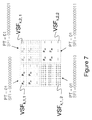
- a video sub-frame VSF k,p,q can be either transmitted in one RTP packet payload either sliced in parts as multiple lines which are transmitted in different RTP packets. For example, two contiguous lines of the video sub-frame VSF k,p,q are arranged in each RTP packet payload, as shown in Figure 6 .
- the source device S_DEV 10 further comprises:
- the second header field of the RTP packet whose payload contains a part of the video sub-frames VSF k,p,q is a representation of k.
- the third header field of the RTP packet whose payload contains a part of the video sub-frames VSF k,p,q is a binary representation of N.(p-1)+q-1 decimal value.
- the RTP packet header is compatible with RFC4175 protocol.
- Fig. 2a and 2b show an illustration of the decomposition step applied by means FDEC 20 for decomposing video frames, for an example where N is equal to 2.
- a video frame VF k is composed of n.m pixels P k,i,j arranged in n columns and m line. i is a column index comprised between 1 and n, j is a line index comprised between 1 and m.
- N is less than the lowest value between m and n.
- the means FDEC 20 for decomposing video frames creates from the video frames VF k four video sub-frame VSF k,p,q where p and q are both comprised between 1 and 2.
- floor(x) represents well-known floor function that returns the highest integer less than or equal to x.
- SP k,p,q,ii,jj is equal to P k,(ii-1).N+(p-1),(jj-1).N+(jj-1) for the indexes ii and jj comprised respectively between 1 and NCVSF k,p,q and 1 and NLVSF k,p,q .
- Fig. 3 represents a block diagram of a destination device D_DEV 50 for receiving a real-time uncompressed video stream according to the invention.
- the destination device D_DEV 100 comprises:
- means RDNC 130 for receiving RTP packets includes :
- Fig. 4 represents a flow chart of the method of reception applied by the destination device D_DEV 50.
- the method of reception includes three main steps:
- the first step 210 of receiving RTP packets further includes a step of reading a first header field of RTP packets containing the Payload Type which is indicative of the number of video sub-frames VSF k,p,q .
- the first step 210 of receiving RTP packets further includes a step of reading a second field header containing the Video Frame Index which represents the video frame VF k from which a part of the video sub-frame VSF k,p,q contained in the RTP packet payload is decomposed.
- the second header field of the RTP packet whose payload contains a part of the video sub-frames VSF k,p,q is a representation of k.
- the first step 210 of receiving RTP packets further includes a step of reading a third header field of the RTP packet containing the Sub-Frame Index which corresponds to the RTP packet payload.
- the third header field of the RTP packet whose payload contains a part of the video sub-frames VSF k,p,q is a binary representation of N. (p-1)+q-1 decimal value.
- the second step 220 of detecting packet loss deals with, for example, a check of the number of the received parts of video sub-frames VSF k,p,q transmitted under RTP packet payloads. It is for example a counting operation of receiving packets including a same Video Frame Index.
- the third step 230, 240 of recomposing transferred video frames includes an alternative depending whether a packet loss is detected or not :
- the means for recomposing recomposes a transferred video frames V k which is identical to VF k .
- the means for recomposing recomposes a transferred video frames V k from payload of received packets, where payload of lost packet is replaced by interpolations of payloads of received packets.
- the third step 240 consists in replacing the missing pixels by values which are interpolated from received packet payload.
- Fig. 5 shows the format of an RFC4175 packet.
- Two entries are marked with a dedicated reference number.
- One is the sequence number in a corresponding 16 bits field and the other is a time stamp in a 32 bits field.
- the sequence number increments by 1 for each RTP data packet sent, and may be used by the receiver to detect packet losses and to restore the packet sequence.
- the initial value of the sequence number should be random (unpredictable) to make known plaintext-attacks on encryption more difficult, even if the source itself does not use encryption, because the packets may flow through a translator that does.
- the time stamp reflects the sampling instant of the first octet in the RTP data packet.
- the sample instant is derived from a clock that increments monotonically and linearly in time to allow synchronization in jitter calculations. If RTP packets are generated periodically, the nominal sampling instant as determined by the sampling clock is to be used, not a reading of the system clock.
- the time stamp field need not necessarily be transported over the network to the destination device, because this information can be derived from the internal clock of the destination device by itself, if the frame rate is known, which is usually the case, and lost packets are detected. The sequence number already provides for recognizing lost packets and, therefore, this condition is fulfilled.
- the payload contains for example two lines of a video frame VF k.
- An Identification Field F is defined as one single bit length.
- Fig. 6 shows an implementation of protocol stacks in sending and destination device for the purpose of transferring uncompressed video data streams over the network according to the invention.
- the Payload Type field (PT) is also utilized to indicate if the payload data contains decomposed video stream.
- Payload type is a 7 bits field which may designates the payload nature of the transmitted data as decomposed video stream.
- Payload Type For example a way of coding a Payload Type could be realized by assigning some bits to indicate the decomposed sub-frames:
- a Sub-Frame Index (SFI) field must be inserted in the payload header of each RTP packet to identify each video sub-frame VSF k,p,q .
- This field has a length which corresponds to the Payload Type.
- Maximum Sub-Frame Index SFI length is 14 bits, it corresponds to the PT field equal to '1111111'.
- the number N is equal to 2: that means an original video frame VFk is split in four sub-frames.
- Payload Type field is equal to '0000001', only the two last significant bits of the field are used.
- SFI is equal to '00000000000000', '00000000000001', '00000000000010', '00000000000011', respectively for sub-frames VSF k,1,1 , VSF k,2,1 , VSF k,1,2 , VSFk,2,2.
- the "R" field in Figure 6 is a 2 bit reserved field.
- the “lines of video data” cited in the payload of the Fig.6 is not restricted to be exactly a physical line of video frame or of video sub-frame.
- Video line in the payload can be any possible scan line of video frame or sub-frame in the network transfer byte order, which depend on the transfer protocol.
- Destination device D_DEV 50 may parse each line data through the "Length” and "Offset" value from the payload header structure.
- a RTP packet may contain some scan line data of sub-frame, or whole sub-frame if the sub-frame is small enough, or line data from different sub-frames.
Landscapes
- Engineering & Computer Science (AREA)
- Multimedia (AREA)
- Signal Processing (AREA)
- Computer Networks & Wireless Communication (AREA)
- Databases & Information Systems (AREA)
- Data Exchanges In Wide-Area Networks (AREA)
Priority Applications (2)
| Application Number | Priority Date | Filing Date | Title |
|---|---|---|---|
| EP07301737A EP2076041A1 (de) | 2007-12-21 | 2007-12-21 | Verfahren zur Übertragung eines unkomprimierten Echtzeitvideostreams in einem Netzwerk von Teilnehmerstationen |
| PCT/EP2008/067250 WO2009080530A1 (en) | 2007-12-21 | 2008-12-10 | Method for transferring a real-time uncompressed video stream in a network of subscriber stations |
Applications Claiming Priority (1)
| Application Number | Priority Date | Filing Date | Title |
|---|---|---|---|
| EP07301737A EP2076041A1 (de) | 2007-12-21 | 2007-12-21 | Verfahren zur Übertragung eines unkomprimierten Echtzeitvideostreams in einem Netzwerk von Teilnehmerstationen |
Publications (1)
| Publication Number | Publication Date |
|---|---|
| EP2076041A1 true EP2076041A1 (de) | 2009-07-01 |
Family
ID=39362545
Family Applications (1)
| Application Number | Title | Priority Date | Filing Date |
|---|---|---|---|
| EP07301737A Withdrawn EP2076041A1 (de) | 2007-12-21 | 2007-12-21 | Verfahren zur Übertragung eines unkomprimierten Echtzeitvideostreams in einem Netzwerk von Teilnehmerstationen |
Country Status (2)
| Country | Link |
|---|---|
| EP (1) | EP2076041A1 (de) |
| WO (1) | WO2009080530A1 (de) |
Cited By (2)
| Publication number | Priority date | Publication date | Assignee | Title |
|---|---|---|---|---|
| WO2012040485A1 (en) * | 2010-09-22 | 2012-03-29 | Qualcomm Incorporated | Mac data service enhancements |
| CN113169977A (zh) * | 2018-12-06 | 2021-07-23 | 交互数字Ce专利控股公司 | 网络装备和用于递送数据分组的方法 |
Citations (1)
| Publication number | Priority date | Publication date | Assignee | Title |
|---|---|---|---|---|
| EP0833517A2 (de) * | 1996-09-25 | 1998-04-01 | AT&T Corp. | Feste oder adpative unverschachtelte Transformationskodierung für Bild- und Intravideokodierung |
-
2007
- 2007-12-21 EP EP07301737A patent/EP2076041A1/de not_active Withdrawn
-
2008
- 2008-12-10 WO PCT/EP2008/067250 patent/WO2009080530A1/en not_active Ceased
Patent Citations (1)
| Publication number | Priority date | Publication date | Assignee | Title |
|---|---|---|---|---|
| EP0833517A2 (de) * | 1996-09-25 | 1998-04-01 | AT&T Corp. | Feste oder adpative unverschachtelte Transformationskodierung für Bild- und Intravideokodierung |
Non-Patent Citations (3)
| Title |
|---|
| GHARAI USC/ISI C PERKINS UNIVERSITY OF GLASGOW L: "RTP Payload Format for Uncompressed Video; rfc4175.txt", IETF STANDARD, INTERNET ENGINEERING TASK FORCE, IETF, CH, 1 September 2005 (2005-09-01), XP015041834, ISSN: 0000-0003 * |
| JU YONG PARK ET AL: "A SIMPLE CONCEALMENT FOR ATM BURSTLY CELL LOSS", IEEE TRANSACTIONS ON CONSUMER ELECTRONICS, IEEE SERVICE CENTER, NEW YORK, NY, US, vol. 39, no. 3, 1 August 1993 (1993-08-01), pages 704 - 709, XP000396352, ISSN: 0098-3063 * |
| TURNER C J ET AL: "Image transfer: an end-to-end design", PROCEEDINGS OF ACM SIGCOMM, XX, XX, 17 August 1992 (1992-08-17), pages 258 - 268, XP002406292 * |
Cited By (4)
| Publication number | Priority date | Publication date | Assignee | Title |
|---|---|---|---|---|
| WO2012040485A1 (en) * | 2010-09-22 | 2012-03-29 | Qualcomm Incorporated | Mac data service enhancements |
| US8700796B2 (en) | 2010-09-22 | 2014-04-15 | Qualcomm Incorporated | MAC data service enhancements |
| CN113169977A (zh) * | 2018-12-06 | 2021-07-23 | 交互数字Ce专利控股公司 | 网络装备和用于递送数据分组的方法 |
| US12192003B2 (en) | 2018-12-06 | 2025-01-07 | Interdigital Ce Patent Holdings, Sas | Network equipment and method for delivering data packets |
Also Published As
| Publication number | Publication date |
|---|---|
| WO2009080530A1 (en) | 2009-07-02 |
Similar Documents
| Publication | Publication Date | Title |
|---|---|---|
| US11381625B2 (en) | Apparatus and method for transmitting multimedia data in hybrid network | |
| EP1351472B1 (de) | Bildung von RTP Paketen | |
| US20090219939A1 (en) | Transporting Packets | |
| US20050018615A1 (en) | Media transmitting method, media receiving method, media transmitter and media receiver | |
| EP1495612B1 (de) | Verfahren und vorrichtung zur effizienten übertrangung von voip verkehr | |
| EP2099193B1 (de) | Datentransportbehälter zum Übertragen von Daten in einem Hochgeschwindigkeitsinternetprotokollnetzwerk | |
| WO2010049312A1 (en) | Data container for transferring high resolution audio/video data in a high speed ip network | |
| KR101278632B1 (ko) | 인터넷 프로토콜을 사용하여 직렬 버스를 통해 데이터운반을 수행하는 방법 및 그러한 방법에 사용하기 위한장치 | |
| EP1936908A1 (de) | Verfahren, Vorrichtung und Datenbehälter zum Übertragen von Audio/Video-Daten mit hoher Auflösung in einem IP-Netz mit hoher Geschwindigkeit | |
| EP2076041A1 (de) | Verfahren zur Übertragung eines unkomprimierten Echtzeitvideostreams in einem Netzwerk von Teilnehmerstationen | |
| EP2395727A1 (de) | Datentransportbehälter, Ursprungsvorrichtung, Zielvorrichtung und Verfahren zur Übertragung unterschiedlicher Datenarten | |
| US8427577B2 (en) | Method for converting between interlaced video and progressive video during transmission via a network | |
| EP2188973B1 (de) | Verfahren, Server und Client-Geräte zur Übertragung hochauflösender Multimediadaten in einem Hochgeschwindigkeitsnetzwerk | |
| CN113542685B (zh) | 一种基于可靠udp的实时超高清视频传输方法 | |
| EP1868342A1 (de) | Verfahren, Sendestation und Empfangsstation zum Umleiten eines Echtzeitdatenstroms in einem Teilnehmeranschlussnetz | |
| JP4030921B2 (ja) | 通信装置 | |
| KR101955690B1 (ko) | 복합 네트워크에서 멀티미디어 데이터를 전송하기 위한 장치 및 그 방법 | |
| Clément et al. | Adapting Test and Measurement Tools to Centralcasting and Broadband IP Contribution | |
| KR20190021300A (ko) | 복합 네트워크에서 멀티미디어 데이터를 전송하기 위한 장치 및 그 방법 | |
| KR20150035857A (ko) | 복합 네트워크에서 멀티미디어 데이터를 전송하기 위한 장치 및 그 방법 |
Legal Events
| Date | Code | Title | Description |
|---|---|---|---|
| PUAI | Public reference made under article 153(3) epc to a published international application that has entered the european phase |
Free format text: ORIGINAL CODE: 0009012 |
|
| AK | Designated contracting states |
Kind code of ref document: A1 Designated state(s): AT BE BG CH CY CZ DE DK EE ES FI FR GB GR HU IE IS IT LI LT LU LV MC MT NL PL PT RO SE SI SK TR |
|
| AX | Request for extension of the european patent |
Extension state: AL BA HR MK RS |
|
| AKX | Designation fees paid | ||
| REG | Reference to a national code |
Ref country code: DE Ref legal event code: 8566 |
|
| STAA | Information on the status of an ep patent application or granted ep patent |
Free format text: STATUS: THE APPLICATION IS DEEMED TO BE WITHDRAWN |
|
| 18D | Application deemed to be withdrawn |
Effective date: 20100105 |