EP2077091A2 - Übungsgerät, Sensor und Verfahren zur Bestimmung der Körperwerte während der Übung - Google Patents
Übungsgerät, Sensor und Verfahren zur Bestimmung der Körperwerte während der Übung Download PDFInfo
- Publication number
- EP2077091A2 EP2077091A2 EP09250024A EP09250024A EP2077091A2 EP 2077091 A2 EP2077091 A2 EP 2077091A2 EP 09250024 A EP09250024 A EP 09250024A EP 09250024 A EP09250024 A EP 09250024A EP 2077091 A2 EP2077091 A2 EP 2077091A2
- Authority
- EP
- European Patent Office
- Prior art keywords
- signals
- light
- sensor
- ear
- detectors
- Prior art date
- Legal status (The legal status is an assumption and is not a legal conclusion. Google has not performed a legal analysis and makes no representation as to the accuracy of the status listed.)
- Withdrawn
Links
- 0 C=CC=*C=CN1C=CC1 Chemical compound C=CC=*C=CN1C=CC1 0.000 description 1
- STLSOFAFTXCYOU-RFZPGFLSSA-N C[C@H](CN)[C@@H](C)N Chemical compound C[C@H](CN)[C@@H](C)N STLSOFAFTXCYOU-RFZPGFLSSA-N 0.000 description 1
Images




Classifications
-
- A—HUMAN NECESSITIES
- A61—MEDICAL OR VETERINARY SCIENCE; HYGIENE
- A61B—DIAGNOSIS; SURGERY; IDENTIFICATION
- A61B5/00—Measuring for diagnostic purposes; Identification of persons
- A61B5/02—Detecting, measuring or recording for evaluating the cardiovascular system, e.g. pulse, heart rate, blood pressure or blood flow
- A61B5/0205—Simultaneously evaluating both cardiovascular conditions and different types of body conditions, e.g. heart and respiratory condition
- A61B5/02055—Simultaneously evaluating both cardiovascular condition and temperature
-
- A—HUMAN NECESSITIES
- A61—MEDICAL OR VETERINARY SCIENCE; HYGIENE
- A61B—DIAGNOSIS; SURGERY; IDENTIFICATION
- A61B5/00—Measuring for diagnostic purposes; Identification of persons
- A61B5/01—Measuring temperature of body parts ; Diagnostic temperature sensing, e.g. for malignant or inflamed tissue
-
- A—HUMAN NECESSITIES
- A61—MEDICAL OR VETERINARY SCIENCE; HYGIENE
- A61B—DIAGNOSIS; SURGERY; IDENTIFICATION
- A61B5/00—Measuring for diagnostic purposes; Identification of persons
- A61B5/02—Detecting, measuring or recording for evaluating the cardiovascular system, e.g. pulse, heart rate, blood pressure or blood flow
- A61B5/024—Measuring pulse rate or heart rate
- A61B5/02416—Measuring pulse rate or heart rate using photoplethysmograph signals, e.g. generated by infrared radiation
-
- A—HUMAN NECESSITIES
- A61—MEDICAL OR VETERINARY SCIENCE; HYGIENE
- A61B—DIAGNOSIS; SURGERY; IDENTIFICATION
- A61B5/00—Measuring for diagnostic purposes; Identification of persons
- A61B5/02—Detecting, measuring or recording for evaluating the cardiovascular system, e.g. pulse, heart rate, blood pressure or blood flow
- A61B5/024—Measuring pulse rate or heart rate
- A61B5/02416—Measuring pulse rate or heart rate using photoplethysmograph signals, e.g. generated by infrared radiation
- A61B5/02427—Details of sensor
- A61B5/02433—Details of sensor for infrared radiation
-
- A—HUMAN NECESSITIES
- A61—MEDICAL OR VETERINARY SCIENCE; HYGIENE
- A61B—DIAGNOSIS; SURGERY; IDENTIFICATION
- A61B5/00—Measuring for diagnostic purposes; Identification of persons
- A61B5/02—Detecting, measuring or recording for evaluating the cardiovascular system, e.g. pulse, heart rate, blood pressure or blood flow
- A61B5/024—Measuring pulse rate or heart rate
- A61B5/02438—Measuring pulse rate or heart rate with portable devices, e.g. worn by the patient
-
- A—HUMAN NECESSITIES
- A61—MEDICAL OR VETERINARY SCIENCE; HYGIENE
- A61B—DIAGNOSIS; SURGERY; IDENTIFICATION
- A61B5/00—Measuring for diagnostic purposes; Identification of persons
- A61B5/145—Measuring characteristics of blood in vivo, e.g. gas concentration or pH-value ; Measuring characteristics of body fluids or tissues, e.g. interstitial fluid or cerebral tissue
- A61B5/1455—Measuring characteristics of blood in vivo, e.g. gas concentration or pH-value ; Measuring characteristics of body fluids or tissues, e.g. interstitial fluid or cerebral tissue using optical sensors, e.g. spectral photometrical oximeters
- A61B5/14551—Measuring characteristics of blood in vivo, e.g. gas concentration or pH-value ; Measuring characteristics of body fluids or tissues, e.g. interstitial fluid or cerebral tissue using optical sensors, e.g. spectral photometrical oximeters for measuring blood gases
-
- A—HUMAN NECESSITIES
- A61—MEDICAL OR VETERINARY SCIENCE; HYGIENE
- A61B—DIAGNOSIS; SURGERY; IDENTIFICATION
- A61B5/00—Measuring for diagnostic purposes; Identification of persons
- A61B5/68—Arrangements of detecting, measuring or recording means, e.g. sensors, in relation to patient
- A61B5/6801—Arrangements of detecting, measuring or recording means, e.g. sensors, in relation to patient specially adapted to be attached to or worn on the body surface
- A61B5/6813—Specially adapted to be attached to a specific body part
- A61B5/6814—Head
- A61B5/6815—Ear
- A61B5/6817—Ear canal
-
- A—HUMAN NECESSITIES
- A61—MEDICAL OR VETERINARY SCIENCE; HYGIENE
- A61B—DIAGNOSIS; SURGERY; IDENTIFICATION
- A61B5/00—Measuring for diagnostic purposes; Identification of persons
- A61B5/68—Arrangements of detecting, measuring or recording means, e.g. sensors, in relation to patient
- A61B5/6801—Arrangements of detecting, measuring or recording means, e.g. sensors, in relation to patient specially adapted to be attached to or worn on the body surface
- A61B5/6813—Specially adapted to be attached to a specific body part
- A61B5/6824—Arm or wrist
-
- A—HUMAN NECESSITIES
- A61—MEDICAL OR VETERINARY SCIENCE; HYGIENE
- A61B—DIAGNOSIS; SURGERY; IDENTIFICATION
- A61B5/00—Measuring for diagnostic purposes; Identification of persons
- A61B5/72—Signal processing specially adapted for physiological signals or for diagnostic purposes
- A61B5/7203—Signal processing specially adapted for physiological signals or for diagnostic purposes for noise prevention, reduction or removal
- A61B5/7207—Signal processing specially adapted for physiological signals or for diagnostic purposes for noise prevention, reduction or removal of noise induced by motion artifacts
-
- A—HUMAN NECESSITIES
- A61—MEDICAL OR VETERINARY SCIENCE; HYGIENE
- A61B—DIAGNOSIS; SURGERY; IDENTIFICATION
- A61B5/00—Measuring for diagnostic purposes; Identification of persons
- A61B5/72—Signal processing specially adapted for physiological signals or for diagnostic purposes
- A61B5/7203—Signal processing specially adapted for physiological signals or for diagnostic purposes for noise prevention, reduction or removal
- A61B5/7207—Signal processing specially adapted for physiological signals or for diagnostic purposes for noise prevention, reduction or removal of noise induced by motion artifacts
- A61B5/7214—Signal processing specially adapted for physiological signals or for diagnostic purposes for noise prevention, reduction or removal of noise induced by motion artifacts using signal cancellation, e.g. based on input of two identical physiological sensors spaced apart, or based on two signals derived from the same sensor, for different optical wavelengths
-
- A—HUMAN NECESSITIES
- A63—SPORTS; GAMES; AMUSEMENTS
- A63B—APPARATUS FOR PHYSICAL TRAINING, GYMNASTICS, SWIMMING, CLIMBING, OR FENCING; BALL GAMES; TRAINING EQUIPMENT
- A63B24/00—Electric or electronic controls for exercising apparatus of preceding groups; Controlling or monitoring of exercises, sportive games, training or athletic performances
- A63B24/0062—Monitoring athletic performances, e.g. for determining the work of a user on an exercise apparatus, the completed jogging or cycling distance
-
- A—HUMAN NECESSITIES
- A63—SPORTS; GAMES; AMUSEMENTS
- A63B—APPARATUS FOR PHYSICAL TRAINING, GYMNASTICS, SWIMMING, CLIMBING, OR FENCING; BALL GAMES; TRAINING EQUIPMENT
- A63B71/00—Games or sports accessories not covered in groups A63B1/00 - A63B69/00
- A63B71/06—Indicating or scoring devices for games or players, or for other sports activities
- A63B71/0619—Displays, user interfaces and indicating devices, specially adapted for sport equipment, e.g. display mounted on treadmills
- A63B71/0622—Visual, audio or audio-visual systems for entertaining, instructing or motivating the user
-
- A—HUMAN NECESSITIES
- A63—SPORTS; GAMES; AMUSEMENTS
- A63B—APPARATUS FOR PHYSICAL TRAINING, GYMNASTICS, SWIMMING, CLIMBING, OR FENCING; BALL GAMES; TRAINING EQUIPMENT
- A63B71/00—Games or sports accessories not covered in groups A63B1/00 - A63B69/00
- A63B71/06—Indicating or scoring devices for games or players, or for other sports activities
- A63B71/0686—Timers, rhythm indicators or pacing apparatus using electric or electronic means
-
- G—PHYSICS
- G05—CONTROLLING; REGULATING
- G05B—CONTROL OR REGULATING SYSTEMS IN GENERAL; FUNCTIONAL ELEMENTS OF SUCH SYSTEMS; MONITORING OR TESTING ARRANGEMENTS FOR SUCH SYSTEMS OR ELEMENTS
- G05B15/00—Systems controlled by a computer
- G05B15/02—Systems controlled by a computer electric
-
- G—PHYSICS
- G06—COMPUTING OR CALCULATING; COUNTING
- G06F—ELECTRIC DIGITAL DATA PROCESSING
- G06F1/00—Details not covered by groups G06F3/00 - G06F13/00 and G06F21/00
- G06F1/16—Constructional details or arrangements
- G06F1/1613—Constructional details or arrangements for portable computers
- G06F1/163—Wearable computers, e.g. on a belt
-
- G—PHYSICS
- G06—COMPUTING OR CALCULATING; COUNTING
- G06F—ELECTRIC DIGITAL DATA PROCESSING
- G06F3/00—Input arrangements for transferring data to be processed into a form capable of being handled by the computer; Output arrangements for transferring data from processing unit to output unit, e.g. interface arrangements
- G06F3/16—Sound input; Sound output
- G06F3/165—Management of the audio stream, e.g. setting of volume, audio stream path
-
- A—HUMAN NECESSITIES
- A61—MEDICAL OR VETERINARY SCIENCE; HYGIENE
- A61B—DIAGNOSIS; SURGERY; IDENTIFICATION
- A61B2503/00—Evaluating a particular growth phase or type of persons or animals
- A61B2503/10—Athletes
-
- A—HUMAN NECESSITIES
- A63—SPORTS; GAMES; AMUSEMENTS
- A63B—APPARATUS FOR PHYSICAL TRAINING, GYMNASTICS, SWIMMING, CLIMBING, OR FENCING; BALL GAMES; TRAINING EQUIPMENT
- A63B71/00—Games or sports accessories not covered in groups A63B1/00 - A63B69/00
- A63B71/06—Indicating or scoring devices for games or players, or for other sports activities
- A63B71/0619—Displays, user interfaces and indicating devices, specially adapted for sport equipment, e.g. display mounted on treadmills
- A63B71/0622—Visual, audio or audio-visual systems for entertaining, instructing or motivating the user
- A63B2071/0625—Emitting sound, noise or music
-
- A—HUMAN NECESSITIES
- A63—SPORTS; GAMES; AMUSEMENTS
- A63B—APPARATUS FOR PHYSICAL TRAINING, GYMNASTICS, SWIMMING, CLIMBING, OR FENCING; BALL GAMES; TRAINING EQUIPMENT
- A63B71/00—Games or sports accessories not covered in groups A63B1/00 - A63B69/00
- A63B71/06—Indicating or scoring devices for games or players, or for other sports activities
- A63B71/0686—Timers, rhythm indicators or pacing apparatus using electric or electronic means
- A63B2071/0688—Timers, rhythm indicators or pacing apparatus using electric or electronic means using non-electronic means, e.g. mechanical, visual, acoustic or tactile means
-
- A—HUMAN NECESSITIES
- A63—SPORTS; GAMES; AMUSEMENTS
- A63B—APPARATUS FOR PHYSICAL TRAINING, GYMNASTICS, SWIMMING, CLIMBING, OR FENCING; BALL GAMES; TRAINING EQUIPMENT
- A63B2230/00—Measuring physiological parameters of the user
- A63B2230/04—Measuring physiological parameters of the user heartbeat characteristics, e.g. ECG, blood pressure modulations
- A63B2230/06—Measuring physiological parameters of the user heartbeat characteristics, e.g. ECG, blood pressure modulations heartbeat rate only
-
- A—HUMAN NECESSITIES
- A63—SPORTS; GAMES; AMUSEMENTS
- A63B—APPARATUS FOR PHYSICAL TRAINING, GYMNASTICS, SWIMMING, CLIMBING, OR FENCING; BALL GAMES; TRAINING EQUIPMENT
- A63B2230/00—Measuring physiological parameters of the user
- A63B2230/20—Measuring physiological parameters of the user blood composition characteristics
- A63B2230/207—P-O2, i.e. partial O2 value
-
- A—HUMAN NECESSITIES
- A63—SPORTS; GAMES; AMUSEMENTS
- A63B—APPARATUS FOR PHYSICAL TRAINING, GYMNASTICS, SWIMMING, CLIMBING, OR FENCING; BALL GAMES; TRAINING EQUIPMENT
- A63B2230/00—Measuring physiological parameters of the user
- A63B2230/50—Measuring physiological parameters of the user temperature
-
- H—ELECTRICITY
- H04—ELECTRIC COMMUNICATION TECHNIQUE
- H04R—LOUDSPEAKERS, MICROPHONES, GRAMOPHONE PICK-UPS OR LIKE ACOUSTIC ELECTROMECHANICAL TRANSDUCERS; ELECTRIC HEARING AIDS; PUBLIC ADDRESS SYSTEMS
- H04R1/00—Details of transducers, loudspeakers or microphones
- H04R1/10—Earpieces; Attachments therefor ; Earphones; Monophonic headphones
- H04R1/1016—Earpieces of the intra-aural type
Definitions
- the current invention relates to an exercise device for monitoring body parameters of a wearer during exercise.
- the invention also relates to sensor for determining sensor signals from which body parameters can be derived and to a method of determining body parameters during exercise.
- Heart rate is one of the most accurate measurements of the intensity or exertion level of an exercise workout.
- the fitness of the heart is the key to aerobic endurance. Aerobic endurance is extremely important for both general fitness training and professional athletes.
- Heart monitors are one of the most effective aids for tracking and developing the progress on the path to increased aerobic endurance. For example, to loss weight and bum fat, it is desirable to exercise at 60-70% of one's maximum heart rate. To improve cardiovascular fitness, it is more suitable to exercise at 70-80% of one's maximum heart rate. Exercise at the wrong intensity will just waste the effort or may even harm the body.
- Heart rate can easily be checked by checking the pulses at the wrist manually for, say, 15 seconds during exercise and calculate beats per minute. However, stopping during exercise to count pulse is not only inconvenient, but also disrupts both the workout and the heart rate. This method also introduces pressure to the carotid artery which slows down the pulse.
- Electronic heart monitors are an effective way to track and record heart rate over the course of an entire workout. They not only provide a complete record of the heart rate for the duration of your workout, but they are also more accurate than manual methods, and can provide other information such as body temperature, Sp02 (Oxyhemoglobin saturation by pulse oximetry) are also important information to determine condition of the body.
- cardiovascular fitness is the most significant factor in speed. Measuring the work-rate of the heart is one of the most accurate methods of determining how much benefit an athlete derives from a workout.
- a heart rate monitor can also help to avoid stressing the body too much. They are a useful tool for maximize the efficiency of the training while minimizing the opportunity for injury.
- Heart rate monitors also enable professional athletes to exercise below a certain ceiling, i.e. avoid depleting the body's glycogen stores and ensuring that the body has the energy to perform intense workouts with vigor.
- a heart rate monitor can function as a coach guiding the user when he or she can handle more and work harder.
- Heart rate monitors use ECG type chest belt with a wireless link to sports watch.
- the heartbeat is detected by sensing the ECG signal from the chest belt and a pulse is sent to the sports watch via wireless connection.
- This type of heart rate monitor is accurate and reliable, but has the disadvantage that it is not comfortable for the user to wear a plastic belt on the chest during exercise. The belt will also become very dirty after use.
- Another method of detecting heartbeat is to use IR LED and IR sensor through the ear lobe or finger tip. This type of detector has the intrinsic problem of motion artifact and they are simply not reliable during exercise.
- thermometer for example, is not suitable for use in motion.
- finger pulse oximeter study suggested the motion will result in blood volume changes that invalidate its measurement [ref - " Motion Artifact in Pulse Oximetry", M.R. Neuman and N. Wang, Annual International Conference of the IEEE Engineering in Medicine and Biology Society, Vol. 12 No. 5, 1990 ].
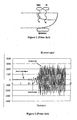
- FIG. 1 is a schematic illustration is a typical finger type pulse oximeter implementation.
- Measuring heartbeat rate and Sp02 blood oxygenation is based on the absorption of red and infrared light.
- the technology is very sensitive to motion and hence is generally not suitable for use in personal exercise monitors.
- a few mechanical designs attempt to improve motion tolerance and enable the measurement to be used later in signal processing such that the heart rate in addition to Sp02 can be derived when the wearer is in motion.
- the device comprises two light sources, typically using LEDs of known wavelength. The wavelengths of the two light sources are 880 - 920nm (Infrared or IR) and 660nm (Red) respectively.
- HR heart rate
- HR heart rate
- both the Red and the IR LED's would need to be used.
- a photo detector is used to sense the light that has been transmitted or reflected into the skin or application sight. This transmission of light into an area of the body that is carrying blood and reflected back to the photo detector will be effected by the pulsiltile flow caused by each heartbeat. This slight change in light intensity is detected and extracted to create a waveform commonly known as a plethysmograph. This waveform or the actual detection of the pulsiltile flow can be converted into heart rate in the absent of motion.
- pulse oximetry the IR and the red light emissions are separately analyzed and then used in an empirical calculation to generate a predetermined blood oxygen level. The calibration and empirical calculation can be found in many literatures.
- Figure 2 shows an example of noise induced by motion in an IR LED and IR heartbeat/SpO2 sensor.
- This noise signal may be of similar or even larger amplitude than the heartbeat signal and they are, in normal situation, in the same frequency band of the heartbeat signal (1-3 Hz). There is no easy method to extract the heartbeat signal from the mixture of the motion signal and heartbeat signal.
- pedometer devices In addition to heart rate people are also interested in measuring the the distance run in an exercise session. There are many pedometer devices in the market that can count steps when a person walks or runs. These pedometers are fairly accurate and can record number of steps for a long period of time. Most of these devices require user to wear the device at particular orientation and position of the body trunk for the devices to work. These devices will usually fail if users are holding the device in hand when running or jogging.
- an object of the present invention to provide an exercise device for determining the body parameters of a wearer during exercise.
- This particular object of the present invention to provide a sensor and method of determining heartbeat from a sensor signal that overcome or at least ameliorates problems with known devices.
- a noninvasive light sensor for detecting heart beat signals comprising:
- the light emitters and light detectors are located in pairs consisting of one of the emitters and one of the detectors.
- the light emitters comprises both red and infra-red light emitters.
- the plurality of light emitters consist of three light emitters located 120 degrees apart about the circumference of the support member.
- the plurality of light detectors consist of three light detectors located 120 degrees apart about the circumference of the support member.
- the light emitters and light detectors are located in pairs consisting of one of the emitters and one of the detectors.
- the support member is one of a ear bud insertable within an ear canal or a band locatable about a wrist or arm.
- the body part is an ear canal
- the circular support member being an ear bud insertable with the an ear canal along an ear canal axis
- the plurality of light emitters are located about the periphery of the ear piece for emitting light signals perpendicular to the ear canal axis into the different areas of tissue surrounding the ear canal
- the plurality of light detectors are located about the periphery of the ear piece for receiving reflected light signals from the different areas of tissue surrounding the ear canal.
- the ear piece is resiliently deformable for expansion within the ear canal, such that the ear piece is firmly locatable within the ear canal.
- the ear price comprises an inner layer and an outer layer having a plurality of openings, the light emitters and light detectors located with the inner layer beneath the outer layer openings.
- the inner lay comprises foam and the outer layer comprises rubber.
- the ear piece has an outer surface for mating with the ear canal and a plurality of openings in the outer surface, the light emitters and light detectors located within the openings.
- the light emitters and light detectors are located below the outer surface of the ear piece.
- the openings have sides surrounding the light emitters and light detectors, the sides defining a narrow gap above the light emitters and light detectors.
- the sides of the openings are light absorbent.
- the noninvasive light sensor of further includes an audio speaker and/or a temperature sensor.
- the body part is a wrist or arm
- the support member comprising a band locatable about a wrist or arm, the emitters and detectors located around an inner circumference of the band for respectively emitting light signals into the different areas of arm tissue and receiving reflected light from the different areas of arm tissue.
- a exercise device comprising:
- a exercise system comprising:
- the attributes of the playback audio files to be varied are beat, tempo, tone and pitch.
- the audio player is programmed to vary the attributes by changing the playback audio files.
- the vital sign monitor is programmed to generating a heart rate, blood oxygen or temperature signal.
- a method of determining heart rate of a person during exercise comprising:
- obtaining a plurality of sensor signals from locations comprises providing a plurality of heart beat sensors for positioning at multiple locations about the body part.
- comparing the signals to separate the heart beat signals and a movement signals comprises comparing the sensor signals to find in phase and out of phase components of the sensor signals.
- comparing the signals to separate the heart beat signals and a movement signals comprises finding a covariance between the sensor signals.
- determining heart rate from the heart beat signals comprises using match filters.
- a method in an exercise device of determining the steps taken by a person during exercise comprising:
- finding a dominant movement signal comprises finding a movement signal having an amplitude greater than a threshold.
- finding a dominant movement signal comprises finding a sum of two sensor signals, finding a product of two times a third sensor signal, and subtracting the product from the sum.
- the third sensor signal has an amplitude lower than amplitudes of the two summed sensor signals.
- determining zero crossing points of the dominant movement signal comprises determining a number of the zero crossing points.
- method further comprises finding a product of a step-distance and the number of the zero crossing points and thereby finding a distance traveled by a person exercising.
- a personal exercise device comprising an earphone sensor for listening to audio files and also for detecting body parameters; such as heartbeat, SpO2 and temperature; during exercise, a signal processing means for resolving sensor information into heartbeat and other body parameters and a workout assistance means for providing feedback of body parameters, exercise instructions and entertainment functions such as, but not limited to, music, video, game, e-book, photo, etc.
- body parameters such as heartbeat, SpO2 and temperature
- a signal processing means for resolving sensor information into heartbeat and other body parameters
- a workout assistance means for providing feedback of body parameters, exercise instructions and entertainment functions such as, but not limited to, music, video, game, e-book, photo, etc.
- the exercise device comprises simply an earpiece sensor and signal processing means for detecting heartbeat for feedback to the user or transmission to another device such as an exercise machine or exercise monitoring equipment.
- the earphones of the invention include several mechanical design characteristics that ameliorate movement inaccuracies inherent in ear sensors known hitherto. It is not
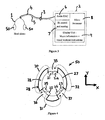
- FIG. 3 shows the block diagram of a personal exercise device.
- a pair of earphones 1 that can be worn by the user is connected to a portable base unit 2 by a cable 3 having conductor means 4, 5 for carrying both audio signals and body parameter sensor signals.
- the portable base unit 2 has a microprocessor 8, audio module 6 for providing audio signals to the earphones, a sensor module 7 for communicating with the earphone sensors and a user interface/display module 9 for interaction with the user.
- the exercise device determines heartbeat of the user and then controls the playback of audio content in accordance with changes in the heartbeat. The heartbeat is also recorded for future reference and for comparing against targeted training level, etc.
- the earphones 1 may also include an IR thermometer or small thermistor embedded in the earphones 50 for determining body temperature.
- the bases unit and or earphones 50 may also include an accelerometer/G-sensor for detecting steps from running or walking motion.
- the earphones may also include a microphone for picking up ambient sound signal and the user could enable or disable or adjusting the ratio of the mixing of ambient sound with content playing back at will. This is necessary because of the mechanical structure for the ear buds blocks a significant part of ambient sound from reaching the user.
- FIG. 4 schematically illustrates the sensor arrangement of the earphones.
- Signal emitter 21, 22, 23 and detector 24, 24, 26 devices are located around the circumferential periphery 27 of the earphone.
- the emitter and detector devices may be either Red or Infared (IR) or both for detecting heartbeat and optionally SpO2.
- the ear piece is of a type commonly known as an ear bud 50 which has a substantially cylindrical shape for insertion within the outer ear canal of the wearer.
- the emitters and detectors are grouped in pairs 21-24, 22-25, 23-26 located 120 degrees apart about the circumferential periphery 27 of the ear bud 50.
- the dashed lines 30, 31, 32 show the path of the IR signals through the soft tissue surrounding the internal wall of the ear canal.
- a first signal 31 from emitter 21 is detected by detector 25
- a second signal 32 from emitter 22 is detected by detector 26
- a third signal 33 from emitter 23 is detected by detector 24.
- the main signal noise is due to radial motion of the ear bud 50 in the x, y plane within the ear cannel because these movement changes the distance between the sensor and the ear canal wall, which affects the transmitted and receive signal.
- the effect due to motion in the x, y plane can be approximated as a linear effect on the amplitude of the received signal.
- Some of the signal emitted from the emitters 21, 22, 23 will be reflected from the skin surface of the ear canal.
- the amount of the IR signals 31, 32, 33 that is reflected from the skin also varies substantially with the aforementioned x, y plane movement of the ear bud 50 within the ear canal.
- the reflected light is detected by the detectors and must be allowed for in later processing to determine heartbeat and other body parameters from the detected signals.
- the amount of referred light that is detected by the detectors can be ameliorated by locating the emitters and detectors within recess channels 35, 36, 37 below the outer peripheral surface 28 of the ear bud 50.
- the recess channels 35, 36, 37 can comprise air or optical glass mediums and form a narrow angle wave guide for IR signals emitted from the emitters or entering the detectors.
- These wave guide cannels 35, 36, 37 produces a narrow angle beam to direct the light in such a way to allow the maximum amount signal by increasing the signal path of the light up and into deeper tissue before the light reflects and is captured by the detector. They also limiting large fluctuation in DC single picked up by detectors.
- the outer part 38 of the ear bud 50 consists of a soft over-molding made of resiliently deformable memory foam or silicone rubber that dampens the effects of motion.
- the foam is compressed when the ear bud 50 is inserted into the ear canal and expands to hold the bud 50 firmly in the ear canal to ameliorate relative motion between the emitters and detectors and the ear canal wall during exercise movement.
- One possible optional feature is to make outer piece 38 removable and interchangeable for varying the size and shape to fit a wide variety of users having different size ear canals.
- the properties (elasticity, softness as known as durometer, memory or rebound rate) of this soft over-molding 38 are chosen to maximizing the damping effects.
- the depth placement of the emitters and detectors inside the ear is also important, but not essential, to reducing the effects of motion introduced within the ear during exercise.
- the emitters and detector are placed at the end of the inner part of the ear bud 50 which is further into the ear canal to help reduce the effects of motion. This placement helps reduce the vibration as the inner ear part is more firmly attached to the bone and muscle (non-soft tissue) which does not move as much during exercise.
- FIG. 5 through 8 A first arrangement of an ear bud 50 is illustrated in Figures 5 through 8 .
- the interchangeable resilient outer part 38 is sized to fit within the ear canal of a person.
- Figure 7 illustrates the core parts of the ear bud 50 with the resilient outer part 38 removed.
- the structure consists of a speaker 44, a hollow inner core 41 for sound conduction from the speaker in to the ear, an resilient inner foam structure 42 for softness and flexibility , a flexible printed circuit (FPC) 43 or thin wirings for connection to emitter and detectors and a rubber over-molding 38 for increase comfort and protection of sensors.
- the resilient inner foam 42 may be compressed during insertion of the bud 50 into the ear to provide further support in the ear canal.
- the FPC 43 comprises a hub 46 having three 120 degree radially extending arms 47.
- the emitter and detector pairs 21-24, 22-25, 23-26 are located at the distal ends of the FPC 43 and are encapsulated with epoxy. The encapsulation provides a round-top to avoid injury to the user when wearing the device and at the same time prevents the emitters and receivers from damage.
- An alternative approach is to use sensors with suitable packaging.
- the FPC arms 47 are made of a flexible material so that sensors follow the foam 42 when squeezed into the ear canal. Flexible wiring tracks are located along the radial arms 47 connecting the emitters and detectors to solder bonding pads 48 on the hub 46. In one embodiment the FPC and arms is formed as a flex circuit.
- the hub 46 is located centrally within the back of the ear bud 50 and the radial arms brought forward within slots 45 on the surface of foam 42.
- the depth of the slots 45 is designed to allow the sensors to be slightly above the foam surface.
- the foam 42 is then covered with the rubber over-molding 38 for increase comfort and protection of sensors.
- Figures 9 and 10 illustrate an alternative arrangement of an ear bud 50 in a behind-the-ear design.
- the cord 3 to each bud 50 hangs around the back of the ear to also help in securing an in ear portion 51 into the ear canal and thus reducing motion introduced into the signal by exercise movement.
- Another feature of this design is to have the cable 3 enter at the back or bottom of the behind the ear portion.
- This cable placement design will reduce the motion effects that can be produced by the pulling forces of the cable during movement. Since the cable 3 can exert a force on the ear piece the reduction of its size and weight is achieved by locating some of the electronics or circuitry into a behind an ear portion 52 of the earphone. This feature reduces the number of wires and thus thickness and weight of the cable 3.
- the circuit design has a communication method between the main unit 2 and the behind the ear portion 52 circuitry.
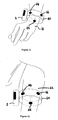
- Figures 11 and 12 illustrate a second embodiment of an exercise device according to the invention employing an arm-band type sensor.
- the sensor was a circular ear bud for location within an ear canal, with the emitters and detectors located in pairs 120 degrees apart around the outer circumference of the bud for obtaining signals from the tissue surrounding the ear canal.
- an annular band 60 is provided which locates about the wrist 61 or upper arm 62 of the user. Emitters and detectors are provided in three pairs 64, 65, 66 at locations 120 degrees apart around the inner circumference of the band 60.
- the emitters and detectors are of the same type as in the ear bud, however the emitters and detectors are located on the inner circumference of the band 60 so as to be pressed up against the skin of the wrist 61 or arm 62 when the band 60 is worn.
- the sensor signal path is through the tissue of the wrist 61 or arm 62.
- the band 60 is made of a resilient material so as to fit snugly about the wrist 61 or arm 62 of the wearer and maintain the emitter and detector pairs 64, 65, 66 in position with the arm tissue.
- the band 60 may be a stand alone band or, as illustrated in Figures 11 and 12 , may be a support strap for wearing the portable base unit 2 on the wrist 61 or upper arm 62 of the users.
- the arm-band embodiment may be preferable to those who run or cycle in busy traffic areas and prefer not to impair their hearing with earphones for safety reasons.
- the embodiment shown in Figure 11 may be, for example, a wrist watch wherein the base unit only provides visual feedback.
- the base unit 2 may also have an ear phone output jack for connection of a standard pair of earphones for listening to music and audio feedback from the portable exercise device if so desired.
- the head phones 1 and arm bands 60 of embodiments of the invention use multiple pairs of emitters and detectors at symmetrical locations to aid the removal or minimization of the additive noise introduced in to the detected sensor signals by exercise motion of the wearer.
- the microprocessor 8 of the main unit 2 receives the detected sensor signals and analyses them to detect the wearer's heartbeat and other body parameters, such as SpO2.
- Figure 13 is a schematic block diagram of the sensor control and processing means.
- a LED driver control is used to send driving signals to the LED emitters 21, 22, 23.
- the detected signals from detectors 24, 25, 26 are amplified by op-amps 62 with DC bias control 63.
- the amplified analog signals go through a multiplexer 64 and an analog-to-digital (A/D) converter 65 for input to the Microprocessor 8.
- the signals are analyzed in Microprocessor 8 to detect the wearer's heartbeat and other body parameters.
- m 3 t L 3 ⁇ I 03 t ⁇ 1 + ⁇ 3 ⁇ hb t ⁇ 1 + N s ⁇ 3 t + N f ⁇ 3 t + z 3 t
- This model is based on the assumption that the motion signals z 1 ( t ), z 2 ( t ), z 3 ( t ) are in the same plane as the circular plane formed by the 3 sensors (the x-y plane) and they can be decomposed to 2 orthogonal components h(t) and v(t) as shown in Figure 14 .
- N' sk ( t ), N' fk ( t ), z k ' ( t ) are scaled versions of the original signals.
- the signal due to heartbeat should have similar effect on the three signals 31, 32, 33 and should be in phase in each signal and differ only by a scaling factor.
- the sensors are placed evenly in a circle and so the effect of motion in x-y plane should be different for the 3 symmetrically located sensors.
- SNR signal to noise ratio
- the amplitude of 3 input heartbeat signal is normalized by calculating the variance (or standard deviation) of each channel when the user is not running.
- Figure 15 schematically illustrates the processing of the sensor signals 31, 32, 33 to determine heartbeat. The following is a description of each block.
- a simple Finite Input Response (FIR) low pass filter is used to remove all high frequency signals. Slow drifting DC offset is removed using a filter or a moving window to extract the DC offset and subtract back from the signal.
- FIR Finite Input Response
- the signal amplitude of the heartbeat signal on each sensor is identified when there is no user motion. This is done by calculating the standard deviation of the 3 input signals when there is no motion. The 3 signal paths are then normalized.
- the signal are check in the time domain. If the heartbeat signal dominates, all the 3 signals should be synchronous and in-phase. If the motion of the user is big enough, it is expected that the signal from motion dominates and sensor signals should not be all in phase. The correlation index across the three signals is calculated. The amplitude of the signal when compared with rest time signal amplitude is a clear indicator for motion.
- ⁇ 2 ⁇ ⁇ T can be obtained calculating the standard deviation of the 3 input signals when there is no motion.
- the 3 input signals are then normalized to having signal standard deviation of ⁇ when there is no motion. Then ⁇ 2 ⁇ ⁇ T becomes ⁇ 2 1 1 1 1 1 1 1 1 1 1 1 1 1 1 1 1 1
- the linear combination may also be done in frequency domain as well.
- the time domain waveform can be restored using an inverse Fast Fourier Transform (FFT).
- FFT Fast Fourier Transform
- the heartbeat signal is detected using match filters in the time domain.
- the user's resting heartbeat rate signal can be recorded as templates.
- the corresponding heart rate of these templates can be calculated and recorded as well.
- a template is stored for each user.
- For the range where there is no recorded template a time wrapping approach is used to predict an approximate template.
- These templates are then used to build multiple matched filters for the user. The corresponding matched filter will be selected according to current heartbeat rate of the user.
- the peaks of the matched filter output are detected and they are marked as the beat time.
- the inter-beat intervals are calculated and stored in a buffer.
- the heart rate is then calculated from the inter-beat intervals buffer.
- each of the input signals is the sum of the heart beat signal and the motion signal.
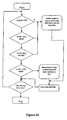
- Figure 16 shows the three sensor signals before and after the user starts to jog or run. Prior to running the three heart beat signals are in phase and of the same amplitude. When the user starts to jog or run the motion signals amplitude varies a lot among the three sensor signals. To accurately detect the step rate instead of the heart rate, it is necessary to remove the heart beat signal from the sensor signals. Step detection is activated only when it is determined that the user is running, which is described earlier. When user is running or jogging, the standard deviation of the three sensor signals is calculated for certain window width, typical 2 seconds.
- Figure 18 shows the relationship of the step distance and the rate of steps.
- the data point will then be used to interpolate or extrapolate the cure of step distance versus rate of step.
- the rate of the step and the number of step will be calculated.
- the rate of steps will be used to estimate the distance traveled of each steps.
- the step distance is accumulated and will be recorded as the total workout distance traveled when the workout is finished.
- the exercise device processes, displays and stores health related data, such as heart rate, blood oxygen level (Sp02), body temperature, steps walked or run, entered weight to calculate calories burned and body mass index (BMI).
- the user connects to the headphones that not only playback audio files but also simultaneously captures end users health related data inside the ear.
- the data is transferred to the portable entertainment device and workout assistant for processing, displaying/notifying and storing the data.
- Preferred features include;-
Landscapes
- Health & Medical Sciences (AREA)
- Life Sciences & Earth Sciences (AREA)
- Engineering & Computer Science (AREA)
- General Health & Medical Sciences (AREA)
- Physics & Mathematics (AREA)
- Biophysics (AREA)
- Medical Informatics (AREA)
- Public Health (AREA)
- Animal Behavior & Ethology (AREA)
- Molecular Biology (AREA)
- Veterinary Medicine (AREA)
- Surgery (AREA)
- Pathology (AREA)
- Biomedical Technology (AREA)
- Heart & Thoracic Surgery (AREA)
- Cardiology (AREA)
- Physiology (AREA)
- Signal Processing (AREA)
- Physical Education & Sports Medicine (AREA)
- Theoretical Computer Science (AREA)
- Otolaryngology (AREA)
- General Physics & Mathematics (AREA)
- General Engineering & Computer Science (AREA)
- Human Computer Interaction (AREA)
- Psychiatry (AREA)
- Computer Vision & Pattern Recognition (AREA)
- Artificial Intelligence (AREA)
- Multimedia (AREA)
- Computer Hardware Design (AREA)
- Optics & Photonics (AREA)
- Spectroscopy & Molecular Physics (AREA)
- Automation & Control Theory (AREA)
- Audiology, Speech & Language Pathology (AREA)
- Pulmonology (AREA)
- Measuring Pulse, Heart Rate, Blood Pressure Or Blood Flow (AREA)
- Measurement Of The Respiration, Hearing Ability, Form, And Blood Characteristics Of Living Organisms (AREA)
Applications Claiming Priority (2)
| Application Number | Priority Date | Filing Date | Title |
|---|---|---|---|
| US632108P | 2008-01-07 | 2008-01-07 | |
| US12/195,502 US8979762B2 (en) | 2008-01-07 | 2008-08-21 | Method of determining body parameters during exercise |
Publications (2)
| Publication Number | Publication Date |
|---|---|
| EP2077091A2 true EP2077091A2 (de) | 2009-07-08 |
| EP2077091A3 EP2077091A3 (de) | 2009-10-07 |
Family
ID=40568064
Family Applications (1)
| Application Number | Title | Priority Date | Filing Date |
|---|---|---|---|
| EP09250024A Withdrawn EP2077091A3 (de) | 2008-01-07 | 2009-01-06 | Übungsgerät, Sensor und Verfahren zur Bestimmung der Körperwerte während der Übung |
Country Status (2)
| Country | Link |
|---|---|
| US (5) | US8979762B2 (de) |
| EP (1) | EP2077091A3 (de) |
Cited By (28)
| Publication number | Priority date | Publication date | Assignee | Title |
|---|---|---|---|---|
| CN102984615A (zh) * | 2012-11-19 | 2013-03-20 | 中兴通讯股份有限公司 | 通过光线感应耳机操控电子设备的方法和光线感应耳机 |
| US8886269B2 (en) | 2009-02-25 | 2014-11-11 | Valencell, Inc. | Wearable light-guiding bands for physiological monitoring |
| US8929965B2 (en) | 2009-02-25 | 2015-01-06 | Valencell, Inc. | Light-guiding devices and monitoring devices incorporating same |
| CN104605828A (zh) * | 2015-01-30 | 2015-05-13 | 南昌欧菲光科技有限公司 | 智能穿戴设备 |
| US9044180B2 (en) | 2007-10-25 | 2015-06-02 | Valencell, Inc. | Noninvasive physiological analysis using excitation-sensor modules and related devices and methods |
| WO2016008167A1 (en) * | 2014-07-18 | 2016-01-21 | Well Being Digital Limited | Device and method suitable for monitoring arterial blood in body part |
| WO2016022295A1 (en) | 2014-08-06 | 2016-02-11 | Valencell, Inc. | Optical physiological sensor modules with reduced signal noise |
| EP2846692A4 (de) * | 2012-05-11 | 2016-02-24 | Harman Int Ind | Kopfhörer und ohrhörer mit physiologischen sensoren |
| US9427191B2 (en) | 2011-07-25 | 2016-08-30 | Valencell, Inc. | Apparatus and methods for estimating time-state physiological parameters |
| WO2016173639A1 (en) * | 2015-04-29 | 2016-11-03 | Brainlab Ag | Detection of the heartbeat in cranial accelerometer data using independent component analysis |
| US9538921B2 (en) | 2014-07-30 | 2017-01-10 | Valencell, Inc. | Physiological monitoring devices with adjustable signal analysis and interrogation power and monitoring methods using same |
| US9591395B2 (en) | 2012-05-11 | 2017-03-07 | Harman International Industries, Incorporated | Earphones and earbuds with physiologic sensors |
| US9750462B2 (en) | 2009-02-25 | 2017-09-05 | Valencell, Inc. | Monitoring apparatus and methods for measuring physiological and/or environmental conditions |
| US9794653B2 (en) | 2014-09-27 | 2017-10-17 | Valencell, Inc. | Methods and apparatus for improving signal quality in wearable biometric monitoring devices |
| US9801552B2 (en) | 2011-08-02 | 2017-10-31 | Valencell, Inc. | Systems and methods for variable filter adjustment by heart rate metric feedback |
| US10076253B2 (en) | 2013-01-28 | 2018-09-18 | Valencell, Inc. | Physiological monitoring devices having sensing elements decoupled from body motion |
| US10258243B2 (en) | 2006-12-19 | 2019-04-16 | Valencell, Inc. | Apparatus, systems, and methods for measuring environmental exposure and physiological response thereto |
| US10413197B2 (en) | 2006-12-19 | 2019-09-17 | Valencell, Inc. | Apparatus, systems and methods for obtaining cleaner physiological information signals |
| US10610158B2 (en) | 2015-10-23 | 2020-04-07 | Valencell, Inc. | Physiological monitoring devices and methods that identify subject activity type |
| CN111327982A (zh) * | 2018-12-17 | 2020-06-23 | 大北欧听力公司 | 听力设备的耳机 |
| US10750267B2 (en) | 2017-12-05 | 2020-08-18 | Shenzhen GOODIX Technology Co., Ltd. | Earplug apparatus and electronic apparatus |
| US10827979B2 (en) | 2011-01-27 | 2020-11-10 | Valencell, Inc. | Wearable monitoring device |
| US10945618B2 (en) | 2015-10-23 | 2021-03-16 | Valencell, Inc. | Physiological monitoring devices and methods for noise reduction in physiological signals based on subject activity type |
| US10966662B2 (en) | 2016-07-08 | 2021-04-06 | Valencell, Inc. | Motion-dependent averaging for physiological metric estimating systems and methods |
| EP3806494A1 (de) * | 2019-10-07 | 2021-04-14 | Sonion Nederland B.V. | Hörgerät mit einem optischen sensor |
| EP3806495A1 (de) * | 2019-10-07 | 2021-04-14 | Sonion Nederland B.V. | Hörgerät mit einem optischen sensor |
| EP4061011A1 (de) * | 2021-03-15 | 2022-09-21 | Sonova AG | Hörgerät mit optischem sensor zur bestimmung einer gewebeeigenschaft |
| CN115443097A (zh) * | 2020-05-07 | 2022-12-06 | 卫保数码有限公司 | 用于长期舒适佩戴的耳戴式生理监测装置以及用于提高其中信号噪声中运动伪影的差异性的方法 |
Families Citing this family (100)
| Publication number | Priority date | Publication date | Assignee | Title |
|---|---|---|---|---|
| US8526646B2 (en) * | 2004-05-10 | 2013-09-03 | Peter V. Boesen | Communication device |
| BRPI0912721B8 (pt) * | 2008-05-14 | 2021-06-22 | Espenusa Holding Llc | unidade de coleta de dados de atividade física com dois ou mais sensores infravermelhos, pelo menos um sensor de temperatura e pelo menos um acelerômetro |
| US20100004518A1 (en) | 2008-07-03 | 2010-01-07 | Masimo Laboratories, Inc. | Heat sink for noninvasive medical sensor |
| US8630691B2 (en) | 2008-08-04 | 2014-01-14 | Cercacor Laboratories, Inc. | Multi-stream sensor front ends for noninvasive measurement of blood constituents |
| TWI439254B (zh) * | 2009-04-09 | 2014-06-01 | 私立中原大學 | Heart rate variability measurement headphones |
| TWI439255B (zh) * | 2009-04-28 | 2014-06-01 | 私立中原大學 | Measurement of arrhythmia |
| EP2519905B1 (de) * | 2009-12-28 | 2018-09-05 | Koninklijke Philips N.V. | Biofeedback für eine programmanleitung in der lungenrehabilitation |
| US8374683B2 (en) * | 2009-12-30 | 2013-02-12 | Ray D. Stone | Medical instrument with probe, probe cover, and methods of using the same |
| US20130012840A1 (en) * | 2010-03-23 | 2013-01-10 | Real Aesthetics Ltd. | System and method for accelerating the relative proportion of fat catabolism |
| US9781514B2 (en) | 2010-03-25 | 2017-10-03 | K&E Holdings, LLC | Stereo audio headphone apparatus |
| US9643049B2 (en) | 2010-08-26 | 2017-05-09 | Blast Motion Inc. | Shatter proof enclosure and mount for a motion capture element |
| US8827824B2 (en) | 2010-08-26 | 2014-09-09 | Blast Motion, Inc. | Broadcasting system for broadcasting images with augmented motion data |
| US9261526B2 (en) | 2010-08-26 | 2016-02-16 | Blast Motion Inc. | Fitting system for sporting equipment |
| US9033810B2 (en) | 2010-08-26 | 2015-05-19 | Blast Motion Inc. | Motion capture element mount |
| US10254139B2 (en) | 2010-08-26 | 2019-04-09 | Blast Motion Inc. | Method of coupling a motion sensor to a piece of equipment |
| US9028337B2 (en) | 2010-08-26 | 2015-05-12 | Blast Motion Inc. | Motion capture element mount |
| US9418705B2 (en) | 2010-08-26 | 2016-08-16 | Blast Motion Inc. | Sensor and media event detection system |
| US8905855B2 (en) | 2010-08-26 | 2014-12-09 | Blast Motion Inc. | System and method for utilizing motion capture data |
| US9247212B2 (en) | 2010-08-26 | 2016-01-26 | Blast Motion Inc. | Intelligent motion capture element |
| US9746354B2 (en) | 2010-08-26 | 2017-08-29 | Blast Motion Inc. | Elastomer encased motion sensor package |
| US9406336B2 (en) | 2010-08-26 | 2016-08-02 | Blast Motion Inc. | Multi-sensor event detection system |
| US9604142B2 (en) | 2010-08-26 | 2017-03-28 | Blast Motion Inc. | Portable wireless mobile device motion capture data mining system and method |
| US9622361B2 (en) | 2010-08-26 | 2017-04-11 | Blast Motion Inc. | Enclosure and mount for motion capture element |
| US9607652B2 (en) | 2010-08-26 | 2017-03-28 | Blast Motion Inc. | Multi-sensor event detection and tagging system |
| US9076041B2 (en) | 2010-08-26 | 2015-07-07 | Blast Motion Inc. | Motion event recognition and video synchronization system and method |
| US8613676B2 (en) | 2010-08-26 | 2013-12-24 | Blast Motion, Inc. | Handle integrated motion capture element mount |
| US9396385B2 (en) | 2010-08-26 | 2016-07-19 | Blast Motion Inc. | Integrated sensor and video motion analysis method |
| US9619891B2 (en) | 2010-08-26 | 2017-04-11 | Blast Motion Inc. | Event analysis and tagging system |
| US9940508B2 (en) | 2010-08-26 | 2018-04-10 | Blast Motion Inc. | Event detection, confirmation and publication system that integrates sensor data and social media |
| US9052201B2 (en) | 2010-08-26 | 2015-06-09 | Blast Motion Inc. | Calibration system for simultaneous calibration of multiple motion capture elements |
| US8944928B2 (en) | 2010-08-26 | 2015-02-03 | Blast Motion Inc. | Virtual reality system for viewing current and previously stored or calculated motion data |
| US9039527B2 (en) | 2010-08-26 | 2015-05-26 | Blast Motion Inc. | Broadcasting method for broadcasting images with augmented motion data |
| US8903521B2 (en) | 2010-08-26 | 2014-12-02 | Blast Motion Inc. | Motion capture element |
| US9235765B2 (en) | 2010-08-26 | 2016-01-12 | Blast Motion Inc. | Video and motion event integration system |
| US9626554B2 (en) | 2010-08-26 | 2017-04-18 | Blast Motion Inc. | Motion capture system that combines sensors with different measurement ranges |
| US9401178B2 (en) | 2010-08-26 | 2016-07-26 | Blast Motion Inc. | Event analysis system |
| US8941723B2 (en) | 2010-08-26 | 2015-01-27 | Blast Motion Inc. | Portable wireless mobile device motion capture and analysis system and method |
| US8702516B2 (en) | 2010-08-26 | 2014-04-22 | Blast Motion Inc. | Motion event recognition system and method |
| US8994826B2 (en) | 2010-08-26 | 2015-03-31 | Blast Motion Inc. | Portable wireless mobile device motion capture and analysis system and method |
| US8465376B2 (en) | 2010-08-26 | 2013-06-18 | Blast Motion, Inc. | Wireless golf club shot count system |
| US9320957B2 (en) | 2010-08-26 | 2016-04-26 | Blast Motion Inc. | Wireless and visual hybrid motion capture system |
| US9646209B2 (en) | 2010-08-26 | 2017-05-09 | Blast Motion Inc. | Sensor and media event detection and tagging system |
| CA2819906A1 (en) * | 2010-12-01 | 2012-06-07 | Sonomax Technologies Inc. | Advanced communication earpiece device and method |
| US8913134B2 (en) | 2012-01-17 | 2014-12-16 | Blast Motion Inc. | Initializing an inertial sensor using soft constraints and penalty functions |
| CN103251393A (zh) * | 2012-02-17 | 2013-08-21 | 钱军 | 便携式测量血氧、血糖和脉搏的系统及其制造方法 |
| US9769556B2 (en) | 2012-02-22 | 2017-09-19 | Snik Llc | Magnetic earphones holder including receiving external ambient audio and transmitting to the earphones |
| US10524038B2 (en) | 2012-02-22 | 2019-12-31 | Snik Llc | Magnetic earphones holder |
| US11185241B2 (en) | 2014-03-05 | 2021-11-30 | Whoop, Inc. | Continuous heart rate monitoring and interpretation |
| CA2883852A1 (en) | 2012-09-04 | 2014-03-13 | Whoop, Inc. | Systems, devices and methods for continuous heart rate monitoring and interpretation |
| JP5998780B2 (ja) * | 2012-09-14 | 2016-09-28 | カシオ計算機株式会社 | 生体情報通知装置、生体情報通知方法及び生体情報通知プログラム |
| KR101911218B1 (ko) * | 2012-10-30 | 2018-10-24 | 삼성전자주식회사 | 운동량 계산 방법 및 장치 |
| US8700354B1 (en) | 2013-06-10 | 2014-04-15 | Blast Motion Inc. | Wireless motion capture test head system |
| EP3039390B1 (de) | 2013-08-28 | 2017-10-11 | Philips Lighting Holding B.V. | System zur messung der belichtung eines benutzers |
| US9949712B1 (en) * | 2013-09-06 | 2018-04-24 | John William Millard | Apparatus and method for measuring the sound transmission characteristics of the central nervous system volume of humans |
| JP2015070514A (ja) * | 2013-09-30 | 2015-04-13 | 株式会社東芝 | 音響装置および制御方法 |
| US20170049335A1 (en) * | 2015-08-19 | 2017-02-23 | Logitech Europe, S.A. | Earphones with biometric sensors |
| US20160051184A1 (en) * | 2013-10-24 | 2016-02-25 | JayBird LLC | System and method for providing sleep recommendations using earbuds with biometric sensors |
| CN104622427A (zh) * | 2013-11-13 | 2015-05-20 | 富港电子(东莞)有限公司 | 耳塞、使用该耳塞的生理机能量测耳机及其量测方法 |
| DE102014100824A1 (de) | 2014-01-24 | 2015-07-30 | Nikolaj Hviid | Eigenständiger Multifunktionskopfhörer für sportliche Aktivitäten |
| CN106464996A (zh) | 2014-01-24 | 2017-02-22 | 布拉吉有限公司 | 用于体育活动的多功能耳机系统 |
| JP6224526B2 (ja) * | 2014-05-28 | 2017-11-01 | 京セラ株式会社 | 測定装置及び測定方法 |
| US20170075422A1 (en) * | 2014-06-09 | 2017-03-16 | Intel Corporation | Wearable Devices and Associated Control of Media Devices |
| TWI530276B (zh) * | 2014-07-08 | 2016-04-21 | 原相科技股份有限公司 | 具去噪功能之生理偵測模組及其生理偵測方法 |
| KR102347247B1 (ko) * | 2014-10-16 | 2022-01-04 | 삼성전자주식회사 | 운동 피드백을 제공하는 장치 및 그 방법 |
| CN104523258A (zh) * | 2014-12-20 | 2015-04-22 | 万步健康科技(江门)有限公司 | 一种具有时钟功能可智能监测运动强度的脉搏血氧仪 |
| WO2016140836A1 (en) * | 2015-03-03 | 2016-09-09 | Valencell, Inc. | Stabilized monitoring devices |
| US10448871B2 (en) | 2015-07-02 | 2019-10-22 | Masimo Corporation | Advanced pulse oximetry sensor |
| US11577142B2 (en) | 2015-07-16 | 2023-02-14 | Blast Motion Inc. | Swing analysis system that calculates a rotational profile |
| US10124230B2 (en) | 2016-07-19 | 2018-11-13 | Blast Motion Inc. | Swing analysis method using a sweet spot trajectory |
| US9694267B1 (en) | 2016-07-19 | 2017-07-04 | Blast Motion Inc. | Swing analysis method using a swing plane reference frame |
| US11565163B2 (en) | 2015-07-16 | 2023-01-31 | Blast Motion Inc. | Equipment fitting system that compares swing metrics |
| CA3031040C (en) | 2015-07-16 | 2021-02-16 | Blast Motion Inc. | Multi-sensor event correlation system |
| US10974121B2 (en) | 2015-07-16 | 2021-04-13 | Blast Motion Inc. | Swing quality measurement system |
| US10264996B2 (en) * | 2015-10-19 | 2019-04-23 | Sayfe Kiaei | Method and apparatus for wirelessly monitoring repetitive bodily movements |
| US10265602B2 (en) | 2016-03-03 | 2019-04-23 | Blast Motion Inc. | Aiming feedback system with inertial sensors |
| US10631074B2 (en) | 2016-04-19 | 2020-04-21 | Snik Llc | Magnetic earphones holder |
| US11272281B2 (en) | 2016-04-19 | 2022-03-08 | Snik Llc | Magnetic earphones holder |
| US10951968B2 (en) | 2016-04-19 | 2021-03-16 | Snik Llc | Magnetic earphones holder |
| US10455306B2 (en) | 2016-04-19 | 2019-10-22 | Snik Llc | Magnetic earphones holder |
| US10225640B2 (en) * | 2016-04-19 | 2019-03-05 | Snik Llc | Device and system for and method of transmitting audio to a user |
| CA3078755A1 (en) * | 2016-10-13 | 2018-04-19 | Cathvision Aps | System for adaptive filtering of cardiac signals |
| GB201620838D0 (en) | 2016-12-07 | 2017-01-18 | Weav Music Ltd | Audio playback |
| DK3343955T3 (en) * | 2016-12-29 | 2022-08-29 | Oticon As | Anordning til et høreapparat |
| US10786728B2 (en) | 2017-05-23 | 2020-09-29 | Blast Motion Inc. | Motion mirroring system that incorporates virtual environment constraints |
| TWI729150B (zh) * | 2017-06-09 | 2021-06-01 | 陳政大 | 智能耳機、智能耳機系統及用於耳機之生理資訊提示方法 |
| WO2019000372A1 (zh) | 2017-06-30 | 2019-01-03 | 深圳市汇顶科技股份有限公司 | 生物特征检测装置及电子终端 |
| US11617514B2 (en) * | 2018-04-24 | 2023-04-04 | Crystal Razouki | Hands free heart-beat audio transmitter and receiver system for exercise, meditation and relaxation |
| US12539079B2 (en) | 2018-04-24 | 2026-02-03 | Crystal Razouki | Hands free heart-beat audio transmitter and receiver system |
| EP3576434A1 (de) * | 2018-05-30 | 2019-12-04 | Oticon A/s | Körpertemperaturhörgerät |
| DK3627856T3 (da) * | 2018-09-19 | 2023-11-13 | Sonion Nederland Bv | Hus, der omfatter en sensor |
| US12465283B2 (en) | 2019-01-07 | 2025-11-11 | Bose Corporation | Biometric detection using multiple sensors |
| WO2020212483A1 (de) * | 2019-04-16 | 2020-10-22 | Cosinuss Gmbh | In einen gehörgang einsetzbare vorrichtung zum erfassen physiologischer parameter |
| CN110568402A (zh) * | 2019-09-04 | 2019-12-13 | 京东方科技集团股份有限公司 | 一种电子设备、空间定位系统及方法 |
| WO2021090195A1 (en) * | 2019-11-04 | 2021-05-14 | Vasanth Nitin | Ear-wearable device and operation thereof |
| KR20220129033A (ko) | 2020-01-13 | 2022-09-22 | 마시모 코오퍼레이션 | 생리학적 파라미터 모니터링 기능이 있는 웨어러블 디바이스 |
| EP4370022A1 (de) | 2021-07-13 | 2024-05-22 | Masimo Corporation | Tragbare vorrichtung mit überwachung physiologischer parameter |
| EP4140401B1 (de) * | 2021-08-31 | 2025-09-17 | Starkey Laboratories, Inc. | Ohr-tragbare elektronische vorrichtung mit einem in-kanal-temperatursensor |
| EP4431166A4 (de) | 2022-02-24 | 2025-03-19 | Samsung Electronics Co., Ltd. | Elektronische vorrichtung zur bereitstellung einer übungsführung auf basis von übungskapazität und verfahren zur steuerung davon |
| EP4309573A1 (de) | 2022-07-21 | 2024-01-24 | Sonion Nederland B.V. | Bestimmung eines parameters in bezug auf den blutfluss in einem blutdurchströmten teil unter verwendung eines vcsel |
| EP4467070A1 (de) * | 2023-05-23 | 2024-11-27 | Nederlandse Organisatie voor toegepast-natuurwetenschappelijk Onderzoek TNO | Vorrichtung und verfahren zur durchführung von sauerstoffsättigungsmessungen |
Citations (5)
| Publication number | Priority date | Publication date | Assignee | Title |
|---|---|---|---|---|
| US4880304A (en) | 1987-04-01 | 1989-11-14 | Nippon Colin Co., Ltd. | Optical sensor for pulse oximeter |
| US5055671A (en) * | 1990-10-03 | 1991-10-08 | Spacelabs, Inc. | Apparatus for detecting transducer movement using a first and second light detector |
| WO1998017172A2 (en) | 1996-10-24 | 1998-04-30 | Massachusetts Institute Of Technology | Patient monitoring finger ring sensor |
| US20020169381A1 (en) * | 2000-04-18 | 2002-11-14 | Asada Haruhiko H. | Photoplethysmograph signal-to-noise line enhancement |
| WO2007004083A1 (en) | 2005-06-30 | 2007-01-11 | Koninklijke Philips Electronics N.V. | Sizing and positioning technology for an in-the-ear multi-measurement sensor to enable nibp calculation |
Family Cites Families (27)
| Publication number | Priority date | Publication date | Assignee | Title |
|---|---|---|---|---|
| US4301808A (en) * | 1979-11-19 | 1981-11-24 | Taus Herbert G | Pulse rate monitor |
| US4938228A (en) * | 1989-02-15 | 1990-07-03 | Righter William H | Wrist worn heart rate monitor |
| EP1357481A3 (de) * | 1991-03-07 | 2005-04-27 | Masimo Corporation | Signalverarbeitungsanlage und Verfahren |
| IL97526A0 (en) * | 1991-03-12 | 1992-06-21 | Tius Elcon Ltd | Exercise monitor |
| US5267942A (en) * | 1992-04-20 | 1993-12-07 | Utah State University Foundation | Method for influencing physiological processes through physiologically interactive stimuli |
| US6080110A (en) * | 1999-04-19 | 2000-06-27 | Tel, Inc. | Heartbeat monitor for wearing during exercise |
| US6608562B1 (en) * | 1999-08-31 | 2003-08-19 | Denso Corporation | Vital signal detecting apparatus |
| BRPI0414359A (pt) * | 2000-06-16 | 2006-11-14 | Bodymedia Inc | sistema para a monitoração e gerenciamento do peso corpóreo e demais condições psicológicas que abrangem um planejamento interativo e personalizado, intervenção e capacidade de formular relatórios |
| US6808473B2 (en) * | 2001-04-19 | 2004-10-26 | Omron Corporation | Exercise promotion device, and exercise promotion method employing the same |
| ATE481922T1 (de) * | 2001-09-28 | 2010-10-15 | Csem Ct Suisse Electronique | Verfahren und vorrichtung zur pulsmessung |
| KR100462182B1 (ko) * | 2002-04-15 | 2004-12-16 | 삼성전자주식회사 | Ppg 기반의 심박 검출 장치 및 방법 |
| US20030216228A1 (en) * | 2002-05-18 | 2003-11-20 | Rast Rodger H. | Systems and methods of sports training using specific biofeedback |
| FR2840794B1 (fr) * | 2002-06-18 | 2005-04-15 | Suisse Electronique Microtech | Equipement portable destine a la mesure et/ou la surveillance de la frequence cardiaque |
| US7521623B2 (en) * | 2004-11-24 | 2009-04-21 | Apple Inc. | Music synchronization arrangement |
| KR100571811B1 (ko) * | 2003-05-09 | 2006-04-17 | 삼성전자주식회사 | 귀속형 생체 신호 측정 장치 |
| KR100601932B1 (ko) * | 2003-09-04 | 2006-07-14 | 삼성전자주식회사 | 바이오피드백을 이용한 훈련제어방법 및 장치 |
| US7164938B2 (en) * | 2004-06-21 | 2007-01-16 | Purdue Research Foundation | Optical noninvasive vital sign monitor |
| US20060122520A1 (en) * | 2004-12-07 | 2006-06-08 | Dr. Matthew Banet | Vital sign-monitoring system with multiple optical modules |
| US7728214B2 (en) * | 2005-11-23 | 2010-06-01 | Microsoft Corporation | Using music to influence a person's exercise performance |
| DE602007001281D1 (de) * | 2006-01-20 | 2009-07-30 | Yamaha Corp | Vorrichtung zur Steuerung der Wiedergabe von Musik und Vorrichtung zur Wiedergabe von Musik |
| WO2007091244A1 (en) * | 2006-02-07 | 2007-08-16 | Impulse Dynamics Nv | Assessing cardiac activity |
| RU2315635C2 (ru) * | 2006-02-27 | 2008-01-27 | Эл Джи Электроникс Инк. | Способ коррекции функциональных нарушений сердечного ритма |
| US20070270671A1 (en) * | 2006-04-10 | 2007-11-22 | Vivometrics, Inc. | Physiological signal processing devices and associated processing methods |
| US20080076972A1 (en) * | 2006-09-21 | 2008-03-27 | Apple Inc. | Integrated sensors for tracking performance metrics |
| JP4311466B2 (ja) * | 2007-03-28 | 2009-08-12 | ヤマハ株式会社 | 演奏装置およびその制御方法を実現するプログラム |
| US8046058B2 (en) * | 2007-08-10 | 2011-10-25 | Salutron, Inc. | Heart beat signal recognition |
| KR101414927B1 (ko) * | 2007-08-27 | 2014-07-07 | 삼성전자주식회사 | 생체정보 측정용 센서 및 이를 구비한 이어폰 |
-
2008
- 2008-08-21 US US12/195,502 patent/US8979762B2/en active Active
-
2009
- 2009-01-06 EP EP09250024A patent/EP2077091A3/de not_active Withdrawn
-
2015
- 2015-01-28 US US14/607,810 patent/US9801554B2/en active Active
-
2016
- 2016-12-29 US US15/394,115 patent/US20170105639A1/en not_active Abandoned
-
2019
- 2019-03-18 US US16/356,408 patent/US20190209023A1/en not_active Abandoned
- 2019-04-23 US US16/391,555 patent/US20190269337A1/en not_active Abandoned
Patent Citations (5)
| Publication number | Priority date | Publication date | Assignee | Title |
|---|---|---|---|---|
| US4880304A (en) | 1987-04-01 | 1989-11-14 | Nippon Colin Co., Ltd. | Optical sensor for pulse oximeter |
| US5055671A (en) * | 1990-10-03 | 1991-10-08 | Spacelabs, Inc. | Apparatus for detecting transducer movement using a first and second light detector |
| WO1998017172A2 (en) | 1996-10-24 | 1998-04-30 | Massachusetts Institute Of Technology | Patient monitoring finger ring sensor |
| US20020169381A1 (en) * | 2000-04-18 | 2002-11-14 | Asada Haruhiko H. | Photoplethysmograph signal-to-noise line enhancement |
| WO2007004083A1 (en) | 2005-06-30 | 2007-01-11 | Koninklijke Philips Electronics N.V. | Sizing and positioning technology for an in-the-ear multi-measurement sensor to enable nibp calculation |
Non-Patent Citations (2)
| Title |
|---|
| CHAN K W ET AL: "Adaptive reduction of motion artifact from photoplethysmographic recordings using a variable step-size LMS filter", PROCEEDINGS OF IEEE SENSORS 2002. ORLANDO, FL, JUNE 12 - 14, 2002; [IEEE INTERNATIONAL CONFERENCE ON SENSORS], NEW YORK, NY : IEEE, US, vol. 2, 12 June 2002 (2002-06-12), pages 1343 - 1346, XP010605313, ISBN: 978-0-7803-7454-6, DOI: 10.1109/ICSENS.2002.1037314 * |
| M.R. NEUMAN, N. WANG: "Motion Artifact in Pulse Oximetry", ANNUAL INTERNATIONAL CONFERENCE OF THE IEEE ENGINEERING IN MEDICINE AND BIOLOGY SOCIETY, vol. 12, no. 5, 1990 |
Cited By (122)
| Publication number | Priority date | Publication date | Assignee | Title |
|---|---|---|---|---|
| US11272849B2 (en) | 2006-12-19 | 2022-03-15 | Valencell, Inc. | Wearable apparatus |
| US11083378B2 (en) | 2006-12-19 | 2021-08-10 | Valencell, Inc. | Wearable apparatus having integrated physiological and/or environmental sensors |
| US10716481B2 (en) | 2006-12-19 | 2020-07-21 | Valencell, Inc. | Apparatus, systems and methods for monitoring and evaluating cardiopulmonary functioning |
| US10595730B2 (en) | 2006-12-19 | 2020-03-24 | Valencell, Inc. | Physiological monitoring methods |
| US11295856B2 (en) | 2006-12-19 | 2022-04-05 | Valencell, Inc. | Apparatus, systems, and methods for measuring environmental exposure and physiological response thereto |
| US10413197B2 (en) | 2006-12-19 | 2019-09-17 | Valencell, Inc. | Apparatus, systems and methods for obtaining cleaner physiological information signals |
| US10987005B2 (en) | 2006-12-19 | 2021-04-27 | Valencell, Inc. | Systems and methods for presenting personal health information |
| US10258243B2 (en) | 2006-12-19 | 2019-04-16 | Valencell, Inc. | Apparatus, systems, and methods for measuring environmental exposure and physiological response thereto |
| US11000190B2 (en) | 2006-12-19 | 2021-05-11 | Valencell, Inc. | Apparatus, systems and methods for obtaining cleaner physiological information signals |
| US11395595B2 (en) | 2006-12-19 | 2022-07-26 | Valencell, Inc. | Apparatus, systems and methods for monitoring and evaluating cardiopulmonary functioning |
| US11350831B2 (en) | 2006-12-19 | 2022-06-07 | Valencell, Inc. | Physiological monitoring apparatus |
| US11324407B2 (en) | 2006-12-19 | 2022-05-10 | Valencell, Inc. | Methods and apparatus for physiological and environmental monitoring with optical and footstep sensors |
| US11109767B2 (en) | 2006-12-19 | 2021-09-07 | Valencell, Inc. | Apparatus, systems and methods for obtaining cleaner physiological information signals |
| US11412938B2 (en) | 2006-12-19 | 2022-08-16 | Valencell, Inc. | Physiological monitoring apparatus and networks |
| US11399724B2 (en) | 2006-12-19 | 2022-08-02 | Valencell, Inc. | Earpiece monitor |
| US11272848B2 (en) | 2006-12-19 | 2022-03-15 | Valencell, Inc. | Wearable apparatus for multiple types of physiological and/or environmental monitoring |
| US9808204B2 (en) | 2007-10-25 | 2017-11-07 | Valencell, Inc. | Noninvasive physiological analysis using excitation-sensor modules and related devices and methods |
| US9044180B2 (en) | 2007-10-25 | 2015-06-02 | Valencell, Inc. | Noninvasive physiological analysis using excitation-sensor modules and related devices and methods |
| US10448840B2 (en) | 2009-02-25 | 2019-10-22 | Valencell, Inc. | Apparatus for generating data output containing physiological and motion-related information |
| US11026588B2 (en) | 2009-02-25 | 2021-06-08 | Valencell, Inc. | Methods and apparatus for detecting motion noise and for removing motion noise from physiological signals |
| US8886269B2 (en) | 2009-02-25 | 2014-11-11 | Valencell, Inc. | Wearable light-guiding bands for physiological monitoring |
| US9301696B2 (en) | 2009-02-25 | 2016-04-05 | Valencell, Inc. | Earbud covers |
| US9289135B2 (en) | 2009-02-25 | 2016-03-22 | Valencell, Inc. | Physiological monitoring methods and apparatus |
| US10750954B2 (en) | 2009-02-25 | 2020-08-25 | Valencell, Inc. | Wearable devices with flexible optical emitters and/or optical detectors |
| US11660006B2 (en) | 2009-02-25 | 2023-05-30 | Valencell, Inc. | Wearable monitoring devices with passive and active filtering |
| US8923941B2 (en) | 2009-02-25 | 2014-12-30 | Valencell, Inc. | Methods and apparatus for generating data output containing physiological and motion-related information |
| US11471103B2 (en) | 2009-02-25 | 2022-10-18 | Valencell, Inc. | Ear-worn devices for physiological monitoring |
| US9289175B2 (en) | 2009-02-25 | 2016-03-22 | Valencell, Inc. | Light-guiding devices and monitoring devices incorporating same |
| US9750462B2 (en) | 2009-02-25 | 2017-09-05 | Valencell, Inc. | Monitoring apparatus and methods for measuring physiological and/or environmental conditions |
| US10542893B2 (en) | 2009-02-25 | 2020-01-28 | Valencell, Inc. | Form-fitted monitoring apparatus for health and environmental monitoring |
| US11160460B2 (en) | 2009-02-25 | 2021-11-02 | Valencell, Inc. | Physiological monitoring methods |
| US10716480B2 (en) | 2009-02-25 | 2020-07-21 | Valencell, Inc. | Hearing aid earpiece covers |
| US9131312B2 (en) | 2009-02-25 | 2015-09-08 | Valencell, Inc. | Physiological monitoring methods |
| US9955919B2 (en) | 2009-02-25 | 2018-05-01 | Valencell, Inc. | Light-guiding devices and monitoring devices incorporating same |
| US11589812B2 (en) | 2009-02-25 | 2023-02-28 | Valencell, Inc. | Wearable devices for physiological monitoring |
| US9314167B2 (en) | 2009-02-25 | 2016-04-19 | Valencell, Inc. | Methods for generating data output containing physiological and motion-related information |
| US10076282B2 (en) | 2009-02-25 | 2018-09-18 | Valencell, Inc. | Wearable monitoring devices having sensors and light guides |
| US10092245B2 (en) | 2009-02-25 | 2018-10-09 | Valencell, Inc. | Methods and apparatus for detecting motion noise and for removing motion noise from physiological signals |
| US8989830B2 (en) | 2009-02-25 | 2015-03-24 | Valencell, Inc. | Wearable light-guiding devices for physiological monitoring |
| US8942776B2 (en) | 2009-02-25 | 2015-01-27 | Valencell, Inc. | Physiological monitoring methods |
| US8934952B2 (en) | 2009-02-25 | 2015-01-13 | Valencell, Inc. | Wearable monitoring devices having sensors and light guides |
| US10973415B2 (en) | 2009-02-25 | 2021-04-13 | Valencell, Inc. | Form-fitted monitoring apparatus for health and environmental monitoring |
| US8929966B2 (en) | 2009-02-25 | 2015-01-06 | Valencell, Inc. | Physiological monitoring methods |
| US8929965B2 (en) | 2009-02-25 | 2015-01-06 | Valencell, Inc. | Light-guiding devices and monitoring devices incorporating same |
| US10898083B2 (en) | 2009-02-25 | 2021-01-26 | Valencell, Inc. | Wearable monitoring devices with passive and active filtering |
| US10842387B2 (en) | 2009-02-25 | 2020-11-24 | Valencell, Inc. | Apparatus for assessing physiological conditions |
| US10842389B2 (en) | 2009-02-25 | 2020-11-24 | Valencell, Inc. | Wearable audio devices |
| US11324445B2 (en) | 2011-01-27 | 2022-05-10 | Valencell, Inc. | Headsets with angled sensor modules |
| US10827979B2 (en) | 2011-01-27 | 2020-11-10 | Valencell, Inc. | Wearable monitoring device |
| US9788785B2 (en) | 2011-07-25 | 2017-10-17 | Valencell, Inc. | Apparatus and methods for estimating time-state physiological parameters |
| US9521962B2 (en) | 2011-07-25 | 2016-12-20 | Valencell, Inc. | Apparatus and methods for estimating time-state physiological parameters |
| US9427191B2 (en) | 2011-07-25 | 2016-08-30 | Valencell, Inc. | Apparatus and methods for estimating time-state physiological parameters |
| US9801552B2 (en) | 2011-08-02 | 2017-10-31 | Valencell, Inc. | Systems and methods for variable filter adjustment by heart rate metric feedback |
| US10512403B2 (en) | 2011-08-02 | 2019-12-24 | Valencell, Inc. | Systems and methods for variable filter adjustment by heart rate metric feedback |
| US11375902B2 (en) | 2011-08-02 | 2022-07-05 | Valencell, Inc. | Systems and methods for variable filter adjustment by heart rate metric feedback |
| US9591395B2 (en) | 2012-05-11 | 2017-03-07 | Harman International Industries, Incorporated | Earphones and earbuds with physiologic sensors |
| US10194233B2 (en) | 2012-05-11 | 2019-01-29 | Harman International Industries, Incorporated | Earphones and earbuds with physiologic sensors |
| EP2846692A4 (de) * | 2012-05-11 | 2016-02-24 | Harman Int Ind | Kopfhörer und ohrhörer mit physiologischen sensoren |
| US9462104B2 (en) | 2012-11-19 | 2016-10-04 | Zte Corporation | Method of using light sensor earphone to control electronic device and light sensor earphone |
| CN102984615A (zh) * | 2012-11-19 | 2013-03-20 | 中兴通讯股份有限公司 | 通过光线感应耳机操控电子设备的方法和光线感应耳机 |
| WO2013174324A1 (zh) * | 2012-11-19 | 2013-11-28 | 中兴通讯股份有限公司 | 通过光线感应耳机操控电子设备的方法和光线感应耳机 |
| US10076253B2 (en) | 2013-01-28 | 2018-09-18 | Valencell, Inc. | Physiological monitoring devices having sensing elements decoupled from body motion |
| US11266319B2 (en) | 2013-01-28 | 2022-03-08 | Valencell, Inc. | Physiological monitoring devices having sensing elements decoupled from body motion |
| US10856749B2 (en) | 2013-01-28 | 2020-12-08 | Valencell, Inc. | Physiological monitoring devices having sensing elements decoupled from body motion |
| US12076126B2 (en) | 2013-01-28 | 2024-09-03 | Yukka Magic Llc | Physiological monitoring devices having sensing elements decoupled from body motion |
| US11684278B2 (en) | 2013-01-28 | 2023-06-27 | Yukka Magic Llc | Physiological monitoring devices having sensing elements decoupled from body motion |
| CN105636510A (zh) * | 2014-07-18 | 2016-06-01 | 卫保数码有限公司 | 适于监测身体部位内的动脉血的装置和方法 |
| WO2016008167A1 (en) * | 2014-07-18 | 2016-01-21 | Well Being Digital Limited | Device and method suitable for monitoring arterial blood in body part |
| EP3858231A1 (de) * | 2014-07-18 | 2021-08-04 | Well Being Digital Limited | Vorrichtung und verfahren zur überwachung des arteriellen bluts in einem körperteil |
| US10806355B2 (en) | 2014-07-18 | 2020-10-20 | Well Being Digital Limited | Device and method suitable for monitoring arterial blood in a body part |
| US12029536B2 (en) | 2014-07-18 | 2024-07-09 | Well Being Digital Limited | Device and method suitable for monitoring arterial blood in a body part |
| US12465227B2 (en) | 2014-07-18 | 2025-11-11 | Well Being Digital Limited | Device and method suitable for monitoring arterial blood in a body part |
| US10314499B2 (en) | 2014-07-18 | 2019-06-11 | Well Being Digital Limited | Device and method suitable for monitoring arterial blood in a body part |
| US11653846B2 (en) | 2014-07-18 | 2023-05-23 | Well Being Digital Limited | Device and method suitable for monitoring arterial blood in a body part |
| US10893835B2 (en) | 2014-07-30 | 2021-01-19 | Valencell, Inc. | Physiological monitoring devices with adjustable signal analysis and interrogation power and monitoring methods using same |
| US12193845B2 (en) | 2014-07-30 | 2025-01-14 | Yukka Magic Llc | Physiological monitoring devices and methods using optical sensors |
| US11412988B2 (en) | 2014-07-30 | 2022-08-16 | Valencell, Inc. | Physiological monitoring devices and methods using optical sensors |
| US11638560B2 (en) | 2014-07-30 | 2023-05-02 | Yukka Magic Llc | Physiological monitoring devices and methods using optical sensors |
| US12274567B2 (en) | 2014-07-30 | 2025-04-15 | Yukka Magic Llc | Physiological monitoring devices and methods using optical sensors |
| US11337655B2 (en) | 2014-07-30 | 2022-05-24 | Valencell, Inc. | Physiological monitoring devices and methods using optical sensors |
| US11638561B2 (en) | 2014-07-30 | 2023-05-02 | Yukka Magic Llc | Physiological monitoring devices with adjustable signal analysis and interrogation power and monitoring methods using same |
| US11179108B2 (en) | 2014-07-30 | 2021-11-23 | Valencell, Inc. | Physiological monitoring devices and methods using optical sensors |
| US11185290B2 (en) | 2014-07-30 | 2021-11-30 | Valencell, Inc. | Physiological monitoring devices and methods using optical sensors |
| US9538921B2 (en) | 2014-07-30 | 2017-01-10 | Valencell, Inc. | Physiological monitoring devices with adjustable signal analysis and interrogation power and monitoring methods using same |
| EP3151737A4 (de) * | 2014-08-06 | 2017-07-05 | Valencell, Inc. | Optische physiologische sensormodule mit reduziertem signalrauschen |
| US10623849B2 (en) | 2014-08-06 | 2020-04-14 | Valencell, Inc. | Optical monitoring apparatus and methods |
| EP3199100A1 (de) * | 2014-08-06 | 2017-08-02 | Valencell, Inc. | Ohrhörer mit einem physiologischen informationen sensormodul |
| EP4098178A1 (de) * | 2014-08-06 | 2022-12-07 | Valencell, Inc. | Optische physiologische sensormodule mit reduziertem signalrauschen |
| US11252498B2 (en) | 2014-08-06 | 2022-02-15 | Valencell, Inc. | Optical physiological monitoring devices |
| US11252499B2 (en) | 2014-08-06 | 2022-02-15 | Valencell, Inc. | Optical physiological monitoring devices |
| US11330361B2 (en) | 2014-08-06 | 2022-05-10 | Valencell, Inc. | Hearing aid optical monitoring apparatus |
| WO2016022295A1 (en) | 2014-08-06 | 2016-02-11 | Valencell, Inc. | Optical physiological sensor modules with reduced signal noise |
| US10536768B2 (en) | 2014-08-06 | 2020-01-14 | Valencell, Inc. | Optical physiological sensor modules with reduced signal noise |
| EP4360552A3 (de) * | 2014-08-06 | 2024-07-10 | Yukka Magic LLC | Optische physiologische sensormodule mit reduziertem signalrauschen |
| US10015582B2 (en) | 2014-08-06 | 2018-07-03 | Valencell, Inc. | Earbud monitoring devices |
| US10798471B2 (en) | 2014-09-27 | 2020-10-06 | Valencell, Inc. | Methods for improving signal quality in wearable biometric monitoring devices |
| US10779062B2 (en) | 2014-09-27 | 2020-09-15 | Valencell, Inc. | Wearable biometric monitoring devices and methods for determining if wearable biometric monitoring devices are being worn |
| US10506310B2 (en) | 2014-09-27 | 2019-12-10 | Valencell, Inc. | Wearable biometric monitoring devices and methods for determining signal quality in wearable biometric monitoring devices |
| US10834483B2 (en) | 2014-09-27 | 2020-11-10 | Valencell, Inc. | Wearable biometric monitoring devices and methods for determining if wearable biometric monitoring devices are being worn |
| US9794653B2 (en) | 2014-09-27 | 2017-10-17 | Valencell, Inc. | Methods and apparatus for improving signal quality in wearable biometric monitoring devices |
| US10382839B2 (en) | 2014-09-27 | 2019-08-13 | Valencell, Inc. | Methods for improving signal quality in wearable biometric monitoring devices |
| CN104605828A (zh) * | 2015-01-30 | 2015-05-13 | 南昌欧菲光科技有限公司 | 智能穿戴设备 |
| WO2016173639A1 (en) * | 2015-04-29 | 2016-11-03 | Brainlab Ag | Detection of the heartbeat in cranial accelerometer data using independent component analysis |
| US12285244B2 (en) | 2015-10-23 | 2025-04-29 | Yukka Magic Llc | Physiological monitoring devices and methods for noise reduction in physiological signals based on subject activity type |
| US10610158B2 (en) | 2015-10-23 | 2020-04-07 | Valencell, Inc. | Physiological monitoring devices and methods that identify subject activity type |
| US10945618B2 (en) | 2015-10-23 | 2021-03-16 | Valencell, Inc. | Physiological monitoring devices and methods for noise reduction in physiological signals based on subject activity type |
| US10966662B2 (en) | 2016-07-08 | 2021-04-06 | Valencell, Inc. | Motion-dependent averaging for physiological metric estimating systems and methods |
| US10750267B2 (en) | 2017-12-05 | 2020-08-18 | Shenzhen GOODIX Technology Co., Ltd. | Earplug apparatus and electronic apparatus |
| EP3522561B1 (de) * | 2017-12-05 | 2021-02-17 | Shenzhen Goodix Technology Co., Ltd. | Ohrstöpselartige vorrichtung und elektronische vorrichtung |
| EP3672272A1 (de) * | 2018-12-17 | 2020-06-24 | GN Hearing A/S | Ohrstück für ein hörgerät |
| CN111327982A (zh) * | 2018-12-17 | 2020-06-23 | 大北欧听力公司 | 听力设备的耳机 |
| US11418899B2 (en) | 2018-12-17 | 2022-08-16 | Gn Hearing A/S | Earpiece for a hearing device |
| EP3806494A1 (de) * | 2019-10-07 | 2021-04-14 | Sonion Nederland B.V. | Hörgerät mit einem optischen sensor |
| EP4335369A3 (de) * | 2019-10-07 | 2024-06-05 | Sonion Nederland B.V. | Hörgerät mit einem optischen sensor |
| US12150783B2 (en) | 2019-10-07 | 2024-11-26 | Sonion Nederland B.V. | Hearing device including an optical sensor |
| EP3806495B1 (de) | 2019-10-07 | 2022-12-07 | Sonion Nederland B.V. | Hörgerät mit einem optischen sensor |
| EP3806495A1 (de) * | 2019-10-07 | 2021-04-14 | Sonion Nederland B.V. | Hörgerät mit einem optischen sensor |
| CN112702685B (zh) * | 2019-10-07 | 2025-06-10 | 声扬荷兰有限公司 | 包括光学传感器的听力装置 |
| CN112702685A (zh) * | 2019-10-07 | 2021-04-23 | 声扬荷兰有限公司 | 包括光学传感器的听力装置 |
| CN115443097A (zh) * | 2020-05-07 | 2022-12-06 | 卫保数码有限公司 | 用于长期舒适佩戴的耳戴式生理监测装置以及用于提高其中信号噪声中运动伪影的差异性的方法 |
| EP4061011A1 (de) * | 2021-03-15 | 2022-09-21 | Sonova AG | Hörgerät mit optischem sensor zur bestimmung einer gewebeeigenschaft |
| US12582355B2 (en) | 2021-03-15 | 2026-03-24 | Sonova Ag | Hearing device with optical sensor for determining a tissue property |
Also Published As
| Publication number | Publication date |
|---|---|
| US20150182135A1 (en) | 2015-07-02 |
| EP2077091A3 (de) | 2009-10-07 |
| US20090177097A1 (en) | 2009-07-09 |
| US20190269337A1 (en) | 2019-09-05 |
| US20170105639A1 (en) | 2017-04-20 |
| US9801554B2 (en) | 2017-10-31 |
| US8979762B2 (en) | 2015-03-17 |
| US20190209023A1 (en) | 2019-07-11 |
Similar Documents
| Publication | Publication Date | Title |
|---|---|---|
| US9801554B2 (en) | Sensor for determining body parameters during exercise | |
| US6808473B2 (en) | Exercise promotion device, and exercise promotion method employing the same | |
| US10834483B2 (en) | Wearable biometric monitoring devices and methods for determining if wearable biometric monitoring devices are being worn | |
| US6783501B2 (en) | Heart rate monitor and heart rate measuring method | |
| US10729358B2 (en) | Medical devices and related methods | |
| US7238159B2 (en) | Device, system and method for monitoring vital signs | |
| US20180358119A1 (en) | Method and system for continuous monitoring of health parameters during exercise | |
| EP2116183B1 (de) | Robustes optoelektrisches im Ohr positioniertes kardiovaskuläres Überwachungsgerät | |
| KR102009711B1 (ko) | 운동 동작 모니터링 시스템 및 그 방법 | |
| US11058304B2 (en) | Methods of controlling biometric parameters via musical audio | |
| US20140228649A1 (en) | Activity monitoring | |
| JP2016195853A (ja) | 組織内の血液酸素添加量を測定する装置 | |
| EP2229880A1 (de) | Stirnbandintegrierte Überwachungseinheit mit einem Beschleunigungsmesser | |
| CN101499301B (zh) | 根据生命体征参数实时调节输出的多媒体装置 | |
| WO2006067690A2 (en) | Device for measuring a user´s heart rate | |
| JP2013000540A (ja) | 脈波検出装置、及び脈波検出システム | |
| US10848854B2 (en) | Wearable device for activity monitoring | |
| KR101461622B1 (ko) | 휴대용 맥박알림 장치 | |
| HK1237631B (en) | Methods and apparatus for improving signal quality in wearable biometric monitoring devices |
Legal Events
| Date | Code | Title | Description |
|---|---|---|---|
| PUAI | Public reference made under article 153(3) epc to a published international application that has entered the european phase |
Free format text: ORIGINAL CODE: 0009012 |
|
| AK | Designated contracting states |
Kind code of ref document: A2 Designated state(s): AT BE BG CH CY CZ DE DK EE ES FI FR GB GR HR HU IE IS IT LI LT LU LV MC MK MT NL NO PL PT RO SE SI SK TR |
|
| AX | Request for extension of the european patent |
Extension state: AL BA RS |
|
| PUAL | Search report despatched |
Free format text: ORIGINAL CODE: 0009013 |
|
| AK | Designated contracting states |
Kind code of ref document: A3 Designated state(s): AT BE BG CH CY CZ DE DK EE ES FI FR GB GR HR HU IE IS IT LI LT LU LV MC MK MT NL NO PL PT RO SE SI SK TR |
|
| AX | Request for extension of the european patent |
Extension state: AL BA RS |
|
| 17P | Request for examination filed |
Effective date: 20100401 |
|
| AKX | Designation fees paid |
Designated state(s): AT BE BG CH CY CZ DE DK EE ES FI FR GB GR HR HU IE IS IT LI LT LU LV MC MK MT NL NO PL PT RO SE SI SK TR |
|
| 17Q | First examination report despatched |
Effective date: 20100602 |
|
| RAP1 | Party data changed (applicant data changed or rights of an application transferred) |
Owner name: PERCEPTION DIGITAL LIMITED |
|
| RIC1 | Information provided on ipc code assigned before grant |
Ipc: A63B 24/00 20060101AFI20121130BHEP Ipc: A61B 5/024 20060101ALI20121130BHEP |
|
| STAA | Information on the status of an ep patent application or granted ep patent |
Free format text: STATUS: THE APPLICATION IS DEEMED TO BE WITHDRAWN |
|
| 18D | Application deemed to be withdrawn |
Effective date: 20130608 |