EP2077237B1 - Container mit verbesserter Sauerstoffträgerfunktion - Google Patents
Container mit verbesserter Sauerstoffträgerfunktion Download PDFInfo
- Publication number
- EP2077237B1 EP2077237B1 EP20080000116 EP08000116A EP2077237B1 EP 2077237 B1 EP2077237 B1 EP 2077237B1 EP 20080000116 EP20080000116 EP 20080000116 EP 08000116 A EP08000116 A EP 08000116A EP 2077237 B1 EP2077237 B1 EP 2077237B1
- Authority
- EP
- European Patent Office
- Prior art keywords
- container
- layer
- container wall
- evoh
- wall layer
- Prior art date
- Legal status (The legal status is an assumption and is not a legal conclusion. Google has not performed a legal analysis and makes no representation as to the accuracy of the status listed.)
- Active
Links
Images


Classifications
-
- B—PERFORMING OPERATIONS; TRANSPORTING
- B65—CONVEYING; PACKING; STORING; HANDLING THIN OR FILAMENTARY MATERIAL
- B65D—CONTAINERS FOR STORAGE OR TRANSPORT OF ARTICLES OR MATERIALS, e.g. BAGS, BARRELS, BOTTLES, BOXES, CANS, CARTONS, CRATES, DRUMS, JARS, TANKS, HOPPERS, FORWARDING CONTAINERS; ACCESSORIES, CLOSURES, OR FITTINGS THEREFOR; PACKAGING ELEMENTS; PACKAGES
- B65D81/00—Containers, packaging elements, or packages, for contents presenting particular transport or storage problems, or adapted to be used for non-packaging purposes after removal of contents
- B65D81/24—Adaptations for preventing deterioration or decay of contents; Applications to the container or packaging material of food preservatives, fungicides, pesticides or animal repellants
- B65D81/26—Adaptations for preventing deterioration or decay of contents; Applications to the container or packaging material of food preservatives, fungicides, pesticides or animal repellants with provision for draining away, or absorbing, or removing by ventilation, fluids, e.g. exuded by contents; Applications of corrosion inhibitors or desiccators
- B65D81/266—Adaptations for preventing deterioration or decay of contents; Applications to the container or packaging material of food preservatives, fungicides, pesticides or animal repellants with provision for draining away, or absorbing, or removing by ventilation, fluids, e.g. exuded by contents; Applications of corrosion inhibitors or desiccators for absorbing gases, e.g. oxygen absorbers or desiccants
-
- B—PERFORMING OPERATIONS; TRANSPORTING
- B32—LAYERED PRODUCTS
- B32B—LAYERED PRODUCTS, i.e. PRODUCTS BUILT-UP OF STRATA OF FLAT OR NON-FLAT, e.g. CELLULAR OR HONEYCOMB, FORM
- B32B27/00—Layered products comprising a layer of synthetic resin
- B32B27/18—Layered products comprising a layer of synthetic resin characterised by the use of special additives
-
- B—PERFORMING OPERATIONS; TRANSPORTING
- B32—LAYERED PRODUCTS
- B32B—LAYERED PRODUCTS, i.e. PRODUCTS BUILT-UP OF STRATA OF FLAT OR NON-FLAT, e.g. CELLULAR OR HONEYCOMB, FORM
- B32B27/00—Layered products comprising a layer of synthetic resin
- B32B27/30—Layered products comprising a layer of synthetic resin comprising vinyl (co)polymers; comprising acrylic (co)polymers
-
- B—PERFORMING OPERATIONS; TRANSPORTING
- B65—CONVEYING; PACKING; STORING; HANDLING THIN OR FILAMENTARY MATERIAL
- B65D—CONTAINERS FOR STORAGE OR TRANSPORT OF ARTICLES OR MATERIALS, e.g. BAGS, BARRELS, BOTTLES, BOXES, CANS, CARTONS, CRATES, DRUMS, JARS, TANKS, HOPPERS, FORWARDING CONTAINERS; ACCESSORIES, CLOSURES, OR FITTINGS THEREFOR; PACKAGING ELEMENTS; PACKAGES
- B65D51/00—Closures not otherwise provided for
- B65D51/24—Closures not otherwise provided for combined or co-operating with auxiliary devices for non-closing purposes
- B65D51/28—Closures not otherwise provided for combined or co-operating with auxiliary devices for non-closing purposes with auxiliary containers for additional articles or materials
- B65D51/30—Closures not otherwise provided for combined or co-operating with auxiliary devices for non-closing purposes with auxiliary containers for additional articles or materials for desiccators
Definitions
- the present invention relates to a container comprising an outer container wall layer and a desiccant capable of absorbing moisture from an interior space of the container. Further, the invention relates to the use of such container for packaging goods sensitive to moisture and/or harmful gases, in particular oxygen.
- containers that contain a desiccant such that moisture introduced into the interior of the container upon opening to access the goods and sealed therein upon closing the container again may be removed from the atmosphere inside the container.
- a container in particular for pharmaceutical substances, having a container body of a substantially atmospheric moisture-impermeable material.
- the container incorporates a solid element which is made at least in part of a desiccant polymer, wherein the solid element is in contact with the atmosphere inside the container.
- EP 1 686 071 discloses a container for moisture-sensitive goods, with a container bottom, a container wall and a cover which may be opened and closed repeatedly.
- the container wall is provided with a desiccant-containing body for absorbing moisture contained in the interior of the container.
- the cover has a cover base and a cover lid which are pivotable against each other.
- the cover base has a through-opening. Sealing means are provided to seal the through-opening by the cover lid.
- the desiccant containing body is arranged at least partially surrounding the through-opening.
- a further problem in storage of sensitive goods in containers exists in that oxygen will permeate, although in small amounts, the outer wall of the closed container and may oxidize compounds contained in the goods. After longer storage, the quality of such goods may be impaired or the products may even be destroyed. Therefore a great need exists in industry for improved containers which do not only have good moisture-barrier function, but also provide a high barrier function to other gases, in particular oxygen, which may harm the goods to be packaged.
- EP 0 059 274 A1 relates to a multi-layer polymeric structure providing for impermeability to oxygen and, furthermore, to moisture in order to preserve oxygen barrier qualities.
- the document discloses rigid containers having a wall structure comprising inner and outer layers of a blend of two polyolefins, adhesive layers that contain drying agents and an innermost barrier layer of EVOH.
- GB 2 429 451 A discloses a tray for packing a foodstuff such as pre-cooked meat.
- Said tray is made of a polyethylene terephathalate film and an oxygen barrier film.
- the tray is sealed by means of a film comprising an oxygen barrier layer of EVOH that is sandwiched with polyethylene terephathalate layers.
- the tray contains a scavenging element such as iron in order to absorb oxygen.
- the inventors have found that with an EVOH-layer covering the interior side of an outer container wall layer, oxygen permeation from the surroundings into the interior space of the container may be kept for a prolonged time at low level when a desiccant is arranged in the interior space of the container such that moisture introduced into the interior space of the container, e.g. by permeation through the container wall or by opening and closing the container again for taking out goods from the container interior space, will be effectively absorbed.
- the container of the invention at the same time provides excellent protection for moisture and oxygen sensitive goods.
- the invention therefore refers to a container comprising an outer container wall layer and a desiccant capable of absorbing moisture from an interior space of the container, wherein an interior side of the outer container wall layer is covered by an EVOH-layer.
- the term "container” as used herein shall include any form of container as known to the skilled person.
- the container is closed or closable and has an interior space.
- the container may be flexible or rigid. Also, it may for example be in the form of a bag, a bottle, a canister, a box, a vial or the like.
- the container comprises an outer container wall layer with an outer side surface oriented towards the surrounding of the container and an inner side surface oriented towards the interior space of the container.
- the outer container wall layer may comprise a single layer or may be comprised of two or more layers arranged one on the other thereby forming a sandwich structure.
- On the outer side of the outer container wall layer may be fixed a label, e.g. made of paper, cardboard or a thin polymer foil, onto which e.g. a trademark or some explanations regarding the goods to be packaged in the container may be printed. Such trademark, explanations or other graphic motives may also be printed directly on the outer side surface of the outer container wall layer.
- the inner side surface of the outer container wall layer is covered by an EVOH-layer.
- the EVOH-layer may be fixed directly to the inner side surface of the outer container wall layer or may be fixed indirectly, e.g. by means of an intermediate layer.
- the EVOH-layer covers the whole inner side surface of the outer container wall layer.
- the EVOH-layer is basically formed by an EVOH-copolymer formed from vinyl alcohol and ethylene monomers.
- the EVOH-copolymer may be obtained according to known procedures, in particular copolymerization of ethylene and a suitable vinyl alcohol monomer, e.g. vinyl acetate.
- the EVOH-copolymer may contain 20 to 85 mol-%, preferably 30 to 50 mol-% repeating units originating from vinyl alcohol and 80 to 15 mol-%, preferably 50 to 70 mol-% repeating units originating from ethylene. Repeating units originating from other monomers than ethylene and vinyl alcohol may also be present in the EVOH-polymer.
- the amount of repeating units contained in the EVOH-copolymer originating from other monomers than ethylene and vinyl alcohol is less than 20 mol-%, preferably less than 10 mol-%.
- the EVOH-copolymer comprises only repeating units originating from ethylene and vinyl alcohol.
- the container further comprises a desiccant arranged such, that moisture present in an interior space of the container is absorbed by the desiccant and only a very low humidity is present in the interior space of the container.
- desiccant shall encompass any absorbent or adsorbent which is capable of absorbing or adsorbing water in liquid form or in the form of moisture (water vapour), or otherwise capable of removing water or moisture from the surrounding atmosphere.
- suitable desiccants include silica gel, zeolites, desiccant clays, molecular sieves, activated carbon, earth alkali oxides and the like, and combinations thereof.
- the desiccant may be present in the container packed in a sachet, a canister or a capsule which is dropped inside the container beside the goods to be protected or the desiccant may be filled into a hollow compartment or canister attached e.g. to a cap used for closing the container.
- the desiccant is combined with an oxygen scavenger.
- an oxygen scavenger By the additional use of an oxygen scavenger, the protection of the packaged goods against oxygen is improved.
- Suitable oxygen scavengers are e.g. polymers bearing functional groups capable to react with molecular oxygen.
- a commercially available polymer oxygen scavenger is e.g. Pharmakeep ® from Mitsubishi Gas Chemical Company, Inc., Chiyo-daku, Tokyo, JP. Any oxygen still penetrating into the container will be consumed by the oxygen scavenger.
- Such oxygen present inside the container may be e.g. oxygen introduced when packaging the goods and may be contained within the headspace above the packaged goods.
- the oxygen scavenger may e.g. be mixed with the desiccant and filled into a capsule dropped into the container.
- the desiccant is arranged in the container such that it is capable of absorbing water or moisture from the interior space of the container or, in other words, is arranged such that humidity that may penetrate into the EVOH-layer or is contained in the EVOH-layer is, at least in part, absorbed by the desiccant.
- the term "absorbing” shall also encompass “adsorbing” or “otherwise reacting with”.
- the desiccant may be present in a desiccant-containing body inserted in the interior space of the container.
- the desiccant may be present in any form either loosely inserted into the interior space of the container or attached to the container wall or container cap or cover (if present) in any conventional manner.
- the desiccant may be present in a desiccant-containing body in the cover of a container or may be present in a desiccant containing insert.
- the outer container wall layer comprises at least one layer made of a thermoplastic polymer material.
- Thermoplastic polymer material as used herein is defined as a polymer material that exhibits thermoplastic properties. While the thermoplastic material can be comprised of a polymer of a single monomer, a copolymer of two or more monomers, a mixture of two or more polymers from single monomers, mixtures of two or more copolymers, or mixtures of one or more polymers from a single monomer and one or more copolymers, in a preferred embodiment, the thermoplastic polymer material comprises a mixture of two or more copolymers or a mixture of at least one polymer from a single monomer and at least one copolymer.
- the thermoplastic polymer material may be prepared from a blend of linear low density polyethylene (LLDPE), low density polyethylene (LDPE) and an ethylene vinyl acetate (EVA) copolymer, wherein each of the components include an ethylene unit.
- LLDPE linear low density polyethylene
- LDPE low density polyethylene
- EVA ethylene vinyl acetate
- Non-limiting examples of polymers from single monomers include: polystyrenes; polyolefins (e.g. polyethylene (HD), polypropylene); polyacrylates, polymethacrylates, polyamides, polyimides, polyesters, such as polyethylene-terephthalate, polybutylene-terephthalate and polycyclohexylene-dimethylene-terephthalate, polycarbonates, polyethersulfones, polyurethanes, polystyrenes and polystyrene based copolymers such as acrylonitrile-butadiene-styrene (ABS) and acrylonitrile-styrene copolymer (SAN), polyacrylonitrile, polyamide-imide, polybutadiene, polyketones, polyhydroxyalkanoates, polyetheretherketone (PEEK) polyetherimides, polyethersulfones, polyacetic acid, polymethylpentene and polyvinyl chloride.
- Non-limiting examples of copolymers include: styrene-butadiene rubbers (SBR); styrene-ethylene-butadiene-styrene copolymers (SEBS); butyl rubbers; ethylene-propylene rubbers (EPR); ethylene-propylene-diene monomer rubbers (EPDM); ethylene-vinyl acetate copolymers (EVA); ethylene-acrylate or butadiene-acrylonitrile; maleic anhydride modified polymers and copolymers; polyether-polyamide copolymers; and grafted copolymers.
- the thermoplastic material may also consist of polymer blends and alloys.
- the outer container wall layer may comprise several layers arranged on top of each other in a side-by side manner wherein the layers may be made of different materials, e.g. different polymer materials.
- a metal foil like an aluminium foil, may be included as a layer of the outer container wall layer.
- a metal can be sputtered onto the surface of the outer container wall layer to form a thin metal layer.
- a labelling layer used to allow or improve labelling of the container may also be included.
- an additional oxygen barrier layer or an oxygen absorbing layer as known in the art may be present as part of the outer container wall layer.
- the outer container wall layer comprises only a single layer made of a thermoplastic polymer material.
- Suitable thermoplastic materials are e.g. various types of polyethylene, e.g. high density polyethylene, polypropylene, polybutylene, polystyrene, and polystyrene based copolymers.
- the outer container wall layer may be composed of a sandwich structure comprising layers made of different materials.
- the outer container wall layer may comprise a two layer sandwich structure comprising an outer layer facing towards the outside of the container and an inner layer facing towards the inside of the container, i.e. oriented towards the EVOH-layer. Only the outer layer is visible to a customer and, therefore, only the outer layer is made of pure material to obtain good surface quality whereas the inner layer is made of material of lower quality, e.g. a re-granulated material.
- the outer layer preferably has a layer thickness of 50 to 150 ⁇ m.
- an outer container wall layer may be obtained having the required barrier and mechanical properties and providing high surface quality which is advantageous in view of optical properties and for e.g. printing a label on the outer container wall surface.
- cost saving may be achieved due to the use of re-granulated material in layers of the outer container wall layer not visible to a customer.
- the EVOH-layer contains an EVOH-copolymer.
- the EVOH-layer comprises more than 90 wt.-% EVOH-copolymer, preferably more than 95 wt.-%, particularly preferred more than 99 wt.-% EVOH-copolymer, or consists essentially or completely of EVOH-copolymer.
- an inner side surface of the EVOH-layer is at least in part covered by an inner container wall layer.
- the complete inner side surface of the EVOH-layer is covered by the inner container wall layer.
- the EVOH-layer is, at least partially, sandwiched between the outer container wall layer and the inner container wall layer.
- the inner container wall layer may comprise a single layer or may be a sandwich of several layers positioned adjacent to each other. According to an embodiment, the inner container wall layer comprises only a single layer.
- the inner container wall layer may be made of the same materials as discussed above for the outer container wall layer.
- the materials selected for the inner container wall layer and the outer container wall layer may be the same or may be different.
- the inner container wall layer is made of a thermoplastic polymer. Suitable thermoplastic polymers were already discussed with reference to the outer container wall layer.
- the thickness of the inner container wall layer may be selected independently from the outer container wall layer.
- the thickness of the inner container wall layer may be selected the same value as the outer container wall layer or may be selected larger or smaller. According to an embodiment of the container, the thickness of the inner container wall layer is selected smaller than the thickness of the outer container wall layer.
- EVOH-copolymer is hygroscopic and, therefore, humidity may permeate from the surroundings of the container through the outer container wall layer to be captured in the EVOH-layer. By providing an inner container wall layer of a small thickness, the humidity may then further diffuse into the interior container space more easily to be then adsorbed by the desiccant. With this embodiment the oxygen barrier function of the EVOH-layer may be maintained at its maximum over a longer period.
- the thickness of the inner container wall layer is less than 80 %, particularly preferred less than 60 % of the thickness of the outer container wall layer.
- the thickness of the inner container wall layer is at least 20 %, more preferred at least 40 % of the thickness of the outer container wall layer.
- the thickness of the outer container wall layer is selected within a range of 200 ⁇ m to 2 mm, preferably within a range of 300 ⁇ m to 1.5 mm, particularly preferred within a range of 500 ⁇ m to 1.0 mm.
- the thickness of the EVOH-layer is preferably selected within a range of 30 ⁇ m to 800 ⁇ m, more preferred within a range of 40 ⁇ m to 200 ⁇ m, particularly preferred within a range of 50 ⁇ m to 150 ⁇ m.
- the thickness of the inner container wall layer if present, is preferably selected within a range of 30 ⁇ m to 2.0 mm, more preferred within a range of 40 ⁇ m to 1 mm, particularly preferred within a range of 50 ⁇ m to 700 ⁇ m.
- an adhesive layer is arranged between the outer container wall layer and the EVOH-layer. Any suitable adhesive known to the skilled worker may be used.
- a further adhesive layer is arranged between the EVOH-layer and the inner container wall layer.
- Any suitable adhesive known to the skilled worker may be used.
- the adhesive may be the same as used for the adhesive layer arranged between the outer container wall layer and the EVOH-layer or may be different.
- suitable adhesives are linear low density polyethylene resins, e.g. of the Bynel ® -type offered by DuPontTM (DuPont de Nemours Int'1. S.A., Geneva, Switzerland).
- the thickness of the adhesive layers may be selected within a range of 10 to 100 ⁇ m, preferably 30 to 100 ⁇ m.
- the container according to the invention may have any form suitable for packaging goods.
- the container may have the form of a bag which is opened by cutting one edge of the bag to take out the goods from the container.
- the container is designed for repeated opening and closing to take out the goods when desired.
- the container comprises an aperture and a container cap for closing the aperture. Every suitable type of cap may be used, e.g. a screw cap.
- the cap may be separate or in the form of a unitary body with the container body.
- the container comprises an aperture for taking out goods stored in the container, wherein the aperture is closed by an induction seal.
- the aperture may be covered by a thin metal foil, e.g. an aluminium foil, which is fixed to the rim of the aperture by an adhesive, e.g. a melt adhesive.
- the seal further reduces the amount of oxygen diffusing into the interior space of the container during storage.
- the seal may be broken by the customer to then take out goods stored in the container.
- the container may then be closed again by means of a screw cap or a stopper introduced into the aperture of the container.
- the desiccant may be located inside the container for example by dropping a desiccant sachet, canister or capsule filled with desiccant into the container as described e.g. in US 5,759,241 .
- the desiccant may be positioned in a cap used to close the aperture of the container, such that the desiccant will always be held in a suitable position and the desiccant will not mix with goods packaged in the container.
- the container according to the invention may be produced according to methods known from the state of the art.
- the layers of the container wall may e.g. be formed by co-extrusion and the container may be produced by e.g. blow moulding of the layers comprised in the container wall.
- the container may be formed by co-injection.
- the container according to the invention is in particular suitable for packaging goods sensitive to moisture and/or oxygen.
- the invention refers to the use of a container as described above for packaging of goods sensitive to moisture and/or oxygen.
- FIG. 1 shows a sectional side view of a first embodiment of a container according to the invention.
- a container body 1 is provided with a neck portion 2 surrounding a container opening 3. On its outer surface neck portion 2 is provided with a thread 4.
- Container opening 3 may be closed by a screw cap (not shown).
- Container 1 comprises an interior space 5 for packaging goods (not shown).
- Interior space 5 is surrounded by a container wall 6 provided with an outer surface 7 directed towards the surrounding of the container and an inner surface 8 directed towards interior space 5 of container 1.
- Container wall 5 comprises several layers situated adjacent to each other thereby providing a sandwich-structure.
- Container wall 6 comprises an outer container wall layer 9 made of a thermoplastic polymer, e.g. HDPE (high density polyethylene). Adjacent to an inner side surface of outer container wall layer 9 is situated EVOH-layer 10 made of an EVOH-copolymer. Between outer container wall layer 9 and EVOH-layer 10 is positioned an adhesive layer 11. Adjacent to the side of EVOH-layer 10 opposite to outer container wall layer 9 is situated inner container wall layer 12. Inner container wall layer 12 is also made from e.g. HDPE. Between EVOH-layer 10 and inner container wall layer 12 is arranged a further adhesive layer 13.
- a further adhesive layer 13 is also made from e.g. HDPE.
- the container is manufactured by extrusion-blowmoulding a sandwich structure comprising outer container wall layer 9, adhesive layer 11, EVOH-layer 10, adhesive layer 13 and inner container wall layer 12 in a basically known manner.
- a small container (not shown) comprising a desiccant.
- the container comprising the desiccant may also be fixed to the side of the container cap oriented towards interior space 5 in a closed position.
- Fig. 4 shows a sectional view of a container according to the invention wherein the desiccant is contained in a small capsule 16 placed inside the container.
- the container basically is the same as described with reference to fig. 1 .
- Container body 1 is provided with a neck portion 2 surrounding a container opening 3. On its outer surface neck portion 2 is provided with a thread 4.
- Container opening 3 may be closed by a screw cap 18.
- Container opening 3 is sealed by a thin aluminium foil 19 induction sealed to the outer rim of container opening 3.
- the induction seal formed by aluminium foil 19 may be broken upon the first opening of the container by a customer.
- the container wall of container body 1 is formed by a sandwich of an outer container wall 9, an EVOH-layer 10 and an inner container wall 12.
- Inside container body 1 is placed a small desiccant capsule 16 containing a desiccant 17, e.g. silica gel.
- the desiccant capsule 16 is closed by a moisture permeable cardboard to allow access of humidity to des
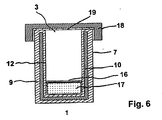
- Fig. 6 is a sectional view of a container according to the invention of a similar construction as the container shown in fig. 5 wherein, however, instead of insert 20 is placed a desiccant capsule 16 in the interior space of container body 1.
- container body 1 is formed of a sandwich structure comprising outer container wall 9, EVOH-layer 10 and inner container wall layer 12.
- Container opening 3 is sealed by an aluminium foil 19 and a cap 18. Fitted inside the interior space of container boy 1 is located a desiccant capsule 16 containing desiccant 17.
- the oxygen barrier function was determined by measuring the oxygen transmission rate through the container wall with a MOCON Oxtran 2/21 according to ASTM standard FR 1307 (in cm 3 O 2 /package ⁇ day).
- a container having a container body and a screw cap is formed by conventional blow-extrusion of the container body and injection moulding of the cap.
- the dimensions of the container are as follows: height: 49.12 mm; square section of 38.48 x 38.48; inner neck diameter of container body: 26.89 mm.
- the container body has a container wall having five layers which are formed by co-extrusion.
- the inner layer facing the interior space of the container and the outer layer facing the surroundings of the container is comprised of HDPE (Paxon ® AS55-003 from Exxon-Mobil Chemical, US).
- the middle layer is produced of EVOH (EVAL F 101 B, Kuraray Co., Ltd., JP).
- An adhesive layer is arranged between the outer container layer and the EVOH-layer and the EVOH-layer and the inner container wall layer, respectively.
- the adhesive layers are produced from anhydride modified linear low density polyethylene (LLDPE) resins (Bynel ® 41E710 from DuPont)
- the thickness of the five layers is as follows:
- the desiccant used was in the form of a desiccant-containing capsule dropped inside the container as displayed in fig. 4 and comprising molecular sieve 4A.
- the volume of the inner space of the container was 45 cm 3 .
- the oxygen transmission rate through the container wall of the container of the invention was measured according to ASTM standard FR 1307 in cm 3 O 2 / package ⁇ day.
- the mean value for oxygen transmission rate recorded for bottles according to the present invention was measured at 0.0005 cm 3 O 2 / package ⁇ day
- Oxygen transmission rate recorded for reference bottles was measured at 0,0041 cm 3 O 2 / package ⁇ day
Landscapes
- Engineering & Computer Science (AREA)
- Mechanical Engineering (AREA)
- Food Science & Technology (AREA)
- Packages (AREA)
Claims (14)
- Behälter umfassend- eine äußere Behälterwandschicht (9),
wobei die gesamte Innenseite der äußeren Behälterwandschicht mit einer EVOH-Schicht (10) bedeckt ist,- einen aktiven Sauerstofffänger, der bei Feuchtigkeitsgehalten unter 40 % relativer Feuchte funktioniert, und- ein Trockenmittel in einem Beutel, in einem Kanister, in einer Kapsel oder in einem Körper innerhalb des Innenraums des Behälters, das in der Lage ist, Feuchtigkeit aus dem Innenraum des Behälters zu absorbieren. - Behälter gemäß Anspruch 1, wobei die äußere Behälterwandschicht (9) wenigstens eine Schicht umfasst, die aus einem thermoplastischen Polymermaterial hergestellt ist.
- Behälter gemäß Anspruch 1 oder 2, wobei die EVOH-Schicht (10) mehr als 90 Gew.% EVOH umfasst.
- Behälter gemäß einem der vorstehenden Ansprüche, wobei eine Innenseitenoberfläche der EVOH-Schicht (10) wenigstens teilweise durch eine innere Behälterwandschicht (12) bedeckt ist.
- Behälter gemäß Anspruch 4, wobei die innere Behälterwandschicht (12) aus einem thermoplastischen Polymer hergestellt ist.
- Behälter gemäß einem der Ansprüche 4 oder 5, wobei die innere Behälterwandschicht (12) eine kleinere Schichtdicke als die äußere Behälterwandschicht (9) aufweist.
- Behälter gemäß Anspruch 6, wobei die Dicke der inneren Behälterwandschicht (12) weniger als 80 % der Dicke der äußeren Behälterwandschicht (9) beträgt.
- Behälter gemäß einem der vorstehenden Ansprüche, wobei zwischen der äußeren Behälterwandschicht (9) und der EVOH-Schicht (10) eine Klebstoffschicht (11) angeordnet ist.
- Behälter gemäß einem der Ansprüche 4 bis 8, wobei zwischen der EVOH-Schicht (10) und der inneren Behälterwandschicht (12) eine weitere Klebstoffschicht (13) angeordnet ist.
- Behälter gemäß Anspruch 8, wobei die Dicke der inneren Behälterwandschicht (12) mehr als 120 % der Dicke der äußeren Behälterwandschicht (9) beträgt.
- Behälter gemäß einem der vorstehenden Ansprüche, wobei der Behälter eine Öffnung (3) und einen Behälterdeckel (18) zum Verschließen der Öffnung umfasst.
- Behälter gemäß Anspruch 11, wobei das Trockenmittel in den Behälterdeckel (18) angeordnet ist.
- Behälter gemäß Anspruch 11, wobei die Behälteröffnung (3) durch eine Induktionsversiegelung (19) abgedichtet ist.
- Verwendung eines Behälters gemäß einem der Ansprüche 1 bis 13 zum Verpacken von Gütern, die empfindlich gegenüber Feuchtigkeit und/oder Sauerstoff sind.
Priority Applications (2)
| Application Number | Priority Date | Filing Date | Title |
|---|---|---|---|
| EP20080000116 EP2077237B1 (de) | 2008-01-04 | 2008-01-04 | Container mit verbesserter Sauerstoffträgerfunktion |
| DE200860006344 DE602008006344D1 (de) | 2008-01-04 | 2008-01-04 | Container mit verbesserter Sauerstoffträgerfunktion |
Applications Claiming Priority (1)
| Application Number | Priority Date | Filing Date | Title |
|---|---|---|---|
| EP20080000116 EP2077237B1 (de) | 2008-01-04 | 2008-01-04 | Container mit verbesserter Sauerstoffträgerfunktion |
Publications (2)
| Publication Number | Publication Date |
|---|---|
| EP2077237A1 EP2077237A1 (de) | 2009-07-08 |
| EP2077237B1 true EP2077237B1 (de) | 2011-04-20 |
Family
ID=39410457
Family Applications (1)
| Application Number | Title | Priority Date | Filing Date |
|---|---|---|---|
| EP20080000116 Active EP2077237B1 (de) | 2008-01-04 | 2008-01-04 | Container mit verbesserter Sauerstoffträgerfunktion |
Country Status (2)
| Country | Link |
|---|---|
| EP (1) | EP2077237B1 (de) |
| DE (1) | DE602008006344D1 (de) |
Cited By (1)
| Publication number | Priority date | Publication date | Assignee | Title |
|---|---|---|---|---|
| WO2016070421A1 (zh) * | 2014-11-04 | 2016-05-12 | 深圳市华星光电技术有限公司 | 一种防潮包装箱 |
Families Citing this family (7)
| Publication number | Priority date | Publication date | Assignee | Title |
|---|---|---|---|---|
| US20110215007A1 (en) * | 2010-02-19 | 2011-09-08 | Kenneth Charles Wurtzel | Container or molded package with buffering capacity |
| US9332782B2 (en) * | 2010-05-12 | 2016-05-10 | Multisorb Technologies, Inc. | Controlled release of water to an oxygen scavenger |
| US9302796B2 (en) | 2010-08-31 | 2016-04-05 | Foodwise Trn, Llc | Long-term packaging of food for consumer use |
| JP5900030B2 (ja) * | 2011-03-08 | 2016-04-06 | 凸版印刷株式会社 | 防湿容器 |
| AT517238B1 (de) * | 2015-05-28 | 2018-11-15 | Pyar Ltd | Behältnis |
| US20210228442A1 (en) * | 2018-06-26 | 2021-07-29 | Abbvie Inc. | Medicine Container, Method of Assembling the Container, and Method of Manufacturing the Container |
| CN109057620A (zh) * | 2018-09-26 | 2018-12-21 | 德清科宝防火保险柜有限公司 | 一种低氧保藏保险柜 |
Family Cites Families (7)
| Publication number | Priority date | Publication date | Assignee | Title |
|---|---|---|---|---|
| ATE23965T1 (de) * | 1981-02-27 | 1986-12-15 | American Can Co | Mehrschichtige polymerstruktur, die eine feuchtigkeitsempfindliche polymerschicht aufweist. |
| US4792484A (en) * | 1986-05-15 | 1988-12-20 | Kuraray Co., Ltd. | Composition, process for producing the same and multi-layer structure |
| ATE208333T1 (de) | 1994-08-05 | 2001-11-15 | West Pharm Serv Cornall Ltd | Behälter für feuchtickeitsempfindliche stoffe und entsprechendes verfahren zum trocknen und zur reduktion |
| CA2160744A1 (en) | 1995-01-03 | 1996-07-04 | George Klett | Desiccant canister |
| US6174952B1 (en) * | 1995-04-19 | 2001-01-16 | Capitol Specialty Plastics, Inc. | Monolithic polymer composition having a water absorption material |
| US7475773B2 (en) | 2005-02-01 | 2009-01-13 | Airsec S.A.S. | Container for moisture-sensitive goods |
| GB2429451B (en) * | 2005-08-25 | 2008-03-26 | Stanelco Rf Technologies Ltd | Gas absorbing means for a container |
-
2008
- 2008-01-04 EP EP20080000116 patent/EP2077237B1/de active Active
- 2008-01-04 DE DE200860006344 patent/DE602008006344D1/de active Active
Cited By (1)
| Publication number | Priority date | Publication date | Assignee | Title |
|---|---|---|---|---|
| WO2016070421A1 (zh) * | 2014-11-04 | 2016-05-12 | 深圳市华星光电技术有限公司 | 一种防潮包装箱 |
Also Published As
| Publication number | Publication date |
|---|---|
| DE602008006344D1 (de) | 2011-06-01 |
| EP2077237A1 (de) | 2009-07-08 |
Similar Documents
| Publication | Publication Date | Title |
|---|---|---|
| US20120006697A1 (en) | Container having improved oxygen barrier function | |
| EP2077237A1 (de) | Container mit verbesserter Sauerstoffträgerfunktion | |
| US10913585B2 (en) | Container and closure assembly with predetermined humidity and related method | |
| US6113927A (en) | Package and packaging method for aqueous liquid materials | |
| JP2009541169A (ja) | 酸素吸収物質を有するシールリング | |
| CA2203744A1 (en) | Sealing disc for a closure cap for containers | |
| US20070163917A1 (en) | Package and device for simultaneously maintaining low moisture and low oxygen levels | |
| US20110215007A1 (en) | Container or molded package with buffering capacity | |
| EP3902755B1 (de) | Tablettenausgabevorrichtung | |
| MX2008015407A (es) | Paquete de indicador. | |
| ES2987514T3 (es) | Disco de sellado para una caperuza de cierre para recipientes, especialmente botellas | |
| US12479647B2 (en) | Package configured to preserve or inhibit pathogens on product, and method of making and using at least portions of same | |
| JP3112358U (ja) | ハイバリア容器 | |
| EP4126697A1 (de) | Verpackung zum verbergen oder anderweitigen visuellen verdecken eines daran befestigten aktiven elements | |
| JPH0516952A (ja) | 多機能中栓 | |
| JP4960604B2 (ja) | 酸素吸収性を有する容器蓋 | |
| JP2023130613A (ja) | スパウト及びその製造方法、口栓、包装容器、並びに包装体 | |
| JP2004099057A (ja) | 内容物未充填包装容器、充填方法及び充填装置 | |
| KR940004976Y1 (ko) | 김치포장용 트레이(Tray) 용기 | |
| JPH11157028A (ja) | 複合シート及び密封容器 | |
| JPH0657139B2 (ja) | 清酒の保存方法 | |
| JPH11157029A (ja) | 複合シート及び密封容器 | |
| JPH11157027A (ja) | 複合シート及び密封容器 |
Legal Events
| Date | Code | Title | Description |
|---|---|---|---|
| PUAI | Public reference made under article 153(3) epc to a published international application that has entered the european phase |
Free format text: ORIGINAL CODE: 0009012 |
|
| AK | Designated contracting states |
Kind code of ref document: A1 Designated state(s): AT BE BG CH CY CZ DE DK EE ES FI FR GB GR HR HU IE IS IT LI LT LU LV MC MT NL NO PL PT RO SE SI SK TR |
|
| AX | Request for extension of the european patent |
Extension state: AL BA MK RS |
|
| 17P | Request for examination filed |
Effective date: 20090924 |
|
| 17Q | First examination report despatched |
Effective date: 20091029 |
|
| AKX | Designation fees paid |
Designated state(s): DE FR GB |
|
| GRAP | Despatch of communication of intention to grant a patent |
Free format text: ORIGINAL CODE: EPIDOSNIGR1 |
|
| GRAS | Grant fee paid |
Free format text: ORIGINAL CODE: EPIDOSNIGR3 |
|
| GRAA | (expected) grant |
Free format text: ORIGINAL CODE: 0009210 |
|
| AK | Designated contracting states |
Kind code of ref document: B1 Designated state(s): DE FR GB |
|
| REG | Reference to a national code |
Ref country code: GB Ref legal event code: FG4D |
|
| REF | Corresponds to: |
Ref document number: 602008006344 Country of ref document: DE Date of ref document: 20110601 Kind code of ref document: P |
|
| REG | Reference to a national code |
Ref country code: DE Ref legal event code: R096 Ref document number: 602008006344 Country of ref document: DE Effective date: 20110601 |
|
| PLBE | No opposition filed within time limit |
Free format text: ORIGINAL CODE: 0009261 |
|
| STAA | Information on the status of an ep patent application or granted ep patent |
Free format text: STATUS: NO OPPOSITION FILED WITHIN TIME LIMIT |
|
| 26N | No opposition filed |
Effective date: 20120123 |
|
| REG | Reference to a national code |
Ref country code: DE Ref legal event code: R097 Ref document number: 602008006344 Country of ref document: DE Effective date: 20120123 |
|
| REG | Reference to a national code |
Ref country code: DE Ref legal event code: R082 Ref document number: 602008006344 Country of ref document: DE Representative=s name: HOFFMANN - EITLE, DE |
|
| REG | Reference to a national code |
Ref country code: DE Ref legal event code: R082 Ref document number: 602008006344 Country of ref document: DE Representative=s name: HOFFMANN - EITLE PATENT- UND RECHTSANWAELTE PA, DE Effective date: 20130612 Ref country code: DE Ref legal event code: R082 Ref document number: 602008006344 Country of ref document: DE Representative=s name: HOFFMANN - EITLE, DE Effective date: 20130612 Ref country code: DE Ref legal event code: R081 Ref document number: 602008006344 Country of ref document: DE Owner name: CLARIANT PRODUCTION (FRANCE) S.A.S., FR Free format text: FORMER OWNER: AIRSEC S.A.S, CHOISY LE ROI, FR Effective date: 20130612 |
|
| REG | Reference to a national code |
Ref country code: GB Ref legal event code: 732E Free format text: REGISTERED BETWEEN 20130905 AND 20130911 |
|
| REG | Reference to a national code |
Ref country code: FR Ref legal event code: TP Owner name: CLARIANT PRODUCTION (FRANCE) S.A.S., FR Effective date: 20130910 |
|
| REG | Reference to a national code |
Ref country code: FR Ref legal event code: PLFP Year of fee payment: 9 |
|
| REG | Reference to a national code |
Ref country code: FR Ref legal event code: PLFP Year of fee payment: 10 |
|
| REG | Reference to a national code |
Ref country code: FR Ref legal event code: PLFP Year of fee payment: 11 |
|
| REG | Reference to a national code |
Ref country code: GB Ref legal event code: 732E Free format text: REGISTERED BETWEEN 20220106 AND 20220112 |
|
| REG | Reference to a national code |
Ref country code: GB Ref legal event code: 732E Free format text: REGISTERED BETWEEN 20220113 AND 20220119 |
|
| REG | Reference to a national code |
Ref country code: DE Ref legal event code: R081 Ref document number: 602008006344 Country of ref document: DE Owner name: AIRNOV, INC., WILMINGTON, NEW CASTLE, US Free format text: FORMER OWNER: CLARIANT PRODUCTION (FRANCE) S.A.S., TROSLY BREUIL, FR |
|
| P01 | Opt-out of the competence of the unified patent court (upc) registered |
Effective date: 20230414 |
|
| PGFP | Annual fee paid to national office [announced via postgrant information from national office to epo] |
Ref country code: GB Payment date: 20260130 Year of fee payment: 19 |
|
| PGFP | Annual fee paid to national office [announced via postgrant information from national office to epo] |
Ref country code: DE Payment date: 20260130 Year of fee payment: 19 |
|
| PGFP | Annual fee paid to national office [announced via postgrant information from national office to epo] |
Ref country code: FR Payment date: 20260130 Year of fee payment: 19 |