EP2077249A1 - Procédé de fabrication de nanostructure en 3D comportant une nano-sous-structure, et pyramide d'isolation disposant d'une pointe métallique, pyramide disposant de nano-ouvertures et nanofils horizontaux et/ou verticaux obtenus par ce procédé - Google Patents
Procédé de fabrication de nanostructure en 3D comportant une nano-sous-structure, et pyramide d'isolation disposant d'une pointe métallique, pyramide disposant de nano-ouvertures et nanofils horizontaux et/ou verticaux obtenus par ce procédé Download PDFInfo
- Publication number
- EP2077249A1 EP2077249A1 EP08000094A EP08000094A EP2077249A1 EP 2077249 A1 EP2077249 A1 EP 2077249A1 EP 08000094 A EP08000094 A EP 08000094A EP 08000094 A EP08000094 A EP 08000094A EP 2077249 A1 EP2077249 A1 EP 2077249A1
- Authority
- EP
- European Patent Office
- Prior art keywords
- pyramid
- nanosubstructure
- mold
- structural material
- deposited
- Prior art date
- Legal status (The legal status is an assumption and is not a legal conclusion. Google has not performed a legal analysis and makes no representation as to the accuracy of the status listed.)
- Withdrawn
Links
Images






Classifications
-
- B—PERFORMING OPERATIONS; TRANSPORTING
- B81—MICROSTRUCTURAL TECHNOLOGY
- B81C—PROCESSES OR APPARATUS SPECIALLY ADAPTED FOR THE MANUFACTURE OR TREATMENT OF MICROSTRUCTURAL DEVICES OR SYSTEMS
- B81C1/00—Manufacture or treatment of devices or systems in or on a substrate
- B81C1/00015—Manufacture or treatment of devices or systems in or on a substrate for manufacturing microsystems
- B81C1/00023—Manufacture or treatment of devices or systems in or on a substrate for manufacturing microsystems without movable or flexible elements
- B81C1/00111—Tips, pillars, i.e. raised structures
-
- B—PERFORMING OPERATIONS; TRANSPORTING
- B82—NANOTECHNOLOGY
- B82Y—SPECIFIC USES OR APPLICATIONS OF NANOSTRUCTURES; MEASUREMENT OR ANALYSIS OF NANOSTRUCTURES; MANUFACTURE OR TREATMENT OF NANOSTRUCTURES
- B82Y35/00—Methods or apparatus for measurement or analysis of nanostructures
-
- G—PHYSICS
- G01—MEASURING; TESTING
- G01Q—SCANNING-PROBE TECHNIQUES OR APPARATUS; APPLICATIONS OF SCANNING-PROBE TECHNIQUES, e.g. SCANNING PROBE MICROSCOPY [SPM]
- G01Q70/00—General aspects of SPM probes, their manufacture or their related instrumentation, insofar as they are not specially adapted to a single SPM technique covered by group G01Q60/00
- G01Q70/08—Probe characteristics
- G01Q70/10—Shape or taper
-
- G—PHYSICS
- G01—MEASURING; TESTING
- G01Q—SCANNING-PROBE TECHNIQUES OR APPARATUS; APPLICATIONS OF SCANNING-PROBE TECHNIQUES, e.g. SCANNING PROBE MICROSCOPY [SPM]
- G01Q70/00—General aspects of SPM probes, their manufacture or their related instrumentation, insofar as they are not specially adapted to a single SPM technique covered by group G01Q60/00
- G01Q70/16—Probe manufacture
-
- B—PERFORMING OPERATIONS; TRANSPORTING
- B33—ADDITIVE MANUFACTURING TECHNOLOGY
- B33Y—ADDITIVE MANUFACTURING, i.e. MANUFACTURING OF THREE-DIMENSIONAL [3D] OBJECTS BY ADDITIVE DEPOSITION, ADDITIVE AGGLOMERATION OR ADDITIVE LAYERING, e.g. BY 3D PRINTING, STEREOLITHOGRAPHY OR SELECTIVE LASER SINTERING
- B33Y10/00—Processes of additive manufacturing
-
- B—PERFORMING OPERATIONS; TRANSPORTING
- B33—ADDITIVE MANUFACTURING TECHNOLOGY
- B33Y—ADDITIVE MANUFACTURING, i.e. MANUFACTURING OF THREE-DIMENSIONAL [3D] OBJECTS BY ADDITIVE DEPOSITION, ADDITIVE AGGLOMERATION OR ADDITIVE LAYERING, e.g. BY 3D PRINTING, STEREOLITHOGRAPHY OR SELECTIVE LASER SINTERING
- B33Y80/00—Products made by additive manufacturing
-
- B—PERFORMING OPERATIONS; TRANSPORTING
- B81—MICROSTRUCTURAL TECHNOLOGY
- B81C—PROCESSES OR APPARATUS SPECIALLY ADAPTED FOR THE MANUFACTURE OR TREATMENT OF MICROSTRUCTURAL DEVICES OR SYSTEMS
- B81C2201/00—Manufacture or treatment of microstructural devices or systems
- B81C2201/03—Processes for manufacturing substrate-free structures
- B81C2201/034—Moulding
-
- Y—GENERAL TAGGING OF NEW TECHNOLOGICAL DEVELOPMENTS; GENERAL TAGGING OF CROSS-SECTIONAL TECHNOLOGIES SPANNING OVER SEVERAL SECTIONS OF THE IPC; TECHNICAL SUBJECTS COVERED BY FORMER USPC CROSS-REFERENCE ART COLLECTIONS [XRACs] AND DIGESTS
- Y10—TECHNICAL SUBJECTS COVERED BY FORMER USPC
- Y10T—TECHNICAL SUBJECTS COVERED BY FORMER US CLASSIFICATION
- Y10T428/00—Stock material or miscellaneous articles
- Y10T428/29—Coated or structually defined flake, particle, cell, strand, strand portion, rod, filament, macroscopic fiber or mass thereof
- Y10T428/2913—Rod, strand, filament or fiber
-
- Y—GENERAL TAGGING OF NEW TECHNOLOGICAL DEVELOPMENTS; GENERAL TAGGING OF CROSS-SECTIONAL TECHNOLOGIES SPANNING OVER SEVERAL SECTIONS OF THE IPC; TECHNICAL SUBJECTS COVERED BY FORMER USPC CROSS-REFERENCE ART COLLECTIONS [XRACs] AND DIGESTS
- Y10—TECHNICAL SUBJECTS COVERED BY FORMER USPC
- Y10T—TECHNICAL SUBJECTS COVERED BY FORMER US CLASSIFICATION
- Y10T428/00—Stock material or miscellaneous articles
- Y10T428/29—Coated or structually defined flake, particle, cell, strand, strand portion, rod, filament, macroscopic fiber or mass thereof
- Y10T428/2982—Particulate matter [e.g., sphere, flake, etc.]
Definitions
- the present invention relates to a method for making a 3D nanostructure having a nanosubstructure and to particular 3D nanostructures having such nanosubstructure, such as an insulating pyramid having a metallic tip, a pyramid having nano-apertures and horizontal and/or vertical nanowires.
- nanotechnology means that the relevant dimension is less than 100nm. This implies that the 3D nanostructure and substructures may be typically a few microns large, but would be much smaller.
- nano also encompasses structure with a relevant dimension up to 100 microns, preferably up to 50 microns or up to 10 microns. The lower limit is about 1nm, preferably about 5 or 10nm.
- Another fabrication strategy includes the use of stress induced retardation of oxide growth in corners to create nano-apertures (See A. Vollkopf, O. Rudow, M. Muller-Wiegand, G. Georgiev, E. Oesterschulze, "Influence of the oxidation temperature on the fabrication process of silicon dioxide aperture tips", Appl. Phys. A, 76 (2003), p. 923-926 ),and low temperature oxidation and selective etching (LOSE) to create an aperture at the apex of a pyramidal tip (see P.N. Minh, T. Ono, and M. Esashi, "Non-uniform silicon oxidation and application for the fabrication of aperture for near-field scanning optical microscopy", Appl. Phys. Lett., 75 (1999), pp. 4076-4078 .
- LOSE low temperature oxidation and selective etching
- stringers the remaining material in the corners
- they either constitute the structural material of wire structures and tips, or are used as a masking material in subsequent fabrication steps.
- the general fabrication method consists of a few basic steps: (1) mold fabrication, (2) conformal deposition of the structural material, (3) isotropic thinning of the structural layer, nanowires remain in sharp concave corners and (4) removal of the mold.
- the present invention has for its object to provide a method for making 3D nanostructures having at least one nanosubstructure and/or horizontal and/or vertical nanowires.
- the invention is based on the insight that by using corner lithography it is possible to create such nanosubstructures and nanowires without the need of nano lithography.
- structural material that remains after conformal deposition and subsequent isotropic thinning of a thin film in sharp concave corners is either used as a mask or directly as structural material. From the embodiments given it is clear that several steps can be added, for example to create an inversion mask.
- the method according to the invention is a powerful technique for nano-patterning of pyramidal tips, as the ones used in scanning probe microscopy (SPM).
- pyramids provided with apertures can be used for liquid meniscus manipulation.
- the 3D oriented wires can be used for manipulating a liquid droplet.
- these nanowires can be used for advanced measurements whereas effects typical for nanowires can now be determined in a 3D mode.
- 3D fluidum (gas/liquid) channels can be made (see for 2D fluidum channels: N.R. Tas, J.W. Berenschot, P. Mela, H.V. Jansen, M. Elwenspoek, A. van den Berg, "2D-Confined Nanochannels Fabricated by Conventional Micromachining", Nano Lett., 2 (2002), pp. 1031-1032 .
- the present invention provides a method for making a 3D nanostructure having a nanosubstructure, comprising the steps of:
- a sharp concave corner has an angle which in principle is greater than 0° and less than 180°. More practically the angles lies between about 10° and about 170°.
- the crystal angles are at about 70°, 90° en 110°. Using other crystal structures for the mold will allow the use of different angles.
- an important (silicon) etching method for micromachining is the so called deep reactive ion etching (DRIE). DRIE etches substancially perpendicular to the (silicon) substrate. This implies that the angle will be in a range around 90°. Furhtermore, at angles close to 180° the differential overetching for selctively removing material will be more difficult. Thus, the angles could be within the range of 30° to 150°, such as 50° to 140°, or from 60° to 120°.
- the 3D nanostructure has a pyramidal form and the conformal deposition takes place in at least the pyramidal apex and/or rigdes.
- the conformal deposition takes place in at least the pyramidal apex and/or rigdes.
- other 3D structures such as cones and pyramids with a triangular or multigonal base, are also possible.
- the structural material can be used as the structural material.
- Examples are polysilicon, silicon nitride and silicon oxide.
- Preferred are materials that can be conformally deposited using different methods and can be (isotropically) removed by different methods using conditions which are not negatively effecting the other applied materials.
- the other structural material deposited by local oxidation of the silicon mold and/or oxidation of a previously deposited structural material, such as poly silicon.
- the step vi) of forming the nanosubstructure may comprise a further material deposition, such as metal, plastic, porous material or mixtures thereof. More preferably the metal deposition results in the formation of an insulating pyramid having a metallic tip.
- Such metallic tip can be used as catalyst for e.g. carbon nanotube (- nanofiber) growth,as a local electrode for electrical or electrochemical measurement + stimulus, or for surface enhanced raman spectroscopy (SERS) measurements.
- the single hole at the apex can be used as a dopingmask.
- Mono crystalline silicon or poly-Silicon
- boron doped p++ silicon nano-dot or line
- Such structure conducts electricity well.
- this layer may be maintained when the mold is removed by etching. This results in the formation of a p++ nanodot or line.
- a metal contact can be provided to the top surface.
- step ii) two or more different structural materials are deposited, and preferably three different structural materials are deposited.
- step vi) of forming the nanosubstructure comprises the timed removal of at least one of the two or more different structural material deposited in step ii).
- step v) the first deposited structural material is isotropically removed. Accordingly, it is possible that the step vi) results in the formation of a pyramid having nano-apertures.
- Such pyramid having nano-apertures may be used as a submold for subsequent metal deposition resulting in the formation of metal surfaces being part of the pyramid structure. Similar as for the apertures is the size and position relative to the tip of the metal apertures tunable.
- a 3D nanostructure having a nanosubstructure in the form of a 3D oriented preferably horizontal and/or vertical nanowire comprising the steps of: i) providing a mold comprising at least one horizontal and/or vertical sharp concave corner; ii) conformal depositing at least one structural material in at least the sharp concave corner iii) isotropically removing structural material thereby forming the horizontal and/or vertical nanowire.
- a nanosubstructure comprising both horizontal and vertical wires. In this respect it is possible to provide a suspended horizontal wire.
- a sacrificial material such as poly-silicon
- a structural material such as an oxide or nitride
- nanosubstructures provided with the nanosubstructure, such as an insulating pyramid having a metallic tip, a pyramid having nano-apertures, and also horizontal and/or vertical nanowires.
- TMAH Low Pressure Chemical Vapour Deposited, LPCVD
- silicon oxide thermal
- LPCVD low stress silicon nitride
- Table 1 summarizes the etch rates of these materials in the etchants used in the examples.
- TMAH refers to a 5 wt% solution of tetramethyl ammonium hydroxide in water at 70 °C. 50% HF etching is performed at room temperature, without stirring.
- H 3 PO 4 refers to a 85 vol% solution at 180°C.
- Etch rates in nm/min Etchant Material Polysilicon Silicon nitride Silicon oxide TMAH 4-7e+02 * 1e-02 7e-02 HF 50% 4e-02 3.3e+00 2e+03 H 3 PO 4 3e-01 4.3e+00 2.5e-01 *The lower value is for the lateral etch rate in confinement, specifically for the conditions presented below. The higher value is for the blank film.
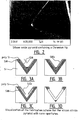
- Fig. 1 shows the fabrication scheme for an oxide pyramid supporting a nanosubstruture metal tip. Fabrication started with the mold fabrication, in this case by KOH etching in a ⁇ 100> silicon wafer to create the pyramidal hole bounded by the ⁇ 111> planes. Next, silicon nitride (220 nm) was deposited by LPCVD (conformal deposition) and isotropically removed in 50% HF (84 min. at room temperature).
- This is a timed etch step which required a 1.23 times over-etching to remove the silicon nitride in the four oblique ribs of the pyramidal hole ( ⁇ 109.4°) and leaving only a small piece of silicon nitride at the tip.
- a dummy wafer containing the same thickness of silicon nitride was etched in parallel.
- the silicon oxide structural material for the pyramid was formed by local oxidation of the silicon (LOCOS) (see J.A. Appels, E. Kooi, M.M. Paffen, J.J. H. Schatorje, W. Verkuylen, "Local oxidation of silicon and its applications in semiconductor-device technology", Philips Res.
- LOC local oxidation of the silicon
- TMAH is a suitable etchant for this step as it has a high selectivity for silicon as compared to silicon oxide (table 1) [7].
- Fig. 2 shows the fabricated silicon oxide pyramid having a Chromium tip of less than 300 nm in size.
- the pyramid may have particular uses. With wires made of piezoresistive material, such as p++ silicon nano-dot or line, the pyramide may be used for measuring (contact) forces. With wires made material having a temperature dependent electrical resistance, a pyramide may be used for local temperature measurement. Wire dissipating electrical power may be used for local heating.
- the aim of this example is to create a pyramid with tunable nanosubstructure apertures close to the tip.
- Fabrication started with KOH etching of the pyramidal mold in a ⁇ 100> silicon wafer.
- 500 nm LPCVD silicon nitride structural material was conformally deposited, followed by 330 nm LPCVD polysilicon. This layer acted as etching mask in later steps.
- a second layer of silicon nitride (120 nm) was deposited and isotropically etched in 50 %HF in order to remove all of the silicon nitride but a small remnant at the tip ( fig. 3a ).
- This remnant was used as an inversion mask in the LOCOS step (wet oxidation at 900°C for 10 min.) of the polysilicon ( fig. 3b ).
- a timed etching of the polysilicon followed, which starts at the apex of the pyramid and moves up along its sides ( fig. 3c ).
- the duration of this step determines the height of the nano apertures to be formed.
- a confined layer of 330 nm polysilicon etches laterally at a speed of 4.2 ⁇ 10 2 nm/min. in the 5 wt% TMAH solution supplied through a silicon oxide pinhole of sub 100 nm.
- Fig. 4 shows a typical fabrication result with apertures in the order of 1 ⁇ m in size. The size and the location of the apertures can be tuned by the thickness of in particular the silicon nitride layers and by the polysilicon etching time.
- Example 3 nano fencing: suspended nanowires
- a silicon oxide mold was made containing the appropriate sharp concave corners. Illustrated is the process which was followed by a structure having four vertical wires created in the corners of a square mold.
- a square silicon pillar is etched by deep reactive ion etching (DRIE) with photoresist as the mask material.
- the resist is stripped and the wafer oxidized (wet oxidation at 950 °C) to form the silicon oxide mold (thickness of about 400 nm), fig. 5a .
- DRIE deep reactive ion etching
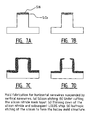
- an overhanging "roof" is added to the mold to create an horizontally oriented concave corner.
- the fabrication of the mold is illustrated in fig. 7 .
- a silicon pillar is etched by DRIE (Bosch process) using a silicon oxide and silicon nitride bi-layer as the mask.
- the silicon oxide is etched in BHF, under-cutting the silicon nitride thin film.
- the silicon nitride is thinned down in hot H 3 PO 4 until it is only left on top of the silicon oxide. Using the remaining mask material a LOCOS step is performed.
- Fig. 8 shows a SEM picture of a typical mold structure. The cross section next to it shows the location of the horizontal nanowires in the concave corners of the mold.
- Fig. 9 shows the resulting suspended nano wire structure formed after conformal deposition of silicon nitride (350 nm by LPCVD), subsequent isotropic thinning of this layer in hot H 3 PO 4 for 83 min., and removal of the mold in BHF .
- Example 4 Method for making a silicon nitride (SiN) pyramid fountain-pen with tunable nano-apertures.
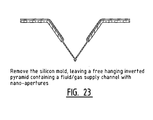
- example 2 is first produced a SiN pyramid with tunable nano-apertures. Subsequently, by further two conformal depositions of structural materials and by sacrificial etching of the formerly deposited structural layer are formed channels for liquid or gas. Finally after removal of the the silicon mold, remains a free hanging inverted pyramid containing a fluid/gas supply channel with nano-apertures.
- Figure 10 Mold fabrication: inverted pyramid in mono crystalline silicon created by anisotropic wet etching.
- Figure 11 shows the conformal deposition of 3 layers: LPCVD SiN, LPCVD Poly-Si, LPCVD SiN.
- Figure 12 shows the isotropic removal of the last deposited LPCVD SiN layer.
- Figure 13 shows the 1.23 times over-etching to remove the LPCVD SiN in the four oblique ribs of the inverted pyramid.
- Figure 14 shows the partly oxidation of the LPCVD poly-Si using the residual LPCVD SiN as inversion mask. (local oxidation of LPCVD poly-Si: LOCOS).
- Figure 15 shows the stripping of the residual LPCVD SiN.
- Figures 16 shows the wet etching of poly-Si using the LOCOS-oxide as mask material. Length A can be tuned by the etching time.
- Figure 17 shows the stripping of the LOCOS oxide.
- Figure 18 shows the isotropic etching of the first deposited LPCVD SiN layer using the polysilicon as the etch mask.
- Figure 19 shows the stripping of the poly-silicon layer.
- Figure 20 shows the conformal deposition of LPCVD poly Si (sacrificial layer).
- Figure 21 shows the conformal deposition of LPCVD SiN (capping layer of the fluid/gas channel).
- Figure 22 shows the sacrificial etching of the LPCVD poly-Si layer, leaving a channel for fluid/gas supply.
- Figure 23 shows the removal of the silicon mold, leaving a free hanging inverted pyramid containing a fluid/gas supply channel with nano-apertures.
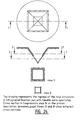
- Figure 24 is the top drawing represents the top view of the final structure: a SiN pyramid fountain pen with tunable nano-apertures.
- Cross section 1-1 represents figure 23 . Views 2) and 3) show different cross sections.
- the advantage of the fountain pen approach compared with NADIS is that a wider variety of inks can be used (also more volatile ones) and that eventually complex fluidic delivery systems can be made.
- some of the possible advantages of the fountain pen technology are: a larger amount of ink is available, the dependence of the writing process on relative humidity could be less, inks can be mixed at the tip, inks can possibly be changed during writing and electrochemical deposition of for example metals is possible.
- a cross-section of the prior art probe is shown in figure 25 below, together with a written line pattern of a self-assembled monolayer (ODT) on gold. As can be seen in fig. 25 , the written feature size is still in the order of 1 ⁇ m.
- the final aim in the scope of this proposal is a ten-fold reduction of the line width, so typically sub-100 nm resolution.
- the applicant has ongoing collaborations with the Biophysical Engineering Group of prof. Subramaniam and the Molecular Nanofabrication group of prof. Huskens (both at the university of Twente) on the application of the nanofountain pen, therefore knowledge of different inks and substrates to be tested is available to the project.
Landscapes
- Engineering & Computer Science (AREA)
- Chemical & Material Sciences (AREA)
- Manufacturing & Machinery (AREA)
- Radiology & Medical Imaging (AREA)
- Physics & Mathematics (AREA)
- Health & Medical Sciences (AREA)
- General Health & Medical Sciences (AREA)
- General Physics & Mathematics (AREA)
- Nuclear Medicine, Radiotherapy & Molecular Imaging (AREA)
- Analytical Chemistry (AREA)
- Microelectronics & Electronic Packaging (AREA)
- Nanotechnology (AREA)
- Crystallography & Structural Chemistry (AREA)
- Micromachines (AREA)
- Crystals, And After-Treatments Of Crystals (AREA)
- Semiconductor Memories (AREA)
- Cold Cathode And The Manufacture (AREA)
- Moulds For Moulding Plastics Or The Like (AREA)
- Mounting, Exchange, And Manufacturing Of Dies (AREA)
Priority Applications (7)
| Application Number | Priority Date | Filing Date | Title |
|---|---|---|---|
| EP08000094A EP2077249A1 (fr) | 2008-01-06 | 2008-01-06 | Procédé de fabrication de nanostructure en 3D comportant une nano-sous-structure, et pyramide d'isolation disposant d'une pointe métallique, pyramide disposant de nano-ouvertures et nanofils horizontaux et/ou verticaux obtenus par ce procédé |
| EP19171039.1A EP3549906A3 (fr) | 2008-01-06 | 2008-12-22 | Procédé de fabrication de nanostructure en 3d comportant une nano-sous-structure comme une pyramide d'isolation disposant d'une pointe métallique |
| JP2010541027A JP5501250B2 (ja) | 2008-01-06 | 2008-12-22 | ナノサブ構造を有する3次元ナノ構造を製作するための方法、および、この方法によって得ることのできる金属先端を有する絶縁角錐、ナノ開口を有する角錐、および、水平および/または垂直なナノワイヤを有する角錐 |
| EP08869344.5A EP2231507B1 (fr) | 2008-01-06 | 2008-12-22 | Procédé de fabrication de nanostructure en 3d comportant une nano-sous-structure comme une pyramide d'isolation disposant d'une pointe métallique |
| US12/811,674 US8932473B2 (en) | 2008-01-06 | 2008-12-22 | Method for making a 3D nanostructure having a nanosubstructure, and an insulating pyramid having a metallic tip, a pyramid having nano-apertures and horizontal and/or vertical nanowires obtainable by this method |
| PCT/EP2008/011107 WO2009086915A1 (fr) | 2008-01-06 | 2008-12-22 | Procédé pour réaliser une nanostructure en 3d comportant une nano-sous-structure, et pyramide isolante comportant une pointe métallique, pyramide comportant des nano-ouvertures et des nanofils horizontaux et/ou verticaux pouvant être obtenue à l'aide de ce procédé |
| US14/570,652 US9416001B2 (en) | 2008-01-06 | 2014-12-15 | Method for making a 3D nanostructure having a nanosubstructure, and an insulating pyramid having a metallic tip, a pyramid having nano-apertures and horizontal and/or vertical nanowires obtainable by this method |
Applications Claiming Priority (1)
| Application Number | Priority Date | Filing Date | Title |
|---|---|---|---|
| EP08000094A EP2077249A1 (fr) | 2008-01-06 | 2008-01-06 | Procédé de fabrication de nanostructure en 3D comportant une nano-sous-structure, et pyramide d'isolation disposant d'une pointe métallique, pyramide disposant de nano-ouvertures et nanofils horizontaux et/ou verticaux obtenus par ce procédé |
Publications (1)
| Publication Number | Publication Date |
|---|---|
| EP2077249A1 true EP2077249A1 (fr) | 2009-07-08 |
Family
ID=39408658
Family Applications (3)
| Application Number | Title | Priority Date | Filing Date |
|---|---|---|---|
| EP08000094A Withdrawn EP2077249A1 (fr) | 2008-01-06 | 2008-01-06 | Procédé de fabrication de nanostructure en 3D comportant une nano-sous-structure, et pyramide d'isolation disposant d'une pointe métallique, pyramide disposant de nano-ouvertures et nanofils horizontaux et/ou verticaux obtenus par ce procédé |
| EP08869344.5A Active EP2231507B1 (fr) | 2008-01-06 | 2008-12-22 | Procédé de fabrication de nanostructure en 3d comportant une nano-sous-structure comme une pyramide d'isolation disposant d'une pointe métallique |
| EP19171039.1A Pending EP3549906A3 (fr) | 2008-01-06 | 2008-12-22 | Procédé de fabrication de nanostructure en 3d comportant une nano-sous-structure comme une pyramide d'isolation disposant d'une pointe métallique |
Family Applications After (2)
| Application Number | Title | Priority Date | Filing Date |
|---|---|---|---|
| EP08869344.5A Active EP2231507B1 (fr) | 2008-01-06 | 2008-12-22 | Procédé de fabrication de nanostructure en 3d comportant une nano-sous-structure comme une pyramide d'isolation disposant d'une pointe métallique |
| EP19171039.1A Pending EP3549906A3 (fr) | 2008-01-06 | 2008-12-22 | Procédé de fabrication de nanostructure en 3d comportant une nano-sous-structure comme une pyramide d'isolation disposant d'une pointe métallique |
Country Status (4)
| Country | Link |
|---|---|
| US (2) | US8932473B2 (fr) |
| EP (3) | EP2077249A1 (fr) |
| JP (1) | JP5501250B2 (fr) |
| WO (1) | WO2009086915A1 (fr) |
Cited By (2)
| Publication number | Priority date | Publication date | Assignee | Title |
|---|---|---|---|---|
| CN109073675A (zh) * | 2015-12-14 | 2018-12-21 | 米纳斯吉拉斯联合大学 | 用于扫描探针显微术的金属装置及其制造方法 |
| CN116715186A (zh) * | 2023-03-03 | 2023-09-08 | 浙江大学 | 基于仿生学的纤毛光学流体传感器阵列及流场测试方法 |
Families Citing this family (10)
| Publication number | Priority date | Publication date | Assignee | Title |
|---|---|---|---|---|
| EP2077249A1 (fr) * | 2008-01-06 | 2009-07-08 | Universiteit Twente | Procédé de fabrication de nanostructure en 3D comportant une nano-sous-structure, et pyramide d'isolation disposant d'une pointe métallique, pyramide disposant de nano-ouvertures et nanofils horizontaux et/ou verticaux obtenus par ce procédé |
| FR2934709B1 (fr) * | 2008-08-01 | 2010-09-10 | Commissariat Energie Atomique | Structure d'echange thermique et dispositif de refroidissement comportant une telle structure. |
| CA2798716A1 (fr) | 2011-12-13 | 2013-06-13 | Endochoice Innovation Center Ltd. | Endoscope a pointe amovible |
| US9334571B2 (en) * | 2012-06-29 | 2016-05-10 | Regents Of The University Of Minnesota | Method of forming individual metallic microstructures |
| US10689245B2 (en) | 2018-02-27 | 2020-06-23 | International Business Machines Corporation | Vertically stacked nanofluidic channel array |
| CN108673880A (zh) * | 2018-06-13 | 2018-10-19 | 北京化工大学 | 一种具有榫卯结构的3d打印填充结构及其加工工艺 |
| EP3552806A1 (fr) | 2018-04-09 | 2019-10-16 | Nederlandse Organisatie voor toegepast- natuurwetenschappelijk onderzoek TNO | Procédé d'appareil de formation d'un objet à l'aide de la fabrication additive |
| NL2022939B1 (en) * | 2019-04-12 | 2020-10-20 | Smarttip Bv | A method of providing a MEMS device comprising a pyramidal protrusion, and a mold |
| CN112062084A (zh) * | 2020-08-25 | 2020-12-11 | 华南理工大学 | 一种高分辨率的硅基中空悬臂探针及其制备方法 |
| NL2026730B1 (en) | 2020-10-22 | 2022-06-16 | Cytosurge Ag | A method of manufacturing a MEMS device |
Citations (5)
| Publication number | Priority date | Publication date | Assignee | Title |
|---|---|---|---|---|
| JPH06117849A (ja) * | 1992-10-07 | 1994-04-28 | Advantest Corp | Spm用探針及びその製造方法 |
| US5483118A (en) * | 1993-03-15 | 1996-01-09 | Kabushiki Kaisha Toshiba | Field emission cold cathode and method for production thereof |
| US20030081651A1 (en) * | 2001-10-31 | 2003-05-01 | Gianchandani Yogesh B. | Micromachined scanning thermal probe method and apparatus |
| WO2003060923A1 (fr) * | 2002-01-15 | 2003-07-24 | International Business Machines Corporation | Microstructures |
| WO2004015362A2 (fr) * | 2002-08-05 | 2004-02-19 | Universität Kassel | Procede pour realiser une structure dotee d'une arete etroite ou d'une pointe effilee et barre de flexion pourvue d'une telle structure |
Family Cites Families (13)
| Publication number | Priority date | Publication date | Assignee | Title |
|---|---|---|---|---|
| US5584740A (en) * | 1993-03-31 | 1996-12-17 | The United States Of America As Represented By The Secretary Of The Navy | Thin-film edge field emitter device and method of manufacture therefor |
| KR100205051B1 (ko) * | 1995-12-22 | 1999-06-15 | 정선종 | 필드 에미션 디스플레이 소자의 제조방법 |
| US5789272A (en) * | 1996-09-27 | 1998-08-04 | Industrial Technology Research Institute | Low voltage field emission device |
| JP3697034B2 (ja) * | 1997-08-26 | 2005-09-21 | キヤノン株式会社 | 微小開口を有する突起の製造方法、及びそれらによるプローブまたはマルチプローブ |
| JP2000123711A (ja) * | 1998-10-12 | 2000-04-28 | Toshiba Corp | 電界放出型冷陰極及びその製造方法 |
| JP3884887B2 (ja) * | 1999-08-27 | 2007-02-21 | 株式会社ルネサステクノロジ | 描画用探針及びその製作方法 |
| JP2001116678A (ja) * | 1999-10-14 | 2001-04-27 | Canon Inc | 光照射用または光検出用プローブの製造方法、および光照射用または光検出用プローブ |
| GB2383187B (en) * | 2001-09-13 | 2005-06-22 | Microsaic Systems Ltd | Electrode structures |
| WO2004028952A2 (fr) * | 2002-06-26 | 2004-04-08 | Cornell Research Foundation, Inc. | Microfils pour dispositifs microelectromecaniques |
| JP2004239704A (ja) * | 2003-02-05 | 2004-08-26 | Renesas Technology Corp | カンチレバーおよびその製造方法 |
| GB0708695D0 (en) * | 2007-05-04 | 2007-06-13 | Univ Nottingham | Fabrication of nanoparticles |
| EP2077249A1 (fr) * | 2008-01-06 | 2009-07-08 | Universiteit Twente | Procédé de fabrication de nanostructure en 3D comportant une nano-sous-structure, et pyramide d'isolation disposant d'une pointe métallique, pyramide disposant de nano-ouvertures et nanofils horizontaux et/ou verticaux obtenus par ce procédé |
| WO2010114887A1 (fr) * | 2009-03-31 | 2010-10-07 | Georgia Tech Research Corporation | Gravure chimique de substrats assistée par métal |
-
2008
- 2008-01-06 EP EP08000094A patent/EP2077249A1/fr not_active Withdrawn
- 2008-12-22 EP EP08869344.5A patent/EP2231507B1/fr active Active
- 2008-12-22 US US12/811,674 patent/US8932473B2/en active Active
- 2008-12-22 WO PCT/EP2008/011107 patent/WO2009086915A1/fr not_active Ceased
- 2008-12-22 EP EP19171039.1A patent/EP3549906A3/fr active Pending
- 2008-12-22 JP JP2010541027A patent/JP5501250B2/ja active Active
-
2014
- 2014-12-15 US US14/570,652 patent/US9416001B2/en active Active
Patent Citations (5)
| Publication number | Priority date | Publication date | Assignee | Title |
|---|---|---|---|---|
| JPH06117849A (ja) * | 1992-10-07 | 1994-04-28 | Advantest Corp | Spm用探針及びその製造方法 |
| US5483118A (en) * | 1993-03-15 | 1996-01-09 | Kabushiki Kaisha Toshiba | Field emission cold cathode and method for production thereof |
| US20030081651A1 (en) * | 2001-10-31 | 2003-05-01 | Gianchandani Yogesh B. | Micromachined scanning thermal probe method and apparatus |
| WO2003060923A1 (fr) * | 2002-01-15 | 2003-07-24 | International Business Machines Corporation | Microstructures |
| WO2004015362A2 (fr) * | 2002-08-05 | 2004-02-19 | Universität Kassel | Procede pour realiser une structure dotee d'une arete etroite ou d'une pointe effilee et barre de flexion pourvue d'une telle structure |
Non-Patent Citations (9)
| Title |
|---|
| A. VOLLKOPF ET AL.: "Influence of the oxidation temperature on the fabrication process of silicon dioxide aperture tips", APPL. PHYS. A, vol. 76, 2003, pages 923 - 926 |
| DELADI S ET AL: "Fabrication of micromachined fountain pen with in situ characterization possibility of nanoscale surface modification; Fabrication of micromachined fountain pen with in situ characterization possibility of nanoscale surface modification", JOURNAL OF MICROMECHANICS & MICROENGINEERING, INSTITUTE OF PHYSICS PUBLISHING, BRISTOL, GB, vol. 15, no. 3, 1 March 2005 (2005-03-01), pages 528 - 534, XP020091497, ISSN: 0960-1317 * |
| E. SARAJLIC ET AL.: "Fabrication of 3D Nanowire Frames by Conventional Micromachining Technology", TRANSDUCERS '05 [DIGEST OF TECHN. PAPERS 13TH INT. CONF. ON SOLID-STATE SENSORS, ACTUATORS AND MICROSYSTEMS, pages 27 - 29 |
| J. HANEVELD ET AL.: "Nano-ridge fabrication by local oxidation of silicon edges with silicon nitride as a mask", J. MICROMECH. MICROENG., vol. 16, 2006, pages S24 - S28 |
| J.A. APPELS ET AL.: "Local oxidation of silicon and its applications in semiconductor-device technology", PHILIPS RES. REP., vol. 25, 1970, pages 118 - 132 |
| N.R. TAS ET AL.: "2D-Confined Nanochannels Fabricated by Conventional Micromachining", NANO LETT., vol. 2, 2002, pages 1031 - 1032 |
| P.N. MINH; T. ONO; M. ESASHI: "Non-uniform silicon oxidation and application for the fabrication of aperture for near-field scanning optical microscopy", APPL. PHYS. LETT., vol. 75, 1999, pages 4076 - 4078 |
| R.B. MARCUS; T.T. SHENG: "The oxidation of shaped silicon surfaces", J. ELECTROCHEM. SOC., vol. 129, 1982, pages 1278 - 1282 |
| SARAJLIC E ET AL: "Fabrication of 3D nanowire frames by conventional micromachining technology", SOLID-STATE SENSORS, ACTUATORS AND MICROSYSTEMS, 2005. DIGEST OF TECHN ICAL PAPERS. TRANSDUCERS '05. THE 13TH INTERNATIONAL CONFERENCE ON SEOUL, KOREA JUNE 5-9, 2005, PISCATAWAY, NJ, USA,IEEE, vol. 1, 5 June 2005 (2005-06-05), pages 27 - 30, XP010827954, ISBN: 978-0-7803-8994-6 * |
Cited By (3)
| Publication number | Priority date | Publication date | Assignee | Title |
|---|---|---|---|---|
| CN109073675A (zh) * | 2015-12-14 | 2018-12-21 | 米纳斯吉拉斯联合大学 | 用于扫描探针显微术的金属装置及其制造方法 |
| CN109073675B (zh) * | 2015-12-14 | 2021-01-15 | 米纳斯吉拉斯联合大学 | 用于扫描探针显微术的金属装置及其制造方法 |
| CN116715186A (zh) * | 2023-03-03 | 2023-09-08 | 浙江大学 | 基于仿生学的纤毛光学流体传感器阵列及流场测试方法 |
Also Published As
| Publication number | Publication date |
|---|---|
| EP3549906A2 (fr) | 2019-10-09 |
| EP3549906A3 (fr) | 2019-12-11 |
| EP2231507B1 (fr) | 2019-05-01 |
| JP5501250B2 (ja) | 2014-05-21 |
| US9416001B2 (en) | 2016-08-16 |
| WO2009086915A1 (fr) | 2009-07-16 |
| US20110039100A1 (en) | 2011-02-17 |
| US20150158724A1 (en) | 2015-06-11 |
| US8932473B2 (en) | 2015-01-13 |
| JP2011511270A (ja) | 2011-04-07 |
| EP2231507A1 (fr) | 2010-09-29 |
Similar Documents
| Publication | Publication Date | Title |
|---|---|---|
| EP2231507B1 (fr) | Procédé de fabrication de nanostructure en 3d comportant une nano-sous-structure comme une pyramide d'isolation disposant d'une pointe métallique | |
| Ziaie et al. | Introduction to micro-/nanofabrication | |
| US7997123B2 (en) | Nanotipped device and method | |
| US20100081278A1 (en) | Methods for Nanoscale Feature Imprint Molding | |
| Rius et al. | Introduction to micro-/nanofabrication | |
| US8828243B2 (en) | Scanning probe having integrated silicon tip with cantilever | |
| CN102205943A (zh) | 一种单晶硅纳米结构的制备方法 | |
| Zhao et al. | Sub-10 nm silicon ridge nanofabrication by advanced edge lithography for NIL applications | |
| Westerik et al. | Sidewall patterning—a new wafer-scale method for accurate patterning of vertical silicon structures | |
| US6887395B2 (en) | Method of forming sub-micron-size structures over a substrate | |
| Berenschot et al. | 3D-nanomachining using corner lithography | |
| Sarajlic et al. | Fabrication of 3D nanowire frames by conventional micromachining technology | |
| Mihalcea et al. | Reproducible large‐area microfabrication of sub‐100 nm apertures on hollow tips | |
| NL2026730B1 (en) | A method of manufacturing a MEMS device | |
| Boisen et al. | Indirect tip fabrication for scanning probe microscopy | |
| Berenschot et al. | A method for making a 3D nanostructure having a nanosubstructure, and an insulating pyramid having a metallic tip, a pyramid having nano-apertures and horizontal and/or vertical nanovires obtainable by this method | |
| Haneveld et al. | Nano-ridge fabrication by local oxidation of silicon edges with silicon nitride as a mask | |
| Golod et al. | Directional-rolling method for strained SiGe/Si films and its application to fabrication of hollow needles | |
| Berenschot et al. | Wafer-scale nanostructure formation inside vertical nano-pores | |
| US11035880B2 (en) | Method for producing a probe suitable for scanning probe microscopy | |
| EP3953716B1 (fr) | Méthode de fabrication d'un dispositif mems comprenant une pointe, et moule | |
| Xie et al. | Fabrication of localized plasma gold-tip nanoprobes with integrated microchannels for direct-write nanomanufacturing | |
| Lin et al. | A liquid-based gravity-driven etching-stop technique and its application to wafer level cantilever thickness control of AFM probes | |
| Yifang et al. | Fabrication of nano-tips employing three different methods | |
| WILLIAMS | Fremont, California, USA |
Legal Events
| Date | Code | Title | Description |
|---|---|---|---|
| PUAI | Public reference made under article 153(3) epc to a published international application that has entered the european phase |
Free format text: ORIGINAL CODE: 0009012 |
|
| AK | Designated contracting states |
Kind code of ref document: A1 Designated state(s): AT BE BG CH CY CZ DE DK EE ES FI FR GB GR HR HU IE IS IT LI LT LU LV MC MT NL NO PL PT RO SE SI SK TR |
|
| AX | Request for extension of the european patent |
Extension state: AL BA MK RS |
|
| AKX | Designation fees paid | ||
| REG | Reference to a national code |
Ref country code: DE Ref legal event code: 8566 |
|
| STAA | Information on the status of an ep patent application or granted ep patent |
Free format text: STATUS: THE APPLICATION IS DEEMED TO BE WITHDRAWN |
|
| 18D | Application deemed to be withdrawn |
Effective date: 20100109 |