EP2077522A1 - Verfahren zur Beurteilung von Beziehungen zwischen Benutzern eines Systems für soziale Vernetzung - Google Patents
Verfahren zur Beurteilung von Beziehungen zwischen Benutzern eines Systems für soziale Vernetzung Download PDFInfo
- Publication number
- EP2077522A1 EP2077522A1 EP07301741A EP07301741A EP2077522A1 EP 2077522 A1 EP2077522 A1 EP 2077522A1 EP 07301741 A EP07301741 A EP 07301741A EP 07301741 A EP07301741 A EP 07301741A EP 2077522 A1 EP2077522 A1 EP 2077522A1
- Authority
- EP
- European Patent Office
- Prior art keywords
- user
- social networking
- networking system
- memory
- stored
- Prior art date
- Legal status (The legal status is an assumption and is not a legal conclusion. Google has not performed a legal analysis and makes no representation as to the accuracy of the status listed.)
- Withdrawn
Links
Images


Classifications
-
- G—PHYSICS
- G06—COMPUTING OR CALCULATING; COUNTING
- G06Q—INFORMATION AND COMMUNICATION TECHNOLOGY [ICT] SPECIALLY ADAPTED FOR ADMINISTRATIVE, COMMERCIAL, FINANCIAL, MANAGERIAL OR SUPERVISORY PURPOSES; SYSTEMS OR METHODS SPECIALLY ADAPTED FOR ADMINISTRATIVE, COMMERCIAL, FINANCIAL, MANAGERIAL OR SUPERVISORY PURPOSES, NOT OTHERWISE PROVIDED FOR
- G06Q10/00—Administration; Management
- G06Q10/10—Office automation; Time management
Definitions
- the present invention relates to relationship valuing in a social networking system.
- the information that can be shared as well as their use can be various, depending on the type of social networking system. They can comprise for example online and offline contact details, favourite things, Web links or content (audio, video, text), etc.
- An object of the present invention is to answer this need.
- the invention proposes a method for valuing relationships between users of a social networking system, each user holding a respective electronic device for communicating through the social networking system, information relating to each user being stored in at least one memory.
- a relationship between a first user and a second user who is defined as a first degree contact of the first user in the social networking system is valued by taking account of an amount of the information relating to the first user stored in said memory that the first user is willing to share with the second user.
- the obtained relationship value is fairly objective as it depends on an amount of the information relating to the first user stored in said memory that the first user is willing to share with the second user. In that sense, it may be considered as representative of the level of confidence the first user may have in the second user.
- relationship value can be interpreted by computer-based systems, as it can take the form of a single number.
- sensitivity of the information relating to the first user stored in said memory may further be taken into account in the relationship valuing.
- the method can also be used to value a relationship between the first user and a third user of the social networking system who is defined as a first degree contact of the second user but not as a first degree contact of the first user.
- Said relationship may indeed be valued by taking account of the relationship value between the first user and the second user and the relationship value between the second user and the third user.
- the resulting relationship value between the first user and the third user may advantageously be used to determine an amount and/or sensitivity of the information relating to the first user stored in said memory that the first user can share with the third user.
- the invention also proposes a social networking system arranged for implementing the above mentioned method, the social networking system allowing relationships between users each holding a respective electronic device for communicating through the social networking system, information relating to each user being stored in at least one memory.
- the social networking system comprises means for valuing a relationship between a first user and a second user who is defined as a first degree contact of the first user in the social networking system, by taking account of an amount of the information relating to the first user stored in said memory that the first user is willing to share with the second user.
- the invention also proposes a server of a social networking system allowing relationships between users each holding a respective electronic device for communicating through the social networking system, information relating to each user being stored in at least one memory.
- the server is arranged for implementing the above mentioned method and comprises means for valuing a relationship between a first user and a second user who is defined as a first degree contact of the first user in the social networking system, by taking account of an amount of the information relating to the first user stored in said memory that the first user is willing to share with the second user.
- the invention also proposes a computer program product comprising code instructions for carrying out the above mentioned method, when loaded and run on computer means.
- FIG.1 shows a non-limiting example of a social networking system having a plurality of users A, B, C and C'.
- the social networking system makes use of equipments 1 which allow a communication between the users.
- equipments may comprise access network devices which provide an interface with some of the users (e.g. xDSL devices to connect the users A and C', WiFi or Bluetooth means to connect the user B, and radio access network devices of the GSM, 3G or WiMax type for the user C), as well as corresponding core network devices, such as switches or routers, which provide appropriate means to correctly direct the traffic received from or sent to the access network devices.
- access network devices which provide an interface with some of the users (e.g. xDSL devices to connect the users A and C', WiFi or Bluetooth means to connect the user B, and radio access network devices of the GSM, 3G or WiMax type for the user C), as well as corresponding core network devices, such as switches or routers, which provide appropriate means to correctly direct the traffic received from or sent to the access network devices.
- the technology on which the social networking system is based can be of any type. It includes but is not limited to Internet, Intranets and IP-based networks.
- An application layer is further provided in the social networking system to allow the users to communicate and share information with each other, as well known in the art.
- Each user of the social networking system holds an electronic device for communicating through the social networking system.
- the users A and C' each hold a computer or a laptop
- the user B holds a personal digital assistant (PDA)
- the user C holds a mobile phone.
- PDA personal digital assistant
- other electronic devices would be suitable as well.
- Information relating to each user is stored in one or several memories.
- the memories may be embedded in the electronic devices.
- each electronic device may advantageously store information relating to the user it belongs to.
- the memory may be part of any other device or system of the social networking system. As an example, it may be associated with the server 2 that will be described below. It may also be distributed across multiple servers and/or systems.
- the information stored in relation to each user can comprise for example online and offline contact details, favourite things, Web links or content (audio, video, text), etc.
- social relationships may exist between the users of the social networking system.
- the user B may be defined as a first degree contact of the user A, as symbolized by the dashed link I AB therebetween in FIG.1 . This means that A may know B and has a certain level of confidence in him.
- the user A and the user B are first degree contacts of each other when they have reached a mutual agreement, which is realised electronically, to be connected directly to each other via a social networking service and appear in each other's contact list of the social network application running on their personal electronic devices.
- A may be willing to share with B a certain amount of his information (that is the information relating to A which is stored in said memory).
- this amount of information as well as the type of information A may be willing to share with B may be highly dependent on the type of relationship they have with each other. For instance, if B has been a close friend of A for a long time or one of his family members, then A may be willing to share all his stored information with B. In contrast, if B has recently come into a relationship with A, A may prefer to share only a small amount of his stored information with B.
- C and C' may be defined as first degree contacts of B, as symbolized respectively by the dashed links I BC and I BC' in FIG.1 .
- C and C' are not first degree contacts of A, perhaps because A does not know them.
- C or C' may be considered as second degree contacts of A, as they are first degree contacts of B who is a first degree contact of
- a value is assigned to the relationship between A and his first degree contact B.
- This value also called RV for "relationship value" in the following, is obtained by taking account of the amount of the information relating to A stored in said memory that A is willing to share with B.
- the RV can be calculated in a sliding scale between 0 and 100, where 0 would equate to a very close relationship in which every stored information is shared and 100 would equate to a very distant relationship in which none of the stored information is shared.
- RV is believed to be a good measurement of the relationship between two users, because, as mentioned above, the amount of personal information shared with a contact user would generally depend on the confidence level in this contact user.
- RVs may be obtained for the relationships A->B and B->A, especially if A and B are not willing to share the same amount of personal information with one another. It could be decided however that the same RV, e.g. the highest value of the two corresponding RVs, applies for both directions A->B and B->A.
- two types of profiles may be associated to a user of the social networking system.
- those profiles could be:
- Each first degree contact of A in the social networking system namely the user B in the illustrated example, is assigned one of A's access profiles.
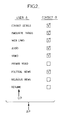
- FIG.2 shows an exemplary access profile of A assigned to B.
- the A's information forming A's user profile UP is divided into a number of categories.
- the A's access profile AP assigned to B allows the latter to access some of A's information (contact details, favourite things, Web links, audio, video and political views), but not some others (private video, religious views and resume).
- the amount of the information relating to A stored in said memory that A is willing to share with B may advantageously be calculated from AP.
- AP shows that A is willing to share with B six information items out of the nine information items contained in UP.
- the relationship valued between A and B may further take account of a sensitivity of the information relating to A stored in said memory.
- a first degree contact of A that would have access to those sensitive information could be considered as having a closer relationship with A than B. This could be reflected in the RV determination.
- each piece of information of the information relating to A stored in said memory may be assigned a weight depending on the respective sensitivity of said piece of information, and the RV between A and B may further take account of at least some of those weights.
- weights may be assigned in a sliding scale of the sensitivity of a piece of information set between 1 and 20, where 1 relates to non sensitive information and 20 relates to highly sensitive information.
- a global, system-defined weighting table for each of the pieces of information entered in a user profile would of course be an asset.
- the RV between A and B may be calculated for instance as 100 - ((x/y)*100), where x represents the total weight of the information relating to A stored in said memory that A is willing to share with B and y represents the total weight of the information relating to A stored in said memory.
- That formula would cause the RV to be in the range of 0 to 100, where 0 would equate to a very close relationship with A (every A's information is shared with B) and 100 would equate to a very distant relationship with A (none of A's information is shared with B).
- the RV between A and B would thus be determined as 100 - ((6*5)/(6*5+3*10)*100), i.e. 50.
- the present invention thus allows to objectively describe a relationship between two users of the social networking system, in a machine readable manner, i.e. in a way which is interpretable by a computer system.
- This description of the relationship is quite simple as it can consist in a single number that may represent the strength of the relationship and, if sensitivity of the information is taken into account, the intimacy of the relationship.
- the RV determination can be completely automated and managed by the social networking system, for example by a central server 2 as shown in FIG.1 , to ensure a consistent and globally understood calculation of the relationship value.
- the RV determination may be carried out by the concerned user directly. An RV determination performed in a distributed way between the concerned user and the social networking system is also possible.
- a computer program can be used for the RV determination. This program may be loaded and run on computer means of the user's electronic device and/or the central server 2 and/or any other device of the social networking system.
- the RV between A and B may be updated after a change in the amount of the information relating to A stored in said memory that A is willing to share with B.
- This change may result for example from a modification of the type of relationship between A and B, e.g. from acquaintance to close friendship. It can also result from the addition of new categories in the A's user profile or the assignment of another A's access profile to B, etc.
- RV calculation would be for a user of the social networking system to value a potential relationship with another user who is not a first degree contact, but only a N st degree contact, with N>1.
- FIG.3 illustrates this embodiment in a schematic way. It is assumed that the RV calculated as explained above for the relationship between A and B is 50 in a range of 0 to 100. Likewise, the RV calculated for the relationship between B and C is assumed to equate 20, while the RV calculated for the relationship between B and C' is assumed to equate 80.
- those values have been represented in a sort of target, in the center of which the user A is placed.
- the target defines four zones corresponding to ranges of RVs for relationships involving A.
- the four zones respectively correspond to RV ⁇ 20, 20 ⁇ RV ⁇ 60, 60 ⁇ RV ⁇ 100 and RV>100 with respect to A.
- B is placed in the target according to the RV value of 50 of the relationship between A and B.
- the distance between A and B is proportional to the corresponding RV. Consequently, B is located in the second zone of the target from the center, that is the zone corresponding to 20 ⁇ RV ⁇ 60.
- the users C and C' can then be placed in the target according to the RV value, respectively of 20 and 80, of the relationship they have with B.
- the links B-C and B-C' have been drawn with different directions. However, they could have the same direction and be in the continuation of the link A-B.
- C thus appears as having a fairly distant relationship with A and C' appears as having a very distant relationship with A.
- RV(A,C) or RV(A,C')
- RV(A,C') could be valued as the sum of RV(A,B) and RV(B,C) (or RV(B,C')).
- RV(A,C) or RV(A,C')
- RV(B,C') could be valued as a function f of RV(A,B) and RV(B,C) (or RV(B,C')), where f can be a sum or any other appropriate operator or combination of operators.
- RV(A,C') may thus be limited to the value of 100, which is the highest possible RV.
- the valuing of RV(A,C) and RV(A,C') may be completely automated and managed by the social networking system, for example by the central server 2 as shown in FIG.1 , to ensure a consistent and globally understood calculation of the relationship value. Alternatively, it may be carried out by the user A directly or in a distributed way between the user A and the social networking system.
- a computer program can be used for the RV determination. This program may be loaded and run on computer means of A's computer and/or the central server 2 and/or any other device of the social networking system.
- A may decide to share only part of his information with C, e.g. only non sensitive information, and to share no information with C'.
- the amount of the information relating to A stored in said memory that A can share with C (or C') may advantageously depend on the distance between A and C (or C') in the target of FIG.3 .
- the sensitivity of the information relating to A stored in said memory that A can share with C (or C') may advantageously depend on the distance between A and C (or C') in the target of FIG.3 .
Landscapes
- Engineering & Computer Science (AREA)
- Business, Economics & Management (AREA)
- Strategic Management (AREA)
- Entrepreneurship & Innovation (AREA)
- Human Resources & Organizations (AREA)
- Operations Research (AREA)
- Economics (AREA)
- Marketing (AREA)
- Data Mining & Analysis (AREA)
- Quality & Reliability (AREA)
- Tourism & Hospitality (AREA)
- Physics & Mathematics (AREA)
- General Business, Economics & Management (AREA)
- General Physics & Mathematics (AREA)
- Theoretical Computer Science (AREA)
- Management, Administration, Business Operations System, And Electronic Commerce (AREA)
- Information Transfer Between Computers (AREA)
Priority Applications (1)
| Application Number | Priority Date | Filing Date | Title |
|---|---|---|---|
| EP07301741A EP2077522A1 (de) | 2007-12-24 | 2007-12-24 | Verfahren zur Beurteilung von Beziehungen zwischen Benutzern eines Systems für soziale Vernetzung |
Applications Claiming Priority (1)
| Application Number | Priority Date | Filing Date | Title |
|---|---|---|---|
| EP07301741A EP2077522A1 (de) | 2007-12-24 | 2007-12-24 | Verfahren zur Beurteilung von Beziehungen zwischen Benutzern eines Systems für soziale Vernetzung |
Publications (1)
| Publication Number | Publication Date |
|---|---|
| EP2077522A1 true EP2077522A1 (de) | 2009-07-08 |
Family
ID=39322902
Family Applications (1)
| Application Number | Title | Priority Date | Filing Date |
|---|---|---|---|
| EP07301741A Withdrawn EP2077522A1 (de) | 2007-12-24 | 2007-12-24 | Verfahren zur Beurteilung von Beziehungen zwischen Benutzern eines Systems für soziale Vernetzung |
Country Status (1)
| Country | Link |
|---|---|
| EP (1) | EP2077522A1 (de) |
Cited By (5)
| Publication number | Priority date | Publication date | Assignee | Title |
|---|---|---|---|---|
| US20110145245A1 (en) * | 2009-12-11 | 2011-06-16 | Choi Seheon | Electronic device and method for providing information using the same |
| EP2680208A1 (de) | 2012-06-29 | 2014-01-01 | Technische Universität Darmstadt | Verfahren und System zum Kontrollieren des Zugriffs auf Informationen in einem sozialen Netzwerk |
| WO2016126069A1 (en) * | 2015-02-02 | 2016-08-11 | Samsung Electronics Co., Ltd. | Apparatus, system and method for searching contents |
| US9704203B2 (en) | 2009-07-31 | 2017-07-11 | International Business Machines Corporation | Providing and managing privacy scores |
| US9965560B2 (en) | 2015-02-02 | 2018-05-08 | Samsung Electronics Co., Ltd. | Social-distance permission-based search algorithm |
Citations (3)
| Publication number | Priority date | Publication date | Assignee | Title |
|---|---|---|---|---|
| WO2006020656A2 (en) * | 2004-08-09 | 2006-02-23 | Spoke Software | Alert triggers and event management in a relationship system |
| US20060136419A1 (en) * | 2004-05-17 | 2006-06-22 | Antony Brydon | System and method for enforcing privacy in social networks |
| WO2006115919A2 (en) * | 2005-04-28 | 2006-11-02 | Contentguard Holdings, Inc. | System and method for developing and using trusted policy based on a social model |
-
2007
- 2007-12-24 EP EP07301741A patent/EP2077522A1/de not_active Withdrawn
Patent Citations (3)
| Publication number | Priority date | Publication date | Assignee | Title |
|---|---|---|---|---|
| US20060136419A1 (en) * | 2004-05-17 | 2006-06-22 | Antony Brydon | System and method for enforcing privacy in social networks |
| WO2006020656A2 (en) * | 2004-08-09 | 2006-02-23 | Spoke Software | Alert triggers and event management in a relationship system |
| WO2006115919A2 (en) * | 2005-04-28 | 2006-11-02 | Contentguard Holdings, Inc. | System and method for developing and using trusted policy based on a social model |
Cited By (6)
| Publication number | Priority date | Publication date | Assignee | Title |
|---|---|---|---|---|
| US9704203B2 (en) | 2009-07-31 | 2017-07-11 | International Business Machines Corporation | Providing and managing privacy scores |
| US10789656B2 (en) | 2009-07-31 | 2020-09-29 | International Business Machines Corporation | Providing and managing privacy scores |
| US20110145245A1 (en) * | 2009-12-11 | 2011-06-16 | Choi Seheon | Electronic device and method for providing information using the same |
| EP2680208A1 (de) | 2012-06-29 | 2014-01-01 | Technische Universität Darmstadt | Verfahren und System zum Kontrollieren des Zugriffs auf Informationen in einem sozialen Netzwerk |
| WO2016126069A1 (en) * | 2015-02-02 | 2016-08-11 | Samsung Electronics Co., Ltd. | Apparatus, system and method for searching contents |
| US9965560B2 (en) | 2015-02-02 | 2018-05-08 | Samsung Electronics Co., Ltd. | Social-distance permission-based search algorithm |
Similar Documents
| Publication | Publication Date | Title |
|---|---|---|
| US9749233B2 (en) | Techniques for smart data routing | |
| US9747650B2 (en) | Determining connectivity within a community | |
| US8789133B2 (en) | Location based content filtering and dynamic policy | |
| US8843463B2 (en) | Providing content by using a social network | |
| US20080154899A1 (en) | System and method for anonymous dating compatibility determination | |
| US9794268B2 (en) | Privacy policy management method for a user device | |
| US20120195422A1 (en) | Routing contact center interactions | |
| US10671615B2 (en) | Methods and systems for assigning affinity scores to contacts | |
| EP2077522A1 (de) | Verfahren zur Beurteilung von Beziehungen zwischen Benutzern eines Systems für soziale Vernetzung | |
| WO2020202127A1 (en) | Network-based partial and full user identification techniques | |
| CN107861967A (zh) | 一种智能匹配好友的方法、装置和系统 | |
| CN105740273B (zh) | 服务提供方法及系统 | |
| US20150363807A1 (en) | Method for encouraging social consumption of coupons | |
| CN105335515A (zh) | 一种信息推荐方法和装置 | |
| US20170208029A1 (en) | System and Method for Improved Social Networking | |
| US20160267578A1 (en) | System and method for implementation of sharing economy in a web environment | |
| EP2392118A1 (de) | Verfahren, vorrichtungen und computerprogrammprodukte zum hinzufügen von profildaten | |
| US20180211259A1 (en) | Artificial Intelligence Based Customer Service and Social Media Method | |
| US8510232B2 (en) | System and method for sharing information | |
| KR101530203B1 (ko) | 네트워크를 이용한 패널 설문 조사 시스템 및 방법 | |
| CN103854204A (zh) | 服务信息推荐方法及装置 | |
| Curtis | To be fair | |
| KR101612797B1 (ko) | 스마트폰 주소록을 이용한 인맥간 연결 정보 제공 방법 | |
| Pal et al. | Automization of Rationing System | |
| WO2005006145A2 (en) | System and method for providing proximity based services using automatic search, discovery and match-making inventions and processes |
Legal Events
| Date | Code | Title | Description |
|---|---|---|---|
| PUAI | Public reference made under article 153(3) epc to a published international application that has entered the european phase |
Free format text: ORIGINAL CODE: 0009012 |
|
| AK | Designated contracting states |
Kind code of ref document: A1 Designated state(s): AT BE BG CH CY CZ DE DK EE ES FI FR GB GR HU IE IS IT LI LT LU LV MC MT NL PL PT RO SE SI SK TR |
|
| AX | Request for extension of the european patent |
Extension state: AL BA HR MK RS |
|
| AKX | Designation fees paid | ||
| REG | Reference to a national code |
Ref country code: DE Ref legal event code: 8566 |
|
| STAA | Information on the status of an ep patent application or granted ep patent |
Free format text: STATUS: THE APPLICATION IS DEEMED TO BE WITHDRAWN |
|
| 18D | Application deemed to be withdrawn |
Effective date: 20100109 |