EP2077998B1 - Composés de phtalazine, d'aza-phtalazine et de diaza-phtalazine et procédés d'utilisation - Google Patents
Composés de phtalazine, d'aza-phtalazine et de diaza-phtalazine et procédés d'utilisation Download PDFInfo
- Publication number
- EP2077998B1 EP2077998B1 EP07837737A EP07837737A EP2077998B1 EP 2077998 B1 EP2077998 B1 EP 2077998B1 EP 07837737 A EP07837737 A EP 07837737A EP 07837737 A EP07837737 A EP 07837737A EP 2077998 B1 EP2077998 B1 EP 2077998B1
- Authority
- EP
- European Patent Office
- Prior art keywords
- methyl
- phthalazinyl
- benzamide
- methylethyl
- trifluoro
- Prior art date
- Legal status (The legal status is an assumption and is not a legal conclusion. Google has not performed a legal analysis and makes no representation as to the accuracy of the status listed.)
- Active
Links
- 0 CC(C1)CC1C1*(C)(C)CCC2C=C(C)C=CC12 Chemical compound CC(C1)CC1C1*(C)(C)CCC2C=C(C)C=CC12 0.000 description 6
- QURVLJRTBZYFBA-UHFFFAOYSA-N CC(C)[N-]1[NH+]2C1C2 Chemical compound CC(C)[N-]1[NH+]2C1C2 QURVLJRTBZYFBA-UHFFFAOYSA-N 0.000 description 1
Classifications
-
- C—CHEMISTRY; METALLURGY
- C07—ORGANIC CHEMISTRY
- C07D—HETEROCYCLIC COMPOUNDS
- C07D403/00—Heterocyclic compounds containing two or more hetero rings, having nitrogen atoms as the only ring hetero atoms, not provided for by group C07D401/00
- C07D403/02—Heterocyclic compounds containing two or more hetero rings, having nitrogen atoms as the only ring hetero atoms, not provided for by group C07D401/00 containing two hetero rings
- C07D403/12—Heterocyclic compounds containing two or more hetero rings, having nitrogen atoms as the only ring hetero atoms, not provided for by group C07D401/00 containing two hetero rings linked by a chain containing hetero atoms as chain links
-
- A—HUMAN NECESSITIES
- A61—MEDICAL OR VETERINARY SCIENCE; HYGIENE
- A61P—SPECIFIC THERAPEUTIC ACTIVITY OF CHEMICAL COMPOUNDS OR MEDICINAL PREPARATIONS
- A61P11/00—Drugs for disorders of the respiratory system
-
- A—HUMAN NECESSITIES
- A61—MEDICAL OR VETERINARY SCIENCE; HYGIENE
- A61P—SPECIFIC THERAPEUTIC ACTIVITY OF CHEMICAL COMPOUNDS OR MEDICINAL PREPARATIONS
- A61P17/00—Drugs for dermatological disorders
-
- A—HUMAN NECESSITIES
- A61—MEDICAL OR VETERINARY SCIENCE; HYGIENE
- A61P—SPECIFIC THERAPEUTIC ACTIVITY OF CHEMICAL COMPOUNDS OR MEDICINAL PREPARATIONS
- A61P17/00—Drugs for dermatological disorders
- A61P17/06—Antipsoriatics
-
- A—HUMAN NECESSITIES
- A61—MEDICAL OR VETERINARY SCIENCE; HYGIENE
- A61P—SPECIFIC THERAPEUTIC ACTIVITY OF CHEMICAL COMPOUNDS OR MEDICINAL PREPARATIONS
- A61P19/00—Drugs for skeletal disorders
- A61P19/02—Drugs for skeletal disorders for joint disorders, e.g. arthritis, arthrosis
-
- A—HUMAN NECESSITIES
- A61—MEDICAL OR VETERINARY SCIENCE; HYGIENE
- A61P—SPECIFIC THERAPEUTIC ACTIVITY OF CHEMICAL COMPOUNDS OR MEDICINAL PREPARATIONS
- A61P19/00—Drugs for skeletal disorders
- A61P19/08—Drugs for skeletal disorders for bone diseases, e.g. rachitism, Paget's disease
- A61P19/10—Drugs for skeletal disorders for bone diseases, e.g. rachitism, Paget's disease for osteoporosis
-
- A—HUMAN NECESSITIES
- A61—MEDICAL OR VETERINARY SCIENCE; HYGIENE
- A61P—SPECIFIC THERAPEUTIC ACTIVITY OF CHEMICAL COMPOUNDS OR MEDICINAL PREPARATIONS
- A61P21/00—Drugs for disorders of the muscular or neuromuscular system
-
- A—HUMAN NECESSITIES
- A61—MEDICAL OR VETERINARY SCIENCE; HYGIENE
- A61P—SPECIFIC THERAPEUTIC ACTIVITY OF CHEMICAL COMPOUNDS OR MEDICINAL PREPARATIONS
- A61P25/00—Drugs for disorders of the nervous system
-
- A—HUMAN NECESSITIES
- A61—MEDICAL OR VETERINARY SCIENCE; HYGIENE
- A61P—SPECIFIC THERAPEUTIC ACTIVITY OF CHEMICAL COMPOUNDS OR MEDICINAL PREPARATIONS
- A61P29/00—Non-central analgesic, antipyretic or antiinflammatory agents, e.g. antirheumatic agents; Non-steroidal antiinflammatory drugs [NSAID]
-
- A—HUMAN NECESSITIES
- A61—MEDICAL OR VETERINARY SCIENCE; HYGIENE
- A61P—SPECIFIC THERAPEUTIC ACTIVITY OF CHEMICAL COMPOUNDS OR MEDICINAL PREPARATIONS
- A61P3/00—Drugs for disorders of the metabolism
- A61P3/08—Drugs for disorders of the metabolism for glucose homeostasis
- A61P3/10—Drugs for disorders of the metabolism for glucose homeostasis for hyperglycaemia, e.g. antidiabetics
-
- A—HUMAN NECESSITIES
- A61—MEDICAL OR VETERINARY SCIENCE; HYGIENE
- A61P—SPECIFIC THERAPEUTIC ACTIVITY OF CHEMICAL COMPOUNDS OR MEDICINAL PREPARATIONS
- A61P31/00—Antiinfectives, i.e. antibiotics, antiseptics, chemotherapeutics
-
- A—HUMAN NECESSITIES
- A61—MEDICAL OR VETERINARY SCIENCE; HYGIENE
- A61P—SPECIFIC THERAPEUTIC ACTIVITY OF CHEMICAL COMPOUNDS OR MEDICINAL PREPARATIONS
- A61P31/00—Antiinfectives, i.e. antibiotics, antiseptics, chemotherapeutics
- A61P31/12—Antivirals
- A61P31/14—Antivirals for RNA viruses
- A61P31/16—Antivirals for RNA viruses for influenza or rhinoviruses
-
- A—HUMAN NECESSITIES
- A61—MEDICAL OR VETERINARY SCIENCE; HYGIENE
- A61P—SPECIFIC THERAPEUTIC ACTIVITY OF CHEMICAL COMPOUNDS OR MEDICINAL PREPARATIONS
- A61P31/00—Antiinfectives, i.e. antibiotics, antiseptics, chemotherapeutics
- A61P31/12—Antivirals
- A61P31/20—Antivirals for DNA viruses
- A61P31/22—Antivirals for DNA viruses for herpes viruses
-
- A—HUMAN NECESSITIES
- A61—MEDICAL OR VETERINARY SCIENCE; HYGIENE
- A61P—SPECIFIC THERAPEUTIC ACTIVITY OF CHEMICAL COMPOUNDS OR MEDICINAL PREPARATIONS
- A61P33/00—Antiparasitic agents
- A61P33/02—Antiprotozoals, e.g. for leishmaniasis, trichomoniasis, toxoplasmosis
- A61P33/06—Antimalarials
-
- A—HUMAN NECESSITIES
- A61—MEDICAL OR VETERINARY SCIENCE; HYGIENE
- A61P—SPECIFIC THERAPEUTIC ACTIVITY OF CHEMICAL COMPOUNDS OR MEDICINAL PREPARATIONS
- A61P35/00—Antineoplastic agents
- A61P35/02—Antineoplastic agents specific for leukemia
-
- A—HUMAN NECESSITIES
- A61—MEDICAL OR VETERINARY SCIENCE; HYGIENE
- A61P—SPECIFIC THERAPEUTIC ACTIVITY OF CHEMICAL COMPOUNDS OR MEDICINAL PREPARATIONS
- A61P37/00—Drugs for immunological or allergic disorders
- A61P37/08—Antiallergic agents
-
- A—HUMAN NECESSITIES
- A61—MEDICAL OR VETERINARY SCIENCE; HYGIENE
- A61P—SPECIFIC THERAPEUTIC ACTIVITY OF CHEMICAL COMPOUNDS OR MEDICINAL PREPARATIONS
- A61P9/00—Drugs for disorders of the cardiovascular system
-
- A—HUMAN NECESSITIES
- A61—MEDICAL OR VETERINARY SCIENCE; HYGIENE
- A61P—SPECIFIC THERAPEUTIC ACTIVITY OF CHEMICAL COMPOUNDS OR MEDICINAL PREPARATIONS
- A61P9/00—Drugs for disorders of the cardiovascular system
- A61P9/10—Drugs for disorders of the cardiovascular system for treating ischaemic or atherosclerotic diseases, e.g. antianginal drugs, coronary vasodilators, drugs for myocardial infarction, retinopathy, cerebrovascula insufficiency, renal arteriosclerosis
-
- C—CHEMISTRY; METALLURGY
- C07—ORGANIC CHEMISTRY
- C07D—HETEROCYCLIC COMPOUNDS
- C07D237/00—Heterocyclic compounds containing 1,2-diazine or hydrogenated 1,2-diazine rings
- C07D237/26—Heterocyclic compounds containing 1,2-diazine or hydrogenated 1,2-diazine rings condensed with carbocyclic rings or ring systems
- C07D237/30—Phthalazines
-
- C—CHEMISTRY; METALLURGY
- C07—ORGANIC CHEMISTRY
- C07D—HETEROCYCLIC COMPOUNDS
- C07D237/00—Heterocyclic compounds containing 1,2-diazine or hydrogenated 1,2-diazine rings
- C07D237/26—Heterocyclic compounds containing 1,2-diazine or hydrogenated 1,2-diazine rings condensed with carbocyclic rings or ring systems
- C07D237/30—Phthalazines
- C07D237/34—Phthalazines with nitrogen atoms directly attached to carbon atoms of the nitrogen-containing ring, e.g. hydrazine radicals
-
- C—CHEMISTRY; METALLURGY
- C07—ORGANIC CHEMISTRY
- C07D—HETEROCYCLIC COMPOUNDS
- C07D403/00—Heterocyclic compounds containing two or more hetero rings, having nitrogen atoms as the only ring hetero atoms, not provided for by group C07D401/00
- C07D403/02—Heterocyclic compounds containing two or more hetero rings, having nitrogen atoms as the only ring hetero atoms, not provided for by group C07D401/00 containing two hetero rings
- C07D403/10—Heterocyclic compounds containing two or more hetero rings, having nitrogen atoms as the only ring hetero atoms, not provided for by group C07D401/00 containing two hetero rings linked by a carbon chain containing aromatic rings
-
- C—CHEMISTRY; METALLURGY
- C07—ORGANIC CHEMISTRY
- C07D—HETEROCYCLIC COMPOUNDS
- C07D413/00—Heterocyclic compounds containing two or more hetero rings, at least one ring having nitrogen and oxygen atoms as the only ring hetero atoms
- C07D413/02—Heterocyclic compounds containing two or more hetero rings, at least one ring having nitrogen and oxygen atoms as the only ring hetero atoms containing two hetero rings
- C07D413/12—Heterocyclic compounds containing two or more hetero rings, at least one ring having nitrogen and oxygen atoms as the only ring hetero atoms containing two hetero rings linked by a chain containing hetero atoms as chain links
-
- C—CHEMISTRY; METALLURGY
- C07—ORGANIC CHEMISTRY
- C07D—HETEROCYCLIC COMPOUNDS
- C07D417/00—Heterocyclic compounds containing two or more hetero rings, at least one ring having nitrogen and sulfur atoms as the only ring hetero atoms, not provided for by group C07D415/00
- C07D417/02—Heterocyclic compounds containing two or more hetero rings, at least one ring having nitrogen and sulfur atoms as the only ring hetero atoms, not provided for by group C07D415/00 containing two hetero rings
- C07D417/10—Heterocyclic compounds containing two or more hetero rings, at least one ring having nitrogen and sulfur atoms as the only ring hetero atoms, not provided for by group C07D415/00 containing two hetero rings linked by a carbon chain containing aromatic rings
-
- C—CHEMISTRY; METALLURGY
- C07—ORGANIC CHEMISTRY
- C07D—HETEROCYCLIC COMPOUNDS
- C07D471/00—Heterocyclic compounds containing nitrogen atoms as the only ring hetero atoms in the condensed system, at least one ring being a six-membered ring with one nitrogen atom, not provided for by groups C07D451/00 - C07D463/00
- C07D471/02—Heterocyclic compounds containing nitrogen atoms as the only ring hetero atoms in the condensed system, at least one ring being a six-membered ring with one nitrogen atom, not provided for by groups C07D451/00 - C07D463/00 in which the condensed system contains two hetero rings
- C07D471/04—Ortho-condensed systems
Definitions
- the invention relates generally to the field of pharmaceutical agents and, more specifically, to pharmaceutically active compounds, pharmaceutical compositions and methods of use thereof, to treat various disorders, including TNF- ⁇ , IL-1 ⁇ , IL-6 and/or IL-8 mediated diseases and other maladies, such as inflammation and pain.
- the invention also relates to intermediates and processes useful in the preparation of such compounds.
- Protein kinases represent a large family of enzymes, which catalyze the phosphorylation of target protein substrates.
- the phosphorylation is usually a transfer reaction of a phosphate group from ATP to the protein substrate.
- Common points of attachment for the phosphate group to the protein substrate include, for example, a tyrosine, serine or threonine residue. Due to their activity in numerous cellular processes, protein kinases have emerged as important therapeutic targets.
- the p38 protein kinase has been reported to be involved in the regulation of pro-inflammatory cytokines, including, interleukin-1 (IL-1) and Tumor Necrosis Factor ⁇ (TNF- ⁇ ), which are secreted by a variety of cells, such as monocytes and macrophages, in response to many inflammatory stimuli (e.g .; lipopolysaccharide - LPS) or external cellular stress (e.g ., osmotic shock and peroxide).
- IL-1 interleukin-1
- TNF- ⁇ Tumor Necrosis Factor ⁇
- HIV-1, HIV-2, HIV-3, cytomegalovirus (CMV), influenza, adenovirus, the herpes viruses (including HSV-1, HSV-2), and herpes zoster are also exacerbated by TNF- ⁇ .
- TNF- ⁇ has been reported to play a role in head trauma, stroke, and ischemia.
- TNF- ⁇ levels increased in the contused hemisphere ( Shohami et al., J. Cereb. Blood Flow Metab. 14:615 (1994 )).
- the levels of TNF- ⁇ mRNA of TNF- ⁇ increased ( Feurstein et al., Neurosci. Lett. 164:125 (1993 )).
- Administration of TNF- ⁇ into the rat cortex has been reported to result in significant neutrophil accumulation in capillaries and adherence in small blood vessels.
- TNF- ⁇ promotes the infiltration of other cytokines (IL-1 ⁇ , IL-6) and also chemokines, which promote neutrophil infiltration into the infarct area ( Feurstein, Stroke 25:1481 (1994 )).
- TNF- ⁇ appears to play a role in promoting certain viral life cycles and disease states associated therewith.
- TNF- ⁇ secreted by monocytes induced elevated levels of HIV expression in a chronically infected T cell clone ( Clouse et al., J. Immunol. 142:431 (1989 )).
- Lahdevirta et al., (Am. J. Med. 85:289 (1988 )) discussed the role of TNF- ⁇ in the HIV associated states of cachexia and muscle degradation.
- TNF- ⁇ is upstream in the cytokine cascade of inflammation.
- elevated levels of TNF- ⁇ may lead to elevated levels of other inflammatory and proinflammatory cytokines, such as IL-1, IL-6, and IL-8.
- Elevated levels of IL-1 over basal levels have been implicated in mediating or exacerbating a number of disease states including rheumatoid arthritis; osteoarthritis; rheumatoid spondylitis; gouty arthritis; inflammatory bowel disease; adult respiratory distress syndrome (ARDS); psoriasis; Crohn's disease; ulcerative colitis; anaphylaxis; muscle degeneration; cachexia; Reiter's syndrome; type II diabetes; bone resorption diseases; ischemia reperfusion injury; atherosclerosis; brain trauma; multiple sclerosis; sepsis; septic shock; and toxic shock syndrome.
- Viruses sensitive to TNF- ⁇ inhibition e.g ., HIV-1, HIV-2,
- TNF- ⁇ TNF- ⁇ ⁇ ⁇ ⁇ ⁇ ⁇ ⁇ ⁇ ⁇ ⁇ ⁇ ⁇ ⁇ ⁇ ⁇ ⁇ ⁇ ⁇ ⁇ ⁇ ⁇ ⁇ ⁇ ⁇ ⁇ ⁇ ⁇ ⁇ ⁇ ⁇ ⁇ ⁇ ⁇ ⁇ ⁇ ⁇ ⁇ ⁇ ⁇ ⁇ ⁇ ⁇ ⁇ ⁇ ⁇ ⁇ ⁇ ⁇ ⁇ ⁇ ⁇ ⁇ ⁇ ⁇ ⁇ ⁇ ⁇ ⁇ ⁇ ⁇ ⁇ ⁇ ⁇ ⁇ ⁇ ⁇ ⁇ ⁇ ⁇ ⁇ ⁇ ⁇ ⁇ ⁇ ⁇ ⁇ ⁇ ⁇ ⁇ ⁇ ⁇ ⁇ ⁇ ⁇ ⁇ ⁇ ⁇ ⁇ ⁇ ⁇ ⁇ ⁇ ⁇ ⁇ ⁇ ⁇ ⁇ ⁇ ⁇ ⁇ ⁇ ⁇ ⁇ ⁇ ⁇ ⁇ ⁇ ⁇ ⁇ ⁇ ⁇ ⁇ ⁇ ⁇ ⁇ ⁇ ⁇ ⁇ ⁇ ⁇ ⁇ ⁇ ⁇
- TNF- ⁇ has been reported to play a role in SAPHO, periodic fever, relapsing polychrondritis, multicentric reticulohistiocytosis, macrophage activation syndrome, Hyper IgD syndrome, familial Hibernian fever, Pyoderma gangrenosum, Cochleovestibular disorders, Cicatrical pemphigoid, Herniated intervertebral disc diseases, amyloidosis, CINCA syndrome, myelodisplastic syndrome, alcoholic hepatitis, and endometriosis.
- indications which have already been approved for an agent which modulates TNF- ⁇ levels in the plasma, and/or other pro-inflammatory cytokines include without limitation, inflammatory bowel disease (IBD), psoriatis arthritis, ankylosing spondylitis and juvenile RA.
- IBD inflammatory bowel disease
- psoriatis arthritis psoriatis arthritis
- ankylosing spondylitis juvenile RA.
- TNF- ⁇ and IL-1 appear to play a role in pancreatic ⁇ cell destruction and diabetes.
- Pancreatic ⁇ cells produce insulin which helps mediate blood glucose homeostasis. Deterioration of pancreatic ⁇ cells often accompanies type I diabetes. Pancreatic ⁇ cell functional abnormalities may occur in patients with type II diabetes. Type II diabetes is characterized by a functional resistance to insulin. Further, type II diabetes is also often accompanied by elevated levels of plasma glucagon and increased rates of hepatic glucose production.
- Glucagon is a regulatory hormone that attenuates liver gluconeogenesis inhibition by insulin. Glucagon receptors have been found in the liver, kidney and adipose tissue.
- glucagon antagonists are useful for attenuating plasma glucose levels ( WO 97/16442 , incorporated herein by reference in its entirety). By antagonizing the glucagon receptors, it is thought that insulin responsiveness in the liver will improve, thereby decreasing gluconeogenesis and lowering the rate of hepatic glucose production.
- IL-1 is a more potent inducer of stromelysin than is TNF- ⁇ ( Firestein, Am. J. Pathol., 140:1309 (1992 )). At sites of local injection, neutrophil, lymphocyte, and monocyte emigration has been observed.
- chemokines e.g ., IL-8
- adhesion molecules Dinarello, Eur. Cytokine Netw., 5:517-531 (1994 )
- IL-1 also appears to play a role in promoting certain viral life cycles.
- cytokine-induced increase of HIV expression in a chronically infected macrophage line has been associated with a concomitant and selective increase in IL-1 production ( Folks et al., J. Immunol., 136:40 (1986 )).
- Beutler et al. J. Immunol., 135:3969 (1985 )
- Baracos et al. New Eng. J. Med., 308:553 (1983 ) discussed the role of IL-1 in muscle degeneration.
- IL-1 and TNF- ⁇ induce synoviocytes and chondrocytes to produce collagenase and neutral proteases, which leads to tissue destruction within the arthritic joints.
- CIA collagen-induced arthritis
- intra-articular administration of TNF- ⁇ either prior to or after the induction of CIA led to an accelerated onset of arthritis and a more severe course of the disease ( Brahn et al., Lymphokine Cytokine Res. 11:253 (1992 ); and Cooper, Clin. Exp. Immunol., 898:244 (1992 )).
- IL-8 has been implicated in exacerbating and/or causing many disease states in which massive neutrophil infiltration into sites of inflammation or injury (e.g ., ischemia) is mediated by the chemotactic nature of IL-8, including, but not limited to, the following: asthma, inflammatory bowel disease, psoriasis, adult respiratory distress syndrome, cardiac and renal reperfusion injury, thrombosis and glomerulonephritis.
- IL-8 also has the ability to activate neutrophils. Thus, reduction in IL-8 levels may lead to diminished neutrophil infiltration.
- TNF- ⁇ Several approaches have been taken to block the effect of TNF- ⁇ .
- the compounds of the present invention including stereoisomers, or pharmaceutically acceptable salts thereof, are defined generally by Formula I wherein A 1 , A 2 , A 3 , A 4 , A 5 , A 6 , L 1 , R 1 , R 2 , R 3 , R 4 and R 5 are as described herein below.
- These compounds are capable of modulating the activity of the p38 kinase enzyme.
- the invention also provides use of these compounds to attenuate, alleviate, or treat disorders, therapeutically, prophylactically, acutely and/or chronically mediated by the activity of p38, such as those described herein.
- the invention provides a pharmaceutical composition comprising an effective dosage amount of a compound of Formula I in association with a least one pharmaceutically acceptable excipient.
- the compounds, including stereoisomers, or pharmaceutically acceptable salts thereof are defined by general Formula I: wherein each of A 1 , A 2 , A 3 , A 4 , A 5 and A 6 , independently, is CR 3 or N, provided that no more than two of A 3 , A 4 , A 5 and A 6 is N; L 1 is -C(O)NR 6 -, -NR 6 C(O)-, -NR 6 C(O)NR 6 -, -S(O) 2 NR 6 -, -NR 6 S(O)NR 6 - or -NR 6 S(O) 2 -, wherein R 6 is H or C 1-4 -alkyl; R 1 is -(CR 7 R 7 ) n X wherein X is C 1-10 -alkyl, C 3-6 cycloalkyl, OC 1-10 -alkyl, or SC 1-10 -alkyl and n is 0, 1 or 2, the C 1-10 -al
- Formula I includes compounds, or a stereoisomer or pharmaceutically acceptable salts thereof wherein each of A 1 is CR 3 , in conjunction with any of the above or below embodiments.
- Formula I includes compounds, or a stereoisomer or pharmaceutically acceptable salts thereof wherein each of A 2 is CR 3 , in conjunction with any of the above or below embodiments.
- Formula I includes compounds, or a stereoisomer or pharmaceutically acceptable salts thereof wherein each of A 2 is N, in conjunction with any of the above or below embodiments.
- Formula I includes compounds, or a stereoisomer or pharmaceutically acceptable salts thereof wherein each of A 3 is CR 3 , in conjunction with any of the above or below embodiments.
- Formula I includes compounds, or a stereoisomer or pharmaceutically acceptable salts thereof wherein each of A 3 is CH, in conjunction with any of the above or below embodiments.
- Formula I includes compounds, or a stereoisomer or pharmaceutically acceptable salts thereof wherein each of A 3 is N, in conjunction with any of the above or below embodiments.
- Formula I includes compounds, or a stereoisomer or pharmaceutically acceptable salts thereof wherein each of A 4 is CH, in conjunction with any of the above or below embodiments.
- Formula I includes compounds, or a stereoisomer or pharmaceutically acceptable salts thereof wherein each of A 4 is N, in conjunction with any of the above or below embodiments.
- Formula I includes compounds, or a stereoisomer or pharmaceutically acceptable salts thereof wherein each of A 3 is CR 3 , in conjunction with any of the above or below embodiments.
- Formula I includes compounds, or a stereoisomer or pharmaceutically acceptable salts thereof wherein each of A 5 is CH, in conjunction with any of the above or below embodiments.
- Formula I includes compounds, or a stereoisomer or pharmaceutically acceptable salts thereof wherein each of A 5 is N, in conjunction with any of the above or below embodiments.
- Formula I includes compounds, or a stereoisomer or pharmaceutically acceptable salts thereof wherein each of A 6 is CR 3 , in conjunction with any of the above or below embodiments.
- Formula I includes compounds, or a stereoisomer or pharmaceutically acceptable salts thereof wherein each of A 6 is CH, in conjunction with any of the above or below embodiments.
- Formula I includes compounds, or a stereoisomer or pharmaceutically acceptable salts thereof wherein each of A 6 is N, in conjunction with any of the above or below embodiments.
- Formula I includes compounds, or a stereoisomer or pharmaceutically acceptable salts thereof wherein each of A 1 and A 2 is CR 3 , and two of A 3 , A 4 , A 5 and A 6 , independently, is N and the other two of A 3 , A 4 , A 5 and A 6 is CR 3 , in conjunction with any of the above or below embodiments.
- Formula I includes compounds, or a stereoisomer or pharmaceutically acceptable salts thereof wherein each of A 1 and A 2 is N, and each of A 3 , A 4 , A 5 and A 6 , independently, is CR 3 , in conjunction with any of the above or below embodiments.
- Formula I includes compounds, or a stereoisomer or pharmaceutically acceptable salts thereof wherein R 1 is -(CR 7 R 7 ) n X wherein X is optionally substituted C 1-10 -alkyl or C 3-6 cycloalkyl and n is 0, 1 or 2, in conjunction with any of the above or below embodiments.
- Formula I includes compounds, or a stereoisomer or pharmaceutically acceptable salts thereof wherein R 1 is -(CR 7 R 7 ) n X wherein X is optionally substituted SC 1-10 -alkyl and n is 0, 1 or 2, in conjunction with any of the above or below embodiments.
- Formula I includes compounds, or a stereoisomer or pharmaceutically acceptable salts thereof wherein R 1 is phenyl, naphthyl, pyridyl, pyrimidyl, triazinyl, quinolinyl, isoquinolinyl, quinazolinyl, isoquinazolinyl, thiophenyl, furyl, pyrrolyl, pyrazolyl, imidazolyl, triazolyl, thiazolyl, thiadiazolyl, oxazolyl, isoxazolyl, isothiazolyl, indolyl, isoindolyl, benzofuranyl, benzothiophenyl, benzimidazolyl, tetrahydrofuranyl, pyrrolidinyl, oxazolinyl, isoxazolinyl, thiazolinyl, pyrazolinyl, morpholinyl, piperidin
- Formula II includes compounds, or a stereoisomer or pharmaceutically acceptable salts thereof wherein L 2 is -O(CH 2 ) n - wherein n is 0, 1 or 2, in conjunction with any of the above or below embodiments.
- Formula II includes compounds, or a stereoisomer or pharmaceutically acceptable salts thereof wherein any two of R 1a , R 1b and R 1c taken together with the carbon to which it is attached form a C 3-6 cycloalkyl ring, optionally substituted with 1-3 substituents of R 9 , in conjunction with any of the above or below embodiments.
- R 2 is H;
- R 3 is H, halo, CF 3 , OCF 3 ,CN, OH, NO 2 , NH 2 , methyl, ethyl, methoxyl or ethoxyl; each R 3a , independently, is H, halo, CF 3 , OCF 3 ,CN, OH,NO 2 , NH 2 , methyl, ethyl, methoxyl or ethoxyl; and R 4 is a cyclopropyl, cyclopentyl, imidazole, pyrazole, triazole, oxazole, isoxazole, thiazole, isothiazole or thiadiazole, each of which is optionally substituted independently with 1-5 substituents of halo, haloalkyl, CN, OH, NO 2 , NH 2 , OH, methyl, methoxyl, ethyl, ethoxyl, propyl, propoxyl
- Formula I or II includes compounds, or a stereoisomer or pharmaceutically acceptable salts thereof wherein L 1 is -C(O)NR 6 -, -NR 6 C(O)-, - NR 6 C(O)NR 6 -, -S(O) 2 NR 6 -, -NR 6 S(O) 2 NR 6 - or -NR 6 S(O) 2 -, wherein R 6 is H or C 1-4 -alkyl, in conjunction with any of the above or below embodiments.
- Formula I or II includes compounds, or a stereoisomer or pharmaceutically acceptable salts thereof wherein L 1 is -C(O)NR 6 - or -S(O) 2 NR 6 -, wherein R 6 is H or C 1-4 -alkyl, in conjunction with any of the above or below embodiments.
- Formula I or II includes compounds, or a stereoisomer or pharmaceutically acceptable salts thereof wherein R 4 is a ring selected from cyclopropyl, cyclobutyl, cyclopentyl, cyclohexyl, phenyl, pyridine, pyrimidine, pyridazine, triazine, thiophene, furan, pyrrole, pyrazole, imidazole, triazole, thiazole, isothiazole, thiadiazole, oxazole, isoxazole, pyrrolidine, tetrahydrofuran, tetrahydropyrrole, piperidine, piparizine, morpholine or pyran, each ring of which is optionally substituted independently with 1-5 substituent of R 9 , in conjunction with any of the above or below embodiments.
- R 4 is a ring selected from cyclopropyl, cyclobutyl, cyclopentyl,
- the compounds of Formula I include compounds wherein R 1 is -C 1-6 alkyl, -OC 1-6 alkyl, phenyl, pyridyl, pyrimidyl, tetrahydrofuranyl, tetrahydropyrrolyl or pyrrolidinyl, each of which is optionally substituted independently with 1-5 substituents of halo, haloalkyl, CN, OH, NO 2 , NH 2 , methyl, methoxyl, ethyl, ethoxyl, propyl, propoxyl, isopropyl, butyl, isobutyl, tert-butyl, methylamino, dimethylamino, ethylamino, diethylamino, isopropylamino, oxo, acetyl, benzyl, phenyl or cyclopropyl, in conjunction with any of the above or below embodiments.
- morpholinyl saturated 3 to 6-membered heteromonocyclic group containing 1 to 2 sulfur atoms and I to 3 nitrogen atoms [e.g., thiazolidinyl].
- partially saturated heterocyclyl radicals include dihydrothienyl, dihydropyranyl, dihydrofuryl and dihydrothiazolyl.
- heteroaryl also embraces bicyclic radicals wherein 5- or 6-membered heteroaryl radicals are fused/condensed with aryl radicals or unsaturated condensed heterocyclic groups containing 1 to 5 nitrogen atoms, for example, indolyl, isoindolyl, indolizinyl, benzimidazolyl, quinolyl, isoquinolyl, indazolyl, benzotriazolyl, tetrazolopyridazinyl [e.g., tetrazolo [1,5-b]pyridazinyl]; unsaturated condensed heterocyclic group containing 1 to 2 oxygen atoms and 1 to 3 nitrogen atoms [e.g.
- Examples of partially saturated and saturated heterocyclyl include, without limitation, pyrrolidinyl, imidazolidinyl, piperidinyl, pyrrolinyl, pyrazolidinyl, piperazinyl, morpholinyl, tetrahydropyranyl, thiazolidinyl, dihydrothienyl, 2,3-dihydro-benzo[1,4]dioxanyl, indolinyl, isoindolinyl, dihydrobenzothienyl, dihydrobenzofuryl, isochromanyl, chromanyl, 1,2-dihydroquinolyl, 1,2,3,4-tetrahydro-isoquinolyl, 1,2,3,4-tetrahydro-quinolyl, 2,3,4,4a,9,9a-hexahydro-1H-3,aza-fluorenyl, 5,6,7-trihydro-1,2,4-triazolo[3,4-a]isoquinolyl,
- Form I includes any sub formulas, such as Formula II.
- a compound of Formulas I-II when used with reference to a compound of Formulas I-II is intended to refer to a form of the compound that is safe for administration.
- a free base, a salt form, a solvate or a hydrate, of a compound of Formula I or of Formula II which has been approved for mammalian use, via oral ingestion or any other route of administration, by a governing body or regulatory agency, such as the Food and Drug Administration (FDA) of the United State, is pharmaceutically acceptable.
- FDA Food and Drug Administration
- salts include salts, commonly used to form alkali metal salts and to form addition salts of free acids or free bases, which have been approved by a regulatory agency.
- salts may be formed from ionic associations, charge-charge interactions, covalent bonding, complexation, coordination, etc. The nature of the salt is not critical, provided that it is pharmaceutically acceptable.
- Appropriate organic acids may be selected from aliphatic, cycloaliphatic, aromatic, arylaliphatic, heterocyclic, carboxylic and sulfonic classes of organic acids, examples of which include, without limitation, formic, acetic, adipic, butyric, propionic, succinic, glycolic, gluconic, lactic, malic, tartaric, citric, ascorbic, glucuronic, maleic, fumaric, pyruvic, aspartic, glutamic, benzoic, anthranilic, mesylic, 4-hydroxybenzoic, phenylacetic, mandelic, embonic (pamoic), methanesulfonic, ethanesulfonic, ethanedisulfonic, benzenesulfonic, pantothenic, 2-hydroxyethanesulfonic, toluenesulfonic, sulfanilic, cyclohexylaminosulfonic, camphoric
- a phosphate salt of a compound of the invention may be made by combining the desired compound free base in a desired solvent, or combination of solvents, with phosphoric acid in a desired stoichiometric amount, at a desired temperature, typically under heat (depending upon the boiling point of the solvent).
- the salt can be precipitated upon cooling (slow or fast) and may crystallize (i.e., if crystalline in nature), as appreciated by those of ordinary skill in the art.
- excipient denotes any pharmaceutically acceptable additive, carrier, adjuvant, or other suitable ingredients, other than the active pharmaceutical ingredient (API), which is typically included for formulation and/or administration purposes.
- API active pharmaceutical ingredient
- the present invention further comprises procedures for the preparation of compounds of Formulas I, and II.
- the compounds of Formulas I-II can be synthesized according to the procedures described in the following Schemes 1-4, wherein the substituents are as defined for Formulas I-II, above, except where further noted.
- the synthetic methods described below are merely exemplary, and the compounds of the invention may also be synthesized by alternate routes as appreciated by persons of ordinary skill in the art.
- a desired 1-ether-substituted-6-halo-phthalazine 7 can be reacted with a desired R 3 -substituted boronic acid 8 in a Suzuki-type or Buchwald-type coupling reaction to afford the desired 3-OR 7 or 8 -6-R 3 substituted phthlazines 9.
- R3 as shown in scheme 2 above is a 6-membered aryl or heteroarl ring as depicted in Formulas I, and II.
- the Suzuki method is a reaction using a borane reagent, such as a dioxaborolane intermediate 8 (also described in scheme 3 below as a borane B-A intermediate 8), and a suitable leaving group containing reagent, such as the 6-X-phthalazine 5 (X is a leaving group "LG", which may be an I or Br).
- a borane reagent such as a dioxaborolane intermediate 8 (also described in scheme 3 below as a borane B-A intermediate 8)
- a suitable leaving group containing reagent such as the 6-X-phthalazine 5 (X is a leaving group "LG", which may be an I or Br).
- Suzuki reactions also utilize a palladium catalyst Suitable palladium catalysts include Pd(PPh 3 ) 4 , Pd(OAc) 2 or Pd(dppf)Cl 2 .
- Suitable bases include, for example, tertiary amine bases such as DIEA, TEA, carbonate bases such as Na 2 CO 3 , K 2 CO 3 , Cs 2 CO 3 , hydrides such as NaH, KH, borohydrides, cyanoborohydrides and the like, alkoxides such as NaOCH 3 , and the like.
- the base itself may also serve as a solvent.
- the reaction may optionally be run neat, i.e., without any base and/or solvent These coupling reactions are generally fast and conversion occurs typically in ambient conditions. However, depending upon the particular substrate, such reactions may require heat, as appreciated by those skilled in the art.
- sub-schemes 1-9 are illustrated as having the nucleophilic and electrophilic coupling groups, such as the amino group and acid chloride groups illustrated in sub-scheme 2, directly attached to the substrate, either the A group or B ring, in question, the invention is not so limited. It is contemplated herein that these nucleophilic and/or electrophilic coupling groups may be tethered from their respective ring.
- the amine group on the B ring, and/or the acid halide group on the A group or ring, as illustrated in sub-scheme 2 may be removed from direct attachment to the ring by a one or more atom spacer, such as by a methylene, ethylene spacer or the like.
- spacer may or may not affect the coupling reactions described above, and accordingly, such reaction conditions may need to be modified to effect the desired transformation.
- a desirably substituted phthalazine benzoic acid maybe reacted with a desirably substituted primary or secondary amine, such as an NHR 10 R 10 or NHR 10 R 11 group in the presence of a suitable solvent and a known coupling reagent, such as TBTU, HATU, CDI or others, to prepare the desired A-BCD amide bond, and the final compound of Formulas I-II.
- a desirably substituted phthalazine benzoic acid maybe reacted with a desirably substituted primary or secondary amine, such as an NHR 10 R 10 or NHR 10 R 11 group in the presence of a suitable solvent and a known coupling reagent, such as TBTU, HATU, CDI or others, to prepare the desired A-BCD amide bond, and the final compound of Formulas I-II.
- R 3 and R 3n substitutions can be installed on the B ring of Formulas I-II, with or without the C-D ring system attached, as described in Scheme 4.
- compounds 11 and 13 may be made by the method described in Scheme 4.
- iodinated aryl B ring compounds 10 and compounds 12 may contain suitable leaving groups, such as a fluoride, at a desired position for substitution.
- R 1 substitutions (where R 1 is linear hydrocarbon group as shown in compounds 20 and 21) can be installed on the phthalazine ring of Formula I with or without the aryl/heteroaryl B ring attached, as described in Scheme 6, designated as Method H.
- a boronate compound 18 may be reacted with a chloro phthalazine 17 in a Suzuki or Suzuki-like reaction, with a suitable base, such as those described herein, to afford desired adduct compound 19.
- Compound 19 may then be further functionalized, such as reduced as shown wbove, to the correposnding desired compound 20 above.
- a glass microwave reaction vessel was charged with 3-(1-chlorophthalazin-6-yl)-4-methyl-N-(1-methyl-1H-pyrazol-5-yl)benzamide (65 mg, 172 ⁇ mol), o-tolylboronic acid (28 mg, 206 ⁇ mol), potassium carbonate (31 ⁇ l, 516 ⁇ mol), tetrakis(triphenylphosphine)palladium (20 mg,17 ⁇ mol) and DME:water:ethanol (7:3:2, 2 mL).
- the reaction mixture was stirred and heated in a Smith Synthesizer® microwave reactor (Personal Chemistry, Inc., Upssala, Sweden) at 140 °C for 20 mins.
- Step 4 To a solution of 4-bromo-3-methylbenzenethiol (5.47 g, 26.9 mmol) in DMF (25 mL) was added NaH (0.743 g, 32.3 mmol) at RT. After 15 minutes at RT, the solution was cooled to 0°C and iodomethane (2.02 ml, 32.3 mmol) was added. The cooling bath was removed and the mixture was allowed to warm up to RT. After 1 hour, water was added and the mixture was extracted with EtOAc (3X). The combined organic layers were dried over anhydrous sodium sulfate, filtered and concentrated to give 5.81 g of (4-bromo-3-methylphenyl)(methyl)sulfane as a pale yellow oil.
- Step 1 Synthesis of Methyl 4-methyl-3-(1-(1,1,1-trifluoroprop-2-en-2-yl)phthalazin-6-yl)benzoate
- Step 3 Synthesis of(+/-)4-Methyl-3-(1-(1,1,1-trifluoropropan-2-yl)phthalazin-6-yl)benzoic acid
- Step 4 Synthesis of (+/-) N-Cycloprpyl-4-methyl-3-(1-(1,1,1-tritluoropropan-2-yl)phthalazin-6-yl)benzamide
- Table 2 Ex. No. R 1 R 3 R 9 L R 10 or R 11 95 1-morpholinyl 4-CH 3 -phenyl H m-C(O)NH- 5-pyrazolyl or 1,3,4-thiadiazol-2-yl 96 1-piperazinyl 4-CH 3 -phenyl H m-C(O)NH- 5-pyrazolyl or 1,3,4-thiadiazol-2-yl 97 1-piperidinyl phenyl H m-C(O)NH- 3-pyrazolyl or 1,3,4-thiadiazol-2-yl 102 3-OH-1-pyrrolidinyl 6-OCH 3 -phenyl H m-C(O)NH- 5-pyrazolyl or 1,3,4-thiadiazol-2-yl 103 3-amino-1-pyrrolidinyl 6-OCH 3 -phenyl H m-C(O)NH- 5-pyrazolyl or 1,3,4-thiadiazol-2-yl 103 3-amino-1-pyrrolidinyl 6-
- Step 2 Methyl 4-methyl-3-(1-(1,1,1-trifluoroprop-2-en-2-yl)phthalazin-6-yl)benzoate
- Trimethylaluminum (11.89 mL of 2.0 M solution in hexane, 23.78 mmol) was added to a solution ofcyclopropylamine (1.65 ml, 23.78 mmol) in CH 2 Cl 2 (20 mL) at 0°C and the mixture was stirred at RT for 0.5 h.
- the invention provides a method of making a compound according to Formula II, the method comprising the step of reacting a compound 8 ,wherein A 1 , A 2 , L 2 , R 1a , R 1b , R 1d , R 2 and R 5 are as defined herein in Formula II and X is a halogen, with a boronic acid having a general formula wherein A 3 ,A 4 , A 5 ,A 6 ,L 1 and R 4 are defined herein in Formula II, to make a compound of Formula II.
- Salts of a compound of the invention having a salt-forming group may be prepared in a conventional manner or manner known to persons skilled in the art.
- acid addition salts of compounds of the invention may be obtained by treatment with an acid or with a suitable anion exchange reagent.
- a salt with two acid molecules for example a dihalogenide
- a salt with one acid molecule per compound for example a monohalogenide
- this may be done by heating to a melt, or for example by heating as a solid under a high vacuum at elevated temperature, for example from 50°C to 170 °C, one molecule of the acid being expelled per molecule of the compound.
- the assay is described in WO 97/16442 .
- Membrane preparations of CHO/hGLUR cells can be used in place of whole cells at the same assay volume. Final protein concentration of a membrane preparation is determined on a per batch basis.
- the mixture is filtered over pre-soaked (0.5% polyethylimine (PET)) GF/C filtermat using an Innotech Harvester or Tomtec Harvester with four washes of ice-cold 20mM Tris buffer (pH 7.8).
- PET polyethylimine
- the radioactivity in the filters is determined by a gamma-scintillation counter.
- compounds of the invention may also be shown to inhibit the binding of glucagon to glucagon receptors.
- THP-1 The human monocytic leukemia cell line, THP-1, differentiated by exposure to phorbol esters expresses only COX-1; the human osteosarcoma cell line 143B expresses predominantly COX-2.
- THP-1 cells are routinely cultured in RPMI complete media supplemented with 10% FBS and human osteosarcoma cells (HOSC) are cultured in minimal essential media supplemented with 10% fetal bovine serum (MEM-10%FBS); all cell incubations are at 37 °C in a humidified environment containing 5% CO 2 .
- the compounds of the invention would be useful in therapy as anti-inflammatory agents in treating inflammation, or to treat, reduce or minimize deleterious effects of p38. Based on the ability to modulate pro-inflammatory cytokine production, the compounds of the invention are also useful in treatment and therapy of cytokine-mediated diseases.
- these compounds can be used for the treatment of rheumatoid arthritis, Pagets disease, osteoporosis, multiple myeloma, uveitis, acute or chronic myelogenous leukemia, pancreatic ⁇ cell destruction, osteoarthritis, rheumatoid spondylitis, gouty arthritis, inflammatory bowel disease, adult respiratory distress syndrome (ARDS), psoriasis, Crohn's disease, allergic rhinitis, ulcerative colitis, anaphylaxis, contact dermatitis, asthma, muscle degeneration, cachexia, Reiter's syndrome, type I diabetes, type II diabetes, bone resorption diseases, graft vs.
- ARDS adult respiratory distress syndrome
- psoriasis Crohn's disease
- allergic rhinitis ulcerative colitis
- anaphylaxis contact dermatitis, asthma, muscle degeneration, cachexia, Reiter's syndrome, type I diabetes, type II diabetes, bone
- Such inflammation may be, for example, consequential to or associated with disease or further (in a broader sense of the invention) with surgical intervention, including, in particular conditions such as insertion endopathy, myofasciale syndrome and tendomyosis.
- the present invention is further applicable to the treatment of inflammation, e.g. inflammatory disease or condition, of connective tissues including dermatomyositis and myositis.
- the compounds of the invention are also useful in the treatment of diabetic conditions such as diabetic retinopathy and microangiopathy.
- the compounds of the present invention are also useful for treating ankylosing spondylitis, inflammatory bowel disease, inflammatory pain, ulcerative colitis, asthma, chronic obstructive pulmonary disease, myelodysplastic syndrome, endotoxic shock, chronic hepatitis C or a combination thereof.
- the compounds are useful for decreasing the level of, or lowering plasma concentrations of, one or more of TNF- ⁇ , IL-1 ⁇ , IL-6 and IL-8 in a subject, generally a mammal and typically a human.
- a daily dose of about 0.01 to 500 mg/kg, advantageously between about 0.01 and about 50 mg/kg, more advantageously about 0.01 and about 30 mg/kg, even more advantageously between about 0.1 and about 10 mg/kg, and even more advantageously between about 0.25 and about 1 mg/kg body weight may be appropriate, and should be useful for all methods of use disclosed herein.
- the daily dose can be administered in one to four doses per day.
- a pharmaceutical composition comprising a compound of this invention in combination with a pharmaceutically acceptable carrier, which includes diluents, excipients, adjuvants and the like (collectively referred to herein as "carrier" materials) as described herein, and, if desired, other active ingredients.
- carrier includes diluents, excipients, adjuvants and the like (collectively referred to herein as "carrier” materials) as described herein, and, if desired, other active ingredients.
- carrier includes diluents, excipients, adjuvants and the like
- the active ingredients When formulated in an ointment, the active ingredients may be employed with either paraffinic or a water-miscible ointment base. Alternatively, the active ingredients may be formulated in a cream with an oil-in-water cream base. If desired, the aqueous phase of the cream base may include, for example at least 30% w/w of a polyhydric alcohol such as propylene glycol, butane-1,3-diol, mannitol, sorbitol, glycerol, polyethylene glycol and mixtures thereof.
- the topical formulation may desirably include a compound; which enhances absorption or penetration of the active ingredient through the skin or other affected areas. Examples of such dermal penetration enhancers include DMSO and related analogs.
- the oily phase of the emulsions of this invention may be constituted from known ingredients in a known manner. While the phase may comprise merely an emulsifier, it may comprise a mixture of at least one emulsifier with a fat or an oil or with both a fat and an oil. Preferably, a hydrophilic emulsifier is included together with a lipophilic emulsifier, which acts as a stabilizer.
- the administration of compounds of the present invention may be in conjunction with additional therapies known to those skilled in the art in the prevention or treatment of TNF- ⁇ , IL-1, EL-6, and It-8 mediated diseases, cancer, and/or hyperglycemia.
Landscapes
- Health & Medical Sciences (AREA)
- Organic Chemistry (AREA)
- Chemical & Material Sciences (AREA)
- Life Sciences & Earth Sciences (AREA)
- Veterinary Medicine (AREA)
- Animal Behavior & Ethology (AREA)
- Chemical Kinetics & Catalysis (AREA)
- General Chemical & Material Sciences (AREA)
- Medicinal Chemistry (AREA)
- Nuclear Medicine, Radiotherapy & Molecular Imaging (AREA)
- Pharmacology & Pharmacy (AREA)
- General Health & Medical Sciences (AREA)
- Public Health (AREA)
- Engineering & Computer Science (AREA)
- Bioinformatics & Cheminformatics (AREA)
- Virology (AREA)
- Physical Education & Sports Medicine (AREA)
- Rheumatology (AREA)
- Orthopedic Medicine & Surgery (AREA)
- Oncology (AREA)
- Pulmonology (AREA)
- Diabetes (AREA)
- Communicable Diseases (AREA)
- Tropical Medicine & Parasitology (AREA)
- Cardiology (AREA)
- Heart & Thoracic Surgery (AREA)
- Hematology (AREA)
- Neurology (AREA)
- Molecular Biology (AREA)
- Dermatology (AREA)
- Immunology (AREA)
- Biotechnology (AREA)
- Pain & Pain Management (AREA)
- Emergency Medicine (AREA)
- Biomedical Technology (AREA)
- Vascular Medicine (AREA)
- Neurosurgery (AREA)
- Urology & Nephrology (AREA)
- Obesity (AREA)
- Endocrinology (AREA)
Claims (22)
- Composé de formule I :

dans laquelle
chacun de A1, A2 , A3 , A4 , A5 et A6 est indépendamment CR3 ou N, sous réserve que pas plus de deux parmi A3, A4, A5 et A6 soient N ;
L1 est -C(O)NR6-, -NR6C(O)-, -NR6C(O)NR6-, -S(O)2NR6-, -NR6S(O)2NR6- ou -NR6S(O)2-, où R6 est H ou un radical alkyle en C1 à C4 ;
R1 est -(CR7R7)nX où X est un radical alkyle en C1 à C10, cycloalkyle en C3 à C6, O-alkyle en C1 à C10 ou S-alkyle en C1 à C10 et n vaut 0, 1 ou 2, chacun des fragments alkyle en C1 à C10 et cycloalkyle en C3 à C6 étant éventuellement substitué par 1 à 5 substituants choisis parmi les halogènes et les radicaux halogéno-alkyle, CN, OH, NO2, NH2, NR7R7, NR7R8, OR7, SR7, OR8, SR8, C(O)R7, C(O)R8, C(O)NR7R7, NR7C(O)R7, NR7C(O)NR7R7, C(O)NR7R8 , NR7C(O)R8, NR7C(O)NR7R8, S(O)2R7, S(O)2NR7R7, NR7S(O)2NR7R7, NR7S (O)2R7, S(O)2R8, S(O)2NR7R8, NR7S(O)2NR7R8, NR7S(O)2R8 ou un système monocyclique à 3 à 8 chaînons ou bicyclique à 6 à 12 chaînons, ledit système cyclique formé d'atomes de carbone contenant éventuellement 1 à 3 hétéroatomes s'il est monocyclique ou 1 à 6 hétéroatomes s'il est bicyclique, lesdits hétéroatomes étant choisis parmi O, N et S, ledit système cyclique étant éventuellement substitué indépendamment par un ou plusieurs substituants choisis parmi R7, R8 et R9 ;
R2 est H, un halogène ou un radical halogénoalkyle, NO2, CN, alkyle en C1 à C10, O-alkyle en C1 à C10, S-alkyle en C1 à C10, NH-alkyle en C1 à C10, C(O)-alkyle en C1 à C10 ;
chaque R3 est indépendamment H, un halogène ou un radical halogénoalkyle, NO2, CN, alkyle en C1 à C10, O-alkyle en C1 à C10, S-alkyle en C1 à C10, NH-alkyle en C1 à C10, C(O)-alkyle en C1 à C10 ;
R4 est un système monocyclique à 3 à 8 chaînons ou bicyclique à 6 à 12 chaînons, partiellement ou entièrement saturé ou insaturé, ledit système cyclique formé d'atomes de carbone contenant éventuellement 1 à 4 hétéroatomes s'il est monocyclique ou 1 à 6 hétéroatomes s'il est bicyclique, lesdits hétéroatomes étant choisis parmi O, N et S, ledit système cyclique étant éventuellement substitué indépendamment par un ou plusieurs substituants additionnels choisis parmi R7, R8, R9, NR7R7, NR7R8, Or SR7, OR8, SR8, C(O)R7 C(O)R8, C(O)NR7R7, C(O)NR7R8, OC(O)NR7R8, NR7C(O)R7, NR7C(O)R8, NR7C(O)NR7R7 , NR7C(O)NR7R8 , NR7(COOR7), NR7(COOR8), S(O)2R7, S(O)2R8, S(O)2NR7R8, S(O)2NR7R8, NR7S (O)2NR7R8, NR7S(O)2R7 et NR7S(O)2R8 ;
R5 est H, un halogène ou un radical halogénoalkyle, NO2, CN, alkyle en C1 à C10, O-alkyle en C1 à C10, S-alkyle en C1 à C10, NH-alkyle en C1 à C10, C(O)-alkyle en C1 à C10 ;
R7 est H ou un radical alkyle en C1 à C10, alcényle en C2 à C10, alcynyle en C2 à C10, cycloalkyle en C3 à C10 ou cycloalcényle en C4 à C10, chacun des radicaux alkyle en C1 à C10, alcényle en C2 à C10, alcynyle en C2 à C10, cycloalkyle en C3 à C10 et cycloalcényle en C4 à C10 comprenant éventuellement 1 à 4 hétéroatomes choisis parmi N, 0 et S et étant éventuellement substitué par un ou plusieurs substituants choisis parmi NR8R9, NR9R9, OR8, SR8, OR9, SR9, C(O)R8, OC(O)R8, COOR8, C(O)R9, OC(O)R9 , COOR9, C(O)NR8R9 , C(O)NR9R9, NR9C(O)R8, NR9C(O)R9, NR9C (O)NR8R9 , NR9C(O)NR9R9, NR9(COOR8), NR9(COOR9), OC(O)NR8R9, OC(O)NR9R9 , S(O)2R8, S(O)2NR8R9, S(O)2R9, S(O)2NR9R9, NR9S(O)2NR8R9 , NR9S(O)2NR9R9, NR9S(O)2R8, NR9S(O)2R9, R8 et R9;
R8 est un système monocyclique à 3 à 8 chaînons, bicyclique à 6 à 12 chaînons, ou tricyclique à 7 à 14 chaînons, partiellement ou entièrement saturé ou insaturé, ledit système cyclique formé d'atomes de carbone contenant éventuellement 1 à 3 hétéroatomes s'il est monocyclique, 1 à 6 hétéroatomes s'il est bicyclique, ou 1 à 9 hétéroatomes s'il est tricyclique, lesdits hétéroatomes étant choisis parmi O, N et S, et chaque cycle dudit système cyclique étant éventuellement substitué indépendamment par 1 à 5 substituants choisis parmi R9, oxo, NR9R9, OR9, SR9, C(O)R9, COOR9, C(O)NR9R9, NR9C(O)R9, NR9C(O)NR9R9, OC(O) NR9R9 , S(O)2R9, S(O)2NR9R9, NR9S(O)2R9, ou un cycle d'atomes de carbone à 5 ou 6 chaînons partiellement ou entièrement saturé ou insaturé, contenant éventuellement 1 à 3 hétéroatomes choisis parmi O, N et S, et éventuellement substitué indépendamment par 1 à 5 substituants de R9 ;
en variante, R7 et R8 pris ensemble, forment un système carboné monocyclique à 5 ou 6 chaînons ou bicyclique à 7 à 10 chaînons, saturé ou partiellement ou entièrement insaturé, contenant éventuellement 1 à 3 hétéroatomes choisis parmi O, N et S, le cycle étant éventuellement substitué indépendamment par 1 à 5 substituants de R9 ;
R9 est H, un halogène ou un radical halogénoalkyle, CN, OH, NO2, NH2, acétyle, oxo, alkyle en C1 à C10, alcényle en C2 à C10, alcynyle en C2 à C10, cycloalkyle en C3 à C10, cycloalcényle en C4 à C10, alkylamino en C1 à C10, dialkylamino en C1 à C10, alcoxy en C1 à C10, thioalcoxy en C1 à C10, ou un système monocyclique à 5 à 8 chaînons, bicyclique à 6 à 12 chaînons, ou tricyclique à 7 à 14 chaînons, saturé ou partiellement ou entièrement insaturé, ledit système cyclique formé d'atomes de carbone contenant éventuellement 1 à 3 hétéroatomes s'il est monocyclique, 1 à 6 hétéroatomes s'il est bicyclique, ou 1 à 9 hétéroatomes s'il est tricyclique, lesdits hétéroatomes étant choisis parmi O, N et S, chacun des radicaux alkyle en C1 à C10, alcényle en C2 à C10, alcynyle en C2 à C10, cycloalkyle en C3 à C10, cycloalcényle en C4 à C10, alkylamino en C1 à C10, dialkylamino en C1 à C10, alcoxy en C1 à C10, thioalcoxy en C1 à C10, et chaque cycle dudit système cyclique, étant éventuellement substitués indépendamment par 1 à 3 substituants choisis parmi les halogènes et les radicaux halogénoalkyle, CN, NO2, NH2, OH, oxo, méthyle, méthoxy, éthyle, éthoxy, propyle, propoxy, isopropyle, cyclopropyle, butyle, isobutyle, tert-butyle, méthylamine, diméthylamine, éthylamine, diéthylamine, propylamine, isopropylamine, dipropylamine, diisopropylamine, benzyle et phényle ; et
p vaut 0, 1, 2 ou 3. - Composé selon la revendication 1 ou sel de celui-ci pharmaceutiquement acceptable, dans lequel
chacun de A3, A4, A5 et A6 est indépendamment CR3 ; et
R4 est un cycle choisi parmi cyclopropyle, cyclobutyle, cyclopentyle, cyclohexyle, phényle, pyridine, pyrimidine, triazine, thiophène, furane, pyrrole, pyrazole, imidazole, triazole, thiazole, isothiazole, thiadiazole, oxazole, isoxazole, pyrrolidine, tétrahydrofurane, tétrahydropyrrole, pipéridine, pipérizine, morpholine et pyrane, dont chaque cycle est éventuellement substitué indépendamment par 1 à 5 substituants de R9. - Composé selon la revendication 1 ou sel de celui-ci pharmaceutiquement acceptable, dans lequel
A1 est CR3 ;
A2 est CR3 ;
L1 est -C(O)NR 6-, -NR6C(O)-, -S(O)2NR6- ou -NR6S(O)2-, où R6 est H ou un radical alkyle en C1 à C4 ;
R1 est un radical alkyle en C1 à C10, cyclopropyle ou O-alkyle en C1 à C10, le fragment alkyle en C1 à C10 de chaque et le radical cyclopropyle étant éventuellement substitués par 1 à 5 substituants choisis parmi les halogènes et les radicaux halogénoalkyle, CN, OH, NO2, NH2, oxo, méthyle, méthoxy, éthyle, éthoxy, propyle, propoxy, isopropyle, cyclopropyle, butyle, isobutyle, tert-butyle, méthylamine, diméthylamine, éthylamine, diéthylamine, propylamine, isopropylamine, dipropylamine, diisopropylamine ;
R2 est H ou un radical alkyle en C1 à C10 ; et
R4 est un cycle choisi parmi cyclopropyle, cyclobutyle, cyclopentyle, cyclohexyle, phényle, pyridine, pyrimidine, triazine, thiophène, furane, pyrrole, pyrazole, imidazole, triazole, thiazole, isothiazole, thiadiazole, oxazole, isoxazole, pyrrolidine, tétrahydrofurane, tétrahydropyrrole, pipéridine, pipérizine, morpholine et pyrane, dont chaque cycle est éventuellement substitué indépendamment par 1 à 5 substituants de R9 ;
R5 est H ou un radical alkyle en C1 à C10 ;
R7est H ou un radical alkyle en C1 à C10, alcényle en C2 à C10, alcynyle en C2 à C10 ou cycloalkyle en C3 à C10, chacun des radicaux alkyle en C1 à C10, alcényle en C2 à C10, alcynyle en C2 à C10 et cycloalkyle en C3 à C10 comprenant éventuellement 1 à 4 hétéroatomes choisis parmi N, O et S et étant éventuellement substitué par 1 à 3 substituants choisis parmi NR8R9, NR9R9, OR8, SR8, OR9, SR9, C(O)R8, OC(O)R8, COOR8, C(O)R9, OC(O)R9 , COOR9 , C(O)NR8R9 , C(O)NR9R9, NR9C(O)R8, NR9C(O)R9, NR9C(O)NR8R9, NR9C(O)NR9R9, NR9(COOR8), NR9(COOR9), OC(O)NR8R9 , OC(O)NR9R9, S(O)2R8, S (O)2NR8R9, S (O)2R9, S(O)2NR9R9, NR9S(O)2NR8R9, NR9S(O)2NR9R9, NR9S(O)2R8, NR9S(O)2R9, R8 et R9 ;
R8 est un radical phényle, naphtyle, pyridyle, pyrimidyle, triazinyle, quinolinyle, isoquinolinyle, quinazolinyle, isoquinazolinyle, thiophényle, furyle, pyrrolyle, pyrazolyle, imidazolyle, triazolyle, thiazolyle, thiadiazolyle, oxazolyle, isoxazolyle, isothiazolyle, indolyle, isoindolyle, benzofuranyle, benzothiophényle, benzimidazolyle, tétrahydrofuranyle, pyrrolidinyle, oxazolinyle, isoxazolinyle, thiazolinyle, pyrazolinyle, morpholinyle, pipéridinyle, pipérazinyle, pyranyle, dioxozinyle, cyclopropyle, cyclobutyle, cyclopentyle, cyclohexyle et cycloheptyle, chacun d'entre eux étant éventuellement substitué indépendamment par 1 à 3 substituants choisis parmi R9 oxo, NR9R9, OR9 SR9 , C(O)R9 , COOR9 , C(O)NR9R9, NR9C(O)R9, NR9C(O)NR9R9 , OC (0) NR9R9, S(O)2R9, S(O)2NR9R9, NR9S(O)2R9, ou un cycle carboné à 5 ou 6 chaînons, partiellement ou entièrement saturé ou insaturé, contenant éventuellement 1 à 3 hétéroatomes choisis parmi O, N et S, et éventuellement substitué indépendamment par 1 à 3 substituants de R9 ;
en variante, R7 et R8, pris ensemble, forment un système carboné monocyclique à 5 ou 6 chaînons ou bicyclique à 7 à 10 chaînons, saturé ou partiellement ou entièrement insaturé, contenant éventuellement 1 à 3 hétéroatomes choisis parmi O, N et S, le cycle étant éventuellement substitué indépendamment par 1 à 3 substituants de R9 ; et
R9 est H, un halogène ou un radical halogénoalkyle, CN, OH, NO2, NH2, acétyle, alkyle en C1 à C10, alcényle en C2 à C10, alcynyle en C2 à C10, cycloalkyle en C3 à C10, cycloalcényle en C4 à C10, alkylamino en C1 à C10, dialkylamino en C1 à C10, alcoxy en C1 à C10, thioalcoxy en C1 à C10 ou un système monocyclique à 5 à 8 chaînons, bicyclique à 6 à 12 chaînons, ou tricyclique à 7 à 14 chaînons, saturé ou partiellement ou entièrement insaturé, ledit système cyclique, formé d'atomes de carbone, contenant éventuellement 1 à 3 hétéroatomes s'il est monocyclique, 1 à 6 hétéroatomes s'il est bicyclique, ou 1 à 9 hétéroatomes s'il est tricyclique, lesdits hétéroatomes étant choisis parmi O, N et S ; chacun des radicaux alkyle en C1 à C10, alcényle en C2 à C10, alcynyle en C2 à C10, cycloalkyle en C3 à C10, cycloalcényle en C4 à C10, alkylamino en C1 à C10, dialkylamino en C1 à C10, alcoxy en C1 à C10, thioalcoxy en C1 à C10 et chaque cycle dudit système cyclique étant éventuellement substitués indépendamment par 1 à 3 substituants choisis parmi les halogènes et les radicaux halogénoalkyle, CN, NO2, NH2, OH, oxo, méthyle, méthoxy, éthyle, éthoxy, propyle, propoxy, isopropyle, cyclopropyle, butyle, isobutyle, tert-butyle, méthylamine, diméthylamine, éthylamine, diéthylamine, propylamine, isopropylamine, dipropylamine, diisopropylamine, benzyle et phényle. - Composé selon la revendication 3 ou sel de celui-ci pharmaceutiquement acceptable, dans lequel
chacun de A3 A4, A5 et A6 est indépendamment CR3 ; et
R4 est un radical cyclopropyle, cyclopentyle, imidazole, pyrazole, triazole, oxazole, isoxazole, thiazole, isothiazole ou thiadiazole, chacun étant éventuellement substitué indépendamment par 1 à 5 substituants de R9. - Composé selon la revendication 1 de formule II

dans laquelle
L1 est -C(O)NR6- , -NR6C(O) -, -S(O)2NR6- ou -NR6S(O)2-, où R6 est H ou un radical alkyle en C1 à C4 ;
L2 est -O(CH2)n- ou -(CH2)nO- où n vaut 0, 1 ou 2 ;
chacun de R1a, R1b et R1c est indépendamment H, un halogène ou un radical halogénoalkyle, CN, OH, NO2, NH2, alkyle en C1 à C10, comprenant éventuellement 1 à 3 hétéroatomes choisis parmi N, O et S, NR7R7, NR7R8, OR7, SR7, OR8, SR8, C(O)R7 C(O)R8, C(O)NR7R7, NR7C(O)R7, NR7C(O)NR7R7, C(O)NR7R8, NR7C(O)R8, NR7C(O)NR7R8, S(O)2R7 , S(o)2NR7R7, NR7S(O)2NR7R7, NR7S(O)2R7, S(O)2R8, S(O)2NR7R8, NR7S(O)2NR7R8, NR7S(O)2R8 ou un système carboné monocyclique à 3 à 6 chaînons contenant éventuellement 1 à 3 hétéroatomes choisis parmi O, N et S et étant éventuellement substitué indépendamment par 1 à 5 substituants de R9 ; en variante, deux quelconques parmi R1a, R1b et R1e, pris ensemble avec l'atome de carbone auquel ils sont rattachés, forment un cycle cycloalkyle en C3 à C6, éventuellement substitué par 1 à 3 substituants de R9 ;
R2 est H ;
R3 est H, un halogène ou un radical halogénoalkyle, CN, OH, NO2, NH2, alkyle en C1 à C4, O-alkyle en C1 à C4 ou O-halogénoalkyle en C1 à C4 ;
chaque R3a est indépendamment H, un halogène ou un radical CF3, OCF3, CN, OH, NO2, NH2, méthyle, éthyle, méthoxy ou éthoxy ; et
R4 est un radical cyclopropyle, cyclobutyle, cyclopentyle, cyclohexyle, phényle, pyridine, pyrimidine, triazine, thiophène, furane, pyrrole, pyrazole, imidazole, triazole, thiazole, isothiazole, thiadiazole, oxazole, isoxazole, pyrrolidine, tétrahydrofurane, tétrahydropyrrole, pipéridine, pipérizine, morpholine ou pyrane, chacun étant éventuellement substitué indépendamment par 1 à 5 substituants choisis parmi les halogènes et les radicaux halogénoalkyle, CN, OH, NO2, NH2, OH, méthyle, méthoxy, éthyle, éthoxy, propyle, propoxy, isopropyle, butyle, isobutyle, tert-butyle, méthylamino, diméthylamino, éthylamino, diéthylamino, isopropylamino, acétyle, benzyle, cyclopropyle, cyclobutyle ou un système monocyclique à 3 à 8 chaînons ou bicyclique à 6 à 12 chaînons, partiellement ou entièrement saturé ou insaturé, ledit système cyclique, formé d'atomes de carbone, contenant éventuellement 1 à 3 hétéroatomes s'il est monocyclique ou 1 à 6 hétéroatomes s'il est bicyclique, lesdits hétéroatomes étant choisis parmi O, N et S, et étant éventuellement substitué indépendamment par 1 à 5 substituants choisis parmi les halogènes et les radicaux halogénoalkyle, CN, NO2, NH2, OH, méthyle, méthoxy, éthyle, éthoxy, propyle, propoxy, isopropyle, cyclopropyle, butyle, isobutyle, tert-butyle, méthylamino, diméthylamino, éthylamino, diéthylamino, isopropylamino, benzyle et phényle ;
R5 est H ; et
p vaut 0, 1 ou 2. - Composé selon la revendication 5 ou sel de celui-ci pharmaceutiquement acceptable, dans lequel L1 est -C(O)NR6- ou -S(O)2NR6-, où R6 est H ou un radical alkyle en C1 à C4 , et L2 est -O-.
- Composé selon la revendication 5 ou sel de celui-ci pharmaceutiquement acceptable, dans lequel chaque R3 , est indépendamment H, un halogène ou un radical CF3, OCF3, CN, OH, NO2, NH2, méthyle, éthyle, méthoxy ou éthoxy et p vaut 0 ou 1.
- Composé selon la revendication 5 ou sel de celui-ci pharmaceutiquement acceptable, dans lequel
L1 est -C(O)NR6- ou -S(O)2NR6-, où R6 est H ou un radical alkyle en C1 à C4 ;
L2 est -O-;
chacun de R1a, R1b et R1c est indépendamment H, un halogène ou un radical halogénoalkyle, CN, OH, NO2, NH2, alkyle en C1 à C10, comprenant éventuellement 1 à 3 hétéroatomes choisis parmi N, O et S, ou un système carboné monocyclique à 3 à 6 chaînons contenant éventuellement 1 à 3 hétéroatomes choisis parmi O, N et S, et étant éventuellement substitué indépendamment par 1 à 5 substituants de R9 ; en variante, l'un quelconque parmi R1a et R1b, pris ensemble avec l'atome de carbone auquel il est rattaché, forme un cycle cyclopropyle, éventuellement substitué par 1 à 3 substituants de R9 ;
R2 est H ;
R3 est H, un halogène ou un radical CF3, OCF3, CN, OH, NO2, NH2, méthyle, éthyle, méthoxy ou éthoxy ;
chaque R3a, est indépendamment H, un halogène ou un radical CF3, OCF3, CN, OH, NO2, NH2, méthyle, éthyle, méthoxy ou éthoxy ; et
R4 est un radical cyclopropyle, cyclopentyle, imidazole, pyrazole, triazole, oxazole, isoxazole, thiazole, isothiazole ou thiadiazole, chacun étant éventuellement substitué indépendamment par 1 à 5 substituants choisis parmi les halogènes et les radicaux halogénoalkyle, CN, OH, NO2, NH2, OH, méthyle, méthoxy, éthyle, éthoxy, propyle, propoxy, isopropyle, butyle, isobutyle, tert-butyle, méthylamino, diméthylamino, éthylamino, diéthylamino, isopropylamino, acétyle, benzyle, cyclopropyle, cyclobutyle ou un système monocyclique à 3 à 8 chaînons ou bicyclique à 6 à 12 chaînons, partiellement ou complètement saturé ou insaturé, ledit système cyclique, formé d'atomes de carbone, contenant éventuellement 1 à 3 hétéroatomes s'il est monocyclique ou 1 à 6 hétéroatomes s'il est bicyclique, lesdits hétéroatomes étant choisis parmi O, N et S, et étant éventuellement substitué indépendamment par 1 à 5 substituants choisis parmi les halogènes et les radicaux halogénoalkyle, CN, NO2, NH2, OH, méthyle, méthoxy, éthyle, éthoxy, propyle, propoxy, isopropyle, cyclopropyle, butyle, isobutyle, tert-butyle, méthylamino, diméthylamino, éthylamino, diéthylamino, isopropylamino, benzyle et phényle ;
R5 est H ;
p vaut 0 ou 1 ; et
R9 est H, un halogène ou un radical halogénoalkyle, CN, OH, NO2, NH2, acétyle, alkyle en C1 à C10, alcényle en C2 à C10, alcynyle en C2 à C10, cycloalkyle en C3 à C10, cycloalcényle en C4 à C10, alkylamino en C1 à C10, dialkylamino en C1 à C10, alcoxy en C1 à C10, thioalcoxy en C1 à C10 ou un système monocyclique à 5 à 8 chaînons, bicyclique à 6 à 12 chaînons, ou tricyclique à 7 à 14 chaînons, saturé ou partiellement ou entièrement insaturé, ledit système cyclique, formé d'atomes de carbone, contenant éventuellement 1 à 3 hétéroatomes s'il est monocyclique, 1 à 6 hétéroatomes s'il est bicyclique, ou 1 à 9 hétéroatomes s'il est tricyclique, lesdits hétéroatomes étant choisis parmi O, N et S, chacun des radicaux alkyle en C1 à C10, alcényle en C2 à C10, alcynyle en C2 à C10, cycloalkyle en C3 à C10, cycloalcényle en C4 à C10, alkylamino en C1 à C10, dialkylamino en C1 à C10, alcoxy en C1 à C10, thioalcoxy en C1 à C10, et le cycle dudit système cyclique, étant éventuellement substitués indépendamment par 1 à 3 substituants choisis parmi les halogènes et les radicaux halogénoalkyle, CN, NO2, NH2, OH, oxo, méthyle, méthoxy, éthyle, éthoxy, propyle, propoxy, isopropyle, cyclopropyle, butyle, isobutyle, tert-butyle, méthylamine, diméthylamine, éthylamine, diéthylamine, propylamine, isopropylamine, dipropylamine, diisopropylamine, benzyle et phényle. - Composé selon l'une quelconque des revendications 1 à 8, ou un stéréoisomère ou sel pharmaceutiquement acceptable de celui-ci, choisi parmi les suivants :N-3-isoxazolyl-4-méthyl-3-(1-((1-méthyléthyl)oxy)-6-phtalazinyl)benzamide ;N-(1-éthyl-1H-pyrazol-5-yl)-4-méthyl-3-(1-((1-méthyléthyl)oxy)-6-phtalazinyl)benzamide ;4-méthyl-3-(1-((1-méthyléthyl)oxy)-6-phtalazinyl)-N-(1-méthyl-1H-pyrazol-5-yl)benzamide ;N-cyclopropyl-3-(1-(éthyloxy)-6-phtalazinyl)-4-méthylbenzamide;4-méthyl-N-(1-méthyl-1H-pyrazol-5-yl)-3-(1-((2,2,2-trifluoro-1-méthyléthyl)oxy)-6-phtalazinyl)benzamide ;4-chloro-N-(1-méthyléthyl)-3-(1-((1-méthyléthyl)oxy)-6-phtalazinyl)benzamide ;4-méthyl-N-(1-méthyléthyl)-3-(1-((2,2,2-trifluoro-1-méthyléthyl)oxy)-6-phtalazinyl)benzamide ;4-méthyl-N-(1-méthyléthyl)-3-(1-(2-méthylpropyl)-6-phtalazinyl)benzamide ;4-méthyl-N-(1-méthyl-1H-pyrazol-5-yl)-3-(1-(((1S)-2,2,2-trifluoro-1-méthyléthyl)oxy)-6-phtalazinyl)-benzamide ;4-méthyl-N-(1-méthyl-1H-pyrazol-5-yl)-3-(1-(((1R)-2,2,2-trifluoro-1-méthyléthyl)oxy)-6-phtalazinyl)-benzamide ;N-cyclopropyl-4-méthyl-3-(1-((2,2,2-trifluoro-1-méthyléthyl)oxy)-6-phtalazinyl)benzamide ;4-méthyl-N-(4-méthyl-1,3-oxazol-2-yl)-3-(1-((2,2,2-trifluoro-1-méthyléthyl)oxy)-6-phtalazinyl)benzamide ;4-méthyl-N-(1-méthyléthyl)-3-(1-(((1S)-2,2,2-trifluoro-1-méthyléthyl)oxy)-6-phtalazinyl)benzamide ;4-méthyl-N-(1-méthyléthyl)-3-(1-(((1R)-2,2,2-trifluoro-1-méthyléthyl)oxy)-6-phtalazinyl)benzamide ;4-méthyl-3-(1-(((1S)-2,2,2-trifluoro-1-méthyléthyl)-oxy)-6-phtalazinyl)benzamide ;4-méthyl-3-(1-(((1R)-2,2,2-trifluoro-1-méthyléthyl)-oxy)-6-phtalazinyl)benzamide ;N-(1,1-diméthyléthyl)-4-méthyl-3-(1-(((1S)-2,2,2-trifluoro-1-méthyléthyl)oxy)-6-phtalazinyl)benzamide ;4-méthyl-N-(1-méthyl-1H-pyrazol-3-yl)-3-(1-(((1R)-2,2,2-trifluoro-1-méthyléthyl)oxy)-6-phtalazinyl)benzamide ;3-(1-((2-fluoro-1-(fluorométhyl)éthyl)oxy)-6-phtalazinyl)-4-méthyl-N-(1-méthyl-1H-pyrazol-5-yl)-benzamide ;N-cyclopropyl-3-(1-((2-fluoro-1-(fluorométhyl)éthyl)-oxy)-6-phtalazinyl)-4-méthylbenzamide ;4-méthyl-3-(1-(1-méthylpropyl)-6-phtalazinyl)-benzamide ;4-méthyl-3-(1-(1-méthyléthyl)-6-phtalazinyl)-N-(2,2,2-trifluoroéthyl)benzamide ;N-cyclopropyl-4-méthyl-3-(1-(((1S)-2,2,2-trifluoro-1-méthyléthyl)oxy)-6-phtalazinyl)benzamide ;N-cyclopropyl-4-méthyl-3-(1-(((1R)-2,2,2-trifluoro-1-méthyléthyl)oxy)-6-phtalazinyl)benzamide ;4-méthyl-3-(1-(1-méthyléthyl)-6-phtalazinyl)-benzamide ;4-méthyl-N-(1-méthylcyclopropyl)-3-(1-(((1S)-2,2,2-trifluoro-1-méthyléthyl)oxy)-6-phtalazinyl)benzamide ;3-(1-(1,1-diméthyléthyl)-6-phtalazinyl)-4-méthyl-N-(1-méthyléthyl)benzamide ;4-méthyl-N-(1-méthylcyclopropyl)-3-(1-((2S)-2-méthyl-1-pyrrolidinyl)-6-phtalazinyl)benzamide ;4-méthyl-N-(1-méthylcyclopropyl)-3-(1-(((1S)-2,2,2-trifluoro-1-méthyléthyl)oxy)-6-phtalazinyl)benzamide ;4-méthyl-N-(1-méthylcyclopropyl)-3-(1-(((1R)-2,2,2-trifluoro-l-méthyléthyl)oxy)-6-phtalazinyl)benzamide ;4-méthyl-N-(1-méthylcyclopropyl)-3-(1-(1-méthyl-éthyl)-6-phtalazinyl)benzamide ;N-cyclopropyl-3-(1-(1,1-diméthyléthyl)-6-phtalazinyl)-4-méthylbenzamide ;4-méthyl-N-(1-méthyl-1H-pyrazol-3-yl)-3-(1-(((1R)-2,2,2-trifluoro-1-méthyléthyl)oxy)-6-phtalazinyl)benzamide ;4-méthyl-N-(1-méthyl-1H-pyrazol-3-yl)-3-(1-(((1S)-2,2,2-trifluoro-1-méthyléthyl)oxy)-6-phtalazinyl)-benzamide ;4-méthyl-N-(2,2,2-trifluoroéthyl)-3-(1-(((1R)-2,2,2-trifluoro-1-méthyléthyl)oxy)-6-phtalazinyl)benzamide ;4-méthyl-N-(2,2,2-trifluoroéthyl)-3-(1-(((1S)-2,2,2-trifluoro-1-méthyléthyl)oxy)-6-phtalazinyl)benzamide ;N-cyclopropyl-3-(1-(2,2-diméthylpropyl)-6-phtalazinyl)-4-méthylbenzamide ;3-(1-(2,2-diméthylpropyl)-6-phtalazinyl)-4-méthyl-N-(1-méthylcyclopropyl)benzamide ;3-(1-(2,2-diméthylpropyl)-6-phtalazinyl)-4-méthyl-N-(2,2,2-trifluoroéthyl)benzamide ;4-méthyl-N-(2,2,2-trifluoroéthyl)-3-(1-(((1R)-2,2,2-trifluoro-1-méthyléthyl)oxy)-6-phtalazinyl)benzamide ;4-méthyl-N-(2,2,2-trifluoroéthyl)-3-(1-(((1S)-2,2,2-trifluoro-1-méthyléthyl)oxy)-6-phtalazinyl)benzamide ;3-(1-(1,1-diméthyléthyl)-6-phtalazinyl)-4-méthyl-N-(1-méthyl-1H-pyrazol-5-yl)benzamide ;3-(1-(1,1-diméthyléthyl)-6-phtalazinyl)-4-méthyl-N-(2,2,2-trifluoroéthyl)benzamide ;4-méthyl-N-1,3,4-thiadiazol-2-yl-3-(1-(((1R)-2,2,2-trifluoro-1-méthyléthyl)oxy)-6-phtalazinyl)benzamide ;4-méthyl-N-1,3,4-thiadiazol-2-yl-3-(1-(((1S)-2,2,2-trifluoro-1-méthyléthyl)oxy)-6-phtalazinyl)benzamide ;4-méthyl-N-1,3-thiazol-2-yl-3-(1-(((1S)-2,2,2-trifluoro-1-méthyléthyl)oxy)-6-phtalazinyl)benzamide ;4-méthyl-N-1,3-thiazol-2-yl-3-(1-(((1R)-2,2,2-trifluoro-1-méthyléthyl)oxy)-6-phtalazinyl)benzamide ;3-(1-(1,1-diméthyléthyl)-6-phtalazinyl)-4-méthyl-N-(1-méthylcyclopropyl)benzamide ;N-cyclopropyl-4-méthyl-3-(1-((1S)-2,2,2-trifluoro-1-méthyléthyl)-6-phtalazinyl)benzamide ;N-cyclopropyl-4-méthyl-3-(1-((1S)-2,2,2-trifluoro-1-méthyléthyl)-6-phtalazinyl)benzamide ;N-cyclopropyl-4-méthyl-3-(1-(1-(trifluorométhyl)-éthényl)-6-phtalazinyl)benzamide ;4-méthyl-N-(1-méthyl-1H-pyrazol-5-yl)-3-(1-((1R)-2,2,2-trifluoro-1-méthyléthyl)-6-phtalazinyl)benzamide ;4-méthyl-N-(1-méthyl-1H-pyrazol-5-yl)-3-(1-((1S)-2,2,2-trifluoro-1-méthyléthyl)-6-phtalazinyl)benzamide ;4-méthyl-N-(1-méthyl-1H-pyrazol-5-yl)-3-(1-(2,2,2-trifluoro-1-hydroxy-1-méthyléthyl)-6-phtalazinyl)benzamide ;N-cyclopropyl-4-méthyl-3-(1-(1-(trifluorométhyl)-cyclopropyl)-6-phtalazinyl)benzamide ;4-méthyl-N-(1-méthyl-1H-pyrazol-5-yl)-3-(1-(R)-2,2,2-trifluoro-1-méthyléthyl)-6-phtalazinyl)benzamide ;4-méthyl-N-(1-méthyl-1H-pyrazol-5-yl)-3-(1-(S)-2,2,2-trifluoro-1-méthyléthyl)-6-phtalazinyl)benzamide ;N-cyclopropyl-4-méthyl-3-(1-((1R)-2,2,2-trifluoro-1-méthyléthyl)-6-phtalazinyl)benzamide ;N-cyclopropyl-4-méthyl-3-(1-((1S)-2,2,2-trifluoro-1-méthyléthyl)-6-phtalazinyl)benzamide ;N-cyclopropyl-4-méthyl-3-(1-(2,2,2-trifluoro-1-hydroxy-1-méthyléthyl)-6-phtalazinyl)benzamide ;3-(1-(1-fluoro-1-méthyléthyl)-6-phtalazinyl)-4-méthyl-N-(1-méthyl-1H-pyrazol-5-yl)benzamide ;4-méthyl-N-(1-méthyl-1H-pyrazol-5-yl)-3-(1-((1R)-2,2,2-trifluoro-1-hydroxy-1-méthyléthyl)-6-phtalazinyl)-benzamide ;N-cyclopropyl-3-fluoro-4-méthyl-5-(1-(((1R)-2,2,2-trifluoro-1-méthyléthyl)oxy)-6-phtalazinyl)benzamide ;N-cyclopropyl-3-fluoro-4-méthyl-5-(1-(((1S)-2,2,2-trifluoro-1-méthyléthyl)oxy)-6-phtalazinyl)benzamide ;N-éthyl-4-méthyl-3-(1-(((1S)-2,2,2-trifluoro-1-méthyléthyl)oxy)-6-phtalazinyl)benzamide ; etN,4-diméthyl-3-(1-(((1S)-2,2,2-trifluoro-1-méthyléthyl)oxy)-6-phtalazinyl)benzamide.
- Médicament comprenant un excipient pharmaceutiquement acceptable et un composé selon l'une quelconque des revendications 1 à 9.
- Composé selon l'une quelconque des revendications 1 à 9, pour utilisation dans le traitement d'un état ou d'un trouble chez un sujet résultant de l'activité anormale de p38.
- Composé selon l'une quelconque des revendications 1 à 9, pour utilisation dans le traitement, chez un sujet, de la polyarthrite rhumatoïde, de la maladie de Paget, de l'ostéoporose, du myélome multiple, de l'uvéite, de la leucémie myéloïde aiguë ou chronique, de la destruction des cellules β pancréatiques, de l'arthrose, de la spondylarthrite ankylosante, de l'arthrite goutteuse, des affections intestinales inflammatoires, du syndrome de détresse respiratoire de l'adulte (SDRA), du psoriasis, de la maladie de Crohn, de la rhinite allergique, de la recto-colite hémorragique, de l'anaphylaxie, de la dermatite de contact, de l'asthme, de la dégénérescence musculaire, de la cachexie, du syndrome de Reiter, du diabète de type I, du diabète de type II, des maladies engendrant une résorption osseuse, de la réaction du greffon contre l'hôte, de la maladie d'Alzheimer, d'un accident cérébro-vasculaire, d'un infarctus du myocarde, d'une lésion par reperfusion ischémique, de l'athérosclérose, d'un traumatisme cérébral, de la sclérose en plaques, d'un accès pernicieux, d'une sepsie, d'un choc septique, du syndrome de choc toxique, de la fièvre, des myalgies dues à une infection par VIH-1, VIH-2, VIH-3, un cytomégalovirus (CMV), la grippe, un adénovirus, les herpès virus ou le zona, ou d'une combinaison de ceux-ci.
- Composé selon l'une quelconque des revendications 1 à 9, pour utilisation dans le traitement de la polyarthrite rhumatoïde chez un sujet.
- Composé selon l'une quelconque des revendications 1 à 9, pour utilisation dans la diminution des concentrations plasmatiques de TNF-α, IL-1, IL-6, IL-8 ou d'une de leurs combinaisons chez un sujet.
- Composé selon l'une quelconque des revendications 1 à 9, pour utilisation dans le traitement du psoriasis ou du rhumatisme psoriasique chez un sujet.
- Composé selon l'une quelconque des revendications 1 à 9, pour utilisation dans le traitement de la douleur chez un sujet.
- Composé selon l'une quelconque des revendications 1 à 9, pour utilisation dans le traitement, chez un sujet, de la spondylarthrite ankylosante, des affections intestinales inflammatoires, d'une douleur inflammatoire, de la recto-colite hémorragique, de l'asthme, de la bronchopneumopathie chronique obstructive, du syndrome myélodysplasique, du choc endotoxique, de l'hépatite C chronique ou d'une de leurs combinaisons.
- Composé selon l'une quelconque des revendications 1 à 9, pour utilisation dans le traitement d'une inflammation.
- Utilisation d'un composé selon l'une quelconque des revendications 1 à 9 pour la préparation d'un médicament pour : le traitement d'un état ou trouble chez un sujet résultant de l'activité anormale de p38 ; le traitement, chez un sujet, de la polyarthrite rhumatoïde, de la maladie de Paget, de l'ostéoporose, du myélome multiple, de l'uvéite, de la leucémie myéloïde aiguë ou chronique, de la destruction des cellules P pancréatiques, de l'arthrose, de la spondylarthrite ankylosante, de l'arthrite goutteuse, des affections intestinales inflammatoires, du syndrome de détresse respiratoire de l'adulte (SDRA), du psoriasis, de la maladie de Crohn, de la rhinite allergique, de la recto-colite hémorragique, de l'anaphylaxie, de la dermatite de contact, de l'asthme, de la dégénérescence musculaire, de la cachexie, du syndrome de Reiter, du diabète de type I, du diabète de type II, des maladies engendrant une résorption osseuse, de la réaction du greffon contre l'hôte, de la maladie d'Alzheimer, d'un accident cérébro-vasculaire, d'un infarctus du myocarde, d'une lésion par reperfusion ischémique, de l'athérosclérose, d'un traumatisme cérébral, de la sclérose en plaques, d'un accès pernicieux, d'une sepsie, d'un choc septique, du syndrome de choc toxique, de la fièvre, des myalgies dues à une infection par VIH-1, VIH-2, VIH-3, un cytomégalovirus (CMV), la grippe, un adénovirus, les herpès virus ou le zona, ou d'une combinaison de ceux-ci ; le traitement de la polyarthrite rhumatoïde chez un sujet ; la diminution des concentrations plasmatiques de TNF-α, IL-1, IL-6, IL-8 ou d'une de leurs combinaisons chez un sujet ; le traitement du psoriasis ou du rhumatisme psoriasique chez un sujet ; le traitement de la douleur chez un sujet ; le traitement de la spondylarthrite ankylosante, des affections intestinales inflammatoires, de la douleur inflammatoire, de la recto-colite hémorragique, de l'asthme, de la bronchopneumopathie chronique obstructive, du syndrome myélodysplasique, du choc endotoxique, de l'hépatite C chronique ou d'une de leurs combinaisons chez un sujet ; ou le traitement d'une inflammation.
- Procédé de préparation d'un composé selon l'une quelconque des revendications 1 à 9, le procédé comprenant l'étape consistant à faire réagir un composé 8

avec un acide boronique de formule générale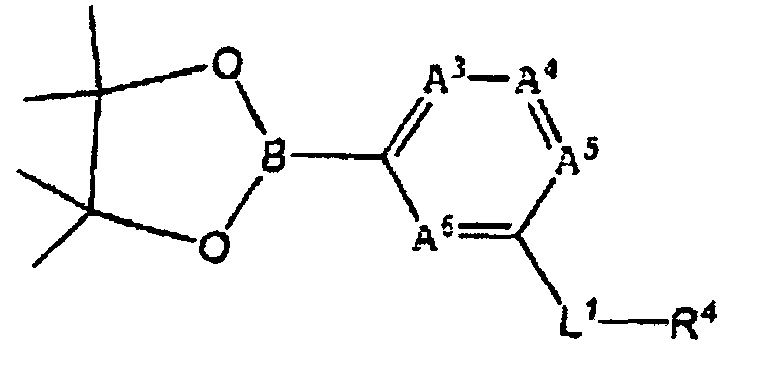
pour préparer un composé selon l'une quelconque des revendications 1 à 9. - Composé selon l'une quelconque des revendications 1 à 9, qui est le N-cyclopropyl-4-méthyl-3-(1-(((1S)-2,2,2-trifluoro-1-méthyléthyl)oxy)-6-phtalazinyl)benzamide ou un sel pharmaceutiquement acceptable de celui-ci.
- Médicament comprenant un excipient pharmaceutiquement acceptable et le composé selon la revendication 21.
Applications Claiming Priority (2)
| Application Number | Priority Date | Filing Date | Title |
|---|---|---|---|
| US84246606P | 2006-09-05 | 2006-09-05 | |
| PCT/US2007/019350 WO2008030466A1 (fr) | 2006-09-05 | 2007-09-04 | Composés de phtalazine, d'aza-phtalazine et de diaza-phtalazine et procédés d'utilisation |
Publications (2)
| Publication Number | Publication Date |
|---|---|
| EP2077998A1 EP2077998A1 (fr) | 2009-07-15 |
| EP2077998B1 true EP2077998B1 (fr) | 2011-03-09 |
Family
ID=38828570
Family Applications (1)
| Application Number | Title | Priority Date | Filing Date |
|---|---|---|---|
| EP07837737A Active EP2077998B1 (fr) | 2006-09-05 | 2007-09-04 | Composés de phtalazine, d'aza-phtalazine et de diaza-phtalazine et procédés d'utilisation |
Country Status (8)
| Country | Link |
|---|---|
| US (1) | US8101612B2 (fr) |
| EP (1) | EP2077998B1 (fr) |
| AT (1) | ATE501124T1 (fr) |
| AU (1) | AU2007293065B2 (fr) |
| CA (1) | CA2662148C (fr) |
| DE (1) | DE602007013079D1 (fr) |
| ES (1) | ES2360927T3 (fr) |
| WO (1) | WO2008030466A1 (fr) |
Cited By (1)
| Publication number | Priority date | Publication date | Assignee | Title |
|---|---|---|---|---|
| US10531655B2 (en) | 2011-12-02 | 2020-01-14 | The Regents Of The University Of California | Reperfusion protection solution and uses thereof |
Families Citing this family (3)
| Publication number | Priority date | Publication date | Assignee | Title |
|---|---|---|---|---|
| CA2725014C (fr) * | 2008-05-30 | 2014-06-17 | Amgen Inc. | Inhibiteurs de la pi3 kinase |
| JP2014513116A (ja) | 2011-05-02 | 2014-05-29 | ゾエティス・エルエルシー | 抗菌剤として有用な新規セファロスポリン |
| WO2018001948A1 (fr) * | 2016-06-29 | 2018-01-04 | F. Hoffmann-La Roche Ag | Inhibiteurs antigrippaux à large spectre à base de pyridazinone |
Family Cites Families (7)
| Publication number | Priority date | Publication date | Assignee | Title |
|---|---|---|---|---|
| AU702887B2 (en) | 1995-10-31 | 1999-03-11 | Merck & Co., Inc. | Substituted pyridyl pyrroles, compositions containing such compounds and methods of use |
| AR023659A1 (es) | 1998-09-18 | 2002-09-04 | Vertex Pharma | Un compuesto inhibidor de p38, una composicion farmaceutica que lo comprende y el uso de dicha composicion en el tratamiento y prevencion de estados patologicos |
| JP2002539187A (ja) | 1999-03-17 | 2002-11-19 | アストラゼネカ アクチボラグ | アミド誘導体 |
| GB0217757D0 (en) | 2002-07-31 | 2002-09-11 | Glaxo Group Ltd | Novel compounds |
| DE10333755A1 (de) | 2003-07-24 | 2005-03-31 | Basf Ag | Verfahren zur Dehydrierung von Carbonylverbindungen |
| GB0417905D0 (en) * | 2004-08-11 | 2004-09-15 | Novartis Ag | Organic compounds |
| US7759337B2 (en) | 2005-03-03 | 2010-07-20 | Amgen Inc. | Phthalazine compounds and methods of use |
-
2007
- 2007-09-04 US US11/899,363 patent/US8101612B2/en not_active Expired - Fee Related
- 2007-09-04 EP EP07837737A patent/EP2077998B1/fr active Active
- 2007-09-04 DE DE602007013079T patent/DE602007013079D1/de active Active
- 2007-09-04 CA CA2662148A patent/CA2662148C/fr not_active Expired - Fee Related
- 2007-09-04 AT AT07837737T patent/ATE501124T1/de not_active IP Right Cessation
- 2007-09-04 AU AU2007293065A patent/AU2007293065B2/en not_active Ceased
- 2007-09-04 ES ES07837737T patent/ES2360927T3/es active Active
- 2007-09-04 WO PCT/US2007/019350 patent/WO2008030466A1/fr not_active Ceased
Cited By (1)
| Publication number | Priority date | Publication date | Assignee | Title |
|---|---|---|---|---|
| US10531655B2 (en) | 2011-12-02 | 2020-01-14 | The Regents Of The University Of California | Reperfusion protection solution and uses thereof |
Also Published As
| Publication number | Publication date |
|---|---|
| AU2007293065A1 (en) | 2008-03-13 |
| ATE501124T1 (de) | 2011-03-15 |
| CA2662148C (fr) | 2012-01-03 |
| US8101612B2 (en) | 2012-01-24 |
| WO2008030466A1 (fr) | 2008-03-13 |
| ES2360927T3 (es) | 2011-06-10 |
| AU2007293065B2 (en) | 2011-08-18 |
| US20080119468A1 (en) | 2008-05-22 |
| EP2077998A1 (fr) | 2009-07-15 |
| CA2662148A1 (fr) | 2008-03-13 |
| DE602007013079D1 (de) | 2011-04-21 |
Similar Documents
| Publication | Publication Date | Title |
|---|---|---|
| EP2086973B1 (fr) | Composés d'imidazo- et de triazolo-pyridine et leurs procédés d'utilisation | |
| US8314131B2 (en) | Triazole fused heteroaryl compounds and methods of use thereof | |
| US7759337B2 (en) | Phthalazine compounds and methods of use | |
| US7935709B2 (en) | 2-quinazolinone compounds and methods of use | |
| US7745449B2 (en) | Thieno-[2,3-d]pyrimidine and thieno-pyridazine compounds and methods of use | |
| US8435987B2 (en) | Pyrazolo-pyridinone and pyrazolo-pyrazinone compounds as P38 modulators and methods of use thereof | |
| WO2009078992A1 (fr) | Composés tricycliques linéaires utilisés comme inhibiteurs de la kinase p38 | |
| US20120040983A1 (en) | Phthalazine Compounds as P38 Map Kinase Modulators and Methods of Use Thereof | |
| US7846944B2 (en) | Pyrazolo-pyridinone compounds and methods of use thereof | |
| EP2077998B1 (fr) | Composés de phtalazine, d'aza-phtalazine et de diaza-phtalazine et procédés d'utilisation | |
| EP2334674B1 (fr) | Composés pyridazino-pyridinone utilisés pour le traitement de maladies médiées par une protéine kinase | |
| US8080546B2 (en) | Pyrazolo-pyridinone derivatives and methods of use |
Legal Events
| Date | Code | Title | Description |
|---|---|---|---|
| PUAI | Public reference made under article 153(3) epc to a published international application that has entered the european phase |
Free format text: ORIGINAL CODE: 0009012 |
|
| 17P | Request for examination filed |
Effective date: 20090330 |
|
| AK | Designated contracting states |
Kind code of ref document: A1 Designated state(s): AT BE BG CH CY CZ DE DK EE ES FI FR GB GR HU IE IS IT LI LT LU LV MC MT NL PL PT RO SE SI SK TR |
|
| AX | Request for extension of the european patent |
Extension state: AL BA HR MK RS |
|
| 17Q | First examination report despatched |
Effective date: 20090810 |
|
| GRAP | Despatch of communication of intention to grant a patent |
Free format text: ORIGINAL CODE: EPIDOSNIGR1 |
|
| GRAS | Grant fee paid |
Free format text: ORIGINAL CODE: EPIDOSNIGR3 |
|
| GRAA | (expected) grant |
Free format text: ORIGINAL CODE: 0009210 |
|
| AK | Designated contracting states |
Kind code of ref document: B1 Designated state(s): AT BE BG CH CY CZ DE DK EE ES FI FR GB GR HU IE IS IT LI LT LU LV MC MT NL PL PT RO SE SI SK TR |
|
| AX | Request for extension of the european patent |
Extension state: AL BA HR MK RS |
|
| REG | Reference to a national code |
Ref country code: GB Ref legal event code: FG4D |
|
| REG | Reference to a national code |
Ref country code: CH Ref legal event code: NV Representative=s name: KIRKER & CIE S.A. Ref country code: CH Ref legal event code: EP |
|
| REG | Reference to a national code |
Ref country code: IE Ref legal event code: FG4D |
|
| REF | Corresponds to: |
Ref document number: 602007013079 Country of ref document: DE Date of ref document: 20110421 Kind code of ref document: P |
|
| REG | Reference to a national code |
Ref country code: DE Ref legal event code: R096 Ref document number: 602007013079 Country of ref document: DE Effective date: 20110421 |
|
| REG | Reference to a national code |
Ref country code: ES Ref legal event code: FG2A Ref document number: 2360927 Country of ref document: ES Kind code of ref document: T3 Effective date: 20110610 |
|
| REG | Reference to a national code |
Ref country code: NL Ref legal event code: VDEP Effective date: 20110309 |
|
| PG25 | Lapsed in a contracting state [announced via postgrant information from national office to epo] |
Ref country code: LV Free format text: LAPSE BECAUSE OF FAILURE TO SUBMIT A TRANSLATION OF THE DESCRIPTION OR TO PAY THE FEE WITHIN THE PRESCRIBED TIME-LIMIT Effective date: 20110309 Ref country code: GR Free format text: LAPSE BECAUSE OF FAILURE TO SUBMIT A TRANSLATION OF THE DESCRIPTION OR TO PAY THE FEE WITHIN THE PRESCRIBED TIME-LIMIT Effective date: 20110610 Ref country code: LT Free format text: LAPSE BECAUSE OF FAILURE TO SUBMIT A TRANSLATION OF THE DESCRIPTION OR TO PAY THE FEE WITHIN THE PRESCRIBED TIME-LIMIT Effective date: 20110309 Ref country code: SE Free format text: LAPSE BECAUSE OF FAILURE TO SUBMIT A TRANSLATION OF THE DESCRIPTION OR TO PAY THE FEE WITHIN THE PRESCRIBED TIME-LIMIT Effective date: 20110309 |
|
| LTIE | Lt: invalidation of european patent or patent extension |
Effective date: 20110309 |
|
| PG25 | Lapsed in a contracting state [announced via postgrant information from national office to epo] |
Ref country code: NL Free format text: LAPSE BECAUSE OF FAILURE TO SUBMIT A TRANSLATION OF THE DESCRIPTION OR TO PAY THE FEE WITHIN THE PRESCRIBED TIME-LIMIT Effective date: 20110309 Ref country code: BG Free format text: LAPSE BECAUSE OF FAILURE TO SUBMIT A TRANSLATION OF THE DESCRIPTION OR TO PAY THE FEE WITHIN THE PRESCRIBED TIME-LIMIT Effective date: 20110609 Ref country code: FI Free format text: LAPSE BECAUSE OF FAILURE TO SUBMIT A TRANSLATION OF THE DESCRIPTION OR TO PAY THE FEE WITHIN THE PRESCRIBED TIME-LIMIT Effective date: 20110309 Ref country code: SI Free format text: LAPSE BECAUSE OF FAILURE TO SUBMIT A TRANSLATION OF THE DESCRIPTION OR TO PAY THE FEE WITHIN THE PRESCRIBED TIME-LIMIT Effective date: 20110309 Ref country code: CY Free format text: LAPSE BECAUSE OF FAILURE TO SUBMIT A TRANSLATION OF THE DESCRIPTION OR TO PAY THE FEE WITHIN THE PRESCRIBED TIME-LIMIT Effective date: 20110309 Ref country code: AT Free format text: LAPSE BECAUSE OF FAILURE TO SUBMIT A TRANSLATION OF THE DESCRIPTION OR TO PAY THE FEE WITHIN THE PRESCRIBED TIME-LIMIT Effective date: 20110309 |
|
| PG25 | Lapsed in a contracting state [announced via postgrant information from national office to epo] |
Ref country code: BE Free format text: LAPSE BECAUSE OF FAILURE TO SUBMIT A TRANSLATION OF THE DESCRIPTION OR TO PAY THE FEE WITHIN THE PRESCRIBED TIME-LIMIT Effective date: 20110309 |
|
| PG25 | Lapsed in a contracting state [announced via postgrant information from national office to epo] |
Ref country code: PT Free format text: LAPSE BECAUSE OF FAILURE TO SUBMIT A TRANSLATION OF THE DESCRIPTION OR TO PAY THE FEE WITHIN THE PRESCRIBED TIME-LIMIT Effective date: 20110711 Ref country code: EE Free format text: LAPSE BECAUSE OF FAILURE TO SUBMIT A TRANSLATION OF THE DESCRIPTION OR TO PAY THE FEE WITHIN THE PRESCRIBED TIME-LIMIT Effective date: 20110309 |
|
| PG25 | Lapsed in a contracting state [announced via postgrant information from national office to epo] |
Ref country code: CZ Free format text: LAPSE BECAUSE OF FAILURE TO SUBMIT A TRANSLATION OF THE DESCRIPTION OR TO PAY THE FEE WITHIN THE PRESCRIBED TIME-LIMIT Effective date: 20110309 Ref country code: SK Free format text: LAPSE BECAUSE OF FAILURE TO SUBMIT A TRANSLATION OF THE DESCRIPTION OR TO PAY THE FEE WITHIN THE PRESCRIBED TIME-LIMIT Effective date: 20110309 Ref country code: IS Free format text: LAPSE BECAUSE OF FAILURE TO SUBMIT A TRANSLATION OF THE DESCRIPTION OR TO PAY THE FEE WITHIN THE PRESCRIBED TIME-LIMIT Effective date: 20110709 Ref country code: RO Free format text: LAPSE BECAUSE OF FAILURE TO SUBMIT A TRANSLATION OF THE DESCRIPTION OR TO PAY THE FEE WITHIN THE PRESCRIBED TIME-LIMIT Effective date: 20110309 |
|
| PLBE | No opposition filed within time limit |
Free format text: ORIGINAL CODE: 0009261 |
|
| STAA | Information on the status of an ep patent application or granted ep patent |
Free format text: STATUS: NO OPPOSITION FILED WITHIN TIME LIMIT |
|
| 26N | No opposition filed |
Effective date: 20111212 |
|
| PG25 | Lapsed in a contracting state [announced via postgrant information from national office to epo] |
Ref country code: PL Free format text: LAPSE BECAUSE OF FAILURE TO SUBMIT A TRANSLATION OF THE DESCRIPTION OR TO PAY THE FEE WITHIN THE PRESCRIBED TIME-LIMIT Effective date: 20110309 Ref country code: DK Free format text: LAPSE BECAUSE OF FAILURE TO SUBMIT A TRANSLATION OF THE DESCRIPTION OR TO PAY THE FEE WITHIN THE PRESCRIBED TIME-LIMIT Effective date: 20110309 |
|
| REG | Reference to a national code |
Ref country code: DE Ref legal event code: R097 Ref document number: 602007013079 Country of ref document: DE Effective date: 20111212 |
|
| PG25 | Lapsed in a contracting state [announced via postgrant information from national office to epo] |
Ref country code: MC Free format text: LAPSE BECAUSE OF NON-PAYMENT OF DUE FEES Effective date: 20110930 |
|
| REG | Reference to a national code |
Ref country code: IE Ref legal event code: MM4A |
|
| PG25 | Lapsed in a contracting state [announced via postgrant information from national office to epo] |
Ref country code: IE Free format text: LAPSE BECAUSE OF NON-PAYMENT OF DUE FEES Effective date: 20110904 |
|
| PG25 | Lapsed in a contracting state [announced via postgrant information from national office to epo] |
Ref country code: MT Free format text: LAPSE BECAUSE OF FAILURE TO SUBMIT A TRANSLATION OF THE DESCRIPTION OR TO PAY THE FEE WITHIN THE PRESCRIBED TIME-LIMIT Effective date: 20110309 |
|
| PG25 | Lapsed in a contracting state [announced via postgrant information from national office to epo] |
Ref country code: LU Free format text: LAPSE BECAUSE OF NON-PAYMENT OF DUE FEES Effective date: 20110904 |
|
| PG25 | Lapsed in a contracting state [announced via postgrant information from national office to epo] |
Ref country code: TR Free format text: LAPSE BECAUSE OF FAILURE TO SUBMIT A TRANSLATION OF THE DESCRIPTION OR TO PAY THE FEE WITHIN THE PRESCRIBED TIME-LIMIT Effective date: 20110309 |
|
| PG25 | Lapsed in a contracting state [announced via postgrant information from national office to epo] |
Ref country code: HU Free format text: LAPSE BECAUSE OF FAILURE TO SUBMIT A TRANSLATION OF THE DESCRIPTION OR TO PAY THE FEE WITHIN THE PRESCRIBED TIME-LIMIT Effective date: 20110309 |
|
| PGFP | Annual fee paid to national office [announced via postgrant information from national office to epo] |
Ref country code: CH Payment date: 20130912 Year of fee payment: 7 Ref country code: DE Payment date: 20130829 Year of fee payment: 7 |
|
| PGFP | Annual fee paid to national office [announced via postgrant information from national office to epo] |
Ref country code: GB Payment date: 20130904 Year of fee payment: 7 Ref country code: FR Payment date: 20130910 Year of fee payment: 7 |
|
| PGFP | Annual fee paid to national office [announced via postgrant information from national office to epo] |
Ref country code: IT Payment date: 20130913 Year of fee payment: 7 |
|
| PGFP | Annual fee paid to national office [announced via postgrant information from national office to epo] |
Ref country code: ES Payment date: 20140812 Year of fee payment: 8 |
|
| REG | Reference to a national code |
Ref country code: DE Ref legal event code: R119 Ref document number: 602007013079 Country of ref document: DE |
|
| REG | Reference to a national code |
Ref country code: CH Ref legal event code: PL |
|
| GBPC | Gb: european patent ceased through non-payment of renewal fee |
Effective date: 20140904 |
|
| REG | Reference to a national code |
Ref country code: DE Ref legal event code: R119 Ref document number: 602007013079 Country of ref document: DE Effective date: 20150401 |
|
| REG | Reference to a national code |
Ref country code: FR Ref legal event code: ST Effective date: 20150529 |
|
| PG25 | Lapsed in a contracting state [announced via postgrant information from national office to epo] |
Ref country code: LI Free format text: LAPSE BECAUSE OF NON-PAYMENT OF DUE FEES Effective date: 20140930 Ref country code: DE Free format text: LAPSE BECAUSE OF NON-PAYMENT OF DUE FEES Effective date: 20150401 Ref country code: CH Free format text: LAPSE BECAUSE OF NON-PAYMENT OF DUE FEES Effective date: 20140930 Ref country code: GB Free format text: LAPSE BECAUSE OF NON-PAYMENT OF DUE FEES Effective date: 20140904 |
|
| PG25 | Lapsed in a contracting state [announced via postgrant information from national office to epo] |
Ref country code: FR Free format text: LAPSE BECAUSE OF NON-PAYMENT OF DUE FEES Effective date: 20140930 Ref country code: IT Free format text: LAPSE BECAUSE OF NON-PAYMENT OF DUE FEES Effective date: 20140904 |
|
| REG | Reference to a national code |
Ref country code: ES Ref legal event code: FD2A Effective date: 20161202 |
|
| PG25 | Lapsed in a contracting state [announced via postgrant information from national office to epo] |
Ref country code: ES Free format text: LAPSE BECAUSE OF NON-PAYMENT OF DUE FEES Effective date: 20150905 |