EP2078272B1 - Protection d'informations secrètes dans un dispositif électronique programmé - Google Patents
Protection d'informations secrètes dans un dispositif électronique programmé Download PDFInfo
- Publication number
- EP2078272B1 EP2078272B1 EP06806092A EP06806092A EP2078272B1 EP 2078272 B1 EP2078272 B1 EP 2078272B1 EP 06806092 A EP06806092 A EP 06806092A EP 06806092 A EP06806092 A EP 06806092A EP 2078272 B1 EP2078272 B1 EP 2078272B1
- Authority
- EP
- European Patent Office
- Prior art keywords
- secret information
- software
- electronic device
- access
- programmed electronic
- Prior art date
- Legal status (The legal status is an assumption and is not a legal conclusion. Google has not performed a legal analysis and makes no representation as to the accuracy of the status listed.)
- Active
Links
Images


Classifications
-
- G—PHYSICS
- G06—COMPUTING OR CALCULATING; COUNTING
- G06F—ELECTRIC DIGITAL DATA PROCESSING
- G06F21/00—Security arrangements for protecting computers, components thereof, programs or data against unauthorised activity
- G06F21/70—Protecting specific internal or peripheral components, in which the protection of a component leads to protection of the entire computer
- G06F21/78—Protecting specific internal or peripheral components, in which the protection of a component leads to protection of the entire computer to assure secure storage of data
-
- G—PHYSICS
- G06—COMPUTING OR CALCULATING; COUNTING
- G06F—ELECTRIC DIGITAL DATA PROCESSING
- G06F21/00—Security arrangements for protecting computers, components thereof, programs or data against unauthorised activity
- G06F21/50—Monitoring users, programs or devices to maintain the integrity of platforms, e.g. of processors, firmware or operating systems
- G06F21/57—Certifying or maintaining trusted computer platforms, e.g. secure boots or power-downs, version controls, system software checks, secure updates or assessing vulnerabilities
- G06F21/575—Secure boot
Definitions
- the present invention generally relates to the field of protecting programmed electronic devices against attacks.
- the present invention relates to the field of protecting secret information in a programmed electronic device.
- Programmable electronic devices have become ubiquitous. In most of these devices, it is desirable to provide at least some level of assurance of the integrity of the software stored in the device. For example, if the programmed electronic device is an embedded device controlling functions of an automotive braking system, any tampering with the software stored in the device may be very dangerous. As another example, if the programmed electronic device is a mobile communication device like, for example, a mobile telephone, unauthorized software may spy out confidential information or may incur unwanted charges or may circumvene restrictions like, for example, digital rights management settings. There is therefore a need in the above-mentioned and other programmed electronic devices that the software executed by the device can be trusted.
- all software that is stored in a mutable memory of the programmed electronic device may be a possible target for an attack.
- Any interface of the programmed electronic device may be used in the attack.
- a manipulated SMS or manipulated WAP data may use a security hole of a browser or message reader to introduce malicious code.
- a user intentionally tries to change the software stored in the programmed electronic device.
- the device is especially vulnerable if the software is stored in a memory that is external to a main semiconductor circuit of the programmed electronic device.
- Such an external memory may be, for example, an EEPROM or FLASH memory that is located on a printed circuit board of the programmed electronic device or on an external memory card.
- the software may be associated with a signature that is or contains a cryptographic hash value of the software.
- a cryptographic hash value is commonly called a Cryptographic Checksum or Message Authentication Code (MAC) or Integrity Check Value.
- the secret component may be a secret key that is used when calculating the cryptographic hash value of the software both during signature creation and during each startup integrity check.
- the cryptographic hash value of the software may be obtained from processing the software - seen as a byte sequence - in a DES block mode operation using the secret key. The last resulting block - or a part thereof - may constitute the cryptographic hash value.
- the secret information - for example, the secret key - must be stored in the programmed electronic device because it is required for the software integrity check each time the device is started up.
- the secret information must be hidden from a possible attacker in order to ensure that the attacker cannot calculate a new signature for any modified software. If the secret information is stored, for example, in a one-time programmable (OTP) memory of the programmed electronic device, there is the risk that an attacker may discover and access the secret information. For example, techniques like the use of malicious software or buffer overflows could potentially be employed to execute code to discover the secret key.
- OTP one-time programmable
- Embodiments of the invention therefore provide an access restriction logic unit that is adapted to allow access to the secret information when starting up the programmed electronic device such that a software integrity check can be conducted using the secret information.
- the access restriction logic is also adapted to block further access to the secret information when such access is no longer needed for the software integrity check.
- the access restriction logic unit of the present invention securely disables any access to the secret information during normal operation of the programmed electronic device, i.e., after the end of the startup phase and the initial software verification phase. Even if an attacker managed to obtain control over the programmed electronic device, the attacker could not access the secret information and could also not execute any system routines - e.g., cryptographic functions - that depend on the secret information.
- the access restriction logic unit may be configured such that it blocks access to the secret information when a predetermined amount of time has passed after starting up the programmed electronic device. This amount of time may be measured, for example, by an analog or digital timer or by a counter that is clocked by a suitable clock signal available within the programmed electronic device.
- the access restriction logic unit may be adapted to be set into an access blocking mode by an external signal or command. For example, a processor unit of the programmed electronic device may disable further access to the secret information by asserting a "disable access" signal or by writing a suitable value into a hardware register of the access restriction logic.
- the secret information is individualized for each programmed electronic device. This further increases the level of protection provided by the present invention because a successful attack would only compromise a single programmed electronic device at each time.
- the secret information may be stored in a one-time programmable memory to ensure that it cannot be altered.
- the programmed electronic device of embodiments of the present invention may be a mobile device and/or a communication device and/or an embedded device.
- Embodiments of the present invention also concern a semiconductor device, which may be part of the programmed electronic device.
- the semiconductor device may be a single integrated circuit or an integrated circuit module.
- the semiconductor device is a base band integrated circuit that is adapted for use in, e.g., a mobile telecommunication apparatus.
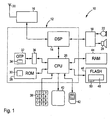
- Fig. 1 shows an example of a programmed electronic device, namely, a mobile communication device 10, in an embodiment of the present invention.
- the mobile communication device 10 may be, for example, a mobile telephone.
- the present invention is not restricted to mobile communication devices, but can be used in connection with all kinds of programmed electronic devices that must provide some level of protection against execution of unauthorized software.
- the programmed electronic device of the present invention generally comprises a semiconductor device, which may be formed of one or more integrated semiconductor circuits.
- the semiconductor device is a base band integrated circuit 12 of the mobile communication device 10.
- the base band integrated circuit 12 comprises a digital signal processor 14 (DSP) that is connected to a high frequency unit 16 and a voice frequency unit 18.
- DSP digital signal processor
- the high frequency unit 16 is connected to an antenna 20 and serves for sending and receiving modulated radio signals.
- the voice frequency unit 18 is connected to a microphone 22 and a speaker 24 for receiving and transmitting voice signals from and to a user of the mobile communication device 10.
- a processor unit 26 interfaces with a variety of components internal or external to the base band integrated circuit 12.
- the internal components include a program memory 28 that contains a number of program routines, including startup code 30.
- the program memory 28 may, for example, be a mask-programmed read-only memory (ROM) or another non-changeable memory.
- a further internal component of the base band integrated circuit 12 is a data memory 32 that contains various configuration values and other data items for operation of the mobile communication device 10. These data items include secret information 34, whose role will be explained in detail below.
- the data memory 32 may, for example, be a one-time programmable memory (OTP).
- the processor unit 26 accesses the data memory 32 - or at least the portion of the data memory 32 that stores the secret information 34 - via an access restriction logic unit 36.
- the access restriction logic unit 36 has at least two modes of operation. A first mode of operation is automatically set when the mobile communication device 10 starts up. In this mode, the processor unit 26 is allowed to access the secret information 34. A second mode of operation blocks the processor unit 26 from accessing the secret information 34.
- the access restriction logic unit 36 enters the second mode of operation in response to a signal or command from the processor unit 26, while in other embodiments, the access restriction logic unit 36 enters the second mode of operation automatically after a predetermined time - e.g., some milliseconds - has elapsed after start up of the mobile communication device 10.
- the blocking function of the access restriction logic unit 36 in the second mode of operation may be effective just with respect to the portion of the data memory 32 that stores the secret information 34, while in other embodiments the blocking function may extend to further portions of the data memory 32.
- the access restriction logic unit 36 will stay in the second mode of operation as long as the mobile communication device 10 is powered on. In other words, there is no way of resetting the access restriction logic unit 36 to its first mode of operation, other than switching off and re-starting the mobile communication device 10.
- the processor unit 26 is further connected to a number of components that are external to the base band integrated circuit 12. These components include a keypad 38, a display 40, a subscriber identity module 42 (SIM), a working memory 44 and a non-trusted memory 46.
- the working memory 44 may, for example, be a volatile read/write memory (RAM).
- the non-trusted memory 46 may, for example, be an electrically erasable programmable read-only memory (EEPROM) or a FLASH memory.
- the non-trusted memory 46 contains software 48 that is intended for execution by the processor unit 26. This software 48 may, for example, be a part of an operating system of the mobile communication device 10 or an application program.
- the software 48 stored in the non-trusted memory 46 is associated with a signature 50 that, in the present embodiment, represents a hash value of the "correct", i.e., non-manipulated, software 48.
- This signature 50 is determined by the manufacturer of the software 48 and/or the mobile communication device 10, and the signature 50 is written into the non-trusted memory 46 together with the software 48.
- the validity of the software 48 is checked when starting up the mobile communication device 10 by re-calculating the hash value of the software 48. If the software 48 has not been tampered with, then the re-calculated hash value and the signature 50 will be identical. On the other hand, if the software 48 has been modified or replaced by different program code, then the re-calculated hash value will differ from the signature 50, and the verification will fail. It is apparent that the startup code 30 that performs this integrity check must be trusted. In the present embodiment, tampering with the startup code 30 is prevented by storing the startup code 30 in an immutable memory like, for example, the mask-programmed program memory 28.
- the hash value is computed as a cryptographic hash value by a cryptographic hashing method both when generating the signature 50 and when performing the startup validity check.
- a hashing method that is based on a symmetric cryptographic algorithm is used. For example, this may be the MD5 hashing method or a hashing method of the SHA-1 family or the AES hashing method. The above and other hashing methods are well known in the art.
- a secret key to ensure that an unauthorized attacker cannot obtain a valid signature 50 for a modified piece of software 48.
- this secret key is stored as the secret information 34 in the data memory 32.
- the secret key may comprise additional or less information than the secret information 34, as long as the secret information 34 enables the cryptographic hashing method to generate the proper hash value of the software 48.
- a single secret key is used for a plurality of mobile communication devices 10.
- the secret key is individualized and is therefore specific to a single mobile communication device 10 and the signature 50 contained therein.
- Fig. 2 shows the sequence of events and calculation steps that take place during the phase of starting up the mobile communication device 10.
- a startup event 52 triggers execution of the startup code 30 stored in the immutable program memory 28.
- the processor unit 36 Under control of the startup code 30, the processor unit 36 first reads out the secret information 34 - representing a secret hashing key - from the data memory 32.
- the access restriction logic unit 36 allows this access to the data memory 32 because the access restriction logic unit 36 has been set to its first mode of operation by the startup event 52 or by a hardware power up signal.
- the dashed box in Fig. 2 represents the integrity check phase 54.
- the processor unit 26 reads the program code - seen as a byte sequence - that represents the software 48 from the non-trusted memory 46.
- the processor unit 26 then verifies the signature 50 by calculating the hash value of the program code and comparing this newly calculated hash value with the value of the signature 50.
- the access restriction logic unit 36 is set to its second mode of operation during the integrity check phase 54. As a consequence, the access restriction logic unit 36 blocks all further attempts to access the secret information 34. Because the access restriction logic unit 36 is implemented as a hardware component, it cannot be circumvened by any software-based attack. Furthermore, the access restriction logic unit 36 in the present embodiment is designed such that it cannot be switched back from the second - i.e., blocking - mode of operation to the first mode of operation as long as the mobile communication device 10 remains powered on.
- the software 48 stored in the non-trusted memory 46 is started, and processing of the startup code 30 terminates. On the other hand, if the integrity check fails (not shown in Fig. 2 ), then an appropriate error message is generated, and the software 48 is not executed.
- the step of disabling further access to the secret information by switching the access restriction logic unit 36 to its second mode of operation is shown at the end of the integrity check phase 54.
- the access restriction logic unit 36 may be switched to its second mode of operation immediately after reading out the key from the data memory 32.
- the read-out operation may at the same time trigger the access restriction logic unit 36 to switch into the blocking mode.
- the access restriction logic unit 36 is time controlled such that the switch to the second mode of operation will be made, for example, a few milliseconds after the startup event 52, i.e., at some time during the integrity check phase 54.
- Fig. 3 and Fig. 4 show an example of an access restriction logic unit 36 that is controlled by a signal from the processor unit 26.
- Fig. 3 depicts the first mode of operation in which the processor unit 26 is allowed to access the secret information through the access restriction logic unit 36; this is symbolized by the arrow 56.
- the access restriction logic unit 36 switches to the second mode of operation shown in Fig. 4 .
- the access restriction logic unit 36 blocks any access to the secret information 34.
- a self holding logic of the access restriction logic unit 36 ensures that the access restriction logic unit 36 will remain in the second mode of operation as long as the mobile communication device 10 remains powered on.
- Fig. 5 and Fig. 6 are similar to Fig. 3 and Fig. 4 , but show an alternative embodiment in which the access restriction logic unit 36 is essentially time-controlled.
- Fig. 5 depicts the first mode of operation in which the secret information 34 is accessible.
- a counter 58 is initially set to a predetermined value N and counts down, driven by a CPU clock or another suitable clock signal. The counter 58 is configured such that the counting stops when the counter 58 reaches zero. At this time the access restriction logic unit 36 is switched to its second mode of operation where all further access to the secret information 34 is disabled.
- the disable access control signal of Fig. 3 can be generated by another element of the mobile communication device 10, including the access restriction logic unit 36 itself, in response to an appropriate event.
- the counter 58 of Fig. 5 may be replaced by any other timer that causes the access restriction logic unit 36 to switch to the second mode of operation at an appropriate time. Accordingly, the scope of the invention should be determined not by the embodiments illustrated, but by the appended claims and their legal equivalents.
Landscapes
- Engineering & Computer Science (AREA)
- Computer Security & Cryptography (AREA)
- Computer Hardware Design (AREA)
- Theoretical Computer Science (AREA)
- Software Systems (AREA)
- General Engineering & Computer Science (AREA)
- Physics & Mathematics (AREA)
- General Physics & Mathematics (AREA)
- Storage Device Security (AREA)
Claims (15)
- Procédé destiné à protéger des informations secrètes (34) dans un dispositif électronique programmé, le dispositif électronique programmé comprenant une mémoire non sécurisée (46) contenant un logiciel (48), une mémoire de données (32) contenant les informations secrètes (34), et une unité logique de restriction d'accès (36) apte à autoriser ou bloquer l'accès aux informations secrètes (34), les informations secrètes (34) pouvant être utilisées pour vérifier l'intégrité du logiciel (48), le procédé comprenant les étapes ci-dessous dans lesquelles/consistant à :- lors du démarrage du dispositif électronique programmé, l'unité logique de restriction d'accès (36) autorise l'accès aux informations secrètes (34) ;- accéder aux informations secrètes (34) en vue de les utiliser pour vérifier l'intégrité du logiciel (48), et- l'unité logique de restriction d'accès (36) bloque tout autre accès aux informations secrètes (34) lorsqu'une durée prédéterminée s'est écoulée suite au démarrage du dispositif électronique programmé.
- Procédé selon la revendication 1, comprenant en outre l'étape consistant à vérifier l'intégrité du logiciel (48) en utilisant les informations secrètes (34).
- Procédé selon la revendication 2, dans lequel l'étape consistant à vérifier l'intégrité du logiciel (48) comprend les étapes ci-dessous consistant à :- calculer une valeur de hachage du logiciel (48) en utilisant une clé secrète connexe aux informations secrètes (34), et- comparer la valeur de hachage calculée à une signature prédéterminée (50) associée au logiciel (48).
- Procédé selon l'une quelconque des revendications 1 à 3, dans lequel la durée prédéterminée est mesurée sous la forme d'un nombre prédéterminé de cycles d'horloge.
- Procédé selon la revendication 4, dans lequel le dispositif électronique programmé comprend une unité de processeur (26) qui accède aux informations secrètes (34) et amène ensuite l'unité logique de restriction d'accès (36) à bloquer tout autre accès aux informations secrètes (34).
- Procédé selon l'une quelconque des revendications 1 à 5, dans lequel les informations secrètes (34) sont individualisées pour chaque dispositif électronique programmé.
- Procédé selon l'une quelconque des revendications 1 à 6, dans lequel le dispositif électronique programmé est un dispositif de communication mobile (10).
- Procédé selon l'une quelconque des revendications 1 à 7, dans lequel le logiciel (48) est exécuté dans le dispositif électronique programmé uniquement lorsque l'intégrité du logiciel (48) a été vérifiée.
- Dispositif à semi-conducteurs, comprenant :- une mémoire de données (32) stockant des informations secrètes (34) ;- une mémoire de programme (28) stockant un code d'amorçage (30) ;- une unité de processeur (26) apte à exécuter le code d'amorçage (30), le code d'amorçage (30) étant apte à amener l'unité de processeur (26) à accéder aux informations secrètes (34) dans la mémoire de données (32) afin de les utiliser pour vérifier l'intégrité du logiciel (48) devant être exécuté par l'unité de processeur (26) ; et- une unité logique de restriction d'accès (36) laquelle autorise l'unité de processeur (26) à accéder aux informations secrètes (34) suite au démarrage du dispositif à semi-conducteurs et bloque l'accès aux informations secrètes (34) lorsque l'unité de processeur (26) a accédé aux informations secrètes (34),
dans lequel l'unité logique de restriction d'accès (36) est apte à bloquer l'accès aux informations secrètes (34) lorsqu'une durée prédéterminée s'est écoulée suite au démarrage du dispositif à semi-conducteurs. - Dispositif à semi-conducteurs selon la revendication 9, dans lequel le dispositif à semi-conducteurs est un circuit intégré à bande de base (12) destiné à un dispositif de communication mobile (10).
- Dispositif selon la revendication 9 ou 10, dans lequel le code d'amorçage (30) est en outre apte à amener l'unité de processeur (26) à vérifier l'intégrité du logiciel (48) en utilisant les informations secrètes (34).
- Dispositif selon la revendication 11, dans lequel le code d'amorçage (30) est en outre apte à amener l'unité de processeur (26) à calculer une valeur de hachage du logiciel (48) en utilisant une clé secrète connexe aux informations secrètes (34), et dans lequel le code d'amorçage (30) est en outre apte à amener l'unité de processeur (26) à comparer la valeur de hachage calculée à une signature prédéterminée (50) associée au logiciel (48).
- Utilisation d'un dispositif à semi-conducteurs selon l'une quelconque des revendications 9 à 12 dans un dispositif électronique programmé, le dispositif électronique programmé comprenant :- une mémoire non sécurisée (46) stockant le logiciel (48).
- Utilisation selon la revendication 13, dans lequel le logiciel (48) est exécuté dans le dispositif électronique programmé uniquement lorsque l'intégrité du logiciel (48) a été vérifiée.
- Utilisation selon l'une quelconque des revendications 13 et 14, dans lequel le dispositif électronique programmé est un dispositif de communication mobile (10).
Applications Claiming Priority (1)
| Application Number | Priority Date | Filing Date | Title |
|---|---|---|---|
| PCT/EP2006/009690 WO2008040377A1 (fr) | 2006-10-06 | 2006-10-06 | Protection d'informations secrètes dans un dispositif électronique programmé |
Publications (2)
| Publication Number | Publication Date |
|---|---|
| EP2078272A1 EP2078272A1 (fr) | 2009-07-15 |
| EP2078272B1 true EP2078272B1 (fr) | 2010-12-15 |
Family
ID=38282830
Family Applications (1)
| Application Number | Title | Priority Date | Filing Date |
|---|---|---|---|
| EP06806092A Active EP2078272B1 (fr) | 2006-10-06 | 2006-10-06 | Protection d'informations secrètes dans un dispositif électronique programmé |
Country Status (5)
| Country | Link |
|---|---|
| US (1) | US8528108B2 (fr) |
| EP (1) | EP2078272B1 (fr) |
| AT (1) | ATE491999T1 (fr) |
| DE (1) | DE602006019011D1 (fr) |
| WO (1) | WO2008040377A1 (fr) |
Families Citing this family (22)
| Publication number | Priority date | Publication date | Assignee | Title |
|---|---|---|---|---|
| EP2078272B1 (fr) | 2006-10-06 | 2010-12-15 | Agere Systems, Inc. | Protection d'informations secrètes dans un dispositif électronique programmé |
| DE112006004173T5 (de) | 2006-12-15 | 2009-11-12 | Agere Systems, Inc. | Schutz eines programmierbaren Speichers gegen unberechtigte Veränderung |
| US9203620B1 (en) * | 2008-01-28 | 2015-12-01 | Emc Corporation | System, method and apparatus for secure use of cryptographic credentials in mobile devices |
| EP2339499A4 (fr) * | 2008-08-22 | 2012-05-09 | Ibm | Dispositif de stockage, dispositif de traitement d'informations et programme |
| US20120174206A1 (en) * | 2010-12-31 | 2012-07-05 | Alpine Access, Inc. | Secure computing environment |
| US20120210001A1 (en) * | 2011-02-11 | 2012-08-16 | Christopher Maybee Ryerson | System and method for managing access to a communication network |
| US8983855B1 (en) | 2011-05-16 | 2015-03-17 | Mckesson Financial Holdings | Systems and methods for evaluating adherence to a project control process |
| US8261085B1 (en) * | 2011-06-22 | 2012-09-04 | Media Patents, S.L. | Methods, apparatus and systems to improve security in computer systems |
| US8181035B1 (en) | 2011-06-22 | 2012-05-15 | Media Patents, S.L. | Methods, apparatus and systems to improve security in computer systems |
| US8595510B2 (en) | 2011-06-22 | 2013-11-26 | Media Patents, S.L. | Methods, apparatus and systems to improve security in computer systems |
| US20130061328A1 (en) * | 2011-09-06 | 2013-03-07 | Broadcom Corporation | Integrity checking system |
| US9280653B2 (en) * | 2011-10-28 | 2016-03-08 | GM Global Technology Operations LLC | Security access method for automotive electronic control units |
| US20130173469A1 (en) * | 2012-01-03 | 2013-07-04 | Intel Mobile Communications GmbH | Chip customization techniques |
| CN103294941B (zh) * | 2012-02-22 | 2016-04-20 | 腾讯科技(深圳)有限公司 | 访问隐私空间的方法及移动设备 |
| US8650645B1 (en) * | 2012-03-29 | 2014-02-11 | Mckesson Financial Holdings | Systems and methods for protecting proprietary data |
| US8844026B2 (en) | 2012-06-01 | 2014-09-23 | Blackberry Limited | System and method for controlling access to secure resources |
| US9843624B1 (en) | 2013-06-13 | 2017-12-12 | Pouya Taaghol | Distributed software defined networking |
| US9088574B2 (en) * | 2013-07-18 | 2015-07-21 | International Business Machines Corporation | Subscriber identity module-based authentication of a wireless device and applications stored thereon |
| US9460567B2 (en) * | 2014-07-29 | 2016-10-04 | GM Global Technology Operations LLC | Establishing secure communication for vehicle diagnostic data |
| US9916452B2 (en) * | 2016-05-18 | 2018-03-13 | Microsoft Technology Licensing, Llc | Self-contained cryptographic boot policy validation |
| DE102017219242A1 (de) * | 2017-10-26 | 2019-05-02 | Audi Ag | Ein-Chip-System, Verfahren zum Betrieb eines Ein-Chip-Systems und Kraftfahrzeug |
| US11068600B2 (en) * | 2018-05-21 | 2021-07-20 | Kct Holdings, Llc | Apparatus and method for secure router with layered encryption |
Family Cites Families (28)
| Publication number | Priority date | Publication date | Assignee | Title |
|---|---|---|---|---|
| US5421006A (en) * | 1992-05-07 | 1995-05-30 | Compaq Computer Corp. | Method and apparatus for assessing integrity of computer system software |
| FR2720532B1 (fr) * | 1994-05-25 | 1997-09-12 | Vincent Lorphelin | Système de location sécurisée de logiciels par carte à mémoire. |
| FR2727227B1 (fr) * | 1994-11-17 | 1996-12-20 | Schlumberger Ind Sa | Dispositif de securite actif a memoire electronique |
| US5943423A (en) * | 1995-12-15 | 1999-08-24 | Entegrity Solutions Corporation | Smart token system for secure electronic transactions and identification |
| US8225089B2 (en) * | 1996-12-04 | 2012-07-17 | Otomaku Properties Ltd., L.L.C. | Electronic transaction systems utilizing a PEAD and a private key |
| US6304970B1 (en) * | 1997-09-02 | 2001-10-16 | International Business Mcahines Corporation | Hardware access control locking |
| US6775778B1 (en) * | 1998-05-29 | 2004-08-10 | Texas Instruments Incorporated | Secure computing device having boot read only memory verification of program code |
| DE19944991B4 (de) * | 1999-09-20 | 2004-04-29 | Giesecke & Devrient Gmbh | Verfahren zur Sicherung eines Programmablaufs |
| GB0020370D0 (en) * | 2000-08-18 | 2000-10-04 | Hewlett Packard Co | Trusted device |
| US7613930B2 (en) * | 2001-01-19 | 2009-11-03 | Trustware International Limited | Method for protecting computer programs and data from hostile code |
| US7007300B1 (en) * | 2001-05-10 | 2006-02-28 | Advanced Micro Devices, Inc. | Secure booting of a personal computer system |
| FI115257B (fi) * | 2001-08-07 | 2005-03-31 | Nokia Corp | Menetelmä informaation käsittelemiseksi elektroniikkalaitteessa, järjestelmä, elektroniikkalaite ja suoritinlohko |
| US7007159B2 (en) * | 2002-05-10 | 2006-02-28 | Intel Corporation | System and method for loading and integrating a firmware extension onto executable base system firmware during initialization |
| EP1387238B1 (fr) * | 2002-07-30 | 2011-06-15 | Fujitsu Limited | Procédé et appareil de reproduction d'informations utilisant module de sécurité |
| US7096137B2 (en) * | 2002-12-02 | 2006-08-22 | Silverbrook Research Pty Ltd | Clock trim mechanism for onboard system clock |
| US7475254B2 (en) * | 2003-06-19 | 2009-01-06 | International Business Machines Corporation | Method for authenticating software using protected master key |
| GB2416956B (en) | 2004-07-29 | 2007-09-19 | Nec Technologies | Method of testing integrity of a mobile radio communications device and related apparatus |
| JP2006085360A (ja) * | 2004-09-15 | 2006-03-30 | Hitachi Ltd | リムーバブルメディアにおけるコンテンツの使用期限管理システム及び方法 |
| JP4496061B2 (ja) * | 2004-11-11 | 2010-07-07 | パナソニック株式会社 | 機密情報処理装置 |
| DE112005002949T5 (de) * | 2004-11-24 | 2007-12-27 | Discretix Technologies Ltd. | System, Verfahren und Vorrichtung zur Sicherung eines Betriebssystems |
| US7657754B2 (en) * | 2005-12-08 | 2010-02-02 | Agere Systems Inc | Methods and apparatus for the secure handling of data in a microcontroller |
| CN100437502C (zh) * | 2005-12-30 | 2008-11-26 | 联想(北京)有限公司 | 基于安全芯片的防病毒方法 |
| US20070162964A1 (en) * | 2006-01-12 | 2007-07-12 | Wang Liang-Yun | Embedded system insuring security and integrity, and method of increasing security thereof |
| US8291226B2 (en) * | 2006-02-10 | 2012-10-16 | Qualcomm Incorporated | Method and apparatus for securely booting from an external storage device |
| EP2078272B1 (fr) | 2006-10-06 | 2010-12-15 | Agere Systems, Inc. | Protection d'informations secrètes dans un dispositif électronique programmé |
| US7917716B2 (en) * | 2007-08-31 | 2011-03-29 | Standard Microsystems Corporation | Memory protection for embedded controllers |
| CN101946452A (zh) * | 2007-12-13 | 2011-01-12 | 塞尔蒂卡姆公司 | 用于控制器件上的特征的系统和方法 |
| JP5476086B2 (ja) * | 2009-10-16 | 2014-04-23 | フェリカネットワークス株式会社 | Icチップ、情報処理装置およびプログラム |
-
2006
- 2006-10-06 EP EP06806092A patent/EP2078272B1/fr active Active
- 2006-10-06 AT AT06806092T patent/ATE491999T1/de not_active IP Right Cessation
- 2006-10-06 DE DE602006019011T patent/DE602006019011D1/de active Active
- 2006-10-06 US US12/444,160 patent/US8528108B2/en not_active Expired - Fee Related
- 2006-10-06 WO PCT/EP2006/009690 patent/WO2008040377A1/fr not_active Ceased
Also Published As
| Publication number | Publication date |
|---|---|
| ATE491999T1 (de) | 2011-01-15 |
| DE602006019011D1 (de) | 2011-01-27 |
| EP2078272A1 (fr) | 2009-07-15 |
| US20100293388A1 (en) | 2010-11-18 |
| US8528108B2 (en) | 2013-09-03 |
| WO2008040377A1 (fr) | 2008-04-10 |
Similar Documents
| Publication | Publication Date | Title |
|---|---|---|
| EP2078272B1 (fr) | Protection d'informations secrètes dans un dispositif électronique programmé | |
| US6026293A (en) | System for preventing electronic memory tampering | |
| US8060748B2 (en) | Secure end-of-life handling of electronic devices | |
| JP4912879B2 (ja) | プロセッサの保護された資源へのアクセスに対するセキュリティ保護方法 | |
| EP3762852B1 (fr) | Protection de données de circuit intégré | |
| US7539868B2 (en) | Run-time firmware authentication | |
| EP2149103B1 (fr) | Procédé et appareil pour protéger des informations de verrouillage sim dans un dispositif électronique | |
| KR100851631B1 (ko) | 보안 모드 제어 메모리 | |
| RU2445689C2 (ru) | Способ повышения ограничения доступа к программному обеспечению | |
| US20090193211A1 (en) | Software authentication for computer systems | |
| US20050138409A1 (en) | Securing an electronic device | |
| EP2115655A1 (fr) | Programmation unique sur puce sécurisée virtuelle | |
| EP1465038B1 (fr) | Dispositif de mémoire sécurisée pour des environnements logiciel flexibles | |
| KR20070017455A (ko) | 프로세서 내에서의 보호된 리소스들로의 억세스에 대한안전한 보호 방법 | |
| CN119788322A (zh) | 一种安全芯片固件下载方法及系统 | |
| HK1021104B (en) | System for preventing electronic memory tampering | |
| AU5418201A (en) | System for preventing electronic memory tampering |
Legal Events
| Date | Code | Title | Description |
|---|---|---|---|
| PUAI | Public reference made under article 153(3) epc to a published international application that has entered the european phase |
Free format text: ORIGINAL CODE: 0009012 |
|
| 17P | Request for examination filed |
Effective date: 20090506 |
|
| AK | Designated contracting states |
Kind code of ref document: A1 Designated state(s): AT BE BG CH CY CZ DE DK EE ES FI FR GB GR HU IE IS IT LI LT LU LV MC NL PL PT RO SE SI SK TR |
|
| RIN1 | Information on inventor provided before grant (corrected) |
Inventor name: KIESSLING, MICHAEL Inventor name: WANG, HAI Inventor name: CHAMBERS, MICHAEL Inventor name: RENSHAW, PAUL Inventor name: AMMER, GERHARD |
|
| RIN1 | Information on inventor provided before grant (corrected) |
Inventor name: CHAMBERS, MICHAEL Inventor name: AMMER, GERHARD Inventor name: RENSHAW, PAUL Inventor name: KIESSLING, MICHAEL Inventor name: WANG, HAI |
|
| GRAP | Despatch of communication of intention to grant a patent |
Free format text: ORIGINAL CODE: EPIDOSNIGR1 |
|
| GRAS | Grant fee paid |
Free format text: ORIGINAL CODE: EPIDOSNIGR3 |
|
| GRAA | (expected) grant |
Free format text: ORIGINAL CODE: 0009210 |
|
| AK | Designated contracting states |
Kind code of ref document: B1 Designated state(s): AT BE BG CH CY CZ DE DK EE ES FI FR GB GR HU IE IS IT LI LT LU LV MC NL PL PT RO SE SI SK TR |
|
| REG | Reference to a national code |
Ref country code: GB Ref legal event code: FG4D Ref country code: CH Ref legal event code: EP |
|
| REG | Reference to a national code |
Ref country code: IE Ref legal event code: FG4D |
|
| REF | Corresponds to: |
Ref document number: 602006019011 Country of ref document: DE Date of ref document: 20110127 Kind code of ref document: P |
|
| REG | Reference to a national code |
Ref country code: NL Ref legal event code: VDEP Effective date: 20101215 |
|
| PG25 | Lapsed in a contracting state [announced via postgrant information from national office to epo] |
Ref country code: LT Free format text: LAPSE BECAUSE OF FAILURE TO SUBMIT A TRANSLATION OF THE DESCRIPTION OR TO PAY THE FEE WITHIN THE PRESCRIBED TIME-LIMIT Effective date: 20101215 |
|
| LTIE | Lt: invalidation of european patent or patent extension |
Effective date: 20101215 |
|
| PG25 | Lapsed in a contracting state [announced via postgrant information from national office to epo] |
Ref country code: NL Free format text: LAPSE BECAUSE OF FAILURE TO SUBMIT A TRANSLATION OF THE DESCRIPTION OR TO PAY THE FEE WITHIN THE PRESCRIBED TIME-LIMIT Effective date: 20101215 Ref country code: FI Free format text: LAPSE BECAUSE OF FAILURE TO SUBMIT A TRANSLATION OF THE DESCRIPTION OR TO PAY THE FEE WITHIN THE PRESCRIBED TIME-LIMIT Effective date: 20101215 Ref country code: BG Free format text: LAPSE BECAUSE OF FAILURE TO SUBMIT A TRANSLATION OF THE DESCRIPTION OR TO PAY THE FEE WITHIN THE PRESCRIBED TIME-LIMIT Effective date: 20110315 Ref country code: AT Free format text: LAPSE BECAUSE OF FAILURE TO SUBMIT A TRANSLATION OF THE DESCRIPTION OR TO PAY THE FEE WITHIN THE PRESCRIBED TIME-LIMIT Effective date: 20101215 Ref country code: SE Free format text: LAPSE BECAUSE OF FAILURE TO SUBMIT A TRANSLATION OF THE DESCRIPTION OR TO PAY THE FEE WITHIN THE PRESCRIBED TIME-LIMIT Effective date: 20101215 Ref country code: LV Free format text: LAPSE BECAUSE OF FAILURE TO SUBMIT A TRANSLATION OF THE DESCRIPTION OR TO PAY THE FEE WITHIN THE PRESCRIBED TIME-LIMIT Effective date: 20101215 Ref country code: SI Free format text: LAPSE BECAUSE OF FAILURE TO SUBMIT A TRANSLATION OF THE DESCRIPTION OR TO PAY THE FEE WITHIN THE PRESCRIBED TIME-LIMIT Effective date: 20101215 Ref country code: CY Free format text: LAPSE BECAUSE OF FAILURE TO SUBMIT A TRANSLATION OF THE DESCRIPTION OR TO PAY THE FEE WITHIN THE PRESCRIBED TIME-LIMIT Effective date: 20101215 |
|
| PG25 | Lapsed in a contracting state [announced via postgrant information from national office to epo] |
Ref country code: EE Free format text: LAPSE BECAUSE OF FAILURE TO SUBMIT A TRANSLATION OF THE DESCRIPTION OR TO PAY THE FEE WITHIN THE PRESCRIBED TIME-LIMIT Effective date: 20101215 Ref country code: BE Free format text: LAPSE BECAUSE OF FAILURE TO SUBMIT A TRANSLATION OF THE DESCRIPTION OR TO PAY THE FEE WITHIN THE PRESCRIBED TIME-LIMIT Effective date: 20101215 Ref country code: GR Free format text: LAPSE BECAUSE OF FAILURE TO SUBMIT A TRANSLATION OF THE DESCRIPTION OR TO PAY THE FEE WITHIN THE PRESCRIBED TIME-LIMIT Effective date: 20110316 Ref country code: CZ Free format text: LAPSE BECAUSE OF FAILURE TO SUBMIT A TRANSLATION OF THE DESCRIPTION OR TO PAY THE FEE WITHIN THE PRESCRIBED TIME-LIMIT Effective date: 20101215 Ref country code: ES Free format text: LAPSE BECAUSE OF FAILURE TO SUBMIT A TRANSLATION OF THE DESCRIPTION OR TO PAY THE FEE WITHIN THE PRESCRIBED TIME-LIMIT Effective date: 20110326 Ref country code: IS Free format text: LAPSE BECAUSE OF FAILURE TO SUBMIT A TRANSLATION OF THE DESCRIPTION OR TO PAY THE FEE WITHIN THE PRESCRIBED TIME-LIMIT Effective date: 20110415 Ref country code: PT Free format text: LAPSE BECAUSE OF FAILURE TO SUBMIT A TRANSLATION OF THE DESCRIPTION OR TO PAY THE FEE WITHIN THE PRESCRIBED TIME-LIMIT Effective date: 20110415 |
|
| PG25 | Lapsed in a contracting state [announced via postgrant information from national office to epo] |
Ref country code: RO Free format text: LAPSE BECAUSE OF FAILURE TO SUBMIT A TRANSLATION OF THE DESCRIPTION OR TO PAY THE FEE WITHIN THE PRESCRIBED TIME-LIMIT Effective date: 20101215 Ref country code: PL Free format text: LAPSE BECAUSE OF FAILURE TO SUBMIT A TRANSLATION OF THE DESCRIPTION OR TO PAY THE FEE WITHIN THE PRESCRIBED TIME-LIMIT Effective date: 20101215 Ref country code: SK Free format text: LAPSE BECAUSE OF FAILURE TO SUBMIT A TRANSLATION OF THE DESCRIPTION OR TO PAY THE FEE WITHIN THE PRESCRIBED TIME-LIMIT Effective date: 20101215 |
|
| PLBE | No opposition filed within time limit |
Free format text: ORIGINAL CODE: 0009261 |
|
| STAA | Information on the status of an ep patent application or granted ep patent |
Free format text: STATUS: NO OPPOSITION FILED WITHIN TIME LIMIT |
|
| PG25 | Lapsed in a contracting state [announced via postgrant information from national office to epo] |
Ref country code: DK Free format text: LAPSE BECAUSE OF FAILURE TO SUBMIT A TRANSLATION OF THE DESCRIPTION OR TO PAY THE FEE WITHIN THE PRESCRIBED TIME-LIMIT Effective date: 20101215 |
|
| 26N | No opposition filed |
Effective date: 20110916 |
|
| PG25 | Lapsed in a contracting state [announced via postgrant information from national office to epo] |
Ref country code: IT Free format text: LAPSE BECAUSE OF FAILURE TO SUBMIT A TRANSLATION OF THE DESCRIPTION OR TO PAY THE FEE WITHIN THE PRESCRIBED TIME-LIMIT Effective date: 20101215 |
|
| REG | Reference to a national code |
Ref country code: DE Ref legal event code: R097 Ref document number: 602006019011 Country of ref document: DE Effective date: 20110916 |
|
| PG25 | Lapsed in a contracting state [announced via postgrant information from national office to epo] |
Ref country code: MC Free format text: LAPSE BECAUSE OF NON-PAYMENT OF DUE FEES Effective date: 20111031 |
|
| REG | Reference to a national code |
Ref country code: CH Ref legal event code: PL |
|
| PG25 | Lapsed in a contracting state [announced via postgrant information from national office to epo] |
Ref country code: CH Free format text: LAPSE BECAUSE OF NON-PAYMENT OF DUE FEES Effective date: 20111031 Ref country code: LI Free format text: LAPSE BECAUSE OF NON-PAYMENT OF DUE FEES Effective date: 20111031 |
|
| REG | Reference to a national code |
Ref country code: IE Ref legal event code: MM4A |
|
| PG25 | Lapsed in a contracting state [announced via postgrant information from national office to epo] |
Ref country code: IE Free format text: LAPSE BECAUSE OF NON-PAYMENT OF DUE FEES Effective date: 20111006 |
|
| PG25 | Lapsed in a contracting state [announced via postgrant information from national office to epo] |
Ref country code: LU Free format text: LAPSE BECAUSE OF NON-PAYMENT OF DUE FEES Effective date: 20111006 |
|
| PG25 | Lapsed in a contracting state [announced via postgrant information from national office to epo] |
Ref country code: TR Free format text: LAPSE BECAUSE OF FAILURE TO SUBMIT A TRANSLATION OF THE DESCRIPTION OR TO PAY THE FEE WITHIN THE PRESCRIBED TIME-LIMIT Effective date: 20101215 |
|
| PG25 | Lapsed in a contracting state [announced via postgrant information from national office to epo] |
Ref country code: HU Free format text: LAPSE BECAUSE OF FAILURE TO SUBMIT A TRANSLATION OF THE DESCRIPTION OR TO PAY THE FEE WITHIN THE PRESCRIBED TIME-LIMIT Effective date: 20101215 |
|
| PGFP | Annual fee paid to national office [announced via postgrant information from national office to epo] |
Ref country code: FR Payment date: 20131009 Year of fee payment: 8 |
|
| REG | Reference to a national code |
Ref country code: DE Ref legal event code: R082 Ref document number: 602006019011 Country of ref document: DE Representative=s name: DILG HAEUSLER SCHINDELMANN PATENTANWALTSGESELL, DE |
|
| REG | Reference to a national code |
Ref country code: FR Ref legal event code: ST Effective date: 20150630 |
|
| PG25 | Lapsed in a contracting state [announced via postgrant information from national office to epo] |
Ref country code: FR Free format text: LAPSE BECAUSE OF NON-PAYMENT OF DUE FEES Effective date: 20141031 |
|
| PGFP | Annual fee paid to national office [announced via postgrant information from national office to epo] |
Ref country code: GB Payment date: 20150924 Year of fee payment: 10 |
|
| REG | Reference to a national code |
Ref country code: DE Ref legal event code: R082 Ref document number: 602006019011 Country of ref document: DE Representative=s name: DILG, HAEUSLER, SCHINDELMANN PATENTANWALTSGESE, DE Ref country code: DE Ref legal event code: R082 Ref document number: 602006019011 Country of ref document: DE Representative=s name: DILG HAEUSLER SCHINDELMANN PATENTANWALTSGESELL, DE Ref country code: DE Ref legal event code: R081 Ref document number: 602006019011 Country of ref document: DE Owner name: AVAGO TECHNOLOGIES GENERAL IP (SINGAPORE) PTE., SG Free format text: FORMER OWNER: AGERE SYSTEMS, INC., ALLENTOWN, PA., US Ref country code: DE Ref legal event code: R081 Ref document number: 602006019011 Country of ref document: DE Owner name: AVAGO TECHNOLOGIES INTERNATIONAL SALES PTE. LT, SG Free format text: FORMER OWNER: AGERE SYSTEMS, INC., ALLENTOWN, PA., US |
|
| REG | Reference to a national code |
Ref country code: DE Ref legal event code: R082 Ref document number: 602006019011 Country of ref document: DE Representative=s name: DILG, HAEUSLER, SCHINDELMANN PATENTANWALTSGESE, DE Ref country code: DE Ref legal event code: R082 Ref document number: 602006019011 Country of ref document: DE Representative=s name: DILG HAEUSLER SCHINDELMANN PATENTANWALTSGESELL, DE Ref country code: DE Ref legal event code: R081 Ref document number: 602006019011 Country of ref document: DE Owner name: AVAGO TECHNOLOGIES GENERAL IP (SINGAPORE) PTE., SG Free format text: FORMER OWNER: AGERE SYSTEMS LLC (N.D.GES.D. STAATES DELAWARE), ALLENTOWN, PA., US Ref country code: DE Ref legal event code: R081 Ref document number: 602006019011 Country of ref document: DE Owner name: AVAGO TECHNOLOGIES INTERNATIONAL SALES PTE. LT, SG Free format text: FORMER OWNER: AGERE SYSTEMS LLC (N.D.GES.D. STAATES DELAWARE), ALLENTOWN, PA., US |
|
| GBPC | Gb: european patent ceased through non-payment of renewal fee |
Effective date: 20161006 |
|
| PG25 | Lapsed in a contracting state [announced via postgrant information from national office to epo] |
Ref country code: GB Free format text: LAPSE BECAUSE OF NON-PAYMENT OF DUE FEES Effective date: 20161006 |
|
| REG | Reference to a national code |
Ref country code: DE Ref legal event code: R081 Ref document number: 602006019011 Country of ref document: DE Owner name: AVAGO TECHNOLOGIES INTERNATIONAL SALES PTE. LT, SG Free format text: FORMER OWNER: AVAGO TECHNOLOGIES GENERAL IP (SINGAPORE) PTE. LTD., SINGAPORE, SG Ref country code: DE Ref legal event code: R082 Ref document number: 602006019011 Country of ref document: DE Representative=s name: DILG, HAEUSLER, SCHINDELMANN PATENTANWALTSGESE, DE Ref country code: DE Ref legal event code: R082 Ref document number: 602006019011 Country of ref document: DE Representative=s name: DILG HAEUSLER SCHINDELMANN PATENTANWALTSGESELL, DE |
|
| PGFP | Annual fee paid to national office [announced via postgrant information from national office to epo] |
Ref country code: DE Payment date: 20241010 Year of fee payment: 19 |