EP2078569B1 - Procédé et dispositif de tri dans le sens de la marche de courriers plats - Google Patents
Procédé et dispositif de tri dans le sens de la marche de courriers plats Download PDFInfo
- Publication number
- EP2078569B1 EP2078569B1 EP09150001A EP09150001A EP2078569B1 EP 2078569 B1 EP2078569 B1 EP 2078569B1 EP 09150001 A EP09150001 A EP 09150001A EP 09150001 A EP09150001 A EP 09150001A EP 2078569 B1 EP2078569 B1 EP 2078569B1
- Authority
- EP
- European Patent Office
- Prior art keywords
- sorting
- items
- posted
- memory modules
- storage modules
- Prior art date
- Legal status (The legal status is an assumption and is not a legal conclusion. Google has not performed a legal analysis and makes no representation as to the accuracy of the status listed.)
- Not-in-force
Links
- 238000000034 method Methods 0.000 title claims abstract description 30
- 238000000605 extraction Methods 0.000 claims abstract 3
- 238000000926 separation method Methods 0.000 claims abstract 3
- 238000011144 upstream manufacturing Methods 0.000 claims description 4
- 230000004308 accommodation Effects 0.000 claims 1
- 230000006870 function Effects 0.000 description 7
- 230000005540 biological transmission Effects 0.000 description 2
- 230000001419 dependent effect Effects 0.000 description 2
- 238000003780 insertion Methods 0.000 description 2
- 230000037431 insertion Effects 0.000 description 2
Images




Classifications
-
- B—PERFORMING OPERATIONS; TRANSPORTING
- B07—SEPARATING SOLIDS FROM SOLIDS; SORTING
- B07C—POSTAL SORTING; SORTING INDIVIDUAL ARTICLES, OR BULK MATERIAL FIT TO BE SORTED PIECE-MEAL, e.g. BY PICKING
- B07C3/00—Sorting according to destination
- B07C3/02—Apparatus characterised by the means used for distribution
Definitions
- the invention relates to a method for sequence sorting flat mailings, in which the mailpieces are stored in a sorting device with a number of F compartments sorted in sequence.
- the invention relates to a device for sequence sorting of flat mail items with a sorting device having a number of F compartments for storing sorted mail items and a process means for controlling the sequence sorting.
- Flat postal items such as letters, large letters, postcards, shrink-wrapped magazines and the like, are sorted in letter centers or large post offices in very large numbers according to their address and, possibly after a presort, stored in a variety of stacking compartments.
- the achievable fineness of the sorting is determined by the number of sorting passages and the number of stacking pockets in each sorting pass into which the mailpieces are distributed. In order to be able to sort a large quantity of mailpieces in a short time, a high throughput of the flat mailpieces through the sorting systems is desirable.
- a high number of mail items is brought from a random order in a predetermined order.
- the predetermined order may be dependent on the mailing addresses of the mailpieces, for example their delivery addresses.
- Such a sequence sorting is from the EP 0 634 957 B1 known.
- This object is achieved by a method of the type mentioned, in which the mailings are presorted according to the invention in a number of M memory modules, which differ from the subjects by an internal trigger device, a presorting.
- a presorting By pre-switching the pre-sorting device, the number of sorting passes-and thus a susceptibility to errors-can be reduced or mailpieces can be sorted to a higher number of mailing addresses with the same number of sorting passages.
- the pre-sorting is expediently carried out such that sequential emptying of the memory modules into the sorting device-connected to the subsequent sorting of the mailpieces from the memory modules in the sorting device into their compartments-produces the sequence sorting in the compartments.
- sequential emptying of the Memory modules in the sorting device is emptying a first memory module and forming a continuous transmission current from the memory module in the sorting device, then a second and then a third memory module and possibly further memory modules.
- the sequence sorting that is, bringing the mail item in a desired order, can be created with a sorting pass, whereby in this case F x M mailing address can be sorted.
- the mail items are placed in the desired order with two or three sorting passes, with the mailpieces then being brought into the desired order by the sequential emptying of the memory modules only in the last sorting pass.
- the mailpieces can be postal items of all kinds, the length and width of each being considerably greater than their thickness, e.g. by at least the factor 10.
- the memory modules are designed for parallel recording of a plurality of mailpieces, expediently at least ten, in particular at least 50, which can be stored in the memory module, in particular stacked on each other.
- they each comprise an internal withdrawal device for separating the postal items stored in a storage module into a delivery stream, in particular with equal gaps between the postal items.
- the presorting device is connected upstream of the sorting device in the transport direction of the mailpieces. The mail items thus first pass through the presorting device and then through the sorting device.
- a lower mail item is stacked in the first memory module to be emptied in the sequence, at least one mail item lying above for at least some of the F boxes, and at least one postal item to be emptied in the following empty memory modules each stacked at least one for at least some of the F subjects each more overlying mail piece.
- the sorting device can be kept simple if the order sorting takes place in at least two sorting passes and the mailpieces are removed from the compartments after the first sorting pass and fed as stack at least to a separating means for feeding to the storage modules.
- the feeding can be done manually.
- the sorting device In order to be able to sort to a large number of mailing addresses, for example to 10,000 mailing addresses, each of which can be assigned to a possible delivery address or a mailbox, the sorting device comprises many compartments, e.g. 72 compartments, which are simply designed for cost reasons. In contrast, the memory modules are carried out considerably more expensive to be able to automatically separate the stored in them mailings again. A good ratio of sorting performance to sorting costs can be achieved if the number F of compartments of the sorting device is greater by at least a factor of 2 than the number M of storage modules.
- the speed of the sorting process can be increased if the mail items are routed through M 1 ⁇ 2 parallel mail feeds to the memory modules and from there into M 2 ⁇ 2 parallel mailings to one segment each of the sorting device.
- each module is associated with only one segment and only promotes mailings there.
- Fast pre-sorting can be achieved if the memory modules are combined in M 3 ⁇ 2 groups connected in parallel and postal items from a mail stream are inserted into memory modules of at least one group and at the same time mail items are removed from memory modules of at least one group.
- the sequence sorting is performed in at least two sorting passes, wherein in the first sorting pass sorting in a first sorting mode and in the second sorting pass is sorted into a second sorting mode which differs from the first sorting mode in terms of sorting in the presorting device.
- a quick pre-sorting can be combined with a fine re-sorting.
- the sorting device and presorting device are expediently used in both sorting passages.
- the mailpieces in the memory modules are then advantageously stored in such a way that the sequence sorting is produced by their sequential emptying - combined with the subsequent sorting of the mailpieces by the sorting device.
- a high speed of presorting with a sorting resolution of M 2 can be achieved if the mail items are presorted by the presorting device in the first sorting pass to M 2 ⁇ 2 parallel mailing discharges to one segment, in particular exactly one segment, of the sorting device.
- a high sorting performance in terms of grading and / or sorting speed can be achieved by means of a bypass of the presorting device, which bypasses the memory modules and is used for presorting.
- Mail items that have been stored in a bin in a bin form a subject content.
- m memory modules
- the sorting method is particularly efficient in terms of efficiency and sorting quality.
- the sorting device has at least two segments, each with a multiplicity of compartments, then with the same advantage, all subject contents expediently become at least one Segments in the subsequent sorting cycle in the same m ⁇ M memory modules stored.
- a part of the M memory modules is assigned to one segment and another part of the M memory modules to another segment.
- a high efficiency of presorting can be achieved if it has a bypass in addition to the memory modules, which bypasses the memory modules and is used for sorting.
- bypass can thus be assigned twice as many addresses as a memory module.
- a further advantageous embodiment of the invention provides that mail items are fed to a separating means and from there to the storage modules in sections, wherein the storage modules are emptied into the sorting apparatus after each section. It can be generated a uniform stream of mail to sorter.
- Efficient sorting is achieved when a section consists of f> 1 subject content, with mail items placed in a bin in a sorting passage forming a subject content.
- the invention also relates to a device for sequence sorting of flat mail items with a sorting device with a number of F compartments for storing order-sorted items Mail items and a process means for controlling the sequence sorting.
- the device comprises a presorting device arranged upstream of the sorting device in the transport direction of the mailpieces with a number of memory modules arranged parallel to M, which differ from the subjects by an internal take-off device, for receiving a plurality of mailpieces in parallel.
- a presorting device arranged upstream of the sorting device in the transport direction of the mailpieces with a number of memory modules arranged parallel to M, which differ from the subjects by an internal take-off device, for receiving a plurality of mailpieces in parallel.
- High sorting fineness can be achieved with a small number of sorting passes.
- a memory module 2 is shown in a schematic representation, in FIG FIG. 1 in an introductory function, and in FIG. 2 in a trigger function.
- the memory module 2 is a last-in-first-out module in which the last-introduced mail item is executed first. It comprises a memory area 4, in which mailpieces P 1 , P 2 , P 3 ,... P n-1 are stored.
- the mail item P n will be the next mail item transferred to the storage area 4. It is fed between two feed belts 6, 8 to the storage module 2 in the conveying direction 10 and then taken over by a roller conveyor 12.
- the roller conveyor 12 is driven in a controlled manner and conveys the mailpieces P 1 , P 2 ,...
- a separating blade 20 and a bottom flange 22 are provided, which are very finely adjustable in the insertion of the memory module 2 in the stacking direction - ie the direction in which the stack in the storage area 4 increases - according to arrows 24, 26 are movable.
- the memory module 2 also has a support roller assembly 28, which in the in FIG. 1 shown insertion function is pivoted to an inactive state. It can be moved in the pivoting direction 30 (FIG. FIG. 2 ) is pivoted into its active state and is part of a trigger device 32, which also includes the roller conveyor 12 and for removing the mail P 1 - P n from the memory module 2 is used.
- FIG. 2 the memory module 2 is shown in its trigger function.
- the support roller assembly 28 is in Wegschwenktem, active state and ensures that the next deducted mail item P n is aligned in a plane that corresponds substantially to the plane defined by the roller conveyor 12 level and in the vicinity of the memory module 2 of the further conveying direction.
- the Zutechnologyanschlag 14 is moved in trigger function according to arrow 34 upwards and thus releases the vent opening 16.
- snapshot shows the mail piece P n + 1 , which is already fully withdrawn and transported in a take-off direction 36, and the mail piece P n , the leading edge just passes through the discharge opening 16 and is held by a scraper 38 in contact with the roll band 12.
- the scraper 38 supports the avoidance of double scoops, since its coefficient of friction is matched to the frictional torque acting on the roller conveyor 12 and, in the case of a double trigger, retains the mail item which is not in direct contact with the roller conveyor 12.
- a withdrawal pressure is set, which is indicated by the arrow 40.
- the underfloor belt 22 is driven as indicated by an arrow and displaces the mail items stored in the storage area 4 in cooperation with the prestressed severing knife 20 ,
- FIG. 3 shows a device 42 for sorting the sequence of flat mail items 44, which in FIG. 3 represented by numbers 1A to FG.
- the device 42 comprises a sorting device 46 with a number of F compartments 48, of which in FIG. 3 five compartments 48 are shown.
- the number F is arbitrary and can vary from 2 to 300 or even higher.
- a control system 50 Through a control system 50, the in FIG. 3 is shown only greatly simplified, the mail items 44 are distributed according to their mailing address in the compartments 48. The distribution is controlled by a control means 52, which is embodied in the form of an electronic data processing device.
- a presorting device 54 Upstream of the sorting device 46 is a presorting device 54 with six memory modules 56-66 and a bypass 68, on which the mailpieces 44 can be transported by a separating means 70 to the sorting device 46, bypassing the memory modules 56-66.
- the memory modules 56-66 are implemented as described for FIGS. 1 and 2.
- a guidance of the mailpieces 44 from the separating means 70 to the compartments 48 is controlled by the control means 52 in accordance with the method described below.
- the sequence sorting is performed in a single sorting pass.
- the mail items 44 are pre-sorted to the extent that their mailing addresses are present only in an address space with F x 7 predetermined mailing addresses. In this case, a plurality of mailpieces 44 may have the same mailing address.
- the presorted, stacked mailpieces 44 are separated by the separating means 70, placed in the form of a mail flow on a mail feed 72 and passed to an address reading means 74. This reads the delivery address and, where appropriate, the name or mailbox of the past mailings 44 and the control means 52 assigns each delivery address or each mailbox a shipment address to. Subsequently, the mailpieces 44 are distributed to the memory modules 56-66, with all the mailpieces with the mailing addresses xB being stored in the first memory module 56, with 1 ⁇ x ⁇ F. Analogously, the mailpieces 44 with the mailing addresses xC are transferred to the second memory module 58 stored, etc., and mail items 44 with the mailing addresses xG in the sixth memory module 66th
- the mail items 44 are shown in the first memory module 56 as if they were already completely sorted therein according to the mailing addresses 1B, 2B, 3B,..., FB. This strict order is in FIG. 3 only for the sake of clarity. Really, the mail items 44 with the mailing addresses 1B, 2B, 3B,..., FB are randomly mixed up in the memory module 56.
- Mail items 44 with the mailing addresses xA are guided by the bypass 68 directly to the sorting device 46 and sorted there into the compartments 48.
- mailpieces 44 with the mailing address 1A will be stored in the first mailing 48, those with the mailing address 2A in the second mailing, etc., wherein each mailing is uniquely associated with a mailing address xA.
- the memory modules 56-66 are emptied sequentially, ie one after the other in a predetermined sequence.
- the memory module 56 is emptied so that the mailpieces 44 with the mailing addresses xB are guided into the sorting device 46 and sorted there into the compartments 48 as described.
- the memory modules 58-66 are successively emptied into the sorting device 46, so that now lie in the subjects 48, the mail items 44 in the order xA, xB, xC, ..., xF, where x is the respective subject number.
- the sequence of the mailpieces 44 in the compartments 48 which is desired for a sequence sorting is produced.
- the mail items 44 can now be removed from the tray 48 for tray 48 in the tray order 1 to F and combined to form a total stack or a plurality of sub-stacks and are in the sequence of, for example, a deliverer.
- FIG. 4 shows in a further schematic illustration another device 76 for sorting the sequence of flat mail items 44 with two separating means, 70, 78, two mail feeders 72, 80 and two Sendungab Entryen 82, 84 from a pre-sorting device 86 to a sorter 88.
- the following description of this and the other figures is essentially limited to the differences from the embodiment of the preceding figure, to which reference is made to the same features and functions. Substantially identical components are basically numbered with the same reference numerals.
- the presorting device 86 comprises 18 memory modules 56-66, of which only six are shown for the sake of clarity.
- the sorting device 88 has 200 compartments 48, which are divided into 100 segments each into two segments 90, 92.
- the memory modules 56-66 are sequentially emptied, in this case in pairs, one after the other.
- the storage module 56 is emptied via the mailing discharge 82 only into the segment 92 of the sorting system 88 and at the same time the storage module 58 is emptied via the mailing discharge 84 only into the segment 90.
- the memory modules 60, 62 are emptied in pairs until the last memory modules 64, 66 are emptied simultaneously.
- the sequence sorting is completed and the mailpieces 44 can be sorted taken from the compartments 48 and, depending on the size of the transport container, assembled into one or more stacks. Due to the parallel supply and discharge of the mailpieces 44 to the memory modules 56-66, the sequence sorting is performed quickly.
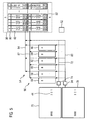
- FIG. 5 Another device 96 for sequence sorting flat mail items 44 is shown in FIG. 5 shown. It is constructed analogously to the device 76 and comprises six memory modules 56-66 and a sorting device 98 with 70 compartments 48, divided into two segments 90, 92. To carry out a sequence sorting method with two sorting passes, only the two are used in the presorting device 54 in the first sorting pass Segments 90, 92 sorted. For this purpose, presorted mail items 44 with mailing addresses in an address space of 9800 mailing addresses are separated from the two separating means 70, 78 in parallel from one stack and introduced as mailing streams with a plurality of uniformly arranged mailpieces 44 into the mail feeders 72, 80. In the first sorting the bypass 68 and the transport lines shown in dashed lines are not used.
- mail items 44 become from the first consignment feeder 72, to which the first segment 90 was assigned by the control unit 52 as a transport destination, guided to the storage module 58 and stored there.
- Mail items 44 from the first mail feeder 72, to which the second segment 92 has been assigned are guided to the memory module 56 and stored there.
- Mail items 44 from the second mailing feeder 80, to which the first segment 90 has been assigned are guided to the memory module 66 and stored there.
- mail items 44 from the second mail feeder 80, to which the second segment 92 has been assigned are guided to the memory module 64 and stored there.
- the memory modules 56, 58, 64, 66 thus fill up with mailpieces 44 according to their statistical distribution according to transport destination and thickness.
- the degree of filling of the memory modules 56, 58, 64, 66 can be monitored by the control unit 52 with the aid of sensors.
- the first period ends and a second period begins.
- the mail items 44 from the first mail feeder 72 are no longer fed to the memory modules 56, 58, but to the memory modules 60, 62, corresponding to their transport destinations to the memory modules 60, 62.
- the memory modules 56, 58 are emptied by the stored in them mailings 44 as FIG. 2 sporadically described and the consignment discharges 82 and 84 are supplied for further transport into the segment 92 and 90, respectively.
- one of the memory modules 64, 66 will then be filled, with the other of the memory modules 64, 66 likewise being largely filled.
- the similarity of the filling levels of the two memory modules 64, 66 depends on the distribution of the mailpieces 44 according to their transport destinations and on the capacity of the memory modules 64, 66. The larger their capacity, the more similar is their relative degree of filling according to the laws of statistics. Therefore, it is advantageous if the memory modules 56-66 can hold as many mail items 44 as possible, for example a stack height of at least 500 mm.
- the third operating mode in which the mailpieces 44 of the mailer feeders 72, 80 are stored in the memory modules 56, 58 and 60, 62 and at the same time the mailpieces 44 are loaded from the memory modules 64, 66 into the mailing discharges 82, 84 ,
- the emptying of the memory modules 64, 66 occurs approximately in half the time as the filling of the other memory modules 56-62, so that the memory modules 64, 66 are emptied when the memory modules 56, 58 approximately half filled and the memory modules 60, 62 approximately are filled.
- the control unit switches to the next operating mode in which the mailpieces 44 are stored in the memory modules 56, 58 and 64, 66 and the initially full memory modules 60, 62 are emptied ,
- control unit 52 switches to the next operating mode, in which the memory modules 60 - 66 are stored and then expelled from the then full memory modules 56, 58.
- This pre-sorting creates a uniform flow of mail into the two segments 90, 92, largely independent of the distribution of the mailpieces 44 in the mail feeders 72, 80 according to transport destination, whereby a high throughput is achieved.
- a finer sorting takes place only in the sorting device 98.
- all the mailpieces 44 having the mailing addresses 2nF + (4 (f-35) - 2) and 2nF + (4 (f-35)) are loaded.
- broadcast address 1. segment 2nF + (4f - 3) and 2nF + (4f - 1) Second segment 2nF + (4 (fF / 2) - 2) and 2nF + (4 (fF / 2)).
- the sorting of the second sorting pass is in FIG. 6 shown.
- the mail items 44 of the 35 compartments 48 of the first segment 90 are given as 35 sections 100 into the singling means 70 and the mail items 44 of the 35 compartments 48 of the second segment 92 as 35 sections 100 into the singling means 72, eg manually.
- a first sorting step the mailpieces 44 of the first compartments 48 of the two segments 90, 92, ie the compartments Nos. 1 and 36, separated in parallel and into the six memory modules 56-66 and the bypass 68 guided with the following sorting: Subjects No. 1 and 36: broadcast address 1.
- the numbers 1-4 can be generalized as 1 ⁇ mm M / 2, depending on the number M of memory modules 56-66 used, wherein an existing bypass 68 can be counted as two memory modules 56-66.
- the singulation is stopped and the memory modules 56-66 are sequentially emptied into the sorter 88 in pairs, starting with the memory modules 60, 62, following the memory modules 64, 66, finally the memory modules 56, 58.
- the mail items 44 are returned to the bins 48 before the third sorting step starts with the contents of the bins # 3 and # 38, and so on.
- the mail pieces 44 are in the desired order and the sequence sorting is completed.
- a plurality of sections 100 can also be processed in a sorting step.
- An example of this is given in FIGS. 7 and 8. Analogous to FIG. 5 For example, mail items 44 are sorted from an address space having, for example, 128 mailing addresses to the bins 48 of the two segments 90, 92, as in FIG FIG. 7 is shown.
- the subject contents are put into the singling means 70, 78 as described.
- the first sorting step two subject contents are each assigned to a section 106 and sorted onto the memory modules 56-66.
- the two subject contents per memory module 56-66 are arranged in front and in the rear of the respective memory module 56-66.
- the memory modules 56-66 are emptied in pairs sequentially into the sorting device 104, starting with the memory modules 60, 62, following the memory modules 64, 66, and finally the memory modules 56, 58.
- the second two sections 106 are first presorted in the memory modules 56-66 and then sorted in the bypass 68 and then in the compartments 48.
- the desired order of the mailpieces 44 already exists after the two sorting steps and the sequence sorting is completed.
Landscapes
- Sorting Of Articles (AREA)
Claims (17)
- Procédé de tri dans le sens de la marche d'envois ( 44 ) postaux plats, dans lequel on dépose les envois ( 44 ) postaux triés suivant leur ordre dans un dispositif (46, 88, 98, 104 ) ayant un nombre F de casiers ( 48 ), dans lequel
on trie au préalable les envois ( 44 ) postaux dans un nombre M de modules ( 56 à 66 ) d'accumulation, qui se distinguent des casiers (48) par un dispositif ( 32 ) interne de retrait, on les trie au préalable dans un dispositif ( 54, 86 ) de tri au préalable, caractérisé en ce que le nombre F des casiers ( 48 ) du dispositif ( 46, 88, 98, 104 ) de tri est plus grand au moins du facteur 2 que le nombre M des modules ( 56 à 66 ) d'accumulation. - Procédé suivant la revendication 1,
caractérisé en ce que, dans le module (56 à 66) d'accumulation à vider le premier dans la séquence, on empile un envoi ( 44) postal inférieur pour au moins certains des F casiers ( 48 ), dans le module ( 56 à 66 ) d'accumulation à vider ensuite, on empile au moins un envoi ( 44 ) postal se trouvant au-dessus pour au moins certains des F casiers ( 48 ) et, dans les modules ( 56 à 66 ) d'accumulation venant encore ensuite, on empile respectivement au moins un envoi ( 44 ) postal se trouvant respectivement encore au-dessus pour au moins certains des F casiers ( 48 ). - Procédé suivant la revendication 1 ou 2,
caractérisé en ce que l'on effectue le tri suivant l'ordre dans au moins deux processus de tri et on prélève les envois ( 44 ) postaux après le premier processus de tri des casiers ( 48 ) et on les envoie en tant que pile à au moins un moyen ( 70, 78 ) d'individualisation pour l'envoi aux modules ( 56 à 66 ) d'accumulation. - Procédé suivant l'une des revendications précédentes,
caractérisé en ce que l'on guide les envois ( 44 ) postaux sur M1 ≥2 guidages ( 72, 80 ) d'entrée d'envoi parallèles vers les modules (56 à 66) d'accumulation et de là, dans M2 ≥ 2, guidages ( 82, 84) de sortie d'envoi parallèles vers respectivement un segment ( 90, 92 ) du dispositif ( 46, 88, 98, 104 ) de tri. - Procédé suivant la revendication 4,
caractérisé en ce que l'on regroupe les modules ( 56 à 66 ) d'accumulation en M3 ≥ 2 groupes parallèles et on introduit des envois ( 44 ) postaux d'un courant d'envoi dans des modules ( 56 à 66 ) d'accumulation d'au moins un groupe et en même temps on évacue des envois ( 44 ) postaux de modules ( 56 à 66 ) d'accumulation d'au moins un groupe. - Procédé suivant l'une des revendications précédentes,
caractérisé en ce qu'on effectue le tri suivant le sens de la marche dans au moins deux processus de tri et, dans le premier processus de tri, on trie dans un premier mode de tri et, dans le deuxième processus de tri, dans un deuxième mode de tri qui, du point de vue d'un tri dans le dispositif ( 54, 86 ) de tri préalable, est différent du premier mode de tri. - Procédé suivant la revendication 6,
caractérisé en ce que l'on trie au préalable les envois ( 44 ) postaux par le dispositif ( 54, 86 ) de tri au préalable dans le premier processus de tri sur M2 ≥ 2 évacuations ( 82, 84 ) parallèles d'envoi vers respectivement un segment 90, 92 ) du dispositif ( 88, 98, 104 ) de tri. - Procédé suivant la revendication 6 ou 7,
caractérisé en ce que l'on dépose les envois ( 44 ) postaux dans le deuxième processus de tri dans les modules ( 56 à 66 ) d'accumulation, de manière à ce que le tri suivant l'ordre soit produit par le fait qu'on les vide séquentiellement. - Procédé suivant l'une des revendications précédentes,
caractérisé en ce qu'on utilise, pour le tri préalable, une dérivation ( 68 ) du dispositif ( 54, 86 ) de tri préalable contournant les modules ( 56 à 66 ) d'accumulation. - Procédé suivant l'une des revendications précédentes,
caractérisé en ce que les envois ( 44 ) postaux, qui ont été déposés dans un casier ( 48 ) dans un processus de tri, forment un contenu de casiers et on accumule plusieurs contenus de casiers dans le processus de tri suivant dans les mêmes m modules ( 56 à 66 ) d'accumulation avec m < M. - Procédé suivant la revendication 10
caractérisé en ce que m = 4. - Procédé suivant la revendication 10 ou 11,
caractérisé en ce que le dispositif ( 88, 98, 104 ) de tri a au moins deux segments ( 90, 92 ) ayant respectivement une pluralité de casiers ( 48 ) et tous les contenus de casiers d'au moins un segment ( 90, 92 ) sont accumulés dans le processus de tri suivant dans les mêmes m < M modules ( 56 à 66 ) d'accumulation. - Procédé suivant l'une des revendications 10 à 12,
caractérisé en ce que l'on introduit, dans une dérivation ( 68 ) du dispositif ( 54, 86 ) de tri préalable, contournant les modules ( 56 à 66 ) d'accumulation, autant d'envois ( 44 ) postaux que dans deux modules ( 56 à 66 ) d'accumulation. - Procédé suivant l'une des revendications précédentes,
caractérisé en ce que l'on envoie les envois ( 44 ) postaux à un moyen ( 70, 78 ) d'individualisation et de là par section aux modules ( 56 à 66 ) d'accumulation, les modules ( 56 à 66 ) d'accumulation étant vidés suivant chaque section dans le dispositif ( 88, 98, 104 ) de tri. - Procédé suivant la revendication 14,
caractérisé en ce que les envois ( 44 ) postaux qui ont été déposés dans un casier ( 48 ) dans un processus de tri forment un contenu de casier et une section ( 100, 106 ) est constituée de f > 1 contenus de casier. - Procédé suivant la revendication 15,
caractérisé en ce que l'on guide les envois ( 44 ) postaux sur M1≥ 1, guidages ( 72, 80 ) d'entrée d'envoi parallèles vers les modules ( 56 à 66 ) d'accumulation et f = n x M1, n étant un nombre entier. - Procédé de tri suivant le sens de la marche d'envois ( 44 ) postaux plats comprenant un dispositif ( 46, 88, 98, 104 ) de tri ayant un nombre F de casiers ( 48 ) pour le dépôt d'envois ( 44 ) postaux triés suivant l'ordre et un moyen ( 52 ) de traitement pour la commande du tri suivant le sens de la marche,
un dispositif ( 54, 86 ) de tri préalable monté en amont du dispositif ( 46, 88, 98, 104 ) de tri dans le sens de transport des envois ( 44 ) postaux et ayant un nombre de M modules ( 56 à 66 ) d'accumulation disposés parallèlement, qui se distingue des casiers ( 48 ) par un dispositif ( 32 ) ) interne de retrait pour la réception parallèle de respectivement une pluralité d'envois ( 44 ) postaux, caractérisé en ce que le nombre F des casiers ( 48 ) du dispositif ( 46, 88, 98, 104 ) de tri est plus grand au moins du facteur 2 que le nombre M des modules ( 56 à 66 ) d'accumulation.
Applications Claiming Priority (1)
| Application Number | Priority Date | Filing Date | Title |
|---|---|---|---|
| DE102008003539A DE102008003539A1 (de) | 2008-01-08 | 2008-01-08 | Verfahren und Vorrichtung zum Gangfolgesortieren flacher Postsendungen |
Publications (2)
| Publication Number | Publication Date |
|---|---|
| EP2078569A1 EP2078569A1 (fr) | 2009-07-15 |
| EP2078569B1 true EP2078569B1 (fr) | 2012-04-18 |
Family
ID=40467324
Family Applications (1)
| Application Number | Title | Priority Date | Filing Date |
|---|---|---|---|
| EP09150001A Not-in-force EP2078569B1 (fr) | 2008-01-08 | 2009-01-01 | Procédé et dispositif de tri dans le sens de la marche de courriers plats |
Country Status (4)
| Country | Link |
|---|---|
| US (1) | US9205462B2 (fr) |
| EP (1) | EP2078569B1 (fr) |
| AT (1) | ATE553856T1 (fr) |
| DE (1) | DE102008003539A1 (fr) |
Families Citing this family (1)
| Publication number | Priority date | Publication date | Assignee | Title |
|---|---|---|---|---|
| US9205461B2 (en) * | 2010-10-15 | 2015-12-08 | Siemens Industry, Inc. | Method and system for delivery point multiplication |
Family Cites Families (9)
| Publication number | Priority date | Publication date | Assignee | Title |
|---|---|---|---|---|
| JPS5670886A (en) * | 1979-11-14 | 1981-06-13 | Nippon Electric Co | Sorter |
| GB2273154B (en) * | 1992-12-02 | 1996-12-11 | Buehler Ag | Method for cleaning and sorting bulk material |
| DE4302231C2 (de) | 1993-01-28 | 1995-08-10 | Licentia Gmbh | Verfahren zum Sortieren von Sendungen in der Verteilgangsequenz bei Briefverteilanlagen |
| NL1003154C2 (nl) * | 1996-05-17 | 1997-11-18 | Nederland Ptt | Werkwijze voor het sorteren op bestelvolgorde van poststukken. |
| DE19625007C2 (de) | 1996-06-22 | 2000-03-02 | Siemens Ag | Verfahren zur Verteilreihenfolgesortierung |
| DE69713482T2 (de) * | 1997-03-07 | 2003-02-13 | Nec Corp., Tokio/Tokyo | Vorrichtung und Verfahren zur Klassifikation von Blättern |
| EP0862953B1 (fr) | 1997-03-07 | 2002-06-19 | Nec Corporation | Dispositif et procédé de classification de feuilles |
| JP2008519753A (ja) * | 2004-11-12 | 2008-06-12 | カセラ ウェイスト システムズ インコーポレーティッド | 混色カレットの特長づけおよび確認を行い、一様に着色された混入物のない混色カレットを提供するためのシステムおよび方法 |
| CA2651858A1 (fr) * | 2006-05-12 | 2007-11-22 | Hanaar Corp. | Systeme, procede et appareil de triage optique de papier |
-
2008
- 2008-01-08 DE DE102008003539A patent/DE102008003539A1/de not_active Withdrawn
-
2009
- 2009-01-01 AT AT09150001T patent/ATE553856T1/de active
- 2009-01-01 EP EP09150001A patent/EP2078569B1/fr not_active Not-in-force
- 2009-01-08 US US12/350,356 patent/US9205462B2/en not_active Expired - Fee Related
Also Published As
| Publication number | Publication date |
|---|---|
| US9205462B2 (en) | 2015-12-08 |
| DE102008003539A1 (de) | 2009-07-09 |
| EP2078569A1 (fr) | 2009-07-15 |
| US20090173669A1 (en) | 2009-07-09 |
| ATE553856T1 (de) | 2012-05-15 |
Similar Documents
| Publication | Publication Date | Title |
|---|---|---|
| DE69528344T2 (de) | Verfahren und Vorrichtung zum Sortieren von Papierblättern oder dergleichen | |
| DE602004012200T2 (de) | Vorrichtung zum Sortieren von Postgut in eine Reihenfolge | |
| EP2085152B1 (fr) | Procédé et dispositif de tri d'objets plats dans plusieurs passes de tri | |
| EP2253390A1 (fr) | Procédé et dispositif destiné au tri d'objets postaux | |
| DE102010022082A1 (de) | Verfahren und Vorrichtung zum Sortieren von Gegenständen mittels Speicherbereichen | |
| EP1868742B1 (fr) | Systeme et procede de traitement de courrier | |
| DE69304390T2 (de) | Anlage zum Sortieren von Gegenständen verschiedener Bestimmungen | |
| WO2000001496A2 (fr) | Dispositif et procede pour produire une pile finale | |
| EP2065325A2 (fr) | Procédé et dispositif de réunion de deux flux d'objets | |
| EP1791657B1 (fr) | Procede et dispositif pour trier des envois postaux | |
| WO2001019537A1 (fr) | Dispositif et procede pour classer des envois plats | |
| WO2013060721A1 (fr) | Installation de tri et procédé de tri comprenant deux zones de stockage | |
| DE102008058843A1 (de) | Sortieranlage mit mehreren Ausgabeeinrichtungen und Sortierverfahren | |
| EP2067535B1 (fr) | Procédé etdispositif de tri d'envois postaux plats | |
| EP1675691A1 (fr) | Procede pour reunir manuellement des envois plats pouvant etre traites manuellement | |
| EP2078569B1 (fr) | Procédé et dispositif de tri dans le sens de la marche de courriers plats | |
| DE102007058581B4 (de) | Sortiersystem für flache Postsendungen | |
| WO2012066066A1 (fr) | Procédé et ensemble de tri pour trier deux types d'objets en une suite unique | |
| WO2007017412A1 (fr) | Procede pour trier des objets et installation de triage pour mettre en oeuvre le procede | |
| EP2226130A1 (fr) | Procédé de tri et installation de tri dotée de deux groupes distincts de dispositif d'émission | |
| DE19714184A1 (de) | Einrichtung zum Sortieren flacher Sendungen in mehreren Sortiergängen | |
| DE102010063211A1 (de) | Sortierverfahren und Sortieranordnung zum Sortieren von zwei Arten von Gegenständen zu einer einzigen Abfolge | |
| DE102008004865A1 (de) | Vorrichtung zum Sortieren von flachen Postsendungen nach ihrer Größe |
Legal Events
| Date | Code | Title | Description |
|---|---|---|---|
| PUAI | Public reference made under article 153(3) epc to a published international application that has entered the european phase |
Free format text: ORIGINAL CODE: 0009012 |
|
| AK | Designated contracting states |
Kind code of ref document: A1 Designated state(s): AT BE BG CH CY CZ DE DK EE ES FI FR GB GR HR HU IE IS IT LI LT LU LV MC MK MT NL NO PL PT RO SE SI SK TR |
|
| AX | Request for extension of the european patent |
Extension state: AL BA RS |
|
| 17P | Request for examination filed |
Effective date: 20100114 |
|
| AKX | Designation fees paid |
Designated state(s): AT BE BG CH CY CZ DE DK EE ES FI FR GB GR HR HU IE IS IT LI LT LU LV MC MK MT NL NO PL PT RO SE SI SK TR |
|
| GRAP | Despatch of communication of intention to grant a patent |
Free format text: ORIGINAL CODE: EPIDOSNIGR1 |
|
| GRAS | Grant fee paid |
Free format text: ORIGINAL CODE: EPIDOSNIGR3 |
|
| GRAA | (expected) grant |
Free format text: ORIGINAL CODE: 0009210 |
|
| AK | Designated contracting states |
Kind code of ref document: B1 Designated state(s): AT BE BG CH CY CZ DE DK EE ES FI FR GB GR HR HU IE IS IT LI LT LU LV MC MK MT NL NO PL PT RO SE SI SK TR |
|
| REG | Reference to a national code |
Ref country code: GB Ref legal event code: FG4D Free format text: NOT ENGLISH |
|
| REG | Reference to a national code |
Ref country code: CH Ref legal event code: NV Representative=s name: SIEMENS SCHWEIZ AG Ref country code: CH Ref legal event code: EP |
|
| REG | Reference to a national code |
Ref country code: IE Ref legal event code: FG4D Free format text: LANGUAGE OF EP DOCUMENT: GERMAN |
|
| REG | Reference to a national code |
Ref country code: AT Ref legal event code: REF Ref document number: 553856 Country of ref document: AT Kind code of ref document: T Effective date: 20120515 |
|
| REG | Reference to a national code |
Ref country code: DE Ref legal event code: R096 Ref document number: 502009003275 Country of ref document: DE Effective date: 20120614 |
|
| REG | Reference to a national code |
Ref country code: NL Ref legal event code: T3 |
|
| REG | Reference to a national code |
Ref country code: SE Ref legal event code: TRGR |
|
| LTIE | Lt: invalidation of european patent or patent extension |
Effective date: 20120418 |
|
| PG25 | Lapsed in a contracting state [announced via postgrant information from national office to epo] |
Ref country code: IS Free format text: LAPSE BECAUSE OF FAILURE TO SUBMIT A TRANSLATION OF THE DESCRIPTION OR TO PAY THE FEE WITHIN THE PRESCRIBED TIME-LIMIT Effective date: 20120818 Ref country code: FI Free format text: LAPSE BECAUSE OF FAILURE TO SUBMIT A TRANSLATION OF THE DESCRIPTION OR TO PAY THE FEE WITHIN THE PRESCRIBED TIME-LIMIT Effective date: 20120418 Ref country code: CY Free format text: LAPSE BECAUSE OF FAILURE TO SUBMIT A TRANSLATION OF THE DESCRIPTION OR TO PAY THE FEE WITHIN THE PRESCRIBED TIME-LIMIT Effective date: 20120418 Ref country code: PL Free format text: LAPSE BECAUSE OF FAILURE TO SUBMIT A TRANSLATION OF THE DESCRIPTION OR TO PAY THE FEE WITHIN THE PRESCRIBED TIME-LIMIT Effective date: 20120418 Ref country code: LT Free format text: LAPSE BECAUSE OF FAILURE TO SUBMIT A TRANSLATION OF THE DESCRIPTION OR TO PAY THE FEE WITHIN THE PRESCRIBED TIME-LIMIT Effective date: 20120418 Ref country code: NO Free format text: LAPSE BECAUSE OF FAILURE TO SUBMIT A TRANSLATION OF THE DESCRIPTION OR TO PAY THE FEE WITHIN THE PRESCRIBED TIME-LIMIT Effective date: 20120718 |
|
| PG25 | Lapsed in a contracting state [announced via postgrant information from national office to epo] |
Ref country code: SI Free format text: LAPSE BECAUSE OF FAILURE TO SUBMIT A TRANSLATION OF THE DESCRIPTION OR TO PAY THE FEE WITHIN THE PRESCRIBED TIME-LIMIT Effective date: 20120418 Ref country code: LV Free format text: LAPSE BECAUSE OF FAILURE TO SUBMIT A TRANSLATION OF THE DESCRIPTION OR TO PAY THE FEE WITHIN THE PRESCRIBED TIME-LIMIT Effective date: 20120418 Ref country code: PT Free format text: LAPSE BECAUSE OF FAILURE TO SUBMIT A TRANSLATION OF THE DESCRIPTION OR TO PAY THE FEE WITHIN THE PRESCRIBED TIME-LIMIT Effective date: 20120820 Ref country code: HR Free format text: LAPSE BECAUSE OF FAILURE TO SUBMIT A TRANSLATION OF THE DESCRIPTION OR TO PAY THE FEE WITHIN THE PRESCRIBED TIME-LIMIT Effective date: 20120418 Ref country code: GR Free format text: LAPSE BECAUSE OF FAILURE TO SUBMIT A TRANSLATION OF THE DESCRIPTION OR TO PAY THE FEE WITHIN THE PRESCRIBED TIME-LIMIT Effective date: 20120719 |
|
| PG25 | Lapsed in a contracting state [announced via postgrant information from national office to epo] |
Ref country code: EE Free format text: LAPSE BECAUSE OF FAILURE TO SUBMIT A TRANSLATION OF THE DESCRIPTION OR TO PAY THE FEE WITHIN THE PRESCRIBED TIME-LIMIT Effective date: 20120418 Ref country code: RO Free format text: LAPSE BECAUSE OF FAILURE TO SUBMIT A TRANSLATION OF THE DESCRIPTION OR TO PAY THE FEE WITHIN THE PRESCRIBED TIME-LIMIT Effective date: 20120418 Ref country code: CZ Free format text: LAPSE BECAUSE OF FAILURE TO SUBMIT A TRANSLATION OF THE DESCRIPTION OR TO PAY THE FEE WITHIN THE PRESCRIBED TIME-LIMIT Effective date: 20120418 Ref country code: SK Free format text: LAPSE BECAUSE OF FAILURE TO SUBMIT A TRANSLATION OF THE DESCRIPTION OR TO PAY THE FEE WITHIN THE PRESCRIBED TIME-LIMIT Effective date: 20120418 Ref country code: DK Free format text: LAPSE BECAUSE OF FAILURE TO SUBMIT A TRANSLATION OF THE DESCRIPTION OR TO PAY THE FEE WITHIN THE PRESCRIBED TIME-LIMIT Effective date: 20120418 |
|
| PLBE | No opposition filed within time limit |
Free format text: ORIGINAL CODE: 0009261 |
|
| STAA | Information on the status of an ep patent application or granted ep patent |
Free format text: STATUS: NO OPPOSITION FILED WITHIN TIME LIMIT |
|
| PG25 | Lapsed in a contracting state [announced via postgrant information from national office to epo] |
Ref country code: IT Free format text: LAPSE BECAUSE OF FAILURE TO SUBMIT A TRANSLATION OF THE DESCRIPTION OR TO PAY THE FEE WITHIN THE PRESCRIBED TIME-LIMIT Effective date: 20120418 |
|
| RAP2 | Party data changed (patent owner data changed or rights of a patent transferred) |
Owner name: SIEMENS AKTIENGESELLSCHAFT |
|
| 26N | No opposition filed |
Effective date: 20130121 |
|
| PG25 | Lapsed in a contracting state [announced via postgrant information from national office to epo] |
Ref country code: ES Free format text: LAPSE BECAUSE OF FAILURE TO SUBMIT A TRANSLATION OF THE DESCRIPTION OR TO PAY THE FEE WITHIN THE PRESCRIBED TIME-LIMIT Effective date: 20120729 |
|
| REG | Reference to a national code |
Ref country code: DE Ref legal event code: R097 Ref document number: 502009003275 Country of ref document: DE Effective date: 20130121 |
|
| BERE | Be: lapsed |
Owner name: SIEMENS A.G. Effective date: 20130131 |
|
| PG25 | Lapsed in a contracting state [announced via postgrant information from national office to epo] |
Ref country code: BG Free format text: LAPSE BECAUSE OF FAILURE TO SUBMIT A TRANSLATION OF THE DESCRIPTION OR TO PAY THE FEE WITHIN THE PRESCRIBED TIME-LIMIT Effective date: 20120718 |
|
| PG25 | Lapsed in a contracting state [announced via postgrant information from national office to epo] |
Ref country code: MC Free format text: LAPSE BECAUSE OF NON-PAYMENT OF DUE FEES Effective date: 20130131 |
|
| GBPC | Gb: european patent ceased through non-payment of renewal fee |
Effective date: 20130101 |
|
| REG | Reference to a national code |
Ref country code: IE Ref legal event code: MM4A |
|
| PG25 | Lapsed in a contracting state [announced via postgrant information from national office to epo] |
Ref country code: BE Free format text: LAPSE BECAUSE OF NON-PAYMENT OF DUE FEES Effective date: 20130131 |
|
| PG25 | Lapsed in a contracting state [announced via postgrant information from national office to epo] |
Ref country code: GB Free format text: LAPSE BECAUSE OF NON-PAYMENT OF DUE FEES Effective date: 20130101 |
|
| PG25 | Lapsed in a contracting state [announced via postgrant information from national office to epo] |
Ref country code: IE Free format text: LAPSE BECAUSE OF NON-PAYMENT OF DUE FEES Effective date: 20130101 |
|
| PGFP | Annual fee paid to national office [announced via postgrant information from national office to epo] |
Ref country code: SE Payment date: 20140108 Year of fee payment: 6 Ref country code: NL Payment date: 20140103 Year of fee payment: 6 Ref country code: DE Payment date: 20140320 Year of fee payment: 6 |
|
| PG25 | Lapsed in a contracting state [announced via postgrant information from national office to epo] |
Ref country code: MT Free format text: LAPSE BECAUSE OF FAILURE TO SUBMIT A TRANSLATION OF THE DESCRIPTION OR TO PAY THE FEE WITHIN THE PRESCRIBED TIME-LIMIT Effective date: 20120418 |
|
| PGFP | Annual fee paid to national office [announced via postgrant information from national office to epo] |
Ref country code: CH Payment date: 20140407 Year of fee payment: 6 |
|
| REG | Reference to a national code |
Ref country code: AT Ref legal event code: MM01 Ref document number: 553856 Country of ref document: AT Kind code of ref document: T Effective date: 20140101 |
|
| PG25 | Lapsed in a contracting state [announced via postgrant information from national office to epo] |
Ref country code: AT Free format text: LAPSE BECAUSE OF NON-PAYMENT OF DUE FEES Effective date: 20140101 |
|
| PG25 | Lapsed in a contracting state [announced via postgrant information from national office to epo] |
Ref country code: TR Free format text: LAPSE BECAUSE OF FAILURE TO SUBMIT A TRANSLATION OF THE DESCRIPTION OR TO PAY THE FEE WITHIN THE PRESCRIBED TIME-LIMIT Effective date: 20120418 |
|
| PG25 | Lapsed in a contracting state [announced via postgrant information from national office to epo] |
Ref country code: LU Free format text: LAPSE BECAUSE OF NON-PAYMENT OF DUE FEES Effective date: 20130101 Ref country code: MK Free format text: LAPSE BECAUSE OF FAILURE TO SUBMIT A TRANSLATION OF THE DESCRIPTION OR TO PAY THE FEE WITHIN THE PRESCRIBED TIME-LIMIT Effective date: 20120418 Ref country code: HU Free format text: LAPSE BECAUSE OF FAILURE TO SUBMIT A TRANSLATION OF THE DESCRIPTION OR TO PAY THE FEE WITHIN THE PRESCRIBED TIME-LIMIT; INVALID AB INITIO Effective date: 20090101 |
|
| REG | Reference to a national code |
Ref country code: DE Ref legal event code: R119 Ref document number: 502009003275 Country of ref document: DE |
|
| REG | Reference to a national code |
Ref country code: NL Ref legal event code: V1 Effective date: 20150801 |
|
| REG | Reference to a national code |
Ref country code: CH Ref legal event code: PL |
|
| REG | Reference to a national code |
Ref country code: SE Ref legal event code: EUG |
|
| PG25 | Lapsed in a contracting state [announced via postgrant information from national office to epo] |
Ref country code: NL Free format text: LAPSE BECAUSE OF NON-PAYMENT OF DUE FEES Effective date: 20150801 |
|
| PG25 | Lapsed in a contracting state [announced via postgrant information from national office to epo] |
Ref country code: CH Free format text: LAPSE BECAUSE OF NON-PAYMENT OF DUE FEES Effective date: 20150131 Ref country code: DE Free format text: LAPSE BECAUSE OF NON-PAYMENT OF DUE FEES Effective date: 20150801 Ref country code: LI Free format text: LAPSE BECAUSE OF NON-PAYMENT OF DUE FEES Effective date: 20150131 |
|
| PG25 | Lapsed in a contracting state [announced via postgrant information from national office to epo] |
Ref country code: SE Free format text: LAPSE BECAUSE OF NON-PAYMENT OF DUE FEES Effective date: 20150102 |
|
| REG | Reference to a national code |
Ref country code: FR Ref legal event code: PLFP Year of fee payment: 8 |
|
| REG | Reference to a national code |
Ref country code: FR Ref legal event code: PLFP Year of fee payment: 9 |
|
| REG | Reference to a national code |
Ref country code: FR Ref legal event code: PLFP Year of fee payment: 10 |
|
| PGFP | Annual fee paid to national office [announced via postgrant information from national office to epo] |
Ref country code: FR Payment date: 20200120 Year of fee payment: 12 |
|
| PG25 | Lapsed in a contracting state [announced via postgrant information from national office to epo] |
Ref country code: FR Free format text: LAPSE BECAUSE OF NON-PAYMENT OF DUE FEES Effective date: 20210131 |