EP2079111A1 - Transistor CMOS nanométrique avec substrat intrinsèque - Google Patents
Transistor CMOS nanométrique avec substrat intrinsèque Download PDFInfo
- Publication number
- EP2079111A1 EP2079111A1 EP08100315A EP08100315A EP2079111A1 EP 2079111 A1 EP2079111 A1 EP 2079111A1 EP 08100315 A EP08100315 A EP 08100315A EP 08100315 A EP08100315 A EP 08100315A EP 2079111 A1 EP2079111 A1 EP 2079111A1
- Authority
- EP
- European Patent Office
- Prior art keywords
- source
- region
- mosfet
- gate
- drain
- Prior art date
- Legal status (The legal status is an assumption and is not a legal conclusion. Google has not performed a legal analysis and makes no representation as to the accuracy of the status listed.)
- Withdrawn
Links
Images




Classifications
-
- H—ELECTRICITY
- H10—SEMICONDUCTOR DEVICES; ELECTRIC SOLID-STATE DEVICES NOT OTHERWISE PROVIDED FOR
- H10D—INORGANIC ELECTRIC SEMICONDUCTOR DEVICES
- H10D62/00—Semiconductor bodies, or regions thereof, of devices having potential barriers
- H10D62/10—Shapes, relative sizes or dispositions of the regions of the semiconductor bodies; Shapes of the semiconductor bodies
- H10D62/13—Semiconductor regions connected to electrodes carrying current to be rectified, amplified or switched, e.g. source or drain regions
- H10D62/149—Source or drain regions of field-effect devices
- H10D62/151—Source or drain regions of field-effect devices of IGFETs
-
- H—ELECTRICITY
- H10—SEMICONDUCTOR DEVICES; ELECTRIC SOLID-STATE DEVICES NOT OTHERWISE PROVIDED FOR
- H10D—INORGANIC ELECTRIC SEMICONDUCTOR DEVICES
- H10D30/00—Field-effect transistors [FET]
- H10D30/60—Insulated-gate field-effect transistors [IGFET]
-
- H—ELECTRICITY
- H10—SEMICONDUCTOR DEVICES; ELECTRIC SOLID-STATE DEVICES NOT OTHERWISE PROVIDED FOR
- H10D—INORGANIC ELECTRIC SEMICONDUCTOR DEVICES
- H10D62/00—Semiconductor bodies, or regions thereof, of devices having potential barriers
- H10D62/10—Shapes, relative sizes or dispositions of the regions of the semiconductor bodies; Shapes of the semiconductor bodies
- H10D62/17—Semiconductor regions connected to electrodes not carrying current to be rectified, amplified or switched, e.g. channel regions
- H10D62/351—Substrate regions of field-effect devices
- H10D62/357—Substrate regions of field-effect devices of FETs
- H10D62/364—Substrate regions of field-effect devices of FETs of IGFETs
-
- H—ELECTRICITY
- H10—SEMICONDUCTOR DEVICES; ELECTRIC SOLID-STATE DEVICES NOT OTHERWISE PROVIDED FOR
- H10D—INORGANIC ELECTRIC SEMICONDUCTOR DEVICES
- H10D64/00—Electrodes of devices having potential barriers
- H10D64/20—Electrodes characterised by their shapes, relative sizes or dispositions
- H10D64/23—Electrodes carrying the current to be rectified, amplified, oscillated or switched, e.g. sources, drains, anodes or cathodes
- H10D64/251—Source or drain electrodes for field-effect devices
- H10D64/256—Source or drain electrodes for field-effect devices for lateral devices wherein the source or drain electrodes are recessed in semiconductor bodies
-
- H—ELECTRICITY
- H10—SEMICONDUCTOR DEVICES; ELECTRIC SOLID-STATE DEVICES NOT OTHERWISE PROVIDED FOR
- H10D—INORGANIC ELECTRIC SEMICONDUCTOR DEVICES
- H10D64/00—Electrodes of devices having potential barriers
- H10D64/20—Electrodes characterised by their shapes, relative sizes or dispositions
- H10D64/23—Electrodes carrying the current to be rectified, amplified, oscillated or switched, e.g. sources, drains, anodes or cathodes
- H10D64/251—Source or drain electrodes for field-effect devices
- H10D64/257—Source or drain electrodes for field-effect devices for lateral devices wherein the source or drain electrodes are characterised by top-view geometrical layouts, e.g. interdigitated, semi-circular, annular or L-shaped electrodes
Definitions
- the present invention relates to nanoscale MOSFETs. More particularly, the present invention relates to nano size MOSFET smaller than 80nm and down to 10nm, without the need to dope the channel region.
- MOSFETs scaling results in problems due to the short distance between the source and the drain. Such problems, which include Drain Induced Barrier Lowering (DIBL) and punch through result in large leakage current and have hampered the possibility of scaling the gate length of MOSFETs below 80 nm.
- DIBL Drain Induced Barrier Lowering
- CMOS complementary MOS circuits
- parasitic thyristors which are created by these well dopings create latch up problems.
- extra steps have been introduced in fabrication process. These steps add yet to the cost and also consume wafer space.
- the US patent document US 5489792 describes a silicon on insulator (SOI) MOSFET transistor in which the source is doped by two opposite regions; the bottom region is lightly doped with respect to the top region and the channel is doped.
- SOI silicon on insulator
- the function of the oppositely doped region is to create a contact to the floating body of the SOI structure in order to collect carriers which are created by impact ionization.
- the collection of impact ionization carriers is only relevant to SOI structures for which a floating body might exist; it yet loses any meaning for MOSFET using bulk substrates.
- the invention discloses a new MOSFET transistor aimed at reducing problems with dopant fluctuations, CMOS latch up, and short channel effects, such as DIBL and punch through.
- a goal of the present invention is to propose a new MOSFET fabricated on intrinsic bulk material, so that the dopant fluctuation is eliminated, n and p devices are fabricated without the need to introduce "well” regions, and the mobility of carriers is increased due to an intrinsic channel region, and the regular thyristor latch up problems in CMOS circuits are eliminated.
- the very large Ion/loff ratio as well as the on and off state currents for both n and p type devices indicate that short channel effects are greatly suppressed as well.
- the nanoscale MOSFET according to the invention allows to overcome the problems of scalability of the gate length below 50 nm and down to 10nm due to short channel effects and doping profile fluctuations. It further does not need a doped channel region to operate properly.
- the present invention also provides methods to fabricate the said region inside the source and the drain. They can be fabricated either by epitaxial growth or by placing the two oppositely doped regions side by side along the width of the source.
- the subject of this invention has been simulated using PISCESS-IIb program which is suitable for overall device lengths down to about 50 nm. Simulations also show that the short channel effects which are encountered in regular MOSFET devices are greatly reduced, without the need to use retrograde or halo doped regions. As simulations show, when the gate voltage is zero the device does turn off and very low leakage current is obtained.
- the source comprises of two regions of opposite dopant types.
- the idea of using an intrinsic bulk material in nano dimensions is counter intuitive because in regular MOSFETs the bulk material must be highly doped to reduce short channel effects and yet a MOSFET with an intrinsic bulk does not operate as a transistor and does not turn off. Having a device which has an intrinsic bulk, with well defined on and off states, without suffering from short channel effects must operate based on unforeseen effects.
- the oppositely doped bottom region of the source creates such effects. It essentially pins the source/ body potential barrier, and this barrier becomes essentially voltage independent, as the voltage of the drain is increased. This is why the problems due to DIBL and punch through are effectively reduced or eliminated. It is thus possible for the gate to decrease or increase this barrier, as a result, the device can be turned on and off.
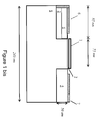
- a cross-sectional view is shown of an illustrative embodiment of the present invention for dimensions most relevant in today's electronic circuitry.
- the gate 1 is disposed over the oxide layer 2 which is disposed on the active body of the semiconductor 8.
- the source comprises two regions 3 and 4 of opposite dopings.
- the region 3 serves two purposes: it makes it possible for the gate voltage to modulate the current from source to the drain by introducing a potential barrier between region 4 and the channel, which can be lowered or increased by the gate; and it also greatly reduces the DIBL problem.
- DIBL refers to the fact that when the drain is too close to the source such that a voltage applied to it can affect the source side, the potential barrier between the source and body decreases.
- DIBL causes problems both in the on and off state of the transistor.
- DIBL causes the current to become dependent on the drain voltage which is not desired.
- DIBL causes leakage current as the carriers of the source can go over the lowered potential barrier.
- Region 3 provides therefore better "ON" characteristics with respect to regular MOSFETs, and it also provides much better lon/loff ratio.
- Regions 5, 6 and 7 are respectively the drain, and connections to the source and the drain, respectively.
- the extra dopant region 3 cannot, and should not, be considered as a halo region or lightly doped region as in LDD (lightly doped drain) transistors, since it is not only doped, but preferably highly doped on the source side, with the opposite doping type. Furthermore, this extra dopant region is electrically connected to the source itself. The DIBL lowering and punch-through limitation derived from this feature would not be possible otherwise.
- the source region comprises a lower portion 3 of a first doping type, and an upper portion 4 of a second doping type proximate to the silicon layer surface of the gate 1.
- the upper portion 4 extends from the edge to the gate 1 so that it covers the lower portion 3 only partially, and contact 6 is made to both portions.
- the upper and lower layers are in this example preferably made through ion implantation.
- FIG. 1 bis illustrates another embodiment of the invention in which epitaxial growth can be used for the source and the drain 5 as proposed in prior art.
- US 6,946,371, Sept 20, 2005 Langdo, et al "Methods of fabricating semiconductor structures having epitaxially grown source and drain elements" can be used or other relevant methods disclosed in the art.
- the region 3 covers entirely the region 4 as a superimposed layer.
- the connector 6 has therefore a different shape as in Figure 1 .
- the feature which is different from regular MOSFETs for all possible embodiments is the particular doping of the source.
- Another feature of the MOSFET according to the invention is to have an intrinsic bulk semiconductor in which p and n channel MOSFETs are fabricated on the same intrinsic bulk material without n and p well regions.
- the PISCES-IIb semiconductor drift-diffusion simulator has been used to obtain the characteristics of the disclosed invention.
- the potential and current voltage characteristics of our invention have been obtained with the dimensions indicated on FIG. 1 , that is the drain 5 and source 3 size (85nm), gate 1 length (75nm), drain 5 and source 3/4 thickness (50nm), wherein the source region 4 is of 40 nm width and 25nm thickness, body region 8 thickness (250 micrometer).
- the overall device width is 245nm.
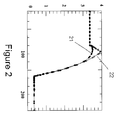
- FIG. 2 compares the potential barrier from the source to the drain for our invention (arrow 22) and a regular MOSFET (arrow 21) of the same gate length and a bulk with a doping density of 10 17 /cm3.
- This MOSFET does not have halo doping and it suffers from short channels effects; the figure is provided to demonstrate the ability of the disclosed invention to reduce short channel effects.
- the gate length is indicated in nanometers on the X axis and the potential is indicated in volts on the Y axis.
- the potential barrier for present invention has not been lowered by the drain voltage, while the regular MOSFET shows the barrier lowering as a result of the drain voltage. This is a clear indication that the problem of has been reduced by this invention.
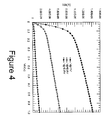
- FIG.3 and FIG.4 show the current I ds between the drain and the source as a function of the voltage V ds between the drain and the source, for different gate voltages Vg, for a regular MOSFET and the MOSFET according to the invention respectively. Comparing Fig3 with Fig4 , it can be observed that the magnitude of the ON current for the regular MOSFET and the subject of this invention are comparable. However, it can be appreciated that the less steep slope of the current-voltage relation, as well as the current magnitude with respect to the gate voltage, indicate that the short channel effects are much less severe for the subject of this invention, which has an intrinsic bulk.
- FIG. 5 and FIG.6 compare the OFF currents I ds of a regular MOSFET and the proposed MOSFET according to this invention, i.e. when the gate voltage Vg is equal to zero, as a function of the drain-source voltage V ds .
- the OFF current of the present invention is orders of magnitude less than the one for a regular MOSFET.
- the device according to the invention is intrinsic and has much less OFF current than a MOSFET doped by 10 17 / cm3 impurities.
- a p-type device By switching the impurity types of the source and drain, a p-type device is obtained and its OFF current is exactly what is shown on Fig.6 .
- P and n-channel devices can thus be obtained using an intrinsic bulk with a very small turn off current, whereby the drastically reduced leakage current in OFF state materializes the suppression of short effect channels.
- FIG. 6 and FIG. 7 illustrate the intensity-voltage (I-V) relation for a p channel device according to the disclosed invention.
- the device is similar to the n channel device with an intrinsic bulk, but the source and drain doping impurities are reversed.
- region 3 is n-doped with 10 18 / cm3 impurity concentration and regions 4 and 5 are p-doped with 10 19 / cm3 impurity concentration.
- ON and OFF states there are well defined ON and OFF states. A regular MOSFET would not turn off, if its bulk was intrinsic.
Landscapes
- Thin Film Transistor (AREA)
- Insulated Gate Type Field-Effect Transistor (AREA)
Priority Applications (1)
| Application Number | Priority Date | Filing Date | Title |
|---|---|---|---|
| EP08100315A EP2079111A1 (fr) | 2008-01-10 | 2008-01-10 | Transistor CMOS nanométrique avec substrat intrinsèque |
Applications Claiming Priority (1)
| Application Number | Priority Date | Filing Date | Title |
|---|---|---|---|
| EP08100315A EP2079111A1 (fr) | 2008-01-10 | 2008-01-10 | Transistor CMOS nanométrique avec substrat intrinsèque |
Publications (1)
| Publication Number | Publication Date |
|---|---|
| EP2079111A1 true EP2079111A1 (fr) | 2009-07-15 |
Family
ID=39431118
Family Applications (1)
| Application Number | Title | Priority Date | Filing Date |
|---|---|---|---|
| EP08100315A Withdrawn EP2079111A1 (fr) | 2008-01-10 | 2008-01-10 | Transistor CMOS nanométrique avec substrat intrinsèque |
Country Status (1)
| Country | Link |
|---|---|
| EP (1) | EP2079111A1 (fr) |
Cited By (1)
| Publication number | Priority date | Publication date | Assignee | Title |
|---|---|---|---|---|
| US20210313458A1 (en) * | 2018-08-17 | 2021-10-07 | The Regents Of The University Of California | Field-effect bipolar transistor |
Citations (4)
| Publication number | Priority date | Publication date | Assignee | Title |
|---|---|---|---|---|
| US5489792A (en) | 1994-04-07 | 1996-02-06 | Regents Of The University Of California | Silicon-on-insulator transistors having improved current characteristics and reduced electrostatic discharge susceptibility |
| US6465283B1 (en) * | 2000-02-01 | 2002-10-15 | Industrial Technology Research Institute | Structure and fabrication method using latch-up implantation for improving latch-up immunity in CMOS fabrication process |
| US20040119076A1 (en) * | 2002-12-20 | 2004-06-24 | Sei-Hyung Ryu | Vertical JFET limited silicon carbide power metal-oxide semiconductor field effect transistors and methods of fabricating vertical JFET limited silicon carbide metal- oxide semiconductor field effect transistors |
| US6946371B2 (en) | 2002-06-10 | 2005-09-20 | Amberwave Systems Corporation | Methods of fabricating semiconductor structures having epitaxially grown source and drain elements |
-
2008
- 2008-01-10 EP EP08100315A patent/EP2079111A1/fr not_active Withdrawn
Patent Citations (4)
| Publication number | Priority date | Publication date | Assignee | Title |
|---|---|---|---|---|
| US5489792A (en) | 1994-04-07 | 1996-02-06 | Regents Of The University Of California | Silicon-on-insulator transistors having improved current characteristics and reduced electrostatic discharge susceptibility |
| US6465283B1 (en) * | 2000-02-01 | 2002-10-15 | Industrial Technology Research Institute | Structure and fabrication method using latch-up implantation for improving latch-up immunity in CMOS fabrication process |
| US6946371B2 (en) | 2002-06-10 | 2005-09-20 | Amberwave Systems Corporation | Methods of fabricating semiconductor structures having epitaxially grown source and drain elements |
| US20040119076A1 (en) * | 2002-12-20 | 2004-06-24 | Sei-Hyung Ryu | Vertical JFET limited silicon carbide power metal-oxide semiconductor field effect transistors and methods of fabricating vertical JFET limited silicon carbide metal- oxide semiconductor field effect transistors |
Non-Patent Citations (6)
| Title |
|---|
| D. S. ANG; C. H. LING: "A reassessment of ac hot-carrier degradation in deep-submicrometer LDD N-MOSFET", IEEE ELECTRON DEV. LETT., vol. 24, no. 9, 2003, pages 598 - 600, XP011424761, DOI: doi:10.1109/LED.2003.815942 |
| E. MURAKAM ET AL.: "Gate length scalability of n-MOSFETs down to 30 nm: Comparison between LDD and non-LDD structures", IEEE TRANS. ELECTRON DEV. VOL., vol. 47, no. 4, 2000, pages 835 - 840, XP011017211 |
| H.-S. P. WONG ET AL.: "Nanoscale CMOS", PROC. IEEE, vol. 87, no. 4, 1999, pages 537 - 570 |
| IRAJ SHEIKHIAN ET AL: "Simulation Results for Nanoscale Field Effect Diode", IEEE TRANSACTIONS ON ELECTRON DEVICES, IEEE SERVICE CENTER, PISACATAWAY, NJ, US, vol. 54, no. 3, 1 March 2007 (2007-03-01), pages 613 - 617, XP011172073, ISSN: 0018-9383 * |
| KOH ET AL.: "Body-Contacted SOI MOSFET Structure with Fully Bulk CMOS Compatible Layout and Process", IEEE ELECTRON DEVICE LETTERS, vol. 18, no. 3, March 1997 (1997-03-01), pages 102 - 104, XP011424023, DOI: doi:10.1109/55.556094 |
| T. MIZUNO: "New channel engineering for sub-100 nm MOS devices considering both carrier velocity overshoot and statistical performance fluctuations", IEEE TRANS. ELEC. DEV., vol. 47, no. 4, 2000, pages 756 - 761, XP000947266, DOI: doi:10.1109/16.830990 |
Cited By (2)
| Publication number | Priority date | Publication date | Assignee | Title |
|---|---|---|---|---|
| US20210313458A1 (en) * | 2018-08-17 | 2021-10-07 | The Regents Of The University Of California | Field-effect bipolar transistor |
| US12324172B2 (en) * | 2018-08-17 | 2025-06-03 | The Regents Of The University Of California | Field-effect bipolar transistor |
Similar Documents
| Publication | Publication Date | Title |
|---|---|---|
| US11152459B2 (en) | Lateral MOSFET with buried drain extension layer | |
| CN100423289C (zh) | 半导体部件及其制造方法 | |
| US8178862B2 (en) | Junctionless metal-oxide-semiconductor transistor | |
| CN101523607B (zh) | 穿隧式场效应晶体管 | |
| US8288803B2 (en) | Tunnel field effect devices | |
| US20080303095A1 (en) | Varying mugfet width to adjust device characteristics | |
| CN100563029C (zh) | 半导体结构 | |
| US7525138B2 (en) | JFET device with improved off-state leakage current and method of fabrication | |
| JP2004356314A (ja) | 半導体装置 | |
| WO2012136066A1 (fr) | Transistor à effet de champ et effet tunnel complémentaire et procédé de formation de celui-ci | |
| CN102187466A (zh) | 半导体器件和这种器件的制造方法 | |
| US20210135006A1 (en) | Lateral double-diffused metal-oxide-semiconductor (ldmos) fin field effect transistor with enhanced capabilities | |
| CN1591899A (zh) | 场效应晶体管、包括fet的集成电路及其形成方法 | |
| US6734498B2 (en) | Insulated channel field effect transistor with an electric field terminal region | |
| EP1965437A1 (fr) | Dispositif transistor à l'échelle nanométrique doté d'une grande capacité de manipulation du courant | |
| US20070117334A1 (en) | Structure and method for reducing miller capacitance in field effect transistors | |
| US12113065B2 (en) | Fin-based field effect transistor (finFET) device with enhanced on-resistance and breakdown voltage | |
| EP2079111A1 (fr) | Transistor CMOS nanométrique avec substrat intrinsèque | |
| CN100499167C (zh) | 半导体结构 | |
| CN211555897U (zh) | 一种非对称mosfet及半导体器件 | |
| Farkoush et al. | Investigating the Source Stack Engineering Effect on the Drive Current of a Tunneling Field Effect Transistor | |
| Choi et al. | Two-dimensional polysilicon quantum-mechanical effects in double-gate SOI | |
| Akbulut et al. | Narrow-channel accumulated-body bulk Si MOSFETs with wide-range dynamic threshold voltage tuning | |
| CN1175494C (zh) | 具有基底接触的绝缘层上有硅的结构 | |
| Vaid et al. | Novel FLI/ODBR based LDMOSFET: A 2-D simulation study |
Legal Events
| Date | Code | Title | Description |
|---|---|---|---|
| PUAI | Public reference made under article 153(3) epc to a published international application that has entered the european phase |
Free format text: ORIGINAL CODE: 0009012 |
|
| AK | Designated contracting states |
Kind code of ref document: A1 Designated state(s): AT BE BG CH CY CZ DE DK EE ES FI FR GB GR HR HU IE IS IT LI LT LU LV MC MT NL NO PL PT RO SE SI SK TR |
|
| AX | Request for extension of the european patent |
Extension state: AL BA MK RS |
|
| AKX | Designation fees paid | ||
| REG | Reference to a national code |
Ref country code: DE Ref legal event code: 8566 |
|
| RBV | Designated contracting states (corrected) |
Designated state(s): AT BE BG CH CY CZ LI |
|
| 17P | Request for examination filed |
Effective date: 20100426 |
|
| RBV | Designated contracting states (corrected) |
Designated state(s): AT BE BG CH CY CZ DE DK EE ES FI FR GB GR HR HU IE IS IT LI LT LU LV MC MT NL NO PL PT RO SE SI SK TR |
|
| STAA | Information on the status of an ep patent application or granted ep patent |
Free format text: STATUS: THE APPLICATION IS DEEMED TO BE WITHDRAWN |
|
| 18D | Application deemed to be withdrawn |
Effective date: 20120801 |