EP2079159A2 - Motor drive apparatus equipped with dynamic braking circuit fault detection capability - Google Patents
Motor drive apparatus equipped with dynamic braking circuit fault detection capability Download PDFInfo
- Publication number
- EP2079159A2 EP2079159A2 EP20080020765 EP08020765A EP2079159A2 EP 2079159 A2 EP2079159 A2 EP 2079159A2 EP 20080020765 EP20080020765 EP 20080020765 EP 08020765 A EP08020765 A EP 08020765A EP 2079159 A2 EP2079159 A2 EP 2079159A2
- Authority
- EP
- European Patent Office
- Prior art keywords
- dynamic braking
- braking circuit
- current
- motor drive
- motor
- Prior art date
- Legal status (The legal status is an assumption and is not a legal conclusion. Google has not performed a legal analysis and makes no representation as to the accuracy of the status listed.)
- Granted
Links
Images


Classifications
-
- H—ELECTRICITY
- H02—GENERATION; CONVERSION OR DISTRIBUTION OF ELECTRIC POWER
- H02P—CONTROL OR REGULATION OF ELECTRIC MOTORS, ELECTRIC GENERATORS OR DYNAMO-ELECTRIC CONVERTERS; CONTROLLING TRANSFORMERS, REACTORS OR CHOKE COILS
- H02P3/00—Arrangements for stopping or slowing electric motors, generators, or dynamo-electric converters
- H02P3/06—Arrangements for stopping or slowing electric motors, generators, or dynamo-electric converters for stopping or slowing an individual dynamo-electric motor or dynamo-electric converter
- H02P3/18—Arrangements for stopping or slowing electric motors, generators, or dynamo-electric converters for stopping or slowing an individual dynamo-electric motor or dynamo-electric converter for stopping or slowing an AC motor
-
- G—PHYSICS
- G01—MEASURING; TESTING
- G01R—MEASURING ELECTRIC VARIABLES; MEASURING MAGNETIC VARIABLES
- G01R31/00—Arrangements for testing electric properties; Arrangements for locating electric faults; Arrangements for electrical testing characterised by what is being tested not provided for elsewhere
- G01R31/50—Testing of electric apparatus, lines, cables or components for short-circuits, continuity, leakage current or incorrect line connections
- G01R31/54—Testing for continuity
Definitions
- the present invention relates to a motor drive apparatus equipped with a dynamic braking circuit fault detection capability, and more particularly to a motor drive apparatus having a capability to detect faults in a dynamic braking circuit (such as a contact welding defect or an electrically inoperable contact, breakage of a resistor, disconnection of a connecting cable, etc.).
- a dynamic braking circuit such as a contact welding defect or an electrically inoperable contact, breakage of a resistor, disconnection of a connecting cable, etc.
- FIG. 7 is a block diagram showing the configuration of a motor drive apparatus according to the prior art.
- a DC power supply 102 converts AC power, supplied from an AC power supply not shown, into DC power.
- the DC power from the DC power supply 102 is supplied to a synchronous motor 104 (hereinafter referred to as the motor) via a power transistor unit 103 comprising power transistors A to F.
- a dynamic braking circuit 105 actuates switches S1 and S2, i.e., relay contacts, so that the power is dissipated through resistors Ru, Rv, and Rw in the dynamic braking circuit 105.
- a motor drive control circuit 110 outputs a dynamic braking circuit control signal SIG1, in response to which a fault detection circuit 111 generates a power transistor control signal SIG2 for controlling the driving/stopping of the motor 104, i.e., a power transistor ON/OFF signal, and supplies it to the power transistors A to F in the power transistor unit 103.
- a current detector 106 detects current flowing from the power transistor unit 103 to the motor 104.
- the fault detection circuit 111 receives the dynamic braking circuit control signal SIG1 from the motor drive control circuit 110 and a contact state signal SIG70 from the dynamic braking circuit 105, i.e., an ON/OFF signal indicating the operation ON/OFF state of the motor 104 in accordance with the ON/OFF state of the switches S1 and S2, and detects from these signals a fault occurring in the dynamic braking circuit 105 (such as a contact welding defect or an electrically inoperable contact, breakage of a resistor, or disconnection of a connecting cable).
- a fault occurring in the dynamic braking circuit 105 such as a contact welding defect or an electrically inoperable contact, breakage of a resistor, or disconnection of a connecting cable.
- Patent Publication No. 1 Japanese Patent No. 3383965 (refer to [CLAIM 1] in Patent Claims, paragraphs [0003] to [0006] in Patent Specification, and FIGS. 1 and 2 )
- the present invention has been devised to solve the problem that the cost increases due to the addition of two extra hardware pieces, i.e., the contact signal and the control circuit, and it is an object of the present invention to provide a motor drive apparatus equipped with a dynamic braking circuit fault detection capability to detect faults in a dynamic braking circuit without requiring the addition of such two extra hardware pieces.
- a motor drive apparatus has a dynamic braking circuit for producing a deceleration torque utilizing a braking force caused by a synchronous motor acting as a generator when the synchronous motor is deenergized, and is equipped with a dynamic braking circuit fault detection capability, comprising: a DC power supply which is obtained by rectifying input AC power; voltage application means for applying a voltage to a winding of the synchronous motor and to the dynamic braking circuit for a predetermined length of time by switching a power transistor connected to the DC power supply; current detection means for detecting the value of a current flowing from the power transistor; and fault checking means for checking the dynamic braking circuit for the presence or absence of a fault, based on the current value detected by the current detection means and on a predefined threshold value.
- the predetermined length of time during which the voltage is applied from the DC power supply is chosen so that a transient current that flows through the motor winding after the power transistor is turned on does not exceed a current that flows through a dynamic braking resistor.
- the predetermined length of time during which the voltage is applied from the DC power supply is set longer than a current detection delay time that occurs when the current detection means detects the current.
- the threshold value is changed according to the resistance value of the dynamic braking circuit or to the inductance of the synchronous motor.
- an overcurrent detection circuit incorporated in a motor drive control circuit is used as the current detection means, and the threshold value is set so as to serve as an overcurrent detection level when checking the dynamic braking circuit for a fault.
- the operation of the dynamic braking can be checked in a short time while the motor is in a stopped condition.
- FIG. 1 is a block diagram schematically showing the configuration of a motor drive apparatus according to a first embodiment of the present invention.
- a DC power supply 2 converts AC power, supplied from an AC power supply not shown, into DC power.
- the DC power from the DC power supply 2 is supplied to a synchronous motor (hereinafter referred to as the motor) 4 via a power transistor unit 3 comprising power transistors A to F.
- a dynamic braking circuit 5 actuates switches S1 and S2, i.e., relay contacts, so that the power is dissipated through resistors Ru, Rv, and Rw in the dynamic braking circuit 5.
- a motor drive control circuit 10 outputs a dynamic braking circuit control signal SIG1, in response to which a fault detection circuit 11 generates a power transistor control signal SIG2 for controlling the driving/stopping of the motor 4 and supplies it to the power transistors A to F in the power transistor unit 3.
- a current detector 6 detects current flowing from the power transistor unit 3 to the motor 4, converts the current value from analog to digital, and supplies the resulting current signal SIG10 to the fault detection circuit 11.
- the fault detection circuit 11 receives the dynamic braking circuit control signal SIG1 from the motor drive control circuit 10 and the current signal SIG10 from the current detector 6, and detects from these signals a fault occurring in the dynamic braking circuit 5 (such as a contact welding defect or an electrically inoperable contact, breakage of a resistor, or disconnection of a connecting cable).
- a fault occurring in the dynamic braking circuit 5 such as a contact welding defect or an electrically inoperable contact, breakage of a resistor, or disconnection of a connecting cable.
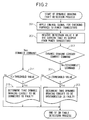
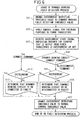
- FIG. 2 is a flowchart illustrating a fault detection process for the dynamic braking circuit in the motor drive apparatus 1 shown in FIG. 1 .
- the process is executed by the fault detection circuit 11 comprising a conventional computer, that is, a CPU, an input/output interface, a RAM, a ROM, a disk, etc.
- step 201 the power transistor control signal SIG2 for checking purposes is applied to the power transistors A to F for a predetermined length of time ⁇ t.
- the predetermined length of time ⁇ t during which the voltage is applied from the DC power supply 2 to the dynamic braking circuit 5 is chosen so that the transient current that flows through the motor windings after the power transistors are turned on does not exceed the current that flows through the dynamic braking resistors.
- step 202 the current that is output from the power transistors A to F is detected by the current detector 6, and the analog-to-digital converted current signal SIG10 (current value I) is received.
- step 203 the dynamic braking circuit 5 checks whether the dynamic braking circuit control signal SIG1 output from the motor drive control circuit 10 is indicating a connect command or not; if the result of the check is YES, the process proceeds to step 214, but if the result of the check is NO, the process proceeds to step 204.
- step 204 the current value I received in step 202 is compared with a threshold value TH, and if I ⁇ TH, the process proceeds to step 205, but if I ⁇ TH, the routine is terminated.
- the threshold value TH may be changed according to the resistance values Ru, Rv, and Rw of the dynamic braking circuit 5 or the inductances Lu, Lv, and Lw of the motor.
- an overcurrent detection circuit (not shown) incorporated in the motor drive control circuit 10 may be used as the current detector 6, and the threshold value may be set so as to serve as an overcurrent detection level when checking the dynamic braking unit 5 for faults.
- step 205 it is determined that the dynamic braking circuit 5 is faulty, and a message "DYNAMIC BRAKING CIRCUIT TO BE DISCONNECTED IS FAULTY" is produced using a display or a printer not shown in FIG. 1 .
- step 214 the current value I received in step 202 is compared with the threshold value TH, and if I > TH, the process proceeds to step 215, but if I ⁇ TH, the routine is terminated.
- step 215 it is determined that the dynamic braking circuit 5 is faulty, and a message "DYNAMIC BRAKING CIRCUIT TO BE CONNECTED IS FAULTY" is produced using a display or a printer not shown in FIG. 1 .
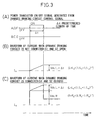
- FIGS. 3A to 3C are time charts showing a first specific example of the pattern of the dynamic braking circuit control signal and the resulting current (when there is no current detection delay) in the motor drive apparatus shown in FIG. 1 :
- FIG. 3A shows the power transistor ON/OFF signal output from the fault detection circuit
- FIG. 3B shows the waveform of the current when the dynamic braking circuit is not connected
- FIG. 3C shows the waveform of the current when the dynamic braking circuit is connected.
- the abscissa represents the time
- the ordinate in FIG. 3A represents the ON/OFF state
- the ordinate in FIGS. 3B and 3C represents the waveform of the current.
- the dynamic braking circuit 5 is connected to the motor power line, and the energy from the motor 4 is dissipated through the resistors Ru, Rv, and Rw in the dynamic braking circuit 5, thereby reducing the stopping distance of the motor.
- the dynamic braking circuit 5 is disconnected from the power transistor unit 3 which is a motor drive circuit, and only the motor 5 is connected to the motor driving power transistor unit 3.
- the contacts for connecting the dynamic braking circuit 5 to the motor power line remain closed due to welding defects, and the dynamic braking circuit 5 is not disconnected from the motor power line when driving the motor 4, the currents Iu, Iv, and Iw for driving the motor 4 flow into the dynamic braking circuit 5, resulting in an inability to perform desired current control or in overheating the resistors in the dynamic braking circuit 5 or generating an overcurrent alarm.
- the motor drive apparatus 1 provided by the present invention is equipped with a capability to apply a dynamic braking checking control signal SIG2 before driving the motor 4 and thereby verify that the dynamic braking circuit 5 is disconnected or connected properly.
- the DC power supply 2 for driving the motor 4 is obtained by rectifying the input AC power, and the voltage from the DC power supply 2 is applied via the power transistors A to F to the motor windings Lu, Lv, and Lw for a suitable length of time for the respective phases U, V, and W of the motor 4, and the currents Iu, Iv, and Iw flowing from the power transistors A to F to the resistors ru, rv, and rw of the respective windings of the motor 4 are detected by the current detector 6 to check the dynamic braking circuit 5 for any fault.
- Equation 1 can be approximated by Equation 2 shown below.
- the first term Vdc/L*t represents the current I (Iu, Iv, Iw) that flows into the windings Lu, Lv, and Lw of the motor 4, and the second term Vdc/R represents the current I (Iu, Iv, Iw) that flows into the dynamic braking circuit 5.
- the first characteristic here is that the current I (Iu, Iv, Iw) that flows when the dynamic braking circuit 5 is disconnected is different by an amount equal to Vdc/R from that when the dynamic braking circuit 5 is connected.
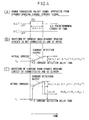
- FIGS. 4A to 4C are time charts showing a second specific example of the pattern of the dynamic braking circuit control signal and the resulting current (when there is current detection delay) in the motor drive apparatus shown in FIG. 1 :
- FIG. 4A shows the power transistor ON/OFF signal output from the fault detection circuit
- FIG. 4B shows the waveform of the current when the dynamic braking circuit is not connected
- FIG. 4C shows the waveform of the current when the dynamic braking circuit is connected.
- the abscissa represents the time
- the ordinate in FIG. 4A represents the ON/OFF state
- the ordinate in FIGS. 4B and 4C represents the waveform of the current.
- the current I (the first term) (Iu, Iv, Iw) that flows into the windings Lu, Lv, and Lw of the motor 4 has a large inductive component, and hence the second characteristic that it takes time to rise after the power transistors A to F are turned on.
- the predetermined length of time ⁇ t during which the voltage is applied from the DC power supply 2 is set longer than the current detection delay time ⁇ that occurs when the current detector 5 detects the current.
- the current I (Iu, Iv, Iw) flowing from the power transistors A to F is detected immediately after ( ⁇ t seconds after) switching the power transistors A to F, if, despite the presence of a command for connecting the dynamic braking circuit 5 to the windings Lu, Lv, and Lw of the motor 4, the current I (Iu, Iv, Iw) flowing from the power transistors A to F is smaller than a threshold value which is set as a current value smaller than Vdc/R but larger than Vdc/L* ⁇ t, it is determined that a fault has occurred such as an electrically inoperable contact in the switches S1 and S2 functioning as relay contacts for connecting the dynamic braking circuit 5, breakage of a resistor in the dynamic braking circuit 5, or disconnection of a connecting cable to the motor power line.
- An overcurrent detection circuit (not shown) originally provided in the motor drive control circuit 10 may be used to detect the current value.
- an overcurrent detection circuit 57 such as shown in FIG. 5 described below is used, it is also possible to use the threshold value by switching between the threshold value for checking the dynamic braking circuit 5 (the overcurrent detection level) and the normal (motor driving) overcurrent detection level.
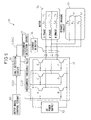
- FIG. 5 is a block diagram schematically showing the configuration of a motor drive apparatus according to a second embodiment of the present invention.
- the DC power output from a DC power supply 52 is supplied to a motor 54 via a power transistor unit 53 comprising power transistors A to F.
- a dynamic braking circuit 55 actuates switches S1 and S2, i.e., relay contacts, so that the power is dissipated through resistors Ru, Rv, and Rw in the dynamic braking circuit 55.
- a motor drive control circuit 60 outputs a dynamic braking circuit control signal SIG1, in response to which a fault detection circuit 61 generates a power transistor control signal SIG2 for controlling the driving/stopping of the motor 4 and supplies it to the power transistors A to F in the power transistor unit 53.
- a current detector 56 detects current flowing from the power transistor unit 53 to the motor 54.
- An overcurrent detection circuit 57 compares the current value, detected and analog-to-digital converted by the current detector 56, with the overcurrent threshold value supplied to the overcurrent detection circuit 57, and supplies the resulting overcurrent state signal SIG50 to the fault detection circuit 61.
- the fault detection circuit 61 receives the dynamic braking circuit control signal SIG1 from the motor drive control circuit 60 and the overcurrent state signal SIG50 from the overcurrent detection circuit 57, and detects from these signals a fault occurring in the dynamic braking circuit 55 (such as a contact welding defect or an electrically inoperable contact, breakage of a resistor, or disconnection of a connecting cable).
- a fault occurring in the dynamic braking circuit 55 such as a contact welding defect or an electrically inoperable contact, breakage of a resistor, or disconnection of a connecting cable.
- FIG. 6 is a flowchart illustrating a fault detection process for the dynamic braking circuit in the motor drive apparatus shown in FIG. 5 .
- the process is executed by the fault detection circuit 61 comprising a conventional computer, that is, a CPU, an input/output interface, a RAM, a ROM, a disk, etc.
- step 601 the overcurrent detection threshold value is changed from the normal control threshold value THNM to the dynamic braking fault detection threshold value THTM.
- step 602 the power transistor control signal SIG2 for checking purposes is applied to the power transistors A to F for a predetermined length of time ⁇ t.
- the predetermined length of time ⁇ t is set sfficiently longer than the current detection delay time ⁇ ( ⁇ t » ⁇ ).
- step 603 the current that is output from the power transistors A to F is detected and analog-to-digital converted by the current detector 56, and the overcurrent state signal SIG50 output from the overcurrent detection circuit 57 in response to the analog-to-digital converted current value I is received.
- the overcurrent detecting circuit 57 compares the current value I with the test mode threshold value THTM and, if I ⁇ THTM, it is determined that the current is not an overcurrent, and a level "0" is output; on the other hand, if I ⁇ THTM, it is determined that the current is an overcurrent, and a level "1" is output.
- step 604 the dynamic braking circuit 55 checks whether the dynamic braking circuit control signal SIG1 output from the motor drive control circuit 60 is indicating a connect command; if the result of the check is YES, the process proceeds to step 615, but if the result of the check is NO, the process proceeds to step 605.
- step 605 if the overcurrent state signal SIG50 received in step 603 is at level "0,” the process proceeds to step 607, but if it is at level "1,” the process proceeds to step 606.
- step 606 it is determined that the dynamic braking circuit 55 is faulty, and a message "DYNAMIC BRAKING CIRCUIT TO BE DISCONNECTED IS FAULTY" is produced using a display or a printer not shown in FIG. 5 .
- step 607 the overcurrent detection threshold value is changed from the dynamic braking fault detection threshold value THTM to the normal control threshold value THNM, and then the routine is terminated.
- step 615 if the overcurrent state signal SIG10 received in step 603 is at level "0," the process proceeds to step 616, but if it is at level "1,” the process proceeds to step 607.
- step 616 it is determined that the dynamic braking circuit 55 is faulty, and a message "DYNAMIC BRAKING CIRCUIT TO BE CONNECTED IS FAULTY" is produced using a display or a printer not shown in FIG. 5 .
Landscapes
- Engineering & Computer Science (AREA)
- Power Engineering (AREA)
- Stopping Of Electric Motors (AREA)
- Control Of Ac Motors In General (AREA)
Abstract
Description
- The present invention relates to a motor drive apparatus equipped with a dynamic braking circuit fault detection capability, and more particularly to a motor drive apparatus having a capability to detect faults in a dynamic braking circuit (such as a contact welding defect or an electrically inoperable contact, breakage of a resistor, disconnection of a connecting cable, etc.).
-
FIG. 7 is a block diagram showing the configuration of a motor drive apparatus according to the prior art. - In the
motor drive apparatus 101 shown inFIG. 7 , aDC power supply 102 converts AC power, supplied from an AC power supply not shown, into DC power. The DC power from theDC power supply 102 is supplied to a synchronous motor 104 (hereinafter referred to as the motor) via apower transistor unit 103 comprising power transistors A to F. When the power to themotor 104 is cut off while themotor 104 is running, adynamic braking circuit 105 actuates switches S1 and S2, i.e., relay contacts, so that the power is dissipated through resistors Ru, Rv, and Rw in thedynamic braking circuit 105. - A motor
drive control circuit 110 outputs a dynamic braking circuit control signal SIG1, in response to which afault detection circuit 111 generates a power transistor control signal SIG2 for controlling the driving/stopping of themotor 104, i.e., a power transistor ON/OFF signal, and supplies it to the power transistors A to F in thepower transistor unit 103. Acurrent detector 106 detects current flowing from thepower transistor unit 103 to themotor 104. - The
fault detection circuit 111 receives the dynamic braking circuit control signal SIG1 from the motordrive control circuit 110 and a contact state signal SIG70 from thedynamic braking circuit 105, i.e., an ON/OFF signal indicating the operation ON/OFF state of themotor 104 in accordance with the ON/OFF state of the switches S1 and S2, and detects from these signals a fault occurring in the dynamic braking circuit 105 (such as a contact welding defect or an electrically inoperable contact, breakage of a resistor, or disconnection of a connecting cable). To check the operation of thedynamic braking circuit 105 at the time of control of themotor 104, it is common to use the contact state signal SIG70 that indicates the contact state of the switches S1 and S2 as hardware provided in thedynamic braking circuit 105. - Methods that do not use such a contact state signal are also known; as one such method, there is disclosed, for example, in Patent Publication No. 1, a method that checks the operation/non-operation of the dynamic braking circuit by lowering the DC voltage when starting the motor operation.
- [Patent Publication No. 1] Japanese Patent No.
3383965 FIGS. 1 and2 ) - The method that requires the addition of a hardware contact signal involves the problem that the apparatus cost increases. On the other hand, the method of Patent Publication No. 1 that does not use such a contact signal requires the addition of a control circuit in order to perform control to obtain a low supply voltage necessary for fault detection, and this also involves the problem that the apparatus cost increases.
- The present invention has been devised to solve the problem that the cost increases due to the addition of two extra hardware pieces, i.e., the contact signal and the control circuit, and it is an object of the present invention to provide a motor drive apparatus equipped with a dynamic braking circuit fault detection capability to detect faults in a dynamic braking circuit without requiring the addition of such two extra hardware pieces.
- It is another object of the invention to enable the operation of the dynamic braking to be checked in a short time while the motor is in a stopped condition.
- A motor drive apparatus according to
claim 1 that accomplishes the above objects has a dynamic braking circuit for producing a deceleration torque utilizing a braking force caused by a synchronous motor acting as a generator when the synchronous motor is deenergized, and is equipped with a dynamic braking circuit fault detection capability, comprising: a DC power supply which is obtained by rectifying input AC power; voltage application means for applying a voltage to a winding of the synchronous motor and to the dynamic braking circuit for a predetermined length of time by switching a power transistor connected to the DC power supply; current detection means for detecting the value of a current flowing from the power transistor; and fault checking means for checking the dynamic braking circuit for the presence or absence of a fault, based on the current value detected by the current detection means and on a predefined threshold value. - In the motor drive apparatus, the predetermined length of time during which the voltage is applied from the DC power supply is chosen so that a transient current that flows through the motor winding after the power transistor is turned on does not exceed a current that flows through a dynamic braking resistor.
- In the motor drive apparatus, the predetermined length of time during which the voltage is applied from the DC power supply is set longer than a current detection delay time that occurs when the current detection means detects the current.
- In the motor drive apparatus equipped, the threshold value is changed according to the resistance value of the dynamic braking circuit or to the inductance of the synchronous motor.
- In the motor drive apparatus, an overcurrent detection circuit incorporated in a motor drive control circuit is used as the current detection means, and the threshold value is set so as to serve as an overcurrent detection level when checking the dynamic braking circuit for a fault.
- According to the invention of any one of
claims 1 to 5, since fault detection can be accomplished without requiring the contact signal that had to be provided from the dynamic braking circuit or the control circuit that had to be provided for detecting faults in the dynamic braking circuit, a motor drive apparatus equipped with a dynamic braking circuit fault detection capability can be achieved at low cost. - According to the invention of any one of
claims 1 to 5, the operation of the dynamic braking can be checked in a short time while the motor is in a stopped condition. -
-
FIG. 1 is a block diagram schematically showing the configuration of a motor drive apparatus according to a first embodiment of the present invention. -
FIG. 2 is a flowchart illustrating a fault detection process for a dynamic braking circuit in the motor drive apparatus shown inFIG. 1 . -
FIGS. 3A to 3C are time charts showing a first specific example of the pattern of a dynamic braking circuit control signal and the resulting current (when there is no current detection delay) in the motor drive apparatus shown inFIG. 1 :FIG. 3A shows a power transistor ON/OFF signal output from a fault detection circuit,FIG. 3B shows the waveform of the current when the dynamic braking circuit is not connected, andFIG. 3C shows the waveform of the current when the dynamic braking circuit is connected. -
FIGS. 4A to 4C are time charts showing a second specific example of the pattern of the dynamic braking circuit control signal and the resulting current (when there is current detection delay) in the motor drive apparatus shown inFIG. 1 :FIG. 4A shows the power transistor ON/OFF signal output from the fault detection circuit,FIG. 4B shows the waveform of the current when the dynamic braking circuit is not connected, andFIG. 4C shows the waveform of the current when the dynamic braking circuit is connected. -
FIG. 5 is a block diagram schematically showing the configuration of a motor drive apparatus according to a second embodiment of the present invention. -
FIG. 6 is a flowchart illustrating a fault detection process for a dynamic braking circuit in the motor drive apparatus shown inFIG. 5 . -
FIG. 7 is a block diagram showing the configuration of a motor drive apparatus according to the prior art. - The embodiments of the present invention will be described below with reference to the accompanying drawings.
-
FIG. 1 is a block diagram schematically showing the configuration of a motor drive apparatus according to a first embodiment of the present invention. - In the
motor drive apparatus 1 generally shown inFIG. 1 , aDC power supply 2 converts AC power, supplied from an AC power supply not shown, into DC power. The DC power from theDC power supply 2 is supplied to a synchronous motor (hereinafter referred to as the motor) 4 via apower transistor unit 3 comprising power transistors A to F. When the power to themotor 4 is cut off while themotor 4 is running, adynamic braking circuit 5 actuates switches S1 and S2, i.e., relay contacts, so that the power is dissipated through resistors Ru, Rv, and Rw in thedynamic braking circuit 5. - A motor
drive control circuit 10 outputs a dynamic braking circuit control signal SIG1, in response to which afault detection circuit 11 generates a power transistor control signal SIG2 for controlling the driving/stopping of themotor 4 and supplies it to the power transistors A to F in thepower transistor unit 3. Acurrent detector 6 detects current flowing from thepower transistor unit 3 to themotor 4, converts the current value from analog to digital, and supplies the resulting current signal SIG10 to thefault detection circuit 11. - The
fault detection circuit 11 receives the dynamic braking circuit control signal SIG1 from the motordrive control circuit 10 and the current signal SIG10 from thecurrent detector 6, and detects from these signals a fault occurring in the dynamic braking circuit 5 (such as a contact welding defect or an electrically inoperable contact, breakage of a resistor, or disconnection of a connecting cable). -
FIG. 2 is a flowchart illustrating a fault detection process for the dynamic braking circuit in themotor drive apparatus 1 shown inFIG. 1 . The process is executed by thefault detection circuit 11 comprising a conventional computer, that is, a CPU, an input/output interface, a RAM, a ROM, a disk, etc. - In
step 201, the power transistor control signal SIG2 for checking purposes is applied to the power transistors A to F for a predetermined length of time Δt. The predetermined length of time Δt during which the voltage is applied from theDC power supply 2 to thedynamic braking circuit 5 is chosen so that the transient current that flows through the motor windings after the power transistors are turned on does not exceed the current that flows through the dynamic braking resistors. - In
step 202, the current that is output from the power transistors A to F is detected by thecurrent detector 6, and the analog-to-digital converted current signal SIG10 (current value I) is received. - In
step 203, thedynamic braking circuit 5 checks whether the dynamic braking circuit control signal SIG1 output from the motordrive control circuit 10 is indicating a connect command or not; if the result of the check is YES, the process proceeds tostep 214, but if the result of the check is NO, the process proceeds tostep 204. - In
step 204, the current value I received instep 202 is compared with a threshold value TH, and if I < TH, the process proceeds tostep 205, but if I ≥ TH, the routine is terminated. The threshold value TH may be changed according to the resistance values Ru, Rv, and Rw of thedynamic braking circuit 5 or the inductances Lu, Lv, and Lw of the motor. Further, an overcurrent detection circuit (not shown) incorporated in the motordrive control circuit 10 may be used as thecurrent detector 6, and the threshold value may be set so as to serve as an overcurrent detection level when checking thedynamic braking unit 5 for faults. - In
step 205, it is determined that thedynamic braking circuit 5 is faulty, and a message "DYNAMIC BRAKING CIRCUIT TO BE DISCONNECTED IS FAULTY" is produced using a display or a printer not shown inFIG. 1 . - In
step 214, the current value I received instep 202 is compared with the threshold value TH, and if I > TH, the process proceeds tostep 215, but if I ≤ TH, the routine is terminated. - In
step 215, it is determined that thedynamic braking circuit 5 is faulty, and a message "DYNAMIC BRAKING CIRCUIT TO BE CONNECTED IS FAULTY" is produced using a display or a printer not shown inFIG. 1 . -
FIGS. 3A to 3C are time charts showing a first specific example of the pattern of the dynamic braking circuit control signal and the resulting current (when there is no current detection delay) in the motor drive apparatus shown inFIG. 1 :FIG. 3A shows the power transistor ON/OFF signal output from the fault detection circuit,FIG. 3B shows the waveform of the current when the dynamic braking circuit is not connected, andFIG. 3C shows the waveform of the current when the dynamic braking circuit is connected. InFIGS. 3A to 3C , the abscissa represents the time, the ordinate inFIG. 3A represents the ON/OFF state, and the ordinate inFIGS. 3B and 3C represents the waveform of the current. - Usually, when the power to the
motor 4 is cut off while themotor 4 is running, thedynamic braking circuit 5 is connected to the motor power line, and the energy from themotor 4 is dissipated through the resistors Ru, Rv, and Rw in thedynamic braking circuit 5, thereby reducing the stopping distance of the motor. - On the other hand, when driving the
motor 4, thedynamic braking circuit 5 is disconnected from thepower transistor unit 3 which is a motor drive circuit, and only themotor 5 is connected to the motor drivingpower transistor unit 3. - If the contacts for connecting the
dynamic braking circuit 5 to the motor power line remain closed due to welding defects, and thedynamic braking circuit 5 is not disconnected from the motor power line when driving themotor 4, the currents Iu, Iv, and Iw for driving themotor 4 flow into thedynamic braking circuit 5, resulting in an inability to perform desired current control or in overheating the resistors in thedynamic braking circuit 5 or generating an overcurrent alarm. - The
motor drive apparatus 1 provided by the present invention is equipped with a capability to apply a dynamic braking checking control signal SIG2 before driving themotor 4 and thereby verify that thedynamic braking circuit 5 is disconnected or connected properly. - More specifically, the
DC power supply 2 for driving themotor 4 is obtained by rectifying the input AC power, and the voltage from theDC power supply 2 is applied via the power transistors A to F to the motor windings Lu, Lv, and Lw for a suitable length of time for the respective phases U, V, and W of themotor 4, and the currents Iu, Iv, and Iw flowing from the power transistors A to F to the resistors ru, rv, and rw of the respective windings of themotor 4 are detected by thecurrent detector 6 to check thedynamic braking circuit 5 for any fault. - When voltage Vdc is applied from the
DC power supply 2 to the power transistors A to F and to thedynamic braking circuit 5 and themotor 4, the current I (Iu, Iv, Iw) that flows from the power transistors A to F after time t has elapsed from the application of the voltage is expressed by the following equation. -

where - r: Motor winding resistance
- L: Motor inductance
- R: Dynamic braking circuit resistance
- As far as the transient period immediately after switching is concerned, it may be assumed that r/L*t « 1, and therefore
Equation 1 can be approximated byEquation 2 shown below. -

- The first term Vdc/L*t represents the current I (Iu, Iv, Iw) that flows into the windings Lu, Lv, and Lw of the
motor 4, and the second term Vdc/R represents the current I (Iu, Iv, Iw) that flows into thedynamic braking circuit 5. The first characteristic here is that the current I (Iu, Iv, Iw) that flows when thedynamic braking circuit 5 is disconnected is different by an amount equal to Vdc/R from that when thedynamic braking circuit 5 is connected. -
FIGS. 4A to 4C are time charts showing a second specific example of the pattern of the dynamic braking circuit control signal and the resulting current (when there is current detection delay) in the motor drive apparatus shown inFIG. 1 :FIG. 4A shows the power transistor ON/OFF signal output from the fault detection circuit,FIG. 4B shows the waveform of the current when the dynamic braking circuit is not connected, andFIG. 4C shows the waveform of the current when the dynamic braking circuit is connected. In partsFIGS. 4A to 4C , the abscissa represents the time, the ordinate inFIG. 4A represents the ON/OFF state, and the ordinate inFIGS. 4B and 4C represents the waveform of the current. - The current I (the first term) (Iu, Iv, Iw) that flows into the windings Lu, Lv, and Lw of the
motor 4 has a large inductive component, and hence the second characteristic that it takes time to rise after the power transistors A to F are turned on. - The predetermined length of time Δt during which the voltage is applied from the
DC power supply 2 is set longer than the current detection delay time δ that occurs when thecurrent detector 5 detects the current. - From the first and second characteristics, when the current I (Iu, Iv, Iw) flowing from the power transistors A to F is detected immediately after (Δt seconds after) switching the power transistors A to F, if, despite the presence of a command for connecting the
dynamic braking circuit 5 to the windings Lu, Lv, and Lw of themotor 4, the current I (Iu, Iv, Iw) flowing from the power transistors A to F is smaller than a threshold value which is set as a current value smaller than Vdc/R but larger than Vdc/L*Δt, it is determined that a fault has occurred such as an electrically inoperable contact in the switches S1 and S2 functioning as relay contacts for connecting thedynamic braking circuit 5, breakage of a resistor in thedynamic braking circuit 5, or disconnection of a connecting cable to the motor power line. - On the other hand, if, despite the presence of a command for disconnecting the
dynamic braking circuit 5 from the windings Lu, Lv, and Lw of the motor 4', the current I (Iu, Iv, Iw) flowing from the power transistors A to F is larger than the threshold value, it is determined that a fault has occurred such that the contacts for connecting thedynamic braking circuit 5 remain closed due to welding defects. - An overcurrent detection circuit (not shown) originally provided in the motor
drive control circuit 10 may be used to detect the current value. - When an
overcurrent detection circuit 57 such as shown inFIG. 5 described below is used, it is also possible to use the threshold value by switching between the threshold value for checking the dynamic braking circuit 5 (the overcurrent detection level) and the normal (motor driving) overcurrent detection level. -
FIG. 5 is a block diagram schematically showing the configuration of a motor drive apparatus according to a second embodiment of the present invention. - In the motor drive apparatus 15 generally shown in
FIG. 5 , the DC power output from aDC power supply 52 is supplied to amotor 54 via apower transistor unit 53 comprising power transistors A to F. When the power to the synchronous motor (hereinafter referred to as the motor) 54 is cut off while themotor 54 is running, adynamic braking circuit 55 actuates switches S1 and S2, i.e., relay contacts, so that the power is dissipated through resistors Ru, Rv, and Rw in thedynamic braking circuit 55. - A motor
drive control circuit 60 outputs a dynamic braking circuit control signal SIG1, in response to which afault detection circuit 61 generates a power transistor control signal SIG2 for controlling the driving/stopping of themotor 4 and supplies it to the power transistors A to F in thepower transistor unit 53. Acurrent detector 56 detects current flowing from thepower transistor unit 53 to themotor 54. Anovercurrent detection circuit 57 compares the current value, detected and analog-to-digital converted by thecurrent detector 56, with the overcurrent threshold value supplied to theovercurrent detection circuit 57, and supplies the resulting overcurrent state signal SIG50 to thefault detection circuit 61. - The
fault detection circuit 61 receives the dynamic braking circuit control signal SIG1 from the motordrive control circuit 60 and the overcurrent state signal SIG50 from theovercurrent detection circuit 57, and detects from these signals a fault occurring in the dynamic braking circuit 55 (such as a contact welding defect or an electrically inoperable contact, breakage of a resistor, or disconnection of a connecting cable). -
FIG. 6 is a flowchart illustrating a fault detection process for the dynamic braking circuit in the motor drive apparatus shown inFIG. 5 . The process is executed by thefault detection circuit 61 comprising a conventional computer, that is, a CPU, an input/output interface, a RAM, a ROM, a disk, etc. - In
step 601, the overcurrent detection threshold value is changed from the normal control threshold value THNM to the dynamic braking fault detection threshold value THTM. - In
step 602, the power transistor control signal SIG2 for checking purposes is applied to the power transistors A to F for a predetermined length of time Δt. The predetermined length of time Δt is set sfficiently longer than the current detection delay time δ (Δt » δ). - In
step 603, the current that is output from the power transistors A to F is detected and analog-to-digital converted by thecurrent detector 56, and the overcurrent state signal SIG50 output from theovercurrent detection circuit 57 in response to the analog-to-digital converted current value I is received. Theovercurrent detecting circuit 57 compares the current value I with the test mode threshold value THTM and, if I < THTM, it is determined that the current is not an overcurrent, and a level "0" is output; on the other hand, if I ≥ THTM, it is determined that the current is an overcurrent, and a level "1" is output. - In
step 604, thedynamic braking circuit 55 checks whether the dynamic braking circuit control signal SIG1 output from the motordrive control circuit 60 is indicating a connect command; if the result of the check is YES, the process proceeds to step 615, but if the result of the check is NO, the process proceeds to step 605. - In
step 605, if the overcurrent state signal SIG50 received instep 603 is at level "0," the process proceeds to step 607, but if it is at level "1," the process proceeds to step 606. - In
step 606, it is determined that thedynamic braking circuit 55 is faulty, and a message "DYNAMIC BRAKING CIRCUIT TO BE DISCONNECTED IS FAULTY" is produced using a display or a printer not shown inFIG. 5 . - In
step 607, the overcurrent detection threshold value is changed from the dynamic braking fault detection threshold value THTM to the normal control threshold value THNM, and then the routine is terminated. - In
step 615, if the overcurrent state signal SIG10 received instep 603 is at level "0," the process proceeds to step 616, but if it is at level "1," the process proceeds to step 607. - In
step 616, it is determined that thedynamic braking circuit 55 is faulty, and a message "DYNAMIC BRAKING CIRCUIT TO BE CONNECTED IS FAULTY" is produced using a display or a printer not shown inFIG. 5 .
Claims (5)
- A motor drive apparatus having a dynamic braking circuit for producing a deceleration torque utilizing a braking force caused by a synchronous motor acting as a generator when said synchronous motor is deenergized, said motor drive apparatus being equipped with a dynamic braking circuit fault detection capability, comprising:a DC power supply which is obtained by rectifying input AC power;voltage application means for applying a voltage to a winding of said synchronous motor and to said dynamic braking circuit for a predetermined length of time by switching a power transistor connected to said DC power supply;current detection means for detecting the value of a current flowing from said power transistor; andfault checking means for checking said dynamic braking circuit for the presence or absence of a fault, based on the current value detected by said current detection means and on a predefined threshold value.
- A motor drive apparatus equipped with a dynamic braking circuit fault detection capability as claimed in claim 1, wherein said predetermined length of time during which said voltage is applied from said DC power supply is chosen so that a transient current that flows through said motor winding after said power transistor is turned on does not exceed a current that flows through a dynamic braking resistor.
- A motor drive apparatus equipped with a dynamic braking circuit fault detection capability as claimed in claim 1 or 2, wherein said predetermined length of time during which said voltage is applied from said DC power supply is set longer than a current detection delay time that occurs when said current detection means detects said current.
- A motor drive apparatus equipped with a dynamic braking circuit fault detection capability as claimed in any one of claims 1 to 3, wherein said threshold value is changed according to resistance value of said dynamic braking circuit or to inductance of said synchronous motor.
- A motor drive apparatus equipped with a dynamic braking circuit fault detection capability as claimed in any one of claims 1 to 4, wherein an overcurrent detection circuit incorporated in a motor drive control circuit is used as said current detection means, and said threshold value is set so as to serve as an overcurrent detection level when checking said dynamic braking circuit for a fault.
Applications Claiming Priority (1)
| Application Number | Priority Date | Filing Date | Title |
|---|---|---|---|
| JP2008001916A JP4361116B2 (en) | 2008-01-09 | 2008-01-09 | Motor drive device with dynamic brake circuit failure detection function |
Publications (3)
| Publication Number | Publication Date |
|---|---|
| EP2079159A2 true EP2079159A2 (en) | 2009-07-15 |
| EP2079159A3 EP2079159A3 (en) | 2015-06-24 |
| EP2079159B1 EP2079159B1 (en) | 2017-07-05 |
Family
ID=40210524
Family Applications (1)
| Application Number | Title | Priority Date | Filing Date |
|---|---|---|---|
| EP08020765.7A Ceased EP2079159B1 (en) | 2008-01-09 | 2008-11-28 | Motor drive apparatus equipped with dynamic braking circuit fault detection capability |
Country Status (4)
| Country | Link |
|---|---|
| US (1) | US8054015B2 (en) |
| EP (1) | EP2079159B1 (en) |
| JP (1) | JP4361116B2 (en) |
| CN (1) | CN101483402B (en) |
Cited By (1)
| Publication number | Priority date | Publication date | Assignee | Title |
|---|---|---|---|---|
| WO2013113051A2 (en) | 2012-02-03 | 2013-08-08 | Fts Computertechnik Gmbh | Method and apparatus for monitoring the short-circuiting switching device of a three-phase motor |
Families Citing this family (32)
| Publication number | Priority date | Publication date | Assignee | Title |
|---|---|---|---|---|
| JP2009142115A (en) * | 2007-12-10 | 2009-06-25 | Yaskawa Electric Corp | Motor control device and failure detection method thereof |
| DE102009046617A1 (en) * | 2009-11-11 | 2011-05-19 | Zf Friedrichshafen Ag | inverter |
| EP2372860A1 (en) * | 2010-03-30 | 2011-10-05 | Converteam Technology Ltd | Protection circuits and methods for electrical machines |
| US8878468B2 (en) * | 2011-04-29 | 2014-11-04 | Pratt & Whitney Canada Corp. | Electric machine assembly with fail-safe arrangement |
| KR20130019911A (en) * | 2011-08-18 | 2013-02-27 | 현대모비스 주식회사 | Device for detecting failure of motor coil in breaking system for vehicle and method thereof |
| JP5421405B2 (en) * | 2012-02-28 | 2014-02-19 | ファナック株式会社 | Motor drive device having dynamic brake control means |
| US9056551B2 (en) * | 2012-09-10 | 2015-06-16 | Caterpillar Global Mining Llc | Braking system contactor control and/or monitoring system and method |
| JP6144900B2 (en) * | 2012-12-03 | 2017-06-07 | オークマ株式会社 | Inverter device with dynamic brake inspection function |
| DE102012224188A1 (en) * | 2012-12-21 | 2014-06-26 | Wobben Properties Gmbh | Method for controlling a water contactor drive for a water contactor with an electric machine, operating circuit, water contactor drive and hydropower plant |
| JP6073147B2 (en) * | 2013-02-06 | 2017-02-01 | 株式会社日立産機システム | Motor drive power converter having dynamic brake circuit inspection method |
| JP2014190773A (en) * | 2013-03-26 | 2014-10-06 | Toyota Motor Corp | Overcurrent detector and semiconductor drive unit having the same |
| US9013123B2 (en) * | 2013-04-22 | 2015-04-21 | Rockwell Automation Technologies, Inc. | Self protected dynamic braking |
| JP5980969B2 (en) | 2015-01-29 | 2016-08-31 | ファナック株式会社 | Motor drive device with dynamic brake circuit failure detection function |
| JP6423765B2 (en) * | 2015-07-31 | 2018-11-14 | ファナック株式会社 | Brake device having a function of detecting brake operation and release abnormality |
| JP6193937B2 (en) * | 2015-08-27 | 2017-09-06 | ファナック株式会社 | Motor drive device having function of detecting failure of shunt |
| JP6356716B2 (en) * | 2016-02-29 | 2018-07-11 | ファナック株式会社 | Motor control device having torque command limiter |
| JP6400617B2 (en) * | 2016-02-29 | 2018-10-03 | ファナック株式会社 | Motor control device having torque command limiter |
| JP6301511B2 (en) * | 2017-01-04 | 2018-03-28 | 株式会社日立産機システム | Motor system |
| DE102017106008B4 (en) * | 2017-03-21 | 2019-07-04 | Schaeffler Technologies AG & Co. KG | Method for detecting a short circuit of an output stage of an electric motor, preferably an electrically commutated electric motor |
| CN107086843A (en) * | 2017-06-30 | 2017-08-22 | 广东美的制冷设备有限公司 | Motor driven systems and transducer air conditioning |
| CN111033287B (en) * | 2017-09-25 | 2022-06-03 | 日本电产株式会社 | Fault diagnosis method, motor control method, power conversion device, motor module, and electric power steering device |
| JP6904201B2 (en) * | 2017-09-27 | 2021-07-14 | セイコーエプソン株式会社 | Robot control devices, robots, and robot systems |
| JP6577549B2 (en) * | 2017-10-12 | 2019-09-18 | ファナック株式会社 | Motor drive device having failure detection function |
| CN108004973B (en) * | 2017-12-25 | 2023-11-21 | 深圳市威捷机电股份公司 | Barrier gate circuit capable of manually lifting and falling gate rod during power failure control |
| CN109471027B (en) * | 2018-11-20 | 2021-03-02 | 南京国电南自维美德自动化有限公司 | A kind of power unit self-checking method of excitation system |
| CN109406997B (en) * | 2018-11-30 | 2020-11-10 | 北京新能源汽车股份有限公司 | Method and device for testing active short-circuit relay of motor and storage medium |
| CN109358288A (en) * | 2018-12-17 | 2019-02-19 | 南京埃斯顿自动化股份有限公司 | A kind of fault detection method of servo dynamic brake circuit |
| CN110460272A (en) * | 2019-09-16 | 2019-11-15 | 江苏科技大学 | High-power permanent magnet synchronous motor energy discharge device and control method |
| CN114047461B (en) * | 2021-09-07 | 2024-11-12 | 湖南皓天信息科技有限公司 | A voltage type sensor path fault detection method, system, device and computer readable medium |
| JP7689901B2 (en) * | 2021-10-22 | 2025-06-09 | 山洋電気株式会社 | Motor Control Device |
| CN114323378B (en) * | 2021-12-30 | 2024-01-23 | 中国科学院工程热物理研究所 | Electric power dynamometer system and electric power dynamometer method |
| US20250091444A1 (en) * | 2022-04-01 | 2025-03-20 | Mitsubishi Electric Corporation | Drive device and deterioration discrimination method |
Citations (1)
| Publication number | Priority date | Publication date | Assignee | Title |
|---|---|---|---|---|
| JP3383965B2 (en) | 1994-05-25 | 2003-03-10 | 株式会社安川電機 | Servo control device DB circuit failure detection method |
Family Cites Families (10)
| Publication number | Priority date | Publication date | Assignee | Title |
|---|---|---|---|---|
| JPH0697875B2 (en) * | 1987-05-20 | 1994-11-30 | 日本オ−チス・エレベ−タ株式会社 | Inverter for driving elevator |
| JP3438748B2 (en) | 1994-07-14 | 2003-08-18 | 株式会社安川電機 | Abnormality detection method of dynamic braking of servo motor controller |
| JP4526612B2 (en) | 1999-02-25 | 2010-08-18 | 三菱電機株式会社 | Servo device |
| JP4735918B2 (en) | 2001-06-20 | 2011-07-27 | 株式会社安川電機 | Motor control device |
| EP2113999A3 (en) * | 2001-09-25 | 2010-01-06 | Daikin Industries, Ltd. | Phase current detection apparatus |
| KR100488523B1 (en) * | 2003-02-14 | 2005-05-11 | 삼성전자주식회사 | Motor control apparatus and control method thereof |
| US20040232864A1 (en) * | 2003-05-23 | 2004-11-25 | Hideki Sunaga | Apparatus for controlling motor |
| JP3851617B2 (en) * | 2003-05-27 | 2006-11-29 | ファナック株式会社 | Motor drive device |
| JP2007174729A (en) * | 2005-12-19 | 2007-07-05 | Yaskawa Electric Corp | Motor drive device and dynamic brake circuit protection method |
| US7479756B2 (en) * | 2006-06-19 | 2009-01-20 | Rockwell Automation Technologies, Inc. | System and method for protecting a motor drive unit from motor back EMF under fault conditions |
-
2008
- 2008-01-09 JP JP2008001916A patent/JP4361116B2/en not_active Expired - Fee Related
- 2008-11-28 US US12/324,972 patent/US8054015B2/en active Active
- 2008-11-28 EP EP08020765.7A patent/EP2079159B1/en not_active Ceased
- 2008-12-08 CN CN200810184613XA patent/CN101483402B/en not_active Expired - Fee Related
Patent Citations (1)
| Publication number | Priority date | Publication date | Assignee | Title |
|---|---|---|---|---|
| JP3383965B2 (en) | 1994-05-25 | 2003-03-10 | 株式会社安川電機 | Servo control device DB circuit failure detection method |
Cited By (5)
| Publication number | Priority date | Publication date | Assignee | Title |
|---|---|---|---|---|
| WO2013113051A2 (en) | 2012-02-03 | 2013-08-08 | Fts Computertechnik Gmbh | Method and apparatus for monitoring the short-circuiting switching device of a three-phase motor |
| AT512477A1 (en) * | 2012-02-03 | 2013-08-15 | Fts Computertechnik Gmbh | METHOD AND DEVICE FOR MONITORING THE SHORT-CIRCUIT SWITCHING DEVICE OF A THREE-PHASE MOTOR |
| WO2013113051A3 (en) * | 2012-02-03 | 2014-02-20 | Fts Computertechnik Gmbh | Method and apparatus for monitoring the short-circuiting switching device of a three-phase motor |
| US9329242B2 (en) | 2012-02-03 | 2016-05-03 | Fts Computertechnik Gmbh | Method and apparatus for monitoring the short-circuiting switching device of a three-phase motor |
| AT512477B1 (en) * | 2012-02-03 | 2016-09-15 | Fts Computertechnik Gmbh | METHOD AND DEVICE FOR MONITORING THE SHORT-CIRCUIT SWITCHING DEVICE OF A THREE-PHASE MOTOR |
Also Published As
| Publication number | Publication date |
|---|---|
| EP2079159B1 (en) | 2017-07-05 |
| JP2009165296A (en) | 2009-07-23 |
| US8054015B2 (en) | 2011-11-08 |
| JP4361116B2 (en) | 2009-11-11 |
| CN101483402B (en) | 2013-02-13 |
| CN101483402A (en) | 2009-07-15 |
| US20090174349A1 (en) | 2009-07-09 |
| EP2079159A3 (en) | 2015-06-24 |
Similar Documents
| Publication | Publication Date | Title |
|---|---|---|
| EP2079159B1 (en) | Motor drive apparatus equipped with dynamic braking circuit fault detection capability | |
| US9647581B2 (en) | Motor drive having function of detecting failure in dynamic braking circuit | |
| US20190113576A1 (en) | Motor drive device having failure detection function | |
| CN103941114B (en) | The self checking method of automobile permanent magnet synchronous motor system power module and current sensor | |
| JP5943484B2 (en) | Arc discharge prevention system when using DC power supply | |
| DE102015011507B4 (en) | Electric motor drive with function for detecting welding of an electromagnetic switch | |
| US9899954B2 (en) | Motor drive apparatus having function of detecting failure of electric shunt | |
| KR101997834B1 (en) | An Apparatus and A Method For Motor Failure Diagnosis | |
| JP2006320176A (en) | Inverter diagnosis method and apparatus | |
| CN102301253A (en) | Method for operating a brushless motor | |
| JP2009229291A (en) | Sr motor drive | |
| KR20190106181A (en) | Methods for controlling EPS that cuts motor drive power when overcurrent occurs | |
| KR20160039247A (en) | Method for determining a fault in an electronically commutated electric motor | |
| JP2000013902A (en) | AC side leakage detection device for electric vehicles | |
| JP2001086762A (en) | Power supply | |
| JP7517171B2 (en) | ABNORMALITY DETECTION DEVICE, LOAD DRIVE DEVICE, ABNORMALITY DETECTION METHOD, AND PROGRAM | |
| JP2018152931A (en) | Railway vehicle control apparatus and method | |
| CN117940303A (en) | Method for operating an electric drive system, computer program product, data carrier and electric drive system | |
| US11579207B2 (en) | Circuit for checking an electrical wire connected to a digital input of an actuator | |
| KR102799269B1 (en) | Fault diagnosis apparatus and method for vehicle inverter | |
| KR102477497B1 (en) | Short circuit fault detection method of vehicle ontroller | |
| KR20210074013A (en) | Over current detecting circuit, and method thereof | |
| US20250052802A1 (en) | Supply circuit having a computer device for diagnosing a connecting circuit, in particular for power electronics in a vehicle, and method for operating a supply circuit having a computer device for diagnosing a connecting circuit | |
| JP2004247367A (en) | Linear solenoid drive | |
| JP2026058428A (en) | Power control circuit |
Legal Events
| Date | Code | Title | Description |
|---|---|---|---|
| PUAI | Public reference made under article 153(3) epc to a published international application that has entered the european phase |
Free format text: ORIGINAL CODE: 0009012 |
|
| AK | Designated contracting states |
Kind code of ref document: A2 Designated state(s): AT BE BG CH CY CZ DE DK EE ES FI FR GB GR HR HU IE IS IT LI LT LU LV MC MT NL NO PL PT RO SE SI SK TR |
|
| AX | Request for extension of the european patent |
Extension state: AL BA MK RS |
|
| RAP1 | Party data changed (applicant data changed or rights of an application transferred) |
Owner name: FANUC CORPORATION |
|
| PUAL | Search report despatched |
Free format text: ORIGINAL CODE: 0009013 |
|
| AK | Designated contracting states |
Kind code of ref document: A3 Designated state(s): AT BE BG CH CY CZ DE DK EE ES FI FR GB GR HR HU IE IS IT LI LT LU LV MC MT NL NO PL PT RO SE SI SK TR |
|
| AX | Request for extension of the european patent |
Extension state: AL BA MK RS |
|
| RIC1 | Information provided on ipc code assigned before grant |
Ipc: G01R 31/02 20060101ALN20150515BHEP Ipc: H02P 3/18 20060101AFI20150515BHEP |
|
| 17P | Request for examination filed |
Effective date: 20151223 |
|
| AKX | Designation fees paid |
Designated state(s): DE |
|
| AXX | Extension fees paid |
Extension state: AL Extension state: RS Extension state: BA Extension state: MK |
|
| 17Q | First examination report despatched |
Effective date: 20160602 |
|
| RIC1 | Information provided on ipc code assigned before grant |
Ipc: G01R 31/02 20060101ALN20161215BHEP Ipc: H02P 3/18 20060101AFI20161215BHEP |
|
| GRAP | Despatch of communication of intention to grant a patent |
Free format text: ORIGINAL CODE: EPIDOSNIGR1 |
|
| INTG | Intention to grant announced |
Effective date: 20170126 |
|
| GRAS | Grant fee paid |
Free format text: ORIGINAL CODE: EPIDOSNIGR3 |
|
| GRAA | (expected) grant |
Free format text: ORIGINAL CODE: 0009210 |
|
| AK | Designated contracting states |
Kind code of ref document: B1 Designated state(s): DE |
|
| REG | Reference to a national code |
Ref country code: DE Ref legal event code: R096 Ref document number: 602008050936 Country of ref document: DE |
|
| REG | Reference to a national code |
Ref country code: DE Ref legal event code: R097 Ref document number: 602008050936 Country of ref document: DE |
|
| PLBE | No opposition filed within time limit |
Free format text: ORIGINAL CODE: 0009261 |
|
| STAA | Information on the status of an ep patent application or granted ep patent |
Free format text: STATUS: NO OPPOSITION FILED WITHIN TIME LIMIT |
|
| 26N | No opposition filed |
Effective date: 20180406 |
|
| PGFP | Annual fee paid to national office [announced via postgrant information from national office to epo] |
Ref country code: DE Payment date: 20231003 Year of fee payment: 16 |
|
| REG | Reference to a national code |
Ref country code: DE Ref legal event code: R119 Ref document number: 602008050936 Country of ref document: DE |
|
| PG25 | Lapsed in a contracting state [announced via postgrant information from national office to epo] |
Ref country code: DE Free format text: LAPSE BECAUSE OF NON-PAYMENT OF DUE FEES Effective date: 20250603 |