EP2079232A2 - Appareil d'affichage d'informations - Google Patents
Appareil d'affichage d'informations Download PDFInfo
- Publication number
- EP2079232A2 EP2079232A2 EP09150348A EP09150348A EP2079232A2 EP 2079232 A2 EP2079232 A2 EP 2079232A2 EP 09150348 A EP09150348 A EP 09150348A EP 09150348 A EP09150348 A EP 09150348A EP 2079232 A2 EP2079232 A2 EP 2079232A2
- Authority
- EP
- European Patent Office
- Prior art keywords
- information
- image
- facial image
- display
- display form
- Prior art date
- Legal status (The legal status is an assumption and is not a legal conclusion. Google has not performed a legal analysis and makes no representation as to the accuracy of the status listed.)
- Ceased
Links
Images















Classifications
-
- H—ELECTRICITY
- H04—ELECTRIC COMMUNICATION TECHNIQUE
- H04N—PICTORIAL COMMUNICATION, e.g. TELEVISION
- H04N23/00—Cameras or camera modules comprising electronic image sensors; Control thereof
- H04N23/60—Control of cameras or camera modules
- H04N23/61—Control of cameras or camera modules based on recognised objects
-
- H—ELECTRICITY
- H04—ELECTRIC COMMUNICATION TECHNIQUE
- H04N—PICTORIAL COMMUNICATION, e.g. TELEVISION
- H04N23/00—Cameras or camera modules comprising electronic image sensors; Control thereof
- H04N23/60—Control of cameras or camera modules
- H04N23/61—Control of cameras or camera modules based on recognised objects
- H04N23/611—Control of cameras or camera modules based on recognised objects where the recognised objects include parts of the human body
-
- H—ELECTRICITY
- H04—ELECTRIC COMMUNICATION TECHNIQUE
- H04N—PICTORIAL COMMUNICATION, e.g. TELEVISION
- H04N23/00—Cameras or camera modules comprising electronic image sensors; Control thereof
- H04N23/60—Control of cameras or camera modules
- H04N23/63—Control of cameras or camera modules by using electronic viewfinders
- H04N23/633—Control of cameras or camera modules by using electronic viewfinders for displaying additional information relating to control or operation of the camera
-
- H—ELECTRICITY
- H04—ELECTRIC COMMUNICATION TECHNIQUE
- H04N—PICTORIAL COMMUNICATION, e.g. TELEVISION
- H04N23/00—Cameras or camera modules comprising electronic image sensors; Control thereof
- H04N23/60—Control of cameras or camera modules
- H04N23/65—Control of camera operation in relation to power supply
- H04N23/651—Control of camera operation in relation to power supply for reducing power consumption by affecting camera operations, e.g. sleep mode, hibernation mode or power off of selective parts of the camera
-
- G—PHYSICS
- G06—COMPUTING OR CALCULATING; COUNTING
- G06F—ELECTRIC DIGITAL DATA PROCESSING
- G06F2200/00—Indexing scheme relating to G06F1/04 - G06F1/32
- G06F2200/16—Indexing scheme relating to G06F1/16 - G06F1/18
- G06F2200/161—Indexing scheme relating to constructional details of the monitor
- G06F2200/1614—Image rotation following screen orientation, e.g. switching from landscape to portrait mode
Definitions
- the present invention relates to an information displaying apparatus that controls information to be displayed based on a state of the face of a viewer who has been photographed.
- a display with good visibility to the viewer can be done by displaying still images information in close-up by using the technology disclosed in Japanese Laid-Open Patent Application No. 2005-26933 .
- Japanese Laid-Open Patent Application No. 2007-264124 discloses among others a technology that performs image display that is easily viewable corresponding to a difference in eye color and to a surrounding color temperature. With the technology disclosed in Japanese Laid-Open Patent Application No. 2007-67782 , it is possible to specify persons by their facial images taken and control functions of equipment available to the respective persons.
- the present invention is made to obtain a display that is easy to be seen by a viewer by an automatic operation to control the form of display information based on a facial image of the viewer (observer) who looks into the display screen.
- An information displaying apparatus comprises: a memory control means for storing information to a storage medium, and outputting the information from the storage medium; a display means for displaying the information output from the storage medium in a predetermined display form on a screen of a display; an image-capturing means for capturing an image of an observer in a state to observe the display and outputting an image signal; a facial image detection means for detecting an inclination of a facial image of the observer based on the image signal; and a display form change means for changing the display form of the information to be displayed on the screen, and in the information displaying apparatus the display form change means changes the display form so that the information to be displayed on the screen rotates by a predetermined rotation angle based on the inclination of the facial image detected by the facial image detection means.
- the information comprises index information that visually conveys an event and a content to the observer.
- the index information may comprise at least one of a character, a sign, a figure, and an icon.
- the information may comprise image information.
- the display form change means rotates the information based on the inclination of the facial image so that the information is substantially in front of and upright to the observer to change the display form.
- the information displaying apparatus further comprises: a directional information determination means for determining whether the information includes directional information, and in the information apparatus, the display form change means may determine the rotation angle based on the inclination of the facial image and the directional information when it is determined by the directional information determination means that the information includes the direction information.
- the display form change means may determine a standard display size of the information based on the inclination of the facial image and the directional information.
- the information displaying apparatus further comprises: a directional information determination means for determining whether the information includes directional information
- the facial image detection means further includes: a pattern determination means for determining whether there is a specific pattern in the information.
- the display form change means may determine directional information based on the specific pattern.
- the image detection means further comprises a pattern determination means for determining whether there is a specific pattern in the information
- the information displaying apparatus further comprises: a directional information determination means for determining whether the information includes directional information; and a prohibition means for prohibiting rotation of the information by the display form change means when it is determined by the directional information determination means that no directional information is included in the information and when it is determined by the pattern determination means that no specific pattern is included in the information.
- the information displaying apparatus may further comprise: a mode switch means for switching operation between a replay mode and another mode other than the replay mode; and a recognition means for recognizing that there is a plurality of the facial images detected by the facial image detection means, and in the information displaying apparatus, if it is recognized by the recognition means that there is a plurality of the facial images while the mode other than the replay mode is being executed, the mode switch means may switch the mode from the mode other than the replay mode to the replay mode.
- the display form change means may comprise a size change means for changing a size of display of the information based on a size of the facial image detected by the facial image detection means.
- the size change means performs expansion or reduction processing so that the smaller the size of the facial image, the larger the information is displayed.
- the size change means comprises at least one of: a display size selection means for selecting a predetermined size of display from a plurality of sizes of display included in the information based on the facial image; and an expansion/reduction means for expanding/reducing, respectively, the information at a predetermined magnification depending on the size of the facial image.
- the information displaying apparatus may further comprise: a size determination means for determining a size of the facial image detected by the facial image detection means, and in the information displaying apparatus, it is preferred that when it is determined by the size determination means that the size of the facial image is not less than a predetermined first threshold, the expansion/reduction means expands or reduces the information at a predetermined magnification based on the first threshold, and when it is determined by the size determination means that the size of the facial image is not more than a predetermined second threshold, the expansion/reduction means expands or reduces the information at a predetermined magnification based on the second threshold.
- the information displaying apparatus may further comprise: a recognition means for recognizing that there is a plurality of the facial images detected by the facial image detection means, and in the information displaying apparatus, it is preferred that when a plurality of the facial images is recognized by the recognition means, the display form change means changes the display form based on a facial image closest to a predetermined point in an image-capturing area captured by the image-capturing means.
- the display means is adapted to display the information in a plurality of directions in different display forms, and when the facial image detection means detects a plurality of the facial images in a plurality of predetermined areas in an image-capturing area captured by the image-capturing means, the display form change means changes the display form based on a facial image in each area.
- the information displaying apparatus may further comprise: a power OFF means for turning OFF power supply to a portion other than the facial image detection means of the information displaying apparatus when no facial image is detected by the facial image detection means for not less than a predetermined time.
- the information displaying apparatus may further comprise: a power ON means for turning ON power supply when a facial image is detected within a predetermined time from a time at which the power supply to the portion other than the facial image detection means of the information displaying apparatus has been turned OFF by the power OFF means.
- An information displaying apparatus comprises: a memory control means for storing information to a storage medium and outputting the information from the storage medium; a display means for displaying the information output from the storage medium in a predetermined display form on a screen of a display; an image-capturing means for capturing an image of an observer in a state to observe the display; a facial image detection means for detecting a position at which a facial image of the observer occupies the image-capturing area based on the image signal; and a display form change means for changing the display form of the information to be displayed on the screen.
- the display form change means changes the display form so that the information to be displayed on the screen is distorted based on the position at which the facial image occupies the image-capturing area detected by the facial image detection means.
- the information comprises index information that visually conveys an event and a content to the observer.
- the index information comprises at least one of a character, a sign, a figure, and an icon.
- the information comprises image information.
- the information displaying apparatus may further comprise: a mode switch means for switching operation between a replay mode and another mode other than the replay mode; and a recognition means for recognizing that there is a plurality of the facial images detected by the facial image detection means, and in the information displaying apparatus, it is preferred that if it is recognized by the recognition means that there is a plurality of the facial images while the mode other than the replay mode is being executed, the mode switch means switches the mode from the mode other than the replay mode to the replay mode.
- the display form change means includes a size change means for changing a size of display of the information based on a size of the facial image detected by the facial image detection means.
- the size change means performs expansion or reduction processing so that the smaller the size of the facial image, the larger the information is displayed.
- the size change means comprises at least one of: a display size selection means for selecting a predetermined size of display from a plurality of sizes of display included in the information based on the facial image, and an expansion/reduction means for expanding/reducing, respectively, the information at a predetermined magnification depending on the size of the facial image.
- the information displaying apparatus may further comprise: a size determination means for determining a size of the facial image detected by the facial image detection means, and in the information displaying apparatus, it is preferred that when it is determined that the size of the facial image is not less than a predetermined first threshold, the expansion/reduction means expands or reduces the information at a predetermined magnification based on the first threshold, and when it is determined that the size of the facial image is not more than a predetermined second threshold, the expansion/reduction means expands or reduces the information at a predetermined magnification based on the second threshold.
- the display form change means elongates the information if the position at which the facial image occupies the image-capturing area is outside a predetermined area.
- the display form change means elongates the information displayed on the screen in an area remoter from the observer at a higher elongation ratio than the information displayed on the screen in an area closer to the observer.
- the information displaying apparatus may further comprise: a recognition means for recognizing that there is a plurality of the facial images detected by the facial image detection means, and in the information displaying apparatus, it is preferred that when a plurality of the facial images has been recognized by the recognition means, the display form change means changes the display form based on a facial image closest to a predetermined point in the image-capturing area captured by the image-capturing means.
- the display is adapted to be capable of displaying the information in a plurality of directions in different display forms, and when the facial image detection means detects a plurality of the facial images in a plurality of predetermined areas in the image-capturing area captured by the image-capturing means, the display form change means changes the display form based on a facial image in each area.
- the information displaying apparatus may further comprise: a power OFF means for turning OFF power supply to a portion other than the facial image detection means of the information displaying apparatus when no facial image is detected by the facial image detection means for not less than a predetermined time.
- the information displaying apparatus may further comprise: a power ON means for turning ON power supply when a facial image is detected within a predetermined time from a time at which the power supply to the portion other than the facial image detection means of the information displaying apparatus is turned OFF by the power OFF means.
- An information displaying apparatus comprises: a memory control means for storing first information and second information to a storage medium and outputting the first information and the second information from the storage medium; a display means for displaying the first information and the second information output from the storage medium in predetermined display forms on a screen of a display; an image-capturing means for capturing an image of an observer in a state to observe the display and outputting an image signal; a facial image detection means for detecting an inclination of a facial image of the observer based on the image signal; and a display form change means for changing the display form of at least one of the first information and the second information to be displayed on the screen, and in the information displaying apparatus the display form change means changes the display form so that at least one of the first information and the second information to be displayed on the screen rotates at a predetermined rotation angle based on the inclination of the facial image detected by the facial image detection means.
- An information displaying apparatus comprises: a memory control means for storing first information and second information to a storage medium and outputting the first information and the second information from the storage medium; a display means for displaying the first information and the second information output from the storage medium in predetermined display forms on a screen of a display; an image-capturing means for capturing an image of an observer in a state to observe the display and outputting an image signal; a facial image detection means for detecting a position at which a facial image of the observer occupies the image-capturing area based on the image signal; and a display form change means for changing the display form of at least one of the first information and the second information to be displayed on the screen, and in the information displaying apparatus the display form change means changes the display form so that at least one of the first information and the second information to be displayed on the screen is distorted based on the position at which the facial image occupies the image-capturing area detected by the facial image detection means.
- a digital camera equipped with the information displaying apparatus according to the present invention is illustrated and an embodiment thereof is described below.
- the present invention is applied to a digital camera.
- the present invention can be embodied in other forms as far as it relates to electronic equipment that includes a display device.
- the digital camera according to an embodiment of the invention will now be described by way of example with reference to FIGS. 1 through 45 .
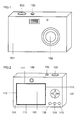
- FIGS. 1 and 2 each are a perspective view showing a digital camera according to the present invention.
- a power supply button 100 mounted on an upper part of the digital camera shown in FIG. 1 is a button that instructs turning ON or OFF of the power supply of the digital camera.
- On a surface 101 of the digital camera there is provided a photographic lens 102 that takes optical information of a subject in order to capture an image of the subject.
- a release button 103 is mounted on the upper part of the digital camera. It is a button that instructs start of image-capturing using the photographic lens 102.
- a surface 104 shown in FIG. 2 is usually a user side (viewer side and observer side) of the digital camera.
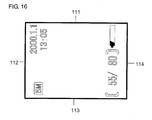
- the LCD 105 is a liquid crystal panel that displays the image information, icons, characters, figures, and signs, and so on
- a side 111 is an upper edge of the LCD 105
- a side 112 is a left edge of the LCD 105
- a side 113 is a lower edge of the LCD 105
- a side 114 is a right edge of the LCD 105.
- the photographic lens 106 is a lens used to capture an image of a user (viewer or observer) of the digital camera.
- the operation unit 107 is an operation member used to move a cursor displayed in the LCD 105 or make a decision on a selected function.
- the digital camera of this embodiment has three modes, i.e., a replay mode in which the image stored in a recording medium is replayed, a shooting mode in which an image of a subject is captured, and a menu mode in which various settings of the camera are made.
- the above-mentioned various modes are adapted to be switchable among them by pressing the replay button 108, the shooting mode button 109, and the menu button 110, respectively.
- the inside structure of the digital camera includes an image sensor 201, an image sensor 202, an A/D conversion circuit 203 (analogue/digital conversion circuit), an A/D conversion circuit 213, a bus 204, a buffer memory 205, an I/O unit 206, a recording medium 207, an image processing unit 208, a flash RAM 209, a CPU 210, a display control unit 211, and a posture detection unit 212.
- the A/D conversion circuit 203, the buffer memory 205, the I/O unit 206, the image processing unit 208, the flash RAM 209, the CPU 210, and the display control unit 211 are connected to each other through the bus 204.
- the image sensor 201 and the image sensor 202 are photoelectric devices, which are elements to convert an optical image into an analog electrical signal.
- the image sensor 201 is an image sensor provided in order to capture an image of a subject in the shooting mode and is disposed in a later stage of the photographic lens 102.
- the image sensor 202 which is to capture an image of the user (viewer) of the digital camera, is disposed in a later stage of the photographic lens 106.
- the photographic lens 106 in the first embodiment is described as including a lens capable of capturing an image of a wide angle area of about 20 mm in terms of a focal length of 35 mm size film camera (having a field angle ⁇ nearly equal to 94 ( ⁇ 94)) as shown in FIG. 4 .
- the A/D conversion unit 203 converts analog electric signals output from the image sensor 201 into digital image signals.
- the A/D conversion unit 213 converts analog electric signals output from the image sensor 202 into digital image signals.
- the image information digitalized by the A/D conversion circuit 203 is once accumulated in the buffer memory 205 through the bus 204.
- the buffer memory 205 is constituted by a VRAM area 205a where the image information displayed in the LCD 105 is temporarily accumulated, an OSD area 205b to accumulate index information displayed in the LCD 105 temporarily, and another area 205c as shown in FIG. 5 .
- the image information digitalized by the A/D conversion circuit 213 is once stored in the other area 205c through the bus 204.
- the recording medium 207 is a detachable recordingmedium that preserves the image information, and it is connected with the bus 204 through the I/O unit 206. Saving of the image information into the recording medium 207 and reading out the image information from the recording medium 207 are performed based on the instruction from the CPU 210.
- the image processing unit 208 is a unit that performs detection of facial images of the viewers, determination of the number of facial images of the viewers, determination of the size of the facial image of the viewers, determination of the inclination of the facial images of the viewers, and determination of positions of the facial images of the viewers. It also performs determination as to whether there is a facial image in the image information and determination of the inclination of the facial image in the displayed image information as well as processing of the image information.
- the image processing unit 208 is driven according to the instruction from the CPU 210.
- the CPU 210 controls the power supply of the digital camera.
- the posture detection unit 212 detects the posture of the digital camera (top and bottom, and right and left) .
- the posture detection unit 212 may be adapted to use these methods to determine the posture of the camera based on two axes, one being the direction of the gravity acceleration and the other being vertical to the direction of the gravity acceleration and parallel to the surface 101 of the camera. Alternatively, it may use a known technology using a gyro, etc.
- the CPU 210 imparts the image information acquired by capturing an image via the photographic lens 102 with the directional information (top and bottom, and right and left) based on the posture detected by the posture detection unit.
- OSD On Screen Display
- the display on the LCD 105 is executed by using the OSD function.
- This function is to display an icon, a character, a figure, and a sign, etc. (index information) over a replayed picture displayed in the replay mode or on a through image displayed in the shooting mode of the display in the play mode in superposition.
- the index information to be displayed is stored to the flash RAM 209.
- the CPU 210 stores predetermined index information in the OSD area 205b according to the status in which the camera is used by the user in stages before it is displayed in the LCD 105.
- the image processing unit 208 performs processing for changing the form of display based on the state of facial image of the user and stores the index information in the OSD area 205b again.
- the image information to be displayed is stored in the buffer memory 205 by the CPU 210 in stages before it is displayed in the LCD 105.
- the display control unit 211 controls the image information and the index information such that the index information stored in the OSD area is displayed on the image information in superposition on the LCD 105. The details of the processing by the camera are described later on.
- the display assistance function is described.
- the display assistance function is concerned with the image information and index information displayed on the LCD 105. This function is to display information that has undergone expansion/reduction processing and rotation processing based on a relative position of the digital camera and the viewer unlike an ordinary display mode. The visibility to the viewer can be improved by using this function.
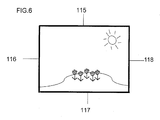
- the display assistance is described separately for the display assistance in the replay mode and the display assistance in the shooting mode/menu mode as follows. The case where no display assistance is used is described with reference to FIG. 6 .
- the LCD 105 displays image information with which direction information is imparted such that the side 115 represents an upper edge portion, the side 116 represents a left edge portion, the side 117 represents a lower edge portion, and the side 118 represents a right edge portion, respectively, of the image as shown in FIG. 6 .
- the side 115 is on the side 111
- the side 116 is on the side 112
- the side 117 is on the side 113
- the side 118 is on the side 114.
- the image is displayed such that the length of the side 115 is equal to that of the side 111, the length of the side 116 is equal to that of the side 112, the length of the side 117 is equal to that of the side 113, and the length of the side 118 is equal to that of the side 114.
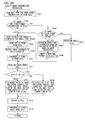
- step S1 the image processing unit 208 performs processing for recognizing a facial image of the viewer who observes the LCD 105 or who is located in a place where it is possible to observe the LCD 105 (hereafter, this processing is referred to as "face recognition processing") .
- step S2 the image processing unit 208 performs processing the index information (hereafter, "index information processing”) according to the instruction from the CPU 210 and the control proceeds to step S3.
- step S3 the image processing unit 208 processes the index information according to the instruction from the CPU 210 and the control proceeds to step S4.
- step S4 the display control unit 211 controls the image information and the index information such that the index information temporarily accumulated in the OSD area 205b is displayed in superposition over the image information temporarily stored in the VRAM 205a.
- step S5 the image processing unit 208 determines whether the facial image of the viewer is recognized. If no facial image is recognized, the control shifts to step S1. If a facial image is recognized, the control proceeds to step S6. In step S6, if it is determined by the image processing unit 208 that the size of facial image or the inclination in the facial image of the viewer of an image-capturing plane has changed to a predetermined extent or more, the control shifts to step S1. If it has been determined that the change has occurred to an extent less than the predetermined extent, the control shifts to step S7. In step S7, the CPU 210 determines whether end of the replay mode (shift to other modes or turning OFF the power) has been instructed by the user.
- end of the replay mode shift to other modes or turning OFF the power
- step S8 the control proceeds to step S8 when the end of the replay mode has not been instructed.
- the CPU 210 determines whether the index information has been changed (for instance, the icon has been changed due to a decrease in residual quantity of the battery).
- the control shifts to step S1 when it is determined that the index information has been changed.
- step S9 when it is determined that the index information has not been changed.
- step S9 the CPU 210 determines whether the replay image has been changed.
- step S1 when it is determined that the replay image has been changed.
- step S5 when it is determined that the replayed image has not been changed.
- step S7 the processing is ended when it is determined that it has been instructed by the user to end the replay mode.
- the recognition processing S1 on the facial image mentioned above, the processing S2 on the index information, and the processing of the image information will be detailed later separately.
- the processing of display assist in the shooting mode and in the menu mode is explained in reference to the flowchart presented in FIG. 8 .
- the display assistance in the shooting mode and in the menu mode according to this embodiment, only the form of index information is processed.
- the processed index information is displayed on a through image of the background in superposition.
- a through image, a replay image or a wallpaper, etc. are displayed in superposition over the index information as a background image.
- the shooting mode and the menu mode are usually used by one user. Therefore, when plural facial images are recognized in the shooting mode and in the menu mode, a message to invite the user to switch the mode to the replay mode is displayed.
- the image processing unit 208 performs recognition of a plurality of facial images.
- step S12 the image processing unit 208 performs recognition of a facial image.
- step S13 the image processing unit 208 processes the index information and the control proceeds to step S14.
- step S14 the display control unit 211 controls the image information and the index information such that the index information temporarily accumulated in the OSD area 205b is displayed in superposition over the image information as a background temporarily accumulated in the VRAM 205a.
- step S15 the image processing unit 208 determines whether the facial image of the viewer has been recognized. If no facial image has been recognized, the control shifts to step S12 and if a facial image has been recognized, the control proceeds to step S16.
- step S16 the image processing unit 208 determines whether there is only one facial image of the viewer. The control proceeds to step S17 when only one facial image of the viewer has been recognized, and when plural facial images of the viewer have been recognized, the control shifts to step S11.
- step S17 if it is determined by the image processing unit 208 that the size of facial image or the inclination in an image-capturing plane of facial image of the viewer has changed to at least a predetermined extent, the control shifts to step S12.
- step S18 the CPU 210 determines whether end of the mode has been instructed by the user. The control proceeds to step S19 when the end of the replay mode has not been instructed. In step S19, the CPU 210 determines whether the index information has been changed. When it is determined that the index information has been changed, the control shifts to step S12 and the index information is processed. If it is determined in step S18 that end of the mode has been instructed by the user, this processing is ended.
- the recognition processing S11 on a plurality of facial images mentioned above, the recognition processing S12 on a facial image, and the processing of the index information will be detailed later separately.
- step S101 if it is determined by the image processing unit 208 that a facial image of the viewer has been recognized, the control shifts to step S104, and if no facial of the viewer has been recognized, the control shifts to step S102.
- step S102 the CPU 210 starts counting elapsed time T and the control shifts to step S103.
- step S103 CPU 210 determines whether the elapsed time T exceeded a predetermined elapsed time T1. T1 is assumed to be one minute in this embodiment.
- the control proceeds to S105 if the elapsed time T is less than one minute, and the control proceeds to step S106 if the elapsed time T is one minute or more.
- step S105 if it is determined by the image processing unit 208 that a facial image of the viewer has been recognized or the CPU 210 has detected an operation by the user, the control shifts to step S104. On the other hand, in step S105, if it is determined by the image processing unit 208 that no facial image of the viewer has been recognized and the CPU 210 has detected no operation by the user, the control shifts to step S103. In step S106, the display control unit 211 displays on the LCD 105 a message to ask if it is acceptable to switch the mode to an energy-saving mode.
- step S107 the CPU 210 determines whether the selection of energy-saving mode has been made by the user. The control proceeds to step S108 if it is determined by the CPU 210 that the energy-saving mode has been selected by the user, and the control proceeds to step S113 if the energy-saving mode has not been selected.
- step S108 the CPU 210 determines whether YES or NO has been selected. The control proceeds to step S109 if it is determined that YES has been selected, and the control proceeds to step S113 if NO has been selected.
- step S109 the power supply to parts excluding the mechanism necessary for the face recognition by the digital camera (for instance, power supply etc. to the LCD 105) is turned OFF as instructed by the CPU 210 to switch the operation mode to the energy-saving mode.
- step S110 the CPU 210 temporarily stores in the OSD area 205b predetermined index information to be displayed and the control proceeds to step S111.
- step S111 the CPU 210 determines whether the present mode is the replay mode. If it is the replay mode, the control proceeds to step S112, where the image information to be replayed is temporarily accumulated in the VRAM 205a, and the control shifts to step S4 shown in the flowchart of FIG. 7 . On the other hand, when it is determined in step S111 that the current mode is other than the replay mode, the control shifts to step S14 shown in the flowchart of FIG. 8 .
- step S113 the CPU 210 determines whether the elapsed time T has reached T2 or more.
- T2 is assumed to be two minutes in this embodiment. Therefore when the elapsed time T2 is 2 minutes or more, the control proceeds to step S109 and the CPU 210 executes the energy-saving mode. On the other hand, when the elapsed time T2 is less than 2 minutes, the control shifts to step S107.
- step S109 if the energy-saving mode is executed, the control proceeds to step S114. If the image processing unit 208 recognizes a facial image or if the CPU 210 determines that there has been an operation of the digital camera by the user, the control proceeds to step S115. On the other hand, in step S114, the control proceeds to step S116 when the image processing unit 208 recognizes no facial image and the CPU 210 determines that there has been no operation of the digital camera by the user.
- step S115 the CPU 210 turns ON the power supply made to turn OFF partially in step S109 to cancel the energy-saving mode, and the control proceeds to step S104.
- step S116 the CPU 210 determines whether the elapsed time T has reached orexceeds T3. T3 is assumedtobe fiveminutes in this embodiment. Therefore, when the elapsed time T is 5 minutes or more, the control proceeds to step S117. On the other hand, when the elapsed time T is less than 5 minutes, the control proceeds to step S114. In step S117, the power supply to the digital camera is turned OFF by the CPU 210. Moreover, the CPU 210 determines whether there has been an operation by the user in step S104.
- control When there has been no operation by the user, the control returns to the main flow to end this processing. On the other hand, if it is determined that there has been an operation by the user, the control proceeds to step S118 where the CPU 210 accepts the input operation and performs appropriate processing in response to the input operation. Then, the control returns to the main flow.
- step S301 the CPU 210 reads in the index information saved in the flash RAM 209 and once saves it in the OSD area 205b. Then, the control proceeds to step S302. In step S302, it is determined by the image processing unit 208 at what an angle the face of the viewer is inclined with respect to the digital camera in a plane of the captured image. Then, the control proceeds to step S303.
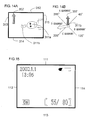
- FIG. 11A - FIG. 14B show the relationships between images captured by use of the photographic lens 106 and the angles of inclination of facial images.
- the area enclosed by a side 312, a side 313, a side 314, and a side 315 is an image-capturing area.
- the side 315 on the right of the image-capturing area corresponds to the side 112, which is the left side of the LCD.
- the side 313 on the left of the image-capturing area corresponds to the side 114, which is the right side of the LCD.
- the side 312 on the top of the image-capturing area corresponds to the side 111, which is the top side of the LCD.
- the side 314 on the bottom of the image-capturing area corresponds to the side 113 on the bottom of the LCD.
- a facial image 308a of FIG. 11A shows a facial image when the LCD is looked into from below.
- a facial image 309a of FIG. 12A shows a facial image when the LCD is looked into from the right.
- a facial image 310a of FIG. 13A shows a facial image when the LCD is looked into from above.
- Facial image 311a of FIG. 14A shows the facial image when LCD is looked into from the left.
- a reference vector 307 that serves as a criterion of the inclination of the facial image is a vector parallel to the side 313 and the side 315 headed from the lower side to the upperpart.
- Face direction vectors 308b-311b which are vectors each indicating the direction of a face, indicate upward directions of the facial images 308a-311a (the mouth being lower and the eyes being upper), respectively.
- the upward direction of the facial image is detected by using a well-known image detection technology.
- Single index information processing is distributed to steps S306-S309 by steps S303-S305 based on the value of angle ⁇ formedbetween the reference vector 307 and the face direction vector, and a rotation angle ⁇ is determined in steps S306-S309 .
- the rotation is not performed by the image processing unit 208 shown in FIG. 15 when the inclination of the facial image 308a is as shown in FIG. 11A and FIG. 11B .
- 270° rotation is given clockwise by the image processing unit 208 with FIG. 15 being assumed to be 0° (standard) as shown in FIG. 16 .
- 180° rotation is given clockwise by the image processing unit 208 with FIG.
- step S310 rotation by only a determined rotation angle is given clockwise by the image processing unit 208 with FIG. 15 being assumed to be 0° (standard) .
- Rotation of the index information by only a rotation angle ⁇ clockwise causes the inclination of the facial image to approach an angle at which it can be viewed by the viewer almost in front upright.
- a step S311 and subsequent steps relate to display sizes of the index information.
- the image processing unit 208 determines a size L of the facial image of the viewer.
- the size of the facial image is determined by using a well-known technology. The longer the distance between the digital camera and the viewer (i.e., the smaller the facial image in the image-capturing plane), the poorer is the visibility of the image. For this reason, the image processing unit 208 controls the size of the index information such that the smaller the size of the determined facial image, the larger the displayed index information.
- the control proceeds to step S314.
- step S314 the image processing unit 208 sets magnification m to m3 and the control shifts to step S3177.
- the control proceeds to step S315.
- step S315 the image processing unit 208 sets magnification m to m2 and the control shifts to step S317.
- step S316 the image processing unit 208 sets magnification m to m1 and the control shifts to step S317.
- step S317 the image processing unit 208 expands the index information m fold and the control proceeds to step S318.
- the size L of the facial image is obtained based on the ratio of the area of facial image to the area of the captured image area the facial image occupies.
- the predetermined threshold L1 is assumed to be 4% in the facial image area, and this corresponds to a distance between the digital camera and the viewer of about 50 cm.
- L2 is assumed to be 10% of the facial image area, and this corresponds to a distance between the digital camera and the viewer of about 30 cm.
- the dimensions of the size of the facial image of the viewer and of the size of the index information are described with reference to FIG. 19-FIG. 21 and FIG. 22-FIG. 24 .
- Facial images 301a-301c are facial images of the viewer captured through the photographic lens 106.
- the facial image area occupies about 20% of the captured image area and the size L of the facial image is shown larger than the predetermined size L2.
- the facial image area occupies about 2% of the captured image area and the size L of the facial image is shown smaller than the threshold L1.
- the facial image area occupies about 8% of the captured image area.
- the size L of the facial image is L1 ⁇ L ⁇ L2.
- FIG. 23 , and FIG. 24 are pieces of index information displayed in the replay mode.
- 302a, 302b, and 302c indicate date and time (year, month, time and minute) of shooting.
- 303a, 303b, and 303c indicate numbers of set pixels at the time of shooting.
- 304a, 304b, and 304c orders of images currently displayed/total number of image frames.
- 305a, 305b, and 305c indicate residual quantity of the battery.
- the present invention will be explained taking an example of the index information displayed in the replay mode.
- the distance from which the viewer visually checks the LCD 105 is near enough. Therefore, the viewer can visually check the index information displayed in a standard size like 302a-305a shown in FIG. 22 , so that the image processing unit 208 does not expand the index information.
- m1 is one fold in this embodiment.
- the image processing unit 208 processes the index information such that the index information is displayed in a larger size like 302b-305b compared with 302a-305a shown in FIG. 23 .
- the image processing unit 208 processes the index information such that the index information is displayed in a still larger size like 302c-305c shown in FIG. 24 as compared with 302b-305b.
- the processed index information is once accumulated in the OSD area 205b by the CPU 210.
- the image processing unit 208 performs the above-mentionedprocessingbasedon the facial image of the person who is the nearest to the center point of the image-capturing area.
- Rotation processing of image information is processing in which taking into consideration directional information of the image, the direction of an image is made to approach a direction along which the image information is positioned upright in front of the facial image of the viewer.
- the directional information of the image can be imparted to a Tag information on Exchangeable image file format (hereafter, "Exif") , which is a file type of image widely used.
- the CPU 210 determines the direction of display by reading out the directional information in the Exif Tag in this processing.
- step S401 the CPU 210 reads out the Exif Tag information stored in the VRAM area 205a and the control proceeds to step S402.
- step S402 it is determined by the CPU 210 whether there is directional information in the Exif Tag in the image information.
- step S403 If there is directional information, the control proceeds to step S403. If there is no directional information, the control proceeds to step S404.
- step S403 rotation is performed in consideration of the directional information in addition to the direction of the facial image of the viewer. Therefore, the rotation angle is determined by the CPU 210 based on the combination of the quadrant in which the face direction vector is present with the image orientation.
- step S403 rotation angle ⁇ is read in from the table shown in FIG. 26 and the control proceeds to step S405.
- step S405 the CPU 210 reads in the image information saved in the VRAM region 205a and the control proceeds to step S406.
- step S406 the image processing unit 208 rotates the read-in image information by only the rotation angle ⁇ clockwise and the control proceeds to step S407.
- step S407 the image information is once saved by the CPU 210 in the VRAM area 205a and the control proceeds to step S411.
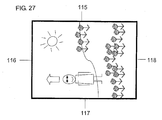
- the image processing unit 208 determines the direction vector of the facial image in the image information, and determines that the side to which the vector is directed is an upper side as shown in FIG. 27 .
- the image processing unit 208 determines whether there is a facial image in the facial image. If there is a facial image in the image information, the control proceeds to step S408.
- the image processing unit 208 determines a face direction vector from the facial image of aperson in the image information and determines directional information of the image information. When there are plural facial images, the image processing unit 208 determines the direction based on the facial image nearest to the center point of the image-capturing area.
- step S409 the CPU 210 imparts the Exif Tag with the above-mentioned directional information.
- the side 116 is determined to be the upper side.
- step S409 if the directional information is imparted to the Exif Tag in the image information, the control shifts to step S403.
- step S404 when it is determined by the image processing unit 208 that there is no facial image in the image information, the control proceeds to step S410.
- step S410 the CPU 210 sets the rotation angle ⁇ to 0° and the control proceeds to step S411.
- Step S411 and subsequent steps are steps of expansion processing of the image information.
- the CPU 210 reads out the image information from the VRAM area 205a and the control proceeds to step S412.
- the CPU 210 determines whether the rotation angle ⁇ is 270° or 90°. If ⁇ is 270° or 90°, the control proceeds to step S413 and the image processing unit 208 processes the image information to a standard size. In the case of standard size, the shorter side of the LCD 105 and the longer side of the image information have the same lengths, and the processing is given like the image shown in FIG. 28 .
- the image processing unit 208 processes the image information by fixing the aspect ratio of the image information such that the longer side of the image information and the shorter side of the LCD 105 have the same lengths. Then, the control proceeds to step S415.
- the standard size the longer side of the LCD 105 and the longer side of the image information have the same lengths and the image processing unit 208 processes the image information to a size such that the longer side of the image information and the longer side of the LCD 105 have the same lengths with fixing the aspect ratio in step S414.
- step S415 the image processing unit 208 expands the image information such that it may become m fold.
- step S416 the processed image information is accumulated in the VRAM area 205a again by the CPU 210 and the control returns to the main loop.
- the replay mode the image information of which replay is instructed by the user (viewer) is read out from the recording medium by the CPU 210 beforehand, and is temporarily stored to the VRAM area 205a.
- step S501 it is determined by the image processing unit 208 whether there is a plurality of facial images of viewers captured by the image sensor 202. When there is a plurality of facial images, the control proceeds to step S502 whereas when there are no plural images, the control returns to the main loop.
- step S502 the display control unit 211 displays a message to ask whether to shift to the replay mode in the LCD 105, and the control proceeds to step S503.
- step S503 the input from the user is accepted. If it is "YES”, the control proceeds to step S1 shown in FIG. 7 in order to shift to the replay mode. If it is "NO”, the control returns to the main loop.
- a different point of this embodiment from the first embodiment is in that a step of the elongation of the index information is added to the latter part of the step of the processing of the index information.
- This embodiment is practiced with a lens with which an image within the range of ⁇ being about 180° as shown in FIG. 4 can be captured.
- FIGS. 35 , 36 , and 37 show areas of which images have been captured by using the photographic lens 106.
- the image-capturing area of each of FIGS. 35 , 36 , and 37 is laterally divided into three sub-areas.
- the sub-areas are named area i1, area i2, and area i3, respectively.
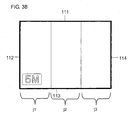
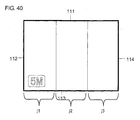
- the display area of the LCD 105 is also divided into three sub-areas and the sub-areas are named area j1, area j2, and area j3, respectively, as shown in FIGS. 38 , 39 , and 40 .
- the image processing unit 208 processes the index information at different elongation ratios depending on whether it exists in the area i1 or the area i3 so that the index information remoter from the viewer can be elongated more.
- the index information displayed in j1 is displayed by the display control unit 211 as shown in FIG. 38 .
- the image processing unit 208 performs 1.5 fold expansion laterally in this embodiment.
- the index information displayed in j1 is processed by the image processing unit 208 and displayed by the display control unit 211 as shown in FIG. 39 .
- the image processing unit 208 performs 2 fold elongation laterally in this embodiment.
- the image processing unit 208 does not perform elongation processing, so that the index information is displayed as shown in FIG. 40 .
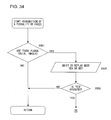
- step S21 the image processing unit 208 performs processing for recognizing the facial image of the viewer.
- step S22 the image processing unit 208 processes the index information according to the instruction from the CPU 210 and the control proceeds to step S23.
- step S23 the image processing unit 208 performs elongation processing on the index information according to the instruction from the CPU 210 and the control proceeds to step S24.
- step S24 the image processing unit 208 processes the index information according to the instruction from the CPU 210 and the control proceeds to step S25.
- step S25 the display control unit 211 controls the image information and the index information such that the index information temporarily accumulated in the OSD area 205b is displayed in superposition over the image information temporarily accumulated in the VRAM 205a.
- stepS26 image processing unit 208 determines whether the facial image of the viewer has been recognized. If no facial image has been recognized, the control shifts to step S21 and if a facial image has been recognized, the control proceeds to step S27. In step S27, if it is determined by the image processing unit 208 that the size of facial image or the inclination in the facial image of the viewer of an image-capturing plane or the position of facial image of the viewer has changed to at least a predetermined extent, the control shifts to step S21. If the change is to an extent below the predetermined extent, the control shifts to step S28. In step S28, the CPU 210 determines whether end of the replay mode has been instructed by the user.
- step S29 the CPU 210 determines whether the index information is to be changed. When it is determined that the index information has to be changed, the control shifts to step S12 and the index information processing is performed. The control shifts to step S30 when it is determined that the index information has not to be changed.
- step S30 the CPU 210 determines whether the replayed image has changed. When it is determined that the replay image has changed, the control shifts to step S21. The control shifts to step S26 when it is determined that the replay image has not changed. In step S28, the CPU 210 ends this processing when it is determined that end of the replay mode has been instructed by the user. Because steps other than the elongation of the index information are similar to those in the first embodiment, the elongation processing in this embodiment is described as follows.
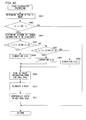
- step S601 the image processing unit 208 determines a column "i" in which the facial image of the viewer exists and the process proceeds to step S602.
- step S602. the image processing unit 208 does not perform the elongation processing and the control returns to the main loop.
- step S607 the control proceeds to step S607, and the CPU 210 sets the elongation rate X to X2.
- step S608 the control proceeds to step S608, and the CPU 210 the elongation rate X to sets X3.
- X1 2 fold
- X2 is 1.8 fold
- X3 is 1.5 fold.
- step S609 the index information is read out by the CPU 210 from the OSD area 205b and the control proceeds to step S610.
- step S610 the index information is elongated X fold by the image processing unit 208 and the control proceeds to step S611.
- step S611 the processed index information is once accumulated in the OSD area 205b by the CPU 210 and the control returns to the main loop.
- the image processing unit 208 has elongated only the index information.
- similar processing may be performed on the image information.
- the image-capturing area may be divided into three sub-areas in the vertical direction although it has been divided into three sub-areas in the lateral direction.
- the image processing unit 208 performs elongation processing taking as a reference the position of a person who is nearest to the center point of the image-capturing area.
- the image processing unit 208 determines that the area in which the facial image exists is the sub-area that occupies the facial image in the largest ratio among the plural sub-areas. Similarly, when the index information extends over plural areas, the image processing unit 208 determines that the index information exists in the sub-area that occupies the index information in the largest ratio among the plural sub-areas.
- the image processing unit 208 is adapted to recognize the facial image of the viewer (observer) based on the image signal output from the image sensor 202, and performs elongation processing on the index information based on the position that the facial image occupies in the image-capturing area. That is, the image processing unit 208 is adapted to perform elongation processing on the index information displayed in an area remoter from the viewer on the LCD 105 at a higher elongation ratio than on the index information displayed in an area closer to the viewer on the LCD 105. As a result, the viewer can confirm the index information to which the distortion is reduced regardless of the position in which the viewer views the LCD 105, so that the visibility can be improved.
- the processing is performed based on the facial image of a person who is closest to the center point of the image-capturing area.
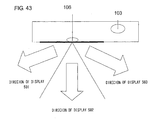
- an LCD that can display different pieces of information in three directions, respectively, is used as the LCD 105 as shown in FIG 43 in the third embodiment.
- this embodiment is executed with a lens with which an image can be captured within the range of ⁇ of about 180° as shown in FIG. 4 .
- FIG. 44 shows an area in which an image is captured by the image sensor 202 by using the photographic lens 106.
- the area in which an image is captured is divided into three sub-areas, i.e., area k1, area k2, and area k3, and the processing described in the first embodiment is performed based on the facial image of a person who is closest to the center point in each sub-area.
- the image processing unit 208 determines that the area of the facial image exists in the sub-area in which there is a part of the facial image that occupies the facial image in the largest ratio. As shown in FIG. 44 , the image processing unit 208 processes the index information and the image information based on the facial image 401 of the person who appears in the area k1.
- the display control unit 211 displays the index information and the image information in the display direction 503 on the display plane of the LCD 105.
- the image processing unit 208 processes the index information and the image information based on the facial image 402 of the person who appears in the area k2.
- the display control unit 211 displays the index information and the image information in the display direction 502.
- the image processing unit 208 processes the index information and the image information based on the facial image 403 of the person who appears in the area k3.
- the display control unit 211 displays the index information and the image information in the display direction 501.
- the appearance of display information displayed in each direction is as shown in FIG. 45 .
- the display control unit 211 may turn OFF the display in a direction corresponding to that area.
- the image processing unit 208 has been explained to determine the direction based on the facial image when the directional information is imparted to the image information.
- the direction of the image may be determined based on other patterns as far as they are specified patterns that can presume the direction of the image.
- the direction may be determined based on, for instance, character pattern or color pattern etc. of the subject, or the direction may be estimated and determined from combinations of them.
- the image processing unit 208 determines the size of the facial image based on the ratio of the facial image area to the image-capturing area.
- other methods may be used to obtain the size of the facial image.
- the relationship between the size of the facial image and the rate of expansion is not limited to the values shown in this embodiment.
- the relationship between the position and the elongation rate of the facial image is not limited to the values shown in this embodiment.
- the comparative values T1, T2, and T3 of the elapsed time shown by the face recognition processing are not limited to the values indicated in this embodiment.
- the rate of expansion of the index information or the image information includes 3 stages, the rate of expansion may be set to be more continuous to change it smoothly.
- the scale of rotation angle of the index information or the image information includes 4 stages, the scale of rotation angle may be set to be more continuous to change it smoothly.
- individual rotation of the icon is shown as an example of the rotation of the index information, the layout that displays the index information may be rotated to change the display position. The same value is used for the magnification m of the index information and for the magnification m of the image information. However, different values may be used therefor.
- the expansion processing is performed on the image information using the center of the image information as a reference point.
- the present invention is not limited thereto and the center of the facial image in the image may be used as a reference point.
- a method that employs expansion processing is used as a method of displaying the index information enlarged.
- a method may also be used in which icons and characters with different sizes are stored in the memory in advance and a piece of index information having a predetermined size may be selected for use from the icons or characters depending on the size of the facial image.
- the facial image of a person who is closest to the center point of the image-capturing area is assumed to be a facial image of a criterion for the determination.
- the facial image of a viewer who is closest to a specific point other than the center point is used as a facial image of the criterion.
- the facial image of the criterion may be determinedbased on the size or inclination of the facial image.
- the image-capturing area in the third embodiment is divided into three sub-areas along the direction of the longer side of the image-capturing area.
- the image-capturing area may be divided into two sub-areas by using an LCD that can display different pieces of information in two directions.
- the image-capturing area may be divided into four or more sub-areas by using an LCD that can display different pieces of information in more than four directions.
- the display direction is divided in a plane vertical to the screen and parallel to the longer side of the screen.
- the display direction may be divided in a plane parallel to the shorter side of the screen.
- the present invention is adopted to the digital camera that displays the image information and index information in superposition as mentioned above, the present invention may also be applied to an information displaying apparatus that displays only the image information or only the index information.
- the present invention has been described as using the image information and the index information.
- the present invention is not limited thereto and text information or sentence information may also be used as far as such is information of the kind that can be displayed on a displaymedium. That is, the present invention is not limited to the digital cameras according to the embodiments as far as the features and functions of the present invention are realized.
- the present invention is applicable to an information displaying apparatus equipped with a display medium constituted by a mobile phone, a PDA, a PC, an LCD such as a photo viewer or the like.
- the information displaying apparatus is assumed to be the one that includes the photographic lens 106 and image sensor 202 for photographing at least the viewer.
- the image processing unit 208 only has to perform various types of processing on the index information and the image information in the manner as mentioned above based on the inclination of the facial image, the size of the facial image, and the position at which the facial image occupies in the image-capturing area and so on detected by using the image signal output from the image sensor 202.
Landscapes
- Engineering & Computer Science (AREA)
- Multimedia (AREA)
- Signal Processing (AREA)
- Controls And Circuits For Display Device (AREA)
- User Interface Of Digital Computer (AREA)
- Position Input By Displaying (AREA)
- Control Of Indicators Other Than Cathode Ray Tubes (AREA)
Applications Claiming Priority (1)
| Application Number | Priority Date | Filing Date | Title |
|---|---|---|---|
| JP2008002902A JP5453717B2 (ja) | 2008-01-10 | 2008-01-10 | 情報表示装置 |
Publications (2)
| Publication Number | Publication Date |
|---|---|
| EP2079232A2 true EP2079232A2 (fr) | 2009-07-15 |
| EP2079232A3 EP2079232A3 (fr) | 2015-06-10 |
Family
ID=40545755
Family Applications (1)
| Application Number | Title | Priority Date | Filing Date |
|---|---|---|---|
| EP09150348.2A Ceased EP2079232A3 (fr) | 2008-01-10 | 2009-01-09 | Appareil d'affichage d'informations |
Country Status (4)
| Country | Link |
|---|---|
| US (1) | US8743259B2 (fr) |
| EP (1) | EP2079232A3 (fr) |
| JP (1) | JP5453717B2 (fr) |
| CN (1) | CN101483719B (fr) |
Families Citing this family (23)
| Publication number | Priority date | Publication date | Assignee | Title |
|---|---|---|---|---|
| JP4536819B2 (ja) | 2008-08-19 | 2010-09-01 | 株式会社神戸製鋼所 | 窒素含有非晶質炭素系皮膜、非晶質炭素系積層皮膜および摺動部材 |
| JP5556098B2 (ja) * | 2009-09-11 | 2014-07-23 | ソニー株式会社 | 表示方法及び表示装置 |
| TWI409576B (zh) * | 2009-10-30 | 2013-09-21 | Htc Corp | 影像擷取方法與可攜式通訊裝置 |
| CN101794193A (zh) * | 2010-02-23 | 2010-08-04 | 华为终端有限公司 | 画面控制方法及电子设备 |
| US20130232423A1 (en) * | 2011-02-03 | 2013-09-05 | Mitsubishi Electric Corporation | Display apparatus and operation checking method for the display apparatus |
| CN102760024A (zh) * | 2011-04-26 | 2012-10-31 | 鸿富锦精密工业(深圳)有限公司 | 屏幕图像旋转方法及系统 |
| WO2012176384A1 (fr) * | 2011-06-21 | 2012-12-27 | 株式会社ニコン | Programme et dispositif d'affichage |
| JP6116115B2 (ja) * | 2011-09-01 | 2017-04-19 | キヤノン株式会社 | 画像処理装置及びその制御方法、並びにプログラム |
| CN103135743A (zh) * | 2011-11-22 | 2013-06-05 | 联想(北京)有限公司 | 一种电子设备的显示画面的调整方法及电子设备 |
| JP2013162352A (ja) * | 2012-02-06 | 2013-08-19 | Canon Inc | 画像処理装置、画像処理方法及びプログラム |
| JP2014106924A (ja) * | 2012-11-29 | 2014-06-09 | Nippon Telegr & Teleph Corp <Ntt> | 端末装置、制御方法及びコンピュータプログラム |
| CN103092344A (zh) * | 2013-01-11 | 2013-05-08 | 深圳市金立通信设备有限公司 | 一种控制终端屏幕画面旋转的方法及终端 |
| CN104122983A (zh) * | 2013-04-27 | 2014-10-29 | 中国移动通信集团公司 | 一种屏幕显示方向调整方法及装置 |
| JP6119991B2 (ja) * | 2013-08-23 | 2017-04-26 | ブラザー工業株式会社 | 画像処理装置およびコンピュータプログラム |
| CN104732225B (zh) * | 2013-12-24 | 2018-12-18 | 中国科学院深圳先进技术研究院 | 图像旋转处理方法 |
| CN104238892B (zh) * | 2014-09-22 | 2018-06-01 | 联想(北京)有限公司 | 一种信息处理方法及电子设备 |
| CN105721739B (zh) * | 2014-12-04 | 2020-04-10 | 富泰华工业(深圳)有限公司 | 屏幕影像画面防抖系统及方法 |
| CN106250791A (zh) | 2015-06-30 | 2016-12-21 | 北京智谷睿拓技术服务有限公司 | 显示控制方法和装置 |
| CN106384065B (zh) * | 2015-06-30 | 2019-08-06 | 北京智谷睿拓技术服务有限公司 | 显示控制方法和装置 |
| CN105159640B (zh) * | 2015-08-28 | 2020-06-12 | 北京小米移动软件有限公司 | 显示界面旋转方法、装置和移动终端 |
| CN108604367B (zh) * | 2016-03-09 | 2022-02-01 | 华为技术有限公司 | 一种显示方法以及手持电子设备 |
| KR102557234B1 (ko) * | 2018-01-23 | 2023-07-20 | 가부시끼 가이샤 구보다 | 표시 장치 및 해당 표시 장치가 구비된 콤바인 |
| CN116320142B (zh) * | 2021-12-20 | 2025-04-04 | Oppo广东移动通信有限公司 | 显示控制方法、装置、电子设备及计算机存储介质 |
Citations (9)
| Publication number | Priority date | Publication date | Assignee | Title |
|---|---|---|---|---|
| JP2004286614A (ja) | 2003-03-24 | 2004-10-14 | Fuji Photo Optical Co Ltd | 機器の姿勢検出装置 |
| US20040263428A1 (en) * | 2003-06-30 | 2004-12-30 | Kabushiki Kaisha Toshiba | Electronic apparatus and display control method |
| JP2005026933A (ja) | 2003-06-30 | 2005-01-27 | Casio Comput Co Ltd | 画像入出力装置 |
| JP2005236883A (ja) | 2004-02-23 | 2005-09-02 | Fuji Photo Film Co Ltd | 撮影装置 |
| JP2005260666A (ja) | 2004-03-12 | 2005-09-22 | Fast:Kk | 分割撮像方式および分割撮像装置 |
| JP2007067782A (ja) | 2005-08-31 | 2007-03-15 | Softbank Mobile Corp | 電子機器 |
| JP2007264124A (ja) | 2006-03-27 | 2007-10-11 | Toshiba Corp | 表示装置 |
| US20070296820A1 (en) * | 2006-06-21 | 2007-12-27 | Sony Ericsson Mobile Communications Ab | Device and method for adjusting image orientation |
| JP2008002902A (ja) | 2006-06-21 | 2008-01-10 | Mitsui Mining & Smelting Co Ltd | 青果物の品質検査装置および青果物の品質検査方法 |
Family Cites Families (25)
| Publication number | Priority date | Publication date | Assignee | Title |
|---|---|---|---|---|
| JP4124404B2 (ja) * | 2001-05-17 | 2008-07-23 | 富士フイルム株式会社 | 撮像装置、画像処理装置、画像処理方法、及びプログラム |
| JP3864776B2 (ja) * | 2001-12-14 | 2007-01-10 | コニカミノルタビジネステクノロジーズ株式会社 | 画像形成装置 |
| JP2004110453A (ja) * | 2002-09-19 | 2004-04-08 | Sony Corp | 携帯端末装置 |
| JP2006522397A (ja) * | 2003-03-10 | 2006-09-28 | コーニンクレッカ フィリップス エレクトロニクス エヌ ヴィ | マルチビュー・ディスプレイ |
| KR100556856B1 (ko) * | 2003-06-14 | 2006-03-10 | 엘지전자 주식회사 | 이동통신 단말기에서 화면 제어 방법 및 장치 |
| FI117217B (fi) * | 2003-10-01 | 2006-07-31 | Nokia Corp | Menetelmä ja järjestelmä käyttöliittymän (User Interface) hallitsemiseksi, vastaava laite ja ohjelmalliset (Software) välineet menetelmän toteuttamiseksi |
| JP2005202208A (ja) * | 2004-01-16 | 2005-07-28 | Nec Corp | 携帯端末および表示制御方法 |
| GB2414616A (en) | 2004-05-28 | 2005-11-30 | Sony Uk Ltd | Comparing test image with a set of reference images |
| EP1566788A3 (fr) * | 2004-01-23 | 2017-11-22 | Sony United Kingdom Limited | Dispositif d'affichage |
| JP2005260870A (ja) * | 2004-03-15 | 2005-09-22 | Matsushita Electric Ind Co Ltd | デジタルカメラ及びデジタルカメラ機能付き携帯電話機並びに顔画像自動回転方法 |
| JP4177779B2 (ja) | 2004-03-31 | 2008-11-05 | 富士フイルム株式会社 | 画像表示制御装置および方法ならびに画像表示制御装置を制御するプログラム |
| JP2006023953A (ja) * | 2004-07-07 | 2006-01-26 | Fuji Photo Film Co Ltd | 情報表示システム |
| JP2006064893A (ja) * | 2004-08-26 | 2006-03-09 | Fuji Photo Film Co Ltd | 画像表示システムおよび画像表示制御方法 |
| JP4533164B2 (ja) * | 2005-01-27 | 2010-09-01 | 富士フイルム株式会社 | 撮影装置 |
| JP2006238362A (ja) * | 2005-02-28 | 2006-09-07 | Fuji Photo Film Co Ltd | 画像天地判定装置および方法並びにプログラム |
| JP2006287386A (ja) * | 2005-03-31 | 2006-10-19 | Casio Comput Co Ltd | 画像の天地判定方法及び画像の天地判定装置 |
| FR2898007B1 (fr) * | 2006-02-27 | 2008-09-19 | Sagem Comm | Procede d'adaptation de l'interface homme/machine d'un telephone et telephone selon le procede |
| JP5044237B2 (ja) | 2006-03-27 | 2012-10-10 | 富士フイルム株式会社 | 画像記録装置、画像記録方法、および画像記録プログラム |
| JP2007280029A (ja) * | 2006-04-06 | 2007-10-25 | Nikon Corp | 画像表示装置 |
| JP2007336515A (ja) * | 2006-05-15 | 2007-12-27 | Olympus Imaging Corp | カメラ、画像出力装置、画像出力方法、画像記録方法、プログラム及び記録媒体 |
| JP5321060B2 (ja) | 2006-07-13 | 2013-10-23 | 株式会社ニコン | 表示制御装置、表示システム、およびテレビジョンセット |
| US7706579B2 (en) * | 2006-12-21 | 2010-04-27 | Sony Ericsson Communications Ab | Image orientation for display |
| JP2008158788A (ja) * | 2006-12-22 | 2008-07-10 | Fujifilm Corp | 情報処理装置および情報処理方法 |
| US8488901B2 (en) * | 2007-09-28 | 2013-07-16 | Sony Corporation | Content based adjustment of an image |
| US8094892B2 (en) * | 2007-11-19 | 2012-01-10 | Arcsoft, Inc. | Automatic photo orientation detection |
-
2008
- 2008-01-10 JP JP2008002902A patent/JP5453717B2/ja not_active Expired - Fee Related
- 2008-12-30 US US12/318,489 patent/US8743259B2/en not_active Expired - Fee Related
-
2009
- 2009-01-09 EP EP09150348.2A patent/EP2079232A3/fr not_active Ceased
- 2009-01-12 CN CN2009100029136A patent/CN101483719B/zh not_active Expired - Fee Related
Patent Citations (9)
| Publication number | Priority date | Publication date | Assignee | Title |
|---|---|---|---|---|
| JP2004286614A (ja) | 2003-03-24 | 2004-10-14 | Fuji Photo Optical Co Ltd | 機器の姿勢検出装置 |
| US20040263428A1 (en) * | 2003-06-30 | 2004-12-30 | Kabushiki Kaisha Toshiba | Electronic apparatus and display control method |
| JP2005026933A (ja) | 2003-06-30 | 2005-01-27 | Casio Comput Co Ltd | 画像入出力装置 |
| JP2005236883A (ja) | 2004-02-23 | 2005-09-02 | Fuji Photo Film Co Ltd | 撮影装置 |
| JP2005260666A (ja) | 2004-03-12 | 2005-09-22 | Fast:Kk | 分割撮像方式および分割撮像装置 |
| JP2007067782A (ja) | 2005-08-31 | 2007-03-15 | Softbank Mobile Corp | 電子機器 |
| JP2007264124A (ja) | 2006-03-27 | 2007-10-11 | Toshiba Corp | 表示装置 |
| US20070296820A1 (en) * | 2006-06-21 | 2007-12-27 | Sony Ericsson Mobile Communications Ab | Device and method for adjusting image orientation |
| JP2008002902A (ja) | 2006-06-21 | 2008-01-10 | Mitsui Mining & Smelting Co Ltd | 青果物の品質検査装置および青果物の品質検査方法 |
Also Published As
| Publication number | Publication date |
|---|---|
| JP5453717B2 (ja) | 2014-03-26 |
| JP2009163659A (ja) | 2009-07-23 |
| CN101483719A (zh) | 2009-07-15 |
| US8743259B2 (en) | 2014-06-03 |
| CN101483719B (zh) | 2013-06-19 |
| EP2079232A3 (fr) | 2015-06-10 |
| US20090180004A1 (en) | 2009-07-16 |
Similar Documents
| Publication | Publication Date | Title |
|---|---|---|
| EP2079232A2 (fr) | Appareil d'affichage d'informations | |
| JP4510713B2 (ja) | デジタルカメラ | |
| CN100407770C (zh) | 附带显示器的电子装置和图标显示控制方法 | |
| CN104735317B (zh) | 摄像装置及其控制方法 | |
| EP2797307B1 (fr) | Appareil, procédé de commande et programme d'affichage d'image et support d'enregistrement lisible par ordinateur enregistrant celui-ci | |
| CN103227896B (zh) | 电子装置及电子装置控制方法 | |
| JP7532129B2 (ja) | 電子機器およびその制御方法 | |
| JP5861395B2 (ja) | 携帯機器 | |
| KR20040065786A (ko) | 디지털 카메라와 그의 제어 방법 | |
| CN101008761A (zh) | 摄像机及其控制方法 | |
| JP2011114487A (ja) | 撮像装置 | |
| JP2010268019A (ja) | 撮影装置 | |
| US20200336665A1 (en) | Display control apparatus, control method, and storage medium | |
| JP7566522B2 (ja) | 電子機器およびその制御方法 | |
| JP2010213057A (ja) | 撮像装置、その制御方法、プログラム及び記録媒体 | |
| JP2005223658A (ja) | デジタルカメラ | |
| KR100414040B1 (ko) | 디지털 카메라 및 그 파노라마 모드의 수행 방법 | |
| CN101299802B (zh) | 附带显示器的装置及信息处理方法 | |
| CN113395442A (zh) | 电子装置、控制方法及存储介质 | |
| JP2017215532A (ja) | 表示制御装置およびその制御方法 | |
| CN113949809B (zh) | 电子设备及其控制方法 | |
| JP5287452B2 (ja) | 撮像装置 | |
| JP5610738B2 (ja) | 表示制御装置、制御方法、プログラム及び記憶媒体 | |
| WO2025011042A1 (fr) | Procédé de photographie et dispositif électronique | |
| JP2004193977A (ja) | デジタルカメラ |
Legal Events
| Date | Code | Title | Description |
|---|---|---|---|
| PUAI | Public reference made under article 153(3) epc to a published international application that has entered the european phase |
Free format text: ORIGINAL CODE: 0009012 |
|
| AK | Designated contracting states |
Kind code of ref document: A2 Designated state(s): AT BE BG CH CY CZ DE DK EE ES FI FR GB GR HR HU IE IS IT LI LT LU LV MC MK MT NL NO PL PT RO SE SI SK TR |
|
| AX | Request for extension of the european patent |
Extension state: AL BA RS |
|
| RAP1 | Party data changed (applicant data changed or rights of an application transferred) |
Owner name: NIKON CORPORATION |
|
| RIC1 | Information provided on ipc code assigned before grant |
Ipc: H04N 5/232 20060101AFI20150113BHEP |
|
| PUAL | Search report despatched |
Free format text: ORIGINAL CODE: 0009013 |
|
| AK | Designated contracting states |
Kind code of ref document: A3 Designated state(s): AT BE BG CH CY CZ DE DK EE ES FI FR GB GR HR HU IE IS IT LI LT LU LV MC MK MT NL NO PL PT RO SE SI SK TR |
|
| AX | Request for extension of the european patent |
Extension state: AL BA RS |
|
| RIC1 | Information provided on ipc code assigned before grant |
Ipc: H04N 5/232 20060101AFI20150506BHEP |
|
| RAP1 | Party data changed (applicant data changed or rights of an application transferred) |
Owner name: NIKON CORPORATION |
|
| 17P | Request for examination filed |
Effective date: 20151210 |
|
| RBV | Designated contracting states (corrected) |
Designated state(s): AT BE BG CH CY CZ DE DK EE ES FI FR GB GR HR HU IE IS IT LI LT LU LV MC MK MT NL NO PL PT RO SE SI SK TR |
|
| AKX | Designation fees paid |
Designated state(s): DE FR GB |
|
| AXX | Extension fees paid |
Extension state: AL Extension state: RS Extension state: BA |
|
| 17Q | First examination report despatched |
Effective date: 20160622 |
|
| STAA | Information on the status of an ep patent application or granted ep patent |
Free format text: STATUS: THE APPLICATION HAS BEEN REFUSED |
|
| 18R | Application refused |
Effective date: 20190702 |