EP2079265A2 - Décodage de message entrant dans des dispositifs de communication sans fil et procédés - Google Patents
Décodage de message entrant dans des dispositifs de communication sans fil et procédés Download PDFInfo
- Publication number
- EP2079265A2 EP2079265A2 EP09006060A EP09006060A EP2079265A2 EP 2079265 A2 EP2079265 A2 EP 2079265A2 EP 09006060 A EP09006060 A EP 09006060A EP 09006060 A EP09006060 A EP 09006060A EP 2079265 A2 EP2079265 A2 EP 2079265A2
- Authority
- EP
- European Patent Office
- Prior art keywords
- data
- message
- incoming
- incoming message
- burst
- Prior art date
- Legal status (The legal status is an assumption and is not a legal conclusion. Google has not performed a legal analysis and makes no representation as to the accuracy of the status listed.)
- Withdrawn
Links
- 238000000034 method Methods 0.000 title claims abstract description 19
- 238000004891 communication Methods 0.000 title claims abstract description 17
- 230000008569 process Effects 0.000 description 9
- 238000010586 diagram Methods 0.000 description 5
- 230000005540 biological transmission Effects 0.000 description 3
- 230000010267 cellular communication Effects 0.000 description 2
- 238000001514 detection method Methods 0.000 description 2
- 238000012545 processing Methods 0.000 description 2
- 230000009467 reduction Effects 0.000 description 2
- 238000012937 correction Methods 0.000 description 1
- 125000004122 cyclic group Chemical group 0.000 description 1
- 230000001419 dependent effect Effects 0.000 description 1
- 230000006870 function Effects 0.000 description 1
- 238000012986 modification Methods 0.000 description 1
- 230000004048 modification Effects 0.000 description 1
- 230000011664 signaling Effects 0.000 description 1
- 238000010200 validation analysis Methods 0.000 description 1
- 230000000007 visual effect Effects 0.000 description 1
Images



Classifications
-
- H—ELECTRICITY
- H04—ELECTRIC COMMUNICATION TECHNIQUE
- H04L—TRANSMISSION OF DIGITAL INFORMATION, e.g. TELEGRAPHIC COMMUNICATION
- H04L1/00—Arrangements for detecting or preventing errors in the information received
- H04L1/004—Arrangements for detecting or preventing errors in the information received by using forward error control
- H04L1/0045—Arrangements at the receiver end
-
- H—ELECTRICITY
- H04—ELECTRIC COMMUNICATION TECHNIQUE
- H04W—WIRELESS COMMUNICATION NETWORKS
- H04W52/00—Power management, e.g. Transmission Power Control [TPC] or power classes
- H04W52/02—Power saving arrangements
- H04W52/0209—Power saving arrangements in terminal devices
- H04W52/0225—Power saving arrangements in terminal devices using monitoring of external events, e.g. the presence of a signal
- H04W52/0229—Power saving arrangements in terminal devices using monitoring of external events, e.g. the presence of a signal where the received signal is a wanted signal
-
- H—ELECTRICITY
- H04—ELECTRIC COMMUNICATION TECHNIQUE
- H04W—WIRELESS COMMUNICATION NETWORKS
- H04W52/00—Power management, e.g. Transmission Power Control [TPC] or power classes
- H04W52/02—Power saving arrangements
- H04W52/0209—Power saving arrangements in terminal devices
- H04W52/0212—Power saving arrangements in terminal devices managed by the network, e.g. network or access point is leader and terminal is follower
- H04W52/0216—Power saving arrangements in terminal devices managed by the network, e.g. network or access point is leader and terminal is follower using a pre-established activity schedule, e.g. traffic indication frame
-
- H—ELECTRICITY
- H04—ELECTRIC COMMUNICATION TECHNIQUE
- H04W—WIRELESS COMMUNICATION NETWORKS
- H04W68/00—User notification, e.g. alerting and paging, for incoming communication, change of service or the like
-
- Y—GENERAL TAGGING OF NEW TECHNOLOGICAL DEVELOPMENTS; GENERAL TAGGING OF CROSS-SECTIONAL TECHNOLOGIES SPANNING OVER SEVERAL SECTIONS OF THE IPC; TECHNICAL SUBJECTS COVERED BY FORMER USPC CROSS-REFERENCE ART COLLECTIONS [XRACs] AND DIGESTS
- Y02—TECHNOLOGIES OR APPLICATIONS FOR MITIGATION OR ADAPTATION AGAINST CLIMATE CHANGE
- Y02D—CLIMATE CHANGE MITIGATION TECHNOLOGIES IN INFORMATION AND COMMUNICATION TECHNOLOGIES [ICT], I.E. INFORMATION AND COMMUNICATION TECHNOLOGIES AIMING AT THE REDUCTION OF THEIR OWN ENERGY USE
- Y02D30/00—Reducing energy consumption in communication networks
- Y02D30/70—Reducing energy consumption in communication networks in wireless communication networks
Definitions
- the present inventions relate generally to wireless communications, and more particularly to incoming message decoding in wireless communications devices capable of receiving information transmitted in portions over successive intervals, for example cellular communications handsets that receive messages transmitted in a series of bursts over consecutive TDMA time frames, methods and apparatuses therefor.
- the Groupe Special Mobile (GSM) communication protocol includes two general classes of communications channels, dedicated channels and broadcast channels.
- the common channels are based on a 51 TDMA frame cycle including multiple Common Control Channel (CCCH) frames, Frequency Control Channel (FCCH) frames, and Synchronization Channel (SCH) frames.
- CCCH may be an Access Grant Channel (AGCH) or a Paging Channel (PCH).
- ACH Access Grant Channel
- PCH Paging Channel
- Channel information is transmitted during multiple time-slots in consecutive frames. For example, every CCCH data block is transmitted in a series of four data bursts in corresponding time-slots of consecutive CCCH time frames.
- the microprocessor control unit wakes-up the radio circuits and DSP from the sleep mode with a command when it is time to receive the incoming data bursts, which are transferred to the DSP from the radio circuits.
- the radio circuits and DSP must remain awake to receive all data bursts in the data block, for example during the 1 st , 2 nd , 3 rd and 4 th time frames of a CCCH message.
- a command from the MCU on the final burst instructs the DSP to decode the PCH burst data. After the DSP decodes the burst data received, the DSP sends the decoded data to the MCU.
- U.S. Patent No. 5,570,369 entitled "Reduction of Power Consumption In A Mobile Station” discloses attempting to recover data bits of a four-burst message by de-interleaving data from at least the 1 st and 2 nd bursts while assuming that data from the remaining bursts of the message are unreliable.
- the de-interleaved data bits are de-convoluted with a Modified Selective-Repeat Type-II Hybrid ARQ based de-convolution algorithm, and the result is FIRE decoded in an effort to reconstruct the original information.
- the 3 rd data burst is received and the de-interleaved data bits thereof are combined with the de-interleaved 1 st and 2 nd data bits, and the combined data bits are de-convoluted with a Viterbi algorithm before FIRE decoding.
- Power consumption of the device is reduced by operating radio circuits of the mobile station in sleep mode during the time frames when the 3 rd and/ or 4 th bursts are transmitted if the original information may be reconstructed with only two or three data bursts.
- the methods of U.S. Patent No. 5,570,369 require receiving at least the 1 st and 2 nd bursts of the four-burst PCH or BCCH message transmitted.
- FIG. 1 is a mobile wireless communications device 100 capable of receiving incoming messages transmitted in a series of portions over successive intervals, for example a wireless GSM cellular communications handset capable of receiving incoming messages transmitted in a series of bursts over consecutive TDMA timeframes.
- the invention is applicable more generally to any receiver that receives information in portions in successive time intervals.
- the device 100 comprises generally a transceiver 110 coupled to a processor 120, which includes micro-controller and in some preferred embodiments a digital signal processor (DSP).
- Memory 130 for example a ROM, RAM and in some embodiments a PROM, is coupled to the processor.
- the exemplary device 100 also includes a visual display device 140, for example an LCD display, coupled to the processor.
- the device also includes input devices 150, like a microphone, keypad and other inputs, and output devices 160, including a loudspeaker, audio output connectors, etc.
- the mobile wireless communication device receives not more than one portion of information, for example burst data, in a corresponding interval or time-slot of one of a series of frames of an incoming message.
- a determination is made whether the incoming message corresponds to a known message based on the not more than the one portion of the message received.
- the message is a paging message.
- the device 100 receives Paging Channel (PCH) information transmitted in a series of four bursts in corresponding time-slots of consecutive CCCH frames.
- PCH Paging Channel
- the PCH is a control channel used for paging a mobile station (MS) when there is an incoming call addressed to the MS. Every message on the PCH channel addressed to an MS contains the paged MS identity number, or the International Mobile Subscriber Identity (IMSI), or Temporary Mobile Subscriber Identity (TIMSI). In the case where no MS is being paged, a "No Identity Page" or like message is sent on the PCH channel.
- IMSI International Mobile Subscriber Identity
- TMSI Temporary Mobile Subscriber Identity
- the decoded PCH burst data may indicate that the MS is being paged, or that another MS is being paged, or that no MS is being paged.
- the paging message is addressed to the MS, or a paging message not addressed to any device, also referred to herein as a "No Identity Page".
- the message may be some message other than a paging message, and thus this aspect of the invention is not limited to paging messages.
- radio circuit power consumption of the mobile wireless communication device is reduced during the time intervals when other bursts of the incoming message are transmitted and would be otherwise received. Under these circumstances, the device is able to conserve power since it is not necessary to receive the remaining bursts of the incoming message, since the incoming message has been decoded correctly from only a portion of the message transmitted.
- FIG. 3 is a more detailed burst data reception and decoding process flow diagram according to an exemplary embodiment of the invention.
- a single burst is received for a first time frame.
- incoming data bit detection occurs at block 320 in a channel equalizer.
- the transmitted bit sequence is reproduced from the demodulated burst.
- the incoming data is compared with known data of a corresponding burst. For example, incoming data from the 1 st time frame of the incoming message is compared with known data from the 1 st time frame of a known message.
- comparison of the known data and the incoming data is performed by computing the differences between the corresponding data bits of the incoming and known data, after equalization.
- the known data used for the comparison may be obtained from a database stored on the device, for example data from a previously received message.
- the known data may be data from all bursts of the known message, or it may be partial data from only a portion of the bursts of the known message.
- the partial or complete data from the known message is stored after equalization.
- results of the comparison at block 330 satisfy a specified requirement indicating that there is a likelihood that the incoming message corresponds to the known message
- the data from the received burst of the incoming message is combined with known data from other bursts of the known message and decoded as discussed further below.
- the extent of the correlation required between the incoming data and the known data at the comparison stage is based on empirical data and is dependent generally upon the quality of the channel and possibly other factors or conditions.
- the specified requirement may be judged relative to a difference threshold or a ratio or some other measure, which may be a function of channel quality, bit error rate, and a confidence factor, among other factors.
- known data from the known message is combined at block 350 with the incoming data before deinterleaving at block 360.
- the known data is rescaled based upon the channel conditions during which the incoming burst was received.
- the rescaling is based upon the signal-to-noise ratio of the channel. The rescaling of the known data occurs prior to the combining of the known data with the incoming data.
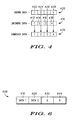
- FIG. 4 illustrates the combination of incoming data received from a burst in the 1 st time frame 412 of a four-burst message 410 with known stored data from bursts in the 2 nd through the 4 th time frames 424, 426 and 428 of a known four-burst message 420, thereby producing a combined data message 430.
- the combination of the incoming and known data occurs preferably after equalization and before deinterleaving.
- the known data may be rescaled based on present channel conditions prior to combining.
- the 2 nd through the 4 th time frames of the incoming data is illustrated in broken lines to indicate that the corresponding incoming bursts have not been received yet for these frames.
- the incoming data received is that of the 2 nd time frame 414 instead of the 1 st time frame 412.
- the incoming data 414 of the 2 nd time frame is combined with known data from the 1 st , 3 rd and 4 th time frames of the known message.
- the radio circuits may be operated in reduced power consumption mode during the 1 st time frame.
- the reception of an incoming burst of the 2 nd time frame without receiving bursts of the 1 st time frame is preferably performed only when the channel quality is sufficiently good to ensure valid decoding of the incoming message with the incoming data of not more than the 2 nd through the 4 th time frames in the event that the incoming message does not correspond to the known message, or in the event that the incoming message cannot be decoded validly with the data from only the 2 nd time frame.
- incoming data from the 3 rd time frame 416 may be combined with known data from the 1 st , 2 nd and 4 th time frames, thus permitting reducing power consumption during the 1 st and 2 nd time frames 412 and 414.
- the reception of incoming bursts of the 3 rd time frame without receiving bursts of the 1 st and 2 nd time frames is preferably performed only when the channel quality is sufficiently good to ensure valid decoding of the incoming message with the incoming data of not more than the 2 nd through the 4 th time frames in the event that the incoming message does not correspond to the known message, or in the event that the incoming message cannot be decoded validly with the data from only the 3 rd time frame.
- the combined data is deinterleaved at block 360 and decoded at block 370.
- the deinterleaving and decoding processes are known generally in the art.
- Decoding generally includes a de-convolution step, for example Viterbi decoding, and a subsequent validation operation, for example FIRE decoding having a cyclic redundancy check (CRC) algorithm, which performs limited error correction and indicates whether the message has been reconstructed correctly.
- CRC cyclic redundancy check
- the incoming data portion from may be compared in parallel with corresponding portions of more than one known message, for example a "No Identity Page" and a page addressed to the MS, among other known messages.
- the decoded message is invalid or unreliable, additional bursts may be received and the incoming data therefrom may be used to reconstruct the incoming message.
- the comparison results do not satisfy the specified requirement at block 340, the burst of a successive time frame is received and data from the two time frames is decoded.
- FIG. 5 at block 510, a 2 nd burst is received, and at block 520 incoming data from the 2 nd burst is recovered by the equalizer and subject to the deinterleaving operation. Thereafter, incoming data from the 1 st and 2 nd time frames is decoded. The data for the remaining time frames not yet received, e.g., the 3 rd and 4 th time frames, is marked as unreliable prior to decoding.
- FIG. 6 illustrates a four-frame message 600 having data bits in the first and second frames 610 and 620, but no data bits in frames 630 and 640, which are designated as having unreliable bits prior to deinterleaving and decoding.
- the radio circuits are also preferably operated in reduced power consumption mode during the time frames during which any remaining data portions, or bursts, are transmitted, since it is unnecessary to receive this data.
- the radio circuits are operated in reduced power consumption mode during the 1 st interval or time period of the data transmission, and the 1 st burst received is in the 2 nd time frame.
- the 2 nd burst received at block 510 is in the 3 rd time frame, and any subsequent burst received is in the 4 th time frame, which is the last time frame for CCCH frames in GSM networks.
- the radio circuit will operate at most for three of the exemplary four time frames, and in some instances the radio circuits may operate for only two of the four time frames, i.e. the 2 nd and 3 rd time frames, if decoding is successful for incoming data from only two received bursts. This mode of operation will be reliable only where and when channel conditions are optimum, but will provide substantial power savings.
- the 1 st burst received is in the 3 rd time frame
- any subsequent 2 nd burst received, at block 510 in FIG. 5 is in the 3 rd time frame.
- the radio circuits are operated in reduced power consumption mode during the 1 st and 2 nd intervals or time periods of the data transmission. According to this embodiment, the radio circuit will operate at most for two of the exemplary four time frames, i.e., the 3 rd and 4 th time frames, if decoding is successful for incoming data from only two received bursts. If decoding is unsuccessful, the MS must wait for the next message transmission. This mode of operation will only be viable where channel conditions are optimum, but will provide substantial power savings.
- a decoding algorithm based on the publication authored by S. Lin Wang entitled “A modified Selective-Repeat Type-II Hybrid ARQ System and Its Performance Analysis", IEEE Transactions on Communications, disclosed for example in of U.S. Patent No. 5,570,369 entitled “Reduction of Power Consumption In A Mobile Station” may be more efficient than a Viterbi decoding algorithm.
- equalization and decoding operations are performed in the DSP as is known by those having ordinary skill in the art.
- comparison and weighting processes are also performed by the DSP.
- a secondary control portion resides inside the GSM signaling stack MCU code layer 1.
- the present inventions thus provide methods for significantly reducing power consumption in radio receivers by operating in reduced power consumption mode when it is unnecessary to receive burst data.
- the processing of received data portions is streamlined by determining first whether the likelihood that an initial incoming data portion corresponds to a known data portion, and where the likelihood is good reconstructing and validating the message by combining the received data portion with other known data portions of the known message. If the likelihood is not good, additional data portions are received and the message is decoded with the assumption that any data portions not yet received are invalid. The process repeats until decoding is successful, which may be verified by a CRC operation.
- the inventions are applicable to any communications system that receives message in portion transmitted over successive interval, for example GSM communications.
Landscapes
- Engineering & Computer Science (AREA)
- Computer Networks & Wireless Communication (AREA)
- Signal Processing (AREA)
- Mobile Radio Communication Systems (AREA)
- Telephone Function (AREA)
Applications Claiming Priority (1)
| Application Number | Priority Date | Filing Date | Title |
|---|---|---|---|
| EP02292026A EP1389883B1 (fr) | 2002-08-13 | 2002-08-13 | Procédé et appareil pour le décodage des messages entrants pour des dispositifs de radiocommunications |
Related Parent Applications (1)
| Application Number | Title | Priority Date | Filing Date |
|---|---|---|---|
| EP02292026A Division EP1389883B1 (fr) | 2002-08-13 | 2002-08-13 | Procédé et appareil pour le décodage des messages entrants pour des dispositifs de radiocommunications |
Publications (2)
| Publication Number | Publication Date |
|---|---|
| EP2079265A2 true EP2079265A2 (fr) | 2009-07-15 |
| EP2079265A3 EP2079265A3 (fr) | 2009-08-05 |
Family
ID=30470332
Family Applications (2)
| Application Number | Title | Priority Date | Filing Date |
|---|---|---|---|
| EP09006060A Withdrawn EP2079265A3 (fr) | 2002-08-13 | 2002-08-13 | Décodage de message entrant dans des dispositifs de communication sans fil et procédés |
| EP02292026A Expired - Lifetime EP1389883B1 (fr) | 2002-08-13 | 2002-08-13 | Procédé et appareil pour le décodage des messages entrants pour des dispositifs de radiocommunications |
Family Applications After (1)
| Application Number | Title | Priority Date | Filing Date |
|---|---|---|---|
| EP02292026A Expired - Lifetime EP1389883B1 (fr) | 2002-08-13 | 2002-08-13 | Procédé et appareil pour le décodage des messages entrants pour des dispositifs de radiocommunications |
Country Status (4)
| Country | Link |
|---|---|
| US (1) | US7715333B2 (fr) |
| EP (2) | EP2079265A3 (fr) |
| DE (1) | DE60232964D1 (fr) |
| ES (1) | ES2329115T3 (fr) |
Families Citing this family (27)
| Publication number | Priority date | Publication date | Assignee | Title |
|---|---|---|---|---|
| US7778225B2 (en) * | 2003-10-08 | 2010-08-17 | Research In Motion Limited | Method and apparatus for dynamic packet transport in CDMA2000 networks |
| US7711377B2 (en) * | 2004-06-10 | 2010-05-04 | Qualcomm Incorporated | Efficient paging in a wireless communication system |
| US7716565B2 (en) * | 2004-08-20 | 2010-05-11 | Broadcom Corporation | Method and system for decoding video, voice, and speech data using redundancy |
| US8046662B2 (en) * | 2004-08-20 | 2011-10-25 | Broadcom Corporation | Method and system for decoding control data in GSM-based systems using inherent redundancy |
| JP4616357B2 (ja) * | 2005-01-11 | 2011-01-19 | サムスン エレクトロニクス カンパニー リミテッド | 無線通信システムにおけるデータバースト割当てを指示する方法及びシステム |
| US7970947B1 (en) | 2005-03-10 | 2011-06-28 | Rockwell Collins, Inc. | Tactical targeting network technology small form factor user system |
| US7508887B1 (en) | 2005-09-06 | 2009-03-24 | Rockwell Collins, Inc. | Signal acquisition with transmit blanking compensation |
| WO2007060589A2 (fr) * | 2005-11-28 | 2007-05-31 | Koninklijke Philips Electronics N.V. | Procede et dispositif de correction d'erreurs du signal pour systeme de telecommunications |
| EP1811674A1 (fr) * | 2006-01-23 | 2007-07-25 | Motorola, Inc. | Appareil et procédé pour le décodage conjoint des messages sur la base des connaissances a priori de la transmission modifiée des mots de code |
| KR101181723B1 (ko) | 2006-02-07 | 2012-09-19 | 삼성전자주식회사 | 무선 통신 시스템에서 페이징 메시지 디코딩 방법과 장치 |
| US7839900B1 (en) | 2006-09-29 | 2010-11-23 | Rockwell Collins, Inc. | Method and architecture for TTNT symbol rate scaling modes |
| US8073471B1 (en) * | 2007-01-03 | 2011-12-06 | Marvell Israel (M.I.S.L.) Ltd. | Saving power in wireless communication devices |
| US8050641B2 (en) * | 2007-01-25 | 2011-11-01 | Texas Instruments Incorporated | Limiting the power consumption of a wireless electronic system |
| US7835427B1 (en) | 2007-03-30 | 2010-11-16 | Rockwell Collins, Inc. | Multiplexed architecture for simultaneous transmission and reception |
| US7957758B2 (en) * | 2007-06-13 | 2011-06-07 | Mediatek Inc. | Method of and apparatus for reducing power consumption in a mobile telephony system |
| US8189581B2 (en) * | 2007-06-20 | 2012-05-29 | Motorola Mobility, Inc. | Method, signal and apparatus for managing the transmission and receipt of broadcast channel information |
| US7953037B2 (en) * | 2007-09-14 | 2011-05-31 | Mediatek Inc. | Electronic device for acquisition of a dummy paging message |
| US8522302B2 (en) * | 2008-08-01 | 2013-08-27 | Arris Enterprises, Inc. | Adaptive power control for CATV systems |
| US8179999B2 (en) * | 2008-08-08 | 2012-05-15 | Nokia Corporation | Decoding of blocks in radio communications |
| US9320034B2 (en) * | 2009-03-05 | 2016-04-19 | Nokia Solutions And Networks Oy | Systems, methods, apparatuses, and computer program products for coordinating communications between network nodes |
| CN102281615B (zh) * | 2010-06-12 | 2014-01-29 | 晨星软件研发(深圳)有限公司 | 通信装置及其控制方法 |
| US8971433B2 (en) | 2010-11-12 | 2015-03-03 | Microsoft Technology Licensing Llc | Compressive wireless modulation |
| US8797933B2 (en) * | 2010-12-27 | 2014-08-05 | Via Telecom Co., Ltd. | Apparatuses and methods for saving power in paging operations |
| EP2563076B1 (fr) * | 2011-08-23 | 2017-07-19 | Telefonaktiebolaget LM Ericsson (publ) | Technique de détection d'un indicateur d'appel vide |
| US9048990B2 (en) * | 2011-12-01 | 2015-06-02 | Broadcom Corporation | Power efficient paging channel decoding |
| US9432056B2 (en) | 2013-11-04 | 2016-08-30 | Microsoft Technology Licensing, Llc | Fast decoding based on ZigZag deconvolution for random projection code |
| EP3876383B1 (fr) | 2020-03-02 | 2025-11-26 | Nokia Technologies Oy | Communications de données |
Citations (1)
| Publication number | Priority date | Publication date | Assignee | Title |
|---|---|---|---|---|
| US5570369A (en) | 1994-03-15 | 1996-10-29 | Nokia Mobile Phones Limited | Reduction of power consumption in a mobile station |
Family Cites Families (21)
| Publication number | Priority date | Publication date | Assignee | Title |
|---|---|---|---|---|
| US5404374A (en) * | 1993-07-12 | 1995-04-04 | Apple Computer, Inc. | Method and apparatus for transmitting and receiving encoded data using multiple frequency coding |
| US5809419A (en) * | 1994-12-14 | 1998-09-15 | Motorola, Inc. | Method for reducing channel scanning time |
| US5930706A (en) * | 1995-11-29 | 1999-07-27 | Ericsson Inc. | Detecting messages transmitted over a communications channel such as a paging channel |
| GB2308531B (en) * | 1995-12-22 | 2000-03-08 | Nokia Mobile Phones Ltd | Radio telephone |
| US5930703A (en) * | 1996-03-21 | 1999-07-27 | Ericsson Inc. | Methods and systems for programming a cellular radiotelephone |
| EP0928522B1 (fr) * | 1996-09-27 | 2000-12-20 | Siemens Aktiengesellschaft | Procede d'adaptation d'un recepteur aux conditions de transmission, et le recepteur correspondant |
| US5978366A (en) * | 1996-12-20 | 1999-11-02 | Ericsson Inc. | Methods and systems for reduced power operation of cellular mobile terminals |
| US6389057B1 (en) * | 1996-12-23 | 2002-05-14 | Telefonaktiebolaget Lm Ericsson (Publ) | Access technique of channel hopping communications system |
| WO1998048521A2 (fr) * | 1997-04-24 | 1998-10-29 | Siemens Aktiengesellschaft | Terminal pour la communication radiotelephonique mobile numerique et procede pour evaluer des donnees reçues dans un terminal de ce type |
| US6275680B1 (en) * | 1997-07-29 | 2001-08-14 | Philips Semiconductors, Inc. | Hardware PCH checking for personal handyphone system portable station |
| DE19813507C2 (de) * | 1998-03-26 | 2000-10-05 | Siemens Ag | Verfahren zur Anpassung eines Empfangsgerätes an Übertragungsbedingungen und Empfangsgerät hierfür |
| FI109865B (fi) * | 1999-12-08 | 2002-10-15 | Nokia Corp | Menetelmä langattoman viestimen tehonkulutuksen pienentämiseksi |
| DE19963040A1 (de) * | 1999-12-24 | 2001-07-05 | Philips Corp Intellectual Pty | Mobilfunkgeät mit adaptiver Erkennnung von leeren Rufmeldungen |
| FI109568B (fi) * | 2000-01-13 | 2002-08-30 | Nokia Corp | Optimoitu lepotilan toiminta |
| GB2358767B (en) * | 2000-01-27 | 2002-04-24 | Motorola Israel Ltd | Method and system for reducing power consumption in communication devices |
| US6717985B1 (en) * | 2000-03-08 | 2004-04-06 | Telefonaktiebolaget Lm Ericsson (Publ) | Technique for efficiently equalizing a transmission channel in a data transmission system |
| US6765893B1 (en) * | 2000-03-31 | 2004-07-20 | Qualcomm Incorporated | Dynamic recognition of an empty general paging message |
| JP3821006B2 (ja) * | 2002-02-15 | 2006-09-13 | 株式会社デンソー | 通信システム及び受信装置 |
| US7107080B2 (en) * | 2003-06-16 | 2006-09-12 | Broadcom Corporation | System and method to conduct idle mode paging channel monitoring within a cellular wireless network |
| US7630701B2 (en) * | 2004-10-18 | 2009-12-08 | Broadcom Corporation | System and method to manage processing operations within a wireless terminal following receipt of a null page |
| US20060104204A1 (en) * | 2004-11-12 | 2006-05-18 | Johan Hansson | Power efficient mobile terminal reception mode |
-
2002
- 2002-08-13 EP EP09006060A patent/EP2079265A3/fr not_active Withdrawn
- 2002-08-13 DE DE60232964T patent/DE60232964D1/de not_active Expired - Lifetime
- 2002-08-13 ES ES02292026T patent/ES2329115T3/es not_active Expired - Lifetime
- 2002-08-13 EP EP02292026A patent/EP1389883B1/fr not_active Expired - Lifetime
-
2003
- 2003-08-08 US US10/637,124 patent/US7715333B2/en not_active Expired - Fee Related
Patent Citations (1)
| Publication number | Priority date | Publication date | Assignee | Title |
|---|---|---|---|---|
| US5570369A (en) | 1994-03-15 | 1996-10-29 | Nokia Mobile Phones Limited | Reduction of power consumption in a mobile station |
Also Published As
| Publication number | Publication date |
|---|---|
| US20050030914A1 (en) | 2005-02-10 |
| US7715333B2 (en) | 2010-05-11 |
| EP1389883B1 (fr) | 2009-07-15 |
| EP1389883A1 (fr) | 2004-02-18 |
| ES2329115T3 (es) | 2009-11-23 |
| EP2079265A3 (fr) | 2009-08-05 |
| DE60232964D1 (de) | 2009-08-27 |
Similar Documents
| Publication | Publication Date | Title |
|---|---|---|
| EP1389883B1 (fr) | Procédé et appareil pour le décodage des messages entrants pour des dispositifs de radiocommunications | |
| EP0864241B1 (fr) | Detection de messages transmis par un canal de communication tel qu'un canal de radiomessagerie | |
| CA2275909C (fr) | Procedes et systemes servant a limiter la consommation de puissance de telephones mobiles cellulaires | |
| EP2095666B1 (fr) | Réduction de l'établissement d'appel terminé par le mobile par identification et atténuation du chevauchement entre pagination et diffusion d'information système | |
| CN101325772B (zh) | 解码方法和解码装置 | |
| EP1151544B1 (fr) | Mode repos a segmentation temporelle pour stations d'abonné à mode double | |
| US6308068B1 (en) | Method and arrangement in a radio communication network | |
| JPH0837491A (ja) | 無線電話器の電力消費低減方法及びそのための制御装置、及び移動局に於ける電力消費制御方法及びそのための制御装置 | |
| RU2526048C2 (ru) | Управление мобильным радиоприемником для приема сигналов, предназначенных для множества приемников | |
| US8797933B2 (en) | Apparatuses and methods for saving power in paging operations | |
| US7729380B2 (en) | Method and device for selectively transmitting voice bursts and regenerated header bursts | |
| CN1557053B (zh) | 在通信终端中省电 | |
| CN101389134B (zh) | 用于获取虚拟呼叫信息的电子装置及其方法 | |
| US5764632A (en) | Mobile terminal having improved paging channel acquisition in a system using a digital control channel | |
| TWI466512B (zh) | 無線通信裝置、系統及用於從無線訊號提取編碼的訊號的方法 | |
| JPH09139980A (ja) | 受信装置 | |
| JP2001285181A (ja) | 移動局とその消費電流低減方法 | |
| JPH10107779A (ja) | 報知メッセージ受信方法 | |
| JP3249404B2 (ja) | Pdcスーパーフレーム同期外れ検出回路 | |
| HK1182874A (en) | Power efficient paging channel decoding | |
| MXPA99011043A (en) | A method of and apparatus for paging a wireless terminal in a wireless telecommunications system |
Legal Events
| Date | Code | Title | Description |
|---|---|---|---|
| PUAI | Public reference made under article 153(3) epc to a published international application that has entered the european phase |
Free format text: ORIGINAL CODE: 0009012 |
|
| PUAL | Search report despatched |
Free format text: ORIGINAL CODE: 0009013 |
|
| AC | Divisional application: reference to earlier application |
Ref document number: 1389883 Country of ref document: EP Kind code of ref document: P |
|
| AK | Designated contracting states |
Kind code of ref document: A2 Designated state(s): AT BE BG CH CY CZ DE DK EE ES FI FR GB GR IE IT LI LU MC NL PT SE SK TR |
|
| AK | Designated contracting states |
Kind code of ref document: A3 Designated state(s): AT BE BG CH CY CZ DE DK EE ES FI FR GB GR IE IT LI LU MC NL PT SE SK TR |
|
| RIN1 | Information on inventor provided before grant (corrected) |
Inventor name: KALUZNY, MARK Inventor name: ABDESSELEM, OUELID Inventor name: BINZEL, CHARLES Inventor name: MENU, ESTELLE Inventor name: RADAKOVIC, DANIELA Inventor name: BOYER-NOEL, BENOIT |
|
| RIN1 | Information on inventor provided before grant (corrected) |
Inventor name: ABDESSELEM, OUELID Inventor name: RADAKOVIC, DANIELA Inventor name: MENU, ESTELLE Inventor name: KALUZNY, MARK Inventor name: BINZEL, CHARLES Inventor name: BOYER-NOEL, BENOIT |
|
| STAA | Information on the status of an ep patent application or granted ep patent |
Free format text: STATUS: THE APPLICATION IS DEEMED TO BE WITHDRAWN |
|
| 18D | Application deemed to be withdrawn |
Effective date: 20100206 |
|
| P01 | Opt-out of the competence of the unified patent court (upc) registered |
Effective date: 20230520 |