EP2080706B2 - Beutelkette - Google Patents
Beutelkette Download PDFInfo
- Publication number
- EP2080706B2 EP2080706B2 EP08000766.9A EP08000766A EP2080706B2 EP 2080706 B2 EP2080706 B2 EP 2080706B2 EP 08000766 A EP08000766 A EP 08000766A EP 2080706 B2 EP2080706 B2 EP 2080706B2
- Authority
- EP
- European Patent Office
- Prior art keywords
- bags
- bag
- spacers
- accordance
- bag chain
- Prior art date
- Legal status (The legal status is an assumption and is not a legal conclusion. Google has not performed a legal analysis and makes no representation as to the accuracy of the status listed.)
- Active
Links
Images


Classifications
-
- B—PERFORMING OPERATIONS; TRANSPORTING
- B65—CONVEYING; PACKING; STORING; HANDLING THIN OR FILAMENTARY MATERIAL
- B65D—CONTAINERS FOR STORAGE OR TRANSPORT OF ARTICLES OR MATERIALS, e.g. BAGS, BARRELS, BOTTLES, BOXES, CANS, CARTONS, CRATES, DRUMS, JARS, TANKS, HOPPERS, FORWARDING CONTAINERS; ACCESSORIES, CLOSURES, OR FITTINGS THEREFOR; PACKAGING ELEMENTS; PACKAGES
- B65D33/00—Details of, or accessories for, sacks or bags
- B65D33/007—Details of, or accessories for, sacks or bags for facilitating the separation of the two walls, e.g. walls of inequal height, tabs; for maintaining the mouth of the sack or bag open
-
- B—PERFORMING OPERATIONS; TRANSPORTING
- B65—CONVEYING; PACKING; STORING; HANDLING THIN OR FILAMENTARY MATERIAL
- B65D—CONTAINERS FOR STORAGE OR TRANSPORT OF ARTICLES OR MATERIALS, e.g. BAGS, BARRELS, BOTTLES, BOXES, CANS, CARTONS, CRATES, DRUMS, JARS, TANKS, HOPPERS, FORWARDING CONTAINERS; ACCESSORIES, CLOSURES, OR FITTINGS THEREFOR; PACKAGING ELEMENTS; PACKAGES
- B65D33/00—Details of, or accessories for, sacks or bags
- B65D33/002—Rolls, strips or like assemblies of bags
Definitions
- the invention relates to a bag chain consisting of a plurality of bags made of a plastic film, the scale-like superimposed on at least two laterally spaced drivable carrying straps are releasably secured, wherein the openings of the bag aligned approximately perpendicular to the straps are.
- suction cups are to be placed on one or both sides of the bag, by means of which the bag is to be opened so far that grippers can be mechanically inserted into them for further opening.
- the forces required to open the bag can be extremely high, as air may not flow into the bag fast enough and a vacuum is created which counteracts the opening forces.
- the vacuum is in this case the higher the faster the bag is opened or the suction pads on one side and the suction pads and / or the straps on the other side are moved apart at an opening speed apart.
- a quick opening of the bags is desirable in the automated opening process, since a high productivity of the process can be achieved.
- the bags are torn off either by the straps in this opening phase, especially when no additional suction pads are used on this side of the bag, or else the suction pads lose the bag. In particular, the tearing of the bag often occurs.
- the indirect reason for this is that the bags have to slide very well against each other in view of the good processability and lubricants are to be used, by which, however, the holding force on the straps is impaired.
- the good sliding behavior is required if the bottom bag under the bags lying on it must be regularly pulled away when opening the bag without the bag chain or its scaling loses its order state by action, in particular jerky shear forces.
- this is achieved in the bag chain of the type mentioned above in that the film forming the bag is provided on one or both inner sides of the bag with incorporated in this spacers.
- the spacers may in this case be formed by an inorganic or organic antiblocking agent, for example synthetic or natural silica, by calcium carbonate or polycarbonate particles.
- the size of the particles of the spacers should be about 3 to 30 ⁇ m [ ⁇ 10 -6 meters], preferably between 5 to 15 ⁇ m [ ⁇ 10 -6 meters].
- silica spacers For synthetic silica spacers, it is indicated that their content is about 1,000 to 2,000 ppm, for natural silica spacers about 2,000 to 5,000 ppm, and for calcium carbonate spacers about 1,000 to 4,000 ppm of the receiving film.
- the portion incorporated in the insides should, in a preferred embodiment, be more than 10% larger than the portion of the spacers incorporated in the outsides.
- the inner sides and adhering to the straps outer side of the film with different proportions of spacers to provide the outside with a preferably by 10 to 20% larger share.
- the film for producing the bags can also be extruded in a multi-layered manner, wherein the spacers are to be integrated into the inner layer and / or into the outer layer of the film.
- the bags should be releasably attached by means of a pressure-sensitive adhesive to the preferably designed as adhesive tapes tapes. Also should the bag chain-forming bag to be wound together with the straps on a roll core.
- a bag chain according to the invention in which the film from which the bags are made, equipped with integrated spacers and thus with a selectable depending on the purpose of type and concentration antiblocking agents, it is reliably guaranteed that the films are not stick together and the bags are easy to open for filling.
- the spacers namely ensures that the films do not abut each other, but that between them an air gap is formed, due to which the films are easily solved even at high speeds from each other.
- the equipment of the inside of the bag with anti-blocking agent also causes the opening of the bag, especially in the initial phase of the opening process, the flow of air when pulling the bag is improved by the fact that by the antiblocking caused surface roughness cannulas and capillaries are available through the flow processes in the bag are very favored. In this way, the resulting negative pressure can be reduced and the force required to open can be reduced. In addition, this improves the reliability of the opening process and the reproducibility and reliability of the automated bag processing, since both the premature tearing off of the straps and the loss is counteracted by suction pads in the first opening phase. Furthermore, the equipment of the bag exterior with anti-blocking agent causes the increased surface roughness increases the effective adhesive surface and the adhesive strength is improved on the straps.
- the scaling of the bags can be reduced. By resulting in this way savings on straps economic efficiency is increased. Furthermore, improved adhesive strength on the straps facilitates the use of lubricants, so that the required slip properties of the bags against each other can be achieved by a suitable combination of antiblocking agent and lubricant.
- a bag chain is thus created, the bags of which can be opened without difficulty even at high operating speeds and with low forces, in particular in the first opening phase, without the bags being torn off the carrier tapes or being lost by the suction grippers.
- the specific adhesive forces on these can be selected to be higher than heretofore, and thus the bags are to be arranged very close to each other, the fastener tapes can be shortened.
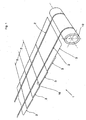
- bag chain consists of a plurality of two parallel to each other extending drivable straps releasably secured bags 3, which are held at a small distance s of, for example, 30 mm next to each other like scales on the straps 2.
- the openings of the bags 3 are aligned approximately perpendicular to the straps 2, which are wound together with the bags 3 on a roll core 10.
- the bags 3 are, as the particular FIG. 2 can be seen, designed as a tubular bag and thus made of a closed film, which are welded after severing the extruded tube on a transverse side.
- the interior 4 of the bag 3 are like this FIG. 3 can be seen on the inner sides 12 and 13 of the film 11 in these spacers 21 and 22 in selectable size and selectable accumulation, however, incorporated according to purpose.
- the spacers 21 and 22 may also be provided only on the inside 12 or only on the inside 13 of the film 11. In this way it is prevented that the film 11 adheres to each other and is difficult to open in the first opening phase.
- the spacers 21 and 22 thus cause 4 air channels form in the interior and the film 11 of the bag 3 is spread out with only little force.
- the bags 3 are by means of a pressure sensitive adhesive 5 at attached to the straps 2.
- a lubricant 6 are applied on the outer sides 14, 15 and / or the inner sides 12, 13 of the bag 3.
- spacer 23 may be included in order to increase the adhesion of the bag 3 to the pressure sensitive adhesive 5 and the straps 2 and to adjust.
- FIG. 7 For example, one of two foils 11 'and 11 ", which are connected to one another in the edge regions by weld seams 16, is shown producing side seaming bags 3' In each of the foils 11 'and 11", an intermediate layer 18 is extruded, so that the individual layers of the The spacers 21 and 22 or 23 are respectively incorporated into the inner and outer layers of the films 11 'and 11 "and thus effective on the surface of the bag 3.
Landscapes
- Engineering & Computer Science (AREA)
- Mechanical Engineering (AREA)
- Bag Frames (AREA)
Description
- Die Erfindung bezieht sich auf eine Beutelkette, die aus einer Vielzahl von aus einer Kunststofffolie hergestellten Beuteln, die schuppenartig übereinander liegend an mindestens zwei mit seitlichem Abstand zueinander angeordneten antreibbaren Tragbändern lösbar befestigt sind, besteht, wobei die Öffnungen der Beutel etwa senkrecht zu den Tragbändern ausgerichtet sind.
- Durch die
DE-U 1-298 03 049 ist eine bei automatisierten Abpackprozessen für Lebensmittel verwendbare aus Schlauchbeuteln gebildete Beutelkette dieser Art bekannt. Die aus hygienischen Gründen auf einem Rollenkern aufgewickelten Schlauchbeutel bleiben bis zu ihrem Einsatz zwar gut verschlossen, das automatisierte Öffnen und Abnehmen einzelner Beutel von den Tragbändern ist jedoch insbesondere bei hoher Geschwindigkeit des Abpackprozesses problematisch. Die Innenseiten der Beutel haften nämlich mitunter derart aneinander, dass sich durch nicht geöffnete Beutel oftmals Betriebsstörungen ergeben. Mittels Blasluft könnten die Beutel eventuell geöffnet werden, dadurch können jedoch Bakterien und/oder Verschmutzungen in die Beutel gelangen. Davon wird daher nur selten Gebrauch gemacht. - Zum Einführen eines zu verpackenden Gutes in einen Beutel sind in einer ersten Phase auf einer oder beiden Seiten des Beutels Saugheber anzusetzen, mittels denen der Beutel soweit zu öffnen ist, dass Greifer zum weiteren Öffnen mechanisch in diesen eingeführt werden können. In dieser ersten Phase können die zum Öffnen des Beutels erforderlichen Kräfte jedoch außerordentlich hoch sein, da Luft eventuell nicht schnell genug in den Beutel strömt und ein Unterdruck entsteht, der den Öffnungskräften entgegenwirkt. Der Unterdruck wird hierbei umso höher, je schneller der Beutel geöffnet bzw. die Sauggreifer auf der einen Seite und die Sauggreifer und/oder die Tragbänder auf der anderen Seite mit einer Öffnungsgeschwindigkeit auseinander bewegt werden. Ein schnelles Öffnen der Beutel ist jedoch beim automatisierten Öffnungsvorgang erwünscht, da eine hohe Produktivität des Prozesses zu erzielen ist.
- Bei zu hoch werdender Öffnungskraft werden die Beutel aber in dieser Öffnungsphase entweder von den Tragbändern abgerissen, insbesondere dann, wenn auf dieser Beutelseite keine zusätzlichen Sauggreifer zum Einsatz kommen, oder aber die Sauggreifer verlieren den Beutel. Insbesondere das Abreißen des Beutels tritt oftmals auf. Mittelbare Ursache hierfür ist, dass die Beutel mit Rücksicht auf die gute Verarbeitbarkeit gegeneinander sehr gut gleiten müssen und hierzu Gleitmittel einzusetzen sind, durch die jedoch die Haltekraft an den Tragbändern beeinträchtigt wird. Das gute Gleitverhalten ist erforderlich, wenn beim Öffnen der Beutel regelmäßig der unterste Beutel unter den darauf liegenden Beuteln weggezogen werden muss, ohne dass die Beutelkette bzw. deren Schuppung ihren Ordnungszustand durch Einwirkung, insbesondere von ruckartigen Querkräften verliert.
- Der Einsatz der bekannten Schlauchbeutelkette zum Verpacken von Lebensmitteln ist daher oftmals, obwohl diese Beutelkette in der Praxis vielseitig verwendet wurde und sich auch bewährt hat, bei mit hoher Geschwindigkeit durchgeführten Abpackvorgängen mit erheblichen Schwierigkeiten verbunden.
- Es ist demnach Aufgabe der Erfindung, die Beutelkette der vorgenannten Gattung in der Weise auszugestalten, dass die Beutel auch bei hohen Arbeitsgeschwindigkeiten stets gut zu öffnen sind. Es soll somit mit einfachen Mitteln erreicht werden, dass ein Aneinanderkleben der die Beutel bildenden Folie nahezu ausgeschlossen ist. Das Öffnen der Beutel soll vielmehr störungsfrei ermöglicht werden.
- Gemäß der Erfindung wird dies bei der Beutelkette der eingangs genannten Art dadurch erreicht, dass die die Beutel bildende Folie auf einer oder beiden Innenseiten des Beutels mit in diese eingebundenen Abstandshaltern versehen ist.
- Die Abstandshalter können hierbei durch ein anorganisches oder organisches Antiblockmittel, beispielsweise synthetische oder natürliche Kieselsäure, durch Kalziumkarbonat oder Polycarbonatpartikel gebildet sein. Die Größe der Partikel der Abstandshalter sollte etwa 3 bis 30 µm [≙ 10 -6 Meter], vorzugsweise zwischen 5 bis 15 µm [≙ 10 -6 Meter], betragen.
- Bei Abstandshaltern aus synthetischer Kieselsäure ist es angezeigt, dass deren Anteil etwa 1000 bis 2000 ppm, bei Abstandshaltern aus natürlicher Kieselsäure deren Anteil etwa 2000 bis 5000 ppm und bei Abstandstandshaltern aus Kalziumkarbonat deren Anteil etwa 1000 bis 4000 ppm an der diese aufnehmenden Folie beträgt.
- Bei einer Ausrüstung der Innenseiten und/oder der Außenseiten der Beutel mit Abstandshaltern sollte der in die Innenseiten eingebundene Anteil in einer bevorzugten Ausgestaltung um mehr als 10 % größer bemessen sein als der in die Außenseiten eingebundene Anteil der Abstandshalter.
- Es ist aber auch möglich, die Innenseiten und die an den Tragbändern haftende Außenseite der Folie mit unterschiedlichen Anteilen an Abstandshaltern, die Außenseite mit einem um vorzugsweise 10 bis 20 % größeren Anteil zu versehen.
- Die Folie zur Herstellung der Beutel kann auch mehrschichtig extrudiert sein, wobei die Abstandhalter in die innere Schicht und/oder in die äußere Schicht der Folie einzubinden sind.
- Vorteilhaft ist es des Weiteren, die Außen- und/oder Innenseiten der Beutel mit einem Gleitmittel zu versehen und bei Anordnung der Beutel an den Tragbändern den Abstand zwischen den Öffnungen der einzelnen Beutel mit höchstens 30 mm zu bemessen.
- Die Beutel sollten mittels eines Haftklebstoffes an den vorzugsweise als Klebebändern ausgebildeten Tragbändern lösbar angebracht sein. Auch sollten die die Beutelkette bildenden Beutel zusammen mit den Tragbändern auf einem Rollenkern aufgewickelt sein.
- Wird eine Beutelkette gemäß der Erfindung ausgebildet, in dem die Folie, aus der die Beutel hergestellt sind, mit eingebundenen Abstandshaltern und somit mit einem je nach Verwendungszweck nach Art und Konzentration wählbaren Antiblockmittel ausgerüstet werden, so ist zuverlässig die Gewähr gegeben, dass die Folien nicht aneinander haften und die Beutel zum Befüllen leicht zu öffnen sind. Durch die Abstandshalter wird nämlich gewährleistet, dass die Folien nicht aneinander anliegen, sondern dass zwischen diesen ein Luftspalt gebildet ist, aufgrund dessen die Folien auch bei hohen Arbeitsgeschwindigkeiten problemlos voneinander zu lösen sind.
- Die Ausrüstung der Innenseite der Beutel mit Antiblockmitteln bewirkt des Weiteren, dass beim Öffnen der Beutel insbesondere in der Anfangsphase des Öffnungsvorgangs das Nachströmen von Luft beim Auseinanderziehen des Beutels dadurch verbessert wird, dass durch die vom Antiblockmittel hervorgerufene Oberflächenrauhigkeit Kanülen und Kapillaren zur Verfügung stehen, durch die die Strömungsvorgänge in den Beutel sehr begünstigt werden. Auf diese Weise können der entstehende Unterdruck gemindert und die zum Öffnen erforderliche Kraft reduziert werden. Außerdem werden dadurch die Zuverlässigkeit des Öffnungsvorgangs und die Reproduzierbarkeit sowie die Betriebssicherheit der automatisierten Beutelverarbeitung verbessert, da sowohl dem vorzeitigen Abreißen von den Tragbändern als auch dem Verlieren durch Sauggreifer in der erst en Öffnungsphase entgegen gewirkt wird. Weiterhin bewirkt die Ausrüstung der Beutelaußenseite mit Antiblockmittel, dass durch die erhöhte Oberflächenrauhigkeit die effektive Klebefläche vergrößert und die Klebefestigkeit an den Tragbändern verbessert wird. Auch kann die Schuppung der Beutel verringert werden. Durch die sich auf diese Weise ergebenden Einsparungen an Tragbändern wird die Wirtschaftlichkeit gesteigert. Ferner erleichtert eine verbesserte Klebefestigkeit an den Tragbändern den Einsatz von Gleitmitteln, so dass die erforderlichen Gleiteigenschaften der Beutel gegeneinander durch eine geeignete Kombination von Antiblockmittel und Gleitmittel erzielt werden können.
- Durch die vorschlagsgemäße Ausgestaltung wird demnach eine Beutelkette geschaffen, deren Beutel ohne Schwierigkeiten auch bei hohen Arbeitsgeschwindigkeiten und mit geringen Kräften, insbesondere in der ersten Öffnungsphase zu öffnen sind, ohne dass die Beutel von den Tragbändern abreißen oder von den Sauggreifern verloren werden. Außerdem können die Tragbänder, da die spezifischen Klebekräfte an diesen höher als bisher gewählt werden können und somit die Beutel sehr dicht nebeneinander anzuordnen sind, verkürzt ausgebildet werden. Des Weiteren ist von Vorteil, dass bedingt durch die mit Abstand zueinander angeordneten Folien keine statische Aufladung entsteht und dass keine zusätzlichen Hilfsmittel zum Öffnen der Beutel erforderlich sind. Eine vielseitige Verwendbarkeit der Beutelkette ist demnach gegeben.
- In der Zeichnung ist ein Ausführungsbeispiel einer gemäß der Erfindung ausgebildeten Beutelkette dargestellt, das nachfolgend im einzelnen erläutert ist. Hierbei zeigt:
- Figur 1
- eine Beutelkette, die aus an Tragbändern befestigten und von einem Rollenkern abgenommenen Beuteln besteht,
- Figur 2
- einen der in
Figur 1 dargestellten Schlauchbeutel in einem achssenkrechten Schnitt und in einer vergrößerten Darstellung, - Figur 3,
- einen Ausschnitt aus
Figur 2 in vergrößerter Wiedergabe, - Figuren 4 und 5
- Ausführungsbeispiele des Beutels nach
Figur 2 , in Darstellungen nachFigur 3 , - Figur 6
- einen weiteren Ausschnitt aus
Figur 2 , in vergrößerter Wiedergabe, und - Figur 7
- einen Seitennahtbeutel in einer Darstellung gemäß
Figur 2 . - Die in
Figur 1 dargestellte und mit 1 bezeichnete Beutelkette besteht aus einer Vielzahl von an zwei parallel zueinander verlaufenden antreibbaren Tragbändern lösbar befestigten Beuteln 3, die mit einem geringen Abstand s von zum Beispiel 30 mm nebeneinander schuppenartig an den Tragbändern 2 gehalten sind. Die Öffnungen der Beutel 3 sind etwa senkrecht zu den Tragbändern 2 ausgerichtet, die zusammen mit den Beuteln 3 auf einen Rollenkern 10 aufgewickelt sind. - Die Beutel 3 sind, wie dies insbesondere der
Figur 2 zu entnehmen ist, als Schlauchbeutel ausgebildet und somit aus einer geschlossenen Folie hergestellt, die nach dem Durchtrennen des extrudierten Schlauches auf einer Querseite verschweißt sind. Um den Innenraum 4 der Beutel 3 leicht öffnen zu können, sind, wie dies derFigur 3 zu entnehmen ist, auf den Innenseiten 12 und 13 der Folie 11 in diese Abstandshalter 21 und 22 in wählbarer Größe und wählbarer Ansammlung jedoch nach Verwendungszweck eingebunden. Gemäß denFiguren 4 und 5 können die Abstandshalter 21 und 22 aber auch nur auf der Innenseite 12 oder nur auf der Innenseite 13 der Folie 11 vorgesehen sein. Auf diese Weise wird verhindert, dass die Folie 11 aneinanderhaftet und in der ersten Öffnungsphase schwierig zu öffnen ist. Die Abstandshalter 21 und 22 bewirken somit, dass sich im Innenraum 4 Luftkanäle bilden und die Folie 11 der Beutel 3 mit nur geringer Kraft auszuspreizen ist. - Die Beutel 3 sind mittels eines Haftklebers 5 an den Tragbändern 2 befestigt. Außerdem kann auf den Außenseiten 14, 15 und/oder den Innenseiten 12, 13 der Beutel 3 ein Gleitmittel 6 aufgebracht werden. Auch auf den Außenseiten 14 und 15 können, wie dies in
Figur 6 bzw. 6' in Bezug auf die Außenseite 15 dargestellt ist, Abstandshalter 23 eingebunden sein, um die Haftfähigkeit der Beutel 3 an dem Haftkleber 5 bzw. den Tragbändern 2 zu erhöhen bzw. einstellen zu können. - In
Figur 7 ist eine aus zwei Folien 11' und 11 ", die in den Randbereichen durch Schweißnähte 16 miteinander verbunden sind, hergestellter Seitennahtbeutel 3' gezeigt. In die Folien 11' und 11" ist hierbei jeweils eine Zwischenschicht 18 einextrudiert, so dass die einzelnen Schichten der Folien 11' und 11" unterschiedlich gewählt werden können. Die Abstandshalter 21 und 22 bzw. 23 sind jeweils in die inneren bzw. äußeren Schichten der Folien 11' und 11" eingebunden und somit an der Oberfläche des Beutels 3 wirksam.
Claims (12)
- Beutelkette (1) bestehend aus einer Vielzahl von aus einer Kunststofffolie (11) hergestellten Beuteln (3, 3'), die schuppenartig übereinander liegend an mindestens zwei mit seitlichem Abstand zueinander angeordneten antreibbaren Tragbändern (2) lösbar befestigt sind, wobei die Öffnungen (16) der Beutel (3, 3') senkrecht zu den Tragbändern (2) ausgerichtet sind,
dadurch gekennzeichnet,
dass die die Beutel (3, 3') bildende Folie (11, 11', 11") auf einer oder beiden Innenseiten (12, 13) des Beutels (3, 3') mit in diese eingebundene Abstandshalter (21 22, 23) versehen ist. - Beutelkette nach Anspruch 1,
dadurch gekennzeichnet,
dass die die Beutel (3, 3') bildende Folie (11, 11', 11") auf einer oder beiden Außenseiten (14, 15) des Beutels (3, 3') mit in diese eingebundene Abstandshalter (21, 22, 23) versehen ist. - Beutelkette nach Anspruch 1 oder 2
dadurch gekennzeichnet,
dass die Abstandshalter (21, 22, 23) durch ein anorganisches oder organisches Antiblockmittel, beilspielsweise synthetische oder natürliche Kieselsäure, durch Kalziumkarbonat oder Polycarbonatpartikel gebildet sind. - Beutelkette nach Anspruch 3,
dadurch gekennzeichnet,
dass die Größe der Partikel der Abstandshalter (21, 22, 23) etwa 3 bis 30 µm [≙ 10 -6 Meter], vorzugsweise zwischen 5 bis 15 µm [≙ 10 -6 Meter] beträgt. - Beutelkette nach Anspruch 3 oder 4,
dadurch gekennzeichnet,
dass bei Abstandshaltern (21, 22, 23) aus synthetischer Kieselsäure deren Anteil etwa 1000 bis 2000 ppm, aus natürlicher Kieselsäure deren Anteil etwa 2000 bis 5000 ppm und aus Kalziumkarbonat deren Anteil etwa 1000 bis 4000 ppm an der diese aufnehmenden Folie (11,11',11") beträgt. - Beutelkette nach Anspruch 2. bis 5,
dadurch gekennzeichnet,
dass bei einer Ausrüstung der Innenseiten (12, 13) und der Außenseiten (14, 15) der Beutel (3,3') mit Abstandshaltern (21, 22, 23) der in die Innenseiten (12,13) eingebundene Anteil um mehr als 10 % größer bemessen ist als der in die Außenseiten (14,15) eingebundene Anteil der Abstandshalter (21, 22, 23). - Beutelkette nach Anspruch 2 bis 5,
dadurch gekennzeichnet,
dass die Innenseiten (12, 13) und die an den Tragbändern (2) haftende Außenseite (15) der Folie (11) mit unterschiedlichen Anteilen an Abstandshaltern (21, 22, 23), die Außenseite (15) mit einem um vorzugsweise 10 bis 20% größeren Anteil, versehen sind. - Beutelkette nach den Ansprüchen 1 bis 7,
dadurch gekennzeichnet,
dass die Folie (11,11') zur Herstellung der Beutel (3') mehrschichtig extrudiert ist, und dass die Abstandshalter in die innere Schicht und ggf. in die äußere Schicht der Folie (11,11') eingebunden sind. - Beutelkette nach den Ansprüchen 1 bis 8,
dadurch gekennzeichnet,
dass die Außenseiten (14,15) und/oder die Innenseiten (12, 13) der Beutel (3,3') mit einem Gleitmittel (6) versehen sind. - Beutelkette nach den Ansprüchen 1 bis 9,
dadurch gekennzeichnet,
dass bei Anordnung der Beutel (3, 3') an den Tragbändern (2) der Abstand (S) zwischen den Öffnungen (16) der einzelnen Beutel (3, 3') höchstens 30 mm beträgt. - Beutelkette nach den Ansprüchen 1 bis 10,
dadurch gekennzeichnet,
dass die Beutel (3, 3') mittels eines Haftklebstoffes (5) an den vorzugsweise als Klebebändern ausgebildeten Tragbändern (2) lösbar angebracht sind. - Beutelkette nach den Ansprüchen 1 bis 11,
dadurch gekennzeichnet,
dass die die Beutelkette (1) bildenden Beutel (3) zusammen mit den Tragbändern (2) auf einem Rollenkern (10) aufgewickelt sind.
Priority Applications (1)
| Application Number | Priority Date | Filing Date | Title |
|---|---|---|---|
| EP08000766.9A EP2080706B2 (de) | 2008-01-16 | 2008-01-16 | Beutelkette |
Applications Claiming Priority (1)
| Application Number | Priority Date | Filing Date | Title |
|---|---|---|---|
| EP08000766.9A EP2080706B2 (de) | 2008-01-16 | 2008-01-16 | Beutelkette |
Publications (3)
| Publication Number | Publication Date |
|---|---|
| EP2080706A1 EP2080706A1 (de) | 2009-07-22 |
| EP2080706B1 EP2080706B1 (de) | 2013-07-24 |
| EP2080706B2 true EP2080706B2 (de) | 2017-05-03 |
Family
ID=39521894
Family Applications (1)
| Application Number | Title | Priority Date | Filing Date |
|---|---|---|---|
| EP08000766.9A Active EP2080706B2 (de) | 2008-01-16 | 2008-01-16 | Beutelkette |
Country Status (1)
| Country | Link |
|---|---|
| EP (1) | EP2080706B2 (de) |
Citations (13)
| Publication number | Priority date | Publication date | Assignee | Title |
|---|---|---|---|---|
| US3428483A (en) † | 1965-01-13 | 1969-02-18 | Du Pont | Vinylidene chloride copolymer coated polymeric film containing steatite talc in the coating |
| US3527660A (en) † | 1966-09-30 | 1970-09-08 | Bexford Ltd | Surface treatment of cellulose acetate film |
| GB1378235A (en) † | 1971-10-22 | 1974-12-27 | Cellophane Sa | Anchoring layer on polyester films |
| US3980611A (en) † | 1970-07-07 | 1976-09-14 | E. I. Du Pont De Nemours And Company | Filled thermoplastic films |
| GB1492178A (en) † | 1973-10-29 | 1977-11-16 | Monsanto Co | Biaxially oriented polymeric sheets |
| US4107380A (en) † | 1976-11-12 | 1978-08-15 | American Can Company | Non-blocking coating composition |
| US4117193A (en) † | 1976-07-22 | 1978-09-26 | Honshu Seishi Kabushiki Kaisha | Antistatic, low temperature heat sealable polypropylene composite film and process for production thereof |
| EP0070524A1 (de) † | 1981-07-16 | 1983-01-26 | Nippon Carbide Kogyo Kabushiki Kaisha | Druckempfindliche Klebeflächenanordnung mit lageveränderbaren Eigenschaften |
| US4659532A (en) † | 1984-08-16 | 1987-04-21 | Wolff Walsrode Ag | Internal dusting of film tubes composed of thermoplastics |
| EP0704319A1 (de) † | 1994-09-28 | 1996-04-03 | Dai Nippon Printing Co., Ltd. | Thermisches Übertragungsblatt |
| US5674600A (en) † | 1995-07-17 | 1997-10-07 | Wolff Walsrode Aktiengesellschaft | Laminating film without a release layer, process for the production thereof and use thereof |
| US5925454A (en) † | 1995-07-11 | 1999-07-20 | W.R. Grace & Co.-Conn. | Film having modified surface characteristics through use of combination of spherical and lamellar particulates |
| US6331355B1 (en) † | 1997-06-17 | 2001-12-18 | Wolff Walsrode Ag | Rollable, single-coated hot melt adhesive film with no interlayer |
Family Cites Families (6)
| Publication number | Priority date | Publication date | Assignee | Title |
|---|---|---|---|---|
| US3224574A (en) * | 1964-06-10 | 1965-12-21 | Scott Paper Co | Embossed plastic bag |
| US3857144A (en) * | 1971-07-02 | 1974-12-31 | Mobil Oil Corp | Method of embossing limp plastic sheet material |
| US4367841A (en) * | 1980-11-18 | 1983-01-11 | Mobil Oil Corporation | Thermoplastic carrying bag with binary polyolefin resin blend |
| CA2030868C (en) * | 1989-12-06 | 1996-07-09 | Michael G. Borchardt | Write-on film surface and bags having a write-on stripe |
| US5965224A (en) * | 1995-11-13 | 1999-10-12 | First Brands Corporation | Closure bag with internal tack surfaces |
| DE29803049U1 (de) | 1998-02-21 | 1998-06-18 | Remmele, Johannes, Dipl.-Betriebsw., 88416 Ochsenhausen | Schlauchbeutelkette |
-
2008
- 2008-01-16 EP EP08000766.9A patent/EP2080706B2/de active Active
Patent Citations (13)
| Publication number | Priority date | Publication date | Assignee | Title |
|---|---|---|---|---|
| US3428483A (en) † | 1965-01-13 | 1969-02-18 | Du Pont | Vinylidene chloride copolymer coated polymeric film containing steatite talc in the coating |
| US3527660A (en) † | 1966-09-30 | 1970-09-08 | Bexford Ltd | Surface treatment of cellulose acetate film |
| US3980611A (en) † | 1970-07-07 | 1976-09-14 | E. I. Du Pont De Nemours And Company | Filled thermoplastic films |
| GB1378235A (en) † | 1971-10-22 | 1974-12-27 | Cellophane Sa | Anchoring layer on polyester films |
| GB1492178A (en) † | 1973-10-29 | 1977-11-16 | Monsanto Co | Biaxially oriented polymeric sheets |
| US4117193A (en) † | 1976-07-22 | 1978-09-26 | Honshu Seishi Kabushiki Kaisha | Antistatic, low temperature heat sealable polypropylene composite film and process for production thereof |
| US4107380A (en) † | 1976-11-12 | 1978-08-15 | American Can Company | Non-blocking coating composition |
| EP0070524A1 (de) † | 1981-07-16 | 1983-01-26 | Nippon Carbide Kogyo Kabushiki Kaisha | Druckempfindliche Klebeflächenanordnung mit lageveränderbaren Eigenschaften |
| US4659532A (en) † | 1984-08-16 | 1987-04-21 | Wolff Walsrode Ag | Internal dusting of film tubes composed of thermoplastics |
| EP0704319A1 (de) † | 1994-09-28 | 1996-04-03 | Dai Nippon Printing Co., Ltd. | Thermisches Übertragungsblatt |
| US5925454A (en) † | 1995-07-11 | 1999-07-20 | W.R. Grace & Co.-Conn. | Film having modified surface characteristics through use of combination of spherical and lamellar particulates |
| US5674600A (en) † | 1995-07-17 | 1997-10-07 | Wolff Walsrode Aktiengesellschaft | Laminating film without a release layer, process for the production thereof and use thereof |
| US6331355B1 (en) † | 1997-06-17 | 2001-12-18 | Wolff Walsrode Ag | Rollable, single-coated hot melt adhesive film with no interlayer |
Also Published As
| Publication number | Publication date |
|---|---|
| EP2080706A1 (de) | 2009-07-22 |
| EP2080706B1 (de) | 2013-07-24 |
Similar Documents
| Publication | Publication Date | Title |
|---|---|---|
| DE60219688T2 (de) | Verpackung, wie zum beispiel beutel, mit ausgerichteter aufreissöffnung | |
| DE69025093T2 (de) | Verfahren zur Herstellung eines Verschlusssystems für eine wiederverschliessbare Folienverpackung und so hergestelltes Verschlusssystem | |
| DE69736672T2 (de) | Beutel mit material für befestigungsstreifen und herstellungsverfahren dafür | |
| DE60302649T2 (de) | Umhüllungsmaterial mit einer z-verriegelung und verfahren zu dessen herstellung und zur verwendung desselben | |
| DE60019259T2 (de) | Kunststoffbeutel und verfahren zu dessen herstellung | |
| EP1863720A1 (de) | Wiederverschliessbare folien-verpackung, insbesondere flow-wrap-verpackung | |
| DE2744506C2 (de) | Bandartiges Verpackungsmaterial und Verfahren zu seiner Herstellung | |
| EP0479715B1 (de) | Bandverschluss | |
| WO2014131798A1 (de) | Windelverschlussband sowie verfahren und vorrichtung zu dessen herstellung | |
| EP2336443B1 (de) | Dichtband und Verfahren zur Ausrüstung eines Bauteils mit diesem Dichtband | |
| EP2792609A1 (de) | Verpackungsbehältnis für Schüttgüter | |
| EP3052395B1 (de) | Sack und sack-herstellungsverfahren | |
| DE60200703T2 (de) | Verfahren und Vorrichtung zur Herstellung von wiederverschliessbaren Beuteln | |
| EP2080706B1 (de) | Beutelkette | |
| EP2998236A1 (de) | Seitenfaltenbeutel sowie Verfahren zur Herstellung eines Seitenfaltenbeutels | |
| DE60312547T2 (de) | Wiederverschliessbare beutel mit aufreissband | |
| EP3037360B1 (de) | Folienverpackungsbeutel sowie Verfahren zur Herstellung von Folienverpackungsbeuteln | |
| DE202008000643U1 (de) | Beutelkette | |
| EP3174808B1 (de) | Verfahren zur herstellung von behältnissen, vorrichtung zur aufbringung einer verschlussvorrichtung an ein behältnis sowie system zur herstellung von einer vielzahl an behältnissen | |
| DE3933572C2 (de) | Wiederverschließbarer Beutel und Verfahren zur Herstellung desselben | |
| EP0912400B1 (de) | Verfahren zur herstellung von öffnungsmitteln für eine verpackung | |
| DE60000572T2 (de) | Verfahren zum herstellen von wiederverschliessbaren taschen | |
| DE29803049U1 (de) | Schlauchbeutelkette | |
| DE10164930B4 (de) | Vorrichtung zum Herstellen von Beuteln | |
| DE60002547T2 (de) | Scheiber und Verfahren zur Befestigung eines Scheibers an einer wiederverschliessbaren Verpackung |
Legal Events
| Date | Code | Title | Description |
|---|---|---|---|
| PUAI | Public reference made under article 153(3) epc to a published international application that has entered the european phase |
Free format text: ORIGINAL CODE: 0009012 |
|
| AK | Designated contracting states |
Kind code of ref document: A1 Designated state(s): AT BE BG CH CY CZ DE DK EE ES FI FR GB GR HR HU IE IS IT LI LT LU LV MC MT NL NO PL PT RO SE SI SK TR |
|
| AX | Request for extension of the european patent |
Extension state: AL BA MK RS |
|
| 17P | Request for examination filed |
Effective date: 20091214 |
|
| 17Q | First examination report despatched |
Effective date: 20100302 |
|
| AKX | Designation fees paid |
Designated state(s): AT BE BG CH CY CZ DE DK EE ES FI FR GB GR HR HU IE IS IT LI LT LU LV MC MT NL NO PL PT RO SE SI SK TR |
|
| GRAP | Despatch of communication of intention to grant a patent |
Free format text: ORIGINAL CODE: EPIDOSNIGR1 |
|
| GRAS | Grant fee paid |
Free format text: ORIGINAL CODE: EPIDOSNIGR3 |
|
| GRAA | (expected) grant |
Free format text: ORIGINAL CODE: 0009210 |
|
| AK | Designated contracting states |
Kind code of ref document: B1 Designated state(s): AT BE BG CH CY CZ DE DK EE ES FI FR GB GR HR HU IE IS IT LI LT LU LV MC MT NL NO PL PT RO SE SI SK TR |
|
| REG | Reference to a national code |
Ref country code: GB Ref legal event code: FG4D Free format text: NOT ENGLISH |
|
| REG | Reference to a national code |
Ref country code: CH Ref legal event code: EP |
|
| REG | Reference to a national code |
Ref country code: AT Ref legal event code: REF Ref document number: 623270 Country of ref document: AT Kind code of ref document: T Effective date: 20130815 |
|
| REG | Reference to a national code |
Ref country code: IE Ref legal event code: FG4D Free format text: LANGUAGE OF EP DOCUMENT: GERMAN |
|
| REG | Reference to a national code |
Ref country code: DE Ref legal event code: R096 Ref document number: 502008010346 Country of ref document: DE Effective date: 20130919 |
|
| REG | Reference to a national code |
Ref country code: NL Ref legal event code: T3 |
|
| REG | Reference to a national code |
Ref country code: NO Ref legal event code: T2 Effective date: 20130724 |
|
| REG | Reference to a national code |
Ref country code: LT Ref legal event code: MG4D |
|
| PG25 | Lapsed in a contracting state [announced via postgrant information from national office to epo] |
Ref country code: LT Free format text: LAPSE BECAUSE OF FAILURE TO SUBMIT A TRANSLATION OF THE DESCRIPTION OR TO PAY THE FEE WITHIN THE PRESCRIBED TIME-LIMIT Effective date: 20130724 Ref country code: SE Free format text: LAPSE BECAUSE OF FAILURE TO SUBMIT A TRANSLATION OF THE DESCRIPTION OR TO PAY THE FEE WITHIN THE PRESCRIBED TIME-LIMIT Effective date: 20130724 Ref country code: CY Free format text: LAPSE BECAUSE OF FAILURE TO SUBMIT A TRANSLATION OF THE DESCRIPTION OR TO PAY THE FEE WITHIN THE PRESCRIBED TIME-LIMIT Effective date: 20130731 Ref country code: IS Free format text: LAPSE BECAUSE OF FAILURE TO SUBMIT A TRANSLATION OF THE DESCRIPTION OR TO PAY THE FEE WITHIN THE PRESCRIBED TIME-LIMIT Effective date: 20131124 Ref country code: HR Free format text: LAPSE BECAUSE OF FAILURE TO SUBMIT A TRANSLATION OF THE DESCRIPTION OR TO PAY THE FEE WITHIN THE PRESCRIBED TIME-LIMIT Effective date: 20130724 Ref country code: PT Free format text: LAPSE BECAUSE OF FAILURE TO SUBMIT A TRANSLATION OF THE DESCRIPTION OR TO PAY THE FEE WITHIN THE PRESCRIBED TIME-LIMIT Effective date: 20131125 |
|
| PG25 | Lapsed in a contracting state [announced via postgrant information from national office to epo] |
Ref country code: GR Free format text: LAPSE BECAUSE OF FAILURE TO SUBMIT A TRANSLATION OF THE DESCRIPTION OR TO PAY THE FEE WITHIN THE PRESCRIBED TIME-LIMIT Effective date: 20131025 Ref country code: LV Free format text: LAPSE BECAUSE OF FAILURE TO SUBMIT A TRANSLATION OF THE DESCRIPTION OR TO PAY THE FEE WITHIN THE PRESCRIBED TIME-LIMIT Effective date: 20130724 Ref country code: PL Free format text: LAPSE BECAUSE OF FAILURE TO SUBMIT A TRANSLATION OF THE DESCRIPTION OR TO PAY THE FEE WITHIN THE PRESCRIBED TIME-LIMIT Effective date: 20130724 Ref country code: SI Free format text: LAPSE BECAUSE OF FAILURE TO SUBMIT A TRANSLATION OF THE DESCRIPTION OR TO PAY THE FEE WITHIN THE PRESCRIBED TIME-LIMIT Effective date: 20130724 Ref country code: FI Free format text: LAPSE BECAUSE OF FAILURE TO SUBMIT A TRANSLATION OF THE DESCRIPTION OR TO PAY THE FEE WITHIN THE PRESCRIBED TIME-LIMIT Effective date: 20130724 |
|
| PG25 | Lapsed in a contracting state [announced via postgrant information from national office to epo] |
Ref country code: CY Free format text: LAPSE BECAUSE OF FAILURE TO SUBMIT A TRANSLATION OF THE DESCRIPTION OR TO PAY THE FEE WITHIN THE PRESCRIBED TIME-LIMIT Effective date: 20130724 |
|
| PLBI | Opposition filed |
Free format text: ORIGINAL CODE: 0009260 |
|
| PG25 | Lapsed in a contracting state [announced via postgrant information from national office to epo] |
Ref country code: CZ Free format text: LAPSE BECAUSE OF FAILURE TO SUBMIT A TRANSLATION OF THE DESCRIPTION OR TO PAY THE FEE WITHIN THE PRESCRIBED TIME-LIMIT Effective date: 20130724 Ref country code: SK Free format text: LAPSE BECAUSE OF FAILURE TO SUBMIT A TRANSLATION OF THE DESCRIPTION OR TO PAY THE FEE WITHIN THE PRESCRIBED TIME-LIMIT Effective date: 20130724 Ref country code: EE Free format text: LAPSE BECAUSE OF FAILURE TO SUBMIT A TRANSLATION OF THE DESCRIPTION OR TO PAY THE FEE WITHIN THE PRESCRIBED TIME-LIMIT Effective date: 20130724 Ref country code: DK Free format text: LAPSE BECAUSE OF FAILURE TO SUBMIT A TRANSLATION OF THE DESCRIPTION OR TO PAY THE FEE WITHIN THE PRESCRIBED TIME-LIMIT Effective date: 20130724 Ref country code: RO Free format text: LAPSE BECAUSE OF FAILURE TO SUBMIT A TRANSLATION OF THE DESCRIPTION OR TO PAY THE FEE WITHIN THE PRESCRIBED TIME-LIMIT Effective date: 20130724 |
|
| 26 | Opposition filed |
Opponent name: CRYOVAC, INC. Effective date: 20140415 |
|
| PG25 | Lapsed in a contracting state [announced via postgrant information from national office to epo] |
Ref country code: IT Free format text: LAPSE BECAUSE OF FAILURE TO SUBMIT A TRANSLATION OF THE DESCRIPTION OR TO PAY THE FEE WITHIN THE PRESCRIBED TIME-LIMIT Effective date: 20130724 Ref country code: ES Free format text: LAPSE BECAUSE OF FAILURE TO SUBMIT A TRANSLATION OF THE DESCRIPTION OR TO PAY THE FEE WITHIN THE PRESCRIBED TIME-LIMIT Effective date: 20130724 |
|
| PLAX | Notice of opposition and request to file observation + time limit sent |
Free format text: ORIGINAL CODE: EPIDOSNOBS2 |
|
| REG | Reference to a national code |
Ref country code: DE Ref legal event code: R026 Ref document number: 502008010346 Country of ref document: DE Effective date: 20140415 |
|
| PG25 | Lapsed in a contracting state [announced via postgrant information from national office to epo] |
Ref country code: MC Free format text: LAPSE BECAUSE OF FAILURE TO SUBMIT A TRANSLATION OF THE DESCRIPTION OR TO PAY THE FEE WITHIN THE PRESCRIBED TIME-LIMIT Effective date: 20130724 |
|
| REG | Reference to a national code |
Ref country code: CH Ref legal event code: PL |
|
| GBPC | Gb: european patent ceased through non-payment of renewal fee |
Effective date: 20140116 |
|
| PLBB | Reply of patent proprietor to notice(s) of opposition received |
Free format text: ORIGINAL CODE: EPIDOSNOBS3 |
|
| PG25 | Lapsed in a contracting state [announced via postgrant information from national office to epo] |
Ref country code: CH Free format text: LAPSE BECAUSE OF NON-PAYMENT OF DUE FEES Effective date: 20140131 Ref country code: LI Free format text: LAPSE BECAUSE OF NON-PAYMENT OF DUE FEES Effective date: 20140131 |
|
| REG | Reference to a national code |
Ref country code: IE Ref legal event code: MM4A |
|
| PG25 | Lapsed in a contracting state [announced via postgrant information from national office to epo] |
Ref country code: GB Free format text: LAPSE BECAUSE OF NON-PAYMENT OF DUE FEES Effective date: 20140116 |
|
| PG25 | Lapsed in a contracting state [announced via postgrant information from national office to epo] |
Ref country code: IE Free format text: LAPSE BECAUSE OF NON-PAYMENT OF DUE FEES Effective date: 20140116 |
|
| REG | Reference to a national code |
Ref country code: AT Ref legal event code: MM01 Ref document number: 623270 Country of ref document: AT Kind code of ref document: T Effective date: 20140116 |
|
| PG25 | Lapsed in a contracting state [announced via postgrant information from national office to epo] |
Ref country code: AT Free format text: LAPSE BECAUSE OF NON-PAYMENT OF DUE FEES Effective date: 20140116 |
|
| REG | Reference to a national code |
Ref country code: FR Ref legal event code: PLFP Year of fee payment: 9 |
|
| PG25 | Lapsed in a contracting state [announced via postgrant information from national office to epo] |
Ref country code: MT Free format text: LAPSE BECAUSE OF FAILURE TO SUBMIT A TRANSLATION OF THE DESCRIPTION OR TO PAY THE FEE WITHIN THE PRESCRIBED TIME-LIMIT Effective date: 20130724 |
|
| PLBP | Opposition withdrawn |
Free format text: ORIGINAL CODE: 0009264 |
|
| PG25 | Lapsed in a contracting state [announced via postgrant information from national office to epo] |
Ref country code: BG Free format text: LAPSE BECAUSE OF FAILURE TO SUBMIT A TRANSLATION OF THE DESCRIPTION OR TO PAY THE FEE WITHIN THE PRESCRIBED TIME-LIMIT Effective date: 20130724 |
|
| PLAY | Examination report in opposition despatched + time limit |
Free format text: ORIGINAL CODE: EPIDOSNORE2 |
|
| PG25 | Lapsed in a contracting state [announced via postgrant information from national office to epo] |
Ref country code: TR Free format text: LAPSE BECAUSE OF FAILURE TO SUBMIT A TRANSLATION OF THE DESCRIPTION OR TO PAY THE FEE WITHIN THE PRESCRIBED TIME-LIMIT Effective date: 20130724 Ref country code: HU Free format text: LAPSE BECAUSE OF FAILURE TO SUBMIT A TRANSLATION OF THE DESCRIPTION OR TO PAY THE FEE WITHIN THE PRESCRIBED TIME-LIMIT; INVALID AB INITIO Effective date: 20080116 |
|
| PLBC | Reply to examination report in opposition received |
Free format text: ORIGINAL CODE: EPIDOSNORE3 |
|
| REG | Reference to a national code |
Ref country code: FR Ref legal event code: PLFP Year of fee payment: 10 |
|
| PUAH | Patent maintained in amended form |
Free format text: ORIGINAL CODE: 0009272 |
|
| STAA | Information on the status of an ep patent application or granted ep patent |
Free format text: STATUS: PATENT MAINTAINED AS AMENDED |
|
| 27A | Patent maintained in amended form |
Effective date: 20170503 |
|
| AK | Designated contracting states |
Kind code of ref document: B2 Designated state(s): AT BE BG CH CY CZ DE DK EE ES FI FR GB GR HR HU IE IS IT LI LT LU LV MC MT NL NO PL PT RO SE SI SK TR |
|
| REG | Reference to a national code |
Ref country code: DE Ref legal event code: R102 Ref document number: 502008010346 Country of ref document: DE |
|
| PGFP | Annual fee paid to national office [announced via postgrant information from national office to epo] |
Ref country code: LU Payment date: 20170124 Year of fee payment: 10 |
|
| REG | Reference to a national code |
Ref country code: NO Ref legal event code: TB2 |
|
| REG | Reference to a national code |
Ref country code: NL Ref legal event code: FP |
|
| REG | Reference to a national code |
Ref country code: FR Ref legal event code: PLFP Year of fee payment: 11 |
|
| PG25 | Lapsed in a contracting state [announced via postgrant information from national office to epo] |
Ref country code: LU Free format text: LAPSE BECAUSE OF NON-PAYMENT OF DUE FEES Effective date: 20180116 |
|
| REG | Reference to a national code |
Ref country code: DE Ref legal event code: R082 Ref document number: 502008010346 Country of ref document: DE Representative=s name: GEITZ PATENTANWAELTE PARTG MBB, DE Ref country code: DE Ref legal event code: R082 Ref document number: 502008010346 Country of ref document: DE Representative=s name: GEITZ TRUCKENMUELLER LUCHT CHRIST PATENTANWAEL, DE |
|
| P01 | Opt-out of the competence of the unified patent court (upc) registered |
Effective date: 20230513 |
|
| REG | Reference to a national code |
Ref country code: DE Ref legal event code: R081 Ref document number: 502008010346 Country of ref document: DE Owner name: SUEDPACK VERPACKUNGEN SE & CO. KG, DE Free format text: FORMER OWNER: SUEDPACK VERPACKUNGEN GMBH & CO. KG, 88416 OCHSENHAUSEN, DE |
|
| REG | Reference to a national code |
Ref country code: NL Ref legal event code: PD Owner name: SUEDPACK VERPACKUNGEN SE & CO. KG; DE Free format text: DETAILS ASSIGNMENT: CHANGE OF OWNER(S), CHANGE OF LEGAL ENTITY; FORMER OWNER NAME: SUEDPACK VERPACKUNGEN GMBH & CO. KG Effective date: 20240715 |
|
| REG | Reference to a national code |
Ref country code: BE Ref legal event code: PD Owner name: SUEDPACK VERPACKUNGEN SE & CO. KG; DE Free format text: DETAILS ASSIGNMENT: CHANGE OF OWNER(S), CHANGE OF LEGAL ENTITY; FORMER OWNER NAME: SUEDPACK VERPACKUNGEN GMBH & CO. KG Effective date: 20240618 |
|
| PGFP | Annual fee paid to national office [announced via postgrant information from national office to epo] |
Ref country code: NL Payment date: 20260121 Year of fee payment: 19 |
|
| PGFP | Annual fee paid to national office [announced via postgrant information from national office to epo] |
Ref country code: NO Payment date: 20260120 Year of fee payment: 19 Ref country code: DE Payment date: 20260120 Year of fee payment: 19 |
|
| PGFP | Annual fee paid to national office [announced via postgrant information from national office to epo] |
Ref country code: BE Payment date: 20260121 Year of fee payment: 19 |
|
| PGFP | Annual fee paid to national office [announced via postgrant information from national office to epo] |
Ref country code: FR Payment date: 20260121 Year of fee payment: 19 |