EP2080806A2 - Verfahren zur heterogenkatalysierten Herstellung von Carbonsäurederivaten - Google Patents
Verfahren zur heterogenkatalysierten Herstellung von Carbonsäurederivaten Download PDFInfo
- Publication number
- EP2080806A2 EP2080806A2 EP08169408A EP08169408A EP2080806A2 EP 2080806 A2 EP2080806 A2 EP 2080806A2 EP 08169408 A EP08169408 A EP 08169408A EP 08169408 A EP08169408 A EP 08169408A EP 2080806 A2 EP2080806 A2 EP 2080806A2
- Authority
- EP
- European Patent Office
- Prior art keywords
- reaction
- acid
- reaction vessel
- catalyst
- gas
- Prior art date
- Legal status (The legal status is an assumption and is not a legal conclusion. Google has not performed a legal analysis and makes no representation as to the accuracy of the status listed.)
- Granted
Links
- 238000000034 method Methods 0.000 title claims abstract description 45
- 150000001732 carboxylic acid derivatives Chemical class 0.000 title claims abstract description 9
- 238000004519 manufacturing process Methods 0.000 title abstract description 4
- 238000006243 chemical reaction Methods 0.000 claims abstract description 64
- 238000003860 storage Methods 0.000 claims abstract description 19
- 239000002638 heterogeneous catalyst Substances 0.000 claims abstract description 10
- 239000000463 material Substances 0.000 claims abstract description 8
- 239000003054 catalyst Substances 0.000 claims description 34
- 108090000790 Enzymes Proteins 0.000 claims description 26
- 102000004190 Enzymes Human genes 0.000 claims description 26
- 239000007789 gas Substances 0.000 claims description 26
- -1 polypropylene Polymers 0.000 claims description 21
- 229910052760 oxygen Inorganic materials 0.000 claims description 13
- 239000001301 oxygen Substances 0.000 claims description 13
- 239000003570 air Substances 0.000 claims description 11
- 150000001875 compounds Chemical class 0.000 claims description 11
- IJGRMHOSHXDMSA-UHFFFAOYSA-N Atomic nitrogen Chemical compound N#N IJGRMHOSHXDMSA-UHFFFAOYSA-N 0.000 claims description 10
- 238000002360 preparation method Methods 0.000 claims description 9
- VYPSYNLAJGMNEJ-UHFFFAOYSA-N Silicium dioxide Chemical compound O=[Si]=O VYPSYNLAJGMNEJ-UHFFFAOYSA-N 0.000 claims description 8
- QVGXLLKOCUKJST-UHFFFAOYSA-N atomic oxygen Chemical compound [O] QVGXLLKOCUKJST-UHFFFAOYSA-N 0.000 claims description 8
- 229920001577 copolymer Polymers 0.000 claims description 7
- 229920003303 ion-exchange polymer Polymers 0.000 claims description 7
- CURLTUGMZLYLDI-UHFFFAOYSA-N Carbon dioxide Chemical compound O=C=O CURLTUGMZLYLDI-UHFFFAOYSA-N 0.000 claims description 6
- 239000000919 ceramic Substances 0.000 claims description 6
- 239000003456 ion exchange resin Substances 0.000 claims description 6
- 239000007787 solid Substances 0.000 claims description 6
- 239000004698 Polyethylene Substances 0.000 claims description 5
- 230000002255 enzymatic effect Effects 0.000 claims description 5
- 229910052757 nitrogen Inorganic materials 0.000 claims description 5
- 229920000573 polyethylene Polymers 0.000 claims description 5
- 229920000642 polymer Polymers 0.000 claims description 5
- 239000004743 Polypropylene Substances 0.000 claims description 4
- PPBRXRYQALVLMV-UHFFFAOYSA-N Styrene Chemical compound C=CC1=CC=CC=C1 PPBRXRYQALVLMV-UHFFFAOYSA-N 0.000 claims description 4
- 230000002378 acidificating effect Effects 0.000 claims description 4
- 239000012876 carrier material Substances 0.000 claims description 4
- 239000005289 controlled pore glass Substances 0.000 claims description 4
- 244000005700 microbiome Species 0.000 claims description 4
- 229920000058 polyacrylate Polymers 0.000 claims description 4
- 229920000193 polymethacrylate Polymers 0.000 claims description 4
- 229920001155 polypropylene Polymers 0.000 claims description 4
- 239000010457 zeolite Substances 0.000 claims description 4
- 239000001569 carbon dioxide Substances 0.000 claims description 3
- 229910002092 carbon dioxide Inorganic materials 0.000 claims description 3
- 229910052756 noble gas Inorganic materials 0.000 claims description 3
- 150000002835 noble gases Chemical class 0.000 claims description 3
- 239000004810 polytetrafluoroethylene Substances 0.000 claims description 3
- 229920001343 polytetrafluoroethylene Polymers 0.000 claims description 3
- 239000000377 silicon dioxide Substances 0.000 claims description 3
- NWUYHJFMYQTDRP-UHFFFAOYSA-N 1,2-bis(ethenyl)benzene;1-ethenyl-2-ethylbenzene;styrene Chemical compound C=CC1=CC=CC=C1.CCC1=CC=CC=C1C=C.C=CC1=CC=CC=C1C=C NWUYHJFMYQTDRP-UHFFFAOYSA-N 0.000 claims description 2
- 229910021536 Zeolite Inorganic materials 0.000 claims description 2
- HNPSIPDUKPIQMN-UHFFFAOYSA-N dioxosilane;oxo(oxoalumanyloxy)alumane Chemical compound O=[Si]=O.O=[Al]O[Al]=O HNPSIPDUKPIQMN-UHFFFAOYSA-N 0.000 claims description 2
- 229920002554 vinyl polymer Polymers 0.000 claims description 2
- 229940088598 enzyme Drugs 0.000 description 22
- 235000014113 dietary fatty acids Nutrition 0.000 description 14
- 229930195729 fatty acid Natural products 0.000 description 14
- 239000000194 fatty acid Substances 0.000 description 14
- 150000004665 fatty acids Chemical class 0.000 description 14
- 239000011541 reaction mixture Substances 0.000 description 14
- 239000002245 particle Substances 0.000 description 12
- LYCAIKOWRPUZTN-UHFFFAOYSA-N Ethylene glycol Chemical compound OCCO LYCAIKOWRPUZTN-UHFFFAOYSA-N 0.000 description 11
- 239000000203 mixture Substances 0.000 description 11
- 238000002156 mixing Methods 0.000 description 7
- 108010084311 Novozyme 435 Proteins 0.000 description 6
- 239000002253 acid Substances 0.000 description 6
- 150000001298 alcohols Chemical class 0.000 description 6
- 238000009835 boiling Methods 0.000 description 6
- 239000000969 carrier Substances 0.000 description 6
- POULHZVOKOAJMA-UHFFFAOYSA-N dodecanoic acid Chemical compound CCCCCCCCCCCC(O)=O POULHZVOKOAJMA-UHFFFAOYSA-N 0.000 description 6
- 239000000047 product Substances 0.000 description 6
- MYMOFIZGZYHOMD-UHFFFAOYSA-N Dioxygen Chemical compound O=O MYMOFIZGZYHOMD-UHFFFAOYSA-N 0.000 description 5
- DNIAPMSPPWPWGF-UHFFFAOYSA-N Propylene glycol Chemical compound CC(O)CO DNIAPMSPPWPWGF-UHFFFAOYSA-N 0.000 description 5
- 125000004432 carbon atom Chemical group C* 0.000 description 5
- 239000007795 chemical reaction product Substances 0.000 description 5
- 150000002148 esters Chemical class 0.000 description 5
- XDOFQFKRPWOURC-UHFFFAOYSA-N 16-methylheptadecanoic acid Chemical compound CC(C)CCCCCCCCCCCCCCC(O)=O XDOFQFKRPWOURC-UHFFFAOYSA-N 0.000 description 4
- 108090001060 Lipase Proteins 0.000 description 4
- 239000004367 Lipase Substances 0.000 description 4
- 102000004882 Lipase Human genes 0.000 description 4
- 229920002125 Sokalan® Polymers 0.000 description 4
- NINIDFKCEFEMDL-UHFFFAOYSA-N Sulfur Chemical compound [S] NINIDFKCEFEMDL-UHFFFAOYSA-N 0.000 description 4
- 150000007513 acids Chemical class 0.000 description 4
- YZXBAPSDXZZRGB-DOFZRALJSA-N arachidonic acid Chemical compound CCCCC\C=C/C\C=C/C\C=C/C\C=C/CCCC(O)=O YZXBAPSDXZZRGB-DOFZRALJSA-N 0.000 description 4
- 229920001429 chelating resin Polymers 0.000 description 4
- GHVNFZFCNZKVNT-UHFFFAOYSA-N decanoic acid Chemical compound CCCCCCCCCC(O)=O GHVNFZFCNZKVNT-UHFFFAOYSA-N 0.000 description 4
- UKMSUNONTOPOIO-UHFFFAOYSA-N docosanoic acid Chemical compound CCCCCCCCCCCCCCCCCCCCCC(O)=O UKMSUNONTOPOIO-UHFFFAOYSA-N 0.000 description 4
- IPCSVZSSVZVIGE-UHFFFAOYSA-N hexadecanoic acid Chemical compound CCCCCCCCCCCCCCCC(O)=O IPCSVZSSVZVIGE-UHFFFAOYSA-N 0.000 description 4
- FUZZWVXGSFPDMH-UHFFFAOYSA-N hexanoic acid Chemical compound CCCCCC(O)=O FUZZWVXGSFPDMH-UHFFFAOYSA-N 0.000 description 4
- VKOBVWXKNCXXDE-UHFFFAOYSA-N icosanoic acid Chemical compound CCCCCCCCCCCCCCCCCCCC(O)=O VKOBVWXKNCXXDE-UHFFFAOYSA-N 0.000 description 4
- 235000019421 lipase Nutrition 0.000 description 4
- WWZKQHOCKIZLMA-UHFFFAOYSA-N octanoic acid Chemical compound CCCCCCCC(O)=O WWZKQHOCKIZLMA-UHFFFAOYSA-N 0.000 description 4
- 230000000717 retained effect Effects 0.000 description 4
- ULQISTXYYBZJSJ-UHFFFAOYSA-N 12-hydroxyoctadecanoic acid Chemical compound CCCCCCC(O)CCCCCCCCCCC(O)=O ULQISTXYYBZJSJ-UHFFFAOYSA-N 0.000 description 3
- LQJBNNIYVWPHFW-UHFFFAOYSA-N 20:1omega9c fatty acid Natural products CCCCCCCCCCC=CCCCCCCCC(O)=O LQJBNNIYVWPHFW-UHFFFAOYSA-N 0.000 description 3
- QTBSBXVTEAMEQO-UHFFFAOYSA-N Acetic acid Chemical compound CC(O)=O QTBSBXVTEAMEQO-UHFFFAOYSA-N 0.000 description 3
- PEDCQBHIVMGVHV-UHFFFAOYSA-N Glycerine Chemical compound OCC(O)CO PEDCQBHIVMGVHV-UHFFFAOYSA-N 0.000 description 3
- 239000005639 Lauric acid Substances 0.000 description 3
- ZQPPMHVWECSIRJ-UHFFFAOYSA-N Oleic acid Natural products CCCCCCCCC=CCCCCCCCC(O)=O ZQPPMHVWECSIRJ-UHFFFAOYSA-N 0.000 description 3
- MBMBGCFOFBJSGT-KUBAVDMBSA-N all-cis-docosa-4,7,10,13,16,19-hexaenoic acid Chemical compound CC\C=C/C\C=C/C\C=C/C\C=C/C\C=C/C\C=C/CCC(O)=O MBMBGCFOFBJSGT-KUBAVDMBSA-N 0.000 description 3
- 230000015572 biosynthetic process Effects 0.000 description 3
- MTHSVFCYNBDYFN-UHFFFAOYSA-N diethylene glycol Chemical compound OCCOCCO MTHSVFCYNBDYFN-UHFFFAOYSA-N 0.000 description 3
- ZQPPMHVWECSIRJ-MDZDMXLPSA-N elaidic acid Chemical compound CCCCCCCC\C=C\CCCCCCCC(O)=O ZQPPMHVWECSIRJ-MDZDMXLPSA-N 0.000 description 3
- 230000032050 esterification Effects 0.000 description 3
- 238000005886 esterification reaction Methods 0.000 description 3
- WGCNASOHLSPBMP-UHFFFAOYSA-N hydroxyacetaldehyde Natural products OCC=O WGCNASOHLSPBMP-UHFFFAOYSA-N 0.000 description 3
- QXJSBBXBKPUZAA-UHFFFAOYSA-N isooleic acid Natural products CCCCCCCC=CCCCCCCCCC(O)=O QXJSBBXBKPUZAA-UHFFFAOYSA-N 0.000 description 3
- 239000002184 metal Substances 0.000 description 3
- CNVZJPUDSLNTQU-SEYXRHQNSA-N petroselinic acid Chemical compound CCCCCCCCCCC\C=C/CCCCC(O)=O CNVZJPUDSLNTQU-SEYXRHQNSA-N 0.000 description 3
- 229920001296 polysiloxane Polymers 0.000 description 3
- 239000002994 raw material Substances 0.000 description 3
- 239000012429 reaction media Substances 0.000 description 3
- 239000000126 substance Substances 0.000 description 3
- 238000003786 synthesis reaction Methods 0.000 description 3
- XLYOFNOQVPJJNP-UHFFFAOYSA-N water Substances O XLYOFNOQVPJJNP-UHFFFAOYSA-N 0.000 description 3
- KBPLFHHGFOOTCA-UHFFFAOYSA-N 1-Octanol Chemical compound CCCCCCCCO KBPLFHHGFOOTCA-UHFFFAOYSA-N 0.000 description 2
- 229940114072 12-hydroxystearic acid Drugs 0.000 description 2
- OBETXYAYXDNJHR-UHFFFAOYSA-N 2-Ethylhexanoic acid Chemical compound CCCCC(CC)C(O)=O OBETXYAYXDNJHR-UHFFFAOYSA-N 0.000 description 2
- YIWUKEYIRIRTPP-UHFFFAOYSA-N 2-ethylhexan-1-ol Chemical compound CCCCC(CC)CO YIWUKEYIRIRTPP-UHFFFAOYSA-N 0.000 description 2
- DPUOLQHDNGRHBS-UHFFFAOYSA-N Brassidinsaeure Natural products CCCCCCCCC=CCCCCCCCCCCCC(O)=O DPUOLQHDNGRHBS-UHFFFAOYSA-N 0.000 description 2
- FERIUCNNQQJTOY-UHFFFAOYSA-N Butyric acid Chemical compound CCCC(O)=O FERIUCNNQQJTOY-UHFFFAOYSA-N 0.000 description 2
- 239000005632 Capric acid (CAS 334-48-5) Substances 0.000 description 2
- 239000005635 Caprylic acid (CAS 124-07-2) Substances 0.000 description 2
- 239000004215 Carbon black (E152) Substances 0.000 description 2
- 241000222175 Diutina rugosa Species 0.000 description 2
- URXZXNYJPAJJOQ-UHFFFAOYSA-N Erucic acid Natural products CCCCCCC=CCCCCCCCCCCCC(O)=O URXZXNYJPAJJOQ-UHFFFAOYSA-N 0.000 description 2
- 108090000371 Esterases Proteins 0.000 description 2
- UFHFLCQGNIYNRP-UHFFFAOYSA-N Hydrogen Chemical compound [H][H] UFHFLCQGNIYNRP-UHFFFAOYSA-N 0.000 description 2
- 108010093096 Immobilized Enzymes Proteins 0.000 description 2
- KFZMGEQAYNKOFK-UHFFFAOYSA-N Isopropanol Chemical compound CC(C)O KFZMGEQAYNKOFK-UHFFFAOYSA-N 0.000 description 2
- 241001661345 Moesziomyces antarcticus Species 0.000 description 2
- LRHPLDYGYMQRHN-UHFFFAOYSA-N N-Butanol Chemical compound CCCCO LRHPLDYGYMQRHN-UHFFFAOYSA-N 0.000 description 2
- AMQJEAYHLZJPGS-UHFFFAOYSA-N N-Pentanol Chemical compound CCCCCO AMQJEAYHLZJPGS-UHFFFAOYSA-N 0.000 description 2
- 235000021314 Palmitic acid Nutrition 0.000 description 2
- 239000002202 Polyethylene glycol Substances 0.000 description 2
- DTQVDTLACAAQTR-UHFFFAOYSA-N Trifluoroacetic acid Chemical compound OC(=O)C(F)(F)F DTQVDTLACAAQTR-UHFFFAOYSA-N 0.000 description 2
- 125000000217 alkyl group Chemical group 0.000 description 2
- JAZBEHYOTPTENJ-JLNKQSITSA-N all-cis-5,8,11,14,17-icosapentaenoic acid Chemical compound CC\C=C/C\C=C/C\C=C/C\C=C/C\C=C/CCCC(O)=O JAZBEHYOTPTENJ-JLNKQSITSA-N 0.000 description 2
- 235000020661 alpha-linolenic acid Nutrition 0.000 description 2
- 239000010775 animal oil Substances 0.000 description 2
- 229940114079 arachidonic acid Drugs 0.000 description 2
- 235000021342 arachidonic acid Nutrition 0.000 description 2
- 239000011942 biocatalyst Substances 0.000 description 2
- 150000001735 carboxylic acids Chemical class 0.000 description 2
- 238000004140 cleaning Methods 0.000 description 2
- 239000002537 cosmetic Substances 0.000 description 2
- RXKJFZQQPQGTFL-UHFFFAOYSA-N dihydroxyacetone Chemical compound OCC(=O)CO RXKJFZQQPQGTFL-UHFFFAOYSA-N 0.000 description 2
- XBDQKXXYIPTUBI-UHFFFAOYSA-N dimethylselenoniopropionate Natural products CCC(O)=O XBDQKXXYIPTUBI-UHFFFAOYSA-N 0.000 description 2
- 238000009826 distribution Methods 0.000 description 2
- 235000020669 docosahexaenoic acid Nutrition 0.000 description 2
- 229940090949 docosahexaenoic acid Drugs 0.000 description 2
- 235000020673 eicosapentaenoic acid Nutrition 0.000 description 2
- 229960005135 eicosapentaenoic acid Drugs 0.000 description 2
- JAZBEHYOTPTENJ-UHFFFAOYSA-N eicosapentaenoic acid Natural products CCC=CCC=CCC=CCC=CCC=CCCCC(O)=O JAZBEHYOTPTENJ-UHFFFAOYSA-N 0.000 description 2
- DPUOLQHDNGRHBS-KTKRTIGZSA-N erucic acid Chemical compound CCCCCCCC\C=C/CCCCCCCCCCCC(O)=O DPUOLQHDNGRHBS-KTKRTIGZSA-N 0.000 description 2
- 125000004185 ester group Chemical group 0.000 description 2
- LQJBNNIYVWPHFW-QXMHVHEDSA-N gadoleic acid Chemical compound CCCCCCCCCC\C=C/CCCCCCCC(O)=O LQJBNNIYVWPHFW-QXMHVHEDSA-N 0.000 description 2
- GAEKPEKOJKCEMS-UHFFFAOYSA-N gamma-valerolactone Chemical compound CC1CCC(=O)O1 GAEKPEKOJKCEMS-UHFFFAOYSA-N 0.000 description 2
- UIZVMOZAXAMASY-UHFFFAOYSA-N hex-5-en-1-ol Chemical compound OCCCCC=C UIZVMOZAXAMASY-UHFFFAOYSA-N 0.000 description 2
- ZSIAUFGUXNUGDI-UHFFFAOYSA-N hexan-1-ol Chemical compound CCCCCCO ZSIAUFGUXNUGDI-UHFFFAOYSA-N 0.000 description 2
- 229930195733 hydrocarbon Natural products 0.000 description 2
- 238000006459 hydrosilylation reaction Methods 0.000 description 2
- 125000002887 hydroxy group Chemical group [H]O* 0.000 description 2
- ZXEKIIBDNHEJCQ-UHFFFAOYSA-N isobutanol Chemical compound CC(C)CO ZXEKIIBDNHEJCQ-UHFFFAOYSA-N 0.000 description 2
- SIOLDWZBFABPJU-UHFFFAOYSA-N isotridecanoic acid Chemical compound CC(C)CCCCCCCCCC(O)=O SIOLDWZBFABPJU-UHFFFAOYSA-N 0.000 description 2
- 229960004488 linolenic acid Drugs 0.000 description 2
- KQQKGWQCNNTQJW-UHFFFAOYSA-N linolenic acid Natural products CC=CCCC=CCC=CCCCCCCCC(O)=O KQQKGWQCNNTQJW-UHFFFAOYSA-N 0.000 description 2
- 150000002632 lipids Chemical class 0.000 description 2
- 229940078812 myristyl myristate Drugs 0.000 description 2
- WQEPLUUGTLDZJY-UHFFFAOYSA-N n-Pentadecanoic acid Natural products CCCCCCCCCCCCCCC(O)=O WQEPLUUGTLDZJY-UHFFFAOYSA-N 0.000 description 2
- 229960002446 octanoic acid Drugs 0.000 description 2
- 239000003921 oil Substances 0.000 description 2
- 235000019198 oils Nutrition 0.000 description 2
- SECPZKHBENQXJG-FPLPWBNLSA-N palmitoleic acid Chemical compound CCCCCC\C=C/CCCCCCCC(O)=O SECPZKHBENQXJG-FPLPWBNLSA-N 0.000 description 2
- 238000010951 particle size reduction Methods 0.000 description 2
- 230000002572 peristaltic effect Effects 0.000 description 2
- 229920000728 polyester Chemical group 0.000 description 2
- 229920000570 polyether Polymers 0.000 description 2
- 229920001223 polyethylene glycol Polymers 0.000 description 2
- 229920000223 polyglycerol Polymers 0.000 description 2
- YPFDHNVEDLHUCE-UHFFFAOYSA-N propane-1,3-diol Chemical compound OCCCO YPFDHNVEDLHUCE-UHFFFAOYSA-N 0.000 description 2
- 238000000746 purification Methods 0.000 description 2
- 239000000376 reactant Substances 0.000 description 2
- 238000010992 reflux Methods 0.000 description 2
- 229920006395 saturated elastomer Polymers 0.000 description 2
- 238000000926 separation method Methods 0.000 description 2
- 239000002904 solvent Substances 0.000 description 2
- 125000001424 substituent group Chemical group 0.000 description 2
- 229910052717 sulfur Inorganic materials 0.000 description 2
- 239000011593 sulfur Substances 0.000 description 2
- HLZKNKRTKFSKGZ-UHFFFAOYSA-N tetradecan-1-ol Chemical compound CCCCCCCCCCCCCCO HLZKNKRTKFSKGZ-UHFFFAOYSA-N 0.000 description 2
- TUNFSRHWOTWDNC-HKGQFRNVSA-N tetradecanoic acid Chemical compound CCCCCCCCCCCCC[14C](O)=O TUNFSRHWOTWDNC-HKGQFRNVSA-N 0.000 description 2
- DZKXJUASMGQEMA-UHFFFAOYSA-N tetradecyl tetradecanoate Chemical compound CCCCCCCCCCCCCCOC(=O)CCCCCCCCCCCCC DZKXJUASMGQEMA-UHFFFAOYSA-N 0.000 description 2
- 238000005809 transesterification reaction Methods 0.000 description 2
- NQPDZGIKBAWPEJ-UHFFFAOYSA-N valeric acid Chemical compound CCCCC(O)=O NQPDZGIKBAWPEJ-UHFFFAOYSA-N 0.000 description 2
- 239000008158 vegetable oil Substances 0.000 description 2
- 235000013311 vegetables Nutrition 0.000 description 2
- PUPZLCDOIYMWBV-UHFFFAOYSA-N (+/-)-1,3-Butanediol Chemical compound CC(O)CCO PUPZLCDOIYMWBV-UHFFFAOYSA-N 0.000 description 1
- OYHQOLUKZRVURQ-NTGFUMLPSA-N (9Z,12Z)-9,10,12,13-tetratritiooctadeca-9,12-dienoic acid Chemical compound C(CCCCCCC\C(=C(/C\C(=C(/CCCCC)\[3H])\[3H])\[3H])\[3H])(=O)O OYHQOLUKZRVURQ-NTGFUMLPSA-N 0.000 description 1
- WRIDQFICGBMAFQ-UHFFFAOYSA-N (E)-8-Octadecenoic acid Natural products CCCCCCCCCC=CCCCCCCC(O)=O WRIDQFICGBMAFQ-UHFFFAOYSA-N 0.000 description 1
- YZUPZGFPHUVJKC-UHFFFAOYSA-N 1-bromo-2-methoxyethane Chemical compound COCCBr YZUPZGFPHUVJKC-UHFFFAOYSA-N 0.000 description 1
- FCBZNZYQLJTCKR-UHFFFAOYSA-N 1-prop-2-enoxyethanol Chemical compound CC(O)OCC=C FCBZNZYQLJTCKR-UHFFFAOYSA-N 0.000 description 1
- FRPZMMHWLSIFAZ-UHFFFAOYSA-N 10-undecenoic acid Chemical compound OC(=O)CCCCCCCCC=C FRPZMMHWLSIFAZ-UHFFFAOYSA-N 0.000 description 1
- XUJLWPFSUCHPQL-UHFFFAOYSA-N 11-methyldodecan-1-ol Chemical compound CC(C)CCCCCCCCCCO XUJLWPFSUCHPQL-UHFFFAOYSA-N 0.000 description 1
- OXEDXHIBHVMDST-UHFFFAOYSA-N 12Z-octadecenoic acid Natural products CCCCCC=CCCCCCCCCCCC(O)=O OXEDXHIBHVMDST-UHFFFAOYSA-N 0.000 description 1
- SXNBVULTHKFMNO-UHFFFAOYSA-N 2,2-dihydroxyoctadecanoic acid Chemical compound CCCCCCCCCCCCCCCCC(O)(O)C(O)=O SXNBVULTHKFMNO-UHFFFAOYSA-N 0.000 description 1
- SMZOUWXMTYCWNB-UHFFFAOYSA-N 2-(2-methoxy-5-methylphenyl)ethanamine Chemical compound COC1=CC=C(C)C=C1CCN SMZOUWXMTYCWNB-UHFFFAOYSA-N 0.000 description 1
- NIXOWILDQLNWCW-UHFFFAOYSA-N 2-Propenoic acid Natural products OC(=O)C=C NIXOWILDQLNWCW-UHFFFAOYSA-N 0.000 description 1
- TWJNQYPJQDRXPH-UHFFFAOYSA-N 2-cyanobenzohydrazide Chemical compound NNC(=O)C1=CC=CC=C1C#N TWJNQYPJQDRXPH-UHFFFAOYSA-N 0.000 description 1
- AGNTUZCMJBTHOG-UHFFFAOYSA-N 3-[3-(2,3-dihydroxypropoxy)-2-hydroxypropoxy]propane-1,2-diol Chemical compound OCC(O)COCC(O)COCC(O)CO AGNTUZCMJBTHOG-UHFFFAOYSA-N 0.000 description 1
- QDTDKYHPHANITQ-UHFFFAOYSA-N 7-methyloctan-1-ol Chemical compound CC(C)CCCCCCO QDTDKYHPHANITQ-UHFFFAOYSA-N 0.000 description 1
- XZOYHFBNQHPJRQ-UHFFFAOYSA-N 7-methyloctanoic acid Chemical compound CC(C)CCCCCC(O)=O XZOYHFBNQHPJRQ-UHFFFAOYSA-N 0.000 description 1
- QSBYPNXLFMSGKH-UHFFFAOYSA-N 9-Heptadecensaeure Natural products CCCCCCCC=CCCCCCCCC(O)=O QSBYPNXLFMSGKH-UHFFFAOYSA-N 0.000 description 1
- 235000021357 Behenic acid Nutrition 0.000 description 1
- BVKZGUZCCUSVTD-UHFFFAOYSA-L Carbonate Chemical group [O-]C([O-])=O BVKZGUZCCUSVTD-UHFFFAOYSA-L 0.000 description 1
- 235000013162 Cocos nucifera Nutrition 0.000 description 1
- 244000060011 Cocos nucifera Species 0.000 description 1
- FBPFZTCFMRRESA-FSIIMWSLSA-N D-Glucitol Natural products OC[C@H](O)[C@H](O)[C@@H](O)[C@H](O)CO FBPFZTCFMRRESA-FSIIMWSLSA-N 0.000 description 1
- FBPFZTCFMRRESA-JGWLITMVSA-N D-glucitol Chemical compound OC[C@H](O)[C@@H](O)[C@H](O)[C@H](O)CO FBPFZTCFMRRESA-JGWLITMVSA-N 0.000 description 1
- 108090000604 Hydrolases Proteins 0.000 description 1
- 102000004157 Hydrolases Human genes 0.000 description 1
- 239000004439 Isononyl alcohol Substances 0.000 description 1
- 239000002841 Lewis acid Substances 0.000 description 1
- OYHQOLUKZRVURQ-HZJYTTRNSA-N Linoleic acid Chemical compound CCCCC\C=C/C\C=C/CCCCCCCC(O)=O OYHQOLUKZRVURQ-HZJYTTRNSA-N 0.000 description 1
- 101710098554 Lipase B Proteins 0.000 description 1
- 241001503485 Mammuthus Species 0.000 description 1
- CERQOIWHTDAKMF-UHFFFAOYSA-N Methacrylic acid Chemical compound CC(=C)C(O)=O CERQOIWHTDAKMF-UHFFFAOYSA-N 0.000 description 1
- 235000021360 Myristic acid Nutrition 0.000 description 1
- TUNFSRHWOTWDNC-UHFFFAOYSA-N Myristic acid Natural products CCCCCCCCCCCCCC(O)=O TUNFSRHWOTWDNC-UHFFFAOYSA-N 0.000 description 1
- UEEJHVSXFDXPFK-UHFFFAOYSA-N N-dimethylaminoethanol Chemical compound CN(C)CCO UEEJHVSXFDXPFK-UHFFFAOYSA-N 0.000 description 1
- 239000005642 Oleic acid Substances 0.000 description 1
- 229910019142 PO4 Inorganic materials 0.000 description 1
- 235000019482 Palm oil Nutrition 0.000 description 1
- 235000021319 Palmitoleic acid Nutrition 0.000 description 1
- 108091005804 Peptidases Proteins 0.000 description 1
- 102000035195 Peptidases Human genes 0.000 description 1
- CNVZJPUDSLNTQU-UHFFFAOYSA-N Petroselaidic acid Natural products CCCCCCCCCCCC=CCCCCC(O)=O CNVZJPUDSLNTQU-UHFFFAOYSA-N 0.000 description 1
- 229920002319 Poly(methyl acrylate) Polymers 0.000 description 1
- 239000004952 Polyamide Chemical group 0.000 description 1
- 239000004721 Polyphenylene oxide Chemical group 0.000 description 1
- 239000004793 Polystyrene Substances 0.000 description 1
- 239000004365 Protease Substances 0.000 description 1
- 241000589774 Pseudomonas sp. Species 0.000 description 1
- 235000019484 Rapeseed oil Nutrition 0.000 description 1
- 241000235403 Rhizomucor miehei Species 0.000 description 1
- 235000021355 Stearic acid Nutrition 0.000 description 1
- 108010055297 Sterol Esterase Proteins 0.000 description 1
- 102000000019 Sterol Esterase Human genes 0.000 description 1
- AWMVMTVKBNGEAK-UHFFFAOYSA-N Styrene oxide Chemical compound C1OC1C1=CC=CC=C1 AWMVMTVKBNGEAK-UHFFFAOYSA-N 0.000 description 1
- 235000019486 Sunflower oil Nutrition 0.000 description 1
- 241000223257 Thermomyces Species 0.000 description 1
- ZJCCRDAZUWHFQH-UHFFFAOYSA-N Trimethylolpropane Chemical compound CCC(CO)(CO)CO ZJCCRDAZUWHFQH-UHFFFAOYSA-N 0.000 description 1
- 125000003342 alkenyl group Chemical group 0.000 description 1
- 125000005907 alkyl ester group Chemical group 0.000 description 1
- 125000005336 allyloxy group Chemical group 0.000 description 1
- DTOSIQBPPRVQHS-PDBXOOCHSA-N alpha-linolenic acid Chemical compound CC\C=C/C\C=C/C\C=C/CCCCCCCC(O)=O DTOSIQBPPRVQHS-PDBXOOCHSA-N 0.000 description 1
- 125000003368 amide group Chemical group 0.000 description 1
- 150000001408 amides Chemical class 0.000 description 1
- 150000008064 anhydrides Chemical class 0.000 description 1
- 229940116226 behenic acid Drugs 0.000 description 1
- 230000036983 biotransformation Effects 0.000 description 1
- KHAVLLBUVKBTBG-UHFFFAOYSA-N caproleic acid Natural products OC(=O)CCCCCCCC=C KHAVLLBUVKBTBG-UHFFFAOYSA-N 0.000 description 1
- 125000005587 carbonate group Chemical group 0.000 description 1
- 125000003178 carboxy group Chemical group [H]OC(*)=O 0.000 description 1
- 150000001733 carboxylic acid esters Chemical class 0.000 description 1
- 230000005465 channeling Effects 0.000 description 1
- 150000001805 chlorine compounds Chemical class 0.000 description 1
- FOCAUTSVDIKZOP-UHFFFAOYSA-N chloroacetic acid Chemical compound OC(=O)CCl FOCAUTSVDIKZOP-UHFFFAOYSA-N 0.000 description 1
- 229940106681 chloroacetic acid Drugs 0.000 description 1
- CRQQGFGUEAVUIL-UHFFFAOYSA-N chlorothalonil Chemical compound ClC1=C(Cl)C(C#N)=C(Cl)C(C#N)=C1Cl CRQQGFGUEAVUIL-UHFFFAOYSA-N 0.000 description 1
- SECPZKHBENQXJG-UHFFFAOYSA-N cis-palmitoleic acid Natural products CCCCCCC=CCCCCCCCC(O)=O SECPZKHBENQXJG-UHFFFAOYSA-N 0.000 description 1
- 239000000470 constituent Substances 0.000 description 1
- 238000010276 construction Methods 0.000 description 1
- 238000010924 continuous production Methods 0.000 description 1
- 229940079919 digestives enzyme preparation Drugs 0.000 description 1
- GPLRAVKSCUXZTP-UHFFFAOYSA-N diglycerol Chemical compound OCC(O)COCC(O)CO GPLRAVKSCUXZTP-UHFFFAOYSA-N 0.000 description 1
- 229940120503 dihydroxyacetone Drugs 0.000 description 1
- 125000004990 dihydroxyalkyl group Chemical group 0.000 description 1
- 239000002270 dispersing agent Substances 0.000 description 1
- 238000004821 distillation Methods 0.000 description 1
- 230000000694 effects Effects 0.000 description 1
- 230000005611 electricity Effects 0.000 description 1
- 125000001033 ether group Chemical group 0.000 description 1
- 239000000284 extract Substances 0.000 description 1
- 238000000605 extraction Methods 0.000 description 1
- 239000011552 falling film Substances 0.000 description 1
- 238000001914 filtration Methods 0.000 description 1
- 238000009472 formulation Methods 0.000 description 1
- 150000004820 halides Chemical class 0.000 description 1
- XXMIOPMDWAUFGU-UHFFFAOYSA-N hexane-1,6-diol Chemical compound OCCCCCCO XXMIOPMDWAUFGU-UHFFFAOYSA-N 0.000 description 1
- 229910052739 hydrogen Inorganic materials 0.000 description 1
- 239000001257 hydrogen Substances 0.000 description 1
- 230000003301 hydrolyzing effect Effects 0.000 description 1
- 150000004679 hydroxides Chemical class 0.000 description 1
- 230000003100 immobilizing effect Effects 0.000 description 1
- 150000002500 ions Chemical class 0.000 description 1
- 229940070765 laurate Drugs 0.000 description 1
- 150000007517 lewis acids Chemical class 0.000 description 1
- 210000004185 liver Anatomy 0.000 description 1
- 238000011068 loading method Methods 0.000 description 1
- 150000007522 mineralic acids Chemical class 0.000 description 1
- 239000000178 monomer Substances 0.000 description 1
- 229940043348 myristyl alcohol Drugs 0.000 description 1
- QAPAPLIQQTVEJZ-UHFFFAOYSA-N n-[(3-fluorophenyl)methyl]ethanamine Chemical compound CCNCC1=CC=CC(F)=C1 QAPAPLIQQTVEJZ-UHFFFAOYSA-N 0.000 description 1
- SLCVBVWXLSEKPL-UHFFFAOYSA-N neopentyl glycol Chemical compound OCC(C)(C)CO SLCVBVWXLSEKPL-UHFFFAOYSA-N 0.000 description 1
- QIQXTHQIDYTFRH-UHFFFAOYSA-N octadecanoic acid Chemical compound CCCCCCCCCCCCCCCCCC(O)=O QIQXTHQIDYTFRH-UHFFFAOYSA-N 0.000 description 1
- OQCDKBAXFALNLD-UHFFFAOYSA-N octadecanoic acid Natural products CCCCCCCC(C)CCCCCCCCC(O)=O OQCDKBAXFALNLD-UHFFFAOYSA-N 0.000 description 1
- 150000002889 oleic acids Chemical class 0.000 description 1
- 239000003346 palm kernel oil Substances 0.000 description 1
- 235000019865 palm kernel oil Nutrition 0.000 description 1
- 239000002540 palm oil Substances 0.000 description 1
- 210000000496 pancreas Anatomy 0.000 description 1
- WXZMFSXDPGVJKK-UHFFFAOYSA-N pentaerythritol Chemical compound OCC(CO)(CO)CO WXZMFSXDPGVJKK-UHFFFAOYSA-N 0.000 description 1
- WCVRQHFDJLLWFE-UHFFFAOYSA-N pentane-1,2-diol Chemical compound CCCC(O)CO WCVRQHFDJLLWFE-UHFFFAOYSA-N 0.000 description 1
- 235000021317 phosphate Nutrition 0.000 description 1
- 150000003013 phosphoric acid derivatives Chemical class 0.000 description 1
- 229920001467 poly(styrenesulfonates) Polymers 0.000 description 1
- 229920002647 polyamide Chemical group 0.000 description 1
- 229920001748 polybutylene Polymers 0.000 description 1
- 239000004417 polycarbonate Chemical group 0.000 description 1
- 229920000515 polycarbonate Chemical group 0.000 description 1
- 238000006068 polycondensation reaction Methods 0.000 description 1
- 229920001451 polypropylene glycol Polymers 0.000 description 1
- 229920002223 polystyrene Polymers 0.000 description 1
- 229920002635 polyurethane Chemical group 0.000 description 1
- 239000004814 polyurethane Chemical group 0.000 description 1
- 239000011148 porous material Substances 0.000 description 1
- BDERNNFJNOPAEC-UHFFFAOYSA-N propan-1-ol Chemical compound CCCO BDERNNFJNOPAEC-UHFFFAOYSA-N 0.000 description 1
- 235000019260 propionic acid Nutrition 0.000 description 1
- 238000005086 pumping Methods 0.000 description 1
- IUVKMZGDUIUOCP-BTNSXGMBSA-N quinbolone Chemical compound O([C@H]1CC[C@H]2[C@H]3[C@@H]([C@]4(C=CC(=O)C=C4CC3)C)CC[C@@]21C)C1=CCCC1 IUVKMZGDUIUOCP-BTNSXGMBSA-N 0.000 description 1
- 238000004064 recycling Methods 0.000 description 1
- 230000000630 rising effect Effects 0.000 description 1
- 150000003839 salts Chemical class 0.000 description 1
- 125000005373 siloxane group Chemical group [SiH2](O*)* 0.000 description 1
- 239000011949 solid catalyst Substances 0.000 description 1
- 239000000600 sorbitol Substances 0.000 description 1
- 238000001179 sorption measurement Methods 0.000 description 1
- 239000003549 soybean oil Substances 0.000 description 1
- 235000012424 soybean oil Nutrition 0.000 description 1
- 238000010025 steaming Methods 0.000 description 1
- 239000008117 stearic acid Substances 0.000 description 1
- 230000035882 stress Effects 0.000 description 1
- 150000005846 sugar alcohols Polymers 0.000 description 1
- 150000003467 sulfuric acid derivatives Chemical class 0.000 description 1
- 239000002600 sunflower oil Substances 0.000 description 1
- 239000000725 suspension Substances 0.000 description 1
- 239000003760 tallow Substances 0.000 description 1
- 230000008646 thermal stress Effects 0.000 description 1
- AQWHMKSIVLSRNY-UHFFFAOYSA-N trans-Octadec-5-ensaeure Natural products CCCCCCCCCCCCC=CCCCC(O)=O AQWHMKSIVLSRNY-UHFFFAOYSA-N 0.000 description 1
- ZIBGPFATKBEMQZ-UHFFFAOYSA-N triethylene glycol Chemical compound OCCOCCOCCO ZIBGPFATKBEMQZ-UHFFFAOYSA-N 0.000 description 1
- 230000007306 turnover Effects 0.000 description 1
- JOYRKODLDBILNP-UHFFFAOYSA-N urethane group Chemical group NC(=O)OCC JOYRKODLDBILNP-UHFFFAOYSA-N 0.000 description 1
- DTOSIQBPPRVQHS-UHFFFAOYSA-N α-Linolenic acid Chemical compound CCC=CCC=CCC=CCCCCCCCC(O)=O DTOSIQBPPRVQHS-UHFFFAOYSA-N 0.000 description 1
- PAPBSGBWRJIAAV-UHFFFAOYSA-N ε-Caprolactone Chemical compound O=C1CCCCCO1 PAPBSGBWRJIAAV-UHFFFAOYSA-N 0.000 description 1
Images

Classifications
-
- C—CHEMISTRY; METALLURGY
- C12—BIOCHEMISTRY; BEER; SPIRITS; WINE; VINEGAR; MICROBIOLOGY; ENZYMOLOGY; MUTATION OR GENETIC ENGINEERING
- C12P—FERMENTATION OR ENZYME-USING PROCESSES TO SYNTHESISE A DESIRED CHEMICAL COMPOUND OR COMPOSITION OR TO SEPARATE OPTICAL ISOMERS FROM A RACEMIC MIXTURE
- C12P7/00—Preparation of oxygen-containing organic compounds
- C12P7/62—Carboxylic acid esters
-
- C—CHEMISTRY; METALLURGY
- C12—BIOCHEMISTRY; BEER; SPIRITS; WINE; VINEGAR; MICROBIOLOGY; ENZYMOLOGY; MUTATION OR GENETIC ENGINEERING
- C12M—APPARATUS FOR ENZYMOLOGY OR MICROBIOLOGY; APPARATUS FOR CULTURING MICROORGANISMS FOR PRODUCING BIOMASS, FOR GROWING CELLS OR FOR OBTAINING FERMENTATION OR METABOLIC PRODUCTS, i.e. BIOREACTORS OR FERMENTERS
- C12M21/00—Bioreactors or fermenters specially adapted for specific uses
- C12M21/18—Apparatus specially designed for the use of free, immobilized or carrier-bound enzymes
-
- C—CHEMISTRY; METALLURGY
- C12—BIOCHEMISTRY; BEER; SPIRITS; WINE; VINEGAR; MICROBIOLOGY; ENZYMOLOGY; MUTATION OR GENETIC ENGINEERING
- C12M—APPARATUS FOR ENZYMOLOGY OR MICROBIOLOGY; APPARATUS FOR CULTURING MICROORGANISMS FOR PRODUCING BIOMASS, FOR GROWING CELLS OR FOR OBTAINING FERMENTATION OR METABOLIC PRODUCTS, i.e. BIOREACTORS OR FERMENTERS
- C12M25/00—Means for supporting, enclosing or fixing the microorganisms, e.g. immunocoatings
- C12M25/16—Particles; Beads; Granular material; Encapsulation
Definitions
- the invention relates to a novel process for the preparation of carboxylic acid derivatives using heterogeneous catalysts.
- Carboxylic acid derivatives such as carboxylic esters or amides, represent a significant group of chemical compounds.
- esters of fatty acids are often used as the oil phase in cosmetic formulations.
- carboxylic acids or activated derivatives such as.
- acid chlorides, anhydrides or esters of short-chain alcohols various methods are known. A first overview can be found at: Becker et al., "Organikum", 22nd Edition, Wiley-VCH: 2004, Weinheim, Germany, page 472 ff ,
- heterogeneous catalysts has the advantage that they can be easily separated off after the reaction and optionally reused.
- heterogeneous catalysts are, in addition to insoluble in the reaction medium solid catalysts, for.
- metal salts ion exchange resins or catalysts immobilized on suitable supports.
- catalysts with particle sizes that allow a simple and rapid separation from the reaction medium. Frequently used as catalyst therefore acidic ion exchange resins, eg. As Amberlite IRA-118 (Rohm and Haas) and enzymes or enzymes containing microorganisms immobilized on carriers.
- Amberlite IRA-118 Amberlite IRA-118
- enzymes or enzymes containing microorganisms immobilized on carriers As a carrier for enzyme immobilization are often ion exchange resins or Polymer particles are used, which have suitable particle size distributions.
- One way to improve the mechanical stability of the catalysts used is the use of a fixed bed reactor.
- Eur. J. Lipid Sci. Technol. 2003, 105, 601-607 describes, for example, the use of a Fixed bed reactor for carrying out lipase-catalyzed esterifications.
- the catalyst is used in the form of a packed bed and the reaction mixture is pumped from a reservoir in the circuit through the fixed bed until the desired degree of conversion is achieved.
- An additional filtration step to separate the biocatalyst is not necessary because it is permanently retained in the fixed bed.
- a disadvantage of this method is the restriction to low-viscosity homogeneous reaction mixtures, since highly viscous mixtures or suspensions can not be promoted by a fixed bed due to the high pressure drop.
- the esters described have viscosities of less than 10 mPas.
- the attempt to process higher-viscosity raw materials, such as polylycerin-3, which has a viscosity of about 2000 mPas at reaction temperature, in such a reactor leads to such drastically reduced achievable pressure due to the significantly increased pressure loss Funding rates that an economically meaningful litigation is not possible.
- solvents are usually undesirable because it causes additional costs (lower reactor loading, recycling costs, etc.) and, secondly, for many product applications, e.g. B. in the cosmetic or pharmaceutical industry, the absence of solvent residues must be guaranteed, often down to the single-digit ppm range. Although the latter is usually possible in principle, but usually requires additional processing steps, such. As distillation, extraction or steaming, take the additional time, and therefore further increase the production costs and reduce the space-time yields of the process.
- the method should be suitable for use of immobilized biocatalysts.
- the present invention therefore provides a process for the preparation of carboxylic acid derivatives, which uses this reactor concept.
- the catalyst used is used in a reaction vessel R, which is characterized in that at least two outlets for the reaction medium, at least one gas outlet and at least one possibility for gas introduction are present.
- a part of the reaction vessel is separated by suitable filters so that the catalyst can be used herein.
- the catalyst should not be tightly packed and the execution of the reaction vessel must ensure that both gas flow and material flow through the area, or the areas which, or which, contain the catalyst.
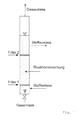
- a preferred embodiment of the reaction vessel R is in Fig. 1 shown.
- the gas inlet serves to uniformly mix the reaction mixture, suspend the heterogeneous carrier and, depending on the reaction carried out, low-boiling reaction products, for example water in esterification or lower alcohols in transesterification reactions of the corresponding esters, to remove from the reaction mixture and thus the Balance to move to the product page.
- the gas outlet of the reaction vessel is connected to a condenser in order to be able to intercept the low-boiling reaction products.
- gas inlets according to the invention are ring sprayers, gas nozzles, ceramic filters, etc., which are generally familiar to the person skilled in the art.
- Air, lean air, oxygen, nitrogen, noble gases or carbon dioxide are preferably used.
- the gases used can from suitable pressure vessels, eg. As gas cylinders, or supplied by compressors.
- the exhaust air flow can be diverted or reused by suitable measures and recycled.
- reaction vessel R further embodiments of the reaction vessel R are possible.
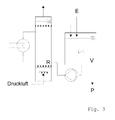
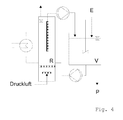
- the filter 1 in the substance inlet or to perform as a candle filter. Examples of such embodiments are in Fig. 3 and Fig. 4 shown.
- the filter can also be integrated as a tube bundle or monolithic tube bundle.
- Alternative embodiments of the reaction vessel R may also be an airlift reactor, pressure loop reactor or mammoth loop reactor.
- At least one storage vessel V is used in addition to the reaction vessel R.
- a storage vessel is used, which is equipped with at least 2 Stoffauslässen.
- the reaction mixture from the storage vessel V is pumped via a suitable line into the reaction vessel R and, after flowing through the region containing the catalyst, pumped back again through a suitable line into the storage vessel.
- at least one suitable pump between storage vessel V and reaction vessel R is required.
- another pump can be operated between the reaction vessel R and the storage vessel V, in which case the pumping capacity of the individual pumps is to be matched to one another by appropriate control elements.
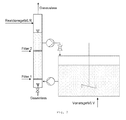
- a preferred embodiment of the entire system, consisting of Reaction vessel R, storage vessel V, lines and pumps is in Fig. 2 shown.
- the storage vessel V may optionally be equipped with an agitator to improve the mixing of the reaction system.
- the supply line from the storage vessel V to the reaction vessel R may be interrupted by a further technical device for improving the mixing, for example a dispersing agent.
- the storage vessel V is provided with the possibility of creating a vacuum in order to further assist the removal of the low-boiling reaction products, for example water in the case of esterifications or lower alcohols in the case of transesterification reactions of the corresponding esters, from the reaction mixture.
- the low-boiling reaction products for example water in the case of esterifications or lower alcohols in the case of transesterification reactions of the corresponding esters.
- vacuum it may be necessary to interrupt the line between the reaction vessel R and reservoir V by a second pump and a pressure-holding valve.
- the removal of low-boiling reaction components can be further accelerated by further internals, for example falling film evaporators.
- reaction vessel R the storage vessel V and the supply and discharge lines
- the components of the system according to the invention may be provided with a possibility of thermostating, for example with a heater based on electricity, steam or thermal oil.
- two storage vessels V1 and V2 are used in a continuous production process.
- the reaction mixture of the, with at least one Material outlet and optionally provided with a stirrer or other mixing device, storage vessel V1 as described above in the reaction vessel R promoted. After flowing through the area containing the catalyst, the reaction mixture is conveyed into the reservoir V2.
- reaction mixture from the reservoir V2 can be conveyed through a second reaction vessel R2 into a reservoir V3, wherein the reaction vessel R2 is constructed as described for the container R1 and filled with a catalyst and the reservoir V2 as the container V1 with at least a Stoffauslass and optionally provided with a stirrer or other mixing device is.
- catalysts which can be used are those whose particle size is such that they can be retained in the reaction vessel with the usual available filter systems without great pressure loss, ie greater than 0.5 .mu.m, preferably greater than 5 .mu.m, particularly preferably greater than 10 .mu.m, in particular greater than 25 ⁇ m.
- These may be polymeric catalysts of corresponding particle size or catalysts immobilized on suitable supports.
- polymeric catalysts examples include ion exchangers, such as. As sulfonated polystyrenes or zeolites.
- According to the invention can be used as catalysts immobilized on suitable supports chemical catalysts or enzyme immobilizates.
- Examples of chemical catalysts are supported Lewis acids and amphoteric hydroxides.
- the enzyme immobilizates For the preparation of the enzyme immobilizates it is possible to use whole cells, quiescent cells, purified enzymes or cell extracts containing the corresponding enzymes or mixtures thereof.
- hydrolytic enzymes eg. As lipases, esterases or proteases, such as lipases from Candida rugosa, Candida antarctica, Pseudomonas sp., Thermomyces langosiosus, porcine pancreas , Mucor miehei, Alcaligines sp., Cholesterol esterase from Candida rugosa, esterase from pig liver, particularly preferably lipases used.
- the enzyme immobilizates preferably contain enzymes from the class of hydrolases, preferably lipases.
- inert organic or inorganic carriers can be used as carriers for immobilizing the enzymes or enzyme-containing microorganisms.
- inert carriers such particulate carriers are preferably used or are present in the enzyme immobilizate which have a particle size distribution in which at least 90% of the particles have a particle size of from 0.5 to 5000 ⁇ m, preferably from 10 ⁇ m to 2000 ⁇ m, particularly preferably from 25 Have up to 2000 microns.
- Particularly suitable organic carriers are those which comprise or consist of polyacrylate, polymethacrylate, polyvinylstyrene, styrene-divinylbenzene copolymers, polypropylene, polyethylene, polyethyleneperephthalate, PTFE and / or other polymers.
- acidic or basic ion exchange resins can be used as support material, for example Duolite A568, Duolite XAD 761, Duolite XAD 1180, Duolite XAD 7HP, Amberlite IR 120, Amberlite IR 400, Amberlite CG 50, Amberlyst 15 (all products of Fa. Rohm and Haas) or Lewatit CNP 105 and Lewatit VP OC 1600 (products from Lanxess, Leverkusen, Germany).
- oxide and / or ceramic supports can be used as inorganic supports.
- inorganic supports for example, celites, zeolites, silica, controlled-pore glass (CPG) or other supports, as described, for example, in US Pat L. Cao, "Carrier-Bound Immobilized Enzyme: Principles, Application and Design", Wiley-VCH: 2005, Weinheim, Germany and, are used.
- the inert supports present in the enzyme immobilizate or the inert supports used for the preparation of the enzyme immobilizates consist of polyvinyl styrene, polymethacrylate or polyacrylate.
- Immobilization on the particles can be carried out covalently or noncovalently according to the invention.
- Examples of the enzyme immobilizates used according to the invention are Novozym 435, Lipozym RM IM or Lipozym TL IM from Novozymes A / S, Bagsvaerd, Denmark or Amano PS, from Amano, Japan.
- the present invention thus provides a process for the heterogeneously catalyzed preparation of carboxylic acid derivatives using a reactor system, for example FIG. 2 containing at least one reservoir V, supply lines, at least one pump and a reaction vessel R, wherein through the reaction vessel R through a gas supply a permanent gas flow is applied and in which a reaction space in which the heterogeneous catalyst is not packed densely filled, so by at least two Filter is separated, that both the material and the gas flow are passed through the reaction space.
- a reactor system for example FIG. 2 containing at least one reservoir V, supply lines, at least one pump and a reaction vessel R, wherein through the reaction vessel R through a gas supply a permanent gas flow is applied and in which a reaction space in which the heterogeneous catalyst is not packed densely filled, so by at least two Filter is separated, that both the material and the gas flow are passed through the reaction space.
- Another object is a method in which at least one enzyme, or at least one enzyme-containing microorganisms are used as the catalyst. Another object is a method in which the enzymatic system is supported heterogeneously on a solid. Another object is a method in which the enzymatic catalyst is particulate fixed on a carrier material covalently or non-covalently. Another object is a method in which the solid consists of a polymer based on polyacrylate, polymethacrylate, polyvinylstyrene, styrene-divinylbenzene copolymers, polypropylene, polyethylene, polyethylene, or polytetrafluoroethylene or copolymers of these compounds or oxidic and / or ceramic supports.
- Another object is a method in which the solid consists of an acidic or basic ion exchange resin. Another object is a method in which the oxide and / or ceramic support of Celite, zeolite, silica or controlled pore glass. Another object is a method in which the carrier material has an average particle size of greater than 0.5 microns. Another object is a method in which the heterogeneous catalyst system is reused. Another object is a method in which the vacuum V is applied to the reservoir. Another object is a method in which the gas used as air, lean air, oxygen, nitrogen, noble gases or carbon dioxide, preferably air or nitrogen.
- Another object is a method in which the reaction is carried out at a temperature of 20 ° C to 100 ° C.
- the optional additional substituents of the radicals R 1 and R 3 independently of one another for example, hydroxy groups, ester groups, polyester groups, carbonate groups, polycarbonate groups, ether groups, polyether groups, urethane groups, polyurethane groups, amide groups, polyamide groups, Alkylamin phenomenon, Dialkylamin phenomenon, halides, siloxane groups, ester groups of inorganic acids, sulfates, phosphates or similar groups.
- R 1 represents the acyl radical of commercially available acids, such as, for example, acetic acid, propionic acid, butanoic acid, pentanoic acid, chloroacetic acid, trifluoroacetic acid, ethylhexanoic acid, isononanoic acid, isotridecanoic acid or isostearic acid.
- acyl radicals used as R 1 are natural fatty acids based on natural vegetable or animal oils. Preference is given to natural fatty acids such as caproic acid, caprylic acid, capric acid, lauric acid, myristic acid, palmitic acid, palmitoleic acid, isostearic acid, stearic acid, 12-hydroxystearic acid, dihydroxystearic acid, oleic acid, linoleic acid, petroselinic acid, elaidic acid, arachidic acid, behenic acid, erucic acid, gadoleic acid, linolenic acid, eicosapentaenoic acid, Docosahexaenoic acid or arachidonic acid, used alone or in admixture.
- natural fatty acids such as caproic acid, caprylic acid, capric acid, lauric acid, myristic acid, palmitic acid, palmitoleic acid, isostearic acid, stearic acid, 12-hydroxy
- the radical R 1 can likewise be the acyl radical of polycondensation products of hydroxy-functionalized acids, for example poly-12-hydroxystearic acid or polyricinoleic acid.
- the acyl radicals used as radical R 1 may be technical mixtures, for example mixtures of natural fatty acids, eg. B. rapeseed oil fatty acid, soybean oil fatty acid, sunflower oil fatty acid, tallow oil fatty acid, palm oil fatty acid, palm kernel oil fatty acid, coconut fatty acid, depending on their specific source and the purification process used in their exact composition May be subject to fluctuations as well as typical minor constituents, such as unsaturated, functionalized or branched components.
- R 3 is, for example, the hydrocarbon radicals of propanol, butanol, pentanol, hexanol, octanol or isomers thereof, such as isopropanol, isobutanol, 2-ethylhexanol, isononyl alcohol, isotridecyl alcohol, polyhydric alcohols, such as 1,6-hexanediol, 1, 2-pentanediol, dihydroxyacetone, 1,2-propylene glycol, 1,3-propylene glycol, neopentyl glycol, trimethylolpropane, pentaerythritol, sorbitol, glycerol, diglycerol, triglycerol, polyglycerol, ethylene glycol, diethylene glycol, triethylene glycol, polyethylene glycol, or amino-functionalized alcohols such as N, N -Dimethylethanolamin used.
- polyhydric alcohols such as
- hydrocarbon radicals of alcohols which are prepared by known processes from monobasic fatty acids based on natural vegetable or animal oils having 6 to 30 carbon atoms, in particular 8 to 22 carbon atoms, for example caproic acid, caprylic acid, capric acid, lauric acid, myristic acid, palmitic acid , Palmitoleic, isostearic, stearic, 12-hydroxystearic, dihydroxystearic, oleic, linoleic, petroselic, elaidic, arachidic, behenic, erucic, gadoleic, linolenic, eicosapentaenoic, docosahexaenoic or arachidonic acid, used alone or in admixture.
- polyether-substituted radicals R 3 are the alkyl radicals of polyethylene glycol, polypropylene glycol, polybutylene glycol, polystyrene or Copolymers of at least two monomers from the group of ethylene glycol, propylene glycol, butylene glycol, styrene oxide, and polyglycerol.
- These polyether-substituted radicals may in turn carry substituents on further OH groups, for example alkyl or alkenyl ethers or alkyl esters.
- polyester substituted radicals R 3 are free OH-group-carrying polymers based on ⁇ -caprolactone or ⁇ -valerolactone, for example, Placcel L212AL Daicel.
- polycarbonate-substituted radicals R 3 are free OH-bearing polymers based on dialkyl carbonate and dihydroxyalkyl units, for example Placcel CD220 from Daicel.
- polysiloxane-substituted radicals R 3 are organomodified polysiloxanes bearing free alkyl-OH groups, such as are obtainable, for example, by hydrosilylation of SiH siloxanes with terminally unsaturated alcohols by methods known to the person skilled in the art.
- linear alkenols such as 5-hexen-1-ol or allyloxy derivatives, such as allyloxyethanol, allylglycerol, allylpolyglycerol, allyltrimethylolpropane, allylpolyethyleneglycol, allylpolypropylene glycol, or allylpolyethyleneglycol-polypropene glycol copolymers, may be used herein.
- polysiloxane-substituted radicals R 1 are organo-modified polysiloxanes which carry free carboxy groups and are obtainable by methods known to the person skilled in the art, for example by hydrosilylation of SiH siloxanes with terminally unsaturated acids.
- acrylic acid methacrylic acid or undec-10-enoic acid can be used here.
- Novozym 435 (NZ435) is a commercial enzyme immobilizate from Novozymes A / S, Bagsvaerd / Denmark, a lipase B from C. antarctica immobilized on a polymethyl acrylate by adsorption .
- the structure of the exemplary experimental reactor is schematically shown in FIG Fig. 5 shown.
- the circulation reactor consists of a thermostated (8) reaction vessel (4, 5) with a length of 60 cm and a diameter of 2.5 cm.
- the reaction vessel is separated into two regions by means of a centrally located, removable metal sieve with a pore width of 50 ⁇ m (4, 5).
- Another metal screen bounds the reaction vessel down and serves as a gas distributor.
- the heterogeneous catalyst is retained.
- the reaction mixture above the gas distributor in the reaction vessel (4) by means of a hose pump (2) is pumped.
- gas is introduced from below into the reaction vessel (3).
- the reaction mixture first fills the lower region (4), then the upper region (5), with the catalyst being retained by the sieves.
- the overflow reaches the reaction mixture flows through a thermostatically controlled line (6, 7) back into the storage container (1).
- the injected gas escapes via the gas outlet (9).
- the discharge of the reaction water, or the other low-boiling reaction products, and the mixing of the reactants takes place in the reaction vessel by the rising gas bubbles.
- the storage tank is stirred, wherein in addition the application of vacuum to the storage tank for accelerated discharge of the low-boiling reaction products is possible.
Landscapes
- Organic Chemistry (AREA)
- Life Sciences & Earth Sciences (AREA)
- Health & Medical Sciences (AREA)
- Chemical & Material Sciences (AREA)
- Wood Science & Technology (AREA)
- Engineering & Computer Science (AREA)
- Zoology (AREA)
- Bioinformatics & Cheminformatics (AREA)
- Genetics & Genomics (AREA)
- General Health & Medical Sciences (AREA)
- Microbiology (AREA)
- Biotechnology (AREA)
- Biochemistry (AREA)
- General Engineering & Computer Science (AREA)
- Biomedical Technology (AREA)
- Sustainable Development (AREA)
- Immunology (AREA)
- Chemical Kinetics & Catalysis (AREA)
- General Chemical & Material Sciences (AREA)
- Molecular Biology (AREA)
- Organic Low-Molecular-Weight Compounds And Preparation Thereof (AREA)
- Devices And Processes Conducted In The Presence Of Fluids And Solid Particles (AREA)
Abstract
Description
- Die Erfindung betrifft ein neuartiges Verfahren zur Herstellung von Carbonsäurederivaten unter Verwendung von heterogenen Katalysatoren.
- Carbonsäurederivate, wie beispielsweise Carbonsäureester oder -amide, stellen eine bedeutende Gruppe chemischer Verbindungen dar. Ester von Fettsäuren werden zum Beispiel häufig als Ölphase in kosmetischen Formulierungen eingesetzt. Zur Herstellung solcher Verbindungen ausgehend von Carbonsäuren oder aktivierten Derivaten, wie z. B. Säurechloriden, Anhydriden oder Estern kurzkettiger Alkohole, sind vielfältige Methoden bekannt. Eine erste Übersicht hierzu findet sich bei: Becker u.a., "Organikum", 22. Auflage, Wiley-VCH: 2004, Weinheim, Deutschland, Seite 472 ff.
- Die Verwendung heterogener Katalysatoren hat den Vorteil, dass diese nach der Reaktion einfach abgetrennt und gegebenenfalls wiederverwendet werden können. Beispiele solcher heterogener Katalysatoren sind, neben im Reaktionsmedium unlöslichen festen Katalysatoren, z. B. Metallsalze, Ionenaustauscherharze oder auf geeigneten Trägern immobilisierte Katalysatoren. Besonders geeignet sind Katalysatoren mit Partikelgrößen, die ein einfaches und schnelles Abtrennen vom Reaktionsmedium erlauben. Häufig als Katalysator eingesetzt werden daher saure Ionenaustauscherharze, z. B. Amberlite IRA-118 (Fa. Rohm und Haas) und Enzyme oder Enzyme enthaltende Mikroorganismen, die auf Trägern immobilisiert sind. Als Träger für die Enzymimmobilisierung werden häufig Ionenaustauscherharze oder Polymerpartikel eingesetzt, die über geeignete Korngrößenverteilungen verfügen. Beispiele hierzu sind die Marktprodukte Novozym 435, Lipozym RM IM oder Lipozym TL IM der Firma Novozymes A/S, Bagsvaerd, Dänemark oder Amano PS, der Firma Amano, Japan. Aber auch viele andere Methoden zur Gewinnung immobilisierter Enzympräparate sind beschrieben, beispielsweise in K. Faber, "Biotransformations in Organic Chemistry", Springer: 2000, Berlin, Deutschland, 384ff., J. Am. Chem. Soc. 1999, 121, 9487-9496, J. Mol. Catal. B, 2005, 35, 93-99 oder die Patentanmeldung
DE 10 2007 031689.7 . - Eine weitere Bedingung zur Gewährleistung der Wiederverwendbarkeit ist die Minimierung der mechanischen Kräfte, die auf die eingesetzten Katalysatoren wirken und eine Desintegration des Trägers und somit eine deutliche Teilchengrößenreduzierung verursachen, wodurch die Anforderung der leichten Abtrennbarkeit nicht mehr erfüllt ist und oftmals auch große Aktivitätsverluste zu beobachten sind. Solche Kräfte treten vor allem auf, wenn konventionelle Rührreaktoren verwendet werden. Beispielsweise beschreibt
DE 10 2007 031689.7 die auftretende Korngrößenreduktion von Enzymimmobilisaten nach Verwendung im Rührkolben. Da durch das erfindungsgemäße Verfahren im Reaktionsraum auf den Einsatz von Rührwerken verzichtet werden kann, und da die Durchmischung durch die Gaszufuhr gewährleistet ist, ist der mechanische Stress, aber auch die durch den Rührer induzierte thermische Belastung auf die Katalysatorteilchen auf ein Minimum reduziert. Dies sind Grundvoraussetzungen dafür, dass der Katalysator, bzw. das bevorzugt geträgerte enzymatische System wiederverwendet werden kann. - Eine Möglichkeit, die mechanische Stabilität der eingesetzten Katalysatoren zu verbessern liegt in dem Einsatz eines Festbettreaktors. Eur. J. Lipid Sci. Technol. 2003, 105, 601-607 beschreibt zum Beispiel den Einsatz eines Festbettreaktors zur Durchführung Lipase-katalysierter Veresterungen. Hier wird der Katalysator in Form eines gepackten Betts eingesetzt und die Reaktionsmischung aus einem Vorratsbehälter im Kreislauf durch das Festbett gepumpt, bis der gewünschte Umsatzgrad erreicht ist. Ein zusätzlicher Filtrationsschritt zur Abtrennung des Biokatalysators ist nicht nötig, da dieser im Festbett permanent zurück gehalten wird.
- Durch die durch die Verwendung des Festbetts erhaltene Kompartimentierung des Systems, also die räumliche Trennung des relativ kleinen Katalysatorbehälters von dem relativ großen Vorratsbehälter, ergibt sich ein weiterer Vorteil: Für die gegebenenfalls erforderliche Reinigung des Systems oder den Austausch des Katalysators muss nur das Festbett geöffnet werden, welches systembedingt deutlich kleiner und leichter zugänglich ist als ein Rührbehälter, welcher über das gleiche Volumen verfügen müsste, wie das verwendete Vorratsgefäß. Gerade im Produktionsmaßstab, also bei Ansatzgröße im Bereich mehrerer Tonnen, ist eine Reinigung solcher Reaktorgefäße von Katalysatorpartikeln äußerst mühsam und umständlich.
- Nachteilig an diesem Verfahren ist allerdings die Beschränkung auf niedrigviskose homogene Reaktionsmischungen, da hochviskose Mischungen oder Suspensionen aufgrund des hoher Druckverlustes nicht durch ein Festbett gefördert werden können. Die in Eur. J. Lipid Sci. Technol. 2003, 105, 601-607 oder Tens. Surfact. Det. 2004, 41, 287-290 beschriebenen Ester verfügen beispielsweise bei Reaktionstemperatur über Viskositäten von unter 10 mPas. Der Versuch, höherviskose Rohstoffe, wie zum Beispiel Polylycerin-3, welches bei Reaktionstemperatur über eine Viskosität von etwa 2000 mPas verfügt, in solch einem Reaktor zu prozessieren führt durch den deutlich gesteigerten Druckverlust zu so drastisch reduzierten erreichbaren Förderraten, dass eine ökonomisch sinnvolle Prozessführung nicht möglich ist. Die alternativ mögliche Verwendung von Lösungsmitteln ist üblicherweise unerwünscht, da dies zum einen zusätzliche Kosten verursacht (niedrigere Reaktorbeladung, Recyclingkosten, etc.) und zum anderen für viele Produktanwendung, z. B. in der kosmetischen oder pharmazeutischen Industrie die Abwesenheit von Lösungsmittelresten gewährleistet werden muss, oftmals bis in den einstelligen ppm Bereich. Letzteres ist zwar meist prinzipiell möglich, erfordert aber üblicherweise zusätzliche Aufarbeitungsschritte, wie z. B. Destillation, Extraktion oder Dämpfen, die zusätzliche Zeit in Anspruch nehmen, und daher die Herstellkosten weiter erhöhen und die Raum-Zeit-Ausbeuten der Verfahren senken.
- Ein weiterer Nachteil des Festbettreaktors liegt in der teils inhomogenen Durchströmung des Reaktors unter Kanalbildung und der Möglichkeit des Verschließens der Hohlräume durch Schwebstoffe.
- Es besteht daher weiterhin Bedarf an Reaktionsverfahren zur heterogenkatalysierten Herstellung von Carbonsäurederivaten, besonders aus hochviskosen Mischungen, welche die Nachteile des Standes der Technik überwinden.
- Aufgabe der vorliegenden Erfindung war daher die Bereitstellung eines universellen Verfahrens zur heterogenkatalysierten Herstellung von Carbonsäurederivaten, welches die lösungsmittelfreie Prozessierung von niedrig- und höherviskosen Reaktionsmischungen bei gleichzeitiger Möglichkeit zur einfachen Abtrennung und Wiederverwendbarkeit des Katalysators ermöglicht. Vorzugsweise sollte das Verfahren zur Verwendung immobilisierter Biokatalysatoren geeignet sein.
- Weitere nicht explizit genannte Aufgaben ergeben sich aus dem Kontext der nachfolgenden Beschreibung, der Beispiele sowie der Ansprüche.
- Überraschender Weise wurde gefunden, dass diese Aufgabe durch ein Reaktorkonzept erfüllt wird, bei dem ein Umlaufreaktor mit einem Reaktionsbehälter eingesetzt wird, in dem der heterogene Katalysator in der Reaktionsmischung frei verteilt ist und ein zusätzlicher Gaseintrag für die Durchmischung im Reaktionsbehälter sorgt.
- Gegenstand der vorliegenden Erfindung ist daher ein Verfahren zur Herstellung von Carbonsäurederivaten, welches dieses Reaktorkonzept nutzt.
- Das erfindungsgemäße Verfahren wird nachfolgend beispielhaft beschrieben, ohne dass die Erfindung auf diese beispielhaften Ausführungsformen beschränkt sein soll. Sind nachfolgend Bereiche, allgemeine Formeln oder Verbindungsklassen angegeben, so sollen diese nicht nur die entsprechenden Bereiche oder Gruppen von Verbindungen umfassen, die explizit erwähnt sind, sondern auch alle Teilbereiche und Teilgruppen von Verbindungen, die durch Herausnahme von einzelnen Werten (Bereichen) oder Verbindungen erhalten werden können. Werden im Rahmen der vorliegenden Beschreibung Dokumente zitiert, so soll deren Inhalt vollständig zum Offenbarungsgehalt der vorliegenden Erfindung gehören. Werden im Rahmen der vorliegenden Erfindung Verbindungen, wie z. B. Polyether oder Polysiloxane, beschrieben, die verschiedene Einheiten mehrfach aufweisen können, so können diese statistisch verteilt (statistisches Oligomer) oder geordnet (Blockoligomer) in diesen Verbindungen vorkommen. Angaben zu Anzahl von Einheiten in solchen Verbindungen sind als Mittelwert, gemittelt über alle entsprechenden Verbindungen, zu verstehen.
- In dem erfindungsgemäßen Verfahren wird der eingesetzte Katalysator in einem Reaktionsgefäß R verwendet, welches dadurch gekennzeichnet ist, dass mindestens zwei Auslässe für das Reaktionsmedium, mindestens ein Gasauslass und mindestens eine Möglichkeit zur Gaseinleitung vorhanden sind. Darüber hinaus ist ein Teil des Reaktionsgefäßes durch geeignete Filter so abgetrennt, dass hierin der Katalysator eingesetzt werden kann. Dabei soll der Katalysator nicht dicht gepackt werden und die Ausführung des Reaktionsbehälters muss gewährleisten, dass sowohl Gasstrom als auch Stoffstrom durch den Bereich, bzw. die Bereiche führen, welcher, bzw. welche, den Katalysator enthalten. Eine bevorzugte Ausführungsform des Reaktionsgefäßes R ist in
Fig. 1 dargestellt. - Die Gaseinleitung dient dazu, die Reaktionsmischung gleichmäßig zu durchmischen, den heterogenen Träger in Schwebe zu halten und, in Abhängigkeit der durchgeführten Reaktion, niedrigsiedende Reaktionsprodukte, beispielsweise Wasser bei Veresterungen oder niedere Alkohole bei Umesterungsreaktionen der entsprechenden Ester, aus der Reaktionsmischung zu entfernen und somit das Gleichgewicht zur Produktseite hin zu verschieben. Erfindungsgemäß bevorzugt wird der Gasauslass des Reaktionsgefäßes mit einem Kondensator verbunden, um die niedrigsiedenden Reaktionsprodukte abfangen zu können. Beispiele für erfindungsgemäße Gaseinleitungen stellen Ringbrausen, Gasdüsen, Keramikfilter, etc. dar, die dem Fachmann allgemein geläufig sind.
- Erfindungsgemäß können als Gase solche verwendet werden, die mit den Reaktanden, dem Katalysator oder den Reaktormaterialien keine Reaktionen eingehen. Bevorzugt eingesetzt werden Luft, Magerluft, Sauerstoff, Stickstoff, Edelgase oder Kohlendioxid. Die eingesetzten Gase können aus geeigneten Druckbehältern, z. B. Gasflaschen, oder durch Kompressoren zugeführt werden. Der Abluftstrom kann abgeleitet oder durch geeignete Maßnahmen wiederverwendet und im Kreislauf geführt werden.
- Erfindungsgemäß sind weitere Ausführungsformen des Reaktionsgefäßes R möglich. Beispielsweise ist es möglich, den Filter 1 in den Stoffeinlass zu integrieren oder als Kerzenfilter auszuführen. Beispiele für solche Ausführungsformen sind in
Fig. 3 undFig. 4 dargestellt. Alternativ lässt sich der Filter auch als Röhrbündel oder monolithischer Rohrbündel integrieren. Alternative Ausführungsformen des Reaktionsgefäßes R können auch ein Airlift-Reaktor, Druckschlaufenreaktor bzw. Mammut-Schlaufen Reaktor sein. - Erfindungsgemäß wird neben dem Reaktionsgefäß R mindestens ein Vorratsgefäß V verwendet. In einer Ausführungsform der Erfindung wird ein Vorratsgefäß verwendet, das mit mindestens 2 Stoffauslässen ausgestattet ist. Dabei wird die Reaktionsmischung aus dem Vorratsgefäß V über eine geeignete Leitung in das Reaktionsgefäß R gepumpt und nach Durchströmen des den Katalysator enthaltenden Bereichs wieder durch eine geeignete Leitung in das Vorratsgefäß zurückgepumpt. Dafür ist mindestens eine geeignete Pumpe zwischen Vorratsgefäß V und Reaktionsgefäß R erforderlich. Optional kann eine weitere Pumpe zwischen Reaktionsgefäß R und Vorratsgefäß V betrieben werden, wobei in diesem Fall die Pumpleistung der einzelnen Pumpen durch entsprechende Steuerungselemente aufeinander abzustimmen ist. Eine bevorzugte Ausführungsform der Gesamtanlage, bestehend aus Reaktionsgefäß R, Vorratsgefäß V, Leitungen und Pumpen ist in
Fig. 2 gezeigt. - Das Vorratsgefäß V kann optional mit einem Rührwerk ausgestattet sein, um die Durchmischung des Reaktionssystems zu verbessern. Aus dem gleichen Grund kann die Zuleitung vom Vorratsgefäß V zum Reaktionsgefäß R mit einer weiteren technischen Vorrichtung zur Verbesserung der Durchmischung, beispielsweise einem Dispergator, unterbrochen sein.
- In einer weiteren Ausführungsform der Erfindung ist das Vorratsgefäß V mit der Möglichkeit versehen, Vakuum anzulegen, um die Entfernung der niedrigsiedenden Reaktionsprodukte, beispielsweise Wasser bei Veresterungen oder niedere Alkohole bei Umesterungsreaktionen der entsprechenden Ester, aus der Reaktionsmischung weiter zu unterstützen. Bei der Verwendung von Vakuum kann es nötig sein, die Leitung zwischen Reaktionsgefäß R und Vorratsgefäß V durch eine zweite Pumpe sowie ein Druckhalteventil zu unterbrechen. Optional kann die Entfernung niedrigsiedender Reaktionskomponenten durch weitere Einbauten, beispielsweise Fallfilmverdampfer, weiter beschleunigt werden.
- Die Bestandteile der erfindungsgemäßen Anlage, insbesondere das Reaktionsgefäß R, das Vorratsgefäß V und die Zu- und Ableitungen können mit einer Möglichkeit der Thermostatisierung versehen sein, beispielsweise mit einer Heizung auf Basis von Elektrizität, Dampf oder Thermalöl.
- In einer weiteren besonderen Ausführungsform werden neben dem Reaktionsgefäß R zwei Vorratsgefäße V1 und V2 in einem kontinuierlichen Herstellungsverfahren verwendet. Dabei wird die Reaktionsmischung aus dem, mit mindestes einem Stoffauslass und ggf. mit einem Rührwerk oder einer anderen Mischereinrichtung versehenen, Vorratsgefäß V1 wie oben beschrieben in das Reaktionsgefäß R gefördert. Nach Durchströmen des den Katalysator enthaltenen Bereichs wird die Reaktionsmischung in den Vorratsbehälter V2 befördert.
- In einer weiteren Ausführungsform kann die Reaktionsmischung aus dem Vorratsbehälter V2 durch ein zweites Reaktionsgefäß R2 in einen Vorratsbehälter V3 gefördert werden, wobei das Reaktionsgefäß R2 wie für den Behälter R1 beschrieben aufgebaut und mit einem Katalysator gefüllt ist und der Vorratsbehälter V2 wie der Behälter V1 mit mindestes einem Stoffauslass und ggf. mit einem Rührwerk oder einer anderen Mischereinrichtung versehenen ist.
- Als Katalysatoren können erfindungsgemäß solche verwendet werden, deren Korngröße so beschaffen ist, dass sie mit den üblichen verfügbaren Filtersystemen ohne großen Druckverlust in dem Reaktionsbehälter zurückgehalten werden können, also größer 0,5 µm, bevorzugt größer 5 µm, besonders bevorzugt größer 10 µm, insbesondere größer 25 µm.
- Dabei kann es sich um polymere Katalysatoren entsprechender Korngröße oder um auf geeigneten Trägern immobilisierte Katalysatoren handeln.
- Beispiele für die polymeren Katalysatoren sind Ionenaustauscher, wie z. B. sulfonierte Polystyrene oder Zeolite.
- Erfindungsgemäß können als auf geeigneten Trägern immobilisierte Katalysatoren chemische Katalysatoren oder Enzymimmobilisate eingesetzte werden.
- Beispiele für chemische Katalysatoren sind trägergebundene Lewis Säuren und amphotere Hydroxide.
- Zur Herstellung der Enzymimmobilisate können ganze Zellen, ruhende Zellen, gereinigte Enzyme oder Zellextrakte, die die entsprechenden Enzyme enthalten oder Mischungen davon eingesetzt werden. Bevorzugt eingesetzt werden hydrolytische Enzyme, z. B. Lipasen, Esterasen oder Proteasen, wie beispielsweise Lipasen aus Candida rugosa, Candida antarctica, Pseudomonas sp., Thermomyces langosiosus, Schweinepankreas, Mucor miehei, Alcaligines sp., Cholesterolesterase aus Candida rugosa, Esterase aus der Schweineleber, besonders bevorzugt Lipasen, eingesetzt. Demgemäß weisen die Enzymimmobilisate vorzugsweise Enzyme aus der Klasse der Hydrolasen, bevorzugt Lipasen, auf.
- Als Träger zur Immobilisierung der Enzyme oder Enzyme enthaltenden Mikroorganismen können inerte organische oder anorganische Träger verwendet werden. Vorzugsweise werden als inerte Träger solche partikulären Träger verwendet bzw. sind im Enzymimmobilisat vorhanden, die eine Teilchengrößenverteilung aufweisen, bei der mindestens 90% der Teilchen eine Teilchengröße von 0,5 bis 5000 µm, bevorzugt von 10 µm bis 2000 µm, besonders bevorzugt von 25 µm bis 2000 µm aufweisen. Als organische Träger können insbesondere solche eingesetzt werden, die Polyacrylat, Polymethacrylat, Polyvinylstyrol, Styrol-Divinylbenzolcopolymeren, Polypropylen, Polyethylen, Polyethylenperepthalat, PTFE und/oder andere Polymere aufweisen oder aus diesen bestehen. Als Trägermaterial können, in Abhängigkeit von dem zu immobilisierenden Enzym, insbesondere saure oder basische Ionenaustauscherharze eingesetzt werden, beispielsweise Duolite A568, Duolite XAD 761, Duolite XAD 1180, Duolite XAD 7HP, Amberlite IR 120, Amberlite IR 400, Amberlite CG 50, Amberlyst 15 (alles Produkte der Fa. Rohm und Haas) oder Lewatit CNP 105 und Lewatit VP OC 1600 (Produkte der Fa. Lanxess, Leverkusen, Deutschland). Als anorganische Träger können aus dem Stand der Technik bekannte, oxidische und/oder keramische Träger eingesetzt werden. Insbesondere können als anorganische Träger beispielsweise Celite, Zeoliten, Silica, Controlled-Pore Glas (CPG) oder andere Träger, wie sie zum Beispiel in L. Cao, "Carrier-bound Immobilized Enzymes: Principles, Application and Design", Wiley-VCH: 2005, Weinheim, Deutschland, beschrieben sind, eingesetzt werden. Besonders bevorzugt bestehen die im Enzymimmobilisat vorhandenen inerten Träger bzw. die zur Herstellung der Enzymimmobilisate verwendeten inerten Träger aus Polyvinylstyrol, Polymethacrylat oder Polyacrylat.
- Die Immobilisierung auf den Partikeln kann erfindungsgemäß kovalent oder nichtkovalent erfolgen.
- Beispiele für die erfindungsgemäß eingesetzten Enzymimmobilisate sind Novozym 435, Lipozym RM IM oder Lipozym TL IM der Firma Novozymes A/S, Bagsvaerd, Dänemark oder Amano PS, der Firma Amano, Japan.
- Gegenstand der vorliegenden Erfindung ist somit ein Verfahren zur heterogenkatalysierten Herstellung von Carbonsäurederivaten unter Verwendung eines Reaktorensystems beispielsweise nach
Figur 2 enthaltend mindestens einen Vorratsbehälter V, Zuleitungen, mindestens eine Pumpe und ein Reaktionsgefäß R, wobei durch das Reaktionsgefäß R durch eine Gaszuleitung ein permanenter Gasstrom angelegt ist und in welchem ein Reaktionsraum, in dem der heterogene Katalysator nicht dicht gepackt eingefüllt ist, so durch mindestens zwei Filter abgetrennt ist, dass sowohl der Stoff- als auch der Gasstrom durch den Reaktionsraum geleitet werden. - Ein weiterer Gegenstand ist ein Verfahren bei dem als Katalysator mindestens ein Enzym, oder mindestens ein Enzym enthaltende Mikroorganismen eingesetzt werden.
Ein weiterer Gegenstand ist ein Verfahren bei dem das enzymatische System heterogen geträgert auf einem Feststoff vorliegt.
Ein weiterer Gegenstand ist ein Verfahren bei dem der enzymatische Katalysator partikulär auf einem Trägermaterial kovalent oder nicht-kovalent fixiert ist.
Ein weiterer Gegenstand ist ein Verfahren bei dem der Feststoff aus einem Polymer auf Basis von Polyacrylat, Polymethacrylat, Polyvinylstyrol, Styrol-Divinylbenzolcopolymeren, Polypropylen, Polyethylen, Polyethylenperepthalat, oder Polytetrafluorethylen oder Copolymeren dieser Verbindungen oder oxidischen und/oder keramischen Trägern besteht.
Ein weiterer Gegenstand ist ein Verfahren bei dem der Feststoff aus einem sauren oder basischen Ionenaustauscherharz besteht.
Ein weiterer Gegenstand ist ein Verfahren bei dem der oxidischen und/oder keramischen Träger aus Celite, Zeolite, Silica oder Controlled-Pore Glas besteht.
Ein weiterer Gegenstand ist ein Verfahren bei dem das Trägermaterial eine mittlere Korngröße von größer als 0,5 µm aufweist.
Ein weiterer Gegenstand ist ein Verfahren bei dem das heterogene Katalysatorsystem wiederverwendet wird.
Ein weiterer Gegenstand ist ein Verfahren bei dem am Vorratsbehälter V Vakuum angelegt wird.
Ein weiterer Gegenstand ist ein Verfahren bei dem als Gas Luft, Magerluft, Sauerstoff, Stickstoff, Edelgase oder Kohlendioxid, bevorzugt Luft oder Stickstoff, eingesetzt werden. - Ein weiterer Gegenstand ist ein Verfahren bei dem die Reaktion bei einer Temperatur von 20 °C bis 100 °C durchgeführt wird.
- Weitere Gegenstände der Erfindung ergeben sich aus dem Wortlaut der Ansprüche.
- Erfindungsgemäß wird das Verfahren bevorzugt eingesetzt zur Durchführung von Umsetzungen der allgemeinen Formel I

- R1
- der Acylrest linearer, verzweigter, gesättigter oder ungesättigter, gegebenenfalls zusätzlich substituierter Carbonsäuren mit 2 bis 30 C-Atomen,
- X
- gleich Sauerstoff, Schwefel oder -NH-, bevorzugt Sauerstoff
- R2
- Wasserstoff oder eine lineare oder verzweigte Alkyl- oder Alkenylgruppe mit 1 bis 3 Kohlenstoffatomen,
- Y
- gleich Sauerstoff, Schwefel oder -NH-, bevorzugt Sauerstoff oder -NH-, besonders bevorzugt Sauerstoff,
- R3
- ein linearer, verzweigter, gesättigter oder ungesättigter, gegebenenfalls zusätzlich substituierter Alkylrest mit 2 bis 30 C-Atomen ist.
- Erfindungsgemäß können die optionalen zusätzlichen Substituenten der Reste R1 und R3 unabhängig voneinander beispielsweise Hydroxygruppen, Estergruppen, Polyestergruppen, Carbonatgruppen, Polycarbonatgruppen, Ethergruppen, Polyethergruppen, Urethangruppen, Polyurethangruppen, Amidgruppen, Polyamidgruppen, Alkylamingruppen, Dialkylamingruppen, Halogenide, Siloxangruppen, Estergruppen anorganischer Säuren, Sulfate, Phosphate oder ähnliche Gruppierungen sein.
- In einer bevorzugten Ausführungsform stellt R1 den Acylrest handelsüblichen Säuren, wie beispielsweise Essigsäure, Propansäure, Butansäure, Pentansäure, Chloressigsäure, Trifluoressigsäure, Ethylhexansäure, Isononansäure, Isotridecansäure oder Isostearinsäure dar.
- In einer weiteren bevorzugten Ausführungsform werden als R1 Acylreste natürliche Fettsäuren auf Basis natürlicher pflanzlicher oder tierischer Öle eingesetzt. Bevorzugt werden natürliche Fettsäuren wie z.B. Capronsäure, Caprylsäure, Caprinsäure, Laurinsäure, Myristinsäure, Palmitinsäure, Palmitoleinsäure, Isostearinsäure, Stearinsäure, 12-Hydroxystearinsäure, Dihydroxystearinsäure, Ölsäure, Linolsäure, Petroselinsäure, Elaidinsäure, Arachinsäure, Behensäure, Erucasäure, Gadoleinsäure, Linolensäure, Eicosapentaensäure, Docosahexaensäure oder Arachidonsäure, allein oder in Mischung eingesetzt. Der Rest R1 kann ebenfalls der Acylrest von Polykondensationsprodukten von hydroxyfunktionalisierten Säuren, beispielsweise Poly-12-hydroxystearinsäure oder Polyricinolsäure sein. Bei dem als Rest R1 eingesetzten Acylresten kann es sich um technische Mischungen handeln, beispielsweise um Mischungen von natürlichen Fettsäuren, z. B. Rapsölfettsäure, Sojaölfettsäure, Sonnenblumenölfettsäure, Talgölfettsäure, Palmölfettsäure, Palmkernölfettsäure, Kokosfettsäure, die in Abhängigkeit von ihrer konkreten Quelle und den eingesetzten Aufreinigungsverfahren in ihrer genauen Zusammensetzung Schwankungen unterworfen sein können, sowie typische Nebenbestandteile, wie ungesättigte, funktionalisierte oder verzweigte Komponenten enthalten können. Darüber hinaus können auch Mischungen von Säuren anderer Herkunft, zum Beispiel auf Basis petrochemischer Verfahren, eingesetzt werden.
- In einer weiteren bevorzugten Ausführungsform werden als R3 beispielsweise die Kohlenwasserstoffreste von Propanol, Butanol, Pentanol, Hexanol, Octanol oder deren Isomeren wie Isopropanol, Isobutanol, 2-Ethylhexanol, Isononylalkohol, Isotridecylalkohol, mehrwertige Alkohole, wie 1,6-Hexandiol, 1,2-Pentandiol, Dihydroxyaceton, 1,2-Propylenglykol, 1,3-Propylenglykol, Neopentylglykol, Trimethylolpropan, Pentaerithrol, Sorbitol, Glycerin, Diglycerin, Triglycerin, Polyglycerin, Ethylenglykol, Diethylenglykol, Triethylenglykol, Polyethylenglykol, oder aminofunktionalisierte Alkohole, wie N,N-Dimethylethanolamin, eingesetzt. Weitere Beispiele sind die Kohlenwasserstoffreste von Alkoholen, die nach bekannten Verfahren aus einbasischen Fettsäuren auf Basis natürlicher pflanzlicher oder tierischer Öle mit 6 bis 30 Kohlenstoffatomen, insbesondere mit 8 bis 22 Kohlenstoffatomen, hergestellt werden, beispielsweise Capronsäure, Caprylsäure, Caprinsäure, Laurinsäure, Myristinsäure, Palmitinsäure, Palmitoleinsäure, Isostearinsäure, Stearinsäure, 12-Hydroxystearinsäure, Dihydroxystearinsäure, Ölsäure, Linolsäure, Petroselinsäure, Elaidinsäure, Arachinsäure, Behensäure, Erucasäure, Gadoleinsäure, Linolensäure, Eicosapentaensäure, Docosahexaensäure oder Arachidonsäure, allein oder in Mischung eingesetzt.
- Beispiele für die erfindungsgemäßen polyethersubstituierten Reste R3 sind die Alkylreste von Polyethylenglykol, Polypropylenglykol, Polybutylenglykol, Polystryroloxid oder Copolymere von mindestens zwei Monomeren aus der Gruppe Ethylenglykol, Propylenglykol, Butylenglykol Stryroloxid, sowie Polyglycerin. Diese polyethersubstituierten Reste können ihrerseits wieder Substituenten an weiteren OH-Gruppen tragen, beispielsweise Alkyl- oder Alkenylether oder Alkylester.
- Beispiele für die erfindungsgemäßen polyestersubstituierten Reste R3 sind freie OH-Gruppen tragende Polymere auf Basis von ε-Caprolacton oder γ-Valerolacton, beispielsweise Placcel L212AL der Firma Daicel.
- Beispiele für die erfindungsgemäßen polycarbonatsubstituierten Reste R3 sind freie OH-Gruppen tragende Polymere auf Basis von Dialkylcarbonat- und Dihydroxyalkyleinheiten, beispielsweise Placcel CD220 der Firma Daicel.
- Beispiele für die erfindungsgemäßen polysiloxansubstituierten Reste R3 sind freie Alkyl-OH-Gruppen tragende organomodifizierte Polysiloxane, wie sie beispielsweise durch Hydrosilylierung von SiH-Siloxanen mit terminal ungesättigten Alkoholen nach dem Fachmann bekannten Methoden zugänglich sind. Insbesondere können hier lineare Alkenole, wie 5-Hexen-1-ol oder Allyloxyderivate, wie Allyloxyethanol, Allylglycerin, Allylpolyglycerin, Allyltrimethylolpropan, Allylpolyethylenglykol, Allylpolypropylenglykol, oder Allylpolyethylenglykol-polyproypylenglykol-copolymere, verwendet werden.
- Beispiele für die erfindungsgemäßen polysiloxansubstituierten Reste R1 sind freie Carboxygruppen tragende organomodifizierte Polysiloxane, wie sie beispielsweise durch Hydrosilylierung von SiH-Siloxanen mit terminal ungesättigten Säuren nach dem Fachmann bekannten Methoden zugänglich sind.
- Insbesondere können hier Acrylsäure, Methacrylsäure oder Undec-10-ensäure verwendet werden.
- Die nachfolgenden Beispiele sollen die vorliegende Erfindung näher erläutern, ohne den Schutzbereich einzuschränken, der sich aus der Beschreibung und den Patentansprüchen ergibt.
- Novozym 435 (NZ435) ist ein kommerzielles Enzymimmobilisat der Firma Novozymes A/S, Bagsvaerd/Dänemark, einer auf einem Polymethyacrylat durch Adsorption immobilisierten Lipase B aus C. antarctica.
- Der Aufbau des beispielhaften Versuchreaktors ist schematisch in
Fig. 5 dargestellt. Der Umlaufreaktor besteht aus einem thermostatisierten (8) Reaktionsgefäß (4, 5) mit einer Länge von 60 cm und einem Durchmesser von 2,5 cm. Das Reaktionsgefäß ist durch ein mittig angebrachtes, herausnehmbares Metallsieb mit einer Porenweite von 50 µm in zwei Bereiche getrennt (4, 5). Ein weiteres Metallsieb begrenzt das Reaktionsgefäß nach unten und dient als Gasverteiler. In dem unteren Bereich des Reaktionsgefäßes (4) wird somit der heterogene Katalysator zurückgehalten. Aus dem gerührten Vorlagebehälter (1) wird die Reaktionsmischung oberhalb des Gasverteilers in das Reaktionsgefäß (4) mit Hilfe einer Schlauchpumpe (2) gepumpt. Gleichzeitig wird von unten kontrolliert Gas in das Reaktionsgefäß eingetragen (3). Die Reaktionsmischung füllt zuerst den unteren Bereich (4), dann den oberen Bereich (5), wobei der Katalysator durch die Siebe zurückgehalten wird. Bei Erreichen des Überlaufs fließt die Reaktionsmischung über eine thermostatisierte Leitung (6, 7) zurück in den Vorlagebehälter (1). Das eingetragene Gas entweicht über den Gasauslass (9).
Der Austrag des Reaktionswassers, bzw. der anderen niedrigsiedenden Reaktionsprodukte, und die Durchmischung der Reaktanden erfolgt im Reaktionsgefäß durch die aufsteigenden Gasblasen. Gleichzeitig wird der Vorlagebehälter gerührt wobei zusätzlich das Anlegen von Vakuum am Vorlagebehälter zum beschleunigten Austrag der niedrigsiedenden Reaktionsprodukte möglich ist. - 329 g Myristylalkohol und 351 g Myristinsäure wurden in einem 1L-Vorlagebehälter auf 60 °C temperiert und durch einen Magnetrührer durchmischt (Viskosität der Mischung bei 60° C ca. 6 mPas). In dem unteren Bereich des Reaktionsbehälters wurde 2.7 g Novozym 435 vorgelegt und der gesamte Reaktionsbehälter auf 60 °C temperiert. Der Drucklufteintrag wurde auf 0,4 L/min eingeregelt und anschließend die Schlauchpumpe auf ∼ 20 mL/min eingestellt und eingeschaltet. Der Rücklauf war auf 60 °C temperiert. Der Reaktionsverlauf wurde für ∼25 h verfolgt, wobei ein Umsatz von 99,3 % bezogen auf die Fettsäure erreicht wurde.
Tabelle 1: Umsatzdaten zu Beispiel 2: Zeit [min] Umsatz [%] 0 0 30 25,8% 60 46,9% 124 74,6% 169 85,7% 223 92,6% 300 96,5% 346 97,4% 1442 99,3% - Analog zu Beispiel 2 werden mehrere Reaktionen zur Synthese von Myristylmyristat unter Wiederverwendung des Enzymkatalysators ohne Zwischenreinigung durchgeführt und der Umsatz nach 1 und 24 Stunden bestimmt. Es wurden 10 Wiederholungen durchgeführt
Tabelle 2: Umsatzdaten zu Beispiel 3 Wiederholung Umsatz 1 h Umsatz 24 h 1 46,9 % 99,3 % 2 45,3 % 99,6 % 3 46,2 % 99,3 % 4 44,7 % 99,5 % 5 47,1 % 99,1 % 6 46,9 % 99,2 % 7 44,7 % 99,0 % 8 47,4 % 98,9 % 9 45,2 % 99,2 % 10 44,3 % 99,0 % - 350 g Polyglycerin-3 (Fa. Daicel) und 280 g Laurinsäure wurden in einem 1L-Vorlagebehälter auf 80 °C temperiert und durch einen mechanischen Rührer durchmischt (Viskosität der Mischung bei 60° C ca. 2000 mPas). In dem unteren Bereich des Reaktionsbehälters wurde 5,5 g Novozym 435 vorgelegt und der gesamte Reaktionsbehälter auf 80 °C temperiert. Der Drucklufteintrag wurde auf 1,20 L/min eingeregelt und anschließend die Schlauchpumpe auf ∼ 20 mL/min eingestellt und eingeschaltet. Der Rücklauf war auf 80 °C temperiert. Der Reaktionsverlauf wurde für ∼24 h verfolgt, wobei ein Umsatz von 96,7 % bezogen auf die Fettsäure erreicht wurde.
Tabelle 3: Umsatzdaten zu Beispiel 4: Zeit [min] Umsatz [%] 0 0,0 15 14,3 30 27,9 60 49,7 123 72,7 244 90,3 1440 96,7
Claims (12)
- Verfahren zur heterogenkatalysierten Herstellung von Carbonsäurederivaten unter Verwendung eines Reaktorensystems enthaltend mindestens einen Vorratsbehälter V, Zuleitungen, mindestens eine Pumpe und ein Reaktionsgefäß R, dadurch gekennzeichnet, dass durch das Reaktionsgefäß R durch eine Gaszuleitung ein permanenter Gasstrom angelegt ist und in welchem ein Reaktionsraum, in dem der heterogene Katalysator nicht dicht gepackt eingefüllt ist, so durch mindestens zwei Filter abgetrennt ist, dass sowohl der Stoff- als auch der Gasstrom durch den Reaktionsraum geleitet werden.
- Verfahren nach Anspruch 1, dadurch gekennzeichnet, dass als Katalysator mindestens ein Enzym, oder mindestens ein Enzym enthaltende Mikroorganismen eingesetzt werden.
- Verfahren nach Anspruch 2, dadurch gekennzeichnet, dass das enzymatische System heterogen geträgert auf einem Feststoff vorliegt.
- Verfahren nach Anspruch 3, dadurch gekennzeichnet, dass der enzymatische Katalysator partikulär auf einem Trägermaterial kovalent oder nicht-kovalent fixiert ist.
- Verfahren nach Anspruch 3 oder 4, dadurch gekennzeichnet, dass der Feststoff aus einem Polymer auf Basis von Polyacrylat, Polymethacrylat, Polyvinylstyrol, Styrol-Divinylbenzolcopolymeren, Polypropylen, Polyethylen, Polyethylenperepthalat, oder Polytetrafluorethylen oder Copolymeren dieser Verbindungen oder oxidischen und/oder keramischen Trägern besteht.
- Verfahren nach Anspruch 3 oder 4, dadurch gekennzeichnet, dass der Feststoff aus einem sauren oder basischen Ionenaustauscherharz besteht.
- Verfahren nach Anspruch 3 oder 4, dadurch gekennzeichnet, dass der oxidischen und/oder keramischen Träger aus Celite, Zeolite, Silica oder Controlled-Pore Glas besteht.
- Verfahren nach einem der Ansprüche 3 bis 7, dadurch gekennzeichnet, dass das Trägermaterial eine mittlere Korngröße von größer als 0,5 µm aufweist.
- Verfahren nach einem der Ansprüche 1 bis 8, dadurch gekennzeichnet, dass das heterogene Katalysatorsystem wiederverwendet wird.
- Verfahren nach einem der Ansprüche 1 bis 9, dadurch gekennzeichnet, dass am Vorratsbehälter V Vakuum angelegt wird.
- Verfahren nach einem der Ansprüche 1 bis 10, dadurch gekennzeichnet, dass als Gas Luft, Magerluft, Sauerstoff, Stickstoff, Edelgase oder Kohlendioxid, bevorzugt Luft oder Stickstoff, eingesetzt werden.
- Verfahren nach einem der Ansprüche 1 bis 11, dadurch gekennzeichnet, dass die Reaktion bei einer Temperatur von 20 °C bis 100 °C durchgeführt wird.
Applications Claiming Priority (1)
| Application Number | Priority Date | Filing Date | Title |
|---|---|---|---|
| DE200810004725 DE102008004725A1 (de) | 2008-01-16 | 2008-01-16 | Verfahren zur heterogenkatalysierten Herstellung von Carbonsäurederivaten |
Publications (3)
| Publication Number | Publication Date |
|---|---|
| EP2080806A2 true EP2080806A2 (de) | 2009-07-22 |
| EP2080806A3 EP2080806A3 (de) | 2009-11-25 |
| EP2080806B1 EP2080806B1 (de) | 2014-04-09 |
Family
ID=40626567
Family Applications (1)
| Application Number | Title | Priority Date | Filing Date |
|---|---|---|---|
| EP20080169408 Revoked EP2080806B1 (de) | 2008-01-16 | 2008-11-19 | Verfahren zur heterogenkatalysierten Herstellung von Carbonsäurederivaten |
Country Status (4)
| Country | Link |
|---|---|
| US (1) | US9234220B2 (de) |
| EP (1) | EP2080806B1 (de) |
| CN (1) | CN101532035B (de) |
| DE (1) | DE102008004725A1 (de) |
Cited By (3)
| Publication number | Priority date | Publication date | Assignee | Title |
|---|---|---|---|---|
| LU103393B1 (de) | 2024-10-01 | 2026-04-01 | Thyssenkrupp Ag | Herstellung chemischer Erzeugnisse durch heterogene enzymatische Katalyse |
| DE102024128406A1 (de) | 2024-10-01 | 2026-04-02 | Thyssenkrupp Ag | Herstellung chemischer Erzeugnisse durch heterogene enzymatische Katalyse |
| WO2026073808A1 (de) | 2024-10-01 | 2026-04-09 | Thyssenkrupp Uhde Gmbh | Herstellung chemischer erzeugnisse durch heterogene enzymatische katalyse |
Families Citing this family (14)
| Publication number | Priority date | Publication date | Assignee | Title |
|---|---|---|---|---|
| DE102006025821A1 (de) * | 2006-06-02 | 2007-12-06 | Degussa Gmbh | Ein Enzym zur Herstellung von Mehylmalonatsemialdehyd oder Malonatsemialdehyd |
| DE102007060705A1 (de) * | 2007-12-17 | 2009-06-18 | Evonik Degussa Gmbh | ω-Aminocarbonsäuren oder ihre Lactame, herstellende, rekombinante Zellen |
| DE102008002715A1 (de) * | 2008-06-27 | 2009-12-31 | Evonik Röhm Gmbh | 2-Hydroxyisobuttersäure produzierende rekombinante Zelle |
| DE102009046626A1 (de) | 2009-11-11 | 2011-05-12 | Evonik Degussa Gmbh | Candida tropicalis Zellen und deren Verwendung |
| DE102010015807A1 (de) | 2010-04-20 | 2011-10-20 | Evonik Degussa Gmbh | Biokatalytisches Oxidationsverfahren mit alkL-Genprodukt |
| US20140017741A1 (en) | 2011-03-30 | 2014-01-16 | Novozymes A/S | Esterification Process |
| BR112014000947A2 (pt) | 2011-07-20 | 2017-06-13 | Evonik Degussa Gmbh | oxidação e aminação de álcoois primários |
| EP2602328A1 (de) | 2011-12-05 | 2013-06-12 | Evonik Industries AG | Verfahren zur Oxidation von Alkanen unter Verwendung einer AlkB Alkan 1-Monooxygenase |
| EP2607479A1 (de) | 2011-12-22 | 2013-06-26 | Evonik Industries AG | Biotechnologische Herstellung von Alkoholen und Derivaten davon |
| EP2631298A1 (de) | 2012-02-22 | 2013-08-28 | Evonik Industries AG | Biotechnologisches Verfahren zur Herstellung von Butanol und Buttersäure |
| EP2639308A1 (de) | 2012-03-12 | 2013-09-18 | Evonik Industries AG | Enzymatische omega-Oxidation und -Aminierung von Fettsäuren |
| FR3029935B1 (fr) | 2014-12-10 | 2018-02-16 | Gattefosse Sas | Procede de preparation d'un excipient a base de cire par catalyse enzymatique |
| CN105441323B (zh) * | 2015-12-31 | 2018-08-10 | 天津大学 | 基于多孔陶瓷梯级布置固定化酶的立式反应器 |
| CN116926958B (zh) * | 2023-07-21 | 2024-10-18 | 宁波润禾高新材料科技股份有限公司 | 一种两性型脂肪族超亲水液体柔软剂及其制备方法 |
Family Cites Families (17)
| Publication number | Priority date | Publication date | Assignee | Title |
|---|---|---|---|---|
| US2553649A (en) | 1945-10-22 | 1951-05-22 | Richard G Garfitt | Wave guide regulator |
| IL46178A (en) * | 1974-12-03 | 1978-10-31 | Rehovot Res Prod | Method for the performance of enzymatic reactions |
| US4251631A (en) | 1978-02-23 | 1981-02-17 | Research Products Rehovot Ltd. | Cross-linked enzyme membrane |
| US4921799A (en) * | 1986-03-14 | 1990-05-01 | Kabushiki Kaisha Kobe Seiko Sho | Fermentation method |
| EP0413307A1 (de) * | 1989-08-15 | 1991-02-20 | Lion Corporation | Verfahren zur Herstellung von Fettsäuremonoestersacchariden |
| KR970009154B1 (ko) * | 1994-02-26 | 1997-06-07 | 주식회사 유공 | 효소에 의한 기상(氣狀) 에스테르화 반응 |
| US5713965A (en) * | 1996-04-12 | 1998-02-03 | The United States Of America As Represented By The Secretary Of Agriculture | Production of biodiesel, lubricants and fuel and lubricant additives |
| DE10050403A1 (de) | 2000-10-12 | 2002-04-25 | Goldschmidt Ag Th | Enzymatische Herstellung von bei Raumtemperatur festen Hydroxyfettsäureestern mehrwertiger Alkohole |
| DE10061558A1 (de) | 2000-12-11 | 2002-06-13 | Basf Ag | Verfahren zur Hydrierung von Maleinsäureanhydrid und verwandten Verbindungen in einem Wirbelschichtreaktor |
| DE10122551A1 (de) * | 2001-05-10 | 2002-11-21 | Zulka Joachim Hans | Einstufiges Verfahren zur Herstellung eines biologisch abbaubaren Fettsäure-Esters (Esteröl) aus Triglyceriden (Fetten) |
| DE102004047869A1 (de) | 2004-10-01 | 2006-04-06 | Goldschmidt Gmbh | Verfahren zur enzymatischen Synthese von Pyroglutaminsäureestern |
| DE102006005100A1 (de) | 2006-02-04 | 2007-08-09 | Goldschmidt Gmbh | Verfahren zur Herstellung organomodifizierter Siloxane |
| US7566795B2 (en) * | 2006-10-06 | 2009-07-28 | Eastman Chemical Company | Preparation of retinyl esters |
| DE102007031689A1 (de) | 2007-07-06 | 2009-01-08 | Evonik Goldschmidt Gmbh | Enzympräparate |
| DE102007041028A1 (de) * | 2007-08-29 | 2009-03-05 | Evonik Goldschmidt Gmbh | Verwendung estermodifizierter Organopolysiloxane zur Herstellung kosmetischer oder pharmazeutischer Kompositionen |
| DE102007055483A1 (de) | 2007-11-21 | 2009-05-28 | Evonik Goldschmidt Gmbh | Kosmetische und dermatologische Formulierungen enthaltend Isononylbenzoat |
| DE102008004726A1 (de) | 2008-01-16 | 2009-07-23 | Evonik Goldschmidt Gmbh | Verfahren zur enzymatischen Herstellung von Carbonsäureestern |
-
2008
- 2008-01-16 DE DE200810004725 patent/DE102008004725A1/de not_active Withdrawn
- 2008-11-19 EP EP20080169408 patent/EP2080806B1/de not_active Revoked
-
2009
- 2009-01-15 US US12/354,256 patent/US9234220B2/en active Active
- 2009-01-16 CN CN 200910002555 patent/CN101532035B/zh active Active
Non-Patent Citations (7)
| Title |
|---|
| "Organikum", 2004, WILEY-VCH, pages: 472 FF |
| EUR. J. LIPID SCI. TECHNOL., vol. 105, 2003, pages 601 - 607 |
| J. AM. CHEM. SOC., vol. 121, 1999, pages 9487 - 9496 |
| J. MOL. CATAL. B, vol. 35, 2005, pages 93 - 99 |
| K. FABER: "Biotransformations in Organic Chemistry", 2000, SPRINGER, pages: 384FF |
| L. CAO: "Application and Design", 2005, WILEY-VCH, article "Carrier-bound Immobilized Enzymes: Principles" |
| TENS. SURFACT. DET., vol. 41, 2004, pages 287 - 290 |
Cited By (3)
| Publication number | Priority date | Publication date | Assignee | Title |
|---|---|---|---|---|
| LU103393B1 (de) | 2024-10-01 | 2026-04-01 | Thyssenkrupp Ag | Herstellung chemischer Erzeugnisse durch heterogene enzymatische Katalyse |
| DE102024128406A1 (de) | 2024-10-01 | 2026-04-02 | Thyssenkrupp Ag | Herstellung chemischer Erzeugnisse durch heterogene enzymatische Katalyse |
| WO2026073808A1 (de) | 2024-10-01 | 2026-04-09 | Thyssenkrupp Uhde Gmbh | Herstellung chemischer erzeugnisse durch heterogene enzymatische katalyse |
Also Published As
| Publication number | Publication date |
|---|---|
| EP2080806A3 (de) | 2009-11-25 |
| DE102008004725A1 (de) | 2009-07-23 |
| EP2080806B1 (de) | 2014-04-09 |
| US9234220B2 (en) | 2016-01-12 |
| US20100167360A1 (en) | 2010-07-01 |
| CN101532035B (zh) | 2013-11-06 |
| CN101532035A (zh) | 2009-09-16 |
Similar Documents
| Publication | Publication Date | Title |
|---|---|---|
| EP2080806B1 (de) | Verfahren zur heterogenkatalysierten Herstellung von Carbonsäurederivaten | |
| EP2080807B1 (de) | Verfahren zur enzymatischen Herstellung von Carbonsäureestern | |
| EP2163617B1 (de) | Enzympräparate | |
| AU2014213063B2 (en) | System and method for improved gas dissolution | |
| Linko et al. | Lipase biocatalysis in the production of esters | |
| EP0999230B1 (de) | Verfahren zur Herstellung von Acrylsäureestern und/oder Methacrylsäureestern von hydroxyfunktionellen Siloxanen und/oder polyoxyalkylenmodifizierten Siloxanen und deren Verwendung | |
| EP0999229B1 (de) | Verfahren zur Herstellung von Acrylsäuereestern und/oder Methacrylsäureestern von Polyoxyalkylenen und deren Verwendung | |
| EP1582594B1 (de) | Verfahren zur beschleunigten enzymatischen Synthese von Triglyzeriden ungesättigter Fettsäuren | |
| EP2059550B1 (de) | Verfahren zur herstellung von polyesterolen | |
| CN114761573A (zh) | 液体中的脂质类粒子的制造方法及微生物的培养方法 | |
| DE69621765T2 (de) | Kombiniertes Verfahren von Fermentations-und mikrobieller Transformations-Reaktion | |
| Patel et al. | Enantioselective enzymatic acetylation of racemic [4-[4α, 6β (E)]]-6-[4, 4-bis (4-fluorophenyl)-3-(1-methyl-1H-tetrazol-5-yl)-1, 3-butadienyl]-tetrahydro-4-hydroxy-2H-pyran-2-one | |
| EP3668848B1 (de) | Verfahren zur herstellung von (meth)acrylaten von glycerincarbonat | |
| EP1654357B1 (de) | Verwendung von pit-emulsionen in enzymatischen reaktionen | |
| DE10050403A1 (de) | Enzymatische Herstellung von bei Raumtemperatur festen Hydroxyfettsäureestern mehrwertiger Alkohole | |
| DE102015209819B4 (de) | Neue Verfahren zur Herstellung von neuartigen epoxidierten Synthesebausteinen auf Basis pflanzlicher Öle | |
| DE69626730T2 (de) | Zwischenflächige Bioreaktor-System | |
| EP2906708B1 (de) | Dreistufiges verfahren zur enzymatischen fettsäureestersynthese | |
| EP2179047B1 (de) | Lipophile Zubereitungen | |
| EP2298727A1 (de) | Verfahren zur Herstellung von Estern kurzkettiger Alkohole aus triglyceridreichen Ölen | |
| EP1848809A2 (de) | Verwendung von pit emulsionen in lyase- oder oxidoreduktase-katalysierten verfahren zur herstellug von cyanhydriden | |
| Tiso et al. | DiscoverChemical Engineering | |
| Boltes et al. | Desulfurization of mixture of dibenzothiophene and 4-methyldibenzothiophene in aqueous and biphasic media with Pseudomonas putida CECT5279 in stirred tank reactor | |
| Vayá et al. | Testing three commercial peroxidases for 4-chlorophenol removal using a continuous tank reactor with ultrafiltration module |
Legal Events
| Date | Code | Title | Description |
|---|---|---|---|
| PUAI | Public reference made under article 153(3) epc to a published international application that has entered the european phase |
Free format text: ORIGINAL CODE: 0009012 |
|
| 17P | Request for examination filed |
Effective date: 20081119 |
|
| AK | Designated contracting states |
Kind code of ref document: A2 Designated state(s): AT BE BG CH CY CZ DE DK EE ES FI FR GB GR HR HU IE IS IT LI LT LU LV MC MT NL NO PL PT RO SE SI SK TR |
|
| AX | Request for extension of the european patent |
Extension state: AL BA MK RS |
|
| PUAL | Search report despatched |
Free format text: ORIGINAL CODE: 0009013 |
|
| AK | Designated contracting states |
Kind code of ref document: A3 Designated state(s): AT BE BG CH CY CZ DE DK EE ES FI FR GB GR HR HU IE IS IT LI LT LU LV MC MT NL NO PL PT RO SE SI SK TR |
|
| AX | Request for extension of the european patent |
Extension state: AL BA MK RS |
|
| RIC1 | Information provided on ipc code assigned before grant |
Ipc: C12M 1/40 20060101ALI20091022BHEP Ipc: C12P 7/62 20060101AFI20091022BHEP |
|
| 17Q | First examination report despatched |
Effective date: 20100525 |
|
| AKX | Designation fees paid |
Designated state(s): AT BE BG CH CY CZ DE DK EE ES FI FR GB GR HR HU IE IS IT LI LT LU LV MC MT NL NO PL PT RO SE SI SK TR |
|
| RAP1 | Party data changed (applicant data changed or rights of an application transferred) |
Owner name: EVONIK DEGUSSA GMBH |
|
| GRAP | Despatch of communication of intention to grant a patent |
Free format text: ORIGINAL CODE: EPIDOSNIGR1 |
|
| INTG | Intention to grant announced |
Effective date: 20131218 |
|
| GRAS | Grant fee paid |
Free format text: ORIGINAL CODE: EPIDOSNIGR3 |
|
| GRAA | (expected) grant |
Free format text: ORIGINAL CODE: 0009210 |
|
| AK | Designated contracting states |
Kind code of ref document: B1 Designated state(s): AT BE BG CH CY CZ DE DK EE ES FI FR GB GR HR HU IE IS IT LI LT LU LV MC MT NL NO PL PT RO SE SI SK TR |
|
| REG | Reference to a national code |
Ref country code: GB Ref legal event code: FG4D Free format text: NOT ENGLISH |
|
| REG | Reference to a national code |
Ref country code: CH Ref legal event code: EP Ref country code: AT Ref legal event code: REF Ref document number: 661400 Country of ref document: AT Kind code of ref document: T Effective date: 20140415 |
|
| REG | Reference to a national code |
Ref country code: DE Ref legal event code: R096 Ref document number: 502008011562 Country of ref document: DE Effective date: 20140515 |
|
| REG | Reference to a national code |
Ref country code: IE Ref legal event code: FG4D Free format text: LANGUAGE OF EP DOCUMENT: GERMAN |
|
| REG | Reference to a national code |
Ref country code: NL Ref legal event code: T3 |
|
| REG | Reference to a national code |
Ref country code: LT Ref legal event code: MG4D |
|
| PG25 | Lapsed in a contracting state [announced via postgrant information from national office to epo] |
Ref country code: LT Free format text: LAPSE BECAUSE OF FAILURE TO SUBMIT A TRANSLATION OF THE DESCRIPTION OR TO PAY THE FEE WITHIN THE PRESCRIBED TIME-LIMIT Effective date: 20140409 Ref country code: NO Free format text: LAPSE BECAUSE OF FAILURE TO SUBMIT A TRANSLATION OF THE DESCRIPTION OR TO PAY THE FEE WITHIN THE PRESCRIBED TIME-LIMIT Effective date: 20140709 Ref country code: IS Free format text: LAPSE BECAUSE OF FAILURE TO SUBMIT A TRANSLATION OF THE DESCRIPTION OR TO PAY THE FEE WITHIN THE PRESCRIBED TIME-LIMIT Effective date: 20140809 Ref country code: GR Free format text: LAPSE BECAUSE OF FAILURE TO SUBMIT A TRANSLATION OF THE DESCRIPTION OR TO PAY THE FEE WITHIN THE PRESCRIBED TIME-LIMIT Effective date: 20140710 Ref country code: BG Free format text: LAPSE BECAUSE OF FAILURE TO SUBMIT A TRANSLATION OF THE DESCRIPTION OR TO PAY THE FEE WITHIN THE PRESCRIBED TIME-LIMIT Effective date: 20140709 Ref country code: FI Free format text: LAPSE BECAUSE OF FAILURE TO SUBMIT A TRANSLATION OF THE DESCRIPTION OR TO PAY THE FEE WITHIN THE PRESCRIBED TIME-LIMIT Effective date: 20140409 |
|
| PG25 | Lapsed in a contracting state [announced via postgrant information from national office to epo] |
Ref country code: LV Free format text: LAPSE BECAUSE OF FAILURE TO SUBMIT A TRANSLATION OF THE DESCRIPTION OR TO PAY THE FEE WITHIN THE PRESCRIBED TIME-LIMIT Effective date: 20140409 Ref country code: SE Free format text: LAPSE BECAUSE OF FAILURE TO SUBMIT A TRANSLATION OF THE DESCRIPTION OR TO PAY THE FEE WITHIN THE PRESCRIBED TIME-LIMIT Effective date: 20140409 Ref country code: HR Free format text: LAPSE BECAUSE OF FAILURE TO SUBMIT A TRANSLATION OF THE DESCRIPTION OR TO PAY THE FEE WITHIN THE PRESCRIBED TIME-LIMIT Effective date: 20140409 Ref country code: ES Free format text: LAPSE BECAUSE OF FAILURE TO SUBMIT A TRANSLATION OF THE DESCRIPTION OR TO PAY THE FEE WITHIN THE PRESCRIBED TIME-LIMIT Effective date: 20140409 Ref country code: PL Free format text: LAPSE BECAUSE OF FAILURE TO SUBMIT A TRANSLATION OF THE DESCRIPTION OR TO PAY THE FEE WITHIN THE PRESCRIBED TIME-LIMIT Effective date: 20140409 |
|
| PG25 | Lapsed in a contracting state [announced via postgrant information from national office to epo] |
Ref country code: PT Free format text: LAPSE BECAUSE OF FAILURE TO SUBMIT A TRANSLATION OF THE DESCRIPTION OR TO PAY THE FEE WITHIN THE PRESCRIBED TIME-LIMIT Effective date: 20140811 |
|
| REG | Reference to a national code |
Ref country code: DE Ref legal event code: R026 Ref document number: 502008011562 Country of ref document: DE |
|
| PLBI | Opposition filed |
Free format text: ORIGINAL CODE: 0009260 |
|
| PG25 | Lapsed in a contracting state [announced via postgrant information from national office to epo] |
Ref country code: SK Free format text: LAPSE BECAUSE OF FAILURE TO SUBMIT A TRANSLATION OF THE DESCRIPTION OR TO PAY THE FEE WITHIN THE PRESCRIBED TIME-LIMIT Effective date: 20140409 Ref country code: CZ Free format text: LAPSE BECAUSE OF FAILURE TO SUBMIT A TRANSLATION OF THE DESCRIPTION OR TO PAY THE FEE WITHIN THE PRESCRIBED TIME-LIMIT Effective date: 20140409 Ref country code: DK Free format text: LAPSE BECAUSE OF FAILURE TO SUBMIT A TRANSLATION OF THE DESCRIPTION OR TO PAY THE FEE WITHIN THE PRESCRIBED TIME-LIMIT Effective date: 20140409 Ref country code: EE Free format text: LAPSE BECAUSE OF FAILURE TO SUBMIT A TRANSLATION OF THE DESCRIPTION OR TO PAY THE FEE WITHIN THE PRESCRIBED TIME-LIMIT Effective date: 20140409 Ref country code: RO Free format text: LAPSE BECAUSE OF FAILURE TO SUBMIT A TRANSLATION OF THE DESCRIPTION OR TO PAY THE FEE WITHIN THE PRESCRIBED TIME-LIMIT Effective date: 20140409 |
|
| PLAX | Notice of opposition and request to file observation + time limit sent |
Free format text: ORIGINAL CODE: EPIDOSNOBS2 |
|
| 26 | Opposition filed |
Opponent name: BASF SE Effective date: 20150109 |
|
| REG | Reference to a national code |
Ref country code: DE Ref legal event code: R026 Ref document number: 502008011562 Country of ref document: DE Effective date: 20150109 |
|
| PLAF | Information modified related to communication of a notice of opposition and request to file observations + time limit |
Free format text: ORIGINAL CODE: EPIDOSCOBS2 |
|
| PG25 | Lapsed in a contracting state [announced via postgrant information from national office to epo] |
Ref country code: LU Free format text: LAPSE BECAUSE OF FAILURE TO SUBMIT A TRANSLATION OF THE DESCRIPTION OR TO PAY THE FEE WITHIN THE PRESCRIBED TIME-LIMIT Effective date: 20141119 Ref country code: BE Free format text: LAPSE BECAUSE OF NON-PAYMENT OF DUE FEES Effective date: 20141130 Ref country code: MC Free format text: LAPSE BECAUSE OF FAILURE TO SUBMIT A TRANSLATION OF THE DESCRIPTION OR TO PAY THE FEE WITHIN THE PRESCRIBED TIME-LIMIT Effective date: 20140409 |
|
| REG | Reference to a national code |
Ref country code: CH Ref legal event code: PL |
|
| PG25 | Lapsed in a contracting state [announced via postgrant information from national office to epo] |
Ref country code: LI Free format text: LAPSE BECAUSE OF NON-PAYMENT OF DUE FEES Effective date: 20141130 Ref country code: CH Free format text: LAPSE BECAUSE OF NON-PAYMENT OF DUE FEES Effective date: 20141130 Ref country code: SI Free format text: LAPSE BECAUSE OF FAILURE TO SUBMIT A TRANSLATION OF THE DESCRIPTION OR TO PAY THE FEE WITHIN THE PRESCRIBED TIME-LIMIT Effective date: 20140409 |
|
| PLAS | Information related to reply of patent proprietor to notice(s) of opposition deleted |
Free format text: ORIGINAL CODE: EPIDOSDOBS3 |
|
| PLBB | Reply of patent proprietor to notice(s) of opposition received |
Free format text: ORIGINAL CODE: EPIDOSNOBS3 |
|
| REG | Reference to a national code |
Ref country code: IE Ref legal event code: MM4A |
|
| PLBB | Reply of patent proprietor to notice(s) of opposition received |
Free format text: ORIGINAL CODE: EPIDOSNOBS3 |
|
| PG25 | Lapsed in a contracting state [announced via postgrant information from national office to epo] |
Ref country code: IE Free format text: LAPSE BECAUSE OF NON-PAYMENT OF DUE FEES Effective date: 20141119 |
|
| REG | Reference to a national code |
Ref country code: FR Ref legal event code: PLFP Year of fee payment: 8 |
|
| REG | Reference to a national code |
Ref country code: AT Ref legal event code: MM01 Ref document number: 661400 Country of ref document: AT Kind code of ref document: T Effective date: 20141119 |
|
| PGFP | Annual fee paid to national office [announced via postgrant information from national office to epo] |
Ref country code: IT Payment date: 20151125 Year of fee payment: 8 Ref country code: GB Payment date: 20151118 Year of fee payment: 8 Ref country code: DE Payment date: 20151119 Year of fee payment: 8 |
|
| PG25 | Lapsed in a contracting state [announced via postgrant information from national office to epo] |
Ref country code: AT Free format text: LAPSE BECAUSE OF NON-PAYMENT OF DUE FEES Effective date: 20141119 |
|
| PGFP | Annual fee paid to national office [announced via postgrant information from national office to epo] |
Ref country code: NL Payment date: 20151118 Year of fee payment: 8 Ref country code: FR Payment date: 20151119 Year of fee payment: 8 |
|
| PLAB | Opposition data, opponent's data or that of the opponent's representative modified |
Free format text: ORIGINAL CODE: 0009299OPPO |
|
| R26 | Opposition filed (corrected) |
Opponent name: BASF SE Effective date: 20150109 |
|
| REG | Reference to a national code |
Ref country code: DE Ref legal event code: R103 Ref document number: 502008011562 Country of ref document: DE Ref country code: DE Ref legal event code: R064 Ref document number: 502008011562 Country of ref document: DE |
|
| RDAF | Communication despatched that patent is revoked |
Free format text: ORIGINAL CODE: EPIDOSNREV1 |
|
| PG25 | Lapsed in a contracting state [announced via postgrant information from national office to epo] |
Ref country code: CY Free format text: LAPSE BECAUSE OF FAILURE TO SUBMIT A TRANSLATION OF THE DESCRIPTION OR TO PAY THE FEE WITHIN THE PRESCRIBED TIME-LIMIT Effective date: 20140409 |
|
| PG25 | Lapsed in a contracting state [announced via postgrant information from national office to epo] |
Ref country code: TR Free format text: LAPSE BECAUSE OF FAILURE TO SUBMIT A TRANSLATION OF THE DESCRIPTION OR TO PAY THE FEE WITHIN THE PRESCRIBED TIME-LIMIT Effective date: 20140409 Ref country code: HU Free format text: LAPSE BECAUSE OF FAILURE TO SUBMIT A TRANSLATION OF THE DESCRIPTION OR TO PAY THE FEE WITHIN THE PRESCRIBED TIME-LIMIT; INVALID AB INITIO Effective date: 20081119 Ref country code: MT Free format text: LAPSE BECAUSE OF FAILURE TO SUBMIT A TRANSLATION OF THE DESCRIPTION OR TO PAY THE FEE WITHIN THE PRESCRIBED TIME-LIMIT Effective date: 20140409 |
|
| RDAG | Patent revoked |
Free format text: ORIGINAL CODE: 0009271 |
|
| STAA | Information on the status of an ep patent application or granted ep patent |
Free format text: STATUS: PATENT REVOKED |
|
| 27W | Patent revoked |
Effective date: 20160610 |
|
| GBPR | Gb: patent revoked under art. 102 of the ep convention designating the uk as contracting state |
Effective date: 20160610 |
|
| REG | Reference to a national code |
Ref country code: AT Ref legal event code: MA03 Ref document number: 661400 Country of ref document: AT Kind code of ref document: T Effective date: 20160610 |